




Abstract
Robert V. Kail,
Scientific Writing for Psychology: Lessons in Clarity and Style
, SAGE Publications: Los Angeles, 2015; 135 pp.: 9781483353043, £17.99 (pbk)
Reviewed by: Julie Taylor, Department of lifelong and inter-professional learning, University of Cumbria, UK
Academic writing is a challenge for many students across a wide range of disciplines. This compact book is replete with tips and exercises to help students at all stages of their careers hone their writing skills. There are a great many enjoyable aspects to this book, which was a bit of a revelation, because “how to” books do have a habit of being rather dry. It is also a book with a surprisingly wide reach; Kail’s lessons span careers and so are not restricted to the novice.
A truly striking aspect of this book is that it is so absorbing. Kail’s writing style draws the reader in and transforms a series of what are traditionally quite challenging tasks into activities which are brief, focused and easy to engage with. It took quite some time to identify the specific facets that made this text book different to others with similar goals. I concluded that what made it work for me was the combination of a positive style and some cleverly designed activities. The style is both conversational and authoritative; you can almost hear the author’s voice as you work through the chapters. Before commencing the chapter by chapter review, it is worth making one further general comment: the value, relevance and number of points made in less than 150 pages make this book quite remarkable. There are lessons in the book on brevity and clarity and it is clear that Kail is a master of both.
The book is structured around seven main lessons, but before launching into the lessons, I would strongly recommend readers to engage with the acknowledgements, the about the author and the prologue. These are brief sections that work really well because as you move into the first lesson, you do so with a sense of who you are being guided by. In the acknowledgements section, for example, Kail explains his motivation for producing this text. He normalizes the struggle that most people face when making the transition to a formal scientific style by making reference to his own experiences as an undergraduate. He then provides the reader with a concise list of credentials that ought to convince the reader that they are in expert hands. Kail’s understated summary of his career is effective because it reminds the reader that he started at the same place as everyone else: as an undergraduate whose work attracted copious amounts of red ink.
In addition to many years as an accomplished academic, Kail’s more recent experience as editor for one of the most prestigious scientific psychology journals apparently motivated him to produce this series of lessons. This means that the reader receives lessons that take them from the very beginning of their career as an undergraduate to the point at which they are seeking to publish their work. Whilst on first sight, given the size of the book, it may seem a little unlikely that seven lessons have the capacity to do this, it is important to note that the lessons are targeted and come with expectations attached. Kail makes no promise of a magic wand, and he warns the reader at the outset that to benefit, the reader needs to commit to practice and work hard at developing these skills.
Following the prologue, the lessons begin. The first lesson is clarity; there is no preamble, the chapter simply opens with two examples, both of which describe what Kail had for lunch. This lays the foundation for the rest of the book; there is no unnecessary chatter to distract the reader. The author sets out to teach and promote learning and everything is focused on doing precisely that. There are seven exercises to complete within this first chapter and suggested answers are available at the end. Each of the seven lesson chapters follows a similar pattern: examples, explanations of the issues, exercises to check the reader can put the lesson into practice, a “wrap up” which reiterates the main points of learning, some additional practice opportunities and finally the answers to the exercises. It was strangely comforting to have a systematic and consistent approach to the structure of each lesson, and great to be able to check the answers and gauge progress. The term “wrap up” was quite alien to me, but the content of these concluding summaries was invaluable. Following a series of exercises all focused on slightly different aspects of writing, having the 3–4 main points of learning stated clearly at the end made for a very useful aide memoire.
Lesson two is about learning to add emphasis in two ways. Kail introduces the student to strategies that display confidence, maintain formality and convince the reader that the emphasis is warranted. The first strategy is about word selection and the second sentence construction. The examples used in this lesson convey the same message each time, but where one is clear and precise the other is awkward and requires effort. The repetition of the same message in two formats is particularly effective because the impact of the change is immediate. Subsequent lessons tackle five equally valuable lessons: writing concisely, paragraph construction, framing an introduction, reporting results and discussing findings. The sequence of the lessons is not unexpected, moving from establishing the foundations of good writing to the production of a report. The final elements are available in the epilogue and appendix; these sections cover the preparation of a manuscript and how to write titles, abstracts and method sections. The final sections are brief but highly focused and as such provide enough nuggets of information for the student to progress independently. The glossary is the final port of call; a useful and highly engaging series of explanations, the terms covered range from antimetabole to verb phrases.
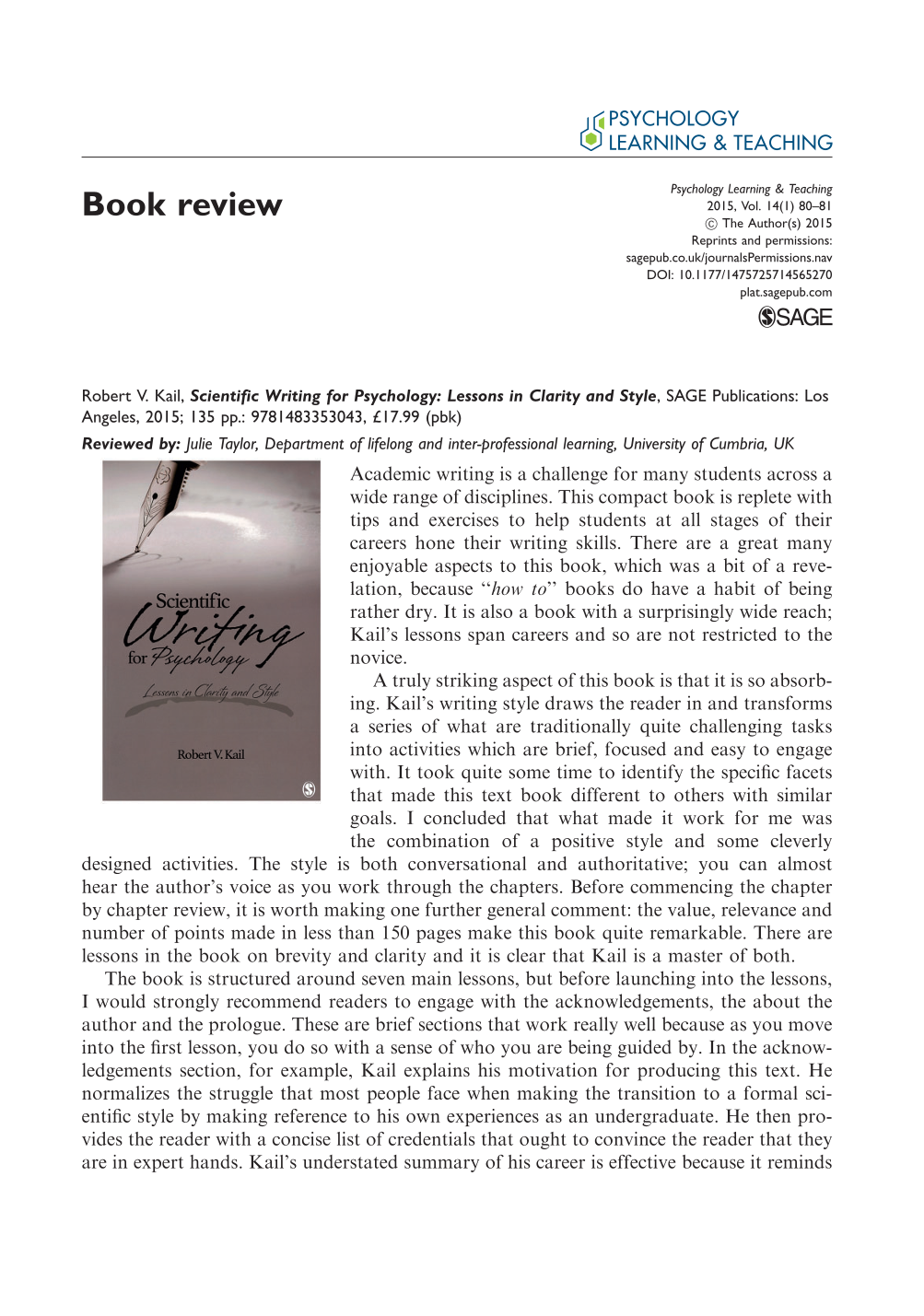
To conclude, this is a concise text that delivers a series of highly important lessons. To gain maximum benefit the student needs to engage with the exercises and participate in the additional learning opportunities identified. There is only one feature of the book that failed to impress and that was the design of the cover, which does communicate the purpose of the text but fails to convey the vibrancy and energy within.