




Abstract
Our goal was to document professional skills and attitudes gained via out-of-class teaching and research experiences during the undergraduate years. Qualitative analysis of reflection papers revealed that students noted gains in professional skills, communication skills, interpersonal skills, and intrapersonal skills. Importantly, students also noted gains in understanding content, research methods, and principles related to teaching and learning emerging from their hands-on experiences guided by role models. Students noted that their out-of-class experiences were relevant for their futures. These results may be useful for instructors and administrators seeking to design and implement out-of-class experiences for undergraduate students that facilitate the emergence and refinement of professional skills and attitudes, growth in understanding, and lifelong application of learning.
Educators and employers agree that skills such as critical thinking, communication, teamwork, leadership, and initiative are necessary for success in adulthood (Bartram, 2005; Landrum & Harrold, 2003; Purdy, Reinehr, & Swartz, 1989; see also Bain, 2004; Griffin, Neal, & Parker, 2007; Landrum, Hettich, & Wilner, 2010). Recently, researchers have focused on mechanisms by which adolescents and emerging adults learn and refine professional skills and attitudes (Larson, 2000). Emerging adulthood (i.e. 18 to 25 years) is an important time of transition marked by refinement of identity and preparation for the future (Arnett, 2000). Undergraduate curricula provide unique opportunities to help prepare emerging adults for personal and professional success, particularly through out-of-class experiences (American Psychological Association, 2011). The goal of this project was to document the specific experiences and skills associated with out-of-class teaching and research experiences in psychology during the undergraduate years using student reflections on learning.
Larson (2000) claimed that structured voluntary activities are best suited for promoting professional skills and attitudes because they offer a unique combination of intrinsic motivation and deep attention not present in classroom settings or leisure activities (see also Strapp & Farr, 2010). Moreoever, participation in structured voluntary activities often entails solving authentic problems through prolonged involvement and intense effort. When asked to reflect on their experiences, high school students and adult supervisors noted that high schoolers learn strategic thinking and responsibility through their engagement in structured voluntary activities, such as arts, service, and leadership organizations (Larson & Angus, 2011; Larson & Hansen, 2005; Wood, Larson, & Brown, 2009).
Likewise, involvement in out-of-class experiences during the college years is beneficial. For example, undergraduate students majoring in sociology benefit from a variety of informal learning opportunities, including research and internship experiences (McKinney, Medvedeva, Vacca, & Malak, 2004; McKinney, Saxe, & Cobb, 1998) and teaching assistantships (Adler, 1993; Fingerson & Culley, 2001). Similarly, undergraduate students majoring in psychology benefit from undergraduate teaching assistantships by learning course content and principles of teaching and learning, as well as by growing personally and professionally (McKeegan, 1998). Psychology undergraduate students also benefit from research collaboration (Gibson, Kahn, & Mathie, 1996; National Survey of Student Engagement (NSSE), 2010; Starke, 1985). These findings are consistent with broader theoretical and empirical ideas highlighting the importance of active engagement in authentic learning, often happening outside traditional classrooms (Jones & Draheim, 1994; Kuh, 1993, 1995; Landrum & Nelsen, 2002; Neapolitan, 1992).
Despite clear indications that out-of-class experiences should be beneficial, we know relatively little about the nature of learning in these experiences. We know even less about the comparative benefits of teaching and research opportunities at the undergraduate level. The goal of this project was to document the experiences and professional skills associated with out-of-class teaching assistantships and research apprenticeships in psychology using undergraduate student reflections.
Method
Participants
Thirty-seven undergraduate students (28 women, eight men) enrolled in out-of-class teaching and research experiences in psychology during fall 2011 and spring 2012 at a large, public university participated. Eighty-eight students were invited to participate, yielding a response rate of 42%. Four students were sophomores, 20 were juniors, and 12 were seniors. One student did not provide demographic details. Fifteen students were completing their first semester of out-of-class experience, 12 students were completing their second semester of out-of-class experience, and nine students were completing their third to fifth semester of out-of-class experience. Eighteen students were participating in undergraduate research experiences, and 18 were participating in undergraduate teaching assistantships. Research apprenticeships and undergraduate teaching assistantships were graded experiences that could be repeated for up to nine credits to fulfill elective requirements for the undergraduate major. Students completed three hours of work per week for each credit. Specific responsibilities and grading criteria varied by instructor. Students were required to have grade point averages of 2.0 or higher to enroll. Honors and independent study research options were available, as well as capstone options for research, teaching, and internship work.
Materials and procedure
Following Institutional Review Board approval, psychology instructors were contacted to determine whether they included reflection papers as part of the out-of-class experiences for which they were the instructor of record and, if so, whether they would give permission for researchers to contact their students to invite them to participate. Researchers then met with students in small groups or individually during team meetings or office hours to describe the project and secure informed consent. Students were given a packet containing a brief demographic questionnaire, a note inviting them to submit a blind copy of their reflection paper once it was finished, and a campus mail envelope for returning these materials. Reflection paper instructions were not collected as part of this project and varied by instructor.
Coding and analysis
We used qualitative analysis to analyze key themes evident in student reflection papers. This approach places individual students and their out-of-class experiences at the center of the research mission. In particular, we used grounded theory, a systematic research methodology that involves generating theory from data (Strauss & Corbin, 1998). Grounded theory is well suited to qualitative research focusing on explaining how changes occur. The first step was to mark key points evident in reflection papers using a series of codes extracted from the texts. The next step was to develop working definitions for the codes and to group the codes into similar conceptual categories, which formed the basis for theory. In the third step, the reflections were re-coded to assess the stability of the emerging themes. The authors completed this three-step qualitative coding process twice, once for the fall reflections and again adding the spring reflections to establish the stability of the themes (Strauss & Corbin, 1998). Given the coding emerged via consensus, no measure of inter-rater reliability is reported. Once coding was complete, we calculated the proportion of students who mentioned each theme to capture the pattern of findings.
Results and discussion
Percentage of undergraduate student reflections noting growth in skills as a function of out-of-class research and teaching experiences.
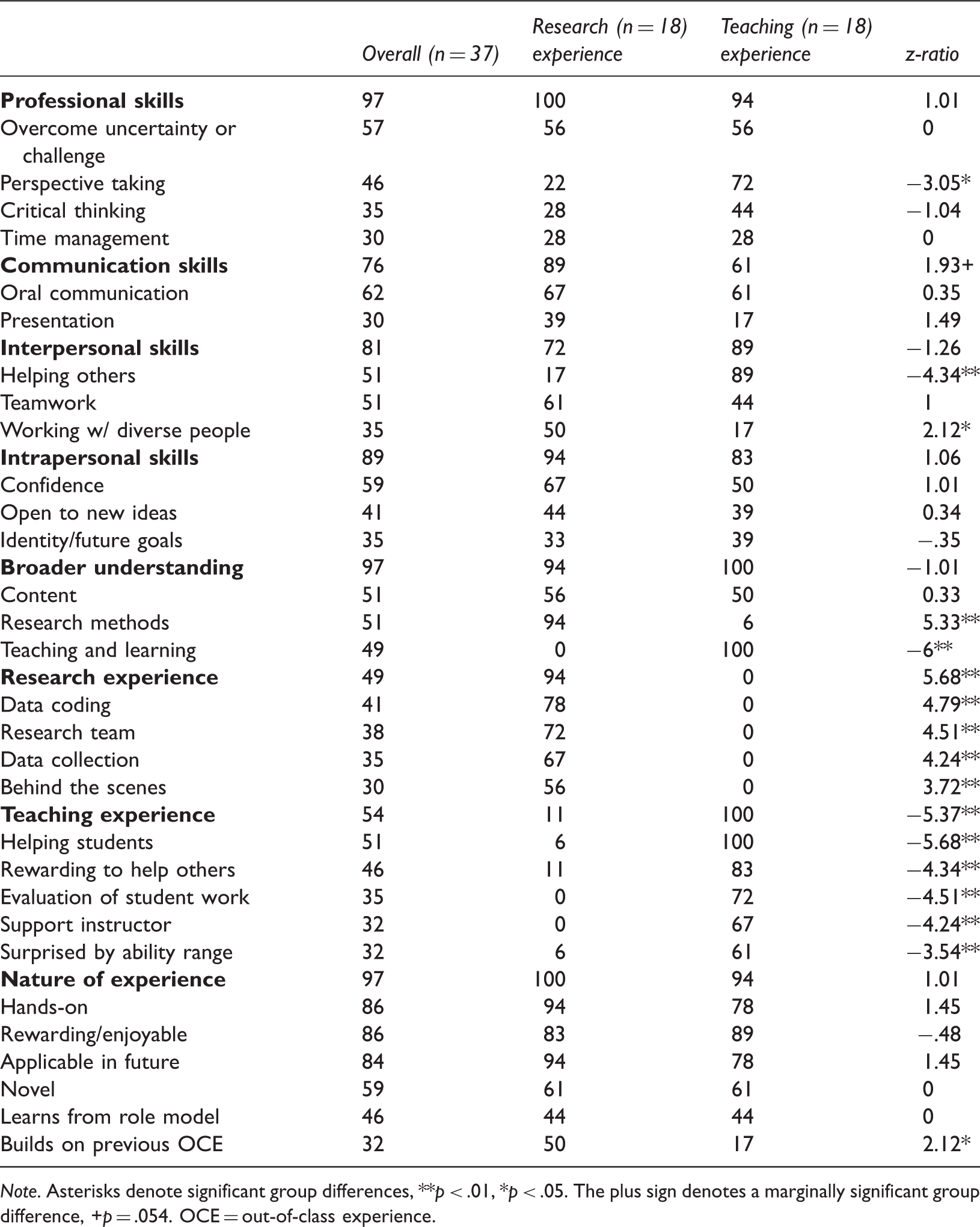
Note. Asterisks denote significant group differences, **p < .01, *p < .05. The plus sign denotes a marginally significant group difference, +p = .054. OCE = out-of-class experience.
We calculated z-ratios to test whether the difference between the proportion of students involved in research and teaching who noted gains in each experince and skill was significant (see Table 1). Overall, students involved in research were more likely to note gains related to research methods, whereas students involved in teaching assistantships were more likely to note gains in teaching and learning details, as would be expected. Otherwise, the pattern of skills reported was similar across research and teaching experiences with the notable exception that the proportion of students noting gains in communication skills and working with diverse people was significantly greater for students involved in research than for students involved in teaching. The difference in communication skills may be because many of our students involved in research make formal presentations at a department or university symposium, whereas formal presentations of teaching experiences are less common. Moreover, several of our research experiences involve children, including children with autism spectrum disorder, which may explain why students noted growth in their ability to work with a diverse variety of people in their research experiences. Conversely, the proportion of students noting gains in perspective taking and helping others was significantly greater for students involved in teaching than for students involved in research. Gains in helping skills perhaps were due to the focus on helping students learn that is evident in teaching contexts. Gains in perspective taking included students explaining how they understood more about instructor intentions and behind the scenes work, their own performance as a student in other contexts, and the (varied) performance of students in the current class by way of their work at the interface between instructors and current students. Interestingly, the proportion of students noting that their current out-of-class experience built on previous out-of-class experiences was significantly greater for students involved in research, perhaps because multiple semesters of research are more common than multiple semesters of teaching assisting (see Table 1).
Overall, the skills described by students enrolled in out-of-class experiences are consistently shown to predict success in the workplace and in life. A meta-analysis by Bartram (2005) suggested that job performance can be predicted by the development of the following skills: analyzing and interpreting (e.g. problem solving, written communication, technology skills, expertise); organizing and executing (e.g. planning); enterprising and performing (e.g. acting in accord with personal and professional goals and values); leading and deciding (e.g. leadership, initiative, responsibility); creating and conceptualizing (e.g. creative thinking, innovation, openness to new ideas); supporting and cooperating (e.g. teamwork); interacting and presenting (e.g. confidence, oral communication, professional presentation); and adapting and coping (e.g. emotional stability). Similarly, Griffin et al. (2007) noted that teamwork is central to successful work performance across settings. Interestingly, 57% of students mentioned overcoming uncertainties and challenges inherent in complex, everyday problem solving as part of their out-of-class experiences. This finding is consistent with Larson’s (2000) theoretical contention that involvement in voluntary, structured activities that center on authentic goals and outcomes is critical for supporting the intrinsic motivation and deep attention necessary to facilitate deep learning.
Importantly, 97% of students reported growth in understanding of content areas, research methods, and teaching and learning. In particular, 94% of students engaged in research experiences noted growth in understanding of research methods. Similarly, 100% of students engaged in teaching assistantships noted growth in understanding principles of teaching and learning. With regard to specific content domains, 56% of students engaged in research experiences and 50% of students engaged in teaching assistantships noted growth (see Table 1).
Students also summarized the nature of their experiences, providing preliminary details about the mechanisms by which out-of-class experiences facilitate personal and professional growth (see Table 1). In particular, students noted how participation in specific research experiences impacted their learning, including collecting and coding data, behind the scenes research work, and working with a research team. Students also noted how teaching and learning experiences impacted their learning, noting that helping students, supporting the instructor, and evaluating student work were influential experiences. They also noted specific insights about the nature of teaching and learning, including the rewarding nature of helping others learn and the surprising range of motivation and ability evident in student work. In general, students noted that their out-of-class experiences were new and rewarding. Their experiences offered hands-on tasks and opportunities to work closely with role models. They also built on experiences from previous semesters, especially in research contexts. Importantly, 84% of students noted that their experiences were applicable to future endeavors. These reflections highlight the value of out-of-class teaching and research experiences.
Our findings may be beneficial for several reasons. First, this project provided a useful reminder that opportunities for students to reflect on their interactions and learning in out-of-class experiences are beneficial experiences in themselves (Fink, 2003; NSSE, 2010). Second, our findings may help undergraduate instructors and administrators understand how out-of-class teaching and research experiences impact professional skills and attitudes, which could facilitate the design of voluntary structured experiences that students find intrinsically motivating and worthy of deep concentration (Blanton, 2001; Gibson et al., 1996; Hogan, Norcross, Cannon, & Karpiak, 2007). Finally, these findings may benefit departments, colleges and universities, and employers by highlighting the processes by which out-of-class experiences facilitate successful development (Stoloff, Curtis, Rodgers, Brewster, & McCarthy, 2012). In fact, students specifically mentioned their appreciation of out-of-class curricular options, including capstone options, as beneficial for their overall learning and development, providing support for their inclusion in the undergraduate experience. These efforts are consistent with national benchmarks of quality, which highlight research with faculty, internships, and senior culminating experiences as high-impact practices that facilitate deep learning among undergraduate students (NSSE, 2010). Interestingly, national survey data suggest that about one-third of psychology majors conduct research with faculty, more than any other major. Nonetheless, our findings suggest that increasing the opportunities available for students to conduct research and carry out other out-of-class experiences would be beneficial, as would incorporating hands-on experiences in traditional courses.
Future research is needed to further refine our understanding of out-of-class experiences and undergraduate student learning and development. First, it is important to include additional measures of student learning. For example, researchers could invite instructors who serve as mentors for out-of-class experiences to provide details that would broaden our understanding of out-of-class experiences (Larson & Walker, 2010). Moreover, developing survey instruments to assess professional skills and attitudes would be beneficial, as these instruments could be used to track changes over time. Second, it is important to sample introductory and capstone experiences across teaching, research, and internship contexts in many departments at a variety of small and large colleges and universities (Kuh, 1993, 1995). This sample was drawn from a large public university with a psychology department that includes well-defined out-of-class experiences. Although our department includes internship options, students completing internships did not choose to participate in our study. Broader sampling would further strengthen the claims. Third, it would be helpful to compare the themes evident in student reflections papers generated by students completing out-of-class experiences and those completing a variety of traditional courses to gain further insight regarding the types of experiences and deep learning evident in both cases.
In summary, our goal was to document gains in professional skills and attitudes through out-of-class teaching and research experiences during the undergraduate years using student reflections. Consistent with previous findings, students involved in out-of-class teaching and research experiences noted gains in professional skills, communication skills, interpersonal skills, and intrapersonal skills. These results may help undergraduate instructors and administrators understand how out-of-class experiences influence the emergence and refinement of the professional skills and attitudes necessary for success.
Footnotes
Funding
This research was supported by a teaching and learning development grant from the Center for Teaching, Learning, and Technology at Illinois State University.