




Abstract
In psychology, it is widely agreed that research methods, although central to the discipline, are particularly challenging to learn and teach, particularly at introductory level. This pilot study explored the potential of embedding a student-conducted research activity in a one-semester undergraduate Introduction to Psychology survey course, with the aims of (a) engaging students with the topic of research methods; (b) developing students’ comprehension and application of research methods concepts; and (c) building students’ ability to link research with theory. The research activity explored shoe ownership, examining gender differences and relationships with age, and linking to theories of gender difference and of consumer identity. The process of carrying out the research and reflecting on it created a contextualized, active learning environment in which students themselves raised many issues that research methods lectures seek to cover. Students also wrote richer assignments than standard first year mid-term essays.
Introduction
Research methods are widely acknowledged to be particularly challenging to teach and learn in psychology. Undergraduates in particular are reported to dislike and have low interest in research methods, including statistics, in many higher education settings across North America, Britain, and Europe (Ball & Pelco, 2006; Estes, Chandler, Horvath, & Backus, 2003; Holmes & Beins, 2009; Lauer, Rajecki, & Minke, 2006; Murtonen, 2005; Rajecki, Appleby, Williams, Johnson, & Jeschke, 2005; Vittengl et al., 2004; Wiggins & Burns, 2009). As Wiggins and Burns (2009) note, “research methods teaching often becomes the bane of a psychology student’s academic life. Despite their efforts and those of teaching staff, it can leave students feeling uninspired, confused or simply bored with research” (p. 29). This reflects my own experience teaching and learning in psychology: higher education students consistently appear to find research methods technical and unappealing, and often fail to link the material to other learning, showing limited application of research methods in written assignments.
This represents a challenge to teachers of psychology, as a sound grasp of research methods is required for critical engagement with psychological constructs, theories, and research. The centrality of research methods is reflected in the curricular guidelines for accreditation of higher education courses by national professional psychological associations such as the Psychological Society of Ireland (PSI), the British Psychological Society’s (BPS) Accreditation through partnership (2013), and the American Psychological Association’s (APA) recent Guidelines 2.0 for undergraduate psychology degrees (2013). These expect students to “learn basic skills and concepts in interpreting behavior, studying research, and applying research design principles to drawing conclusions about psychological phenomena” (APA, 2013, p. 15). Clearly, it is only possible to achieve such goals if students acquire well-developed research methods knowledge.
Active learning and student engagement are key themes in the learning and teaching literature. An active, discovery-focused learning approach is considered necessary for understanding and applying concepts (Carlile & Jordan, 2005); knowledge gained through activity is more useful than knowledge gained by memorization (Moran, 1997). Effective learning is more likely to take place where students talk and write about concepts, relating them to their experience and daily lives where possible (Chickering & Gamson, 1987). Student engagement is considered necessary for active learning as it increases enjoyment and fulfilment (Bryson & Hand, 2007; Case, 2008); without engagement, alienation from the group or necessary activities may result (Mann, 2001).
Recognizing the importance of active learning of research methods, the APA recommends that “hands-on experience in the research enterprise or criticising and building theory” will “promote stronger ownership of the abilities” (APA, 2013, p. 12); the PSI recommends that teaching and learning structures should ensure students have “direct experience of empirical work” at all stages of a course (PSI, nd). Typically, however, direct research experience takes place late in a psychology curriculum, in research methods courses or final year projects (McConnell & Marton, 2013). Some instructors have proposed innovative in-class research demonstrations, for example inviting students to rate words for pleasantness (Balch, 2006); rate colas in a virtual taste test (Akers & Hodge, 2006); or rate and code crimes (McConnell & Marton, 2013). However, although studies suggest that active learning of research methods in early-stage undergraduate psychology has benefits, overall there is little evidence of its application across Ireland, the UK and elsewhere (McConnell & Marton, 2013; Wiggins & Burns, 2009).
Aim
This pilot aimed to explore whether active engagement in collecting research data in the early-stage curriculum would result in student-led enquiry about research method concepts and relevant theory. A research activity was created to enhance traditional didactic research methods delivery in a one-semester introductory first year undergraduate psychology survey course, with 20 contact hours and two assessment points (mid-term and end-of-semester). This aimed to provide research in action on a topic likely to be of personal relevance to students, and to give them direct, hands-on experience of empirical research.
The pilot: Embedding an active learning research activity in the course
Time constraints on a one-semester introductory psychology course mean that any new activity needs to be simple and brief; generate meaningful topic learning; and link to other psychological topics within the series. At the same time, students require structured supports to carry out unfamiliar research activities. To meet these criteria, this activity was embedded in the course with supporting lecture content, small-group activities, whole class discussion, and a closed class Facebook group. To ensure that students participated in the activity, it formed the mid-term assessment, worth 50% of the module grade.
The activity was piloted with a small group of 14 students to explore its feasibility. The following sections outline its content and supporting course activities in more detail.
The research topic
The research activity explored shoe ownership, identifying gender differences and relationships with age, adapted from Stern (1999). I anticipated that this topic, although apparently simple, had potential to generate student engagement and rich learning opportunities for a number of reasons. (1) The topic is relevant to all: shoes are a simple item that all students own and wear daily. (2) Students typically find questions of gender and age differences engaging. (3) It is suitable for a brief in-class demonstration study as shoe ownership is non-sensitive and there is no difficulty accessing shoe-wearing respondents. (4) The research question allows demonstration of two key statistical concepts: group differences (gender) and relationship (age). Statistically significant gendered differences in shoe ownership are almost certain (Stern, 1999), whereas relationships with age are not known, again making this topic useful for demonstration. (5) The nature of the research activity had the potential to prompt students to reflect on key research issues, such as construct definitions, sampling, the data collection process, the value of descriptive statistics, inferential analysis, and reporting and discussing findings, e.g. considering generalizability. Typically, when research methods content is delivered in lecture format, even with many applied examples, early-stage students struggle to understand why these issues are meaningful. (6) Finally, this topic allows for links to psychological theories of gender differences, biological and social origins of behavior, and consumer identity (see below).
The study
Each student asked 10 male and 10 female friends or family “how many pairs of shoes do you own?” They recorded age, gender and number of shoes owned and emailed findings to me in a table. I entered the data into SPSS; explored basic descriptives (range, mean, mode, standard deviation, normal distribution, age range and distribution of the sample and its gender balance); and conducted a t-test for gender and a correlation with age. I presented findings to students in class having created bar and line charts for the descriptive statistics, and explained the concept of statistical significance for inferential analyses.
Embedded structured preparation and supports were offered through lectures and small-group activities in the weeks surrounding the research study. Two social psychology lectures were dropped from the series to facilitate presentation of students’ research results and a small-group session.
Lectures
Three lectures prepared students for concepts and theories relating to the study. Sex and gender: Myths and research in psychology was an existing lecture on the psychology of gender differences. Two excellent instructor resources for this topic are Hyde’s (2014) comprehensive overview of empirical research and evolutionary versus social theories on gender differences, and Halpern’s (2010) accessible review of two popular psychology books addressing “neuromythologies” and sex stereotypes. Self, identity and consumption adapted an existing lecture on self, identity and self-esteem to incorporate the concept of consumer identity, which hypothesizes that material goods play a greater role in identity construction and self-esteem in modern urban environments where community, family, and religion may have been eroded (Dittmar & Kapur, 2011). Quantitative and qualitative research: Basic principles and methods, a standard research methods lecture, was delivered after students had collected their data, allowing links to be made to their findings and experience.
Whole-group discussion, in-class and on Facebook
Whole-group discussion took place on the closed class Facebook page and in class about the research process, its findings, and implications. These led to multiple learning opportunities, detailed below.
A structured small-group session
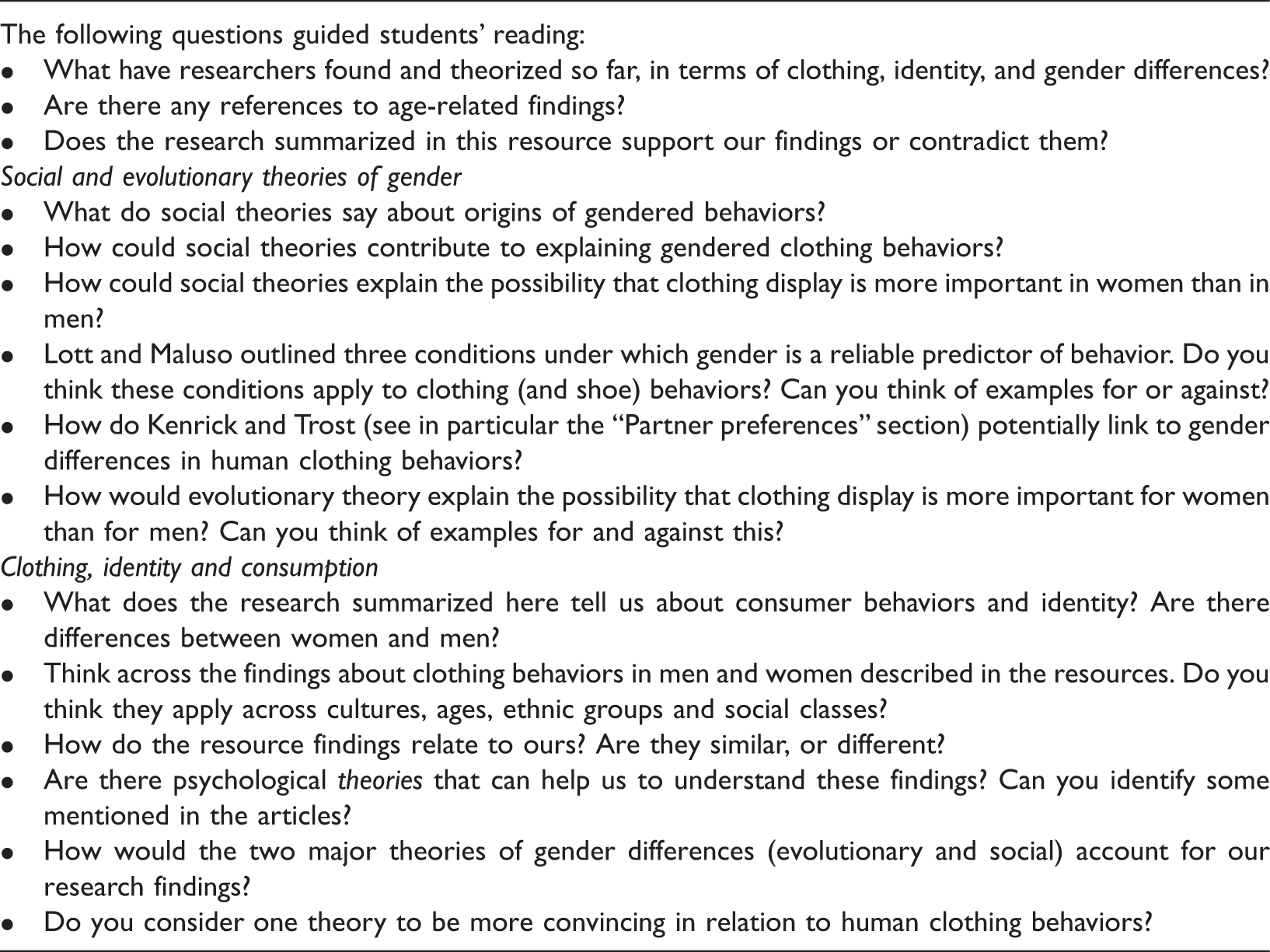
Finally, a small-group session took place in class. In groups of up to five, students discussed one of three prearranged topics. Each linked to one of the core supporting lectures described above: Topic 1, the methodological strengths, limitations, and generalizability of our research study; Topic 2, theories and research about gender differences (evolutionary and social) and how these might be applied to clothing behaviors; and Topic 3, clothing behavior, consumerism and identity research. Students reported conclusions back to the larger class, moderated by the lecturer. Students therefore needed to pay attention to reflections from other groups in order to gather all the material for their mid-term assignment. The Appendix details required and recommended readings, and guiding questions that students received for the readings.
The mid-term assessment
Students received 10% of the mid-term grade for completing data collection. I supplied them with standard Method and Results sections for our study. For the remaining 90% of their mid-term grade they were required to submit a written exercise consisting of the Introduction (500 words), Discussion (1000 words) and References. They received specific structured guidelines to support them in writing this as a psychological report.
Student responses and lecturer reflections on the pilot
This was an initial feasibility pilot of a class research demonstration, conducted with a small group of 14 students. Here, I present lecturer observations and student responses that suggest it has potential as a learning tool. These are drawn from my own teaching and learning journal reflections, and from students’ anonymized course feedback and Facebook closed-group comments. Use of student feedback received ethical exemption from the University College Dublin Human Research Ethics Committee. I first address student engagement and then summarize the research-related learning opportunities that emerged from students’ questions about the demonstration. After this, I consider benefits and limitations of the learning approaches used (e.g. small-group discussion and closed Facebook page) and reflect on students’ mid-term and end-of-semester assignments.
Student engagement
Students’ engagement with the topic appeared high. In class, they made amused, intrigued, and baffled comments when the topic of shoe ownership, consumer identity, and gender and age differences was first announced. Class discussions were lively as students shared their views on shoe ownership and its meaning: once they started collecting data they discussed the variation in their own samples and wanted to see if this would be replicated across the group. After the results were presented, one student commented:
I was happy and surprised to see where the shoe data was going. Initially, I had a hard time understanding how it was going to be applied. I'm looking forward to delving into this, seeing as there's so much more to it than what I initially thought it would be.
Research-related issues raised by students in the course of the shoe/gender study
Students’ questions in class or on Facebook raised the following research methods issues:
Construct definitions
Students experienced the need for consistent, clear construct definitions in research. In class and on the class Facebook page, they reasoned about whether boots, ski boots, flip-flops, slippers, and other forms of footwear should be included:
I wouldn’t count slippers because I don’t wear them outside the house. But I’m not sure if I should include flip-flops or not. You could wear them to places other than the pool, so does that make them count as shoes?
I’m counting it as shoes that you wear out of the house. That has seemed to work well when people have questions about what counts.
Accuracy of self-report
Students noticed that some respondents estimated the number of pairs of shoes they owned while others actually counted them. They queried the reliability of their data and this allowed for learning about self-report versus direct observation methods.
Sample size, representativeness, generalizability
There was class discussion on the source of the sample, which consisted of students’ friends and family, and was hence demographically skewed, as well as its size and age profile (n = 250; age range 11–92 years, but 60% were aged 17–19 years). This allowed for learning about sampling and the generalizability of findings.
Descriptive statistics—role of outliers
Two respondents reported owning 125 and 200 pairs of shoes respectively, which generated a great deal of interest in class, and provided a good opportunity to illustrate and discuss the effect of dependent variable outliers on measures of central tendency.
Descriptive statistics—mode, mean, and standard deviation
Charting the central tendencies of shoe ownership led to students querying the usefulness and accuracy of these measures and allowed for illustration of the meaning of the standard deviation, a concept with which students often struggle.
Analysis—group differences and correlations
With a t-test, significantly greater female shoe ownership was found; a weak positive correlation of shoe ownership and age was also found. Students initiated discussion of causation in relation to the correlation and this allowed for learning about this principle. Discussion about gender difference raised the opportunity to link to theory.
Quantitative versus qualitative research
Students observed that female respondents often wished to explain why they owned the number of shoes they did, whereas males did not. This led to discussion of the benefits and limitations of quantitative and qualitative research, and the role that qualitative research might play in exploring under-researched topics.
Linking to theory
The subject proved engaging enough to prompt students to do their own research and seek links to theory. One student asked:
In my research of typical differences in the shopping habits of men and women (possibly explaining why women tend to have more shoes than men), I came across a theory about how women were typically involved in gathering and men were typically involved in hunting meat. Is this something that I can include in my research paper, or would it be too off track?
Further benefits and limitations: Learning approaches and assignments
In addition to the research-related issues raised by students, there were further benefits as well as some limitations to this research demonstration pilot. These are considered here, including implications for extending the activity to a more typical undergraduate introductory class of 100–250 students.
Small-group discussions
These were essential to build students’ capacity to link to theory: these early-stage students needed highly structured materials and guidelines. Students expressed considerable anxiety when the assignment expectations were first discussed after the research study had been conducted, but after the small-group session they were visibly relieved. Several approached me after class to say that this had clarified how they would apply theory and previous research to our findings. Therefore, I do not recommend assessing students regarding this demonstration without having adequate in-class tutor support to facilitate small-group discussion.
A Facebook closed group
A Facebook closed group where students could post queries led to a better uptake than I have found on Blackboard with previous course offerings (without the research demonstration). However, end-of-semester informal feedback from students in class revealed that (a) they had mixed feelings about using Facebook for course-related work, as they consider it a venue for their social life and (b) they feel shy about venturing a learning-related question or view on Facebook, as it still involves committing a thought to writing. Its usefulness therefore remains to be evaluated formally in further offerings.
Mid-term assignment
In my experience, first year assignments typically demonstrate little or no consideration of methods and theory. In the mid-term assignments for this research study, all students applied relevant methodological and theoretical considerations. A typical range of ability was evident in this small group, with grades from C to A+, but all students linked our research findings clearly and meaningfully, to some degree, to some aspect of social learning versus evolutionary theories of gender differences, and to the empirical research on clothing consumption and gendered identities. In addition, all engaged to some degree with the strengths and limitations of the research study we had conducted, interpreting findings correctly, understanding the limitations of a correlation, and raising issues of self-report accuracy, sampling and generalizability; and almost all made valid suggestions for future research.
Lack of transfer of learning to later assessments
These observations suggest that this active learning approach to research methods in first year undergraduate psychology may aid understanding of research concepts and application of theory. However, a critical drawback was that there was no evidence of transfer of the level of critical analysis shown in students’ mid-term assignments to their end-of-semester essays, which were largely descriptive and quite superficial, and hence more typical of introductory student assignments. Perhaps this simply reflects the inherent challenge of research methods knowledge transfer; for example, McConnell and Marton (2011), surveying students after a research activity, found students’ lowest mean score was for an item stating that participation in the project had helped them understand course material.
In future offerings I plan to make more explicit links for students between the mid-term assignment and the critical evaluation expected of them in subsequent essays. In addition, to activate this linkage, I plan to ask students as part of their end-of-semester assignment to write a reflective paragraph about whether the research activity helped their understanding of research. This should also have the benefit of deepening teachers’ understanding of any strengths and limitations of this approach.
Final reflections
This class demonstration of a hands-on research experience in an early-stage introductory survey course employed an active learning approach, aiming to engage students with research methods content. Although a small number of reported demonstrations have aimed to do this, this demonstration was also designed to encourage early-stage students to make links to core psychological theory regarding evolutionary/social origins of behavior as well as self and identity.
The pilot met several of its goals. Students appeared more engaged than I have experienced when giving traditional lectures on research methods. Their questions generated many key learning opportunities, addressing design, sampling, data collection, analysis, generalizability of findings and differences between qualitative and quantitative research. Furthermore, students’ questions about gender differences and consumer behavior led to in-class discussion and links to empirical research and theory, which students drew on for their written assignments.
These observations, however, should be considered in light of the fact that this was a small-scale pilot with a sample of just 14 students. Carrying out the activity with a larger class would facilitate pre–post analysis of students’ attitudes to research and comprehension of concepts; ideally, a control group would be created with a parallel class, allowing for between-groups analysis. This would be particularly valuable in light of the existing but small body of research indicating that research activities in introductory courses create positive student attitudes to research (McConnell & Marton, 2013) and could allow examination of the issue of knowledge transfer. Analysis of students’ comprehension of concepts should include their understanding of theory, one of the novel goals of this research demonstration.
Footnotes
Funding
This research received no specific grant from any funding agency in the public, commercial, or not-for-profit sectors.