




Abstract
Psychological research on learning has brought forth many insights that are relevant for teachers (for example, knowledge about learning strategies). However, teachers sometimes have intuitive fragmentary knowledge that is partly incorrect. Such knowledge hinders the acquisition of psychological knowledge. Tried-and-tested interventions dealing with fragmentary knowledge remain scarce and thus a generalized categorical framework was developed to support preservice teachers to (re)organize their fragmentary prior knowledge. In the present experiment the framework group (n = 23) received this categorical framework as a pretraining intervention. The control group (n = 22) received similar factual information as a pretraining intervention but no categorical framework. Afterwards, all participants learned about cognitive and metacognitive learning strategies. While achieving approximately equal learning outcomes, the framework group needed less learning time (strong effect) and stated higher interest (medium effect). Overall, this study reveals that providing a categorical framework can help to heighten preservice teachers' interest in the learning material and save learning time.
Psychological research on learning has yielded many insights that are relevant for professionals in the area of education. Accordingly, there have recently been several projects attempting to convey such psychological knowledge (e.g., Benassi, Overson, & Hakala, 2014; Dunlosky, Rawson, Marsh, Nathan, & Willingham, 2013). However, in some cases the type of prior knowledge that educational professionals such as teachers have might prevent the “smooth” acquisition of psychological knowledge (e.g., Ambrose & Lovett, 2014; Kowalski & Taylor, 2009). Addressing such difficulties in acquiring psychological knowledge is extremely important, because knowledge in the area of educational psychology is highly relevant for teachers (Patrick, Anderman, Bruening, & Duffin, 2011; Woolfolk Hoy, 2000).
Such incorrect knowledge is increasingly conceptualized within a knowledge-in-pieces framework (diSessa, 1993)—in the following, we will refer to this type of knowledge as fragmentary knowledge. Knowledge in pieces is somewhat fragmented, incoherent over different contexts, and partly incompatible with scientific concepts. These unorganized pieces of knowledge can lead to conceptual cognitive disorientation and thus cognitive overload when learners are confronted with new information. There is currently an almost total lack of tried-and-tested intervention approaches to address the issue of fragmentary knowledge. We therefore designed a pretraining intervention which provided a generalized, cognitive framework to help preservice teachers (re)organize their fragmentary prior knowledge and thus reduce unnecessary cognitive load during later learning (see also Kalyuga & Hanham, 2011; Kalyuga, Renkl, & Paas, 2010).
Novices’ knowledge conceptualized as fragmentary knowledge
Structural representations of knowledge differ between novices and experts. Unlike experts, novices do not possess a well-organized, correct and deep representation of the topic (e.g., Chi, 2011). Novices tend to focus on obvious information (e.g., a system's components) rather than on underlying functions, and they are apt to miss connectedness within knowledge systems (Hmelo-Silver & Green Pfeffer, 2004). According to the knowledge-in-pieces framework, novices' intuitive knowledge (e.g., about certain concepts) is largely unstructured, fragmented and not embedded in a theory. Furthermore, fragmentary knowledge often differs from normative knowledge (e.g., diSessa, 1993; Wagner, 2006). Pieces of knowledge are regarded as mental resources that learners generate in direct experiences as an individual heuristic to interpret an observed phenomenon (e.g., more effort leads to greater success). These pieces of knowledge serve as mental resources that learners activate unconsciously to interpret similar phenomena. Pieces of knowledge are embedded in a recognition system and therefore activated in a context-sensitive manner. Pieces can coexist because their activation is context-sensitive and because learners are unaware of contradictions when pieces of knowledge are activated in different contexts (Ashe & Bibi, 2011). Which pieces are activated depends on cues in a specific context (cuing priority, diSessa, 1993). Since they stay isolated as minimal elements of cognition, they do not constitute a knowledge system or framework (diSessa, 2002).
Prior knowledge is usually considered very helpful in learning. However, prior partly inaccurate knowledge can have the opposite effect: When learners have unorganized prior knowledge and are then confronted with new (perhaps even contradictory) information, they may struggle to integrate this information in their prior knowledge. We will refer to this struggle as conceptual cognitive disorientation. Resolving the disorientation requires cognitive resources in order to eventually construct new knowledge. Fragmentary prior knowledge thus hampers the effectiveness of later instruction, slows down learning and can even lead to a failure to learn in case of cognitive overload.
Inaccurate fragmentary knowledge can be highly resistant to change because it is often highly functional and plausible in everyday life (Sinatra, Brem, & Evans, 2008). Thus should fragmentary intuitive knowledge be incompatible with scientific knowledge, conventional teaching strategies are often insufficient to correct learners' concepts. Instead, instructions are needed that support conceptual change. According to the knowledge-in-pieces framework, conceptual change is a process in which loosely composed fragmentary knowledge (isolated mental structures) becomes continuously organized, further strengthened or weakened, sophisticated, and more normative (Özdemir & Clark, 2007).
According to the knowledge-in-pieces framework, constructing scientific out of intuitive knowledge (conceptual change) requires two main processes: displacement and incorporation (diSessa & Wagner, 2005; Ozdemir, 2013). Displacement processes become necessary when pieces of knowledge are encoded inappropriately in specific contexts. In this case, the inappropriate pieces of knowledge need not be abolished or replaced. Instead, they provide productive mental resources for specific contexts, can be displaced and then incorporated into a new concept (Ozdemir, 2013). Incorporation refers to a process by which pieces of prior conceptualization are subsumed under a new concept. That is, pieces activated within another concept become integrated within the new one. For example, when the knowledge piece “initiating group work” is encoded within the context of the concept “learning strategies,” the piece should become displaced in the context learning strategies and instead incorporated in the concept of “teaching strategies.”
Researchers seem to agree that learners with fragmentary prior knowledge need support in constructing more coherent understanding (Orrill & Eriksen Brown, 2012). However, despite the more general ideas on knowledge change described above, there are very few tried-and-tested instructional approaches for this purpose. Such approaches, however, are essential in several domains such as teacher education.
Teachers’ prior educational fragmentary knowledge hinders the acquisition of knowledge about how students learn
There is ample evidence that larger parts of teachers' educational-psychology knowledge is structured as fragmentary knowledge (Ashe & Bibi, 2011; Hopper, Sanford, & Bonsor-Kurki, 2012; Kali, Goodyear, & Markauskaite, 2011; Orrill & Eriksen Brown, 2012). This is hardly surprising, considering that teachers' educational-psychology knowledge is shaped by their long personal experience of learning and being taught. Based on this experience, teachers generate pieces of knowledge as heuristics to make sense of pedagogical phenomena (Kali et al., 2011). Prior educational-psychology fragmentary knowledge can hinder (preservice) teachers from acquiring educational-psychological knowledge. Teachers, however, require knowledge about how learners learn, which includes knowledge about cognitive and metacognitive learning strategies, in order to teach their students effectively (National Academy of Education, 2005). Thus fragmentary knowledge can be regarded as a general problem for teachers' education and it is therefore important to develop an intervention to handle fragmentary knowledge in order to improve teachers' knowledge about educational psychology effectively.
The importance of scientifically correct knowledge
We address below the importance of scientifically correct knowledge using the example of knowledge about learning strategies. Learning strategies are categorized as cognitive strategies (rehearsal, elaboration, and organization), metacognitive strategies (planning, monitoring, and regulation related to learning strategies), and resource management strategies (time management, study environment management, effort management, support of others) (McKeachie, Pintrich, Lin, & Smith, 1986; Weinstein & Mayer, 1968). Only the former categories (cognitive and metacognitive strategies) initiate deep processing in learning and are therefore especially important. In the following, when speaking of “learning strategies,” we mean only cognitive and metacognitive strategies. An ideal scientific definition of learning strategies would include the following three aspects: A learning strategy is (a) a cognitive process that is (b) learner-initiated and (c) serves to construct knowledge (Weinstein & Mayer, 1968).
Teachers need profound knowledge about learning strategies in order to teach them (see Dignath, Buettner, & Langfeldt, 2008) and to assess learning processes formatively (Glogger, Schwonke, Holzäpfel, Nückles, & Renkl, 2012; Jonassen, 2000; Robertson, 1990). In particular, if teachers lack scientific knowledge about learning strategies, they rarely apply them in their classroom routine, and they may even foster sub-optimal learning activities while considering them (erroneously) as effective learning strategies. Findings from a meta-analysis revealed that the effect sizes of strategy interventions were significantly higher when researchers directed the training intervention rather than the regular teachers (Dignath et al., 2008). This result is counter-intuitive, because researchers typically lack profound teaching expertise and extensive knowledge about the particular class they are teaching. The teachers, in contrast, should know how to teach their own students. Dignath et al. (2008) maintained that the teachers might in fact be less effective than researchers because of their lack of knowledge about self-regulated learning and, more specifically, about learning strategies. A likely reason why teachers are prevented from teaching learning strategies effectively is that their knowledge about them deviates from the scientific concept (Clift, Ghatala, Naus, & Poole, 1990; Hamman, 1998; Hamman, Berthelot, Saia, & Crowley, 2000).
The preceding assumption is supported by studies showing that neither novices nor experienced teachers have well-defined, scientific concepts about learning strategies: rather, that their concepts are somewhat intuitive, fuzzy, and partly incorrect fragmentary knowledge (Clift et al., 1990; Dignath et al., 2008; Glogger, Holzäpfel, Schwonke, Nückles, & Renkl, 2009; Hamman, 1998). For example, teachers considered implementing group work to be a learning strategy, whereas it is a teaching strategy (for more detailed analysis of preservice teachers' incorrect knowledge, see the section “pretraining intervention”). To foster students' learning strategies effectively, teachers need to be familiar with at least one well-established learning-strategy taxonomy (e.g., the classical taxonomy by Weinstein & Mayer, 1986: rehearsal, elaboration, organization, and metacognition). However (and this is typical of fragmentary prior knowledge), a “traditional” learning module in a computer-based learning environment (Glogger, Holzäpfel, Kappich, Schwonke, Nückles, & Renkl, 2013) did not suffice to change (preservice) teachers' intuitive knowledge about learning strategies into scientific concepts. In the present study we therefore developed an instructional approach explicitly addressing preservice teachers' fragmentary intuitive knowledge.
The present study and hypotheses
In this study we designed an intervention intended to support (preservice) teachers in reorganizing and (re)interconnecting their concepts about learning strategies and related sub-strategies. More specifically, we provided learners with a generalized categorical scheme (Kalyuga et al., 2010) in a pretraining intervention which they could use as a structuring cognitive framework for their respective fragmentary knowledge. This framework could help learners (re)organize their prior knowledge and thereby reduce intrinsic cognitive load during subsequent learning (see also Kalyuga et al., 2010). Intrinsic cognitive load is reduced by the single information chunks clustered into appropriate categories of the scheme as provided in the pretraining intervention.
Our intention was to support preservice teachers' incorporation and displacement processes. Preservice teachers should incorporate knowledge that was not encoded in the learning-strategies context, but which should be (e.g., “finding an analogy”), and they should displace pieces of knowledge that were encoded inappropriately in the context of learning strategies (e.g., “implementing group work”). Furthermore, we suggested the alternative category in which the displaced pieces could be incorporated (e.g., implementing group work is a teaching strategy). In this way, (preservice) teachers should learn to decide which pieces of knowledge they need to displace to other, better-fitting categories.
We therefore designed a pretraining intervention in which we trained preservice teachers in the distinction between learning strategies and other strategies they would otherwise easily confuse with the former. We expected that after this pretraining intervention the learners would be better able to integrate new information about learning strategies. Furthermore, such well-structured knowledge should enable (future) teachers to apply their knowledge to the analysis of students' learning processes. We therefore formulated the hypotheses that the pretraining intervention would increase learning outcomes on learning strategies (Quantity Hypothesis) and lead to deeper understanding, better-organized knowledge structures and, consequently, to better explanations of learning strategies (Quality Hypothesis).
In addition we expected that learners in the framework group would perceive less cognitive disorientation and therefore less cognitive load due to the support they had received in reorganizing prior knowledge. Reduced cognitive load frees limited cognitive capacity, most likely resulting in better performance and/or reduced learning time (Clark, Nguyen, & Sweller, 2006). In cognitive load research, this relation between performance and learning time is referred to as efficiency in learning (Clark, Nguyen, & Sweller, 2006). Besides effects on performance we therefore expected that the pretraining intervention would make learning more efficient in terms of reduced cognitive disorientation, which would lead to reduced learning times (Efficiency Hypothesis).
Gaining more coherent knowledge could also help heighten the (preservice) teachers' interest in learning strategies. “Interest” describes the interaction between a person and an object (Boekaerts & Boscolo, 2002; Krapp, 2002; Schiefele, Krapp, Wild, & Winteler, 1992). When learners who had only fragmented bits of prior knowledge become more familiar with the domain and thus their knowledge becomes broader, deeper and more coherent, their topic-specific interest should increase (Alexander, Kulikowich, & Schulze, 1994). The interconnected ideas become valuable mental resources (Hidi, 1990). Renninger (2000) argues that a precondition for interest is sufficient knowledge to organize new information. Thus we anticipated that such a pretraining intervention would exert a positive influence on interest (Interest Hypothesis). Interest also fosters conceptual change (Kang, Scharmann, Kang, & Noh, 2010; Linnenbrink & Pintrich, 2009; Mason, Gava, & Boldrin, 2008) also having motivational and cognitive aspects (hot conceptual change, Pintrich, Marx, & Boyle, 1993; see the reviews by Hofer & Pintrich, 1997 and Sinatra, 2010).
Method
Ethics Statement
We conducted this study in accordance with the ethical guidelines (2004, CIII) of the German Psychological Society (DGPs) as well as APA ethical standards. According to the German Psychological Society's ethical commission, approval from an institutional research board need only be obtained if funding is subject to ethical approval by an Institutional Review Board. This research was reviewed and approved by the Ministry of Science, Research and Arts of Baden-Württemberg, Germany [grant number 7532.3/130], which did not require any Institutional Review Board approval. The Ministry of Science, Research and Arts of Baden-Württemberg, Germany approved the research procedures of the present study. The participants volunteered and received €15 as well as a learning environment for participation. All of them were aware of taking part in research. We read them a standardized explanation about ethical guidelines and the participants provided verbal informed consent. Participants who did not want to provide the verbal informed consent could immediately quit the experiment and still receive payment. All participants provided written informed consent allowing us to use their data anonymously. All data were collected and analyzed anonymously.
Participants and Design
Forty-five mathematics and physics preservice teachers (28 female, Mage = 22.73 years; SD = 4.20) participated in this experiment. Thirty preservice teachers were studying mathematics, three physics, and 12 both. Their average high school GPA was 2.16 (SD = 0.50) (6-point scale from 1: excellent, to 6: inadequate). None of them had previously attended courses on learning strategies or their diagnosis.
The preservice teachers were randomly assigned to either the framework condition (n = 23; receiving a generalized categorical scheme as part of pretraining) or the control condition (n = 22; undergoing pretraining without a categorical framework). Dependent variables referred to students' learning outcomes as measured by the number of correctly identified learning strategies (quantity) and the quality of corresponding explanations (quality). To observe effects on efficiency in learning, we assessed the learning time required to complete the learning environment. We also measured topic-specific interest in learning strategies.
Procedure
Data collection took place in a university computer room: the entire procedure was computer-based. A supervisor assessed groups ranging from four to 20 participants from both conditions simultaneously. First, we measured the participants' prior knowledge about learning strategies according to the pretest, as well as their self-rated prior knowledge. Next, they underwent the condition-specific pretraining intervention (M = 3.43 min; SD = 0.83). Subsequently they worked with the computer-based learning environment (M = 19.96 min, SD = 1.92). We then assessed preservice teachers' topic-specific interest and gave them the post-test to assess learning outcomes. In order to measure different learning times, the time to do this task was not limited. Instead, we encouraged the preservice teachers take their time. On average, participants needed 64.65 minutes (SD = 10.76) to complete the experiment.
Materials
Pretest
A pretest on prior knowledge consisted of a self-assessment measure (from 0 %: very low; to 100 %: very high) and a direct measure of prior knowledge. The latter included the following four open-ended questions: “What are important learning strategies in your subjects?,” “How can teachers diagnose their students' learning strategies?,” “Which function do learning journals have for students and for teachers?,” and “What are the main differences between (meta) cognitive and resource management strategies?” We used a scheme to code the open-ended questions (e.g., learning strategies were scored if they were consistent with the taxonomy of, for example, Weinstein & Mayer, 1986, or related models). We awarded one point for each correctly mentioned learning strategy. Suggestions for diagnosing learning strategies were accepted provided they were comparable with established assessment methods such as those of Winne and Perry (2000). Two independent raters scored the preservice teachers' answers to the four open-ended questions (not adjusted ICC = 0.95).
Pretraining intervention
To conceptualize the pretraining intervention, we first needed to identify activity categories that (preservice) teachers often confuse with learning strategies. Therefore we reanalyzed pretest data from previous studies (Glogger, Kappich, Schwonke, Holzäpfel, Nückles, & Renkl, 2011; Glogger et al., 2012) originally used to control for differences in prior knowledge. Furthermore, we considered findings from studies in the USA (Clift et al., 1990; Hamman, 1998) that analyzed teachers' knowledge about learning strategies. On this basis we identified four key categories which (preservice) teachers often confound with (meta) cognitive learning strategies, namely resource management strategies (e.g., creating a timetable), problem-solving strategies (e.g., writing out what has been provided and is needed to solve a task), using tools (e.g., using index cards), and teacher-directed strategies (e.g., group work). These categories share some features of learning strategies, but they do not fulfil all the prerequisites of a learning strategy (i.e., being cognitive processes, learner-initiated, and serving to construct knowledge).
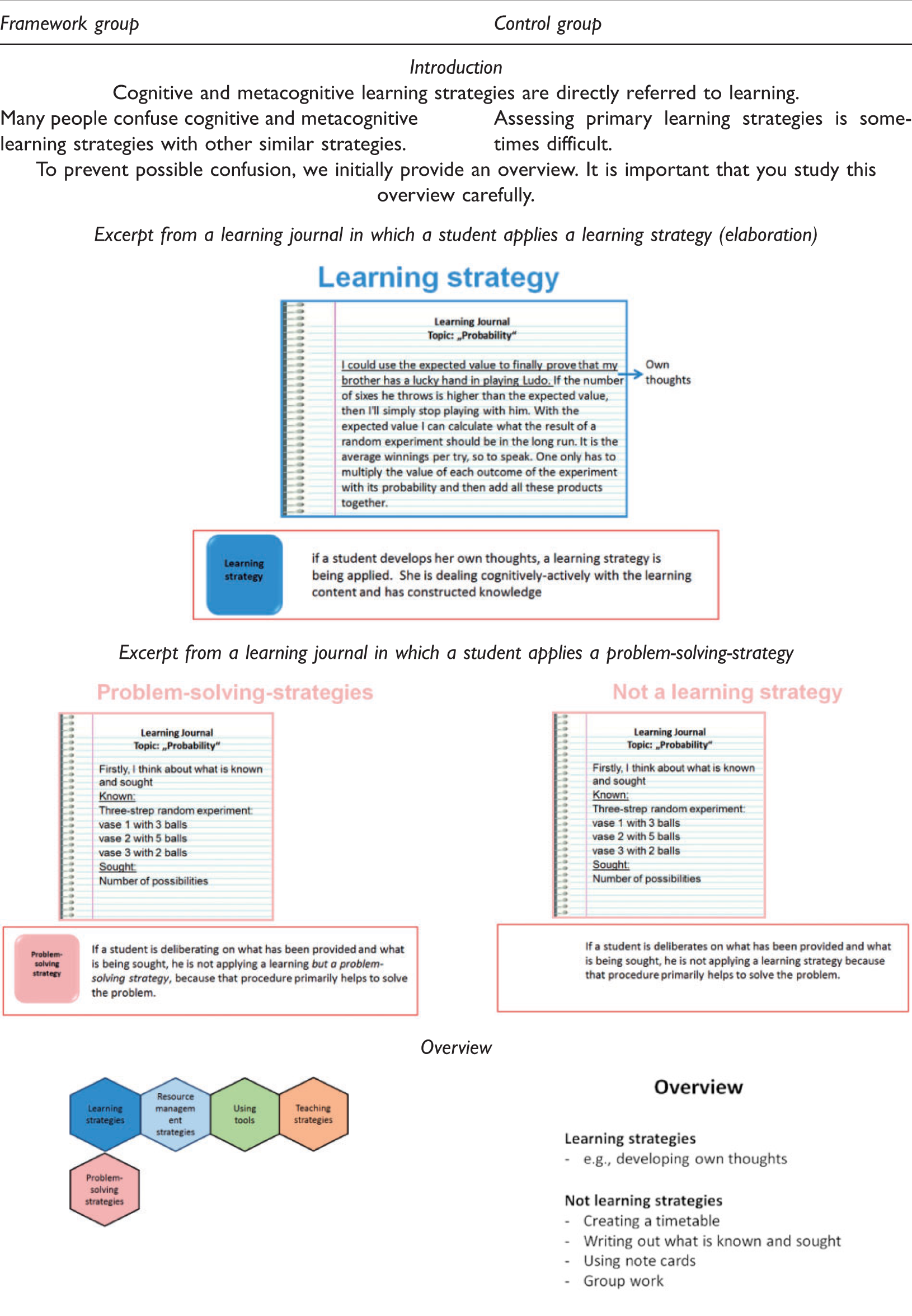
Overview of the Group-Specific Differences in the Pretraining Interventions.
Pretraining in the framework condition
During the pretraining intervention, we instructed the preservice teachers in the distinction between learning strategies and other strategies that can easily be confused with them. The preservice teachers received a generalized categorical scheme providing them with an idea of how to distinguish learning strategies from the four similar categories. They could use this framework to reorganize their fragmentary knowledge and to make the concept's learning-strategy boundaries more salient for themselves. Furthermore, they could incorporate inappropriate pieces of knowledge into better-fitting categories (displacement).
We presented categorical contrasts by using refutational text elements to encourage the preservice teachers to compare their prior intuitive knowledge with the information provided (Skopeliti & Vosniadou, 2008). The refutational statements should make the concept of learning strategies and its difference to similar ones more obvious (Chi, 1992). Refutational texts help learners to compare their prior intuitive knowledge with the given (scientific) information. Such texts can thus elicit conceptual change of intuitive concepts (e.g., Tippett, 2010). The appropriate type of refutational text is crucial (e.g., Sinatra & Broughton, 2011). Skopeliti and Vosniadou (2006; 2007) found that categorical types of refutational texts are especially effective in prompting conceptual change as compared to noncategorical text. A reason for this finding could be that categorical information addresses the presuppositions and implicit beliefs that learners apply spontaneously to a category (Skopeliti & Vosniadou, 2007).
We used a categorical type of refutational texts to present deviant intuitive ideas of learning strategies (inappropriate piece of knowledge), then refused them and suggested other, better-fitting categories. First, we explained that learning strategies are often confused with four categories (e.g., “Learning strategies can be confused with problem-solving strategies.”) in order to present deviant intuitive ideas of learning strategies (inappropriate pieces of knowledge). These were then rejected. We provided a corresponding example of each easily confused category and then explained why that example would not fit into the concept of learning strategies and suggested other, better-fitting categories (e.g., “If a student deliberates on what has been provided and what is being sought, he is not applying a learning strategy but a problem-solving strategy because that procedure primarily helps to solve the problem”). We made the different categories readily apparent by using bold print and colors. An overview of the different categories concluded the pretraining intervention for the framework group (Table 1).
Pretraining in the control condition
Preservice teachers in the control group received a pretraining intervention providing the same factual information but no framework characterized by “confusing” categories (e.g., “If a student deliberates on what has been provided and what is being sought, he is not applying a learning strategy because that procedure primarily helps to solve the problem.”). Hence, apart from the framework, the following elements were kept constant across conditions: factual information, structure, colors, and the amount of presented pages in the pretraining interventions (Table 1). The amount of text was similar (framework group: 593 words; control group: 601 words).
Learning environment of learning strategies
After the pretraining intervention, the preservice teachers learned in a computer-based learning environment (Glogger et al., 2013) how to classify learning strategies into organization, elaboration, and metacognition (Weinstein & Mayer, 1986) as well as how to diagnose them. We did not limit the learning time so as to be able to test the Efficiency Hypothesis.
Interest
We measured topic interest by using six items (Magner, Schwonke, Aleven, Popescu, & Renkl, 2014; Schiefele, 1990) on a 6-point Likert scale (from 1: not true at all; to 6: absolutely true, Cronbach's α = 0.66). As interest has a value-related component and a feeling-related component (e.g., Schiefele, 1990, 2009), three items referred to each component (e.g., emotion-related: “Learning about learning strategies was entertaining”; value-related: “Learning about learning strategies is important.”).
Post-test
The post-test consisted of two parts: an identification test and a speed test. The post-test items referred to the learning environment. In the identification test, preservice teachers had to identify learning strategies in excerpts from learning journals and explain their decisions. In the speed test, preservice teachers had to decide quickly whether or not a presented strategy should be classified as a learning strategy (e.g., generating one's own example (learning strategy) or using a calculator (no learning strategy)). All of the items could be classified into the categories used during the pretraining intervention. We took the number of correctly identified learning strategies in both parts as a measure for the quantity of learning (Cronbach's α = 0.84).
We used a coding scheme to analyze answers to open-ended post-test items in the identification test. One point was earned if the teachers mentioned learning strategies related to the main categories (i.e., rehearsal, organization, elaboration or metacognition) as well as to the subcategories provided in the learning environment. Two independent evaluators scored 20% of the post-test answers (not adjusted ICC = 0.97). In addition, we measured the quality of reasoning. We scored the answers referring to the SOLO-taxonomy according to the three criteria: capacity, consistency and closure (Biggs & Collis, 1982). These criteria were applied to determine an overall score (see Hübner, Nückles, & Renkl, 2010). More specifically, each answer was assigned to one of four levels ranging from 0 points (no central points, no relation to the learning environment, incoherent, e.g., “the colors used are appealing”) to 3 points (all central points, high relation to the learning environment, very coherent, e.g., “the student used an organizational strategy. Having used color-coding, she visualizes connections clearly. This attracts attention to the relevant facts”). Two independent raters scored 20% of the post-test answers (not adjusted ICC = 0.88).
Results
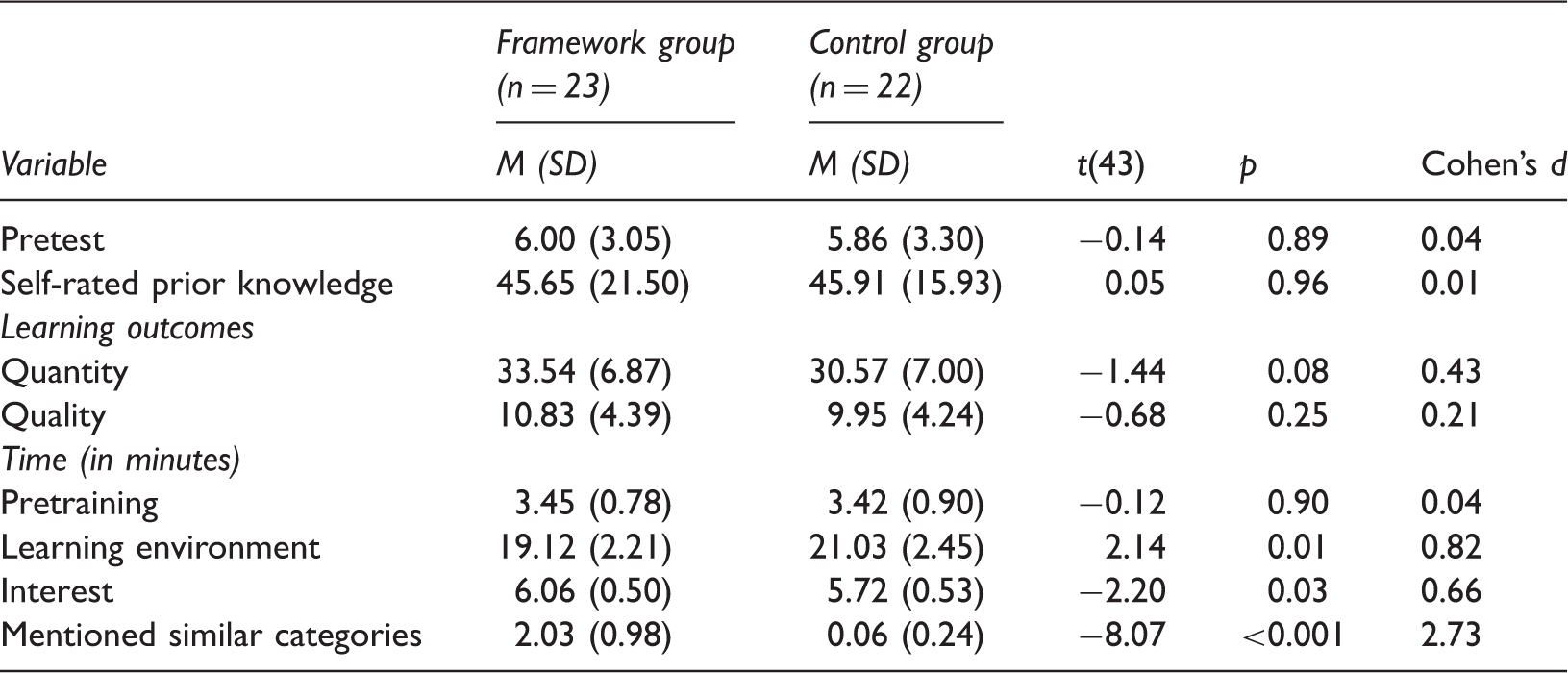
Means (and Standard Deviations), t Values, p Values, and Cohen's d of the Main Variables.
Preanalyses
There was no significant group difference in prior knowledge. Generally speaking, both groups displayed very low prior knowledge (M = 5.93, SD = 0.47). Self-rated prior knowledge was 45.78 (SD = 18.77, the maximum rateable value was 100).
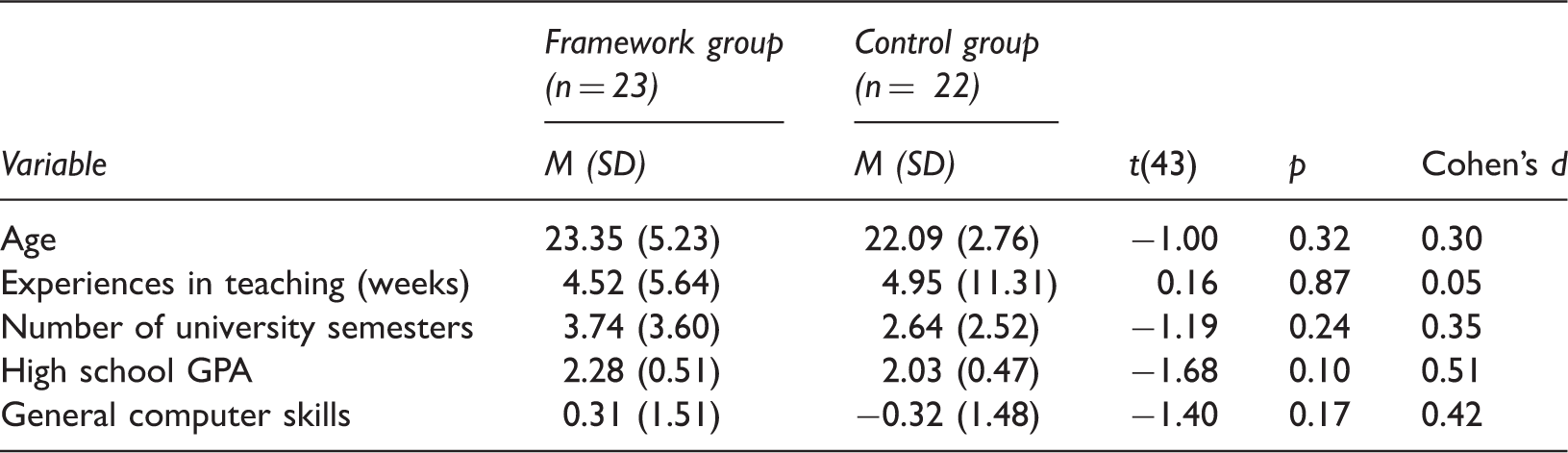
Means (and Standard Deviations), t Values, p Values, and Cohen's d of Demographic Variables.
Working time on the pretraining intervention was unlimited. Both groups took about the same time, namely generally very little (framework group: M = 3.45 min, SD = 0.78 min; control group: M = 3.42 min, SD = 0.90 min). (The framework group worked 1.5 seconds longer on the pretraining intervention). This difference, which amounted to less than 1% of the working time, did not reach the level of statistical significance, t(43) = –0.12, p = 0.90, Cohen's d = 0.04.
At the end of the experiment we asked the participants to name the categories of strategies that are often mixed up with learning strategies. This measure of the processing depth of the pretraining contents in the framework group was a sort of manipulation check. The framework group significantly outperformed the control group in this task, t(19) = –8.28, p < 0.001, Cohen's d = 8.52.
One participant was an outlier with respect to learning time in the learning environment (value ≥ 2.5 SD; Hair, Black, Babin, Anderson, & Tatham, 2010). We changed that score to one unit above the next highest score in the dataset (Field, 2009).
Hypotheses testing
In order to test our hypothesis on pretraining intervention effects, we conducted t tests (one-tailed). We measured the quantity of learning by using a combined measure of identified learning strategies in the identification test and the speed-test task. There were no statistically significant group differences in the learning outcomes (quantity of learning, t(43) = –1.44, p = 0.08, Cohen's d = 0.42; quality of learning outcomes, t(43) = –0.68, p = 0.25, Cohen's d = 0.21). Hence, our Quantity and the Quality Hypotheses was not confirmed. However, the framework group needed significantly less time to complete the learning environment, t(36.76) = 2.14, p = 0.01, Cohen's d = 0.82 (strong effect). Our Efficiency Hypothesis was thus confirmed.
Overall, the preservice teachers' interest in learning strategies in both groups was relatively high after working with the learning environment (M = 5.89, SD = 0.54, range = 5–7; scale from 1 = low to 7 = high). Nevertheless, the participants in the framework condition showed significantly more interest after working with the learning environment, t(43) = −2.20, p = 0.03, Cohen's d = 0.66 (Table 1). Our Interest Hypothesis was thus confirmed. Further post-hoc analysis on the interest measures revealed a significant difference in the value-related component (Cronbach's α = 0.65), t(35.1) = –2.34, p = 0.02, Cohen's d = 0.72. Because the subscale of the feeling-related component was unreliable (Cronbach's α = -0.03), we did not consider this component separately.
Discussion
We investigated whether providing learners with intuitive fragmentary knowledge with a categorical framework encourages them to learn more, more efficiently, and with greater interest from a subsequent learning environment. Our findings can be summarized as follows.
The pretraining intervention did not influence preservice teachers' learning outcomes in terms of quantity or quality (Quality and Quantity Hypotheses). However, the categorical pretraining intervention reduced learning time significantly and, therefore, seems to be a promising approach to encourage learners to learn more efficiently (Efficiency Hypothesis, large effect). Furthermore, the pretraining intervention raised interest in the learning topic (Interest Hypothesis, medium effect).
In training concepts, there is a substantial demand for accelerating the speed and quality of learning processes (Clark, Nguyen, & Sweller, 2006). Efficient learning is especially crucial in teacher education because it is so extensive and time-consuming. In covering all the relevant fields of knowledge, often little time remains to apply and practice them (Bransford, Goldman, & Vye, 1991). However, if knowledge is not strengthened and deepened, it can result in inert knowledge. Such inert knowledge is neither applicable nor flexibly transferable (Renkl, Gruber, & Mandl, 1996) and it thus fails to contribute to pedagogical competencies. Educational training programmes should therefore be conceptualized so that they help learners attain learning goals with minimal effort (e.g., time or cognitive resources) so that they can achieve the best learning outcome in the time they have to study (Chew, 2014). More efficient learning provides temporal resources for practising knowledge and making it applicable. A pretraining intervention that leads to more efficient learning could therefore be a means of providing more opportunities to practise and deepen learning contents.
Our findings on interest are important, as well. Greater interest provides favourable (although not sufficient) conditions for conceptual change (Kang et al., 2010). Interest can thereby enhance the transition from intuitive to scientifically based knowledge. Moreover, interest in the to-be-learned topic can foster transfer (Pugh & Bergin, 2006) and thus increase the probability that learners will apply their knowledge about learning strategies and their assessment in classrooms.
Our findings on efficiency are in line with our assumption of how the pretraining intervention worked. We anticipated that our pretraining intervention would make preservice teachers aware of their pieces of knowledge about learning strategies. We provided them with a scheme of how to structure their intuitive knowledge. This scheme should help them distinguish and then displace deviant from scientific knowledge and, therefore, help construct a generalized, cognitive framework. This framework could have enabled them to more easily integrate new information into their restructured knowledge system and, consequently, to reduce cognitive disorientation. Hence we expected that learning time would be reduced.
Our approach may recall certain aspects of research on advance organizers (Ausubel, 1960; Gurlitt, Dummel, Schuster, & Nückles, 2012). On the one hand, advance organizers are very similar to our approach. Learners receive information on a higher level of abstraction, which should support them in organizing their knowledge. On the other hand, both approaches differ in three ways.
First, traditional (“expository”) advance organizers (Ausubel & Fitzgerald, 1961) activate prior knowledge in order to support learners in relating subsequent new information to an existing cognitive structure (Ausubel, 1960). Thus an advance organizer is supportive if learners have not already developed their own abstract concepts, so that they can build a bridge from their prior knowledge to the unfamiliar learning content (Ausubel, 1968; Corkill, 1992; Mayer, 1979). In our approach, however, the pretraining intervention helps learners restructure their prior knowledge and it is thus supportive when learners possess intuitive prior knowledge that is partly incompatible with the scientific view.
Second, a traditional advance organizer provides a subsuming or generalized scheme directly related to the contents to be learned. However, the scheme in our pretraining intervention not only addresses information on a more generalized level but also provides information about contrasting concepts (hierarchical and lateral ones—somewhat similar to comparative advance organizers; e.g., Ausubel & Fitzgerald, 1961).
Third, our pretraining intervention included categorical refutational elements which are usually not part of advance organizers.
However, if one defines advance organizers more broadly—that is, as a “(…) vehicle for suggesting an appropriate scheme for a reader to access (…)” (Corkill, 1992, p. 40; Gurlitt et al., 2012)—our refutational text elements can be taken as a kind of advance organizer (Sinatra & Broughton, 2011). Referring to this general definition, our effects can be interpreted as advance organizer effects.
The framework we created did not provide detailed information about learning strategies – it only helped the framework group to distinguish learning strategies and other learning or teaching activities. Both groups received the same factual information. The main difference between groups was that the framework group received information about which categories of learning or teaching activities are not learning strategies, (e.g., problem-solving strategies). Hence the framework group acquired knowledge about what learning strategies are not. This kind of knowledge is also called negative knowledge (e.g., Gartmeier, Bauer, Gruber, & Heid, 2008).
Limitations and alternative explanations
Why did our pretraining intervention not influence preservice teachers' learning outcomes positively? We assume that the preservice teachers participating in this experiment were not especially motivated in studying the pretraining intervention carefully and working on the post-test. Despite the reported high interest in the topic of learning strategies, there is evidence that our preservice teachers did not process the pretraining intervention's content deeply: they processed the pretraining contents quite quickly. On average, they worked for only about 3.5 minutes (Table 1) on the pretraining intervention instead of the estimated 15 minutes (as determined by some pilot tests). Considering the complexity of the pretraining intervention, this average study time is too short. The framework group significantly outperformed the control group in the manipulation check (naming categories of strategies that are similar to learning strategies). Note, however, that although the framework group learned four of these categories in pretraining, on average they could only name two of them. This is a further indication that the learners processed the pretraining contents too superficially. From informal observations, we also know that at the end of the experimental session some preservice teachers reported that they could not fully recall the pretraining categories while working on the learning environment. Thus the framework group probably had a suboptimal mental representation of the pretraining intervention content. As a result, they might have obtained a very general idea but no deeper knowledge of the differentiation between learning strategies and related categories. They might therefore have learned more efficiently thanks to this rough idea, in the sense that they required less learning time. However, they did not acquire deeper knowledge from that overview. The effects on efficiency in learning, despite the short working time on the pretraining intervention, could be regarded as a potential strength of the basic intervention approach.
Insufficient motivation could also be a reason why the framework group spent less time in the learning environment. However, they claimed to possess higher levels of interest after the pretraining intervention than the control group—a motivational variable (e.g. Hidi, 2006). We thus consider this alternative explanation unlikely.
Implications for further research
Due to limitations, our findings have only tentative implications for approaches for dealing with fragmentary prior knowledge. To investigate whether longer and presumably more appropriate learning time on the pretraining intervention resulted in effects on learning outcomes, we suggest optimizing the pretraining intervention—for example, by interspersing prompts for deeper processing (e.g., Berthold & Renkl, 2010). In the present study, we simply asked our subjects to work on the pretraining intervention carefully. This encouragement was probably not specific enough. To encourage learners to process more deeply, Peeck (1994) suggested specifically prompting them to produce tangible products (e.g., to confer or to complete tasks). Another option would be to intersperse test questions which encourage the preservice teachers to repeat regularly and to elaborate central parts of the learning content (retrieval practice), which would facilitate information retrieval (e.g., Karpicke, 2012; Karpicke & Grimaldi, 2012).
In addition, by using prompts to be answered in text boxes, one can (a) detect indicators of learning processes, (b) to obtain information on the structure of intuitive concepts and the process of conceptual change, and (c) provide corrective feedback during the learning process (Peeck, 1993). Furthermore, while working on the learning environment, we could provide preservice teachers with a cue card about the central categories from the pretraining intervention.
Conclusion
There has been a good deal of research on fragmentary knowledge. However, it has not yet yielded a tried-and-tested intervention approach to deal with such knowledge as an obstruction to learning. The present experiment provides initial indications on how to overcome the barrier of such incorrect prior knowledge. Approaches to deal with fragmentary knowledge are important for fostering teachers' educational-psychology knowledge with regard to learning strategies. As mentioned above, a lot of teachers' intuitive educational-psychology knowledge consists of unstructured pieces of knowledge (Goodyear & Markauskaite, 2009; Kali et al., 2011). Providing a generalized categorical scheme in advance might therefore eventually prove to be a promising approach to optimize teacher education in other areas as well.
General consequences
In both teacher education and in other disciplines, inaccurate knowledge that hardly changes after traditional instruction poses a problem by interfering with further learning (e.g., Taylor & Kowalski, 2014). Especially when teaching psychology, instructors are frequently confronted with students' inaccurate assumptions—so-called folk psychology (Dennett, 1971)—such as “opposites attract in interpersonal relationships” (e.g., Lilienfeld, 2010; Lyddy & Hughes, 2011). Merely informing in the classroom that an assumption is incorrect or does not belong to a certain category can sometimes backfire, with the result that the misconception is fortified (Schwarz, Sanna, Skurnik, & Yoon, 2007). Lilienfeld (2010) suggests providing information as to why the assumption is wrong. Our findings lead us to propose in addition the teaching of negative knowledge (Gartmeier, et al., 2008) to which concept or theory the belief belongs instead, in order to support both the displacement and incorporation of inaccurate pieces of knowledge. This approach could also prevent the rebound effect, that is, when misconceptions are temporarily decreased by teaching content and then re-established once teaching ends (Lyddy & Hughes, 2011).
Our pretraining intervention is easily adaptable to other topics and, therefore, is also applicable when teaching sub-disciplines other than educational psychology. A further advantage of our economical pretraining intervention is that it can easily be added to existing learning environments without the need to restructure them. In a nutshell, our findings are both theoretically relevant and practically relevant for teaching psychology at universities.
Footnotes
Funding
The research reported on in this article was supported by the Graduate School Pro|Mat|Nat (Educational Professionalism in Mathematics and Natural Sciences). Pro|Mat|Nat is a project of the Competence Network Empirical Research in Education and Teaching (KeBU) of the University of Freiburg and the University of Education, Freiburg. The Graduate School is funded by the state of Baden-Wuerttemberg, Germany