




Abstract
The noise emitted by axisymmetric, dual-stream, internally mixed jets was studied. At a jet Mach number of 0.90, the jet howled loudly (i.e., acoustic tones dominated over the broadband jet noise) for multiple mixing-duct lengths and for both unheated and heated core flows. Particle-image velocimetry data revealed that the jet’s potential core was substantially shortened when the howling occurred and there were intense velocity fluctuations in the jet’s shear layer. Using schlieren images, it was shown the jet’s instability waves were excited at the frequency of the fundamental acoustic tone, suggesting a flow/acoustic interaction was responsible for these observations.
Introduction
Internally mixed exhaust systems (see Figure 1(a)) are receiving increased attention for their prospective use on supersonic civilian aircraft (e.g., see Clemens and Gavin
1
). Relative to separate-flow systems (see Figure 1(b)), internally mixed jets can offer thrust-specific noise reductions (e.g., see2–4 for noise studies and5–7 for thrust considerations). Internal mixing is most effective and practical when features such as corrugations to the core-nozzle lip (i.e., a so-called ‘lobed mixer’) are used to promote mixing inside the nozzle. This paper focuses on an axisymmetric internally mixed system (which we refer to as a confluent nozzle). This nozzle did not possess any mixing-enhancement features, and it was intended as a baseline for future studies. The nozzle system represents a notional exhaust system intended for a future supersonic business jet, with design inputs as described in reference 8. Illustration of different nozzle architectures: (a) internally mixed and (b) separate-flow. Internally mixed jets are the sole focus of this paper.
Jet-noise measurements using confluent nozzles other than the one studied here have been reported in several prior works (e.g., see references2–4,9–17 listed in reverse chronological order). The reader may wish to note the varied terminology used to refer to confluent nozzles in these references (e.g., Bridges and Wernet 4 used the term ‘axisymmetric splitter’). Of these references, only Bridges et al. 9 reported a resonance. This resonance occurred when an external ‘plug’ centerbody was present, the core stream was heated, and both streams were operated at the same total pressure. The resonance was identified as a howling (i.e., acoustic tones were observed above the broadband jet noise) that persisted at all of sub-critical, critical, and super-critical pressure ratios. With both streams operational and total-temperature- and total-pressure-matched (i.e., the flow into the mixing duct was approximately a single stream), the resonance did not occur. Bridges et al. 9 noted that the resonance was perhaps due to a feedback phenomenon involving the core jet impinging on the final-nozzle lip.
This paper presents extensive noise and corresponding flow measurements of internally mixed jets, with particular emphasis on a set of operating conditions at which tonal acoustic emissions (or howling) and flow oscillations at the same frequency were observed. There are very few experimental data available in the published literature for such phenomena involving internally mixed jets. As will be discussed in this paper’s conclusions, these data were the building block for a recently developed understanding of the underlying aeroacoustic resonance responsible for the phenomena observed here. Computational researchers may view these data as a set of test cases for aeroacoustic resonances of internally mixed jets, which they may attempt to resolve.
The test nozzle
The confluent nozzle used is shown in Figure 2(a), and it comprised two, coaxial flow paths routing two streams of air into a round, 52.58-mm-diameter mixing duct. The area ratio between the upstream plenum chambers and the mixing-duct inlets were in excess of 30:1 for the core stream and 200:1 for the bypass stream. The core nozzle had 40.64-mm exit diameter. The composite flow was expanded through a final, convergent-straight nozzle with a further 1.48:1 area contraction. Figure 2(b) shows a close-up view of the far-downstream portion of the nozzle, along with important nozzle dimensions and coordinate conventions. In this paper, the Cartesian Cross-sectional views of nozzle used: (a) nozzle assembly, (b) 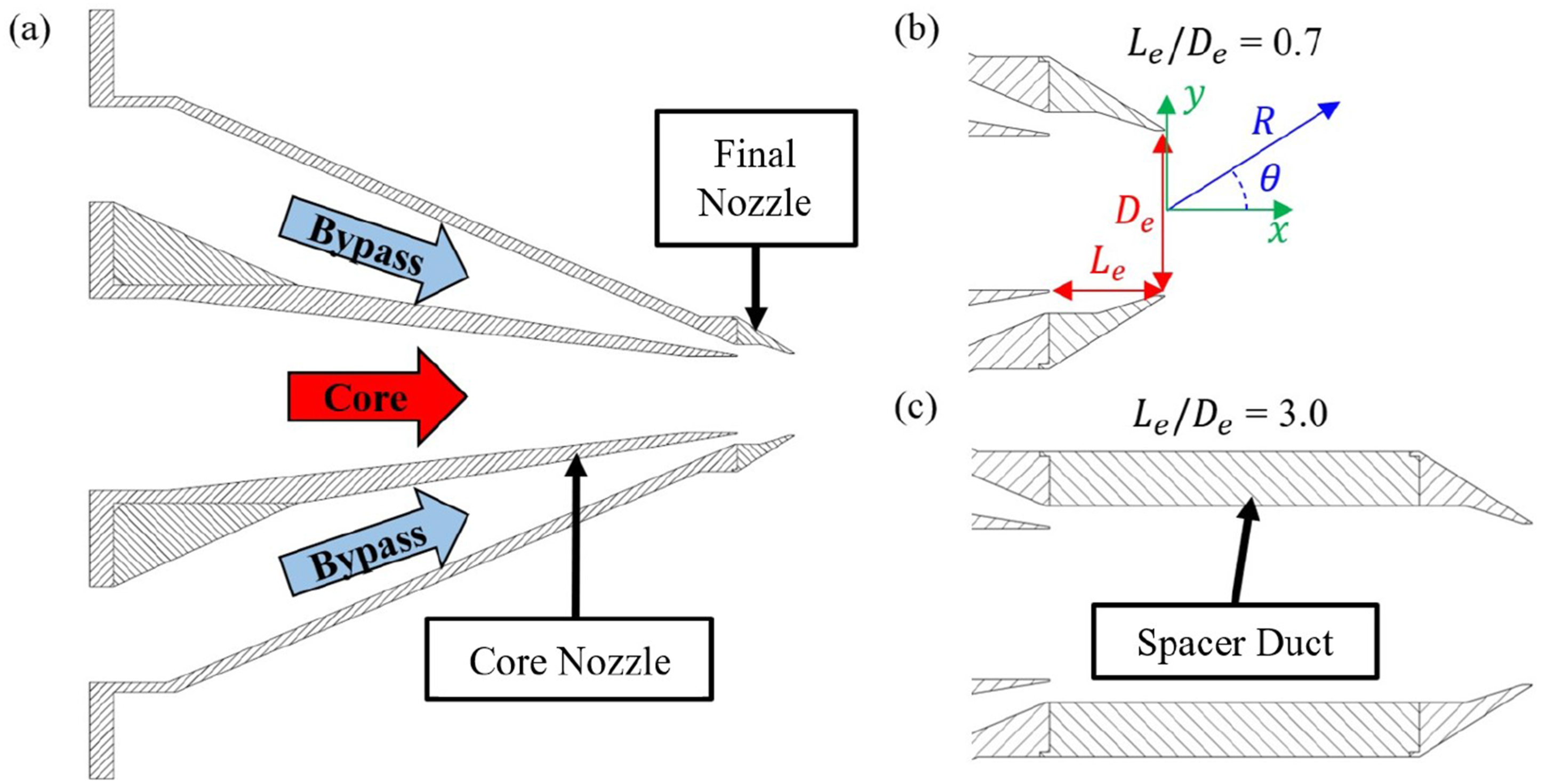
Jet operating conditions
A jet Mach number will be reported as
The measured
A look at the observed phenomena
Figure 3 previews the results to be presented later in this paper, with the measurement systems described below. In Figure 3(a), acoustic spectra measured in the jet’s farfield at Typical measurements: (a) farfield noise at 
The schlieren flow visualization in Figure 3(b) acquired at
Layout of this paper
The
Background
The following subsections briefly discuss two topics of relevance to this paper. First, flow/acoustic interactions which have been found in prior works to give rise to powerful resonances are described. Then, the concept of an excited jet is discussed. These topics form a foundation for interpreting the results to follow.
Flow/acoustic interactions
Flow/acoustic interactions can occur when unsteady flow features couple with the acoustics of a duct or enclosure, and this coupling can produce powerful flow oscillations and acoustic tones at the same frequency. The well-known Parker resonance 23 associated with air flowing through a cascade of parallel, flat plates offers a classical example of this. This configuration leads to powerful pressure oscillations when vortex shedding from the plates couples to natural acoustic modes of the plate arrangement. The oscillation frequencies were equal to or just less than the frequency of vortex shedding from a single, isolated plate. The “lock-on” 24 of the vortex-shedding frequency to the frequency of the acoustic modes is a resonant flow/acoustic interaction, and both the flow and acoustic field influence one another. A more-recent paper by Zaman et al. 25 dealt with a co-annular nozzle system that emitted powerful tones due to a coupling between vortex shedding from centerbody struts with the acoustics of the nozzle interior. Vortex shedding is just one type of unsteady flow feature that can lead to a flow/acoustic interaction. The instability waves of a jet are another.
As discussed by Massey and Ahuja, 26 a 20-foot-diameter steel duct with six-inch-thick walls was shaken when a supersonic jet was operated inside it. This duct was part of an Arnold Engineering Development Complex (AEDC) engine test cell. They stated that such powerful oscillations must be the result of a coupling between the jet and the natural acoustic modes of the facility. Through model-scale experiments of a system comprising a jet issuing into a test cell equipped with an ejector (similar in principle to the AEDC test cell), Massey and Ahuja 26 showed that when the most-preferred frequency of a jet’s instability waves matched closely with a natural frequency of the ejector, there were marked changes in the jet’s flow field and powerful acoustic tones were produced. For more details on this type of phenomenon, see the detailed study of Tam et al. 27 and related papers.28–31
As the howling of the confluent nozzle at
Excited jets
A jet’s instability waves are generally present regardless of whether it is excited or not; however, they are more powerful and less random in the former case as shown by Ahuja et al. 22 for example. Ahuja et al. 22 also showed that the potential core of an excited jet tends to be shorter than that of an unexcited jet – a trend which will be important later in this paper. Here, an excited jet is taken to be one whose instability waves have been made more powerful and less random via forcing at particular frequencies and amplitudes which perturb the shear layer of the jet near the nozzle exit. The ‘more powerful’ descriptor is meant to exclude the effect of turbulence suppression via instability-wave excitation that was studied by Zaman and Hussain, 32 among others.
Introducing discrete tones of particular amplitudes and frequencies into a jet flow in a controlled manner (e.g., via an acoustic driver upstream of a nozzle) can produce an excited jet and allows for isolated study of the effects of excitation. In this paper, the flow of air through the confluent nozzle led to powerful acoustic tones and an excitation of the resulting jet. This jet may be called self-excited.
Methodology
The following three subsections describe the facilities and measurement systems used to obtain (i) farfield noise, (ii) particle-image velocimetry (PIV), and (iii) time-resolved schlieren data.
Farfield noise
The acoustic data presented were measured in the GTRI Anechoic Jet Facility, with the details of this facility documented in great detail in prior works.33–37 Figure 4 shows the GTRI Anechoic Jet Facility and the confluent nozzle installed therein. Figure 4(a) shows a view of the anechoic chamber from the facility’s entry. On the right, the co-axial plenum chambers to which the nozzle was mounted are seen. In Figure 4(b), the confluent nozzle ( GTRI Anechoic Jet Facility: (a) view from anechoic chamber entry and (b) view of confluent nozzle (
A single microphone in the farfield of the jet at an angle of
Particle-image velocimetry (PIV)
Velocity-field measurements were acquired in the GTRI Flow-Diagnostics Facility using a double-pulsed, two-dimensional, two-component PIV system. The GTRI Flow-Diagnostics Facility is a companion facility to the GTRI Anechoic Jet Facility and was outlined by Burrin and Tanna. 34 Although this facility was separate from the GTRI Anechoic Jet Facility, the plenum-to-nozzle contraction ratios were approximately equal and the same compressed and dried air supply serviced this facility as well. The GTRI Flow Diagnostics Facility was not anechoic, although the side walls and the ceiling have been treated with polyurethane foam to reduce reverberation effects of hard walls.
Detailed information about the PIV system was provided by Ramsey.
40
Only key details are provided here. Two PIVTech fluidized bed seeders introduced Fields of view along an eight-station traverse. Not to scale.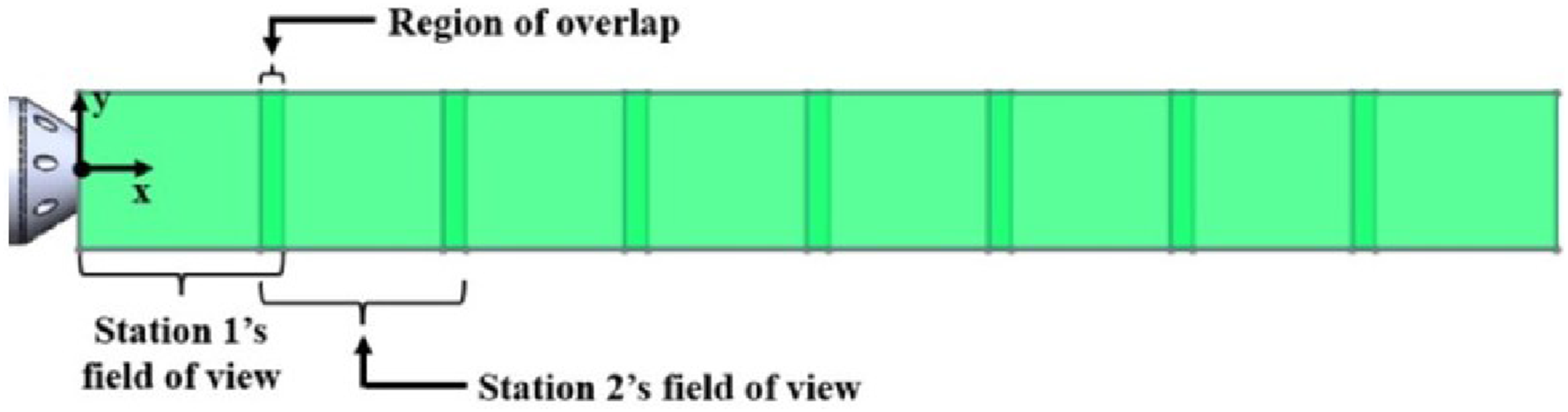
PIV processing parameters.

The axial and radial turbulence intensities appearing later are defined as
Agreement between data obtained using this system and historical data was demonstrated by Ramsey, 40 along with a detailed explanation of how uncertainty estimates were obtained.
Time-resolved schlieren
A Z-type schlieren setup in the GTRI Flow-Diagnostics Facility was also used. Images of the system, and a detailed description can be found in Breen’s PhD dissertation. 45 An arc lamp emitted light that followed a Z-shaped path along a series of mirrors and lenses. A knife-edge cutoff was positioned in one of two orientations: normal to the jet axis (showing axial density gradients) or parallel to the jet axis (showing transverse density gradients). The light was then passed through a pair of refocusing lenses and the schlieren images were captured on a Vision Research Phantom v2512 at 25 kHz at a 1280-by-800 resolution with a 1 µs exposure time.
Results
The following subsections are dedicated to discussing (i) farfield acoustic measurements, (ii) velocity-field measurements obtained via PIV, and (iii) time-resolved schlieren flow visualizations, each of which characterize the noise and flow field produced at jet operating conditions that produced the howling.
Farfield noise
Figure 6(a) shows several acoustic spectra measured for Farfield noise spectra with unheated core stream: (a) 
The spectrum without data markers is referred to as the predicted, unexcited jet-noise spectrum for
Before continuing, we note that the acoustic spectra presented in this paper are plotted against the dimensional frequency in hertz. It is common to find jet-noise measurements plotted against non-dimensional frequencies in the published literature. These dimensionless frequencies are formed using a length scale,
Figure 6(b) shows spectra measured using
Figure 7 shows acoustic spectra measured with Farfield noise spectra with 
A similar howling was observed for the intermediate mixing-duct lengths of Effect of mixing-duct length on the fundamental tone produced at 
As the farfield characteristics of the fundamental tone were roughly similar for all mixing-duct lengths and core-flow total temperatures, the remainder of this paper focuses on the
Velocity-field measurements
Witze
46
gave an expression for the centerline axial velocity distribution of a compressible round jet that agreed well with a large body of experimental data. This expression is

Figure 9 shows comparisons of measured centerline distributions of mean velocity to Witze’s model. In Figure 9(a), a very good agreement between Witze’s model and the measured data for Measured centerline mean velocity (solid curves) and associated 95.4% confidence interval (gray envelope around solid curves) compared to Witze’s model
46
at: (a) 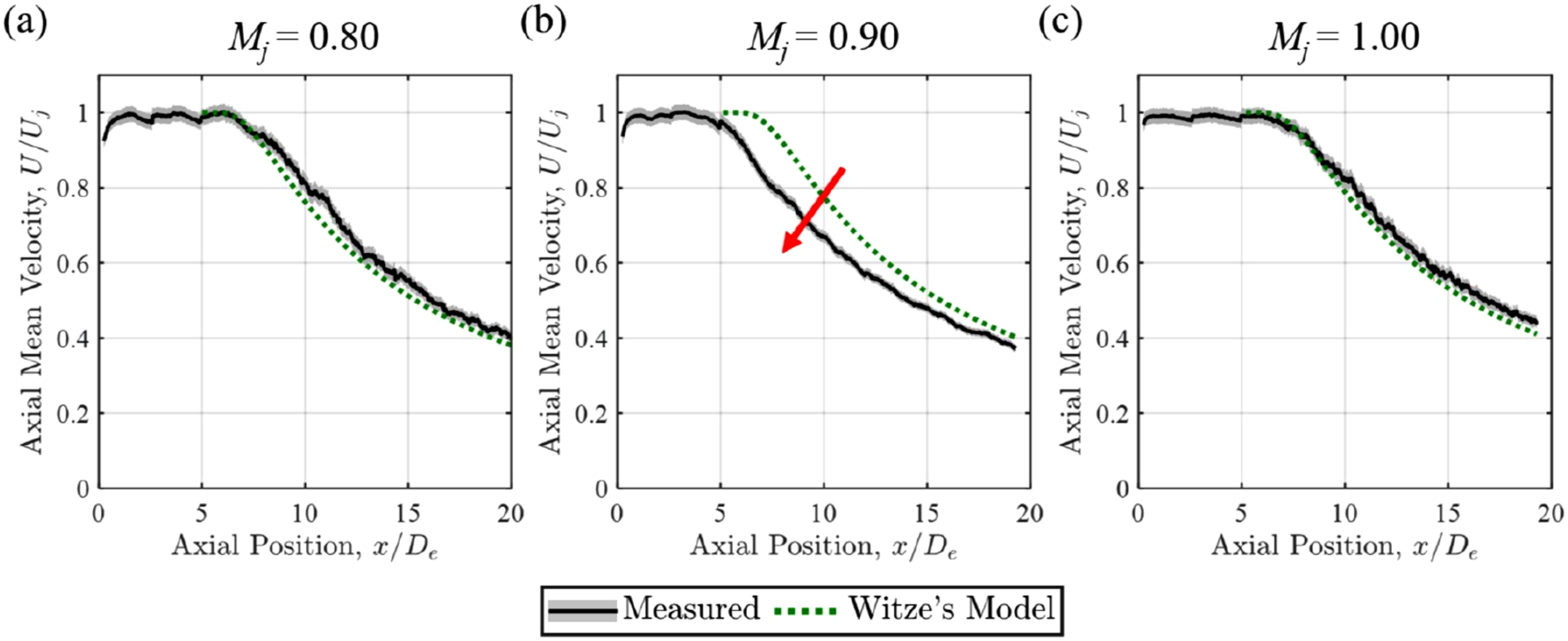
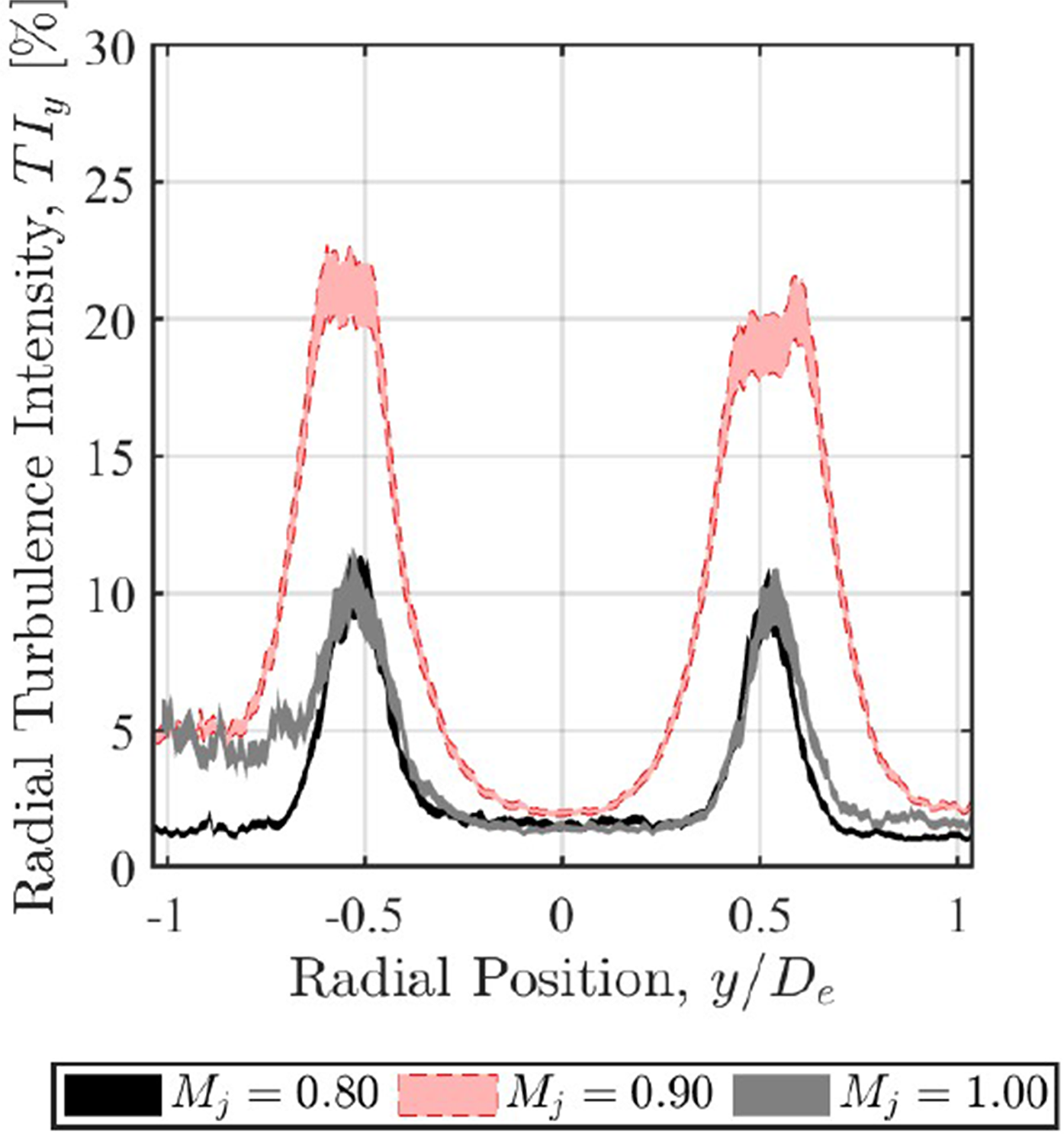
Figure 10 shows maps of radial turbulence intensities measured near the nozzle exit. The radial turbulence intensity is shown rather than the axial because it revealed the most severe differences between the tone-producing and tone-free Radial turbulence intensity near the nozzle exit at: (a) Radial turbulence intensity profiles at 
Time-resolved schlieren
For reference, Figure 12 shows single frames from high-speed schlieren videos at Schlieren images at 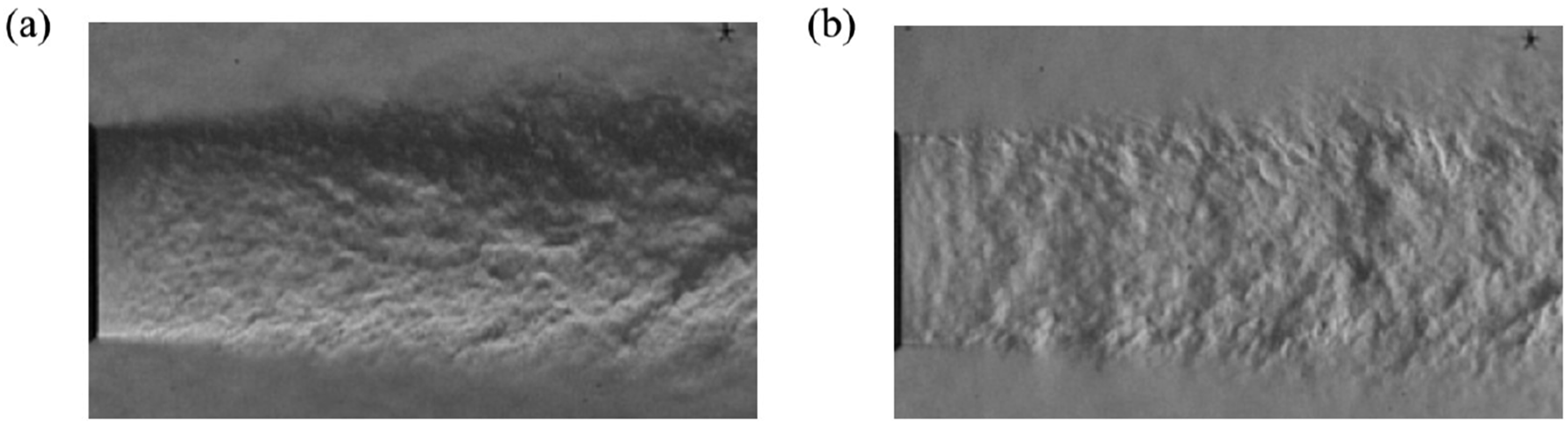
A similar pair of images acquired at Schlieren images at Schlieren images at 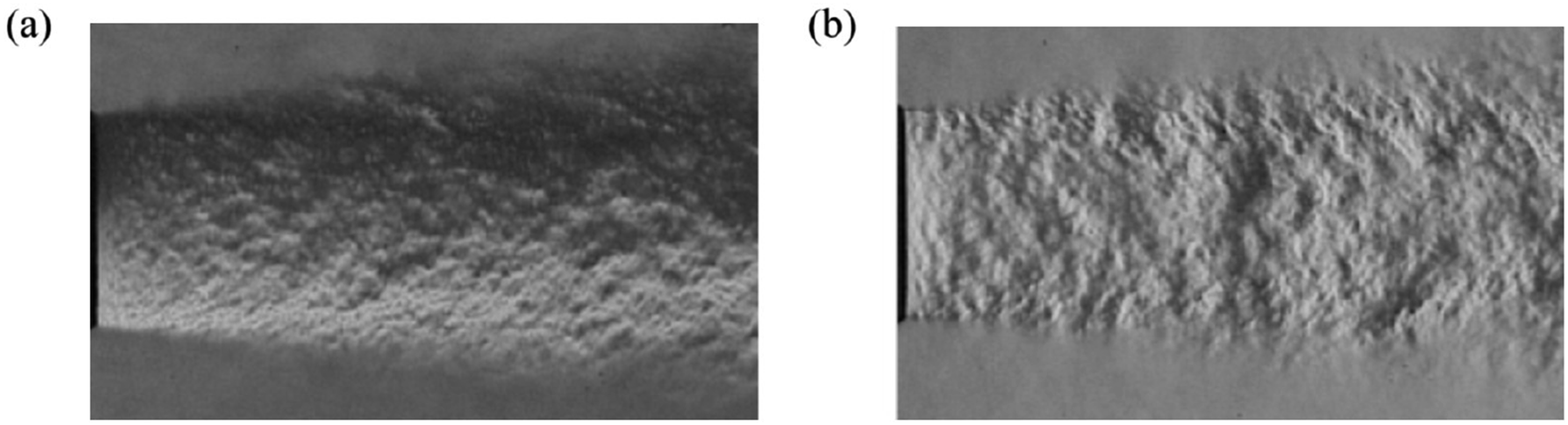
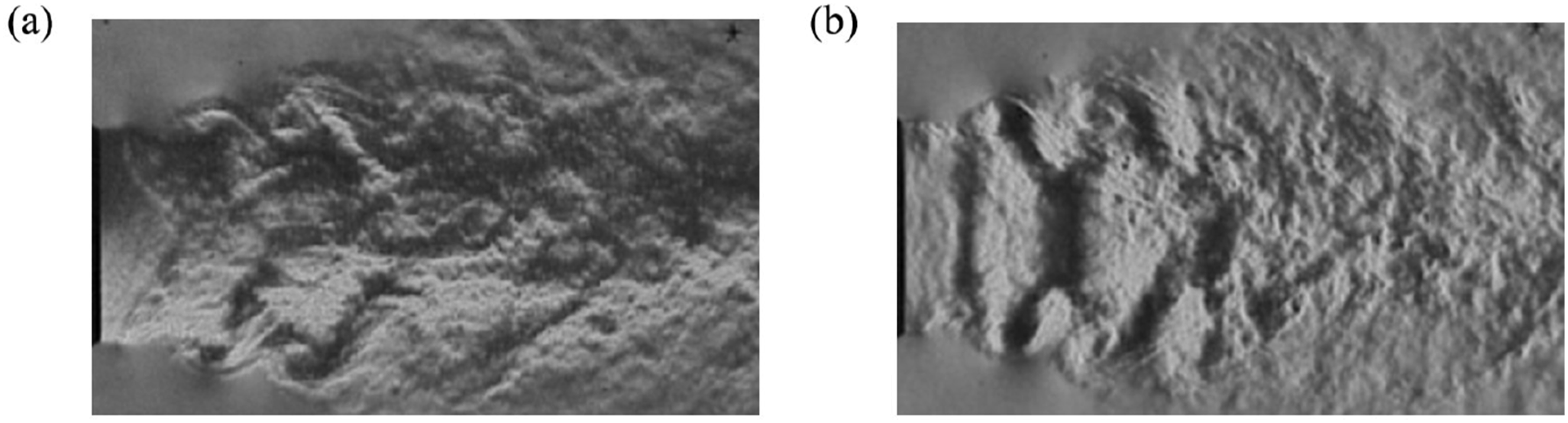
Figure 15 shows further analysis of the time-resolved schlieren corresponding to Figure 14(a). Figure 15(a) shows a map of the sample standard deviation of pixel intensity values calculated using 500 images. The time history of the pixel located at the single, red ‘ × ’ in this figure was extracted from a total of Analysis of schlieren recording shown in Figure 14(a): (a) sample standard deviation of pixel fluctuations and (b) power spectral density computed from single point in video denoted by red ‘ × ’ in (a).
Conclusions
It has been shown that, when operated at
With the
There have been a number of publications on internally mixed nozzles equipped with lobed mixers. We wish to point out several publications11–13,47–49 which dealt with an additional, broadband noise produced by such nozzles. This additional noise was ultimately due to a small-radius, convex bend in the nozzle wall and an associated region of over-expanded supersonic flow just upstream of the nozzle exit. A recent paper by Ramsey et al.
50
showed that the howling studied in this paper is due to a similar transonic flow inside the nozzle. However, unlike the studies referenced above, this region of transonic flow led to shock-induced separation of the boundary layer – giving rise to a periodic flow instability that coupled with a natural acoustic mode of the nozzle interior in a flow/acoustic interaction (or ‘feedback phenomenon’). The physical mechanism at play is a true flow/acoustic interaction involving both a natural acoustic mode (which some may call a ‘duct resonance’) and an unusual flow instability coupled to this natural acoustic mode. The flow instability was a transonic phenomenon, and thus only exists above a certain, subsonic
For completeness, we note that the Strouhal number (based on the velocity and diameter of the final jet) of the acoustic tones and flow oscillations measured at
This is not to say the Strouhal number (based on, say, the velocity and diameter of the final jet) of the howling and flow oscillations is unimportant. On the contrary, the Strouhal number of the howling would provide rough insight into the coupling between the resonance responsible for the howling and the instability waves of the final jet. This is especially true when the core jet was unheated and the final jet was approximately a single, uniform stream. In this case, the Strouhal number of the howling was about 0.9. This Strouhal number is higher than the expected most-preferred frequency of the instability waves in a round jet (e.g., see the work of Ahuja and Blakney 21 on axisymmetric instability waves of model-scale jets) and, had the Strouhal number been lower, instability waves in the final jet might have been even higher in amplitude.
To date, no dynamic measurements of the fluctuating flow field inside the nozzle have been conducted. However, these measurements would be of great interest. Though a detailed understanding of the resonance is now available, 50 in-duct measurements obtained simultaneously with farfield acoustic data could shed light on the contribution of the resonance internal to the nozzle to the farfield noise.
It is noted for the interested reader that more recent work by Ramsey et al. 51 also outlined a different resonance of the exact same nozzle, which was rooted in impingement of the core/bypass shear layer upon the final-nozzle lip under certain conditions. It is emphasized that only certain operating conditions led the nozzle studied here to howl. For example, the paper by Ramsey et al. 52 dealt only with conditions at which no howling was produced.
Footnotes
Acknowledgements
The authors are grateful to GTRI for allowing the use of their facilities in completing this work. Senior Research Engineer Michael Mayo (GTRI) is thanked for his consultation regarding PIV measurements. The efforts of Callum Gray (LaVision GmbH) to provide technical support and information regarding the DaVis software is gratefully acknowledged.

Funding
The authors disclosed receipt of the following financial support for the research, authorship, and/or publication of this article: As part of his doctoral research, DNR was supported by the National Science Foundation Graduate Research Fellowship under Grant No. DGE-2039655 and much of the work reported here was conducted under this grant. Any opinion, findings, and conclusions or recommendations expressed in this material are those of the authors and do not necessarily reflect the views of the National Science Foundation. The building block for this work was the discovery of large-amplitude tones in the acoustic farfield of confluent nozzles during work under FAA ASCENT Project 59B under grant GR00005737 (Program Manager: Sandy Liu) and through a cost-sharing partnership with Gulfstream Aerospace (POC: Brian Cook). The authors are grateful to GTRI for allowing the use of their facilities in completing this work.
Declaration of conflicting interests
The authors declared no potential conflicts of interest with respect to the research, authorship, and/or publication of this article.