The propagation of sound in a uniform flow with rigid body swirl has been considered in the approximation of low swirl Mach number ,where the swirl Mach number is specified by the angular velocity , stagnation sound speed and radial distance r; in this case the mass density and sound speed in the mean flow are constant, and the convected wave equation is solved in terms of Bessel functions. In this paper the restriction on swirl Mach number is relaxed from to , thus keeping O () terms in the mean flow, mass density and sound speed, that become non-uniform; the acoustic vortical wave equation is no longer the convected wave equation, and is extended to this case and solved in terms of generalized Bessel functions. The radial dependence to second order in the swirl Mach number is specified by a generalized Bessel differential equation for decoupled acoustic or vortical modes and for acoustic-vortical waves to first order in the swirl Mach number. The solutions are obtained: (i) for finite radius in terms of generalized Bessel and Neumann functions, that determine the radial wavenumbers, natural frequencies and normal eigenfunctions for cylindrical or annular ducts with rigid or impedance wall boundary conditions; (ii) asymptotically for large radius in terms of generalized Hankel functions, specifying the growth of amplitude with radius either as a power law or as an exponential of one-half of the square of the swirl Mach number. Thus the compressible uniform mean flow with rigid body rotation is spatially unstable in the radial direction; it is also unstable in time for cut-on modes with real axial wavenumbers and cut-off modes with imaginary axial wavenumbers. Compared with acoustic waves the acoustic-vortical waves have more modes, some with complex rather than real eigenvalues leading to instabilities.
Acoustic-vortical waves in a uniform flow with rigid body rotation have been studied with the restriction of low Mach number swirl (, where is the angular velocity, the stagnation sound speed and is the radius. This restriction allows a constant mass density and sound speed in the mean flow, and leads to a convected wave equation in cylindrical coordinates, that can be solved in terms of Bessel functions. The restriction to low Mach number swirl limits the angular velocity or the radius of the duct. In the present paper the assumption of small swirl Mach number is relaxed to moderate swirl Mach number , thus increasing the range of swirl Mach numbers from for to for . The relaxed assumption implies that terms of O () must be retained and thus: (i) the mass density, pressure and sound speed are no longer constant in the mean flow; (ii) the wave equation has extra terms, is no longer the convected wave equation and is no longer solvable in cylindrical coordinates in terms of Bessel functions. The solution of the acoustical-vortical wave equation with moderate swirl Mach number is obtained in terms of generalized Bessel functions, that reduce to the original Bessel functions in the particular case of low Mach number swirl.
The designation of low Mach number approximation is used in most texts of fluid mechanics1–5 for although this may depend on the coefficients; the same proviso may apply to the condition for the moderate Mach number approximation. Considering an International Standard Atmosphere (I.S.A.) sea level sound speed6,7 of = 1224 km/h the low Mach number approximation or applies to airspeeds km/h that cover the take-off and climb and approach and landing phases of most aircraft, but not the cruising speeds of most airliners. The moderate Mach number approximation extends the speed range to km/h at sea level that includes the cruising speeds of most propeller driven aircraft at low altitudes. It does not cover the cruise Mach numbers of transonic jet liners flying at altitude of 11 km at the tropopause, where the sound speed is km/h corresponding to the speed range km/h. The fundamental physical difference, that will be demonstrated in the sequel is: (i) purely acoustic or vortical cylindrical waves in a low Mach number swirling flow have real eigenvalues and thus an asymptotic decay on the inverse square root of the radial distance ; (ii) acoustic-vortical waves in a moderate Mach number swirling flow can have complex eigenvalues , whose imaginary part leads to an exponential decay for or growth for associated respectively with stability or instability. Thus, the low Mach number approximation may exclude the radial stability or instability of waves that already appears at moderate Mach numbers. This is particularly relevant for radial modes of acoustic-vortical waves in turbomachinery, since radial instabilities that do not occur for purely acoustic or vortical waves, may appear for acoustic-vortical waves due to the coupling of compressibility and swirl.
The extension of the acoustic-swirl wave equation from low to moderate swirl Mach number has both fundamental and practical implications. On the fundamental side: (i) the low swirl Mach number approximation implies constant mean flow mass density, pressure and sound speed, so that there is no refraction of sound, leaving only convection by the mean flow with a constant Doppler shift depending on the mode; (ii) the moderate swirl Mach number approximation retains O () terms in the mean flow mass density, pressure and sound speed and thus adds refraction effects in the radial direction. On the practical side consider turbomachinery rotating at r.p.m. (revolutions per minute) corresponding to r. p.s (revolutions per second). For a nozzle diameter m, the tangential or swirl velocity is . Considering a TET (Turbine Entry Temperature) K, the perfect gas constant for air and adiabatic exponent for diatomic gas lead to the sound speed on axis . The swirl Mach number : (i) does not meet the low swirl Mach number approximation because ; (ii) does meet the moderate swirl Mach number approximation because . In conclusion the flow conditions in modern turbomachinery imply not only convection by rigid swirl but also refraction by a non-uniform sound speed, and can be accounted for extending the low to the moderate swirl Mach number approximation.
It can be shown that for moderate Mach number swirl the acoustic-vortical waves are specified by generalized Bessel functions of non-zero degree, that are not reducible8,9 to the original Bessel functions of degree zero. The generalized Bessel functions can be related10 to Whittaker11,12 or confluent hypergeometric13–15 functions but have an important advantage: (a) the distinction between low and moderate swirl Mach number approximation for acoustic-vortical waves described respectively by original and generalized Bessel functions is made most simply and clearly by a parameter, namely non-zero or zero degree; (b) the usual relation between the original Bessel functions and confluent hypergeometric functions, or Whittaker functions, is a limit involving several parameters, which is not as simple and clear as (a), also in terms of physical interpretation.
The compressible linear non-dissipative perturbations of a uniform flow satisfy the acoustic convected wave equation whose solution in cylindrical coordinates involves Bessel functions in the radial direction.16 The Bessel functions with a different radial wavenumber also specify the radial dependence of acoustic-vortical waves that are incompressible linear non-dissipative perturbations of an axisymmetric swirling flow with constant angular velocity corresponding to rigid body rotation.17 There is a contrast between purely acoustic waves that are longitudinal perturbations of an irrotational compressible flow18 and vortical waves that are rotational perturbations of an incompressible flow with vorticity, for example, shear or swirl.19 The third type of waves possible in a fluid not subject to external forces is entropy modes20–23 that are not considered here by assuming homentropic conditions. The focus of the paper is the combination of the (i) acoustic and (ii) vortical waves may be designated acoustic-vortical waves and are generally perturbations of an homentropic compressible flow with vorticity, for example, shear or swirl. Considering the case of swirl the simplest instance of acoustic-vortical waves is compressive linear non-dissipative perturbations of a uniform flow with superimposed rigid body swirl. In this case the radial dependence is specified by Bessel functions12 only in the low Mach number swirl approximation, that is if the tangential velocity of the mean flow is small compared with the sound speed. If this condition is not met a generalized Bessel differential equation8 is obtained to second order in the swirl Mach number. The wave field is obtained by solving the generalized Bessel differential equation as an indication of the scaling of the wave perturbations on the swirl Mach number. Since the mean flow is incompressible there is no restriction on Mach number. Thus, the complete study of acoustic-vortical waves in a uniform flow with rigid body swirl requires the use of the mathematical properties of the solutions of the generalized Bessel equation. These involve the generalized Bessel, Neumann and Hankel functions9,10 that extend the properties of Bessel, Neumann and Hankel functions found in standard works of reference12–15 including tables of functions.24–26 The generalized Bessel differential equation can be solved directly as a power series expansion around the regular singularity27 at the origin, leading to generalized Bessel and Neumann functions.8 Their asymptotic expansions for large radius2 involve generalized Hankel functions9 that are obtained most readily through confluent hypergeometric functions.12–15
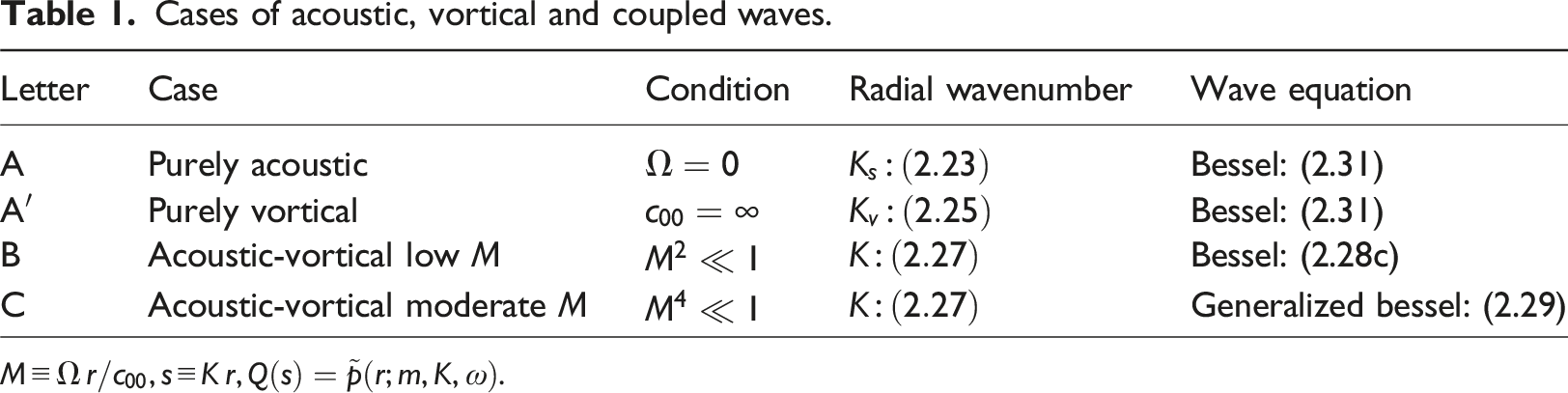
The starting point is a linear, non-dissipative, compressible perturbation of a uniform flow with rigid body rotation; this leads to the acoustic-vortical wave equation specifying the radial dependence of the pressure perturbation spectrum with given frequency and axial and azimuthal wavenumbers. The latter leads to second order in the swirl Mach number to a radial dependence specified by a generalized Bessel differential equation, that has two parameters, namely the order and the degree: (i) the order is the azimuthal wavenumber as for purely acoustic or vortical (also called ‘rotational’ waves); (ii) the degree is proportional to the square of the swirl Mach number. If the square of swirl Mach number is neglected, the degree is zero, and the original Bessel differential equation12 is regained. Thus, it is the coupling of acoustic and vortical modes that leads to the generalized Bessel differential equation (Table 1) if the swirl Mach number is not ‘low’ but rather ‘moderate’ . The low Mach number approximation for the mean flow applies up to whereas the moderate Mach number approximation or extends the swirl Mach number to . The low Mach number approximation leads to uniform mean flow, and thus to purely vortical waves described by the original Bessel differential equation; in contrast the moderate Mach number approximation allows for non-uniform mean flow, and leads to coupling with swirl perturbations, corresponding to acoustic-vortical waves; the solution of the corresponding acoustic-vortical wave equation requires generalized Bessel, Neumann and Hankel functions.8,9 The generalized and original Bessel differential equation both have two singularities, at the origin and at infinity: (i) singularity at the origin is regular8,27 in both cases, and leads to power series solutions valid for finite variable; (ii) the asymptotic solutions for large variable are determined by the irregular singularity9,28 at infinity that is of different degree, respectively one and two for the original and generalized Bessel differential equation. Thus, the acoustic-vortical waves are: (i) qualitatively similar (though quantitatively different) to acoustic waves for small radius, that is when the swirl Mach number is much less than unity; (ii) for rigid body swirl the swirl Mach number will not be small for sufficiently large radius and then the acoustic-vortical waves will be both qualitatively and quantitatively different from acoustic waves.
Cases of acoustic, vortical and coupled waves.
Letter
Case
Condition
Radial wavenumber
Wave equation
A
Purely acoustic
Bessel: (2.31)
A′
Purely vortical
Bessel: (2.31)
B
Acoustic-vortical low M
Bessel: (2.28c)
C
Acoustic-vortical moderate M
Generalized bessel: (2.29)
.
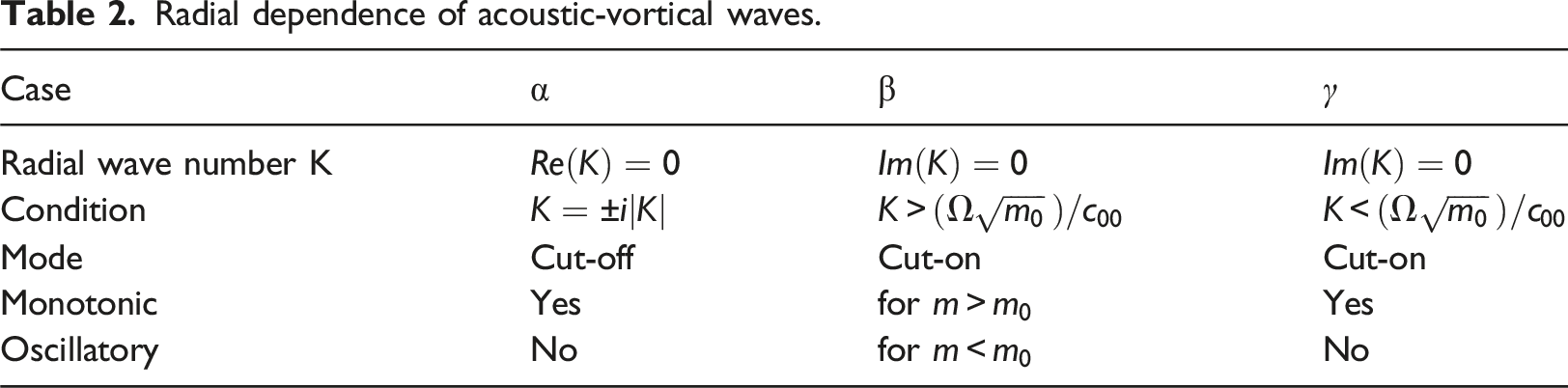
The general integral around the regular singularity at the origin is a linear combination of generalized Bessel functions if the order is not an integer8,10 as for the original Bessel differential equation11,12; in the case of acoustic-vortical waves the order is the azimuthal wavenumber, that is an integer so generalized Neumann functions appear in the general integral,10 as the Neumann functions would appear for the original Bessel differential equation.12,15 The pressure perturbation spectrum for acoustic-vortical waves is specified by the generalized Bessel and Neumann functions for finite radius: (i) they are close to the original Bessel and Neumann function for small radius, in the sense of small swirl Mach number; (ii) differ considerably as the increasing radius with rigid body rotation leads to a non-negligible swirl Mach number. A consequence is (Table 2) that: (i) for cut-off modes with imaginary radial wavenumber all the decoupled or coupled acoustic and vortical waves are monotonic; (ii) for cut-on modes with real radial wavenumber the decoupled acoustic or vortical modes are oscillatory but the coupled acoustic-vortical waves become monotonic at sufficient large azimuthal wave number; (iii) if the swirl is strong enough the acoustic-vortical waves for cut-on modes with real radial wavenumber small enough will be monotonic for all radii, that is have no oscillations at all. These conclusions (i) to (iii) apply waves both in cylindrical ducts specified by generalized Bessel functions and in annular ducts when generalized Neumann functions are also involved and also in free space from the origin to infinity or outside a cylinder.
Radial dependence of acoustic-vortical waves.
Case
α
β
Radial wave number K
Condition
Mode
Cut-off
Cut-on
Cut-on
Monotonic
Yes
for
Yes
Oscillatory
No
for
No
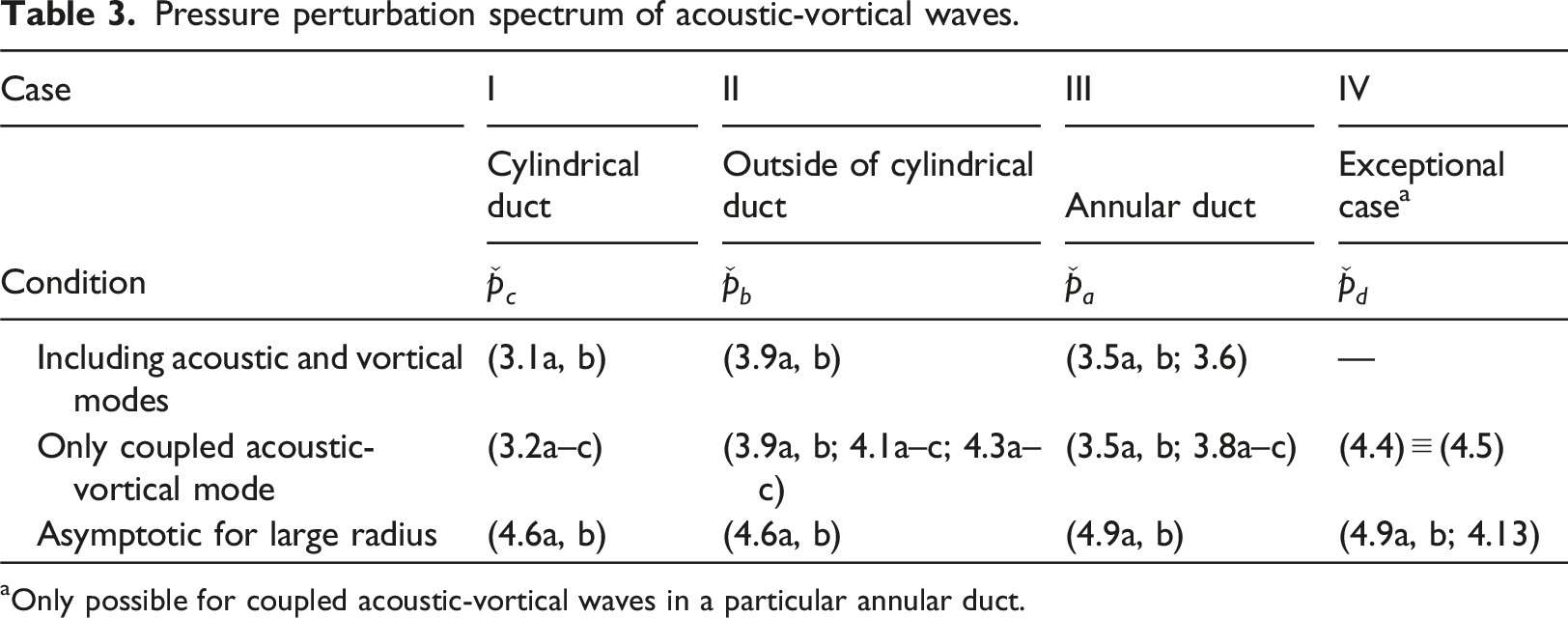
For large radius when the swirl Mach number is not small the pressure perturbation spectrum for coupled acoustic-vortical waves is quite different from that of decoupled acoustic or vortical waves. The asymptotic pressure perturbation spectrum for decoupled acoustic or vortical waves is specified by the original Hankel functions of two kinds12,13 implying that: (i) for cut-on modes with real radial wavenumber there is oscillatory decay; (ii) for cut-off modes with imaginary axial wavenumber there is monotonic exponential growth or decay proportional to the radius. For purely acoustic or vortical cylindrical waves the asymptotic field is specified by Hankel functions, whose modulus or amplitude decays like the inverse square root of the radial distance. In strong contrast (Table 3) the pressure perturbation spectrum for coupled acoustic-vortical waves asymptotically at large radius is typically dominated by the generalized Hankel function of the second kind,18 implying that the amplitude grows like an exponential of the square of the radius, more precisely as the exponential of one-half of the square of the swirl Mach number. This result is independent of the axial wavenumber and shows that both for cut-on and cut-off modes there is a strong radial growth of the amplitude of acoustic-vortical waves, due to the coupling of compressibility and vorticity. There is only one exception to this result, that cannot occur for the coupled acoustic-vortical waves neither in the interior nor in the exterior of a cylinder, but only in a particular case of annulus, for which the asymptotic solution excludes the generalized Hankel function of the second kind and consists only of the generalized Hankel function of the first kind8; the latter has an asymptotic power-law dependence on the radius that is monotonic for cut-off and oscillatory for cut-on modes. There are four cases of acoustic-vortical waves inside or outside cylinders or in annular ducts that are superpositions of waves that have two modes: (i) an ‘acoustic mode’ specified by generalized Hankel function of the first kind that scales like a power of the radius; (ii) a ‘vortical mode’ specified by the generalized Hankel function of the second kind that scales like the exponential of the square of the radius. The vortical mode will dominate asymptotically, apart from the exceptional case when only the acoustic mode exists. Thus, the asymptotic pressure perturbations: (i) for negligible swirl Mach number would decay like the inverse square root of the radial distance; (ii) if the swirl Mach number is not small will generally grow like the exponential of one half of the square of the swirl Mach number. For sufficiently large radius (ii) will always be the case, that is the coupling of acoustic-vortical waves causes amplitude growth, that is wave amplification.
Pressure perturbation spectrum of acoustic-vortical waves.
aOnly possible for coupled acoustic-vortical waves in a particular annular duct.
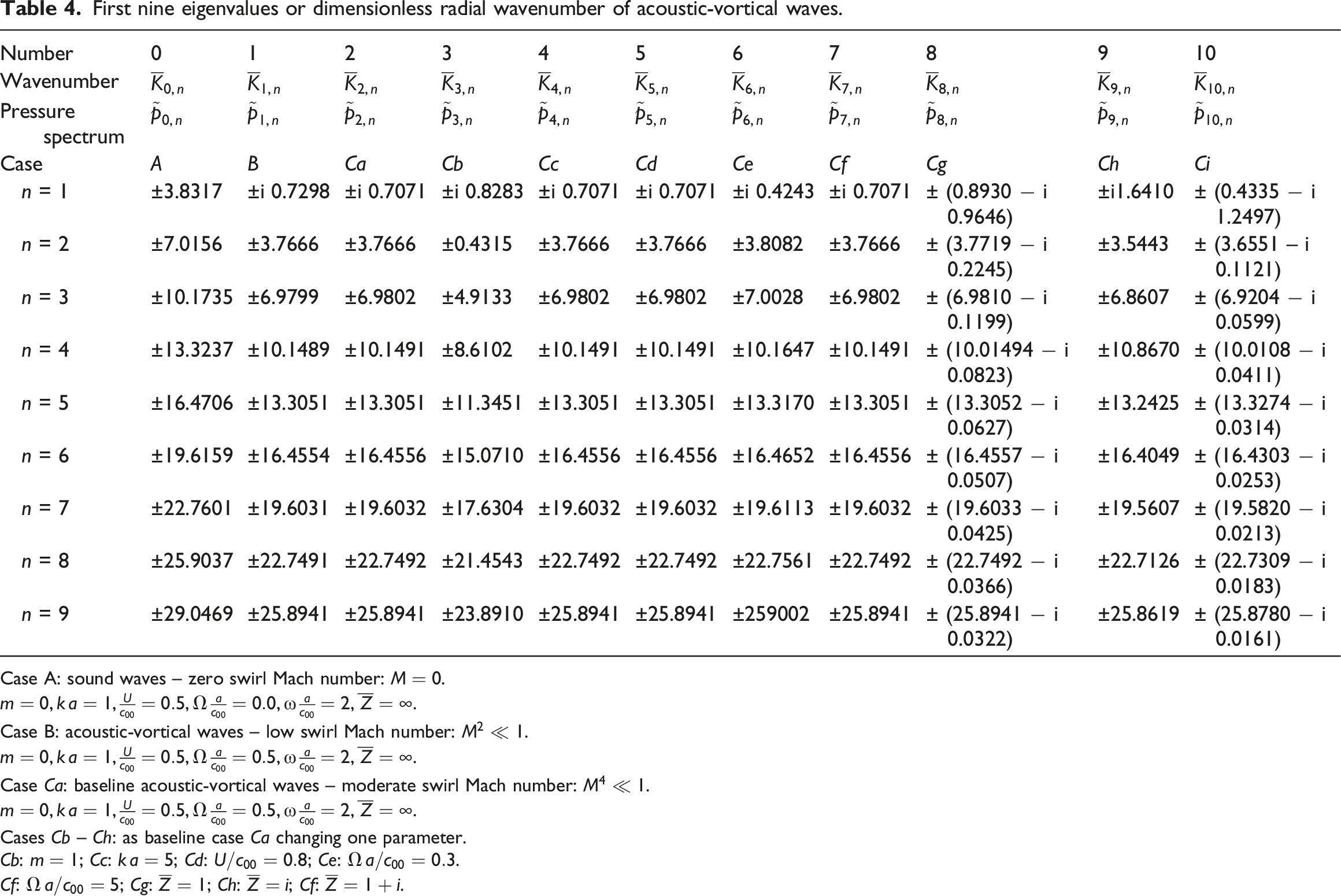
The acoustic-vortical waves are linear non-dissipative compressible perturbations of a uniform flow with rigid body swirl, and thus specify its stability. The radial instability scaling like an exponential of the square of the radius has already been pointed out. The temporal stability is specified by the frequency as a root of a dispersion relation that is a quartic polynomial (§5.1). It is proved that the dispersion relation always has at least one pair of complex conjugate roots for the frequency, one of which leads to exponential growth in time, and hence temporal instability for waves in free space, that is both cut-on modes with real radial wavenumber and cut-off modes with imaginary radial wavenumber. In the case of coupled acoustic-vortical waves in cylindrical or annular nozzles the values of the radial wavenumber are the eigenvalues associated with rigid or impedance wall boundary conditions. The eigenvalues for the radial wavenumber (Table 4), the corresponding Doppler shifted frequencies as roots of the dispersion relation (Table 5) and the radial waveforms (Figures 1–10) are obtained for several combinations of the parameters of the problem as variations around a baseline case. The Table 6 quantifies the importance of moderate versus low Mach number effects by comparing for the predictions with real eigenvalues with the corrections that may be complex and lead to instability, and the corresponding waveforms are compared in Figures 1 and 2. The acoustic-vortical waves not only modify the acoustic modes (Table 8) but also lead to the appearance of new modes (Table 7). The Figures 2–10 compare (a) acoustic waves with acoustic-vortical waves with (b) low or (c) moderate Mach number swirl with different parameters. For a cylindrical nozzle the six dimensionless parameters are: (i-iii) azimuthal and axial wavenumbers and frequency; (iv–v) the constant Mach number for the uniform axial flow and the swirl Mach number for rigid body swirl taken as the maximum value at the wall; (vi) the specific wall impedance, including rigid, reactive, inductive and mixed walls. Concerning the singularities of the wave equation in non-uniform flows it is noted that a uniform flow and rigid body swirl do exclude the existence of critical layers and a continuous spectrum that otherwise is a general feature19,29 of acoustic-vortical waves30 when there is either shear or non-rigid body swirl or both. The conclusion summarizes the main results for acoustic-vortical waves in a uniform flow with rigid body swirl in the moderate Mach number approximation.
First nine eigenvalues or dimensionless radial wavenumber of acoustic-vortical waves.
Number
0
1
2
3
4
5
6
7
8
9
10
Wavenumber
Pressure spectrum
Case
A
B
Ca
Cb
Cc
Cd
Ce
Cf
Cg
Ch
Ci
n = 1
±3.8317
±i 0.7298
±i 0.7071
±i 0.8283
±i 0.7071
±i 0.7071
±i 0.4243
±i 0.7071
± (0.8930 − i 0.9646)
±i1.6410
± (0.4335 − i 1.2497)
n = 2
±7.0156
±3.7666
±3.7666
±0.4315
±3.7666
±3.7666
±3.8082
±3.7666
± (3.7719 − i 0.2245)
±3.5443
± (3.6551 – i 0.1121)
n = 3
±10.1735
±6.9799
±6.9802
±4.9133
±6.9802
±6.9802
±7.0028
±6.9802
± (6.9810 − i 0.1199)
±6.8607
± (6.9204 − i 0.0599)
n = 4
±13.3237
±10.1489
±10.1491
±8.6102
±10.1491
±10.1491
±10.1647
±10.1491
± (10.01494 − i 0.0823)
±10.8670
± (10.0108 − i 0.0411)
n = 5
±16.4706
±13.3051
±13.3051
±11.3451
±13.3051
±13.3051
±13.3170
±13.3051
± (13.3052 − i 0.0627)
±13.2425
± (13.3274 − i 0.0314)
n = 6
±19.6159
±16.4554
±16.4556
±15.0710
±16.4556
±16.4556
±16.4652
±16.4556
± (16.4557 − i 0.0507)
±16.4049
± (16.4303 − i 0.0253)
n = 7
±22.7601
±19.6031
±19.6032
±17.6304
±19.6032
±19.6032
±19.6113
±19.6032
± (19.6033 − i 0.0425)
±19.5607
± (19.5820 − i 0.0213)
n = 8
±25.9037
±22.7491
±22.7492
±21.4543
±22.7492
±22.7492
±22.7561
±22.7492
± (22.7492 − i 0.0366)
±22.7126
± (22.7309 − i 0.0183)
n = 9
±29.0469
±25.8941
±25.8941
±23.8910
±25.8941
±25.8941
±259002
±25.8941
± (25.8941 − i 0.0322)
±25.8619
± (25.8780 − i 0.0161)
Case A: sound waves – zero swirl Mach number: .
.
Case B: acoustic-vortical waves – low swirl Mach number: .
Cases Cb – Ch: as baseline case Ca changing one parameter.
Cb: ; Cc: ; Cd: ; Ce: .
Cf: ; Cg: ; Ch: ; Cf: .
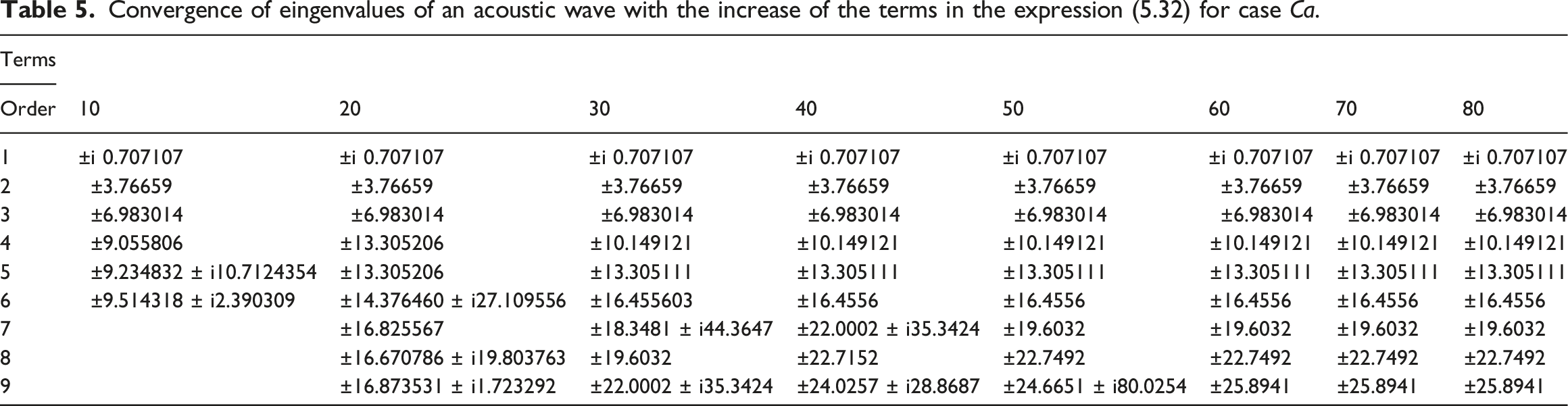
Convergence of eingenvalues of an acoustic wave with the increase of the terms in the expression (5.32) for case Ca.
Terms
10
20
30
40
50
60
70
80
Order
1
±i 0.707107
±i 0.707107
±i 0.707107
±i 0.707107
±i 0.707107
±i 0.707107
±i 0.707107
±i 0.707107
2
±3.76659
±3.76659
±3.76659
±3.76659
±3.76659
±3.76659
±3.76659
±3.76659
3
±6.983014
±6.983014
±6.983014
±6.983014
±6.983014
±6.983014
±6.983014
±6.983014
4
±9.055806
±13.305206
±10.149121
±10.149121
±10.149121
±10.149121
±10.149121
±10.149121
5
±9.234832 ± i10.7124354
±13.305206
±13.305111
±13.305111
±13.305111
±13.305111
±13.305111
±13.305111
6
±9.514318 ± i2.390309
±14.376460 ± i27.109556
±16.455603
±16.4556
±16.4556
±16.4556
±16.4556
±16.4556
7
±16.825567
±18.3481 ± i44.3647
±22.0002 ± i35.3424
±19.6032
±19.6032
±19.6032
±19.6032
8
±16.670786 ± i19.803763
±19.6032
±22.7152
±22.7492
±22.7492
±22.7492
±22.7492
9
±16.873531 ± i1.723292
±22.0002 ± i35.3424
±24.0257 ± i28.8687
±24.6651 ± i80.0254
±25.8941
±25.8941
±25.8941
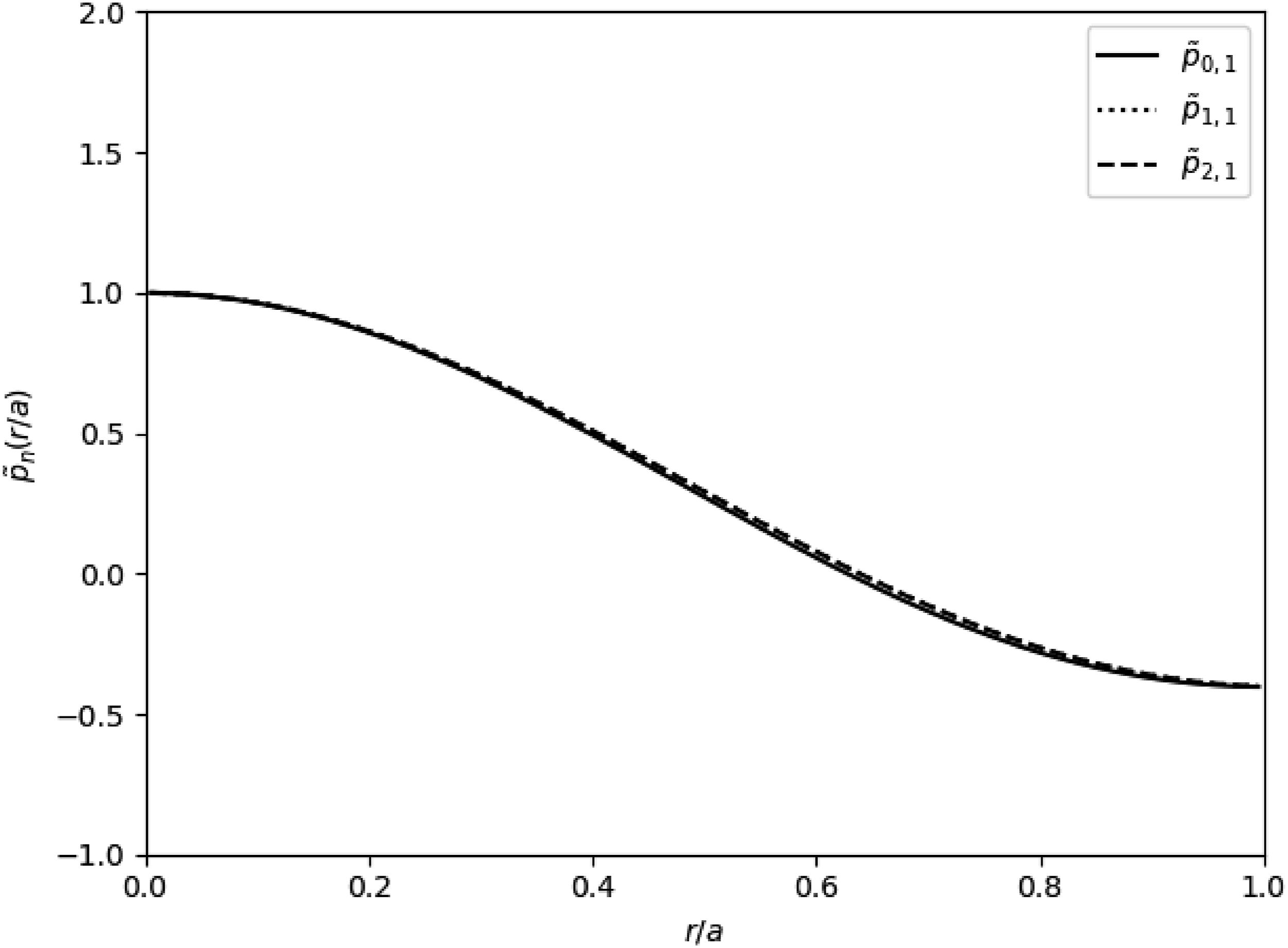
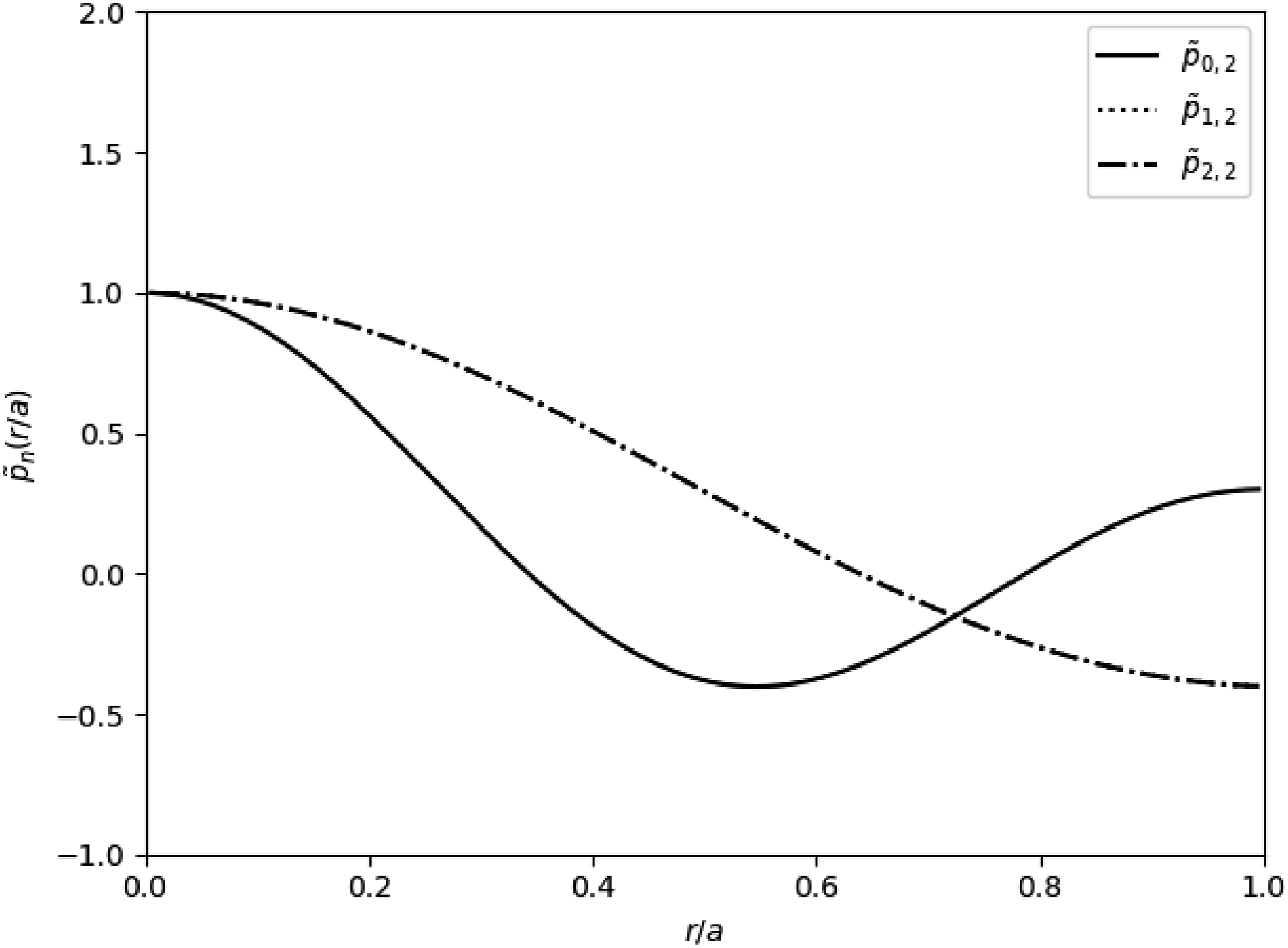
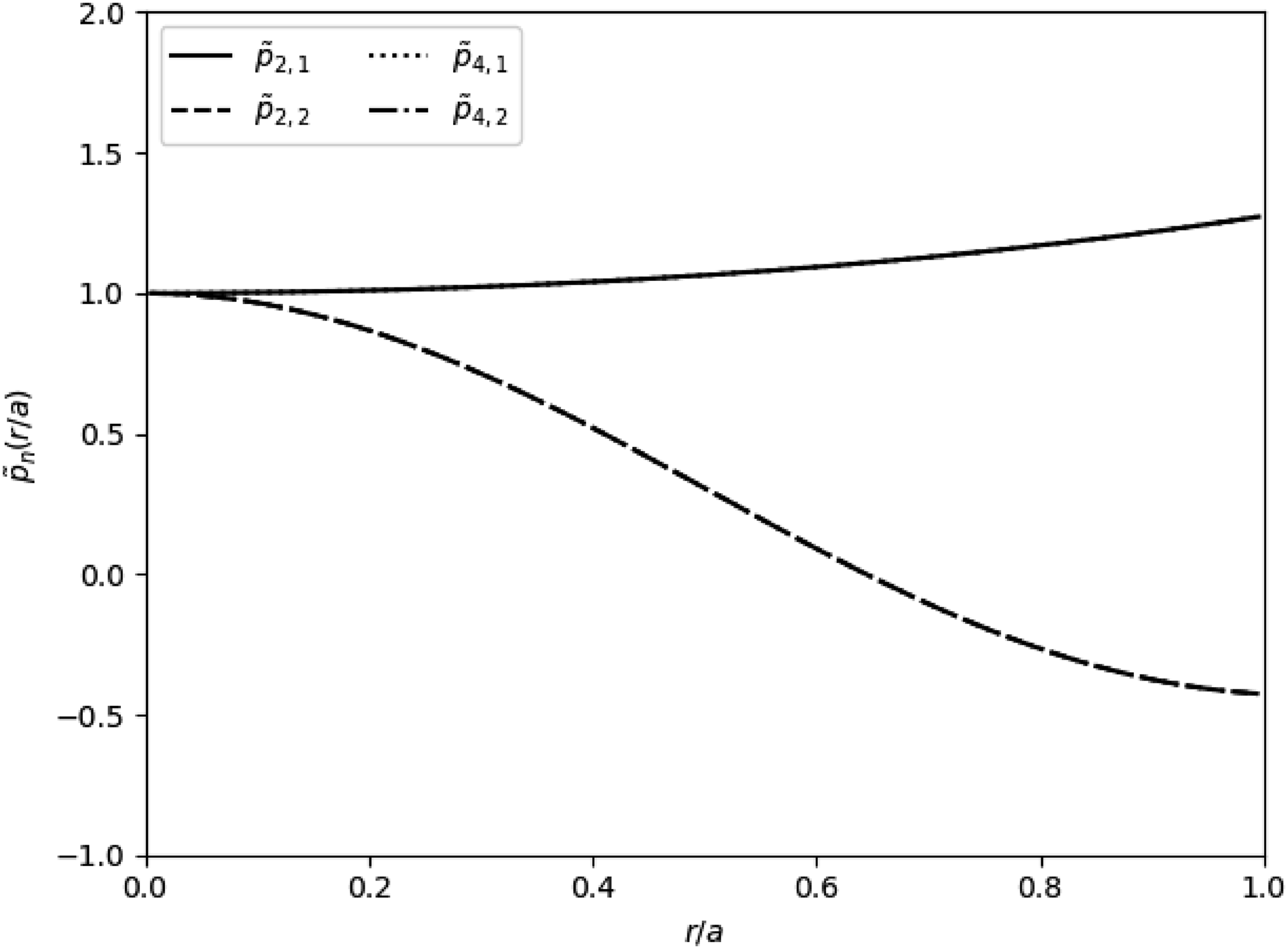
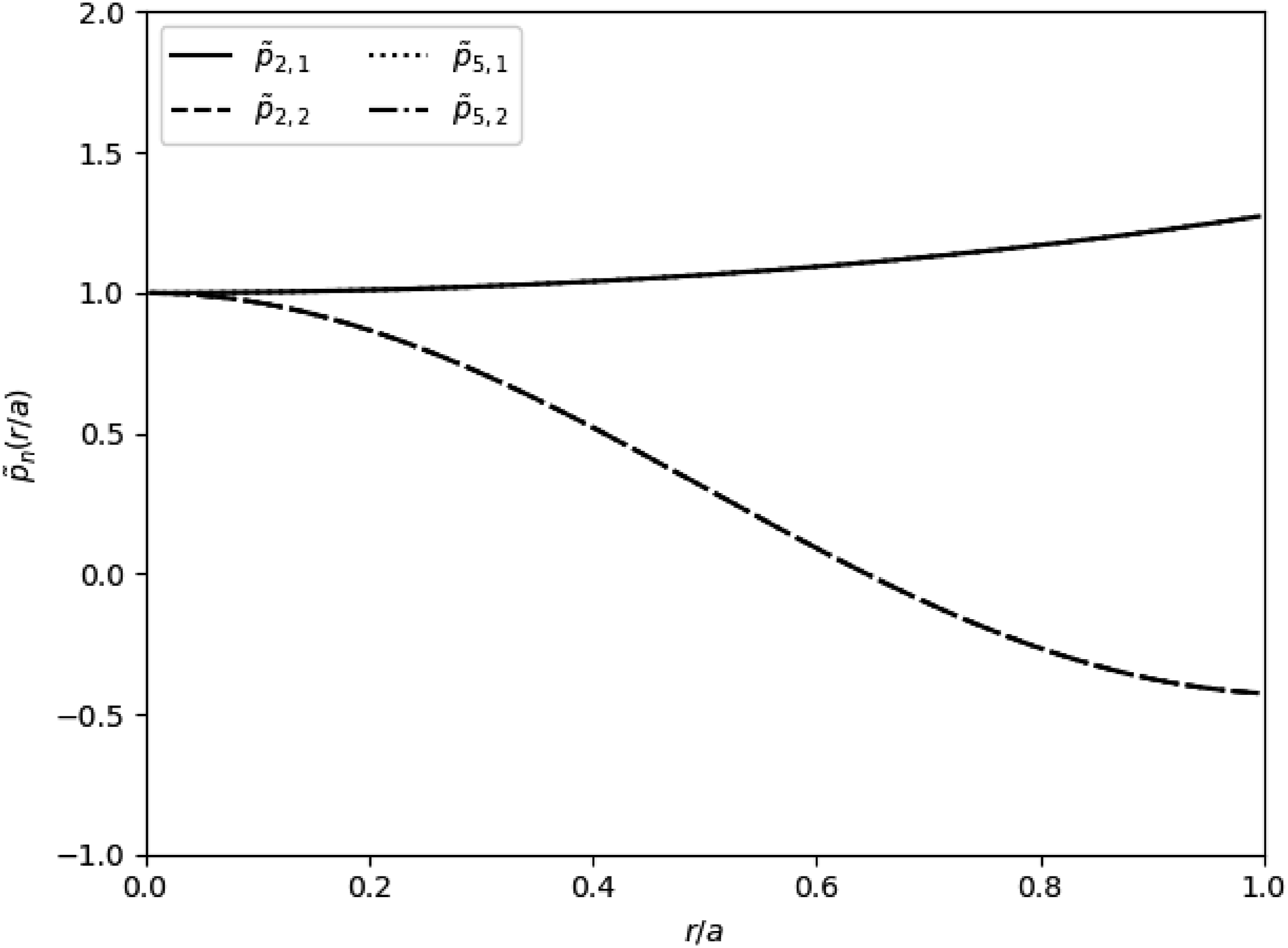
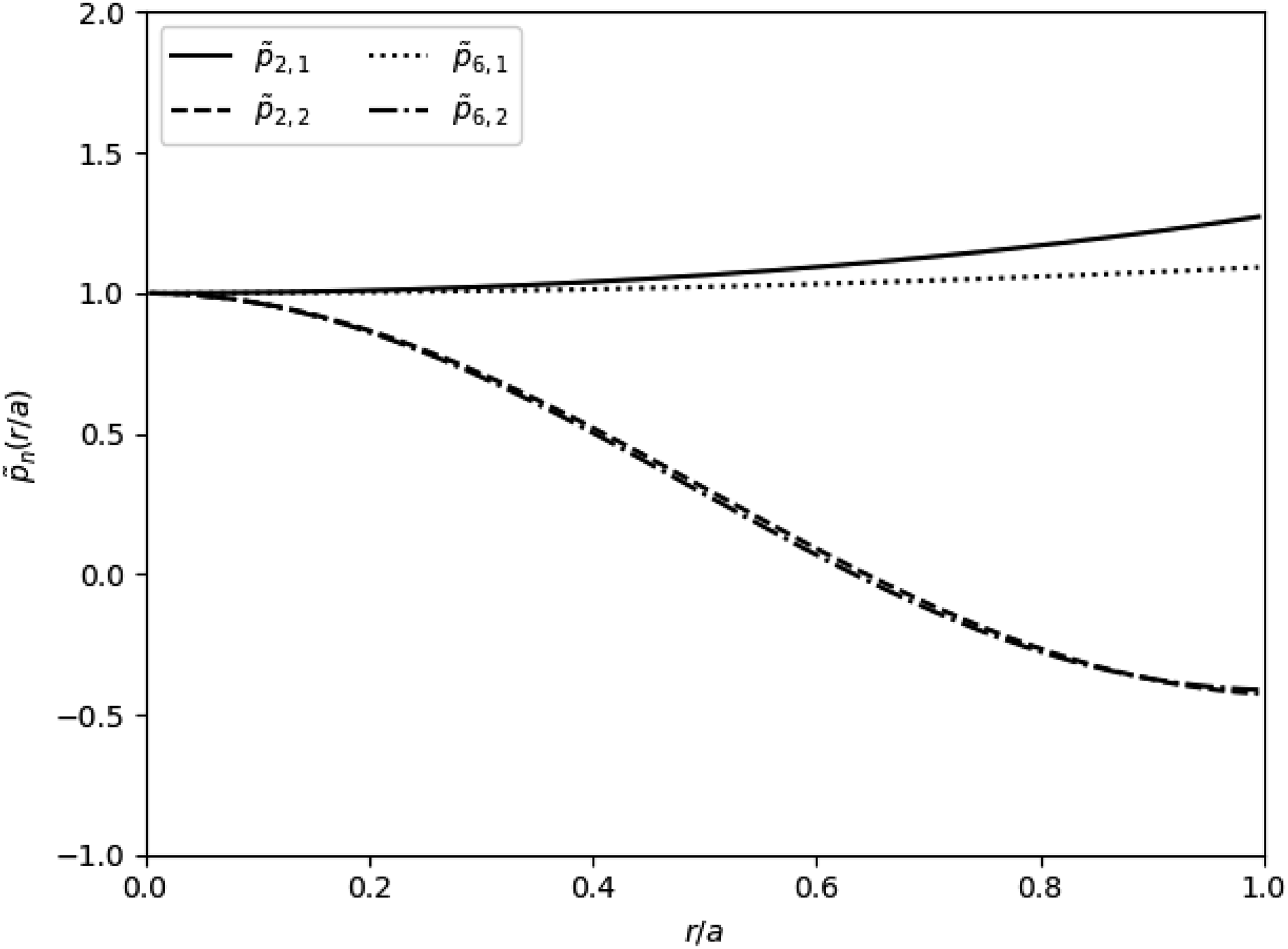
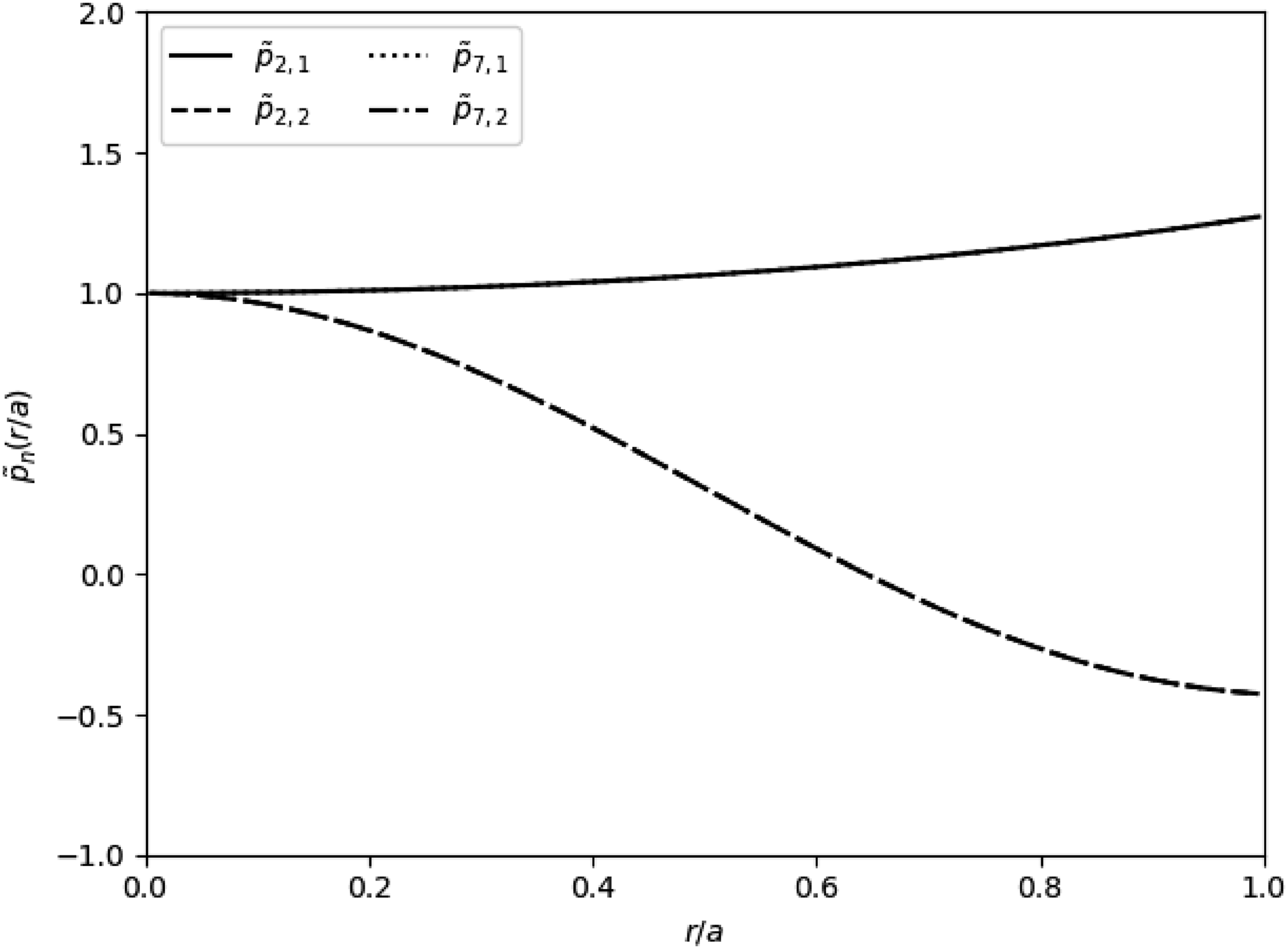
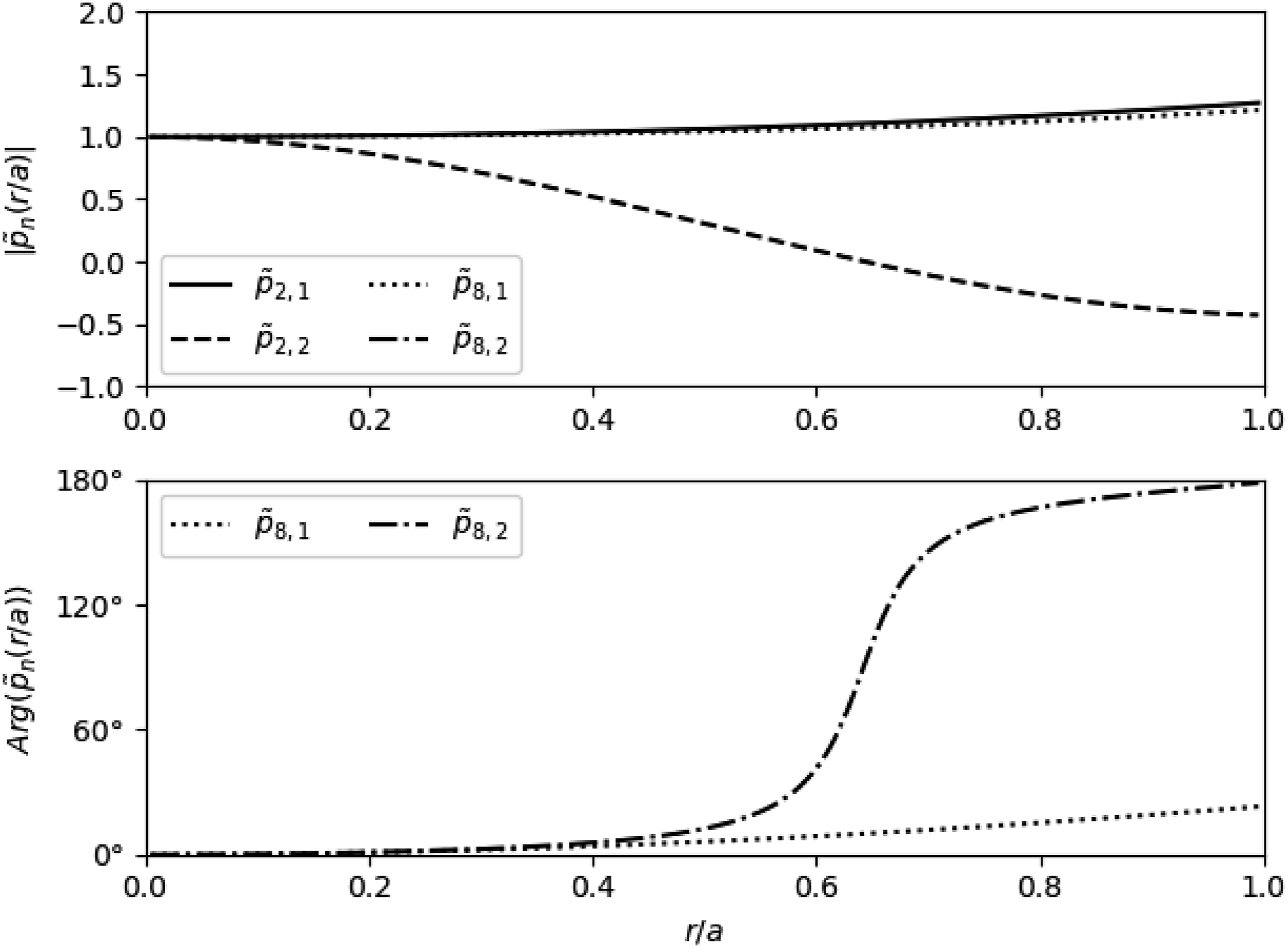
Comparison for the fundamental mode of the waveforms for the pressure spectrum versus dimensionless radius for: (A) purely acoustic waves without swirl ; (B) acoustic-vortical waves with low Mach number swirl ; (c) acoustic-vortical waves with moderate Mach number swirl . The parameters are indicated in Table 8. For the low Mach number approximation (B) is not accurate, as shown by the difference from the moderate Mach number case (c).
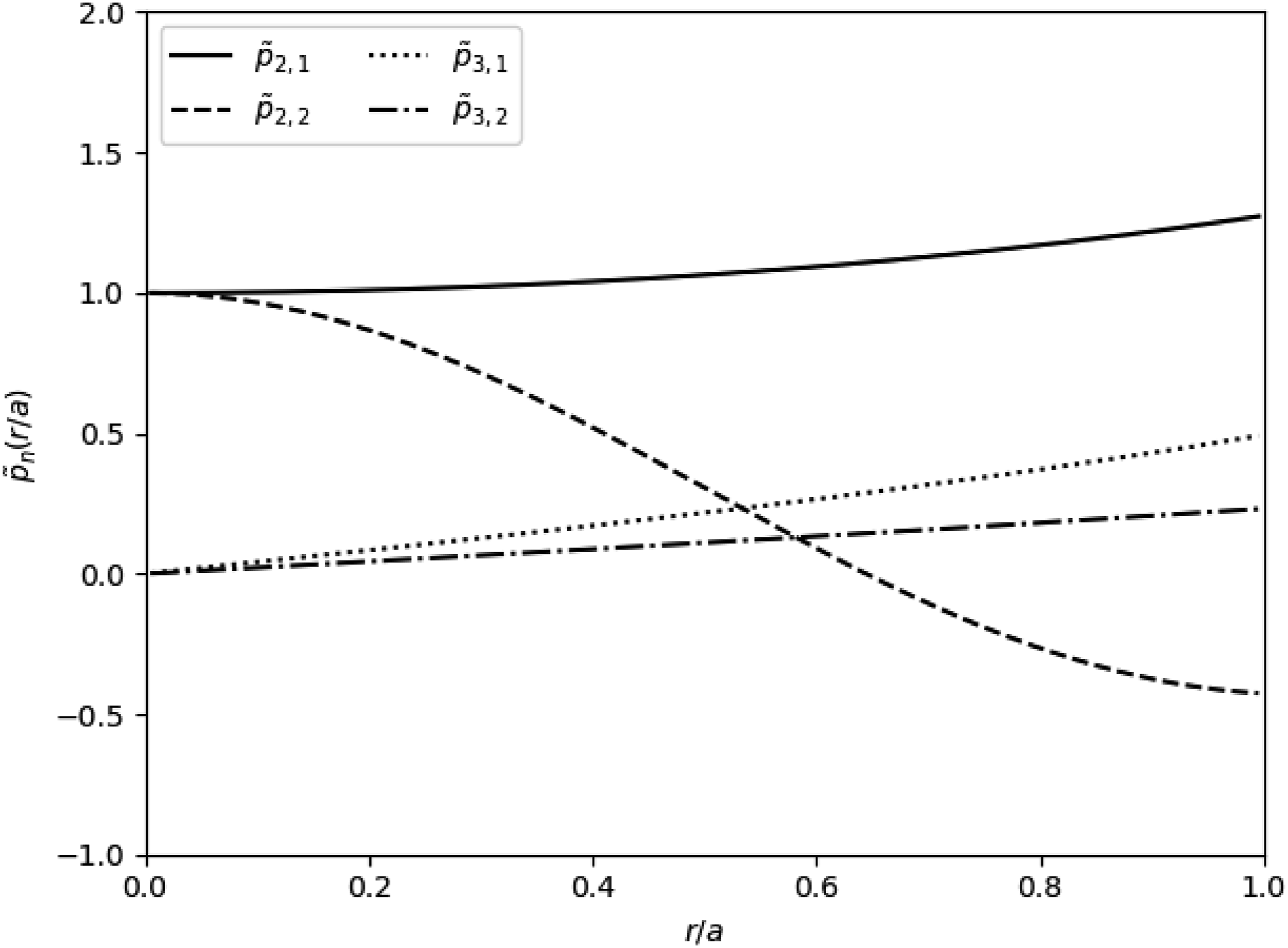
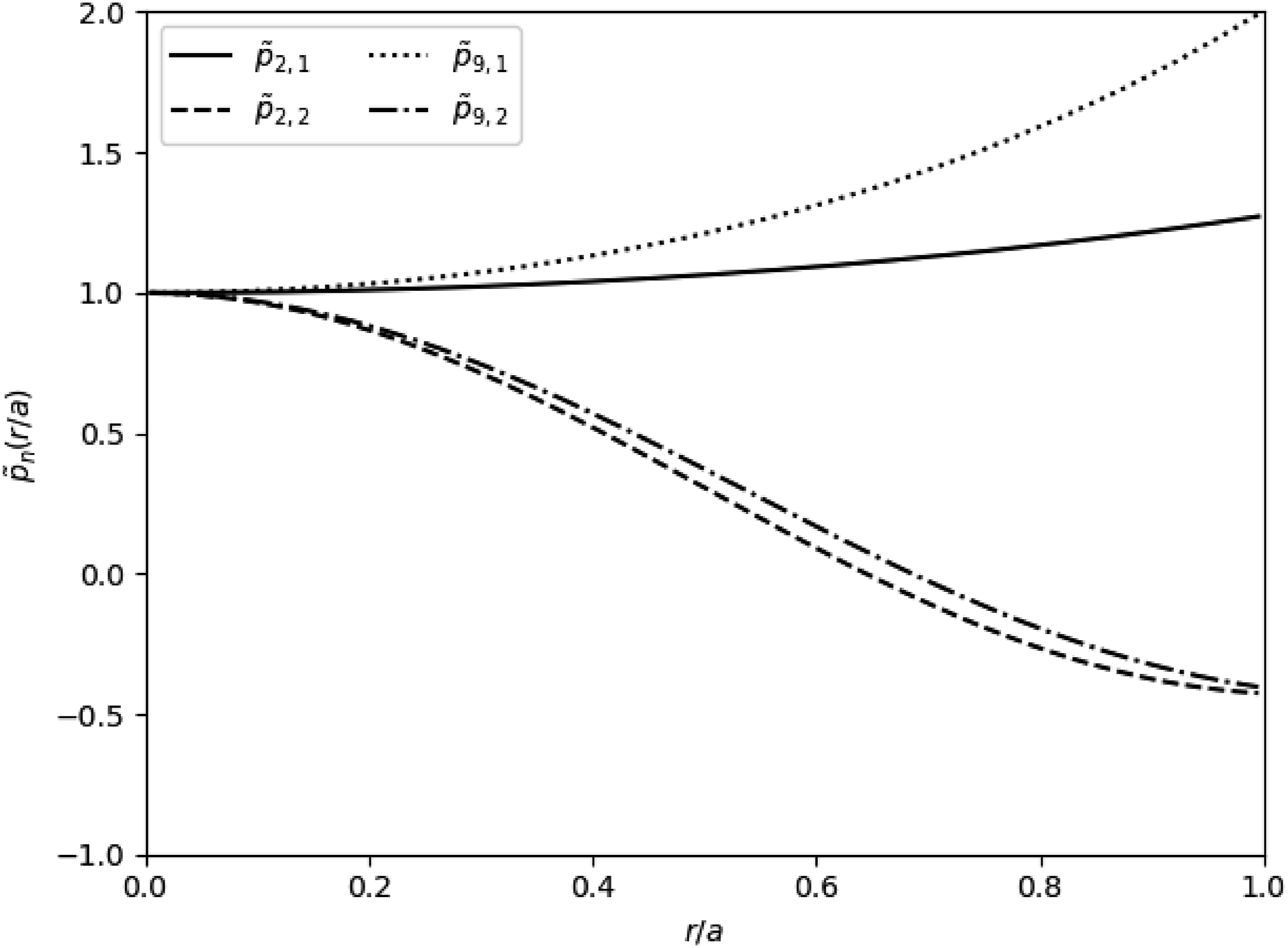
Pressure perturbation spectrum versus dimensionless radial distance for acoustic-vortical waves with moderate swirl Mach number, comparing the baseline case with for second azimuthal mode with two radial modes are illustrated for each.
As Figure 3 comparing baseline case with for dimensionless axial wave number instead of .
As Figure 3 comparing baseline case with for dimensionless axial velocity instead of .
As Figure 3 comparing baseline case with for maximum swirl Mach number instead of .
As Figure 3 comparing baseline case with for dimensionless frequency instead of .
As Figure 3 comparing baseline case with for resistive specific impedance instead of .
As Figure 3 comparing baseline case with for resistive specific impedance instead of .
As Figure 3 comparing baseline case with for resistive specific impedance instead of .
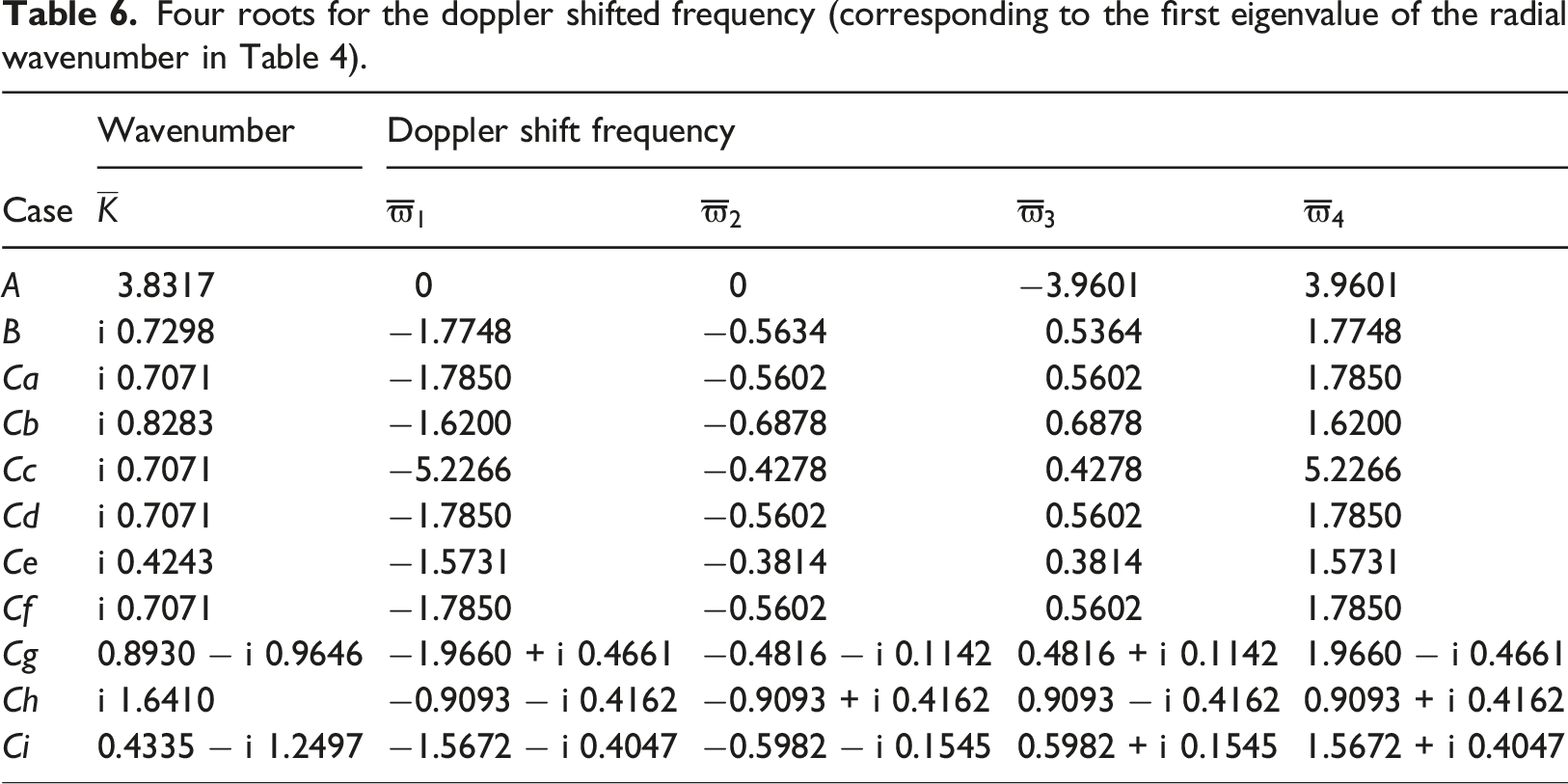
Four roots for the doppler shifted frequency (corresponding to the first eigenvalue of the radial wavenumber in Table 4).
Case
Wavenumber
Doppler shift frequency
A
3.8317
0
0
−3.9601
3.9601
B
i 0.7298
−1.7748
−0.5634
0.5364
1.7748
Ca
i 0.7071
−1.7850
−0.5602
0.5602
1.7850
Cb
i 0.8283
−1.6200
−0.6878
0.6878
1.6200
Cc
i 0.7071
−5.2266
−0.4278
0.4278
5.2266
Cd
i 0.7071
−1.7850
−0.5602
0.5602
1.7850
Ce
i 0.4243
−1.5731
−0.3814
0.3814
1.5731
Cf
i 0.7071
−1.7850
−0.5602
0.5602
1.7850
Cg
0.8930 − i 0.9646
−1.9660 + i 0.4661
−0.4816 − i 0.1142
0.4816 + i 0.1142
1.9660 − i 0.4661
Ch
i 1.6410
−0.9093 − i 0.4162
−0.9093 + i 0.4162
0.9093 − i 0.4162
0.9093 + i 0.4162
Ci
0.4335 − i 1.2497
−1.5672 − i 0.4047
−0.5982 − i 0.1545
0.5982 + i 0.1545
1.5672 + i 0.4047
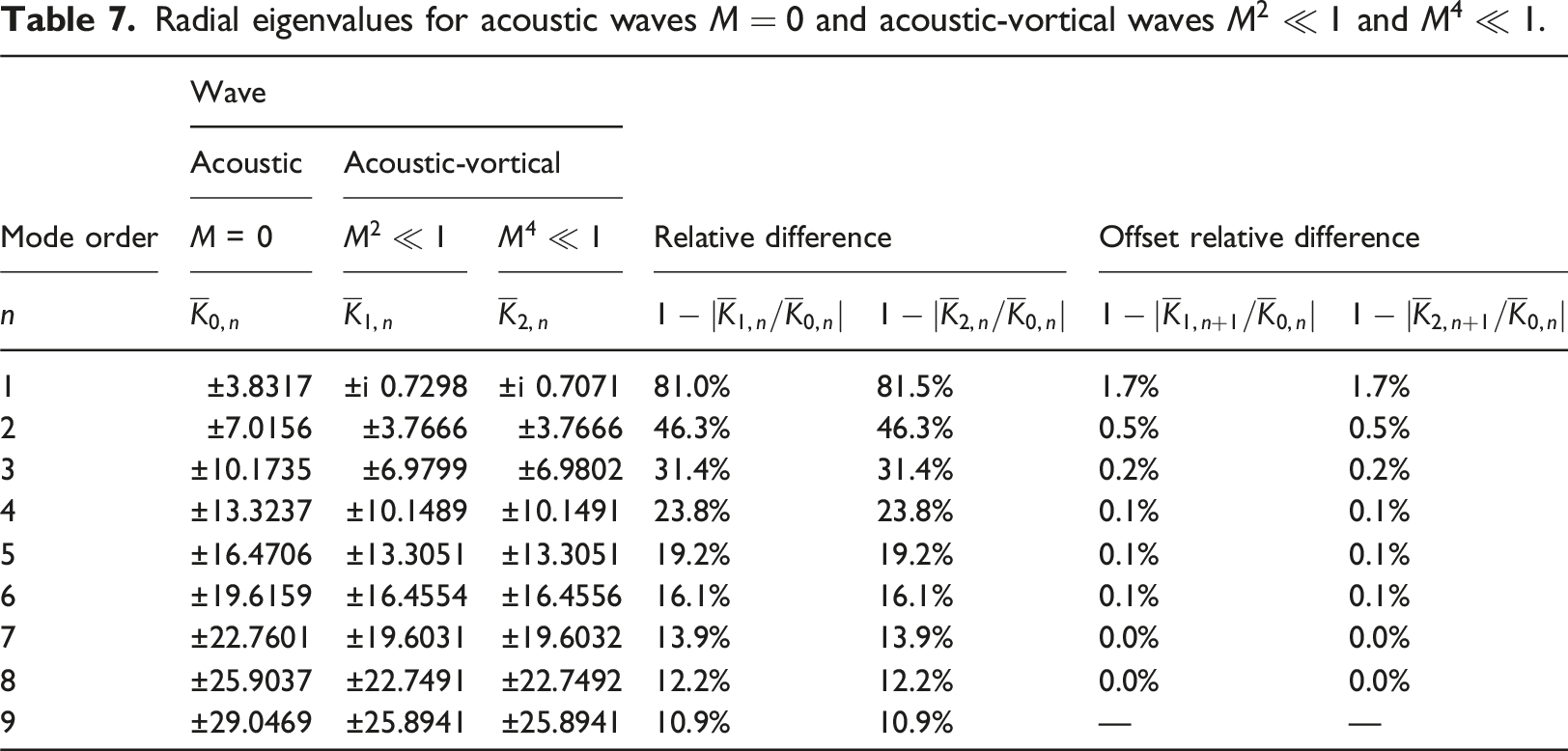
Radial eigenvalues for acoustic waves and acoustic-vortical waves and .
Mode order
Wave
Relative difference
Offset relative difference
Acoustic
Acoustic-vortical
M = 0
n
1
±3.8317
±i 0.7298
±i 0.7071
81.0%
81.5%
1.7%
1.7%
2
±7.0156
±3.7666
±3.7666
46.3%
46.3%
0.5%
0.5%
3
±10.1735
±6.9799
±6.9802
31.4%
31.4%
0.2%
0.2%
4
±13.3237
±10.1489
±10.1491
23.8%
23.8%
0.1%
0.1%
5
±16.4706
±13.3051
±13.3051
19.2%
19.2%
0.1%
0.1%
6
±19.6159
±16.4554
±16.4556
16.1%
16.1%
0.1%
0.1%
7
±22.7601
±19.6031
±19.6032
13.9%
13.9%
0.0%
0.0%
8
±25.9037
±22.7491
±22.7492
12.2%
12.2%
0.0%
0.0%
9
±29.0469
±25.8941
±25.8941
10.9%
10.9%
—
—
Acoustic-vortical wave equation
The starting point is the acoustic-vortical wave equation for the pressure perturbation of an axisymmetric isentropic mean flow with shear and swirl. The particular case of an homentropic uniform axial mean flow with rigid body swirl leads to a radial dependence specified by a generalized Bessel differential equation, to lowest order in the swirl Mach number.
Perturbation of an axisymmetric sheared and swirling mean flow
The starting point is the equations of fluid mechanics in cylindrical coordinates, namely the equation of continuity:
the inviscid momentum equation:
and the equation of state (2.3a) in isentropic form:
where is the velocity, the mass density, P the pressure, C the adiabatic sound speed in Eq. (2.3b) and:
is the exact non-linear material derivative involving partial differentiation with regard to time and to the cylindrical coordinates . Consider an axisymmetric mean flow with arbitrary shear axial velocity and swirl with non-uniform angular velocity , given in cylindrical coordinates by:
This mean flow is incompressible as defined by Eq. (2.6a):
and satisfies the momentum Eq. (2.2a) with a radial pressure gradient Eq. (2.2b) due to the centrifugal force. The equation (2.1) of continuity is satisfied by a mass density that is an arbitrary function of the radius.
The unsteady non-uniform perturbations of this mean flow may be designated acoustic-vortical waves. Since the mean flow depends only on the radius r, and not on time, axial or azimuthal coordinate, the pressure perturbation:
may be represented as: (i) a Fourier series with azimuthal wavenumber m; (ii-iii) double Fourier integral with frequency and axial wavenumber k. The dependence on the radius of the pressure perturbation spectrum of an acoustical-vortical wave is specified10,12 by a second order differential equation:
with the coefficients given by:
involving the Doppler shifted frequency:
that also appears in:
The derivation of the wave Eq. (2.8) assumes an isentropic mean flow and thus involves the adiabatic sound speed
that generally varies radially.
The first simplification of the acoustic-vortical wave Eq. (2.8) is for an homentropic mean flow when the equation (2.3a) of state simplifies to Eq. ((2.13a):
where it was substituted in Eq. (2.6b) leading to Eq. (2.13b). The latter Eq. (2.13b) simplifies Eq. (2.11) to Eq. (2.14a):
and the coefficients in Eq. (2.9a,b) respectively to Eq. (2.14b,c):
The acoustic-vortical wave Eq. (2.8) thus has simplified coefficients in Eq. (2.10, 2.14a–c) in the homentropic case.
Generalized bessel differential equation for the radial dependence
A further simplification is a uniform axial flow in Eq. (2.15a) with rigid body swirl in Eq. (2.15b) when Eq. (2.14a, b) simplify to Eq. (2.15c, d):
and the remaining coefficient of the wave Eq. (2.14c) also simplifies to:
Substitution of Eq. (2.15d–e) in Eq. (2.8) leads to:
for the radial dependence of the pressure perturbation spectrum of an acoustic-vortical waves in an uniform axial flow with rigid body swirl where prime denotes derivative with regard to r. The assumption of homentropic mean flow specifies the radial dependence of the pressure (2.17b) and mass density (2.17d) where Eq. (2.17a) and Eq. (2.17c) are the respective values on axis:
The adiabatic sound speed in Eq. (2.12) is given by Eq. (2.18b) where Eq. (2.18a) is the sound speed on axis:
The minus sign in Eq. (2.18b) implies that the critical flow condition of sound speed equal to swirl velocity in Eq. (2.18c) corresponds to the critical velocity in Eq. (2.18d) beyond which homentropic flow is impossible:
if the minus sign in Eq. (2.18b) was replaced by the positive sign there would be no critical velocity. Thus the sound speed in Eq. (2.19b) is constant only for swirl with low Mach number in Eq. (2.19a):
For example the coefficient in Eq. (2.15d) is given by:
Thus the sound speed may be taken as constant and equal to the value on axis in Eq. (2.18b) to lowest order of Eq. (2.18a) in the swirl Mach number of Eq. (2.19a), and becomes non-uniform of Eq. (2.19b) to next order for moderate swirl Mach number given by Eq. (2.21a). With this approximation the coefficient in Eq. (2.15d) is given by Eq. (2.21b) in terms of the swirl Mach number:
In the coefficient of Eq. (2.15e) the last term in square brackets of Eq. (2.21c) is as follows from Eq. (2.18b):
hence in the coefficient of Eq. (2.15e), that appears in the second square brackets in Eq. (2.16), the last term of Eq. (2.21c) may be suppressed; also bearing in mind that in the remaining terms in Eq. (2.15e) the local sound speed appears only in the combination:
in the first two terms on the r.h.s of Eq. (2.15e) the sound speed may be replaced by the constant value on axis :
omitting higher order terms scaling like , and retaining only terms.
In the absence of swirl given by Eq. (2.22a), that is for a uniform axial flow the wave equation (2.16) reduces Eq. (2.22b) to a Bessel equation:
for sound waves with radial wavenumber:
For an incompressible fluid defined by Eq. (2.24a) the Bessel equation (2.24b) is regained:
for vortical waves with radial wavenumber:
For a compressible fluid in the presence of swirl the radial dependence in Eq. (2.16) in the wave equation with coefficients given by Eq. (2.21b; 2.21e) coincides with a Bessel equation (2.26b) only if the low Mach number swirl approximation of Eq. (2.26a) is made:
and the radial wavenumber is given by:
The low Mach number swirl approximation Eq. (2.26a) requires the tangential velocity to be small compared with the sound speed and is violated asymptotically for large radius .
The Bessel differential equation Eq. (2.26b) Eq. (2.28c) of order m for the pressure perturbation in Eq. (2.28b) has16,20,31 dimensionless variable defined by Eq. (2.28a):
and applies (Table 1) in: (i, ii) the case A of purely acoustic (equations 2.22a, b; 2.23) or case A′ of purely vortical (equations 2.24a,b; 2.25) waves; (iii) also in the case B of their coupling as acoustic vortical waves (Eqs. (2.26)ab, b; 2.27) for low swirl Mach number (Eq. (2.26a)) limited to small radius 2. Relaxing the restrictions (i) to (iii), that is for coupled acoustic-vortical waves in an uniform flow with rigid body swirl leads to lowest order of Eq. (2.21a) in the swirl Mach number - Eq. (2.19a) leads (case C in Table 1) to the wave equation of Eq. (2.8) with Eqs. (2.21b, e) that is the generalized Bessel differential equation (2.29):
where the degree is given by:
In the case of low (2.31a) swirl Mach number (2.19a) the sound speed (2.19b) is constant (2.31b), the degree (2.30) may be taken equal to zero (2.31c) and the generalized Bessel differential equation (2.29) reduces to the original Bessel differential equation (2.31c):
for which there are solutions in terms of the original Bessel and Neumann (2.32a) or Hankel (2.32b) functions:
in the literature on cylindrical waves16,20,31 including acoustic-vortical waves with low Mach number swirl.17 If the swirl Mach number is taken into account to second order - Eq. (2.19a, 2.21a) then the radial dependence of the acoustic-vortical waves is specified by the generalized Bessel differential equation (2.29) with degree and order m. Since the low Mach number swirl approximation fails for large radius the radiation field may be calculated as the asymptotic solution of Eq. (2.29) to order given by Eq. (2.21a).
As the term that distinguishes the generalized Eq. (2.29) from the original Bessel differential equation (2.28c) is negligible, and thus in both cases the origin is a regular singularity; physically this means that for small radius the rigid body swirl velocity is small compared with the stagnation sound speed and the acoustic-vortical waves are similar to sound waves. In contrast as the term becomes dominant and the asymptotic solution of the generalized Bessel equation is quite different8 from that of the original Bessel equation: (i) the latter or original Bessel equation has an irregular singularity of degree 1, that scales as with constant real or complex α; (ii) the former or generalized Bessel equation has an irregular singularity of degree 2, that is scales as where β is again a constant. Physically for large radius the swirl velocity diverges and dominates the uniform axial velocity, so that the acoustic-vortical waves are dominated by the vortical mode; the acoustic oscillations can be suppressed, and the wave field becomes monotonic diverging signalling the instability of the mean flow. The transition between the ‘acoustic’ regime for small radius and ‘vortical’ regime for large radius is specified by the solutions of the generalized Bessel differential equation as specified by: (i) a linear combination of generalized Bessel and Neuman functions10 specified by power series (with a logarithmic term in the case of the Neumann function) that converge for finite radius; (ii) a linear combination of generalized Hankel functions,9 whose asymptotic expansions can be related to the generalized Bessel and Neumann functions. The mathematical results concerning the solution of the generalized Bessel equation (29) are quoted from the literature,8,18 so that the main body of the paper concentrates on the physical aspects, namely: (i) the properties of acoustic-vortical waves; (ii) the relation with the stability of the mean flow; (iii) the plotting of waveforms illustrating (i) and (ii). The solution around the origin is the starting point for the comparison of decoupled and coupled acoustic-vortical waves.
Acoustic-vortical waves in ducted flows
The initial and asymptotic solutions of the generalized Bessel equation specify the radial dependence of the pressure spectrum of acoustic-vortical waves for uniform stream with rigid body swirl, either in unbounded free space or in cylindrical or annular nozzles; in the latter case the rigid or impedance wall boundary conditions specify the eigenvalues for the radial wavenumber, and hence the natural frequencies and eigenfunctions or waveforms.
Cylindrical nozzles and generalized bessel functions
The radial dependence of the pressure spectrum in Eq. (2.7) of acoustic-vortical waves in a uniform stream of velocity U with swirl with constant angular velocity is specified by the solution of a generalized Bessel equation (2.29) with variable defined by Eq. (2.28a) where K is the radial wavenumber in Eq. (2.27), the integral order is the azimuthal wavenumber and the degree in Eq. (2.30) involves the angular velocity and stagnation sound speed . In the general integral the generalized Neumann function is singular at the origin and must be omitted for a cylindrical duct leaving only the generalized Bessel function. The generalized Bessel function is specified 8,10 by the solution of the differential equation (2.29) as an ascending power series of s around the regular singularity at the origin10,15,27,28 that converges for all finite values . In the case of acoustic-vortical waves the order ν = m is the integer azimuthal wavenumber and the variable of Eq. (2.28a) and degree of Eq. (2.30) lead to the pressure perturbation given by Eq. (3.1b)
where C+ is an arbitrary function of the frequency ω, axial k and azimuthal m wavenumber and the generalized Bessel function is used. The product in the last factor of Eq. (3.1b) is omitted or replaced by unity in the case . If the azimuthal wavenumber is positive the solution finite at the origin is ; if it is negative the solution finite at the origin . Hence in both cases the solution finite at the origin in Eq. (3.1a, b) involves . For simplicity the modulus will be omitted in the sequel. The solution (3.1b) holds in a cylinder in Eq. (3.1a) also without swirl or for an incompressible mean flow , when the last factor in square brackets is unity, leading back to the original Bessel function in Eqs. (3.1c, d):
that applies respectively for decoupled (A) acoustic or (A′) vortical waves and for (B) acoustic-vortical waves with low-Mach number swirl, but not for (C) acoustic-vortical waves with moderate Mach number swirl.
An alternative form of the generalized Bessel function leading to another representation for the pressure spectrum is given8,10 by Eq. (3.2c):
where is the Gamma function.11,32 The solution of Eq. (3.2c) applies only to coupled - Eq. (3.2a, b) acoustic-vortical waves to second order in the swirl Mach number. For the original Bessel function, and hence for decoupled acoustic or vortical waves, the series (3.1b) without last term has: (i) alternating sign for real wavenumber corresponding to wave oscillations; (ii) fixed sign for imaginary wavenumber that correspond to monotonic solutions. In the case of acoustic-vortical waves the last factor in Eq. (3.1b) the generalized Bessel function: (a) is positive for imaginary radial wavenumber so that the solution (ii) remains monotonic; (b) for real axial wavenumber will be negative at least for large , causing another alternating sign and possibly leading to a monotonic instead of an (i) alternating solutions. Thus for imaginary radial wavenumber corresponding to cut-off modes, the decoupled or coupled acoustic and vortical waves are all monotonic. For real radial wavenumbers corresponding to cut-on modes the decoupled acoustic and vortical waves are oscillatory, but coupled acoustic-vortical waves may be monotonic for strong swirl, large azimuthal and radial wavenumbers.
This becomes apparent noting that: (i) for decoupled acoustic or vortical waves, corresponding to the original Bessel function in Eq. (3.1d), the variable is the square of the radial compactness - Eq. (2.28a), that is the product of the radius by the radial wavenumber, and leads to oscillating sign for real K and fixed sign for imaginary K; (ii) for coupled acoustic-vortical waves the variable of Eq. (3.3b) in the power series of Eq. (3.2c) is the square of the swirl Mach number in Eq. (3.3a) divided by two:
that does not depend at all on the radial wavenumber and is always positive. For sufficiently large all factors last in Eq. (3.1b) are negative leading to a positive sign for all subsequent terms of the series; the same conclusion can be drawn from Eq. (3.2c) noting that for sufficiently large j the Gamma function will have fixed sign. In particular the condition of Eq. (3.4a):
of sufficiently strong swirl - Eq. (3.4b) implies that the cut-on modes are monotonic because: (i) in (3.1b) all terms of the series have product of pairs of negative signs, and hence are positive; (ii) alternatively (3.2c) shows that all terms are positive because the Gamma functions are positive. Thus for sufficiently strong swirl defined by Eq. (3.4b) the cut-on coupled acoustic-vortical modes corresponding to real axial wavenumber are monotonic, whereas the decoupled acoustic and vortical modes would have been oscillatory. Thus there are three cases in the Table 2 concerning the radial dependence of acoustic-vortical waves: (α) cut-off modes with imaginary radial wavenumber are monotonic; (β) cut-on modes with radial wavenumber satisfying Eq. (3.4b) are oscillatory for azimuthal wavenumber and monotonic for ; (γ) if or then all cut-on modes with real axial wavenumber are monotonic. The transition to monotonic modes for cut-on acoustic-vortical waves when Eq. (3.4a) is met occurs for: (I, ii) larger azimuthal wavenumber and swirl angular velocity to the square ; (iii, iv) smaller axial wavenumber and stagnation sound speed both to the square. The effect of strong swirl in preventing wave oscillations will be further demonstrated by considering asymptotic solutions for large radius corresponding to dominant swirl Mach number (3.3a). Before the acoustic-vortical waves are considered in an annular nozzle involving the generalized Neumann function .8
Annular nozzles and generalized neumann functions
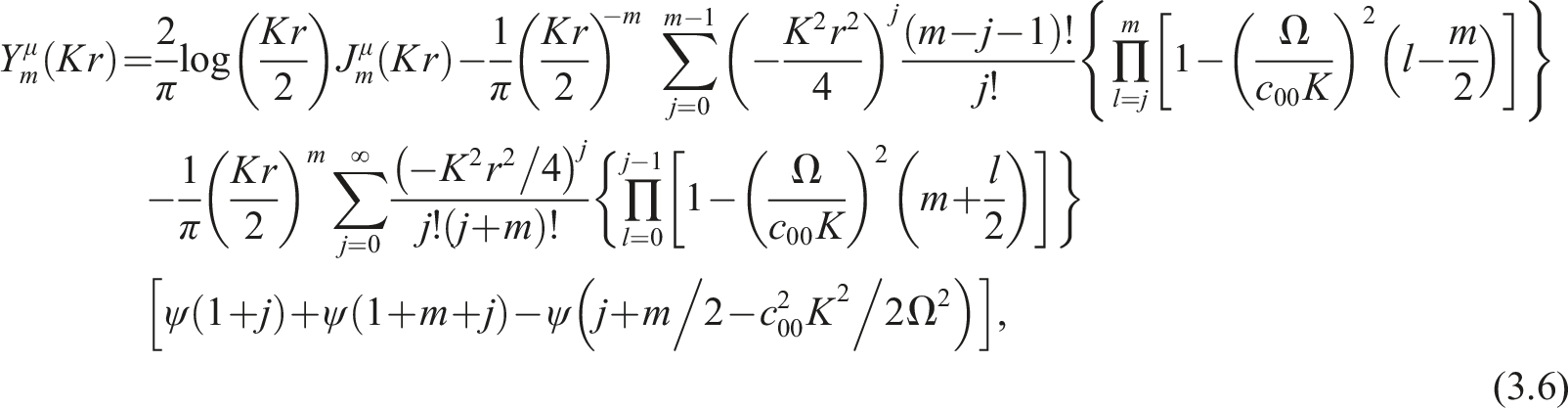
In the case of annular nozzles (3.5a) the acoustic pressure spectrum defined by Eq. (3.5b) involves also the generalized Neumann function8,10:
where do not depend on the radius. In the generalized Newmman function18 and in the present case of acoustic-vortical waves the variable - Eq. (2.28a) and degree - Eq. (2.30) specify the second term in the pressure perturbation spectrum of Eq. (3.5b):
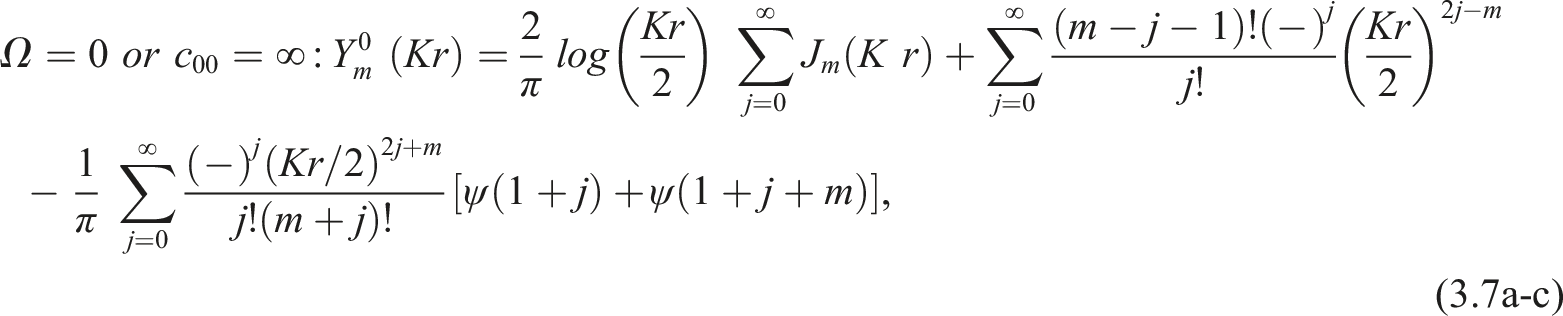
where ψ (…) denotes the digamma function.33,34 In the case of decoupled acoustic - Eq. (3.7a) or vortical - Eq. (3.7b) waves the factors in curly brackets reduce to unity and the pressure perturbation spectrum is specified by Eq. (3.7c):
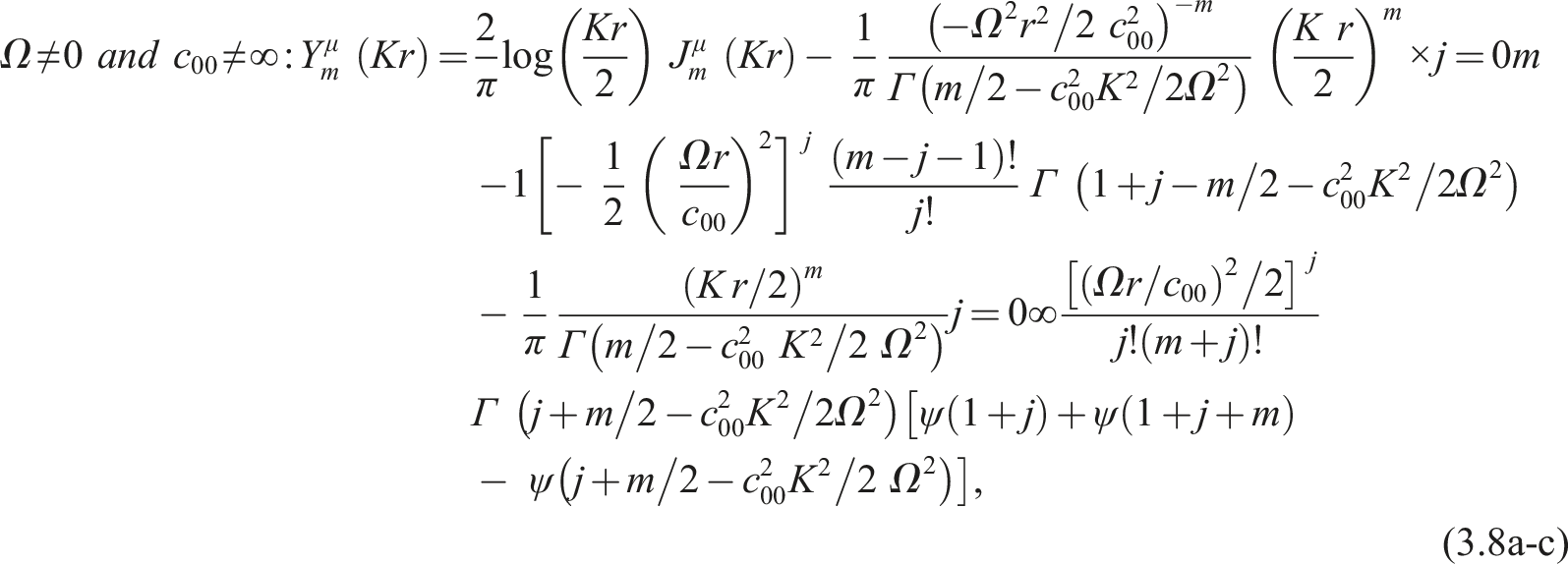
that is the original Neumann function.11,12 In the case of non-zero degree - Eq. (3.2a) and Eq. (3.8a) the products in the generalized Bessel - Eq. (3.1c) and Neumann - Eq. (4.6) functions may be replaced8,10 respectively by Gamma functions in Eq. (3.2c) and Eq. (3.8c):
Considering instead of a cylindrical - Eq. (3.1a) or annular - Eq. (3.5a) duct the exterior of a cylinder - Eq. (3.9a) the pressure perturbation is a linear combination - Eq. (3.9b) of generalized Hankel functions8 of two kinds:
where (C1, C2) are arbitrary constants. In the case of purely acoustic or vortical waves the asymptotic solution is specified by the original Hankel functions in Eq. (3.10) that have17,19 an algebraic decay as the inverse square root of distance:
with: (i) oscillatory behaviour for real radial wavenumber, corresponding to propagating waves; (ii) for imaginary radial wavenumber the stable/unstable monotonic term respectively decays/grows as an exponential of the distance. In the case of acoustic-vortical waves: (i) it is still true that the wave field is monotonic for imaginary radial wavenumber due to the fixed signs in all terms appearing in the coefficients of the power series (3.1b); (ii) it is also monotonic for real axial wavenumber with sufficiently strong swirl, for example Eq. (3.4b). The latter case (ii) of monotonic pressure for acoustic-vortical waves with real axial wavenumber shows that asymptotic scalings like (3.10) cannot possibly hold. The reason is that: (i) for small radius in the sense of small swirl Mach number - Eq. (3.3a) the waves are predominantly acoustic, with the radial compactness- Eq. (2.28a) as the variable; (ii) for large radius the wave variable is actually given by Eq. (3.3b) leading to a different asymptotic solution as shown next.
Asymptotic pressure spectrum for large radius
Two linearly independent asymptotic solutions of the generalized Bessel equation are the generalized Hankel functions of two kinds, that specify the pressure perturbation spectrum of coupled acoustic-vortical waves for large radius. It follows that apart from one exceptional case of power-law scaling the pressure perturbation spectrum grows as an exponential of one-half of the square of the swirl Mach number, implying an amplification due to the coupling of compressibility and vorticity.
Generalized Hankel functions of two kinds as asymptotic solutions
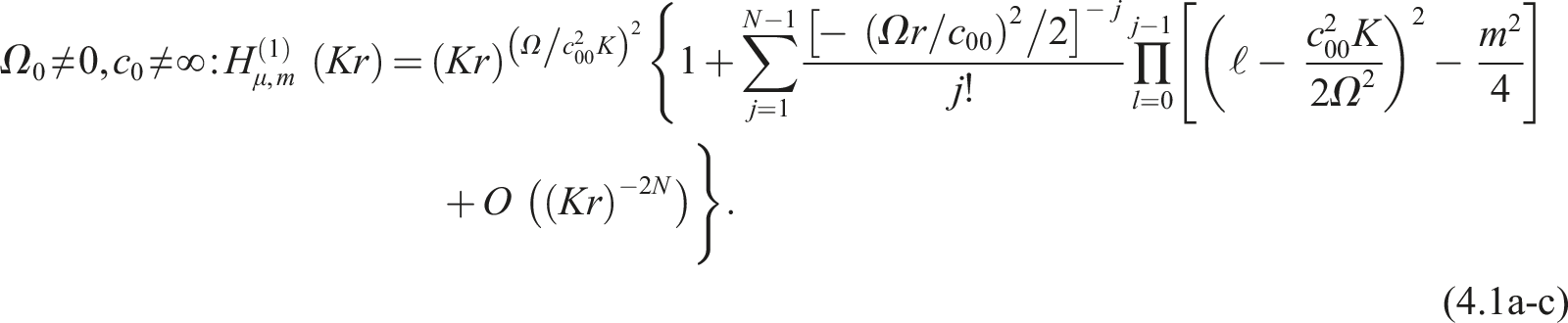
The generalized Bessel differential equation (2.29) has one asymptotic solution devoid of exponentials, namely9,10 the generalized Hankel function of the first kind of Eq. (4.1c) for non-zero degree - Eq. (4.1a, b):
The asymptotic solution of Eq. (4.1c) includes not only the leading power but also all the following terms to arbitrary order. The asymptotic wave field of Eq. (4.1c) is devoid of exponentials and real for cut-on modes with real axial wavenumbers. For cut-off modes with imaginary axial wavenumber - Eq. (4.2a) the leading term is Eq. (4.2b):
and has an imaginary part. The acoustic variable in Eq. (2.28a) appears only in the leading term of the asymptotic expansion - Eq. (4.2a), and otherwise only the swirl variable of Eq. (3.3b) appears in all the subsequent descending powers.
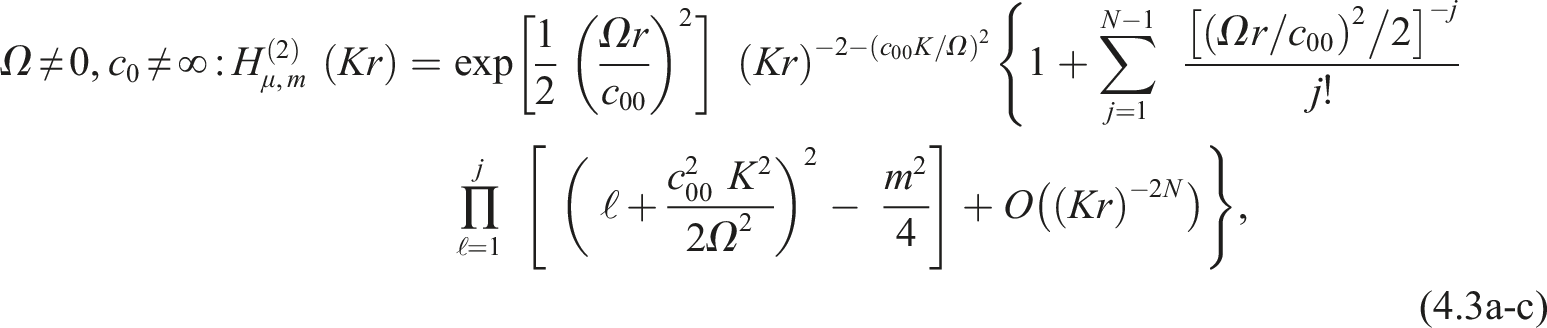
The other linearly independent asymptotic solution of the generalized Bessel equation (2.29) is8 the generalized Hankel function of the second kind - Eq. (4.3c) for non-zero degree - Eq. (4.3a,b):
that grows in amplitude like an exponential of one-half of the square of the swirl Mach number - Eq. (3.3a). This asymptotic scaling of acoustic-vortical waves is monotonic and like an exponential of the square of the distance; this is a stronger growth than the exponential of the distance for unstable, monotonic decoupled acoustic or vortical waves of Eq. (3.10) with imaginary radial wavenumber. Thus the coupling of compressibility and vorticity leads to a larger magnitude of pressure perturbations than for decoupled acoustic or vortical waves; the enhanced amplitude of coupled acoustic-vortical waves applies in all cases, except when the generalized Hankel function of the second kind - Eq. (4.3a-c) is absent in Eq. (3.9b).
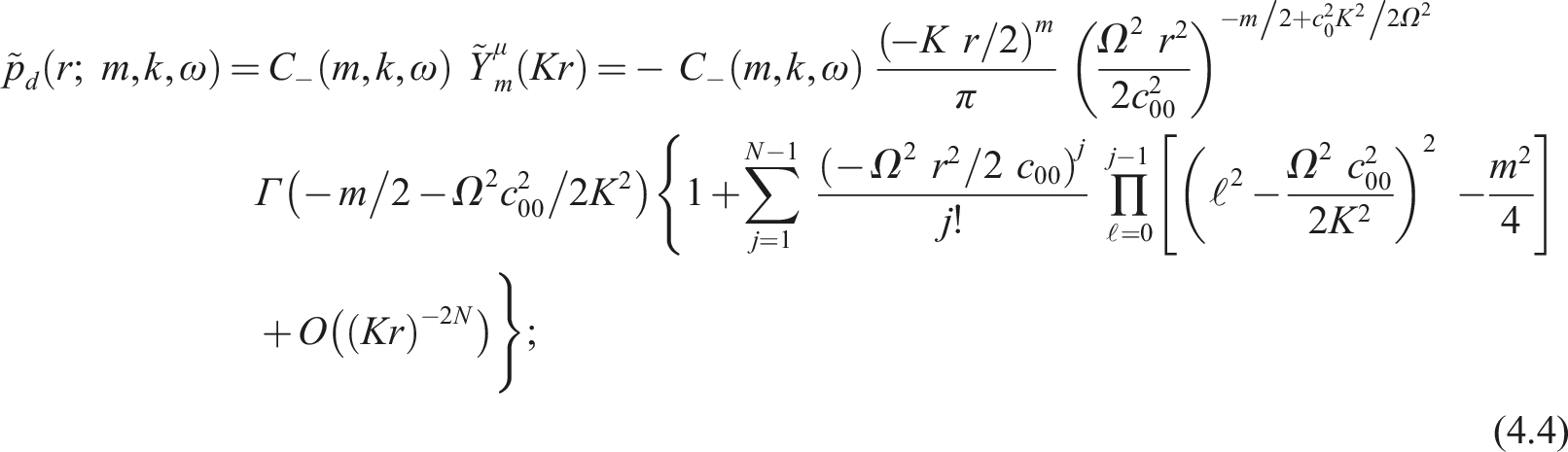
The strong exponential growth - Eq. (4.3c) of the magnitude of pressure perturbations is excluded only for the generalized Hankel function of the first kind - Eq. (4.1c). The latter coincides to within a constant multiplying factor with the modified generalized Neumann function that is a particular combination of generalized Bessel and Neumann functions.8 It follows that the pressure perturbation spectrum of coupled acoustic-vortical waves scales asymptotically as power law only when it corresponds to the modified generalized Neumann function:
This implies a particular combination - Eq. (4.5) of generalized Bessel and Neumann functions:
This combination can occur for coupled acoustic-vortical waves only in a particular case of annular nozzle - Eq. (3.5a, b).
Radial power-law or square exponential scaling
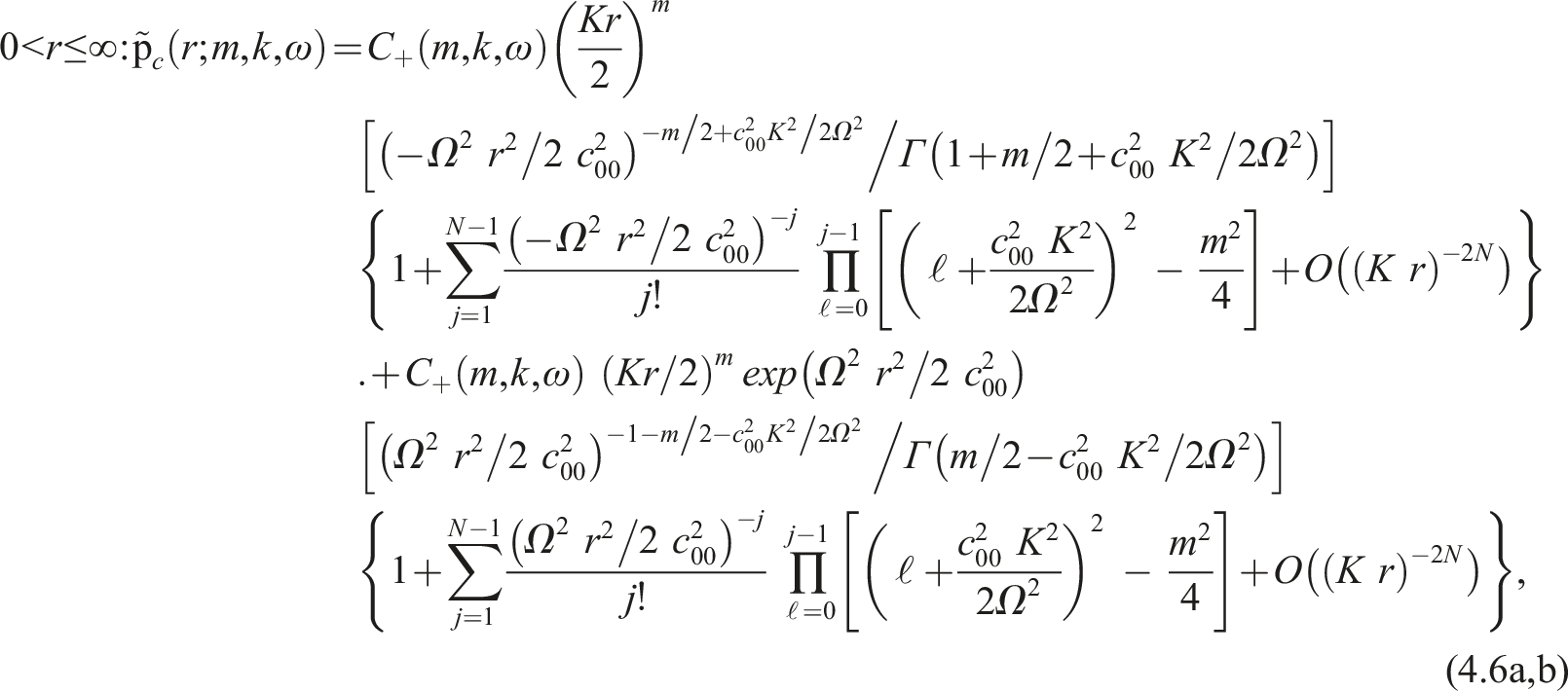
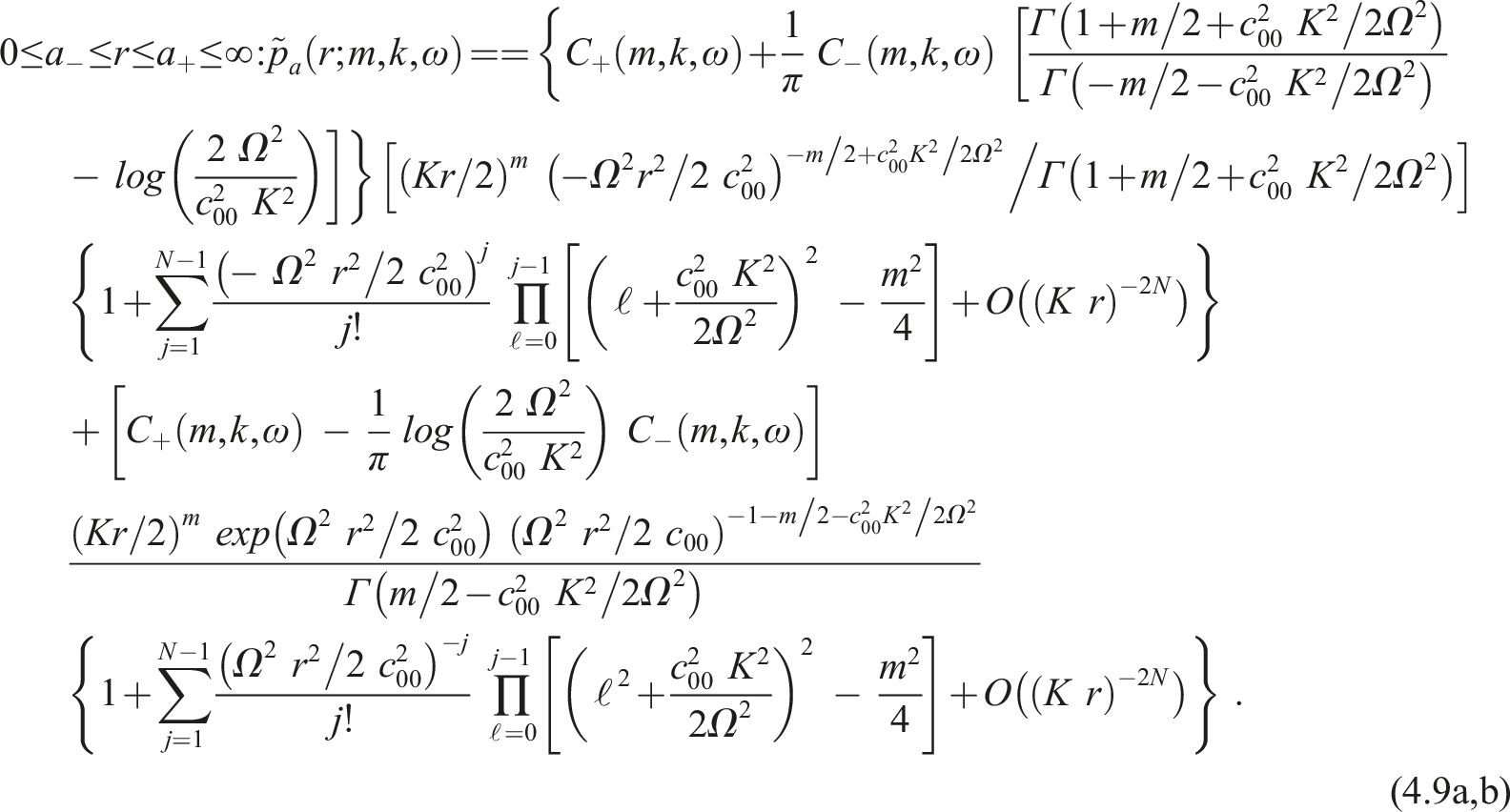
The power law asymptotic radial scaling in Eq. (4.4) is not possible in a cylindrical nozzle - Eq. (3.1a) for which only the generalized Bessel function appears - Eq. (3.1b). The asymptotic pressure perturbation spectrum of coupled acoustic-vortical waves - Eq. (3.1b) for large radius is given in this case of a cylindrical nozzle - Eq. (3.1a) by the asymptotic form of the generalized Bessel function as a linear combinations of Hankel functions of two kinds9,10 leading to:
the pressure perturbation spectrum in Eq. (4.6b) of coupled acoustic-vortical waves in a cylindrical nozzle or in free space asymptotically for large radius - Eq. (4.6a).
In the case of an annular nozzle- Eq. (3.5a) the pressure perturbation spectrum of coupled acoustic-vortical waves of Eq. (3.5b) also involves the generalized Neumann function. The relation8 with the generalized Bessel and modified generalized Neumann function:
May be substituted in Eq. (3.5b):
Thus the pressure perturbation spectrum of coupled acoustic-vortical waves is given by Eq. (4.9b) asymptotically for large radius in an annular nozzle - Eq. (3.5a, b) or in free space outside a cylinder - Eq. (4.9a) of radius a:
The case of the cylindrical nozzle or free space - Eq. (4.6a, b) corresponds to Eq. (4.9a, b) with .
Four cases of acoustic-vortical waves
The preceding results for the pressure perturbation spectrum of acoustic-vortical waves in nozzles may be summarized (Table 3) in the four cases: cylindrical outside cylinder , annular and exceptional . In the case I of a cylindrical nozzle (3.1a) the pressure perturbation spectrum: (I.i) is specified for finite radius (3.1a) by the generalized Bessel function (3.1b) for decoupled or coupled acoustic-vortical waves; (I.ii) this may be replaced by Eq. (3.2c) only for Eq. (3.2a, b) - coupled acoustic-vortical waves; (I.iii) the asymptotic form of Eq. (4.6b) for large radius also holds in free space - Eq. (4.6a) for coupled acoustic-vortical waves; (I.iv) the latter exhibit an asymptotic growth for large radius:
that is an exponential of the swirl variable - Eq. (3.3b), and thus grows like an exponential of the square of the radial distance, more precisely as one-half of the square of the swirl Mach number in Eq. (3.3a); (I.v) in contrast decoupled acoustic or vortical waves - Eq. (3.10):
grow at most as an exponential of the radius for imaginary radial wave number and have oscillatory decay for real axial wavenumber.
In the case II of the outside of a cylinder in Eq. (3.9a) the pressure perturbation spectrum: (II.i) is a linear combination in Eq. (3.9b) of Hankel functions of two kinds; (II.ii) the generalized Hankel function of first kind in Eq. (4.1a–c) corresponds to an ‘acoustic’ mode with power law asymptotic scaling that has a phase term in Eq. (4.2b) for imaginary wavenumber in Eq. (4.2a); (II.iii) the generalized Hankel function of the second kind in Eq. (4.3a–c) corresponding to a ‘vortical’ mode scales asymptotically as the square of the radial distance in Eq. (4.10); (II.iv) the ‘vortical’ mode always dominates the ‘acoustic’ mode since both are present in the asymptotic solution in Eq. (4.6b); (II.v) this contrasts with the decay on inverse square root of radial distance in Eq. (3.10) for purely acoustic or vortical waves.
In the case III of an annular duct - Eq. (3.5a) the pressure perturbation spectrum: (III.i) is specified by Eq. (3.5b) involving the generalized Neumann function of Eq. (3.6) for coupled or decoupled acoustic and vortical waves; (III.ii) it may be replaced by Eq. (3.8c) only for coupled acoustic-vortical waves - Eq. (3.8a, b); (III.iii) asymptotically for large radius Eq. (4.9b) holds for an annular nozzle and also in free space - Eq. (4.9a) outside a cylinder of radius a; (III.iv) the asymptotic growth is the same as before - Eq. (4.10) for coupled acoustic-vortical waves, again in contrast with decoupled acoustic or vortical waves:
There is one exceptional case IV that occurs only for coupled acoustic-vortical waves, and applies in a special case of annular nozzle, for which the pressure perturbation spectrum: (IV.i) scales asymptotically like a power Eq. (4.4) that includes an imaginary part - Eq. (4.2b) for imaginary radial wavenumber; (IV.ii) this case corresponds - Eq. (4.5) to the modified generalized Neumann function of Eq. (4.7) that is a particular combination of generalized Bessel and Neumann functions; (IV.iii) this particular combination occurs in the general case - Eq. (4.9a, b) if the coefficients satisfy:
to cancel the second term that has the factor of Eq. (4.10); (IV.iv) this leaves only the first term on the r.h.s. of Eq. (4.9b), that coincides with Eq. (4.5) with coefficient:
obtained substituting Eq. (4.13) in the first curly bracket on the r.h.s. of Eq. (4.9b).
Spatial and temporal stability for free and ducted flows
The acoustic-vortical waves are linear non-dissipative compressible perturbations of a uniform flow with rigid-body swirl and thus specify its stability: (i) the spatial stability in the radial direction is specified by the asymptotic solutions of the generalized Bessel differential equation; (ii) the temporal stability is specified by the frequencies or Doppler shifted frequencies as roots of the dispersion relation. The temporal stability is established for free waves, for which the radial wavenumber is either real for cut-on modes or imaginary for cut-off modes; in the case of coupled acoustic-vortical waves in cylindrical or annular nozzles with impedance walls the boundary conditions specify the values of the radial wavenumber as generally complex eigenvalues.
Dispersion relation and temporal stability
The acoustic-vortical waves are linear, non-dissipative, compressive perturbations of the mean flow, and their growth or decay with position or time species the stability of the mean state. In the present case the mean state is an uniform flow with superimposed rigid body swirl. The asymptotic scaling in Eq. (4.10) for all modes - Eq. (4.9b) except Eq. (4.5) indicates a strong radial instability, implying a large magnitude of the pressure spectrum at non-negligible swirl Mach number - Eq. (3.3a). The question of stability in other directions and time can be addressed by considering Eq. (2.7) in the pressure perturbation:
where the Doppler shifted frequency (2.10) may be used:
For free acoustic-vortical waves in an unbounded space the frequency , azimuthal m and axial k wavenumbers can be chosen at will, and the radial wavenumber in Eq. (2.27) is either real or imaginary. The Doppler shifted frequency is related by Eq. (2.27) leading to the dispersion relation that is specified by:
thus the Doppled shifted frequency is one of the four roots of the quartic polynomial of Eq. (5.3) that has real coefficients, leading to three possibilities: (i) four real roots (all distinct or some coincident); (ii) two real roots (distinct or coincident) and a complex conjugate pair (imaginary only if the real part is zero); (iii) two complex conjugate pairs (distinct or coincident). For any root, generally complex, of the polynomial in Eq. (5.3) it follows from Eq. (5.2) that there is instability in time- Eq. (5.4b) if the imaginary part is positive - Eq. (5.4a):
Thus the mean flow will be unstable if there is at least one root with positive imaginary part; this is surely the case for (ii) and (iii) when there are complex conjugate roots. Real non-zero roots in the case (i) lead to an oscillation with constant amplitude. There is no zero root , because the last term on the r.h.s. of Eq. (5.3) is positive for .
The temporal stability condition is thus that the polynomial of Eq. (5.3) has all roots real. In the case of axisymmetric modes of Eq. (5.4a) the quartic dispersion relation of Eq. (5.3) reduces to a biquadratic Eq. (5.5b):
The roots for are given by Eq. (5.6c) involving the coefficients of Eq. (5.6a, b):
In order that Eq. (5.6c) be real the condition of Eq. (5.7a) must be satisfied:
if Eq. (5.7a) is satisfied then is real if is positive requiring Eq. (5.7b). The two conditions of Eq. (5.7a, b) ensure that all four roots of are real and thus the amplitudes are constant. In the case of non-axisymmetric modes in Eq. (5.8a) the quartic dispersion relation of Eq. (5.3) is no longer biquadratic and has an extra term relative to Eq. (5.5b; 5.6a, b):
The stability condition that Eq. (5.9) has four roots real35,36 is A > 0 < D, that is, independent of the azimuthal wavenumber m, and thus coincident with Eq. (5.7a, b). Thus the temporal stability of acoustic-vortical waves is the same for axisymmetric and non-axisymetric modes, and is ensured by the conditions of Eq. (5.7a, b) involving Eq. (5.6a, b):
If at least one of the conditions in Eq. (5.10a, b) is violated, the dispersion relation of Eq. (5.3) has at least one pair of complex conjugate roots for the Doppler shifted frequency, and the root with positive imaginary part - Eq. (5.4a) leads to exponential growth with time - Eq. (5.4b) and hence instability.
The first condition - Eq. (5.10a) is met - Eq. (5.11a) for: (i) all real radial wavenumbers - Eq. (5.11b) corresponding to cut-on modes; (ii) cut-off modes with imaginary radial wavenumber (5.11c) not exceeding - Eq. (5.11d) in modulus:
The second condition- Eq. (5.7a) or D > 0 in Eq. (5.9) can be rewritten:
The condition in Eq. (5.12a) is equivalent to a biquadratic inequality for the axial wavenumber:
The second stability condition - Eq. (5.12b) ≡ Eq. (5.10b), unlike the first, can be restated independently of the value of the axial wavenumber, as follows. The square of the radial wavenumber is taken as the variable in Eq. (5.13a), and it is real both for cut-on and cut-off modes, when it is respectively positive and negative; the second stability condition in Eq. (5.12b) requires that the quadratic polynomial of Eq. (5.13d) with coefficients in Eq. (5.13b, c) be positive:
Since for it has only one minimum at Eq. (5.14a) and it will be positive for all ξ if it is positive at the minimum of Eq. (5.14b):
Using Eq. (5.13b, c) the condition of Eq. (5.14b) is re-stated:
The r.h.s. of Eq. (5.15) is negative, therefore the stability condition is not met. It has been proved that the dispersion relation of Eq. (5.13) for acoustic-vortical waves with real (cut-on) or imaginary (cut-off) radial wavenumber always has complex conjugate roots for the Doppler shifted frequency, and the root with positive imaginary part - Eq. (5.4a) leads to exponential growth in time hence - Eq. (5.4b) instability.
Impedance wall boundary condition, eigenvalues and eigenfunctions
The impedance Z boundary condition at a wall - Eq. (5.16a) relates Eq. (5.16b) the spectra of the pressure and axial velocity:
The pressure and radial velocity perturbations are related by the linearization of Eq. (2.2a, b) with regard to the mean flow in Eq (2.5), leading to:
where appears the linearized (2.5) material derivative (2.4), leading to:
For the spectra (2.7) the azimuthal and axial derivatives correspond to Eq. (5.19a, b) and the linearized material derivative in Eq. (5.18) involves (5.19c, d) the Doppler Shifted frequency (2.10):
Using Eqs. (5.19a, b, d) together with the linearized adiabatic relation (5.20a) leads from Eqs. (5.17b, a) to Eqs. (5.20b, c):
The azimuthal velocity perturbation spectrum can be eliminated multiplying Eq. (5.20b) by and adding Eq. (5.20c) leading to:
as the relation between the pressure and radial velocity spectra.
Substituting Eq. (5.21) in Eq. (5.16b) at the wall (5.16a) leads to the impedance boundary condition in Eq. (5.22) for acoustic-vortical waves:
The impedance wall boundary condition of Eq. (5.22) is a relation between the pressure and its radial gradient with complex coefficients. The coefficients become real - Eq. (5.23b) for a rigid wall - Eq. (5.23a):
For low Mach number swirl - Eq. (5.24b) the boundary condition simplifies further - Eq. (5.24c):
It is only for the axisymmetric mode - Eq. (5.25c) that the normal gradient of the pressure is zero:
Thus the normal gradient of the pressure spectrum is not zero at the wall due to the tangential velocity of non-axisymmetric modes - Eq. (5.25c), swirl with Mach number not small - Eq. (5.24b) and wall impedance - Eq. (5.23a).
In the case of a cylindrical duct - Eq. (3.1a–c) the boundary condition in Eq. (5.22) is:
involving the generalized Bessel function. In the case of an annular duct - Eq. (5.27a) there are two boundary conditions given by Eq. (5.27b) at the walls with possibly different impedances:
involving both the generalized Bessel function - Eq. (3.1b) and a similar expression for the generalized Neumann function in Eq. (3.6). For a non-zero pressure field the amplitudes cannot both vanish - Eq. (5.28a) so the determinant is zero - Eq. (5.28b):
Thus the eigenvalues for the radial wavenumber are the roots of Eq. (5.26) for a cylindrical and Eq. (5.28b) for an annular nozzle. Since the same factors appear in both cases the cylindrical nozzle - Eq. (5.26) is considered next.
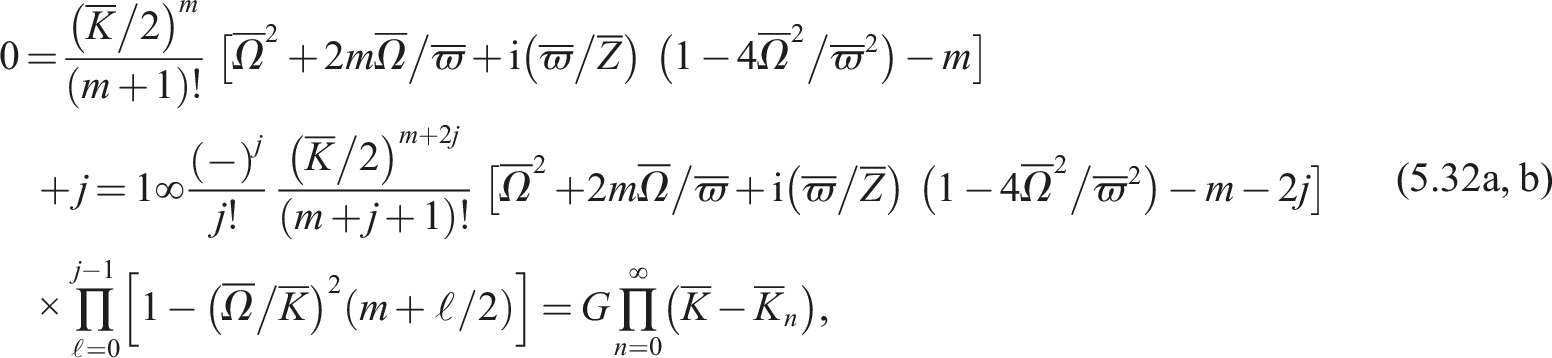
The eigenvalue equation involves six dimensionless quantities indicated by overbars:
namely: (i-ii) the axial - Eq. (5.29a) and radial - Eq. (5.29b) wavenumber made dimensionless multiplying by the radius a of the duct; (iii-iv) the axial - Eq. (5.29c) and swirl - Eq. (5.29d) Mach numbers, the former uniform and the latter taken as the maximum value of Eq. (3.3a) at the wall; (v) the dimensionless frequency - Eq. (5.24e) or Helmholtz number; (vi) the specific impedance - Eq. (5.29f) obtained by dividing by that of a plane wave. In Eq. (5.26) also appears the Doppler shifted frequency- Eq. (2.18b) that may be made dimensionless as the wave frequency in Eq. (5.30):
Substituting Eq. (3.1b) in Eq. (5.26) leads to the boundary condition:
In Eq. (5.31) the term of the product is omitted or set to unity, leading to
using dimensionless parameters of Eq. (5.29a–f; 5.36) in Eq. (5.32a). The coefficient in Eq. (5.32b) is independent of for the dimensionless Eq. (5.24b) radial wavenumber in Eq. (2.27). Also separating the term in Eq. (3.1b) and using dimensionless parameters of Eqs. (5.29a–f) and radial distance of Eq. (5.33a) the corresponding eigenfunctions for the pressure spectrum are given by Eqs. (5.33b, c):
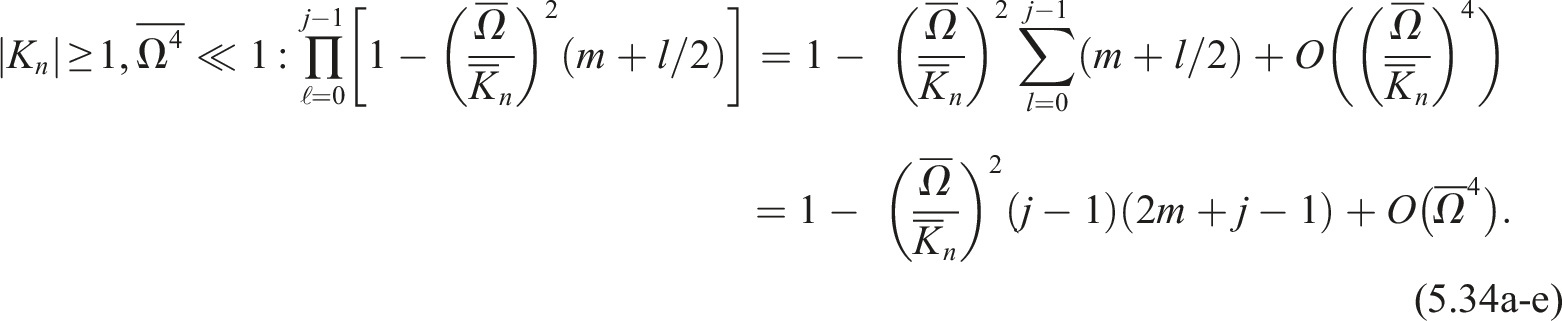
If the dimensionless radial wavenumber is not less than unity (5.34a), the moderate swirl Mach number approximation in Eq. (5.34b) allows simplifying the product in the last factor of Eqs. (5.32b) and (5.33c) leading to Eqs. (5.34c-e):
The eigenvalues of Eq. (5.32b) and eigenfunctions of Eq. (5.33c) are illustrated next for several values of the parameters in Eqs. (5.24a–f).
Oscillatory and monotonic acoustic-vortical waves
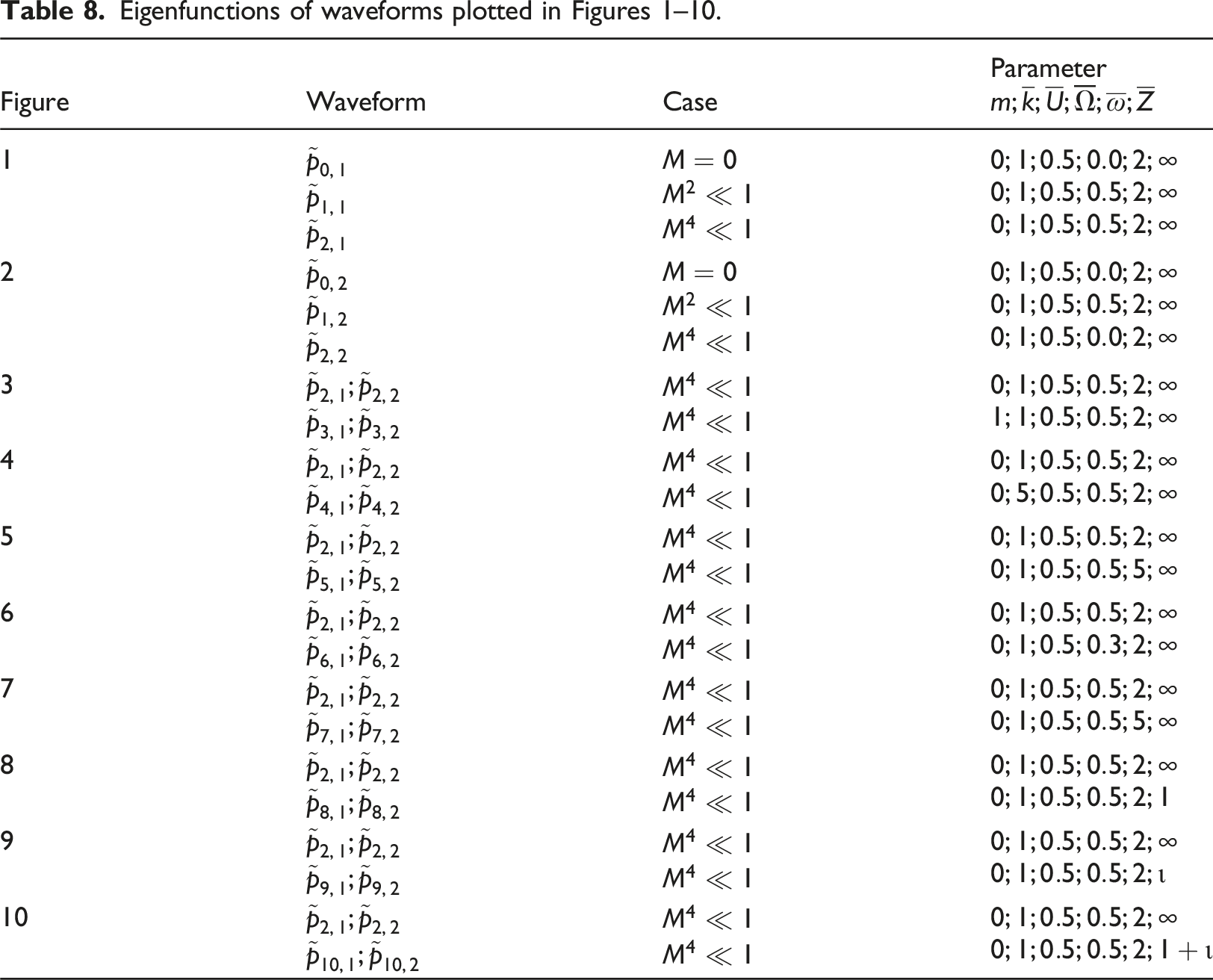
The eigenvalues are calculated (Tables 4–8) and the corresponding waveforms plotted (Figures 1–10) for acoustic-vortical waves corresponding to several combinations of the parameters of the problem, namely axial and azimuthal wavenumbers, axial and swirl Mach numbers, Helmholtz number and specific impedance.
Eigenfunctions of waveforms plotted in Figures 1–10.
Figure
Waveform
Case
Parameter
1
2
3
4
5
6
7
8
9
10
Effect of wavenumbers, mach numbers, frequency and impedance
Concerning the temporal instability, the dimensionless Doppler shifted frequency in Eq. (5.25) is a root - Eq. (5.3) of Eq. (6.1):
using the dimensionless parameters - Eqs. (5.29a, b, d; 5.30). In Eq. (6.1) is considered the case of acoustic-vortical waves in a cylindrical or annular nozzle with rigid or impedance wall boundary conditions specifying the eigenvalues for the dimensionless radial wavenumber, for example the roots of Eqs. (5.32a, b) for a cylindrical duct of radius a. In this case: (i) the corresponding eigenfunctions for the pressure perturbation spectrum are given by Eqs. (5.33a–c); (ii) the Doppler shifted frequencies are the four roots of Eq. (6.1); (iii) they appear in the phase term - Eq. (5.2) in Eq. (5.1) the pressure perturbation is space-time:
where each of the four Doppler shifted frequencies may lead to a distinct spectrum . The eigenvalues and eigenfunctions are considered next for several combinations of the parameters of the problem. For acoustic-vortical waves in a cylindrical nozzle the six dimensionless parameters are defined by Eq. (5.24a, c, d, e, f) plus the azimuthal wavenumber m. A choice is made as the baseline case (), and then each parameter is varied in turn in cases () to () for acoustic-vortical wave all using the moderate swirl Mach number approximation . The acoustic case () is included for comparison to ; the baseline acoustic-vortical case () is also included with the low swirl Mach number approximation . All 10 cases are listed in the Table 4.
The Table 4 indicates in the first column (i) the first nine radial eigenvalues that are the roots the derivative of the Bessel function in Eq. (6.3g) for an axisymmetric (6.3a) sound (6.3b) wave in a rigid cylinder (6.3c) with axial flow (6.3d) and dimensionless axial wavenumber (6.3e) and frequency (6.3f):
taken as the reference case for comparison (). The first comparison in the second column (ii) concerns the baseline case for acoustic-vortical waves:
corresponding to (ii) an axisymmetric mode - Eq. (6.4a), rigid wall - Eq. (6.4b), equal axial and swirl - Eq. (6.4c, d), Mach number one-half – Eq. (6.4c), axial wavenumber unity - Eq. (6.4e) and Helmholtz number two - Eq. (6.4f) that is considered: (i) in the second column () in the low Mach number swirl approximation that is not accurate for ; (ii) in the third column () to show the correction in the moderate swirl Mach number approximation that is accurate for . The next 8 columns () to () vary in turn one of the parameters, namely:
corresponding to: (iii) the first azimuthal harmonic Eq. (6.5a); (iv) an axial wavenumber - Eq. (6.5b) larger than the frequency - Eq. (6.4e) leading to radially evanescent modes in the acoustic case; (v-vi) a larger axial - Eq. (6.5c) and smaller swirl - Eq. (6.5d) Mach numbers, the latter ensuring that the moderate swirl Mach number approximation in Eq. (2.21a) is met both in the baseline - Eq. (6.4d) case and also in the second - Eq. (6.5d) case ; (iii) a frequency - Eq. (6.5e) larger than the wavenumber of Eq. (6.4b) leading to radially propagating modes in the acoustic case; (viii-x) a real or resistive - Eq. (6.5f), imaginary or inductive - Eq. (6.5g) or complex or mixed - Eq. (6.5b) specific wall impedance. The presentation of results includes: (i) the calculation of the eigenvalues for the dimensionless radial wavenumber as roots of Eq. (5.32a, b) in the Table 4; (ii) the corresponding radial eigenfunctions of Eq. (5.33b) as a function of the radius of the cylinder in the Figures 1–10; (iii) for each eigenfunction and the corresponding the dimensionless radial wavenumber the four dimensionless Doppler shifted frequencies in Table 5 that are roots of Eq. (6.1).
The eigenvalues for the dimensionless radial wavenumber are calculated as the roots of the series of Eq. (5.32a, b) truncated at N terms. The effect of the order of truncation, that is the number of terms N taken is shown in the Table 5 stating with N = 10 and proceeding in seven equal steps up to . The acoustic case (i) is taken as example because the eigenvalues are documented in the literature.20 The first three eigenvalues have six accurate digits with terms of the series, the fourth and fifth eigenvalues with terms of the series, the sixth eigenvalue with terms of the series, the seventh and eighth eigenvalues with terms of the series and the nineth eigenvalue with terms of the series. The spurious roots disappear as more terms of the series are included. terms are sufficient to obtain the first eight non-zero eigenvalues with six accurate digits, and there is no point in adding more terms to the series as shown by the cases and . The same method is used to calculate the first nine eigenvalues for the dimensionless radial wavenumber in each of the nine cases 2 to 10 of acoustic-vortical waves in the Table 4. The eigenvalues are real or imaginary in the cases (2) to (7) of rigid wall and (case 9) imaginary impedance when the coefficients in Eq. (5.32a,b) are real; a real (case 8) or complex (case 10) impedance leads to complex radial eigenvalues. For the smallest eigenvalue in modulus in each of the 10 cases in the Table 4, the corresponding four values of the Doppler shifted frequencies are indicated in the Table 5. The real values specify the frequency of the temporal oscillations with constant amplitude, and the complex roots indicate through their positive/negative imaginary part the rate of respectively growth/decay in time for unstable/stable modes.
Oscillatory and monotonic radial waveform
The difference in radial eigenvalues or dimensionless wavenumbers between purely acoustic modes corresponding to and the baseline acoustic-vortical mode is shown in Table 7 in the low and moderate swirl Mach number approximations respectively as and . The first column of Table 7 shows that all eigenvalues are real for acoustic waves but acoustic-vortical waves have an extra imaginary mode, that is different in the low and moderate swirl Mach number approximation respectively in the third and fourth columns. The mismatch in the numbering of modes leads to large relative differences between acoustic and acoustic-vortical modes with low or moderate swirl Mach number shown respectively in the fifth and sixth columns. The implication is that the nth acoustic mode is closest to the (n + 1)-th acoustic vortical mode with low or moderate swirl Mach number as shown respectively in the seventh and eight columns.
The Table 8 indicates the eigenfunctions plotted in Figures 1–10, specifying all parameters, and distinguishing three cases in Table 1, namely: (A) acoustic waves with zero swirl Mach number specified by Bessel functions (3.1c,d) with radial wavenumbers (2.23); (B) acoustic-vortical waves with low Mach number swirl, also specified by Bessel functions (3.1c, d) with more general radial wavenumbers (2.27); (C) acoustic-vortical waves with the moderate Mach number approximation specified by generalized Bessel functions (3.1a, b) with the more general radial wavenumber (2.27).
The Figure 1 plots the fundamental mode for acoustic waves in comparison with the fundamental mode for acoustic-vortical waves with low or moderate swirl Mach number showing small differences among the three cases. The Figure 2 plots the first radial harmonic , which is similar for acoustic waves and acoustic-vortical waves with low swirl Mach number but rather different form acoustic-vortical waves with moderate swirl Mach number ; the latter oscillate less, showing that the effect of swirl is to reduce oscillations. This agrees with the remark that swirl can cause higher order oscillatory acoustic modes to become monotonic in the acoustic-vortical case. The Figures 1 and 2 thus compare the three cases (Table 4) of (A) acoustic and acoustic-vortical waves with (B) low or (C) moderate swirl Mach number.
All the remaining Figures 3–10 concern acoustic-vortical waves with the moderate swirl Mach number approximation and compare the baseline (6.4a-f) with changing one parameter in turn (6.5a–h). The Figure 3 compares the baseline case for the radial fundamental and first harmonic , for the fundamental azimuthal mode , with respectively and for the first azimuthal harmonic . Thus corresponds to fundamental and azimuthal modes and (i) the first azimuthal harmonic shows stronger oscillation; (ii) the first radial harmonic shows smaller amplitude; (iii) the first radial and azimuthal harmonic has smaller amplitude and less oscillation.
The Figure 4 shows the baseline case with axial wavenumber unity for the fundamental radial mode and first radial harmonic , compared with dimensionless axial wavenumber increased to for the radial fundamental and harmonic . The increase in the dimensionless axial wavenumber from to has little effect on the radial eigenfunctions with the main distinction remaining between the radial fundamental and radial harmonic .
The Figure 5 shows the effect of increasing the axial Mach number from for the baseline radial fundamental and harmonic to a faster axial flow with axial Mach number increased to for the radial fundamental and harmonic . The conclusion is similar for Figures 4 and 5, with the axial Mach number increase from to having small effect either on the radial fundamental and harmonic , so that the main difference remains the radial mode.
The Figure 6 compares the baseline maximum swirl Mach number for the radial fundamental and harmonic with the maximum swirl Mach number for the radial fundamental and harmonic . As in Figures 4 and 5, the main difference is between radial fundamental and harmonic, but in Figure 6 the decrease on maximum swirl Mach number from to has a more noticeable effect.
The Figure 7 compares the baseline case of Helmholtz number or dimensionless frequency for the radial fundamental and first harmonic with the increased value for the radial fundamental and first harmonic . As in Figures 4 and 5 the effect of increasing the frequency from to is barely noticeable, less than if Figure 6, and the main difference remains between radial fundamental and harmonic.
The Figure 8 compares the baseline case of rigid wall with infinite impedance for the radial fundamental and first harmonic with dimensionless resistance for the radial and first harmonic . The effect on the amplitude of the waveform (at the top of Figure 8) is small; the main difference is that finite wall resistance leads to a complex pressure field, with a phase (at the bottom of Figure 8) that varies much more noticeably for the radial first harmonic than for the fundamental.
The Figure 9 compares the baseline case of rigid wall for the radial fundamental and first harmonic with a purely inductive wall for the radial fundamental and first harmonic . The wave pressure fields remain real, and the difference is greater for the fundamental between rigid and inductive wall, than for the first harmonic between and . In all cases the inductive wall increases the amplitude of the waves relative to the rigid wall, more noticeably for the radial fundamental than for the first harmonic.
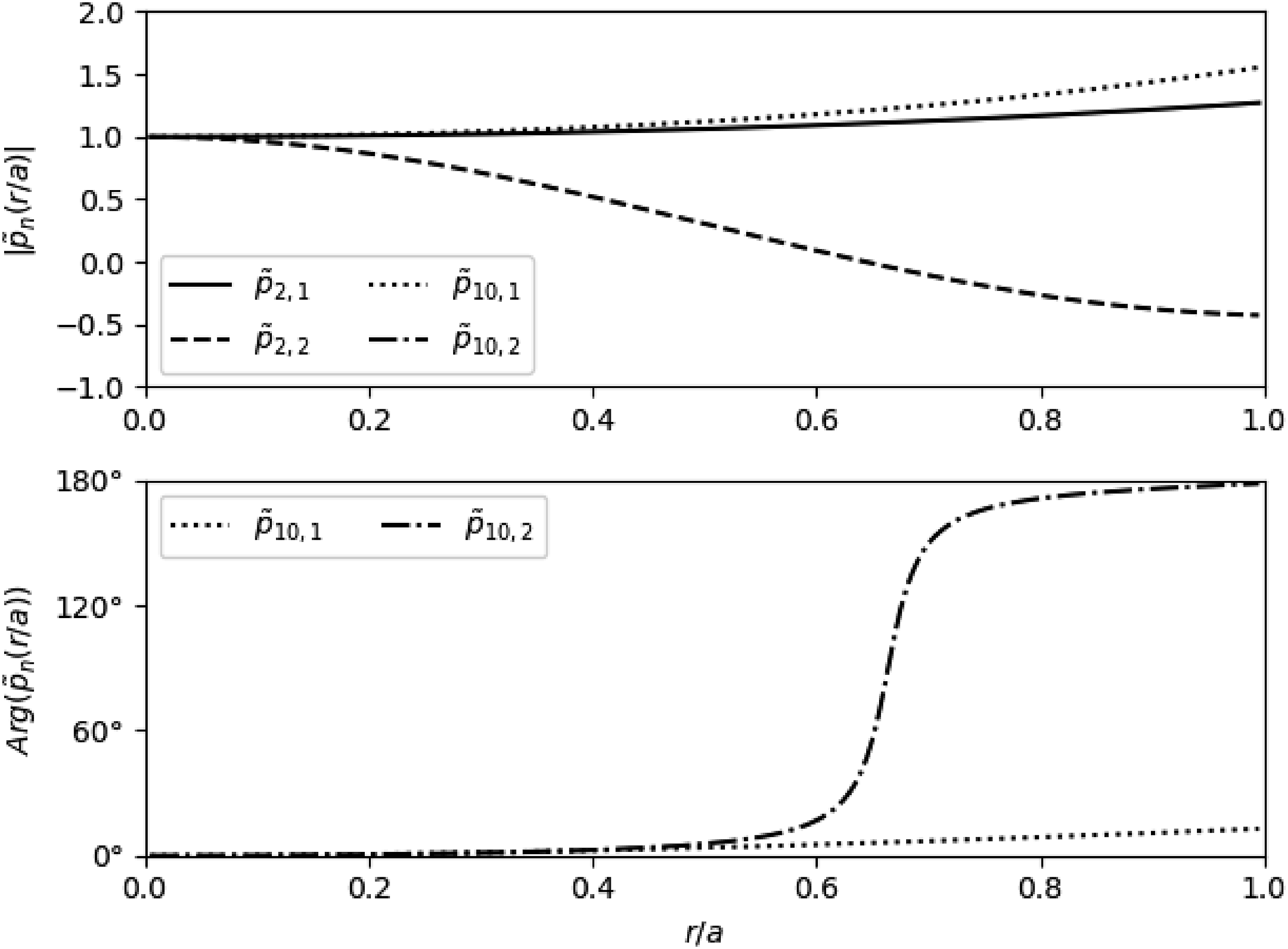
The last Figure 10 compares the baseline case of rigid wall for the radial fundamental and first harmonic with a mixed resistive inductive wall for the radial fundamental and first harmonic . The Figure 10 is closer to Figure 8 than to Figure 9, showing that wall resistance has greater effect than wall inductance. Besides causing the wave pressure field to become complex, and thus dominating the phase effect (Figure 10 bottom), the wall resistance opposes the amplitude growth due to wall inductance.
In conclusion acoustic-vortical waves in the moderate swirl Mach number approximation are more affected by wall boundary conditions (rigid, resistive, inductive or mixed) than by flow and wave parameters (axial and swirl Mach numbers, axial and radial wavenumbers and frequency). The difference between purely acoustic waves and acoustic-vortical waves includes: (i) with low swirl Mach number the appearance of additional modes, possibly unstable; (ii) with moderate swirl Mach number the reduction or suppression of oscillations, more noticeable for the radial harmonics than for the fundamental.
Singularities of the wave equation in non-uniform flows
The main results of the paper were briefly summarized in the introduction and some possible extensions and related problems are discussed before the conclusion. The acoustic-vortical waves may be sub-classified into acoustic-rotational and acoustic-shear depending on whether the vorticity is associated with swirl or shear; the two may be combined. The case of a uniform stream with rigid body rotation is special for acoustic-vortical waves in that the Doppler shifted frequency (2.10) is constant, and thus: (i) in the exceptional case it is zero it follows from Eq. (2.27) that and hence from Eq. (2.26b) that the pressure spectrum is also zero , and there are no waves: (ii) apart from this exceptional case the radial dependence of the pressure spectrum in Eq. (2.26b) is specified to lowest order in the swirl Mach number by a generalized Bessel equation (2.29) that has only two singularities:8–10,37 a regular singularity at the origin and an irregular singularity of degree two at infinity. The other special case is a uniform flow with potential vortex swirl,38,39 for which the pressure spectrum satisfies the convected wave equation if irrotational, that is centrifugal and Coriolis forces are neglected, leaving only the convective effect of rotation on sound waves; the radial dependence is specified by an extended Bessel equation, that is distinct from the present generalized Bessel equation because40 the singularity at the origin (where the mean flow velocity diverges) is irregular of degree two and at infinity (where the mean velocity vanishes) is irregular of degree one.10,27 Thus the generalized and extended Bessel functions are similar to the original where the mean flow swirl velocity is small and acoustic modes predominate, and quite different where the mean flow swirl velocity is large and vortical modes dominate. The potential vortex (with the restriction of neglect of rotational forces) and the rigid body rotation (without neglect of rotational forces) are special in the sense that they are the only cases when the acoustic-vortical wave equation has only two singularities at the origin and infinity.
For any other radial profile of the angular velocity or shear of the axial flow the Doppler shifted frequency - Eq. (2.10) is a function of the radius as in Eq. (7.1a):
The point where it vanishes is a critical layer - Eq. (7.1b) or regular singularity18,36 of the acoustic-vortical wave equation (2.8) that has at least three regular singularities.29,36 The range of radial distances for an annular duct or free stream (7.1c) corresponds to a critical layer - Eq. (7.1b) for a range of forbidden wavenumbers - Eq. (7.1d), that specify a continuous spectrum and a branch-cut in the complex k-plane.29,30 In contrast the discrete spectrum corresponds to poles in the complex k-plane, and has exponential growth or decay compared with algebraic scaling for the continuous spectrum. Thus the rigid body swirl leads to acoustic-rotational waves without a continuous spectrum. The continuous spectrum exists for example for angular velocity proportional to the radius.41 The Doppler shifted frequency is a function of the radius for any shear velocity profile and thus acoustic-shear waves always have a continuous spectrum. This applies to acoustic-shear waves in a plane homentropic shear flow that has been considered for several velocity profiles: (i) linear42–48; (ii) exponential boundary layer,49 hyperbolic tangent shear layer50 and parabolic duct shear51 velocity profiles. The number of singularities can be more that three for acoustic-shear-entropy waves in non-homentropic conditions, for example a plane homenergetic shear flow with linear velocity profile,52,53 leading to extensions of the Gaussian54 and confluent55 hypergeometric and Heun56 functions.
Conclusion
Although the uniform flow with rigid body swirl is a special case, the existence of only two singularities at the origin and infinity simplifies the analysis over the whole range of radial distances including asymptotics. Angular velocities other than rigid body and any shear velocity profile lead to at least three singularities at the origin, critical layer and infinity, for acoustic-vortical waves; additional singularities may appear for acoustic-shear-entropy waves in non-homentropic flows and for acoustic-swirl waves even in homentropic conditions. To cover all radial distances this will require at least three pairs of solutions and two sets of matchings. In the present case only two pairs of solutions, around the origin and infinity, and one matching is needed. This is the case for the original Bessel equation that describes acoustic16,20,31 and vortical2 waves separately. In the case acoustic-rotational waves with rigid body swirl the Bessel equation applies in the low Mach number swirl approximation, that corresponds to weak coupling and breaks down asymptotically at large radius. If this approximation is not made then acoustic-rotational waves in a uniform mean flow with rigid body swirl satisfy a generalized Bessel equation to second order in the swirl Mach number.
The singularity at the origin remains regular because the azimuthal velocity associated with rigid body swirl is small; the solutions around the origin are qualitatively but not quantitatively similar for the original and generalized Bessel and Neumann functions. Both are specified by power series with two-term recurrence formulas for the coefficients and the same indices; however there are quantitative differences leading to distinct radial eigenvalues, natural frequencies and waveforms for normal modes for acoustic-rotational waves in cylindrical and annular ducts with rigid or impedance wall boundary conditions when compared with purely acoustic or rotational waves. The differences are not only quantitative but also qualitative as concerns the asymptotic solutions for large radius when the azimuthal velocity associated with rigid body swirl is no longer small compared with the sound speed. The acoustic and vortical propagating waves are oscillatory with algebraic decay radially, and the standing modes decay exponentially if evanescent and grow exponentially if unstable. The acoustic-vortical modes can be monotonic in all cases and can grow like the exponential of one half of the square of the swirl Mach number, that is like an exponential of the square of the radius. To this radial instability is added a temporal instability specified by an exponential of time for any mode with real or imaginary radial wavenumber. Thus acoustic-rotational waves lead to greater magnitudes of the pressure spectrum that acoustic or vortical waves, most significantly for larger swirl Mach number. Other examples of similarities and differences between (i) acoustic or (ii) vortical waves in isolation and their coupling into (iii) acoustic-vortical waves are: (a) all three (i-iii) are monotonic functions of the radial distance for imaginary radial wavenumber; (b) for real radial wavenumber the (i) acoustic and (ii) vortical waves are always oscillatory radially whereas the (iii) acoustic-vortical waves may be oscillatory or monotonic functions of the radial distance.
In the present paper the solution of the Tam and Auriault17 equation has been extended from (i) the low Mach number swirl approximation neglecting terms , to (ii) the moderate swirl Mach number approximation retaining all terms and neglecting . The process could be extended to higher orders, the (iii) next retaining terms and neglecting Since this would extend the Mach number range from in (i) the original study to in (ii) the present paper to in (iii) the further extension to higher order. The Bessel differential equation with coefficients in the case (i) of low Mach number swirl, and the generalized Bessel differential equations with coefficients in the case (ii) of moderate swirl Mach number, would in the case (iii) include in the coefficients terms of leading to further double generalization of the Bessel differential equation.8,10,57 The power series and asymptotic solutions would still apply in the case (iii) with coefficients satisfying a triple ( as a function of ) recurrence formula instead of a double recurrence formula ( as a function in the cases of (i) low or (ii) moderate swirl Mach number. The double recurrence formula for the coefficients of power series and asymptotic solutions can be solved explicitly both in the cases of the (i) original12–15 and (ii) generalized8–10 Bessel functions, whereas the further extension (iii) would require the coefficients to be determined by recurrence, in terms of continued fractions58,59 or an equivalent method.60 The additional analytical complexity of case (iii) could be weighted against the benefit of limited extension to from in the case (ii) of the present paper. The Mach number range covers the cruising speed of most regional transport aircraft, but not that of longer range jet airliners.
The main differences between (a) purely acoustic or vortical waves in the low swirl Mach number approximation compared with (b) coupled acoustic-vortical waves in the moderate Mach number approximation are: (i) for small radial distances cut-off modes corresponding to imaginary wavenumbers are monotonic in both cases (a) and (b), whereas cut-on modes corresponding to real wavenumbers are always oscillatory for (a) but may be monotonic for (b) depending on azimuthal wavenumber with all modes being monotonic for sufficiently strong swirl; (ii) asymptotically for large radius in case (a) cut-on modes decay like and cut-off decay exponentially like whereas in case (b) there is strong exponential growth on the square of the radius in Eq. (4.10) if the ‘vortical’ mode is present, and power law growth if only the ‘acoustic’ mode is present; (iii) there is temporal instability for both cut-on and cut-off modes in case (b) with exponential growth in time instead of constant amplitude:; (iv) there are additional modes in case (b) relative to case (a) which may include complex eigenvalues in case (b) and imply more instabilities and the eigenfunctions and eigenvalues are modified for ‘comparable’ modes.
The simplest physical explanation of the physical properties of acoustic-vortical waves is based on the contrast between cylindrical (a) acoustic waves in an uniform axial flow and (b) vortical waves in a rigid body swirling flow. Both are unsteady flows but (a) is a irrotational motion that tends to be stable1–5 whereas (b) is a rotational motion that tends to be unstable.1–5,34 The former (a) leads to the original Bessel differential equation showing that cylindrical waves decay as the inverse square root of the radius for large distance. The latter (b), combining the mean flow swirl velocity that is proportional to the radius for rigid body swirl with compressibility, leads to the generalized Bessel equation, and to divergent waves for large radius with: (i) power law dependence on the radius in one exceptional case when only the acoustic mode is present; (ii) otherwise when the vortical mode is present the asymptotic wave field is dominated by an exponential of the square of the swirl Mach number . The latter factor can be neglected because it reduces to unity, for low Mach number swirl, and thus does not appear for purely vortical, incompressible waves.17 For acoustic-vortical waves the same factor can be neglected near the axis because for and , but becomes dominant for large swirl Mach number and radius ; thus adding swirl to an uniform flow transform stable acoustic waves into unstable acoustic-vortical waves: acoustic-vortical waves exhibit instability as an exponential of time and an exponential of square of radius. The present linear theory cannot be applied to large amplitudes because it is limited to but the solution including terms of shows that the combination of swirl and compressibility leads to instability for increasing radial distance, can change between cut-off and cut-on modes, and generally affects the dispersion relation between frequency and wavenumbers and modifies the radial dependence of wave forms. There are significant differences between acoustic-vortical waves of swirl type29,30,38–41 and of shear type,42–53 since the latter have a critical layer.19,22,31
Footnotes
Declaration of conflicting interests
The author(s) declared no potential conflicts of interest with respect to the research, authorship, and/or publication of this article.
Funding
The author(s) disclosed receipt of the following financial support for the research, authorship, and/or publication of this article: The authors acknowledge Fundação para a Ciência e a Tecnologia (FCT) for its financial support via the project LAETA Base Funding (DOI: 10.54499/UIDP/50022/2020).
ORCID iD
FJP Lau
References
1.
LambH. Hydrodynamics. Cambridge, UK: Cambridge University Press, 1931.
2.
BatchelorGK. Fluid mechanics. Cambridge, UK: Cambridge University Press, 1953.
CamposLMBC. Complex analysis with applications to flows and fields. Boca Raton, Florida: CRC Press, 2011.
6.
PhilipsNF. Mechanics of flight. Hoboken, NJ: Wiley, 2010.
7.
CamposLMBCVilelaLAR. Compressible flow with applications to engines, shocks and nozzles. Boca Raton, Florida: CRC Press, 2022.
8.
CamposLMBCMoleiroFSilvaMJS, et al.On regular integral solutions of a generalized Bessel differential equation. Adv Math Phys2018; 2018: 1–9. DOI: 10.1155/2018/8919516.
9.
CamposLMBCSilvaMJS. On generalised Hankel functions and a bifurcation of their asymptotic expansion. WSEAS Trans Math2024; 23: 237–252.
10.
CamposLMBC. Singular differential equations and special functions. Boca Raton, FL: CRC Press, 2020.
11.
WhittakerETWatsonGN. Course of modern analysis. Cambridge, UK: Cambridge U. P, 1927.
12.
WatsonGN. Bessel functions. Cambridge, UK: Cambridge U. P, 1944.
ErdelyiA. Higher transcendental functions. New York, NY: McGraw-Hill, 1953.
15.
WangZXGuoDR. Special functions. Singapore: World Scientific, 1989.
16.
MorsePMIngardKU. Theoretical acoustics. New York, NY: McGraw-Hill, 1968.
17.
TamCKWAuriaultL. The waves modes in ducted swirling flows. J Fluid Mech1999; 371: 1–20.
18.
CamposLMBC. On 36 forms of the acoustic wave equation in potential homentropic flows. Rev. Appl. Mech2007; 60: 260–290.
19.
CamposLMBC. On 24 forms of the acoustic wave equation in vortical flows and dissipative media. Appl Mech Rev2007; 60: 291–315.
20.
PierceAD. Acoustics. New York, NY: McGraw-Hill, 1981.
21.
GoldsteinME. Unsteady vortical and entropy distortions of potential flows round arbitrary obstacles. J Fluid Mech2003; 89: 433–468.
22.
CamposLMBCMartaAC. On the extension of cylindrical acoustic waves to acoustic-vortical entropy cases in a flow with rigid body swirl. J Sound Vib2018; 137: 389–409.
23.
CamposLMBCÁvilaI. On two-dimensional acoustic-entropy waves in a mean flow with uniform velocity and laterally varying sound speed. J Sound Vib2020; 490(10): 115680.
24.
AbramowitzMStegunI. Tables of mathematical functions. Mineola, NY: Dover, 1964.
25.
PrudnikovAPBrishkovIAMarichevOI. Tables of functions, nauka 1981. London, UK: Gordon & Breach, 1990.
26.
OlverFWJLozierDWBoisvertRF, et al.NIST handbook of mathematical functions. Cambridge, UK: Cambridge University Press, 2010.
CamposLMBCPGTAS. On the acoustics of unbounded and ducted vortex flows. SIAM J Appl Math2004; 65: 1353–1368.
41.
CamposLMBCSerrãoP. On sound propagation in a nozzle with non-uniform swirl. J Sound Vib2016; 361: 261–271.
42.
GoldsteinMERiceE. Effect of shear on duct wall impedance. J Sound Vib1973; 30: 79–84.
43.
JonesDS. The scattering of sound by a simple shear layer. Phil Trans Roy Soc1977; A284: 287–328.
44.
JonesDS. Acoustics of a splitter plate. IMA J Appl Math1978; 21: 197–209.
45.
ScottJN. Propagation of sound waves through a linear shear layer. AIAA J1979; 17: 237–244.
46.
KoutsoyannisSP. Characterization of acoustic disturbances in linearly sheared flows. J Sound Vib1980; 68: 187–202.
47.
KoutsoyannisSPKaramchetiKGalantD. Acoustic resonances and sound scattering by a shear layer. AIAA J1980; 18: 1446–1454.
48.
CamposLMBCOliveiraJMGSKobayashiM. On sound propagation in a linear shear flow. J Sound Vib1999; 219: 739–770.
49.
CamposLMBCPGTAS. On the acoustics of an exponential boundary layer. Phil. Trans. Roy. Soc. A1998; 356: 2335–2378.
50.
CamposLMBCKobayashiMH. On the reflection and transmission of sound in a thick shear layer. J Fluid Mech2000; 424: 303–326.
51.
CamposLMBCOliveiraJMGS. On the acoustic modes in a duct containing a parabolic shear flow. J Sound Vib2011; 330: 1166–1195.
52.
CamposLMBCKobayashiMH. On the propagation of sound in a high-speed non-isothermal shear flow. Int J Aeroacoustics2008; 6: 93–126.
53.
CamposLMBCKobayashiMH. On sound transmission from a source outside a non-isothermal boundary layer. AIAA J2010; 48: 718–725.
54.
CamposLMBC. On the extended hypergeometric equation and functions of arbitrary degree. Integr Transforms Special Funct2001; 11: 233–256.
55.
CamposLMBC. On some solutions of the extended confluent hypergeometric differential equation. J Comput Appl Math2001; 137: 177–200.
56.
RonveauxA. Heun’s, Differential equations. Oxford, UK: Oxford University Press, 1986.
57.
CamposLMBC. On the derivation of asymptotic expansions for special functions from the corresponding differential equations. Integr Transforms Special Funct2007; 12: 227–236.
58.
ChrystalG. Textbook of algebra. Chelsea, MA: A. C. Black, 1964.
59.
CamposLMBC. Transcendental representation with applications to solids and fluids. Boca Raton, FL: CRC Press, 2012.
60.
CamposLMBC. Classification and examples of differential equations and their applications. Boca Raton, FL: CRC Press, 2020.