



Abstract
An old model problem for the exchange of energy between sound field and mean flow by vortex shedding has been worked out in numerical detail. The analytically exact solution of the problem of reflection, diffraction and radiation of acoustic modes in a semi-infinite annular duct with uniform subsonic mean flow, including shedding of unsteady vorticity from the duct exit, allows a precise formulation of Myers’ energy for perturbations of an inviscid mean flow. The transmitted power
Introduction
Since its formulation in the late 19th century, Kirchhoff’s expression for acoustic energy in quiescent flow 1 has been a well-confirmed conserved quantity for the linear acoustic wave equations. During the 1960s and early 1970s several attempts were made to extend this energy as a conserved quantity to linear perturbations of inviscid flow in general.2–5 This appeared possible for potential and homentropic flow but failed for (roughly speaking) flow with vorticity or a varying entropy. Although it was of course known from Ffowcs Williams et al6,7or Crighton 8 that vorticity near sharp edges can produce sound, it was only from the experiments of Bechert9,10 and the explanation by Howe11,12 that it was realized that this coupling can work in the other direction too, leading to absorption of sound by vorticity. Still, it was unclear if this all plays on the level of the linear perturbations only, or that there is a coupling with the (infinite energy of the) mean flow. Only the model problem of plane waves diffracting at the trailing edge of a semi-infinite flat plate with uniform mean flow (the Sommerfeld 13 problem with mean flow) by Rienstra 14 yields an exact expression of the (positive or negative) acoustic energy loss into the vortical wake – present due to the unsteady Kutta condition 15 – that shows unequivocally that more energy can be “harvested” from the wake than enters from the incident waves. In other words, that there is a coupling with the mean flow.
A similar result in the form of analytic expressions for the various energy contributions was a little later obtained by Rienstra 16 for the problem of sound radiated from a semi-infinite (annular) duct with uniform mean flow, but (unfortunately) without a numerical study of its parametric dependencies.
All this was beautifully clarified and brought into a unified perspective by Myers.17–19 He showed that the linearized energy equations (for inviscid and compressible flow with negligible heat conduction) form indeed a conserved acoustic quantity of the linearized equations if both mean flow and perturbations are irrotational and isentropic. But in the other case the energy equations have a right-hand side that can be interpreted as a source from, or sink to, the vortical perturbations or vortical mean flow, and similarly for the entropy. A remarkable side result is the fact that all this can be described without second or higher order nonlinear terms. So with the Myers equations for the acoustic energy, the energy loss to, or generation from, the vorticity in the model problems of Refs. 14 and 16 were confirmed and understood.
Unfortunately (albeit before Myers’ publications), by omitting the distinction between (a) acoustic, i.e. pressure based, energy, (b) hydrodynamic, i.e. velocity based, energy of the potential field associated to the wake, and (c) the contribution of the vortical wake itself, Howe 20 drew the incorrect conclusion that our result of sound lost into or produced by the wake is wrong. Howe argued that the expression for the “acoustic dissipation” should include not only the loss into the vortical wake, but also the associated, “trapped”, hydrodynamic (but non-vortical!) field, even though this energy contribution is kinetic and not lost or dissipated at all. Of course, far from the edge the hydrodynamic field is silent and for practical purposes we could reserve the word “acoustic dissipation” to processes that reduce the audible (i.e. pressure-based) part of the acoustic energy. But this would be an ad-hoc and unphysical distinction, if there is no real dissipation but only a conversion into purely kinetic energy of convected vortices. They may be inaudible (at least, far from the edge), but there is nothing dissipated about these vortices. They could again create sound once they pass along another edge. Therefore, only when acoustic energy, including the hydrodynamic component, has been lost into the mean flow, we can say that acoustic energy has disappeared.
Extensions to the supersonic version of the problem were given by Guo 21 , to the scattering at a hard-wall/pressure-release-wall transition by Quinn and Howe 22 and recently to the problem of scattering by an infinite cascade by Maierhofer and Peake. 23
Although the expression of the power lost into the wake is simple and most elegant for the plane wave, flat plate problem, the incident and radiated energy components are infinitely large and it is hard to assess how strong the effect is compared with the rest of the field. The semi-infinite duct problem is in this respect much more informative. The only problem here is that the expressions, although explicitly available and analytically exact, are more difficult to evaluate numerically because they are given in terms of complex contour integrals. Forty years ago this was a serious obstacle (while the question was not vital to the project under which the work fell), but not anymore presently. The – compared to then – superior computer equipment and numerical software we have now, make it possible to fill this lacuna. Therefore the goal of the present paper is to revisit this problem and, based on the same formulas
16
but a new numerical implementation, make a numerical study of the behavior of the various energy contributions (indicated in Figure 1 by powers = time-averaged energy fluxes across certain control surfaces) as a function of frequency, and a selection of problem parameter combinations. Sketch of configuration, with control surfaces for power integrals 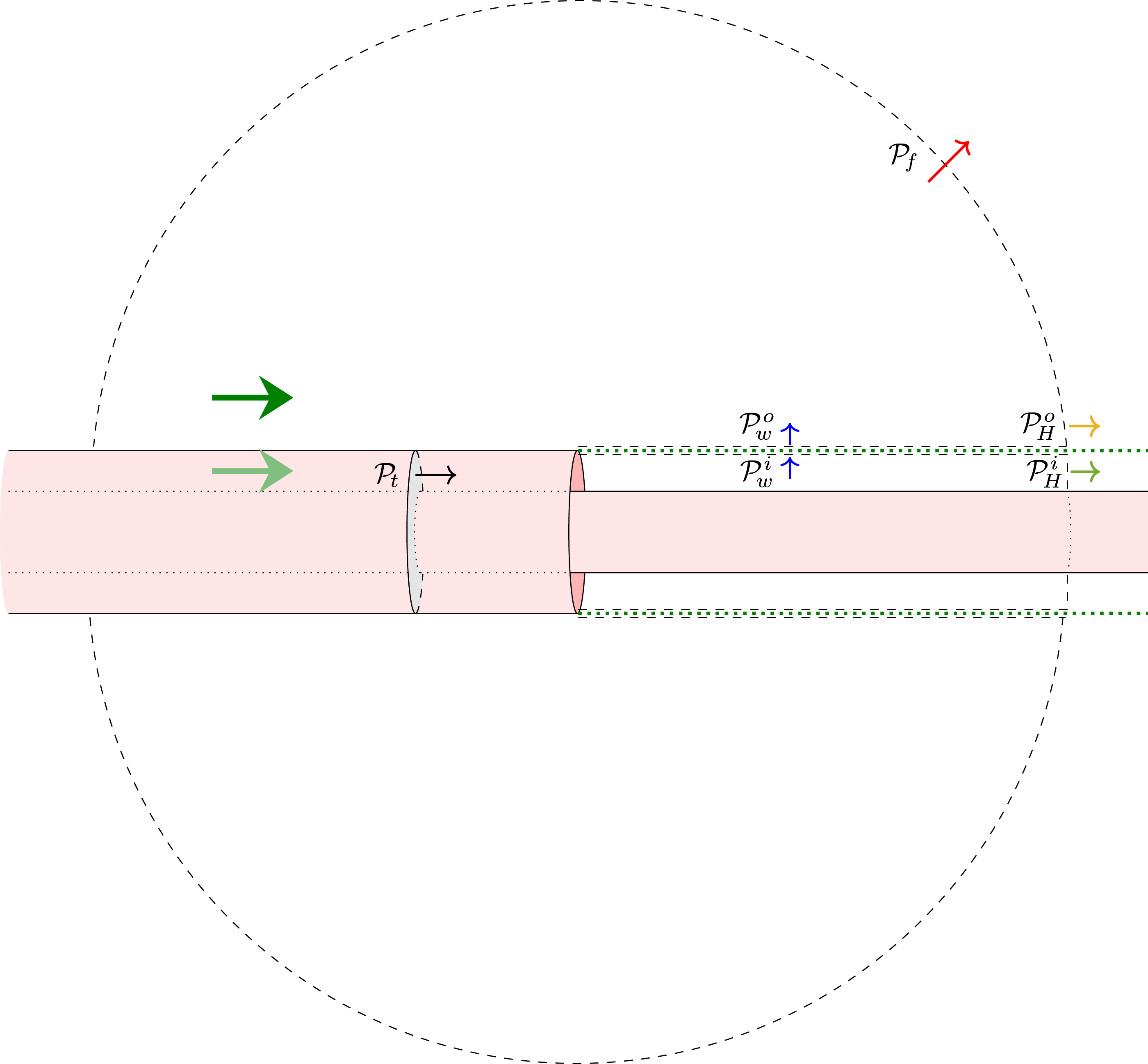
Shôn Ffowcs Williams
By this contribution I would like to honor Shôn Ffowcs Williams for his seminal and inspiring work in aeroacoustics. I remember his visits to Leen Poldervaart’s laboratory in Eindhoven 24 when I was a student. His door was always open in Cambridge, and I am forever grateful he directed me to his former student David Crighton, the right person to finish successfully my PhD research.
My present contribution is a study of a model problem for sound scattering, vortex shedding, and their interaction with a mean flow. Model problems are very important for the understanding of quintessential phenomena. In a model problem they can be isolated and studied in detail, while in a full, “industrial” problem they drown in the plethora of other effects. Shôn was very keen on model problems. I remember vividly how he explained in a lecture Tyler and Sofrin’s rotor-stator interaction by a both amusing and crystal-clear comparison with the virtually backward running cartwheels of stage-coaches in old American cowboy movies.
The problem presented here is not as iconic and colorful, but I hope simple enough to add a little bit to the understanding of sound in vortical flow, and the way acoustic energy enters and leaves the mean flow.
Time-harmonic sound waves in uniform mean flow
In the next section we describe the problem and its solution as presented in 16 with a few very minor typographical simplifications. Of course, no details are given of the derivation, but inevitably the solution have to given in sufficient detail, for the meaning of the results to become clear.
The model
Anticipating the shedding of vorticity only from the trailing edge, we assume a perturbation field, irrotational almost everywhere, such that the velocity field

The boundary conditions are a vanishing normal velocity v along the duct walls r = h and r = a, x < 0 (Figure 1), and continuity of normal velocity v and pressure p along any trailing edge streamline r = a, x > 0. The corresponding time-averaged energy equations
19
are, for the acoustic intensity vector


Here, p* indicates the complex conjugate of p. As we will see,
Non-dimensionalization
We assume the field variables and cylindrical coordinates (x, r, θ) made dimensionless:
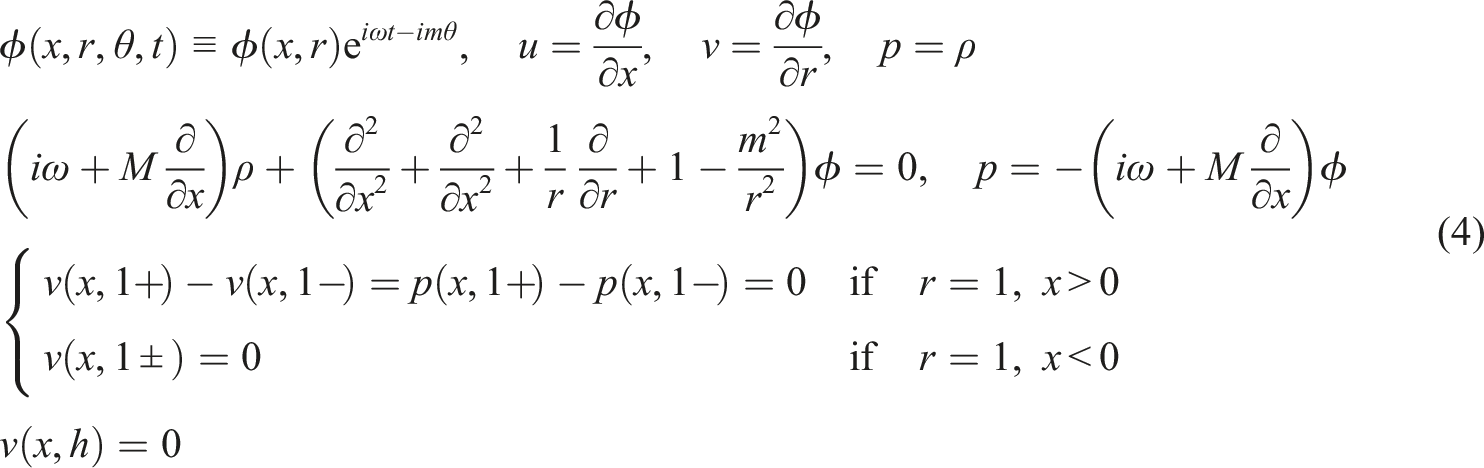

To facilitate the shedding of vorticity at the trailing edge, some form of unsteady Kutta condition, in the form of a smooth connection of the streamlines with the edge, is vital. 15 Without vortex shedding, this connection is not smooth because the pressure is singular, although the potential is continuous. This is what we usually call “no Kutta condition”. With vortex shedding, the singularity may be reduced at the expense of a discontinuous potential and (axial) velocity, i.e. a vortex sheet. This is what we could call a “partial Kutta condition”. Mathematically (at least, in the inviscid linear model), the field of the shed vorticity is an eigensolution of the problem, i.e. a solution that exists without external forcing. With the right amplitude (in other words, with the right amount of vortex shedding) this eigensolution may annihilate the singularity completely. This is the “full Kutta condition”.
Physically, vortex shedding is a process that happens for high enough Reynolds number, high enough amplitude and low enough Strouhal number. Under these circumstances the inertial forces intrinsic to the trailing edge singularity cannot be tamed by viscosity alone. In the inviscid limit that we have here, we have to select the amount of vortex shedding by an additional condition that replaces the now ineffective no-slip condition of a viscous model. Assuming the field of shed vorticity (the eigensolution of above) available from elsewhere, the extra condition will be described by a parameter γ, the amplitude of the eigensolution. This is normalized such that γ = 1 corresponds to full vortex shedding and no singularity, while γ = 0 corresponds to no vortex shedding at all. Other choices of γ are equally well possible, depending on the (viscous) problem parameters.14,25–28
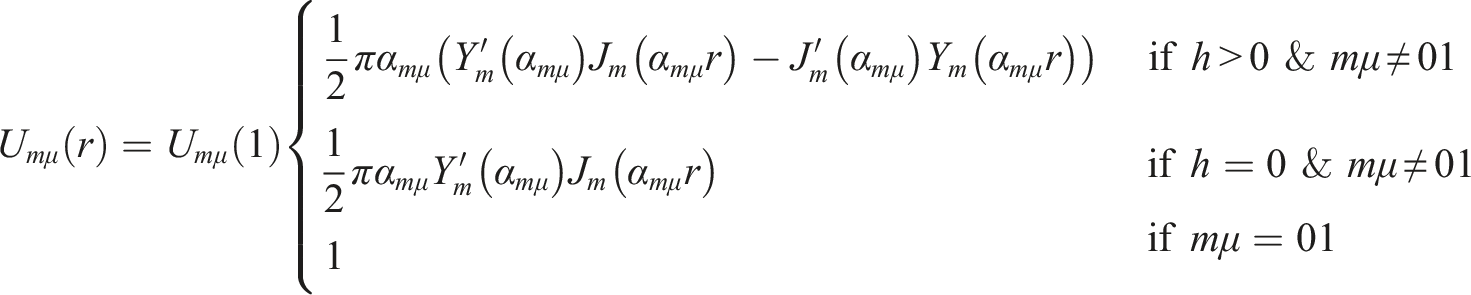
From upstream inside the duct, h < r < 1, x → −∞, an incident field p
in
is assumed consisting of a sum of radial modes of amplitude A
mμ
, and defined by


Solution
By introducing a Prandtl-Glauert/Lorentz transformation, complemented (for later use) by Strouhal number S and a form of spherical coordinates (R, ξ)


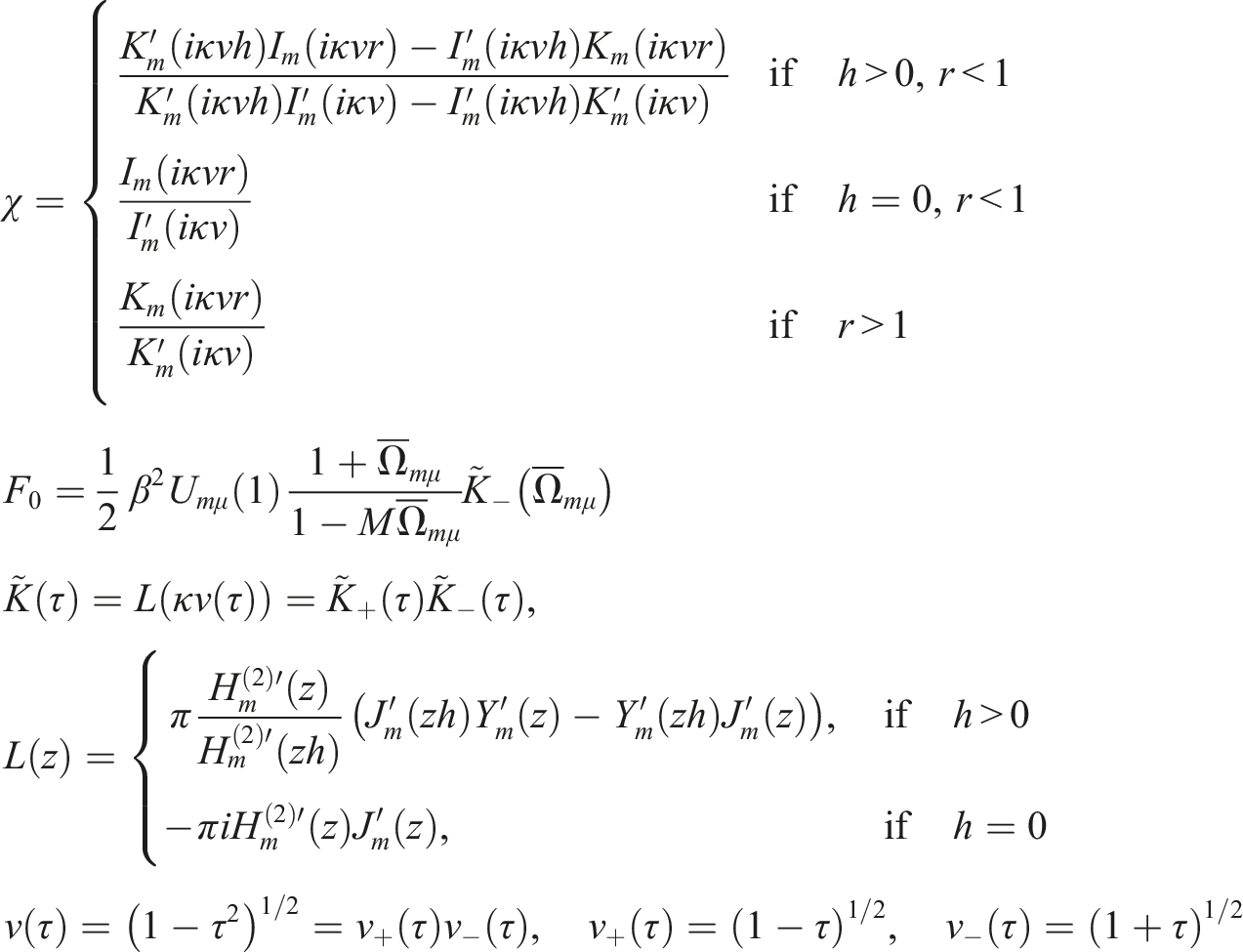
See for details Ref.16. Except for a few minor exceptions, like ω for k and the introduction of κ and S, all notations have been retained exactly the same.
The functions

If


If


Numerical evaluation of these complex integrals are crucial for the final solution, and should be done with care. Analyticity of the integrand, however, makes it possible to avoid impeding singularities by contour deformation. See further below.
The underlying Wiener-Hopf technique is indebted to the classic solution by Levine and Schwinger 29 of the problem for m = 0 and no flow and no hub. The generalizations for general m and a hub are not fundamentally different. The generalization to a uniform flow we need here, can be obtained by utilizing a Prandtl-Glauert or (which is here equivalent) Lorentz transformation to the no-flow solution, but this is not entirely straightforward. Due to the possible complication of vortex shedding in the case of an out-flow duct the singularity at the duct edge may be different without violating the edge condition. 30 Therefore, we applied in Rienstra 16 the transformation along with the Wiener-Hopf procedure and relaxed the central argument of a bounded entire and therefore constant function being zero (as it tends to zero at infinity) to possibly being non-zero. We can, however, construct in a slightly more efficient way the full solution also by elementary operations on the no-flow solution, as is shown in the Appendix.
The celebrated generalization by Munt31,32 to a jet-type mean flow (different inside and outside the duct and its extension) involves a particular difficulty that we don’t have here, namely the Kelvin-Helmholtz instability of the jet. This instability is excited by the shed vorticity (and therefore absent in case of γ = 0), but with vortex shedding it is there and its exponential growth prevents a regular Fourier transform in x. There are various ways to overcome this difficulty. Munt followed originally the approach of Jones and Morgan 33 by introducing the Fourier transform of exponential functions as a form of generalized functions (more specifically, ultra-distributions). This is very ingenious, but only necessary in time domain. For a single frequency we can split off the exponential part and write the bounded part of the solution as a regular Fourier transform. 34
The solution made explicit in various parts of the field
The foregoing Fourier integral solution can be made more explicit in certain parts of the field. We have:
For x < 0, h < r < 1
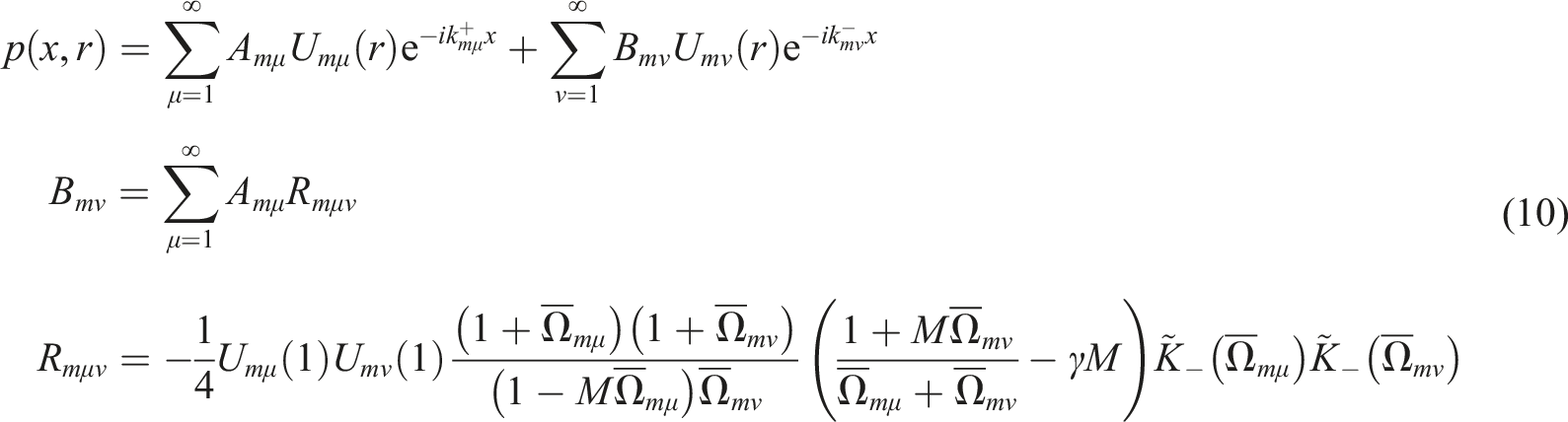
For κR → ∞, ξ > 0
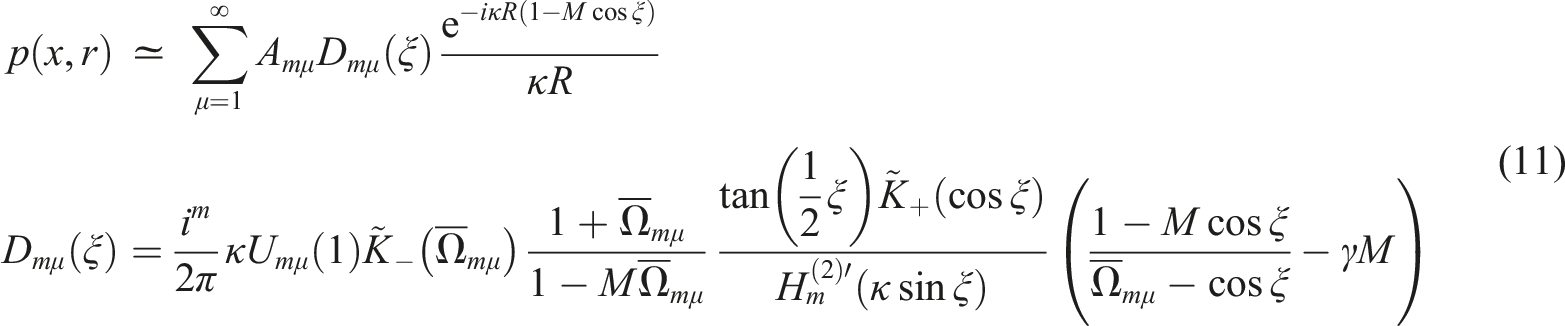
For Sx → ∞, h < r < 1

For Sx → ∞, r > 1

The argument M−1 of
Power integrals
By using the axial component I
x
and radial component I
r
of the intensity vector
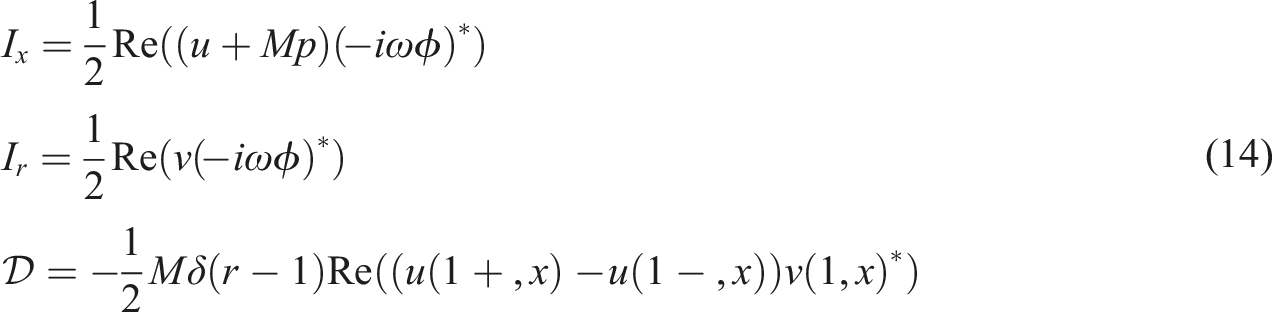

By noting that


Since we have no analytically exact expressions for

Furthermore, by taking an integral over the whole space, we find the relation between

This energy conservation relation (17) can serve as a numerical check of the solution. Let μ = μ0 denote the index of the first radial cut-off mode (at azimuthal order m). We find for the various contributions
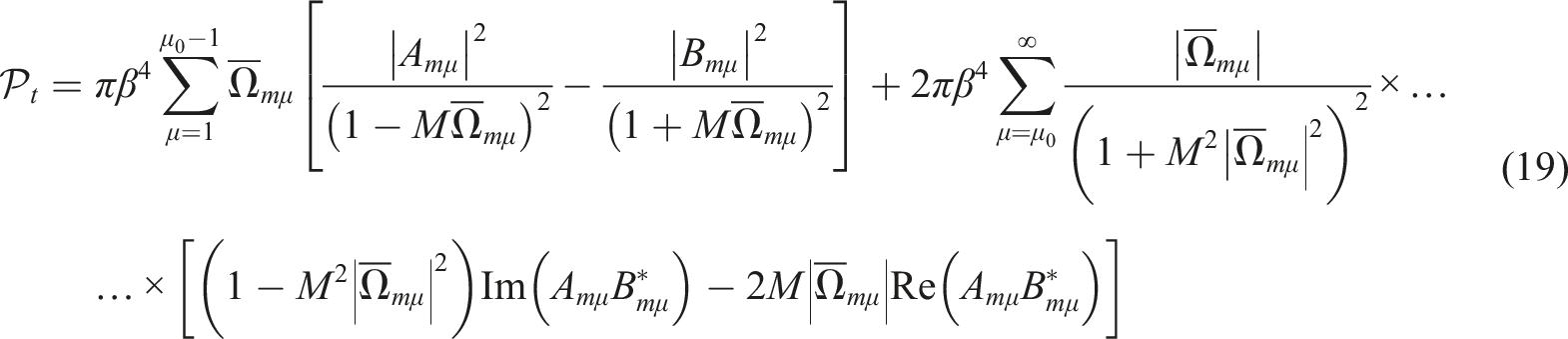



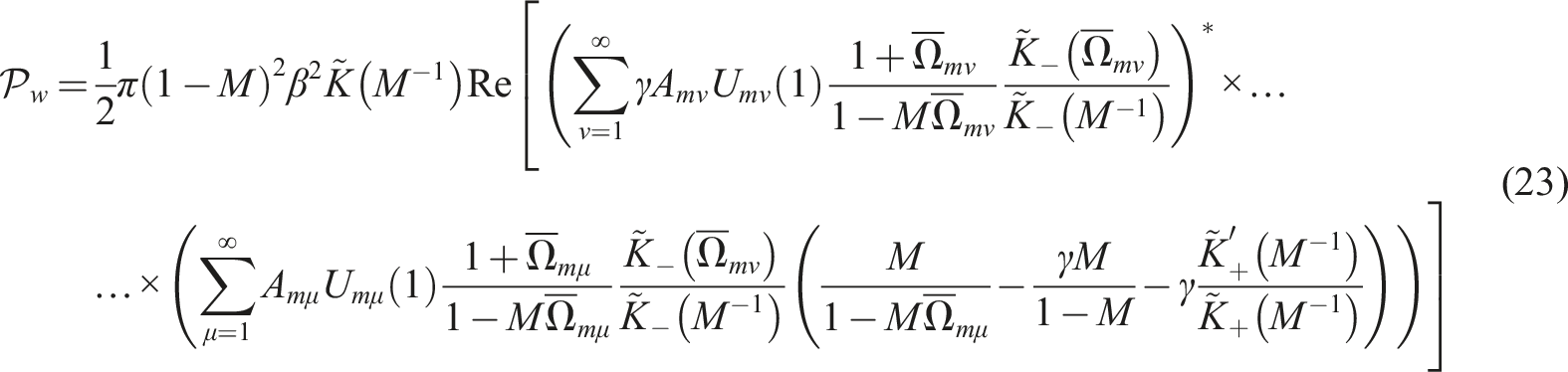
These are valid for any 0

Although the solution, equation (8), has no particularly simple form along the vortex sheet, still an explicit expression of

The above expressions are for a general incident field, made of a linear combination of radial modes of azimuthal order m. For the restricted case of a single incident μ-mode, we assume A mμ = 1 and A mν = 0 for all ν ≠ μ, and the expressions simplify accordingly.
Numerical details on the integration
The typical integral to determine the split functions Examples of deformed integration contours in complex τ-plane.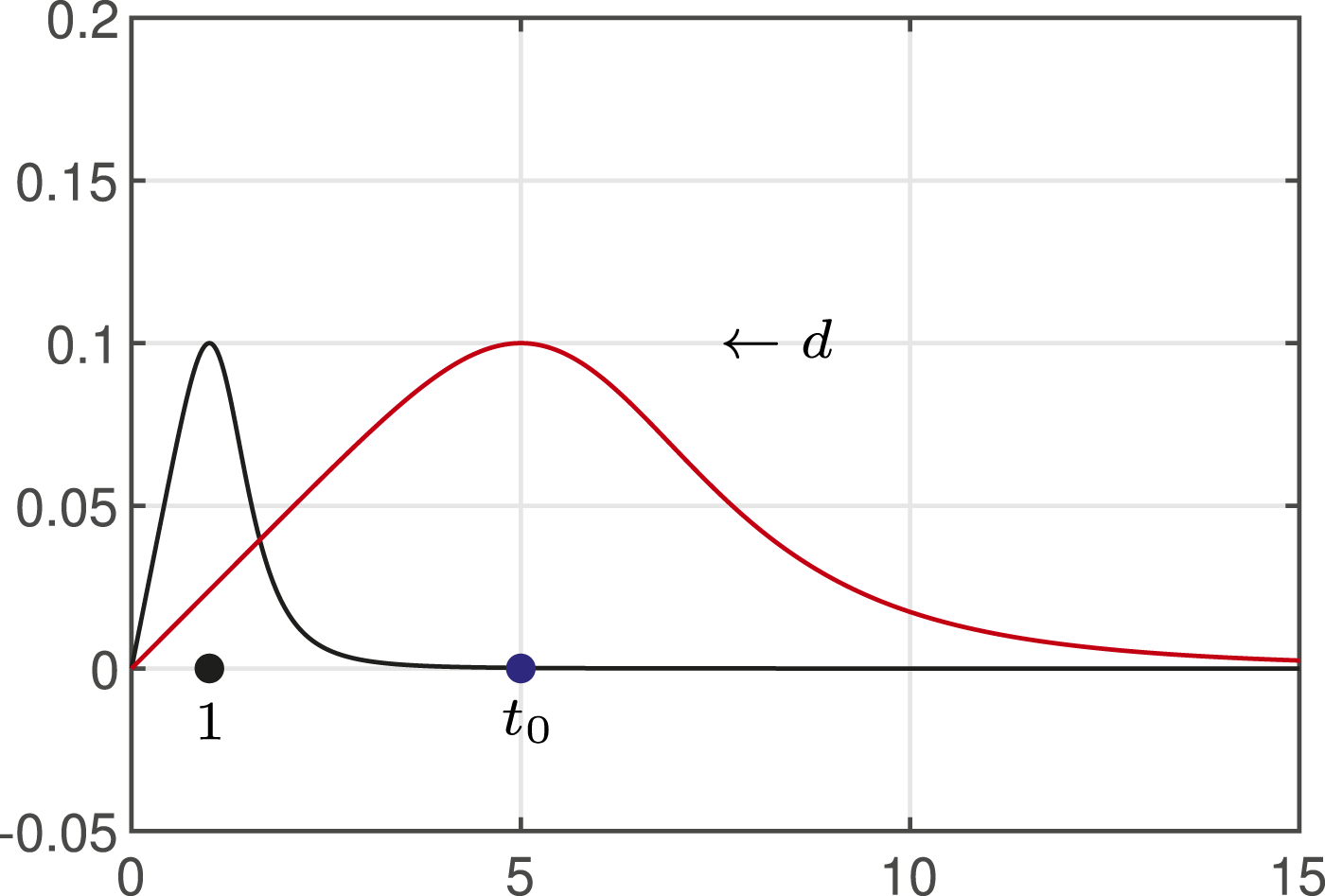


The deformed contour τ = σ starts at the origin τ = 0, then has an indentation of height d around τ = t0 and returns to the real τ-axis for ζ → ∞ by a convergence rate of


The other relevant integral is the power of the far field
A survey of the power contributions
In order to assess the relative importance of the various power contributions, we made a survey of several configurations, all involving a full Kutta condition (γ = 1).
We made plots of the powers
For the interpretation of the graphs it is important to realize that there is a certain arbitrariness in the way the modes depend on frequency. The incident modes, and thus the resulting powers, are normalized on the pressure, more specifically on the mean squared modal function U
mμ
(r). We could have normalized the incident potential or velocity, but we chose for pressure because this is what is normally measured. A normalization on the transmitted power
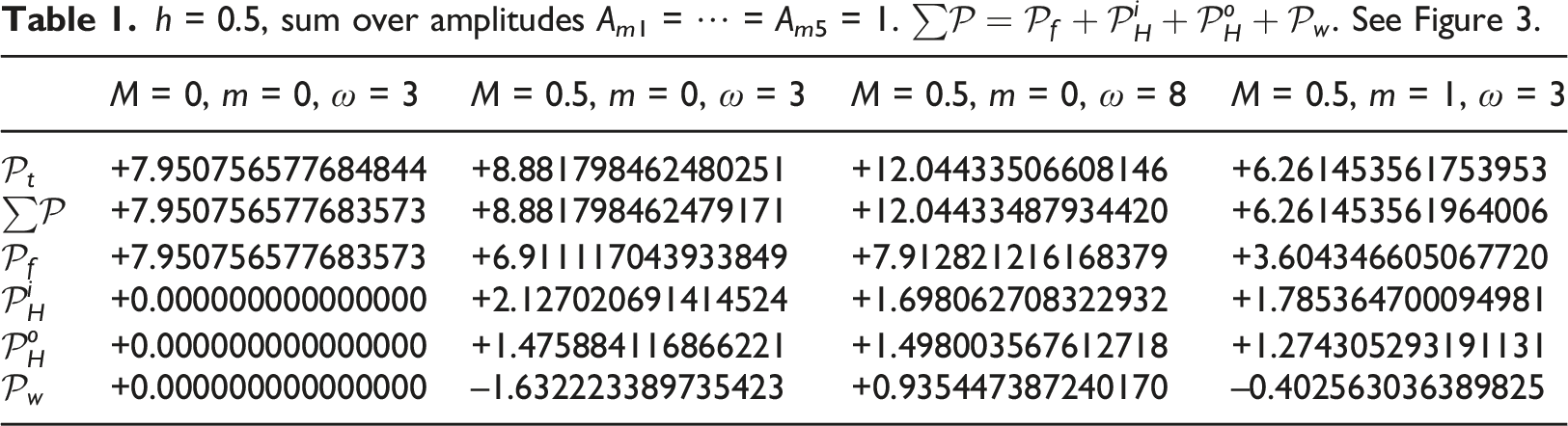
h = 0.5, sum over amplitudes Am1 = ⋯ = Am5 = 1.
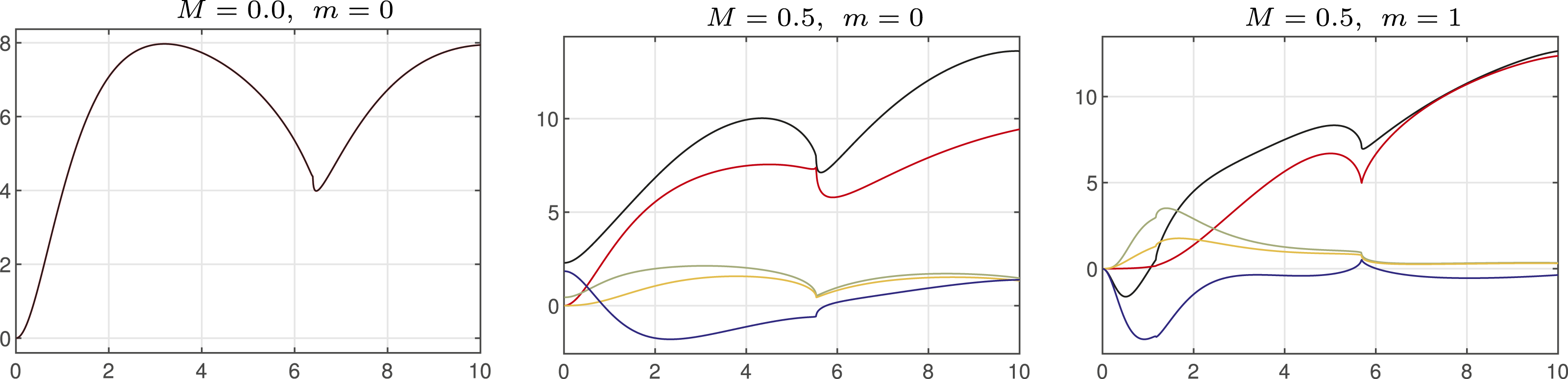
h = 0.5, sum over amplitudes Am1 = ⋯ = Am5 = 1, for frequency ω ∈ (0, 10]. Powers
We see from the table, evaluated at ω = 3, that without mean flow,
Figure 3 shows the behavior as a function of ω. Most interesting is the fact that for many frequencies
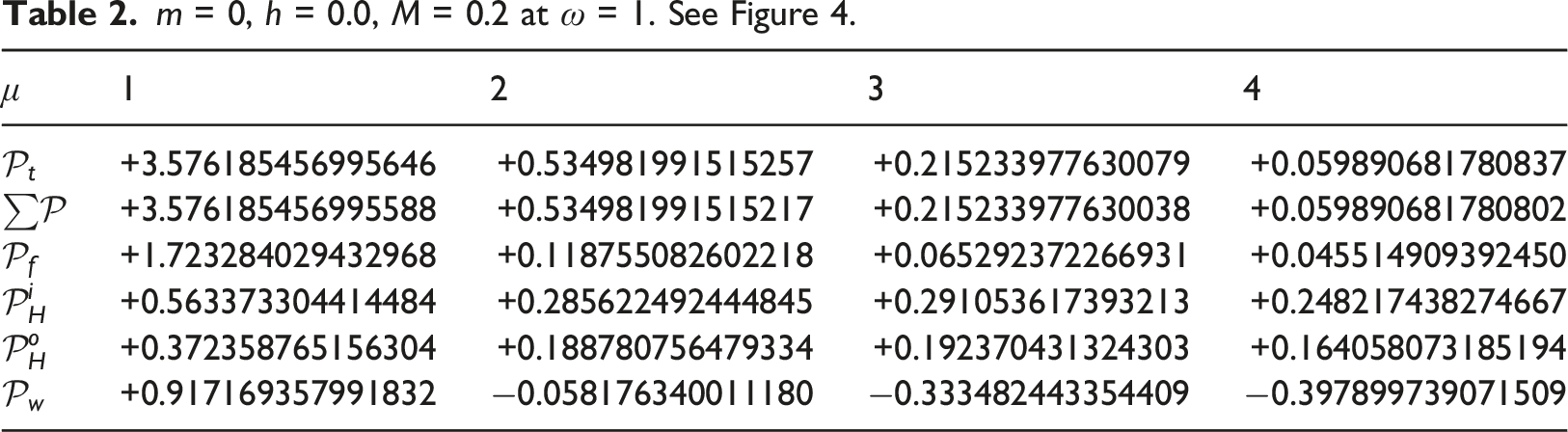
m = 0, h = 0.0, M = 0.2 at ω = 1. See Figure 4.
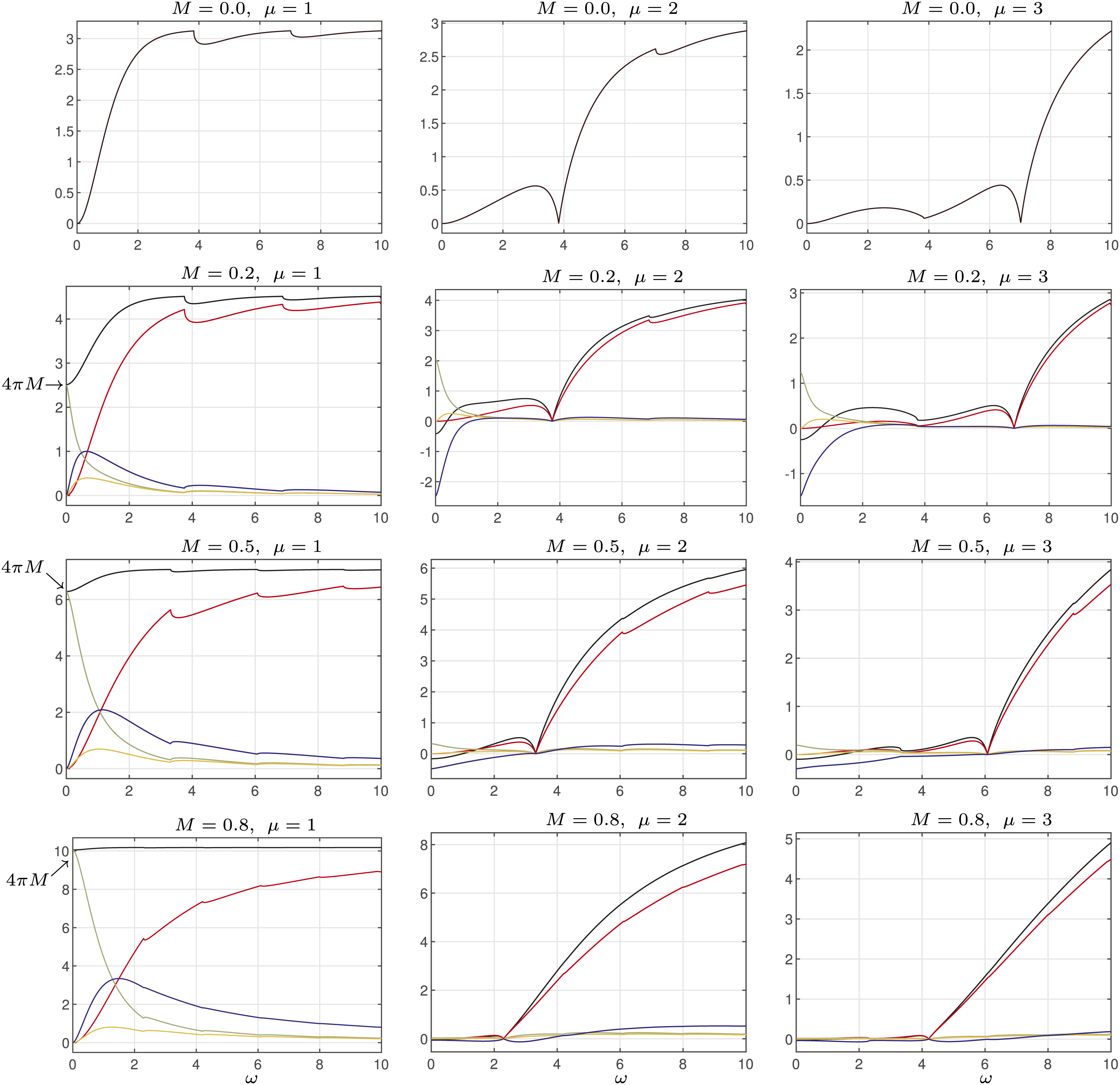
m = 0, h = 0.0, M = 0.0, 0.2, 0.5, 0.8, and incident modes μ = 1, 2, 3. Powers
For other than the plane wave modes (the 2nd and 3rd columns of Figure 4),
Another phenomenon of interest is the important role played by the cut-off frequency of the incident mode (i.e. where
For high frequencies the sound waves become ray-like and the part of the field that interacts with the edge becomes smaller and smaller. It is therefore no surprise that for ω → ∞ the power contributions are dominated by
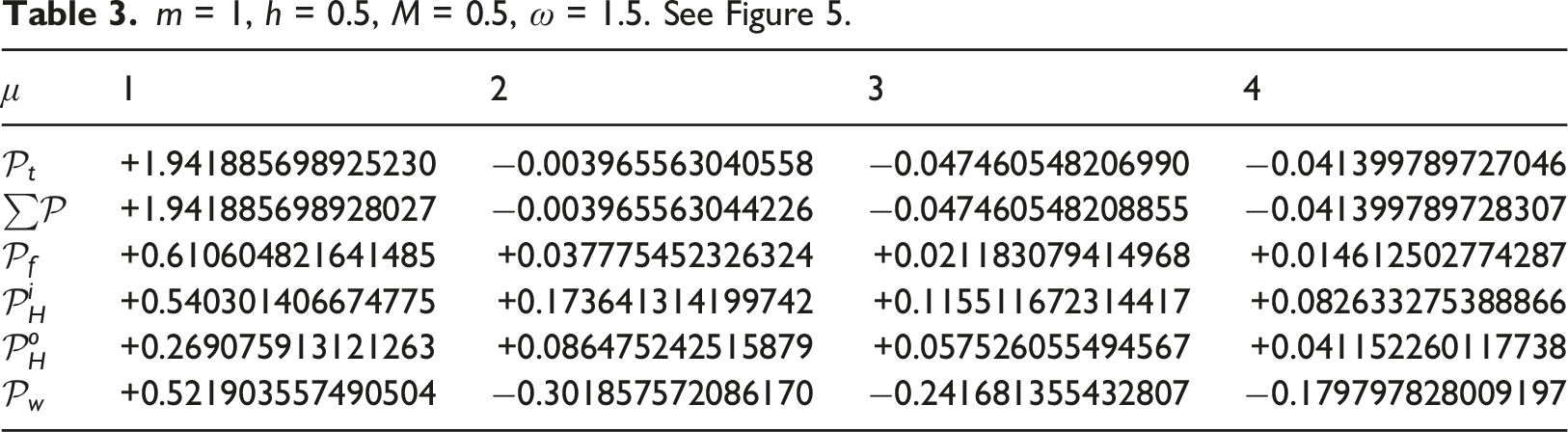
m = 1, h = 0.5, M = 0.5, ω = 1.5. See Figure 5.
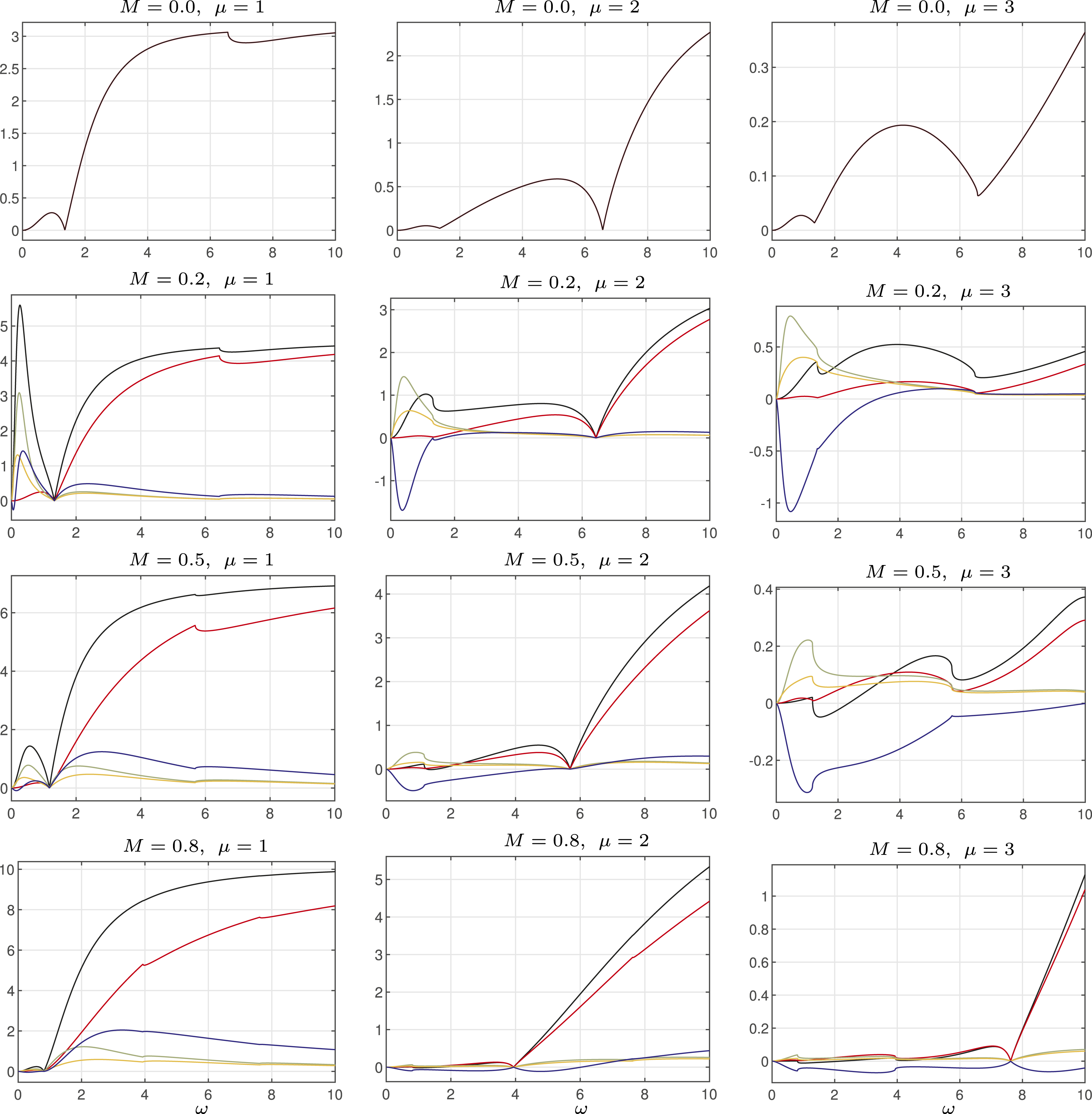
m = 1, h = 0.5, M = 0, 0.2, 0.5, 0.8, and incident modes μ = 1, 2, 3. Powers
The first mode is cut-off under (roughly) ω ≃ 1, and in general (M = 0 or M⩾0.5) not much energy is passing the exit. However, for small Mach numbers (like M = 0.2), a large amount of acoustic energy in the duct is used for the vortex shedding, but without radiating to the far field. This is different from the previous case of m = 0 (Figure 4), because now the production from the duct field
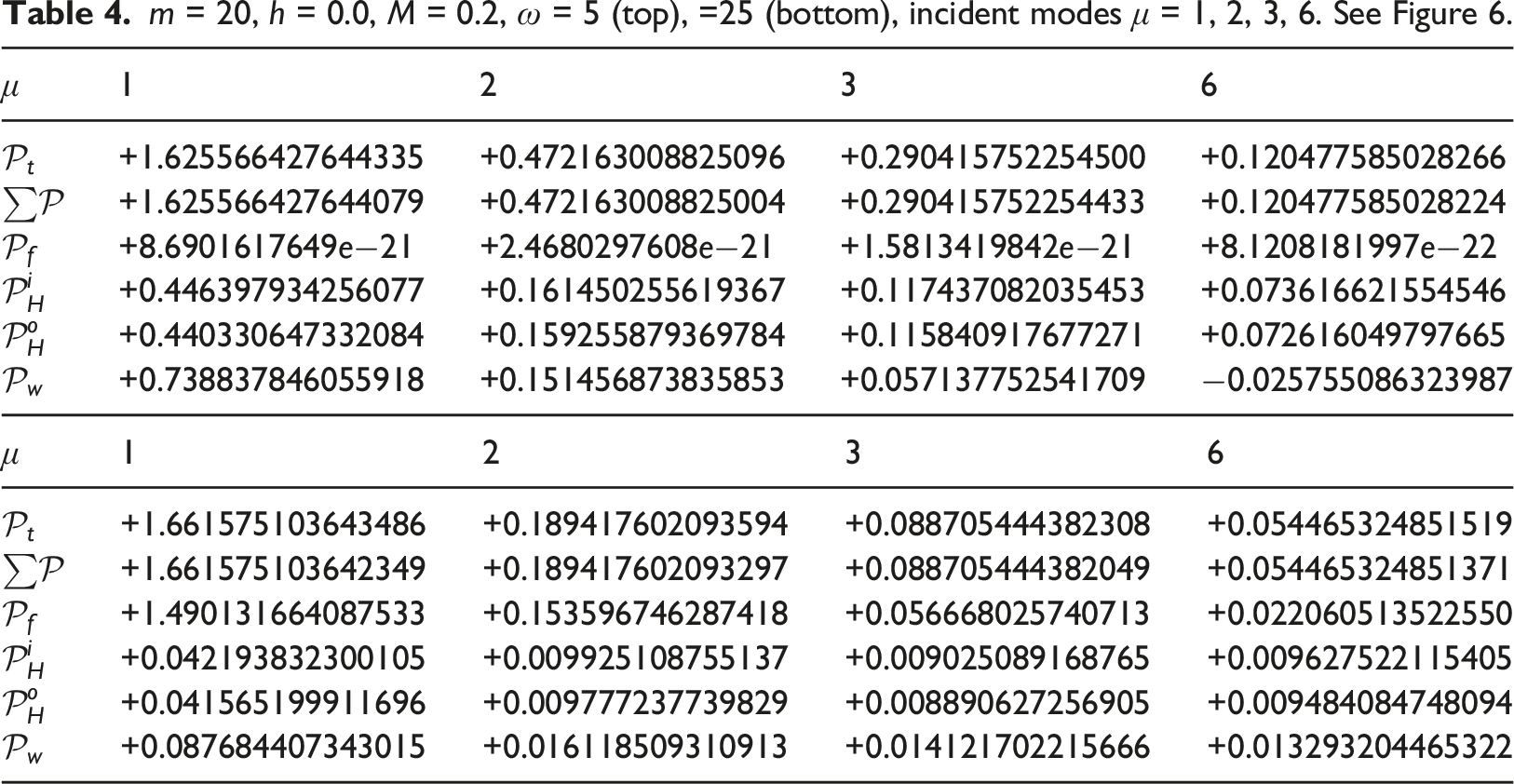
m = 20, h = 0.0, M = 0.2, ω = 5 (top), =25 (bottom), incident modes μ = 1, 2, 3, 6. See Figure 6.
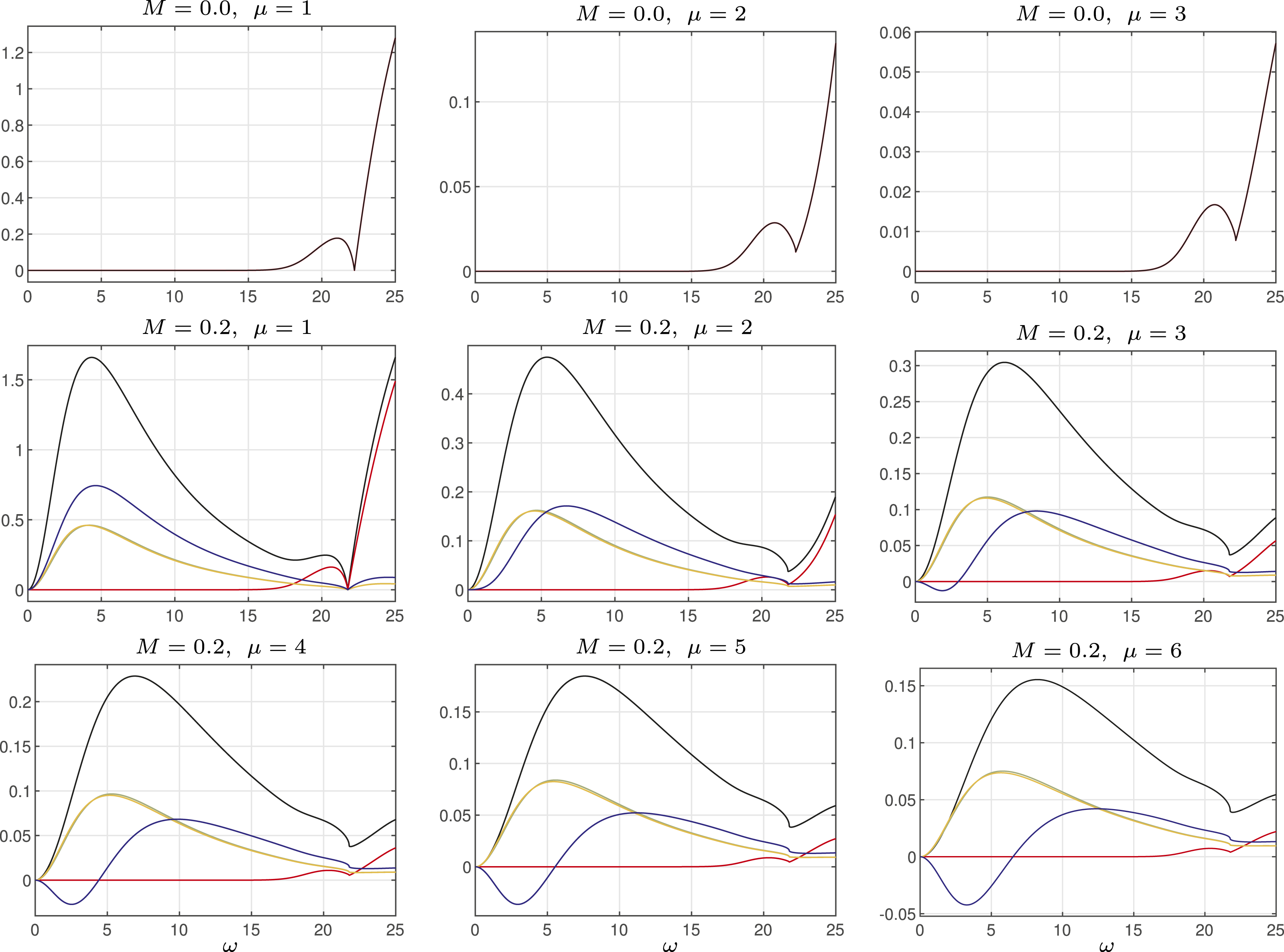
m = 20, h = 0.0, M = 0.2, incident modes μ = 1…6. For comparison 3 modes at M = 0.0. Powers
Conclusions
Acoustic energy in mean flow is in general not conserved, as was shown conclusively by Myers. 19 Energy may be produced by or disappear into vorticity or entropy. In particular in the case of production there must be an exchange with the energy of the mean flow, because there is no other source. One way to study this is by model problems that are simple enough for analytically exact energy expressions and can be evaluated without approximation. The simplest (to our knowledge) of such model problems is the convective Sommerfeld problem of plane waves diffracting at a half plane with uniform mean flow. 14 The absorption of energy by the wake of shed vortices has a remarkable simple form and it is easy to show that it can be both positive and negative, depending on Mach number and angle of incidence. However, the vortices are shed by incident plane waves with, in principle, an infinite content of acoustic energy. So it is still hard to compare the amount of dissipated energy with the incident energy, and in particular to conclude if and how much of the energy must be produced by the mean flow.
Therefore it is interesting to revisit the next simplest model problem, namely of sound radiated from a semi-infinite duct with uniform mean flow. 16 Here the incident energy carried by the duct modes is definitely finite, but otherwise the various contributions are very similar as in the convective Sommerfeld problem.
Although the energy components (power transmitted through the duct
In the present paper we filled this lacuna and gave a survey of the various energy components as function of frequency and other problem parameters. The main conclusions are that (i) the global energy conservation
Footnotes
Declaration of conflicting interests
The author(s) declared no potential conflicts of interest with respect to the research, authorship, and/or publication of this article.
Funding
The author(s) received no financial support for the research, authorship, and/or publication of this article.
