



Abstract
This study explores the factors that can promote (or deny) inclusion and support for students with special educational needs in international schools. It is informed by data collected in a selection of six international schools, located in four different global regions, using a combination of data gathering tools that included teacher questionnaires, semi-structured interviews with the schools’ leadership and SENCOs, and analysis of relevant school documentation
The findings show that host-state intervention and related legislative requirements were the most significant factors in influencing international schools within specific areas towards adopting more inclusive practices in supporting students with special educational needs. Other important factors were leadership and governance that were committed to the principles of inclusion, and that supported and implemented effective inclusive policies and practices. These were found to influence other factors such as the levels of resources and professional development used by the school for supporting students with special educational needs.
Introduction
Diversity among students is often celebrated and explored in academic literature as an important facet of international schooling. Much research has been undertaken into the dynamics and potential of multinational and multicultural groupings within international school classrooms, of the drive to encourage global citizenship, and of the inculcation of international mindedness among students. Relatively little, however, has been undertaken to research academic diversity or variations in learning characteristics and ability range within the student bodies of international schools.
It has been estimated that the number of children in international schooling has passed the 6.7 million mark, in more than thirteen thousand schools worldwide. Predictions suggest that this might increase to over 16,000 schools, with 8.75 million students, by 2028 (ISC Research, 2021). This relatively recent and unprecedented growth of the international school sector has seen a change in character away from the ‘traditional’ model of international schooling. In the past, international schools largely catered for globally nomadic families, generally from European, North American, or Australasian backgrounds, who migrated in pursuit of work and career opportunities (Bunnell, 2014; Leach, 1964 and 1969). Notwithstanding the ongoing debate on the definition, categorisation and characteristics of international schools (the work of the following, for example, has proven invaluable in informing the study in regard to this debate: Hayden and Thompson, 2013; Hill, 2015; Bunnell, 2014, 2021), the use of the term ‘international school’ now encompasses a wider and far more diverse range of schools. These schools include those that cater for children of expatriate workers but also, increasingly, schools that educate national students from the country in which the international school is located who have either fully or partially opted out of their national education system.
The speed of change within the market has made the seemingly simple task of defining an international school difficult. The proliferation of ‘non-traditional’ type international schools that cater for host-state children who have opted out of their national education system (Hayden and Thompson, 2013) in growth areas such as Asia and the Middle East, in comparison to the numbers of the more ‘traditional’ type schools developed in the past for itinerant, mostly Western workers’ children, or schools established according to a specific ideology, has made identification challenging. The growth of ‘non-traditional’ type international schools and movement away from the cosmopolitan values of the more ‘traditional’ type schools have caused some to question the use of the term ‘international school’ in favour of descriptors that may more accurately reflect new business models and related student demographics, namely ‘elite schools’ or Globalised English Medium of Instruction Schools (GEMIS) (Bunnell, 2019). The rapid growth of these types of schools has seen the fragmentation of the field of international schooling into at least two identifiable sectors: the ‘premium’ and ‘non-premium’ – a reference to the ‘elite’ nature of provision offered by some schools in comparison with others (Bunnell, 2019; Morrison, 2016). The pattern of change suggests an ever more complex landscape of further fragmentation resulting from the proliferation in number and types of schools according to local demand. The inevitable result of this fragmentation is seen in the identification of the field as ‘a complex area of study, constantly growing and evolving to such an extent where the frameworks used to describe it can barely keep up’ (Bunnell, 2019: 12).
Consequently, these recent trends in the expansion of the international school sector in both number and character have been accompanied by changes in expectations of the types of students who would attend an international school. Factors such as traditions of selective admissions policies in international schools and a reluctance among expatriate families to travel with children with learning difficulties (Shaklee, 2007) have, in the past, tended to limit the academic diversity of students in international schools to a relatively narrow range of ability and learning characteristics. Recently, however, those schools identified under the umbrella term of ‘international schools’ are experiencing an increasingly wide range of academic ability among their students. By far the most significant change has been the growth in demand for international schooling for children from the same country or nation as that in which the school is located (‘host country’), largely via English language instruction. This study argues as a central tenet that this movement away from the ‘traditional’ model of international schooling has resulted in the broadening of the range of ability among students within institutions classed as ‘international schools’. If ISC Research (2021) figures for numbers of children educated globally in international schools are taken into consideration, with estimates suggesting global averages of more than 10% of learners identified as having additional learning needs (OECD, 2023), this could mean that there are half a million students with special educational needs (SEN) or learning difficulties enrolled in international schools, with predictions of a rise in numbers, in line with the rate of growth of the total international school student population, to over a million by 2028. Whilst many international schools suggest that they have a positive inclination towards supporting students with special educational needs (as shown, for example, in the results of ISC Research surveys from 2016, 2017 and 2019), the recent rapid growth of international schooling has led to suggestions that many schools may be underprepared for the challenge of supporting these students (Gaskell, 2019). This study examines the impact of the rapid growth of the international schooling sector on admission and provision for students with special educational needs by exploring practice in a selection of international schools in different geographical areas, with a view to developing an understanding of the main factors that affect the admission and support for students with special educational needs in international schools.
The complexities of locating the ‘inclusion debate’ within an international school setting
The issue of inclusion within an international school setting offers a variety of challenges and opportunities to the researcher who hopes to gain insight into the meaning of inclusion and the universality of its applicability within different contexts. Many international schools, with the possible exception of some religious, ideological or philanthropically-motivated schools, are private, fee-paying, and for-profit institutions. The concept of inclusion and, to some extent, its practical application within the environment of some international schools are, therefore, immediately challenged by the financially exclusionary nature of many of the world’s international schools. The appeal of this study was related to the opportunity to consider the meaning of inclusion not only across geographically diverse areas, but also within a socio-economic environment that was subject to powerful neoliberal, elitist and potentially exclusionary forces. An exploration of the resilience and universality of the concept of inclusion within these settings would, it was felt, offer key insights into the wider debate on inclusion.
The disputed nature of inclusion can be seen within several different contexts. Some, for example, have drawn attention to the view that inclusion can be seen as a construct related to primarily western ideas about social justice and democracy that have less relevance in other cultural contexts (Rapp and Corral-Granados, 2021; Rose et al, 2014). Others (Hansen, 2012; Nilholm, 2020; Norwich, 2013; Qvortrup and Qvortrup, 2018) question the applicability of inclusion as a definite, conclusive set of principles and behaviours, and instead posit the idea that the very nature of inclusion means that it can be better understood as part of a broad set of attitudes, or otherwise as part of a continuous process that adapts and evolves in response to specific challenges. These understandings of inclusion are particularly apt for this study. The multiple types of challenges to the application of inclusive principles within globally located international schools, which often act independently of state-specific systems without recourse to a monolithic set of standards, mean that a single, conclusive definition of inclusion, and most certainly a single set of practical guidelines for its achievement, are difficult to apply to the context in which many international schools operate. For example, if international schools are seen by some as merely globally located private schools, with few functions apart from supporting the ambitions of the global elites, then the concept of inclusion in a wider sense that considers different forms of diversity (that would include financial, gender-based, cultural and religious, amongst other forms of inclusion) are immediately challenged. Similarly, the myriad individual contextual features of what can now be described as ‘international schools’ ranging from, for example, elitist, wealthy individual private schools to less well resourced ‘low-fee’ type schools attended by the children of those who seek to find better alternatives to the state’s educational provision, serve to undermine the certainties that are assumed in many descriptions or definitions of inclusion. This can be seen even in assumptions as simple as that made by the Salamanca Statement that ‘a child with a disability should attend the neighbourhood school’ (UNESCO, 1994:17), a concept undermined by the fact that many international school students are part of globally itinerant families who often rely on the international school, perhaps because children do not speak the language of the host country, and cannot relate to the assumption that they could attend a ‘neighbourhood school’, whether they have special learning needs or not. Recent recognition by UNESCO (2021) of the significance of the role of non-state actors within educational provision in global settings goes some way to address and mitigate these assumptions when considering the effectiveness of the implementation of inclusive practice in diverse global educational environments. The UNESCO report acknowledges the various stratified forms of provision found within different international contexts and asks pertinent questions about the socio-economic contexts in which these forms of education are offered. The report offers some parallels with this study in acknowledging the complexity of the different forms of educational offering within global environments and supports the idea that even a simple categorisation of international schools into ‘for-profit’ and ‘not-for-profit’ proves to be a very difficult task. Furthermore, efforts by UNESCO to classify schools into type according to the levels of fees charged, in recognition of the fact that not all international schools are ‘elite international private schools’ and acknowledging the proliferation of ‘low-fee private schools’, serve to further highlight the complexity of the context. Efforts to address concepts such as inclusion within such a diverse variety of contexts and practices can, therefore, be very challenging and complex. For the purposes of this article, however, the definition of ‘inclusion’ will be limited and relates specifically to the inclusion of students with special educational needs in international schools.
The pattern of admission and provision for students with SEN in international schools is also complex. Some studies suggest that international schools are generally slow to develop strategies and policies that can be classed as inclusive for learners with SEN (Haldimann and Hollington, 2004; Lane and Jones, 2016; Shaklee, 2007). However, recent ISC Research surveys (in 2016, 2017 and 2019) indicate a movement away from international schools’ self-perceptions as being selective, with high numbers of schools that participated in the surveys expressing ambitions to be seen as moving towards greater inclusion. Other results within these surveys support the idea that elements of inclusive practice are happening on a widespread scale across globally located international schools. Nevertheless, there are relatively few existing studies or empirical data on the issue of inclusion in international schools to support these suggestions in any real depth.
Lack of research on inclusion of students with special educational needs in international schools
Some references to inclusion of students with SEN within international school settings have historically been made in the literature, for example Bradley’s (2000) description of support provided by the Dover Court Preparatory School in Singapore for a range of special educational needs and learning difficulties, including ‘physical disabilities, specific learning difficulties, mild, moderate or severe learning difficulties . . . hearing impaired, children with Down’s Syndrome or autism, students with speech and language impairments, students with epilepsy, gifted or talented students, those with cerebral palsy’ (Bradley, 2000:30). Similarly, Haldimann’s (2004) study referenced practice at three international schools in Barcelona, Manila and Sao Paulo that had demonstrated a commitment to the principles of inclusion according to a framework known as the ‘Optimal Match Concept’.
Nevertheless, reference to studies of inclusion in international schools is generally infrequent and refers only to isolated and individual cases. Arguably, despite the early promise of examples such as Dover Court Preparatory School, the field remains, over twenty years later, underdeveloped and lacking in formal academic study and the resultant empirical evidence that could allow more conceptual approaches and frameworks of understanding to be created.
The relatively few contributors to the field (for example Agustian, 2021; Haldimann, 2004; Pletser, 2019; Shaklee, 2007 and the work of Next Frontier Inclusion) have argued that the lack of academic research on inclusion in international schooling is a matter of concern. Pletser’s view that there is ‘little rigorous research carried out in international schools in the field of learning support and with no theoretical frameworks identified’ (Pletser, 2019:200) is echoed by Bunnell’s (2014) concern at the lack of empirical evidence relating to international schooling in general, which includes little by way of conceptualisation and theoretical frameworks, and is limited to ‘a relatively non-critical narrative’ (Bunnell, 2019:29).
It is clear, then, that there remains a lack of directly relevant material and, of more concern, a lack of empirical evidence upon which to base clear practical decisions on how best to support students with special educational needs and learning difficulties in international schools.
Research focus
The study sought to develop an understanding of school processes and external influences that can either support or hinder the inclusion of students with special educational needs in international schools. The main focus of the enquiry was to investigate the following:
In what ways are students with special educational needs supported in international schools?
What are the factors that influence admission, inclusion and support for students with special educational needs in international schools?
Research approach, methods and design
Research context: school types and their location
The study examined, through case studies involving six different international schools, the factors that help or hinder students with special educational needs or learning difficulties in being admitted to international schools and, following admission, in accessing the necessary support to enable meaningful interaction with the school’s regular curriculum. The factors examined that were considered relevant to the admission and support for students with SEN in international schools include the philosophy and attitudes of the leadership of the school towards SEN, teachers’ attitudes and preparedness, host state attitudes and legislation, external environmental factors such as availability of resources, and the effects of accreditation and inspection procedures.
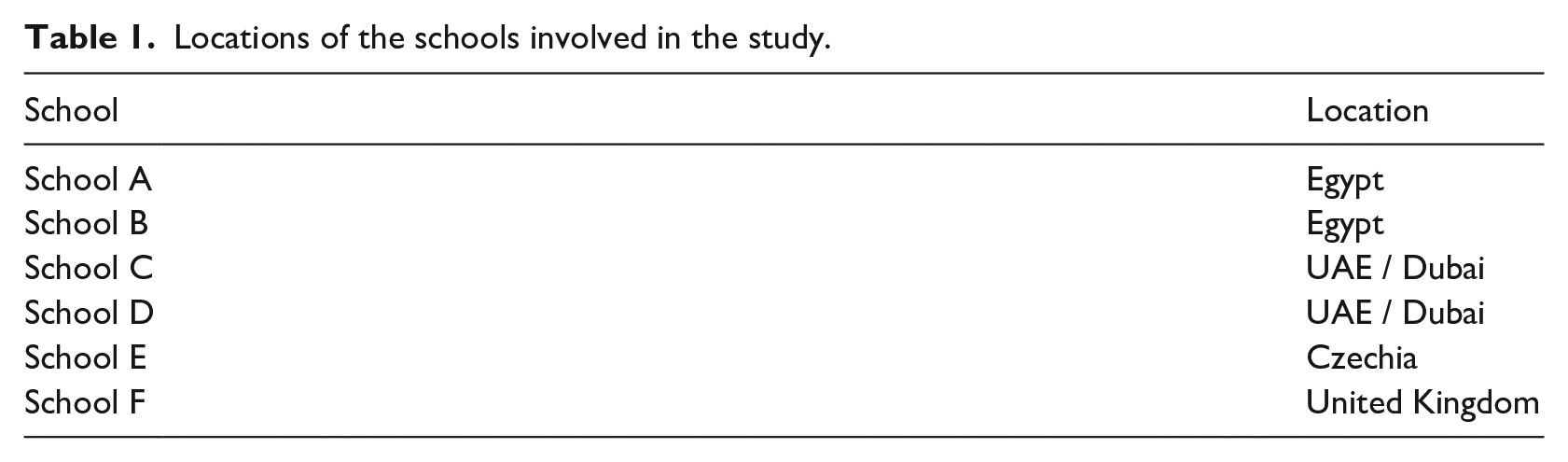
The study was conducted between 2020 and 2022 in different geographical areas to capture and reflect the diverse influences that act upon international schools within their local environment. It examined practices in international schools operating in four different states: Egypt, Czechia, the United Arab Emirates (Dubai) and the United Kingdom. The choice of these areas was purposive, in that they offered a variation of historical, economic and cultural contexts within which the international schools operate. The study also sought to involve a range of different types of international school within the four geographical areas of study, including independently owned schools, schools owned as part of multinational chains of schools, and a mix of schools that were either for-profit or not-for-profit. Each school was chosen to reflect aspects of international schooling that have relevance to the inclusion of students with special educational needs, and that reflect the diverse circumstances that can affect decision-making in different global environments.
Table 1 shows the locations of the schools involved in the study.
Locations of the schools involved in the study.
The study adopted a ‘nested case study’ design, which involved gathering, exploration, interpretation and analysis of the data at local, national and global levels through what might be thought of as a ‘Russian doll’ model (Chong and Graham, 2013). This approach was chosen due to the multi-layered geographical, political, cultural and socio-economic factors that influenced the design and conduct of the study. The approach was deemed particularly appropriate as it allowed for exploration of issues and concepts at individual school level, at area or national level, and globally across the field of international schooling in general. The view that ‘a scaled approach that travels through macro, meso and micro levels to build nested case studies allows more comprehensive analysis of both external/global and internal/local factors that shape policy making and education systems’ (Chong and Graham, 2013:3) supported the aims of the study in examining the factors that determine the levels of implementation and success of inclusive measures in schools at both local and global levels. The placement of the case studies within their broader historico-cultural, political and socio-economic contexts would, potentially, reveal information pertinent to an understanding of the ‘ecology’ of the school and its systems (eg for inclusion) within the broad and varied international landscape within which it operates (Vulliamy, 1984). The study sought in each case to explore attitudes among the school staff towards the principles of inclusion, and the extent to which the school had committed to these. Participants invited to take part in the study included stakeholders who were able to explain decisions made by the school in terms of its orientation towards inclusion and inclusive practice.
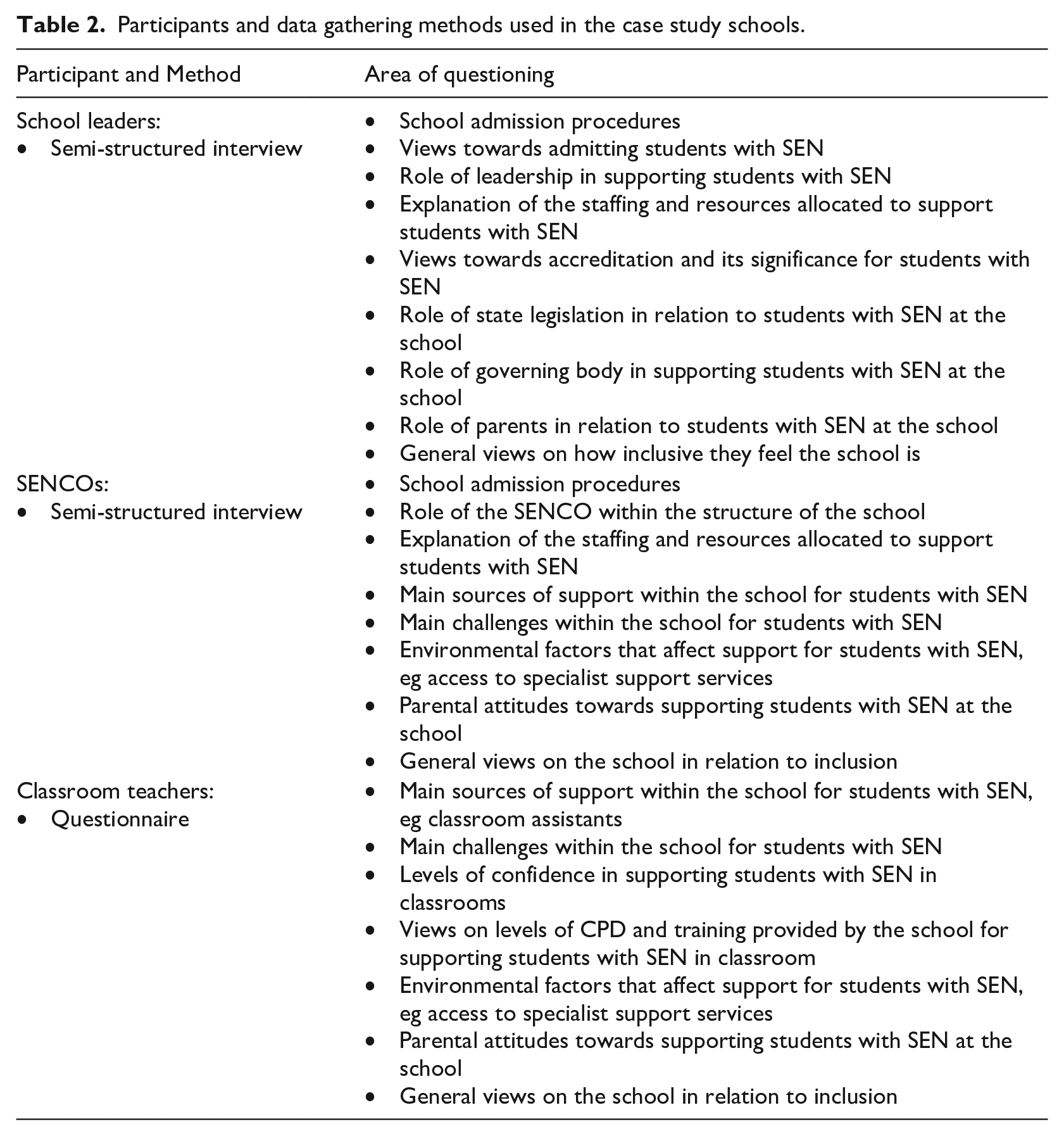
School leaders and SENCOs (Special Educational Needs Coordinators) were invited to participate in semi-structured interviews, considered to be the most appropriate format due to the potential volume and complexity of the data gathered through responses from those best informed about admissions and inclusive practice at the school. The interview questions were informed by elements of the Index for Inclusion (Booth and Ainscow, 2016) and, in order to gain an understanding of the typology of the school, according to Hill’s (2015) framework on characteristics and typology of international schools. The interviews were conducted either in-person (when opportunity allowed this), or via Zoom video-conferencing.
Teaching staff were also invited to take part in the study as respondents to detailed questionnaires, in order to gain insight into the views of those practitioners who may have been tasked with adapting provision to support inclusive measures (or not) in the different schools. Staff volunteered to take part in the questionnaires, following an introduction to the study during staff meetings. Participating teachers, following exploratory conversations, felt that questionnaires would best suit their availability and time constraints. A questionnaire of 25 closed questions and three open-ended questions gathered data on the background, experience, training and attitudes of a purposive sample of teachers (involving a combination of primary teachers, secondary teachers and cross-phase teachers, according to the schools in question) with respect to inclusion in the international school in which they were employed. Construction of the questionnaire and the central themes of the inquiry were influenced by the Index for Inclusion (Booth and Ainscow, 2016), and by reference to the THEMIS inclusion tool (Azorin and Ainscow, 2018) and a framework for examining curricular issues related to specific learning needs (Lewis and Norwich, 2005). Hard copies of the questionnaires were shared with the participants and returned to the researcher confidentially via sealed envelopes and a ‘Drop off box’ distributed to the schools.
In each of the six case-study schools, participant views were elicited, either via semi-structured interview (School Leaders and SENCOs) or questionnaire (teaching staff) on the areas shown in Table 2.
Participants and data gathering methods used in the case study schools.
Main themes and discussion
Following thematic analysis of the interview and questionnaire data, specific themes emerged relating to inclusion, admission and support for students with SEN. Analysis of the data for the six schools revealed a series of emergent themes in the form of commonalities that related to all the schools involved.
Theme 1: Schools’ self-perceptions in relation to inclusion
The first commonality was that none of the schools involved with the study, according to the views of the leadership, identified themselves as being selective. Most of the teachers, all school leaders, and most SENCOs in all six schools claimed that their school was inclusive or moving towards inclusion, both in its admission processes and in the levels of support it offered students with SEN. The descriptor most commonly chosen by teachers in response to the question ‘Which one of the following characterises the school’s approach towards admission / support of learners with SEN: Inclusive / Quite Inclusive / Quite Selective / Selective’ in relation to their school was ‘Quite Inclusive’, while the more commonly chosen descriptor of the school in response to the final, summative reflection question was ‘The school is moving towards supporting children with learning difficulties and is adapting its policies and practices to reflect this.’ The only exception to this was found with the teachers of School A, some of whom considered the school to be ‘Selective’. Their views were supported by the SENCO of School A, who felt that the school did not invest enough resources in supporting students with SEN, but contrasted with the view of the leader of School A, who considered the issue of inclusion to be a priority for the school. The different views in School A offer an example of how measures within a school can be perceived in different ways by the stakeholders involved. These responses also justified the approach adopted by the study of including data from potentially different viewpoints.
These findings are supported by the results of a wide-scale quantitative survey of international schools conducted by ISC Research and Next Frontier Inclusion in 2016, 2017 and 2019 on inclusion in international schools, which saw similar findings in the declining proportion of schools that identified themselves as ‘Selective and not interested in inclusion’ from 4.5% of the 584 schools polled in 2016 to 1.46% of the 207 schools polled in 2019. The majority of the schools in the 2017 poll identified with the descriptor, ‘We are well on our way [towards inclusion]. Policies, protocols, and personnel are in place. We can still grow. We take pride in the learning diversity of our students.’ The selection of this descriptor by the majority of participants in the ISC Research surveys mirror the results found in the schools in this study, both in their movement away from associations with selective admissions policies, and in their claims to be moving towards an inclusive ethos and practices.
Whilst the views expressed by many of those involved in the study about the inclusive nature of their schools may be supported by the results of the broader surveys, it cannot be assumed that this would necessarily apply to all international schools worldwide. Despite recent improvements in provision for students with SEN by many international schools, Shaklee’s (2007) view that ‘as private entities the international schools by and large have no legal requirement to accept or serve students with disabilities of any kind’ may remain relevant. (Shaklee, 2007:270). This can be seen in the fact that all but one of the schools (School D) involved with the study had refused admission to at least one student with SEN within two years prior to the survey. The justification offered by almost every school in the survey regarding refusal of admission to potential students at the school was by way of reference to a concept that they described as a ‘pupil profile’. When questioned on the meaning of, or descriptors involved with, the ‘pupil profile’, three of the schools explained that there were no formal criteria but applicants were considered on a case-by-case basis. A further comment frequently offered to support the concept of a pupil profile was a reference to a mismatch between the characteristics of the applicant student and the resources that the schools could offer, or had access to, that could support the learning of the student. Schools used phrases such as ‘the right fit’ (School B), a ‘best fit’ (School E) and ‘the child is out of profile’ (School F) to explain this idea of a mismatch.
Studies (Carrasco et al, 2017; Haldimann, 2004; Shaklee, 2007) have suggested that the concept of a ‘pupil profile’ exists when it comes to deciding on international school admissions. Haldimann (2004:134) claims that ‘when international schools do allow access for exceptional students the definition of exceptionality is often very narrow and seldom includes more than mild learning disabilities, highly able or English as a second language (ESL) learners’. Similarly, Shaklee found that ‘the majority of international schools also have selective admissions policies primarily dependent on prior grades, standardized testing and teacher recommendations that show the student to be average or above average in academic performance with few behavioural problems’ (Shaklee, 2007:270). The findings from our study, as shown in many of the school leaders and SENCO interviews, suggest that despite the schools seeing themselves as moving towards inclusion (ISC Research, 2019), a degree of selectivity in international schools’ approaches to admitting students with SEN persists, and that these practices have not entirely disappeared in the period since Haldimann and Shaklee were writing. The concept of a ‘pupil profile’, for example, still enables schools to refuse admission to students with SEN (evidenced by the fact that five of the six schools that took part in the study had refused admission to students with SEN within the two years prior to the study, with some of the schools referencing the concept of the ‘pupil profile’ as justification). Whilst the lack of recent literature on this issue may suggest that selective admissions procedures are becoming less prevalent (or that schools are unwilling to take part in research that may reveal these types of practices), the findings in this study offer a view that these types of selective practice can persist in subtler forms.
An exception to the ‘ill-defined’ pupil profiles suggested by some of the schools was provided by School F, whose detailed criteria served as an example of a more clearly defined ‘pupil profile’:
The school has a pupil profile agreed with the governing body. We accept pupils that we feel we can make reasonable adjustments for and who will benefit from the education we can provide. We accept pupils with very severe dyslexia, dyspraxia, dyscalculia, speech and language communication difficulties. We do not accept pupils with moderate or general learning difficulties if it is apparent that they would not be able to function in school without one-to-one support. The school policy is not to have teaching assistants in the classroom and consequently we do not accept pupils with severe ASD, ADHD, or behavioural problems such as oppositional defiance disorder.
(SENCO, School F)
The existence of a selective ‘pupil profile’ can lead to a trend shown by parents of applicant pupils with SEN of trying to downplay the child’s learning difficulties in order to secure admission. Comments made by School E demonstrate the range of reasons why parents may not be forthcoming with detailed information about their child’s learning needs during the admissions application:
Parents find it quite hard to accept that their child has special needs. And parents of those that don’t have special needs sometimes don’t want the education of their child affected by students who do. Parents think of the school as very prestigious and don’t want the reputation of the school to be affected by having lots of children with SEN.
Sometimes it can be difficult to find [evidence of SEN] at admissions . . . If the child comes from past schools with reports that suggest a behavioural issue, or if the child scores very low on the test, which indicates a severe learning difficulty, we may refuse the child. However, we do receive very young children who have not got English as a first language, so we have to consider whether the problem is EAL based or if it is something else. But sometimes they find ways to hide this information to admissions. (SENCO, School E)
This is not a new phenomenon, as commented on by Shaklee’s (2007) observations that ‘parents can be sometimes less than forthcoming about their child’s past history, special needs services or learning supports needed in order to acquire access for their child to an international school’ (Shaklee, 2007:271). These tensions relate to broader ‘dilemmas of difference’ within inclusion and provision for learners with SEN (Norwich, 2008 and 2013). The view that the identification and potential labelling of students’ needs are a source of tension is demonstrated emphatically by the international school context in this case. The practical realities experienced by some parents or carers who seek admission for children with SEN to international schools by concealing their child’s learning needs provides a further example of how consideration of the international school situation can offer a different contextual background to the inclusion debate, and raises issues that may not relate to more general state-based educational contexts.
It is also evident that, in some cases, the issue of admissions can lead to tensions between parental desire for placement of their child at the international school and the views of other parents towards inclusion (Paseka and Schwab, 2020). These often interact with the schools’ preconceived (and arguably selective) notions of a ‘pupil profile’ and their estimation of whether they are able to support the child with their current resources and specialisms, creating a complex decision-making process over admission of students with SEN. The existence of the notion of a ‘pupil profile’ (whether explicit and acknowledged or not) implies that, despite the stated views of the majority of teachers and leaders at the schools in this study, many can be selective to a degree due to the existence and application of these criteria as part of the admissions process.
Theme 2: Reluctance of international schools to admit students with emotional and behavioural difficulties
A second commonality, related to the above concerns with admissions and a ‘pupil profile’, was found across all the case study schools in their reluctance to admit students considered to have emotional and behavioural difficulties.
Within the international school context, ISC Research (2019) found that 60% of participant international schools had students reported as having mental health or emotional problems that required intervention, constituting a 6% rise in numbers since 2017, whilst 35% of schools reported students with significant behavioural challenges that needed intervention. The problems faced by students with emotional and behavioural difficulties can include emotional disorders such as anxieties, phobias, and depression, self-harm and suicide, conduct disorders (CD), hyperkinetic disorders or attention deficit hyperactivity disorder (ADHD), autistic spectrum conditions (ASC), psychotic disorders, eating disorders, and substance and drug abuse. This group, therefore, represents a considerable proportion of current students or potential admissions to international schools. Gopalkrishnan (2018) and Hechanova and Waelde’s (2017) studies provide further insight in their findings that cultural differences can impact on how mental health is understood in different global environments. This relates strongly to the case of the intercultural mix of students found in many international schools, many of whom are seen as ‘third culture’ children who exist between, or apart from, home and host state cultures. A tendency by international schools to apply western understandings of issues such as mental health and emotional difficulties may well exacerbate this situation for some students, with the effects potentially compounded by dislocation from home environments (WISE, 2020).
Despite the prevalence of emotional and behavioural difficulties among young people, reactions to these conditions may remain relatively uninformed within the international school environment. Studies suggest that inexperience and perceived lack of specialism among teachers in supporting students with emotional and behavioural difficulties may lead to prolonged tension between teacher and student, characterised by problematic relationships within school and classroom environments (Cooper, 2011; Sheffield and Morgan, 2017). Jull (2007) comments that this situation is exacerbated by the fact that a common recourse in responding to young people who experience such issues is to use punitive action and possibly exclusion as a response. The perceived risk of disruption to learning activities means that successful admission of those students with a history of emotional and behavioural difficulties may be jeopardised, particularly within the more selective environment of international schools’ admissions processes.
The responses of every case study school confirmed that schools are reluctant to admit students with emotional and behavioural difficulties. The schools’ comments offer insights into the reasons why admission may be denied, ranging from ‘not having the capacity’ (Leader of School A), ‘can’t cater for their needs’ (Leader of School B) and ‘not well equipped for that sort of issue’ (Leader of School E). Further explanation of this reluctance to admit students with a history of emotional and behavioural difficulties referenced issues such as a lack of staff knowledge and expertise and the potential for classroom disruption. It was interesting to note that even those case study schools that demonstrated a strong commitment to inclusive principles and practice and were well staffed with the expertise to provide support, expressed reluctance to admit students with emotional and behavioural difficulties.
The data suggested that it was evident that some international schools feel unprepared for supporting students known to have conditions associated with emotional and behavioural issues. The resultant reluctance to support students with emotional and behavioural difficulties can pose a threat to the inclusion process, as acknowledged by Ogden’s (2001) view that ‘behavioural difficulties and individual differences in behaviour are among the main barriers for making the principle of the inclusive school work’ (Ogden, 2001:75).
Theme 3: The role of the Learning Development Department (or equivalent)
All the schools involved with this study had a Learning Development Department or equivalent (also known by other designations, such as the Learning Support Department, Inclusion Team, and so on). However, levels of reliance on the department for support and guidance on issues related to inclusion and support for students with SEN varied between the schools. The main factor that determined this level of reliance related to the confidence and preparedness of the classroom teacher in their provision for all students. In those schools where teachers felt confident in supporting a range of different learning needs, SENCOs expressed the view that the learning support departments felt able to deploy their support more effectively, and in different ways. Studies suggest that several factors such as the effectiveness of differentiation by class teachers, levels of reliance on teaching assistants, and the practice of creating smaller groups taught by learning support teams are relevant to the success of inclusive provision and practices in schools (Asfa-Wossen, 2018; Civvitillo et al, 2016; Hoover et al, 2004; Webster and Blatchford, 2018; Westwood, 2013). SENCOs’ comments from the case study schools confirmed that when classroom teachers showed greater degrees of confidence and autonomy in supporting students with SEN, this allowed Learning Development teams to consider and develop a broader variety of ways to support learners. This was confirmed by responses to the teacher questionnaires, which revealed that the roles of the Learning Development team and SENCO were less important to teachers from those schools that had invested in higher degrees of training and provision on inclusion and supporting SEN. The effect of this investment was seen in increased teacher confidence in supporting a range of learning needs (shown, for example, in responses to related teacher questionnaire items for schools C, D and F). This was particularly the case if the requirement for classroom teachers to develop successful and effective inclusive pedagogical practices was mandated by the school (as in the case of School F) or by the state in which the school was located (as in the case of Dubai, and Schools C and D). This was seen by the schools involved (and acknowledged by the leaders and SENCOs of those schools) to be a powerful incentive in encouraging mainstream teachers to address and embody effective pedagogical practices for students of all abilities.
Theme 4: The main factors that influenced inclusion in the international schools
Host state intervention, attitudes and orientation towards inclusion
The case studies based on Schools C and D in Dubai provided the most compelling evidence of the importance of host state requirements regarding inclusion in supporting students with SEN. School leaders, SENCOs and teachers’ responses suggested that the instructions embodied in the Dubai Inclusive Education Policy Framework meant that orientation towards inclusive practice was to become central to their approach and pedagogy. This was evident in various aspects of responses of teachers at Schools C and D to the survey, including those items associated with the focus of CPD, attitudinal questions regarding teachers’ views of the schools’ approaches to inclusion and SEN, and perceptions of the schools’ ethos, allocation of resources and admissions processes.
Dubai’s Inclusive Education Policy Framework required international schools to implement the following measures by 2020:
School governance is oriented towards inclusion of ‘students of determination’ (a term used in the UAE to describe students with disabilities or SEN), including implementation of measures such as appointing a governor for inclusive education.
Schools create an Inclusion Support Team, led by the Principal, to ensure implementation and monitoring of measures stipulated in the Inclusion Framework.
Principals review, develop and implement a comprehensive and strategic inclusive education improvement plan, supported by implementation and monitoring of the Framework’s requirements.
Inclusion Champions are nominated in each school to promote and model practice that supports the development of inclusive attitudes and approaches.
Appointment of ‘support teachers’ to model and advise classroom teachers on effective practices that support the implementation of inclusive attitudes and practice in classrooms.
Classroom teachers cooperate with the Inclusion Support Team and Learning Support Assistants to support the learning, progress, and outcomes of all the students in their classroom.
The evidently ambitious, pervasive, and far-reaching requirements of the Framework had a demonstrably positive effect on the orientation and attitudes of school leaders, SENCOs and teachers in the two Dubai schools (C and D) involved with the study. The notion that host-state attitudes and interventions can have a significant impact on international schools’ orientation towards inclusion is reinforced by Shaklee’s (2007) comment that: ‘The degree to which the host country has embraced and created legislation to serve exceptional children may be reflective of the degree to which the international school embraces special needs students as well.’ (Shaklee, 2007:274).
The situation of the schools in Dubai and the Dubai government’s directives also provoke important questions about the nature of inclusion and how it is achieved. Inclusion in this case is evidently understood as a definitive process achievable by implementing a specific set of directives. Consideration of the methods by which these inclusive measures were implemented and achieved, understood within the context of the nature of a state’s power and its relationship with its people, leads to interesting insights into issues related to inclusion, the democratic process and a state’s influence within this. The particular context of this study, within specific international environments that are affected as much by economic influences such as neoliberalism or state interventionism as they are by political influences such as authoritarianism or liberal democracy, serves to emphasise the importance of examining the concept of inclusion within a variety of different educational and social contexts. Whilst such issues are beyond the remit of the current study, consideration of these principles can serve to enrich and inform the inclusion debate, particularly with respect to how inclusion is practically achieved.
A degree of host-state influence expressed through a set of expectations was also described by the leader of School F in the United Kingdom, who outlined the school’s obligations related to inclusion as: SEN targets, standards and measures are at the core of our education. We are monitored annually by the national education and training inspectorate. We are registered with [the] Secretary of State and CReSTeD [Council for the Registration of Schools Teaching Dyslexic Pupils] for the admission of pupils with SpLD [Specific Learning Difficulties]. Expectations are rigorous and are monitored regularly. (Leader, School F)
These details refer to a combination of national guidelines and inspection procedures within the UK, implemented by the national government, that involve a self-evaluation process for improvement aspects of schooling (that includes provision for students across the ability range), in addition to a formal whole-school inspection visit organised on a three-to-four-year basis. The case of School F, then, demonstrates the importance of the influence of the host state through the interaction of formal, state-driven inspection procedures, coupled with accreditation by an organisation (such as CReSTeD) concerned with provision for learners with SEN.
In contrast, the influence of the host state on the other schools in the survey was considered by the participant schools to be a relatively unimportant factor, with very little bearing on either the admissions process (‘it really is up to us as to whether a pupil is admitted’ (Leader of School A)) or on the day-to-day running of the school.
The influence of the host state, then, is often complex and linked with the traditional and cultural norms that relate to disability and SEN. Shaklee’s views on the dynamic between host-state attitudes towards SEN and the values of the international schools summarise the situation experienced by many international schools: ‘respect for the host country traditions, beliefs and values are of paramount importance; this can present a unique dilemma for serving learners with disabilities. While the school personnel might embrace the ideal of serving a diverse population including those with learning disabilities or behaviour disorders, the cultural norms of the host country itself might not support those ideals.’ (Shaklee, 2007:273). Conversely, the attitudes of the host state towards the issue of inclusion may be proactive and positive, as has been recently seen in the case of states such as Dubai. If this is the case, then an opposite dynamic to that suggested here by Shaklee may be discernible in the form of a greater impetus towards inclusion and, consequently, a requirement that international schools examine and, if necessary, change existing practices to become more inclusive in both admissions procedures and pedagogical approaches.
Inclusive leadership of international schools
The data showed that inclusion in international schools also happens because of specific decision-making by the leadership of individual schools (Pedaste et al, 2021). Both Schools B and F described the inclusive natures of their schools as being the result of planned leadership decisions to adopt and develop an inclusive culture and practices. The leader of School F detailed the evolution of the school along these lines, and felt that the school’s subsequent marketing of its culture and levels of support had proved so successful that it was commonly (and mistakenly) identified in both local and international contexts as a school that was created from the outset for the specific purpose of supporting students with SEN. This, to some extent, conceals the efficacy of the decision-making process demonstrated by the leadership that led to the development of this reputation. A similar case was described by Pletser (2019) where an international school that served as the focus of a case study in her research became so successful in its inclusive approach and practice that it ‘necessitated the school having to manage and protect the inclusion balance in order to prevent the school becoming an international special education school’ (Pletser, 2019:207).
The importance of the creation and encouragement of an inclusive ethos by school leadership was demonstrated in several parts of the study and was seen to have impacted on teachers’ opinions on factors such as resourcing (eg in recruiting and allocating qualified and successful specialist teaching staff), training and CPD (eg in focussing on developing specialisms further and in encouraging and informing inclusive practice through differentiation by the class teacher), and parental engagement.
Leaders who were identified by their staff in questionnaire responses as being inclusive (or well advanced in taking the school on a journey towards inclusion) often showed a commitment to ensuring that the leadership team was attuned to, or trained in, understanding inclusive principles and practices. This was expressed either by references made to the prominent roles played by SENCOs within leadership teams (‘a really key part of our school, the Head of Learning Support, is part of SLT and an Assistant Head’ (Leader of School D)) or by the SENCOs themselves in praise of the support that they felt was being offered to them by the leadership (‘We’re well supported by leadership and, unlike other schools that I’ve worked at, [are] an integral part of the school both in what we do and in being part of the decision-making process.’ (SENCO School B)).
Some of the case study schools demonstrated a long-term commitment to inclusive practice through a system of continuous monitoring and improvement that asked questions of the effectiveness of the whole school within the context of inclusion. This was often linked with planning for staff training and professional development to address any perceived deficiencies in provision for learners across the ability range. The participant teachers in those schools whose leaders offered comments on these types of procedures (Schools B, C, D and F) often offered positive responses in the questionnaires on issues such as their views of the school’s inclusive approaches, and their confidence and preparedness to support students with SEN.
Finally, elements of inclusive leadership related to a determination to maintain inclusive admissions and provision, even when these may conflict with other interests or stakeholders at the school, referred to by Abawi et al (2018:4) as ‘espoused values and beliefs’. This form of commitment can place inclusive leaders in situations that may conflict with other stakeholders (for example school governors), within nuanced and complex relationships, as described by the following example: Their [the governing body] perception is that we should not have one-to-one classroom support because that could give us the reputation of accepting anybody because, in other people’s perception, if we’re taking those students, we’ve got a financial difficulty. They would not understand that it’s because of our ethos, you know, that we can make a difference. Then that would put us at a disadvantage, compared to some other schools, who might have a different marketing philosophy. So governance affects us in both ways actually. They will support me, but they’ve made the decision: no one-on-one. Which is a pity, but I fully understand where they’re coming from. (Leader, School B)
The above demonstrates how commitment to inclusive leadership can be compromised by the stance of a governing body or owner (in the case of the above example, the reluctance to commit to ‘one-on-one’ teaching due to its perceived effect on the marketing of the school). It effectively illustrates the complexities of inclusive decision-making in an international school context, as the nuances of this particular case relate not only to the school leader’s desire to maintain an inclusive offer in the form of close support of students with SEN, but also to the governors’ wider commitment to including individual students in classrooms with their peers, and to the overall impact of decisions based on inclusive principles within the competitive economic environment of international schooling.
Conclusion
The study was designed with a focus on two broad issues involving international schools and inclusion, namely:
In what ways are students with special educational needs supported in international schools?
What are the factors that influence admission, inclusion and support for students with special educational needs in international schools?
In conducting the study it was found that, whilst it is becoming increasingly clear that many international schools may view themselves as moving away from selective admissions policies (despite the persistence of some exclusionary practices), evidenced both by many of the responses of the schools involved in this study and by responses to the 2016, 2017 and 2019 surveys of ISC Research, the reasons for adopting inclusive measures and the extent to which international schools are doing this are still closely linked with the orientation of the individual school and its leadership towards the principles of inclusion. The exception to this was seen with the adoption of inclusive principles on a state-wide basis (by the government of Dubai), which proved to be the single strongest and most effective incentive for the adoption of inclusive principles and measures by any of the international schools involved with the survey. Nevertheless, this does not exclude the possibility that schools in areas that are not subject to similar state-driven incentives also adopt effective inclusive practices. The influence of a leadership and governing body that demonstrated a belief and commitment to inclusive principles also proved to be important in developing positive and supportive practices within the international schools in this study that they administered. Other factors that had potentially limiting effects on the effective implementation of inclusive practices, such as scarcity of resources and specialist support, or negative parental attitudes towards mixed-ability classrooms, were largely mitigated by the influence of inclusive leaders, who innovated and found creative ways to overcome the types of challenges that many international schools can face in promoting inclusion.
As a still relatively under-researched area in the field of international education, it is hoped that inclusion and support for learners with Special Educational Needs will be the basis for growing interest in research as the international school sector continues to grow, and that this study of six such schools will have made a meaningful contribution to the development of the field.
Footnotes
Funding
The authors received no financial support for the research, authorship, and/or publication of this article.
