




Abstract
Inclusive education in Australia incorporates education to support a wide range of students’ physical abilities, social conditions and culture-religious constructs. The case study described here focuses on religious inclusivity in the application of pedagogical strategy within the International Baccalaureate Diploma Programme Visual Arts curriculum. Specifically, it aims to analyse the challenges that may arise from enacting culturally-sensitive pedagogy in teaching Visual Arts at an Islamic secondary school in Melbourne, Victoria, Australia. The research includes analysis of available literature that discusses education in Islam, culturally-sensitive pedagogy and inclusive education. It also includes critical practice-based reflection on the pedagogical strategies used, classroom sessions and students’ responses.
The case study covered a time period of one week out of a 20-week unit of work of a Year 11 International Baccalaureate Diploma Visual Arts programme delivered to a class of Muslim students of diverse ethnic backgrounds. The two main challenges that arose are firstly, the need for the teacher to address the Islamic notion of adab (etiquette) in preventing wrong-doing while delivering content deemed prohibited by Islam; and secondly, the accessibility of information from the internet that may contradict the Islamic ethos of the school. The case study suggests that with a responsive attitude towards pedagogical strategy and a respectful approach to the cultural needs of the student demographic, it is possible to mitigate the tensions of delivering content that may be deemed culturally inappropriate in an Islamic school setting without compromising the demands of a rigorous curriculum such as the International Baccalaureate Diploma Visual Arts programme.
Introduction
The case study upon which this paper is based seeks to analyse the challenges and tensions in enacting culturally-responsive pedagogy in the teaching of Visual Arts at an Islamic secondary school in Victoria, Australia, based on analysis of available literature and reflection on teaching practice. Analysis of academic and peer-reviewed literature is ‘a pre-condition for doing substantive, thorough, sophisticated research’ (Boote & Beile, 2005: 3), while reflective teaching practice is what Moss (2011) refers to as ‘constantly reviewing one’s beliefs and practices, the theories and ideas underpinning them, and the outcomes observed, in order to learn from them and improve from them’ (p25). This paper aims to build a compilation of best practices within a specific professional context.
The context of this paper revolves around my role as a Visual Arts teacher at an Islamic secondary school in Victoria, Australia. An issue that is important for me is the notion of religious inclusivity in the application of pedagogical strategy within the pre-university International Baccalaureate (IB) Diploma Visual Arts curriculum. Loreman et al assert that teachers are ‘mandated to translate curriculum into meaningful activities that are relevant and accessible to all students in a class’ (2010: 139), stressing that in an inclusive classroom, teachers are expected to formulate suitable classroom activities with techniques that are sympathetic to different students’ demographics. Apart from reflecting on my own pedagogical strategy by revisiting journal entries, a unit of work and a lesson plan, I critically analyse several academic and peer-reviewed literature sources within the limited scope of one week out of a 20-week unit of work of a Year 11 IB Diploma Visual Arts programme. Explanation of my approach in the collection of research data will be presented in later sections.
Rationale
The key questions of this paper arise from my teaching rounds at a public school in the outer suburbs in the northwestern area of Victoria. A casual conversation with my mentor teacher about teaching media to Muslim students was the beginning of my search for academic, and not mainstream media, views on the matter of culturally-sensitive pedagogy, Western-based curriculum and religious inclusivity. The search led me to the research of a member of academic staff at Monash University, Melbourne, Fida Sanjakdar (2001) on an Islamic school in Victoria, which coincidentally was the same school that I had been engaged to support with their Visual Arts and Design Technology curriculum and pedagogical strategies. Sanjakdar (2001) believes that Islam has a fluid but prescriptive influence on education at an Islamic School in Victoria. Further reading revealed challenges and tensions that may arise from running a non-religious curriculum in an Islamic secondary school.
A few weeks after I had finished my teaching rounds, the Herald Sun (a daily newspaper published in Melbourne) published an article about the opening of a new Islamic school in the same suburb where I had completed my placement. Rogers (2015) reported that the opening of the Islamic school at a previously tertiary education site allowed the suburb to have more diverse outcomes for the community, highlighting the belief of Loreman et al that ‘in inclusive schools, communication and collaboration amongst teachers, parents, students and sometimes others from the wider community can determine how to reduce barriers for students’ (2010: 25). Teachers at Islamic schools in Australia may wish to explore inclusive teaching strategies as part of their professional development requirements.
The Australian Institute for Teaching and School Leadership (AITSL) (2011) clearly states that graduate teachers need to ‘demonstrate knowledge of teaching strategies that are responsive to the learning strengths and needs of students from diverse linguistic, cultural, religious and socioeconomic backgrounds’ (p8). This case study may assist graduate and experienced teachers in addressing their concerns regarding their professional practice in relation to Islamic inclusivity in an Australian context. Furthermore, Bolam affirms that ‘professional development is widely accepted as fundamental to the improvement of organisational performance’ (2002: 103). Generally speaking, if there is improved organisational performance in schools, the students will benefit.
Standard 6 of the AITSL’s Australian Professional Standards for Teachers (2011) asserts that teachers are to continuously ‘engage in professional learning’ in multiple focus areas (pp 1-8). The specific focus area for this paper is Section 6.2, which focuses on engaging in professional learning and improving practice. In the context of this paper, I critically analyse academic and peer-reviewed literature (in the Literature Review section) as well as reflecting on a unit of work (in the Approach section). The research questions that underpin this study are:
1. What are the challenges and tensions in enacting culturally-responsive pedagogy in teaching Visual Arts at an Islamic secondary school in Victoria?
2. What are the implications of these for a teacher’s practice in an Islamic school setting?
Literature Review
Education in Islam
In Islam, teaching is regarded as a noble profession. Al Ghazali, in his book Iḥyāʾ ʿulūm al-dīn (The Revival of the Religious Sciences) translated to English by Maulana Fazlul Karim (2001), explains that when ‘God says: When they return to them they warn their people, so that they may guard themselves - 9:122’, this means teaching and guidance. Furthermore, Al Ghazali, as translated by Karim (2001), asserts that the Holy Prophet of Islam said ‘If a man learns a section of knowledge to teach it to the people, he will be given the rewards of seventy Siddiqs (true righteous men)’ (p21). Al Ghazali also reported that Hazrat Ibn Abbas said ‘If a man teaches good to the people, everything seeks forgiveness for him, even the fish’ (p23). Thus, it is clear that based on the sacred text of Islam, the saying of the Holy Prophet and wise words of the sages, teaching is a noble and highly regarded profession.
Halstead (2004) cites Kinany (1957) in stating that ‘Islamic Scholarship led the world for hundreds of years in virtually every known academic discipline’ (p517). So, in the context of Western contemporary education, what may the perceived problem be in applying the Islamic ethos in executing the curriculum? Gunther (2006) succinctly points out that ‘insufficient awareness of the education achievements of the past bears the risk of not recognizing what is genuine progress in the field of education and what is mere repetition’ (p367). Gunther (2006) acknowledges the contribution of Ibn Sahnun (817-70) – the first Muslim scholar to create a document intended to guide teachers; and Al Farabi or Avennasar (d. 950) – who was the ‘first Muslim scholar to suggest an integrated curriculum’ for ‘the “foreign” and “religious” sciences’ (p373). Hence, an in–depth study of Ibn Sahnun and Al Farabi’s works, which are outside the scope of the professional learning project described here, may provide valuable research data in the field of culturally-responsive curriculum and teaching development.
Nevertheless, Gunther’s (2006) attempt to rejuvenate medieval Muslim instructional and practical philosophy is not an unwarranted effort. There are many instances of current teaching and curriculum strategies and philosophies that have similar intended outcomes, or are able to recreate the successful models of the past. The academic works of Emeritus Professor Naguib Al-Attas (1980) and Dr Fida Sanjakdar (2001, 2011) highlight the fluid but algorithmic influence that Islam has on education. Al-Attas (1980) prescriptively asserts that in Islam, ‘the process, the content, the recipient’ are ‘the fundamental elements that constitute education’ (p1). Generally speaking, the secular or Western context of education exhibits similar fundamentals that include teachers teaching as the process, the curriculum as the content and the students as the recipient.
Most importantly, Ibn Sahnun, Al Farabi, Al Ghazali and many other Muslim scholars past and present have highlighted the notion that teachers and students need to have the correct adab (etiquette) to execute their duties. As the context of this project is based on the teacher’s reflective practice, the focus will be on the etiquette and duties of the teacher. In Islam, adab (etiquette) is integral to the life of all believers. Sheikh Anuar Al Qadri Al Khalidi (2016) in his book, Sirajul Murid, highlights that the Holy Prophet said, ‘those without Adab (etiquette) hereby do not have knowledge, even if they are among the learned’ (p274). Gunther (2006) acknowledges that Ibn Sahnun and Al Ghazali wrote at length and were prescriptive about the adab (etiquette) and duties of a teacher. Therefore, within the limited scope of this professional learning project, below is Al Ghazali’s interpretation of the duties of a teacher from Maulana Fazlul Karim’s translation of Iḥyāʾ ʿulūm al-dīn (The Revival of Religious Sciences):
‘He will show kindness and sympathy to the students and treat them as his own children’ (p61).
‘The second duty of a teacher is to follow the usages and ways of the Prophet’ (p61).
‘The third duty of a teacher is that he should not withhold from his students any advice’ (p62).
‘The fourth duty of a teacher is to dissuade his students from evil ways with care and caution’ (p62).
‘The fifth duty of a teacher is that he shall not belittle the value of other sciences before his students’ (p62).
‘The sixth duty that a teacher should do is to teach his students up to the power of their understanding’ (p62)
‘The seventh duty of a teacher is that he should teach his backward students only such things as are clear and suited to their limited understanding’ (p63)
The eighth duty of a teacher is that he should himself do what he teaches and should not give a lie to his teaching’ (p63)
In the limited scope of this paper and this professional learning project, it is not possible to review the whole educational theory and practice in Islam. Nevertheless, Gunther (2006) asserts that if educators are ‘willing to learn from the past and, as the great American educational reformer and pragmatic philosopher John Dewey (1859-1952) put it, “conceive education as the process of forming fundamental dispositions, intellectual and emotional, toward nature and fellow-men”, we can be confident that we can recreate that which we seem to have lost and so restore our picture of an education system that gives credence to human development as a whole’ (p388). In general, the current review on education in Islam provides sufficient and valuable data to guide me through this paper as well as to reflect on the religious inclusivity of my teaching practice.
Inclusive Education
The Australian Curriculum, Assessment and Reporting Authority (ACARA) clearly states that it is ‘committed to the development of a high quality curriculum for all Australian students that promotes excellence and equity in education’ (ACARA, 2016). Loreman et al (2010) further emphasise ACARA’s policy and cite the United Nations Education, Scientific and Cultural Organisation, UNESCO (1994, 2000), affirming that ‘international standards on human rights are based on the idea of full participation of all persons in society on equal terms and without discrimination’ (p22) and claiming that ‘in education, this means that students must have the same educational opportunities’ (p22). Therefore, in theory all students in Australia have the equal opportunity to receive high quality curriculum and teaching.
Thus, it is expected that Muslim students in Victoria, who are predominantly from migrant Muslim families, will have equal educational opportunities even if they choose to be enrolled in an Islamic secondary school. The issue of identity crisis of being a Muslim may not occur in an Islamic secondary school, but will the ‘non-Islamic’ curriculum be an issue? Sanjakdar (2011) notes that the manifestation of Islamic ethos in the school is apparent, but the execution of the curriculum is still questionable. Although teachers in an established Australian Islamic secondary school face many negative pedagogical issues, such as restricted class time and restricted content for the arts, the students are able to immerse themselves in a school environment that projects Muslim values and ethos (Sanjakdar, 2001). Therefore, it is useful to understand several strategies within inclusive education that teachers may apply in the Islamic secondary school.
Inclusive education, with reference to ACARA and UNESCO, highlights the fact that all students, regardless of their physical, cultural, religious and sexual orientation, have the rights to the same curriculum and pedagogical applications. Loreman et al (2014) assert that the ‘attempts to define inclusive education . . . are problematic because such definitions can be impacted by shifts in educational practice, context, culture and circumstance’ (p7). Nevertheless, education academics such as Loreman et al (2010), Vargas-Vargas et al (2011), Lin (2011) and Campbell (2015) have explored several inclusive educational strategies that integrate technologies with traditional strategies such as, among others, the Jigsaw cooperative learning methods, among others. Vargas-Vargas et al (2011) recommend that in a Jigsaw cooperative learning method, teachers may integrate different points of view, collaborative practice and high intensity student activities as jigsaw pieces to form the intended learning experience. There are therefore opportunities for teachers to re-invent traditional inclusive strategies according to the intended circumstances and situations.
The professional application of the core or elaborative curriculum really depends on the point of view of the teachers with respect to the subjects they teach. Loreman et al (2010) ‘believe that the learning of all students, regardless of difference, should be based on a mixture of both the core and elaborative curriculum’ (p139). Most of the figurative drawing examples in the IB Visual Arts resources website depict something that could be considered haram (forbidden) in Islamic teaching (dependent on the Art Movement that is being taught). That is why many stakeholders from Islamic schools throughout Victoria consider Visual Arts as a non-core curriculum, not as important as Mathematics or Science. Interestingly, Loreman et al (2010) raise a very important educational point, insisting that good professional teachers ‘translate (the) curriculum into meaningful learning activities that are relevant and accessible to all students in a class’ (p139).
Furthermore, inclusive education provides opportunities for teachers to apply variable learning design and strategies, one of which is the Universal Design for Learning that involves multiple means of representation, expression and engagement with the curriculum. This may include utilizing educational technology tools such as Google Classroom or Microsoft Teams in supporting students to have multiple means of accessing learning outcomes (Kurtts, 2016). Sanjakdar (2000) reveals that teachers at an Australian Islamic secondary school had recommended that the school ‘develop an integrated curriculum model, based on Islamic principles and beliefs’ (p4). Loreman et al (2010) advise that ‘when planning for instruction for the inclusive classroom you must bear in mind not only what must be taught (activities appropriate for all), but also how it should be taught (techniques appropriate to a wide variety of learners)’ (p141). Therefore, it may be possible for teachers to integrate Islamic religious principles into other subjects within the curriculum and create a culturally-responsive pedagogical strategy.
Culturally-Responsive Pedagogy
Understanding a diverse classroom may well be the start of an inclusive teaching strategy. Invariably in Australia, and specifically in Melbourne, a classroom may consist of students from diverse cultural backgrounds. Gay (2010) cites Pai, Adler and Shadiow (2006) who claim that ‘there is no escaping the fact that education is a sociocultural process’ (p8). Gay (2010) further argues that ‘culture is at the heart of all we do in the name of education, whether that is curriculum, instruction, administration or performance assessment’ (pp7-8). Generally speaking, teachers or educators may need to achieve a level of cultural competency to effectively understand inclusive teaching strategy.
Cultural competency will complement any pedagogical strategy that is required in an inclusive classroom, although in the context of virtual project teams, Anne Bartel-Radic, J Chris Moss and Suzanna K Long (2015) acknowledge that multicultural interaction in a classroom is a complex task to manage. Godinho (2011), citing a document produced by the Department of Education, Employment and Workplace Relations (2003), believes that pedagogy is a ‘way to interact with students’ (p256). Therefore, without understanding the already complex demographics and cultural make-up of the students in a class, it would be impossible for teachers to have any effective interaction with their students.
Generally speaking, good teachers can expertly interact with their students whether it is in a traditional or virtual classroom. Quality teaching will take place when teachers understand that their classroom’s cultural demographic is continually changing, not just over time but also across different year levels. Gay (2010) claims that ‘culture is influenced by a wide variety of factors, including time, setting, age, economics, and social circumstances’ (p11), also affirming that excellent teaching quality ‘transcends place, people, time and context’ (p23). Thus, the teachers’ choice of the method of instruction in class may dictate the responsive nature of the classroom.
Responsive instructional strategies can be derived from sound pedagogical application. Cultural competency can be a complex skill to master but there are factors which may help the learning process. Gay (2010) asserts that ‘teaching is a contextual, situational, and personal process; a complex and never-ending journey’ (p22). Nevertheless, Gay (2010) believes that ‘teaching is most effective when ecological factors, such as prior experiences, community settings, cultural backgrounds, and ethnic identities of teachers and students, are included in its implementation’ (pp22-23). Teachers thus have the responsibility to progressively think and apply differentiated strategies or universal design for learning in tandem with the culturally-responsive demands of modern classrooms.
Approach
In order to reflect on my own pedagogical strategy, I have revisited my journal entries, unit of work, lesson plans and students’ reaction from my teaching rounds at an Australian Islamic school in the northern suburbs of Melbourne in Victoria, Australia. I was initially approached to assist in the design of the units of work for the new IB Diploma Visual Arts curriculum 2016. The design and planning started a week after the end of my summer semester, comprising two weeks of intensive class time. The initial intention was to reflect on the unit of work and lesson plan that I had prepared with a weekend class that I had taught (with the same learning outcome) previously.
While completing my teacher training at Monash University in Melbourne, the International Professional Experience component at an international school in Sharjah, United Arab Emirates, and a supervised part-time teaching role at an Islamic secondary school in the northern suburbs of Melbourne allowed for more practical journal entries and recording of students’ reactions. At the international school in Sharjah, I was allocated to team-teach a Year 11 IB Visual Arts class for three weeks. Coincidentally immediately after returning to Melbourne, I was allocated to teach a Year 11 IB Diploma Visual Arts at the Islamic secondary school. What follows is a summary of my journal entries, unit of work and lesson plans.
The main reflective journal entries used for data collection are derived from the Year 11 IB Visual Arts class at the Islamic secondary school, with journal entries from the International Professional Experience in Sharjah used to value-add the findings and data analysis. This is because the school in Sharjah is not an Islamic school; it is an international school in an Islamic country. The scope and context are therefore different from the other school discussed in this paper.
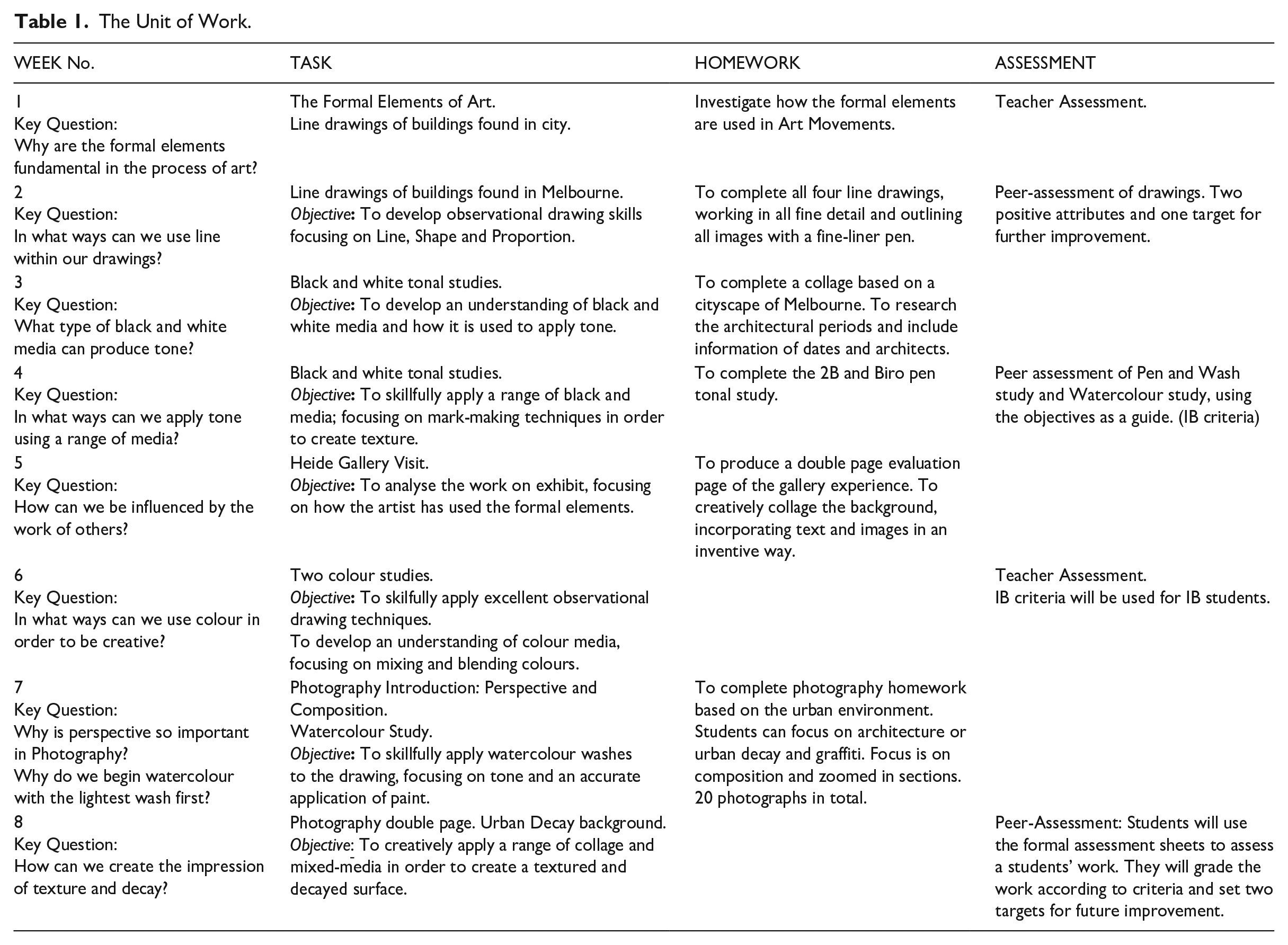
The Unit of Work
The unit of work (see Table 1) was formulated according to the outcomes necessary to fulfil the requirements stipulated by the IB and planned to cater for more collaborative and cooperative learning strategies. It was also workshop-focused so that students had more practical sessions within a limited three single and one double periods each week, with each period about forty-five minutes long and bearing in mind the loss of a few minutes of class time for periods after the mandatory prayers allocated during lunchtime. Technology-based cooperative and collaborative learning using Google Classroom and Apps were also integrated into all weekly outcomes because of the limited class time, thus providing students with materials, theoretical readings, homework and assignment instructions online.
The Unit of Work.
The Lesson Plan
The lesson plans (see Table 2) were prepared using the Universal Design for Learning template. Students were introduced to cooperative learning using Google Classroom. Other teachers, including the IB Diploma Coordinators, were also invited to the Google Classroom as another ‘eye’ to look out for learning issues that may arise from the diverse student cohort. Direct or scaffolded instructions can be utilised in the Google Classroom communication with constant feedback available at any time. This allowed students to maintain the Islamic ethos in terms of socialising and communicating with the opposite sex.
Technology-based Application of a Cooperative Learning Strategy.
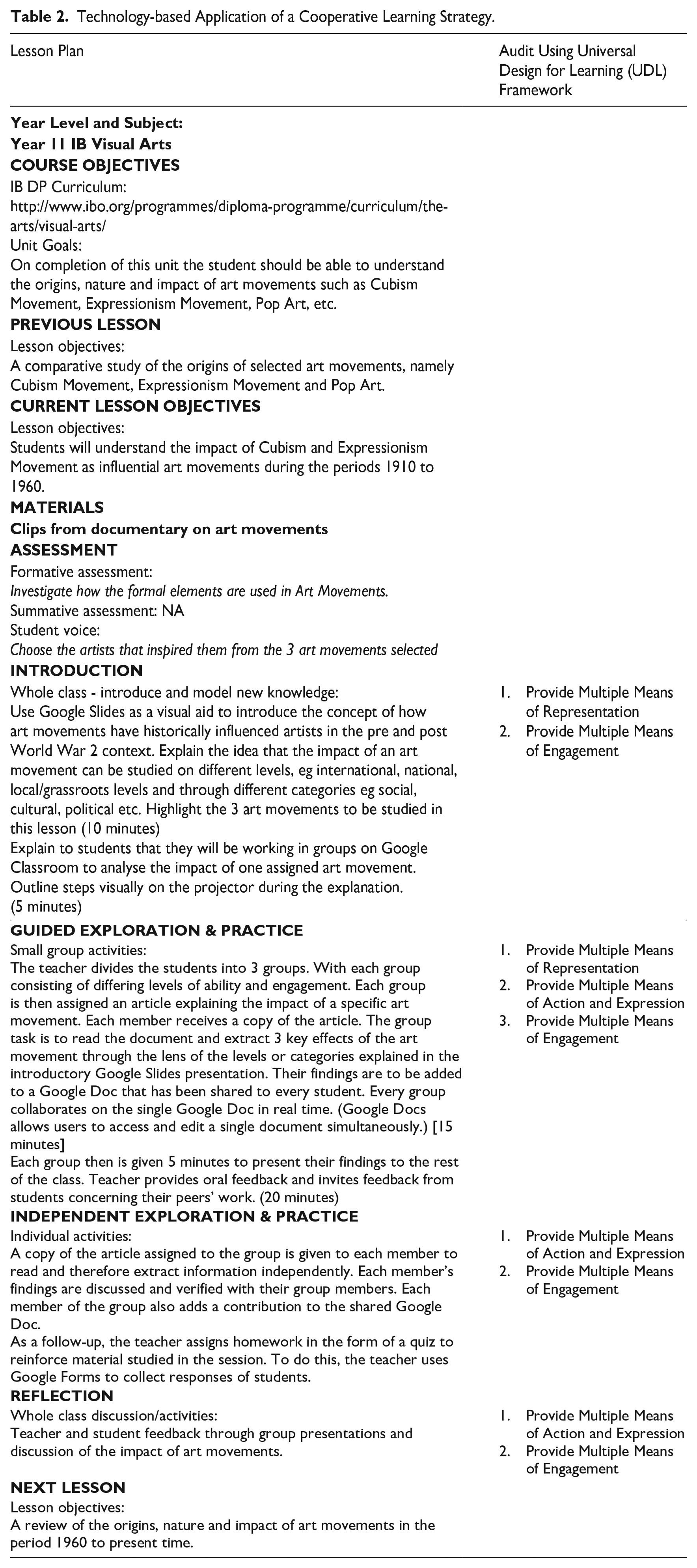
The technology-based application of a cooperative learning strategy was intended to effectively assess students’ abilities, especially the theoretical concepts and understanding of the subject. The multiple means of representation, expression and engagement provided the students with options to adhere to the Islamic ethos and not a Western or secular perspective. Parents could also monitor their child’s activities online and through open email conversations with me.
Findings
The Planning Stage
The resources that are readily available from the IB and those shared by other IB teachers were all contrary to the Islamic ethos described earlier, including as they do imagery that is prohibited in Islam. I had to sift through all the artists and their artwork before settling on those which I deemed Islamically appropriate. I was reminded of a statement by Loreman et al (2010) in which they point out that a curriculum can be ‘prescriptive and narrow in its objective that many teachers would have difficulty in taking too many liberties in their professional translation of the curriculum’ (p139). I also faced the difficulty of avoiding possible discussions of the artists’ lifestyles in my planned questions to the students. This process took a lot more planning time than anticipated as I had to recreate the resources from scratch.
I had also thought of adding some Islamic context to the unit of work and relating it to the art movements. Before finally putting the idea aside, I asked myself a few questions which were mainly based on what Loreman et al (2010) term as barriers to curriculum and instructional access. The questions that I asked myself were:
Do I have time to include the Islamic context in an already theory-heavy subject?
Are there any activities and/or techniques that are appropriate for the students?
Upon reflection, I found that a single forty-five minutes period was not enough to apply the appropriate techniques and activities, thus eliminating the idea of integrating Islamic context to the unit of work and lesson plan. Therefore, I considered the advice of Loreman et al (2010) to adapt and modify the curriculum according to the type of materials to be distributed, the required or additional instructional support and the inclusive-oriented instructional strategies.
The individual lesson plan that I prepared took into account both guided and independent student exploration and practice. It was necessary for me to understand individual students’ responses to, and perceptions of, a guided and independent learning experience. This would allow me to make the necessary modifications to the learning outcome as well as differentiate the assessments of individual students, thus providing the students with every opportunity to achieve the required learning outcomes.
The Application Stage
First and foremost, the Year 11 students did not have any issues joining the Google Classroom I had set up for the subject. They were able to confidently navigate the postings and thus understand the outcome and purpose of the subject. Their previous knowledge of Google Applications had made the process of introducing Google Classroom easy. Therefore, the students at all levels of expertise and familiarity with technology-based instructions managed to access important subject materials and communicate at a level with which they were comfortable.
During the introduction to the new knowledge, the Google Slides presentation previously prepared provided clear learning goals for the students, who understood what was expected of them and seemed comfortable answering the questions about the art movements and the artists’ works. As the presentation slides were prepared with careful selection of materials and information, there were no awkward moments that would have arisen from any prohibited or non-Islamic material. I was also able to indicate several Islamic-related items of content when we discussed the social and cultural impact of the art movements.
After the introductory slides, the classroom situation grew a little tense because students started to search the Internet for more information with regards to the artists and the art movements they belong to. One student identified Jackson Pollock as the artist she had chosen (based on her own interest rather than the introductory slides). She found a YouTube documentary on Pollock and remarked that she was slightly taken aback by but not uncomfortable with the language and the moderate bedroom scene that was on the documentary. However, she did acknowledge that her conservative parents might not approve of the content. An almost similar situation had happened at the international school in Sharjah whereby a non-Muslim student had delivered a presentation on Yves Klein as the artist who inspired her. It was clear that some Muslim students in the class were quite uncomfortable with Klein’s Antropometries. Later, in a feedback session, my mentor teacher assured me that it was considered acceptable content in the school but that she would also address the uncomfortable students separately.
Ideally, more time would be required to understand and reflect on the application of the lesson. Nevertheless, within the limited scope of this paper, the limited class time provided sufficient data for the analysis that follows.
Analysis
The review of literature and the reflection on my professional practice provide some useful insights into the challenges and tensions in enacting culturally-responsive pedagogy in teaching Visual Arts at an Islamic secondary school in Victoria, Australia. Firstly, it is worth noting that the Islamic notion of adab (etiquette) is one of the most important factors in an Islamic school setting; responsibility for it is directly attributed to teachers, with the fourth precept in Al Ghazali’s articulation of etiquette for the teacher stating that he or she is to prevent wrong-doings with care and caution. To circumvent this issue, I have demonstrated that some of the prohibited nature of content for the Visual Arts curriculum can be re-invented with careful planning and intelligent pedagogical strategies such as Jigsaw cooperative learning and Universal Design for Learning.
Secondly, the accessibility of information from the internet may give rise to some tensions in a culturally sensitive educational setting such as an Islamic secondary school in Australia. As demonstrated by the student researching Jackson Pollock, while a teacher can to some extent anticipate the type and nature of resources students are likely to encounter on the internet, there are clearly limits to teachers’ capacity to control what students discover in their individual research journeys. The management of students’ reactions and behaviors towards awkward and religiously forbidden information in a culturally sensitive educational setting should be a priority for educators in our efforts to find the best strategy to deal with ‘that awkward moment’. It will be an even more delicate and sensitive situation when parents and other stakeholders are involved, and teachers find themselves having to justify the inclusion of particularly sensitive content in order to meet the requirements of the curriculum. Therefore, it is critical for teachers to prioritise inclusive teaching strategies as part of their ongoing professional development.
Nevertheless, the application of technology-based cooperative learning strategies has lightened the challenge and provided an effective communication channel that can adhere to the Islamic ethos. Consequently, these strategies provide more options in the application of culturally-responsive pedagogical strategy to subjects other than Visual Arts, such as Media Studies and Design Technology. The evolving repertoire of culturally-responsive pedagogical strategy, through careful instructional planning and progressive professional development implementation, may result in a better student learning environment and satisfactory overall outcome, as well as ongoing on-the-job satisfaction for the teacher.
Conclusion
The AITSL’s Australian Professional Standards for Teachers (2011) clearly stipulate that to be a highly accomplished teacher, one needs to ‘plan for professional learning by accessing and critiquing relevant research, [and] engage in high quality targeted opportunities to improve practice’ (p18). The process of reflecting on pedagogy should be in a teacher’s professional repertoire of good practice. The review of academic literature and analysis of the case study here have highlighted not only the challenges and tensions that may arise in a culturally sensitive educational setting, but also opportunities for improving professional practice. With an intelligent and responsive attitude towards pedagogical strategy and a respectful approach to the cultural needs of the student demographic, it is possible to mitigate the challenges and tensions of delivering content that may be deemed culturally inappropriate in an Islamic school setting without compromising the demands of a rigorous curriculum such as the IB Diploma Visual Arts programme.
Footnotes
Funding
The author received no financial support for the research, authorship, and/or publication of this article.
