




Abstract
International schools exist in almost every country of the world, and international school educators come from a variety of countries, often teaching students from cultural and linguistic backgrounds different from their own. This article reports on a study that examined English-speaking educator beliefs about their Arabic-speaking students in a bilingual, international elementary school in the Middle East Near Africa region. Using mixed methods, the study also explored English language educators’ culturally responsive teaching self-efficacy. Educators expressed high levels of self-efficacy in using culturally responsive teaching practices, but were unsure how to bridge the differences between home and school cultures. Additionally, educators expressed deficit beliefs about their students. These beliefs framed students as victims of their own culture, held back from academic success by home cultural practices, beliefs, and norms. Results suggest educators at the school may not be prepared to facilitate students’ negotiation of identities, bridging home and school languages and cultures, due to deficit beliefs about students’ home culture that lower educator expectations and students’ opportunities to learn. The article concludes with discussion of the effects of these educator beliefs on students and ways in which international school leaders and policy makers may productively address them.
The Organization for Economic Cooperation and Development’s (OECD) Trends Shaping Education report (2019) suggests that growing international mobility challenges educational service providers and policy makers to consider if teachers are prepared to teach an increasingly diverse and globalized student population. Teaching diverse student populations requires multicultural competencies and respectful development of student identities. ‘Nowadays, migration is increasingly temporary or circular rather than permanent. What does this mean for teaching citizenship and identity? Can one be a global citizen with a national identity, or vice-versa?’ (OECD, 2019: 23). International schools have long contended with competing concepts of identity among their student populations. Many people inhabit multiple cultures, including those of our local communities and the broader global society. Developing both identities is possible (Sears, 2012; Srivastava, 2006), but without explicit attention to the complex, dynamic, and interactive roles that languages and cultures play in learning and development in international school communities, educators may not be prepared to teach their culturally and linguistically diverse student populations (Deveney, 2007; Fryer, 2009).
Background and Literature Review
International schools are often unconnected entities that serve unique communities (Bunnell et al, 2016; Hill, 2007), meaning that generalizable research on their students, teachers, and practices is limited. Originally developed from the localized needs of expatriates (often Western) living in countries where local education was not accessible for their children, by reasons of language or culture, a theme of exclusivity emerges when examining the history of international schools, particularly those in the global south. For example, Dittrich describes the exclusive nature of the first international schools in Korea: A feeling of superiority produced a distance from the local population that prevented parents from considering East Asian children as equal human beings and adequate playmates for their own offspring. This attitude made a common education together with Korean children virtually impossible. (2016: 634)
Dittrich suggests that international schools founded in non-Western countries were often designed to prevent Western expatriate children from ‘going native’ (2016: 635). International schools were thus often formed by individual communities of expatriates using North American or European (ie Western) curricular and scholastic norms. Although such schools were diverse in terms of nationalities represented among the stakeholders (students, families, and educators), these nationalities tended to be North American and European (Bunnell et al, 2016; Dittrich, 2016; Hill, 2007).
In contrast to the example Dittrich (2016) uses, more recent international schools often serve affluent local and non-Western student populations in addition to expatriates (Bunnell et al, 2016; Hill, 2007; Kim, 2016). In the past 20 years, for-profit schools have become a part of the international school market, as well as the more traditional not-for-profit school (Bunnell et al, 2020; Kim, 2016). Marketing materials from some of these more recent for-profit schools promote the exclusivity and assumed superiority of a Western-style education, highlighting their Western staff members and English language curricula (Fryer, 2009; Kim, 2016). The transnational corporation schools described by Kim (2016) are designed and marketed towards local populations with money and a desire to send their children to universities in Europe or North America. Other international schools describe a mission similar to that of the International Baccalaureate (2020) which espouses the development of ‘inquiring, knowledgeable and caring young people who help to create a better and more peaceful world through intercultural understanding and respect’, while also promising rigorous standards and assessment, often aligned with Euro-Western educational norms. Though current models for international schools can be categorized in different ways (generally by student population, medium of instruction, or curriculum) and may provide instruction in multiple languages, the predominant form is English-medium with a Western-style curriculum (Bunnell et al, 2020; Bunnell et al, 2016; Hill, 2007; Kim, 2016). In this article international schools will be considered to be English-medium secondary and/or primary private schools using a curriculum different from the local national curriculum.
Some international schools serve diverse student populations holding many different passports and speaking a variety of home and community languages, but as Kim (2016) note, this is not always the case; other international schools serve students representing a limited number of nationalities from very similar, primarily affluent, socioeconomic backgrounds. When discussing culturally and linguistically diverse (CLD) students in the context of this article, cultural and linguistic diversity is considered to be located in the make-up of the student body, or in the differences between the culture and language of the student population and the culture and language of the curriculum and educators.
Consistent with the legacy of global economic and political colonialism as well as the notion that English is essential bilingual capital (Sears, 2012), international schools may prefer teachers from Western, English-speaking countries in general, and citizens of the USA or the UK, in particular (Bunnell, 2016; Canterford, 2003). Jenkins (2007) found that among international school teachers who were non-native speakers of English there was a desire for first language–like proficiency according to US or British standards.
Little reliable and comprehensive research on the demographics of international school teachers exists (Bunnell, 2019; Lee & Walker, 2018), but research suggests that American or British accents, grammatical standards, and cultures are privileged over internationally-diverse forms of English as a global lingua franca (see for instance Sears, 2012). Similarly, and contrary to what one might expect in international contexts, beliefs that languages and cultures are discreet and specifiable rather than interactive and dynamic constituents of bilingual/bicultural development in a heteroglossic, multicultural global culture dominate (Cummins, 2017; Gardner-McTaggart, 2018; Jenkins, 2006, 2007; Sears, 2012).
Bilingual and multilingual speakers outnumber monolingual speakers globally (Adescope et al, 2010; Marian & Shook, 2012), suggesting that international school educators likely need to understand the strengths and needs of their multilingual students. Moreover, educators need to be aware that multilingualism provides lifelong cognitive benefits to learners that are assets in the classroom (Bialystock, 2011; Marian & Shook, 2012). Such benefits include increased attention control (Adescope et al, 2010; Marian & Shook, 2012), improved ability to maintain executive function in both languages (Bialystock, 2011; Marian & Shook, 2012), sophisticated metacognition and metalinguistic awareness (Adescope et al, 2010), and highly developed problem-solving and inhibition control (Adescope et al, 2010; Marian & Shook, 2012).
Educator beliefs about monolingualism, and cultural and linguistic superiority and values associated with standards of English and Euro-Western culture, support negative comparisons to local languages and cultures, as well as locally relevant emergent forms of English in students who are learning to become bilingual and bicultural global and local citizens in international schools. Research in individual international schools suggests that educators from countries other than the host country may hold deficit beliefs about their students and may be unprepared to implement culturally responsive pedagogies and policies for the learning of CLD students (Deveney, 2007; Fryer, 2009; Sears, 2012). As Sears (2012) argues, even students from relatively affluent backgrounds whose bilingualism is elective may be marginalized or disempowered. Cummins (2017) argues that international teachers of CLD students must confront biases and ideologies that devalue local language and culture as separate from and less than a target language/culture, ie British or American English and cultures. Cummins advocates using practices and approaches that recognize the fluid, heteroglossic, multicultural nature of bilingual/multilingual and bicultural/multicultural students’ linguistic and cultural development. Approaches to instruction that address deficit thinking and are guided by the assumption that language learning is not compartmentalized, but integrates the fully interactive linguistic repertoire and cognitive advantages of bilingualism/ polylingualism (Bialystok, 2011), include translanguaging (Garcia, 2009; Garcia & Wei, 2014) and active bilingualism (Cummins, 2017). Approaches that assume the fluidity and cognitive advantages of becoming bicultural/multicultural include cultural modelling (Lee, 2003) and culturally and linguistically responsive teaching (Gay, 2002; Lucas & Villegas, 2013).
According to Gay (2002), culturally responsive teaching and pedagogies use ‘the cultural characteristics, experiences, and perspectives of ethnically diverse students as conduits for teaching’ (p 106). Culturally responsive classrooms, teachers, and schools integrate students’ home cultures into classroom instruction, structures, and policies (Gay, 2002). Similarly, linguistically responsive teaching makes use of emergent bilingual students’ conceptual and linguistic knowledge as well as their meta-linguistic awareness in instruction (Lucas & Villegas, 2013), while translanguaging draws on the students’ full linguistic repertoire, ie home or other languages as well as the target language with a focus on using all one’s linguistic resources in developing one’s bilingualism or polylingualism (Garcia, 2017). These connections between local and global or home and school cultures and languages allow a student to activate prior knowledge when learning new concepts and skills, and then integrate this new knowledge into the student’s existing schema and metacognitive awareness of how languages and cultures are learned and enacted, increasing the student’s opportunities to learn (Gay, 2002; Morris et al, 2019; Rawlings & Childress, 2021; Rychly & Graves, 2012). In international schools, where diversity exists (either among the students themselves, or between the students, the educators, and the curriculum), culturally and linguistically responsive teaching practices are essential to ensuring all students in the classroom have the opportunity to learn and develop identities as capable bicultural and bilingual/polylingual learners and members in both local and global societies (Deveney, 2007; Sears, 2012).
Examination of Teacher Beliefs and Self-Efficacy
Using mixed methods, the study reported here examines the beliefs English language educators in one bilingual international school hold about their students, and the educators’ feelings of self-efficacy towards using culturally responsive teaching pedagogy. Findings indicate that educators in this international school view students as victims of their own culture, hindered from achieving academically by their families’ beliefs, native language, and cultural practices. The findings also suggest that educators may be overestimating their culturally responsive practices. After providing the theoretical lens for data analysis and reporting methods and findings, followed by discussion, the article concludes with implications for international school leaders and education policymakers regarding potential interventions and training.
Theoretical Framework
Building on the background and literature review above, this study employs a sociocultural lens on the social and cultural construction of identities, ie those of teachers and the students with whom they interact. Consistent with an orientation of bilingual and bicultural learning and development as an active, integrated process facilitated in teacher-student interactions, Lim and Renshaw argue that sociocultural theories allow researchers to examine cultural identities that are ‘neither fixed nor static, but are actually fluid, dynamic, negotiable, and constantly in the process of change and transformation’ (2001: 11). This perspective aligns with the findings of the OECD (2019) report on trends impacting education, which predicts that, as international connections through travel and technology become easier to foster, educators will have to consider how the interaction between local and incoming cultures as well as the movement of global cultures (Urban, 2001) impact individuals, educational practices and policies. Sociocultural theories allow us to examine the interactions between local and global cultures as they are enacted by students and teachers in classrooms, in order to understand the possible impacts of teacher beliefs about CLD students on learning (Lim & Renshaw, 2001).
Beliefs are individually held assumptions about reality maintained without empirical evidence, and have a stronger influence on practice than cognitive knowledge (Datnow et al, 2018; Fryer, 2009; Nelson & Guerra, 2014; Siwatu, 2011). Deficit beliefs refer to the tendency of educators to view certain groups, especially CLD students, as deficient and not capable of academic achievement (Gainer & Larrotta, 2010; Nelson & Guerra, 2014). Research has suggested that beliefs may be more powerful than policies and formalized learning in predicting behavior (Bandura, 1982, 1986; Pajares, 1992). Beliefs matter in the education of CLD students because when beliefs about such students are deficit-focused, these difficult-to-change beliefs often contribute to low achievement expectations and blame (Nelson & Guerra, 2014). Deficit beliefs may contribute to the construction of CLD student identity as being less capable than White, middle class English speakers. Hawkins explains that identity ‘can be described as an ongoing negotiation between the individual and their social context or environment, with particular attention paid to operant cultural and power relations’ (2005: 61).
Deficit beliefs may affect not only student-teacher interactions, but also those between teachers and parents. Interactions between educators and parents are equally susceptible to beliefs informed by teacher and school cultural values (Ladson-Billings, 1995; Lim & Renshaw, 2001; Nelson & Guerra, 2012; Wink, 2011). Schools, including international schools, have cultures with values and norms, often aligned with dominant White, middle class ways of knowing and acting (Gonzales & Gabel, 2017; Lim & Renshaw, 2001; Nelson & Guerra, 2014; Sleeter 2001; 2017). Even in international schools serving elective and elite bilinguals at the behest of parents who value the opportunities associated with English language proficiency and access to higher education in English-speaking countries, seasoned international educators may not be able to understand or recognize the value of local culture in providing conceptual knowledge, and key linguistic and cultural knowledge and experience that can optimize students’ opportunities to become bilingual and bicultural learners (Fryer, 2009; Kim, 2016).
A powerful factor in an educator’s ability to practice culturally responsive pedagogy is their self-efficacy (Bandura, 1986; Siwatu, 2007; 2011). Self-efficacy is the belief that one has in one’s abilities to complete a task or goal, and is a predictor of behavior (Bandura, 1982; 1986; Brown, Roediger & McDaniel, 2014; Caprara et al, 2006; Siwatu, 2007). Self-efficacy in terms of culturally responsive practice is a teacher’s belief that they have the ability to facilitate opportunities to learn for their CLD students. Teachers with high self-efficacy in a practice are more likely to use it (Siwatu, 2007, 2011). Deficit beliefs, meanwhile, may confound culturally responsive practice (Fryer, 2009; Gonzales & Gabel, 2017; Lim & Renshaw, 2001; Nelson & Guerra, 2014; Sleeter, 2017). Teacher self-efficacy and beliefs about their students are key variables examined in the present study.
Methods
Given the powerful impact of beliefs and self-efficacy on teaching practices, the study reported in this article focuses on English-speaking educator (teachers and leaders) beliefs and feelings of self-efficacy about teaching culturally and linguistically diverse students. The research questions guiding the study are:
(1) How confident do teachers feel about their abilities to assess and instruct culturally and linguistically diverse students?
(2) What are the beliefs of educators (teachers and leaders) about the learning strengths and weaknesses of culturally and linguistically diverse students?
Context
The study focuses on teachers who use English as the medium of instruction in the elementary section of a bilingual, private international school in the Middle East, referred to here by a pseudonym: Morning School. Morning School serves approximately 1,000 students (more than 95% being local citizens) and, according to the school’s guiding statements, emphasizes traditional local values. The school is gender-segregated and separates girls and boys from Grade 1 onwards. The educational staff is diverse, with representatives from over 30 different countries. Morning School is bilingual, teaching in English and Arabic, and is authorized in the Primary Years Programme (PYP) curriculum framework of the International Baccalaureate (IB). English language curriculum, which includes mathematics, English, science, social studies, and some specialist classes, constitutes 50-70% of the school day. Arabic language instruction and curriculum, including national studies and religion, accounts for 30-50% of the school day in the primary school, depending on the grade level and the schedule for specialist classes. Though data on the socioeconomic status of families is not kept at the school, the fee structure ensures that the vast majority of students come from families of relatively high socioeconomic status.
Study Design and Data Collection
The study on which this article is based reports on a secondary analysis of existing data from the school’s ongoing program evaluation and accreditation documents that support and inform the school’s regular improvement efforts. The larger study from which this article is drawn focused on understanding data use and assessment practices with CLD students. The present article reports results concerning educators’ beliefs about their CLD students and culturally responsive practices.
The data collected and organized for analysis included official school documents, meeting notes and minutes, de-identified transcripts of interviews and focus groups conducted for regular program evaluation, and de-identified results of a quantitative survey used in the course of school improvement efforts. English-speaking teachers and school leaders who planned to stay at the school for the following year provided the interview and focus group data. All data were collected in the spring of 2019 and the secondary analysis was carried out in the summer of 2019 by one of the authors, who was an employee of the school during the study duration. Descriptions of the instruments used follow.
Survey
The study analysed the results of a subscale of the Culturally Responsive Teaching Self- Efficacy (CRTSE) scale (Siwatu, 2007; 2011) administered to current and incoming English language teachers (not school leaders) and represents an attempt to capture teacher beliefs related to culturally-responsive education. Only teachers who planned to remain at the school the following year were asked to participate. Of the 22 teachers who planned to remain, 20 responded to the survey; twelve incoming teachers were sent the survey and six responded. The survey included seven questions on respondents’ educational qualifications and teaching experiences, and 14 Likert-scale questions.
Interviews and Focus Groups
Transcripts from over 4.7 hours of interviews and focus groups were organized for analysis. Individual semi-structured interviews were conducted with school leaders. Transcripts were also examined from a focus group conducted with six teachers representing different sections of the elementary school and different nationalities using the same semi-structured interview protocol. Transcripts from interviews with two teachers who participated in standardized testing events were used as well.
Observations
Observations were conducted by one of the authors as a participant observer using opportunistic sampling to capture real and organic discussions about assessments and curriculum planning. This includes participant observations conducted during regularly held meetings to understand how teachers and leaders discuss and use data and assessments in the course of their daily work. The written observation protocols captured 3.48 hours of formal and informal meeting time that included a total of 11 participants.
Document Collection and Self-Studies
Approximately 600 pages of formal school documents related to assessment and education practices were analysed. Documents such as accreditation reports, policies, job descriptions, and handbooks were sampled on the basis of criteria being related to assessment practices. The researchers also collected and organized accreditation and authorization documents from the Council of International Schools (CIS) and the IB PYP respectively, which contained self-studies and aggregate and de-identified reviews of teaching and learning practices.
International schools undergoing accreditation/authorization from these agencies must perform a thorough self-study of the school’s practices, services, and operations against a set of standards provided by the agency; Morning School therefore rates itself against the standards set by the IB and CIS. The self-studies are developed in a two-year process whereby the school determines its alignment with agency criteria and provides evidence of that alignment. The visiting teams are groups of professionals representing the agencies, who use their own observations, interviews, and document analysis to examine the self-study and make recommendations for improvement. Schools then respond to the recommendations for improvement and follow up information before final accreditation or authorization occurs. Pertinent sections of all of these accreditation/authorization documents (self-study, reviewers’ notes, and school responses) from both the IB and CIS were analysed by the researchers in this study.
Data Analysis
The Culturally Responsive Teaching Self-Efficacy (CRTSE) score was used to answer the research question: ‘How confident do teachers feel about their abilities to assess and instruct culturally and linguistically diverse students?’ After cleaning and preparing the raw data, we used SPSS to run a basic statistical analysis of the Likert-scale item responses.
The qualitative data were analysed to answer the research question: ‘What are the beliefs of educators (teachers and leaders) about the learning strengths and weaknesses of culturally and linguistically diverse students?’ Qualitative data from interviews, the focus group, observations, and the document analysis (including accreditation/authorization self-studies) were coded using Microsoft Word tables, as described by La Pelle (2004). Data were coded in three rounds using the constant comparative method (Glaser & Strauss, 1967), and emergent codes evolved, including cultural tensions, students as victims, cultural reciprocity, and culturally responsive pedagogy.
We examined the quantitative results in order to inform the qualitative findings. Using four different sources of qualitative information (interviews, a focus group, observations and participant observations, and document analysis) permitted triangulation of findings across and between data sources (Creswell & Miller, 2000, Golafshani, 2003).
Limitations
This exploratory study describes a single point in time for a unique context that has little basis for comparison. Morning School has few peer schools against which it can be compared, and results are not generalizable. Additionally, researcher bias is a possible limitation; the on-site researcher was a member of the school community, with professional and personal relationships with educators in all subgroups. Quantitative tools were chosen to provide a measure of culturally responsive teaching self-efficacy to balance the possibility of the researcher’s bias intruding on the study and give necessary reflection points to findings from the qualitative data.
Results
Quantitative Results
After running a basic descriptive statistical analysis in SPSS, it was clear that most of the mean scores for item responses were 4.00 (‘Quite a bit’ of agreement with the statement) or higher on a scale of one to five, signalling generally high culturally responsive teaching self-efficacy. The mean score for all responses was 4.14. Because the results showed consistently high levels of culturally responsive teaching self-efficacy, we looked for patterns and outliers in this quantitative data to make connections to the qualitative data. Two items fell below a mean of 4. The lowest mean (3.65) was for item 14: ‘I can implement strategies to minimize the effects of the mismatch between my students’ home culture and the school culture’, with a range of 2 (min=2; max=4). The second lowest mean (3.81) was for item 21: ‘I can critically examine the curriculum to determine whether it reinforces negative cultural stereotypes’. This item also had the largest range in responses (min=1; max=5), indicating that teachers felt very different levels of agreement with this statement.
Qualitative Results
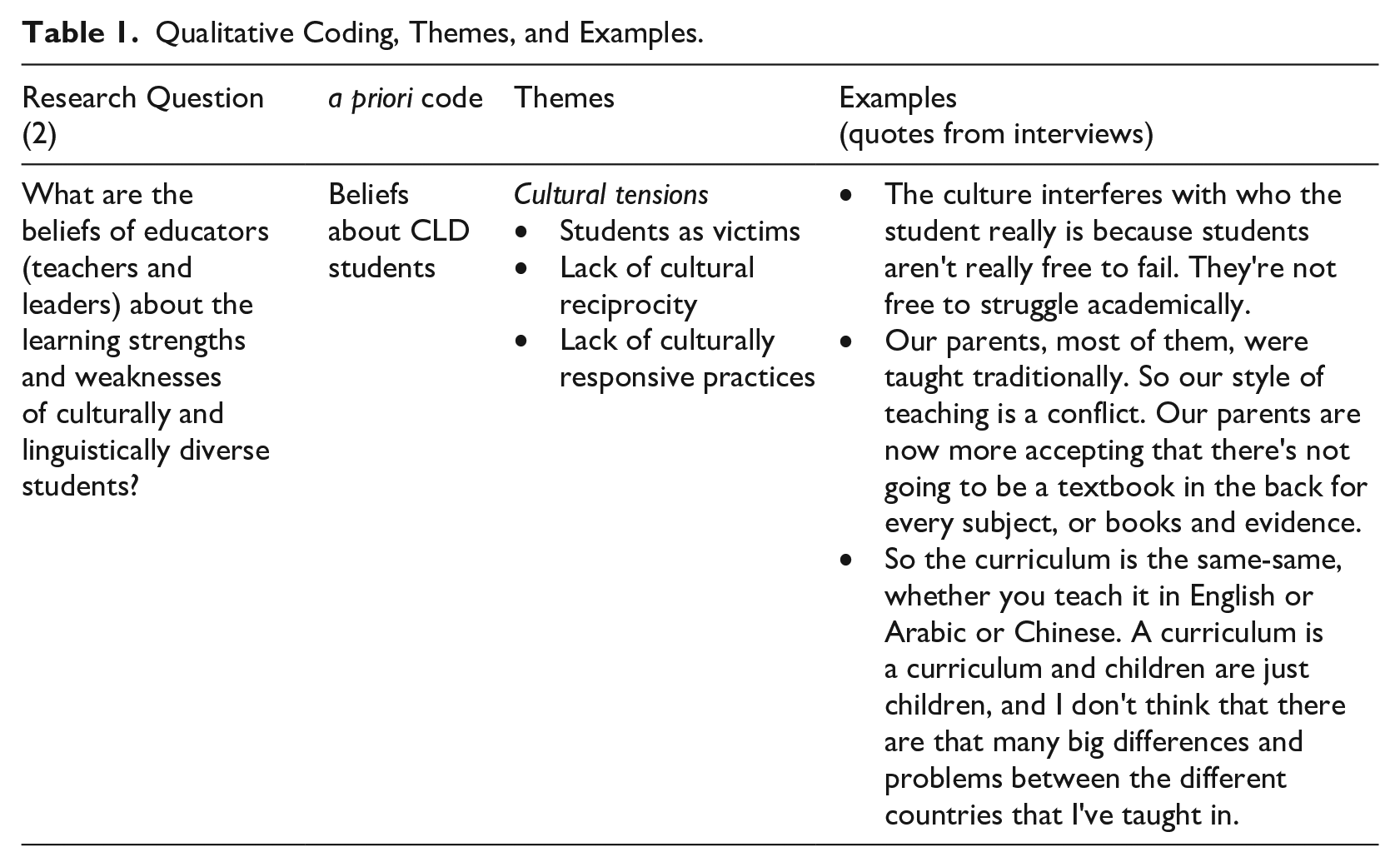
Results from the qualitative coding were analysed and triangulated across data sources and types to look for consistent themes. The researcher then compared the findings with the quantitative results and the literature. Table 1 shows the a priori codes, with their emergent themes and examples. Three major themes were identified. First, deficit beliefs among educators framed students as victims of their own culture, who would be capable of succeeding but for their parents and cultural practices. Second, results indicated that educators view success as procuring conformity to Western school values from parents and students, and do not generally value cultural reciprocity. Finally, the results suggest that teacher perceptions of their culturally responsive practices and their actual practices are not aligned.
Qualitative Coding, Themes, and Examples.
Discussion
The discussion that follows begins with consideration of the major themes that emerged from the qualitative analysis of teacher beliefs regarding their CLD students and associated findings from the survey. It then moves to consideration of culturally responsive self-efficacy and practices.
Beliefs
The qualitative results demonstrate that educators may hold deficit beliefs about how a child’s culture inhibits student achievement. The category of ‘cultural tensions’ was the second largest category of codes which was held across all four qualitative data types. Teachers and leaders alike discussed existing tensions between the school culture and the culture of the community, often describing the student as a victim of the culture: ‘The culture interferes with who the student really is because students aren’t really free to fail. They’re not free to struggle academically’, one educator noted. This finding of tension between home and school is supported by the results of the CRTSE scale, which indicated that teachers felt the least amount of self-efficacy on the item, ‘I can implement strategies to minimize the effects of the mismatch between my students’ home culture and the school culture.’
Educators blamed parents, the culture, the language, and the bilingual nature of the curriculum for difficulties in learning. While students themselves were generally characterized as ‘friendly’ or ‘enthusiastic’, there were multiple comments about parents being over-protective, having a tendency to ‘spoil’ their children, or being uninterested in school: I will link it to the culture thing. To compare our school to any international school, then when, as a teacher coming from a different environment, maybe the teacher will have the shock, because we are used to kids [who demonstrate] their independence. They do their own things. Even from small age, they inquire, they observe. It all I think affects our teaching, because you come to this environment, you have to babysit the whole day, because some of my little ones, they don’t move unless I move [them] physically. He’s used to someone put him here, pull him from here… tie his shoelace, washing their hands. It’s simple things. It’s all, I think it links to the culture, to the society. That’s how they raised them.
Educators shared numerous examples of how students have not been taught to do what are perceived as basic skills, and of how students are forgetful, irresponsible, naïve, and ‘spoiled’ as a direct result of their culture: The culture enables [sic] them from doing things on their own, because everyone’s doing it for them. In class, they have this pattern of coming to you the instance that they are slightly confused or don’t know how to fold the paper or things like that . . . or they don’t have the habit of looking at the board when all the directions are there.
In an observation, a group of teachers dismissed the necessity of clearly communicating summative assessment expectations because the teachers said that parents would not care or assist their child in preparing for the assessment. This implies that teachers believe parents do not understand or hold the same values that the school holds, so the school has a limited duty to inform parents of important events.
Deficit beliefs do not only apply to the beliefs teachers hold about students; researchers have also found that educators can hold deficit beliefs about families and the student’s home culture (Gonzales & Gabel, 2017; Hatt, 2012; Mitchell, 2012; Nelson & Guerra, 2014; Wink, 2011). Lim and Renshaw (2001) contend that these deficit beliefs about families inhibit collaboration, understanding, and opportunities to learn. Research by Gonzales and Gabel (2017) found that educators in the United States expect families to contribute to education in a manner accepted by white, middle-class standards, and as a result, educators often do not see the ways in which families do support their children, a finding that is seen in this study. Educators at Morning School may see the home culture as a barrier to academic achievement and are not aware of the ways that families support their students (Gonzales & Gabel, 2017).
Cultural Reciprocity
Some educators, especially those who had been at the school longer, shared different narratives about students, giving examples of how students and families could be understood differently or have learned to adjust to the school: It’s a cultural thing that they talk while somebody else is talking. They’re not very good at listening. So, I think from a Western teacher’s perspective, it comes over as dissent, that they’re not actually listening. . . . If you’re ever in a group of [local] people . . . they’re talking over each other all the time. So this is the model that the children see at home. It’s having to train them that there are times they need to stop and listen.
In an interview, a leader described the school community: ‘So I’ve seen a huge change over the years in the way parents were very standoffish and hands-off when it came to being involved in their child’s education, whereas now they are very aware of what needs to be done and what is their role as parents.’
A discussion about the mismatch between the home and school underlay the discussions about student behaviours and students being unprepared for the school. Even the educators who spoke positively about students and parents found the positive in student and family conformity to the school culture, not an understanding of the strengths of the students’ home culture, bilingualism, or multiculturalism. Educators expected parents and students to understand the requirements of the school, like learning to listen quietly or parents supporting students in school-approved ways. In the research literature, schools often expect that families and students will conform to school values and standards, which often map onto mainstream Euro-Western culture (Gonzales & Gabel, 2017; Hatt, 2012; Mitchell, 2012; Wink, 2011), rather than a sharing of understandings, building what Lim and Renshaw describe as ‘cultural reciprocity’ (2001:16).
This finding is especially notable, given that school guiding statements emphasize local values. These values are present in the English language curriculum, which has at least one six-week unit each year in each grade dedicated to local history and culture. The school-wide dedication to local values is clear in the admissions policies, which state ‘At Morning School, while the majority of our students are local nationals, we welcome applications from students of other nationalities who are prepared to embrace our unique culture.’ Accreditation/authorization documents commend the school for its commitment to local culture, but also highlight that there appears to be a lack of connection between the English-speaking staff and the local culture, recommending that ‘The Primary School staff . . . explore opportunities to uncover the diversity within the student and staff population as a springboard for authentic learning and appreciating cultural diversity.’ Further recommendations include exploring how the Arabic language and English language programs complement each other: ‘[T]he visiting team observation is that there does not appear to be a school wide understanding of how the teaching and learning of the two languages relate to and/or complement each other, nor whether the school is a bilingual or a dual language institution.’ These findings indicate that the school may have two parallel cultures (local vs Western) that struggle to interact with each other reciprocally, building an ‘us vs them’ dichotomy (Lim & Renshaw, 2001).
Culturally Responsive Self-Efficacy and Practices
School leaders also noted that the bilingual nature of the program created tension and uncertainty of the level of learning that occurs, because the highly conceptual teaching and learning occurs in English language classes, rather than in Arabic classes. One school leader observed: Everything is delivered to [students] on a first language level, and you think about something like implementing PYP at our school and the fact that it’s so conceptual; just the word conceptual means abstract, and so the abstraction of them having to articulate themselves when a lot of these students do not even have the basic vocabulary. . . English is a real barrier for many of our students. I would love to know how successful our students would be if they just worked in Arabic.
Research in Mitchell’s examination of language expectations of a teacher trained in the United States found that, even with multilingual teachers, English became the prime focus of student education, leading to educational practices where ‘multilingual learners were treated as if they were monolingual’ (2012: 14). At Morning School, a leader states that students are treated as if English is their first language, which was recognized as an issue, but was not addressed.
The relatively high levels of culturally responsive teaching self-efficacy reported in the CRTSE (Siwatu, 2011) results of this study reflect teacher perceptions of their ability to implement culturally responsive pedagogical practices, not their actual practices. The qualitative measures in this research suggest that teacher feelings of self-efficacy and their practices do not align. While teachers, on average, felt ‘quite a bit’ of self-efficacy, the school practices on an organizational and individual level do not align with this finding. These misaligned practices include (but are not limited to) expectations that parents conform to school norms, and the assumption that students were spoiled and uninterested in school. Gonzales and Gabel state, ‘Many teachers assume that they know the needs of [English Language Learner] students and ways to prepare them for success based on what they feel are common-sense strategies’ (2017: 68), but they then find that teachers’ perceptions of their abilities and their practices do not align, citing high levels of referrals to learning support services and negative attitudes towards CLD students. Documents at Morning School indicate that during the duration of this study approximately 20% of students in the primary school were identified as needing additional support (despite admissions requirements that focus on academic achievement). In comparison, the National Center for Education Statistics (2019) reports that approximately 13% of students in the United States required services provided under the Individuals with Disabilities Education Act. High levels of referrals to learning support services, interviews, and documentation from accreditation all demonstrate that educators may not be implementing culturally responsive practices, though they hold high levels of culturally responsive teaching self-efficacy (Gonzales & Gabel, 2017; Hatt, 2012; Mitchell, 2012).
Conclusions and Implications
Though it is not possible to generalize from this study, it suggests several important findings that may be of interest to researchers, international school leaders, and international school policymakers. First, the deficit beliefs held by educators in schools in the United States may also exist in international schools. Research in the United States on multilingual populations tends to focus on students who are marginalized or face social and economic barriers (Bertrand & Marsh, 2015; Datnow et al, 2018; Gainer & Larrotta, 2010; Gonzales & Gabel, 2017; Hatt, 2012; Hawkins, 2005; Ladson-Billings, 1995; Menken & Kleyn, 2010; Sleeter, 2001). However, the present study finds that deficit beliefs about CLD students exist even when students are in places of privilege in their own country and community.
These deficit beliefs may be especially negative towards non-Western families and cultures, rather than directed at the students themselves and may, thus, be harder to identify or address (Wink, 2011). Second, cultural exchange may be viewed as a one-way street by some educators in international schools, where CLD families are expected to change beliefs and practices to suit the school culture, rather than as providing an opportunity for engagement between professionals and families in cultural reciprocity; this finding mirrors the expectations of schools in the United States, particularly towards immigrant families and students (Lim & Renshaw, 2001; Nelson & Guerra, 2014). Finally, educators may feel high levels of self-efficacy in using culturally responsive pedagogies, but these self-efficacy levels may not be reflected in actual practices, which often value English language and monolingual teaching practices over local languages and learning (Gainer & Larrotta, 2010; Gonzales & Gabel, 2017; Mitchell, 2012).
Recommendations
While absolute alignment between home and school cultures may be difficult to achieve, schools can and should strive for a continual process of critical reflection on their practices that informs improvement in culturally responsive pedagogies. Literature suggests several ways in which schools are currently working towards this alignment, including engaging in an ongoing reciprocal and deliberate dialogue with students about the development of a multicultural identity (Deveney, 2007; Flesh et al, 2020; Sears 2012), with reflection on and celebrations of stakeholders’ multiple identities (Flesh et al, 2022; Hawkins, 2005; Lim & Renshaw, 2001). Particularly in multilingual settings, students and teachers in culturally responsive schools are aware of the benefits of bilingualism (Bialystock, 2011). Teachers and school leaders in such organizations deliberately engage in reflective practices to confront their own biases and develop practices that are fluid and heteroglossic (Cummins, 2015; Gay, 2002).
International school leaders and policy makers should consider how the interactions among and between school professionals and communities are formed (Deveney, 2007; Fryer, 2009; Gonzales & Gabel, 2017; Lim & Renshaw, 2001). Leaders should also consider how new teachers are inducted into the school and community culture and ensure that orientation and professional development includes factual information about culture that helps teachers to navigate differences between home and school, and make meaningful connections (Gay, 2002; Lim & Renshaw, 2001; Nelson & Guerra, 2014; Rychly & Graves, 2012). Leaders might wish to consider implementing a program of home visits or other ways to support meaningful cultural exchange and understanding (Ladson-Billings, 1995; Wink, 2011). In addition, school leaders should be prepared to provide programs that support ongoing professional development for teachers on the unique needs of CLD students as cultural, linguistic, and academic learners.
Above all, educators in international schools should understand that schools and ways of viewing the world are changing through increased global mobility (OECD, 2019). It is not just the duty of parents to adapt to the school; the school must also participate in meaningful changes that engage local student identities, cultures, and experiences, integrating these local values with values such as international-mindedness, empathy, and respect for others.
Footnotes
Data Availability
Due to the nature of this research, the organization providing the data for this study did not agree for their data to be shared publicly, so supporting data are not available.
Declaration of conflicting interests
The authors declared no potential conflicts of interest with respect to the research, authorship, and/or publication of this article.
Ethical Statement
This study is based on secondary analysis of existing, de-identified data and was approved by the Johns Hopkins University Institutional Review Board (HIRB00009364).
Funding
The authors received no financial support for the research, authorship, and/or publication of this article.