



Abstract
Interest in how to promote student wellbeing in schools is growing. Research shows that some drivers of wellbeing are universal, but others are country-specific. No prior study has investigated this question in the United Arab Emirates (UAE), where geographic, socio-demographic and school type differences in student wellbeing are substantial. We address this gap by using multilevel regression to analyse data from the PISA 2018 study. Our focus is on life satisfaction, positive affect, negative affect, meaning and purpose in life, and mental health symptoms of internalizing difficulties. We find large school effects on student wellbeing, the second largest school effects out of 56 countries. School resources are of little importance, whereas factors related to time use, social connections, health and body image, positive school climate, and feelings around school and education are important correlates. These factors help explain a substantial part of the wellbeing inequalities observed across types of schools in the UAE.
Introduction
There is growing interest in promoting student wellbeing in schools (Taylor et al, 2022). Any attempt to achieve this must start by providing a definition of what is meant by wellbeing. Historically, it has been conceptualised through two approaches. In the first, hedonic or subjective wellbeing comprises an affective component (ie, experiencing positive and negative emotions), and a cognitive component (ie, life satisfaction (LS)) (Diener et al, 2002). In the second, eudaimonic or psychological wellbeing has been defined less concisely, most often in terms of purpose, environmental mastery, autonomy, personal growth, self-acceptance, positive relations with others, and optimism (Ryff et al, 2021). Some studies adopt a broader definition of wellbeing to include symptoms of mental ill health, with many using the terms wellbeing and mental health interchangeably (eg, Fuhrmann et al, 2022; Orben & Przybylski, 2019). This paper adopts a broad definition of wellbeing to consider measures of hedonic and eudaimonic wellbeing as well as mental health symptoms of internalizing difficulties.
Schools and education authorities have become more interested in promoting student wellbeing for two reasons. Research has shown that wellbeing in adolescence predicts important outcomes later in life, including adult wellbeing and mental health, physical health and health behaviour, relational, labour market as well as socioeconomic outcomes (Cavioni et al, 2021; DeNeve & Oswald, 2012; Goodman et al, 2015; Guzmán et al, 2020; Kansky et al, 2016; Richards & Huppert, 2011). Researchers have also shown the absence of a conflict between wellbeing and academic outcomes, incentivizing their simultaneous pursuit (Cárdenas et al, 2022; Clarke, 2020; Lindorff, 2021; Shoshani et al, 2016).
Research investigating how schools and education authorities can promote student wellbeing has grown and far more is known now than only a decade ago (see section below headed School-relevant factors associated with student wellbeing). Yet, research in this area remains scarce in some regions and almost non-existent in countries including the United Arab Emirates (UAE). The present study addresses this gap.
School and education in the UAE
Evolution and policy priorities
That the national school system of the United Arab Emirates (UAE: a federation of seven emirates, consisting of Abu Dhabi, Ajman, Dubai, Fujairah, Ras Al Khaimah, Sharjah and Umm Al Quwain) has evolved over time is an understatement. With modest beginnings in the 1950s, curricula were imported from other Middle Eastern countries. A national curriculum was developed in 1985, and English language curriculum in the 1990s. In 2007, the Madares Al Ghad (Schools of Tomorrow) model was realized which included a bilingual Arabic/English and science focus. Since 2000, a focus on giftedness, 21st century skills and career guidance has emerged, with some emirates prioritising additional needs (AlGhawi, 2017). The Abu Dhabi School Model (2010 to 2018), for instance, focused on outcomes-based curriculum, technology, and bilingualism, while the 2017-2021 national education strategy (UAE Government, 2018) aimed to build a competitive knowledge society to meet labour market needs.
More recently, the Ministry of Education published its UAE Centennial 2071 plans. This includes the development of an early childhood to post-secondary national school framework and goals to upscale a public school network that has not produced much-needed educational outcomes. The academic performance gap between private and public schools is estimated to be three years (Marquez et al, 2022a) and both socioeconomic (Buckner, 2018) and gender gaps (OECD, 2019) are observed, where low-income Emirati nationals are most affected and girls most advantaged.
Wellbeing promotion in schools
The nation has also implemented wellbeing initiatives. At the national level, the UAE Moral Education program was implemented in 2017-2018 across all schools from grades 1 to 12, focusing on (1) character, ethics and morality; (2) individual and community; (3) civic and (4) cultural studies. The first two pillars target socio-emotional learning comprising character traits (resilience, perseverance, work ethic, honesty, humility) and awareness of addiction, mental and physical wellbeing. In 2019, the National Program for Happiness and Wellbeing and Ministry of Education launched a voluntary ‘Well Schools Network’ to promote positive education. Published data on either program’s effectiveness is unavailable.
At the emirate level, Dubai’s educational authority, the Knowledge and Human Development Authority (KHDA), was early in its efforts to promote student wellbeing via school initiatives and professional development events, as well as local and international conference appearances. Nonetheless, the OECD (2021) identified several issues. School stakeholders lacked information, skills and resources to implement school wellbeing policies and practices, raw census data was not made available to schools, and the Authority did not identify Dubai’s wellbeing concerns or at-risk student groups. It added that in the absence of data, schools were investing in ‘fashionable and visible programmes and tools, such as mindfulness sessions or school gyms’. Such strategies may have served little purpose other than to enhance schools’ positions in the KHDA school rankings and justify an increase in school fees, although local research shows that differences in academic performance and wellbeing do not justify higher fees (El-Sholkamyl & Al-Saleh, 2017; Marquez et al, 2022b). The OECD (2021) encouraged empirical measures of school climate, related procedures and policies, student services, and/or curricula offerings that address wellbeing and demonstrate efficacy instead. Finally, positive education programs have been adopted by schools themselves. Yet, save for one (Lambert et al, 2022), none has been empirically evaluated in the research literature.
Thus, despite haphazard activity, there is no systematic, data-driven movement to raise wellbeing in UAE schools, nor, despite one study (Marquez et al, 2022b), any broad national data on which to base decisions. In fact, like efforts to raise scores in the PISA examination, many initiatives have been imported (Rautalin et al, 2019), ignoring the socio-demographic profile of the UAE student population.
School-relevant factors associated with student wellbeing
A small proportion of variation in student wellbeing (around 1 to 6%) is explained at the school level (Ford et al 2021; Marquez & Main, 2020). Small school effects are significant as they accumulate and impact large numbers of students (Greenberg & Abenavoli, 2017; Reynolds et al, 2014). There are many school factors linked to student wellbeing, some of which tend to be found globally (such as bullying), while others are more country-specific (Marquez & Main, 2020; Savahl et al, 2019). We focus on those with available data in PISA as this is the only large-scale study providing detailed data to support investigation of our research question (see section below headed Students’ wellbeing in the UAE). However, PISA includes information on a very large number of wellbeing drivers. As it is not feasible to study all of them, we shortlist those considered more important in the literature described next.
For example, in the area of health and body image, young people with better self-reported health tend to report higher LS (Berkelbach van der Sprenkel et al, 2022; Hodacova et al, 2017) and associations between adolescent wellbeing, physical health and health-related behaviours have been identified (Currie et al, 2012; Inchley et al, 2020). Meanwhile, having a positive image of one’s body is correlated with psychological and social wellbeing, LS, self-esteem and fewer symptoms of depression (Maes et al, 2021; Urke et al, 2021).
Social connections in and out of school impact adolescents’ wellbeing and mental health (Badri et al, 2021; Kern et al, 2014; Törrönen, 2021). Positive relationships young people have with their parents are linked to less depression and anxiety, as well as greater wellbeing in many countries (Francis et al, 2020; Marquez & Main, 2021). Within schools, positive teacher-student relationships are linked to less depression and loneliness (Gariépy et al, 2016; Long et al, 2021), higher LS (Marquez & Main, 2021) and higher emotional subjective wellbeing (García-Moya et al, 2021). Peer relationships are also central. The negative wellbeing and mental health consequences of school bullying have been well-documented (Eyuboglu et al, 2021; Múzquiz et al, 2022; Wolke & Lereya, 2014).
School climate and norms play a role (Long et al, 2021), alongside a feeling of school belonging (Long et al, 2021; Steiner et al, 2019; Marquez & Main, 2020). In a meta-analysis of school climate and wellbeing, positive perceptions of school connectedness were associated with increased psychosocial wellbeing, including overall LS as well as mental health symptoms (Aldridge & McChesney, 2018). School climate encompasses both social and physical aspects of school (Lester & Cross, 2015). As such, school type and resources may predict wellbeing. For example, Henderson et al (2022) argue that private schools in England could spend more money on resources and time for pastoral care, smaller class sizes, and better access to school counsellors and support staff, thus improving mental health and LS. Marquez and Main (2021) found differences in levels of LS across types of schools (ie, public, semi-private or private) in 14 out of 33 countries studied; however, when studying specific school resource-related factors, effect sizes were small and inconsistent across countries.
A strong focus on examinations and academic performance contributes to poorer wellbeing and mental health; more so in girls (Giota & Gustafsson, 2017; Högberg et al, 2020) and upper middle-class youth (Cho & Chan, 2020; Luthar et al, 2020). Academic experiences and feelings within school, notably test anxiety, lead to differences in wellbeing and mental health outcomes across countries (O’Driscoll & McAleese, 2022; Steinmayr et al, 2016). The relationship between maths anxiety and academic performance has received particular attention in recent research (Barroso et al, 2021; Caviola et al, 2022), while overall academic performance is positively associated with wellbeing (Gutman & Vorhaus, 2012; Heffner & Antaramian, 2016; Lindorff, 2020; Miller et al, 2013).
Finally, how students spend their time also matters. Youth engaging in many, as opposed to one or no, extracurricular activities, are less apt to engage in screen-based activity and more likely to report greater LS and less anxiety and depression (Doré et al, 2019; Martins et al, 2021; Santini et al, 2020). Increased time spent on homework on weekdays and weekends is associated with depressive symptoms, adjusting for time spent on other activities: this is increasingly the case in academically competitive Asian cultures in Korea, Japan and China (Yeo et al, 2020). In Finland, social leisure time in adolescence was associated with fewer psychiatric disorders, less anxiety and substance abuse at the age of 33, while less social leisure was tied to all three (Timonen et al, 2021).
Factors in social relationships universally predict wellbeing outcomes across countries, while others, such as school resources or time use, differ across societies. Country-specific approaches to promoting student wellbeing are needed to better understand how these can be supported in specific socio-cultural contexts.
Students’ wellbeing in the UAE
Research on factors associated with student wellbeing in the UAE is almost non-existent, with the only evidence arising from international comparative studies. Drawing on data from PISA 2015, Marquez and Main (2020) found that in the UAE family relationships, including feeling emotionally supported by parents and time spent talking to them, are predictors of adolescent LS. School-based anxiety, bullying, and unfair treatment by teachers negatively impact LS and were found to have a relatively lower impact than family relationships, as is the case in most countries. Apart from this study and OECD international reports (OECD, 2019), there is no UAE national study investigating factors associated with student wellbeing.
Although research on drivers of student wellbeing in the UAE is scarce, a national study by Marquez et al (2022) provides valuable information. The authors found geographic, socio-demographic, and school-type differences in adolescent wellbeing, which varied across distinct wellbeing domains. Schools play a substantial role, as they explain part of the gaps across the emirates and a large proportion of the national/expatriate gap. A small positive association between academic and wellbeing outcomes was also found.
A number of studies have focused on adolescent mental health in the UAE and region. Chan et al (2021) calculated pooled prevalence rates for depression (based on three measures) at 26%, 45% and 46%, anxiety (two measures) at 57% and 17% in the Gulf region’s youth, noting their upper limits to be above global rates. In one UAE city (Al-Ain), Shah et al (2020) showed that depressive symptoms were reported in 17% of youth, with predictors including neglect, being verbally abused in school, and low family income. One in three South Asian expatriates reported depressive symptoms, while one in five Emirati nationals did the same. Western expatriate students reported half the rates, but all had higher than global averages. Nationally, Al-Yateem et al (2020) also explored anxiety and found a prevalence of 28%, with females having double the rate of boys.
With the above in mind, the present paper examines the following questions in the context of the UAE:
What is the proportion of variation in student wellbeing explained at the school level?
What school-related factors are associated with student wellbeing?
To what extent do school-related factors explain differences in student wellbeing across school types?
Do differences vary across distinct wellbeing domains?
Methods
Participants
In this study, we used a sample from PISA 2018 consisting of 19,277 15-year-olds in the UAE. See PISA’s technical report (OECD, 2018) for information about the PISA study.
Measures
Our dependent variables included measures of (1) subjective/hedonic wellbeing (overall LS measuring cognitive dimensions, and positive affect and negative affect measuring affective dimensions), (2) psychological/eudaimonic wellbeing (meaning and purpose in life), and (3) mental health symptoms of internalizing difficulties. Our independent variables included health and body image (reporting good health; had enough energy to get things done yesterday; satisfaction with body image), social connections (social connection with parents; frequency of being bullied; teacher support; easy to talk to teachers about things that bother you), positive school climate (perception of a climate of cooperation at school; sense of belonging at school), time use (satisfied with how you used your time yesterday; days per week spent with friends after school; frequency of doing homework; days per week of physical exercise outside school; hours per week language class at school; hours per week of maths class at school; days per week physical education at school on average this school year), feelings at school (fear of academic failure; feeling nervous in the last maths class that you had; feeling inspired in the last maths class that you had; feeling bored last time did homework or studied), school resources (staff shortage in the school; material resource shortage in the school; average class size in the school; student/teacher ratio in the school). Finally, socio-demographic control variables included gender, socio-economic status (SES), immigrant background (national or expatriate), and school type (Ministry of Education curriculum (MoE), Technical and Vocational (TVET), British, American, Indian, or Other). Descriptive information relating to these variables is presented in Appendix 1 (Table A1).
Analytical approach
We conducted multilevel regression analysis. First, we estimated school effects and the ICC/VPC to obtain the proportion of variation in wellbeing explained at the school level. Second, a series of multilevel regression models (with students at level 1, schools at level 2) were estimated. For each dependent variable, we estimated a series of multilevel regression models sequentially introducing the groups of explanatory factors to assess how school type gaps vary as these are added to the models. We used replicate weights to account for PISA’s complex design and used listwise deletion to deal with missing data, which was relatively low (see Appendix 1), and common in multilevel analyses using this data set (Schirripa Spagnolo et al, 2020; Tsai et al, 2018; van Hek et al, 2018). To facilitate the interpretation of results and comparisons between different wellbeing outcomes, all the scales were standardized (0 = UAE average; 1 = UAE standard deviation). Analyses were conducted in STATA 15 (StataCorp, 2017).
Results
School effects
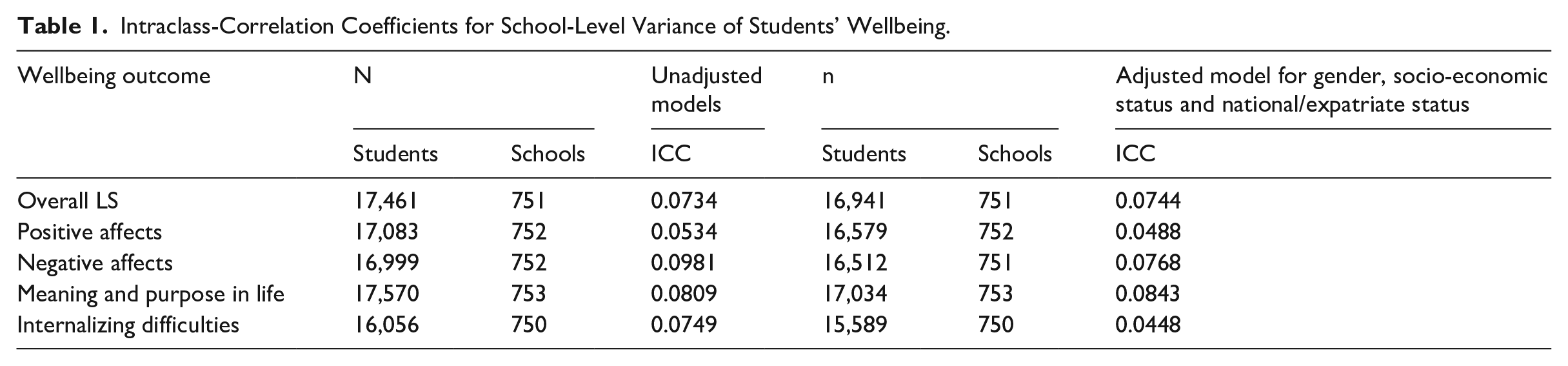
Table 1 shows the ICC in the null (unadjusted) model and in the model adjusted for students’ gender, SES and national/expatriate status. For example, for negative affect, the ICC in the null (unadjusted model) is 0.0981, meaning that 9.81% of the variation in overall LS takes place at the school level. This reduces to 8.43% when accounting for differences in students’ socio-demographic variables across schools. Table A2 in Appendix 1 ranks all countries that collected student wellbeing data in PISA 2018 according to the average ICC levels for overall LS, negative affect, positive affect and meaning and purpose in life. Data for internalising symptoms were only collected in a handful of countries, and thus not included. The results show that, on average, school effects on student wellbeing are the strongest in Kazakhstan (7.77% of the variation in wellbeing was explained at the school level) and the UAE (7.65%). In the remaining 54 countries, it ranges between 0.87% (Greece) and 5.02% (Saudi Arabia). Table 1 shows that in the UAE, ICC levels in the adjusted model controlling for socio-demographic characteristics remain large for wellbeing and larger than in non-adjusted models in 54 countries, although it decreases substantially for internalizing difficulties.
Intraclass-Correlation Coefficients for School-Level Variance of Students’ Wellbeing.
School factors associated with wellbeing
For each of the five domains of wellbeing, the series of models (model 1 to model 7) with the different group of independent variables introduced sequentially are presented in Tables A3 to A7 in Appendix 1. The results of final model 7 with all the independent variables included for each of the five domains is presented in Table 2. Adjusted R-squared estimates show that, depending on the wellbeing domain considered, socio-demographic variables explain only between 3.22% (positive affect) and 9.22% (negative affect) of the variation in student wellbeing. When incorporating all policy-relevant variables in model 7, this increases to at least 27.37% (meaning and purpose in life) and 32.57% for internalizing difficulties, indicating that these factors explain a substantial proportion of the variation in student wellbeing.
Correlates of life satisfaction, positive affect, negative affect, meaning and purpose in life and internalizing difficulties in the final model 7.
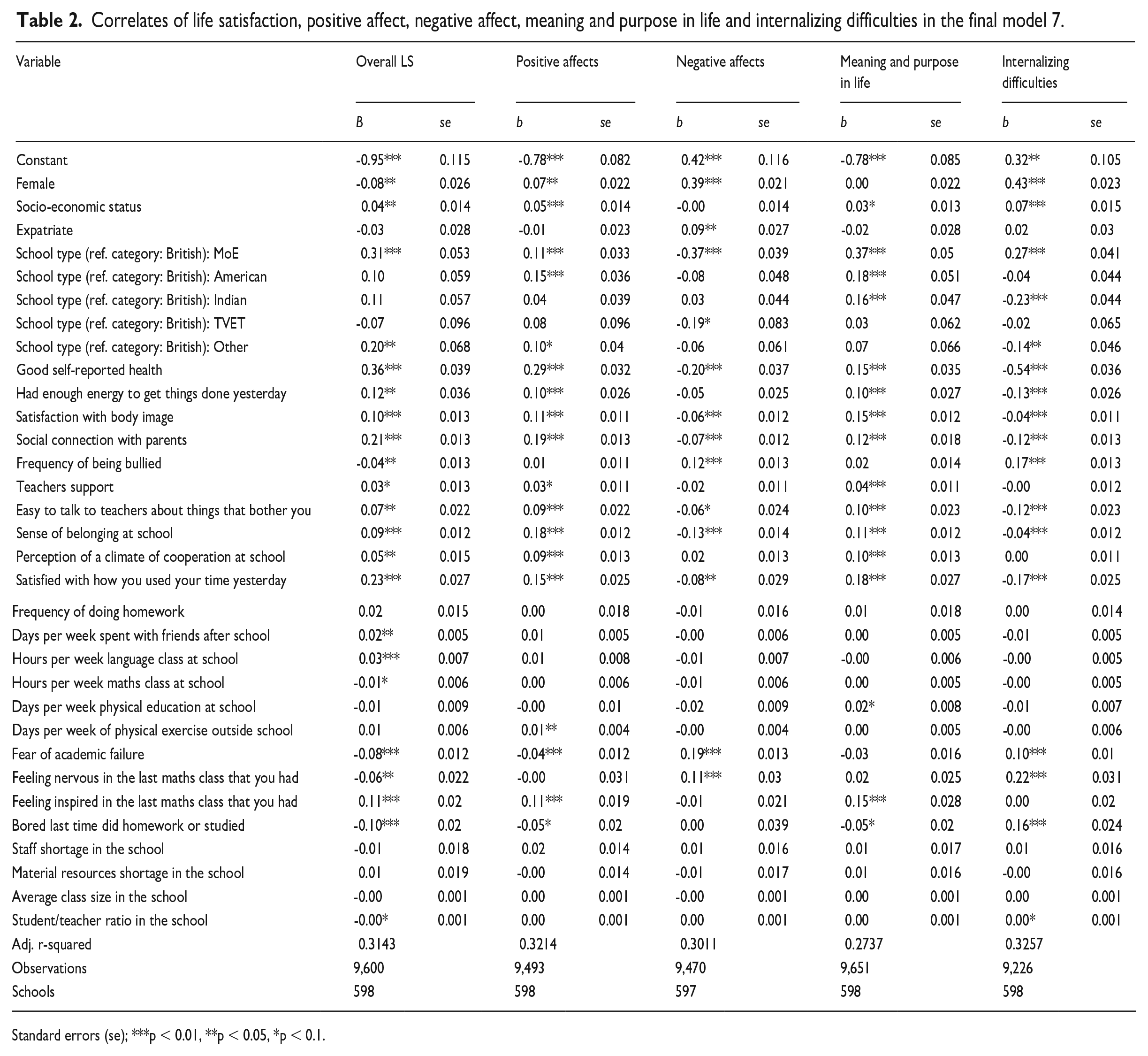
Standard errors (se); ***p < 0.01, **p < 0.05, *p < 0.1.
Health and body image
Table 2 shows that those who report good health enjoy higher levels of wellbeing and this association is strong for internalizing difficulties. For example, reporting good health is associated with -0.54 standard deviations (s.d.) in lower internalizing difficulties. Those who report having more energy to get things done and higher body image satisfaction also enjoy higher levels of wellbeing, although effect sizes are smaller compared to reporting good health in all domains except meaning and purpose in life.
Social connections
Positive social connections with parents, and to a lesser extent with teachers and peers, is associated with higher wellbeing. For example, an increase of 1 s.d. in the index of feeling socially connected to parents is associated with an increase of 0.19 s.d. in the positive affect scale. For bullying, the association is particularly strong for internalizing difficulties and negative affect.
Positive school climate
A higher sense of belonging is associated with higher wellbeing. Similarly, a stronger perception of a climate of cooperation at school is associated with higher wellbeing, although effects are smaller compared to sense of school belonging. No associations are observed for negative affect and internalizing difficulties.
Time use
Students who are satisfied with their time use enjoy better wellbeing. Specifically, spending time with friends after school is positively associated with overall LS (0.2 s.d.). Similarly, higher overall LS is reported by those attending more hours of language class per week and fewer hours of maths class (attending 5 more hours of language class per week is associated with 0.15 s.d. higher overall LS). No associations were found in other domains for these two variables. A greater number of days per week of physical education at school is also associated with higher wellbeing, but only for meaning and purpose in life (0.02 s.d.), whereas a greater number of days per week of physical exercise outside school is associated with slightly higher wellbeing, but only in the positive affect domain (0.01 s.d.). Finally, the frequency of homework or studying is not associated with wellbeing.
Feelings around school
Feelings around school and education are also influential. For instance, while no associations were found for the frequency of homework or studying, how students feel when they are doing homework or studying matters. Those who report feeling bored in these activities report lower wellbeing. Similar associations were found for feeling inspired and feeling nervous in maths class, as well as feelings of fear of academic failure. For example, those who reported feeling nervous in maths class reported 0.22 s.d. higher internalizing difficulties.
School resources
Finally, school resources were not associated with student wellbeing. This is the case for staff shortage in the school, material resources shortage in the school and average class size in the school. The only exception is student/teacher ratio in the school, although the association is small as an increase of 1 s.d. is associated with 0.003 s.d. higher internalizing difficulties and 0.002 s.d. lower overall LS.
Do these factors explain wellbeing gaps across school types?
Model 1 (in Table A3 to Table A7 in Appendix 1) shows that, after controlling for gender, socio-economic status and national/expatriate status, student wellbeing is lowest in British schools and TVET schools, and highest in MoE schools. Internalizing difficulties is the exception, as outcomes in this domain are the best in Indian schools. Indian schools also present the best outcomes in positive affect. However, as the policy-relevant variables are introduced in model 2 to model 7, these gaps become smaller or even disappear, suggesting that these factors play a role in explaining wellbeing differences across school types. For example, Table A3 shows that the overall LS gap between British schools and Indian schools reduces from 0.36 s.d. in model 1, to 0.23 s.d. in model 2, to 0.17 s.d. in model 3, to 0.13 s.d. in model 4, and becomes non-statistically significant in models 5 to 7.
Discussion
Findings and policy recommendations
In this paper we have presented the first national assessment of contributors to student wellbeing in the UAE. We have identified very large school effects, with the proportion of wellbeing variation explained at the school level ranging between 5% and 10%, larger than the average 1% to 6% range observed in other studies (Ford et al, 2021; Marquez & Main, 2020), and larger than in 54 of the 56 countries ranked in Table A2 in Appendix 1 according to ICC levels for wellbeing in PISA 2018. The fact that in the UAE, ICC levels in the adjusted model controlling for socio-demographic characteristics remain large for wellbeing suggests that large school effects on student wellbeing cannot be due to the effects of sorting students based on their socio-economic status or other background characteristics such as gender, or national/expatriate status. Overall, this suggests that schools in the UAE are more influential than almost anywhere else in shaping wellbeing. Education authorities need to take student wellbeing more seriously, particularly as it predicts adult wellbeing and mental health, physical health and health behaviour, relational, labour market and other socioeconomic outcomes (Cavioni et al, 2021; DeNeve & Oswald, 2012; Goodman et al, 2015; Guzmán et al, 2020; Kansky et al, 2016; Richards & Huppert, 2011).
Moreover, the policy-relevant factors studied explain a large proportion of variation in student wellbeing and a substantial part of the wellbeing differences between school types. The issues identified in the analysis should be addressed by schools and other stakeholders. Doing so may help promote student wellbeing and, more importantly, reduce wellbeing inequalities, including socio-demographic (eg, SES) and school type inequalities, both of which are large in the UAE (Marquez et al, 2022).
Good health, having enough energy to get things done the day before, and being happy with one’s body were consistent contributors to wellbeing, with negative affect and mental health difficulties being negatively affected. This supports prior studies on body image (Baker et al, 2019; Maes et al, 2021; Swami et al, 2018; Urke et al, 2021; Wang et al, 2019). Policymakers may implement an effective national health promotion agenda that targets national health concerns affecting adolescents and offers practical initiatives to remediate obesity, sleep, physical inactivity, body image and mental health issues, etc (Abduelkarem et al, 2020; Alharballeh & Dodeen, 2023; Baniissa et al, 2020; Ibrahim & Mahfoud, 2021; Paulo et al, 2018; Pengpid & Peltzer, 2020). Initiatives could include delaying school day start times (Dunster et al, 2018), instituting periods of physical activity (Andermo et al, 2020) and offering healthy food options during school (Esteban-Gonzalo et al, 2019).
The role of material and human resources was inconsequential, except for smaller teacher/student ratio, which was associated with slightly higher student wellbeing. Conversely, the importance of nurturing a positive school climate through the promotion of positive relationships and positive feelings at school was revealed. As in prior studies, bullying was inversely related to all wellbeing indicators and a significant contributor to mental health difficulties (Eyuboglu et al, 2021; Múzquiz et al, 2022; Wolke & Lereya, 2014). A countrywide bullying prevention strategy was established in 2018 as it is a significant issue (Mullis et al, 2016; Rigby et al, 2019); however, its impact is unknown (AlKetbi et al, 2021). Authorities need to go beyond awareness to impactful strategies to develop institutional kindness and empathy over punishment.
A sense of belonging and culture of cooperation were positively associated with wellbeing, aligning with prior studies (see Long et al, 2021; Parr et al, 2020; Steiner et al, 2019). Hence, we recommend that schools promote a culture of cooperation rather than competition, and nurture integration efforts. The latter may be relevant for certain groups who feel out of place in some schools (such as Emirati students in British schools). Schools should also create inspiring lessons, homework and activities, but this cannot be achieved unless teachers are provided adequate support and time, issues we discuss further later.
Students who struggle with schoolwork-related anxiety, a growing issue worldwide (Marquez & Main, 2020; Steinmayr et al, 2016, 2018), need to be assisted. This includes tackling fears of academic failure and focusing on subjects that may produce negative feelings, such as mathematics. An excessive focus on performance negatively impacts mental health, and more so in girls (Giota & Gustafsson, 2017; Högberg et al, 2020; Long et al, 2021), while higher student wellbeing is associated with better academic outcomes (Gutman & Vorhaus, 2012; Heffner & Antaramian, 2016; Lindorff, 2020; Miller et al, 2013). Maintaining or raising academic performance through joyful learning and cooperation, as opposed to adding more time and fostering competition, is key.
Our analysis further revealed the importance of feeling supported by parents and teachers, both of which were positively correlated with wellbeing indicators and negatively correlated with negative affect and mental health difficulties, as studies have shown (Francis et al, 2020; Gariépy et al, 2016; Long et al, 2021). Parents may prioritise academic standards over wellbeing in school selection; however, adolescent wellbeing predicts important outcomes, including academic ones, later in life (Cavioni et al, 2021; DeNeve & Oswald, 2012; Goodman et al, 2015; Guzmán et al, 2020; Kansky et al, 2016; Richards & Huppert, 2011). As parents make decisions involving the wellbeing of their children, schools need to engage them in conversations on the importance of wellbeing and how to support it.
Teachers also play a role. For instance, we found a small association between a lower student/teacher ratio and higher student wellbeing. Yet, hiring more teachers may not be a solution unless they have time to focus on wellbeing and access knowledge and training opportunities to support their students’ wellbeing. This necessarily includes efforts to promote teacher wellbeing, a predictor of student wellbeing and academic performance (Burić et al, 2019; Harding et al, 2019; Madigan & Kim, 2021). Across OECD countries, 18% of teachers report experiencing a lot of stress; yet, among teachers in Dubai’s private sector, it is 28% (OECD, 2021). Learning the skills of promoting wellbeing could be made a condition of employment, criteria for teacher recertification and component of induction.
As problems in family functioning and mental health issues of parents increases the risk of poor wellbeing (Collishaw et al, 2016; Kamis, 2021), services for parents that are multilingual, culturally aligned, and offered in person, online, or at school are vital. Schools may also have as part of registration procedures, universal screening interviews with parents to identify mental health, parenting or child welfare concerns.
Adolescent dissatisfaction with how they used their time emerged as a critical correlate of wellbeing, much as it does in the literature (see Ahn & Yoo, 2022; Doré et al, 2019; Martins et al, 2021; Oberle et al, 2020; Santini et al, 2020). Their dissatisfaction may reflect the fact that excessive hours spent studying are also associated with less sleep and activity (Yoo, 2020). Schools may promote physical activity and homework during the day, especially as the latter is not negatively experienced, although its monotony and high-stakes nature is. This could free up time after school for leisure, family mealtime, peer relationships and sleep. Countering gender norms in the UAE that limit the participation of girls in leisure may be key (Ahn & Yoo, 2022), as its support depends on cultural norms, school climate, the freedom youth have to make decisions, and parental values (Ahn & Yoo, 2022; Gracia et al, 2020).
Last, and in line with intervention and research trends, is the need to consult young people. Not blind to what contributes to their emotional experience, young people should be considered experts on what they need in order to feel a sense of belonging, as well as how their time is distributed as examples (Fazel & Hoagwood, 2021). Their input is useful as consumers and co-producers of wellbeing interventions, and removes the burden from schools alone of solving wellbeing issues.
Limitations
Our analysis is limited to 15-year-old students and may overlook the reality of wellbeing at other ages, particularly as older youth tend to score more poorly on wellbeing measures and experience poorer relationships with their teachers (García-Moya et al, 2015; Newland et al, 2018). Limited information regarding the country of origin of expatriate students also prevents further analysis that could provide valuable insights. Moreover, to capture some phenomena (such as bullying), PISA, as most cross-national studies do, uses Western-derived measures that may be problematic for international comparisons involving socio-culturally diverse countries (Smith et al, 2016), which calls for caution when interpreting our results. This is especially relevant with regards to the wellbeing measures used in this study in a non-Western nation such as the UAE where, given cultural and linguistic issues, students may understand and respond to questions in different ways. The body of research assessing the cross-cultural validity of adolescent wellbeing measures is growing (Casas & Gonzalez-Carrasco, 2021), but more research is needed to assess the validity of these measures locally. Finally, while students’ lives may have changed since 2018, establishing a pre-COVID19 baseline from which to assess post-COVID19 data when these become available, remains critical.
Conclusions
As the drivers of student wellbeing may differ across sociocultural contexts, it is essential to advance our understanding of these in countries where research evidence remains scarce, which was the focus of this study. Assuming that what is observed in Western high-income societies is the standard towards which all nations should aspire may lead to less effective responses in many parts of the world. This is particularly important in the UAE, a nation that presents some peculiar characteristics involving the socio-demographic composition of its diverse student population that may also be observed in other countries in the GCC region, but that are substantially different from those observed in those countries where most research evidence is available. Even within the country, many realities co-exist and student populations from different emirates and school types vary substantially. Thus, responses involving systematic data collection and analysis at the national, regional/local and school level, in both the public and private sectors, are needed, and these must prioritise the identification of the most vulnerable student groups and the issues affecting wellbeing in order to effectively promote student wellbeing. This first national study sets a baseline for progress, and offers several intervention points that schools and authoritative bodies may consider in determining how wellbeing inequalities can be addressed. Given the gains to be had from nurturing the wellbeing of young people, we urge all stakeholders to act in concert, urgently, and with an eye on tangible outcomes.
Supplemental Material
sj-docx-1-jri-10.1177_14752409241243011 – Supplemental material for Exploring factors associated with student wellbeing in the United Arab Emirates: PISA 2018
Supplemental material, sj-docx-1-jri-10.1177_14752409241243011 for Exploring factors associated with student wellbeing in the United Arab Emirates: PISA 2018 by Jose Marquez, Louise Lambert and Devi Khanna in Journal of Research in International Education
Footnotes
Funding
The author(s) received no financial support for the research, authorship, and/or publication of this article.
Supplemental material
Supplemental material for this article (Appendix 1, including Tables A1-A7) is available online.
Author biographies
 in Dubai (UAE), and Editor of the Middle East Journal of Positive Psychology.
References
Supplementary Material
Please find the following supplemental material available below.
For Open Access articles published under a Creative Commons License, all supplemental material carries the same license as the article it is associated with.
For non-Open Access articles published, all supplemental material carries a non-exclusive license, and permission requests for re-use of supplemental material or any part of supplemental material shall be sent directly to the copyright owner as specified in the copyright notice associated with the article.
