




Abstract
This paper explores the thesis of de-globalisation in relation to international education. Through interrogating accounts of international school leadership during the Covid-19 crisis, the tension between international expectations and localised realities is charted, with four central tenets of internationalism undermined by the pandemic experience. It is argued that the Covid-19 crisis, ostensibly a single global event, resulted in the fractalisation of international education; the conceptualisation of unified internationalism was undermined by the inherently localised material effects of the pandemic. In place of an internationalism that is unified, transcendent, inclusive and connected, international school leaders’ accounts of leading through the pandemic focused on their sense that their schools were fractured, rooted, privileged and isolated. It is suggested that this international crisis demonstrates the precarious nature of the respatialising of the global that is intrinsic to international schooling.
Introduction
In early 2020, as the Covid-19 pandemic swept across the world and national systems of education were suspended in the interests of public health and safety, there was one type of school which received little official attention – international schools (Doll et al, 2021). Originally founded to serve the families of the globally-mobile, now more often catering to national elites (Kim and Mobrand, 2019), these institutions were hardly the focus of governments struggling to protect livelihoods for their own populace.
This paper analyses interviews with thirteen international school leaders, leading schools through the pandemic in fourteen different countries, to explore the nature of the ‘international’ in their responses. This is not a study of the effects of the pandemic; rather, we ask what these accounts of the pandemic reveal about the relationship between the international and the national in international schools. In other words, we explore what Covid-19 revealed about the nature of international schools and their leadership.
The Covid-19 pandemic is seen as an international event, but in this paper we suggest that it is helpful to view it through the lens of ‘de-globalisation’ (Irwin, 2020; Elsner, 2021). The paper identifies strands of how international schools define their ‘internationalism’, and demonstrates how these were challenged by Covid-19 experiences. Specifically, versions of internationalism promulgated in international schools suggest these institutions are united by a shared Cosmopolitan identity (Reid and Ibrahim, 2017; Bolay and Rey, 2020), whether pragmatic or idealistic in nature, that transcends national boundaries, is inclusive of national diversity (Weenink, 2008), and is connected via the concept of international. International school leaders’ accounts of their pandemic experiences are contrasted with these four concepts.
International schools offer education following a curriculum which differs from the national curriculum in the country where they are located (Bailey, 2021). This is often delivered through the medium of English and they are typically fee-paying schools. Study of international schooling is of significance since this is a rapidly expanding sector of schooling, with approximately 6.51 million students attending international school worldwide, a 53% growth over the last ten years (ISC Research, 2023). Originally founded to serve the offspring of globally-mobile expatriates, such as those working for international corporations and diplomats, who wished to return to their passport nations for higher education, international schools were traditionally run as not-for-profit institutions (Hayden and Thompson, 2008). The expansion of this sector has been fuelled by changes in the nature of both the demand and the supply. First, whereas in 1989, expatriates made up approximately 80% of international school students with 20% of host-country national students, by 2018 the proportions had been reversed (ISC Research, 2018). This demand change is in part explained by economic globalisation seeing the expansion of a global middle class who want their children to develop the linguistic and other skills to succeed in a globalised workforce, often through attendance at international schools (Beech et al, 2021). Second, the growth in numbers has been met by the opening of for-profit institutions (Kim, 2019), including international schools, and overseas franchises of prestigious institutions from ‘Anglo-Saxon’ countries (Gibson and Bailey, 2021), or as Kachru (1985) refers to them ‘inner circle’ countries, where English is traditionally the first language of the majority of the population, such as the UK, the USA, Australia and New Zealand. This change in supply is partially consequent upon the rise of transnational corporations also linked to globalisation.
During the global lockdowns of the Covid-19 pandemic, national schools in countries moved to online learning or closed altogether. What distinguished international schools is that their often multinational staff and students may well have departed to their ‘home’ country at that time, and in addition aspects such as assessment regulations were organised from other countries in different contexts; their communities were separated. Theirs was a unique experience and although international schools have received some attention in the pandemic-related literature (see for instance Jan, 2020; Putri et al, 2020; Stasel, 2020), to date this has not been proportionate to international schools’ numeric position in global education. We hope this paper will contribute to that knowledge gap.
The social, political and economic changes associated with globalisation have decelerated over the past fifteen years and, in some cases, reversed; however, the nuanced effects of these macro changes remain little-examined in relation to education (Wu and Koh, 2022). Specifically, the rapid expansion of international schooling and increasing numbers of host-country nationals at such institutions, alongside a resurgence of nationalism in many parts of the world, has created a more complex landscape for this educational sector (Poole, 2020). The shifting relationship between the national and the international in international schools consequent upon these trends merits further examination (Poole and Bunnell, 2023). This paper makes a contribution to this research gap.
Literature Review
Being ‘international’ is used by international schools as their unique selling point (Bailey, 2021), but it is a concept that remains essentially contested (Keßler and Krüger, 2018). Prior to the recent expansion of the sector, international schools traditionally had an ideological orientation, claiming to offer an education in international understanding, although their recent more commercially-driven expansion has arguably created institutions which place less emphasis on this aspect (Palmer, 2022). Nevertheless, the International Baccalaureate, as one provider of internationally-focused programmes for students aged 3-19 that have been adopted in many international schools (IB, 2024), purports to develop students’ ‘international-mindedness’, while many international schools are proud to display the multicultural nature of their student and staffing demographics (Tanu, 2017; Meyer, 2021).
There are several elements to the internationalism/ ‘international-mindedness’ such institutions claim to foster. First, international education operates on a dialectic of inclusion and exclusion, positioning itself as simultaneously globally inclusive and as a mark of distinction (Peter, 2018). This uneasy tension between inclusivity and exclusivity arises in part from international schools’ traditional links to privileged expatriate enclaves. There is an expanding literature exploring the ways in which globally mobile communities insulate themselves from the local sociocultural community: the so-called expatriate ‘bubble’ (Gaggiotti et al, 2023). In part, this may act as a mechanism whereby people protect themselves from encountering otherness and othering (Guttormsen, 2018). The transient nature of the communities thereby created is captured by the metaphor of an ephemeral bubble (Gaggiotti et al, 2023). An emerging literature has critically analysed the claimed inclusivity of international schooling, suggesting instead that such institutions are elitist and Westernised. For example, it has been argued that ‘international-mindedness’ may create a shared identity for the global elite (Bunnell et al, 2022) or that some international schools operate as post-colonial sites (Gibson and Bailey, 2022).
This literature has critically engaged with a second strand to the internationalism of international schools – the supposedly harmonious relationships within them – showing instead how these institutions may privilege certain perspectives and exclude host-country cultures (Bailey, 2015). Researchers have highlighted that there is a preponderance of white, ‘inner-circle’ country males leading international schools (Gibson and Bailey, 2022). It has been suggested that schools’ recruitment practices reify global structural inequalities (Gardner-McTaggart, 2021; Bunnell and Gardner-McTaggart, 2022). Additionally, analysis of some international schools’ teaching practices has suggested they are ethnocentric and engage with local non-Western communities as ‘other’ (Tanu, 2017), such that ostensible multiculturalism becomes neo-colonialism in practice.
A third element in the internationalism of ‘international’ schooling is the idea that international schools somehow transcend national boundaries (Wu and Koh, 2022; Dugonjić, 2014). Various concepts have been developed by critical theorists to capture the presumption of the global to transcend context – such as the global gaze, which Bailey describes as ‘an imagined perspective from which education is judged independent of context’ (2023: 1). This builds upon Meyer’s ‘global imaginary’, which sees being global as inherently good whilst its actual meaning remains vague (Meyer, 2021). In their study of 21 Swiss international schools, Bolay and Rey (2020) argue that a form of ‘corporate cosmopolitanism’ is nurtured by these schools, with an emphasis on diversity and mobility. They argue that international school students are praised for their ability to adapt to diverse settings, while being simultaneously separated from the local environment of their school. Overall, the authors conclude, these students are being prepared for the needs of transnational corporations. They say that ‘private international schools position themselves within a global, transnational space in contrast to a local, national setting’ (Bolay and Rey, 2020: 108), which mirrors the kinds of transnational enclaves inhabited by those working in transnational corporations.
The transcendence of location is connected to a fourth strand of the internationalism of international schools – the imagined global networks within which these schools are entwined. International aspects of education serve to change conceptualisations of space and proximity, and their social meaning. Lewis (2020) develops Topological Spatialisation theory to explain transnational actors, consultancies and agencies operating on policy discourse at a local level. Here, OECD PISA assessment, for example, becomes the space between the ‘global’ and the ‘local’ school. In this theory, a ‘topological space is a space of flows, a “smooth space”. . . defined by relations between points (and actors), instead of solely considering the location of points’ (Lewis, 2020: 37). This results in ‘topological modes of culture [which] emerge through processes of continuity and ordering, and significant advances in our computational capacities to collect, calculate and compare such data have enabled new kinds of “ordered-ness”’(Lewis, 2020: 39). In his study of international testing by the OECD, Lewis (2020) argues that globalisation creates a sense of closeness and connection that serves to effectively ‘fold’ the global into local spaces, so that a new social topology is created.
Similarly, part of the appeal of international schools is that they are ‘de-territorialised’ (Kong et al, 2022). Their networks are transnational, so that they are socio-spatially separated from the communities that physically surround them; many international schools even operate as transnational chains. This may be compounded by segregated lifestyles and in some cases discrete housing enclaves that separate them from their locality, which contrast with the symbolic and social connections that are celebrated in these schools (Kong et al, 2022). As a result, students may develop a sense of ‘inter-belonging’, where ‘inter-belonging’ is an outcome of (de)territorialisation; it reflects the reconciliation of different forms of (non-) attachment to the school, the locality and the country of origin (Kong et al, 2022: 244).
These four elements of the international identified here – inclusive of diversity, unified in harmony, transcendent of locality, and globally networked – are integral to how many international schools view themselves. They are reminiscent of the ‘global imaginary’ that Meyer (2021) suggests many international schools adopt. Much analysis of the international in international schools has been focused on understanding the relationship between globalisation and international education (Kim and Mobrand, 2019; Bunnell, 2022). Globalisation refers to the economic, political, cultural and social changes resulting from increased connectedness and interdependence, which are seen variously as either an outcome of modernity, the consequence of new technology, or the triumph of neoliberal capitalism (Zajda, 2022; Stevenson, 2019). The globalisation of education encompasses such diverse shifts as the increased homogenisation of educational policies. These policies include the rise in international assessments, with diverse education systems being judged against the same yardstick and curricular alignment, so that students supposedly need to be prepared with universal twenty-first century skills to become global workers (Zajda, 2021). The changing market for international schooling is itself ascribed to globalisation (Bunnell, 2022), as parents seek opportunities for their children to join the global middle-class, and international edu-businesses emerge to meet this demand (Bailey, 2023).
Theorists of international education have explored how global factors play out in international schools, but have paid insufficient attention to understanding how aspects of locality shape international schooling in a particular context (Wu and Koh, 2022). There are some salient exceptions. For example, the concept of ‘glocalisation’ has been developed to capture the fact that globalisation is not inherently characterised by homogenisation and neo-colonialism, but inevitably involves a reciprocal and dialectic relationship between the local and the global (Bettney and Nordmeyer, 2021); it constitutes a synthesis between the global and the local, rather than acceptance of such a dualism. Some researchers have drawn on the concept of ‘glocalisation’ to understand the relationship between international schools and their locality. For example, Bettney and Nordmeyer (2021) draw on school profiles written by international school educators to distinguish different relationships, arguing that some schools can be termed ‘glocal’, characterised by intentional hybridity and heteroglossic linguistic practices.
The relationship between the global and local in international schools may be fluid and may vary by national context. In China, for example, the state has taken measures to curb the global flows of international schooling (Wu and Koh, 2022), through strict control of the curriculum, student admissions, and the promulgation of (supposedly) Western values. Poole and Bunnell (2023) use the metaphor of ‘dovetailing’ to capture how international schools fuse the internationalist nurturing of cosmopolitan sensibilities with the nationalist requirements of the Chinese state. Elsewhere, research has suggested that those in some international schools are dismissive of their national context; some leaders of international schools in Malaysia for instance have expressed to researchers stereotypical (and racist) views of their host nation, including representing host country nationals as lazy, mercenary or ‘Tiger moms’ (Gibson and Bailey, 2022). Research from Cyprus has suggested that the uneasy relationship between global and local may challenge the international identity of international schools in that context (Elerian and Solomou, 2023).
In the last decade, however, theories of ‘de-globalisation’ have emerged to complement – or even supplant – those of globalisation and glocalisation. This is the thesis that countries have started to move away from further integration. World trade data suggests a faltering in economic globalisation since the 2008 financial crisis (Irwin, 2020), with the Covid-19 pandemic exacerbating the downward trend as, for example, governments imposed export bans on medical equipment and pharmaceuticals. Even in the heyday of globalisation after the end of the Cold War, commentators pointed to contradictory impulses, such as a renewed emphasis on national identities. During this period, globalisation became associated with economic liberalism, peaceable international relations, democratisation and systems of global governance – though there is no necessary connection between these things (Kornprobst and Paul, 2021). In recent years, there are record numbers of refugees and migrants, which could lead to destabilisation of democracies and emergence of more authoritarian governments. Aspects of de-globalisation have included a decline in international trade, some governments imposing restrictions on cross-border communication (for instance barring access to social media sites); and a resentment of supra-national institutions such as the European Union (EU) (Kornprobst and Paul, 2021). Brexit (the UK’s withdrawal from the EU) and Trump’s ‘America First’ policies in the US have both been cited as examples of de-globalisation (Ezeani, 2018). The emerging geo-political order, with America and China seeking economic de-coupling and Russia’s exclusion after the invasion of Ukraine, are further instances of de-globalisation (Woo, 2022).
The de-globalisation concept is contested. For example, Roccu and Talani (2019) challenge the thesis of de-globalisation; they posit that it is not that globalisation has slowed, but rather that the ‘dark side’ of globalisation – the large number of people excluded from its benefits – has become harder to ignore. They suggest that globalisation has always involved two extremes, whereby a wealthy few become more interconnected while large sections of the global population are marginalised and excluded from its economic benefits. Building on this insight, perhaps we should not conclude that de-globalisation has supplanted globalisation; rather, a more helpful approach is that of Eftimie (2017), who argues that society oscillates between globalisation and de-globalisation.
There is an abundance of literature on education and globalisation (Zajda, 2021; Lingard, 2021), but little at present on education and de-globalisation, although researchers such as Allen et al (2020) predicted that the pandemic would slow or arrest the globalisation of higher education, as nation-states shut their borders and called their citizens home. Nevertheless, recent changes in the world of international schooling may indeed suggest the emergence of a ‘post-globalisation era’ (Bunnell, 2022: 53) in which their continued expansion may be under threat. For instance, in 2020 Saudi Arabia announced the dismissal of all foreign national leaders of international schools, so that they could be replaced by Saudi nationals (Govind, 2020).
The Covid-19 pandemic has been seen by some commentators as a further impetus to de-globalisation (Antràs, 2020). For example, the threat posed to supply chains by the pandemic led some policy-makers and business leaders to question whether global economic integration risked national security and public health (Irwin, 2020). Svetličič (2021) asked whether Covid-19 is ‘the child of globalisation or the mother of de-globalisation’, concluding that the pandemic was the result of unfettered global capitalism and calling for a more egalitarian version of globalisation to ensue from the pandemic.
To summarise, the internationalism referred to in international schooling has been critically analysed by many commentators. Literature has identified that the imagined internationalism at international schools emphasises what is shared by members of the international school community; it is presented as transcending national boundaries; an emphasis is placed on its inclusive nature; and the connections between diverse individuals and institutions are emphasised. This conception of being international mirrors the connectedness and interdependence that characterises globalisation. Less attention has been paid to inclinations to de-globalisation and how this may reconfigure the connection between the international and the national in international schooling. The Covid-19 pandemic, which was both global and led to pressure for some de-globalising strategies, therefore provides an ideal opportunity to explore the relationship between conceptualisations of ‘international schooling’ and de-globalisation.
Research Methods
The data drawn on in this paper were collected for a study of international school leadership during the Covid-19 pandemic. Though the focus of the study was not on ‘internationalism’, this emerged as a dominant theme from the interviews undertaken. Other issues emerging, related to stress and well-being, are the focus of separate papers.
The analysis that follows is based on online, semi-structured interviews with international school leaders, conducted from May to October 2022. All participants had remained during the pandemic in the host country where their school was located. The most senior leader in each school was contacted through a combination of convenience and snowball sampling. We contacted leaders who had participated in a previous study we conducted of international school leadership prior to the pandemic, and also had support from international school organisations which agreed to promote our study. Once we had conducted the first few interviews, we were contacted by other leaders who had heard that the interview process was cathartic. With each participant, a semi-structured interview was conducted, lasting for approximately one hour.
The research had ethical approval from a UK university. We followed ethical procedures – for example, reassuring our participants of the confidential nature of the interviews – and in the discussion below have given each a pseudonym, and been careful to omit any identifying information in the accounts below. Unfortunately, this precludes given detailed information about the demographic make-up of each school.
The data demonstrate the diversity of experiences during the pandemic. Indeed, it is this very divergence for individuals from what others were experiencing, even in other international schools, that was one of the salient aspects of the experience for leaders; this is discussed further below. We are conscious of the limitations posed by a small sample, and the dangers of over-generalising from the data presented here, though a considerable geographic spread was represented by our participants (see Table 1). It is of interest to note that only one participant was a national of the country in which they were working; the participants were mainly from ‘inner circle’ English speaking countries.
International school leaders interviewed.
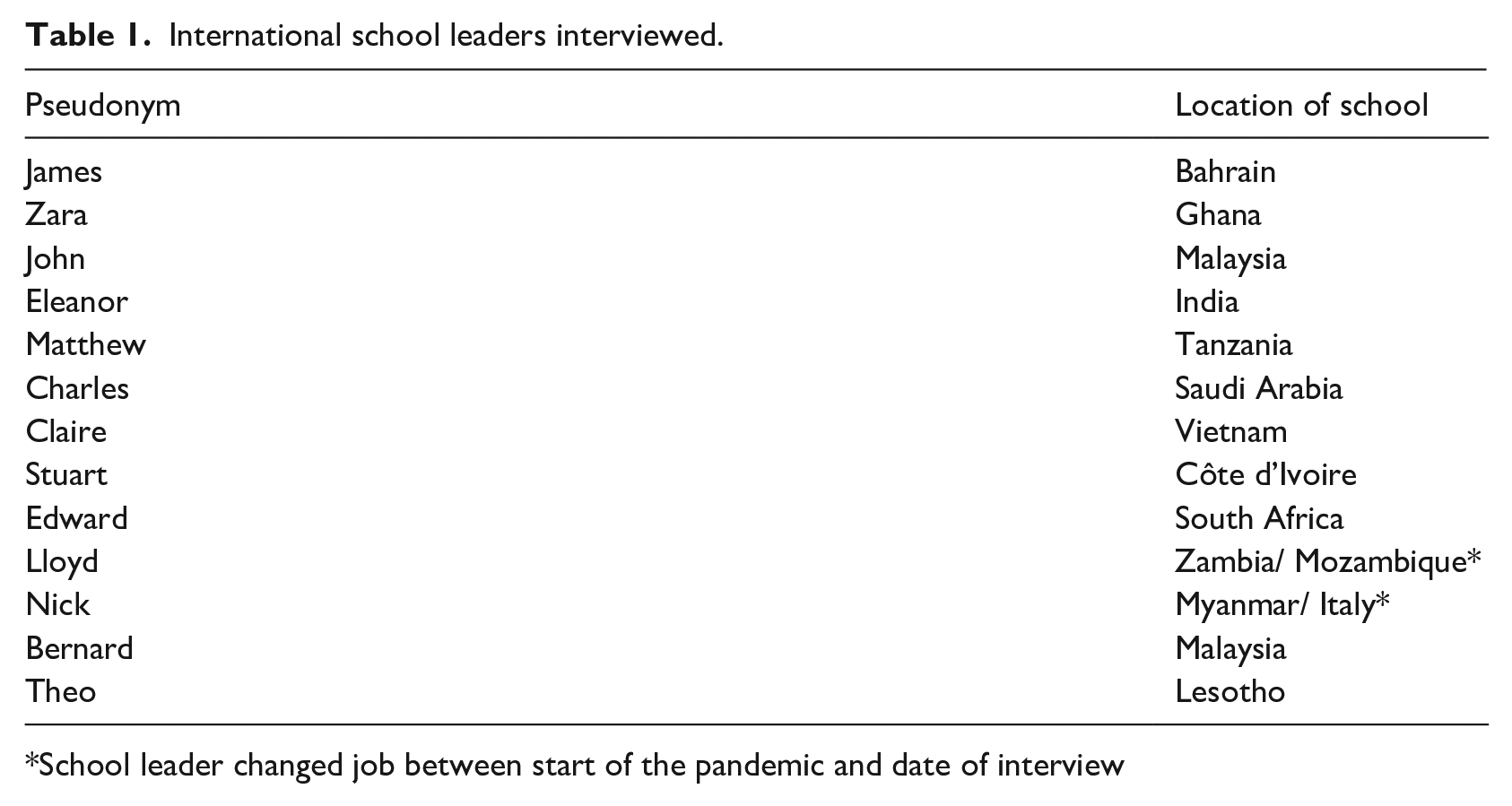
School leader changed job between start of the pandemic and date of interview
13 leaders (10 male and 3 female) were interviewed individually online, and all interviews were recorded using either Google Meet or Microsoft Teams. Transcriptions of the interviews were analysed using grounded theorising, with the application of constant comparison to identify recurrent themes and develop codes (Saldaña, 2020; Saldana, 2011). Detailed analysis of our rich, qualitative data offered insight into international school leaders’ experiences during the pandemic, and indicated ways in which their conceptualisation of what it means to be an ‘international’ school had been challenged by these experiences. It is the latter that is the focus of this paper.
Data Analysis
Four themes were dominant in the school leaders’ descriptions of their experiences during the pandemic, each of which related to how the international nature of their school was challenged by the pandemic experience. They described ways in which their school community
From Unified to Fractured
For many leaders the start of the pandemic had led almost immediately to the disintegration of their international community into its constituent parts. This happened both physically – many leaders reported the school being dispersed as people headed to the country they deemed home – and metaphorically, as for people from different nationalities the ‘home’ nation became a yardstick for judging how to behave during the pandemic. The myth of a unified body formed of multiple nationalities (Tanu, 2017) was therefore brought into question.
It was revealing to note where, in a time of crisis, people saw as a place of safety, and for many teachers, parents and students, ‘home’ was equated with their passport country. Lloyd described how many people in his school: thought they might be taking an undue risk by staying, and so they fled to their home . . . And a lot of them chose to, and a lot of them didn’t have the choice. A lot of governments sent people home, they booked evacuation flights, everybody raced for the doors. (Lloyd)
Several leaders reported the different reactions to leaving amongst different nationalities. A typical example was Stuart, who explained: In the first two or three months a lot of the American staff were evacuated. So the American embassy said there’s planes, if you want to leave you can go home, and so the Americans did go. The rest of us stayed. And it turned out that we were almost better off here. (Stuart)
Stuart contrasted how the Americans felt about the pandemic with how the African students felt, who compared it to Ebola and malaria, and felt that Covid-19 was comparatively low-risk for young, healthy people.
After this initial fracturing, several leaders reported tension between different national groups about how they felt pandemic learning should be managed. For example, Edward explained that: We have a lot of consulate families, so government workers, and so they were under direct guidance from their governments, even though they were here in South Africa. So . . . for sure, our Chinese students weren’t even allowed [outside] the complex. I’m generalising here, but in general our Asian families were super strict around everything, all the regulations. Our American families were ready to forget about [pandemic restrictions] . . . It did resemble what was going on more so in each country. (Edward)
Lloyd referred to the ‘big Swedish contingent’ in his school that ‘was probably the only national group that created an issue’, as they felt the school’s measures were too strict. Claire explained that most of the Korean community in her school left the country because there was an incident where a Korean person died in a Covid-19 camp (a number of Covid camps were set up in the country of Claire’s school, to which anyone diagnosed as having Covid was required to relocate) and their next-of-kin wasn’t informed before they were cremated.
Some leaders reported tensions emerging between different parts of their school communities. The difficulties were particularly acute in Theo’s school, when some teachers experienced internet difficulties during online lessons and parents became frustrated, questioning the quality of teaching of local teachers: There were parents that were sending some really, really nasty messages [to local teachers]. Very hostile, very antagonistic . . . . I would say some of them are borderline racist. They were never saying that sort of thing with expat teachers. (Theo)
In many schools, the financial impact of Covid-19 was not necessarily felt equally across all of the school community. Diplomatic families, for example, continued to have secure incomes. At Bernard’s school, many Malaysian parents who ran their own businesses lost their income because of the lockdown. By contrast, a lot of international parents moved back to their home countries. As the international school communities fractured, the financial implications for some schools became acute. Some came under pressure to reduce fees, school enrolment leeched, and some staff were made redundant, leading to a further fracturing of the teacher community.
In summary, although differences between parts of the international school community pre-dated Covid-19, the pandemic made these more explicit as people escaped to the place they considered ‘home’, used their passport country as a referent point for disagreements over school policies, sometimes became antagonistic towards one another, and suffered contrasting financial difficulties. The idea that they were united as an international community was challenged by such differences.
From Transcendent to Rooted
In normal times, many international schools may operate in ways that bear little connection to their locality. They may seem to transcend borders – through, for example, their curriculum, assessment and classroom practices – such that some authors have argued that they are de-territorialised (Kong et al, 2022). By contrast, the responses of the leaders in this study concerning their pandemic experiences were repeatedly rooted in their national, or regional, context. Here, we shall discuss three aspects of this: the cultural context, lockdown context, and assessment.
Leaders’ accounts of their pandemic experience made it clear how culture mediated the impact on their school community. Matthew explained that the Tanzanian families at his school typically lived in multi-generational homes and wanted the school to be extremely cautious, whereas expatriate nuclear families with grandparents who lived elsewhere were less concerned about school re-opening. Theo explained that in the context of Lesotho, multi-generational families living together led to an enormous impact on children when an elderly family member died from Covid-19. Cultural differences in the importance that families placed on different aspects of education also came to the fore. For example, Bernard commented that: Particularly in Asia, schools are seen as exam factories, they’re something where you get high exam grades. That’s all they thought about. The last two years has really shown parents that the social interaction, the mixing, the laughing, the joking, that’s an enormous part of schooling. (Bernard)
Some leaders also mentioned other elements of the social and political context that came to the fore as a result of the pandemic. For Theo, concern about weaknesses in the local health care system were important. For Nick, students’ stresses in studying online were compounded by the political situation in Myanmar. Such social and political differences meant that, although all the schools were locked down to some extent, leaders reported very different experiences of lockdown, and each was very conscious of contrasts between how lockdown was managed in their schools’ context and how it was managed in their passport country. For example, Matthew explained that the initial decision to shut his school in Tanzania was made by him, and that his school ‘led the way in some ways’. By contrast, in Saudi Arabia Charles had to follow national decrees without debate – and was thankful that this took some pressure away from him: The nice thing about the Saudi system is that there wasn’t a whole lot of debate on the subject. When the King issues a decree, that pretty much is the end of the discussion. So we didn’t have to endure any of the silliness that you saw in the United States. (Charles)
Claire explained the impact of these differences on the wellbeing of her teachers: It was quite draconian. If you had Covid you would be dragged off to a camp . . . And some of our expat staff were, and they were very traumatised by that experience . . . [During] the second lockdown . . . streets were barricaded, the army moved into the city and no-one was allowed out of their building. And people couldn’t get food, and people couldn’t get medicine, and I had to deal with a lot of wellbeing [issues], and people who were in high-rise flats when the lifts were turned off, it was a health and safety issue as well. (Claire)
By contrast, in Tanzania Matthew experienced a completely different way of managing Covid-19: When Tanzania declared schools could go back [in June 2020], the President declared that Covid was over, and from that point in time it was illegal to mention that Covid existed in the country of Tanzania . . . When we had a case of Covid, to keep the community informed we did everything verbally, we would host Zoom calls, because I couldn’t write an e-mail to say that we had Covid because . . . I could be arrested, it was illegal. (Matthew)
The variable impact of these measures on student assessment was another feature of the interviews. International schools rely on the idea that somehow fair assessment can take place at a transnational level, and this idea was exposed as precarious by the pandemic. For some, these differences in lockdown experiences meant that transnational assessment was not possible, and leaders were frustrated that examination boards located in a different country did not understand their own context. For example, Claire talked about how hard it was to get the examination boards to understand that ‘lockdown’ in Vietnam meant something very different to ‘lockdown’ in the UK. John explained that Cambridge International Assessment initially insisted that examinations be completed in all countries, but later changed its approach: ‘In the end Cambridge [International Assessment] buckled on the “everyone has to do exams”, because some countries couldn’t’. James was angry with the International Baccalaureate’s failure to accommodate contextual differences, which he said was the most stressful part of his pandemic experience: The worst, the most difficult and challenging time that I had as a principal, was dealing with the IB diploma. It got to the point that I went to the board and said I want to stop doing the IB diploma, because of the way that they’re managing and dealing with the pandemic, and I don’t trust them in future. But the board refused. (James)
In diverse ways, then, the leaders felt that their local context was salient during the pandemic, reminiscent of the ‘glocal’ nature of the international schools studied by Bettney and Nordmeyer (2021). They were conscious of how their context differed from that of other international schools, although they also acknowledged that they garnered support from their international networks.
This refocusing on the local had not been temporary for all. Stuart observed that this experience had made him reappraise his recruitment decisions, and consider seeking to appoint more local staff, who would be more likely to stay in the country during any future emergency. Hence, this reorientation to the local context may have a lasting impact on the nature of these schools.
From Inclusive to Privileged
The uneasy tension between inclusion and exclusivity that previous studies suggested characterise international schooling (Peter, 2018) featured in the interviews, with exclusion and privilege being emphasised by the pandemic. The cultivation of cosmopolitanism through diversity and mobility has been one of the distinctive features of international education (Bolay and Rey, 2020), but travel restrictions imposed during the pandemic prevented mobility from legitimising advantage, and consciousness of privilege came to the fore.
At the same time as these leaders felt a renewed awareness of their specific context, they also were very conscious of factors that kept them distinct. Specifically, many alluded to ways in which they used privilege within that context; discussion of resources and contacts recurred during the interviews. Claire was explicit about the importance of financial factors to how her international school responded: Everybody’s been a rabbit in the headlights with this. They’re just really slow to respond and to realise what the priorities are. And unfortunately the priority was money. Right? Finance. How are we not gonna lose a load of money? (Claire)
Several leaders described how the resources available to their school were better than those of other schools in their locality. They explained that they had already made extensive use of educational technologies prior to the pandemic, which made the transition to online learning comparatively smooth. For example, before the pandemic Lloyd’s school already required every student to have their own device. James explained that his school purchased laptops and cameras for all teachers soon after the pandemic started. He also mentioned that many parents had helpers in their homes who could assist with care for children learning from home. He was very conscious of this privilege: The same rules applied to the private schools as they did to the government schools, it’s just I think the private schools were more agile and better equipped, and had the resources that the government schools don’t have to manage that. (James)
Similarly, Charles mentioned that it was already culturally acceptable for children of Arab families at his school to have support from nannies and drivers, so they found the transition to online learning easier than other nationalities. By contrast, in some of the countries we studied, access to food was a major challenge for families outside the international school community.
Using their local contacts was another privilege discussed by our participants. Two of the principals in our sample – Lloyd and Theo – explained that the country lead for the US Centre for Disease Control was a parent in their school, and that they used them to advise on safe school policies. James had contacts who were connected to the royal family. Zara approached the Vice-President’s wife, who was a parent of children at the school and helped her to get students with special needs into school before other schools were re-opened, so that ‘I was able to get in 25 percent of my students way before any other school’ (Zara). The privilege associated with leading an international school was captured by Theo in reporting that: In my school I had the head of CDC’s children, the head of WHO’s children, and the head of UNICEF’s children, and a couple of other parents on the board who were paediatricians. (Theo)
It should be acknowledged that mention was also made of global networks, as has characterised the internationalism of such schools in the past (Kong et al, 2022). Several leaders also connected with international colleagues who could advise them on developing safety protocols. Again, Theo explained: The expats who had the connections knew something was coming, but the locals weren’t getting the information because the Ministry of Health and so on wasn’t really paying attention. (Theo)
It is important to stress that all the leaders interviewed were highly conscious of their privilege, and affirmed their commitment to more inclusive practices. Several heads mentioned that consideration of social justice issues – diversity, equity and inclusion – had become more important as a result of the pandemic. For example, Edward commented that ‘like many other schools . . . that’s a really big focus this year.’
From Connected to Isolated
Internationalism and globalisation both rest on a premise of connectedness (Lewis, 2020), and connection is part of the conceptualisation of being ‘international’ (Kong et al, 2022). It is therefore notable that a sense of isolation was a major theme of the leaders’ interviews – at both an institutional and an individual level. At an institutional level, several leaders said that their schools ‘led the way’ (Matthew), as they made decisions before government schools and trialled different forms of online learning, and this could come with a sense of being different and vulnerable. At a personal level, isolation in decision-making had been a source of trauma for several leaders. Loneliness has previously featured in research into the challenges faced by international school principals (Bailey and Gibson, 2020), but the current study suggests that this was exacerbated by the Covid-19 pandemic.
All the participants in this study had found leading an international school through the pandemic to be highly stressful, and many wept during their interview. Two of the leaders in this study had lost a parent themselves during the pandemic and been unable to attend their funeral; in Theo’s case, he felt unable to tell colleagues that his mother had died because, as the leader: I felt I had to still be seen as in control. And there’s sort of, there was no mechanism or anything that allowed me to lose it. (Theo)
Other leaders recounted dealing with traumatic situations in the school and similarly feeling there was no support to help them through this. Claire described trying to support a staff member who developed a serious mental health condition during the first lockdown. This teacher was committed to a mental health institution, and Claire became their guardian until they were discharged and became homeless. The teacher ultimately returned to their home country and committed suicide. Claire felt that she received no support through this unprecedented situation: I felt like if I was in the position of my CEO . . . I would have given some counselling or some HR support, and I didn’t feel like I had any of that. In fact my PA was the person who helped me, you know? (Claire)
Some participants reported planning to leave their current school, or to take a sabbatical from teaching, as a result of their pandemic experiences. For example, Matthew explained: I think I’ve given up a lot personally, you know, my health, emotional health, my physical health has suffered a lot from Covid . . . I was killing myself, literally, to do this work, and just getting I felt like crapped on by people, it was really really hard . . . And I was looking at the teachers and I’m saying, you know, you guys get to go have a summer, I’m spending all my summer here building all these ways to make you feel safe, right? (Matthew)
Conclusion
We have suggested that four elements of what is typically represented as being ‘international’ were inhibited in these accounts of leading through the pandemic. While the institutional legitimacy of international schools is connected to the nebulous positives associated with being ‘international’ that constitute the ‘global gaze’ (Bailey, 2023) or ‘global imaginary’ (Meyer, 2021), during these pandemic interviews there was an emphasis on contextual factors, including local culture, regulations, politics and resources. We suggest that this is compatible with the thesis of de-globalisation (Irwin, 2020; Kornprobst and Paul, 2021), whereby disconnection and the particular replace universal connectedness. Concurrently, however, these leaders were conscious that the pandemic was global in impact – they used experiences in other countries as points of comparison and inspiration, and choices over international mobility by members of their school communities featured heavily in their responses – and these are features associated with globalisation. Following Eftimie (2017), we suggest that globalisation and de-globalisation are not mutually exclusive; globalisation and de-globalisation are not monolithic juggernauts, but can be seen as waves that intersect to create different patterns.
As this study is based on a small, in-depth sample of school leaders located in Africa, the Middle East and South-East Asia, it is unclear whether their experience was echoed in other parts of the world, such as Europe or the Americas. Moreover, further research is needed to explore whether the myths of internationalism have been revived during the time that has elapsed since the pandemic. However, the salience of locality in international school leaders’ accounts of the pandemic suggests that this was not a single global event with common effects; rather, the concept of shared internationalism is challenged by these participants’ experiences. Features of their national context, of their stakeholder demographics, of how Covid-19 was both spread and perceived in their specific context were more salient than shared international frameworks for, say, curriculum or assessment. International education thereby was fractalised, and this feeling that each leader was alone in managing their unique context resulted in a sense of isolation and stress. The respatialising of the global that previous writers (Lewis, 2020; Kong et al, 2022) have suggested is intrinsic to international schooling was therefore demonstrated to be precarious.
This discussion of international school leadership through the pandemic is not merely of historical interest, charting what happened at a particular juncture, but provides insight into how the ‘international’ element in international schools is continually contested. For many of these schools, a national or international crisis leading to school closure was not unprecedented; they had previously experienced this arising from threats against American interests in their country (Stuart), Ebola (Zara) and cholera (Lloyd). However, several leaders stated that they felt the pandemic had been a missed opportunity for educational change. Instead of internationally addressing educational issues together – a genuine internationalism inspired by a shared crisis – there had been a rapid return to convention: My only . . . regret globally is that most schools have just done the elastic band effect and have gone back pre-Covid, and I think that’s the biggest mistake of all. I think we’ve got an archaic institution, it’s 19th century at best, and we had an opportunity. (Eleanor) From education, this would have been the perfect opportunity to shift some of our thinking, you know, particularly with assessment and technology and teaching. And I felt . . . that the optimism was there for a little while post-pandemic, and then everybody crawled back into their shells, which is a real lost opportunity. (Claire)
In conclusion, Covid-19 pressure-tested the internationalism of international schools – and the fissures in their internationalism were exposed. School leaders described how their schools felt fractured, rooted, privileged and isolated. Looking ahead, after such a period of stress the challenge for international schools is to repair these cracks.
Footnotes
Funding
The authors received no financial support for the research, authorship, and/or publication of this article.