



Abstract
With their central position in society as facilitators of information, schools and teachers play a key role in the articulation and embedding of government-driven policy targeted at school-age children; under the British government, this key role extends beyond the borders, to British Schools Overseas. In the last decade, this has been especially prevalent in the dissemination of anti-terrorism rhetoric and policy, created to prevent the radicalisation of students; most recently, this has involved the inclusion of ‘fundamental British values’ (FBV) in policy and curriculum. Using the work of Basil Bernstein and, in particular, the model of transmission context which sits within his theories on pedagogic discourse, this paper analyses the discourse embedded in multiple FBV policies. Through a focus on classification and framing of the discourses embedded in the policies, this paper highlights the transmission of power in these policies, with a focus on language used to convey this power; and conveys an understanding of the positioning, role and ‘responsibilisation’ of British schools, located outside of the United Kingdom, as central to FBV education as well as the solution to terrorism in Britain.
Introduction
Fundamental British values, as defined in education policy, are ‘democracy, the rule of law, individual liberty, and mutual respect and tolerance of those with different faiths and beliefs’ (Department for Education, 2016a: 9). These are listed, or referred to, in a number of policy documents that have been issued to schools under various guises, including Promoting fundamental British values as part of SMSC [spiritual, moral, social and cultural development] in schools (Department for Education, 2014), The Prevent duty (Department for Education, 2015) and Keeping Children Safe in Education (Department for Education, 2019).
The teaching of fundamental British values (FBV) has been a constant point of contention in schools in England since they were included as a requirement for teachers to promote ‘across all subjects’ (Sant and Hanley, 2018: 319) in 2014. Much has been written, in both academic and popular journals, around the subject of FBV, which is often centred around, inter alia, the following common themes of concern:
The definition of FBV (eg Maylor, 2016; Struthers, 2017; Vincent and Hunter-Henin, 2020)
Having adequate student teacher training for teaching of FBV (eg Adams, Monahan and Wills, 2015; Maylor, 2016; Sant et al, 2018)
The necessity of teaching FBV, particularly in Early Years education (Farini, 2019; Granger, 2019)
Challenging the purpose of the FBV existence in school curriculum (Beck, 2018; Ford, 2016)
Acknowledging these concerns, this paper undertakes an analysis, through the lens of the work of Basil Bernstein, of the policy of FBV as it is required of British Schools Overseas (BSOs) and the role imposed upon BSOs in promoting FBV. To complete this analysis, it is essential to understand the history and context of the FBV values and how they originally contributed to education policy.
A solution to radicalisation and extremism
Whilst much of the controversy surrounding FBV stems from their inclusion in the 2014 Teacher Standards, the term actually came into policy discourse much earlier, from a wider political context. The term ‘British values’ entered into public space at the beginning of the millennium, as ‘part of the broader agenda that seeks to address wider though related concerns about cultural and ethnic diversity in twenty-first-century Britain’ (Beck, 2018: 230). Speeches by Prime Minister Tony Blair, in response to the so-called 7/7 attacks (coordinated suicide bombings of the London transport system on 7 July 2005 which killed 52 and injured hundreds more), and by Prime Minister David Cameron five years later at an international security conference, made clear that ‘all UK citizens [have] a duty to integrate into the mainstream by endorsing British values’ (Beck, 2018: 230). It is worth noting here that David Cameron referred to these as ‘liberal’ as opposed to ‘British’ values, perhaps in order to appeal to his international audience, though Beck (2018) asserts that his speech is an example of ‘rhetoric recycling’ and is ‘substantively indebted to Blair’s speech’ (p 230), suggesting that the concept of ‘British values’ permeates through this period of modern public discourse.
In 2011, the UK government released the Prevent strategy, which was ‘the first serious attempt to define British values within a strategically important official document’ (Struthers, 2017: 95). The purpose of the Prevent strategy was to:
respond to the ideological challenge of terrorism and the threat we face from those who promote it;
prevent people from being drawn into terrorism and ensure that they are given appropriate advice and support; and
work with sectors and institutions where there are risks of radicalisation which we need to address.
(HM Government, 2011: 7)
The ‘sectors and institutions’ referred to included schools and other educational institutions, where it is suggested they can take an active role in ‘protect[ing] children from extremist and violent views’ (HM Government, 2011: 69). As part of their support, the Department for Education (DfE) was to ‘give due weight to schools’ activities in support of our shared values’ (HM Government, 2011: 71), assuming that shared values here refers to the values raised earlier in the document as ‘mainstream British values’ (HM Government, 2011, p34; my italics) that are defined as ‘democracy, rule of law, equality of opportunity, freedom of speech and the rights of all men and women to live free from persecution of any kind’ (HM Government, 2011: 34). In a footnote on the same page, these values are alternatively defined with respect to extremism, which is considered to be ‘active opposition to fundamental British values, including democracy, the rule of law, individual liberty and the mutual respect and tolerance of different faiths and beliefs’ (HM Government, 2011: 34; my italics), the first reference using ‘fundamental’ in the document. In just one policy, these values have been defined as shared, mainstream British and fundamental British; this, in conjunction with the multiple definitions of FBV that have been offered in the policy, caused inevitable confusion and uncertainty around the message of British values.
Purpose of the Paper
Using the theoretical lens of Basil Bernstein and his work on the ‘transmission of pedagogic discourse’ (Leow, 2011: 311), this paper will conduct an analysis of DfE policy, in particular relating to BSOs and FBV. Using Bernstein’s model of transmission context, which incorporates ‘his other theoretical constructs’ (Leow et al, 2010: 1), the language used in these policies and how they convey the voice and message of the DfE will be examined. Bernstein ‘argued that ideology was constructed through the nature of the relay (or transmission)’ (Cause, 2010: 3); Bernstein suggests that it is not just the message, but the manner in which a message is transmitted, that determines its understanding by the receiver.
This paper follows the framework of Leow (2010, 2011) who used Bernstein’s work as a lens for the analysis of Queensland’s Eat Well Be Active policy, a health policy for schools designed to combat childhood obesity. Leow’s work served as inspiration for this paper as I drew parallels between this particular health policy and its ambition to rid the Australian state of childhood obesity, written to resolve a non-education issue yet placing schools as central policy actors and ‘problem solvers’, and the policies that oblige schools to promote FBV in order to stem radicalisation.
In addition to this, and in line with Leow’s work, I will examine the FBV policy’s intention to use the teaching profession, in current anti-terrorism discourse, to deliver and espouse British values to children internationally, including those who are not British and have no British allegiance, but attend a BSO. As Leow (2011) asserts, ‘[G]iven their reach and influence on children and young people, schools are ideally positioned as conduits for the implementation of health promotion policies’ (Leow, 2011: 310); presumably this same ‘reach and influence’ is being tapped into in order to promote FBV, part of the UK government solution to prevent radicalisation. As Leow continues, ‘this reasoning implies that schools are implicated as part of the solution, or part of the problem’ (Leow, 2011: 310), an argument that supports the timing of the government’s change of policy, and targeting of schools, after the 2014 Trojan Horse scandal (an alleged ‘conspiracy to Islamise Birmingham [England] schools’ (Shackle, 2017)) came to light. The placement of the school at the centre of the solution to what could be viewed as a non-educational problem validates the belief that ‘education has long been conceived as a political instrument’ (Gramsci in Maylor, 2016: 319) and that schools are ‘sites for disseminating or reproducing the correct ideology’ (Blacker in Maylor, 2016, p319); it is ‘in effect a political exercise where the state’s hegemony is exercised over the schools and teachers’ (Hargreaves and Lupton in Leow, 2011: 312).
The use of policy to ‘compel all English state schools to “actively promote British values” is educationally problematic’ (Beck, 2018: 234) and has far-reaching impact; this, I contend, is especially ‘problematic’ for those who teach in BSOs, where standards require that FBV are taught and upheld, despite not being in the United Kingdom, nor necessarily having British teachers and students. Using policy to influence curriculum choices, using schools as anti-terrorist organisations and advocates of who or what is British, ensures BSO teachers are not in a position to rebuff their roles as anti-terrorist policy actors.
Policy Analysis and Policy as Text
‘[W]e could view the new Teachers’ Standards focus on British values as representative of a fear amongst the government of British values being lost and as a consequence the government’s attempt to engender and some might argue indoctrinate (minority ethnic) commitment to British values.’ (Maylor, 2016: 319)
This sentiment, though a quote from the 21st century, reflects a period in the 1950s where ‘policy was seen as the mechanism for fixing social problems or ensuring the welfare of the state and its citizens’ (Rizvi and Lingard in Anderson and Holloway, 2020: 188); the education policy that insists upon, and measures, the promotion of FBV has, in its creation, ‘embraced technocratic procedures’ without consideration for ‘the complexities, contingencies, and indeterminacies of policy’ (Anderson and Holloway, 2020: 189). As mentioned previously, this reference to British values in the Teachers’ Standards is similar to the references in other policy documents, including the British Schools Overseas standards.
The analysis of this policy relies on the understanding that policy is text, which can be encoded and decoded in complex ways (Ball, 2006: 44); as Codd states, ‘for any text a plurality of readers must necessarily produce a plurality of readings’ (Codd, 1988: 239). With policy as text, Bernstein’s transmission model is used here as a method for discourse analysis, an area of policy analysis that is ‘typically less interested in understanding how well a policy supposedly works’ (Anderson and Holloway, 2020: 190) and is more concerned with the factors that influence:
a. policy formation
b. policy enactment
c. the actors within policymaking
d. the ‘assumptions associated with policy and politics’
(Anderson and Holloway, 2020: 190)
Discourse analysis is ‘centrally concerned with the relationship between language and ideology’ (Codd, 1988: 242) and, more specifically, the power that language can have in reproducing or conveying power; as Bourdieu stated: ‘[L]anguage is not only an instrument of communication or even knowledge, but also an instrument of power. One seeks not only to be understood but also to be believed, obeyed, respected, distinguished.’ (Bourdieu in Codd, 1988: 242)
In Anderson and Holloway’s 2020 interpretive analysis of 37 articles ‘that bring together educational policy and analyses of discourse’ (p188), they assert that ‘researchers who use discourse analysis as a means of analysing educational policy and related practices should, but often do not, explicitly define their use of discourse’ (p191). In categorising their analytics, Anderson and Holloway evaluated each article and grouped them according to their ‘interpretation of how authors oriented to discourse’ (p200); Leow’s article that serves as the grounding for this paper was one of the 37 studies included. As suggested by Anderson et al, Leow does not overtly define discourse. However, through their interpretation they suggest that, in his study, discourse is defined as ‘synonymous with spoken or written language (ie text) that portrays underlying thoughts, actions, beliefs, and ideologies’ (p201); this paper will continue to define discourse in this way. In this paper, I am working under the presumption that the ‘discourse represents the values and ideologies of the policy makers’ (p203) and, as such, fortifies power and dominance in the relationship between policy maker and policy actor, where the ‘powerful do things to the less powerful . . . in order to maintain hegemonic power’ (p201). In this case, the power of the authors of the policy in which FBV is defined is wielded over teachers, whose identities are constructed ‘based on how [they] read and react to policy demands and definitions of rules’ (p210).
‘Within any pedagogic discourse, there needs to be a process of transmission and acquisition’ (Bernstein in Leow et al, 2010:2). As both policymaker and, ultimately, regulator of education in England, the government is ‘undoubtedly the most important transmitter of the pedagogic discourse’ (Leow et al, 2010: 2) of the DfE policies. By using Bernstein’s transmission model as a lens for the policy analysis, and with a particular focus on the voice and message of the policy, this paper will explore how the language of the FBV policy in the BSO standards contributes to the reproduction of discourses and shapes policy readers’ responses.
From Rhetoric to Policy
The determinations from the Prevent strategy were translated into DfE policy in 2013, when certain schools (including academies, free schools and independent schools) were required to ‘encourage pupils to respect the fundamental British values of democracy, the rule of law, individual liberty and mutual respect and tolerance of those with different faiths and beliefs’ (Sippitt, 2014). However, when in June 2014 the Trojan Horse affair came to light, Michael Gove, then Secretary of State for Education, in direct response ‘announced that schools should not only respect FBV but should also actively promote them’ (Struthers, 2017: 96), a move designed to bring maintained schools (those funded and controlled by a local authority, and therefore indirectly by government, in England) into line with independent schools, as well as to elevate and mandate the teaching of FBV in all schools. The language surrounding the change, from respect to actively promote, along with other language used in order to compel schools to comply with these changes, particularly BSOs, will be examined more closely later in this paper, as part of the policy analysis.
No written policy followed this announcement, and the definition of FBV was therefore open to interpretation, by both the media and those in education. It should be noted that, as part of this announcement, Gove determined that the changes would come into effect at the beginning of the upcoming academic year and that ‘schools’ performance in relation to [the active promotion of FBV] is inspected by Ofsted’ (Beck, 2018: 231). Schools were thus set a standard to reach which, at the time, was ill-defined, given the varying definitions in various government publications, including the 2012 Teacher Standards (Department for Education, 2011), as well as in public rhetoric from politicians. In November 2014, non-statutory guidance entitled Promoting fundamental British values as part of SMSC in schools was provided ‘that [was] to come into force just three days later’ (Goodwin, 2014), a rapid and unexpected change that did, finally, provide a definitive list of FBV as ‘democracy, the rule of law, individual liberty, and mutual respect and tolerance of those with different faiths and beliefs’ (Department for Education, 2014: 5).
Whilst this guidance is non-statutory, the sentiments expressed by Gove in his June 2014 announcement are supported by the compelling language used within the document; on page 3, it is written that the ‘guidance relates specifically to the requirements to actively promote fundamental British values in schools’ (Department for Education, 2014: 3). In the same document, schools are advised that they ‘should promote the fundamental British values’ (Department for Education, 2014: 5; my italics). The misalignment between the terms non-statutory and requirements/should further offers a confusing and uncertain message to policy actors. As Richardson and Bolloten assert: For schools in their dealings with Ofsted, the legal difference between ‘must’ and ‘should’ is not of paramount importance! Constitutionally, however, the anomaly is arguably of great seriousness, for it implies the government does not have a coherent overview of what it wants, and leaves schools therefore in confusion and uncertainty.
At the time of writing, FBV continues to be a part of education policy in England, where the purpose remains to ensure that young people in schools are protected from radicalisation and extremism. Below are several examples of how FBV is interwoven into policy, with either direct use of FBV, or reference to other policy that includes FBV:
From Keeping Children Safe in Education: ‘Children are vulnerable to extremist ideology and radicalisation. Similar to protecting children from other forms of harms and abuse, protecting children from this risk should be a part of a school’s or college’s safeguarding approach . . . . Extremism is the vocal or active opposition to our fundamental values, including democracy, the rule of law, individual liberty and the mutual respect and tolerance of different faiths and beliefs.’
From The Prevent duty: ‘Schools and childcare providers can also build pupils’ resilience to radicalisation by promoting fundamental British values and enabling them to challenge extremist views.’
From The Education Inspection Framework: ‘those with responsibility for governance ensure that the provider fulfils its statutory duties . . . and other duties, for example in relation to the ‘Prevent’ strategy and safeguarding, and promoting the welfare of learners’ (Ofsted, 2019: 12)
These three documents, among others, could form part of the ‘BV curriculum policy ensemble’ that Winter and Mills (2020: 46) refer to in their analysis of ‘media and political discourse about BV’. These particular policies, all of which have direct impact on schools, are, in some form, statutory; Keeping Children Safe in Education is statutory guidance, The Prevent duty is non-statutory advice based on the statutory guidance, and The Education Inspection Framework ‘reflects legislation’ in each of the areas it covers. As opposed to the earlier, non-statutory guidance, this group of statutory policies removes any confusion as to the message; all schools must use the teaching of FBV to mitigate any risk of radicalisation of students. The perplexity, however, in how they are to be taught or why these are FBV, remains.
One can debate the virtues of fundamental British values for quite some time. In fact, many have, questioning what makes these values British or ‘superior’, as suggested by Prime Minister Theresa May in 2017 (Travis in Winter and Mills, 2020: 46). Boyce argues that these are not, ‘in fact, values at all, but are instead quite simply “the basic qualifications of not being a failed state’’’ (in Struthers, 2017: 98), and therefore questions of comparison with other liberal, Western democracies have also emerged. By teaching that the ‘rule of law’ should be respected and not questioned, it could be argued that we are suggesting that those who opposed slavery, or members of the Suffragette Movement, who in their time fought, sometimes violently, against the laws of Britain, were not upholding fundamental British values. The word ‘tolerance’ suggests that one merely ‘puts up with’ or ‘allows’ those who are different, who practise different faiths and beliefs; it does not suggest acceptance or a willingness to understand those faiths and beliefs. The form of words of ‘actively promotes the fundamental British values of . . .’ might be interpreted in a way that suggests that other values do not exist, are not British, are not fundamental, or simply are not required to be actively promoted. Farini (2019) makes a definitive statement when he refers to the ‘vacuity of a concept such as FBV’ (Farini, 2019: 367) and later discusses the ‘elusiveness of the idea of distinctive British values’ (p367). There is much discussion around the determination of FBV (of most interest were Beck [2018] and Ford [2016] along with Struthers [2016], who explored the conflict of FBV and ‘existing international obligations concerning the teaching of human rights values’), and whilst this is certainly an area in which I have great interest, it is not the focus of this paper, which is to support understanding of the role of British Schools Overseas as policy actors in British values education.
The Place of Educational Policy in British Schools Overseas
Policy from the DfE has an impact upon schools outside of the United Kingdom, through the British Schools Overseas (BSO) scheme. Until 2010 there was no regulatory body for schools located internationally that labelled themselves as British; for context there are ‘more than 8,000 English medium international schools around the world’, of which ‘more than 3,700 are British schools’ (COBIS, 2020). In order to address the lack of regulation, and ostensibly to protect the ‘brand’ of British education, a voluntary inspection scheme was created by the DfE ‘against a common set of standards that British Schools Overseas can choose to adopt’ (Association of British Schools Overseas (AoBSO), 2020). These standards are the Standards for British Schools Overseas (2016) and have been written by the Department for Education to ‘measure up against the standards that apply to independent schools in England’ (Department for Education, 2016a: 4). Essentially, British Schools Overseas are voluntarily measured against the standards of an independent school, taking into account the local guidelines, restrictions and laws; at the time of writing, there are currently over 150 accredited British Schools Overseas (gov.uk, 2021).
Being held to the standards of independent schools in England requires a school to demonstrate: the extent to which the British character of the school is evident in its ethos, curriculum, teaching, care for pupils and pupils’ achievements. By achieving UK inspection based approval, participating schools will be able to demonstrate that they provide a British education that has similar characteristics to an education in an independent school in England.
With this in mind, the BSO standards, which for the purposes of this paper are considered to be education policy, bear many common elements of those policies that govern or guide schools in England. This includes the same statement regarding ‘actively promoting’ the FBV which are defined in the same way as the social, moral, spiritual and cultural (SMSC) guidance from November 2014.
Theoretical Framework for Analysis
Classification and framing
As mentioned earlier, Bernstein’s model of transmission includes a number of his theoretical constructs, with classification (power) and framing (control), originally published in 1971, being ‘at the heart of [his] 2000 theory of pedagogic discourse and practice’ (Leow, 2011: 313); further than this, they ‘occupy an increasingly central role’ (Thompson, 2019: 128) in his entire body of work. Bernstein’s assertion is that within a social setting, such as a school or classroom, ‘classification and framing describe the social relationships stemming from external class relations, translating distributions of power and control into ways of experiencing, interpreting and describing the world.’ (Thompson, 2019: 128)
The two concepts are linked and ‘provide a strong model for analyzing the way in which the education system privileges some forms of literacy knowledge and styles of pedagogy over others’ (Larson and Marsh in Leow, 2011: 313). Lim suggests that classification refers to content, whilst frame refers to context (2017: 358); in Bernstein’s words ‘[C]lassification refers to what, framing is concerned with how meanings are to be put together, the forms by which they are to be made public, and the nature of the social relationships that go with it’ (Bernstein in Thompson, 2019: 129). According to Cause (2010: 6), the concepts of classification and framing ‘provide a sound basis for analysing power relations and principles of control within any educational organisation’; in this case, the power relations and principles of control between the DfE, as FBV policy makers, and educators in BSOs, the enactors of the policy.
Classification, which sits at the structural level (Daniels in Tsatsaroni et al, 2005: 392) ‘refers to the existence, establishment or maintenance of boundaries/distinctions between categories of discourse, space and agents’ (Bernstein in Koustourakis, 2018: 1211); these may refer to ‘categories of, for example, school knowledge, agents, and agencies in the social division of [labour], or gender’ (Lim, 2017: 357). Classification is determined to be either strong or weak. Strong classification indicates ‘contents are well insulated from each other by strong boundaries’ (Bernstein in Leow, 2011: 313); for example, where there are distinct subject areas ‘with curriculum content, teaching staff, facilities and possibly even teaching and assessment methods being specific to the subject’ (Thompson, 2019: 129). Where classification is weak, the lines between subjects are blurred, teaching is less specialised by subject and is more of a general, cross-disciplined approach; there is ‘reduced insulation between contents’ (Bernstein in Leow, 2011: 313). To assess the classification in regard to the subject matter of this paper, the English national curriculum is the curriculum adopted by many BSOs, which is written in a manner that would indicate a strong classification between subjects, with distinct ‘programmes of study for all the national curriculum subjects’ (Department for Education, 2016b: 4). This strong classification could be supported by the very fact that a separate policy document has been written regarding FBV in spiritual, moral, social and cultural development of pupils (Department for Education, 2014) which, by its creation, further insulates the fundamental British values from other subjects taught in English schools and BSOs; however, the SMSC policy that supports the teaching of FBV alludes to a cross-curricular approach, giving a weak classification.
At the interactional level (Daniels in Tsatsaroni et al, 2005: 392), framing is ‘the locus of control over the selection, sequencing, pacing and criteria of the knowledge to be acquired’ (Bernstein in Leow, 2011: 314); to elaborate Bernstein’s definition, Lim explains that framing, in schools, comprises four facets: the degree of control teachers and pupils possess over the selection (the material that is taught or communicated), sequence (what comes first, second etc), pacing (the rate of expected acquisition), and criteria (what constitutes a valid realization) of the knowledge transmitted and received. (Lim, 2017: 358; original italics)
Framing can, just as classification, be determined as strong or weak; in a classroom context, ‘strong framing refers to a limited degree of options between teacher and students; weak framing implies more freedom’ (Sadovnik, 1991: 3). In the context of policy, strong framing would indicate that the policymaker dictates the actions of the policy reader ‘in accordance to the rigid expectations and requirements of the policy’ (Leow, 2011: 314); alternatively, where framing is weak, the ‘control is more liberal and the avenues to attain the objectives of the policy are more flexible’ (Leow, 2011: 314).
Upon analysis of the framing of the FBV policy within the BSO standards, and according to the definitions above, the policy framing is weak. Whilst the policy compels schools, in order to demonstrate that a standard is met, to ‘actively promote the fundamental British values’ (Department for Education, 2016a: 9), as well as to ‘not undermine the fundamental British values’ (Department for Education, 2016a: 7), the policy does not explicitly compel schools or teachers to attain these standards in a specific manner, though the SMSC document does make suggestions as to how the values could be fostered, leaving schools with ‘more space and leeway to negotiate the demands of the policy’ (Leow, 2011: 314).
The privileging of schools and teachers in anti-radicalisation policy
As noted earlier, transmission and acquisition are integral parts of the pedagogic discourse (Bernstein, 2000). Using Rizvi and Lingard’s (in Winter and Mills, 2020: 47) assertion of ‘policy as text, process and discourse that express decisions made by authoritative political actors as a means to direct understanding and action towards change’, it could be understood that the DfE (along with other policymakers in the anti-terrorism sphere) are the ‘most important transmitter of the policies’ pedagogic discourse’ (Leow, 2011: 314), making schools and teachers operating under the various FBV policies the unwitting acquirers of the policy.
In the transmission and acquisition of this policy, there is an instance of strong classification and framing. In Leow’s work in the context of health promotion, this strength was ‘characterised by the ordering and privileging of the schools and teachers on the front line of the obesity problem compared to other state and community agencies such as local health authorities’(Leow, 2011: 315). In the case of FBV policies for BSOs, this creates a similar privileging of schools and teachers in the terrorism problem in the UK; whilst police and other government agencies are involved, the policies very much place the problem, and therefore the solution, in the hands of schools. Busher, Choudhury and Thomas, in their analysis of the Prevent duty as a whole policy (not just the FBV), reference the ‘responsibilisation of first-line professionals’ (Busher et al, 2019: 455), placing upon the teaching fraternity the need to overcome ‘policy failings by focusing professional attention on questions of policy implementation rather than policy design’ (2019: 457).
This responsibilisation is very much present in the FBV policies, as a direct result of the ‘authoritative’ policy makers, the DfE; this privileging of schools and teachers on the front line of anti-radicalisation is clear in a number of the interrelated FBV policies, reflecting the ‘dominant power and control relations between policy writers and policy performers’ (Leow, 2011: 315). In the summary of The Prevent duty: Departmental advice for schools and childcare providers the implications of the policy are explained: The Prevent duty is the duty in the Counter-Terrorism and Security Act 2015 of specified authorities, in the exercise of their functions, to have due regards to the need to prevent people from being drawn into terrorism. (Department for Education, 2015: 5; my italics)
The placing of duty and need on the teaching profession, as one of the ‘specified authorities’, is an example of the power and control of the policymaker over the policy actor.
There are repeated illustrations of policy placing education institutions and professionals at the centre of using FBV in counter-terrorism efforts (my emphasis in each case):
The Prevent duty: Schools and childcare providers can also build pupils’ resilience to radicalisation by promoting fundamental British values and enabling them to challenge extremist views.
A footnote to the above quote redefines extremism as ‘an opposition to’ FBV, but extends that definition to ‘calls for the death of members of our armed forces’ (Department for Education, 2015: 5), which is an emotionally charged statement used to underscore the importance of FBV.
Schools are already expected to promote the spiritual, moral, social and cultural development of pupils and, within this, fundamental British values.
Promoting fundamental British values as part of SMSC in schools: Schools should promote fundamental British values . . . Teachers’ Standards expect teachers to uphold public trust in the profession and maintain high standards of ethics and behaviour, within and outside school. This includes not undermining fundamental British values.
Standards for British schools overseas: The standard [of quality of education provided] is met if the written policy, plans and schemes of work do not undermine the fundamental British values . . .
In these quotes from policy documents there are multiple examples of language conveying the power and control between transmitter and acquirer. In particular, the word expect suggests that a teacher is required to fulfil their obligation to promote or uphold FBV, while should also refers to an obligation or requirement, clearly articulating the message of policy writers’ power over the policy actor.
Any discussion on the use of power and control in pedagogic code found in these policies should not overlook the consistent use of the term ‘fundamental’; the choice of language is deliberate in its messaging. Fundamental is defined as ‘serving as, or being an essential part of, a foundation or basis; basic; underlying’ (www.dictionary.com, 2020); the connotation of the British values, which are always preceded by this word (including in its ubiquitous acronym, FBV), as essential, a foundation or basic once again impresses the power and control from policymaker to policy actor, as well as assuming a common understanding of the term.
From the examples above, it is clear that there is a direct and inseparable relationship between policy formation and policy enactment, between the makers and the actors. Bernstein’s theory would suggest that, given the strong classification and framing of the policies in terms of their relationship between transmitter and acquirer, teachers would perhaps have little space for movement in their compliance with the policy. Busher et al (2019), however, found that the attitude amongst educators was ‘neither simply a story of reluctant accommodation of the Prevent duty nor, as some supporters of Prevent might hope, one of straightforward policy acceptance’ (p458). To wholly understand this power relationship, and to use the Bernstein lens as Leow (2010, 2011) has, it is important to understand (a) what the voice and message of the FBV policies are; (b) how the DfE transmits this voice and message; and (c) how the policies position BSOs in their anti-radicalisation strategy.
Leow’s use of the model of transmission of pedagogic knowledge as a lens for policy analysis is useful ‘in instances where the transmission process takes precedence over the acquisition process’ (Leow, 2011: 316).
The Model of Transmission Context
In aligning these concepts and demonstrating their dynamics (Bernstein, 2000: 16), Bernstein created the model of transmission context (Figure 1) within any pedagogic context, which refers ‘to the process of acquisition within a given framing relation’ (p16).
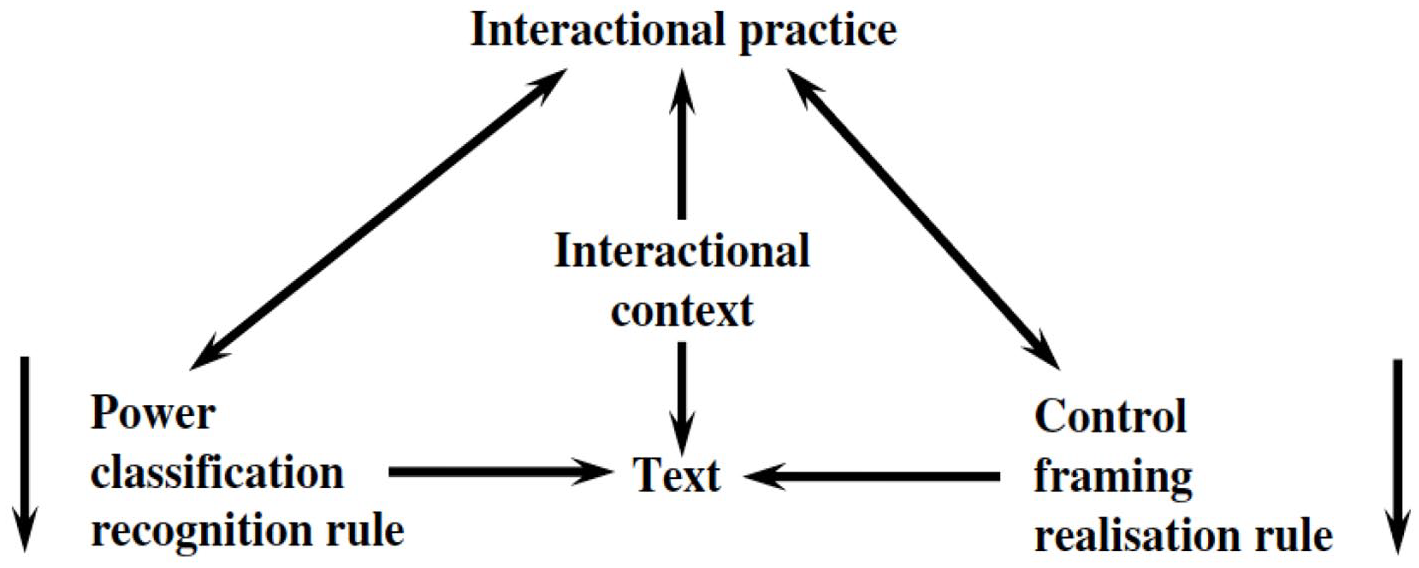
Model of the transmission context (Bernstein in Leow, 2011, p316).
Alongside power and control as well as classification and framing, this model also introduces the ‘specific coding orientation (SCO)’ which includes the recognition and realisation rules: [T]he recognition rules create the means for distinguishing between contexts and therefore for the recognition of the specificity of a given context and the realization rules that create the means to select the meanings adequate to the context . . . and to the production of the legitimate text in that context. (Alves and Morais, 2012: 53)
These rules are ‘in effect functions of classification and framing’ (Leow, 2011: 316) where ‘recognition rules regulate what meanings are relevant and realisation rules regulate how the meanings are put together to create the legitimate text’ (Bernstein, 2000: 18).
Though Bernstein illustrates the above model, and the recognition and realisation rules, with an example of working-class and middle-class children sorting pictures of food, I will take Leow’s (2011: 317) more relevant example, in the case of this paper, based on policy implementation. For policy implementation to be effective, the policy reader ‘needs to possess both the recognition and realisation rules of the new policy’ (Leow, 2011: 317). An acquisition of the recognition rules of the policy will be reflected in ‘his/her knowledge of the policy’; for example, understanding the content of the policy and what may be required of him/her as a reader of the policy. Alongside this, having the realisation rules ‘will be evident in how effectively he/she is able to navigate the demands of the policy and produce an appropriate response to these demands’; this might consider how a teacher incorporates the policy demands into curriculum planning or classroom practice. The recognition and realisation rules ‘shape the creation, reproduction and possible transformation of specialised contexts’ (Leow, 2011: 317).
The interactional practice referred to in the model is ‘defined by classification and framing procedures’ and these procedures then act selectively on the realisation and recognition rules; the text is ‘anything which attracts evaluation’ (Bernstein, 2000: 18). As Bernstein states, in this model, the pedagogic context is interactive and demonstrates ‘how the distribution of power and the principles of control translate into the classification values which select out recognition and realisation rules to create contextually appropriate text’ (Bernstein, 2000: 18). The interactional context ‘denotes the physical and electronic spaces in which the intended acquirers . . . interact with the transmitters’ (Leow, 2011: 317). To translate this to a real-life context, we can examine how a school may create an SMSC policy, incorporating explicit rules for the promotion of FBV in order to satisfy the standards given in DfE policy, which are then passed to teachers, ‘expecting them to respond appropriately when the situation arises’ (Leow, 2011: 317).
The BSO standards regarding FBV within the transmission context
If one is to examine voice and message through Bernstein’s lens, it is prudent to understand how they are defined and linked to the model for the transmission context; ‘“voice” represents recognition of the pedagogic rules whilst “message” represents the use of these rules in particular contexts, i.e. its realisation’ (King, 1979: 456). Not only are voice and message linked to recognition and realisation, the concepts are also linked to classification and framing, where the classificatory relation establishes voice and the message is a function of framing (Bernstein and Solomon, 1999: 271).
From the examples of language presented earlier in this paper, such as the move from respect to actively promote, it is evident that part of the solution to radicalisation and extremism, the promotion of FBV in British schools and their counterparts around the world, ‘has been rendered as the dominant message’ in the SMSC and other related policies; as Bernstein states, ‘the stronger the framing, the smaller the space accorded for potential variation in the message (what was said and its contextual realisation)’ (Bernstein and Solomon, 1999: 271). With strong classification from the interrelated policies, this ‘entails important implications for the text where the evaluation of policy implementation takes place’ (Leow, 2011: 317). In the context of this paper, the BSO standards (2016) provide the structure for evaluation of the FBV policies. Whilst these have been produced as documents for schools, rather than for evaluators or inspectors, the policy ‘outlines the standards for accreditation of British schools overseas which approved inspectorates will use as a benchmark’ (Department for Education, 2016a: 4). By using these standards, which require schools to ‘measure up against the standards that apply to independent schools in England’ (Department for Education, 2016a: 4), BSOs are required to follow all the aforementioned policies to the best of their ability; teachers are therefore placed in a position to ‘actively promote’ and ‘not undermine’ FBV, positioning them, irrespective of their place of residence or nationality, as essential actors within the anti-extremism policies of the British government. As Leow (2011: 318) expresses in the context of obesity policies of the Queensland government, I will do so here for the FBV policies; the voice and message is clear: the British government is concerned that radicalisation and extremism are being bred in school-age children (voice) and, therefore, are concerned with what schools and teachers can do by actively educating students about fundamental British values to negate these ideologies (message).
The power and control between the British government and BSOs is not a direct line; it is based on a voluntary system that could easily be disregarded by schools and their proprietors. In order to undergo an inspection and accrue the subsequent benefits that recognition and accreditation brings, however, the power and control is strongly classified and framed. Conversely, the policy itself, and the text that is being evaluated, may not share this strength. There can be: tension between ‘voice’ and ‘message’ in that the latter could change the former, that is the framing relations could lead to a change in the classificatory relations. In this way, framing relations could challenge the power relations imposing or enabling the classification. (Bernstein and Solomon, 1999: 271)
It is clear that the standards provide an unequivocal message to potential BSOs that ‘schools must provide evidence to their inspectorate body that each standard has been met’ (Department for Education, 2016a: 6; my italics). The authoritative language of all of the FBV policies has been highlighted earlier in this paper but, for clarity, the BSO policy is restated here in dictating that:
The standard about the spiritual, moral, social and cultural development of pupils at the school is met if the proprietor- (a) actively promotes the fundamental British values of democracy, the rule of law, individual liberty, and mutual respect and tolerance of those with different faiths and beliefs.
Though the BSO policy compels schools to actively promote FBV, it gives no indication, explicitly or implicitly, as to how this should be achieved, which does make the framing of the policy weak. However, the language used across all of the policies ‘suggests to the reader (or the acquirer) that the speaker (or transmitter) . . . is exercising its authority’ (Leow, 2011: 319).
Acquisition of recognition and realisation rules
‘Any textual production in a given context depends on the acquisition of the specific coding orientation to it’ (Morais, 2002: 560). In the model of transmission, the recognition and realisation rules form a code of the acquisition within any pedagogic context. As discussed above, recognition and realisation are functions of classification and framing; ‘at the level of the acquirer, the recognition and realisation rules enable the ‘what and how’ for constructing the expected legitimate text’ (Parker and Adler, 2014: 206). Strong framing of pedagogic discourse between transmitter (the DfE) and the acquirer (BSOs) would suggest that the acquirers would possess, or have the ability to acquire, recognition (they should be able to recognise the voice of the policy) and realisation (they should be able to legitimately reproduce the policy’s message) rules required to enact the policy (Leow, 2011: 320).
However, from analysis of the policy so far, it is evident that the BSO policy has a weak framing in regard to the teaching of FBV in the affected schools. Outcomes are not explicitly articulated, giving schools and teachers the space to move and control the message as deemed appropriate for their school. One could hypothesise that, given the weak framing from the BSO policy, acquirers would find it difficult to comprehend the recognition and realisation rules needed to faithfully follow the policy, especially when combined with the weak definition/classification of FBV; a justification for considering the framing to be weak is Richardson’s assertion that ‘the introduction into education policy and practice of these values is marked by absence of definition, explanation, justification, discussion or examples’ (in Winter and Mills, 2020: 52).
Whilst the text of the BSO standards is weakly classified and framed at the micro level, strong classification and framing is evident at the macro level; the chain of FBV policies, as well as guidance, political speeches and media coverage – the aforementioned ‘BV curriculum policy ensemble’ – has created a strong classification and framing between the DfE as the transmitter, and the education fraternity as the acquirer, ensuring that schools and teachers in BSOs have the ability to recognise the voice of the FBV policy and the reason for its creation. However, the earlier discussed ambiguity of FBV is another point of contention in the transmission of the policy as the weakly framed definition of FBV does little to support teachers in their efforts to enact the policy; the lack of direction given for exactly ‘how’ the promotion of FBV can be demonstrated as a learning outcome, and therefore a measurable standard for a BSO, greatly reduces the potential of schools and teachers to demonstrate their acquisition of the realisation rules and generate a response reflective of their cognisance of the recognition rules, thus ensuring policy fidelity. (Leow, 2011: 321)
The connection between the strong and weak framing across the various policy actors and texts does leave a number of interesting potential outcomes. Firstly, it aggravates the struggles of BSO stakeholders (the acquirers) in ‘reproducing the message’ of the BSO standards, in particular the FBV portions of the policy. With less access to the ‘whole industry of training providers’ that have blossomed since the policy was created (Winter and Mills, 2020: 51) and often located in a community that is not majority British, the reproduction of the FBV message will be problematic for many BSO schools. Conversely, BSOs and BSO teachers have the freedom to enact the policy in a manner that is ‘contextually appropriate within the idiosyncrasies of the schools’ (Leow, 2011: 322); when coupled with the fact that BSO inspectors follow the policy as a framework for inspection, there is little scope for an inspector to judge a school negatively in regard to their FBV curriculum.
Criticisms of Bernstein’s theories
Bernstein’s work is not without its detractors. Critics such as Gibson (1977) have suggested that his work ‘lacks clarity’ and is ‘an exercise in mystification’ (in Walford, 1986: 184), while King (1979: 456) chided that ‘[r]eading Bernstein is like inspecting a palimpsest, in which new concepts are written over others they are derived from’. In fact, much has been said about the overcomplication of Bernstein’s theories, that they ‘are simply new ways of stating empirical generalizations that are fairly well known and easily expressible in the language of ordinary English we are all (without special initiation) familiar with’ (Pring in King, 1979: 456).
Bernstein’s work has been referred to as a set of simple dichotomies (Pring in Walford, 1986: 184); pairs of terms are often associated with his concepts, as seen in Figure 2.
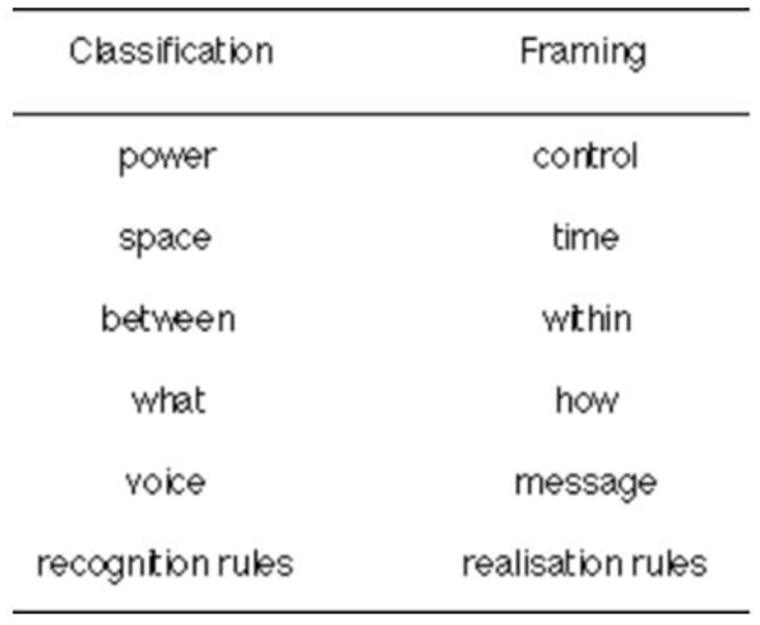
Classification and Framing (Dowling, 1999: 6).
The terms above could be seen as representative of simplistic notions, with little overlap; there are clearly demarcated boundaries with few blurred lines between the concepts. In the model of transmission context, the terms transmission and acquisition could be added to the above list. From the perspective of FBV policy, teachers as policy actors are mere recipients of policy, or acquirers of rules; Bernstein offers no place in the model, nor in his use of language, for making sense of resistance from policy actors, for ‘subverting espoused policy’ (Davies and Hughes, 2009: 597). This potential lack of acceptance on the part of the acquirer is recognised by Au (2008: 646), who states, in reference to Bernstein’s device, that ‘through the operation of every set of its rules, there are individual actors and groups involved in interpretation and implementation’, which means that the ‘transmission of power and control’, in this case between the DfE and schools, including BSOs, ‘does not transmit a perfect mirror reflection of the power relations external to education’; Au cites teachers in the US who are actively resisting high-stakes testing policy. Further studies in this area might show that this is also the case with FBV policy.
Implications for FBV Policy
Whilst FBV remains an integral part of policies governing both national schools and British schools overseas, moving forward there is an opportunity to re-evaluate the current policies, which could be ‘particularly important at a time of rising Islamophobia, anti-immigration and nationalist feeling in an austere, Post-Brexit, Trump world’ (Winter and Mills, 2020: 61). The advent of FBV in policy was not intended to create division yet failed, through weak framing of the policy, to create a ‘shared understanding of “Britishness” and also British values’ (Maylor, 2016: 325).
In the current political climate, with movements gaining traction across the Western world such as Black Lives Matters (BLM), which is exposing ‘clear example[s] of institutional ignorance’ as well as ‘[taking] a stand against the physical and symbolic violence of White supremacism’ (Moncrieffe, 2020), the articulation and strengthening of framing will become more important than ever. The BLM movement is an example of protests against the current rule of law as well as of tolerance for the beliefs of others, yet the movement cannot be ignored in schools as it is an important thread in the fabric of British society.
The weak framing of the FBV policy may not require a change in the language of the policy; it gives teachers and schools the opportunity to create FBV curriculum opportunities to suit the context of their school. In order to help acquirers to understand the realisation rules of the transmission context, this could be done through sharing best practice from a DfE level; by publishing guidance of schools ‘actively promoting’ FBV, school leaders and teachers would be given the opportunity to fully acquire the necessary recognition and realisation rules to enact the policy in a way that suits their school, yet demonstrates fidelity to the voice and message of the policy.
In order to actively promote a concept, or equally to not undermine a concept, one must have a strong grounding or understanding of it. Given the nature of BSOs, where it is not a requirement that all teachers are British, or have resided in Britain, to herald these teachers as the beacons of anti-radicalisation could be seen as an example of what Ball refers to as ‘policy magic’, where generic policies are ‘ways of representing, accounting for and legitimating political decisions’ (2006: 72) and are considered the ‘solution to educational problems’. In this context, the FBV policy, and its counterparts in the BV curriculum ensemble, are seen as the answer to extremism and the radicalisation of British youth. It has been written both to ‘achieve material effects and to manufacture support for those effects’ (Ball, 2006: 72), but does not take into account ‘the importance of local politics and culture and tradition, and the processes of interpretation and struggle involved in translating these generic solutions into practical policies and institutional practices’ (Ball, 2006: 76), in other words the ability of a teacher, working in a BSO with a non-British community, to interpret the policy and effectively create opportunities to actively promote FBV. Whether or not this is ‘policy magic’ is outside the scope of this Bernsteinian analysis, though could be the subject of further research.
Conclusion
From the turn of the century, fundamental British values have been heralded as the saviour of British society; teaching them, promoting them and embodying them are all seen as the way to ensure a ‘collective identity is forged’ (Ford, 2016: 4). In the analysis of the FBV elements of the British Schools Overseas policy, and the supporting, interrelated policies including Promoting fundamental British values as part of SMSC in schools, and The Prevent duty, it has become apparent how educational institutions, and the teachers within them, have been ‘responsibilised’ to become major actors in the fight against extremism and radicalisation; yet, due to weak framing within the policy, the ‘collective identity’ mark has been missed. These policies could be seen as an extension of imperative safeguarding policies (and FBV is a part of the Keeping children safe in education policy) and pre-existing values education, ‘inclusive citizenship and anti-prejudice norms’ (Busher et al, 2019: 458).
‘It is a truism but an important one that education (and education systems) cannot be value free’ (Beck, 2018: 234). Suggesting the promotion of values, fundamentally British or otherwise, as a direct solution to a high-profile, emotionally charged and political problem, is something to be wary of, at all levels of policy, and problematising the education system, and privileging teachers in counter-terrorism politics, is ‘educationally problematic’ (Beck, 2018: 234). The use of Bernstein’s model of transmission context (2000) as a lens for analysis of this policy has demonstrated, ‘through the values of classification and framing, how power and control is differently distributed between the transmitter and acquirer in the quest to create contextually appropriate text’ (Leow, 2011: 323). The dominant code of the British government, as the transmitter, is clear in the language used in the various FBV policies; this language is used, not only to demonstrate and reproduce power over the acquirer, but also to convey a voice and message to the acquirer.
In the analysis of this policy through the model of transmission context, we are able to ‘gain an understanding of how power and control are implicated within the policy-making process’ (Leow, 2011: 323), and, with the FBV polices, to understand how BSOs are privileged within this, forced to uphold and promote values that may, or may not, be consistent with their own, or their communities, in order to prevent an issue that may not be present in their community. As such, these schools, and the educators within them, are forced to create their own appropriate response, with little support either from the policy itself, or from those who created the discourse and expect the ‘material effects’ of the policy, the DfE as policy creators.
Au’s earlier reference to the imperfect operation of power transmission (2008: 646) is important to reinforce here. Whilst the aim of this paper was not to evaluate the success of the policy enactment, it would be interesting in a next paper to review the practical application of the recognition and realisation rules at a school level for, as Leow asserts, ‘there is no guarantee that the schools and teachers (the acquirers) will . . . assume their responsibilities as the vanguard’ (2011: 320) of the anti-radicalisation agenda. Further analysing the power relations between policymaker and policy actor, and assessing the success of the policy in practice, would be a further step to understanding Bernstein’s (2000) model of transmission context and the ‘shaping of the pedagogic consciousness’ (p16) in the school setting.
Whilst ‘Britain has long struggled with the notion of a common British identity’ (Commission for Racial Equality, in Maylor, 2016: 316), it is evident that ‘education can be viewed as a political instrument that is used to advance, support and/or reinforce a national British perspective/ identity’ (Maylor, 2016: 319). By using Bernstein’s (2000) model of transmission context, the way in which ‘power and control are implicated’ in policymaking has become clear (Leow, 2011: 323) and, from this policymaking and subsequent transmission of the policy, how schools and teachers are placed within the policy and its enactment. ‘Under the UK government’s counter-radicalisation strategy “Prevent”, childcare providers, schools and universities must “have due regard to the need to prevent people being drawn into terrorism”’ (Ford, 2016: 1); with this strategy, and the values-education being positioned within the British Schools Overseas standards, teachers, both within the UK and around the world, are being asked to actively participate in the counter-terrorist strategies of the British government.
I contend that, with the strong macro framing, but weak micro framing, of the BSO standards and FBV policies contained within them, the acquirers in the transmission model have little choice but to create their own understanding of the policy outcomes, which they are compelled to do through the power of the transmitter, the British government, over their schools. Whether this transmission of voice, message and therefore power leads to a successful enactment of the policy, and teachers in BSOs are therefore able to actively promote FBV in their schools, would need to be the subject of another paper. The analysis in the present paper seems to suggest that, for these schools, it would be an uphill climb to success.
Footnotes
Funding
The author received no financial support for the research, authorship, and/or publication of this article.