



Abstract
As the ship manufacturer, including new building, repair, and conversion, the shipyard significantly impacts the ship’s quality and performance output. A well-planned ship design that will be built requires skilled shipbuilders who can fulfil quality, timeline, budget, safety, and environmental requirements from shipowners, rules, and regulations. Since diverse and multiple factors influence its efficiency and product output, evaluating the shipyard’s performance is critical for a more impactful and strategic advancement approach. This research aims to apply the novel integrated Value Engineering and Risk Assessment (VENRA) framework, which integrates five main elements: technical, business, external, personnel’s safety, and environment, for measuring shipyard performance. This paper demonstrates the VENRA business element in more detail and applies it to a shipyard case study. Integrated fuzzy Decision Making Trial and Evaluation Laboratory (DEMATEL) and Weighted Evaluation Technique (WET) are used to analyse the criteria’s interrelationship by determining the cause-effect group and weight ranking prioritisation. The objective grading system is developed to determine the shipyard’s performance score based on multi-resource qualitative and quantitative data. The shipyard’s case study demonstrates that ‘delivery time’ remains the most critical and influential aspect of the business elements’ performance. In addition, the top three most important factors, ‘delivery time’, ‘financial report condition’, and ‘ship manufacturing cost’, must be taken into account, as they directly influence the shipyard’s performance. Despite being a minor element, ‘innovation and human resources’ is the second most influential factor after ‘delivery time’. The case study’s results demonstrate that the framework can simultaneously identify cause-and-effect criteria groups while prioritising the most critical factors via methodologies.
Keywords
Introduction
The knowledge of shipbuilding, including construction, maintenance, and modification, serves as the fundamental basis of the business in shipbuilding industry. They encompass everything from design and engineering to construction, repair and innovation. A shipyard’s success and competitiveness depend on its expertise in that knowledge, enabling it to deliver high-quality vessels and services to its customers while staying at the forefront of the maritime industry. Overall, the shipyard is a unique facility in its specialised infrastructure, long product lifecycle, customisation, global presence, regulatory compliance, and integration of multi-disciplines. Successfully operating a shipyard requires technical expertise, adaptability, and an understanding of the global maritime landscape.
Due to the requirement of incorporating many aspects above, it needs an approach to keep the shipyard competitive and competent. One of the most potent tools is performance measurement. Performance measurement is a powerful tool that drives improvement, accountability, and informed decision-making across all levels of an organisation. It helps businesses stay on track, adapt to changing conditions, and ultimately achieve their goals more effectively. 1 However, selecting the proper criteria becomes crucial in performance measurement since it highly influences strategic decisions and prioritisation in the shipyard. 2
The current study proposes models to analyse the shipyard competitiveness based on technical aspects, such as technological level 3 and productivity efficiency 4 or economic aspects, such as focusing on profit rate perspective, cost competitiveness, and marketing strategy.5,6 Current research studies focus on tools such as the balanced scorecard model for assessing the criteria in shipbuilding. 7 However, to the best of the authors’ knowledge related to the publicly available information and resources, the analysis in these studies provides a fragmented approach as they highlight the use of a single or small number of parameters in the assessment of the shipyard performance. In this respect, a novel model for shipyard performance measurement is required to provide more holistic and comprehensive performance measurement.
This above aim is performed by introducing the novel integrated Value Engineering and Risk Assessment (VENRA) framework for the shipyard performance. VENRA comprises five elements: Technical, Business, External, Personnel Safety and Environment. A number of parameters inclusion for performance measurement is selected through the VENRA concept, integrating value (cost, quality, time) and risk (safety and environment) aspects. Due to economies of space, this article presents the business element of the framework in more detail, further applied in an actual shipyard case study. Since the need to determine cause-effect and weight for main criteria and sub-criteria within VENRA framework, a hybrid MCDM tool using combination of fuzzy DEMATEL-WET is suggested to assess the criteria prioritisation analysis.
The remaining sections of this paper are organised as follows. Section 2 examines the current literature and critically analyses performance measurement in shipbuilding industry, value engineering and risk assessment, and fuzzy Multi-Criteria Decision Making (MCDM). In section 3, the presented VENRA criteria framework in the business group is described. Section 4 provides the application and results of the suggested business elements in the case of a shipyard, while the paper discussion, conclusions and future work are presented in sections 5 and 6, respectively.
Literature and critical review
Shipyard performance models and influencing factors
A thorough literature review suggests limited references on shipyard performance measurement, covering shipbuilding, ship repair, and ship conversion. This section presents the productivity, Data Envelopment Analysis (DEA), and Multi-Criteria Decision-Making (MCDM) shipyard performance measurement models and their associated strengths and weaknesses.
The productivity model refers to the shipbuilding measured through person-hour/Compensated Gross Tonnage (CGT). CGT is a measurement approach introduced by the United Kingdom in the 1960s to account for ship types and sizes, utilised to assess shipbuilding competitiveness among various countries.8,9 This model is still relevant for measuring shipyard competitiveness for new ships being built, such as validating the statistically predicted shipbuilding productivity through several parameters, 8 comparing productivity rates of different regional shipyards, 10 comparing shipyard competitiveness, 11 and measuring more accurately shipbuilding productivity through data cost centres. 12 However, this model accounts for labour hours used and the size and type of the ship. This model does not include other influencing attributes, such as the level of technology, and external or financial parameters. Moreover, a data driven performance in shipbuilding in a case study of shipbuilding has been presented by Bilen and Helvacioglu 13 showing the performance evaluation and cost are very important factors for ship production. Moreover, the use of key performance indicators to evaluate the productivity has also been studied by Bilen et al., 14 presenting the KPIs for cost and producibility evaluation were formulated in mathematical model upon historical data analysis. However, this evaluation has focused on technical aspect of the shipyard activities and focus on cost and productivity. The other influencing factors has not been considered for inclusion.
The Data Envelopment Analysis (DEA) model, introduced by Farrell 15 and Charnes et al., 16 can accommodate various influencing factors for shipyard performance measurement, making this model more comprehensive by incorporating quantitative and qualitative attributes through the input-output method. DEA approach has been used to benchmark shipbuilding performance17,18 and compare shipyard competitiveness.4,19 Krishnan 20 also suggests DEA as a new shipyard performance measurement approach incorporated within the work breakdown structure. DEA has been utilised in ship repairs to evaluate maintenance and repair efficiency in shipyard operations 21 and analyse dry-docking performance.22,23 However, DEA requires sufficient data with the ratio of analysed Decision-Making Units (DMUs) factors being at least twice the number of inputs and outputs24,25 or a minimum of three DMUs per combined input-output count. 26 DEA also provides non-dimensional parameters and cannot measure the criteria ranking.
The multi-criteria decision-making (MCDM) model approach can be used as an advanced model for measuring performance in shipyards. However, applications in the shipbuilding industry sector are still rare. Several studies have been conducted, such as: to rank critical qualitative factors that affect naval shipbuilding performance, 27 prioritise criteria through the internal and external environment for strategic enhancement 28 and assess shipbuilding performance indicators. 7 Other researchers use the MCDM model for shipyard selection,29,30 analyse the shipbuilding sector’s barrier factors in achieving net-zero emissions, 31 and measure port performance based on operational and financial aspects. 32 The MCDM approach improves the measurement process by considering multiple factors, prioritising weighted importance levels, and comprehensively assessing shipyard performance. However, there are very few MCDM applications for shipyard performance, and the variables affecting performance measurement are still fragmented and not yet integrated. Some studies only focus on technical or business aspects.
Different parameters are included for measuring the shipyard performance technically, such as the dock capacity, productivity, technology level, or labour force in shipbuilding cases17,18 or docking type, docking days, and number of workers in ship repair cases. 23 Regarding the economic or business aspect, several studies analysed influence factors affecting the shipyard’s competitiveness and performance. Jiang and Strandenes 5 suggest a cost-based framework to assess shipbuilding competitiveness, including material and equipment costs, labour costs, steel cost of equipment and structure costs. Jiang et al. 6 demonstrate that the profit rate parameter is a more relevant measure of international shipbuilding competitiveness. Bruce 33 presents a number of various parameters for shipyards, such as technical aspects, business and commercial, and the impact on the shipyard’s competitiveness. Mascaraque-Ramírez and Para-González 34 analyse the implementation degree of six dimensions for marketing promotion in the shipbuilding sector and the relationship between this degree and performance; Kim and Park 35 investigated the causal relationship between freight rate earnings and newbuilding orders in the shipbuilding market on the Korean shipbuilding industry. Gavalas et al. 7 proposed several criteria using a balanced scorecard model focusing on business parameters for shipbuilding performance. However, the analysis is rather not holistic and focuses on specific parameters such as cost or the impact of one attribute on another in terms of performance.
Value Engineering concept and integration
Since some of the criteria affecting shipyard performance are scattered, and there is no guideline for selecting the criteria that are encountered, a framework is needed to develop and assess the measurement process. A balanced scorecard (BSC) framework suggested by Kaplan and Norton, 36 includes customer, financial, internal and innovation and learning perspectives, which has been applied in the shipbuilding sector. 7 Tree Bottom Line (TBL) framework, which incorporates people, the economy and the environment, could also be applicable, which has been applied to the risk analysis in the ship recycling industry. 37 However, the BSC model has limitations since it focuses on financial parameters; moreover, it does not provide any guidance on selecting the relevant attributes and suggests a complex feedback sequence from the financial perspective to the customer and process perspectives. 38 On the other hand, TBL focuses on only three dimensions which cannot take into account technical parameters or more flexible variables.
Value Engineering (VE) is a systematic methodology that aims to improve the value and quality of a product or service while simultaneously reducing costs.39,40 It involves the collaboration of multidisciplinary experts from various fields. VE can be effectively combined with other methodologies, such as grey multi-criteria decision-making, 41 Quality Function Deployment (QFD), 42 sustainability considerations in construction projects, 43 and the design for assembly concept in product development. 44 Additionally, VE can be integrated with risk assessment practices and applied in the manufacturing industry. For instance, integrated VE with risk assessment is implemented in the automotive industry through the combination of the Function Analysis System Technique (FAST) and Failure Mode and Effect Analysis (FMEA). 45
Similarly, in construction project management, the integration of VE with risk assessment has been explored by Masengesho et al. 46 However, within the marine industry, the concept of integrated VE and risk assessment has been mainly analysed theoretically and qualitatively, with limited practical application. 47 Baihaqi et al. 2 have proposed a number of criteria for shipyard performance through the integrated value engineering and risk assessment (VENRA) with the case study in the technical elements dimension and personnel’s safety and environment. 48 The detailed criteria and sub-criteria through the suggested framework have identified the critical criteria and sub-criteria as well as the cause-effects analysis in criteria considering the shipyard data assessment score. Strategies to enhance shipyard performance were suggested within this framework, specifically targeting technical elements. The integration of VENRA allows for a more flexible and comprehensive assessment of ship-manufacturing performance, utilising multidimensional experts to overcome limitations associated with individual experts in each dimension.
Fuzzy MCDM
In the realm of Multiple Criteria Decision-Making (MCDM), numerous methodologies exist to assess complex criteria, such as Analytic Hierarchy Process (AHP), Analytic Network Process (ANP), Simple Additive Weighting (SAW), Technique for Order of Preference by Similarity to Ideal Solution (TOPSIS), and Weighted Evaluation Technique (WET). Each of these methodologies serves specific functions and addresses various aspects of decision-making. However, when it comes to simultaneously analysing cause-effect relationships and weight ranking, only a few tools are capable, with DEMATEL being one of them.
DEMATEL, short for Decision-Making Trial and Evaluation Laboratory, is an MCDM method renowned for handling complex and comprehensive decision-making problems.49,50 This powerful tool efficiently determines the cause-effect relationships among attributes and their relative importance in decision-making. 51 By employing DEMATEL, decision-makers can gain valuable insights into the interconnectedness of various factors influencing their decisions.
Due to subjectivity through numeric judgement, DEMATEL can be integrated with Fuzzy Set Theory (FST) 52 to eliminate its subjectivity. The integration into fuzzy DEMATEL enables a more natural linguistic approach to assessing attributes, eliminating the need for a purely numerical process and enhancing the handling of subjective inputs in the original method. Fuzzy DEMATEL empowers decision-makers to incorporate imprecise or uncertain information and provides a more flexible and inclusive decision-making framework.
Fuzzy DEMATEL has found extensive application in the marine sectors, particularly in analysing causal factors related to ship break-in-two construction accidents, 53 enclosed space incidents on ships, 54 ship recycling safety management, 37 port performance measurement, 32 and shipbuilding indicators. 7 Nevertheless, when dealing with hierarchical criteria framework, consisting of main criteria and sub-criteria, the judgement process becomes time-consuming and burdensome for experts. In such situations, integrating fuzzy DEMATEL with other methods becomes necessary to enhance assessing the main criteria and sub-criteria in more effective way.
In this respect, WET (Weighted Evaluation Technique) is hybridly integrated with the fuzzy DEMATEL tool to overcome the hierarchical criteria and sub-criteria. WET is a robust and straightforward method for determining attribute weights, even with the availability of various other methods such as Simple Additive Weighting (SAW), Likert scale, eigenvector, and entropy. In the WET approach, the moderator or manager ranks the suggested attributes and assigns relative importance on a scale of 0–100. The most important criteria receive a weight of 100, while other criteria are assigned weights relative to that value.55–58 WET has been successfully used in the marine sector for determining weight criteria in cases involving oil and gas platforms, offshore structures, ship design, vessel arrangement, ship manoeuvring, and ship ballasting operations.55–60 However, to the best of the author’s knowledge, there is no study combining fuzzy DEMATEL-WET to assess multiple criteria for shipyard performance measurement related to the business elements dimensions.
Following the above, the paper makes a dual contribution. Firstly, it introduces a novel performance measurement process for the ship-manufacturing industry using an integrated VENRA framework. Secondly, it proposes the utilisation of fuzzy DEMATEL-WET methodology to evaluate criteria weight and cause-effect in the business elements perspective of the criteria framework. The fuzzy DEMATEL is employed to determine the main criteria cause-effect and weight analysis and at the same time the WET approach is used to assess the sub-criteria ranking. Further elaboration on these two aspects will be provided in more detail in the following section.
The VENRA framework development
This section illustrates the three-phase development process of the novel shipyard performance measurement using the VENRA framework, as depicted in Figure 1. Firstly, the criteria framework is established through an integrated value engineering and risk assessment. In the second phase, the developed criteria are assessed using MCDM tools. The third phase involves evaluating the shipyard’s assessment score. The performance measurement is derived from the combined criteria and shipyard score analysis results, culminating in suggestions or recommendations.
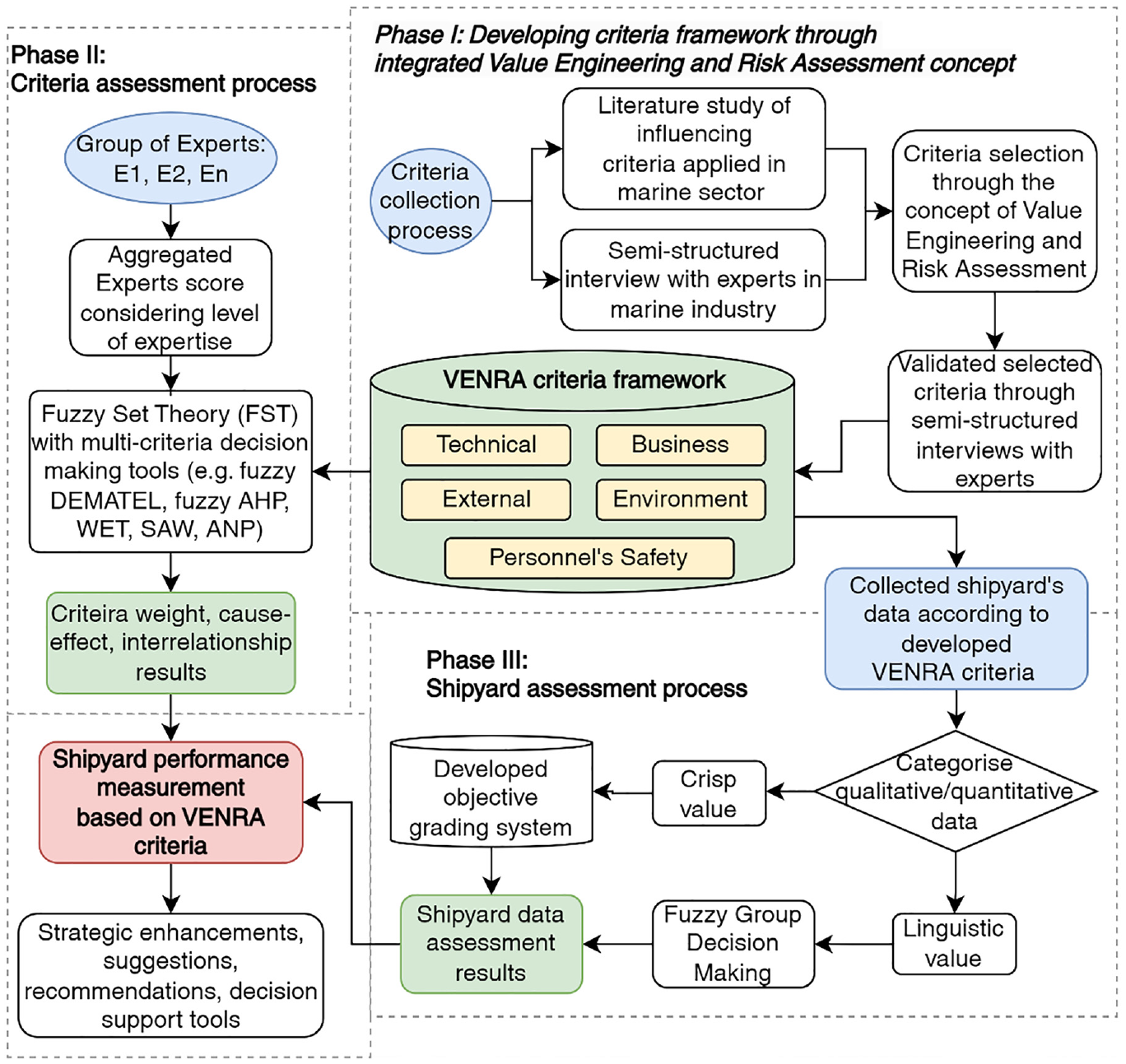
The new VENRA shipyard performance measurement framework.
The VENRA criteria are developed in the first phase through comprehensive literature studies and semi-structured interviews with marine sector experts. The existing relevant criteria are collected and subsequently filtered using the integrated VENRA knowledge. This concept combines value factors (quality, cost, and time) with risk factors (safety and environmental impacts). The selected criteria are then categorised into five groups: Technical, Business, External, Personnel’s Safety, and Environment. In the second phase, the VENRA criteria are evaluated by multidisciplinary experts using MCDM tools, such as fuzzy DEMATEL, fuzzy AHP, WET, SAW or ANP. This assessment process provides criteria analysis results, including criteria weights and cause-effect or interrelationships among the criteria. In the third phase, the shipyard’s data is evaluated according to the established VENRA criteria to obtain the score. The collected data, comprising quantitative and qualitative information, is assessed using a grading system for crisp values and fuzzy group decision-making. 55 Based on the collected data, this process yields a numeric score representing the shipyard’s performance. Once all results are obtained, shipyard performance is determined by combining criteria analysis and shipyard assessment results. Strategies for enhancement are then formulated based on the analysis of these results.
Influencing factors for shipyard performance in the VENRA framework
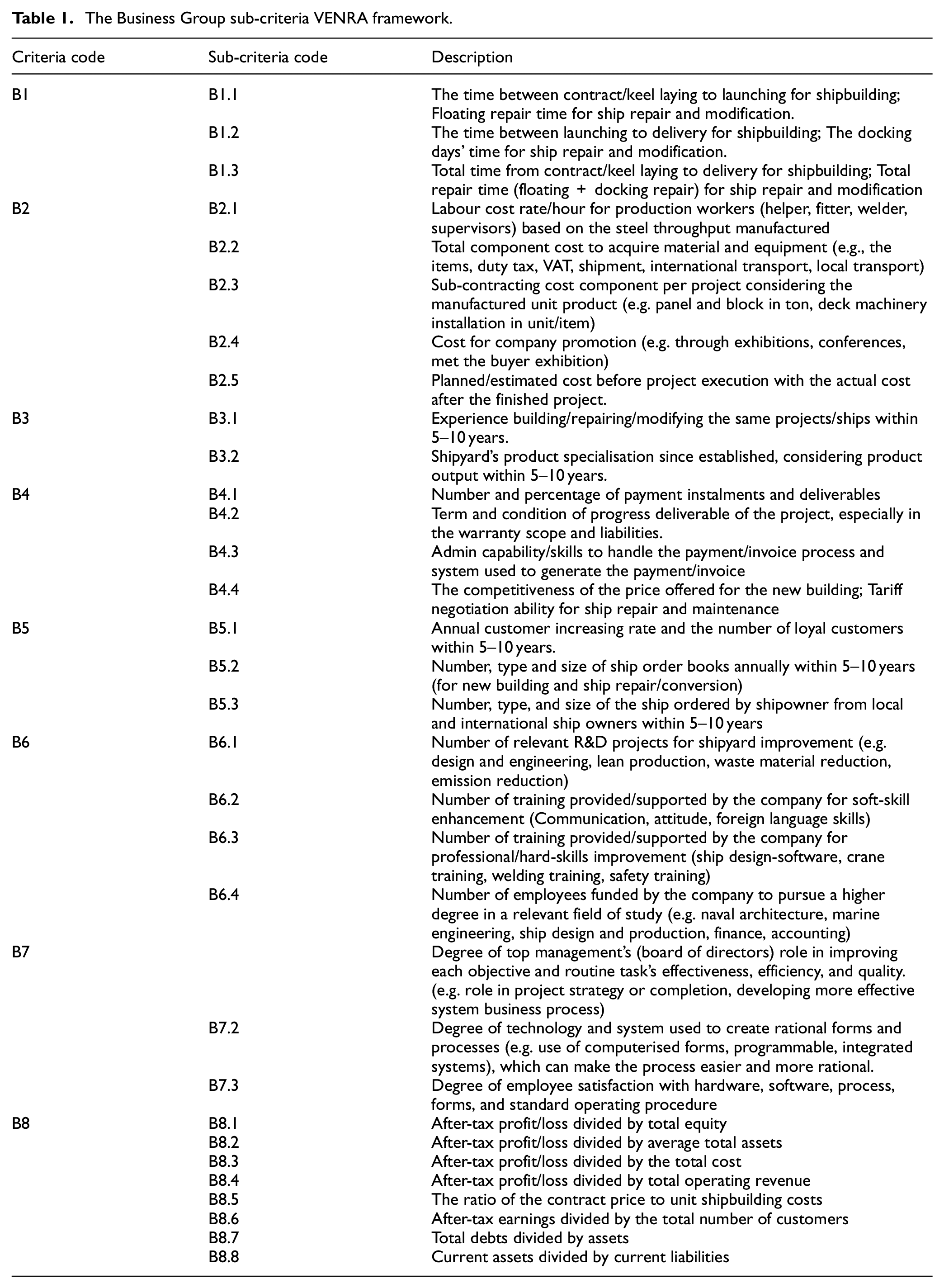
The proposed performance measurement criteria encompass various groups, criteria, and sub-criteria, aiming to optimise value (cost and time reduction while maintaining quality) and minimise risk impact on personnel safety and the environment within the shipyard. As presented in Figure 1, the framework consists of five groups of VENRA criteria that influence shipyard performance. Additionally, Figure 2 highlights the main criteria of each group. The Technical Group includes six criteria, while the Business group incorporates eight. The External Group consists of three criteria, while the Personnel’s Safety and Environment use 6 and 5 criteria, respectively. Due to the economy of space and word limitation, this paper presents the Business group and the associated criteria and sub-criteria in more detail, while the External Group will be presented in the subsequent publication. The Business group criteria and sub-criteria name are presented in Figure 2, while their description is shown in Table 1.
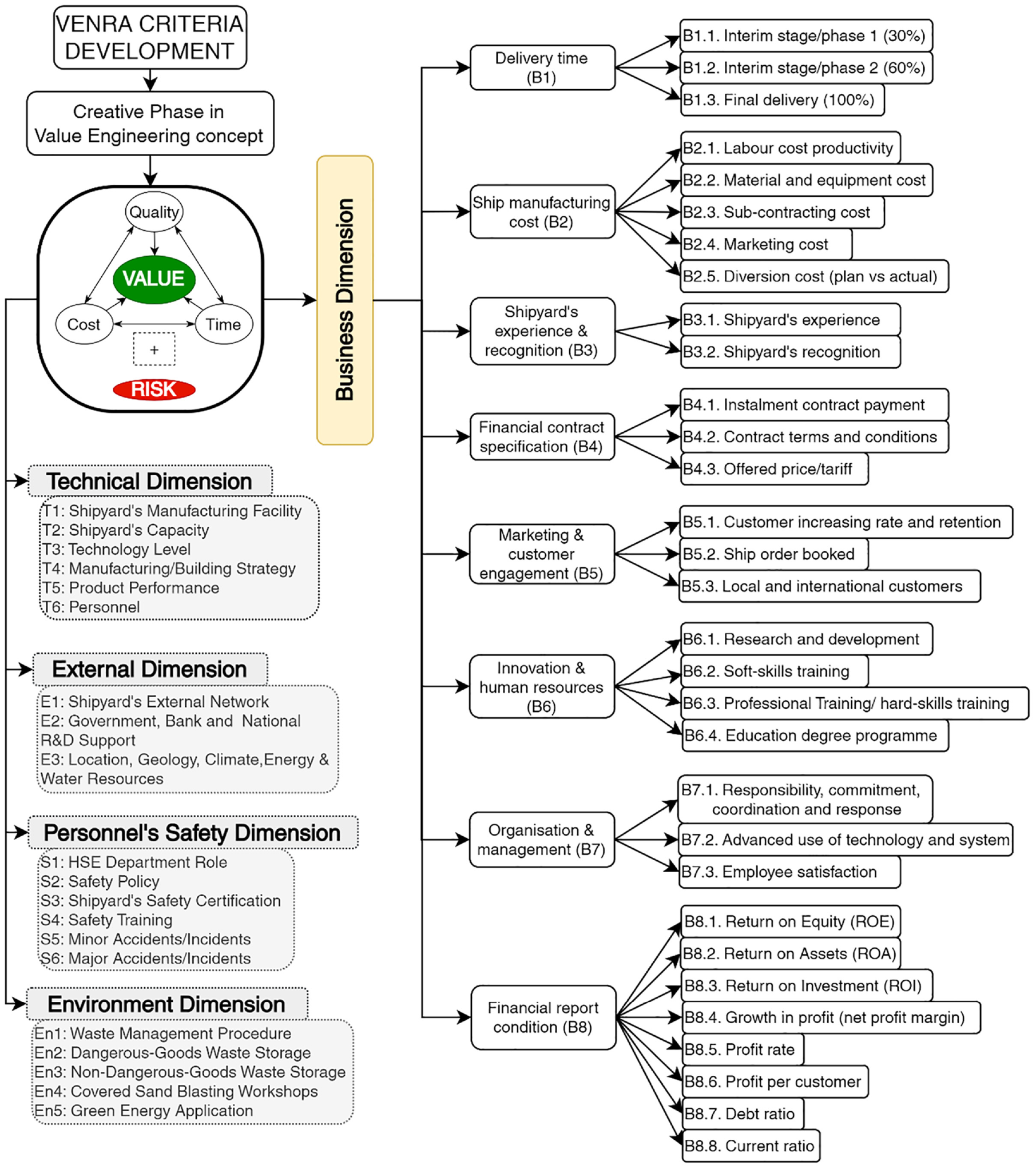
The VENRA criteria development for shipyard performance with detailed sub-criteria name for business elements.
The Business Group sub-criteria VENRA framework.
Hybrid Fuzzy DEMATEL-WET methodology
Appropriate methodologies are essential to address the requirements of determining weight, cause-and-effect relationships, and interrelationships among the VENRA-based criteria. The integrated fuzzy DEMATEL-Weighted Evaluation Technique (WET) approach is proposed to achieve this aim. This method proves beneficial as it enables the determination of criterion weights and establishes cause-and-effect relationships among the criteria. By utilising the combined method, a comprehensive analysis of the criteria can be conducted to achieve the study’s objectives. The global steps of fuzzy DEMATEL-WET methodology are outlined in Figure 3. The process commences with the fuzzy DEMATEL steps for the main criteria and WET for the sub-criteria analysis. The results of both approaches are then combined to determine the cause-effect and weight score for criteria and sub-criteria. The detailed calculation process of both methods is elaborated upon in the subsequent sub-section.
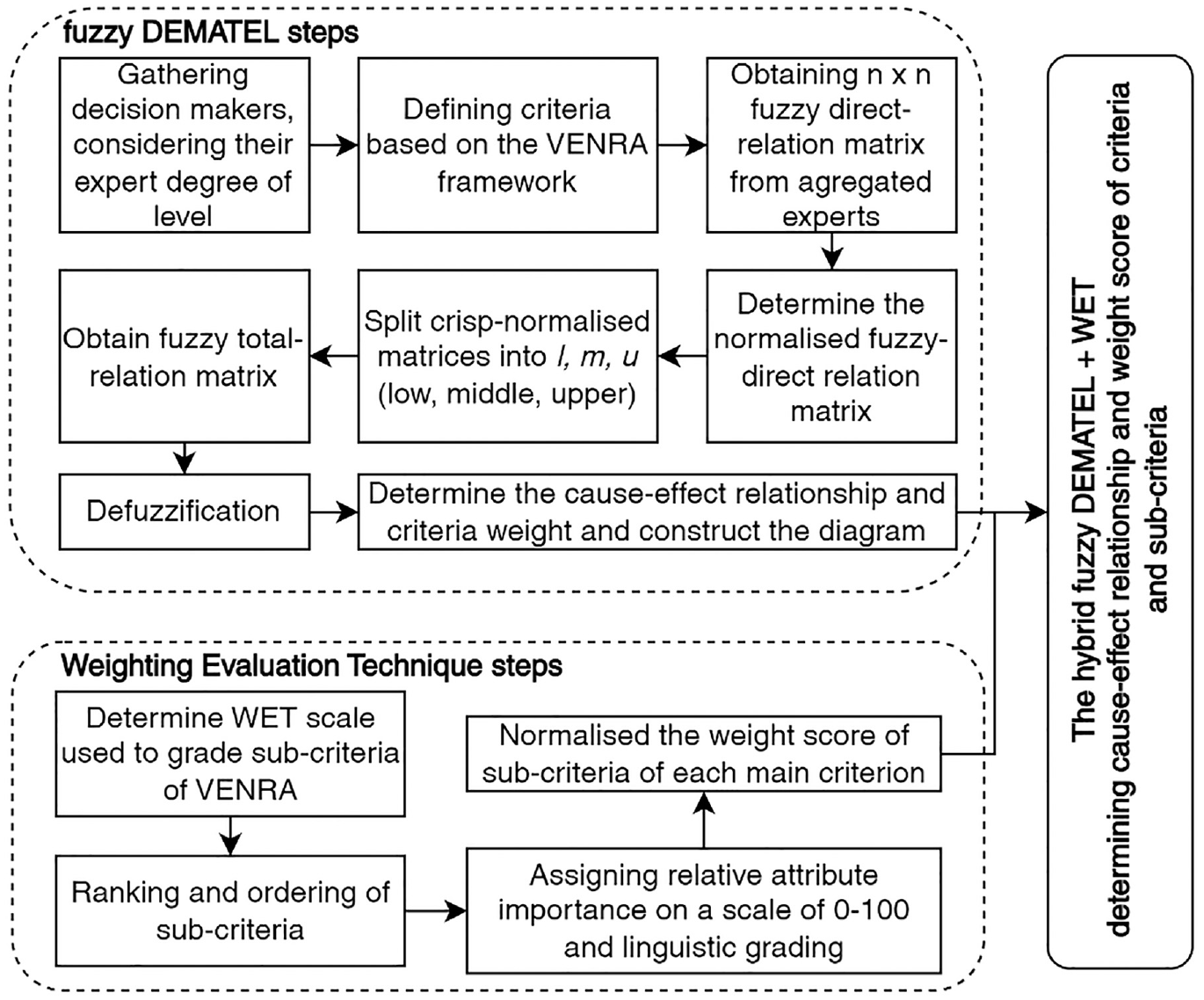
Flowchart of fuzzy DEMATEL-WET methodology.
Fuzzy DEMATEL steps
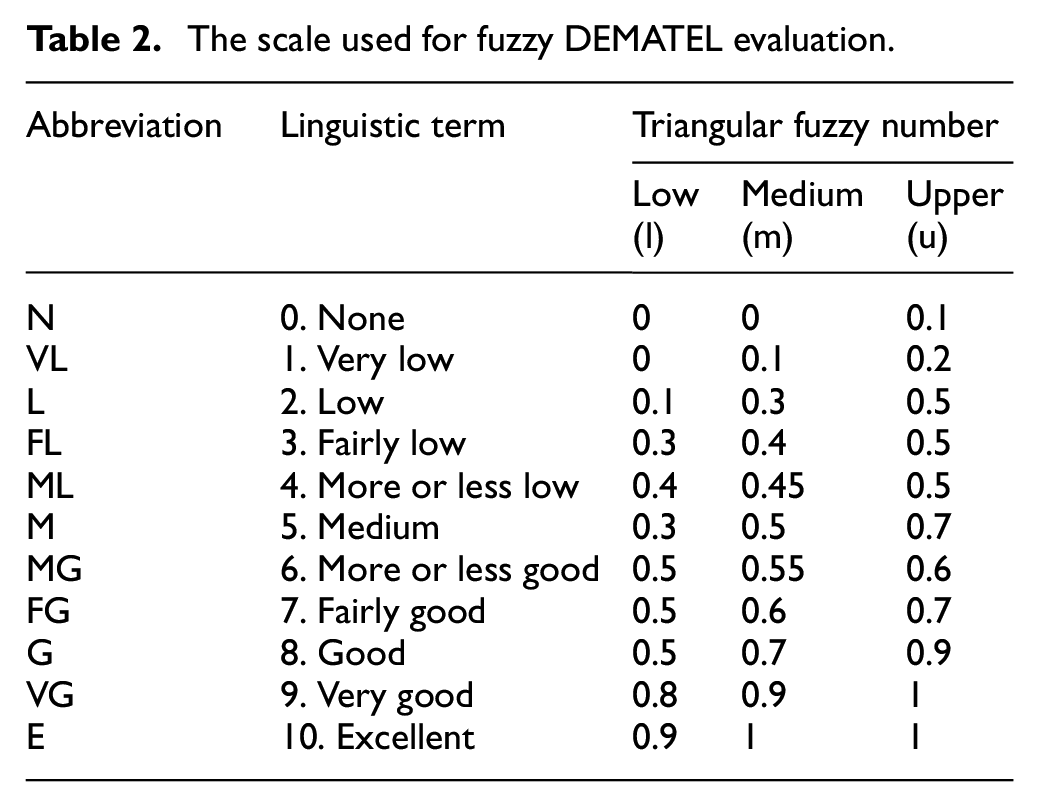
The fuzzy DEMATEL method often employs a scale ranging from zero to four, which may not adequately accommodate the range of expert judgement. In this study, the scale proposed by Chen and Hwang 61 is adapted and modified to meet the requirements of the fuzzy DEMATEL analysis, as presented in Table 2.
The scale used for fuzzy DEMATEL evaluation.
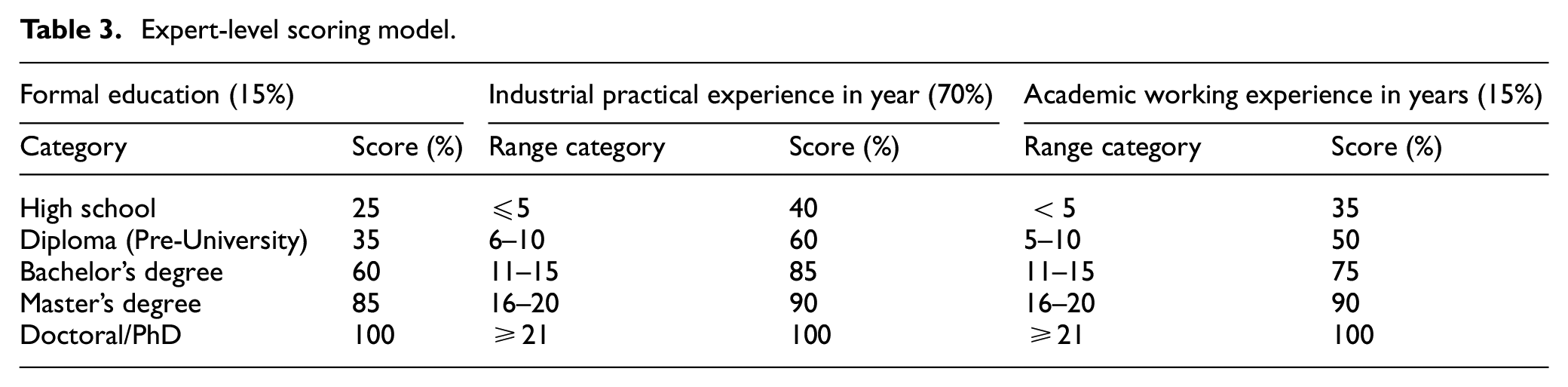
The first step in Fuzzy DEMATEL is gathering the decision-makers by considering their expert level. This paper considers the expert’s level based on the scoring model in Table 3. Assume the degree of importance of expert
Expert-level scoring model.

The second step is to set the criteria matrix based on the VENRA framework criteria, followed by the third step, which is obtaining a

The fourth step is to determine the normalised fuzzy direct-relation matrix

Where
The fifth step is defining three crisp matrices (low, middle, upper) based on
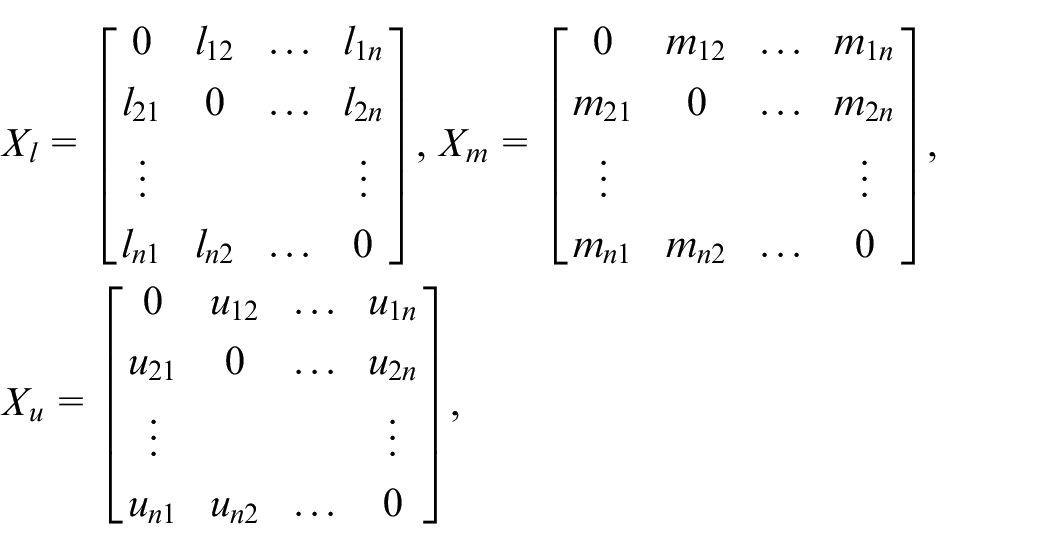
The sixth step is obtaining the fuzzy total-relation matrix




The seventh step is the process of defuzzification of matrix

The last step is computing the row sum (
WET steps
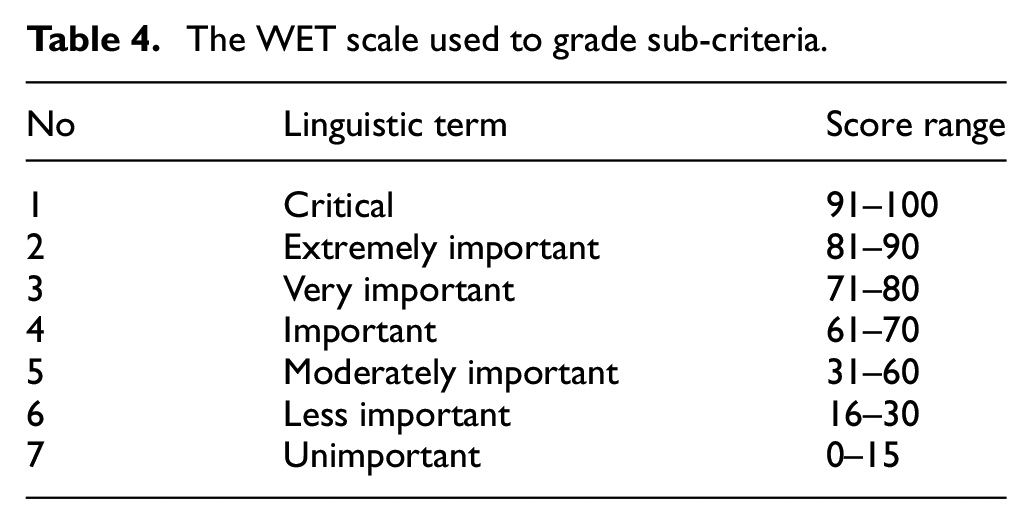
The proposed approach utilises the Weighted Evaluation Technique (WET) to determine sub-criteria weights. WET is a straightforward and advantageous method for weighting analysis. In this research, the moderator (or manager) assigns relative importance to each sub-criterion on a zero-to-100 scale based on their rankings. The author served as the moderator, possessing a background in education, knowledge of shipbuilding and shipyard industries, and experience in shipyard assessment. Additionally, the scale is complemented with linguistic terms to align with linguistic preferences. Subsequently, the scores are weighted for each main criterion’s sub-criteria. For example, the ‘ship manufacturing cost’ (B2) consists of five sub-criteria, weighted using WET and normalised relative to the B2 criterion. The ranking is validated through semi-structured interviews with experts having experience in the shipyard industry, shipping companies, or relevant academic backgrounds. Table 4 provides the tabulated WET scale complemented with the corresponding range score and linguistic term.
The WET scale used to grade sub-criteria.
The preceding VENRA framework is demonstrated in the context of an Indonesian shipyard, concentrating on the business elements to demonstrate its applicability and efficacy, as described in the subsequent section.
Application of VENRA framework
Shipyard case study data
This case study is related to a 12-year-old shipyard which provides new building and maintenance services for steel and aluminium boats. It is located in Indonesia and has a steel capacity throughput of around 3120 tons/year for steelwork and approximately 48 tons/year for aluminium. The labour cost of this shipyard is relatively low, making it competitive in terms of labour cost. It has also acquired the ISO 9000:2015 certification in quality management systems and has actively joined marketing exhibitions such as Marine Equipment Plaza (MEP) and Meet the Buyer (MTB). Concerning the shipyard experience, government-contracted ships have been built, such as general cargo and container ships, for Indonesia’s sea toll ship scheme, specialised tugs for oil and gas companies and several other ships ordered by overseas companies from abroad. This shipyard can also handle docking services, repair, and maintenance for ships up to 2000 GT.
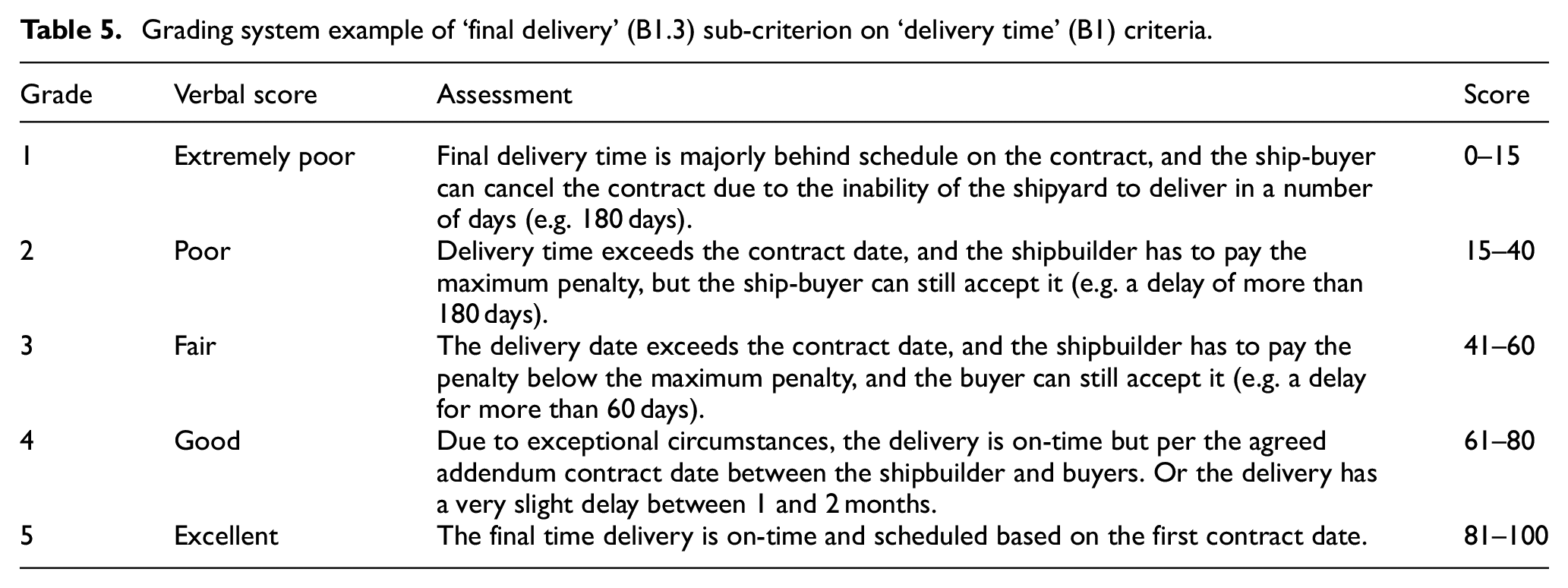
Various methods and procedures are conducted to collect, estimate and predict the available data of the shipyard. A direct survey and semi-structured interviews with the shipyard’s expert representatives were also conducted for the data collection process. In this paper, the data collection can be grouped into three categories: first, the website, company profile and internal technical report in the shipyard; second, a group of expert opinions/judgements from similar shipyards; and third, observation considering the condition or benchmarking process. Concerning this condition, the author proposed a developed grading system to score the shipyard assessment according to the criteria and sub-criteria. An example of the grading system is shown in Table 5, presenting the verbal score, assessment, and grade score for the ‘final delivery’ (B1.3) sub-criterion on the ‘delivery time’ (B1) criteria. The collected data from shipyards, from multi-sources, is scored according to this grading system by selecting the suitable grade using either a verbal score or based on the verbal assessment. The shipyard’s representative experts validate the summarised-assessed data score, which has been scored following its qualitative or quantitative values to obtain the results needed to measure the shipyard’s performance.
Grading system example of ‘final delivery’ (B1.3) sub-criterion on ‘delivery time’ (B1) criteria.
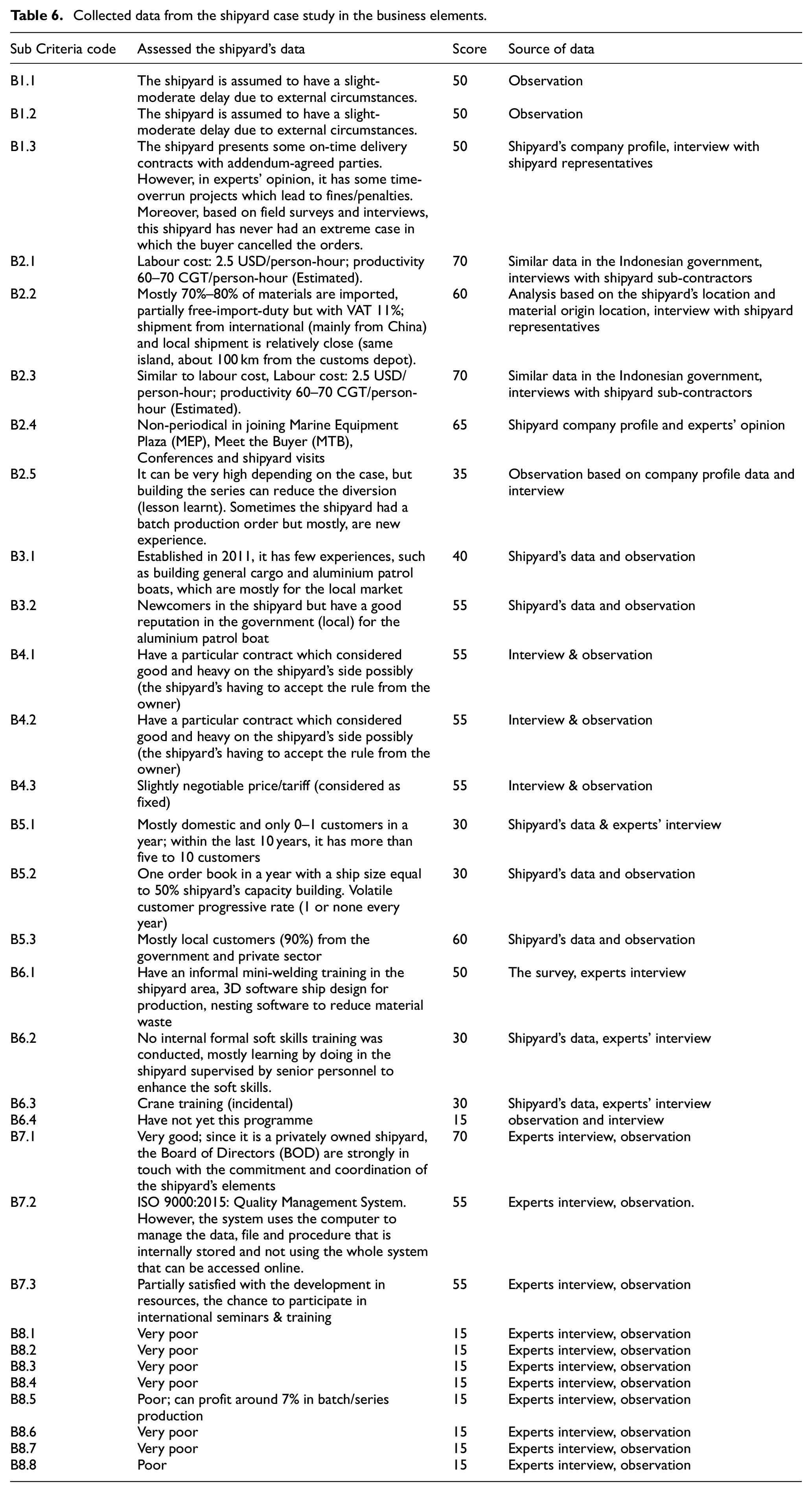
The summarised data, containing the verbally assessed shipyard’s data, the numeric score, and the collected data sources are presented in Table 6. The collected data is presented in accordance with the sub-criteria code of the business group elements.
Collected data from the shipyard case study in the business elements.
Cause-effect and ranking of criteria results
Main criteria results based on fuzzy DEMATEL
Based on their experience, academic background, and practical knowledge, seven experts provided their qualitative judgement in evaluating the suggested criteria. Expert 1 occupies the technical and development director in a shipyard. Experts 2, 4, and 5 are academic naval architecture and shipbuilding engineering staff with extensive knowledge of ship production technology. Expert 3 incorporates valuable commander experience and extensive knowledge of shipyard operations and facilities. Expert 6 serves as a project manager/coordinator in a shipyard, supervising operations and allocating resources effectively. Expert 7 has relevant experience as a marine consultant, overseeing and supervising ship production processes within shipyards. The summary of data profiles for experts is depicted in Table 7.
Experts list background and profile.
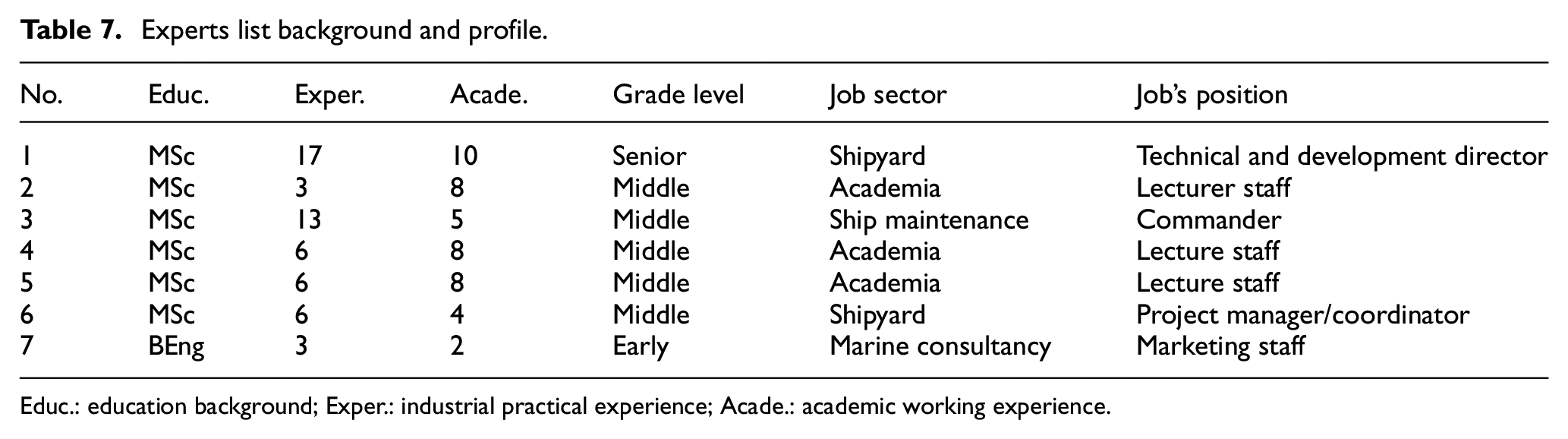
Educ.: education background; Exper.: industrial practical experience; Acade.: academic working experience.
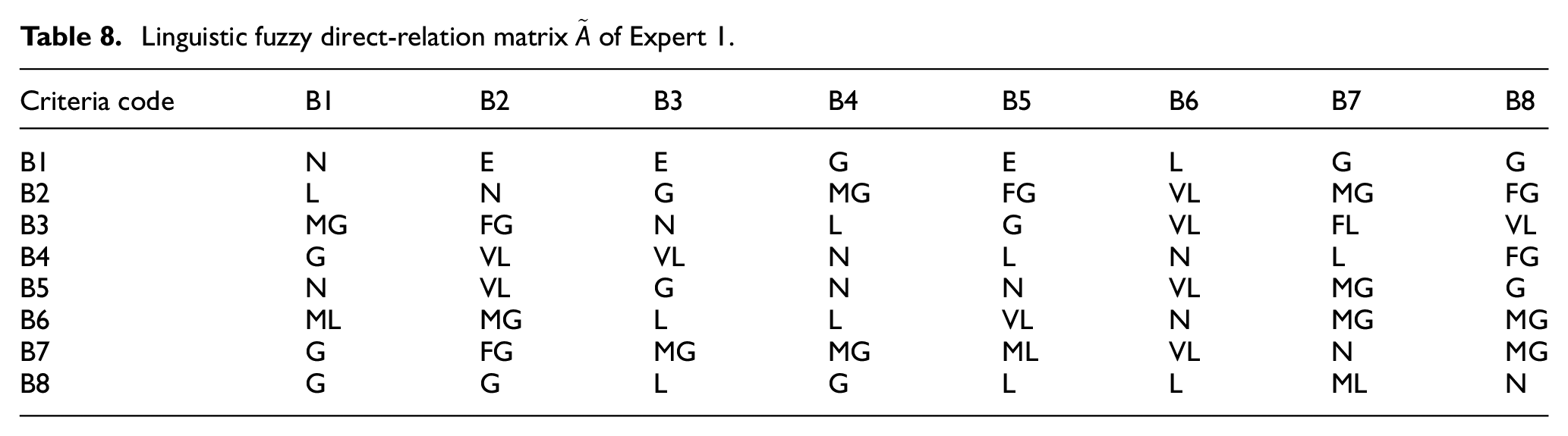
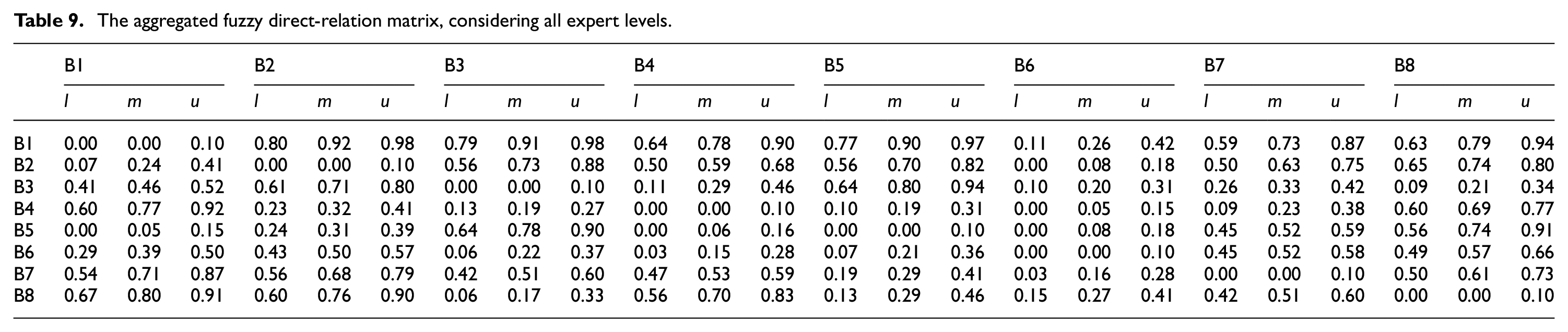
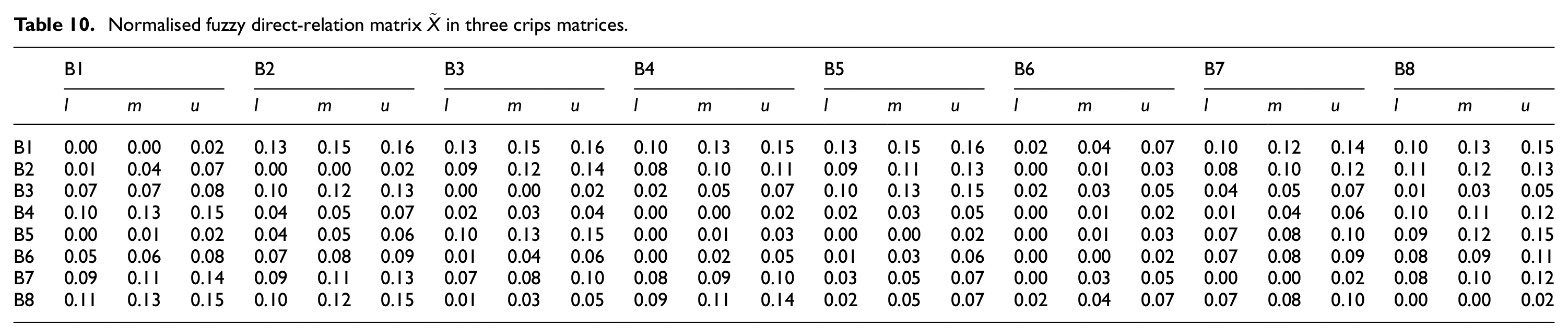
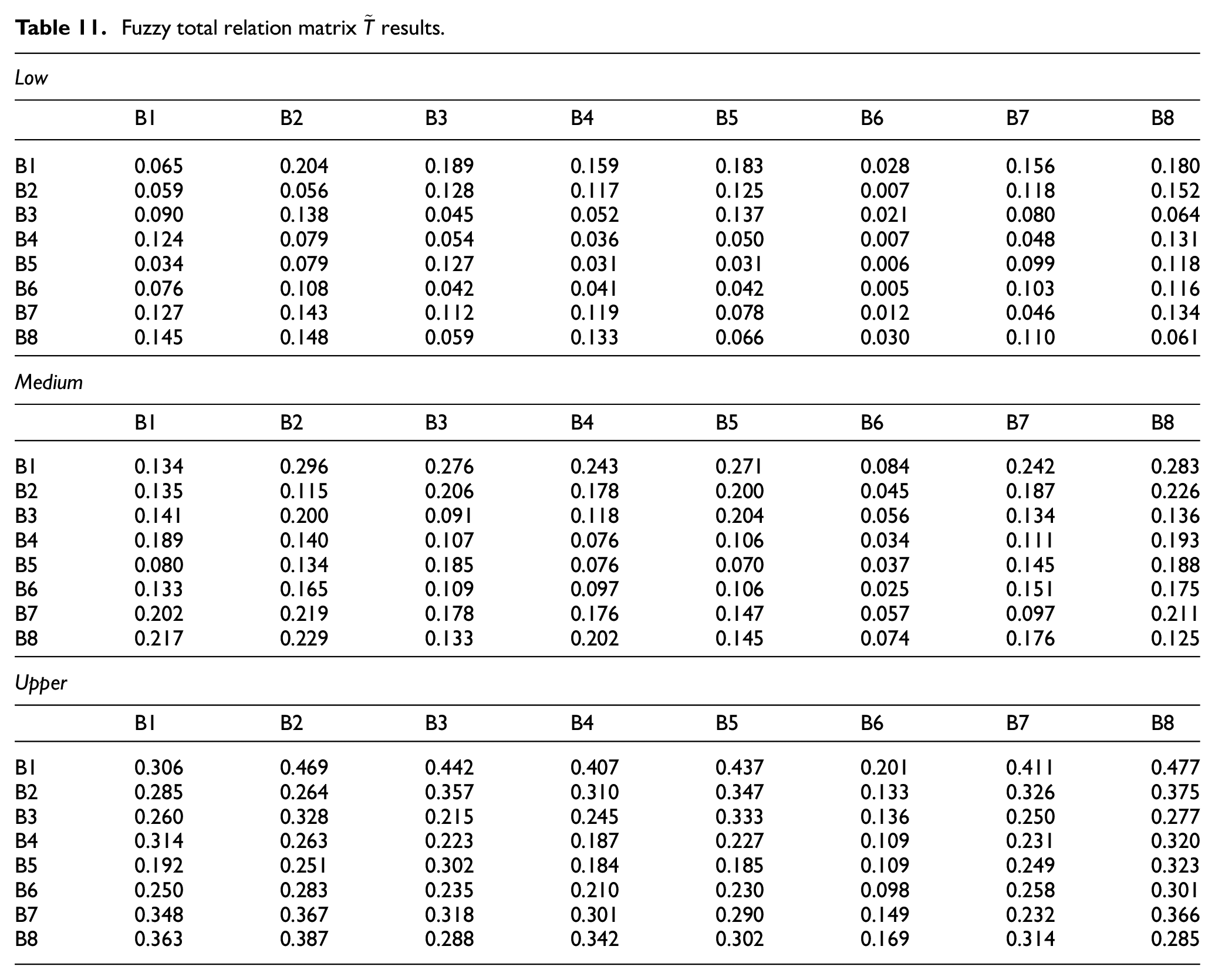
All seven experts provided their expert judgement through the fuzzy DEMATEL scale and aggregated considering their expert degree level. An example of the linguistic fuzzy direct-relation matrix of Expert 1 is shown in Table 8. Tables 9 and 10 present the aggregated fuzzy direct-relation matrix from seven experts as the result of equation (2) and the normalised fuzzy direct-relation matrix based on equation (3) which both are divided into low (l), medium (m), and upper (u) scores in the applied triangular fuzzy number. The fuzzy total relation matrix is then calculated based on equation (4), which is divided into the low score (equation (5)), medium score (equation (6)), and upper score (equation (7)), and the results are presented in Table 11.
Linguistic fuzzy direct-relation matrix
The aggregated fuzzy direct-relation matrix, considering all expert levels.
Normalised fuzzy direct-relation matrix
Fuzzy total relation matrix
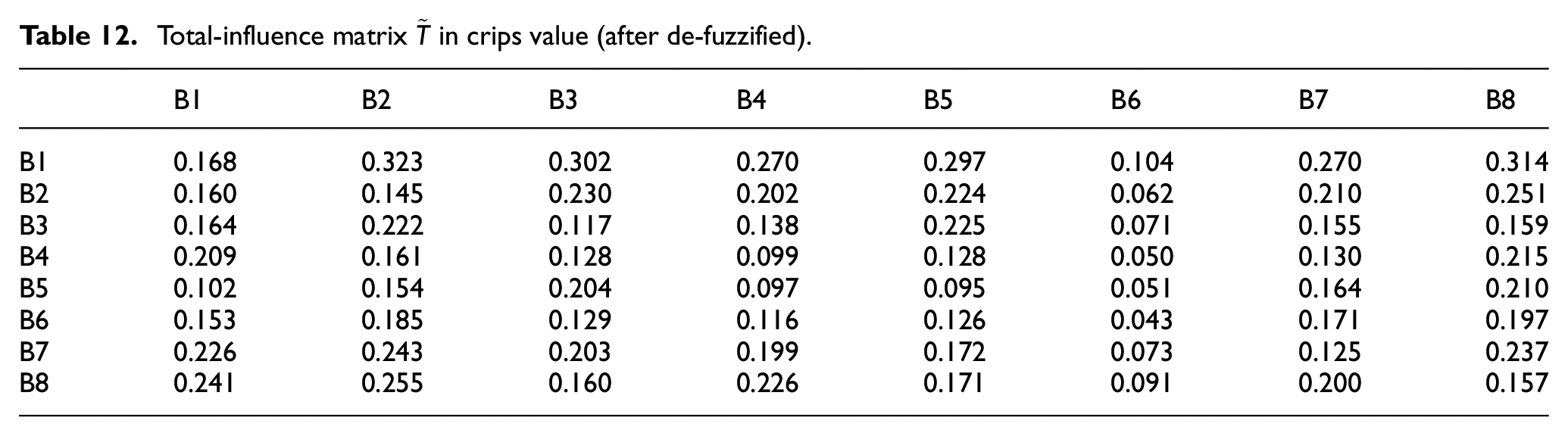
The crisp value from the fuzzy number of the matrix
Total-influence matrix
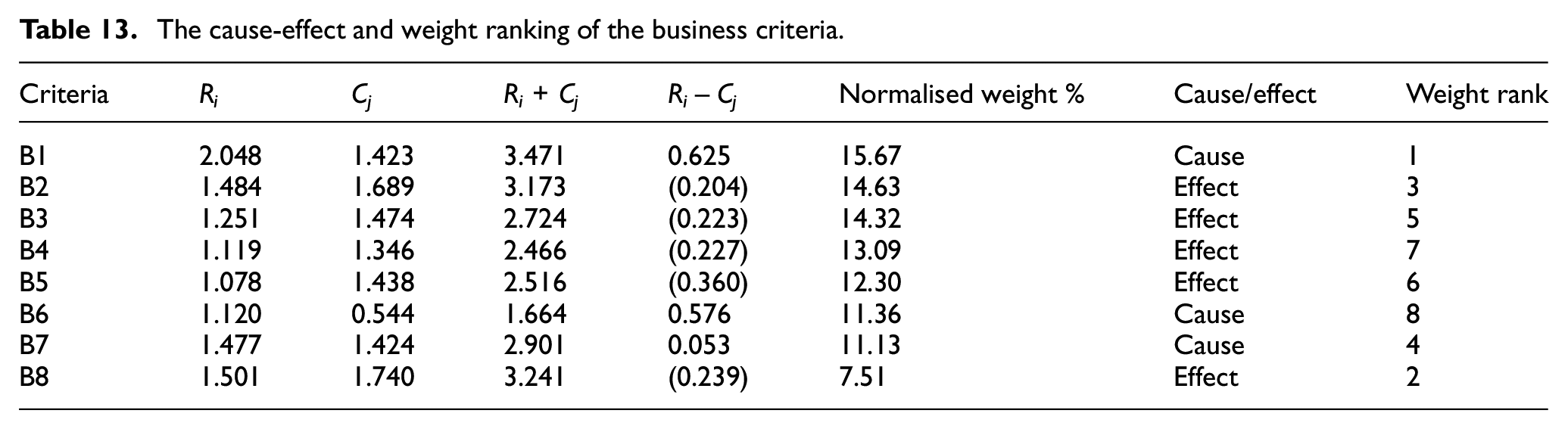
The cause-effect and weight ranking of the business criteria.
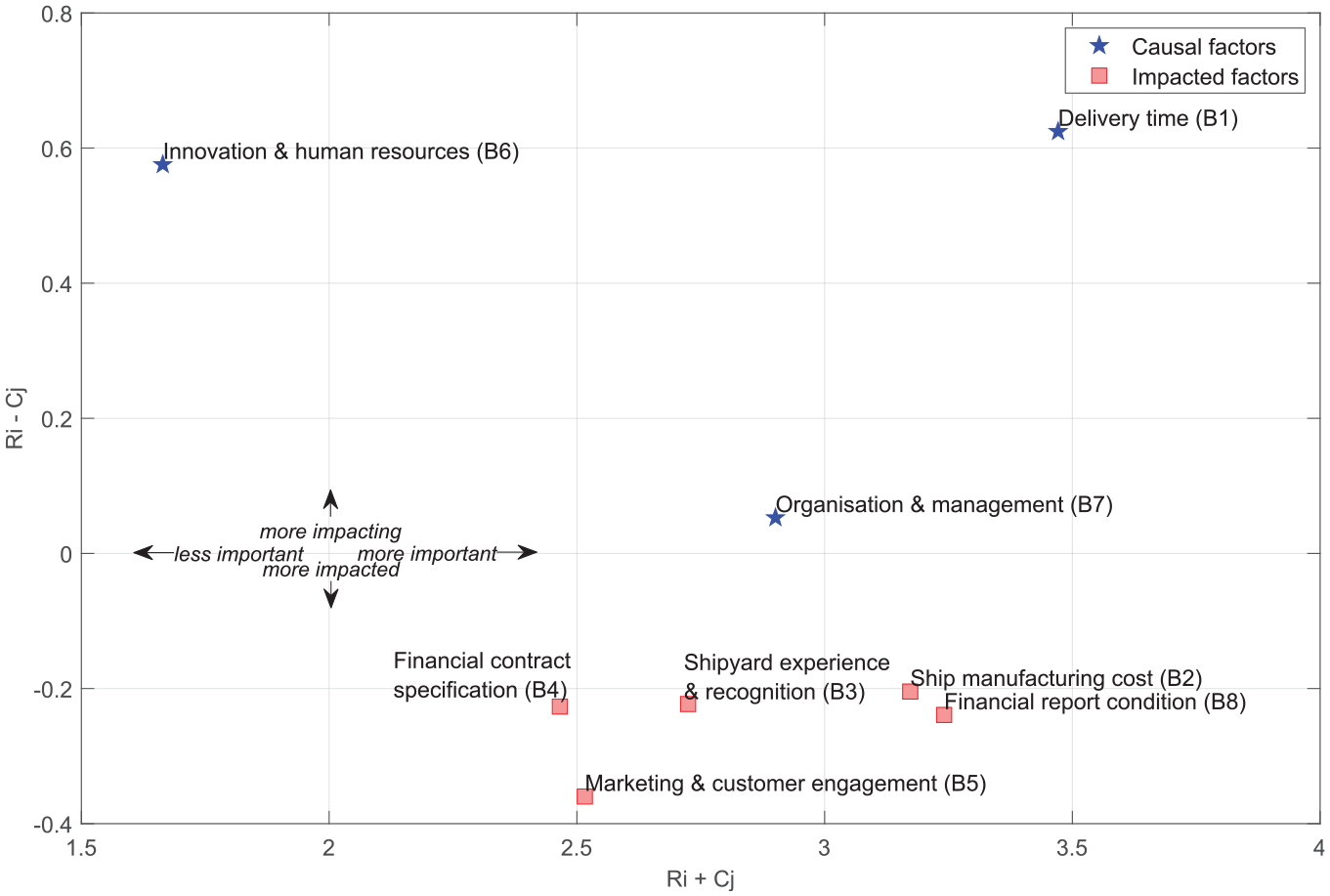
The cause-effect diagram of the total influence matrix of business elements of VENRA.
The cause-effect diagram generated by the fuzzy DEMATEL approach is depicted in Figure 4. This diagram was plotted with (
As plotted in Figure 4, there are three causal factors: ‘delivery time’ (B1) with the (
Shipyard assessment scores and the criteria weight results are plotted as bar charts and line charts, as presented in Figure 5, which are sorted according to the weight ranking. Concerning the shipyard score assessment, the (B8) criteria has the lowest score at 15%, followed by (B6) and (B5) at about 30%–35%. In contrast, the strong score refers to (B2) and (B7) at around 65%and 60%, respectively. The other criteria concerning the shipyard’s score have 50% for (B1) and 55% for (B4).
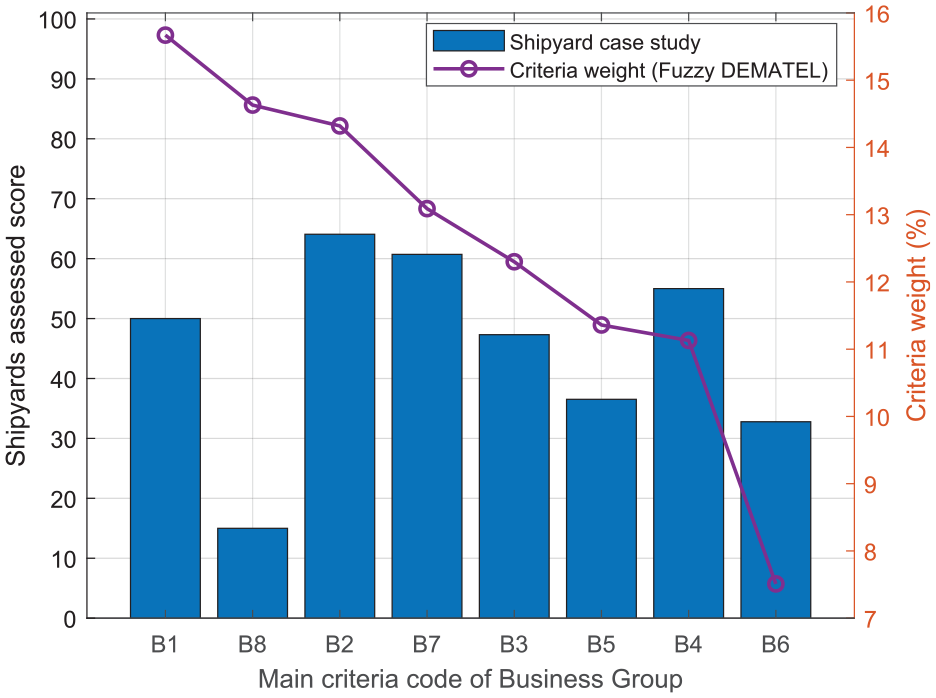
Shipyard assessed score within main criteria weight.
Business group sub-criteria results
Figure 6 presents the local ranking of sub-criteria in the weighting process from the WET approach on each main criterion in the business elements. It presents the sub-criteria based on each main criterion from ‘delivery time’ (B1) to ‘financial report condition’ (B8) following the shipyard score assessed, sorted according to sub-criteria ranking. The line chart presents the sub-criteria weight ranking with different slope degrees. The steep slope means there are wide gaps of percentage weighting amongst criteria, whereas the light slope means the criteria weightings have relatively similar values.
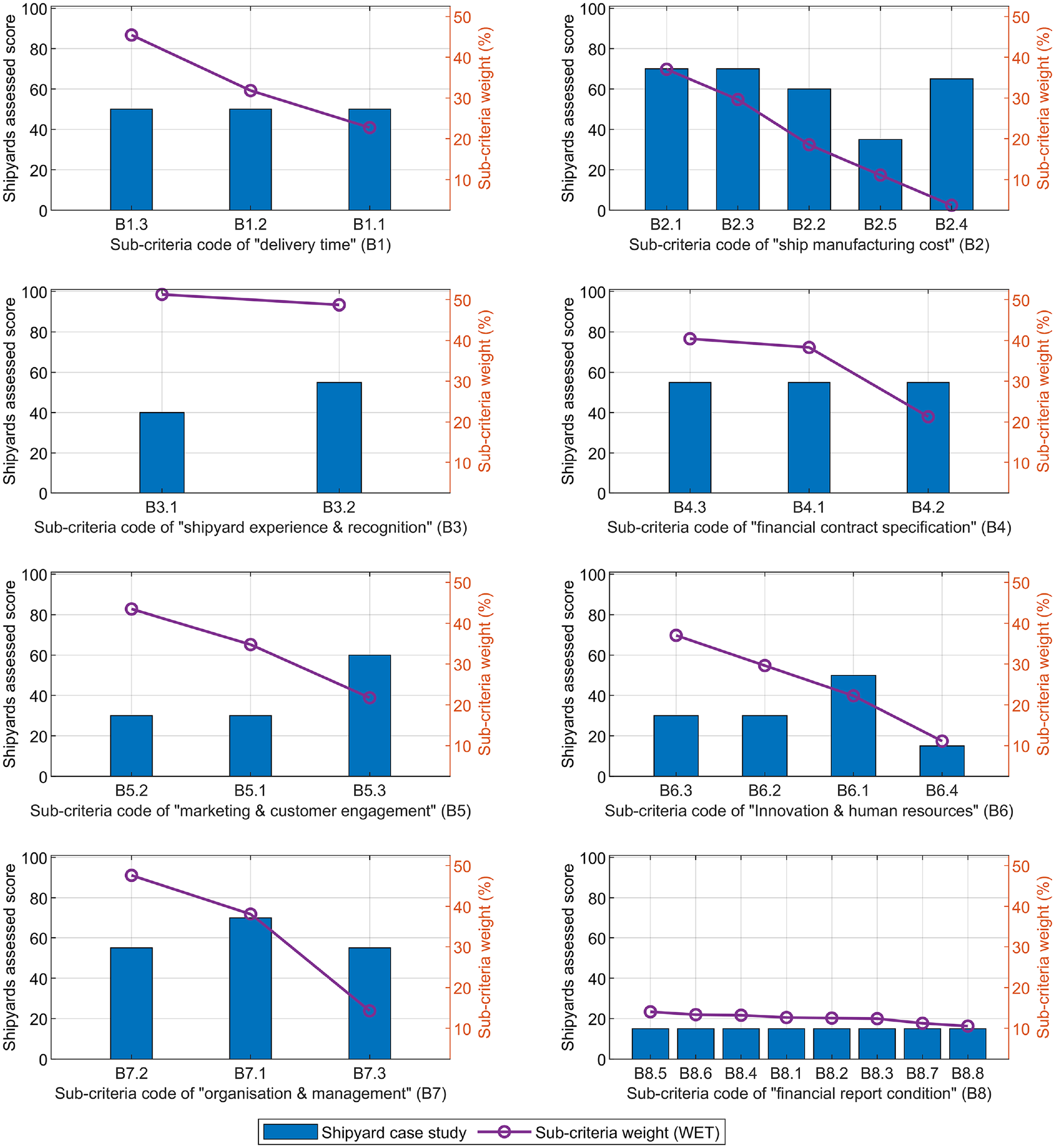
Shipyard score assessment (bar chart) along with sub-criteria weight (line chart).
The sub-criteria ranking for the (B1) criterion is as follows: ‘final delivery’ (B1.3) holds the highest weight at approximately 45%, followed by ‘interim stage/phase 2 (60%)’ (B1.2) at around 31%, and ‘interim stage/phase 1 (30%)’ (B1.1) at approximately 22%. The shipyard’s performance scores for these sub-criteria are 50%. In contrast, the sub-criteria for the (B2) have steeper weight slopes than the (B1). ‘Labour cost productivity’ (B2.1) is ranked first, with the highest weight at 37%, followed by ‘sub-contracting cost’ (B2.3) at about 29%, ‘material and equipment cost’ (B2.2), and ‘diversion cost’ (B2.5) at approximately 18% and 11%, respectively. On the other hand, ‘marketing cost’ (B2.4) has the lowest weight at 3.7%. The shipyard’s performance scores are relatively good for (B2.1) and (B2.3), scoring 70% each, followed by (B2.4) at 65% and (B2.2) at 60%. The sub-criteria (B2.5) has a lower score of about 35%.
Regarding the sub-criteria of (B3), ‘shipyard’s experience’ (B3.1) and ‘shipyard’s recognition’ (B3.2) carry similar weights of approximately 52% and 48%, respectively. The shipyard’s assessment scores are 40% for (B3.1) and 55% for (B3.2). In the sub-criteria of (B4) criterion, ‘offered price/tariff’ (B4.3) holds the highest weight at 40%, followed closely by ‘instalment contract payment’ (B4.1) and ‘contract terms and conditions’ (B4.2) at about 38% and 21%, respectively. The shipyard achieves a score of 55% for all these sub-criteria in its assessed performance.
The sub-criteria of (B5) consists of ‘ship order booked’ (B5.2) as the most important, with a weight of 48%, followed by ‘customer increasing rate and retention’ (B5.1) at approximately 35%, and ‘local and international customers’ (B5.3) at 21%. The shipyard’s assessment scores are 30% for both (B5.2) and (B5.1), indicating areas for improvement, while (B5.3) received a commendable score of 60%. In criterion (B6), ‘professional/hard-skilled training’ (B6.3) takes precedence with a weight of 37%, followed by ‘soft-skilled training’ (B6.2) at 29%, and ‘research and development’ (B6.1) at 22%. ‘Education degree programme’ (B6.4) is currently not considered in this criterion, carrying a weight of 11%. In criterion (B6), the shipyard scores low for (B6.3) and (B6.2) at 30%, indicating areas that need improvement. However, it achieves a satisfactory score for (B6.1) at 50%. The lowest score is obtained for (B6.4), which stands at 15%.
The final two criteria, B7 and B8, exhibit distinct sub-criteria rankings. For B7, ‘advanced use of technology and system’ (B7.2) holds the top position, weighted at 47%, followed by ‘responsibility, commitment, coordination, and response’ (B7.1) at 38%, and ‘employee satisfaction’ (B7.3) at 14%. The shipyard’s assessment scores for (B7.2) and (B7.3) are both satisfactory, each achieving 55%, while (B7.1) has a good score of 70%. The B8 sub-criteria has a close rank score, ranging from 10% to 14%, with a slight slope in the graph. The shipyard’s score gains a low score for all B8 sub-criteria, scoring at 15% each.
Sensitivity analysis
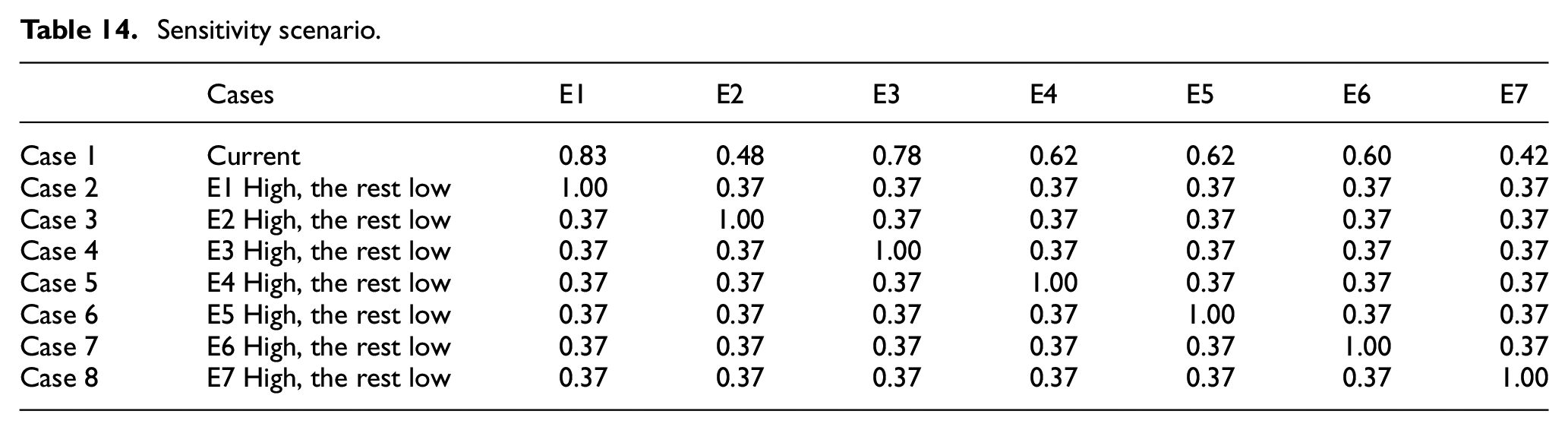
Sensitivity analysis is conducted to identify the model changes’ effect on the criteria weighting. Table 14 presents the sensitivity analysis scenario of each expert degree variation based on the grading expert system in the methodology part of equation (1). There is only a slight change in the criteria ranking between ‘financial contract specification’ (B4) and ‘marketing & customer engagement’ (B5), shown in Figure 7, and the cause-effect diagram changes in Figure 8. These results mean that the experts have a similar agreement regarding the input scale.
Sensitivity scenario.
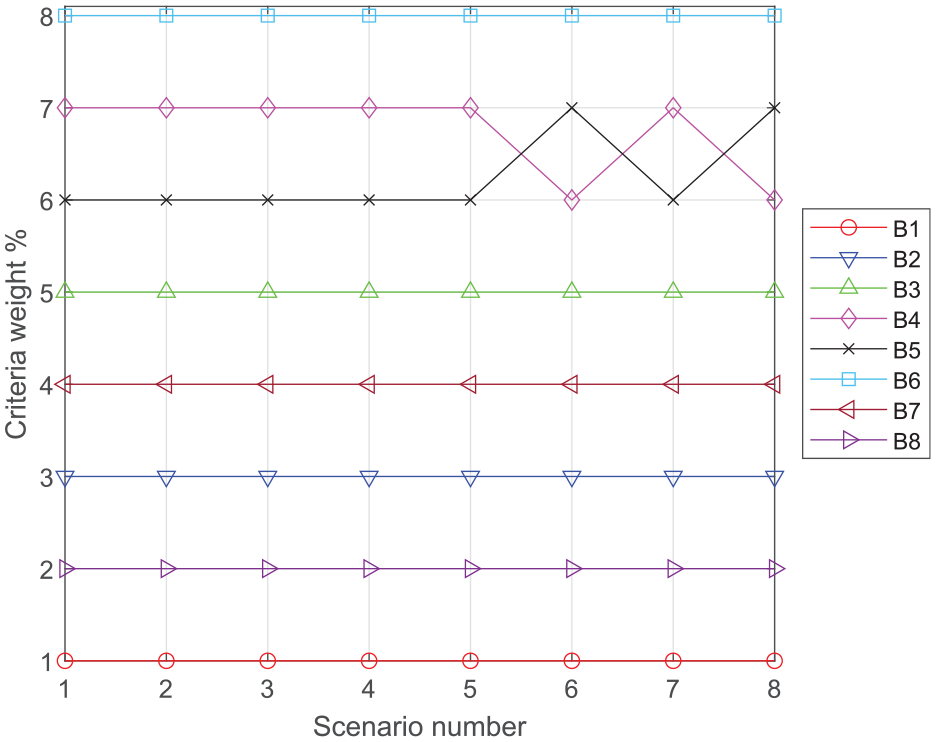
Criteria ranking after sensitivity analysis.
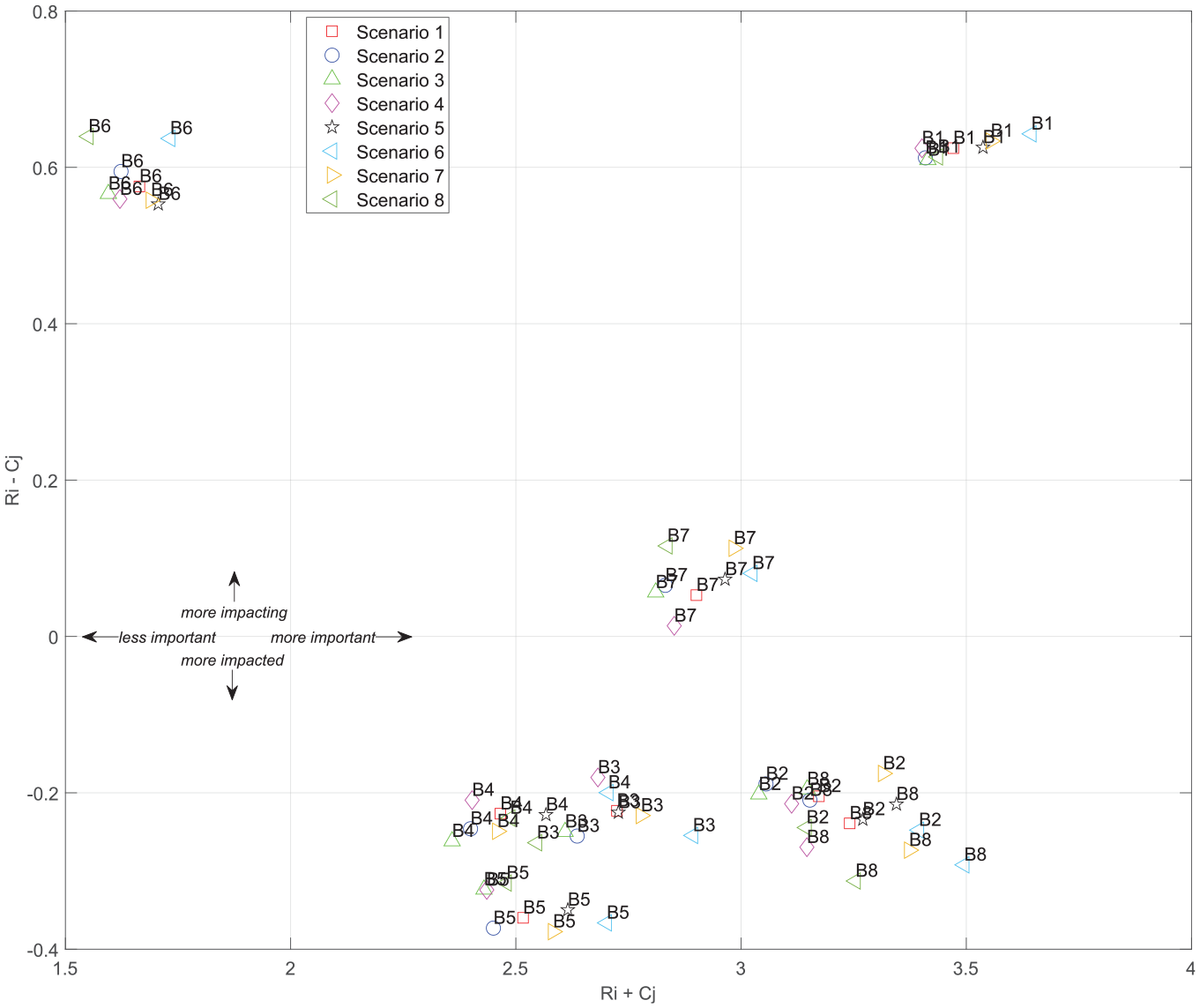
The cause-effect diagram changes due to sensitivity analysis calculation.
Figure 7 shows that the rankings of all main criteria remain unchanged, except for B4 and B5, which slightly shift from rank 6 to 7 and vice versa. On the other hand, the other main criteria (B1, B2, B3, B6, B7 and B8) remain consistent across all scenarios. Likewise, the cause-effect diagram from sensitivity analysis demonstrates similarity within each scenario. The status of causal and affected factors remains constant across all scenarios, as depicted in Figure 8.
Discussion
The ‘delivery time’ (B1) criterion can affect the ‘shipyard’s reputation & recognition’ (B3), ‘financial report condition’ (B8), and ‘shipyard manufacturing cost’ (B2) as shown in the cause-effect diagram, presented in Figure 4. This criterion also affects the ‘marketing & customer engagement’ (B5) criterion. Gavalas et al. 7 support this finding, which stated that ‘delivery time’ (B1) is the second most crucial business factor after shipbuilding cost in their model analysis. In addition, in the perspective of shipowner, delivery time also become the most important factors in shipyard selection. 29 The ‘innovation & human resources’ (B6) involve enhancing personnel’s hard skills and soft skills, and also the research & development in the organisation. In the cause-effect diagram, this criterion, including the sub-criteria, will impact the manufacturing cost and quality of the business process as represented by ‘marketing & customer engagement’ (B5). The results are also supported by Baihaqi et al., 2 showing that personnel criteria are considered the most causal factor in the Technical Group of VENRA related to human resources in the B6 criterion. Although the B6 criterion is the least one, it can indirectly impact the business performance in the shipyard by affecting the impacted criteria group. The ‘organisation & management’ (B7) refers to ‘the role of top management in organising the shipyard business to comfort their employee, external personnel, and owner/owner representatives’. It comprises three sub-criteria: top role management, advanced-used of technology for better rational forms, and employee satisfaction degree. These mentioned sub-criteria are also considered causal factors affecting the business process in shipyard activity.
On the other hand, ship manufacturing cost is considered as the impacted criteria since it is the impact of managing the delivery time, organised the operational effectiveness and the impact of organisation and management. If the delivery time exceeds the contract due date, the cost will exceed the budget and impact the financial report condition. Shipyard experience and recognition, contract specification, and marketing & customer engagement are also impacted by the time delivery. If the shipyard has an excellent on-time delivery record, these criteria will be improved and recognised as good shipyard performance. In vice versa, it can negatively impact the shipyard’s reputation, engagement, contract, cost, and financial condition.
Based on the results on cause-effect and criteria prioritising, it is suggested to focus on managing the time delivery on time, from the initial progress of weekly, monthly, or based on the phase/stage progress. The factor impacting the delivery time is plenty, it can be from technical factors such as personnel, technology or capacity, or it could be from external factors such as the regulation or purchasing process from import material. The second suggestion is also focusing on the available training, enhancement and upgrading of the personnel, enhancing their soft and hard skill and knowledge through education, especially towards the challenge of the new regulation and new policy from the future ship, which will change a lot, especially towards net zero-emission.
Causal factors and managerial impact on the shipyard
Delivery time (B1)
Although the shipyard may have some project delivery on time and partially behind schedule, it should significantly improve its production time. In a one data case, it took about 882 calendar days (2.4 years) to build a 2000 GT general cargo ship (800–1000 tons of steel plate) which is relatively too long considering its steel production capacity of about 200–220 per month. 2 Ideally, the hull construction process needs 4–5 months, while the rest of the process until delivery needs another 4–5 months, or it estimates that total production is 9–10 months up to delivery. This relatively very long-building process may happen due to other factors rather than the technical capacity of the shipyards, such as the material supply, especially for the main engine, machinery outfitting, and electrical outfitting installation process, which are 70% from imported materials. The ship owner’s cash-flow condition, unclear payment or addendum contract could also be other affecting factors. The improper block construction process may also contribute to the over-time delay since this shipyard hires external sub-contractors, which are hard to control and manage.
Innovation & human resources (B6)
Based on the shipyard’s data, strategic improvements should be considered in this criterion by evaluating the existing efforts in R&D research projects (welding centre, 3D ship software and nesting for production waste effectiveness). Further strategy by strengthening collaboration with local and international academia could also suggest the shipyard’s strategy for better-relevant innovation. Since there is no structured and formal training for soft-skill, improving communication skills and international language proficiency is suggested to handle customers worldwide and better understand international rules and regulations. Expanding the scope of hard skill training is needed for better human resources skills such as welding training, safety training and design and engineering software training, which enhance workers’ technical skills and impact the shipyard’s business. Further higher education could also improve the human resources in the shipyard in better knowledge, skills and networks of the marine sector.
Organisation & management (B7)
Some strategic improvement can be used to improve this part by building a better management system in the top role in controlling the business process, backing up the stored data better by using an online storage system and recording employee feedback on employee satisfaction for shipyard work environments. The role of top management in this private shipyard enormously improves the decision-making process in the shipyard’s activity. However, building a well-recorded system in any activity or decision process could improve and manage the past knowledge of this sub-criteria. Using online and offline system forms and processes based on internal web-based to monitor the progress of each project could improve the business process. However, it is also better to check the rationale form and simplify it for a better and quicker process. The internal employee satisfaction record has not been well-documented; this parameter is also important in management to identify what the employee complains and feedback as it can direct the shipyard management to adapt and enhance the process from the employee inputs.
Most important factors affecting business performance
In this section, the top three ranked criteria are discussed next, in which the ‘delivery time’ has been discussed since it is categorised as the causal and most crucial factor. The remaining is elaborated on in the following paragraph.
Financial report condition (B8)
The financial condition affects the business process very much since it impacts the process of purchasing, the operation of manufacturing activity, the bills and the cash flow of the shipyard in the business process. For example, current assets such as cash money are vital to run the shipyard’s daily, weekly or monthly operation activity. The profit ratio is also very important to show the degree of profits that the shipyard gained profit well; the debt ratio is also important to show the shipyard-business growth in managing their short-term or long-term debt.
The judgement of financial report condition focuses on the financial ratio statements. In this case, they cannot share their financial ratio report. However, based on the interview, the shipyard’s representative estimated that the shipyard’s profit ratio depends on the project type. If the project is only building one ship or a batch number of ships with different types, the shipyard cannot make a significant profit because the shipyard has to find the learning curve in the production process. However, if the shipyard has a batch production, such as 3 or 5 ships with the same type (sister ship), the shipyard can gain a significant margin of about 7% for the second ship and so on by learning from the mistakes in the first ship. Concerning the debt-ratio or ROI ratio, the shipyard cannot share this data, but through the interview with the shipyard representatives and the benchmarking data from another Indonesian opened-data shipyard which publish the financial ratio reports, this shipyard has a deficient performance in the financial ratio. The experts also said that the management should get a new-shipbuilding or repair contract not to gain a profit margin but to survive and maintain their experience or skilled-level workers.
Ship manufacturing cost (B2)
Labour cost productivity & sub-contracting cost
Overall, Indonesian labour cost is relatively low at about 1/5 to 1/6 compared with UK or Europe but also has low productivity, at around 60 man-hours/CGT compared with Europe at around 33–40 man-hours/CGT. The labour cost rate is between USD 2-3.59 or around USD2.5/h based on the Indonesian government’s data and interviews with sub-contractors in Indonesia and verified by the shipyard representatives. Since there is no available open data from the shipyard, both collected data are used as the benchmark, presenting the shipyard labour cost data. If compared with the minimum wages in the UK (£10/h) or EUROPE (EURO12/h) as the minimum wages and it is assumed the comparison between fitter and welder multiplier, thus the minimum wage of Indonesia shipyard is only 1/5 of the UK or 1/6 of EUROPE. With this concern, the labour cost should consider the productivity measurement in the labour cost for the manufacturing process, for example, the CGT or the ship’s product. Only one resource presents the person-hour record for 100 TEUS container ship data, extracted from the shipyard’s internal report, estimated at 60 person-hour/CGT in productivity. The other resource is from Suwasono et al., 62 which presents three different shipyards’ productivity in Indonesia based on observation and interviews with experts in 2010, showing about 41.44, 50.88 and 54.06 person-hour/CGT in three different Indonesian shipyards. The productivity of European shipyards, estimated by Roque and Gordo, 12 amongst 30 ship-built cases, shows that for Chemicals at 40.3 and Containers at 33.9 man-hour/CGT. Koenig et al., 10 based on data acquired from Nagatsuka 2002, show a comparison of productivity and labour costs amongst Japan, S. Korea, China and West Europe, presenting 1, 0.7, 0.2 and 0.6 for productivity and 1, 0.5, 0.2, 0.8–1.2 for labour cost, respectively. However, the last data is rather obsolete and irrelevant to the current condition.
The sub-contracting cost includes hull construction, machinery installation, piping installation, electrical installation and Interior installation. The cost for sub-contracting is relatively based on the working load and type. In the hull construction case, this shipyard breaks down the construction into several blocks. Each block is built from the sub-assembly and assembly process (from cut piece part) into a ring block supervised by the shipyard representatives. Since the shipyard handles the material acquirement, the sub-contracting cost is relatively based on the labour cost, which is similar to ‘labour cost productivity’ (B2.1). In this regard, the sub-contracting cost is relatively low in cost and productivity.
Material and equipment cost
Indonesian shipyard highly depends on imported material for shipyard activity since almost 70%–85% is based on the value of the material from abroad, especially for specific stiffeners, main engine, propulsion and steering gear and outfitting. A free tax duty for specific imported materials has been waived by the Indonesian government 63 to reduce the cost. However, gaining these benefits requires effort and additional time for administration and technical documents, which ultimately consume extra time in acquiring the materials. Government initiative to enhance the local content of marine standard material for shipyard activity is highly required to reduce the dependency on import material.
Marketing cost & diversion cost
The joining and involvement in Marine Equipment Plaza (MEP), Meet the Buyer (MTB) and Conference and shipyard visits, although not periodically, are considered reasonable efforts from the shipyard. This marketing cost is used to support the marketing purposes such as producing posters or flyers during exhibitions such as MEP and MTB. The shipyards can introduce their products, technologies and specialities through this process and potentially engage the customer’s candidate for shipbuilding, ship repair or ship conversion.
Since diversion cost is the impacted criterion, it depends mainly on delivery-time factors since the extension of production time requires more effort and cost for the manufacturing process, which in the end, impacts the total production cost. In this case, the shipyard has to control the delivery time factors to reduce the wide gap between planned and actual costs.
Conclusion
In this paper, the VENRA framework has been presented, describing the business group of elements in more detail, including eight criteria and 31 sub-criteria. The application of the suggested framework and Business group of elements has been demonstrated in the case of an Indonesian shipyard by assessing the shipyard condition and analysing the cause-effect, and prioritising criteria and sub-criteria to perform the shipyard measurement. The hybrid fuzzy DEMATEL-WET has been demonstrated to assess the criteria and sub-criteria analysis, addressing the weighting process and identifying the cause-effect group of the criteria.
Considering the shipyard case study result, it is suggested that the shipyard focus on managing the time delivery as the contract stated. This aspect can impact the business performance of the shipyard and the other criteria. The ‘delivery time’ remains the most crucial and impacting factor in the performance within the business aspect. Furthermore, the top three most important factors, ‘delivery time’, ‘financial report condition’ and ‘ship manufacturing cost’, need to be considered since they influence the shipyard’s performance directly. Although it is a minor factor, ‘innovation and human resources’ is also the most impactful factor after ‘delivery time’. The case study shows that the framework can identify the cause-effects criteria and prioritise through the methodologies.
Further research can assess the global whole VENRA criteria in the main criteria to analyse the cause-effect group and weight results within five groups to investigate the most important group within all framework. Moreover, the five groups dimension of VENRA criteria can be adopted to select the best shipyard in shipyard selection process in the perspective of shipping industry. The VENRA’s remaining groups’ External group criteria, including their main criteria and sub-criteria, can also be demonstrated in similar way to compare different shipyards. Furthermore, the criterion evaluation procedure can be refined using combination of different MCDM approach, such as fuzzy AHP, TOPSIS, VIKOR or simple additive weighting (SAW).
Footnotes
Acknowledgements
The author would like to express his heartfelt appreciation to the Directorate General of Resources for Science, Technology, and Higher Education-BPPLN-DIKTI (Beasiswa Pendidikan Pasca Sarjana Luar Negeri-DIKTI), Ministry of Education and Culture Indonesia, for kindly financing his PhD study at the University of Strathclyde in Glasgow, Scotland. Furthermore, the author wishes to thank an anonymous expert representing the shipyard who graciously contributed vital data and validation for the research. Their assistance and efforts were critical to the effective completion of this study.
CRediT authorship contribution statement
Imam Baihaqi: Conceptualisation, Methodology, Validation, investigation, Writing-original draft. Iraklis Lazakis: Conceptualisation, Methodology, Validation, Supervision, Writing-Review & Editing. Heri Supomo: Writing-Review & Editing.
Declaration of conflicting interests
The author(s) declared no potential conflicts of interest with respect to the research, authorship, and/or publication of this article.
Funding
The author(s) received no financial support for the research, authorship, and/or publication of this article.

Data availability statement
Due to the nature of this research, participants of this study did not agree for their data to be shared publicly, so supporting data is not available.