



Abstract
Identifying the effect of thermal loads that are caused by temperature differences of inner and outer fluids on the structural sealing performance and strength is a long-standing quest in the design of subsea connectors. However, the structural stress and sealing parameters of the gasket under thermal loads are difficult to analyze and calculate using the current theoretical method because the boundary conditions of the gasket’s geometry surface are contact constraints interacted by the gasket and hubs. This paper presents an analytical calculation method (ACM) that evaluates the thermal-structural coupling strength and sealing performance considering such special boundary conditions. The thermal load is converted into an equivalent compression load, that is, a concentrated force, and applied to the contact region of the gasket. Additionally, a thermal-structural coupling finite element model is proposed to verify the ACM and the results show good agreement. Taken together, this work contributes to the design of subsea connectors that more likely take thermal loads into account.
Introduction
Due to metal-to-metal contact sealing is highly reliable on high pressure and temperature operation conditions, it is extensively used for zero leakage design in many industry applications, such as pipe flange connections and covers of pressure vessels in nuclear engineering, chemical plants, and the cylinder head in combustion engines. Bolted connections with metal gaskets are usually used in these mechanical structures. The ASME Boiler and Pressure Vessel VIII code is the general design method for the pressure vessel flange structure, where various sealing connection mechanisms have been elaborated, such as flat gasket sealing, double-cone gasket sealing and clamp sealing. The lack of the traditional design procedures in ASME Boiler and Pressure Vessel VIII code to quantify tightness and the effect of temperature is of major concern in the past decades. 1 Therefore, investigations on effect of thermal loads are in progress in the design of bolted connections with metal gaskets by various methods, especially in a theoretically way.
In the field of subsea production systems for deep-water oil and gas field development, because of the high internal pressure medium load and high pressure of external sea water over a long period, metal-to-metal contact sealing is selected to solve the sealing problems of various subsea facilities. The subsea production system is composed of wellhead trees, manifolds, jumpers and submarine pipelines etc.,2,3 as shown in Figure 1. The subsea connector, located on the end of the jumper, is the key connection facility in subsea production system. The main function of a subsea connector is to achieve sealing performance between two different subsea facilities. A sealing passageway is established after the subsea connector is locked or preloaded, which is used to transport oil and gas under high pressure and temperature, so the sealing type of subsea connectors is metal-to-metal contact sealing in order to achieve a reliable performance. The highest temperature of inner fluids can reach 120°C, while the constant temperature of the outer fluids, that is, sea waters, is about 3°C. Therefore, thermal loads caused by temperature differences of inner and outer fluids cannot be ignored at the structural designing stage. The influences of pressure loads and preloading forces on sealing structures have been investigated in a former study, 4 but the thermal loads are not considered. Therefore, thermal loads will be emphasized in this paper to discuss its effects on contact loads, sealing parameters and structural stresses.
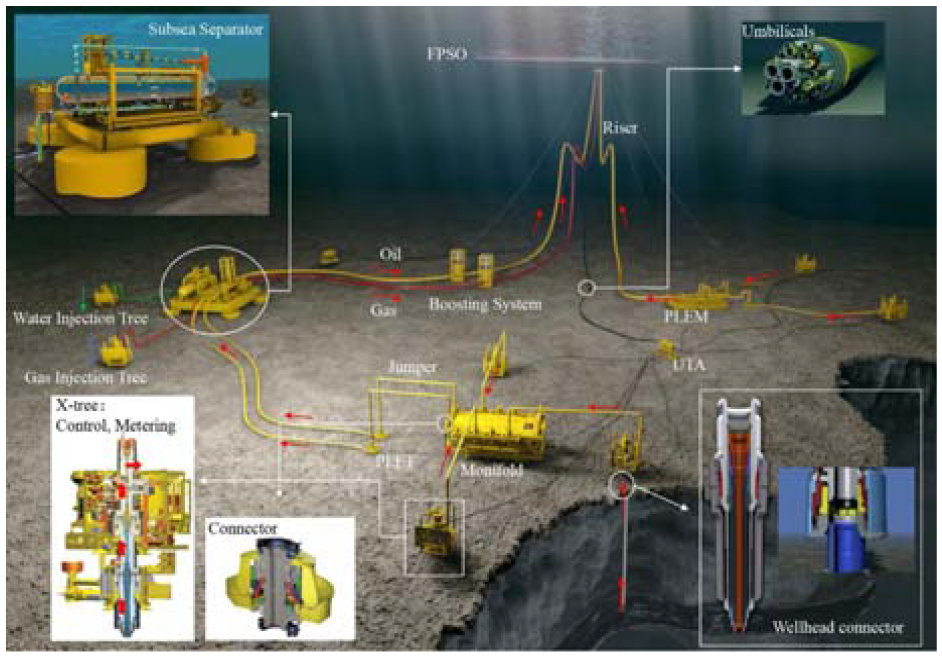
Typical configuration of a subsea production system.
As for the thermal stress analysis of sealing structures, the finite element method (FEM) is usually applied through thermal-structural coupling simulations to investigate the effects on sealing performance caused by thermal loads. For example, Abid 5 carried out a 3D nonlinear finite element analysis (FEA) of a gasket flange joint to investigate the joint strength and sealing capability under combined internal pressure and different steady-state thermal loading. Nagata and Sawa 6 performed finite element analysis for the flange connections with ring type joint gasket subjected to internal pressure and/or temperature loads on bolt-up and operating conditions. Sawa et al. 7 examined the high-temperature properties of the spiral wound gasket in pipe flange connections by compression tests at elevated temperature and conducted the stress analysis to estimate the sealing performance. Li et al. 8 calculated the contact pressure on the sealing surface in the preload and operating state by finite element model to investigate the sealing characteristics of the subsea wellhead connector with consideration of the thermal stress. In another paper, Li et al. 9 developed theoretical models for calculating contact stress of subsea wellhead connectors by taking external pressure, internal pressure and bending loads into consideration, and then utilized FEM to investigate relationships between contact pressure and preloads, contact width, radial compression, as well as internal pressure. In that paper, various loads were equivalently converted into a theoretical model in an innovative way in order to perform mathematical analyses.
Moreover, a lot of studies also focused on the sealing performance analysis of metallic sealing structures, but thermal loads are not concerned in those works. For example, Murtagian et al. 10 introduced the metal-to-metal seal on a tubular connection and investigated the effectiveness of stationary metal-to-metal seals concerning contact pressure and load history. Krishna et al. 11 developed a three-dimensional finite element model to find the contact stresses on a gasket and studied the influence of flange rotations on the sealing performance under preloading and operating conditions. Mathan and Prasad 12 studied the sealing performance of a gasket flange joint under external bending by using a three-dimensional finite element analysis and experiments. Nelson and Prasad 13 talked about the sealing behavior of twin gaskets in a flange joint, studied the effect on contact stress with different bolt preloads and internal pressure through finite element method, and proposed an empirical relation to determine the bolt preload for ensuring the minimum compressive stress. Aljuboury et al. 14 investigated the leakage and strength of a metallic bolted flange joint through 2D and 3D finite element models, and stress of the flange hub and contact pressure on the gasket are analyzed.
For the subsea connector discussed in this article, studies on structural deformations and sealing characteristics analysis are enormous, but most of which ignored the influence of thermal loads. For example, Wang et al. 15 adopted the finite element method to design the metal gasket of a subsea connector and analyzed stresses of the gasket under different loads conditions. Gong et al. 16 presented a finite element model to analyze the sealing characteristics of flange joints with a lenticular gasket by calculating the contact width, contact pressure and stresses, and presented the equations of leakage rate. Peng et al. 17 introduced a subsea connector with a cone metallic gasket, established the calculation model for preloads in different conditions, and made an optimized design for the locking mechanism. Wei et al. 18 founded a critical condition to meet sealing performance for a subsea pipeline mechanical connector, then defined the formula for the critical mean contact pressure on the sealing surface to investigate the sealing mechanism, and used the finite element analysis results to verify the analytical models. Yun et al. 19 built up a mathematical model of the contact pressure distribution on the gasket of the subsea connector based on Hertz contact theory, deduced the relations between the preload, contact pressure, the sealing width and structural parameters, and checked out analytical calculation results of the contact pressure and the contact width by FEM simulation and experimental systems. Zhang et al. 4 presented an analytical model for calculating the compression deformations of the lenticular gasket and obtained the relationships among the contact load, the contact pressure, the contact width and the compression deformation. Zeng et al. 20 established random load models of working pressure and temperature for a deep-water pipeline connector, and developed a sealing reliability assessment method to determine the deep-water pipeline connector reliability.
In this paper, thermal loads are involved in structural deformation calculation to investigate the influence on contact loads, sealing performance and strength of the metallic gasket of subsea connectors. In addition, what is noteworthy is that thermal-structural coupling calculations will be performed not only by FEM, but also by an analytical method, named analytical calculation method (ACM) in this study, so as to estimate efficiently the sealing performance parameters and structural strength of the metallic gasket of subsea connectors. The main idea of ACM is to transform the thermal load into an equivalent compression load, that is, a concentrated force, and then to load this concentrated force on the contact region of the gasket in order to evaluate structural stresses and sealing parameters. To implement the idea, a heat conduction mathematic model for the subsea connector structure will be developed firstly to obtain temperature distribution functions in the radial direction. Secondly, based on the existing calculation formula of radial displacements for a thick-walled cylinder structure under thermal loads and the calculation formula of thermal expansion displacements on the axial direction, the analytical equation for equivalent compressive amounts of the sealing surface on the metallic gasket will be put forward with consideration of boundary conditions of contact constraints on the gasket’s geometry surface. Thirdly, with the help of the analytical relationships between contact loads and amounts of compression developed in previous studies, the equivalent contact loads of the thermal-structural coupling model can be estimated through utilizing the obtained equivalent compressive amounts. Then this equivalent contact forces are loaded on the contact region of the gasket, and the structural stresses and sealing parameters will be predicted analytically in the end. Finally, the thermal-structural coupling simulation by FEM is carried out to verify the ACM and to discuss the effects on sealing performance posed by thermal loads.
Problems and solutions
Sealing principles of subsea connectors
As shown in Figure 2, the key structural sealing components of subsea connector are the female-hub, the male-hub, claws, the actuator ring, and the lenticular gasket. The way to achieve sealing performance is squeezing the gasket by the female-hub and the male-hub simultaneously, and making the gasket deformed to fill the microscopic gaps between the contact surface of the hubs and the gasket. With the deformations of the lenticular gasket, the contact region of the lenticular gasket surface, contacting directly with the hub, presents a shape of annular belt, as shown in Figure 3. It is on this narrow annular region that the reliable sealing performance is achieved. The contact region can be described by two sealing parameters, namely the contact pressure and the contact width, which directly relate to the contact load values and further determine deformations of the lenticular gasket.
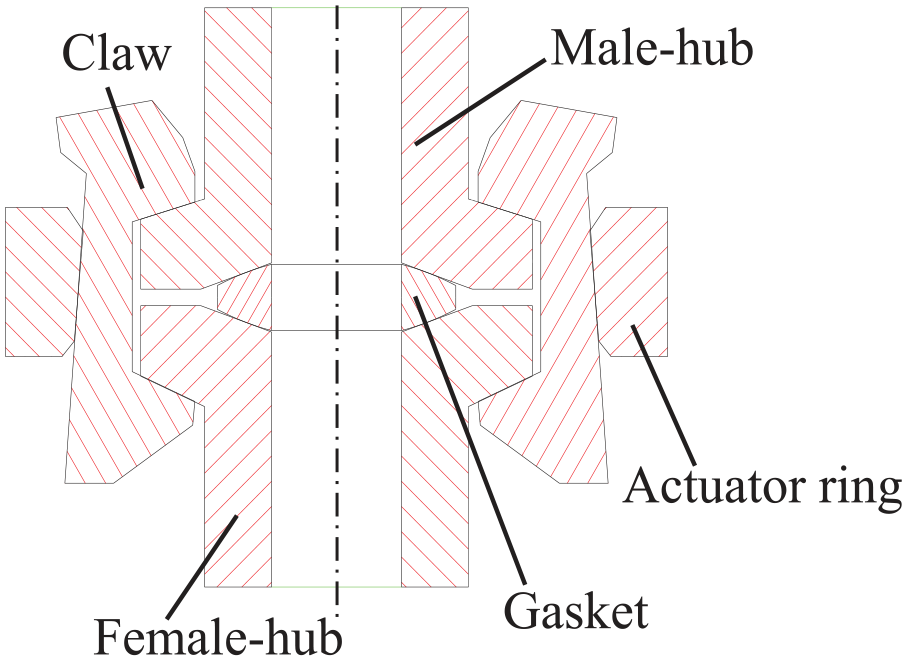
Main sealing structure of subsea connector.
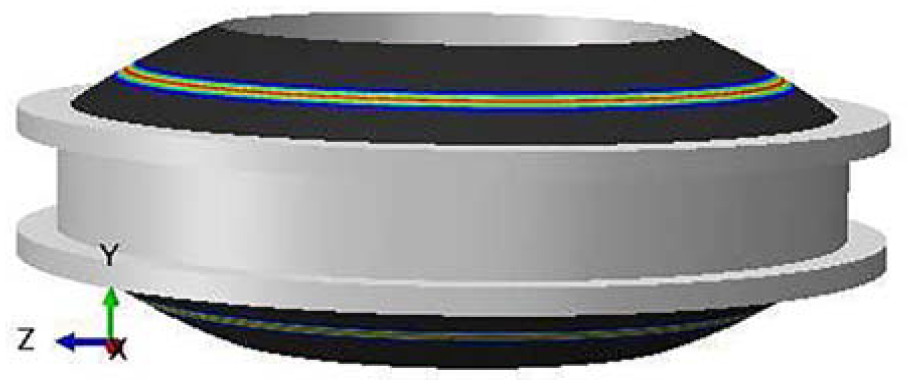
Narrow annular contact region on the gasket.
Key problems of thermal-structural coupling analysis
After it is preloaded, the subsea connector is used for transmit oil and gas with high temperature and pressure on the operating condition. However, the subsea connector is surrounded by sea waters with a lower temperature, so it is inevitable for the subsea connector to subject to severe thermal loading, as well as pressure loads. This paper only addresses the action on the structures caused by thermal loads, since thermal stresses analyses are more difficult and complicated than other loads with consideration of thermal-elastic mechanics. It’s an inescapable topic that thermal loads will obviously impact on the sealing capability and structural strength of the metallic gasket of subsea connectors because of large temperature differences between inner and outer fluids.
Viewing from geometric features of the gasket in Figure 2, a routine thought or way to calculate thermal stresses is to assume the gasket as a thick-walled cylinder, and then to utilize the existing thermal stresses calculation formulas to estimate structural strength of the metallic gasket of subsea connectors. However, it neglects a crucial factor which is the boundary condition of contact constraints on the gasket’s geometry surface. In the theory of the thick-walled cylinder under thermal loads, the boundary conditions are free and unconstrained. Nevertheless, the boundary conditions of the gasket’s geometry surface are contact constraints in this paper, which cannot be ignored because large deformations exits on the contact region interacted by the gasket and hubs. Therefore, it is unreasonable to utilize the existing thermal stresses calculation formulas of the thick-walled cylinder to estimate structural strength of the metallic gasket of subsea connectors. Considering the boundary conditions of contact constraints on the gasket’s geometry surface, a new analytical calculation method will be put forward for the sealing structure of subsea connectors.
The idea of ACM is to turn the thermal load into an equivalent compression load, that is, a concentrated force, and then to load this concentrated force on the contact region of the gasket to predict structural stresses and sealing parameters. Therefore, how to make the transformation between the thermal load and the equivalent compressive load is a key task to be settled in the next part of this study.
Solutions
Since an analytical relationship between contact loads and amounts of compression have been developed in previous studies, solving the equivalent amounts of compression is prior to be conducted. And after that, the equivalent compressive load can be obtained. For this purpose, four steps are carried out in this article. Firstly, a heat conduction mathematic model for the subsea connector structure will be developed to obtain temperature distribution functions in the radial direction by assuming the sealing structures in Figure 3 as thick-walled cylinder structures. Secondly, substituting the temperature distribution functions into the existing calculation formula of radial displacements for a thick-walled cylinder structure under thermal loads, the freedom thermal expansion displacements on the radial direction are acquired. The calculation formula of radial displacements for a thick-walled cylinder is applied, but the stress components calculation formulas for a thick-walled cylinder are not utilized. Thirdly, combining the radial displacements of freedom thermal expansion with the axial displacements, the freedom thermal expansion displacements on the normal direction of the sealing surface on the metallic gasket will be gained through coordinate transformation. Fourthly, with consideration of boundary conditions of contact constraints on the gasket’s geometry surface, the analytical equation for equivalent compressive amounts of the sealing surface on the metallic gasket is put forward by model assumptions. Finally, the equivalent contact loads of the thermal-structural coupling model can be estimated through utilizing the obtained equivalent compressive amounts. Then with loading this equivalent contact forces on the contact region of the gasket, the structural stresses and sealing parameters will be evaluated analytically by taking advantage of the theoretical relationships developed in previous studies.
Analytical calculation models
As mentioned above, the temperature distribution function of the subsea connector is needed to be determined firstly. And then the analytical equation for equivalent compressive amounts of the sealing surface under thermal loads is developed with consideration of boundary conditions of contact constraints on the gasket’s geometry surface. Finally, substituting the obtained equivalent compressive amounts into the developed analytical relationships between contact loads and amounts of compression developed in previous studies, the equivalent contact loads of the thermal-structural coupling model can be solved. After that, the structural stresses and sealing parameters can be estimated by utilizing the analytical relations between contact loads and sealing parameters as well as stress components. The detail derivation processes of the analytical relations have been published by Zhang et al. 4 And this paper only shows the simplified contact model (shown in Figure 4) and utilizes the final relationship expressions directly.
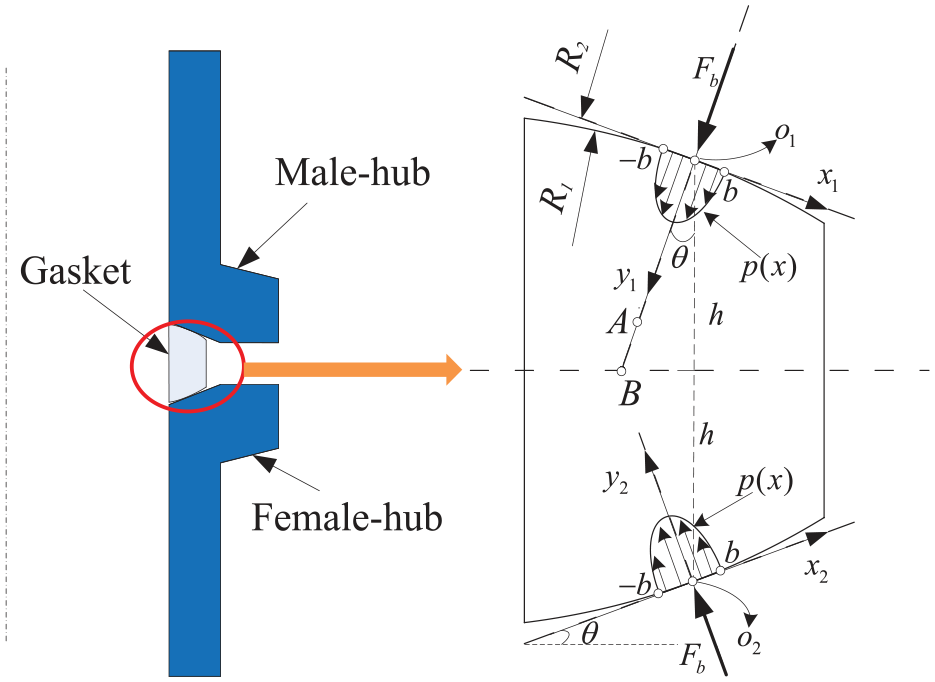
Simplified diagram of contact model.
As shown in Figure 4, the circular arc curvature of the gasket contact section is marked as R1. The flange section is regarded as a half-infinite plane, and its circular arc curvature, marked as R2, is assumed as infinity. R* is defined as the equivalent arc curvature, which is equal to 1/(1/R1+1/R2). Because of the assumption of R2 = ∞, the value of R* is the same with R1, namely R* = R1. The two circular arcs will be in tangency at one certain point when contacting, and the contact load will act on the normal direction of the circular arc. To make the analysis more convenient, the local coordinate systems, x1o1y1 and x2o2y2, is developed. The contact load on the unit length of the narrow annular contact region, that is, the axial compression load acting on the gasket at Point o1, is marked as Fb. The contact pressure distribution caused by Fb is marked as p(x). The width of contact region is marked as 2b. The inclination angle of the contact surface of the hub is marked as
Analytical equations for equivalent compressive amounts of thermal-structural coupling deformations
Temperature distribution estimating
The sealing structures in Figure 1 are regarded as multilayer thick-walled cylinder in order to take advantage of the existing formulas. According to the theoretical equations of steady state heat conducting for multilayer thick-walled cylinder, the unit heat flux of the thermal transmission model can be express as

where the inner and outer radius of the thick-walled cylinder of the gasket are marked as r1 and r2 respectively, and the heat conductivity coefficient of the thick-walled cylinder of the gasket is marked as
The outer wall’s temperature of the thick-walled cylinder of the gasket is marked as t2, which can be expressed as

Then the temperature distribution functions in the radial direction of the gasket can be expressed as

Analytical equations for equivalent compressive amounts
Substituting the equation (3) into the existing calculation formula of radial displacements for a thick-walled cylinder structure under thermal loads, the freedom thermal expansion displacements on the radial direction are expressed as
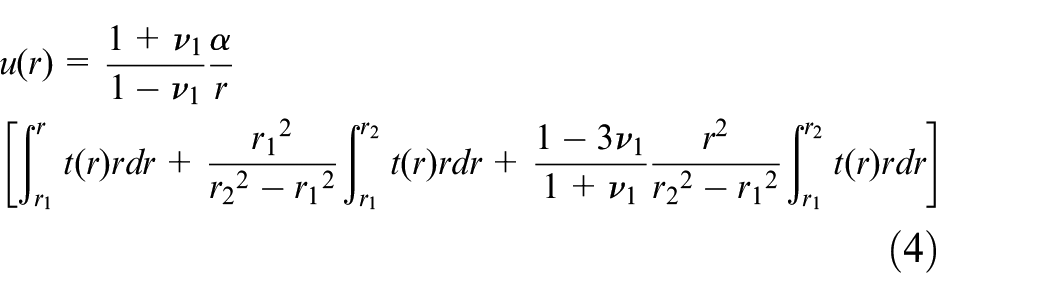
where
According to equation (4), the radial displacements of Point o1 and Point B can be calculated, which are marked as
In the local coordinate systems x1o1y1, the displacements of Point o1 on the o1x1 axis direction can be expressed as

where
On the preloading condition, the gasket will contact directly with the hubs, and the amount of compression deformation is related to the contact load between contact surfaces. The analytical relationships between contact loads and amounts of compression developed by Zhang, et al. 4 are expressed as

where
After the preloading condition, the thermal forces are loaded. The gasket will expand because of thermal loads. Since the contact constraints between the gasket and the hubs developed in the preloading condition, the interaction of contact surfaces will strengthen with the expansion of the gasket, which will lead to the increase of the contact force. Consequently,

where
Equivalent contact loads calculating and structural strength predicting under thermal loads
After obtaining the equivalent compressive amounts, the equivalent contact loads can be calculated by the developed analytical relationship expressions, 4 as well as the corresponding contact width, and contact pressures.
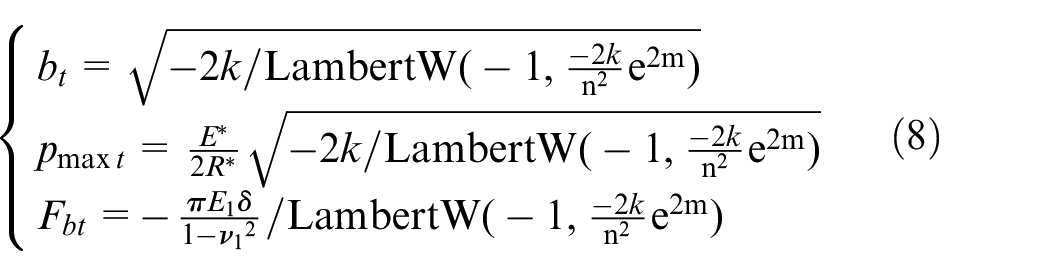
where
The structural stress component in the local coordinate systems x1o1y1 can be expressed as
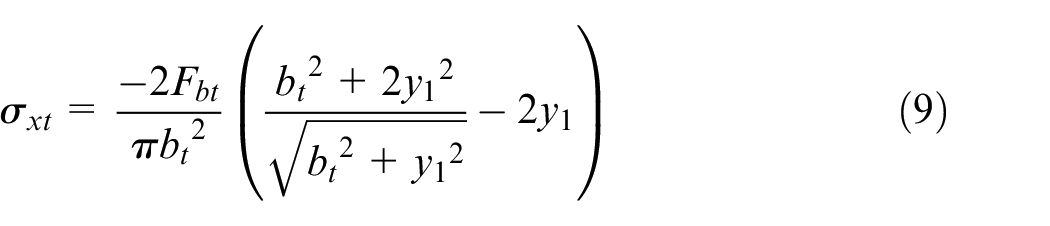


The structural equivalent stresses
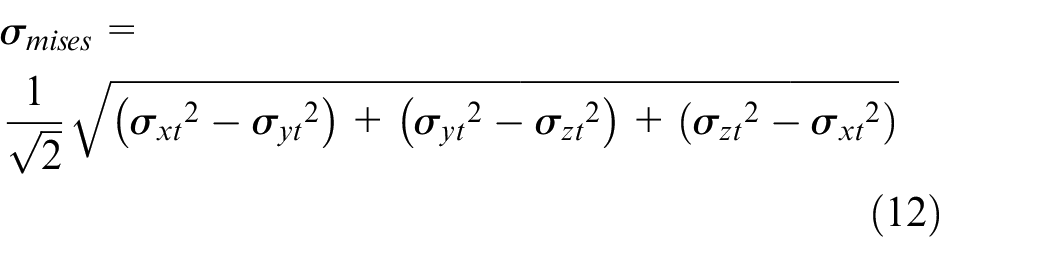
Case study
The finite element method is applied to build a numerical model for sealing structures of the subsea connector, by which thermal forces are loaded after the preloading condition and then the thermo-mechanical coupling stresses are calculated. FEM calculation results are compared with estimated values by ACM.
Finite element model
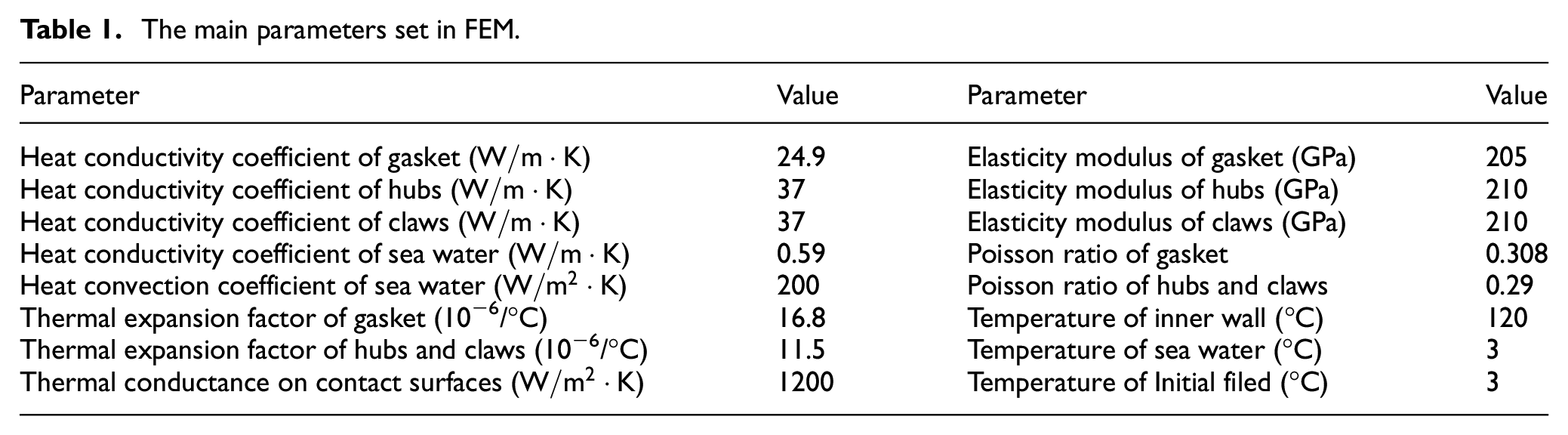
The steady-state heat transfer analysis is carried out to simulate temperature distributions of the sealing structures. Then the temperature field is loaded in the predefined field of mechanical analysis, and the thermo-mechanical stress field is computed. The main parameters set in FEM are as shown in Table 1. The surface-to-surface interaction constrains are set on every contact surface. The normal behavior of contact properties is set as hard contact, and the tangential behavior of contact properties is set as penalty constrain. The friction coefficient is set as 0.15 on every contact surface. Elastic model is set on every material.
The main parameters set in FEM.
Results discussions
Temperature field calculation
The calculated results of temperature field of the sealing structures can be seen in Figure 5. Because of contacting directly with the oil and gas, temperatures of the inner wall of sealing structures are the highest. Temperatures present a downtrend from the inner side to the outer side, and the lowest temperature appears on interaction regions of the outer surface on claws. A detailed view of the gasket is given in Figure 6, and the temperature decreasing trend on the whole is also from the inner wall to the outer wall. To further learn about the changes of temperatures, a path MN along the radial direction of the gasket cross section is selected, and temperatures of various points on path MN are described in Figure 7. It can be seen that two curves, representing different calculation results by FEM and ACM of temperature distributions on path MN respectively, are consistent, and the maximum temperature deviation of ACM on various points is 0.5% when it is compared with FEM. The analytical-predicting temperature on outer wall, which is of great concern in the temperature distribution functions, also consists with FEM results with a deviation of 0.3%. Through analyzing the deviations, the analytical equations developed in this article are accepted to estimate the temperature distribution along the radial direction of the gasket cross section, which will be beneficial to compute the theoretical thermal stress accurately.
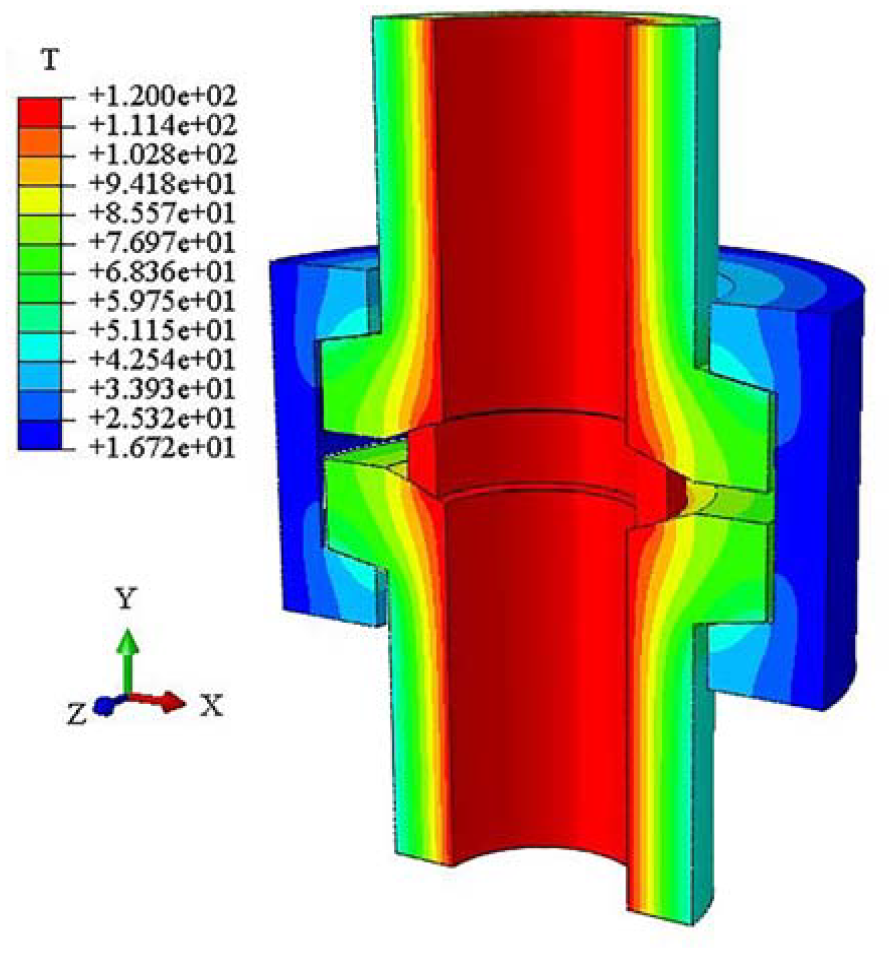
Temperature field of sealing structures of subsea connector.
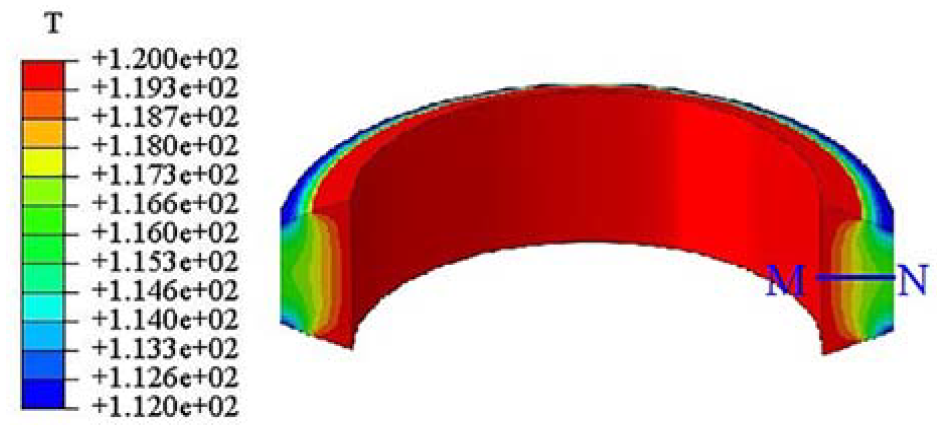
Temperature distributions on gasket.
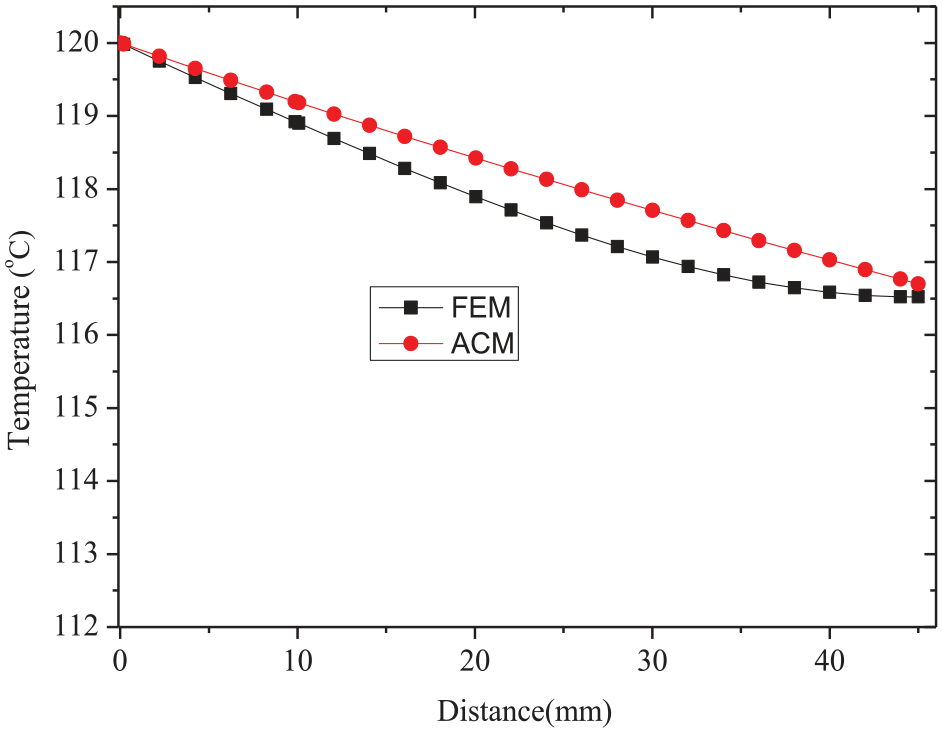
Temperature change curves along path MN.
Thermo-mechanical coupling calculations
Five parameters calculated by FEM and ACM are listed in Table 2, which are the amount of compression, the contact width, the maximum contact pressure, the contact load and the maximum equivalent stress. As shown in Table 2, analytic solutions of the equivalent contact width, the maximum equivalent contact pressure and the equivalent contact load by ACM all agree with FEM results, with the relative deviations of 9.1%, 6.8% and 8.3%, respectively. When it comes to predicting the structural deformations, deviations of the equivalent compressive amount and the maximum equivalent stress are 4.4% and 2.2%, respectively. The deviations are caused by the temperature distribution functions based on the analytical-predicting temperature, and the analytical calculation relationships between contact loads and compression amounts based on assumptions of the contact mechanics model. Viewing from these five comparison indexes, it can be concluded that the ACM developed in this article is well consistent with FEM calculation results. The equivalent stresses and stress components of various points on the axis o1y1 obtained by ACM are compared with the ones by FEM, as shown in Figures 8 to 10.
Comparison of calculation results by FEM and ACM.

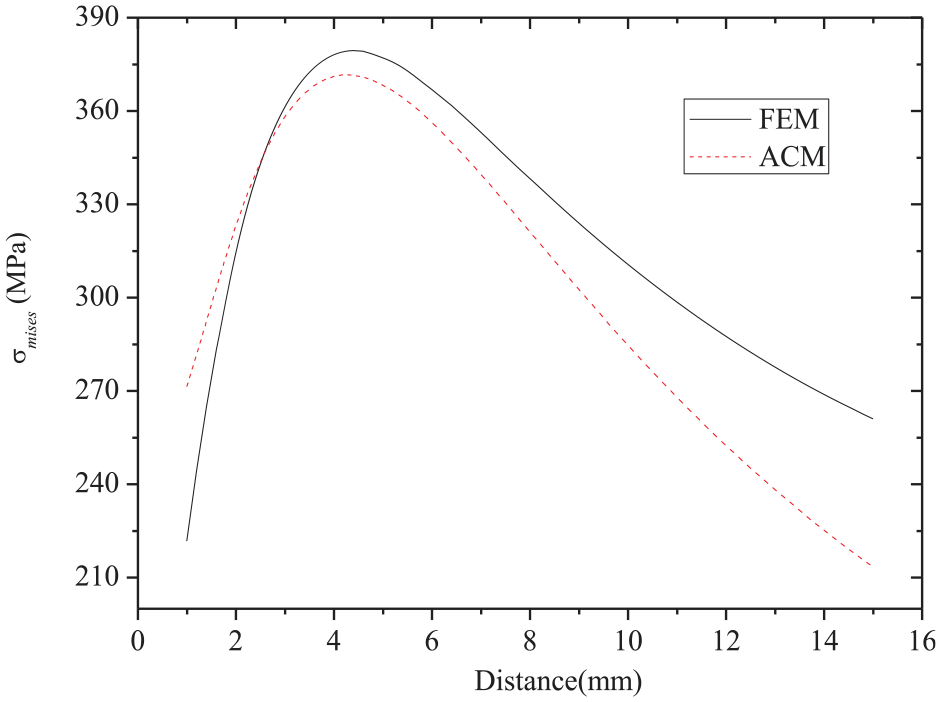
Comparison of σmises of various points on the axis o1y1.
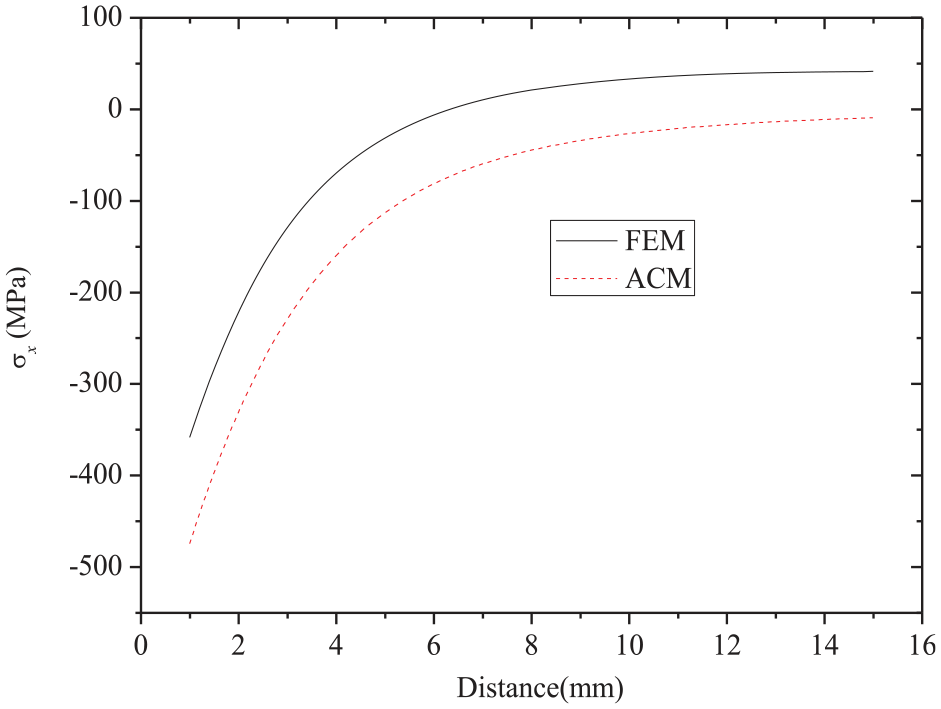
Comparison of σx of various points on the axis o1y1.
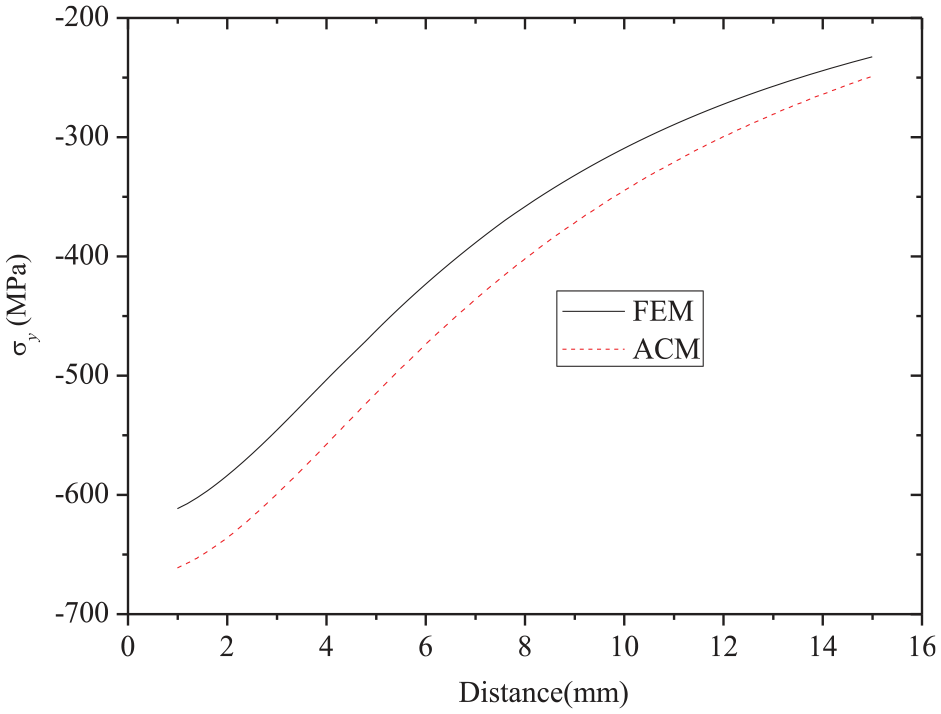
Comparison of σy of various points on the axis o1y1.
It can be seen from Figure 8 that the equivalent stresses increase firstly, and thereafter reach to the peak on a certain point, then decrease with the growth of distances far away from point o1. The calculated values of ACM and FEM have the same changing trend. The peak value by ACM is 371.6 MPa, which is on a certain point far away from point o1 with a distance of 4.4 mm. As a contrast, the peak value by FEM is 379.9 MPa, which is on a certain point far away from point o1 with a distance of 4.6 mm. It can be concluded that the calculated results from ACM agree very well with the ones by FEM in predicting the position of weak point and the peak value. As portrayed in Figures 9 and 10, with the increase of distances far away from point o1, the stress components σx and σy all decrease, and the calculated values of both methods have the same changing trend. Compared with the stress value calculated by FEM, the maximum deviation of σx by ACM is beyond 20%, while the maximum deviation of σy is within 13%. Therefore, the analytical calculation method developed in this paper is more suitable to predict the peak value of equivalent stresses σmises on the weak point than stress components, and it is more accurate to estimate the normal stress component σy than the tangential stress component σx.
Influence on sealing performance generated by thermal loads
In order to analyze the influence on sealing performance generated by thermal loads, sealing parameters and structural deformation parameters under the preloading condition, that is, the condition before loading thermal forces, and the thermo-mechanical coupling condition, that is, the condition after loading thermal forces, are compared. As listed in Table 3, the amount of compression changes distinctly with a 2.75 times growth upon loading thermal forces. With the increase of the amount of compression, the reaction force on the contact region between the gasket and the hub, that is, contact load Fb, will be four times of the one under preloading condition, which directly makes the contact width and contact pressure increase, as well as structural stresses. Comparison statistics show that loading thermal forces will cause an increase in the sealing parameters, so thermal loads are benefit to the sealing performance of the subsea connector. However, loading thermal forces will also lead to the increase in structural stresses, which brings about disadvantages for the safety of structural strength. Structural stress distributions of the gasket on two different conditions are presented in Figures 11 and 12. It can be seen that the influence region by contact loads enlarges distinctly as well as the contact width after loading thermal forces, and structural stresses of the region under contact loads also change obviously with a transformation of the weak point’s position. Two curves of the equivalent stress of various positions on the axis o1y1 are portrayed in Figure 13, which represent the effect on structural stress made by preloads and thermal loads. It is observed that the peak value of equivalent stresses on the thermo-mechanical coupling condition increases by reaching to two times of the one on the preloading condition. The position of the peak value of equivalent stresses moves toward the inner of gasket’s structure when load thermal forces.
Comparison of structural deformation and sealing parameters on different conditions.

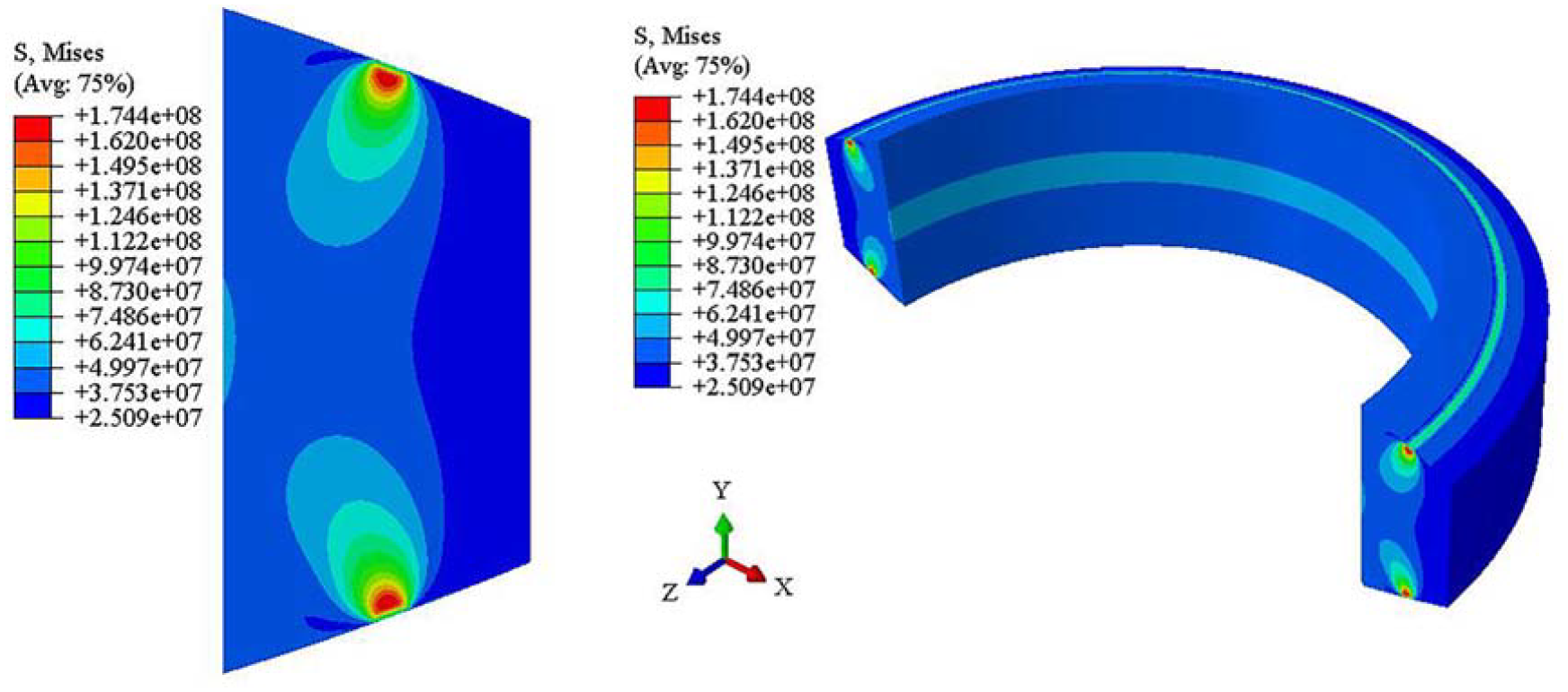
Structural stress distributions of the gasket on the preloading condition (2D and 3D).
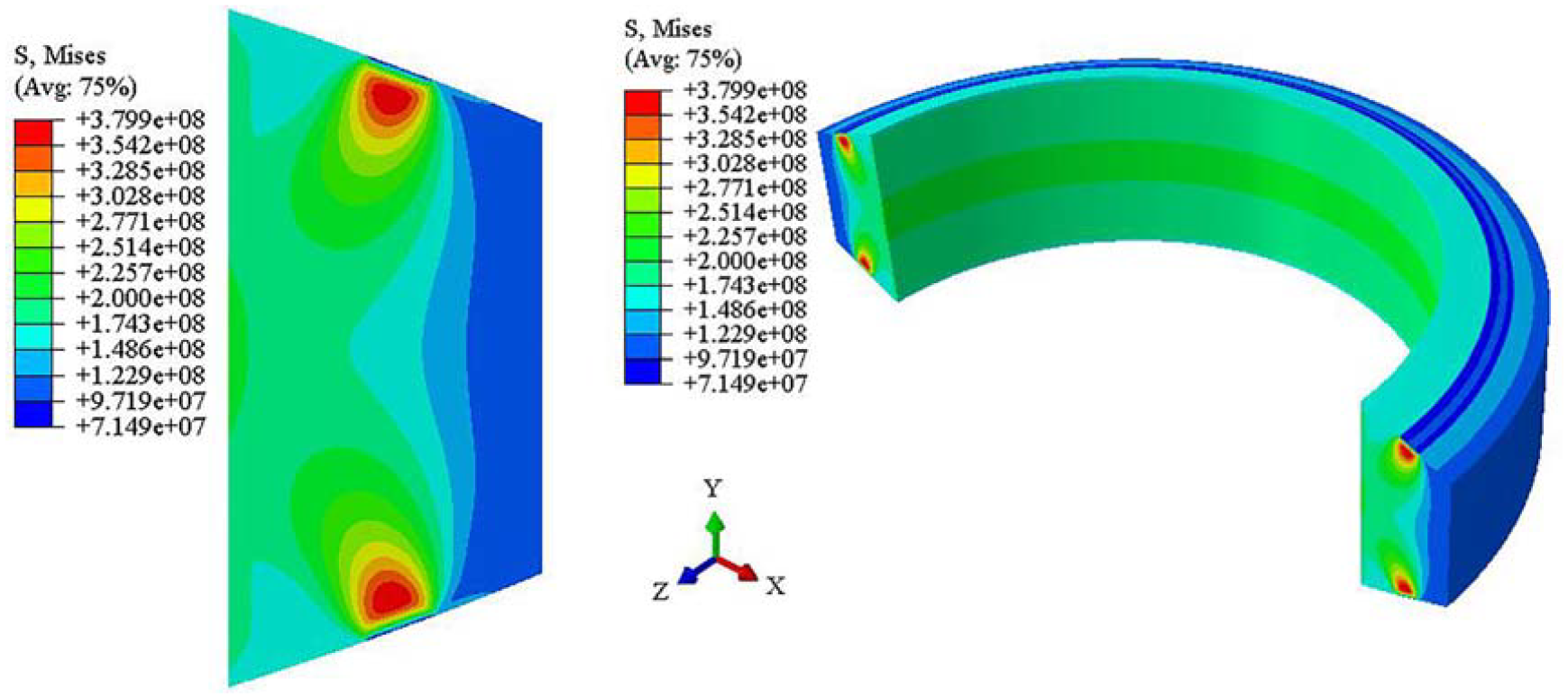
Structural stress distributions of the gasket on the thermo-mechanical coupling condition (2D and 3D).
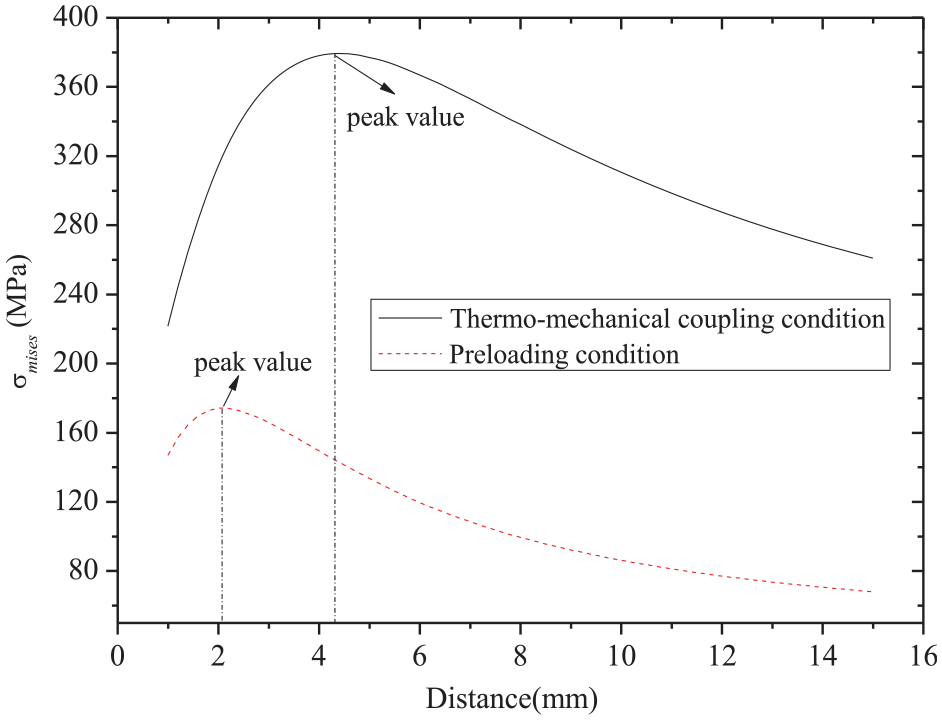
Curves of the equivalent stress of various positions on the axis o1y1 on different conditions.
Conclusions
The sealing contact region between the gasket and the hub of subsea connectors presents a complicated boundary condition of contact constraints, which results in failing to take advantage of the current theoretical formulas of thermal stresses for thick-walled cylinders to calculate structural stresses of the gasket. Consequently, it is difficult to evaluate influences on sealing performance generated by thermal loads in an analytical calculation way. To solve this problem, the thermal load is converted into an equivalent compression load, and then the structural stresses and sealing parameters are estimated analytically through loading this equivalent compression force on the contact region of the gasket and utilizing the developed analytical relations between contact loads and sealing parameters as well as stress components. In this way, an analytical calculation method (ACM) is developed for the sealing structure of subsea connectors to evaluate the thermo-mechanical coupling strength and sealing performances. Numerical simulations of thermo-mechanical coupling by FEM are adopted for the sealing structures of subsea connectors to validate the ACM. The main conclusions are as follows:
The analytical-predicting temperature on the outer wall of the gasket is consistent with FEM results with a relative deviation of 0.3%. The analytical temperature distribution functions to estimate the temperature distribution along the radial direction of the gasket cross-section agree well with FEM results with a maximum temperature deviation of 0.5%.
Compared with FEM results, deviations of analytic solutions of the equivalent contact width, the maximum equivalent contact pressure, the equivalent contact load, the equivalent compressive amount and the maximum equivalent stress are 9.1%, 6.8%, 8.3%, 4.4%, and 2.2% respectively. Viewing from these five comparison indexes, it can be concluded that the ACM developed in this article is well consistent with FEM calculation results.
Stress distribution curves of various points show that the ACM developed in this article is highly recommended to estimate the peak value of equivalent stresses and confirm the position of the weak point.
The thermal load is beneficial to sealing performances of the subsea connector, whereas it poses disadvantages to the safety of structural strength.
Footnotes
Declaration of conflicting interests
The author(s) declared no potential conflicts of interest with respect to the research, authorship, and/or publication of this article.
Funding
The author(s) disclosed receipt of the following financial support for the research, authorship, and/or publication of this article: This work was financially supported by the National Natural Science Foundation of China (Grant No.52201335) and Natural Science Foundation of Jiangsu Province, China (Grant No.BK20200165).
