




Abstract
Fault detection and diagnostics (FDD) have great potential to enable safety, efficiency, and reliability measures of critical machinery systems. However, it is clear that there is a lack of systematic literature review to identify and classify the FDD studies conducted within the scope of marine engineering. This paper offers a systematic review of FDD models particular to marine machinery and systems. The numbers of 72 core articles were highlighted through a comprehensive literature review conducted in the 2002–2022 period. The studies are classified based on the mostly utilized methods such as data-driven, model-based, knowledge-based, and new generation-hybrid. In addition, new generation and hybrid methods are discussed in detail. The experimental environment (i.e. shipboard, labs, simulator) and technical details of the conducted studies are extensively discussed. While 56.94% of the examined studies are related to the main engine, 43.06% of them are related to auxiliary engines. In addition, the main and auxiliary engine studies are also divided into subject headings and examined in detail. Given the recent developments in green and smart maritime concepts, a future research agenda of the FDD studies on marine machinery systems is then pinpointed. Consequently, the study stimulates scholars interested in FDD while it enables innovative ideas for marine engineers, technology providers, ship operators, and maritime entrepreneurs.
Introduction
The sustainability, dependability, and accessibility of vessels are crucial demands of the maritime industry. In recent years, safety-related and environmental regulations have become more strict, demanding more rigorous requirements for the condition and operation of vessels in order to achieve higher safety standards. Therefore, efficient, accurate, and timely maintenance becomes crucial. The implementation of the maintenance schedule is one of the most essential issues in the maritime industry. Initially, corrective maintenance practices were implemented, in which repair was conducted only after problems occurred. This strategy will inevitably entail excessive expenses, downtime, and in certain instances, dangerous activities.
In general, maintenance in vessels either follows a Reactive Maintenance (RM) or Preventive Maintenance (PvM) approach. 1 RM may be defined as post-failure repair; hence, it will incur excessive expenditures when major maritime component failures occur during operation. PvM comprises specified maintenance intervals based on regular intervals, age-based maintenance, or inadequate maintenance. 2 PvM will give high dependability, however it requires unnecessary periodic maintenance and procedures on systems that are adequately working. Additionally, crucial marine components are prone to unpredictable failure patterns owing to changing operating loads and environmental conditions. 3 However, RM and PvM need to be developed in order to detect such errors and use them effectively.
Therefore, advanced methods and solutions have been developed to achieve higher compliance in navigational safety, energy efficiency, and ecologically friendly operations in maritime industry. 4 One of these methods is Fault Detection and Diagnostics (FDD). Using learning approaches and methods such as machine learning, deep learning, artificial neural networks and artificial intelligence, it is feasible to identify faults early on, resulting in several advantages. 5 Especially in the last few years, the number of studies in this field has been increasing. Existing literature studies are collected in four main categories:
Data-driven fault detection and diagnostics methods
Model-based fault detection and diagnostics methods
Knowledge-based fault detection and diagnostics methods
New generation and hybrid fault detection and diagnostics methods
Data-driven FDD techniques have gotten a lot of interest from a variety of sectors and are now being used to monitor complicated industrial processes. 6 The analytical models utilized and the quality of historical data are critical to the success of data-driven FDD techniques.7,8 The most widely used and accepted methods are: Hidden Markov Model (HMM), Dynamic Principal Component Analysis (DPCA), Discriminant Partial Least Squares (DPLS), Dynamic Neural Network (DNN), Independent Component Analysis (ICA), Gaussian Mixture Model (GMM), Recursive Partial Least Analysis (Recursive PLA), Hidden Semi-Markov Model (HSMM), Monte Carlo Simulation (MCS) and Support Vector Machine (SVM). Many relevant model-based techniques have been proposed because of the limitations of traditional FDD methodologies.9,10 The most widely used and accepted methods are Observer-based, Kalman filter-based, Causal model, Hierarchical model, Expert systems, Trend analysis, Parity Equation-based, NN, PCA, and PLS. Representative knowledge-based FDD methods include cause-effect analysis based on fault models, expert systems based on human reasoning, neural network (NN) approaches based on the link between faults and process variables, and a mix of NN and fuzzy logic.11,12
When new and hybrid methods are examined, it is seen that most of the technologies used in this field are artificial intelligence, machine learning, and deep learning. For instance, this study’s primary objective is to develop a methodology capable of harmonizing data collected from various onboard sensors and implementing a scalable and responsible artificial intelligence framework to recognize patterns that indicate early signs of faulty behavior in the operational state of the vessel. In particular, the technology investigated in this paper is based on a 1D Convolutional Neural Network (CNN) that is directly fed time series from the given information.13–15 In addition, some studies use machine learning algorithms and hybrid methods such as Support Vector Machines (SVM), Neural Networks (NN), Bayesian Networks (BNs), Gaussian Processes (GPs), Gaussian Mixture Model (GMM), and visualization to perform situation analyses of auxiliary machinery and ship equipment and anomaly detection.16–19 An unsupervised defect detection technique for marine components based on reconstruction. Real operational run-to-failure data given by a well-renowned industrial business are used to validate the suggested algorithm’s benefits. Each data set is susceptible to an error at an undetermined time step. In addition, various levels of random white Gaussian noise are introduced to each data set to simulate a variety of real-world scenarios.20,21 Also, Prognostics and health management (PHM) has emerged as a promising method for formulating the optimal maintenance strategy. PHM seeks to deliver an ideal maintenance plan by using sensor measurements for fault identification and fault prognostics, fault detection being the first and most basic activity. In this research, a variational autoencoder based on long-short-term memory (LSTM-VAE) is suggested for defect detection of onboard nautical components. It is a semi-supervised method that needs just error-free training data.22–25 In addition, auto ships will need sophisticated Prognostics and Health Management (PHM) systems to run and maintain their complex and interconnected systems in a safe, efficient, and cost-effective way. Deep learning (DL) is a viable area for this growth since it is fast-finding applications in several areas, including autonomous vehicles, smartphones, vision systems, and most recently PHM applications. There are studies that present and evaluates four well-established DL approaches that have recently been applied to a variety of real PHM issues. The objective is to encourage innovation and offer motivation for PHM based on DL in auto ships and the marine sector.26–28 The utilization of machine learning and deep learning is also prevalent in the investigation of maritime pollution and accidents. For instance, statistical image segmentation has been widely used to distinguish similar oil spills with varying degrees of accuracy; however, the emergence of digitalization technologies in the fourth industrial revolution (IR 4.0) enables the use of Machine learning (ML) and deep learning (DL) models, which are more promising than the statistical methods. Provide Support Vector Machine (SVM) and Artificial Neural Networks (ANN) are the most widely used machine learning methods for oil spill detection; nevertheless, the inability of ML models to support an end-to-end trainable framework reduces their accuracy. In contrast, the robust feature extraction and autonomous learning capabilities of deep learning models improve their detection accuracy.29–32 In addition, there are studies in which machine learning and algorithms are combined with condition-based maintenance to perform early defect diagnostics on the main engine and various auxiliary engines. For example, this study was conducted using the no-cost Weka data mining application, which was utilized to evaluate the data of the engine’s operational parameters that were discovered to be beyond the prescribed range. The suggested technique is based on the building of an ensemble classification model called “AdaBoost,” which enhances the performance of a fundamental Simple Cart classifier. During the linked experimental activities, the total performance rate was 96.5%, demonstrating that this strategy is an excellent option.33,34 In addition, combining the advantages of Expected Behaviour (EB) models by choosing the appropriate regression model with the Exponentially Weighted Moving Average (EWMA) for defect detection in innovative ship applications, is the suggested solution. It is shown that a multiple polynomial ridge regression model, with a testing R2 score of about 0.96, can correctly predict growing flaws in the Main Engine (ME) cylinder Exhaust Gas (EG) temperature and the ME scavenging air pressure.35–37 Moreover, this paper focuses on the forecasting of two crucial marine features: sea surface temperature (SST) and sea water height (SWH) (Significant Wave Height). In this study, it was suggested to build statistics, deep learning, and machine learning models for forecasting the SST and SWH using a real dataset received from the Korea Hydrographic and Oceanographic Agency.38–41 In addition, there are studies using machine learning for the cylinder block, lubricating oil system, fuel system, turbocharger, and other components. For instance, the purpose of the study is to improve performance monitoring of an electronically controlled two-stroke ship propulsion engine within its working environment. This is accomplished by establishing a machine-learning model that can monitor important operational characteristics and anticipate fuel use. Different machine learning methods, particularly linear regression, multilayer perceptron, Support Vector Machines (SVM), and Random Forests, are used to evaluate the model (RF). The optimal approach is chosen based on common evaluation metrics, namely Root Mean Square Error (RMSE) and Relative Absolute Error (RAE), after validation of the modeling framework and analysis of the findings to enhance the forecast accuracy (RAE).42,43 In studies on propeller and propulsion systems, obtained data were analyzed using machine learning and various algorithms, including multilayer perceptron (MLP), Exponentially Weighted Moving Average control charts, Bayesian diagnostic networks, and energy efficiency, optimization analysis, and sensor status.44–48
Nevertheless, there is a lack of a comprehensive literature review to identify and classify the FDD studies conducted within the scope of marine machinery and marine engineering. However, this type of screening is an onerous need to shape FDD studies for next-generation ships and marine vessels. This study overcomes the mentioned gap. The main aim of this study is to conduct a systematic review of FDD models on main engine and auxiliary engine onboard ships to highlight the future research agenda. The objectives of the study are given as follows: (i) Reviewing the potential of existing FDD studies in marine machinery systems, (ii) Identifying the critical gaps for further improvements, (iii) Highlighting future research potential. The organization of the paper is based on four sections. The first section provides an introductory part on FDD. The second section gives the systematic literature review methodology. The results are provided in the third section. The final section expresses a few concluding remarks.
Literature review methodology
The methodology of this study is built on the systematic literature review which was proposed by Kitchenham et al. 36 To carry out a literature review, Spanos and Angelis’s guidelines are examined. 35 These guidelines are shown in Figure 1. Guidelines are divided into three stages: Planning, Conducting, and Reporting.
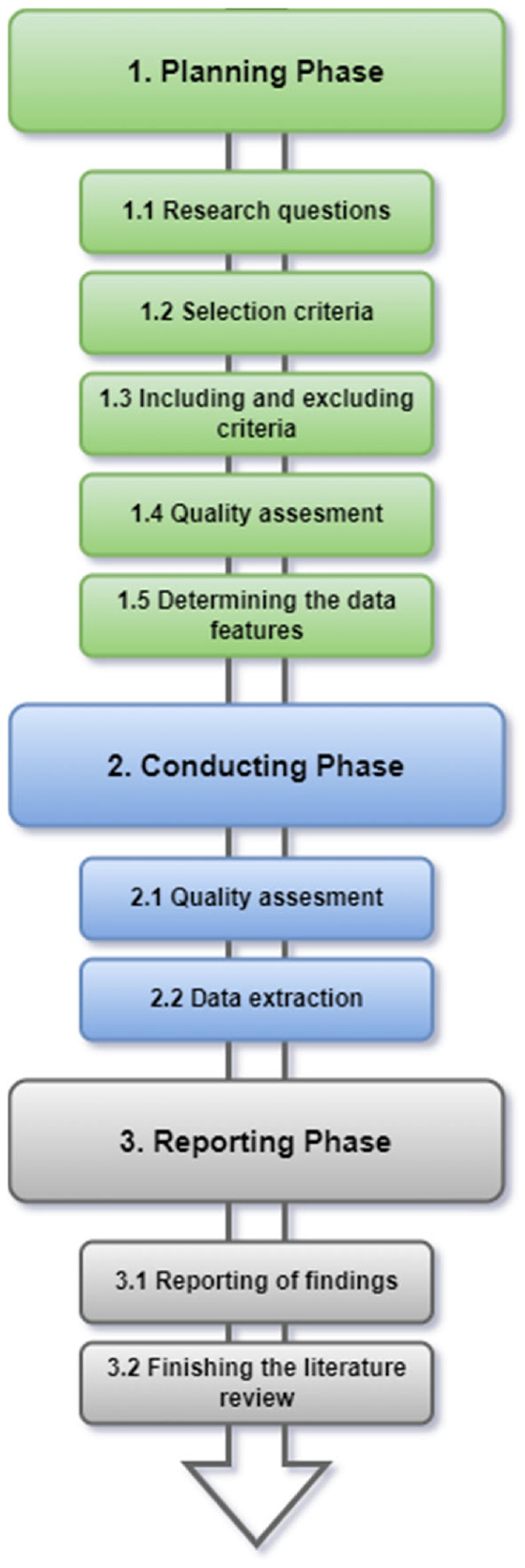
Process of systematic literature review.
Planning
This phase determines the demands of the literature review. Regarding the FDD for marine machinery and systems, there is no systematic review that compiles the findings of such a significant research field. The literature review in FDD for marine machinery and systems can provide deep insight for scientific research. The planning step continues with the creation of a review protocol to specify all required methods for a systematic literature review. It is critical to specify research goals, as well as search terms, restrictions, article selection criteria, quality evaluation, and defining the needed data from selected publications, at this point. For the fault diagnosis in maritime/marine machinery and systems literature, these steps are given below:
Step 1: Research questions. The relevant questions will serve as the foundation for the literature review. The questions should correspond with the to-be-conducted research and establish its scope. Consequently, the research questions were addressed as follows:
How many studies exist, having as subject the impact of FDD on marine machinery and systems?
Which methods have been used in the field of FDD in the maritime field and marine machinery and systems?
What is the method of obtaining the data obtained in the studies (from the ship, from the laboratory environment, simulation and literature data)?
What is the importance of the study in terms of maritime and future studies?
Step 2: Selection criteria. This stage specifies the literature review selection criteria, which should be based on the research questions. In addition, it is decided which digital libraries should be included in the research. Science Direct, Web of Science, Scopus, Taylor & Francis, and Sage databases are used in this research. After that, the period should be set so that search results from certain years may be filtered. In this study, the time interval is conducted between 2002 and 2022 as the impact of very old studies is not likely to be beneficial in terms of FDD literature. The inclusion and exclusion criteria phase also have this drawback. The literature review can begin with the selection of search phrases. These terms can be determined by considering the most popular keywords about the study’s goal. The following search strings were utilized in this literature review:
(“fault diagnostics” OR “fault detection” OR “fault detection and diagnostics”) AND (“maritime” OR “marine”) AND (“machinery” OR “systems”)
Additionally, different variations of this string are utilized to uncover entire research in both FDD and marine/maritime FDD literature in order to acquire statistical data. Even though certain studies meet the requirements, they may not appear in the search results. As a result, after each iteration of the current papers, the snowball backward approach should be used.
Step 3: Including and excluding criteria. These criteria can also be used as a modifier to the selection criteria that have already been established. After each cycle, they define which papers can be included or excluded. As a result, these requirements must be explicitly defined. The following are the inclusion and exclusion criteria for this literature review:
Step 4: Quality assessment. Papers with unclear or partial data are eliminated using the quality evaluation criteria. As a result, they are removed from the research database since their quality is not judged adequate. The major requirements for quality evaluation in this study are an explanation of the used methodology, a demonstration of the application technique, and a presentation of the findings.
Step 5: Determining the data features. The data types collected from the papers should be identified in this final step of the planning stage. These data are essential to generate significant findings, as stated in the study’s goal. Authors, Year of Publication, Country, Methodology, Data Source, and Target System are the data aspects in this review. The planning stage ends after the review protocol is completed. After that, there should be a conducting phase.
Conducting phase
When the planning step is complete, the literature review protocol begins. To finish this stage, the final database should be generated by taking into consideration the requirements indicated above at each step. These studies were assessed, and then implemented quality rating and exclusion criteria. In each phase, the number of studies was altered. After applying the backward snowball approach, the final number of chosen articles was determined.
Reporting phase
A complete examination of marine/maritime FDD literature should be carried out, according to the database of final publications. This section of the systematic literature review might also include statistical results. As a result, the findings of this study are detailed in the results section, together with all other results.
Results
Brief overview
The purpose of this paper’s systematic literature review is to find answers to the research questions as well as to fulfill the study’s goal. Nonetheless, a statistic can be useful in determining the status of marine FDD research in the overall FDD field. Hence, the first searching string is specified as: (“fault diagnostics” OR “fault detection” OR “fault detection and diagnostics”). The findings of this search correspond to a number of 136,786 research papers within the specified databases between 2002 and 2022. Secondly, the string is changed to (“fault diagnostics” OR “fault detection” OR “fault detection and diagnostics”) AND (“maritime” OR “marine”) to examine maritime FDD studies. The number decreases to 4521. After, the research string is changed to (“fault diagnostics” OR “fault detection” OR “fault detection and diagnostics”) AND (“maritime” OR “marine”) AND (“machinery” OR “systems”). According to the results, the number decreases to 1024.
For FDD about marine machinery and systems literature; titles and abstracts of these 1024 papers are inspected and only 156 of them remain. After that, this number decreases to 55 by applying exclusion criteria. In this step, the backward snowball method was carried out. As a result, another 17 studies have been found. Finally, 72 articles were found to be examined by the scope and objectives of the study. All these numbers and steps are shown in Figure 2.
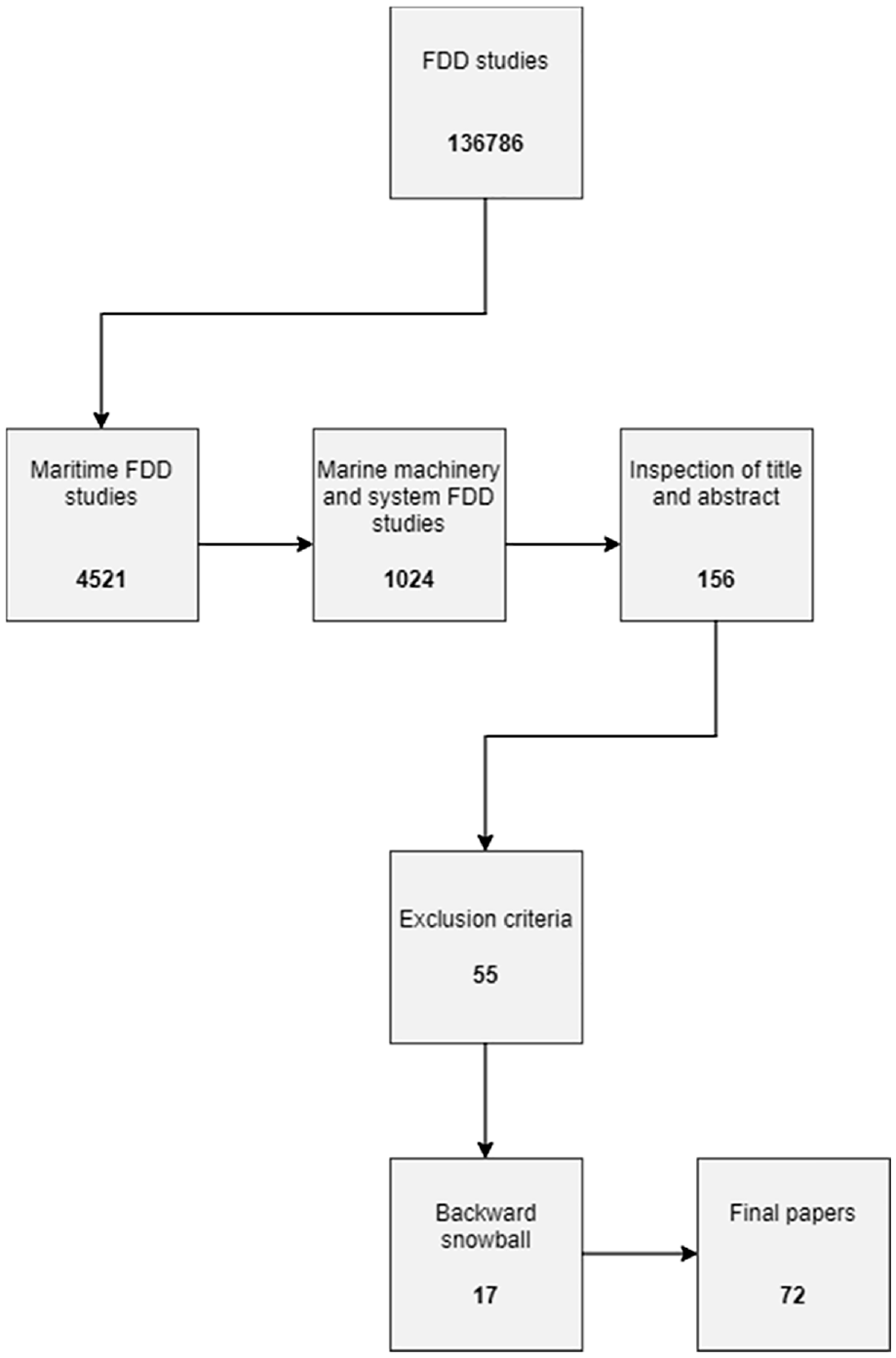
The steps to reach final papers for FDD marine machinery & system.
Sources of publications
The final 72 studies were examined and necessary notes were taken. Authors, country, method, target system, and years are demonstrated in Table A.1 in Appendices. When looking at the studies in the field of FDD for marine machinery and systems, country distributions are seen in Figure 3. Countries that are the source of publications are the UK, China, France, USA, Australia, Taiwan, Greece, Austria, Canada, Poland, Iran, Croatia, Turkey, Spain, Russia, Norway, Sweden, Korea, Malaysia, Italy, Germany, and Ireland. In the country ranking, the countries that contribute the most to FDD are China (28), the UK (25), the USA (17), Taiwan (15), Australia (12), and France (14) respectively. It should be noted that, if more than one different country participated in a study, all countries are counted as they conducted one study. Therefore, the total numbers are larger than the paper quantities. For example, while the number of studies reviewed is 72, the total of contributing countries is 201.
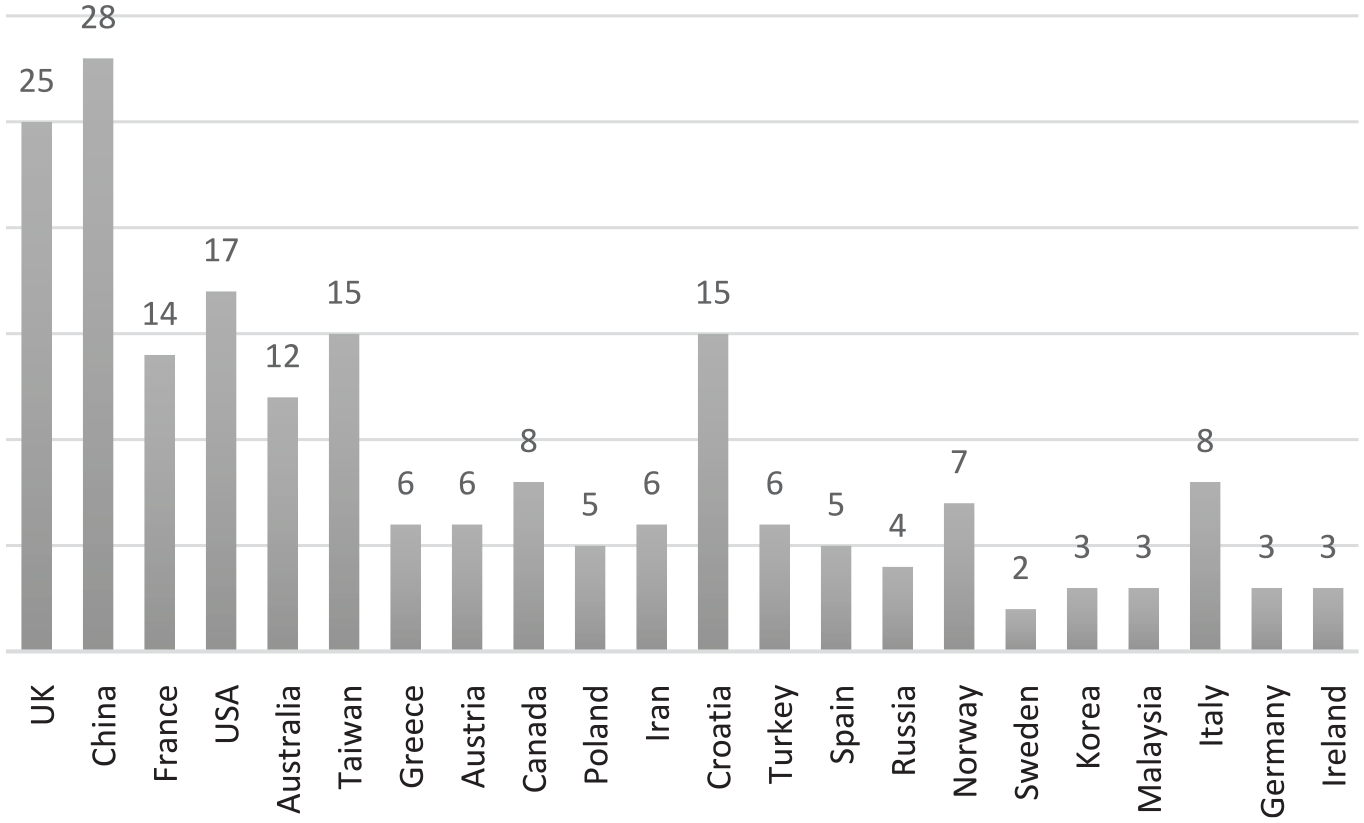
Distribution of countries in FDD for marine machinery & system.
Figure 4 shows the distribution of research by year and the pace of growth after a study of the relevant literature. It has been discovered that the amount of research undertaken after 2018 has grown. It was established that 4 studies were conducted in 2018, 6 studies in 2019, 12 studies in 2020, 13 studies in 2021, and 6 studies in 2022. In addition, based on the number of approved studies for 2022 that have not yet been published, that the number of accepted studies has steadily grown since 2018. As can be seen, the significance of fault identification research in the marine industry is expanding. It should be noted that these numbers are in line with the scope of the present study, the number of out-of-scope publications may vary.
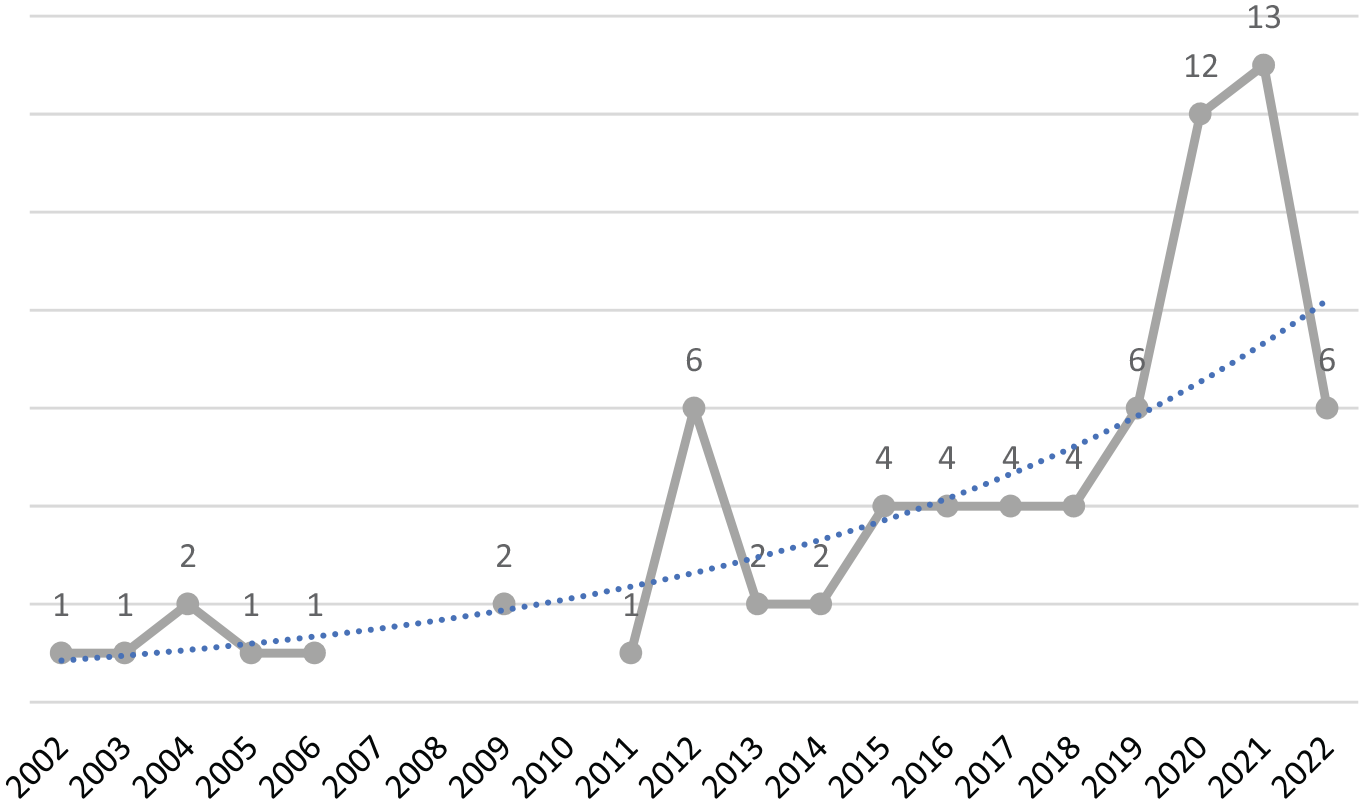
Distribution of FDD for marine machinery & system studies based on publication years.
Another subject of examination of the studies carried out is the method of using and testing the methodology. The experimental environment distributions of the studies are shown in Figure 5. In particular, it is seen that simulation and laboratory environments are used in the majority of studies due to hazardous environmental conditions. In addition, it has been observed that the most used test environment is the simulator with 26 studies and thus the percentage of these studies was 36.11%.
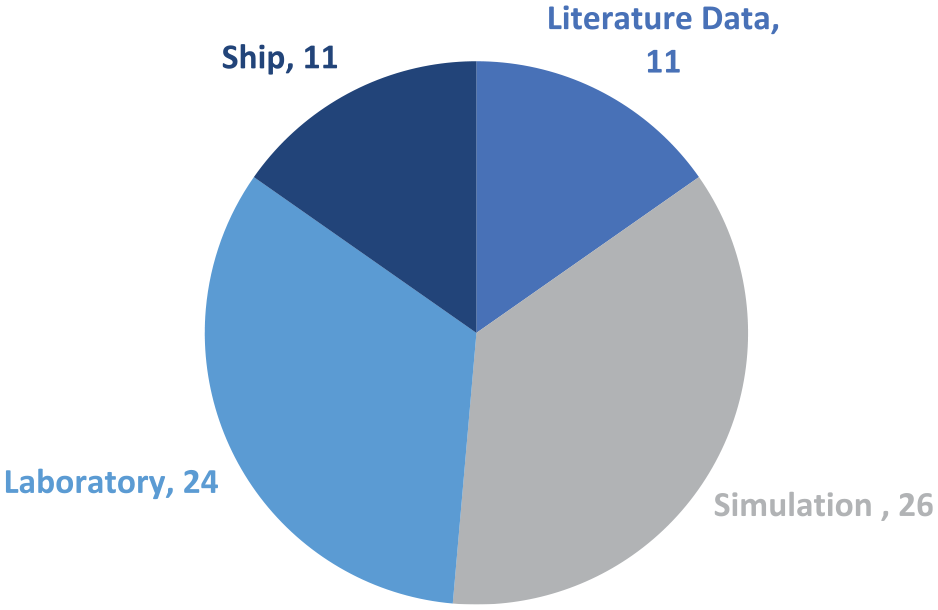
Distribution of FDD for marine machinery and system studies based on experimental environment.
Traditional fault detection and diagnostics framework
When the last documents were examined, it was seen that 25 of the 72 studies were conducted using the traditional method, and thus the percentage of these studies was 34.72%. The biggest difference between these studies from the next generation and hybrid methods is that there is no modeling and a self-learning algorithm that can make predictions as in the new generation and hybrid studies. The traditional method of the studies is given in Figure 6. First of all, the data of the system to be examined are obtained. Examined data are taken, prepared, stored, and made ready for use. This section is called data processing. Then, filtering is performed to retrieve data about the faults of the system to be examined. This is called property extracting. The filtered data is used with a model for learning and classification. This is called transfer learning strategies. After the method to be used is selected, the data is used according to the requirements of the method. This stage is called classification. At the last stage, fault diagnoses are taken from the system according to system components and values.
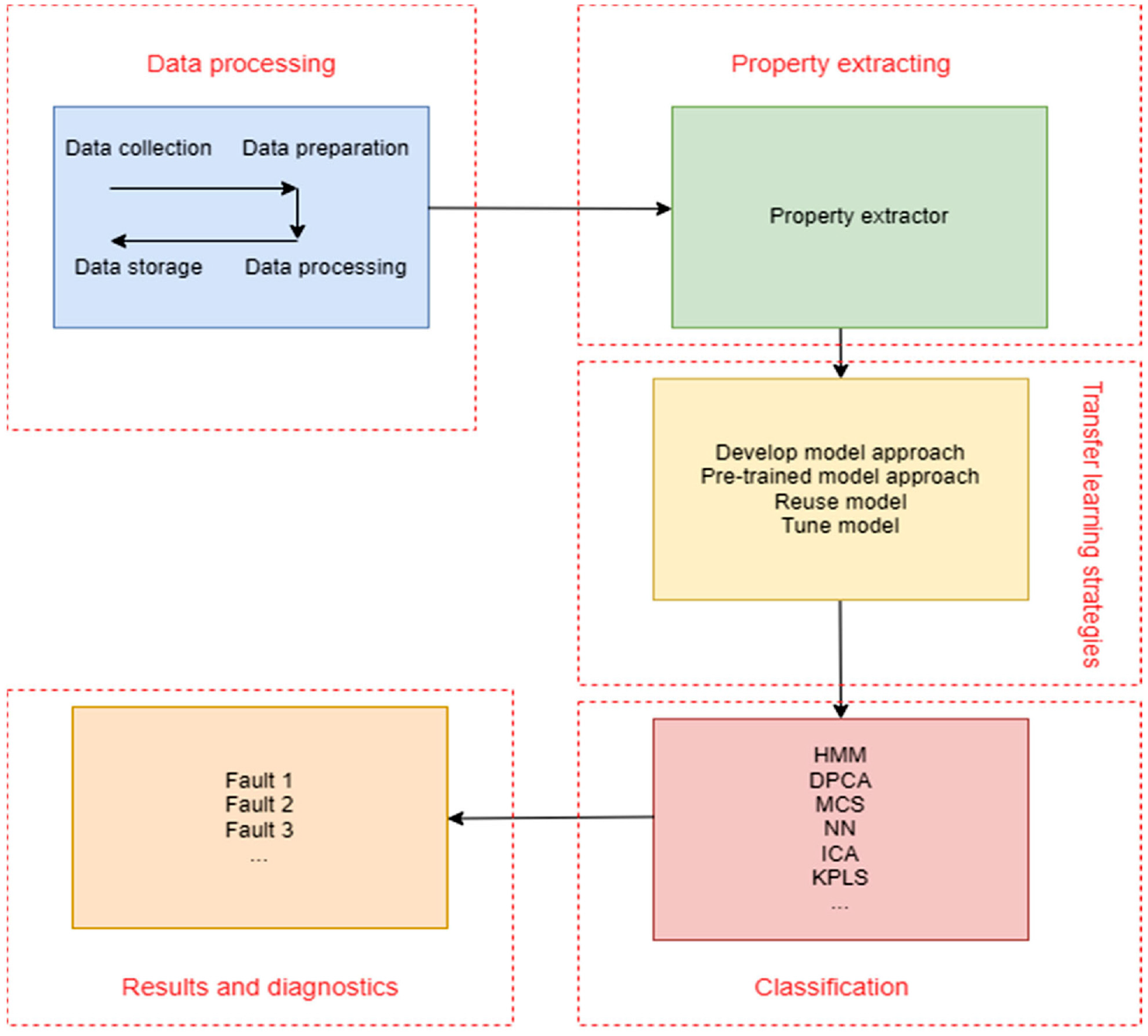
Illustration of traditional fault detection and diagnostics methodology.
New generation and hybrid fault detection and diagnostics framework
Technologies such as machine learning, deep learning, artificial neural networks, and artificial intelligence, are widely used in the fault diagnosis of ship machinery and systems. When the last 72 articles are examined, it is seen that new generation and hybrid methods are used in a total of 47 studies, thus these studies constitute 65.28%.
In the data acquisition section, raw data is received from maritime companies, along with sensors placed on ship machinery and various systems. In the data preparation part, the data is cleaned, filtered, and made suitable with various technology tools to make the received data ready for use. Here, methods such as machine learning methods, deep learning, and artificial intelligence are preferred. After the algorithm is selected, some of the data is used to train and teach the model. For example, in some studies, 25% of data is used for teaching and 75% of data is used for testing the model, while this rate varies from algorithm to algorithm. After this stage, it is time to apply and test the model. In the model development section, the trained algorithm is tested and run on the component to be diagnosed, such as the main engine turbocharger system, fuel system, and lubrication system. In the model optimization, in the parameter tuning part, the results obtained are more optimized. Then, when the reliability of the model is at the appropriate level, it is ready for self-learning and prediction. The ability of the model to make predictions is extremely important for the success of the study. After the successful conclusion of this phase, the model is ready to be used in real machines and applications. Some of the most used methods in this field are Machine Learning (ML), Artificial Neural Network (ANN), Deep Learning (DL), Artificial Intelligence (AI), Bayesian Diagnostics Network (BNN), Support Vector Machine (SVM), and Exponentially Weighted Moving Average (EWMA). The new generation and hybrid method of the studies is given in Figure 7.
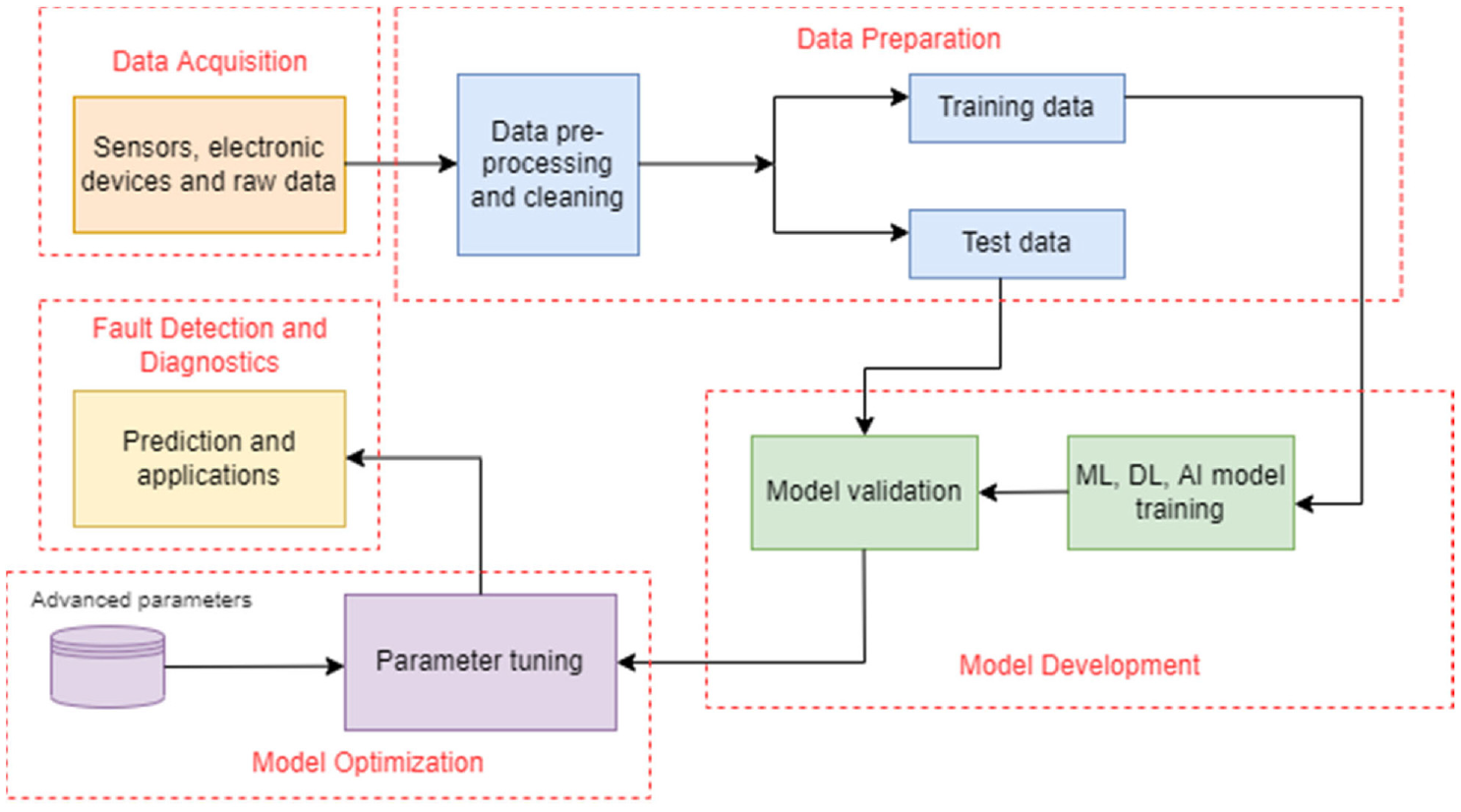
Illustration of new generation and hybrid fault detection and diagnostics methodology.
New generation and hybrid fault detection and diagnostics studies
When the last 72 articles were examined, it was determined that new generation and hybrid methods were used in 47 studies and the percentage of these studies was 65.27%. In this section, the most frequently used methods in the studies will be discussed. Since more than one method is used in a study, the sum of the methods used will be more than the total number of studies.
One of the most used machine learning methods in the articles was Support Vector Machine (SVM) with 35 times and constitutes 74.46%. The second most used method was K-Nearest Neighbor (KNN) with 14 times usage and constitutes 29.78%. Third, the most widely used method was the Decision Tree (DT) with 13 uses, with the percentage of 27.65%. In studies, it generally plays an important role in choosing the method to be used and taking references. Fourth, the Gradient Boosting (GB) algorithms have a 21.27%, with a total of 10 uses. Examples of these are Cat-Boost and Ada-Boost. Fifth, Bayesian Networks (BNs) has a 19.14%, with a total of nine uses. And sixth, Artificial Neural Networks (ANNs) have a 17.02% with a total of eight uses. Finally, Neural Networks (NNs) and Exponentially Weighted Moving Average (EWMA) methods have a 12.76% with a total of six uses.
System-based distribution of studies
In line with the last 72 articles reviewed, the first stage is divided into two main engines and the auxiliary engine. For marine diesel engines, the number of main engine studies is 41 and thus the percentage of these studies is 56.94%, while the number of studies on auxiliary engines is 31 and these studies constitute 43.06%. It has been determined that main engine studies are more common in the literature due to the necessity of studies on energy efficiency and emissions, especially such as IMO’s 2030 and 2050 targets, decarbonization, and green shipping. The distribution of studies is shown in Figure 8.
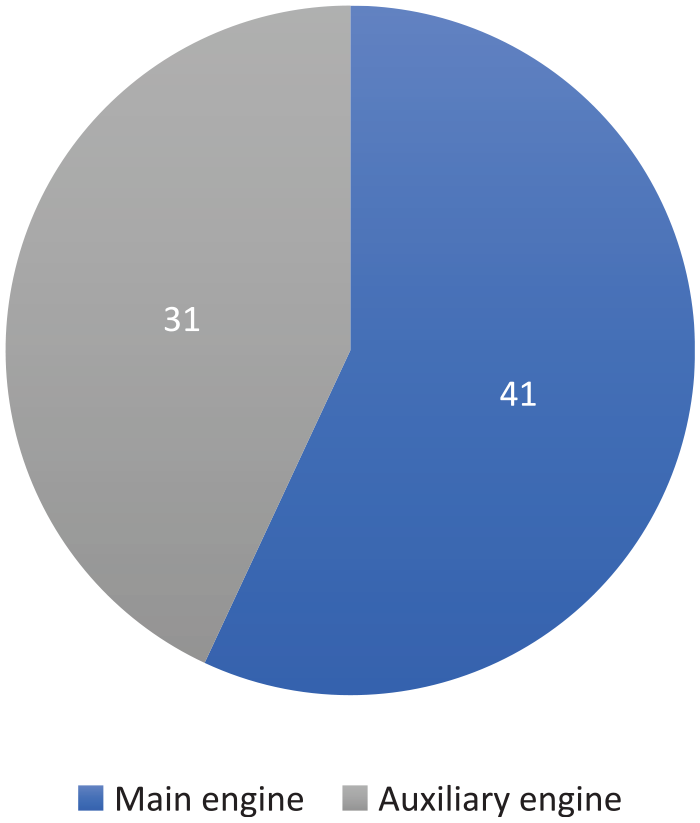
Illustration of articles based on commonly used target systems.
In the second stage, main engine and auxiliary engine studies were examined separately. In the main engine studies, there were seven studies with cylinder and liner in the first place. In this respect, cylinder wear, corrosion, and other cylinder characteristics were measured. By the obtained data, machine learning, deep learning, and different algorithms are utilized to forecast potential cylinder and liner defects. Secondly lubrication oil system, thirdly cylinder lubrication oil, and fourthly combustion system and exhaust system studies. Then there are three studies on fuel oil systems and main bearings and bearings and exhaust valves, fuel injector studies. Finally, there are articles on starting air, intake system, dual fuel engine, and scavenging air systems with two studies each. The distribution of main engine studies is shown in Figure 9.
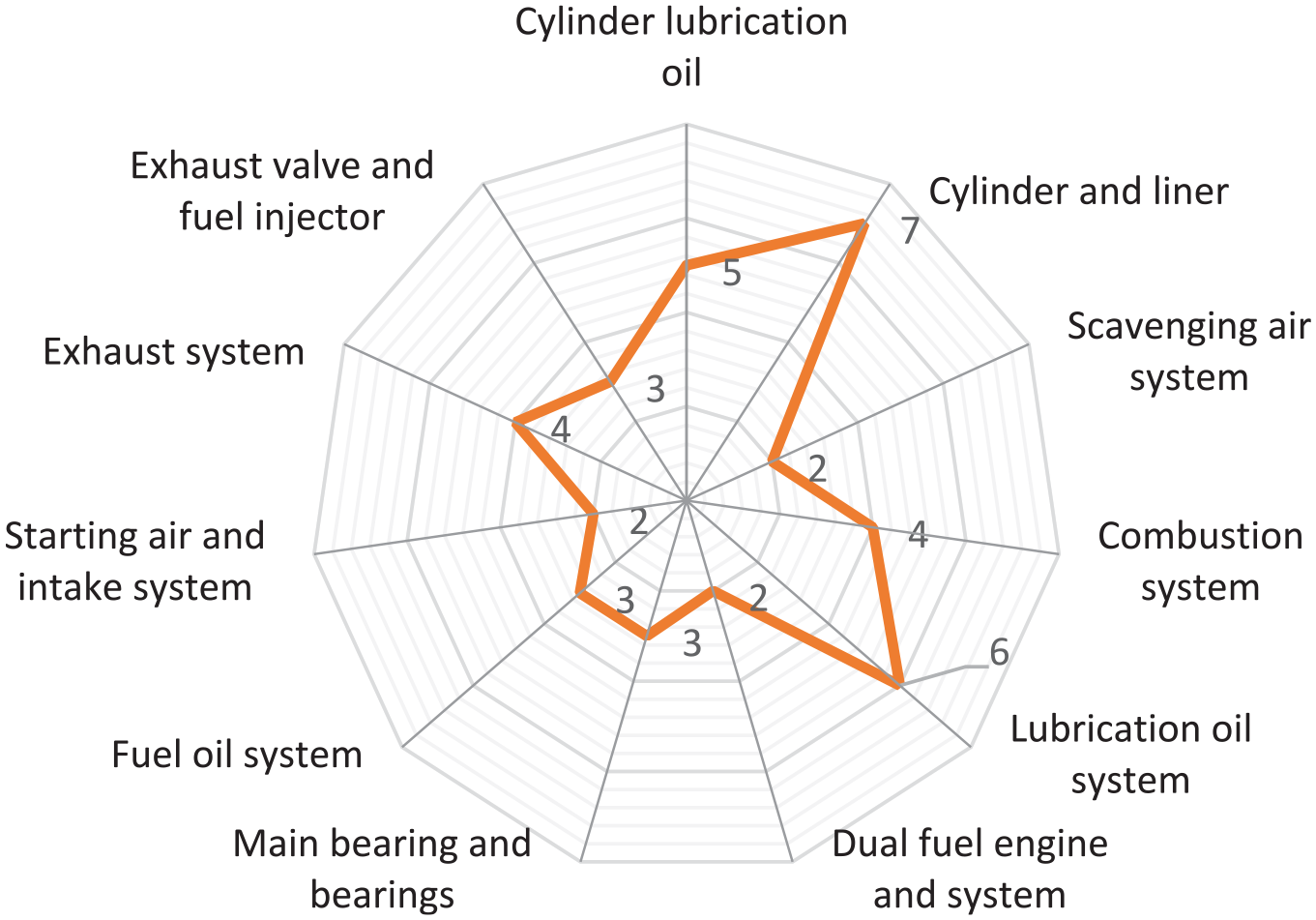
Distribution of main engine components and systems studies.
When the auxiliary engine studies are examined, the number of propeller and propeller shaft studies is 5, marine turbine and turbine blades studies 4, electric motor, batteries, and transmitter studies are 3, gas turbine system studies are 2, unmanned vehicle propeller studies are 3, air and gas handling system studies are 2, steering gear system studies are 3, offshore wind turbine system studies are 2, marine turbocharger and turbocharging system studies are 2, air condition and HVAC system study is 1, diesel generator studies are 2 and steam power propulsion and feedwater system studies are 2. The main goal of the propeller and propeller shaft studies, which make up the majority of studies in this field, is to develop a methodology capable of harmonizing data collected from various onboard sensors and implementing a scalable and responsible artificial intelligence framework, to identify patterns that indicate early signs of faulty behavior in the operational state of the propellers. The distribution of auxiliary engine studies is shown in Figure 10.
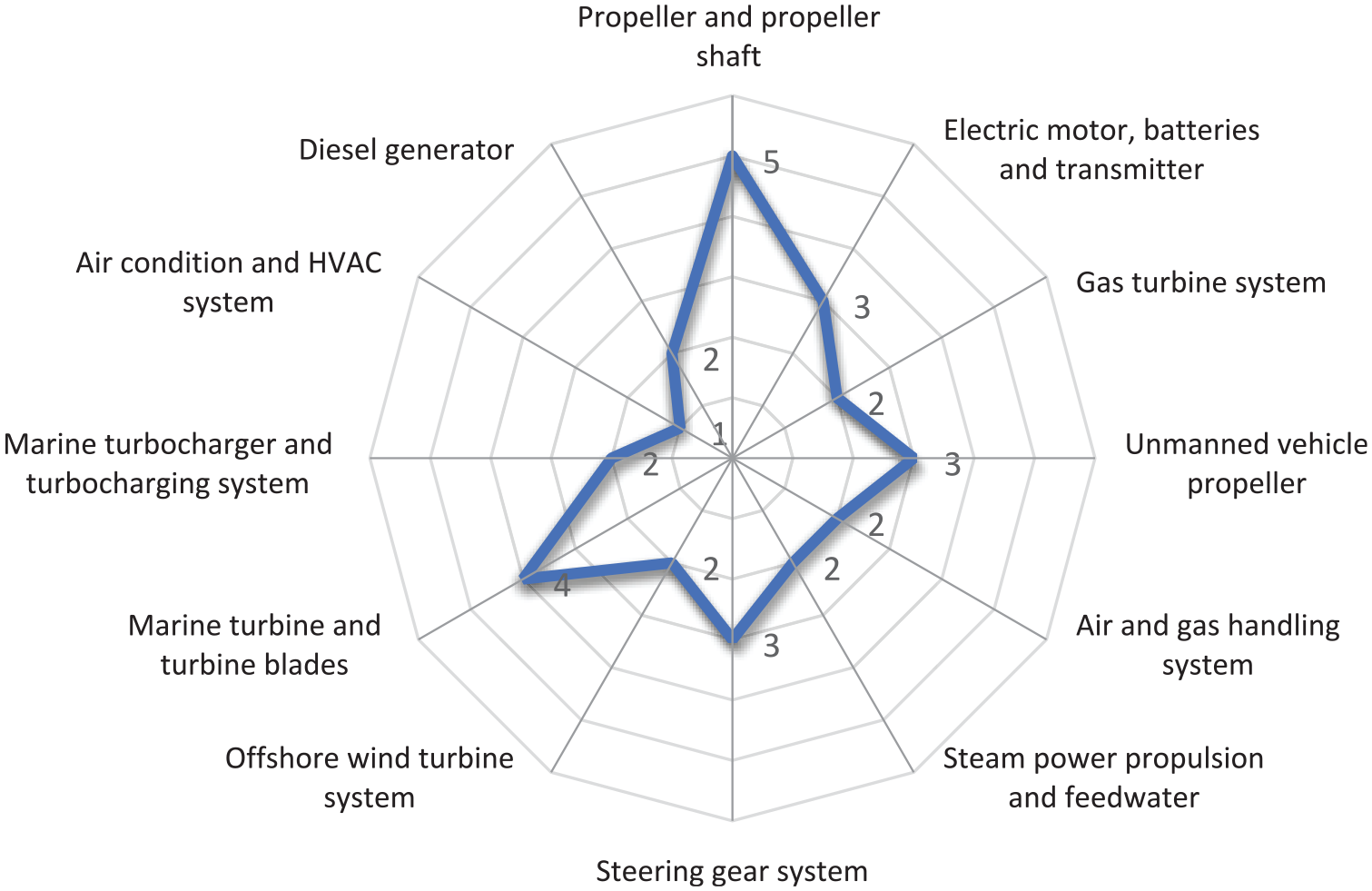
Distribution of auxiliary engine components and systems studies.
Technical details of studies
Main engine studies
When the subjects of the studies on the main engine are examined, there are emission reduction measures, studies to increase efficiency, and early fault diagnosis. The primary objective of the main engine studies is to create and develop a model based on current data, to select Machine Learning (ML) algorithms, deep learning (DL), Prognostics and Health Management (PHM), Support Vector Machine (SVM), Neural Networks (NN), Bayesian Networks (BNs), Gaussian Processes (GPs), Gaussian Mixture Model (GMM), and ensemble methods, to develop and explain the most appropriate model for quick and accurate detection of malfunctions that may.49–53 As a result, the purpose of this research is to serve as an example of a successful data-based decision support system.
When the main engine cylinder, liner, and piston ring fault diagnosis are examined, the primary monitoring parameters in the cylinder of a marine diesel engine include cylinder exhaust outlet temperature, early injection timing, late injection timing, worn injector nozzle, clogged injector nozzle, exhaust valve leakage, contaminated scavenging airports, cylinder air inlet temperature, cylinder liner water outlet temperature, cylinder piston oil outlet temperature, cylinder liner mean temperature, cylinder cover mean temperature, cylinder fuel oil pump wear, cylinder scavenging airbox fire, cylinder fuel oil high press pipe rupture, cylinder indicated power, cylinder combustion pressure, cylinder compression pressure, and cylinder time of ignition.54–58
General issues in studies related to intake and exhaust systems, air compressor failure, the impeller or diffuser dust build-up, and damage that results in geometry changes are the typical culprits for compressor failure. By decreasing the compressor’s isentropic efficiency and air mass flow rate (by 5%, 10%, or 15%), the compressor failure is simulated. Air cooler failure, the failure of the air cooler is typically brought on by an increase in fouling on its inner wall, which results in an excessive pressure drop and a decrease in cooling capacity. By decreasing the isentropic efficiency of the air cooler (by 5%, 10%, or 15%) and increasing the intake and output pressure fluctuation, failure is simulated.59–63
When the fuel oil system is analyzed, the following categories of marine fuel system states are produced as a result of the interaction of various pressure waveform features normal state, insufficient fuel supply (75% oil, 25% oil, idle oil volume), stuck needles to plug holes (small oil quantity, standard oil quantity), needle valve leakage, and oil valve failure. That is, eight sub-states, normal injection, 75% oil volume, 25% oil volume, idle oil volume, injector needle stuck 1, injector needle stuck 2, injector needle leakage, and high-pressure pump outlet valve failure. Where the system condition other than the usual state falls within the category of marine fuel system failures. In the event of a shortage of oil, the waveform, waveform area, and average waveform will all drop along with the waveform as the oil supply declines. The pressure wave increases extremely rapidly and the pressure wave curve is sharp when the needle valve is situated in faults. In the pipe, the reflected wave is also rather strong, the durability duration is longer, and the residual pressure is larger than the usual pressure.64–67
The subjects of lubrication oil system studies are analysis of cylinder lubricating oil, determination of wear conditions of lubrication pumps, condition-based maintenance planning of filters and other lubricating oil elements, fault prediction according to the characteristics of the lubricating oils used in the main and auxiliary machines and according to the condition of the lubricating oil. cylinder wear is detected.68–72
Even though the number of studies on dual-fuel engines and systems is insufficient for analysis, the analyzed research focused on the examination of electric batteries, and hybrid fuels, and the identification of potential faults caused by them. Since there is insufficient data in this sector, the number of studies on other topics is minimal. However, it is anticipated that the number of studies to be conducted in this field and the diagnostics domains about other autonomous ships would steadily expand over the next several years.73–77
In articles on main bearings and bearings, it has been observed that there are models for fault diagnosis and prediction, especially according to the wear state of the main machine bearings, metal corrosion detection, and the state of the lubricating oil.78–82
Auxiliary engine studies
The primary objective of studies on propellers and propeller shafts is to monitor the propulsion and propeller equipment by making use of a variety of sensors. This will allow for diagnosis and, more importantly, the prognosis of the components that make up the propulsion and propeller system and of any potential failures they may experience in the future. The capacity to create accurate prediction models is essential to the success of condition-based maintenance. These papers advocate making efficient use of machine learning, deep learning, and artificial intelligence approaches to achieve this goal.83–88
In the studies of turbines, turbine blades, and turbine systems, vibration measurements were obtained by placing sensors on the movable and fixed parts of the turbine in general. Fault detection of the turbine system was performed with the data obtained by utilizing a variety of algorithms and machine-learning techniques. For instance, misaligned rotor blades cause difficulties with rotor blade pitch imbalance. These misalignments alter the vertical shear profiles that the blades encounter and may lead to changes in shaft torque. Rotor blade pitch imbalance faults induce shaft torque variations, shaft torque variations create dynamic loads and vibrations that are transferred onto the rotor shaft, the kinetic energy housed within these dynamic loads and vibrations modulate the generator’s electrical power signal, and the shaft torque variations create excitations within the frequency spectra of the electrical power signals. Signal acquisition and conditioning, time-frequency spectrum analysis, feature space creation, and optimization.89–92
Studies on electric motors and batteries have shown that electronic sensors are used to monitor pressure and temperature, as well as identify mistakes in transmitters and make frequency measurements.93,94
The multilayer perceptron (MLP) method for condition-based maintenance of a combination diesel-electric and gas (CODLAG) marine propulsion system was proposed in the research using gas turbines. MLPs were built to predict the decay state coefficients of gas turbines (GT) and GT compressors by making use of the data that is accessible in the online machine learning repository at UCI.95,96
Due to the enormous influence that unmanned marine vehicles (UMVs) have had on maritime operations in recent years, there has been a rising interest in the use of fault analysis methods in these vehicles. This research proposes a unique technique for the detection of faults in an electric thruster motor in UMV propulsion systems based on orthogonal fuzzy neighborhood discriminative analysis for feature dimensionality reduction. The faults in question include imbalanced load, also known as blade damage. The method of diagnosis is predicated on the use of discrete wavelet transforms as a tool for the extraction of features, as well as the determination of the optimum number of mother wavelet functions and degrees of resolution by performing an analysis of the vibration and current signals.97–100
In research studies on air and gas handling systems, the framework can detect the underlying cause of emerging problems, hence eliminating the need for black-box Neural Networks and sophisticated physics-based models. This study combines Machine Learning-based Fault Detection with Exponentially Weighted Moving Average control charts and Bayesian diagnostic networks, which together make it possible to investigate the pace of development (fault profile) of faults and failure mechanisms.75–77
In steam power propulsion and condensate feedwater system studies, there are generally boiler ignition problems, burner air-fuel ratio, burner clogging, combustion problems, and fault diagnosis according to steam quality.78–80
Gap analysis
In the field of fault diagnostics and detection, the total number of all available articles is 136,786, while this number drops to 4521 when a search is made with the keywords maritime or marine. This means that the percentage of studies in the maritime field is 3.30% in other fields. Considering that it constitutes a large part of world trade and has the largest share in the supply chain, it has been determined that this rate is quite low when compared to other areas.
After the literature review, a total of 72 studies were examined and these studies were grouped as the main engine and auxiliary engine studies. However, out of 72 studies, two studies were in the field of dual-fuel engines and systems and three studies were in the field of unmanned vehicle propellers. That is, only five studies in total are related to new generation maritime and the percentage of these studies to all studies is only 6.94%. In all other articles, studies have been carried out on 2-stroke and 4-stroke diesel engines, combustion and fuel system, lubrication oil system, propeller, turbine systems, gas turbines, and air and steam power propulsion in general. Therefore, there is a lack of studies on new-generation maritime issues such as autonomous ships, green shipping, ships working with ammonia and hybrid fuel systems, fully electric propulsion engines, remotely controlled semi-autonomous ships, and cyber security. Although autonomous ships and hybrid fuel ships that are being used today are not as common as conventional ships, their usage areas will expand in the future and they will have an important role in maritime thanks to their advantages such as safe navigation, more environmentally friendly fuel, energy efficiency and elimination of human accidents.
Another analysis is on the lack of a test environment/simulator to develop an error prediction model for autonomous and hybrid/ammonia fuel ships. Existing simulators/test environments are insufficient to use and analyze data since the working environment is dangerous and there are not enough ships to carry out real tests.
Future research agenda
The maritime industry is going through a perpetual transformation process to comply with the recent expectations of smart, green, secure, and sustainable transportation. The regulatory authorities have addressed advanced technologies as a pivotal direction. Considering the increased autonomy level of marine machinery systems, maritime innovations, remote control centers, recent regulatory updates, and alternative fuel solutions, the FDD studies have furtherly been scheduled to promote the research initiatives.
The potential and challenges of the Maritime Autonomous Surface Ships (MASS) Code are already investigated in literature.67–71 At this insight, the capability of the artificial intelligence components to enhance safety, ecological, and cost-effectiveness dimensions has become the main concern. Considering the MASS operations (normal operations, emergency operations, maintenance, and other conditions of service), the regulatory scoping exercise for MASS Code addressed the new working areas such as artificial intelligence, machine learning, cybersecurity, etc. Especially, the goal-based instruments to define specific ship functions/systems are still under development. The ongoing studies also consider the technical details of remote-control centers integration, data transfer, and communication protocols.
Current FDD studies may not be up to par in terms of the MASS Code, alternative fuels, environmentally friendly shipping, and remote control centers. This is due to the fact that it is not yet possible to fully evaluate the supply chain, as well as possible failures of autonomous ships, risk situations, knowing the variety of accidents that may occur in autonomous ships, ensuring the full integration of alternative fuels to commercial ships, and possible damages. Moreover, knowing the variety of accidents that may occur in autonomous ships. In addition to this, it would seem that the conventional technique used in the FDD experiments now being conducted will be modified. For instance, the data processing section will be entirely capable of collecting, sorting, and analyzing data on its own, and real-time information will be able to be sent to distant control centers.
Alterations are also going to be performed to the property extraction section due to the fact that the characteristics, technical particulars, and system components that are going to be analyzed along with the ideas behind the MASS Code, alternative fuels, and remote centers are going to be modified. For instance, while the current diagnostics of main diesel engines are carried out with cylinder temperatures and values of combustion pressure, the fault diagnosis of an ammonia-powered or all-electric main engine will be carried out with conditions such as the condition of fuel cells, diagnostics of electrical faults, and chemical reactions. Even if remote control centers, alternative fuels, and autonomous ships do not widespread usage in today’s marine industry, the adoption of these technologies is expected to accelerate in the maritime industry. As a result, it is believed that the number of FDD studies will steadily expand to ascertain the hazards, carry out risk assessments, and identify any potential malfunctions that may occur.
Conclusion
Especially with various technological developments such as machine learning, deep learning and artificial intelligence, FDD studies have been increasing in the maritime field recently. The studies are classified based on the mostly utilized methods such as data-driven, model-based, knowledge-based, and new generation-hybrid. The traditional FDD studies constitute 34.72%, while the new generation and hybrid FDD studies constitute 65.28%. When the methods and approaches in new generation and hybrid FDD studies was examined, one of the most used machine learning methods in the articles was SVM with 35 times and constitutes 74.46%. The second most used method was KNN with 14 times usage and constitutes 29.78%. Third, the most widely used method was the DT with 13 uses constitutes 27.65%. When the experimental environment in all studies was examined, the simulator was the most preferred as 36.11% due to the dangerous conditions and working environment. In addition, studies on the main engine constitute 56.94%, while the rate of studies on the auxiliary engine constitute 43.06%. The most studied related on the main engine has been cylinder and liner, the most studied topic in the field of auxiliary engine has been propeller and propeller shaft. Although the number of FDD research increases with new generation methods, there are limited studies on the new generation maritime industry. For instance, out of 72 studies, two studies were in the field of dual-fuel engines and systems and three studies were in the field of unmanned vehicle propellers. That is, only five studies in total are related to new generation maritime and these studies constitute to all studies is only 6.94%.
The concept of FDD studies will evolve when technologies such as remote control centers, autonomous ships, fuel cells, and electric ships become more prevalent. Especially in the coming years, number and importance of FDD studies will increase with the automatic receipt of data, preparation and ready for use, more precise and accurate algorithms that can predict, development and changes of ship equipment and systems, change in the properties of the faults to be predicted and examined and the experimental environment changes with technological equipment such as Augmented Reality (AR), Virtual Reality (VR).
Footnotes
Appendix
The final papers for FDD marine machinery and system studies.

| Authors | Country | Year | Target system | Method |
|---|---|---|---|---|
| Kuo et al. 84 | Taiwan | 2002 | Marine Propulsion Shaft System | Back Propagation Neural Network (BPNN) |
| Antonic et al. 52 | USA, Croatia | 2003 | Marine Diesel Engine | Fault Detection and Isolation (FDI) |
| Kuo and Chang 83 | Taiwan | 2004 | Marine Propulsion System | Symbiotic Evolution-based Fuzzy-Neural Diagnostic System (SE-FNDS) |
| Chen et al. 71 | China, USA | 2005 | Marine Condensate, Booster and Feedwater System | Fault Detection and Isolation (FDI) |
| Li et al. 43 | China, UK | 2006 | Marine Diesel Engine | Empirical Mode Decomposition (EMD) |
| Watzenig et al. 96 | Austria | 2009 | Marine Diesel Engine | Condition Monitoring System (CMS) |
| Ahmadi et al. 51 | Iran | 2009 | Marine Electro Pump and Systems | Vibration Condition Monitoring |
| Yan et al. 42 | China, Australia | 2011 | Marine Propulsion System | Artificial Neural Networks (ANNs) Back Propagation Neural Network (BPNN) |
| Yan et al. 93 | Australia, China | 2012 | Marine Diesel Engine | Independent Component Analysis with Reference (ICA-R) Multiple Simplified Fuzzy ARTMAP (SFAM) |
| Li et al. 74 | Australia, China | 2012 | Marine Diesel Engine | Copy-move Forgery Detection (CMFD) Short-time Fourier Transform (STFT) Principal Component Analysis (PCA) |
| Yang et al. 75 | China | 2012 | Marine Propulsion System | Non-Contact Condition Monitoring |
| Khelil et al. 69 | Canada | 2012 | Marine Diesel Engine | Machine Learning (ML) Support Vector Machine (SVM) Critical Path Method (CPM) |
| Yan et al. 55 | Australia, China | 2012 | Marine Diesel Engine | Machine Learning (ML) Support Vector Machine (SVM) |
| Wang et al. 23 | China, Malaysia, UK | 2012 | Marine Diesel Engine, Main Engine Lubrication Oil System, Main Engine Cylinder and Liner | Machine Learning (ML) Spectrometric Oil Analysis Programme (SOAP) Condition Based Maintenance |
| Xiong et al. 89 | China | 2013 | Marine Power System | Condition-based Maintenance Machine Learning (ML) Support Vector Machine (SVM) Support Vector Regression (SVR) K-Fold Cross Validation (KCV) |
| Cao et al. 47 | China, Australia | 2013 | Marine Diesel Engine and System | Wear Condition Monitoring Tribological and Dynamic Information |
| Yan et al. 78 | China | 2014 | Marine Diesel Engine | Copy-move Forgery Detection (CMFD) |
| Obradovic et al. 12 | Croatia | 2014 | Maritime Anomaly Detection, Maritime Components | Machine Learning (ML) Support Vector Machine (SVM) Bayesian Networks (BNs) Explanation Trees (ET) Causal Explanation Trees (CET) Neural Networks (NNs) |
| Zhang et al. 57 | China | 2015 | Marine Diesel Engine | Wireless Sensor Networks (WSNs) Kernel Extreme Learning Machine (KELM) Artificial Neural Networks (ANNs) |
| Zhou et al. 43 | China | 2015 | Marine Propulsion System | Support Vector Machine (SVM) Partly Ensemble Empirical Mode Decomposition (PEEMD) Principal Component Analysis (PCA) |
| Yan et al. 42 | China | 2015 | Marine Diesel Engine | On-Line Tribological Signal Acquisition 3G/B3G |
| Giorgio et al. 28 | Italy | 2015 | Marine Diesel Engine Cylinder Liner, Main Engine Piston Ring | Machine Learning (ML) Maximum Likelihood Estimates (MLE) Transformed Gamma (TG) Decision Maker Rules |
| Gu et al. 37 | Taiwan | 2016 | Marine Vessels and Components | Elman Neural Network (ENN) |
| Coraddu et al. 29 | Italy | 2016 | Gas Propulsion Plant Type, Combined Diesel Electric, Propulsion Plants | Condition-based Maintenance Machine Learning (ML) Support Vector Machine (SVM) Support Vector Regression (SVR) K-Fold Cross Validation (KCV) |
| Merigaud and Ringwood 31 | Ireland | 2016 | Marine Renewable Energy, Marine Turbine System | Machine Learning (ML) Artificial Intelligence (AI) Structural Health Monitoring (SHM) Gaussian Mixture Model (GMM) Artificial Neural Networks (ANNs) Fuzzy Logic Condition Monitoring (CM) |
| Peng et al. 65 | France, China | 2016 | Hybrid Propulsion Technology, Hybrid Propulsion System, Marine Propulsion System, Marine Battery System | Machine Learning (ML) Remaining Useful Life (RUL) Relevance Vector Machine (RVM) |
| Ming and Zhao 53 | China, UK | 2017 | Marine Diesel Engine | Machine Learning (ML) Support Vector Machine (SVM) Belief Rule-based Inference(BRB) Artificial Neural Network (ANN) |
| Cai et al. 46 | China | 2017 | Marine Diesel Engine | Machine Learning (ML) Support Vector Machine (SVM) HFF |
| Sharma et al. 50 | UK | 2017 | Unmanned Marine Vehicle Thruster | Orthogonal Fuzzy Neighborhood Discriminative Analysis (OFNDA) |
| Kowalski et al. 70 | Poland | 2017 | Marine Diesel Engine | Extreme Learning Ensemble |
| Li et al. 64 | China, UK | 2018 | Marine Gas Turbine System | Machine Learning (ML) Fuzzy Cognitive Map (FCM) |
| Zhang et al. 67 | China | 2018 | Marine Diesel Engine | Machine Learning (ML) Support Vector Machine (SVM) Critical Path Method (CPM) |
| Wei and Yue 59 | China | 2018 | Marine Fuel System | Self-Adaptive Differential Evolutionary Extreme Learning Machine (SADE-ELM) |
| Song et al. 82 | Iran, China, Russia | 2018 | Marine Bearing and System | Machine Learning (ML) Alternating Direction Method of Multipliers (ADMM) |
| Cao et al. 66 | China | 2019 | Marine Gas Turbine System | Machine Learning (ML) Predictive Fault Diagnosis Support Vector Machine (SVM) |
| Quiles et al. 38 | Spain | 2019 | Marine Batteries and System | Machine Learning (ML) Predictive Fault Diagnosis |
| Qiu and Dai 76 | China | 2019 | Marine Gas Turbine System | Probabilistic Neural Network (PNN) |
| Ellefsen et al. 19 | Norway | 2019 | Autonomous and Semiautonomous Ships, Prognostics and Health Management (PHM) | Deep Learning (DL) Machine Learning (ML) Hidden Markov Model (HMM) Support Vector Machine (SVM) Neural Network (NN) |
| Ellefsen et al. 15 | Norway | 2019 | Prognostics and Health Management (PHM), Maritime Components | Deep Learning (DL) Machine Learning (ML) Gaussian Noise Unsupervised Reconstruction-Based Feed-Forward Neural Network (FNNs) |
| Lorencin et al. 32 | Croatia | 2019 | Marine Propulsion System, Gas Turbine, Combined Diesel-Electric and Gas (CODLAG) | Machine Learning (ML) Multilayer Perceptron (MLP) Artificial Neural Network (ANN) Limited-memory Broyden-Fletcher-Goldfarb-Shanno Algorithm (L-BFGS) Stochastic Gradient Descent Algorithm (SGD) |
| Xie et al. 95 | France, China | 2020 | Marine Turbine System | Depth-wise Separable Convolutional Neural Network (DS-CNN) Machine Learning (ML) Deep Learning (DL) |
| Xu et al. 90 | China | 2020 | Marine Diesel Engine Cylinders | Genetic Algorithm (GA) Multilayer Perceptron (MLP) |
| Wei et al. 60 | China | 2020 | Marine Turbocharger System | Machine Learning (ML) Unsupervised Algorithms One-class Support Vector Machine (OSVM) Affinity Propagation (AP) Gaussian Mixture Model (GMM) |
| Knezevic et al. 88 | Croatia | 2020 | Marine Turbocharger System | Fault Tree Analysis (FTA) Machine Learning (ML) |
| Yang et al. 81 | China, Austria | 2020 | Marine Diesel Engine | Artificial Neural Network (ANN) Belief Rule-Based Expert System (BRBES) |
| Cheliotis et al. 25 | UK | 2020 | Main Engine Scavenging Air Pressure, Main Engine Exhaust Gas, Machinery Conditions | Machine Learning (ML) Exponentially Weighted Moving Average (EWMA) Expected Behaviour (EB) Optimal Regression Model |
| Kretschmann 21 | Germany | 2020 | Marine Propulsion System, Maritime Risk Assessment | Machine Learning (ML) Cross-industry Standard Process for Data Mining (CRISP-DM) Random Forest (RF) Gradient Boosted Decision Trees Mean Squared Error (MSE) |
| Makridis et al. 17 | Greece | 2020 | Main Engine Crosshead Bearing, Main Engine Bearings, Main Engine Lubrication Oil System | Machine Learning (ML) Supervised (XGBoost) Model Multivariate Long-short Term Memory (LSTM) Unsupervised (LSTM- One Class SVM) Support Vector Machine (SVM) |
| Temitope Yekeen and Balogun 22 | Malaysia | 2020 | Maritime Components, Maritime Satellite and Optical Sensors | Machine Learning (ML) Deep Learning (DL) Artificial Neural Network (ANN) Support Vector Machine (SVM) |
| Tsaganos et al. 24 | Greece, Sweden | 2020 | Marine Diesel Engine, Main Engine Exhaust Gas System, Main Engine Scavenge Air | Machine Learning (ML) Bayesian Networks Support Vector Machine (SVM) Neural Networks (NNs) Decision Trees AdaBoost Multi-Boost |
| Vorkapic et al. 27 | Croatia | 2020 | Marine Diesel Engine, Main Engine Exhaust Gas System, Main Engine Turbocharger, Main Engine Cylinder and Liner | Machine Learning (ML) Support Vector Machine (SVM) Root Mean Square Error (RMSE) Relative Absolute Error (RAE) Random Forests (RF) |
| Maged and Xie 5 | China | 2021 | Marine Diesel Turbocharging System | Machine Learning (ML) Support Vector Machine (SVM) Random Forests (RF) |
| Theotokatos and Stoumpos 39 | UK | 2021 | Marine Dual Fuel Engine Sensors | Machine Learning (ML) Neural Networks (NNs) |
| Xu et al. 87 | China | 2021 | Marine Common Rail Injector System | Cyclostationarity Blind Deconvolution (CYCBD) Least-Squares Support Vector Machine (LSSVM) |
| Wang et al. 45 | China | 2021 | Marine Common Rail Injector System | Machine Learning (ML) Least-Squares Support Vector Machine (LSSVM) |
| Tan et al. 41 | China | 2021 | Marine Machinery and System | Machine Learning (ML) Multi Label Classification |
| Yang et al. 97 | China | 2021 | Marine Diesel Engine | Machine Learning (ML) Support Vector Machine (SVM) T-Distributed Stochastic Neighbor Embedding (t-SNE) |
| Freeman et al. 20 | USA | 2021 | Marine Turbine System | Continuous Morlet Wavelet Transform (CMWT) K-Nearest Neighbor (KNN) Principle Component Analysis (PCA) |
| Wang et al. 94 | China | 2021 | Ship Machinery Parts | Structural Health Management (SHM) Fault Detection and Isolation (FDI) |
| Ali et al. 26 | China | 2021 | Marine Data, Sea Surface Temperature (SST) and Significant Wave Height (SWH) | Deep Learning (DL) Machine Learning (ML) Recurrent Neural Networks (RNNs) Autoregressive Moving Average (ARMA) |
| Han et al. 16 | Norway | 2021 | Prognostics and Health Management (PHM), Maritime Components, Marine Diesel Engine | Machine Learning (ML) Variational Autoencoder (VAE) Kullback-Leibler (KL) Long-short Term Memory Based Variational Autoencoder (LSTM-VAE) Principal Component Analysis (PCA) Recurrent Neural Networks (RNNs) |
| Kim et al. 13 | Korea | 2021 | Marine Diesel Engine, Main Engine Turbocharger System, Main Engine Lubrication Oil System, Main Engine Fuel Oil System | Artificial Intelligence (AI) Machine Learning (ML) Shapley Additive Explanations (SHAP) Unsupervised Anomaly Detection |
| Michalowska et al. 18 | Norway | 2021 | Marine Propeller System, Marine Propulsion System, Controllable-pitch Propeller (CPP) | Machine Learning (ML) Semi-supervised Learning Unsupervised Learning One-class Support Vector Machine (SVM) |
| Theodoropoulos et al. 3 | Greece | 2021 | Maritime Components, Maritime Operations, Marine Diesel Engine, Diesel Generator | Machine Learning (ML) Convolutional Neural Network (CNN) Neural Network (NN) |
| Karatuğ and Arslanoğlu 56 | Turkey | 2022 | Marine Diesel Engine | Analytic Hierarchy Process (AHP) Technique for Order of Preference by Similarity to Ideal Solution (TOPSIS) |
| Wen et al. 100 | China | 2022 | Ship Hull Vibration | Ensemble Empirical Mode Decomposition (EEMD) Autocorrelation Method (AM) Fast Fourier Transform (FFT) |
| Lazakis et al. 4 | UK, Greece | 2022 | Marine Applications, Air and Gas Handling Systems | Machine Learning (ML) Bayesian Networks Support Vector Machine (SVM) |
| Zhang et al. 68 | China | 2022 | Marine Diesel Engine | Machine Learning (ML) Bayesian Diagnostic Network Thermo-economics Fault Diagnosis Exponentially Weighted Moving Average (EWMA) |
| Cheliotis et al. 30 | UK, Greece | 2022 | Marine Air Cooler, Air and Gas Handling System, Main Engine Exhaust Gas Temperature | Machine Learning (ML) Deep Learning (DL) Exponentially Weighted Moving Average Control Charts Bayesian Diagnostics Network Neural Networks |
| Karatuğ and Arslanoğlu 33 | Turkey | 2022 | Marine Diesel Engine, Main Engine, Exhaust Gas System, Main Engine Fuel Oil System | Machine Learning (ML) Artificial Neural Network (ANN) Mean Squared Error (MSE) Mean Absolute Error (MAE) |
| Şahin et al. 14 | Turkey | 2022 | Marine Diesel Engine, Main Engine Liner and Cylinder, Main Engine Lubrication Oil System, Main Engine Exhaust Gas System, Main Engine Fuel Oil System | Machine Learning (ML) Light Gradient Boosting Machine (LIGHTGBM) Support Vector Machine (SVM) Decision Tree Classifier (DT) SVM-Linear Kernel Ada Boost Classifier (ADA) Linear Discriminant Analysis (LDA) Quadratic Discriminant Analysis (QDA) |
