




Abstract
Search and rescue craft have to endure the toughest conditions to save lives at sea. The design, resourcing, operation and support of a search and rescue fleet requires state-of-the-art technology and an ability to react to and exploit cutting edge research and foment future research agenda. This article reviews the unique relationships that exist between the Royal National Lifeboat Institution and academia to drive engineering innovations to the forefront of Royal National Lifeboat Institution’s search and rescue craft and in particular the legacy of the Advanced Technology Partnership.
Keywords
Introduction
The Royal National Lifeboat Institution (RNLI) has provided a search and rescue (SAR) service for the United Kingdom and the Republic of Ireland since 1824, and it is recognised as being one of the leading lifeboat organisations in the world. The RNLI provides a lifeboat service around the coast of the United Kingdom and Ireland 24 h a day and 365 days a year, along with other prevention and lifesaving activities. The RNLI has a fleet of over 400 lifeboats ranging from 4.9 to 17 m in length operating from over 230 lifeboat stations. The boats are launched more than 7000 times a year under all weather conditions. The RNLI, as with other SAR organisations, is primarily concerned with saving lives. The boats are expected to be the ultimate in marine craft safety designed to withstand the loads likely to be experienced during a service call.
In August 2000, two friends and professional engineering colleagues discussed how to transfer technology advances between their two organisations for those organisations’ mutual benefit and for dissemination to the wider scientific and industrial communities. They were passionate that through collaboration and co-operation, industrial innovation could be fast-tracked by supporting cutting edge research and stimulating new areas of academe. These two gentlemen were Bob Cripps, the then Engineering Manager at the RNLI, and Ajit Shenoi, then a senior lecturer in lightweight structures at the University of Southampton (UoS). The seeds were sown for what was to later become, following a succession of undergraduate and postgraduate projects and ad hoc consultancy, the Advanced Technology Partnership (ATP) between the RNLI and the UoS (Plate 1). The ATP was established in 2001 and subsequently flourished, providing a model for applying and disseminating academic knowledge from institutions across the United Kingdom and beyond to the mission of saving lives at sea. 1
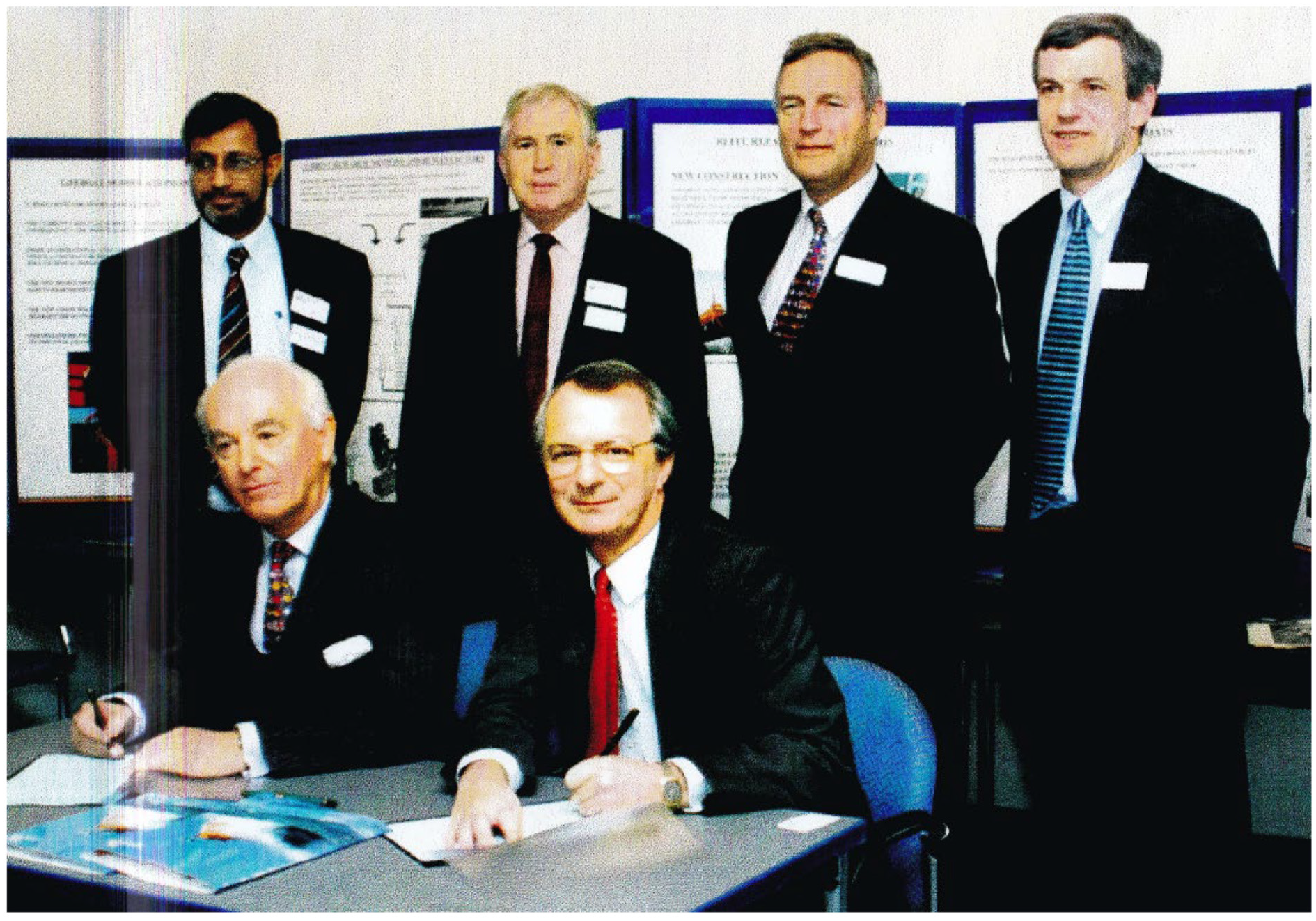
Signing of the Advanced Technology Partnership between the RNLI and the University of Southampton, 2001. From left to right: (back) Prof. Ajit Shenoi (UoS), Prof. Geraint Price (Head of the School of Engineering Sciences, UoS), Mr Andrew Freemantle (Chief Executive, RNLI), Prof. Bob Cripps (RNLI); (front) Mr Peter Nicholson (Chairman of the RNLI) and Prof. Sir Howard Newby (Vice-chancellor at the University of Southampton).
This article reviews first the relationship between the RNLI and academia before reporting on how the RNLI has specifically engaged with the engineering research community and importantly how the research initiated by the RNLI continues to be cited by researchers across the international community.
RNLI publication timeline
To generate a timeline of RNLI scholarly references, Harzing’s Publish or Perish was used to collate all 991 articles from Google Scholar that explicitly refer to the RNLI and lifeboat in online documents. While Web of Science is the standard data set for bibliometric analysis, it is possible that relevant publications are missed. 2 Google Scholar is a powerful resource to gather online scholarly articles but can index low-quality sources and artificially inflate the number of citations. 3 Google Scholar is therefore used to provide a comprehensive timeline of publications, but Web of Science will be used for citation indexing.
Up to the end of 2000, the number of scholarly publications per year was less than 20 (Figure 1). Most of these publications were focussed on the role of RNLI and its history as a charitable organisation that exists to save lives at sea.
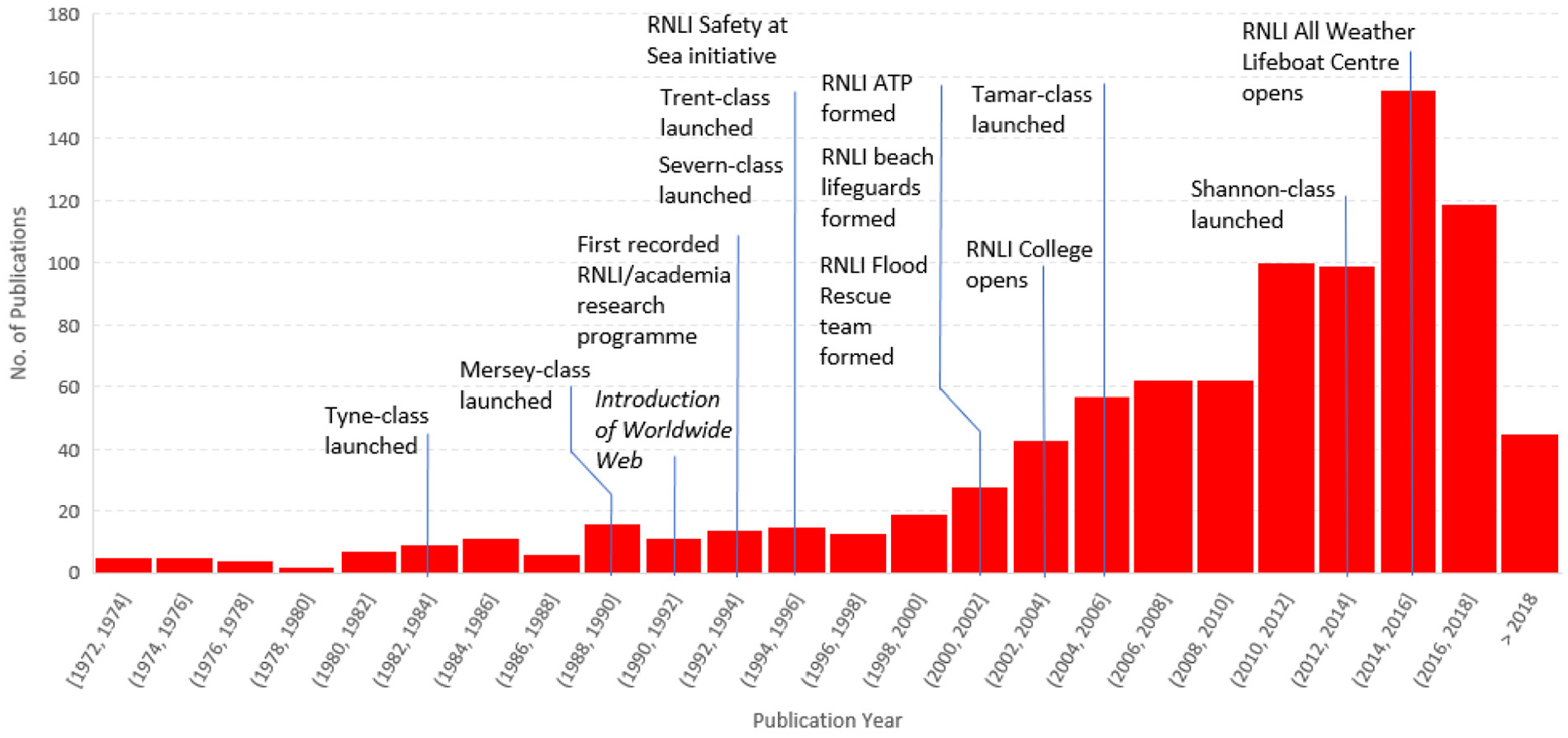
Number of scholarly publications from 1970 to 2020 identified by RNLI and lifeboat keyword search using Google Scholar and collated through Harzing’s Publish or Perish. Overlaid is a timeline of RNLI key events. 991 publications were identified.
As the RNLI fleet expanded from the mid-1980s, incorporating the Tyne and Mersey into their fleet by 1990, it was becoming more challenging to meet target displacements with conventional hull materials; lifeboats were getting heavier due to adoption of new technologies and requirements for increased operational range. In 1993, the RNLI partnered the UoS with link funding from the then Department of Trade & Industry and the Science and Engineering Research Council (DTI/SERC Structural Composites Link Programme) 4 to investigate the use of structural composites for future RNLI lifeboats. For the RNLI, this was their first funded research relationship in engineering and initiated international recognition of how their state-of-the-art lifeboats were underpinned by cutting edge research. In 1995, the first production Severn-class lifeboat entered service. This was the first lifeboat designed at the outset to be constructed from advanced polymer composites.
Figure 1 shows that the sharp increase in scholarly publications related to the RNLI and its activities really came from the start of the 2000s, increasing on average by around seven publications/year until a peak in 2016 of around 120 publications. The rapid increase of publications may be linked to the use of the Worldwide Web from the mid-1990s allowing for more RNLI-related scholarly sources to be stored and accessed electronically. But there are also clear increases and diversification of RNLI activities in the early 2000s including the formation of the beach lifeguard and flood rescue services, both initiating new research areas in academia.5,6 The Advanced Technology Partnership at Southampton was also officially started in 2001, consolidating burgeoning academic links in engineering already initiated at Newcastle7–8 and Southampton4,9–11 to support the move to composite lifeboats. In 2010, the RNLI ATP’s breadth was expanded to include Southampton’s Centre of Operational Research, Management Sciences & Information Systems (CORMSIS). This expansion reflected the RNLI’s increasing need to engage management science and operational research in supporting the RNLI’s engineering department. 12 By engaging with academia and supporting a programme of PhD scholars through the RNLI ATP at Southampton and more recently with Newcastle, Bournemouth and Bristol, dissemination of applied research was secured.
RNLI research areas
It is possible to see the nature of these publications, what their focus is and how they are related by using a bibliometric analysis tool, in this case VOSviewer. 13 To facilitate this analysis, a Web of Science search using the terms RNLI or Royal National Lifeboat Institution allows a more focussed collection of articles, detailing author-supplied and Web of Science-indexed keywords, as well as citation information. The Web of Science core collection covers over 76 million journal articles, conference proceedings, book chapters, notes, reviews and news items. The bibliometric tool, VOSviewer, uses natural language computation to analyse the relationship between the 26 articles found, using in this instance 124 terms identified to have some co-occurrence between articles. VOSviewer generated 14 clusters from the 124 co-occurring terms; clusters in this instance can be interpreted as topics. Figure 2 provides a visualisation of the cluster relationships and the links between clusters. Not all terms in a cluster are visible and either the highest linked or a representative term (alphabetically sorted) is visible. The separation of the clusters in the visualisation shows the connection strength between the clusters or topics. Clearly areas relating to social, management and risk, key principles underpinning the RNLI vision and values have the highest number of publications and the most links.
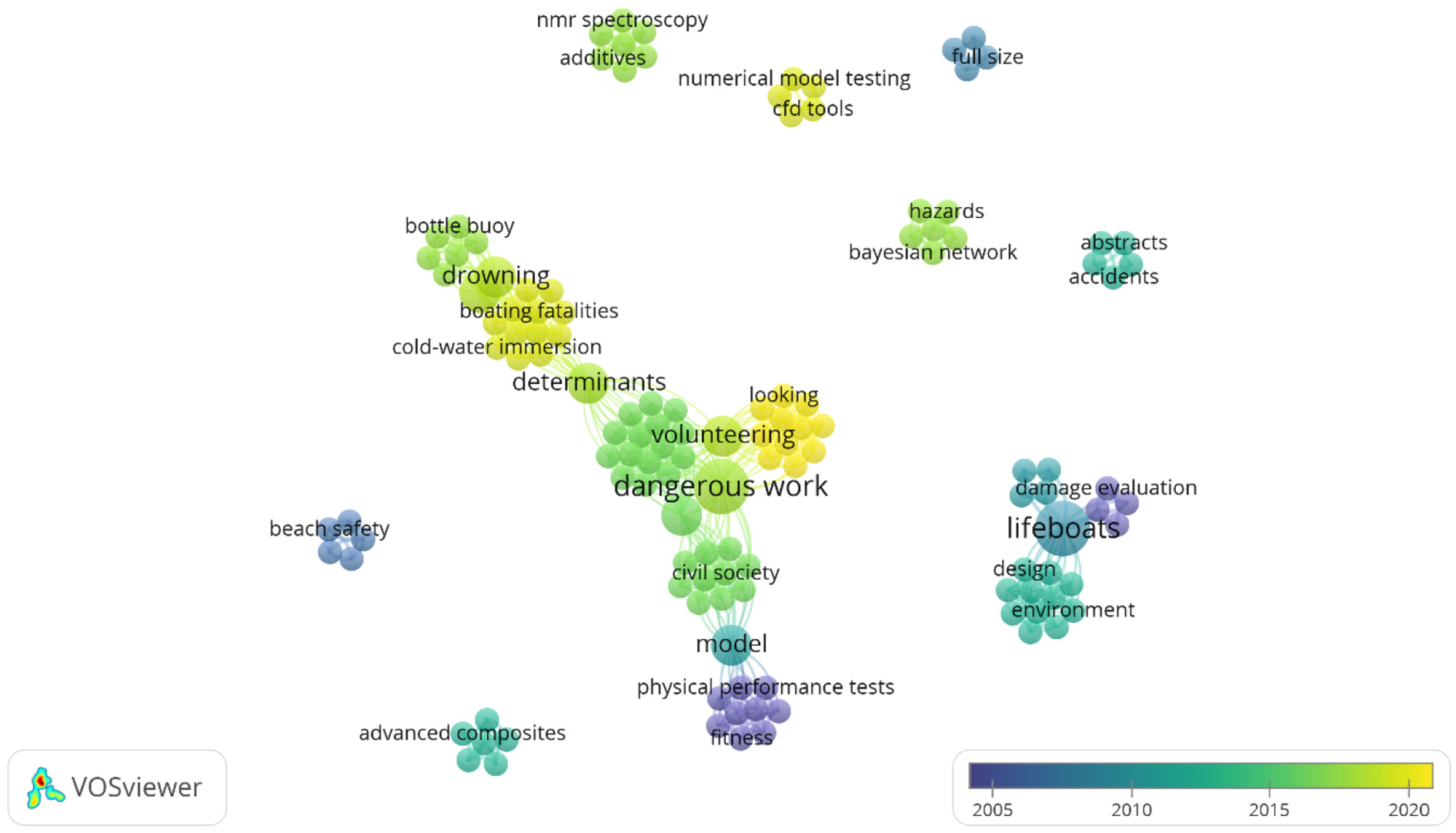
RNLI or Royal National Lifeboat Institution keyword in Web of Science core collection publications since 1970. Legend details average year that cluster terms were published.
Table 1 provides more details on the 14 clusters and the co-occurring terms. The most linked clusters seen in Figure 2 are clusters 1–4 and 6, relating to the more social, management and risk terms: human and organisation. Clusters 5 and 7 are highly linked: these tie more to the efficiency and assessment of the most recognisable RNLI engineering asset: the lifeboat. The remaining clusters have no co-occurring terms between them, but closer inspection shows that they represent scientific investigations into beach safety and accident reporting (clusters 10–12) and four remaining clusters (8, 9, 13 and 14) supporting the engineering assets. The most recent publications centre around cluster 13 with the use of numerical modelling and CFD and cluster 3 where dangerous work is the strongest co-occurring term in publications associated with the RNLI.
Fourteen clusters made up of 124 co-occurring terms from 26 scientific RNLI-referenced articles from Web of Science since 1970.
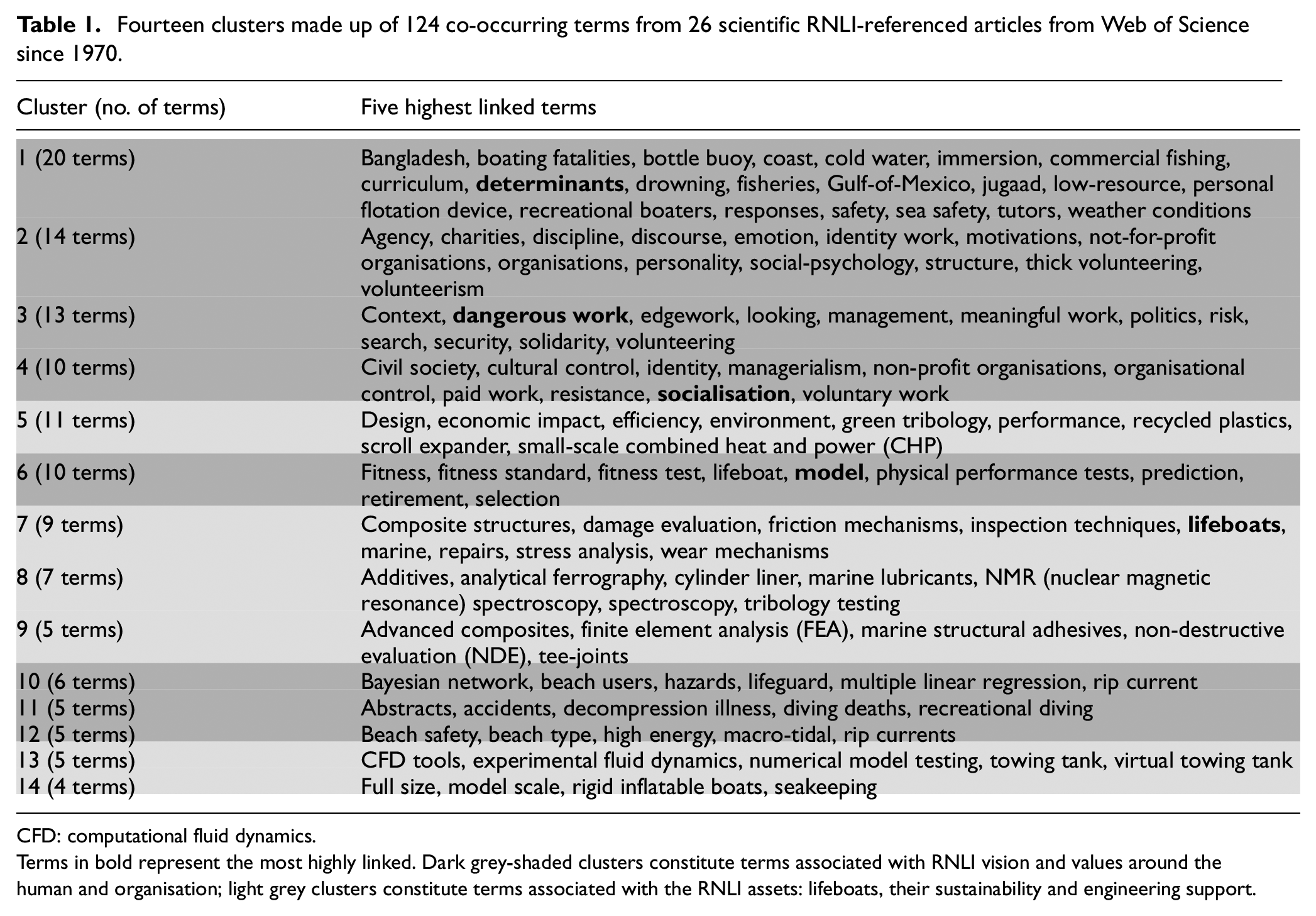
CFD: computational fluid dynamics.
Terms in bold represent the most highly linked. Dark grey-shaded clusters constitute terms associated with RNLI vision and values around the human and organisation; light grey clusters constitute terms associated with the RNLI assets: lifeboats, their sustainability and engineering support.
Figure 2 and Table 1 clearly show that as a charity with volunteer lifeboat crews operating under potentially dangerous conditions, they provide rich material for case studies in social and management sciences (83 of 124 terms). But the RNLI also has a wide engagement with the engineering science community through actively supported research, initiated through the RNLI’s engineering teams over the years, including Bob Cripps,14–16 Steve Austen17–19 and Holly Phillips.20–22 The focus of this research is centred in the United Kingdom as indicated by the network of RNLI-associated researchers that have been cited in engineering fora, Figure 3 (Harzing’s Publish or Perish and Google Scholar). Using VOSviewer, four principal institutions are reflected by the author affiliations: Bournemouth University (BU), Newcastle University (NU), University of Bristol (UoB) and the UoS.
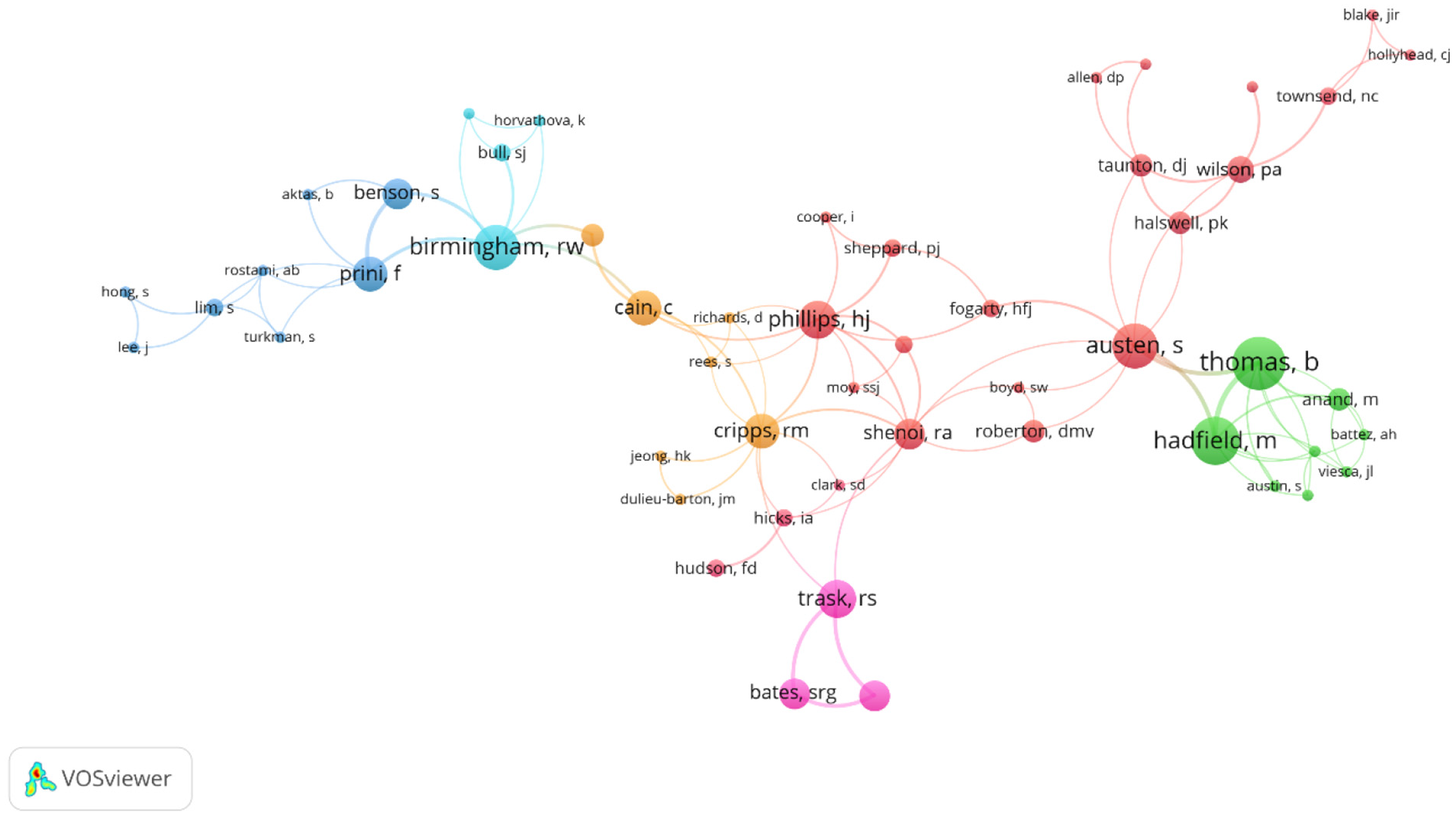
Network of authors: cited engineering texts referencing RNLI or Royal National Lifeboat Institution. Authors are broadly clustered by institutions: University of Southampton (red and orange); Newcastle University (blue); Bournemouth University (green); RNLI (centre red and orange); University of Bristol (pink). Google Scholar search (1970–2020) using Harzing’s Publish or Perish. Fifty-two out of 1599 authors are identified and presented based on connection to RNLI engineering staff: Cripps, Austen or Phillips.
By identifying the authors linked to RNLI research, it is possible to see implied institutional strength. Table 2 describes in more detail the five highest characteristic terms associated with RNLI-research authors from each institution (ranking is based on ‘total link strength’, the number of times a term co-occurs between documents in the data set). For the RNLI, BU is used mainly for tribology research. Here, tribology research focussed predominantly on the challenge for the RNLI to better understand the launch slipway interactions with the lifeboats 23 and also on lifeboat engine wear reduction.24–26 Broadly defining labels for the clusters, NU and the UoS concentrated predominantly on the lifeboats themselves: Newcastle focussing on RNLI interests in safety,7,8 vessel response and load characterisation,27–31 and Southampton on high-performance composites,4,9–11,32–34 fleet life extension15,32,35,36 and human factors.37–41 With Professor Trask having moved from Southampton to the UoB, the RNLI have broadened their composites research to include more recent developments in 3D printed thermoplastic sandwich cores.42,43
Perceived institutional strengths based on most cited authors for research undertaken with the RNLI.
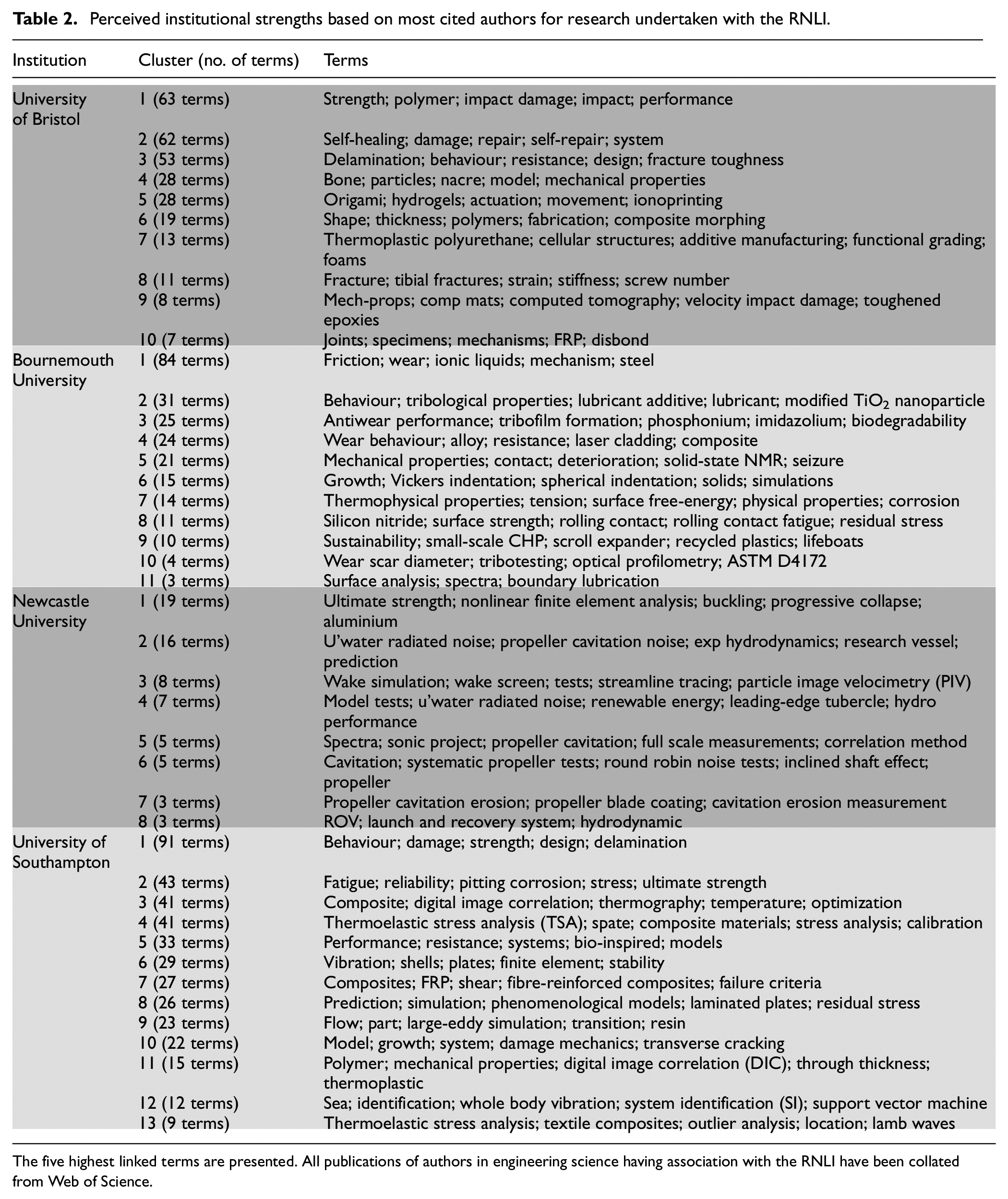
The five highest linked terms are presented. All publications of authors in engineering science having association with the RNLI have been collated from Web of Science.
RNLI research impact
By tracking the citations of those publications associated with RNLI engineering research, it is possible to determine the impact the RNLI has had on the scientific community and the reach of their engineering influence.
Using Web of Science to collate all identifiable engineering articles written in association with the RNLI (the reference section contains a list of authors), it is possible to see, using VOSviewer, the extent to which those articles have been cited, the publication’s relevance and longevity and the citation ‘connectivity’. Figure 4 shows the citation connectivity by examining the co-occurrence of terms in the citations’ titles, abstracts and keywords (review articles and self-citations have been removed). To remove the effect of an article’s age having had more time to gain citations, VOSviewer non-dimensionalises article citations against the total number of citations for all articles in the data set for that year in question. 13
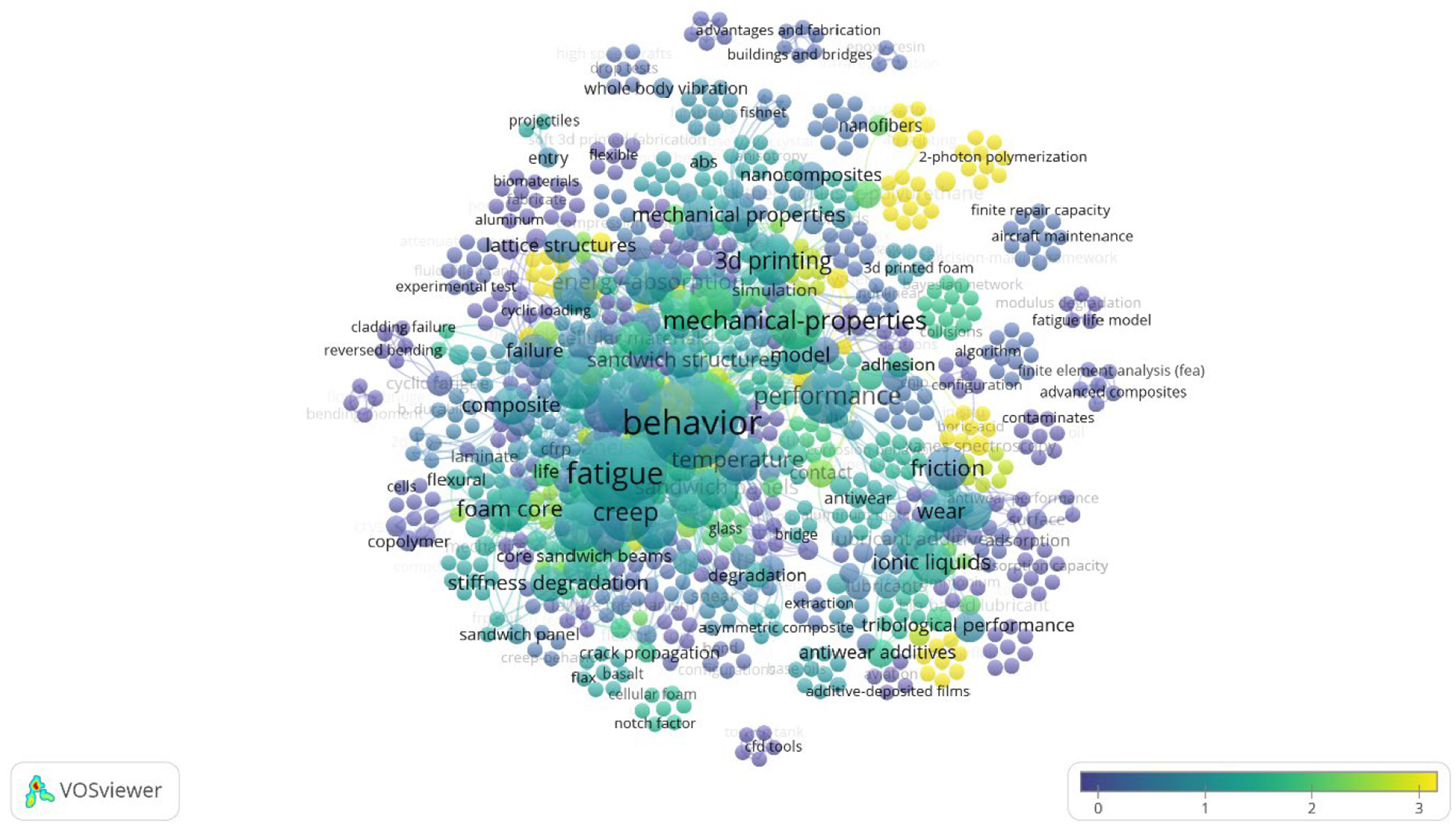
922 co-occurring keywords between all citations of RNLI engineering publications (Web of Science 1970–2020). The focus of international attention very much centres around historic research on sandwich composites, damage tolerance and life prediction methodologies. Legend details a cluster’s average number of citations, normalised against age. Bright yellow clusters indicate rapidly developing areas of impact in tribology and additive manufacturing.
The largest academic impact is usually correlated to scientific fields that have obvious cross-sector appeal. Many of the citations therefore refer to the RNLI ATP’s research on composites, sandwich composites and life prediction methodologies. The yellow clusters indicate that there is a rapidly increasing impact of work undertaken at BU in tribology,25,26,44 and at the UoB with their recent advances in additive manufacturing (3D printing) as applied to novel energy-absorbing sandwich cores.42,43 Table 3 provides more detail on the engineering top 10 research areas45–54 citing RNLI-associated publications (review articles and authors citing their own work are de-selected to show the breadth of RNLI impact).
Top 10 articles based on normalised-by-age citing of RNLI-associated engineering research undertaken at UoB, BU, NU, UoS and example corresponding research area or term (VOSviewer bibliometrics from Web of Science search of citations of all RNLI-associated engineering authors at UoB, BU, NU and UoS; review papers and self-citations omitted; 1970–2020).
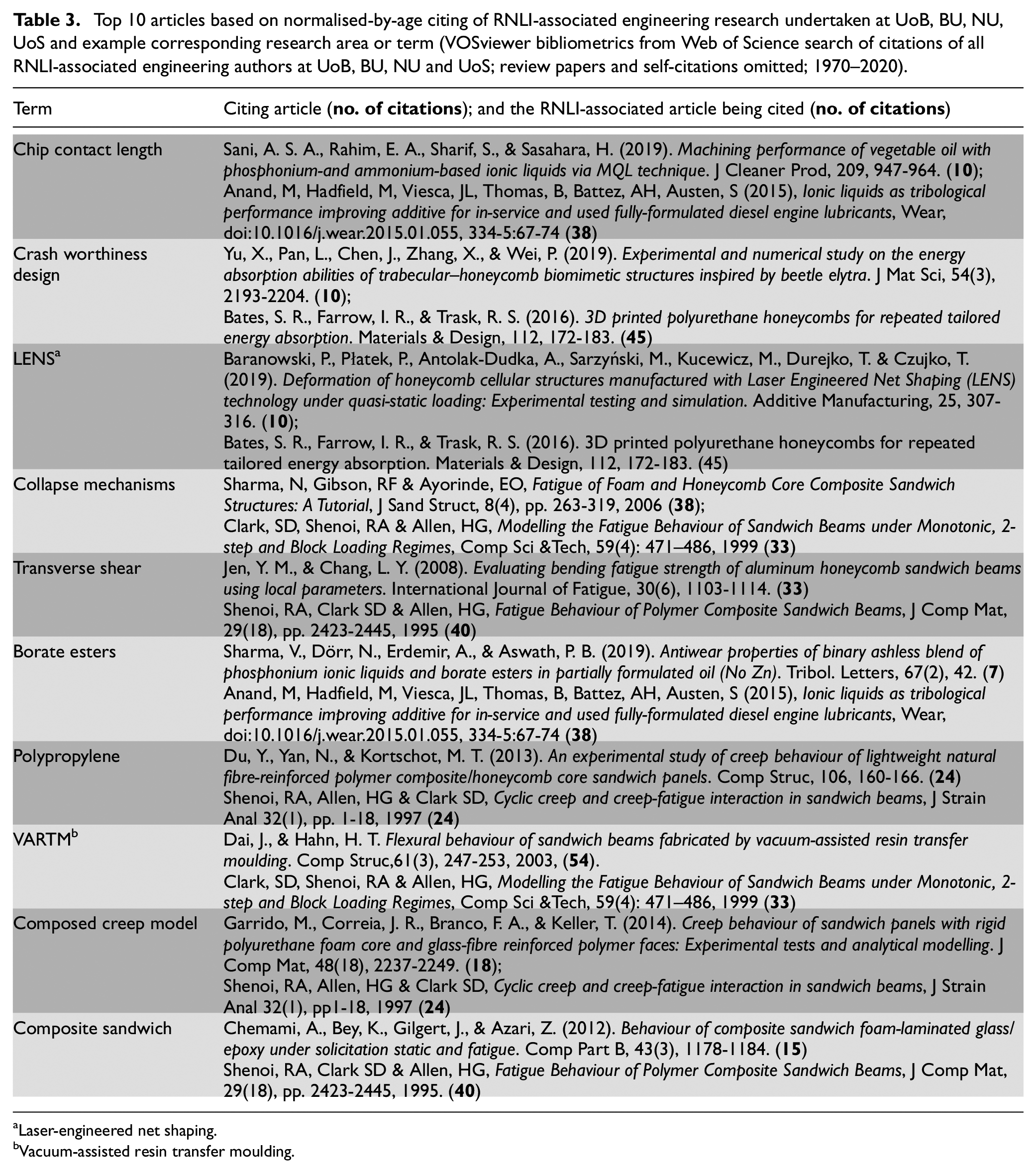
Laser-engineered net shaping.
Vacuum-assisted resin transfer moulding.
Table 3 highlights two points: Ajit Shenoi and colleagues9–11 author most of the top-cited publications associated with RNLI engineering research. This clearly emphasises the importance of the early desire of Bob Cripps and Ajit Shenoi to undertake research for the benefit of the RNLI and produce research output that would benefit the composites community as a whole. Second, the need to understand (sandwich) composite fatigue remains a fertile area of research. With the increasing use of composites across industry sectors in the 1990s, the scientific knowledge then being generated by the RNLI research at Southampton had immediate relevance. After 20 years and a growing confidence built through familiarity of designing and operating a composite fleet, the RNLI’s need for fundamental material knowledge evolved into research into the lifeboat by treating it as an integrated system, and research into composites centred instead around strategies for life extension and sustainable assets.18,19,55,56 The future looks exciting with some of the most recent work in RNLI-associated research in tribology 26 and additive manufacturing 42 already generating considerable impact in the scientific community.
The RNLI has recently published ‘Our Watch’, 57 its strategic intent up to 2024, and a view to beyond. It is acknowledged that the way the RNLI delivers its lifesaving, water safety and fundraising activities will change over time as technology and methods of communication emerge rapidly. Consequently, it will be vital for the RNLI to maintain and continue its relationship with academia and other industry partners to enable it to meet these challenges now and in the future.
Summary
The RNLI’s interest in composite engineering for their fleet and the need to understand their lifeboats’ condition after being subjected to extremely challenging, persistent and tough environmental loads finds much resonance with the scientific community looking at similar challenges in sectors from aerospace to renewable energy. It is evident that the scientific community and wider industry benefit from partnerships and collaboration of academia with the RNLI. But if recent research explorations between the RNLI and academia, not just in engineering but across all disciplines, are to create the largest scientific impact, this work must be disseminated through the most wide-reaching of scholarly mechanisms. In this way, recent trends in the number of scientific publications post 2016 (see Figure 1) can be revitalised. There is an appetite for research outcomes associated with the RNLI, and the open dissemination of this must be assured. This was the original philosophy behind the initiative of Bob Cripps and Ajit Shenoi in advanced technology partnerships, a philosophy of collaboration, collegiality and dissemination. It has had a significant impact both for the RNLI and for the institutions and their researchers, present and past, excited by the challenge of engineering lifesaving craft in the maritime environment, and it is a legacy that should be cherished. It is fitting also to acknowledge the foresight of the RNLI’s founder, Sir William Hillary, who in 1824 understood that new technology could help more people and this vision will no doubt continue well beyond the RNLI’s 200th anniversary.
Footnotes
Declaration of conflicting interests
The author(s) declared no potential conflicts of interest with respect to the research, authorship and/or publication of this article.
Funding
The author(s) received no financial support for the research, authorship and/or publication of this article.
