




Abstract
Democratic student participation is widely endorsed as a pillar of civic education and inclusive schooling. However, its enactment remains complex and often contested in everyday pedagogical practice. This study investigates how teachers’ concerns about democratic student-participation are internally structured and shaped by individual beliefs and contextual conditions. Drawing on a cross-sectional survey of Austrian teachers (n = 311), the study employs exploratory factor analysis and multiple regression modeling to identify key dimensions of concern and their predictors. Results reveal a three-dimensional structure of teacher concerns: Loss of Control and Structure, Low Student Engagement, and Organizational Overload. Contrary to the assumption that concerns reflect ideological resistance, findings suggest that they are significantly shaped by institutional and relational factors, such as socio-economic student background, teacher age, and the extent to which participatory practices are embedded in core teaching processes and formal structures. Notably, teachers’ abstract beliefs about democracy, whether civic, institutional, or social justice-oriented, did not significantly predict concern levels. These results underscore the need to reconceptualize teacher concerns not as obstacles but as context-sensitive indicators of the institutional conditions under which democratic education can thrive. Implications for professional development and policy reform are discussed.
Introduction
Democratic student participation has emerged as a central normative aspiration in contemporary educational discourse across Europe and beyond. However, its translation into the everyday classroom practice remains fraught to conceptual ambiguity and institutional tension. While existing research has predominantly theoretically examined democracy in schools, little is known about teachers’ perspectives on democratic student participation in concrete educational and pedagogical settings. The present article addresses this gap in knowledge by investigating teachers’ concerns about the enactment of democratic student participation as analytically meaningful indicators of the contextual, relational and institutional conditions, shaping perceived feasibility of democratic practices in schools.
Across Europe, democratic elements in schooling have become a key policy priority, reflected in initiatives, such as the Council of Europe’s Reference Framework of Competences for Democratic Culture (Council of Europe, 2018). European research highlights the effort to embed democratic practices in education are shaped not solely by pedagogical commitments but also by differences in institutional structures, teacher autonomy and school governance across European school systems (Fielding, 2007; Lundahl and Olson, 2013; Mager and Nowak, 2012). Situating the present study within wider European discourses underscores the importance of examining how teachers’ concerns emerge and which factors influence their emergence.
Theoretical and conceptual foundations of democratic student participation
Democratic schooling has long been recognized as a central and normative empirical topic of interest (Biesta, 2007; Fielding, 2012; Gert, 2009; Levin, 2000; Westheimer and Kahne, 2004). The inclusion of student voice with participatory pedagogies and shared governance as an expression of democratic principles has received extensive support from educational theorists and practitioners alike (e.g. Biesta, 2006; Dewey, 1916; Gutmann, 1999; Peterlini, 2016a, 2016b). In this sense, proponents argue that democratic learning should not merely involve abstract learning about democratic principles but focus on experimental learning instead. Students should be involved in meaningful decision-making processes that affect their learning and environment (Cook-Sather, 2006; Fielding, 2001; Mitra, 2004). Democratic student participation is therefore envisioned as an educational paradigm that centers around the voice, agency and lived experiences of students. This foregrounds participatory pedagogies and shared governance structures. Students are not merely passive recipients of democratic learning outcomes, they are active contributors of co-constructed knowledge (Cook-Sather, 2006; Mitra, 2004).
Dewey (1916) conceptualized democracy as an ethical ideal, a mode of associated living and communicative action. Schools as miniature democratic communities should cultivate reflective and engaged citizens by engaging students actively in decision-making processes and inquiry to develop underlying democratic habits of mind. Dewey (1916) argues that education itself must reflect democratic values in order to foster democratically minded citizens. Freire (1979, 1985) builds on Dewey (1916) by introducing a critical pedagogical perspective that emphasizes dialogical learning, critical consciousness and emancipative school transformations. Instead of treating students as passive recipients of knowledge, Freire (1979, 1985) positions students as co-creator of knowledge and agents of transformation. Both perspectives challenge hierarchical and authoritarian models of schooling, advocating experiential and inquisitive learning that is deeply relational. The concept of democratic student-participation therefore challenges tokenistic involvement or symbolic consultation. Instead, democratic student-participation should foster meaningful engagement in decisions surrounding learning and learning-environments (Cook-Sather, 2009; Fielding, 2004).
Evidence suggests that, when democratic student engagement is implemented authentically, then it may have beneficial outcomes and effects on student learning. For example, democratic student-participation can increase intrinsic student motivation, responsibility-uptake, student-engagement and a deeper sense of belonging to the class and school community (Rudduck and Flutter, 2004; Toshalis and Nakkula, 2012). Besides improving academic outcomes on the individual level, democratic schooling can foster civic-engagement and ethical responsibility on societal level (Benner, 2015; Dewey, 1916). These outcomes are aligned with broader educational goals and socio-political aspirations for justice, equity and sustainability as represented in global policy frameworks (UNESCO, 2017), turning participatory processes in school into an ethical imperative. Yet, the enactment of democratic principles in schools and classrooms is not without friction.
Despite the normative appeal, the practical enactment of democratic student-participation remains fragmented due to conceptual ambiguities and institutional challenges. Schools as institutions are constrained by traditions and legal obligations, characterized by hierarchy and standardized accountability which are conditions that can undermine democratic ambitions (Apple and Beane, 2007; Kupfer, 1984; Peterlini, 2016a). These institutional constraints generate a central paradox that describes democratic education as becoming undemocratic in practice when enacted with prescriptive and coerced methodologies (Kupfer, 1984; Peterlini, 2016a). Specifically, imposing predefined outcomes that condition or restrict student autonomy may be problematic as this undermines democratic principles and diminishes democratic learning. When participation is enforced, instrumentalized or staged, democratic student-participation loses its transformative potential (Biesta, 2006; Fielding, 2004; Lundy, 2007; Peterlini, 2016a; Rudduck and Flutter, 2004). As such, democratic learning is not conceptualized as a transmissible content but characterized as an open-ended process that includes unpredictability and ethical subjectivity (Biesta, 2006, 2010; Freire, 1985; Mezirow, 2000). While these theoretical perspectives articulate a compelling vision of democratic education, their translation into institutional practice reveals significant tensions.
State of the art: Empirical research
The tension between ideal and reality is further reflected in the growing body of literature examining the multifarious challenges in democratic student-participation. A substantial body of empirical research has examined democratic education, student participation and teachers’ perspectives on participatory practices in classroom environments. Studies that investigated how teachers interpret, enact and negotiate democratic ideals have revealed persistent tensions between normative aspirations and practical enactment. Research across different international contexts shows that teachers often support democratic values in principle but interpret participation in limited ways. For instance, studies on student voice initiatives demonstrate that participatory practices are commonly endorsed by teachers while remaining consultative rather than transformative (e.g. Mitra, 2004; Rudduck and Flutter, 2004). Fielding’s (2012) school-based empirical work in the UK similarly highlights how student participation and democratic schooling is constrained by institutional norms that domesticate student voice within pre-existing power structures. These issues are particularly salient in hierarchical school systems that lack systemic support for democratic practices (Apple and Beane, 2007; Fielding, 2012). In these settings teachers who advocate for democratic student-participation may feel isolated and overburdened due to insufficient resources, training or collegial backing (Fielding, 2012; Peterlini, 2016a).
Also, teachers’ interpretations of democracy may vary depending on professional identity and school culture. In a comparative study across European schools, Veugelers (2011) highlighted how teachers tended to prioritize either discipline-oriented, socialization-oriented, or critical-oriented interpretations of citizenship education, reflecting broader ideological and institutional orientations. Reichert and Torney-Purta (2019) analyzed international data from the International Civic and Citizenship Education Study (ICCS) identified that teachers’ support for open classroom climates varies substantially depending on professional autonomy.
This highlights a further key mediator in the enactment of participatory practices: Institutional structures. Apple and Beane’s (2007) school-based research illustrates that democratic schooling requires sustained institutional commitment rather than isolated teacher-based attempts. Without systemic alignment, participatory practices can become fragmented or symbolic This is further highlighted by studies examining accountability regimes highlighting how performative cultures and standardized assessment frameworks can constrain teachers’ willingness to engage in open-ended democratic processes (Ball, 2003; Priestley et al., 2015). In high-stakes environments, teachers report prioritizing measurable outcomes over dialogical experimentation which limits the scope of participatory practices. Recent Scandinavian studies provide further proof for this finding, suggesting that market-oriented reforms and school competition reshape democratic aspirations into managerial accountability structures (Öhrn and Lundahl, 2017).
Importantly, structural barriers are compounded by individual factors such as pedagogical beliefs and the individual sense of self-efficacy. Teachers with lower self-efficacy or confidence in their ability to manage participatory classrooms were found to be less likely to implement student-centered strategies effectively, even if they endorse democratic values (Holzberger et al., 2022; Voigt et al., 2020a, 2020b). These challenges are further intensified by the social and economic context within which schools are embedded. Teachers who work in schools that serve socioeconomically disadvantaged students report higher levels of occupational stress lower levels of parental engagement and more frequent behavioral disruptions (Dupont et al., 2023a, 2023b; Morris, 2015; Reay, 2006). These stressors may exacerbate existing concerns about the feasibility and sustainability of participatory practices, contributing to skeptic and cautious attitudes toward democratic student-participation (Dupont et al., 2023; Morris, 2015; Reay, 2006).
This is further highlighted by theoretical perspectives on teacher agency and professional identity. Specifically, teacher’s sense of agency is formed by self-perceptions of their professional autonomy, pedagogical legitimacy and by their capacity to act meaningfully within the constraints of the school system (Eteläpelto et al., 2013; Priestley et al., 2015). A strong sense of agency stands in a positive relationship with openness to pedagogical innovation, including student-participation approaches (Holzberger et al., 2022). If, however, teachers feel disempowered through top-down organizational mandates, high-stakes accountability or a lack of institutional trust, then teachers are more likely to withdraw from democratic pedagogic practices, regardless of their personal values (Peterlini, 2016a; Voigt et al., 2020). Additionally, the emotional dimensions of teaching, which are often overlooked in research, may be relevant in understanding how teachers may relate to student participation. Feeling vulnerable, being exposed to uncertainty and relational strain can act as relevant barriers to teaching democratic practices (Zembylas, 2005a, 2005b). Given these complexities, democratic student-participation must be understood not merely as a set of techniques but as a comprehensive cultural and institutional transformation.
Teacher support for democratic student-participation may therefore implicate multilayered systemic, cultural and relational influences. As such, the enactment of democratic student participation entails a reorientation of authority and power relations, a renegotiation of teacher-student roles and a shift from performative education goals to open-ended and ethically grounded learning processes (Biesta, 2010; Fielding, 2012). This reconceptualization, however, necessitates not only structural support but also a transformation of school culture. Participation is not merely to be added but embedded within the architecture of school itself (Apple and Beane, 2007; Mitra, 2008) and involves emotional and cognitive labor. Teachers must balance between the democratic ideal of student autonomy and the pragmatic responsibilities that lie within the curriculum delivery, behavioral regulation and assessments (Levin, 2000; Ranson, 2000). Within this space of tension teachers’ concerns surrounding democratic student-participation emerge as analytically significant. However, instead of viewing concerns as a mere resistance or professional inertia, they should be understood as expression of professional judgment and ethical reflection that may reflect a deep engagement with the multilayered dimensions of educational practice (Biesta, 2014; Bingham and Sidorkin, 2004). As such, teachers’ concerns may represent a manifestation of a pedagogical conscience rather than a pedagogical deficiency.
Given these dynamics, it is imperative to center teachers not simply as mediators of democracy but as co-constructors of democratic culture. Their concerns, reservations, and hesitations should be treated as valuable data that reveal the institutional frictions and pedagogical dilemmas embedded in the practice of democratic education. This approach challenges binary framings of compliance versus resistance and instead emphasizes the need for dialogical professional development, institutional reflexivity, and systemic support structures. Democratic participation in education, then, must include the participation of teachers in shaping the conditions under which democracy in schools can genuinely thrive. As such, this study conceptualizes teacher concerns not as obstacles to be overcome, but as diagnostic indicators of the structural and cultural work still required to actualize democratic education. In this sense, teachers’ concerns must not be dismissed as anti-ethical to democratic aims but rather understood within the multilayered complexity of the broader ecology of schooling.
Aim of the study and research questions
In conclusion, the reviewed literature highlights a persistent gap between the normative ambitions of democratic education and the realities teachers encounter in their environments. Theoretical positions reveal tensions between autonomy and authority, open-ended learning and curricular pressures and participatory ideals and institutional constraints. These tensions are underscored by empirical studies that highlight teacher concerns relating to classroom control, student engagement and organizational requirements. These conceptual and empirical frictions highlight the need for a systematic examination of how teachers understand, experience and navigate the potential challenges of democratic student engagement. The present study will address this gap in literature by investigating teachers’ anticipated concerns in relation to the enactment of democratic student participation as well as their contextual, relational and institutional dependence.
In doing so, the present article focuses specifically on democratic student participation within the classroom as a distinct, though not exhaustive, expression of democracy in education. This delimitation is intentional as democratic education may encompass a broad range of activities (e.g. civic empowerment, critical consciousness, social justice engagement). However, the delimitation on democratic student participation within the classroom will allow to investigate specific relational, organizational, institutional and emotional conditions within which democratic practices are enacted. The present study may therefore not represent the full scope of democratic education as envisioned by Dewey (1916), Biesta (2006) or Freire (1979, 1985) but identifies classroom participation as one critical perspective within which democratic ideals confront reality. As such, the present empirical data centers on teachers’ perceptions and their immediate pedagogical contexts rather than on broader civic or societal movements.
Building on the conceptual and empirical tensions representing contradictions between democratic educational ideals and the practical challenges associated to them, the present study investigates factors that influence teachers’ concerns regarding democratic student participation in the classroom. Accordingly, the present study investigates democratic participation on the classroom level, acknowledging that this constitutes one specific manifestation of democracy in education and not broader civic or societal processes. The present study therefore examines how concerns are patterned and relate to structural, institutional, relational and individual factors. This will allow to answer the present study’s research questions:
Which underlying dimensions structure teachers’ concerns about implementing democratic student-participation in the classroom?
The term “enactment” here does not refer to technical or procedural aspects, but rather to the teachers’ anticipations of the lived enactment of democratic student-participation practices within the relational, organizational, and cultural realms and dynamics of their classroom environments. In this sense, the term “enactment” captures teachers’ experiences navigating complexities such as the use of authority, time and institutional conditions when attempting to translate democratic principles into classroom settings. As such “enactment” is understood as a situated pedagogical process. “Underlying dimensions” refers to latent patterns that structure teachers’ concerns that may not be visible at surface level of questionnaire items.
2. Which individual beliefs and school-level contextual factors significantly predict teachers’ concerns about democratic student-participation in the classroom?
By situating teacher concerns within the broader institutional and cultural framework of democratic schooling, this study allows to move beyond reductive interpretations of resistance and instead investigate nuanced, contextually embedded realities that teachers navigate. Understanding how concerns are structured and influenced by multilayered factors further provides critical insights into the practical conditions that support democratic student-participation. In this sense, the present research illuminates the conditions that contribute to a successful integration of democratic student-participation in everyday pedagogic practices.
Method
Participants, recruitment and sample
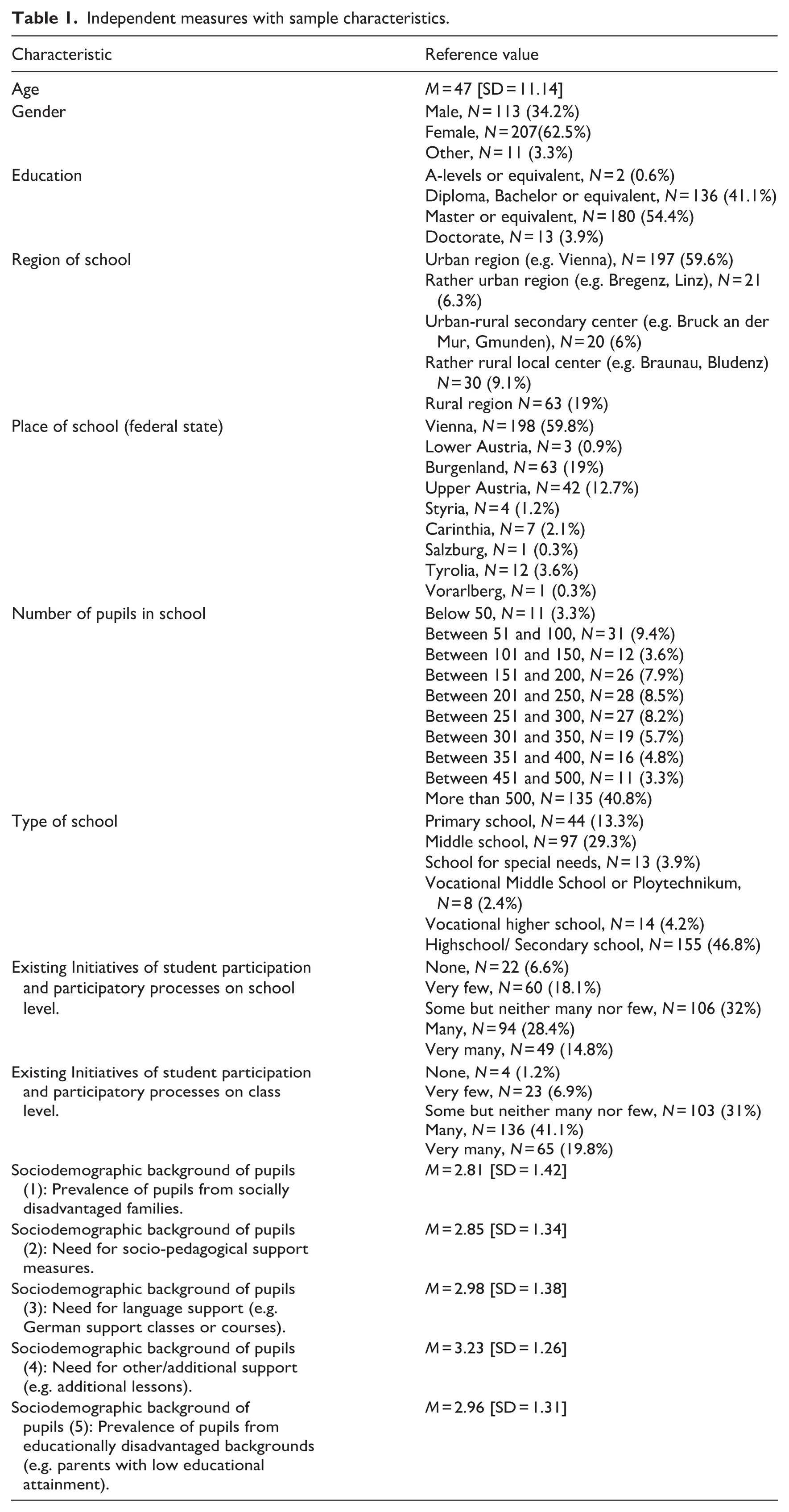
A total of 564 teachers who teach at Austrian schools were recruited through convenience sampling. Invitations to participate were distributed via social media channels, pedagogical and education platforms and university premises across all nine federal states of Austria. The online survey was made accessible between May 1 and July 1, 2025. Out of the total sample of 564 teachers, 331 completed the survey in full and were included in further analyses. An overview of demographic participant characteristics can be found in Table 1. The sample is predominantly consistent of middle-aged, highly educated female educators, most of whom are employed in urban settings. Nearly half of the participants work in high schools or secondary schools with student populations exceeding 500 individuals. While the sample reflects national averages for Austrian teachers in relation to age and education, it skews toward an overrepresentation of urban and secondary-level educators, underrepresenting rural, and primary school teachers (BMBWF, 2022; OECD, 2023; Statistik Austria, 2023, 2024a, 2024b). The data that support the findings of this study are available on request from the corresponding author. The data are not publicly available due to containing information that could compromise the privacy of research participants. This study involved anonymous survey research with adult participants and posed no foreseeable risks beyond everyday life. The study was conducted in accordance with the Declaration of Helsinki and approved ethical guidelines. The research was conducted in accordance with the ethical standards of the Declaration of Helsinki and the Belmont Report. Informed consent was obtained electronically prior to participation, with participants explicitly acknowledging their voluntary participation, right to withdraw at any time, and assurance of anonymity and confidentiality. Ethical policies of [authors’ institution] were maintained.
Independent measures with sample characteristics.
Measures
The development of the measures included in the present study followed a hybrid approach, combining a theory-driven top-down process with a participative bottom-up input. The top-down phase drew on established theoretical and empirical literature on democratic education, participation and teacher agency. Based on this literature, three broad conceptual domains were identified that structured the survey: These included (1) Democratic beliefs, informed by canonical work on liberal-institutional, participatory-civic and social-justice orientated understandings of democracy (e.g. Dewey, 1916; Gutmann, 1999; Westheimer and Kahne, 2004), (2) types of student participation, derived from research on participatory pedagogies and school-level (e.g. Cook-Sather, 2006; Mitra, 2004), and (3) potential challenges associated with participatory practices, grounded in prior qualitative and quantitative studies documenting teacher challenges (e.g. Ranson, 2000; Rudduck and Flutter, 2004).
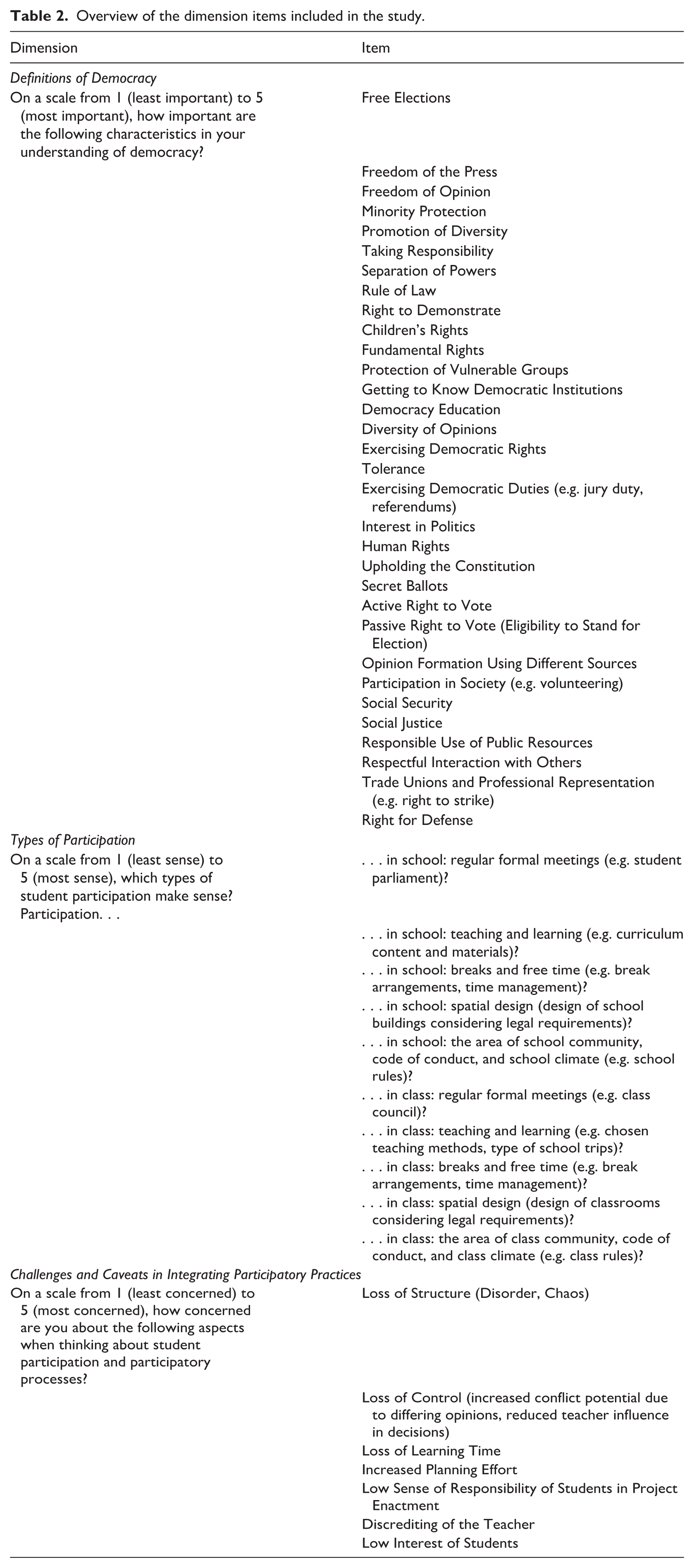
To incorporate practitioner perspectives and enhance contextual relevance, a participatory resonance group was formed, including practitioners from diverse educational and regional backgrounds. This resonance group helped with the wording of the question items by drawing on their unique contextual knowledge. Their contributions led to several refinements, including the use of everyday classroom language for questionnaire items and concrete examples to clarify ambiguous concepts. In addition, the resonance group proposed two additional teacher-concern items (“discrediting of the teacher,” “low student responsibility”), that were not part of the original item set but reflected challenges that members of the resonance had group encountered in their professional environment. The bottom-up process therefore ensured contextual fir, comprehensibility and the ecological validity of the final instrument. An overview of the dimensions domains definitions of democracy, types of participation and challenges and caveats in integrating participatory practices can be found in Table 2. The final set of dimension items included 32 items on definitions of democracy, 10 types of participation and seven challenges and caveats in integrating participatory practices items.
Overview of the dimension items included in the study.
The survey was intentionally designed to focus on school-level and classroom-level contextual factors rather than on broad societal factors, such as broader civic and societal democratic processes. While these macro-level conditions may contribute to the environment within which democratic student-participation unfolds, they extend beyond what teachers can reliably report within the scope of a standardized survey instrument. In order to maintain conceptual precision and avoid conflating societal processes within school-specific dynamics, the survey was limited to factors that teachers may directly experience within the school setting. This methodological choice does not imply that broader societal tensions are irrelevant but reflect the typical boundaries of empirical social science research.
After completing releasing the online questionnaire, it was piloted with 20 teachers. Minor amendments improving concision and clarity were made. Following these amendments the questionnaire was distributed nationally.
Data analyses
To develop statistically robust models for identifying latent structures in teacher concerns and to examine how these structures may be affected by individual beliefs and school-level contextual factors, a series of data processing and analytical procedures were carried out. For data processing and analysis SPSS 29.0.2.0 has been utilized. The following section outlines an overview of data preparation and analysis.
Principal component factor analysis with Promax rotation
To identify answering patterns in teacher concerns and reduce the number of variables used in predicting teacher concerns, a principal component factor analysis (PCA) with Promax rotation was run. PCA is dimensionality-reduction technique that simplifies complex datasets by extracting a smaller number of components while retaining as much variance as possible (Jolliffe, 2002). Originally correlated variables are transformed (X = X1, X2, . . ., Xk) into a new set of orthogonal principal components (Z = Z1, Z2, . . . . Zk). Each component is calculated as a linear combination of the original variables, weighted by the eigenvectors derived from the covariance (Rencher, 2002). This can be expressed as:

In this equation, the coefficients aj = (a1j, a2j, . . ., apj) form the eigenvector corresponding to the jth largest eigenvalue λj of the covariance matrix ∑. The eigenvalues represent the variance explained by each component (Var (Zj) = λj). The aim is to retain a smaller number (m) of components that collectively explain a substantial proportion of the total variance in the data. To ensure equal contribution of items, regardless of initial scale differences, Kaiser normalization is applied (Kaiser, 1958). This involves transforming variables to have unit variance, effectively working with the correlation matrices to prevent larger variances from dominating the results (Costello and Osborne, 2005).
Given the theoretical assumptions of the interrelatedness in dimensional scores, an oblique Promax rotation was computed. This assumption was empirically confirmed by the observed moderate factor correlations. Promax rotation modifies the factor loading matrix by applying a power transformation to highlight dominant loadings while diminishing weak loadings. The transformation for each element can be mathematically expressed by:

Here Lij represents the loading of variable i on the factor j after the initial orthogonal Varimax rotation, sign(Lij) retains the direction of the loading (positive or negative) and ∣Lij∣k represents the value raised to the power k (Hendrickson and White, 1964). Promax was chosen over Direct Oblimin due to tendency to produce clearer, more interpretable factor structures. This technique allows for the extraction of coherent item groupings while accommodating correlations among the resulting components.
Multivariate multiple linear regression
Multivariate multiple linear regressions (MMR) are the extension of classical multiple linear regressions that allow for the simultaneous modeling of multiple continuous dependent variables with a common set of independent predictors (Rencher, 2002). This inferential approach is particularly suited for research questions that include conceptually or related outcome variables as the joint modeling provides additional explanatory power (Tabachnick and Fidell, 2013). Mathematically, MMR estimate a set of linear equations, one for each dependent variable Yj, as a function of a shared predictor matrix. This can be represented as Y = XB + E. Here, Y represents an n × m matrix of m outcome variables (types of teacher concerns), X represents the n × p matrix of predictors (e.g. individual and contextual factors), B stands for the p × m matrix of regression coefficients, and, E is an expression of the n x matrix of residuals. The main differentiation from standard multiple linear regressions lies within the multivariate treatment outcomes. As such, MMR accounts for intercorrelations among the dependent variables (types of teacher concerns) and therefore increases statistical power, reducing the Type I error when compared to conducting several regression models (Stevens, 2009). The shared variance among the dependent variable is used more efficiently to detect the overall predictive strength of the independent variables integrated into the model on the set of outcome variables.
The overall model fit is assessed using multivariate test statistics, decomposing the hypothesis and error matrices. Here, Pillai’s Trace is the most commonly recommended statistic to assess model fit due to its robustness to violations of assumptions such as multivariate normality and homogeneity of variance-covariance matrices (Finch, 2005; Olson, 1976). Following significant multivariate effects, univariate follow tests are used to determine significant predictor variables, whereby effect sizes such as partial η2 provide information surrounding the magnitude of the relationship between predictor and outcome variables. In this sense, MMR allow to examine how individual beliefs and school-contextual factors may jointly influence the different types of concerns surrounding democratic student-participation enactment.
Results
Principal component factor analysis with Promax rotation
To understand the underlying dimensions structuring teachers’ concerns about implementing democratic student-participation in classroom, and, to reduce the dimensionality of the predictors “definitions of democracy” and “types of participation,” three separate exploratory factor analyses were conducted. For each PCA sampling adequacy was checked with the Kaiser-Meyer-Olkin (KMO) measure and Bartlett’s test of sphericity. All three factor solutions demonstrated good structural validity with low cross-loadings and interpretational as well as theoretical coherence. The final z-standardized factor scores were computed and saved for use in subsequent MMR models.
Dimension “Challenges and Caveats in Integrating Participatory Practices.”
The dimension “Challenges and Caveats in Integrating Participatory Practices” explores teachers’ apprehensions regarding student participation. A three-factor solution was retained based on strong conceptual coherence and clear thematic distinction. The final three component solution explained 77.81% of variance and demonstrated very good sampling adequacy (KMO = 0.829) and factorability of the dataset (Bartlett’s test, χ2(45) = 1462.94, p < 0.001). Moderate positive inter-factor correlations support the use of oblique rotation. Component 1 “Loss of Control and Structure” captures fears of disorder, diminished authority, and classroom chaos (e.g. “loss of control,” “loss of structure”). Component 2 “Low Student Engagement” reflects concerns surrounding students’ disinterest, lack of initiative and unreliability in taking on responsibilities. Component 3 “Organizational Overload” represents practical barriers, such as increased planning effort and perceived loss of instructional time. An overview of item-component loadings can be found on Table 3.
Rotated component matrix with item loadings for dimension “Potential Challenges and Caveats in Integrating Participatory Practices.”
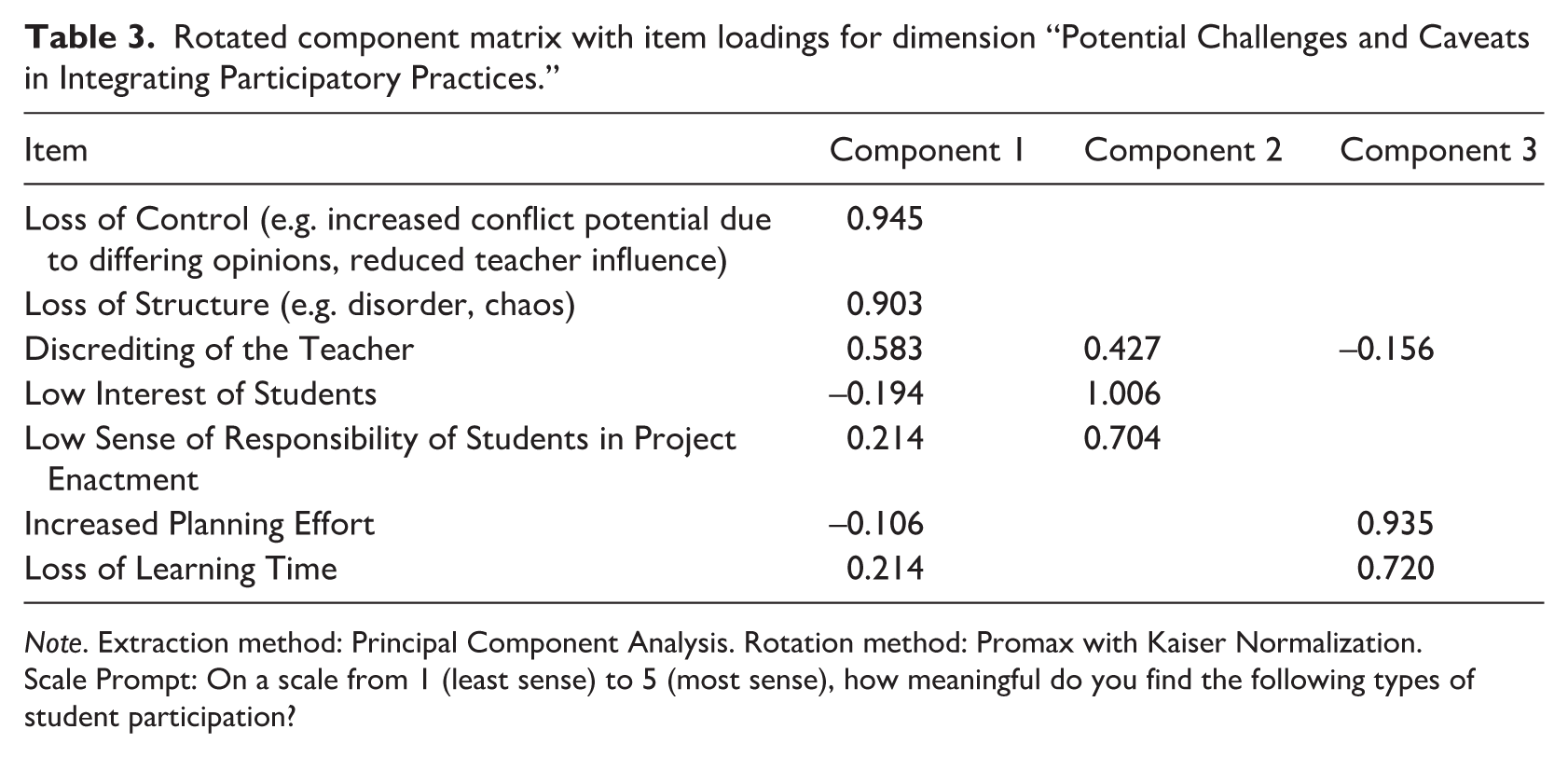
Note. Extraction method: Principal Component Analysis. Rotation method: Promax with Kaiser Normalization.
Scale Prompt: On a scale from 1 (least sense) to 5 (most sense), how meaningful do you find the following types of student participation?
Dimension “definitions of democracy.”
A three-component solution was extracted from the PCA on “definitions of democracy,” accounting for 65.9% of explained variance. Detailed item loadings can be found in Table 4. The sampling adequacy was excellent (KMO = 0.961), and Bartlett’s test of sphericity confirmed the factorability of the data, χ2(496) = 9677.31, p < 0.001. Component 1 “Democratic Principles” captures institutional and constitutional aspects of a liberal democracy, including high loadings for free elections, rule of law, separation of powers, freedom of press and speech, and the protection of fundamental rights. Component 2 “Political Participation and Engagement” reflects the civic dimension of democracy, emphasizing voting rights, interest in politics, civic duties, and democratic literacy. Component 3 “Social Justice and Protection of Vulnerable Groups” focuses on inclusivity and equity in democracy, including minority protection, children’s rights, social justice, and diversity promotion.
Rotated component matrix with item loadings for dimension “Definitions of Democracy.”
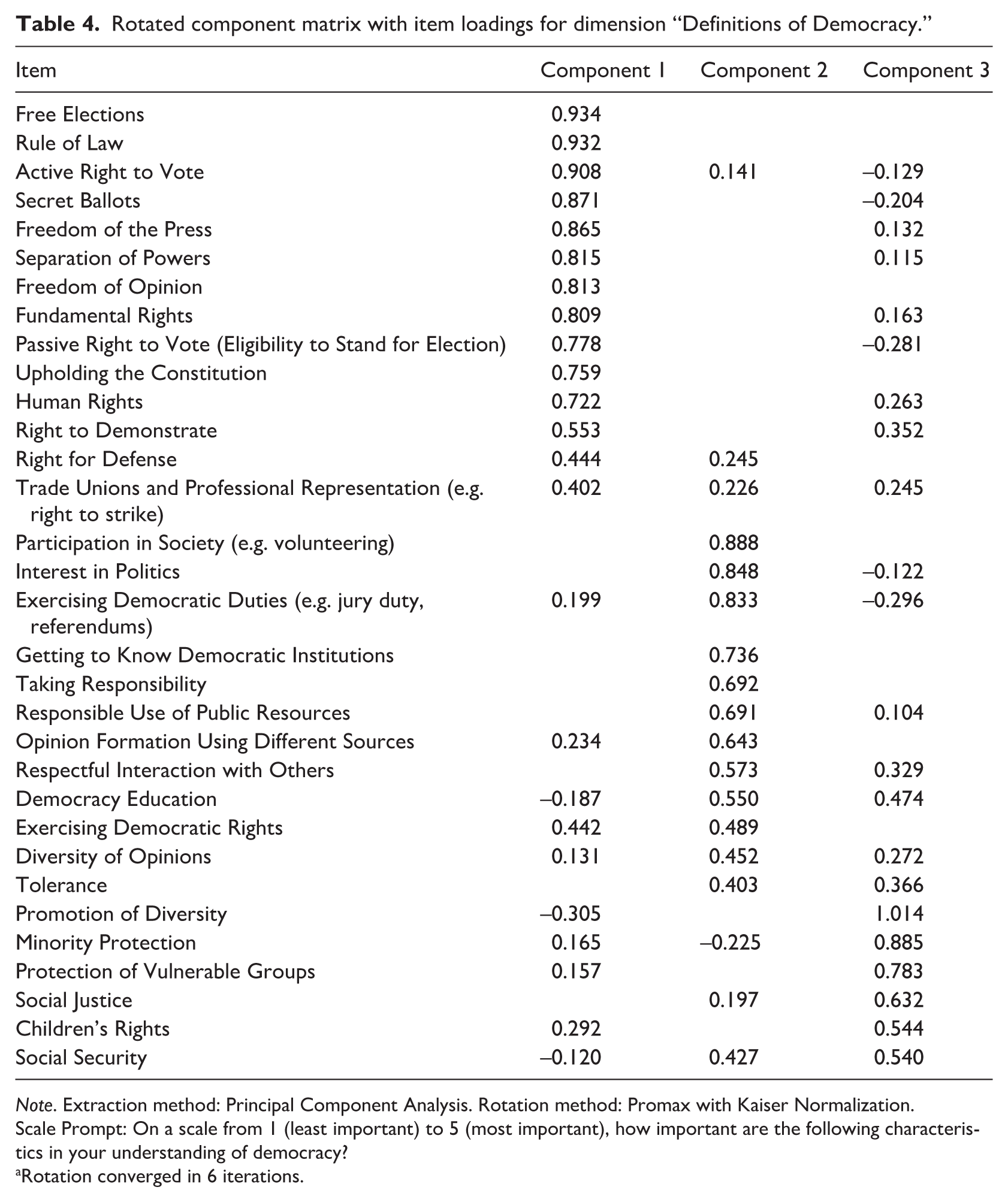
Note. Extraction method: Principal Component Analysis. Rotation method: Promax with Kaiser Normalization.
Scale Prompt: On a scale from 1 (least important) to 5 (most important), how important are the following characteristics in your understanding of democracy?
Rotation converged in 6 iterations.
Dimension “Types of Participation.”
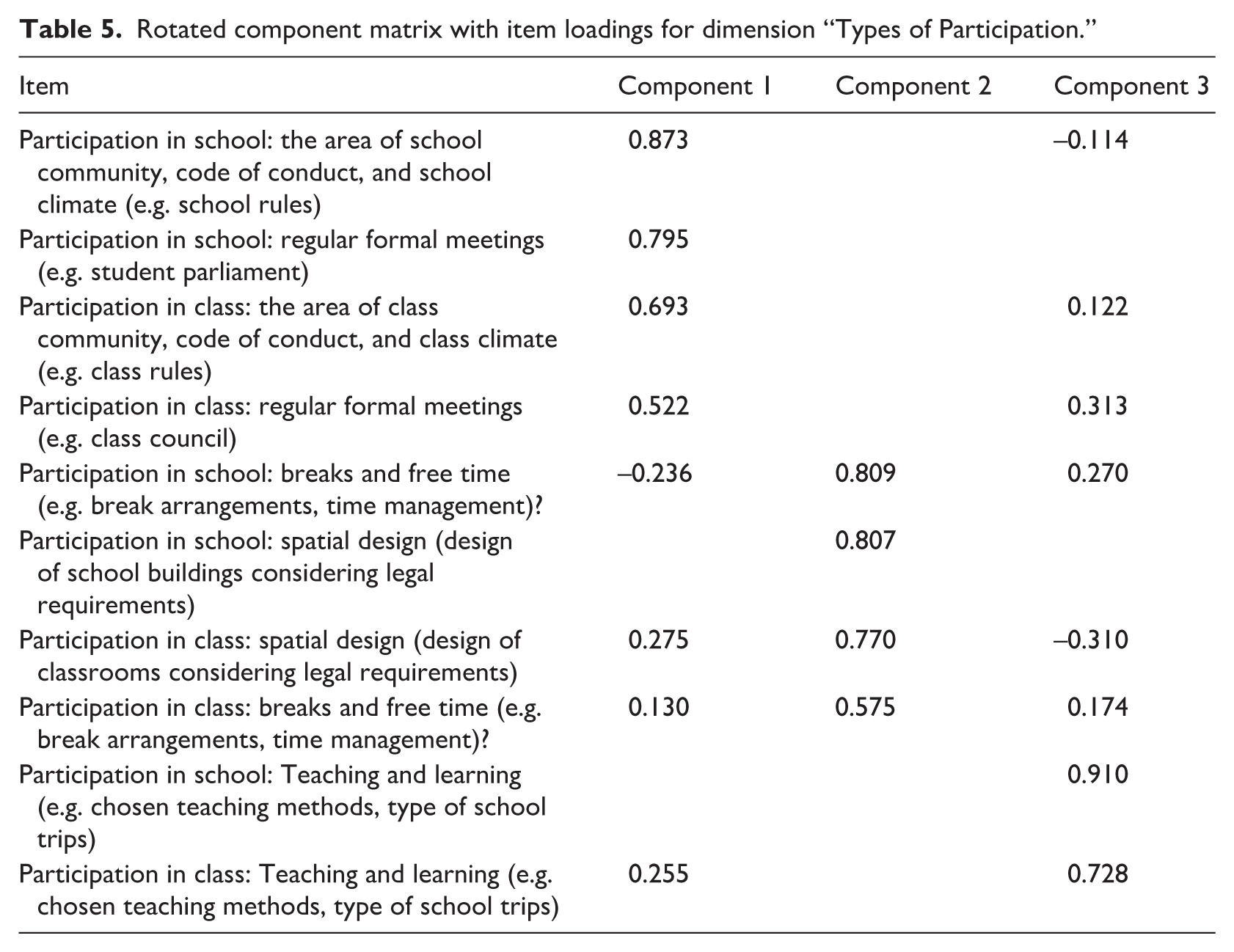
The PCA on items how teachers perceived areas of student-participation (e.g. teaching, school life, decision-making), identified a three factor solution. The three components explain 66.52% of variance. The sampling adequacy was acceptable (KMO = 0.791) and Bartlett’s test of sphericity was significant, χ2(45) = 1462.94, p < 0.001. The final component model with item loadings can be found in Table 5. Component 1, “School Community and Formal Meetings” reflects structure opportunities for participation in school, including involvement in school rules, climate, and representative bodies such as student councils. Component 2 “Physical and Recreational Environment” captures involvement in decisions related to classroom design, recreational spaces, and break-time organization. Lastly, component 3 “Teaching and Learning” focuses on the pedagogical engagement, encompassing input into curricula, learning content, instructional methods, and field trips. The inter-factor correlation coefficients confirm theoretical interrelatedness (r = 0.42–0.52), and the factor solution demonstrated good structural clarity.
Rotated component matrix with item loadings for dimension “Types of Participation.”
Multivariate multiple linear regression
To examine the influence of individual beliefs and school-level contextual factors on teachers’ concerns about democratic student-participation in the classroom, a multivariate multiple linear regression was conducted.
The dependent variables were identified in the PCA as:
(1) Loss of Control and Structure
(2) Low Student Engagement
(3) Organizational Overload
The independent variables were partially identified in the PCA and partially relate to the structural and sociodemographic factors included in the questionnaires:
(Democratic Dimension Component 1) Democratic Principles
(Democratic Dimension Component 2) Political Participation and Engagement
(Democratic Dimension Component 3) Social Justice and Protection of Vulnerable Groups
(Participation Context Component 1) School Community and Formal Meetings
(Participation Context Component 2) Physical and Recreational Environment
(Participation Context Component 3) Teaching and Learning
(Demographic) Teacher Age
(Demographic) Teacher Education Level
(Structural Factors) School Region
(Structural Factors) School Size
(Structural Factors) Existing Opportunities for Participation at School Level
(Structural Factors) Existing Opportunities for Participation at Class Level
(Structural Factors) Factor Scores of Socioeconomic Background (Pupils)
The multivariate tests revealed a significant overall model effect, Pillai’s Trace = 0.289, F(13, 315) = 9.89, p < 0.001, η2 = 0.289, indicating a large effect size. Significant multivariate effects of the following predictors were outlined in relation to the dependent variables (1) Loss of Control and Structure, (2) Low Student Engagement, (3) Organizational Overload.
Loss of control and structure
Univariate tests yielded a significant overall model effect, F(13, 317) = 9.89, p < 0.001, η2 = 0.289. The predictor (Participation Context Component 1) School Community and Formal Meetings was negatively associated with this concern, F(1, 317) = 21.05, p < 0.001, η2 = 0.062, indicating that structured participation opportunities correlate with reduced worry about loss of control. Also, the predictor (Participation Context Component 3) Teaching and Learning (F(1, 317) = 13.69, p < 0.001, η2 = 0.041) and (Participation Context Component 2) Physical and Recreational Environment (F(1, 317) = 7.44, p = 0.008, η2 = 0.022) were associated with lower levels of concern. In contrast teacher age (F(1, 317) = 10.95, p = 0.001, η2 = 0.033) and the socioeconomic backgrounds of students (F(1, 317) = 9.31, p = 0.002, η2 = 0.029) were positively associated with concerns regarding loss of control and structure. In this sense, teachers expressed fewer concerns regarding the loss of control when participatory structures exist within formal school settings, instructional contexts and recreational design. However, teachers who are older and those who are working with social disadvantaged students expressed higher levels of concern regarding the loss of control and structure.
Low student engagement
The univariate test statistics suggest a significant overall model fit for concerns about low student engagement, F(13, 317) = 8.60, p < 0.001, η2 = 0.261. Teachers reported significantly less concern in relation to low student engagement if participatory structures are thought to be located within (Participation Context Component 1) School Community and Formal Meetings (F(1, 317) = 11.61, p < 0.001, η2 = 0.035) or within (Participation Context Component 3) Teaching and Learning (F(1, 317) = 29.48, p < 0.001, η2 = 0.085). In this sense, structured participation in teaching and in formal contexts is linked to reduced concerns about student engagement. However, the socioeconomic background was identified to be a positive predictor (F(1, 317) = 11.30, p < 0.001, η2 = 0.034), suggesting teachers working with more disadvantaged student groups to be more concerned about limited student engagement.
Organizational overload
Lastly, univariate test statistics also outline a significant effect of the included predictors on organizational overload, F(13, 317) = 4.02, p < 0.001, η2 = 0.142. The predictor (Participation Context Component 3) Teaching and Learning indicated a negative relationship (F(1, 317) = 8.48, p = 0.004, η2 = 0.026), indicating that when students are involved in instructional processes and learning, teachers perceive fewer burdens in relation to organization. In contrast, teacher age was found to be positively associated with organizational overload (F(1, 317) = 7.36, p = 0.007, η2 = 0.023), suggesting that older teachers are more likely to perceive participatory practices as overly time-consuming and logistically challenging.
In conclusion, the results highlight that teacher concerns about implementing democratic student-participation are primarily shaped by the context within which participation occurs (e.g. school community structures and formal meetings, participation in teaching and learning), the socioeconomic backgrounds of students and the age of teachers. In contrast, democratic beliefs, regional school context and school size did not significantly impact concerns. Notably, participatory opportunities embedded in formal school structures and teaching contexts were consistently associated with fewer concerns across all dimensions, highlighting the importance of supportive environments in reducing teacher apprehension toward democratic student-participation.
Discussion
The present study examined how teachers’ concerns about democratic student-participation may be internally structured and predicted by individual beliefs and contextual factors. Consistent with previous literature, the results suggest that the enactment of democratic education is a contested process. Rather than simply a function of ideological resistance, teacher concerns are shaped by multi-layered influences, including contextual realities, pedagogical environments, and student demographics. Teacher concerns therefore highlight the friction between normative ideals and institutional realities that practitioners face.
At the heart of this tension lies the paradox suggesting that the enactment of democratic student-participation is in itself often undemocratic, as enacted through tokenistic top-down mandates and prescriptive procedures (Kupfer, 1984; Peterlini, 2016a). The concern “Loss of Control and Structure” articulates this paradox effectively, by highlighting anticipated caveats surrounding the erosion of classroom order and authority despite literature’s strong endorsement of participatory practices (Cook-Sather, 2006; Dewey, 1916; Freire, 1985). These findings resonate with earlier studies that outline how deeply entrenched the expectations for teacher control are in current pedagogical cultures, with anxieties surrounding the reconfiguration of traditional roles and flattened structures of authority (Bingham and Sidorkin, 2004; Fielding, 2004; Kupfer, 1984; Ranson, 2000).
Importantly, the results suggest that teacher concerns can be moderated by the contextual embeddedness of participatory practices. Specifically, teacher concerns are lower if participation could be embedded into institutionalized formal structures (e.g. school councils), This finding aligns with Apple and Beane’s (2007) arguments, that democratic participation cannot effectively function when relegated to symbolic or peripheral spaces but necessitates the integration into institutional structures. Similarly, the findings suggest lower teacher concerns if participation is integrated into core instructional processes (teaching and learning). In this sense, democratic practices that are placed within the domain of learning, which represents the very site of epistemic authority, significantly decreased levels of teacher concerns regarding disorder. This aligns with Freire’s (1985) and Mezirow’s (2000) argument that participation must not be procedural but epistemologically significant. In conclusion, participation needs to be meaningfully embedded in pedagogical and organizational frameworks (cf. Cook-Sather, 2006) in order to alleviate teacher concerns.
Conversely, levels of teacher concerns were heightened among teachers working with socioeconomically disadvantages student populations. This reiterates previous literature, suggesting that contextual adversity may exacerbate teacher skepticism about participatory practices (Dupont et al., 2023; Morris, 2015; Reay, 2006). Schools serving marginalized populations may operate under intensified structural pressure, including behavioral disruptions, diminished parental involvement, and resource scarcity, which may amplify challenges that teacher face in their pedagogical environment. Thus, democratic student-participation may risk becoming an aspirational ideal rather than a sustainable pedagogic strategy if systemic support is not available (cf. Biesta, 2006; Levin, 2000).
Similarly, teacher age was a significant predictor of concerns, specifically in relation to organizational overload and the loss of control and structure. Older teachers expressed higher levels of concern regarding the enactment of democratic participatory-practices. However, age-related patterns observed in the data may not be interpreted as suggesting that age itself determines teachers’ responses to democratic participation. Instead, age may function as a proxy for differences in professional socialization, cumulative workload, or a possible dissonance toward emerging pedagogical paradigms rather than a deficit in competence or commitment (Holzberger et al., 2022). As such, the predictor age may suggest a cohort or training effect rather than a general assumption that older teachers may be inherently less open to participatory approaches. This aligns with Zembylas’ (2005a, 2005b) work on affect by locating emotional responses in relational and institutional histories rather than in individual traits.
Importantly, the study also suggests that conceptualizations of democracy, whether orientated toward institutional liberalism, civic engagement or social justice, did not significantly predict teacher concerns. This finding challenges previous assumptions that personal values may directly predict institutional behavior (Levin, 2000; Pajares, 1992). Instead, it supports a more contextualized understanding of teacher agency, wherein structural and relational constraints may outweigh individual dispositions (Biesta, 2010; Voigt et al., 2020). Even if teachers endorse strong democratic commitments, the enactment of participatory processes may depend on the affordances and limitations of the institutional environment. This highlights the relevance of reconceptualizing democratic education not solely as an ideological alignment but as a situated practice contingent upon relational, structural and cultural variables.
In this sense, the present study achieved a more holistic and nuanced understanding of teacher concerns as diagnostic indicators rather than ideologically-driven obstacles. Rather than classifying teacher concerns as resistance or professional inertia, teacher concerns should be conceptualized as a manifestation of a pedagogical conscience that is shaped by competing institutional demands and ethical responsibilities.
Despite its contribution, caveats and limitations need to be acknowledged and considered, when interpreting the findings. First, the sample was recruited via convenience sampling and therefore is not representative for the Austrian teacher population, overrepresenting urban and secondary school teachers. This is an important caveat as it limits the generalizability of the findings. Rural contexts and primary school settings may have specific institutional cultures and teacher-student dynamics which are not taken into account in the present study. Additionally, the cross-sectional design of the study may preclude any causal inferences. While the results suggest significant relationships between structural and individual factors and teacher concerns, the directionality and potential mediating mechanisms could not be established further. Also, the reliance on self-reported data may have introduced potential biases, including social desirability bias and self-perception distortions. Furthermore, the present study focused on quantitative conceptualizations of the key dimensions observed. However, qualitative dimensions, such as emotional labor or relational dynamics remain underexplored. Therefore, future mixed-method studies may enrich the understanding of teacher concerns by triangulating qualitative and quantitative data and thereby capture the complexity and depth of teachers’ experiences and beliefs. While the hybrid development of the survey that intended to balance theoretical frameworks with practitioners’ experiences contributed to clarity, it also introduced important caveats. As the literature-guided inclusion of theoretically-recognized dimensions and items was reviewed and altered by the practitioner resonance group, it may be possible that the final instrument places greater emphasis on professional realities than on theoretical constructs. However, as this study focused on practitioner-based lived experiences, this emphasis ensures strong contextual validity and practical relevance. Future research may extend this work by focusing solely on theoretically derived dimensions, testing the instrument across diverse contexts. Lastly, the focus on classroom-based democratic participation necessarily leaves aside other expressions of democracy in education, emphasized by Dewey (1916), Freire (1979, 1985) and Biesta (2007, 2010). This reflects an analytical choice rather than a conceptual denial as the present data reflects teachers’ concerns in classroom practice and not their enactment of wider democratic agendas. In this sense, the present study examines one important but circumscribed aspect of democratic schooling. The absence of broader civic or societal democratic processes reflects therefore the scope of the empirical data rather than undermining these dimensions’ relevance. Future research may extend this analytical frame by examining how teachers navigate democratic practices beyond the classroom, including whole-school governance, community engagement, and social justice orientated pedagogies.
However, despite these caveats, the present findings carry several important implications for educational policy and practice. Essentially, the findings suggest that policy and professional efforts should prioritize the structural embedding of democratic practices. In this sense, professional development initiatives must move beyond an ideological training of teachers. Instead, adaptive expertise, emotional resilience and institutional support needs to be fostered. In addition, targeted support may be required for teachers in socioeconomically disadvantaged contexts and for older teachers who may experience participatory approaches as being more time consuming and demanding. Without addressing these relational, situational and contextual factors, democratic student participation may reproduce the very inequalities it seeks to redress.
These results resonate with broader European research highlighting that the enactment of democratic education is closely linked to structural conditions and institutional affordances (Kioupkiolis, 2023; Torres and Alves, 2024). Even strong normative commitments may not translate into pedagogical practice when teachers face contextual constraints and accountability pressures. However, the present study contributes to the wider European dialog by highlighting the intertwined nature of the relationship between contextual and institutional factors and barriers in the enactment of participatory initiatives. This provides a more nuanced understanding of the challenges in translating democratic ideals into practice.
In conclusion, the present study highlights that the enactment of democratic student-participation is not merely a matter of normative commitment but a deeply situated, relational and structurally contingent practice. To implement sustainable and meaningful democratic student-participation, teacher concerns need to be taken seriously as indicators for conditions under which democratic student-participation may flourish.
Footnotes
Declaration of conflicting interests
The author declared no potential conflicts of interest with respect to the research, authorship, and/or publication of this article.
Funding
The author disclosed receipt of the following financial support for the research, authorship, and/or publication of this article: This research was funded by Sparkling Science 2.0, administered by the OeAD on behalf of the Austrian Federal Ministry of Education, Science and Research (BMBWF), project number SPSC_02_100 – transform2gether.
