




Abstract
The paper examines the double schooling of displaced children from Ukraine, who simultaneously participate in Ukrainian distance education (UDE) and local schooling in host countries. Drawing on data from two empirical studies with parents conducted in Germany—a quantitative survey (2023–2024, N = 500; 528; 714) and qualitative interviews (2022–2023, N = 24)—this research explores the phenomenon of UDE, its educational dimensions, influencing factors and the agency of families in the context of double schooling. Quantitative findings indicate that nearly half of Ukrainian children abroad were enrolled in both systems as of early 2024, with participation closely tied to families’ plans to return to Ukraine, satisfaction with the German education system, parents’ language skills, and their educational level. Qualitative data reveal that motivations for UDE relate to academic continuity and progression, legal and certification needs, cultural and linguistic preservation, socio-emotional support, and organizational feasibility. Rather than viewing UDE as a barrier to integration, the study frames it as a form of transnational education and calls for a theoretical and practical conceptualization of double schooling as an educational strategy aimed at securing, accumulating, legitimizing and converting cultural, social and symbolic capital.
Keywords
Introduction
Following the large-scale Russian invasion on February 24, 2022, and the resulting forced displacement, refugees from Ukraine have come into focus for both policymakers and researchers. 1 In the field of education, particular attention has been given to the integration of children and adolescents into school systems, who constitute roughly 40% of the displaced population and have faced substantial disruptions to their educational pathways (OECD, 2023: 23). The activation of the Temporary Protection Directive in 2022 granted displaced persons holding Ukrainian citizenship or residence permits temporary protection (for an in-depth analysis of contributing factors, see Fullerton, 2024). This protection has been extended only on a yearly basis, leaving the long-stay planning and prospects of displaced individuals uncertain (cf. Schneider, 2024).
In the 2023/2024 school year, despite various efforts, the 23 EU member states reported continuing challenges in their national education systems, including language barriers, well-being concerns, teacher shortages, and challenges related to the option of Ukrainian schooling (European Commission, 2024: 9). The Council of Europe (2024: 25) indicates that “around 60% of children of Ukraine enrolled in the regular education process in host countries participate additionally in online classes broadcast from Ukraine.” As of January 2025, 355,747 Ukrainian children abroad were enrolled in both Ukrainian distance education (further UDE) and local schools in the host countries (Cabinet of Ministers of Ukraine, 2025; Nova ukrainska shkola [NUS, New Ukrainian school], 2025). The share of school-aged Ukrainian children not attending local schools in 2023/2024 varied but remained in the double digits in most host countries, with Ireland as the only exception (UNHCR, 2024a: 5). MSNA data from 10 countries indicate that secondary-school-aged children are far more likely than others to be out-of-school or engaged only in remote education (UNHCR, 2024b: 7). Among families who did not enroll their children in local schools, 57% cited ongoing Ukrainian distance education as the primary reason (UNHCR, 2024a: 9). Another survey of 15 European countries highlights significant disparities in how such distance learning is recognized and integrated. Approaches range from allowing individual students to follow parts of the Ukrainian curriculum to full implementation at the upper secondary level—with Lithuania standing out as the only country providing all necessary equipment to support this model (OECD, 2023: 33–34). In numerous host countries, education authorities have established various forms of cooperation with Ukrainian institutions to facilitate the recognition of academic achievements acquired abroad (Council of Europe, 2024: 26). Some governments held consultations with Ukraine’s Ministry of Education and Science on the rapid adaptation of displaced children; however, these consultations were sporadic and received limited public communication (State Service of Education Quality of Ukraine [SSEQ], 2023: 12).
The emerging practice of double schooling of displaced children as a new educational phenomenon—namely, the continuation of UDE alongside attendance at local schools—has been mentioned, in various studies and reports conducted in Poland (Klisowska et al., 2023: 25; Paradowski et al., 2023; Schmid 2023: 70–71), Austria (Woltran et al., 2025), Sweden (Pidgorna, 2023), Denmark (Lundtofte, 2024), the Czech Republic (Šeďová et al., 2025), Norway (Storen and Kalisha, 2025: 12), and G7-counties (Sharhorodska, 2025). These studies mostly do not theorize and frequently frame double schooling as conflicting or counterproductive to children’s integration. Pidgorna’s (2023: 58) study in Sweden highlights parental ambivalence between fears of “de-education” and a reconsidering of the purpose of schooling. Mützelburg and Krawatzek (2023: 23) further emphasize that children’s educational and social integration will be decisive in families’ decisions to stay or return—while return itself may introduce new tensions, as children bring back experiences shaped by divergent pedagogical approaches abroad. Similarly, Lundtofte in the Danish context, identifies an inherent tension “how practices of belonging create dilemmas in terms of prioritizing between local socialization, language development, staying close to Ukrainian society, and educational progress” (Lundtofte, 2024: 3). Storen and Kalisha (2025: 12) highlight double participation by contrasting the emphasis of Norwegian schooling—on developing students’ ability to get along with peers—with the subject-focused and performance-oriented nature of online Ukrainian classes.
Empirical research on the schooling situation in Germany also acknowledges the continuation of UDE as a common practice (cf. Huber et al., 2023; Letzel-Alt and Pozas, 2024; Moskalets et al., 2024; Mützelburg and Krawatzek, 2023; Skintey and Orobchuk, 2025). From a psychological perspective, research has shown that double schooling can have a positive effect on students’ well-being by fulfilling their basic needs for autonomy, competence, and relatedness (Chabursky et al., 2024: 8). At the same time, students face challenges, including difficulties coordinating classes, lacking appropriate learning spaces, limited support, and additional pressure in leisure time (Chabursky et al., 2024: 8). However, while the complex influences of UDE are recognized, national education institutions frequently identify UDE as an integration challenge (European Commission, 2024: 10). This form of education remains largely excluded from host-country educational and policy discourses and has not yet been systematically examined. Moreover, there is a lack of theoretical frameworks that adequately capture the double educational participation of individuals under temporary protection.
To address this gap in research and theory, this article explores UDE in double schooling among Ukrainian children, viewed through the lenses of forced migration and transnationalism, against the background of digitalization. We examine the dimensions and influencing factors of the UDE participation and the educational agency of families within the double schooling practice. Additionally, we explore the associated challenges and opportunities, framed as conflict of “burden versus enrichment,” and interpret them from the perspective of cultural, social and symbolic capital.
The paper draws on two studies from Germany (2022–2024): an online survey investigating the living conditions of Ukrainian refugees and qualitative interviews exploring parental perspectives on their children’s educational and linguistic integration. Our findings show that, beyond current insecurities and future prospects, families’ educational orientations, progress in specific subjects, language learning and maintenance, familiarity with legal and educational procedures, and various social and psycho-emotional factors, all shape the decision to engage with UDE. Parents perceive the continuation of Ukrainian education as an important link to the homeland and as a means of enabling their children to make informed educational choices. We situate these findings within the framework of transnational education, in which educational arrangements are characterized by a pluri-local structure across national borders, an explicit educational objective, and the private ownership and accountability of the educational space (Adick, 2018: 126). Consequently, UDE constitutes a new phenomenon and a genuinely novel type of transnational educational arrangement by a high degree of educational agency of the families and children. These insights contribute to both practice and research on the academic and socio-educational needs of displaced children and adolescents by advancing a perspective that acknowledges and supports familial agency.
First, the paper provides an overview of the structural educational conditions in Ukraine (2) and Germany (3). It then introduces the theoretical framework of transnational education, capital, and agency as applied to UDE (4). The quantitative study identifies key factors that correlate with the double schooling of displaced children (5.1). Subsequently, the qualitative study examines, based on parental perspectives, the dimensions of UDE in the context of double schooling that contribute to securing and accumulating children’s various forms of capital and its potential conversion (5.2). The conclusion and discussion synthesize the findings from both studies and situates them within the broader theoretical framework (6), followed by implications for further research and relevant educational policies (7).
The Ukrainian education system since 2022
To understand children’s double schooling, we first outline key features of the Ukrainian education system that provides conditions for UDE. Firstly, Ukraine is undergoing a major reform known as the New Ukrainian School (NUS; OECD, 2025). Introduced in the 2018/19 academic year for first grade and reaching eighth grade by 2025, this reform has fostered notable flexibility and adaptability within the education system and among educators. The goal of the NUS is “comprehensive development, education, and formation of individuals who perceive themselves as citizens of Ukraine, capable of living in the society and interacting with nature in a civilized way, aspire for self-perfection and life-long study, are ready for a conscious life choice and self-fulfillment, labor activities and community involvement” (Ministry of Education and Science of Ukraine [MESU], 2016: 5).
Secondly, while the COVID-19 pandemic led to significant challenges and educational losses (Nazarenko, 2025: 6; Zhenchenko et al., 2022: 137), it also created important preconditions for wartime distance education (Lytvynova et al., 2024) by strengthening the digital competencies of children and teachers, increased parental acceptance, and improved the digital infrastructure at Ukrainian schools.
Thirdly, in the past decade, private tutoring has become a widespread supplement to regular schooling in Ukraine, especially in the urban area (Budz, 2021; Khmelevska, 2017; Vashchenko, 2020), fostering greater agency among parents and children in navigating the educational process. We argue that this form of agency continues to manifest within UDE.
Fourthly, from a formal and legal standpoint, multiple forms of education were already possible under Ukrainian education law well before 2022 and were further adapted after the invasion (cf. Law of Ukraine on Education (n.d: Article 9)):
- on-site learning (attendance at a school where the security condition permits);
- online learning (online learning in a Ukrainian school, currently offered only in certain classes or schools, including state-licensed private schools);
- hybrid (combining on-site and online learning);
- individual forms of remove learning encompassing:
(a). external, a self-directed and asynchronous model where children are typically assessed once or twice per year by schools; (b). family learning or home schooling, a parent-organized, asynchronous model that must meet educational standards and is assessed at least four times annually.
In the following, we use UDE as an umbrella term to refer to all forms of education that can be pursued remotely.
With the onset of the Russian invasion, additional challenges emerged that promoted the shift to remote education. These included safety related concerns (frequent air raid alarms, proximity to the front lines, the availability and capacity of shelters, and parental concerns about children’s safety), the territorial dispersion of the students (students abroad with mandatory or non-mandatory school attendance requirements, students in occupied territories, internally displaced students) and teachers, as well as damaged infrastructure (destroyed school buildings, power and internet outages 2 ; see Orobchuk and Dyakiv, 2024).
The 2022–2023 academic year for schools began mainly in distance (41%) and mixed mode (34%), with a much smaller number in on-site mode (24%; Nazarenko, 2025: 9). In 2023/2024, most students (81%) were enrolled in full-time on-site education (SEI EMCEQI (State Educational Institution Educational and Methodological Center for Education Quality Issues), 2024: 11). The situation remained the most difficult in schools in the south (78%) and east (86%) – where distance education was the most common (SEI EMCEQI (State Educational Institution Educational and Methodological Center for Education Quality Issues), 2024: 12). Remote and online education was offered jointly to students in Ukraine and abroad. Consequently, the focus of school education was adjusted to address the war experiences in the curriculum (cf. Makarevych et al., 2024).
Since 2022, Ukraine’s Ministry of Education has implemented several legal, logistical, and structural adjustments to streamline double schooling for children abroad, in particular, by introducing innovations in distance learning (see Londar and Pietsch, 2023). Beginning in 2023, to reduce excessive workload, students may opt for distance education in Ukrainian schools that follows an educational program with a Ukrainian studies component, including subjects such as Ukrainian language and literature, Ukrainian history, law, and civic education (MESU, 2023). Grades in other subjects completed in foreign schools can be transferred to Ukraine using a conversion scale established by the Ministry of Education (Committee on Education Science and Innovation [CESI], 2025). At the same time, the capacities of the All-Ukrainian Online School (Всеукраїнська школа онлайн) and the International Ukrainian School (Міжнародна українська школа) have expanded. In some cities, metro stations have been converted into schools and underground schools have been built. Since 2022, the National Multidisciplinary Test (NMT), a shortened entrance examination for admission to Ukrainian universities, has been offered in 32 countries (Ukrainian Center for Educational Quality Assessment [UCEQA], 2024a). 3
Displaced children from Ukraine in Germany
As of early December 2025, approximately 1,33 million individuals from Ukraine under temporary protection had been registered in Germany (UNHCR, 2025). In 2022, most of them were women—77% arriving in Germany without a partner and 48% with minor children (Brücker et al., 2022: 1). Moreover, 72% of Ukrainian refugees hold a higher education degree (Brücker et al., 2022: 1), making them a population characterized by “high self-selection” (Kohlenberger et al., 2023: 14).
In the fourth quarter of 2025, 223,975 Ukrainian students were enrolled in general and vocational schools (KMK (Kultusministerkonferenz), 2025a). Alongside continued arrivals from Ukraine, departures—either returns to Ukraine or onward migration to other countries—must also be taken into account: By December 2025, 467,081 individuals who had fled to Germany since February 2022 were no longer residing there (Mediendienst Integration, 2025). Among those who moved away, the share of children and adolescents was approximately 40% in 2022, gradually declining to around 22% by 2025 (Statistisches Bundesamt Destatis, 2025).
In Germany, school entry regulations for newly arrived migrant children and youth vary by federal state, shaped by age requirements, legal residency status and structural conditions (Ständige Wissenschaftliche Kommission [SWK], 2025: 13). School attendance is compulsory from the age of six, yet school placement models differ by state and school type. Overall, five models—ranging from full integration in regular classes to fully separate, age-mixed classes focused solely on German as a second language (DaZ) or so-called “welcome classes”—are distinguished by the degree of integration into the German education system (cf. Ahrenholz et al., 2018: 44; Massumi et al., 2015: 44). Drawing on interviews with 2415 adolescents from the panel ReGES—Refugees in the German Educational System, Will et al. (2022) show that legal regulations of schooling in different federal states in Germany are significantly related to the educational participation of young refugees—for example, the duration until school enrollment in Germany, the type of class attended (regular class vs. welcome class), the type of school attended (other school form vs Gymnasium), and age-appropriate placement—whereas family and individual resources appear to play only a minor role (Will et al., 2022: 16–17). These findings suggest that the “scope of action” for newly arrived refugee students and their parents “is limited” (Will et al., 2022: 17), constraining their opportunities for educational decision-making and individual educational choices relative to other families. The analysis of the academic trajectories of refugee students from the same panel shows that most students remained in the initially attended lower secondary school track and that downward transitions occurred more frequently than upward transitions (Schouwink and Mundt, 2025: 1627).
Ukrainian displaced children were placed according to the regulations of the respective federal state: either in regular classes with language support or in separate formats known as “welcome classes” (Willkommensklassen), “preparatory classes” (Vorbereitungsklassen), “bridge classes” (Brückenklassen) or “intensive classes” (Intensivklassen; European Commission, 2024: 17; Menetrier and Meyer, 2023: 29). In some states, these models were revised based on experiences from the 2015 refugee intake. In areas with particularly high numbers of Ukrainian students, secondary-level transition classes exclusively for Ukrainian students—often with mixed age groups—were established (cf. Skintey and Orobchuk, 2025: 156). Recent findings reveal a mixed picture of school integration: While nearly 51% of Ukrainian children and youth report good German proficiency, their school belonging is lower than that of peers in PISA surveys (cf. Gambaro et al., 2025: 3). Their intentions to remain in Germany are also weaker than those of their parents; however, children and youth with friends in Germany report higher levels of overall satisfaction (cf. Gambaro et al., 2025: 3).
The initial implementation of the Temporary Protection Directive in Germany triggered policy debate over the recognition of UDE as a substitute for compulsory school attendance. In alignment with the Standing Scientific Commission recommendation for the “swiftest possible integration of refugee children and adolescents into early childhood education and schools” (SWK, 2022: 1), the Kultusministerkonferenz (KMK) confirmed on May 10, 2022 that state school attendance laws apply to Ukrainian students (KMK (Kultusministerkonferenz), 2022b: 2). While acknowledging the “particular challenge” of balancing access to Ukrainian curricula with the imperative of German language acquisition and integration (KMK (Kultusministerkonferenz), 2022b: 2), the KMK recommended the use of Ukrainian online materials as supplementary resources. UDE may be pursued privately for Ukrainian certification purposes (KMK (Kultusministerkonferenz), 2022a: 1–2). Given Germany’s compulsory schooling requirement, the national education system constitutes the formal educational framework for Ukrainian students. While Ukrainian authorities recognize both local schooling and distance education as formal education, German policy while accepting Ukrainian school certificates as formal qualifications, albeit with certain limitations—generally classifies parallel UDE participation as non-formal learning.
Despite its growing relevance as a unique educational practice, the UDE participation has received little attention in empirical educational research. Despite that’s fact, some education scholars view this phenomenon as “a new arrangement” that grants Ukrainian students—due to their distinct legal status—expanded rights and thus requires critical examination through an anti-racist lens (Mediendienst Integration, 2024). Others view it as an unprecedented recognition of transnational educational trajectories and new spaces of possibility in the digital age—opportunities that, they argue, should not be limited to specific groups (cf. Karakaşoğlu, 2024: 45–46). These debates—despite their critical orientation, but largely centered on the German context—tend to overlook Ukraine’s EU-aligned education reforms, the advancement of digital learning infrastructure, and the Ukrainian governmental diplomatic initiatives to support the educational participation of displaced children and youth abroad. At the same time, we agree that the shifting conceptualization of UDE may potentially provide impetus for transforming education systems toward a more transnational approach to schooling—one aligned with the idea of cosmopolitan education rather than a nation-state-centered perspective (Karakaşoğlu, 2024: 41).
Transnational education, educational capital and family agency
Transnational education
The everyday realities of migrants can be explained by the approach of transnationalism (Glick Schiller et al., 1992), that challenges the traditional notion of migration as a one-dimensional process in which migrants lose contact with their country of origin and fully integrate into their new society. In contrast to classical assimilation models, transmigration theory emphasizes that migrants are simultaneously active in two (or more) societies, developing flexible identities. The term transnational, according to Pries, refers to cross-border phenomena that—locally anchored in different national societies—constitute relatively permanent and dense social relationships, social networks, or social spaces (Pries, 2010: 13). Accordingly, for migrant families, the trans nationalization of everyday life worlds (Pries, 2010: 35) can generally be attested, when they live simultaneously “here and there” and are bound less by space than by time (Yildiz, 2013: 140). But what does this mean for the design of school education?
The meaning and purpose of education has been compelled to evolve in response to the needs of modern time with its significant advances in information technology and unprecedented access to knowledge (Kesper-Biermann et al., 2018: 116). Nowadays the school can’t integrate transnational life worlds of students, but take them into account in a contradictory way. On the one hand, children socialized in Germany are increasingly expected to be open to networking with and mobility in the world, because they prepare themselves linguistically and culturally for cross-border mobility; on the other hand, newly immigrated children are expected to focus on learning for a life in Germany, which in terms of residence law is not intended for everyone (cf. Karakaşoğlu et al., 2019: 20). The knowledge and qualifications that students have brought with them from other educational contexts are often not taken into account, although for them, at least from a pedagogically professional, inclusion-oriented perspective, individual connections in the local educational context should be established (cf. Karakaşoğlu et al., 2019: 20).
To theoretically conceptualize the participation of Ukrainian students in two national education systems, we refer to the Adick’s concept of transnational education (TNE), that is distinguished from other types of education by the following characteristics: (1) formal or non-formal as the objective of the interaction; (2) non-state, non-governmental, for profit or non-profit ownership and accountability of the educational space and (3) border crossing interaction through mobility and location of programs, people, educational institutions and artifacts (Adick, 2018: 126). Transnational educational formats in the school system include, for example, international schools offering fully international curricula and certificates, schools with double curricula and certificates, and foreign (non-state, non-governmental) actors (churches, foundations, NGOs) that operate the national curricula and certificates of a given country in place of the host state’s authorities (Adick, 2018: 129–130). Building on the notion of educational spaces constituted by different actors at various levels and through relations, interactions and perceptions (Kesper-Biermann, 2016: 93), TNE operates with transnational educational spaces as “educational spaces that span across several national boundaries” (Adick, 2018: 134). Such a space may be characterized (and compared to others ones) by what participants are doing there (like practices in a school, a classroom or in a yard of kindergarten), its symbols (like the motto of a school or a flag, medals, songs and rituals), and its artifacts (like textbooks, the architecture and furniture of its buildings, apparatus in laboratories, devices for instruction and play; Adick, 2018: 126).
Within the context of TNE, learners may acquire not only social and moral support but also social, cultural, symbolic, and economic capital (cf. Somalingam, 2017). Drawing on Bourdieu’s concept of capital as “accumulated labor” which depending on the field it functions, and at the cost of transformation expenses acting as preconditions for its efficacy, capital can present itself in three fundamental guises: economic capital, cultural capital, social capital (Bourdieu, 1986: 243). Education can be understood as primarily cultural capital, which can exist in three forms (Bourdieu, 1986: 243):
in the embodied state, that is, in the form of long-lasting dispositions of the mind and body;
in the objectified state, in the form of cultural goods (pictures, books, dictionaries, instruments, machines, etc.), which are the trace or realization of theories or critiques of these theories, problematics, etc.;
in the institutionalized state, a form of objectification which must be set apart because, as will be seen in the case of educational qualifications, it confers entirely original properties on the cultural capital which it is presumed to guarantee.
Under certain conditions, each form of capital can be transformed into other types of capital and can function as symbolic capital, provided that it contributes to the acquisition and maintenance of social recognition and is defined as legitimate by (political) power holders (cf. Bourdieu, 1998: 108–115). Further, Howard et al. propose the concept of educational capital “to assist in the examination and empirical evaluation of family and school variables which provide children with the capital to be successful” (Howard et al., 1996: 139). Their hierarchical mirror model of educational capital reflects both school- and home-based variables, as well as the ways in which these variables influence schooling and are interrelated. The model includes, on the family side, factors such as parenting style, parental expectations, contact with schools, (educational) resources, network with other families, homework aid, involvement in extracurricular activities, civic participation, a sense of the future; on the school side, the model encompasses safe, quiet, and disciplined environments, rules for social and academic conduct, teach social values, computer equipment, remedial programs, parent volunteer programs, high culture, mentorship, community service (Howard et al., 1996: 142).
Agency as mediation
While transnational education provides a framework for understanding the spatial, institutional, and symbolic configurations in which UDE operates, these configurations alone do not explain why and how displaced families create, navigate, appropriate, and transform transnational educational spaces in double schooling. To capture these lived enactments, we draw on the concept of agency as a productive perspective in the sociology of education and educational science—one that provides comprehensive insights into the various dimensions and mechanisms of socialization and their effects on actors’ possibilities for action (cf. Mick, 2012: 538). To begin with, the agency paradigm operates within the tension of central dichotomies that have shaped sociology since its beginnings: foremost among them action and structure, followed by consciousness and being, nature and culture, society and the individual, the local and the global (cf. Mick, 2012: 527). Bouchard and Glasgow (2018: p. 2) specify the nature and scope of agency in terms of complex links between people, their goals and aspirations, their ability to exercise their own will, and the local and broader contexts in which these phenomena unfold. From a relational–relativist perspective, Raithelhuber (2022: 45) argues that agency should not be understood as an individual capacity for action, but rather as a characteristic of an overall milieu, since it is produced, situated, and made available within a complex relational–dynamic context.
Sewell shifts the focus from abstract to concrete entities: “Agency arises from the actor’s control of resources, which means the capacity to reinterpret or mobilize an array of resources in terms of schemas other than those that constituted the array” (Sewell, 1992: 20). Against the backdrop of technological change, Wee (2021) calls for rethinking agency in relation to language highlighting the role of non-human entities, and Peck et al. (2024) demonstrate how human actors can actively create virtual learning spaces.
The most applicable for our data conceptualization is provided by Emirbayer and Mische, who characterize the agency paradigm as a mediation between past, present, and future, consisting of three dimensions (Emirbayer and Mische, 1998: 971):
Iterationality refers to the selective reactivation by actors of past patterns of thought and action, as routinely incorporated in practical activity, thereby giving stability and order to social universes and helping to sustain identities, interactions, and institutions overtime;
Projectivity encompasses the imaginative generation by actors of possible future trajectories of action, in which received structures of thought and action may be creatively reconfigured in relation to actors’ hopes, fears, and desires for the future.
Practical-evaluative element entails the capacity of actors to make practical and normative judgments among alternative possible trajectories of action, in response to the emerging demands, dilemmas, and ambiguities of presently evolving situations.
In the realm of transnational education—an educational sphere that is optional rather than nationally compulsory—there is considerable room for agency, expressed through the ability to make choices, take decisions, and enact strategies across plurilocal contexts. Such agency also involves the work of rendering these choices coherent. This occurs both through rationalization, directed toward the future, which puts practical pressure on people to work out good reasons for action and to assemble meaningful patterns (Summers, 2017: 33), and through post-rationalization, whereby agents retrospectively, rather than sticking to the original motives, adopt post hoc rationales that justify their actions, adjust their attitudes and beliefs to legitimize their past choices (cf. Eyster et al., 2022: 12). Given the central role of parental agency in these educational decisions, the motivations and underlying considerations warrant closer investigation.
Parental agency in transnational educational contexts: Empirical studies on practices and decision-making
Enabling “maintaining the link to the Ukrainian national education system” is proclaimed as a task at the European Schools, but implementation is seen as depending on the specific personal situation of each individual student: “Despite the war, the Ukrainian national education system is functioning. Many schools and their teachers offer distance teaching and learning to their pupils who may follow the teaching at the place where they have found shelter. The European Schools are encouraged to help pupils maintaining links with Ukrainian schools where necessary to support their Ukrainian pupils. The concrete arrangements for each individual pupil will depend on his/her personal situation, the provision of teaching and learning of his/her (former) school and the mid-term perspective of the pupil and his family” (Office of the Secretary-General of the European Schools, 2024: 5–6). In this respect, the actual decision about starting and continuing participation in Ukrainian school education lies with the students and their parents as private actors.
This dynamic is echoed in a study commissioned by the State Service of Education Quality of Ukraine during the 2022/2023 school year, conducted in various countries and confirming that “[p]arents play the primary role in determining the form of their children’s education abroad—they make decisions about the place and mode of schooling [. . .], which are also influenced by the legal requirements of host countries mandating compulsory school attendance in local educational institutions” (SSEQ, 2023: 10). Parents cite a range of motivations reflecting multiple layers of reasoning: foremost among them is the desire to ensure that their child remains connected to the Ukrainian school system, does not lose their official place in a Ukrainian school, is not be placed in a lower grade due to age discrepancies, and retains a fallback option—particularly in light of the uncertainty surrounding the consequences of withdrawing from distance education (SSEQ, 2023: 10–14). Some parents also reported that distance education through a Ukrainian school was, in fact, their only viable option (SSEQ, 2023: 14).
If we apply these characteristics of transnational educational space of Ukrainian displaced students in Germany, we can observe social practices of participation in one or two national education systems. Symbol systems are documented in the acquisition of state-regulated curricula and certificates, and technical equipment for participation in UDE, virtual spaces, e-books and learning products, and achievements function as artifacts. The conceptual framework developed above positions UDE as a transnational educational practice sustained through the agency of children and families who negotiate multiple spaces and expectations. Yet the ways in which this agency is articulated—how parents interpret constraints and opportunities, mobilize resources, and make strategic decisions about their children’s schooling—can only be understood empirically. The following section outlines the methodological design and key findings from two empirical studies exploring parents’ perspectives and practices, examining how educational agency is exercised in the context of displacement, uncertainty, and double schooling.
Quantitative study: Design and results
As part of the ifo Center for International Comparison and Migration Research project “Adaptation and Integration Strategies of Refugees from Ukraine in Germany,” three online surveys were conducted in the periods January–March 2023, June–July 2023 and December 2023–January 2024. Participants were recruited through groups on the social networks Facebook and Telegram. The sample sizes for each survey were accordingly: 1067, 1246 and 1671 (500, 528 and 714 respondents had school children and answered questions about the schooling). The recruitment relied on a convenience sampling approach via online refugee communities, which means the sample is not representative of the broader population of Ukrainian refugees in Germany. This method inherently introduces a selection bias, as participants recruited through social media platforms are likely to be more online-affine, better educated, and more open to participating in surveys than the average Ukrainian refugee family. Since no random sampling was employed, the findings must be interpreted with caution and cannot be generalized. Each study wave consisted of independent cross-sectional samples, with no systematic tracking of the same families over time, thus, it should not be considered as panel study. While this limits the ability to analyze individual-level changes, the consistent use of the same recruitment channels across all three waves allows for an examination of aggregate trends over time within this specific group. All surveys were carried out in Qualtrics and administered in Ukrainian, with no incentives offered to participants. Ethical approval for the study was granted by the Ethics Committee of the Faculty of Economics of the Ludwig-Maximilians-University Munich. The survey data were analyzed with standard quantitative methods using the R programing language. Initially, we calculated summary statistics for the sample to obtain a general overview of displaced Ukrainians with school-aged children. Subsequently, we employed logistic regression analysis to examine potential determinants of their children’s participation in the German and Ukrainian school systems.
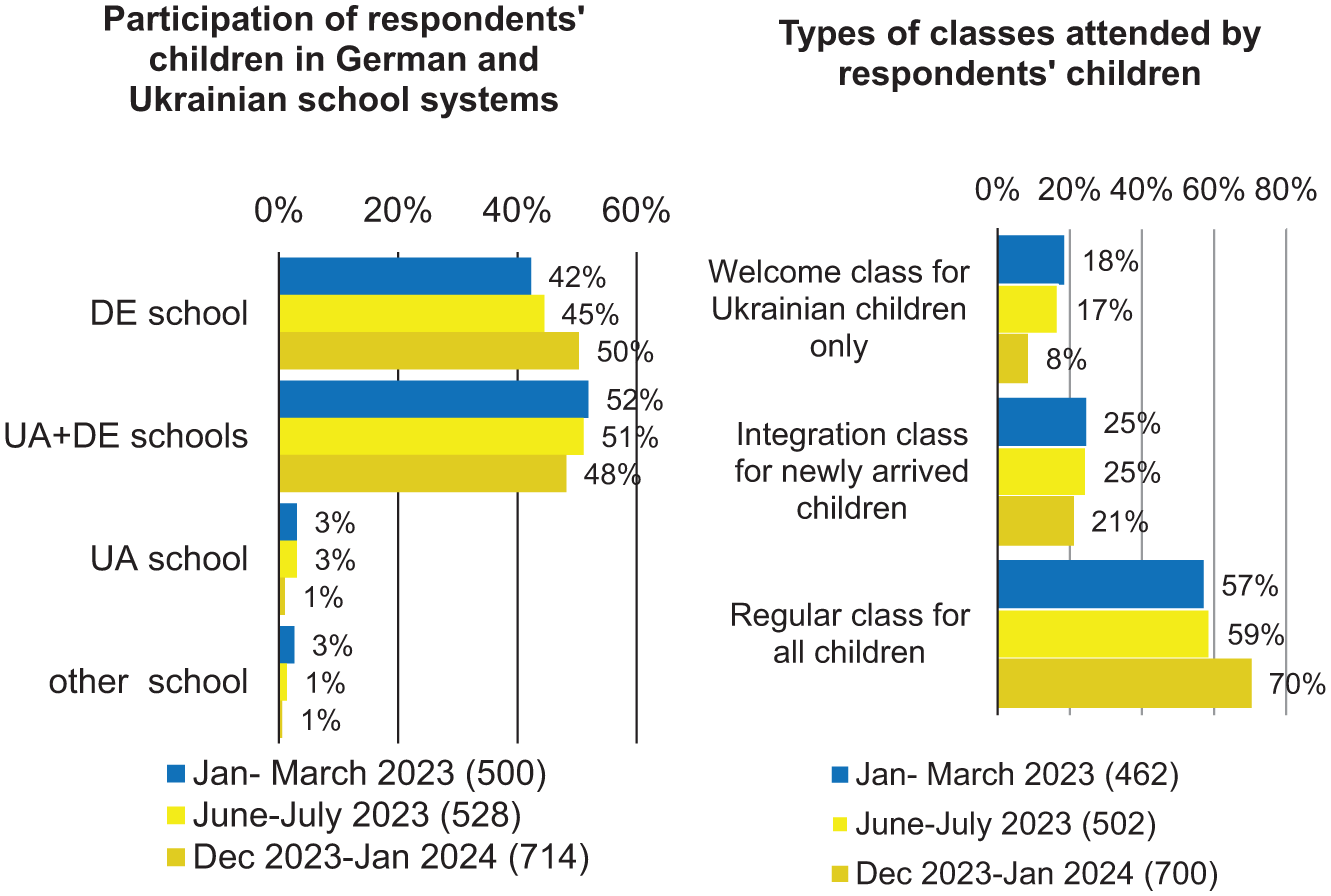
In the survey, several questions were posed regarding the school education of children. Figure 1 presents data on children’s participation in German and Ukrainian school systems (right panel) and the types of classes attended in German schools that either include or exclude an integration component (left panel), across three independent cross-sectional surveys (see Figure 1).
Participation of Ukrainian children in the German school system and types of classes attended. 4
Survey responses reveal several notable trends in children’s enrollment in German and Ukrainian school systems. Initially, in January–March 2023, 52% of respondents reported that their children were enrolled in both German and Ukrainian schools. By December 2023–January 2024, this proportion had declined to 48%. Concurrently, the share of children attending only German schools increased from 42% in the first survey to 50% in the third. A small percentage of respondents—1%–3%—indicated that their children were enrolled only in UDE or other (presumably international) schools. This suggests that a minority of children were not integrated into the German education system, possibly due to age (beyond mandatory schooling in Germany) or other circumstances. Over time, in early 2024, the share of children in both categories decreased: out of 714, 7 attended only UDE, and 4 other schools.
Regarding the types of classes attended in German schools, the majority of parents reported their children’s placement in regular classes. This proportion rose from 57% in the first survey to 70% in the third. The share of children in integration classes decreased from 25% to 21% in the third survey. Notably, the proportion of children in welcome classes declined significantly—from 18% to 8% accordingly. These findings align with the IAB-BAMF-SOEP survey reporting that “in the second half of 2023, 60% of 11- to 17-year-olds were fully integrated into regular classes, while 24% and attended a regular class with additional supportive teaching 16% participated exclusively in special welcome or preparatory classes” (Kosyakova et al., 2025: 3). This reflects a broader trend of gradual dissolution of welcome classes and the transition of children into regular with language support classes.
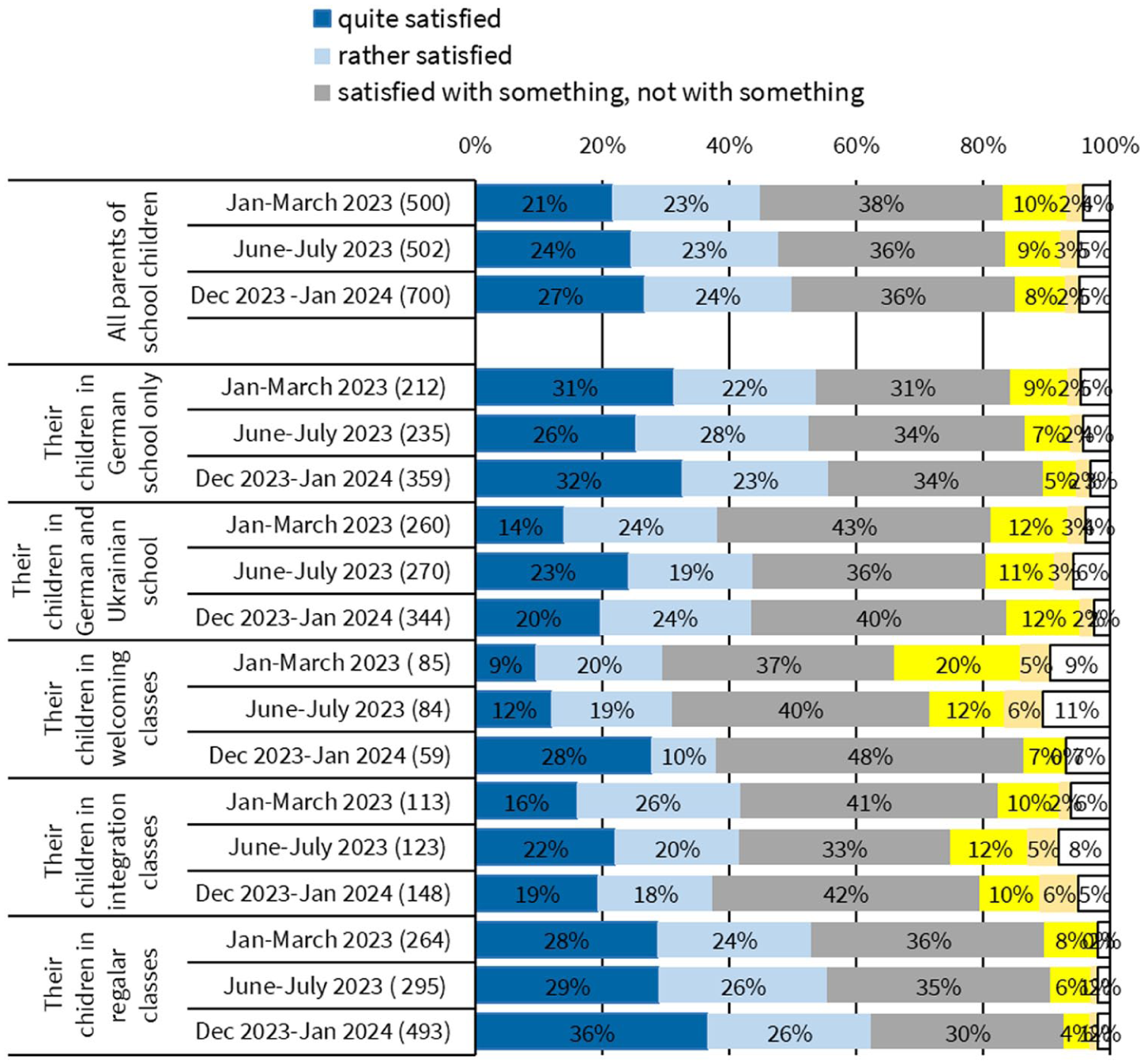
Building on these structural developments, the next step is to examine how parents evaluate their children’s educational experiences. Figure 2 illustrates parents’ satisfaction with their children’s schooling situation in Germany, depicting variations based on whether children participate in one or both school systems and the type of class they attend in German school.
Satisfaction of parents with the education of their children in Germany. 5
Research data indicates that approximately half of the parents are fully or partially satisfied with the German school system and their children’s schooling, with overall satisfaction increasing over time—from 44% to 52%. The proportion of parents who are fully satisfied has grown from 21% to 27%. Meanwhile, 36%–38% of respondents reported mixed satisfaction (satisfied in some aspects but not others), and 10%–12% expressed dissatisfaction, and only 2%–3% were completely dissatisfied.
The study further examines how children’s involvement in one or both school systems, as well as the type of class they attend in German schools, is related to parental satisfaction with German education. Analysis of all three surveys revealed that satisfaction levels are higher among parents whose children attend German schools only (53%–55%) compared to those whose children are in double participation (38%–44%). The relationship between the type of school and satisfaction with the German schooling was statistically significant, as confirmed by the χ2 test (χ2 = 280.56, p = 2.2e-16 in the last survey). Similarly, satisfaction was the highest among parents whose children attend regular classes (52%–62%), while parents of children in welcome classes reported the lowest satisfaction (29%–38%). The association between class type and parental satisfaction was also statistically significant (χ2 = 30.799, p = 0.0006332 in the last survey). These results suggest that regular classes attendance positively correlates with parental satisfaction with the German schooling, as does exclusive enrollment in the German system. Both relationships remained statistically significant across all three surveys, suggesting that insufficient accumulation of cultural (subject-specific) and social capital may contribute to these patterns.
Lower satisfaction with the German schooling, particularly among parents of children in integration or welcome classes, may be linked to a greater inclination to supplement their children’s education and maintain their enrollment in Ukrainian schools.
To test this hypothesis—and to explore the role of education, parental language skills, plans to return to Ukraine, and socio-demographic characteristics—a logistic regression model was employed to analyze potential determinants of children’s participation in double schooling. The dependent variable was binary: 1 if the child attends a Ukrainian school, and 0 if the child attends only a German school (as mandated by German law for children aged 6–18). Logistic regression is well-suited for this analysis, as it estimates the probability of an event (enrollment in UDE) based on a set of predictors. The model is formally represented as:

p is the probability of participating in UDE, p/(1–p) are the odds of the event occurring, and ln(p/(1–p)) is the logit. The coefficients β_1, β_2,. . .,β_k reflect the influence of the independent variables X_1, X_2,. . .,X_k on the log odds of attending a UDE.
The model included a range of independent variables:
Socio-demographic characteristics (gender, education, presence of a partner in Germany),
Plans to return to Ukraine or stay in Germany (intention to return within 2 years or in general, regardless of timing),
Employment status in Germany,
Language proficiency (German and English),
Satisfaction with the German education system.
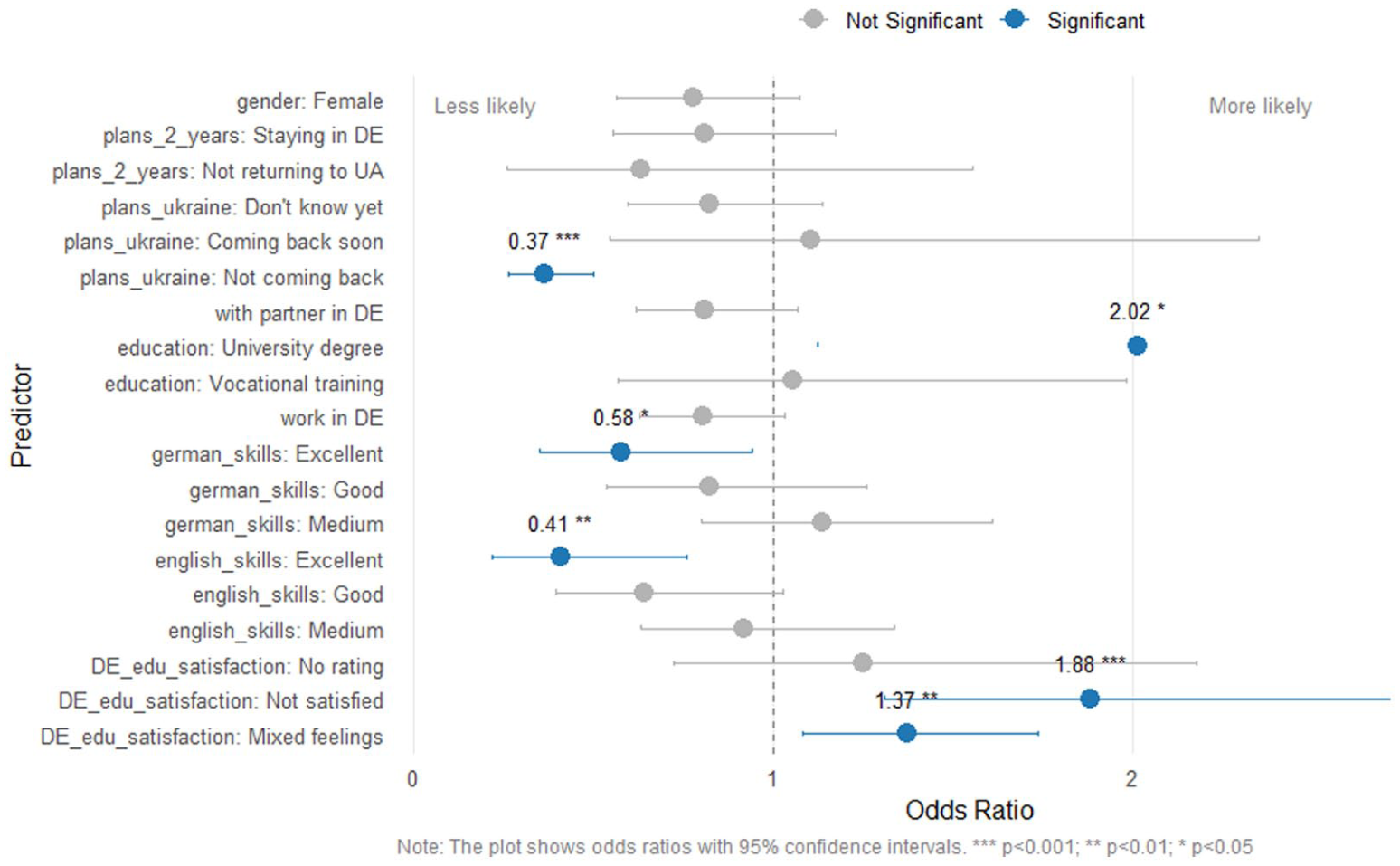
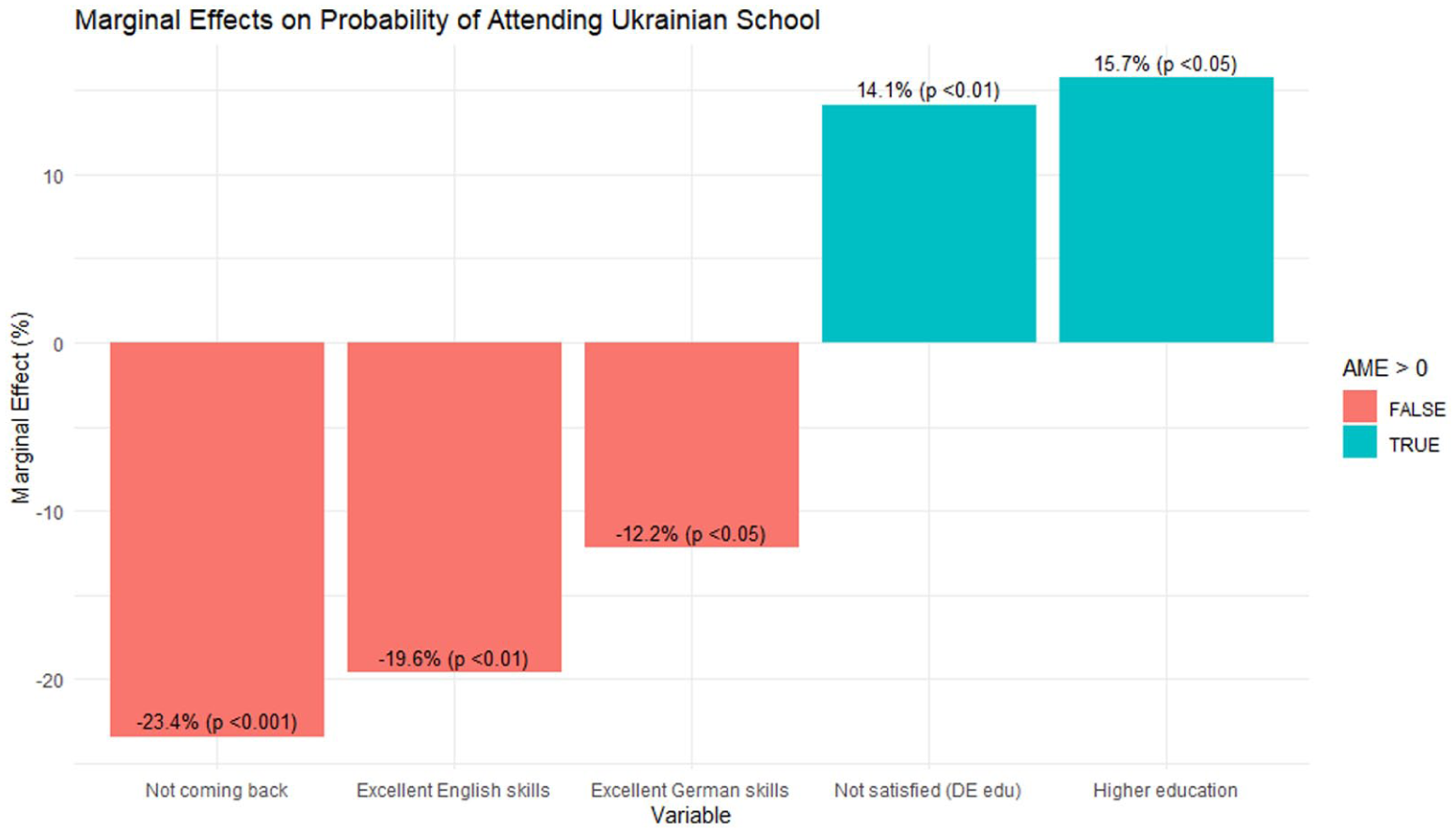
The model was estimated using maximum likelihood estimation, identifying statistically significant factors that affect the probability of UDE enrollment. The inclusion of time dummies enabled us to explicitly account for the temporal dynamics of Ukrainian school attendance. Although their effect was not statistically significant in our model (p = 0.214), their inclusion enhanced the robustness of the analysis by controlling for potential time-related trends. Figure 3 presents the odds ratios (OR) for all variables, illustrating the relative changes in the odds of Ukrainian school attendance. Figure 4 shows average marginal effects (AME) only for statistically significant variables, representing absolute changes in probability (in percentages).
Odds ratios of factors influencing attendance at Ukrainian schools among displaced children from Ukraine in Germany.
Average marginal effects of significant factors on the probability of attending Ukrainian schools.
The results of the regression analysis demonstrate that the participation of Ukrainian displaced children in two education systems significantly depends on families’ plans to return to Ukraine, satisfaction with the German education system, parents’ language skills, and their educational level.
Although plans to stay in Germany for 2 years were not statistically significant in this model, this does not exclude their potential influence on parents’ decisions. Perhaps short-term plans have not yet been fully formed, or their influence is overshadowed by other factors, such as long-term intentions to return. However, respondents who do not plan to return to Ukraine have a 63.4% lower likelihood of enrolling their children in Ukrainian schools (OR = 0.366, p < 0.001), corresponding to a 23.4% decrease in probability (AME, p < 0.001). This indicates that these families might prioritize the investment of personal costs into German education integration. In contrast, families considering the possibility of returning to Ukraine or those who have not yet decided are more likely to maintain a connection with Ukrainian education to provide flexibility for their children in case of return.
Satisfaction with the German education system is also one of the most important determinants of educational trajectory choices for children. Parents who are not satisfied with the German education system are almost twice as likely to enroll their children in Ukrainian schools (OR = 1.79), equivalent to a 14.1% increase in probability (AME, p < 0.01). This suggests that dissatisfaction with the quality or features of the schooling situation of their children in Germany prompts parents to seek alternative educational opportunities, including enrolling their children in Ukrainian schools. Parents who are only partially satisfied with German education are 35% more likely to choose a double education for their children (OR = 1.35), corresponding to a 7.2% increase in probability (AME, p < 0.01). This may be related to the desire to compensate for the shortcomings or limitations they observe in the schooling in Germany through additional UDE.
Parents’ language skills play an important role in decisions about their children’s education. A Likelihood Ratio Test (LRT) confirmed that the combined effect of German and English language skills is statistically significant in influencing the likelihood of children attending Ukrainian schools (p = 0.0003833). Children of parents with excellent German language skills are 42.2% less likely to attend Ukrainian schools (OR = 0.578, p < 0.05), corresponding to a 12.2% decrease in probability (AME, p < 0.05). Children of parents with excellent English language skills are 60% less likely to attend Ukrainian schools (OR = 0.41, p < 0.05), equivalent to a 19.6% decrease in probability (AME, p < 0.01). Presumably, parents who speak foreign languages feel more positive about their own prospects for integration into the job market and therefore prioritize and focus on their children’s participation in German schooling. Overall, children of parents with low proficiency in foreign languages are more likely to be enrolled in UDE (though this dependency is not statistically significant), which may be related to the desire to preserve cultural and linguistic identity and to remain educationally flexible (including possible relocation to third countries) when parents do not feel confident in a new language environment.
Particularly noteworthy is the role of parents’ higher education. Children of parents with higher education are twice as likely to attend Ukrainian schools (OR = 2.02, p < 0.05), corresponding to a 15.7% increase in probability (AME, p < 0.05). This can be explained by the fact that parents with higher education have greater cultural and social capital, better understand the benefits of bilingual education and cultural ties with Ukraine, and are less prone to fear of double workload, as they have the resources (time, finances, information) to effectively organize the learning process. They are also often better informed about the importance of preserving cultural heritage and developing bi- and multilingualism as cultural, social and symbolic capital, which contributes to the successful adaptation of children both in Ukraine and abroad with a chance to convert it into economic capital.
In this model, gender, presence of a partner, and employment in Germany were not statistically significant, although some of them show a tendency toward influence. Specifically, the predictor of employment in Germany for the choice of educational strategy does not reach the standard level of significance (p ≈ 0.087), but its proximity to this level indicates a potentially important influence. Parents who work in Germany are approximately 19.2% less likely to enroll their children in UDE (OR = 0.81) compared to those who do not work. Working parents may feel greater pressure to integrate into the local community and strive to provide their children with stability through German education. They may also have less time and resources to organize additional UDE.
Thus, satisfaction with the German education system, plans to return to Ukraine, parents’ language skills, and their educational level are key factors determining children’s participation in two education systems. Families with higher education and lower satisfaction with the German education system are more likely to involve their children in UDE. This underscores the importance of cultural and social capital, and family resources in choosing an educational trajectory for children of displaced Ukrainians.
Qualitative study: Research design and findings
While the quantitative data reveal trends and correlations, the qualitative data expand the analysis with additional variables and provide deeper insights into the phenomenon of distance and double education. As part of the qualitative, exploratory study “Linguistic Situation of Refugee Families from Ukraine in Germany” 24 semi-structured, problem- and theme-centered interviews (cf. Witzel, 2000) were conducted between June 2022 and January 2023 with women who had fled to Germany and had children of preschool or school age. Participants were recruited using a combination of social media postings and personal networks. Accordingly, the sample can be considered largely self-selected. The interviews were conducted nationwide via dyadic video calls and phone conversations, following the ethical standards of the Deutsche Gesellschaft fr Fremdsprachenforschung (DGFF, 2019). All names have been pseudonymized.
Participants were offered a choice of interview language, with all but one opting for Ukrainian, and two interviews featuring topic-driven code-switching to Russian. The total recording time was approximately 13.9 hours. The interview guide comprised 20 questions focusing on families’ linguistic situation before and after displacement and on their children’s educational experiences in Ukraine and Germany. The interview guide did not include questions about educational qualification or profession; however, they were verbalized as part of participants’ own relevance-setting. According to their narratives, all participants largely represented an urban middle class in Ukraine: all of them were estimated to possess a higher education degree and were employed in the public sector or business, for example, educators, journalists, psychologists, doctors, administrators, and managers. According to the mothers, 23 of the 33 children and adolescents (15 in primary, 16 in secondary, and 2 in tertiary education) participated in UDE at the time of the interview (cf. Skintey and Orobchuk, 2025: 175 –179). The transcripts were analyzed using MAXQDA Plus 24, applying Mayring’s (2022) qualitative content analysis, with the category distant education yielding 58 coded segments.
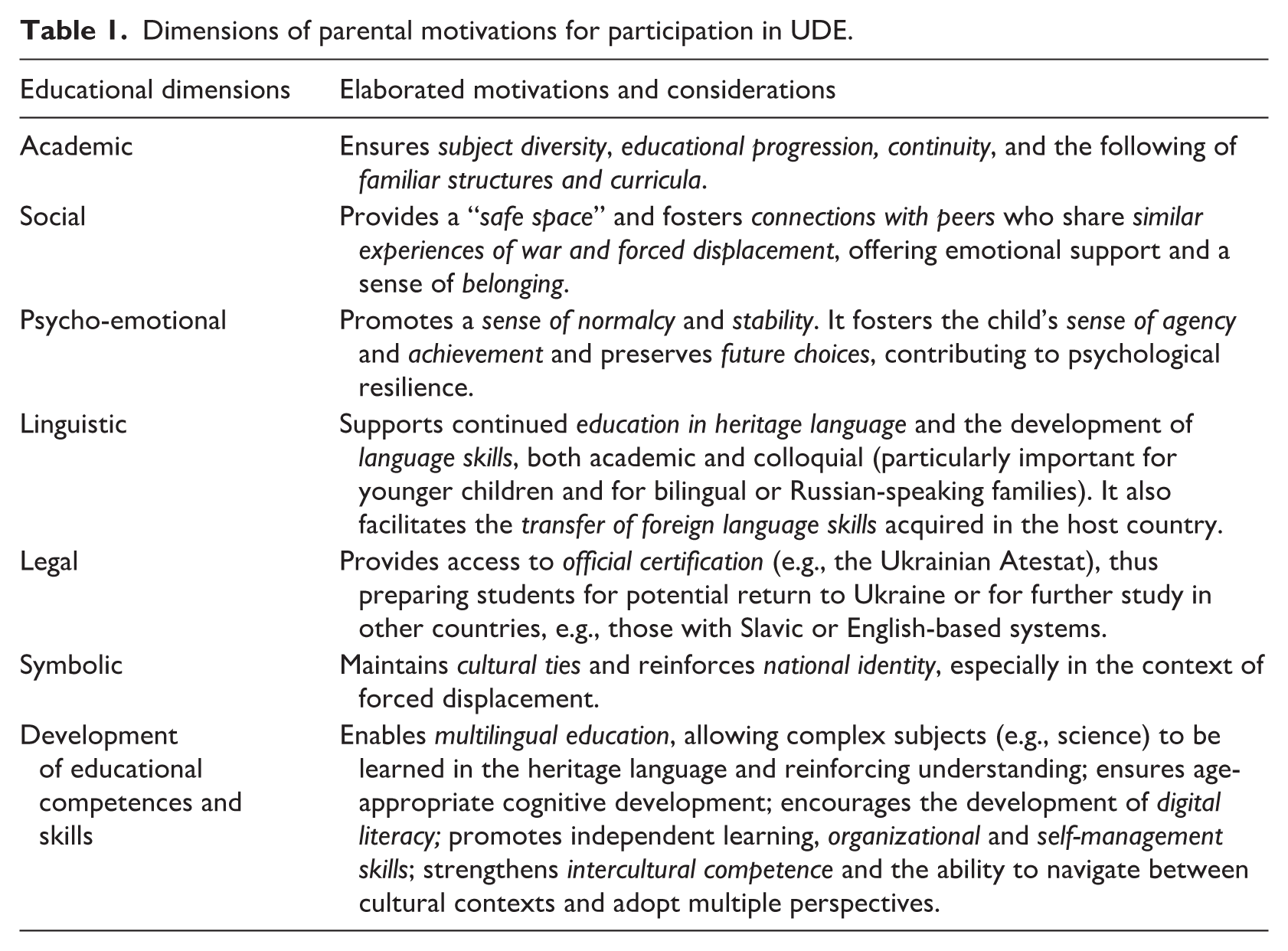
Drawing on interview excerpts, we found that parental choices regarding UDE following forced displacement are influenced by complex intersecting factors, including the conditions of schooling in the host country, particularly language integration, the pursuit of educational continuity and diversity, academic advancement, cultural preservation, social connectedness, and emotional well-being. Participation in UDE reflects parents’ agency within transnational education by balancing multiple educational dimensions: academic, psychological, social, emotional, logistical, legal and educational. These dimensions, outlined in Table 1 and elaborated in the subsequent subsections, are integrated into the theoretical framework.
Dimensions of parental motivations for participation in UDE.
Spatial and temporal negotiations for creating transnational educational spaces
The children’s participation in UDE, described as having been “organized very quickly” (interview 2/ turn 70; further 2/7) in March 2022, reveals the family’s practices to negotiate the spatial and organizational demands of maintaining schooling across two national systems. Interviewee Shevchenko reflects a particular continuity and familiarity after pandemic-related distance learning (2/72). Children are frequently involved in discussions about their education and the extent of their participation in double schooling (e.g. 6, 12, 16, 17, 19, 23), illustrating a collaboratively negotiated form of educational agency, in which decision-making is distributed across family members. Moroz, for example, describes a joint decision with her son to limit his participation in German vocational schooling to German and English classes only (19/83–85). Similarly, Marchenko recounts how she discussed the feasibility of double schooling with her daughter, asking whether she could manage the workload and offering reassurance and support if needed (17/53–60).
Families are engaged in the continuous production of a plurilocal transnational educational space. To sustain these spaces, families and Ukrainian schools have developed diverse strategies with a high level of organizational agency. Some students capitalize the time zone differences to attend Ukrainian classes before the German school day begins or on weekends (19/93), while others adapt by scheduling Ukrainian lessons during school breaks (2/70–72). Several parents report opting for asynchronous models, when synchronous participation is unfeasible (7, 9, 12, 13, 14, 17, 22). Marchenko describes that although her son aspires to join online classes, he mostly relies on self-study and only occasionally attends online sessions (17/56). Similarly, Klymenko highlights:
If they have the opportunity, they join Zoom classes or at least complete some homework or tests (22/63).
Ukrainian schools, aware of these constraints, have adapted by offering recorded lessons supplemented by occasional teacher consultations (7/58), more flexible assignment systems (13/52), and digital platforms for distributing and receiving coursework and feedback (17/122–126). These digital products serve as artifacts within a transnational educational space, enabling families to bridge educational expectations across borders.
However, these strategies do not eliminate the organizational strain and workload associated with double schooling. Continuing participation in UDE involves significant practical and logistical challenges due to conflicting schedules, time zone differences, digital infrastructure limitations, and wartime disruptions. Wartime conditions further complicate participation as air raid alarms, power outages, and unstable internet in Ukraine interrupt synchronous learning (23/44; 6/109–110).
Parents, like Koval, voice concerns about the long-term sustainability of this double arrangement due to ongoing stress and exhaustion (9/62). Parents coordinate schedules, monitor assignments, and assist with coursework—what often contributes to their daily stress framed by Tkachuk as a joint (linguistic) struggle:
We try, but I can’t say we’re very successful — there’s very little time left after German school, after the classes, after translating the homework from German (14/70).
In some cases, German schools themselves facilitated access to UDE and created local transitional educational spaces. Koval described how, after trial lessons in regular classes, German teachers allowed students to continue specific subjects, particularly in history and geography, through the UDE in a separate classroom (9/56). At some German schools, also teacher shortages create openings for UDE as Klymenko explains:
For the older kids, there is still one day a week when they have no lessons at school due to a shortage of teachers. So, accordingly, they study in the Ukrainian school online (22/63).
In few federal states, the continuation of Ukrainian online education was formally recognized and integrated into Germany’s educational framework, as described by Tkachenko:
If our Ukrainian children have already completed nine years of secondary education, they can choose. They can go to a vocational training, continue their education online in Ukraine, or apply to a high school, but in a bridge class, but downgraded for two years. [. . .] So, we chose the option of the Ukrainian school online (6/86).
The interviewee Kovalenko describes her intention to negotiate with the school to allow her child, who is in the final grade to accommodate the participation in UDE:
He says, ‘I join the class, but I can’t speak.’ So how can this be combined? [. . .] I will talk to the headteacher. [. . .] He sits there for six hours, can’t touch his phone or tablet, doesn’t understand a word. What’s the point of that kind of schooling? I will ask, insist, look for a format that works for my child so he can actually learn (3/9).
Families undertake these efforts because they recognize different forms of potential capital and the need to exercise agency in order to access and mobilize these resources, as elaborated below.
Mobilizing embodied cultural capital: Academic continuity and subject-specific progression
One of the reasons to continue UDE is the desire to maintain educational continuity within a structured and comprehensive framework, enabling children to sustain subject-specific competencies and make consistent progress at a time when limited proficiency in the host country language hinders it (e.g. 3). Some parents point to perceived gaps in curricular depth and academic rigor of some subjects (e.g. 13, 14, 15, 16, 18, 19). These efforts reflect a deliberate attempt to accumulate and preserve embodied cultural capital—knowledge, skills, and academic dispositions that parents consider not bound to German and potentially transferable across educational systems. Interviewee Tkachuk addresses the importance of continuity, expressing a desire for a more intensive curriculum for her son (7 years old):
So he studies the Ukrainian curriculum in a Ukrainian group after school (14 / 64). [. . .] It’s just that the education system here in Germany is currently at the level of a Ukrainian preschool group, in terms of its curriculum (14/70).
Other parents report maintaining UDE to complete a grade level or educational stage, illustrating the significance of institutionally constructed and individually perceived continuity (9/60; 16/63; 3/71). This concern is especially pronounced for students in upper grades or those preparing for national exams, as families recognize that integrating into the German system and catching up—particularly in language-dependent subjects—may be nearly unfeasible. For example, Moroz, whose son (16 years old) attends a vocational school in Germany, describes a sense of “losing time” due to perceived lack of academic challenge, particularly in mathematics. Aligning with the child’s educational priorities, the family decided to continue UDE in math and physics, while attending only German and English lessons in the vocational school (19/83–85). Similarly, Savchenko describes her son’s English proficiency as “far higher than the current school level in this [German] school,” and thus motivates continued participation in UDE (15/156–160). Kovalenko, speaking about her nephew (16 years old), articulates a forward-looking orientation toward educational advancement through UDE, independent of concrete future plans:
As for my [name], for my nephew, it’s too much for a child to lose because of the war. A child needs to learn, to work, to move forward — not to stand still. . . Even if they don’t master the language, even if they don’t want to return” (3/5). It’s a challenging situation, but at least they need to be activated [. . .]. Otherwise, they end up losing their Ukrainian knowledge too; I mean, they forget everything (3/7–8).
These perspectives align with Bourdieu’s understanding of cultural capital acquisition as a process of em-bodiment, a gradual incorporation that requires substantial personal cost, an investment, above all of time, but also of what he calls libido sciendi—the socially constituted desire to know (Bourdieu, 1986: 243). They illustrate how parents act as educational agents who recognize such preconditions and manage the resources, evaluate the forms of cultural capital embedded in plurilocal educational constructs, and who contribute to accumulate such capital.
Securing symbolic capital: Aspirations, certification, and future educational mobility
For parents, continuing the Ukrainian education as UDE represents a long-term strategic agency aimed at preserving educational flexibility amid an uncertain future; maintaining access to diverse educational opportunities and enabling smoother transitions. These educational strategies reflect considerations about the capital conversion after possible return to Ukraine (either voluntarily or as a result of shifting legal conditions) or potential onward migration to third countries. An important motivation for maintaining participation in UDE is the pursuit of the Ukrainian secondary school certificate as artifacts – this, investing into objectified cultural capital, which is defined only in the relationship with embodied cultural capital. For instance, Savchenko stressed the need to keep her child in UDE to prevent learning gaps and secure the official school certificate (15/139–141). Certificate functions as symbolic capital—a formally recognized credential that holds institutional legitimacy and can be converted into further educational or socio-economic advantages across different national contexts. For displaced families, obtaining a Ukrainian school certificate is vital to maintaining access to higher education—whether in Ukraine, abroad, or even in Germany, where their prospects within the German school system remain uncertain, as metaphorically described by Kovalenko:
As I say: ‘A train needs two rails to run properly.’ I tell them, ‘Stay on both tracks — that way you’re sure to get somewhere. On just one, who knows, maybe you will, maybe you won’t’ (3/97).
Parents like Tkachuk turn to UDE as an academic safety net to help their children overcome challenges in the German system, preserve access to diverse educational pathways, and make informed decisions about their futures (14/136). Shevchenko anticipates prolonged displacement, emphasizing the need for educational strategies that remain flexible (2/76). Similarly, Kravchenko emphasizes:
Regardless of where we end up living, we want her to continue UDE in parallel — it just depends on how much pressure there will be (7/58).
Over time, Ivanova, like other parents, have adjusted to the prolonged war realities, reassessing expectations and adapting their educational strategies:
I’ve let go of the illusion that we’ll be returning quickly — this will take years. It’s clear now, and increasingly so, that my eldest will finish school here, and likely also apply to university here. Even if the war ends soon, rebuilding the country will take time. At this point, I’m even considering the possibility that if we return, he [son] might stay here (15/189).
This parent, reflecting on long-term planning, describes the prospect of return as an “illusion”—a metaphor also used by Kovalenko to express concerns about children’s educational outcomes and future opportunities:
They’re presented with an illusion of success, an illusion that here they will obtain a European education and that all doors will be open. But what will happen to these children in two or three years when they can’t achieve this? [. . .] It will be, to put it bluntly, a huge letdown when they aren’t able to. And most of them won’t be. [. . .] To me, this feels like a lost generation of children (3/91).
Kovalenko’s reference points to the psycho-emotional impact of prolonged uncertainty, particularly the risk of disillusionment. Parental uncertainty is further intensified by the unpredictable consequences of discontinuing UDE and the absence of formal closure as Kovalenko notes:
What worries me more is what will happen to them later if we cut them off now — if we don’t allow them to complete their Ukrainian education. To finish, at least, to have something — a credential, a diploma (3/91).
The pursuit of a double-track strategy reflects deliberate efforts to secure symbolic capital in the form of objectified cultural capital such as diploma and certificates in order to preserve educational mobility, and mitigate the risks associated with uncertain legal, spatial, and temporal horizons.
Institutionalized cultural capital: Symbols and conversions
For displaced families, UDE is bound to preserve cultural identity and linguistic heritage for their children as well—whether they plan to return or build ties to Ukraine from abroad (e.g. 3, 12, 13, 15, 20, 21, 24). These efforts represent an investment in the symbol system—the culturally and socially recognized markers of belonging across borders, which give meaning to educational practices. Ivanova for example, emphasized her commitment to keeping her child fluent in Ukrainian:
[So that] my son also doesn’t lose the Ukrainian language, I talk to him, he reads books — and he also started online in the first grade (13/56). And just yesterday he was doing his homework [for UDE], working on writing exercises and some songs. . . singing, learning tongue twisters, and all of that was in Ukrainian too (13/58).
The interviewee illustrates that maintaining the Ukrainian language requires sustained support, especially in families where Ukrainian is spoken alongside Russian or only Russian. In such contexts, UDE provides the institutionalized framework for developing literacy and ensuring use in academic settings.
Savchenko frames participation in Ukrainian education as a social and symbolic investment: the value of being assessed according to Ukrainian standards extends beyond academic achievement:
Well, I see our future with Ukraine. [. . .] He will be tested in all subjects, just like all the other kids in Ukraine (15/139).
Displacement also prompts children to renegotiate and recognize their agency within transnational educational spaces. Kovalenko explains that her nephew reconsidered his educational path and reoriented himself toward studying in Ukraine:
Our kids — they will still be Ukrainian. And he thought it over, and he had this sort of reassessment for himself. . . And now he says, ‘Yes, I want to apply to a university in Ukraine.’ (3/91).
Within such transnational educational spaces, UDE becomes both practical and symbolic, reflecting a broader agency among parents and children to maintain ties to national identity and communities. It enables children to catalyze concerns about capital conversion: it means to mobilize and apply social capital through the institutionalized cultural capital and the symbol systems attached to it.
Converting social capital into cultural: Communication and sense of belonging in transnational spaces
For families, UDE serves as an emotional anchor that helps children maintain connections with peers and teachers in Ukraine and abroad, while also enabling parents to communicate with schools and other parents and remain involved in the educational process (e.g. 2, 3, 4, 5, 6, 12, 13, 14, 16, 19). The psycho-emotional impact of displacement influences parental decision-making significantly, as parents recognize the socio-emotional dimension of education as essential for providing stability and support. These continued relationships clearly reflect social capital—the durable networks of recognition and reciprocity that facilitate children’s sense of belonging across borders and can, under certain conditions, be accumulated and converted into cultural capital.
A positive condition, according to parents, is the ease of digital communication. The interviewee Shevchenko explains that her child’s pre-existing friendships remained intact despite displacement (2/74). Teachers, including the principal and deputy principal, regularly reached out to families to inquire about their well-being and educational progress (2/70). Parents mention that their children maintain regular contact with teachers (13/50) who remain accessible and active in group chats (15/141). Similarly, Moroz described how her son continued to resolve many issues directly with teachers and classmates in Ukraine (19/89), while Bondar added that such communication persisted even with those who remained under occupation (16/94–95).
The importance of such a connectivity is further emphasized by Kravchenko who relays teachers’ concerns about the emotional vulnerability of students dispersed across countries, separated from loved ones, or experiencing the emotional strain of having a parent at war (7/76). This ongoing interaction helped reduce feelings of isolation and provided a sense of normalcy after fleeing the war (7/76). Moroz adds that children of military personnel, like her son, face unique emotional and social challenges, and although they may receive some support within the Ukrainian school system, she hesitates to call them “privileges” (19/89).
The education functions as a form of social glue, connecting various actors across national and experiential boundaries. Through educational interactions, students remain linked to their wartime experiences and to peers who share similar displacement trajectories. Kovalenko’s statement vividly illustrates this transnational continuity:
Most of the [children] have already returned to Kyiv. They were scattered all over the world, many have come back. And they stay in touch all the time — with the homeroom teacher, in the parents’ chat where the parents write. So, in other words, they’re constantly in contact. The school is standing, everything is fine. [. . .] Even though a bomb fell — they live in Akademmistechko, and not too far from there, a shopping mall and two buildings were hit. A girl from the class lived there, thank God she wasn’t home. So it’s already close, this war, it’s not that far away (3/75).
Kovalenko’s description underscores a powerful linkage between the social connection and the physical space—school as an artifact. The interviewee frames the spatial proximity of the war through the experience of a fellow student showing how children abroad remain effectively embedded in war realities through UDE.
Parents as educational agents draw on UDE to recognize and cultivate the social and -emotional capital of their children through continued digitalized communicative practices. These educational connections may also facilitate students’ emotional involvement in the lived realities of war—both their own and those of peers who remained in Ukraine. While such engagement carries the potential for psychological strain and retraumatization, it can also offer, particularly for older students, a meaningful space to reflect on, make sense of, and process their experiences within a familiar and trusted educational context.
Cooperative decision-making and post-rationalization in educational agency
The involvement in UDE requires continuously evaluating their child’s stress levels, workload, and emotional resilience. These practices represent a dynamic exercise of educational agency, unfold through ongoing negotiations within families and are shaped by shifting circumstances, structural constraints, and children’s evolving capacities. Thus, families negotiate the potential investment in accumulating cultural capital against the resources required to do so—often expressed in terms of time constraints, and psycho-emotional considerations connected to internalization of knowledge. For instance, Kravchenko explicitly states that her child’s mental well-being would determine whether they continue UDE (7/58). Other parents ultimately decide against double schooling to prevent additional stress on their child caused by managing two curricula simultaneously, often compounded by extracurricular activities and private tutoring (e.g. 23/44; 16/91). The vast majority of interviewed families (1, 2, 3, 5, 6, 7, 10, 11, 12, 13, 14, 15, 16, 17, 18, 24) reported of additional existing practices, continuing or resuming private online lessons with Ukrainian tutors (Orobchuk and Skintey, 2025: 223 – 225). Pavlenko describes the emotional strain of managing both schooling alongside additional commitments:
Well, we just don’t have enough time. We simply can’t keep up. . . And I decided not to overload my child. We’ve also signed up for one, two, three extracurricular activities here. It’s just too much — for me and for the kids. The pace is too intense. So I thought, ‘Where would we possibly fit in Ukrainian school as well?’ (23/44)
For similar reasons, the interviewee Bondar withdrew her daughter from UDE and reflects on their strategy in the event of returning to Ukraine:
If we return, I’ll just send her to school and she’ll catch up with tutors, if we make it that far (16/53). [. . .] My child is smart, she said ‘Mom, I’ll catch up on everything’ (16/91).
Some families choose to shift from the Ukrainian public school system to private distance-learning institutions (7/76, 12/60, 13/14). As described by Polishchuk, this decision is shaped by difficulties meeting assignment deadlines due to poor internet connectivity and scheduling conflicts, which contributed to heightened anxiety (12/60–67). For her, the structured flexibility and perceived higher quality of the private school in Ukraine provide a more stable alternative (12/60). This reflects parents’ attempts to optimize learning conditions across transnational educational spaces in ways that enhance their children’s cultural and symbolic capital.
Frequent relocations within Germany further complicate participation in UDE. Kovalchuk, for example, describes how unstable internet access and psychological strain caused by constant displacement undermined the possibility of sustaining a stable learning environment (8/34).
For some, the decision to discontinue UDE as a complex negotiation marks a shift toward prioritizing integration into the German system. Rudenko highlights the stress associated with adapting to a new language, culture, and educational system in the host country, perceiving participation in two school systems as competing and potentially incompatible, particularly due to the academic demands of Ukrainian curriculum:
If there weren’t a law in Germany requiring school attendance, she would almost certainly have continued studying [in UDE] [. . .]. Otherwise, she would completely neglect German (18/55).
Before withdrawing her daughter from UDE, Rudenko consulted a psychologist (18/53).
Kravchuk, who intends to remain in Germany long-term describes her daughter’s strong cultural attachment to Ukraine:
She sees Ukrainian symbols everywhere, the blue and yellow flag — our room is covered in flags (24/106).
Despite this connection, Kravchuk decided to withdraw her children from UDE after 6 months of double schooling citing her son’s exhaustion (24/76) and questioning the educational quality of UDE:
What’s the point if [he] just sits with Google doing asynchronous homework assignments? I don’t see any value in that (24/78).
Across the interviews, it becomes evident that while the continuation of Ukrainian education is rather future-oriented and rationalized, decisions to discontinue UDE or any other educational arrangement are frequently accompanied by parental post-rationalization. In these cases, parents may construct coherent narratives which help them to reconcile conflicting pressures, defend emotionally difficult decisions, and sustain a coherent narrative of good parenting.
Summary and discussion
The paper analyzed UDE as a component of double schooling and an agency-driven educational practice among displaced Ukrainian families in Germany. By combining quantitative and qualitative data, we demonstrated that UDE is not merely an ad hoc response to crisis but a sustained, structured, and meaningful form of transnational educational participation shaped by family agency within specific contexts. In doing so, the study advances theoretical understandings of transnational education (Adick, 2018), cultural capital (Bourdieu, 1986), and agency (Emirbayer and Mische, 1998) within the context of forced migration and digitalization. UDE is identified as an emerging novel type of transnational education, illuminating its distinctive mostly digitalized practices (e.g. online lessons, watching recorded videos, online communication), symbols (e.g. certificates, songs) and artifacts (e.g. technical equipment, recorded lessons, digitalized learning materials and products). Its non-formal status in the host country also compels families to create and continually renegotiate temporally constrained transnational educational spaces.
Situating our findings within Emirbayer and Mische’s (1998) triadic model of agency reveals how parents draw on past educational patterns, envision future trajectories amid uncertainty, and continuously evaluate the demands of everyday life. Our data link double schooling to families’ future plans: those not intending to return to Ukraine are significantly less likely to enroll in UDE, whereas return-oriented or undecided families use it as a flexible bridge for possible reintegration. This underscores UDE’s role as a cultural anchor and pragmatic safeguard under their long-term uncertainty. Given such high level of uncertainty, exercising their own agency through transnational strategies can be understood as a response to these uncertainties (cf. Lapshyna, 2026).
Parents with substantial cultural capital (higher education degree) are about twice as likely to enroll their children in UDE, reflecting their capacity to evaluate risks, to identify the needs, mobilize the relevant resources, and anticipate potential benefits and pathways for capital conversion in Ukraine, Germany, or third countries (see also trends in Ukrainian students migration in Stadnyi, 2025). This supports theories of education as capital conversion: the more capital one possesses, the greater the opportunities to convert and activate these resources (Ream and Palardy, 2008). As Bourdieu argues, parents with higher education and therefore greater cultural capital constitute the very precondition for the fast and easy accumulation of further forms of cultural capital by their children (Bourdieu, 1986: 246). Conversely, parents with lower foreign language skills more often prioritize UDE, as a protective educational anchor within uncertain migration trajectories, likely reflecting their own weaker host-country labor-market prospects and a strategy to preserve—and invest in—children’s transferable capital.
The factor of time as a cultural resource in educational processes has received limited academic attention to date (Mick, 2012: 537), although parents frequently argue in temporal terms, aligning educational practices either with short-time needs or with long-term aspirations. The notion of “losing time” in preparatory classes (cf. Letzel-Alt and Pozas, 2024: 859) more accurately reflects the “personal costs” of investment, such as time and libido sciendi (Bourdieu, 1986: 244)—parental concerns regarding children’s developmental stages, learning capacity, motivation, and educational progress.
Our data confirm the multifaceted nature of double participation during the initial phases of displacement (see SSEQ, 2023: 10; Skintey and Orobchuk, 2025: 161), aligning with the spectrum of agency that spans key sociological dichotomies—structures and action, society and the individual, and the local and the global (Mick, 2012). The ambiguities identified in our study echo the tension between fears of “de-education” and a reconsideration of the purpose of schooling (Pidgorna, 2023: 58), as well as the psychosocial benefits of UDE alongside the challenges of coordinating two systems (Chabursky et al., 2024). The distinction between social competencies in Norwegian schools and academic skills in UDE (cf. Storen and Kalisha, 2025) as a separation or contrast seems to be questionable. Children’s socialization—and the ways they position themselves among peers also emerges through their academic performance, making both dimensions deeply intertwined and proving the capital conversion approach. The prioritizing language development and academic progress as dilemma (cf. Lundtofte, 2024: 3) was strongly mediated by children’s age: parents of younger children tended to prioritize German language learning, whereas parents of older children emphasized academic progression via UDE supplemented by German classes. The assumed opposition between socialization in the host country and maintaining connections to Ukrainian society (cf. Lundtofte, 2024: 3) was not evident in our data. Instead, our quantitative findings that parents who are dissatisfied with schooling in the host country are nearly twice as likely to opt for double schooling aligning with Skintey and Orobchuk (2025) suggest a causal mechanism: separated schooling, slow and insufficient language acquisition and differences in academic rigor create perceived gaps in children’s socialization, subject-specific continuity and progression, leading parents to express dissatisfaction and seek support through UDE. Recognizing such tensions, it is important to note that non-participation in UDE does not inherently foster social integration; it merely frees up leisure time, which may or may not be used for meaningful social engagement.
In academic and educational discourse on displaced individuals in Germany, low educational attainment and limited study habits—often stemming from disrupted or incomplete educational trajectories—are frequently cited as barriers to integration, alongside psychological burdens and trauma (Baier-Klenkert, 2021: 155–214). From a different angle, refugee experiences in Germany are seen as cultivating passivity and patiency rather than agency and participation, reinforcing dependency and diminished autonomy (Birkner et al., 2022: 22). By contrast, the findings of our studies point to a proactive trend: through UDE the displaced families and students secure their academic continuity, fulfill their basic psycho-social and educational needs (cf. Chabursky et al., 2024) and preserve their agency. Figure 5 illustrates the exercising educational agency of displaced families regarding the UDE participation, which can be understood as a multi-layered process of negotiation and structuring. First, parents identify the forms of cultural and social capital that can potentially be accumulated or preserved within the context of double or distance schooling. Building on this assessment, they organize the transnational educational space, coordinating learning arrangements across national and digital contexts. In a further step, they weigh the personal costs involved—including time, organizational strain, and psycho-emotional demands—against the anticipated possibilities for capital conversion. Finally, they strategically prioritize specific dimensions of education, a process in which rationalization and post-rationalization play a central role: decisions are not only justified but also retrospectively framed in ways that align with parents’ self-understanding as responsible and agentive actors in their children’s educational trajectories. Decision-making involves assigning different weights to these dimensions depending on the child’s age and corresponding developmental and educational needs. These evaluations are further shaped by how families balance short-term and long-term perspectives as well as by the extent to which individualistic or collectivistic family orientations influence these educational priorities.
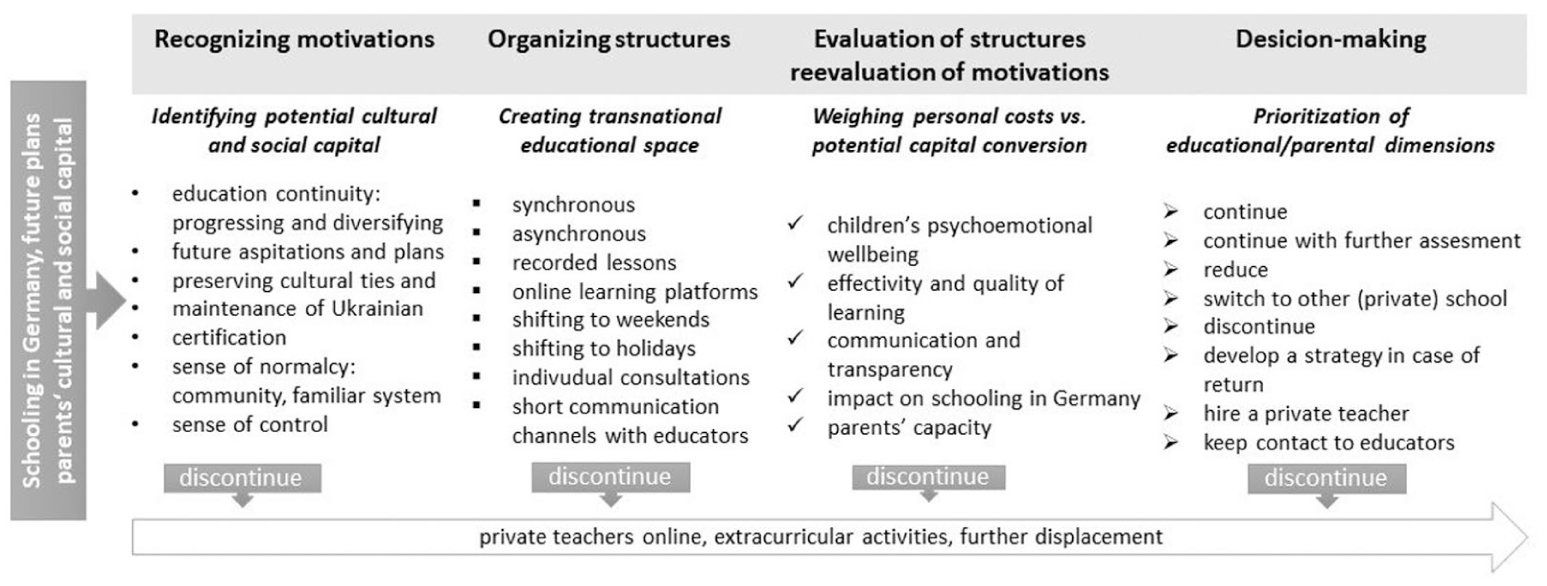
Exercising educational agency in UDE participation.
As a result, families’ agency is both challenged and collaboratively enacted, and should be understood as a continuum of negotiations across actors and intertwined dimensions—time, space, and varying degrees of embodiment, including cognitive, emotional, and social capacities. Families seek to preserve, accumulate, and secure different forms of capital, assess the personal costs involved in mobilizing and converting that capital, and enable its potential future conversion by creating, navigating, or deliberately not engaging in transnational educational spaces for their children. Against the background of the high educational aspirations of students and parents with immigrant background identified in previous research, and the various explanations discussed for these aspirations (for an overview, see Becker and Gresch, 2016), it can be also assumed that, for parents and legal guardians from Ukraine, a relative status maintenance motive with reference to the country of origin may play an important role, and that participation in UDE is associated with an increased perceived probability of their child obtaining a higher education entrance qualification.
Our findings offer a nuanced contribution to debates about the role of capital in refugee education, suggesting that double schooling serves as a mechanism for safeguarding and expanding educational opportunities rather than contrasting and fragmenting them.
Implications for further research, practice and policy
The phenomenon of double schooling among children who fled Ukraine offers multiple insights for educational research on displaced and migrated children—particularly when reframed not as a “double burden,” but as a complex and potentially enriching practice (cf. Chabursky et al., 2024: 9) 6 . First, these findings with a solid empirical basis illuminate the structural strengths and weaknesses of schooling models in host counties, particularly in relation to language acquisition and integration, not only for refugee children, but also for students with diverse migration backgrounds. Second, the results provide insights into the educational needs and orientations of children and families in the early stages of forced migration. Third, the findings underscore how digitalization and transnationalism shape children’s everyday experiences: digital spaces are not peripheral but central, actively reinforcing transnational realities that can no longer be ignored in educational discourse and practice. Within cultural and social capital frameworks, these processes of recognizing, converting and mobilizing such capital are central to education of displaced and migrated children (cf. Bogachenko and Burke, 2024; Ream and Palardy, 2008). In such contexts, factors such as age-appropriate educational capacities, subject-specific continuity, psycho-emotional well-being, flexible educational trajectories, enduring national ties, and a sense of agency in future planning are central. These dimensions not only influence educational outcomes but also imbue educational capital with a pedagogical dimension that is essential in the context of forced displacement. Furthermore, virtual spaces can provide opportunities for maintaining and building social contacts with the country of origin, in terms of “social bonds,” for displaced students (Röhner and Heiker, 2023: 193).
Although education policymakers addressed the possibility of a supplementary integration of Ukrainian online materials into regular classroom instruction, there has so far been a lack of approaches for practical implementation or systematic integration, indicating a short-term recommendation rather than a perspective oriented toward long-term objectives. This results in an unequal recognition of symbolic systems and educational/cultural capital: while educational certificates as symbolic systems are formally acknowledged in both Ukraine and Germany (for Germany, see KMK (Kultusministerkonferenz), 2025b: 2), it remains unclear whether and to what extent the linguistic, subject-specific, and cross-curricular competencies acquired in Ukraine are recognized by different educational actors as symbolic capital.
Therefore, the educational experiences of displaced children in UDE warrant further empirical research regarding the questions: How is participation in UDE implemented in practice? How does it affect the psychosocial well-being of students and their families? Whether and to what extent does the transfer of subject-specific competencies and skills take place from one education system to the other? How do students themselves narrate their agency? How do teachers perceive double schooling? How does double schooling affect dimensions of personality traits such as motivation, self-regulation, and their development over time?
Policy approaches that portray double schooling as an obstacle risk overlooking the agency, aspirations, and resourcefulness of displaced families. Instead, further theoretical conceptualization, recognition on the part of policymakers, and—to some degree—the creation of supportive frameworks integration of distance education from students’ home countries into the school systems of host countries could contribute to the deconceptualization of migration as a “crisis” and instead frame it as an opportunity for innovation in learning. Karakaşoğlu (2024: 45) emphasizes the need for a fundamental shift of perspective - moving away from the “crisis diagnosis” of migration and transnationality toward perceiving them as normative conditions that should be integrated into the fundamental transformation needs of the education system (Karakaşoğlu, 2024: 45). Crucially, this requires reassessing individual educational interests and resources—not just in isolation, but from the perspective of their fundamental potential for transnational educational careers (Karakaşoğlu et al., 2019: 20). Longitudinal designs could illuminate how transnational educational practices evolve with shifting legal conditions and migration trajectories. Such an approach would benefit all participants in Germany’s education system, whether they remain temporarily, permanently, or are in transit, by framing mobility as an opportunity rather than a disruption (Karakaşoğlu, 2024: 41). The question posed by Karakaşoğlu (2024: 39), whether the recognition of transnationality in the educational context of displaced children from Ukraine, as manifested in educational policies and administrative documents, creates the potential for sustainable transformation for understanding general education from the perspective of a migrant society, in our opinion, cannot and should not be addressed at the national or binational level, but requires transnational solutions at the supranational level, both within and outside the EU.
Footnotes
Acknowledgements
We gratefully acknowledge the support of the student assistants Olen Mamai and Svitlana Andronik, who contributed to the transcription of the interviews conducted as part of the project “Linguistic Situation of Displaced Ukrainian Families.”
Author’s note
The research (data collection) was conducted at the University of Koblenz-Landau (since 2023: University of Koblenz). In 2023, the author moved to the University of Innsbruck, where the project was continued through data analysis and publication.
Declaration of conflicting interests
The authors declared no potential conflicts of interest with respect to the research, authorship, and/or publication of this article.
Funding
The authors disclosed receipt of the following financial support for the research, authorship, and/or publication of this article: Supported by Anschubfinanzierung der Forschungskommission of the University of Hildesheim and Anschubfinanzierung der Forschungsinitiative Nachwuchsfonds of the University of Koblenz-Landau (since 2023: University of Koblenz).
Ethical approval
The study Integration Strategies of Refugees from Ukraine received ethical approval from the Ethics Committee of the Faculty of Economics at Ludwig-Maximilians-Universität Munich (May, 2023). For the study Linguistic Situation of Displaced Ukrainian Families, the ethical standards of the Deutsche Gesellschaft für Fremdsprachenforschung (DGFF, 2019) were applied. Informed consent was obtained from all participants in written and partially verbal form.

Data availability statement
Due to the inclusion of potentially identifying information about participants and their children, the data (interviews and transcripts) cannot be shared publicly.