




Abstract
This study explores the lived experiences of students participating in school-to-school collaborations (SSCs) within educational neighbourhoods (ENs) in Vienna, Austria. ENs were introduced as a policy initiative to address the inequities of Austria’s stratified education system by fostering interinstitutional collaboration. Drawing on Ahmed’s phenomenological lens, the study examines how students navigate social and academic participation in SSC activities, focussing on feelings of inclusion and exclusion. Data were collected through semi-structured interviews with 36 students from primary, middle and grammar schools, as well as phenomenological vignettes capturing embodied experiences during collaborative activities. Findings reveal that SSCs provide opportunities to bridge social and academic divides, but they also highlight challenges that perpetuate hierarchies and biases. While SSCs have the potential to foster meaningful connections and enrich learning for some, they also reveal obstacles, such as unequal participation, socioemotional gaps and hierarchical structures that impede comprehensive inclusion. By examining these nuanced experiences, this study sheds light on the critical conditions necessary to create truly inclusive and empowering educational communities. The findings contribute to the discourse on inclusive education (IE) by emphasising the importance of students’ perspectives in evaluating collaborative practices.
Keywords
Introduction
Various definitions of inclusive education (IE) offer evaluative frameworks for understanding the processes of inclusion and exclusion, yet they are frequently idealised and decontextualised from actual practices (Nilholm, 2021). Considering these limitations, it is essential to explore local conditions of policy translations and the resulting practices to overcome barriers to the presence, participation and achievement of all learners, regardless of individual prerequisites (Ainscow, 2020). Accordingly, the social concept of IE focuses on transforming schools and communities to enhance their capacity to respond to students’ diverse needs rather than expecting students to conform to existing systems (Ainscow, 2020). Recent developments in research, policy and practice have signalled a shift towards pedagogies of cooperation (UNESCO, 2021), which is aimed at fostering supportive structures for IE. These align with the concept of a ‘whole school approach’ provided by the European Commission, Directorate-General for Education and Culture (2015) that emphasises cross-sectoral collaboration and stronger partnerships with a diverse range of stakeholders, such as social and youth services, local authorities, unions and the broader community. By acknowledging that schools alone cannot address all challenges, this approach considers the entire system of actors and their interrelationships in and around schools to support learners’ educational journeys. A similar phenomenon can be observed in Austria, where educational neighbourhoods (ENs) known as Bildungsgrätzl, were introduced at the local level in Vienna in 2017. Designed to bridge institutions, such as schools, libraries and youth centres, the EN policy aims to promote interinstitutional collaboration in the education sector (City of Vienna [CoV], 2025). Austrian ENs act independently, planning local diverse activities (e.g. joint lessons, transition activities, festivals or activities in the public sphere) tied to internal agendas and the seven overarching guidelines of the policy: openness, basic skills, multilingualism, empowerment and participation, inclusion and diversity, gender sensibility and social equality (CoV, 2025). Within the framework of this policy, the objectives are to enhance educational success, promote equal opportunities and foster sustainable, inclusive communities through targeted community-building initiatives (CoV, 2025; Francesconi et al., 2024). Importantly, ENs are supported financially, and their implementation follows a top-down informed, bottom-up logic that is linked to the agency of local actors’ willingness (Ball et al., 2011; Öztürk, 2025). Stakeholders (e.g. school leaders, teachers and social workers) are required to enable ‘lifeworld-oriented learning spaces’ (SCWR, 2019: 118) that promote learning and collaboration among participants (CoV, 2025). Institutions belonging to ENs are expected to offer, for example, school-to-school collaborations (SSCs) and amplify awareness of transition opportunities opening their doors to local students. A total of 34 ENs were implemented to open up schools and address the deep social inequities perpetuated by Austria’s highly stratified education system. A key divide emerges after primary education, when students transition to either middle school (MS, Mittelschule) or grammar school 1 (GS, Gymnasium; Buchner and Proyer, 2020), with around 80% of GS students coming from socioeconomic privileged families holding high academic qualifications (Walenta- Bergmann et al., 2024). Additionally, students who speak a language other than German at home are disproportionately placed in MS rather than GS (Walenta- Bergmann et al., 2024). This is particularly significant in Vienna, where around 52% of children are multilingual, speaking a further language in addition to German (Statistik Austria, 2024). Moreover, after completing lower-secondary education in either middle or grammar school, statistics reveal a strong contrast in transition patterns: 59% of GS students continue to higher-secondary education in GS, whereas only 8% of MS students make the transition to higher-secondary GS (Statistik Austria, 2024). Despite the potential of ENs to foster collaboration and reduce inequities, their ability to fully counteract the segregated dynamics of the education system remains debated (Herzog-Punzenberger, 2023; Schrott and Lener, 2020). Austria also reports one of the highest percentages of students in the European Union failing to meet language of instruction proficiency standards (Seifert, 2021), a critical factor strongly linked to academic success (OECD, 2023). These challenges underscore the urgent need for systemic reforms to ensure equitable access to quality education, particularly in the context of Europe’s diverse migrant population, where educational policies and institutional practices, such as segregation and marginalisation in lower-quality schools, can either foster integration or exacerbate exclusion and disadvantage for all students, including students with migration biographies (Pantić et al., 2025). However, inclusion policies within Europe are shaped by broader migration and language regimes as well as separatist practices, which pose challenges for students’ educational attainment (Pantić et al., 2025). Thus, it is important to critically analyse policy translation processes to better address their implications and limitations.
Although current evidence for Austrian ENs is lacking, international findings on SSCs have reported decreases in contextual barriers to students’ academic and social participation (Muijs, 2015; West, 2010). While different studies have noted the positive effects of collaborative formats on students’ outcomes and IE (Armstrong et al., 2021; Azorín and Muijs, 2017; Fang et al., 2022), there have also been critical voices pointing to a thin evidence base (Wu et al., 2024). In particular, students’ perspectives remain underexplored, yet it is essential to investigate them further, as students should not be regarded merely as passive recipients of policy (Ball et al., 2011) but as active participants in their educational experiences. Focussing on students’ perspectives entails adopting a contextual approach to inclusive and exclusive processes (Messiou, 2023) in their interconnectedness (Hansen, 2012) and shifting the emphasis from policy expectations to tangible outcomes. By adopting Ahmed’s (2006, 2012) phenomenological lens, this study engages with students’ perspectives to understand how they orientate themselves socially and academically in collaborative settings in EN activities. Ahmed’s framework emphasises that inclusion and exclusion are relational, embodied, and performative processes shaped by power dynamics, norms, and affective structures. These experiences emerge through interactions with the environment and others, mediated by bodily orientations and affective responses. Inclusion involves alignment with social norms, fostering ease and belonging, while exclusion arises from disorientation or deviation, often resulting in discomfort and diminished participation (Ahmed, 2006). Rather than a binary understanding of space, Ahmed highlights the fluidity of these processes, where disorientation can expose social norms, enabling resistance and change. At the same time, social spaces issue a persistent invitation to conform to normative expectations, which would enable individuals to navigate these spaces with ease. In educational contexts, these dynamics are particularly salient. Feelings of inclusion (being ‘in line’) or exclusion (being ‘out of line’) are shaped by relational interactions, perceived status differences, and unmet social expectations, which regulate legitimate forms of participation (Ahmed, 2006). Ahmed’s (2006, 2012) approach thus provides a nuanced framework for understanding how students navigate collaborative settings, emphasising the interplay between social norms and embodied orientations.
Social and academic participation in collaborative settings
Göransson and Nilholm (2014) argued that the creation of communities in schools is the last hierarchical level of inclusion after the placement definition (placing students in need in mainstream classrooms), the specified individualised definition (meeting the social and academic needs of some students) and the general individualised definition (meeting the social and academic needs of all students). Both the social and academic aspects of the learning environment are crucial for addressing factors that either hinder or promote children’s participation (Sandberg, 2017) and serve as interconnected prerequisites for cultivating inclusive communities (Nilholm, 2021). Literature highlights that positively valued social experiences (relationships with others, including peers) in school contexts can create a sense of belonging and reduce academic disadvantages (Juvonen et al., 2019; Slee, 2019). According to a study by Black-Hawkins et al. (2022), children value classroom communities that (a) give them a sense of security and comfort, (b) facilitate mutually supportive relationships (having peers and working together), (c) promote personal and collective learning opportunities and (d) enable shared values and behaviours. In the literature, peer learning formats within and across class and group boundaries that encourage individuals to work together, share knowledge and contribute to common goals (Burns et al., 2025) have been discussed as a strategy to foster inclusive environments that embrace diversity (Hargreaves et al., 2022; Niemi and Vehkakoski, 2024; Toulia et al., 2023; Zubiri-Esnaola et al., 2020). However, shared spaces for collaborative work are not inherently beneficial, particularly as perceived academic status hierarchies can result in the exclusion of lower-achieving peers (Hargreaves et al., 2022; Niemi and Vehkakoski, 2024). In this context, research indicates that performance distinctions between student groups can lead to stigmatising labels, with some peers perceived as less knowledgeable or unhelpful (Ambreen, 2021). This dynamic may result in school disengagement when students feel socially and academically less competent (Holmström et al., 2014). Such status and performance comparisons hinder social inclusion by undervaluing certain students’ efforts and limiting their participation (Niemi and Vehkakoski, 2024). These dynamics are also expected while SSCs, where students from different institutions participate in joint learning activities. On a structural level, cross-institutional cooperation is evaluated as a way of breaking down systemic barriers to the social and academic participation of students (Ainscow, 2020; Azorín and Muijs, 2017; Hargreaves and Shirley, 2019). Although studies have pointed to increases in children’s social and academic participation, especially in less privileged schools and competitive educational systems (Chapman and Muijs, 2014; West, 2010), it is critically noted that the evidence is thin (Wu et al., 2024) and that collaboration efforts raise teachers’ educational expectations of students rather than their academic outcomes (Pino-Yancovic and Ahumada, 2020). In parallel to critiques and uncertainties about evolving outcomes on the ground (Armstrong and Ainscow, 2018), research has demonstrated the potential benefits of SSC, such as increasing children’s educational experiences and enabling interaction with other students across school boundaries, thus smoothening school transitions (Fang et al., 2022). Preparing and supporting students during the process of primary–secondary transition with different intervention programmes (e.g. orientation tours, peer support systems or information sessions) has been discussed as an effective way to counteract unfamiliarity with the potential new environment and foster a sense of connexion with the social group (Beatson et al., 2023; Heinsch et al., 2020). Similar objectives have been argued in connexion with ENs (CoV, 2025), which have tended to lead to several new foundations in Vienna since their implementation.
The present study
This study examines the lived experiences of students during SSC in ENs in Viennese schools. These networks were established as part of broader transition activities initiated by stakeholders (e.g. school leaders, teachers) and encompass transitions from primary-to-secondary education as well as lower-secondary to higher-secondary education. The study employs a methodological framework based on the principle of maximum variation (Babchuk and Boswell, 2023) to capture a wide range of lived experiences, and their implications for students. Lived experiences are conceptualised phenomenologically as contextual and embodied engagements with the world from which one emerges changed (Agostini et al., 2024). Feelings of being ‘in’ or ‘out of line’ (Ahmed, 2006, 2012) are central to evaluating the inclusiveness of specific settings (Dederich, 2018). Accordingly, the following research questions are posited:
(1) What role does SSC play for students in terms of transitions?
(2) How do students describe their academic and social participation in SSC activities in ENs?
(3) What lived experiences of inclusion and exclusion are evident in SSC?
Materials and methods
Participants and procedure
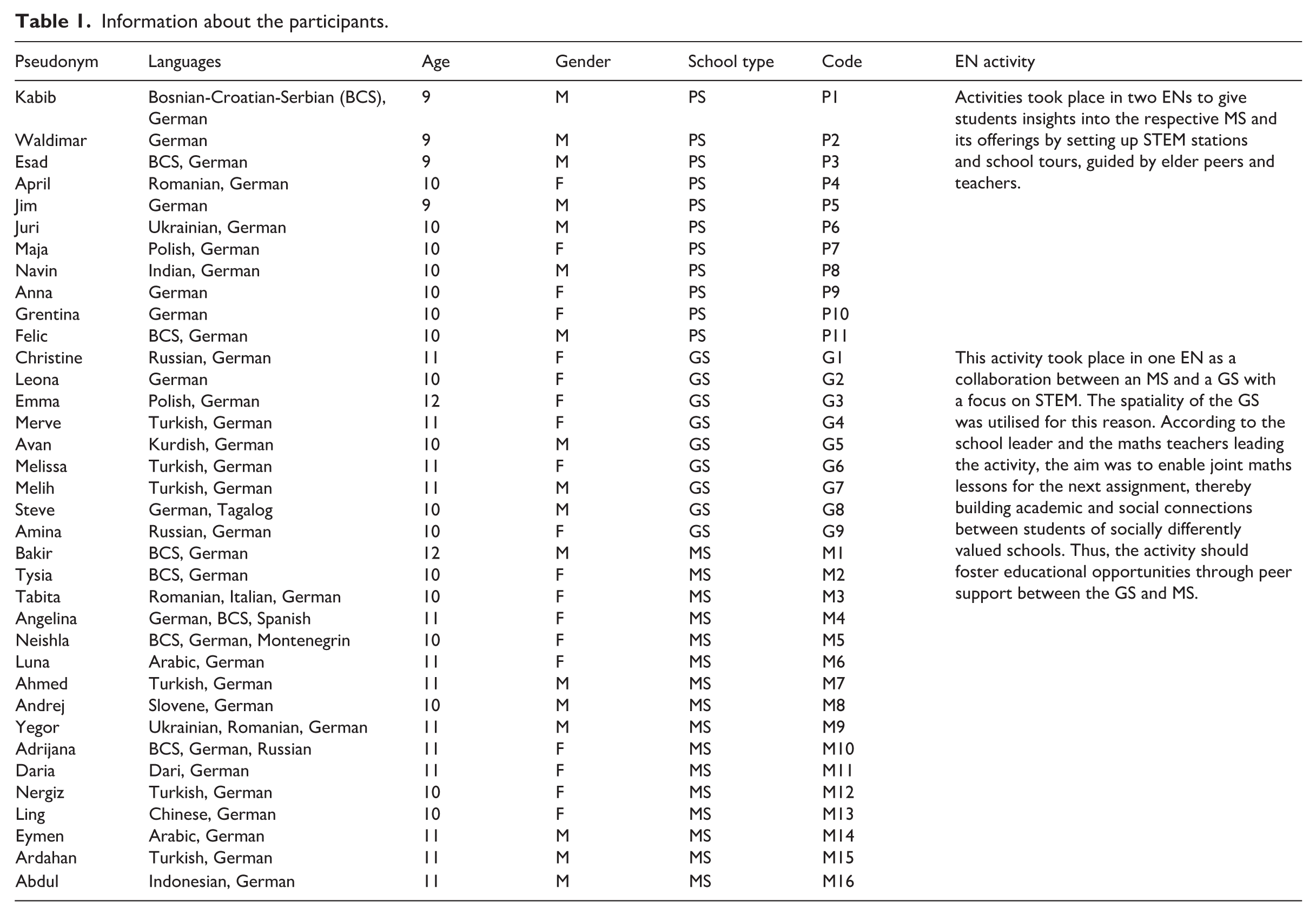
Access to the participants was secured through an ongoing project called Teaching the Good Life. Theory, Policy and Practice in Education to Promote Quality of Life in the 21st Century. A total of 36 individuals from 3 different school types – primary school (PS), grammar school (GS) and middle school (MS) – participated in the interview study (see Table 1). The collaborations examined focussed on facilitating transitions between school types and implementing joint learning activities across schools with differing statuses (Chapman and Muijs, 2013). Data collection took place in November and December 2024 in two different ENs. Lower-secondary students (GS, MS) participated in a joint 2-hour mathematics, designed to promote seamless academic and social transitions from MS to higher-secondary GS. PS students participated in activities introducing to the learning environments of GS or MS, though MS school tours were overrepresented in the data. According to stakeholders, these activities aimed to build social and academic connections between students from different school types, highlighting their transitional value. In-depth qualitative face-to-face interviews (Bogner et al., 2014) were carried out using a semi-structured interview guide (Witzel, 2000), including questions on various topics, such as perceptions of EN activities, social and learning conditions and similarities to and differences from regular school lessons and surroundings. The interviews were audio-recorded, with an average duration of 37 minutes. They were then transcribed and translated into English.
Information about the participants.
Furthermore, data were collected through phenomenological vignettes (Agostini et al., 2024) to capture and analyse the lived experiences of students during the collaborative activities prior to the interviews. In vignette methodology, observational data from shared experiences are condensed into brief descriptions of scenes. In contrast to observation protocols, these vignettes capture experiences that affect researchers as co-experiencers, which are often revealed through students’ actions, body language, facial expressions and tone of voice. Four researchers collected raw vignettes, which were collaboratively refined and condensed into final texts. The triangulation of data sources, following Denzin’s (1970) framework, enhances the reliability and depth of findings by examining phenomena across diverse contexts (Flick, 2011)In the results section, extracts from eight vignettes are used to triangulate the interview data to exemplify the pre-reflexive embodied lived experiences of the students, going beyond their self-statements and beliefs. In contrast to spoken language, the body always reveals more than it would like to reveal, such as through red cheeks in the case of embarrassment. Vignettes provide rich, personal perspectives on what facilitates or impedes conquering social and academic differences in the context of SSC. As an exemplification of an experience vignettes enable readers to draw a general lesson or broader knowledge from the specific case in question (Buck, 1989).
Ethical considerations
Ethical approval for this study was granted by the Ethics Committee of the University of Vienna (approval no. 01124). The legal guardians of the students provided formal written informed consent. Furthermore, the participants were informed of their right to withdraw from the interviews at any point or to refuse to answer specific questions. During the interviews, awareness of the vulnerability of children was practiced; therefore, the participants were listened to even if they deviated from the topic and gave insights into their lifeworld interests. Following this, important interview questions were asked flexibly. Additionally, critical reflections on power dynamics took place, including those that may have emerged within the interview context, since children are particularly susceptible to providing socially desirable responses (Velten and Höke, 2021).
Data analysis
To initiate the analysis, the first author systematically identified the initial codes within the transcripts using MAXQDA 2024 software (VERBI, 2023). The categories were constructed with careful attention to capturing the diversity of student experiences across various activities. In alignment with grounded theory (Strauss and Corbin, 1994), the data were subjected to open, axial and selective coding processes. Throughout this iterative process, the emergent codes were continuously compared within the dataset (Qureshi and Ünlü, 2020). By rigorously contrasting similar and divergent elements across categories, the codes were progressively refined, synthesised and integrated into a cohesive theoretical framework. This stage is typically referred to as selective coding (Corbin and Strauss, 2015). The authors engaged in ongoing discussions to critically examine, refine and validate both the process and the findings, ensuring a robust and comprehensive analysis. Based on Ahmed’s (2006, 2012) theorisation of feeling in line or out of line, seven categories were found to have relevance for academic and social participation. The first three categories (a and b) primarily explore academic participation, while the last four categories (c, d, and e) explore social participation, although this separation is analytical in nature. In other words, academic and social aspects are to be seen in the same context, as dissatisfaction with the social setting can also have a negative impact on academic participation and vice versa. Furthermore, existing vignettes were viewed in this order. In the process of analysis, eight final vignettes were selected and triangulated with interview data to add contextual and co-experiential value to the results (Denzin, 1970).
Findings
Navigating school transitions: Exploring new environments and questions of belonging
Students’ descriptions of SSC mostly referred to the perceived differences of the activity in comparison to ordinary school lessons in their own schools. The visited school was often described as beautiful, welcoming and large, with some critical statements about disorientation, confusion in the classrooms and high volume due to the presence of many children, accompanied by feelings of comfort or discomfort. Thus, EN activities were discussed in terms of their relevance for future transition opportunities. On the part of both primary (P1, P5–P8) and secondary students (G1, M2, M5, M6), getting to know schools and their pupils was referred to positively in terms of academic educational careers, as the following quotes underscore: So that I can get on with my life. So that I can get to the next school. (Jim) Because it’s good to see a new school, because if you have to or want to go to a different school, then you can see it a bit, and then maybe you can go there if you like it. (Tysia)
Seeing the available options and routines made students feel secure about future school selection, and they concluded that peers in their classes would attend the visited MS (Waldimar) or expressed that for them (P1, P5, P6), attending a GS would be a better option. For example, Juri said, ‘I wasn’t so convinced that I would go to the MS, and I think my mother also thought that I would go to the GS’. Social distancing from the MS school type was justified by Kabib, with his negative perception about children’s behaviours, positing, ‘I’m not saying that they’re all bad, but some of them aren’t good role models. I don’t like that very much’. Furthermore, the following vignette illustrates that transitional issues occupied children and, at the same time, raised questions of belonging: ‘I go to GS. I’m certainly not coming here,’ says Jonas, rolling his eyes. ‘What if they don’t accept you?’ Lara, the girl in front of him in the queue, looks at him and turns to face him. ‘I’ve got really good grades,’ Jonas replies casually, still with his arms crossed. ‘Do you go to MS?’ he asks Lara, a little curious. ‘My brother goes here,’ is Lara’s answer, which Jonas nods to without comment. Other children turn to look at the two of them, and a discussion begins about planned school decisions. (V1, Bergmoser)
While Jonas positions himself as a suitable GS student, Laras’ response to him is measured, and she leaves open the possibility of being a student in MS due to her siblings’ attendance. Furthermore, fitting in one school or another was negotiated based on skin colour, as another vignette shows. Based on his appearance, Franz was addressed by the student Jadi in MS as not belonging to this spatiality, as the student population in MS was perceived to include only ‘foreigners’, as Jadi explained to Franz.
Jadi looks at him questioningly: “What’s your name?”. Franz answers curtly, “Franz.” It’s Jadi again who continues with a slight grin: “There are no Germans or Austrians in our class. We are all foreigners. Where are you from?” The audience laughs. Franz’s gaze drops and his shoulders slump forward. “Do you like him?” Jadi asks Franz and points to his buddy Kiran. The group laughs again. Franz is now overlooked by the eyes of the middle school students and slides deeper into the chair he had previously grabbed. “What do you think of his skin colour?” Jadi continues, pointing to Kiran’s arm. Another boy outside the group shouts in between and interrupts the situation: “Leave him alone, poor thing!” (V2, Bergmoser)
Similarly, a primary school teacher expressed a critical perspective regarding the likelihood of her students transitioning to GS. During a conversation with the researcher, the teacher highlighted the significant German language deficits among her students as a primary barrier to their successful transition, as this vignette highlights: The teacher concluded: ‘Honestly, they don’t stand a chance’. Then, with her eyes wide open, she continues: ‘We can hope that they will try harder now that they’ve seen the Gymnasium’. (V3, Tillack)
This scene illustrates the structural challenges that disproportionately affect students with limited German language proficiency, further complicating their educational trajectories.
Experiencing academic engagement: Insights, (dis)comfort, and collaborative learning
Many students rated that their academic participation in joint maths lessons or their guided school tours provided them with insights into the learning content of the school form as particularly successful. Overall, the students liked to learn in small teams of four or five children from different school types (G1, G2, G5, G8, M1, M3, M5, M6, M7, M10, M12, P1, P3, P4, P6, P10). Their specifications of learning methods and content were diverse, as they participated in different stations and EN activities. In joint maths classes, the focus was on learning together for the next assignment. Some students perceived that learning together included new content and methods (M1, M5, M7, M10, M12–M16), which is why Neishla evaluated her learning experience as follows: ‘That was something new for me, and I understood it very well’. The fun of learning together and the perception of having learned more in relation to ordinary maths lessons as a result were mentioned in the interviews (M2, M5, M10, M11).
For the PS children, visiting stations guided by elder students and teachers was also acknowledged, with Grentina justifying the reason why she liked the activity as follows: ‘Because they taught me a lot of things with electro, or they taught me that if a snake has a pattern like this, then it’s not poisonous’. PS students reported their excitement about insights into new subjects, such as physics, chemistry, electronics and biology (P1, P3, P4, P6, P10). The students concluded that they had learned something new or deepened their understanding of the content after the activity. However, the unusual nature of the activity was emphasised by Adrijana: ‘I don’t think we’ll always like going somewhere for every school assignment, because it takes time to go there and it’s not much fun, but it’s more fun for learning in maths or German’.
Also, critical voices also emerged during the interviews, as some students experienced repeating only what they had already learned in their regular math classes (G1, G4, M5, M12). Some students believed they had hardly learned anything new (G3, G6, M6–M10, M14–M17, P2) or stated they had learned only ‘a little’ (Abdul) ‘because we had already done it at school anyway’ (Ardahan). Less supportive conditions of joint classes were verbalised by Neishla, who stated that she loved maths but couldn’t keep up: ‘It helped me, but I didn’t understand as much as I would have liked (. . .) [because] if you do it really quickly and it’s so mixed up, I can’t understand it at all, and then I don’t even know it’.
Limited time resources for deepening further understanding of topics such as ‘rounding’ or ‘number line’ and for visiting all the maths stations were critically voiced by the students (M5, M6, M10, M12–M16). For example, Andrijana wished to have enough time to complete the tasks as a team, ‘but the time passed so quickly’, in her opinion. Another issue mentioned in the interviews was the volume in the room: ‘It was loud, but we were quiet. We practiced alone for ourselves’ (Nergiz). Further, students mentioned that they had concentration challenges (G1, G2, G3, G6, M13, M14, M15, P2, P10, P11): ‘I couldn’t (concentrate) because everyone was talking’ (Ardahan). ‘I learned there that it is very loud, and nothing more’ (Waldimar). When asked what they wished to learn further, Bakir stated, ‘Nothing, it’s enough already’. Christine even critically questioned participation in joint math lessons: ‘We can do the same in class without children’. Sometimes, students felt overstrained because they supported each other in content learning (G1, G6).
It was a bit different for me because there were more children, and they asked many questions, as if I were a teacher, and I think it’s better in the classroom because we discuss everything there. (Melissa)
Acknowledging learning in her own class, Emma added, ‘[There,] you can ask your teacher, and you don’t talk so much’. In this context, some students felt left on their own because the teachers did not come to them (Abdul) or encourage them to help each other in the group (G9, M5, M6), which, in cases of a lack of peer support, led to dissatisfaction with not having achieved enough (M5, M6). These dynamics are shown in the following vignette: During the lesson, the children raise their hands to ask for help from the teachers. At least five times, students who are not seen get up and go directly to call one of the female teachers. At the centre table, a student talks individually with a teacher; then, she returns to her table without talking to the other members of her group. This situation also occurs at another table. (V4, Montanari)
By reading the short vignette, it can be co-experienced how it feels to be overlooked and how such settings prevent cooperation between students.
Building social bridges and meeting peers
In the interviews, the potential of joint activities was seen above all in getting to know or meeting peers again. Meeting old out-of-school peers or friends (e.g. in a neighbourhood park) was provided by the students as an answer to the question of what they liked most about the activity. Some PS students reported that they had met many children who had previously been at their schools (P3, P6, P7, P8). In addition, knowing peers from the neighbourhood or from their previous school was a criterion for quickly finding their way into the new situation. ‘I was very happy to go to a new school, and a friend of mine showed me around’ (Tysia). For the secondary school students, reunions with former classmates from PS after transitioning to different school types (MS or GS) were rated particularly positively (G1, G4–G7, M1, M3, M4, M6, M9, M10), as expressed by Tysia: ‘It was a lot of fun. There were more children who I got to know, and there were also children who I missed from PS. I just saw them, so I had fun with them, too’. In this context, some students (M13, G4, G5) mentioned that they would appreciate the opportunity to reconnect with former peers from PS during future activities, as Melissa reasoned: ‘Because she was there with me the whole time’. Additionally, to share previous experiences, a shared language was cited to facilitate connexion, as Emma reported: ‘One of them also speaks Polish, like me, and we got to know each other and talked, and then we worked together’. Angelina praised the diversity of students with the words ‘new children, new countries’.
Overall, students’ statements underscored that getting to know new peers and talking and working together were perceived positively (G1, G2, G8, M2, M5, M12, M15, P1, P2, P4, P5), which was why, from the students’ perspectives, more children could profit socially from EN activities, as Ahmed described: ‘The nice thing was that you got to see the other children from the other school, and you could talk to them a bit and do some teamwork’. Kabib evaluated his perception of students in MS as follows: ‘They were very nice and made me feel welcome’. Like Leona, Christine rated the visiting students from the MS as ‘very open, nice and helpful’. The following vignette illustrates how breaktime was used to build closeness across class boundaries: Mia from the MS, who has been very quiet at her table, quickly approaches Fatima from the same school and hugs her. They move away with their arms around each other’s shoulders, along with Anne, Fatima’s desk partner from the GS. Fatima is in the middle, Mia to her left and Anne to her right. Later, the three come back from break, holding hands. (V5, Montanari)
Feeling socially supportive conditions
According to some students (P3, P4, P5, P6, P7, P8, P9, P10, P11), the activity functioned well, since they perceived support from elder peers who showed the visiting PS students their school or were provided by peers or teachers with new knowledge: ‘They showed us how to do it, and they explained it so well’ (Felic). Also, on behalf of the secondary school students, working with peers on the same content was acknowledged (G1, G2, G5, G7, M1, M2, M15). Many students described the perceived benefits of learning together. Phrases such as ‘learning together is more fun’ (M1, M2) and ‘we helped each other’ (M7, M14, M15, M16) underscore the interwovenness of emotional, social and academic aspects of learning, according to the views of the students. Communicating with peers while learning was experienced as supportive in comparison to working alone on maths problems (G7, G8, M1, M2, M11, M12).
Sometimes, the children asked us questions. We explained it to them, and then they tried to do it, and then we compared it together. (. . .) And when we asked, they also somehow explained something because we didn’t understand anything. It was good. (Chrisine)
Nergiz and Tysia added that working in a team and feeling supported by each other led to the tasks being perceived as simple. Also, Tabita verbalised new possibilities of accessing the content better through learning together: ‘Because you communicate with other children and teachers. Maybe they explained better than the others. It helped me’. Compared to peer support, there was less mention of teachers in the interviews; only a few participants noted receiving support from teachers (M3, M5, M6, M10). Tysia even questioned asking teachers for help: ‘The children are smart, and you can help each other, and it’s also more fun’. The following vignette illustrates how teachers walked around during the activity and how the children worked together, talking and giggling: The teachers walk between the group tables, approaching the groups again and again and answering any questions. The children talk to each other, giggle and pick up a worksheet from the pile on each group table. It is loud in the room. (V6, Öztürk)
Dealing with social discomfort, isolation and perceived differences
For some students, finding their way around the new school and situation with unfamiliar peers presented significant challenges, leading to feelings of discomfort, isolation, and social distance (G1, G3, G4, G6, M1, M2, M4, M5, M7, M8, M9, M10, M12, M15, M15, P5, P9, P11). These experiences were often shaped by the dynamics of group interactions, communication barriers, and perceived differences between students from different school types. The unfamiliarity of the new environment and people made it difficult for some students to feel comfortable. Andrej shared: ‘I didn’t feel good because I didn’t know anyone there’, while Melissa expressed her reluctance to work with ‘strangers’: ‘I didn’t really want to [work] with strangers either’. For others, the process of acclimatisation was slow and required time to build connections. Nergiz described her initial fear and how she overcame it: ‘I was afraid, because at some schools there are bad children. (. . .) We didn’t talk because we were new, and then we became friends. We helped and understood each other’. However, not all students were able to overcome these barriers. Some reported that connecting with others failed due to perceived shyness, silence, or annoyance from their peers (M1–M6, P1, P10). Students perceived social distances to be overcome before getting to know each other or feeling good in the situation. Christine and Avan perceived that the visiting students from MS were shy in the beginning, ‘but then they felt good’ (Christine).’ The new situation of orienting themselves in a new environment was perceived by some as too much of a challenge, and the children spoke of slow acclimatisation to the situation, which went faster if they could connect to others, with Nergiz describing her fear and how she overcame it: Tabita and Angelina highlighted the growing social distance, stating: ‘We hate some people’. Cases of bullying further exacerbated feelings of discomfort as Kabib recounted: ‘A kid from the other class bullied one of us, and so on, and then we just left. Then he started hitting me. I pushed him away once, and then we walked on’. Communication problems also hindered collaboration, with some students citing language barriers as a significant challenge (M5, M9, M10). Yegor noted: ‘Some children don’t want to communicate. They spoke Turkish’., which made group interaction difficult. These dynamics often led to frustration and a sense of exclusion, as students struggled to find common ground.
The activities also revealed underlying perceptions of social group differences, particularly between students from GS and MS. These differences were often linked to academic and social performance, creating hierarchical dynamics that further contributed to social discomfort. For example, Melissa felt that the MS students worked more slowly, describing the activity as a waste of time. Similarly, Luna noted: ‘It wasn’t good for me that the children from the GS didn’t want to join in with us. They didn’t take part; they didn’t write their names with us, and it was nice, but a bit difficult’. The perceived lack of willingness to cooperate led to frustration on both sides. Neishla expressed disappointment, ‘I think it’s a pity that the children didn’t want to help the others or didn’t want to communicate with them’. Eymen added: ‘Neither they helped me nor I helped them’. These dynamics often led students feeling isolated and forced to work independently (M6, M10, G3, G6).
Certain students in the MS also reported feeling socially marginalised, perceiving themselves as being viewed as inferior by their GS counterparts. Andrej shared that he was labelled ‘stupid’, which reinforced feelings of inadequacy. Adrijana echoed this sentiment, describing her insecurity: I was the only one who knew almost nothing, because I found it difficult to memorise and write down the numbers. And that’s why I found it difficult, and I was really surprised that the teacher simply told the children to read the sentence again and then they’d get it. I would never have understood it like that.
The perceived differences between GS and MS extended to academic performance, with some participants noting a knowledge gap (M3, M4, M16, G1, G3, G6). Abdul observed that GS students completed tasks quickly, while MS students struggled for longer. Tabita and Angelina admitted to copying from their GS peers, while Melissa found this behaviour ‘annoying because they [MS students] always asked if they could copy’. These assumptions of academic inferiority were challenged by a few voices (M4, M7, M10), such as Ahmed, who felt more knowledgeable than the GS students in certain areas: ‘They (GS students) didn’t know that much’.
Some students attributed these differences to instructional methods rather the difficulty of the material (G2, G4, M10). Melissa noted: ‘GS is harder’, while Adrijana critically reflected, ‘The GS kids have said all the time that the MS is so much easier than the GS, even though I think it’s almost the same, except they get a little more than we do’. Neishla added that the emphasis on STEM in MS ensured academic similarity, suggesting that the differences were not as pronounced as perceived.
The challenges of group work were further exacerbated by differences in working speeds and the pressure to conform to group expectations. The following vignette illustrates how these dynamics played out: When some children signal that they have finished, Mr Anders approaches the group and asks if everyone in the group is finished, emphasising in an emphatic voice, ‘You only get the stamp when everyone is finished. This is group work.’ The children look at Karim, whose sticky card is still blank. Some of them give Karim impatient looks or verbally urge him to be ‘quick’. Karim continues to look soberly at his sheet. Slowly, he writes the name and draws the logo; he doesn’t have time to colour it in. (V7, Öztürk)
Additionally, hierarchical dynamics were unintentionally reinforced by teachers, as illustrated in the following vignette: The MS class remains seated. The GS students quickly rush to the door without exchanging any last words with the other class. Only a few of them wave to the others. Mr Anders now explains to his students that they still have a time buffer and can stay a little longer. Immediately afterwards, Mrs Peters thanks the children in the room and speaks of the joint activity, which took place ‘for the first time’, as ‘a little chaotic’. She also talks about the next time. Now, Mr Anders asks the children to throw away the ‘garbage on the floor’ and to push down the ‘eraser crumbs on the tables’ because ‘the cleaning lady’ can’t wipe the tables. The children quickly follow this instruction and tidy up. (V8, Öztürk)
These moments highlight how structural and social dynamics within the activities reinforced existing hierarchies, further complicating efforts to foster meaningful collaboration and inclusion.
Discussion
Inclusion is often idealised and decontextualised from the realities of educational practices, as noted in the introduction This study contributes to addressing this issue by investigating the lived experiences of primary and lower secondary school students in Vienna’s ENs, focussing on the role of SSC in transitions, their social and academic participation in SSC and examining their feelings of inclusion and exclusion. The findings reveal that inclusion is not a straightforward process of integrating students into a shared space; rather, it is a complex and dynamic phenomenon shaped by structural inequities, interpersonal interactions, and societal norms. Entering an unfamiliar environment compared to regular lessons required orientation in these social spaces, which was accompanied by a sense of ease or discomfort with the perceived conditions. Orientation also took place in institutionalised, hierarchical spaces (e.g. different school types) that were more welcoming for some than for others (Ahmed, 2006), leading to different outcomes in terms of academic and social participation. As Ahmed (2012) claims, ‘Institutional spaces are shaped by the proximity of some bodies and not others’ (p. 35), the participants in this study negotiated transition opportunities along with perceived imaginations about which bodies were more likely to fit into the respective school types and their explicit (e.g. grades, German language skills) and implicit norms (e.g. appearances). Accordingly, some children felt they were exploring possible intelligible places for future pathways, while others felt out of place or were excluded as such (e.g. Franz not fitting into the MS). Along with these expressed or unspoken classifications, attributions were made that, for example, labelled MS children as ‘bad role models’. However, this must have been related to structural rather than individual issues – namely, the early separation of children into differently valued and composed school types (Buchner and Proyer, 2020; Herzog-Punzenberger, 2023). This phenomenon was implicitly referenced by students who viewed SSC as an opportunity to reconnect with former PS friends, suggesting that the primary–secondary transition may have been challenging due to the loss of friendships (Heinsch et al., 2020). In this sense, SSC presented opportunities for transitions that provided a sense of (re-)connexion and familiarity with the context, on the one hand (Beatson et al., 2023; Heinsch et al., 2020), and raised questions of belonging that reflected societal lines of difference, on the other hand (Baldridge, 2023). These findings align with broader understandings of social spaces as dynamic and relational, shaped by both structural hierarchies and interpersonal interactions. Social spaces in SSC settings were not neutral; rather they were imbued with power dynamics and norms that influenced students’ embodied orientation.
Against this backdrop, the students’ descriptions of academic and social participation underscore that satisfaction with certain aspects of collaboration (learning together, social support, connections with others) coexists with discomfort with other aspects (noisy environment, limited working time, social disengagement), indicating ambivalence in the students’ statements. Confirming Black-Hawkins et al.’s (2022) findings, many children in this study valued learning with peers on common topics and felt comfortable and supported within their learning communities (e.g. reports of joy and appreciation). Feeling in line with the space’s demands, such as active engagement in peer learning and mutual support, led to positive experiences and a desire to participate more often in SSC settings. Accordingly, students reported high levels of academic (increased understanding and knowledge) and social (meeting new and former friends) participation (Zubiri-Esnaola et al., 2020). The diversity of the learning group in terms of school types, skills and social and linguistic characteristics was valued insofar as it did not interfere with the achievement of the common goals (Hargreaves et al., 2022; Niemi and Vehkakoski, 2024; Toulia et al., 2023). This finding is noteworthy, as diversity was experienced as a disruptive factor when differences were too pronounced (Black-Hawkins et al., 2022). Some participants expressed dissatisfaction with general conditions, such as the rapid change between work assignments and the requirement to ask peers questions more than teachers. These conditions were not considered enriching learning, and students felt left alone in their learning process or felt that they shouldered responsibility for the group’s academic success. This perception led to resistance towards performing tasks typically associated with teachers, resulting in the suitability of SSC as an ideal learning environment being questioned. In contrast, incorporating flexible group sizes, a quieter environment and differentiated tasks could accommodate different learning styles. The results show that SSC spaces addressed the social and academic needs of some students, but not all, indicating that the precondition for successful inclusion at the community level had not been fully met (Göransson and Nilholm, 2014).
Moreover, these processes demonstrate exclusion dynamics as an internal part of inclusion (Hansen, 2012), since formal participation in SSC does not necessarily eliminate the limits of inclusion on interpersonal levels (Dederich, 2018). In this sense, participants reported subtle forms of social distancing by describing their counterparts as too shy, silent, annoying or strange, which resulted in emotional discomfort. In accordance with Ahmed (2006), the data illustrates that the circulation of emotions contributed to processes of social differentiation. Thus, the socioemotional gap between some students represented situational or permanent barriers to social and academic participation within the group events. In this context, behaviours that deviated from the space’s demands were problematised, such as working too slowly, not communicating or speaking in Turkish, which marked the insiders and outsiders in the collaboration. The vignette scenes also reveal a way of dealing with differences that require adaptation and sanction non-adaptation. These moments highlight the need for SSC designs that actively address group cohesion and create spaces in which all students feel valued, regardless of their prerequisites. On a structural level, this phenomenon can be related to homogenisation dynamics within the educational system that represent some forms of dealing with diversity (Buchner and Proyer, 2020; Herzog-Punzenberger, 2023).
The systemic division of students into two differently valued school types, GS and MS, is interconnected with and contributes to feelings of superiority among GS students and inferiority among MS students. This perception may be unintentionally reinforced by the teachers’ unequal treatment before, during and after lessons, highlighting the need for diversity-conscious SSC design. For example, during a conversation with the researcher the statement of the teacher reflects the education systems structure, where German language proficiency becomes a gatekeeping mechanism that limits students’ opportunities for inclusion and success. Assumptions about academic gaps between students were verbalised by addressing GS as a higher-ranking school, resulting in stigmatising labels and hindering equal collaboration (Ambreen, 2021). These processes contributed to the perception that some MS students felt disadvantaged in participating socially and academically (Holmström et al., 2014; Niemi and Vehkakoski, 2024). Feeling disadvantaged resulted in employing coping mechanisms such as conformity, questioning or rejecting perceived academic gaps. Some recognised this hierarchical positioning by talking about copying strategies, others questioned the additional knowledge of GS pupils by citing counterexamples and a few denied academic gaps by giving reasons for the equality of both schools in the learning material. In conclusion, the results of this study uncover the complex dynamics of inclusion and exclusion (Hansen, 2012) within SSC settings, as formal participation in SSC does not necessarily eliminate exclusionary mechanisms within community learning formats.
Conclusion
In attempting to consider young people’s experiences with SSC activities, this article utilised IE literature and discussed studies on social and academic participation in collaborative settings. It provides insights into the dual realities of SSC, where opportunities for fostering social connections and academic growth coexist with challenges such as socioemotional gaps, hierarchical biases and unequal participation. While SSC activities in ENs can bridge divides and enrich students’ educational experiences, they also reveal barriers that hinder inclusion. These findings highlight the importance of designing SSC carefully to address students’ diverse needs across multiple levels.
Community Life: Addressing hierarchical biases and socioemotional gaps is essential to creating a more inclusive community learning environment. Since such biases are often pre- or subconscious and interwoven with ambivalent, embodied feelings of being ‘in line’ or ‘out of line’, this research will raise awareness among students, their parents and primary and secondary caregivers to ensure that the students’ voices are heard. By critically analysing how inclusion is shaped by structural inequities, such as language barriers and societal norms, this study contributes to a deeper understanding of the relational and situated nature of inclusion.
Teacher Education and School Development: Teachers play a pivotal role in mitigating power dynamics through their actions, through what they expect from students or by facilitating different didactic settings. Thus, training programmes that equip teachers with strategies to manage diverse group dynamics and facilitate meaningful collaboration should be prioritised. Additionally, SSC designs must address structural hierarchies between school types, ensuring that students from all backgrounds feel equally respected and included.
Policy Development: Inclusion policies within Europe are shaped by broader migration and language regimes as well as separatist systems. This study helps to provide scenarios for the future that go beyond institutionalised, hierarchical spaces and are welcoming to all children in an inter-institutional setting. This could inform future policies in Austria and Europe, providing more equitable schooling opportunities for students in Vienna and beyond.
Limitations
An important limitation of the study was in capturing the in-depth perspectives of the children, since their language skills may have limited verbalising their experiences in nuance. Accordingly, younger participants tended to give shorter and more positive responses about their social and academic environments, while older students were more detailed and nuanced. Nevertheless, these perspectives remain of great importance in the way they are expressed, even if they cannot reflect the ‘whole’ picture. Thus, they cannot be understood in isolation from the contextual factors of schooling that frame students’ lived experiences. Furthermore, the qualitative approach of the study, including interviews and observations that provide in-depth insights, may not be easily quantifiable or replicable. Additionally, due to its design, this study did not address the full range of experiences and changes over time. Therefore, longitudinal studies are necessary to understand the long-term impact of SSC on students’ academic and social outcomes.
Research involving children as research participants and considering SSC, in which students from different institutions engage in joint learning activities, has not been widely undertaken. Therefore, the results we present are indicative and should be treated with caution. However, as tomorrow’s citizens, the views of today’s children are fundamental in determining how and what type of school and community life is produced and what is desired in the future.
Footnotes
Declaration of conflicting interests
The authors declared no potential conflicts of interest with respect to the research, authorship, and/or publication of this article.
Funding
The authors disclosed receipt of the following financial support for the research, authorship, and/or publication of this article: This work was supported by the FWF, with the project number: 5101523, and grant DOI 10.55776/PAT5101523.
