




Abstract
This study examines how students in the Netherlands perceive the formal opportunities provided by the educational system to realize their educational aspirations. Drawing on 15 focus groups with 61 students in primary and secondary education, we investigate how students interpret key features of the opportunity structure, such as mobility, selectivity, and stigma, as well as the barriers they perceive in navigating their educational trajectories. We find that students largely align their expectations with the formal structure of the Dutch system but tend to overestimate their freedom to shape their own educational pathways. While they recognize stigma attached to vocational tracks, structural barriers such as discrimination, financial concerns, or limited mobility often go unacknowledged. Instead, students attribute success primarily to individual traits such as motivation and effort, revealing a strong belief in meritocracy even within a highly selective system. This study sheds light on how opportunity structures are perceived by students themselves, offering a lens on how systemic features are internalized. These findings are relevant for other European countries with early tracking and selective educational structures, where similar dynamics may shape students’ aspirations, decision-making, and perceived agency.
Keywords
Introduction
In the Netherlands, as in most countries, educational pathways vary according to students’ backgrounds (Marginson, 2016; Shavit, 2007). Students from socio-economically privileged backgrounds are more likely to enroll in higher education (Palmisano et al., 2022), while students with migrant parents or parents without upper secondary qualifications are less likely to reach tertiary education (Borgna, 2017; OECD, 2024), and more likely to follow indirect pathways to higher education (Baysu et al., 2018). Inequalities in educational pathways have lasting effects, as educational attainment is closely linked to outcomes such as income and health (e.g. Mou, 2023).
In recent decades, scholars have sought to explain why differences in educational pathways persist between students from different social and cultural backgrounds. Much research has focused on differences in academic ability (Stienstra et al., 2021) as well as differences in expectations, ambitions, or knowledge about higher education (Ball and Vincent, 1998; Forster and van de Werfhorst, 2019; Zimmermann, 2024). In addition, studies have examined the impact of role models in students’ environments on their academic aspirations and achievements (Rivera et al., 2007; Valero et al., 2019) or have explored how characteristics of the education system, such as the level of standardization, can influence students’ educational pathways (Pomianowicz, 2023; Van den Broeck et al., 2023; Zapfe and Gross, 2021).
However, little attention has been paid to the way how students themselves perceive the opportunity structure as provided by educational systems and how this shapes their educational pathways (Boone and Van Houtte, 2013). More often, assumptions are made based on administrative data about the actual course of educational pathways, rather than asking students how they perceive the opportunity structure (Manski, 1993). Specifically a gap between the formal opportunities on the one hand, and students’ perceptions on the other, may contribute to explaining differences in educational pathways among students from diverse social and cultural backgrounds (Allmendinger, 1989; Howell et al., 1984; Kerckhoff and Campbell, 1977). Students may perceive the opportunities differently than formally intended, but they may also differ in their perceptions among themselves (Merton, 1995). Therefore, our focus in this study is on exploring how students perceive the educational opportunity structure, and whether and how this differs from the formal opportunity structure.
We explore students’ perceptions of the educational system in the Netherlands, a country characterized by early and rigorous tracking. While the structure of educational systems varies considerably across Europe, many countries, including Germany, Austria, Switzerland, and parts of Belgium, share key features of selectivity, such as early tracking and differentiated pathways based on academic performance (Buchmann and Park, 2009; Haas and Hadjar, 2020). Other European countries, such as the Nordic states, operate more comprehensive systems that delay selection. A recent comparison of school systems in the Netherlands and neighboring countries shows the wide variation in how and when selection takes place in Europe (Van der Molen and Keuning, 2024). In selective systems like the Dutch one, educational trajectories are structured through a sequence of transitions that are conditional on previous placements, which limits students’ ability to shape their own pathways (Mortimer and Shanahan, 2003). While research on students’ perceptions of opportunities has mostly been conducted in Anglo-Saxon or comprehensive systems (Kerckhoff and Campbell, 1977; Walker and Sutherland, 1993), few studies have investigated these perceptions within selective European contexts (Boone and Van Houtte, 2013). By examining the Dutch case, our study offers insight into how students interpret opportunity within a rigid and hierarchical system, which is relevant for broader European debates about education and inequality.
Theoretical Framework
The formal versus perceived opportunity structure
Educational systems delineate pathways through a sequence of transitions and conditions, forming the “opportunity structure” (Merton, 1995)—a set of options enabling individuals to achieve outcomes (Rigney, 2010). Pallas (2003) proposed eight features of the formal opportunity structure that guide educational pathways: (1) specificity: the extent to which a given track provides access to future educational options; (2) scope: the extent to which a track shapes a student’s entire educational experience, ranging from taking all courses within the same track (wide-scope) or allowing variation (narrow-scope); (3) selectivity: the level of homogeneity of the population within tracks in terms of individual characteristics, such as gender or ethnicity; (4) mobility: the extent to which students can move from one position in the system to another, and whether this is rare or common; (5) curricular differentiation: the extent to which curricula differ between certain locations in the system, both in quality, quantity and pace of instruction; (6) electivity: the room for students to choose their educational pathway in the system; (7) stigma: (subjective) value that a certain track or position in the educational system has in society; (8) institutionalization: the level of public understanding about the meaning of tracks in the educational system. 1
Nevertheless, it should be noted that students’ perceptions of and responses to the opportunity structure may not always align with the formal opportunity structure (Merton, 1995). On paper, an educational system is characterized by a predetermined set of conditions to which students are subject, such as the prerequisites (e.g. the necessary degree) for applying to higher education, or the financial obligations associated with pursuing a particular degree. However, these conditions are often interpreted subjectively by students (Alkire, 2007), thereby forming a perceived opportunity structure that can influence their decisions and aspirations (Howell et al., 1984).
Students may interpret the opportunity structure differently from how it is designed, but even more so, their perceptions may also vary according to on their social and cultural backgrounds. Kerckhoff and Campbell (1977) found that Black American students perceived the opportunity structure to be less open than their white peers, often perceiving their educational outcomes as predetermined with limited influence from effort. Walker and Sutherland (1993) further noted that male Black American students held more negative views of the opportunity structure than female Black American students. Contemporary research indicates that white and black students in the United States may perceive structural influences differently from each other, with black students exhibiting more pessimistic perceptions regarding opportunities, such as to mobility (Matthew, 2011). In contrast, European studies suggest a different pattern. Ethnic minority students in Europe, for instance, have been shown to hold optimistic perceptions of opportunities and exhibit high aspirations (D’hondt et al., 2016; Nygård, 2017). Furthermore, D’hondt et al. (2016) also found that students from a lower socioeconomic status hold more pessimistic attitudes. This may be described as a “perception gap” (Diehl et al., 2025): students may have different perceptions on their opportunities according to their background.
While research on the relationship between tracking and inequality is extensive, studies that do so from the perspective of students are relatively scarce. Existing research often examines single aspects of perception, such openness (Kerckhoff and Campbell, 1977), but rarely considers multiple dimensions simultaneously. Our study aims to advance this research by examining multiple, interrelated dimensions of students’ perceptions of the opportunity structure in the Dutch context.
Perceived barriers to the formal opportunities
In addition to structural opportunities, students may perceive additional barriers that define their educational trajectories. Such barriers refer to obstacles that are not formally or deliberately put in place in the education system but may nevertheless shape students’ educational trajectories in practice. Unlike formal barriers, which are typically merit-based, perceived barriers can be informal in nature and may, in addition to their perceptions of the opportunity structure, explain variations in pathways among students who are equally qualified.
One prominent perceived barrier is financial concern, even when objective financial support (such as grants or loans) is available. Hutchings and Archer (2001) found that working-class students in the United Kingdom perceive finances to be one of the greatest barriers in pursuing their educational goals, despite the availability of grants, which contributes to lower participation rates. This finding aligns with the work of Bailey (2018: 13) who argued that students perceived higher education as a “guaranteed cost, without a guaranteed benefit.” Although on paper there is no financial barrier in many cases, due to the availability of grants or other forms of financial support, students still perceive this to be a barrier.
Another perceived barrier may be an (anticipated) sense of (not) belonging, which can significantly influence whether students see higher education—particularly selective or elite institutions—as “for people like them.” Murphy and Zirkel (2015) show that underrepresented students in the U.S. report feeling culturally and socially out of place in university environments. In the Dutch context, Nieuwenhuis et al. (2019) and Van Herpen et al. (2021) demonstrate how similar dynamics of cultural mismatch and social distance can inhibit aspirations and undermine educational confidence, even among academically capable students.
Informational barriers also play a role: students may lack access to accurate or complete information about educational options and pathways, particularly when they come from families without a tradition of higher education (Abbiati et al., 2018; Forster and van de Werfhorst, 2019).
While the barriers discussed above—financial concerns, lack of belonging, and informational deficits—are commonly cited in the literature, they do not constitute an exhaustive list. Importantly, much existing research identifies a limited set of potential obstacles and then asks students whether they experience these as barriers. This approach risks overlooking the more nuanced, contextual, or unexpected challenges students may face: the informal, perceived barriers. To truly understand how students navigate educational opportunity structures, it is crucial to approach perceived barriers not as predefined variables, but should be identified and articulated by students themselves. Rather than assuming which factors matter, our study aims to foreground students’ own perceptions and interpretations of the barriers they encounter.
The present study
In this study, we explore students’ perceptions of the Dutch opportunity structure, and examine to what extent these align with the formal opportunities and characteristics as described above. We use Pallas’ framework to find out how students perceive the opportunities within the educational system, and investigate whether students identify any additional barriers that may shape their educational pathways. The study addresses the following research questions:
How can the formal opportunity structure of the Dutch educational system be described according to Pallas’ (2003) framework?
To what extent do students’ perceptions of the opportunity structure align with the formal opportunity structure?
What additional barriers do students perceive within the opportunity structure?
Methodology
This study draws on qualitative data gathered at five Dutch primary and secondary schools, which was collected in 2022 and 2023 by the first author. 2 Schools were recruited to participate in the research through the professional networks of the authors, reaching out to diverse schools in terms of track composition, to ensure that students from all educational tracks in the Netherlands were included in the study. We conducted focus group interviews with a total of 61 students from these schools, across 15 focus groups (Table 1). Participants were selected from the final year of primary education (Grade 6), and the second (Grade 8) and fourth (Grade 10) years of secondary education. These grade levels reflect key moments in the Dutch educational pathway. Grade 6 students are still in comprehensive groups; Grade 8 students have been tracked for 2 years, while some of them are still in multi-track schools preparing for tracking after Grade 8; and Grade 10 students are fully tracked ad preparing for their subsequent transition to post-secondary education. Each group comprised three to five students from the same classroom. Considering the young age of the students (ranging between 10 and 16), we aimed to keep the focus groups smaller to encourage a lively discussion whilst making sure the focus group was manageable (Gibson, 2007).
Description of the schools and participants of the study.
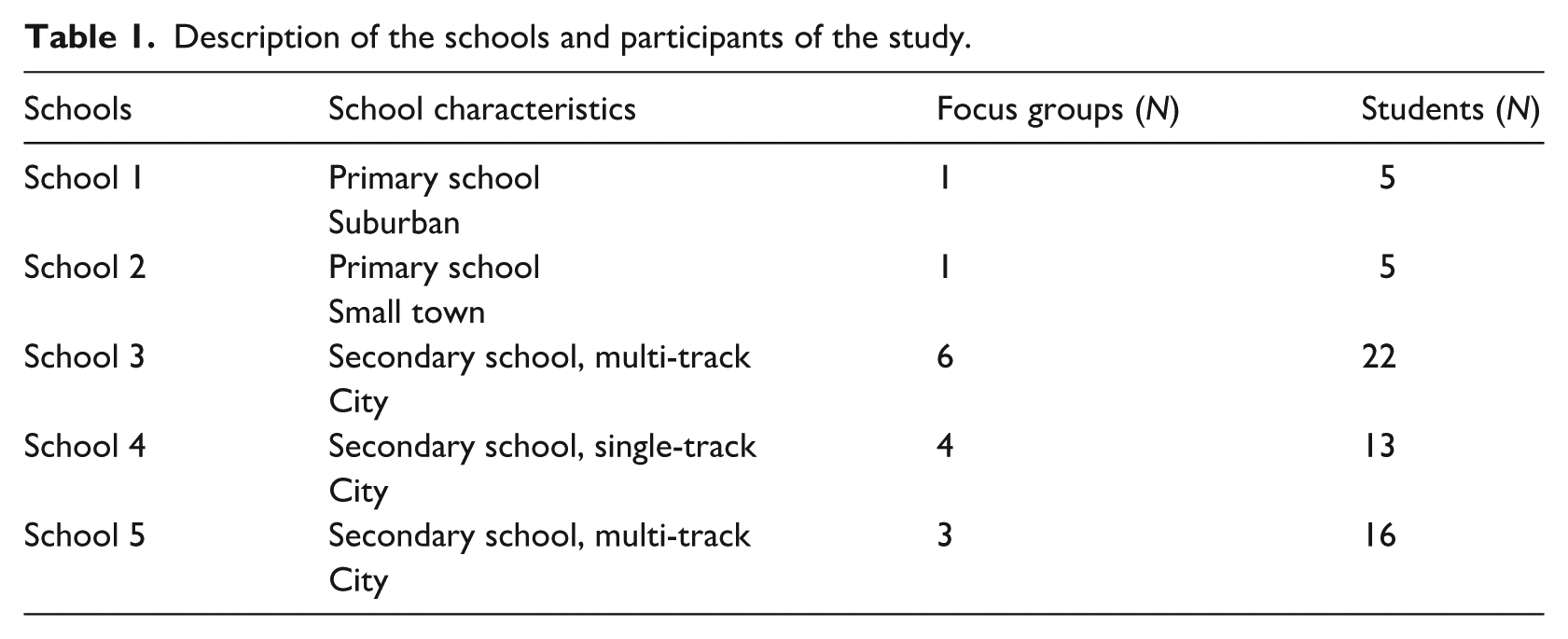
We chose focus groups over individual interviews to reduce the power imbalance between the researcher and participants and to foster an open environment to discuss students’ (future) educational pathways (Mauthner, 1997). Focus groups also encouraged students to articulate and negotiate their views in interaction with peers. We observed that while some students initially struggled to reflect on their own experiences within the educational system, peers often prompted them to elaborate, which enriched the discussion.
The first author, a white young woman from a middle-class background who pursued an academic path (comprising pre-university secondary education and university), conducted the focus groups. She had never visited any of the schools participating in the study before, and was introduced to the schools and students by a teacher, principal or other staff member. While some students perceived her as a student researcher, others addressed her more formally as “Miss,” despite her encouragement to use her first name. During the conversations, the students became very much engaged with each other in the conversation, which she felt decreased most of the distance between them.
We drew up a focus group conversation guide to explore how students perceive the opportunity structure (based on Pallas’ characteristics, as described in Section 2.1) and barriers they had faced or anticipated. The duration of the focus groups ranged from 20 to 65 minutes, depending on the level of students’ engagement and the prevailing school schedule. Most focus groups were conducted in Dutch, with the exception of one focus group where international students joined, in which we spoke English.
Audio recordings of the focus groups were transcribed verbatim. Thematic analysis was undertaken in several cycles of coding (Braun and Clarke, 2006) to identify how students perceived the opportunity structure. We adopted a hybrid approach. First, we applied a deductive strategy by using Pallas’ (2003) characteristics of the opportunity structure as predefined codes to identify how students perceived stigma, selectivity, specificity, electivity, and mobility. In addition, we used an inductive strategy to capture students’ perceived barriers, which were coded openly as we chose a more exploratory approach. The primary analysis was conducted by the first author using Atlas.ti 23. To improve the coding, the second author independently coded several transcripts using the codebook developed in the first round of analysis. Discrepancies were discussed, leading to minor textual refinements and the merging of a few overlapping codes. Table 2 portrays all themes and codes, and includes examples per code.
Themes and codes.
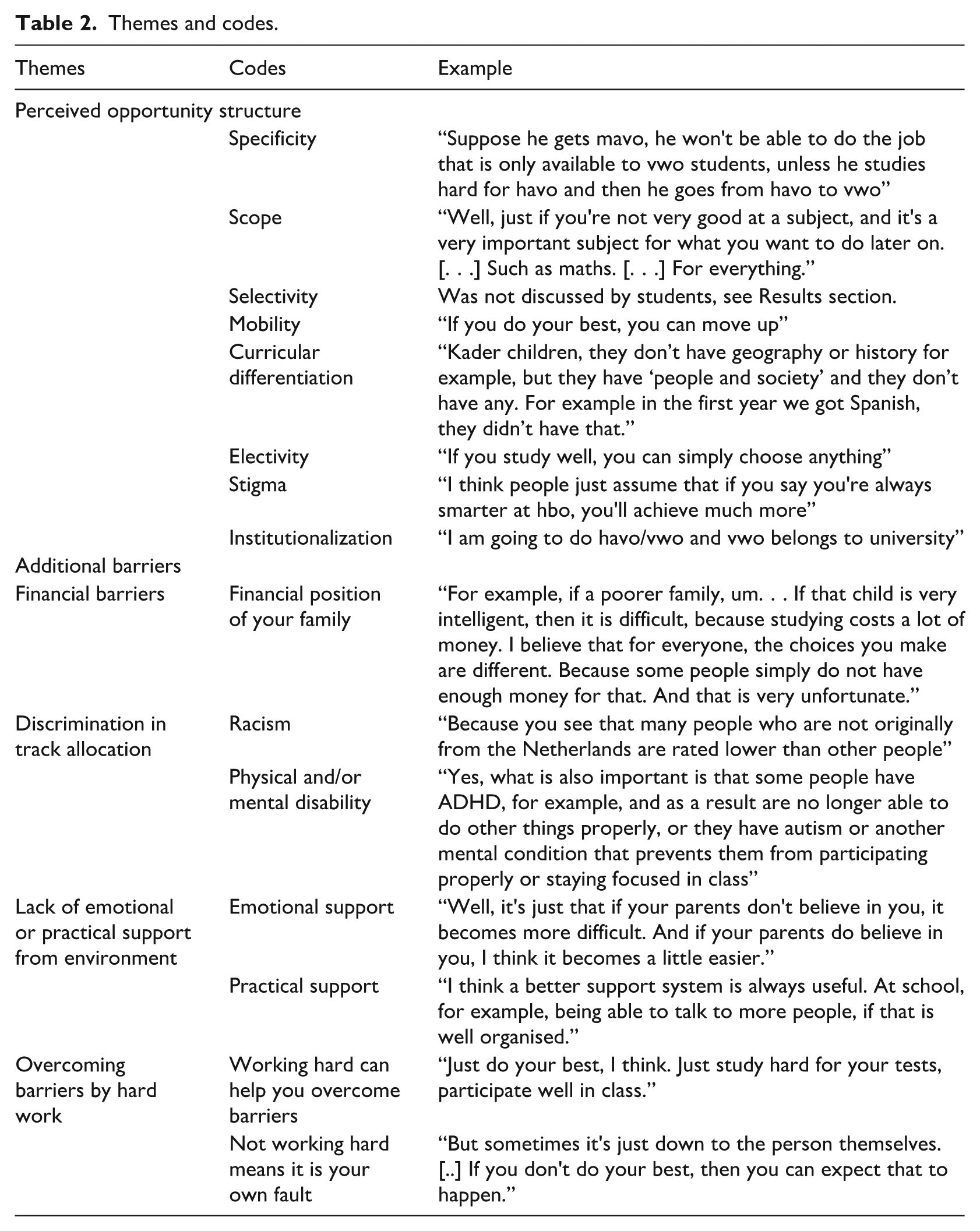
Results
The formal opportunity structure of education in the Netherlands
The Dutch educational system is characterized by its rigorous selectivity, with students being placed into one of seven distinct tracks. At approximately age 12, students are placed into one of seven tracks in secondary education. These tracks include four pre-vocational tracks (vmbo), one intermediate track (havo), and one pre-university track (vwo), which are often ranked from “low” to “high.” The vmbo tracks vary in emphasis on practical skills versus theoretical knowledge.
After gaining a secondary education degree, students can either advance by stacking diplomas within secondary education or continue in senior secondary vocational education (mbo) or higher (hbo, university 3 ) education. Figure 1 portrays all tracks and the most common transitions. While students can move to a lower track (e.g. from havo to mbo), such pathways are uncommon. Access to higher education is determined by secondary education degree. There is a limited number of programs in higher education that apply additional selection criteria. The tuition fee in the Netherlands is the same for almost all programs in publicly funded institutions (€2.601 per 2025/2026) and students receive grants mainly based on parental income.
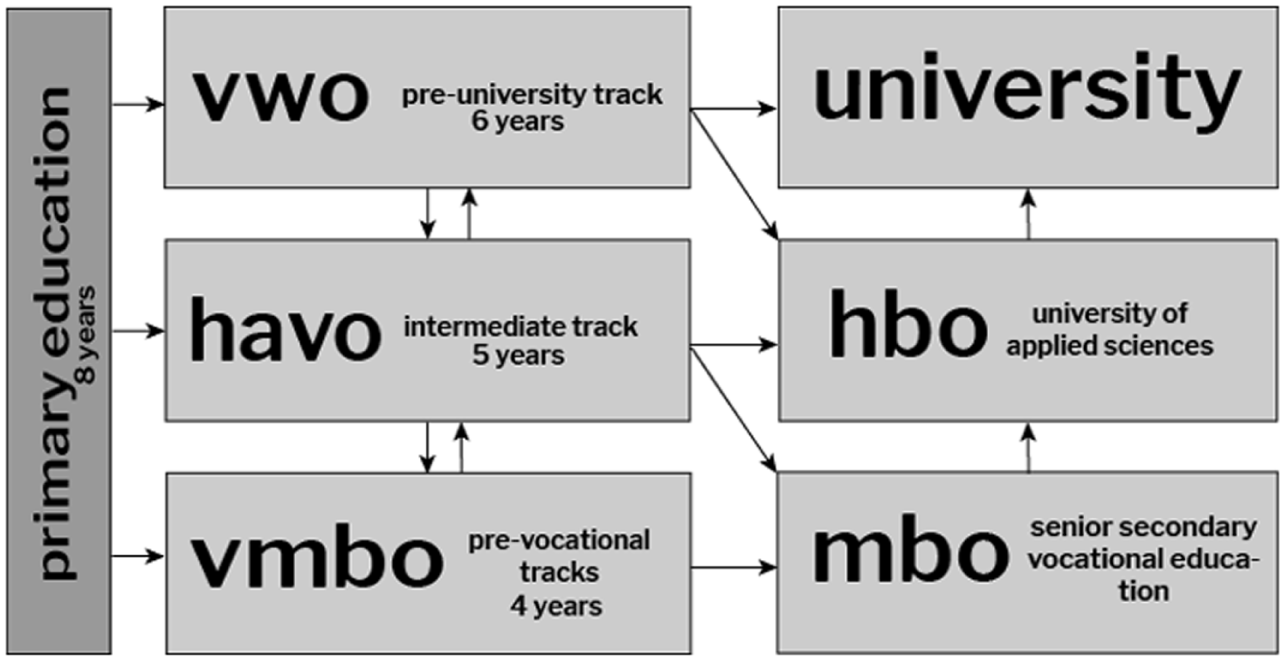
Schematic overview of the Dutch educational system.
When we apply Pallas’ framework to the Dutch education, we would describe the formal opportunity structure of the Netherlands in the following way:
In the Dutch educational system, specificity—the extent to which a specific position provides access to future educational options—depends on the stage in students’ educational career: in the early years, most future options are open to all students, whereas in later years, students’ track position narrows their options. Once tracking has taken place, the level of specificity depends on track rank: students in the higher ranked tracks in secondary education have the choice to enroll in any continued track in post-secondary education, including higher education, whereas students in the lower ranked tracks have a limited number of options available to them.
In terms of scope—the extent to which a particular position in the education system shapes a student’s entire educational experience—in an early tracking system like the Dutch, the scope is wide. Students in the same track follow most to all courses at the same level, meaning that their track shapes students’ entire educational experience. 4
Selectivity—the homogeneity within particular tracks—is high in the Netherlands. Tracks differ to a great extent in the characteristics of their student populations. In the vocationally oriented tracks, there are more students from socio-economically less privileged and migrant backgrounds than in the tracks that prepare students directly for higher education (Baysu et al., 2018). Selectivity may also refer to homogeneity in terms of scholastic achievement of student groups within certain tracks. As students are assigned to tracks according to standardized test scores and teachers’ judgment of their academic level, scholastic homogeneity is the main objective of track allocation.
Mobility—the opportunity to move from one position to another—is theoretically widely available in the Dutch systems: students have the option to “stack up” diplomas or switch tracks during their educational pathway. It is possible to continue in the lower tracks of secondary education, and continue in higher tracks after graduating from these lower tracks. Similar steps are possible within post-secondary education, where access to higher education can be gained if a student graduated from the highest level in senior secondary vocational education. However, in reality, there are several boundaries to mobility, such as having to take at least one additional course. Moreover, both the transition from senior secondary vocational education to higher education (Vervoort and Elffers, 2018) and from university of applied sciences to university is a vulnerable moment where students are more likely to drop-out after the transition.
The level of curricular differentiation is very high in the Dutch system. While the curriculum in primary education is similar for all students, the curricula differ strongly between secondary tracks. The curricula in the lower tracks focus more on vocational skills, and are considered less demanding than the curricula of higher tracks. Similarly, the curricula of higher tracks are targeted at academic skills. These tracks prepare for higher education and thus focus more on theoretical knowledge.
School systems with early tracking differ in the extent to which students are allowed to choose which path they wish to follow. For instance, in Germany or Flanders, students have the opportunity to make choices for their educational pathway upon the change from primary to secondary education. In these countries, track choice is guided by a teacher’s advice or test score, but not completely determined by it. This is different in the Netherlands: students are allocated to a track by teachers/schools, and track allocation determines their possibilities for taking subsequent steps along their educational pathway. This means there is little electivity in the Dutch system. Only students in higher ranked tracks have the opportunity to decide to enter lower track options, which is not the case for students in lower ranked tracks.
In the Netherlands, there are clear indications of stigma on particular tracks (Van Daalen, 2010). Pre-vocational and senior secondary vocational education are perceived as inferior types of education (van de Weerd, 2023), designed for less intellectual students. The hierarchical nature of the educational system is depicted in these stigmas: vocational tracks are perceived as lower or “worse” and academic tracks are higher or “better.”
Lastly, educational tracks in the Netherlands are to a large extent institutionalized. There is a common understanding in society about what the tracks are and what they prepare for. For example, vocational tracks in secondary education are widely understood to prepare for senior secondary vocational education and craftmanship, and pre-university education is understood as directly feeding into university, and to prepare students for higher status and higher paying jobs.
The characteristics of certain tracks or positions with the opportunity structure imply that the opportunities for individuals change while proceeding through the educational system. Whereas in the beginning of a students’ school career, the system is more open, for instance with more room for electivity, and mobility and limited curricular differentiation, once a student enters one of the tracks in secondary education, these aspects become more fixed.
The perceived opportunity structure
Specificity
Several students in the vocational track of secondary education (vmbo) stated that their school only focused on preparing them for senior secondary vocational education (mbo), rather than presenting the full range of options, including the intermediate route of havo. Despite the fact that approximately 20% of vmbo students chooses to pursue havo, these students felt their schools pushed them toward mbo by failing to provide information or support for the havo pathway. As a student shared: she felt unprepared for academic options as career guidance and teacher discussions at her school centered exclusively on the vocational route.
A small group of international students we spoke with were more aware of the high specificity of vocational tracks than Dutch students. One student, for example, mentioned: “Suppose he gets mavo, he won’t be able to do the job that is only available to vwo students, unless he studies hard for havo and then he goes from havo to vwo.” This suggests that having knowledge of or experience with other educational systems, makes students more aware of particular characteristics of the opportunity structure that they currently navigate. International students referred to the vocational tracks in the Dutch system as hardly providing any opportunities to graduate from a higher track in the end.
Scope
In the Dutch educational system, students’ track allocation determines their entire educational experience. This is also how students perceived the opportunity structure. Some mentioned that that this wide scope is difficult if you have one course in which you are not doing so well in some subjects. They share that for example mathematics can be a difficult subject for some, and even if you are performing very well in all subjects but math, it could mean that you have to go to the track that corresponds with your math level.
Selectivity
Students did not touch upon selectivity in the interviews, and it was not something students noticed when discussing educational pathways or their peers in the classroom. They appeared to look at the composition of their classroom or track as a given. Yet, several students noted that the family background of students can affect educational pathways, stating that migrant students’ academic capacities are often overlooked by teachers, leading to their allocation to vocational tracks.
Mobility
Most students did not consider possibilities for mobility within their own pathway. Most participants in the tracks that prepare for higher education only had one pathway in mind: the pathway leading to higher education. They did not have to envision any other options, as their track prepared them for their desired education after secondary education.
This was different for students in pre-vocational tracks. Among these students, several students expressed the ambition to “stack up diplomas,” showing that for them mobility was something they perceived as a possibility. One of the students expressed that she wanted to “stream up toward vwo.” Streaming up is common language to discuss upward mobility in education in the Netherlands. She felt that “it really seems impossible, but it will work out.” This was something commonly expressed by students when reflecting on upward mobility. Although we did not know the students personally, nor had any impression of their performance in school, it seemed that they felt the urge to express to us that upward mobility would be possible, as though they had to convince us—or themselves—of them being able to stack diplomas.
Similarly, when students spoke of options for upward mobility in education, for themselves or others, they told us that this was only an option for those who put in a lot of effort, and have the right mindset. One vmbo-t student said: “You can. That, you just can. It depends on how you think. If you really want to do something you can achieve with havo, then you go and do an extra year of havo..” Mobility appeared to be perceived as something that is reserved for those students who are able and willing to go the extra mile and work very hard.
A number of students had seen an influential educational documentary that was aired on national television. The documentary showed inequalities in the Dutch opportunity structure in education. A student told that watching this documentary, she realized the lack of possibilities for mobility in the Netherlands: “It is very difficult, for example if you are now at vmbo-t, and you want to go to havo: that is difficult and they almost never do that.”
Downward mobility was something that students only discussed in terms of unacceptability for their parents. Their parents do not want them to “stream down” to a lower track. It was seen as a worst case scenario, yet for some students appeared a real, but feared possibility.
Curricular differentiation
Respondents rarely reflected on the differences in curricula between the different tracks in terms of subjects. As students are sorted in separate tracks at the beginning of secondary education, they are not familiar with the curricula of other educational pathways and the differences to their own track. In case respondents did notice differences, these mostly pertained to courses that are part of some tracks, but not in the others: “Kader [in hierarchical terms the second out of four pre-vocational tracks] children, they don’t have geography or history for example, but they have ‘people and society’ and they don’t have [. . .] Spanish.”
Students who did notice these differences, thought that differences in curricula can be explained by the fact that students in the lower tracks of pre-vocational secondary education learn better in more practical courses—“working with their hands”—whereas the higher tracks are supposed to focus on more theoretical learning. Their perspective of the differences between the various vmbo tracks aligns with the rationale that some of the vmbo tracks focus on practical skills and some on theoretical knowledge.
Electivity
The level of electivity, which refers to the extent to which students can steer their own educational pathways by making choices, was perceived as plenty by most respondents. They portrayed educational pathways in the Netherlands as free of force, allowing them to navigate as they like. Most students describe this freedom in clear terms, stating that they experience no pressure to make certain decisions and that students can decide for themselves what to do and where to go in their educational pathway. For example, a student in the vmbo-t (vocational secondary education - theoretical) track says: “You have a lot of choice, and you are like free to choose. Nobody is forcing you nowadays.” They express strong individual agency related to their educational pathways.
Respondents across all age groups and tracks noted that, in the Netherlands, students have to make a choice early in their educational pathway: upon the transition from primary to secondary education. They see the transition from primary to secondary education as a moment that provides ample room for choice. This does not match the formal level of electivity upon this transition. In the Netherlands, students can decide which specific secondary school they attend, but not which track they enter. Secondary schools will only accept a student if the track recommendation and test scores of the student match the track they wish to enter. Students are allowed to enroll in a lower track than has been suggested by their track recommendation, but this is hardly ever done.
In contrast to the experienced level of electivity among respondents, students also suggested that they experience a strong push from their parents to reach the highest educational track possible. Students felt that their parents pre-define the options from which they are supposed to choose. Some students told that while they did not intend to go to higher education, and rather preferred a vocational pathway, their parents pushed them toward stacking up diplomas to eventually enroll in higher education.
But I do think they put a bit of pressure on us to get a higher education, to go to university or something like that. [. . .] I think it’s mainly adults, so it could be teachers or just your parents who put pressure on you to get a good education and become successful.
This was especially prominent among students who were currently in vmbo-education. The following quote illustrates how students, while having various alternative paths in mind, may feel pushed by their parents to opt for an academic educational pathway: “For example, I am doing vmbo-t, but my mother, she wants me to do havo, and she pushes me toward that” (vmbo-t student, second year of secondary education). This strongly contrasts the feeling expressed by students; although on the one hand, they are free to choose, they also feel parental pressure for certain pathways.
Stigma
The level of stigma in Dutch society on the vocational tracks is visible in many daily practices, which was reflected in students’ perceptions of these tracks as well. When reflecting on vocational education, even respondents in primary education referred to existing prejudices: “Vocational education is always seen as one of the poorer forms of education, and perhaps it is also less well funded or something, so that it simply cannot be good. But there are always prejudices about it.” Some respondents echoed a common stigma of a stronger prevalence of negative and delinquent behavior in vocational education: “Because there [vmbo] are many problem youth, and there is a lot of fighting. There will be police quite often.”
Students in secondary education also used stigmatizing statements about students in the different tracks in the opportunity structure, for example that students in vocational education will more likely be seen as kids who steal, or bully or that students in the (pre-)academic tracks were considered to be “nerds” who never have any fun. Students openly phrased these stigmas, and were not afraid to do so in strong words. For example, a student who previously had been enrolled in vmbo-kader, recently transfered to vmbo-tl. One of the other students in the group stated that “If you do kader, you are just stupid,” disregarding the fact that one of the students had just come from that track.
Some students in the academic tracks were even more negative about the vocational tracks. They stated that students in the vmbo or havo tracks should not be satisfied with their current position, even finding “it a bit sad for people doing mavo [historic name for one of the vmbo tracks] or havo,” as they would have to either compensate for their lower track by taking the longer, non-ideal pathway to university, or would have to do jobs that they might not like doing. Another student said that “mbo is always seen as just really one of the worse educational tracks.” In general, students who were less familiar with vocational education, because they were currently enrolled in a different track, expressed more stigmatizing views than students who went there themselves.
Yet, after the respondents expressed existing stereotypes about certain educational tracks, in society or in direct social environments (parents, teachers), students voiced their disagreement with the stigmas, either from the perspective of their own position in vocational education, or expressing that in general the vocational track is unjustly stigmatized. For example, a student in the pre-academic track mentioned: “But of course, that’s not true at all, and also, for example, if you train to be a builder or something like that, you are considered immediately stupid and inferior to, say, a doctor. But construction workers are also desperately needed, but some people don’t see that.” In many cases, respondents simply denied the stigmas on certain educational tracks that exist in society and countered these by speaking in positive terms about vocational education. Students appeared to have internalized stigmas on vocational education that exist in society, while at the same time feeling uncomfortable with these stigmas.
Institutionalization
Students’ perceptions reflected the public understanding of the different tracks in the education system. This started as early as primary school; respondents from primary education made claims such as “I am going to do havo/vwo and vwo belongs to university.” Students link the secondary tracks to the most common subsequent step after secondary education. The common understanding of the meaning of tracks was even more prominent among older students. They know very well which tracks are supposed to guide them toward which levels of tertiary education.
Students also shared their views about how they understand the differences between “practical” and “theoretical” education. While the highest track of vmbo education is called “theoretische leerweg,” which translates roughly to theoretical trajectory, this did not appear to confuse our respondents as they stated clearly that vmbo is for students who “learn with their hands,” whereas havo and vwo is for students who learn “with their head.” This resonates with the broader public understanding of these tracks.
Additional barriers
After discussing eight characteristics of the opportunity structure, we asked students whether they identified barriers that may limit options to design and follow their own pathway through the educational system.
Financial barriers
The most commonly mentioned barrier was a lack of financial resources. Especially studying in higher education is considered very expensive, and perhaps only an option for students whose parents are able to additionally fund them. Respondents felt that it might set them back if they would have to work next to studying, “which costs time you cannot put into your education.” Respondents were aware of the possibilities to ask for financial aid, for example “associations that help you [..] to afford school necessities,” yet felt that it can be difficult to reach out to financial support. While in practice, there are financial support schemes for students from poorer families, students appeared unaware of their existence, or maybe did know of their existence but felt that these would not take away financial barriers to enrolling in post-secondary education.
Discrimination in track allocation
As students are sorted into different tracks upon the transition to secondary education based on teacher recommendations, some respondents identified a risk of discrimination, which some had indeed experienced themselves in the past. They noted that students whose parents were not born in the Netherlands, or students with names that “do not sound Dutch,” may encounter racism and stereotyping as barriers in their educational pathways. They felt that this can influence students’ potential track allocation, as these students may be “rated lower than other people.” The respondents feared this could not only result in a biased recommendation from their teacher upon the transition to secondary education, but also in the way they are treated by teachers. This might impact their academic performance and thus, their educational career.
Students also spoke about the potential impact of illness and disability, on individual educational pathways. Given the tracked nature of the system, students feared that disabled students may be guided to a lower track if they have missed some schooling, rather than getting the opportunity to catch up within their current track. They felt that a “one-size-fits-all” treatment in which no adaptation is possible for disabled students could negatively impact their educational pathways.
Lack of emotional or practical support from environment
Students frequently discussed that having parents or other family members who can support them along their educational pathway significantly boosts their school career. Missing this support may hinder students in their pathways. Support was mentioned in terms of support to complete homework, but also in terms of having parents who believe in you, which increases their motivation to go the extra mile. Students for example mentioned: “[When you have a] teacher who doesn’t explain something well, then they’re like: well, who should I ask? And then it’s usually my father I ask, but some people don’t [have that].”
At the same time, students pointed out that if you have “problems with your parents,” it can have a tremendous impact on their motivation and the educational pathway. Additionally, students mentioned that having parents who do not speak Dutch can make things more difficult, as they are unable to assist with homework or to quiz them in preparing for an exam.
Students’ also discussed parental push as a lack of support. This push appears to focus mainly on reaching higher levels of education within the hierarchically tracked system, or on preventing downward mobility within that system. Students felt that their “parents wouldn’t be too happy if [they] would say: mom, dad, I’m not doing all of this anymore, I am going to the havo” (vwo student, second year of secondary education). Even though they might want to follow a different educational level, the lack of support for some choices may limit their room to consider alternative pathways.
Overcoming barriers by hard work
A majority of the respondents did not bring forward any additional barriers, or said that these do not matter as long as you work hard. These students seemed to think of barriers as something one may face individually, but not as something posing limitations at a structural level. The belief that working hard would help to overcome anything was prominent in the interviews. The counterthought was also present: if students do not work rigorously or lose focus of school work, respondents thought this would impact their educational pathways and this would be their own failure.
Discussion
This study explored how students perceive the Dutch opportunity structure by comparing the formal design of the system with students’ own accounts. Overall, students’ perceptions of the opportunity structure were largely in line with its formal characteristics, including its scope, selectivity, specificity, mobility, institutionalization, stigma, and curricular differentiation. A notable exception concerned electivity: despite the fact that the Dutch system allows for limited choice due to its selective and sequential nature, respondents often they had considerable control over the course of their own educational pathway. When considering their own trajectories, students identified additional barriers that could affect their trajectories such as financial constraints, discrimination in track allocation, and limited support from family or school. Nevertheless, students generally attributed educational success or failure to individual traits such as effort and persistence.
Our findings point to a certain paradox: although the selective design of the Dutch system restricts mobility and choice, students perceive of themselves as the main directors of their own pathways. This finding echoes prior research showing that young people often favor individual over structural explanations of inequality (Kostet et al., 2021), which is reflecting the presence of strong meritocratic beliefs (Mijs, 2016; Van Den Bulk, 2011). This ambivalence illustrates how students negotiate their own agency within structural constraints, a struggle long noted in sociological debates on the relationship between structure and agency (Shilling, 1992) and more recently addressed again in research on (migrant) youth aspirations in selective systems in Europe (Gomensoro et al., 2025; Nygård, 2017). While students’ tendency to view their pathways as flexible and open may foster ambitious aspirations, it can also lead to disillusionment when the system offers limited opportunities for mobility. In primarily viewing the course of their educational trajectory as their own responsibility, students may experience unwanted transitions or pathways as personal failure, instead of acknowledging the role of structural barriers inherent in the educational system.
At the same time, however, students’ accounts revealed moments of tension. They had internalized societal hierarchies and stereotypes associated with different educational tracks (Boone and Van Houtte, 2013), yet simultaneously expressed a desire to resist these frames. They shared that their own educational trajectory was open to navigate through, yet also voiced a strong parental push for higher educational levels. Such cases of duality highlight the importance of student-centered research: students’ voices reveal not only how opportunity structures are experienced, but also how they can reproduce inequalities by shaping young people’s sense of agency and responsibility. Much of the existing research on educational tracking and inequality has focused on the structural characteristics of school systems or on policy-level reforms (such as Pomianowicz, 2023; Van Den Broeck et al., 2023; Zapfe and Gross, 2021). While such approaches offer valuable insights, they tend to overlook how students interpret and navigate the opportunity structures that they are part of. By foregrounding students’ voices, our study demonstrates that opportunity structures are both formal institutional arrangements as well as lived experiences that define the boundaries of young people’s agency. Such an approach adds a relevant dimension to the study of tracking, as students’ perceptions provide insights in the reproduction of inequality through formal rules and institutional practices and through the meanings and expectations that students attach to their educational pathways.
In addition, our student-centered approach provides a new perspective to Pallas’ (2003) framework. By analyzing students’ accounts in light of his eight characteristics, we found that some features appear to overlap in the lived experience of students. For instance, students’ perceptions of mobility seemed inseparable from their perceptions of choice. Next to that, we also argue that the model could be refined by distinguishing between the formal characteristics of the system (e.g. scope and specificity) and the socially constructed elements (e.g. stigma and institutionalization) that influence how students experience the opportunity structure.
Although our sample did include variation in terms of gender, age, cultural, socio-economic, and educational background, the focus group design limited our ability to systematically explore differences along these lines. It would be valuable for future research to assess to what extent students’ backgrounds relate to their perceptions and educational trajectories, as this may enhance our understanding of existing inequalities in educational pathways. Our focus group design limited the room for personal accounts of individual pathways, and in some cases students may have been reluctant to share more personal experiences in the group.
Keeping these limitations in mind, the findings also point to some considerations for practice. It is helpful for educational professionals, such as career guidance counselors, teachers and policy makers, to recognize that students often perceive the education differently to how they do. As these opportunity structures are lived rather than paper realities, professionals may need to consider the lenses through which students view the system and their options within it more explicitly. Rather than making assumptions about students’ perceptions, views and ambitions, professionals could address these more directly to create policies that better fit students’ interpretations.
Our study shows that educational systems shape more than educational pathways. They shape how students imagine their educational futures and own pathways. In a selective educational system, Dutch students both aim to make their own educational choices yet internalize the hierarchies that constrain them. Our results echo the well-known tension between agency and structure, showing that this tension is a lived reality. By centering students’ voices, our findings indicate that opportunity structures are designed by policy, but are experienced differently by students. These perceptions deserve attention in our research and practice.
Footnotes
Declaration of conflicting interests
The authors declared no potential conflicts of interest with respect to the research, authorship, and/or publication of this article.
Funding
The authors disclosed receipt of the following financial support for the research, authorship, and/or publication of this article: This work was supported by the Netherlands Initiative for Education Research [NRO] under Grant [40.5.19945.602].
Ethical approval
The project was approved by the Institutional Review Board (IRB) of the University of Amsterdam, Research Institute of Child Development and Education (IRB #2022-CDE-14964). Written informed consent was obtained from parents and, if applicable, children above twelve years prior to participating.

Data availability statement
The data supporting this study are not publicly available due to privacy considerations. The focus group transcripts contain sensitive information from underage participants, and public sharing was not included in the informed consent process. Anonymized excerpts or additional information about the dataset may be made available upon reasonable request to the corresponding author, subject to institutional review and data protection regulations.