




Abstract
This article systematically reviews 20 years of publications related to Chinese as a Heritage Language (HL) learning in European contexts. Adhering to guidance for research synthesis, this study runs a systematic review in English (i.e. Web of Science and Scopus) and Chinese (i.e. CNKI) databases based on this paper’s research scope. To explore the reported experiences of Chinese HL stakeholders (e.g. learners, teachers, and parents) in Europe, an in-depth analysis of 17 journal articles describes the research trends, encompassing research domains, focal countries, methods, and significant findings. This study identifies three key observations: (1) Pull and push factors in HL maintenance; (2) Multilingual and multimodal language practices in various settings; (3) Dynamics in identity negotiation and reconstruction, from the focal publications. It discusses the major issues encountered by the HL stakeholders, such as the mismatch of linguistic repertoires between teachers and learners in multilingual environments, the shortfall of collaboration amongst families, Chinese language schools and public (mainstream) educational authorities, and the dynamic and evolving outlook of HL identity-making. Reflecting on the research procedures, findings and discussions, we suggest specific potential directions for further research on HL learning in Europe, which is endowed with multilingualism, and beyond.
Introduction
In recent decades, the growing number of Chinese (im)migrants to Europe has drawn the attention of applied linguists to the multilingualism in overseas Chinese communities, examining how they navigate themselves among domestic, heritage, and foreign languages for language maintenance and development. To provide fresh insights into research trends in the existing literature in European discourse, we systematically review 20 years of publications related to Chinese as a Heritage Language (CHL) education in Europe, drawing from both English and Chinese literature databases. This paper provides a brief overview of Chinese migration to Europe, along with our rationale for an updated review. Having illustrated the running procedures of systematic review in the methodology section, we synthesise and present key observations encompassing research domains, focal countries, methods, significant findings, and other relevant aspects. This work offers further research directions and practical implications for researchers, educational practitioners, and other CHL stakeholders in Europe and beyond.
According to the EUROSTAT report, the number of registered Chinese nationals in Europe increased twofold from 2008, reaching 1.2 million in 2018 (Eurostat, 2019; Thunø and Li, 2020). Traditionally, the majority of Chinese migrants have been known as low-skilled workers in ethnic-basis entrepreneurship sectors. Yet, the recent economic-political growth of China has changed the composition of Chinese migration communities in Europe (Thunø and Li, 2020). In particular, student migration has been predominantly increasing, echoing the commercialisation of higher education by some European countries and China’s call to study abroad since the 21st century (Thunø and Li, 2020). Another evident type of increasing migration population is attracted by “golden visas” schemes or investor citizenship/residence launched in many European countries (Thunø and Li, 2020). These two new types of migrants indicate that the growing Chinese migration communities are better educated and more affluent. In turn, they are more likely to be able to afford or devote attention to the education of their descendants to secure or improve their socioeconomic conditions. Simultaneously, Thunø and Li (2020) pinpoint that recent years have witnessed a change from a one-way migration flow (from China to Europe) to transnational mobility (between China and Europe). The rapid economic rise of China boosts Chinese migration communities’ pride in their heritage ethnicity, which motivates some young Chinese descendants, especially those in economically regression areas, to return to China for potential career development (Thunø and Li, 2020). These emerging trends of Chinese migration to Europe highlight the need for an updated review of how academic discourse has investigated the Chinese diaspora’s aspirations and practices around heritage language maintenance and development. Specifically, this article seeks to uncover the following questions: How has Chinese HL been researched in European contexts in English and Chinese publications? What tendencies have emerged from the reported experiences of Chinese HL stakeholders in Europe?
Heritage language maintenance and development in Europe
Heritage language, alias “mother tongue” and “home language,” generally refers to the language widely used or contacted within migrant families or their ethnic communities. Although the term may vary slightly according to socio-political orientations in specific contexts, the core idea is to distinguish the languages spoken by minority ethnic groups from the dominant or national languages (e.g. Duff and Doherty, 2019; Ennser-Kananen and King, 2018; Montrul, 2015). In Europe, Chinese is considered a heritage language due to its immigration characteristics rather than being spoken by indigenous or national groups. Furthermore, research on Heritage Language Learners (HLL) is frequently associated with sociocultural/political discourses and identity-making, though the view of proficiency-based or linguistic-features approach (e.g. cross-linguistic influence) also enjoys popularity (Ennser-Kananen and King, 2018; Kupisch, 2021). Unlike Foreign Language Learners, HLLs usually maintain a deep and close connection to the target language (i.e. heritage language) and obtain more or less receptive, even productive knowledge of the HL (Montrul, 2015). In other words, HLLs are bestowed blood-based affinity with the HL, which can significantly contribute to their identity-building. At the same time, the degree of HLL’s proficiency may largely depend on family language planning and policy. For example, Montrul (2015:24) illustrated an “inter-generational transmission and loss” of HL proficiency from the first generation (grandparents) to the third generation (grandchildren) in the United States and many other parts of the world. Nevertheless, the Chinese migration to Europe may not be as longstanding as in traditional immigration countries/territories, such as North America and Australia. As a result, the inter-generational transmission and loss of the Chinese language may not be that evident in European contexts. Instead, as Thunø and Li (2020) explained, with the recent economic-political rise of China, the new generations of Chinese (im)migrants are more likely to be proud of their heritage culture and value the language, which can positively impact their ethnic identity construction.
The “new speaker” is an eye-catching academic discussion about the HLL identity emerging in Europe (O’Rourke et al., 2015: 2). In their view, HLLs cannot be simply categorised into “non-native,” “L2,” or “foreign language” speakers, and they criticise the predominant epistemologies on majority and minority languages attached to the “legitimise(-d) claim to nationhood and cultural authenticity” (2015:2). From a sociolinguistic perspective, the concept of “new speaker” underlines the emerging power of HLL(s) that has the potential to shape and even replace the traditional “native speaker” communities in (im)migration contexts (O’Rourke et al., 2015). At the same time, one should note that the “new speaker” is associated initially with language revitalisation in Europe, especially for indigenous or national minority languages (O’Rourke et al., 2015). We must be cautious about the different socio-political roots between the immigrated HL and the indigenous or national HL. Given that Chinese (a non-Indo-European language) is brought by immigrants from outside Europe, we need to carefully delve into how this emerging concept is relevant and helpful in describing Chinese as HL in Europe.
Previous review and research questions of the current study
To date, the existing synthesis reviews of HL studies have been primarily conducted by scholars affiliated with North America - a popular destination for immigrants. A wide range of research foci include language mixing (Jiang, 2021), disorder and development of a child’s HL (Lim et al., 2019; Reimann and Ratto, 2023), parent-child relationship in multilingual navigation (DeSouza et al., 2023), and learning problem of young refugees and mental health related to cultural and linguistic maintenance (Hasnain et al., 2023). In terms of types of languages, existing reviews, such as Spanish as L2 (Antón, 2011) and Japanese as L2 (Mori and Mori, 2011), slightly touch on the notions of the heritage language in the Second Language Acquisition (SLA) domain. More recently, Visonà and Plonsky (2020) undertook a scoping review on Arabic HL, responding to a need for research on the growing body of heritage language learners in SLA. Their review maps out research trends of Arabic HL at a global scale and provides practical suggestions for conducting other language-specific synthesis reviews, especially data collection and analysis procedures.
Synthesis reviews of Chinese HL are scarce to date in English literature databases. Duff and Doherty (2019) carried out a narrative review that summarises four research currents in the sociocultural domain. They (2019: 150) elicited a turn of research agenda on Chinese HL learners from a “deficiency” and “diversity” to multicompetence (Cook, 1992), which recognises language learner agency to negotiate various linguistic or dialectical practices and language ideologies and to fashion their identities alongside the increase of socioeconomic status of China worldwide. Grounding their argument, Duff and Doherty (2019) questioned (1) the socio-historically hegemonic discourses of Chinese HL in academia. Given the large size of the Chinese-speaking migrant population in North America, “Chinese-Americans” have been frequently equivalent to learners/users of Chinese HL in academia and “Chinese” has been usually represented by “Mandarin Chinese,” which oversimplifies the scope of Chinese HL users/learners and varieties of Chinese in prior literature. (2) Various factors, such as instrumental (employment and entrepreneurship), integrative (communication with older family members), intrinsic (challenging self and character building) and convenient choice to fulfil university requirements of foreign language, motivate HL learners to study or retrieve their Chinese competence. (3) The socialisation spaces avaliable for Chinese HL learners are relatively limited, typically consisting of daily conversation with grandparents and interactions in HL classroom. Despite parental guidance, the shortage of social and official support results in a slow or delayed development of the children’s HL, whose vocabulary, extent of registers, and written literacy are limited. (4) Challenges in curricula call for sociolinguistically-informed pedagogy and materials, which acknowledge the characteristics and prior knowledge of HL learners, customise pedagogical approaches to open up more socialisation space and decentralised cultural representations of “essential” Chinese to engage Chinese HL learners/users. This narrative review summarises critical tendencies in Chinese HL, yet the authors state that most reviewed studies are in North America. This paper will zoom into European contexts and provide a nuanced picture of research on Chinese HL in Europe.
Lately, Jiang and Troyan (2024), drawing attention to the varieties of CHL, systematically reviewed 25 empirical journal articles from 2005 to 2021. It is somewhat not surprising that most of the reviewed studies focus on English-speaking contexts, and no European cases appear in their selected list (Jiang and Troyan, 2024). The result further supports that research on Mandarin significantly outnumbers that of other varieties of Chinese, such as Cantonese, Hokkien, and Hakka, which leaves the maintenance and revitalisation of these minority Chinese varieties underexplored (Duff and Doherty, 2019; Jiang and Troyan, 2024). The authors also discussed the theoretical frameworks employed by previous studies in CHL education, and they found that socioculturally impacted concepts (e.g. Bourdieu’s notion of capital, Vygotsky’s ZPD, identity and ideology, cultural-ecological theory, and translanguaging) enjoy more popularity than the cognitive perspective (e.g. language anxiety)(Jiang and Troyan, 2024). Dividing HL education into formal (i.e. learning programme) and informal (i.e. families and communities) settings, Jiang and Troyan (2024) noted that learners of minority varieties of Chinese are likely to be marginalised in classroom HL learning in comparison to their Mandarin counterparts, which intensifies their identity ambivalence. The empirical studies on classroom discourses and pedagogies collectively suggest that cross-cultural perspectives and innovative pedagogies should be emphasised in the professional development of Chinese HL educators (Jiang and Troyan, 2024). Parents’ perception of HL also plays a significant role in maintaining children’s HL varieties, and they sometimes have to manage the inconsistency between their family language policies and de facto language practices (Jiang and Troyan, 2024). They (2024) concluded that promoting collaboration among families, communities, and schools is crucial to comprehensively supporting children’s HL development. Similarly, Zhang and her colleagues (2025) reviewed 53 empirical studies on CHL from 2008 to 2023 (in which only five studies were conducted in the European context). Their systematic review adds several methodological reflections, especially calling for experimental methods, classroom-based action research and longitudinal study of innovative pedagogies and curriculum development (Zhang et al., 2025).
In Chinese literature databases, synthesis reviews display divergent focal areas compared to those in English databases. A noticeable reviewing focus is the variations and evolution of Chinese linguistics overseas (Xiao and Fang, 2023; Zhu and Zhou, 2017). As host researchers of Chinese linguistics, the researchers affiliated with Chinese domestic institutions have attached great importance to tracking and recording how the language (including dialects) has been used and evolved in overseas communities and regions, textbooks and assessment systems, as well as the chronological development of HL research in the discipline of Chinese (Zhu and Zhou, 2017). Regarding interdisciplinary studies like Applied Linguistics, studies in Chinese literature databases shared similar interests in language policy and planning, language education and pedagogy, identity and ideology and so forth (Lin, 2021; Zhu and Zhou, 2017). At the same time, the scope of research synthesis in Chinese literature covers a broader range of geographical diversity than those in English literature databases, not only focusing on Anglophone countries but also Southeast Asian countries and neighbouring areas (Lin, 2021). Yet, Lin (2021) pointed out that CHL education in Europe remains underexplored (especially the role of Chinese complementary schools), even though Europe is well known for its established research on bi/multilingualism. Also, a few scholars, in their reviews, have been able to systematically synthesise the empirical studies found in both English and Chinese literature databases. This paper attempts to bridge this methodological gap by searching empirical studies in both English and Chinese databases with particular attention to reported experiences of Chinese HL stakeholders (e.g. teachers, learners, and parents) in Europe. In doing so, we began with the following questions: (1) How has Chinese HL been researched in European contexts in English and Chinese publications? (2) What tendencies have emerged from the reported experiences of Chinese HL stakeholders in Europe?
The first question helps us to gather descriptive components of focal studies, such as research settings, participants, methods, and theoretical perspectives, which maps out the research landscape of Chinese HL in Europe. The second question synthesises significant insights learned from research findings, results, and implications of the focal studies, which facilitate our understanding of the challenges and opportunities amongst Chinese HL stakeholders in Europe. Upon addressing these two questions, this paper will suggest key issues concerning Chinese HL teaching and learning in European contexts and provide implications for future research and practices.
Methodology
The study identified literature records in three databases: Web of Science and Scopus (in English), and China National Knowledge Infrastructure - CNKI (in Chinese). Accessing records in both languages enables the authors to track the existing literature targeting international and Chinese academia. With the guidance for systematic review (Cooper, 2017; Siddaway et al., 2019), our search and selection procedure started with scoping the prior synthesis reviews of CHL to rationalise this study. We identified the niches, considered the breadth of the current review and formulated research questions, as stated in the above section. Then, we compared terminology that commonly appeared in English and Chinese literature and agreed on searching keywords, such as “heritage language” and “mother tongue,” “华语,” “华文,” and “继承语.” This study set up inclusion and exclusion criteria primarily concerning research questions, definition, types of articles (empirical or theoretical), geographic location of study, language, participants, time frame, etc. (Siddaway et al., 2019). The specific inclusion and exclusion criteria are listed as follows.
Inclusion criteria
Research designated/described in the fields of Chinese as a heritage language or mother tongue Chinese and中文/汉语/华文/华语 (作为继承语/母语)(teaching and learning);
Research published in peer-reviewed journals;
Research settings in Europe;
Empirical studies;
Time frame: 2004–2024.
Exclusion criteria
Research on Chinese as a Foreign Language Teaching/Learning, Chinese linguistics, 国际汉语, 对外汉语, foreign language teaching or learning, dialects/ethnic minority languages in China, heritage culture and migration studies (unless it focuses on language);
Master’s theses, doctoral dissertations, and book chapters;
Research in non-European contexts, such as North America, Australia and Southeast Asia;
Other systematic reviews, meta-analyses, and meta-syntheses (as those used for this article’s literature review);
Research on mixed different types of languages, and the main focus was not on Chinese (or its varieties) in overseas China.
As this paper is interested in Chinese as a heritage language, we excluded research foci on Chinese as a foreign language (e.g. CFL, 国际汉语, 对外汉语) and Chinese linguistics in studies. Plus, “heritage” can be associated with the maintenance and revitalisation of dialects and ethnic minority languages in China as well as the heritage culture of migration abroad. Thus, these terms and research foci were on the exclusion list. We limited the search scope to peer-reviewed journal articles due to the quality and accessibility of the searched records; therefore, we did not prioritise dissertations, book chapters, and books in the present study. With a particular interest in geographical Europe as a research context, we excluded non-European regions such as North America, Australia and Southeast Asia. Only empirical studies were eligible for the review because most of the searched meta-analyses and other types of reviews have already been used for the literature review in this paper. The time frame is set from 2004 to 2024 because the first two decades of the 21st century witnessed a large growth of Chinese migration in Europe (Thunø and Li, 2020). Finally, we excluded the empirical studies that examined mixed-language groups of participants, such as Spanish, German, and Chinese HL learners in one study, and/or the focus was not solely on Chinese (or its varieties) in overseas China, in order to refine our focus on Chinese and its primary feature as a heritage language.
Adopting the Preferred Reporting Items for Systematic Reviews and Meta-Analyses (PRISMA) flowchart (Page et al., 2021), Figure 1 illustrates the four stages for record search and selection in English databases. The first author applied “heritage language” OR “mother tongue” AND “Chinese” AND “Europe” (in Title, Abstract and Keywords) to search on Web of Science and Scopus (date: April 4, 2024). The published year ranged from 2004 to 2024, and the article language included “English” and “Chinese.” This search yields 729 records in total, Web of Sciences (n = 365) and Scopus (n = 364). With a tech-assisted tool – Rayyan, we removed 144 duplicate records and assigned 585 publications for abstract screening. A total of 509 records were excluded according to the exclusion criteria. To check the eligibility of selected studies, the first author manually accessed the full texts, and finally, 15 peer-reviewed journal articles met the inclusion criteria for data analysis.
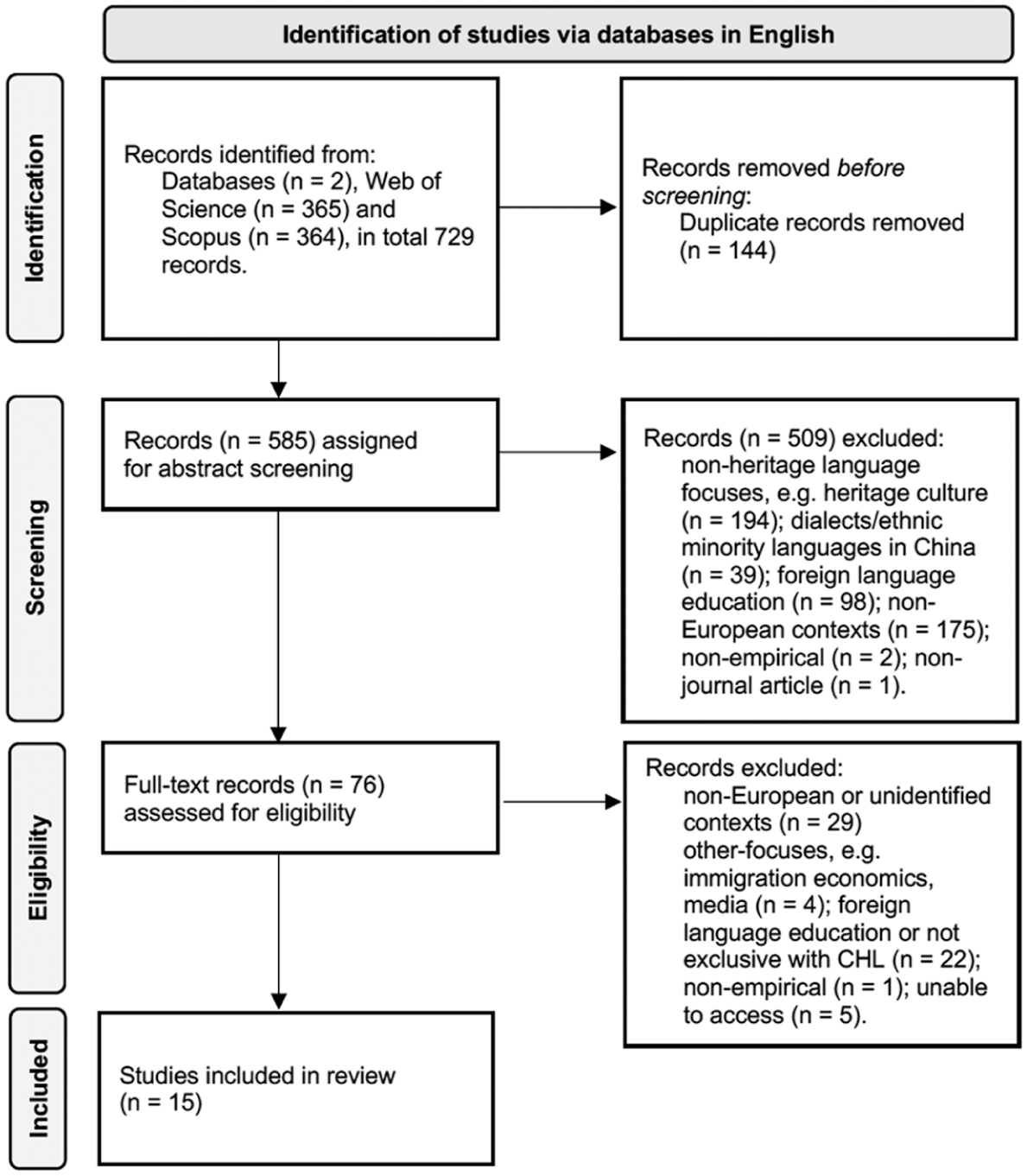
PRISMA flowchart in English databases.
Following the same process applied to English databases, Figure 2 illustrates the four stages for record search and selection in a Chinese database (i.e. CNKI). The first author applied “中文” OR “汉语” OR “华文” OR “华语” (Fuzz search) AND “欧洲(Europe)” (Fuzz search; in Title, Abstract and Keywords) to search on CNKI (date: May 17, 2024). The selected Chinese words or collocations (i.e. “中文,” “汉语,” “华文” and “华语”) for “OR” have contained the meanings of “Chinese” and as a “heritage language” and “mother tongue” according to the lexical variation in the Chinese language, so that we did not add “继承语/母语(heritage language/mother tongue)” in the initial phase of search while paying attention to screening abstracts. We selected the published years ranging from 2004 to 2024 and the relevant subject areas (as provided by the database system), encompassing “Chinese Language and Letter,” “Foreign Language and Letter,” “Culture,” and “Education Theory and Education Management.” To align with the quality standards of peer-reviewed articles in the English databases, we selected the category of journals including “Peking University Core Journal of China” and “Chinese Social Sciences Citation Index - CSSCI.” This search yielded 190 records assigned for abstract screening, and then 7 records were left. To check the eligibility of selected studies, two authors manually accessed the full texts, and finally, 2 peer-reviewed journal articles met the inclusion criteria for data analysis.
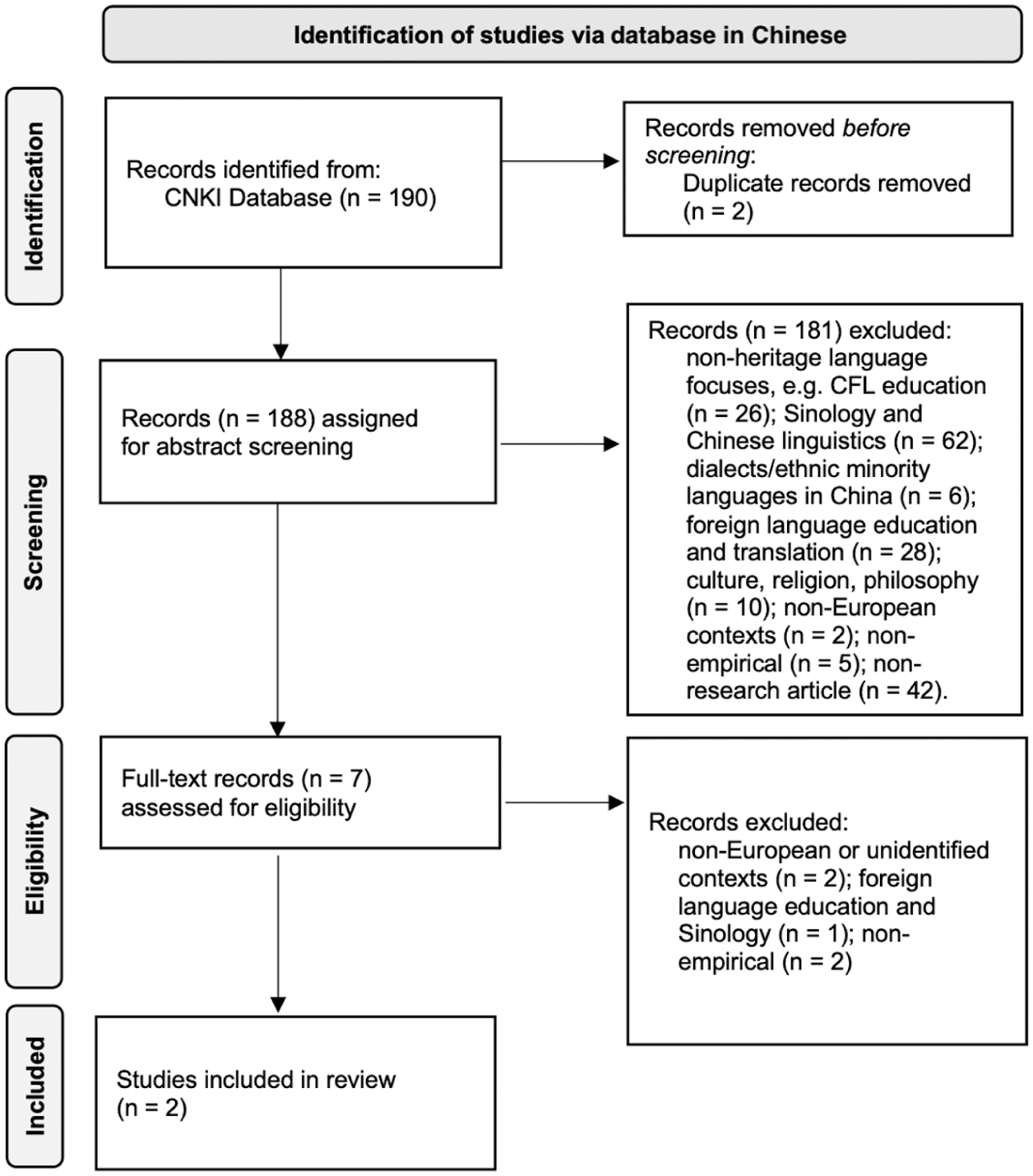
PRISMA flowchart in Chinese database.
Data analysis
This study approaches 17 empirical research articles through meta-synthesis. Based on our impression of the articles after skimming, most of them adopted a qualitative research paradigm with a few mixed-methods studies and only one quantitative study. Given the nature of the literature dataset, the meta-synthesis approach is effective in synthesising qualitative studies on a topic to “locate key themes, concepts, or theories that provide novel or more powerful explanations” for reviewing research trends on CHL in Europe (Siddaway et al., 2019: 756; Thorne et al., 2004). At the same time, we combine meta-synthesis with a quantitative feature from the meta-analysis to capture the critical statistical implications that emerged from our data analysis (Siddaway et al., 2019). Having familiarised ourselves with the dataset, we re-read full-text articles with our research questions. We recorded vital information such as research aims, contexts, participants, methods, and results, along with our observations and reflections, in an Excel sheet. Then, these initial findings were compared and discussed between authors. Finally, both authors agreed on and concluded the key themes and sub-themes for presenting the findings.
Results
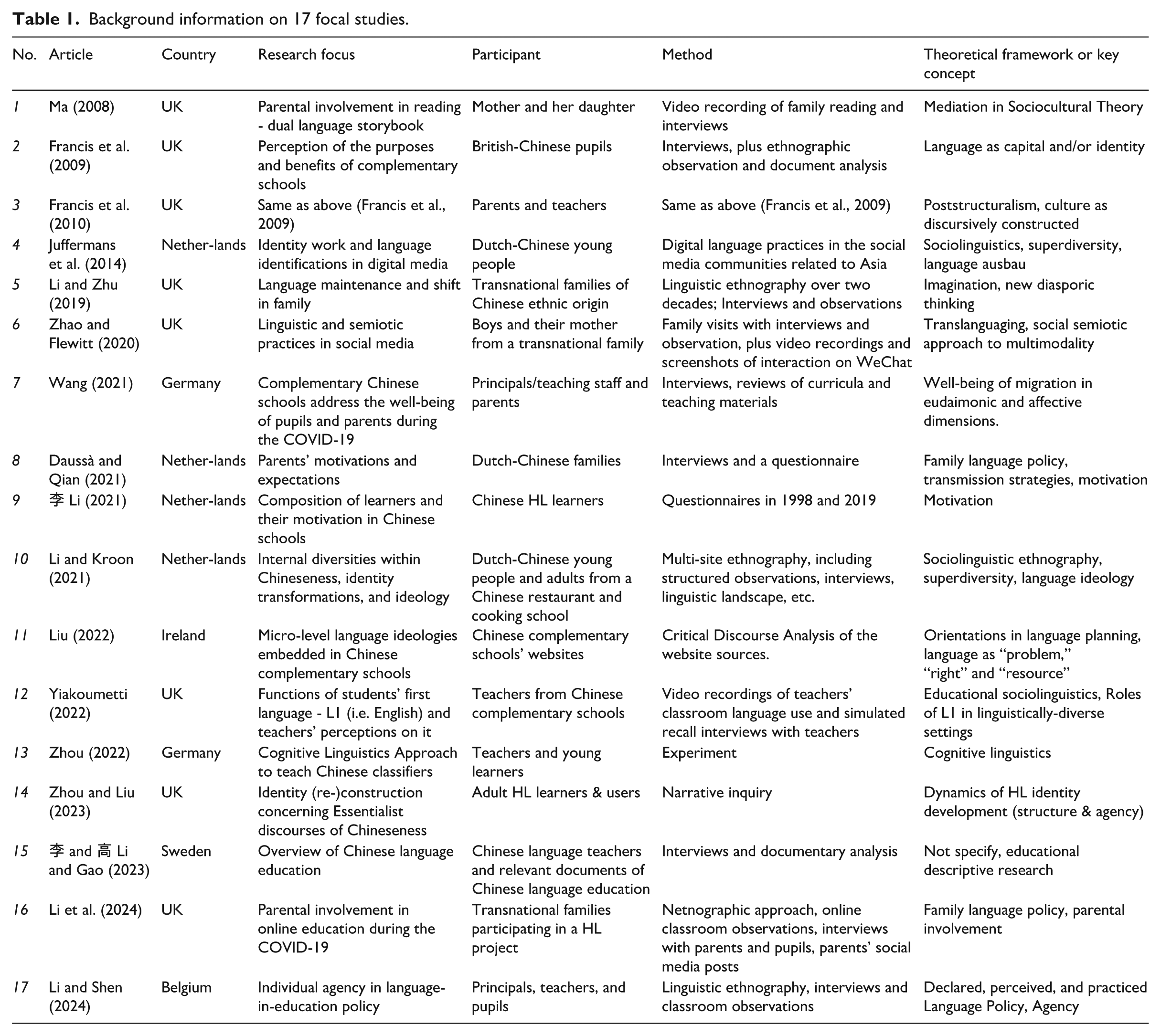
This study aims to explore the reported experiences of CHL stakeholders in Europe through a systematic review. This section addresses the two research questions (RQs) related to the research landscape and tendencies that emerged from the focal publications. Table 1 provides background information on 17 empirical research articles included in this study.
Background information on 17 focal studies.
RQ1: Mapping out the research landscape with descriptive components
With respect to the geographical location of study, 9 of 17 were conducted in English-speaking countries (8 in the UK and 1 in Ireland), followed by the Netherlands (n = 4), Germany (n = 2), Sweden (n = 1), and Belgium (n = 1). Within these countries, only Belgium is an officially bilingual country (French and Dutch), while others are monolingual countries at the national level. In terms of study settings and participants, a wide range of CHL stakeholders (i.e. young to adult learners, parents, teachers, and principals) were involved; however, little research reached out to non-Chinese local parties, such as public schools and municipality services for education.
The research focuses on three domains: home/informal education, Chinese schools/formal education, and self-formation of learners. These domains interconnect with each other rather than being separated, suggesting that CHL learning requires joint efforts from various parties. Specifically, the domain of home/informal education includes bilingual story-reading between mother and child (Ma, 2008), family language planning and policy (Daussà and Qian, 2021; Li and Zhu, 2019), social media interaction (Zhao and Flewitt, 2020), and parental involvement in online learning (Li et al., 2024). Regarding the domain of Chinese language schools/formal education, the topics cover stakeholders’ perceptions and expectations (Francis et al., 2009, 2010; Li, 2021; Li et al., 2024 ), pedagogical practices (Li and Shen, 2024; Yiakoumetti, 2022; Zhou, 2022), and courses provision and promotion by the schools (Li and Gao, 2023; Liu, 2022; Wang, 2021). The third domain comprises the hybrid identity reconstruction of CHL adolescents (Jufferman et al., 2014; Li and Kroon, 2021) and adults (Zhou and Liu, 2023).
Turning to the theoretical frameworks and key concepts, we found that the majority of studies employed poststructuralism-impacted perspectives, especially theories and concepts derived from sociolinguistics, such as mediation (Ma, 2008), identity and agency (Francis et al., 2009, 2010; Zhou and Liu, 2023), superdiversity (Li and Kroon, 2021), roles of different languages and translanguaging (Yiakoumetti, 2022; Zhao and Flewitt, 2020), imagination (Li and Zhu, 2019) and family language policy (Liu, 2022). Other research lines explore well-being (Wang, 2021) and the pedagogical approach of cognitive linguistics (Zhou, 2022). Informed by these theoretical trends, ethnographic methods (qualitative and mixed methods) are prevalent among focal studies, including interviews, observations of family interaction and classrooms, (digital) documents, etc. Other methods evident in these studies are questionnaire surveys with a 10-year interval (Li, 2021) and classroom experiments (Zhou, 2022). Intriguingly, we observed two notable trends in research methods: longitudinal research – over 10–20 years of studies (e.g. Li, 2021; Li and Zhu, 2019) – and digital discourses such as social media communities and school websites (e.g. Juffermans et al., 2014; Liu, 2022; Zhao and Flewitt, 2020).
RQ2: Emerging tendencies from the reported experiences of CHL stakeholders
The following part delves into the findings, results, and implications of these empirical studies, identifying key tendencies that have emerged from CHL stakeholders’ experiences in Europe.
Pull and push factors in HL matinenance: Affinity, future, and integration
A key theme identified in the literature dataset is related to pull and push factors in HL maintenance. In the UK, Francis et al. (2009, 2010) investigated the HL stakeholders’ perceptions of the purposes and benefits of Chinese complementary schools. Internal factors, such as intergenerational communication and socialisation with family/friends living in Chinese-speaking regions, profoundly motivated pupils and parents to learn and maintain HL (Francis et al., 2009, 2010). These pull factors are further supported by later studies in the UK (Li and Zhu, 2019; Wang, 2021), the Netherlands (Daussà and Qian, 2021; Li, 2021) and other contexts. In other words, Chinese is a crucial language link in sustaining affinity among family members, especially between grandparents and children. Wang’s (2021) questionnaire survey showed that Dutch-Chinese students (over 19 years old) perceived media and entertainment products in Chinese as a top reason over parental expectations for keeping them learning Chinese. A similar finding can be found in Francis et al. (2009), which suggests that the pop cultural products in Cantonese sparked British-Chinese pupils’ interest in learning Cantonese (their home language). Other reported internal factors include the perpetuation of Chinese culture, heritage cultural identity and community-building, and teaching Christianity (e.g. Francis et al., 2009, 2010; Li and Zhu, 2019; Wang, 2021). We will further discuss issues associated with identity and culture in the third theme.
Instrumental use of Chinese or future-oriented ideology is another pivotal factor driving migrant parents, young people and educators in Chinese schools to learn HL. Due to the recent economic growth of China, HL stakeholders perceived the Chinese language as an ethnic capital; this capital is more likely to transform into economic capital, creating potential employment in industries related to Chinese markets and in Chinese-speaking regions, such as Hong Kong, Singapore, and China’s mainland (Daussà and Qian, 2021; Francis et al., 2009, 2010; Li, 2021). In particular, Francis et al. (2009) pointed out that middle-class parents have a more positive attitude towards the instrumental values of the Chinese than their working-class counterparts in the UK. This tendency – highly educated or affluent migration groups’ positive belief in maintaining Chinese - has been explicitly mentioned in recent studies, such as in the Netherlands (Li, 2021) and Sweden (Li and Gao, 2023). Additionally, these studies also suggest that adult stakeholders have considered the Chinese language as an additional credential, contributing to HL learners’ school performance, since Chinese, either as a Heritage Language or a Foreign Language, is recognised as a selective subject (e.g. GCSE in the UK) by local educational authorities (Francis et al., 2010; Liu, 2022). For example, Liu (2022) revealed that Chinese complementary schools in Ireland have commodified their Chinese courses to sustain HL learners and attract FL (Foreign Language) learners. This commodification trend implies that these Chinese schools underscore the instrumental use of Chinese to promote multiculturality in line with the Irish “Languages Connect” strategy for Foreign Languages in education (Liu, 2022: 320).
On the other hand, language shift or loss of HL is not uncommonly observed in the literature dataset. The push factors that demotivate HL learners and parents vary depending on their immigration trajectories and personal histories. As many studies show, parental expectations and strategies play a vital role in maintaining children’s HL. The migrant parents, who demonstrated a strong desire to integrate into local society or pictured their children with limited connection with Chinese communities in the future, have tended to place less priority on learning Chinese HL (e.g. Daussà and Qian, 2021; Francis et al., 2010; Li and Zhu, 2019). Li and Zhu (2019) interviewed and followed up with 13 British-Chinese families (and 18 individual members after 10 years) to map out their language maintenance and shift. For the type of language shift family, the demotivated reasons include children’s friendship ties in local communities, children’s lack of interest in engaging in Chinese as an extracurricular activity, and parents’ desire to secure their subsequent generation’s access to a better life in the UK through excelling in English (Li and Zhu, 2019). This finding is also evident in Daussà and Qian’s (2021) study on parents’ beliefs in learning HL in the Netherlands. They added that Dutch is dominant in children’s school and social discourses except for intergenerational communications, and most migration families were highly multilingual according to their language composition survey (Daussà and Qian, 2021). In comparison with other foreign languages (i.e. English at least learned at School plus German, French, etc., based on educational track), some parents thought Chinese was squeezed out of the Dutch mainstream educational system, making them struggle to maintain Chinese HL without sufficient official support (Daussà and Qian, 2021). At the same time, Li and Zhu (2019) argued that language shift is not a single linear process, and significant events in a family can have consequential impacts on family strategies regarding the relationship between HL and dominant languages.
Schools, home and beyond: Multilingual and multimodal practices in learning and socialisation
Another key theme concerns language practices across various contexts, including classrooms, home, and social media. A recurrent observation in the literature dataset is that multilingual and multimodal practices are ubiquitous, regardless of schooling or socialisation. In classroom settings, Yiakoumetti (2022) examined the functions of students’ first language - L1 (i.e. English) in HL teaching at two UK Chinese complementary schools. Analysing classroom observations and simulated recalled interviews with four HL teachers, Yiakoumetti (2022) found that the teachers naturally and systematically utilised English to facilitate students’ HL learning, such as explaining new vocabulary and linguistic concepts, classroom management, and building rapport. Although the teachers admitted the positive role of students’ L1 in CHL teaching, they seemed uncertain about how to appropriately use students’ L1, as they often reported ill feelings concerning their linguistic behaviours and self-doubt when dealing with parents’ views against treating their children as learners of a foreign language (Yiakoumetti, 2022). To relieve these concerns, the study suggested that sociolinguistics-informed teacher training should equip teachers with pedagogical theories and techniques to celebrate linguistic diversity embedded in HL students’ language habits and raise their cross-linguistic awareness (Yiakoumetti, 2022). Likewise, Li and Shen (2024) investigated how different-level stakeholders exercise their agency to navigate declared-, perceived-, and practised-language policies in two Chinese community language schools in Brussels, Belgium. The linguistic landscape of Brussels is rather complex because of the dual official languages - French and Dutch. The interviews with principals, teachers, and students show that different stakeholders demonstrated diverse perceptions of language policies, shifting from monolingual (principals) to translingual orientations (teachers and students). Unlike a shared linguistic repertoire between teachers and students in the UK, this study highlights a mismatch in language proficiency between teachers and students (Li and Shen, 2024). For instance, most of the teachers had a good command of English, while their proficiency in French was mixed with a minimal level of Dutch; for students, senior graders were proficient in English, while younger learners’ linguistic repertoires were determined by the instrumental language of their mainstream schooling, usually French or/and Dutch (Li and Shen, 2024). Such a heterogeneous linguistic community challenges the traditional monolingual pedagogy. It encourages teachers and students to deploy their full linguistic and multimodal repertoires to bridge mismatched linguistic resources to facilitate Chinese HL learning (Li and Shen, 2024).
Apart from the sociolinguistic-impacted perspective, Zhou (2022) piloted an experimental study adopting a cognitive linguistic approach (i.e. image-schema) to teach Chinese classifiers at a Chinese complementary school in Germany. Comparing the HL learners’ performances between the control (traditional method via rote memorisation) and the treatment groups, the study did not find that learners in the treatment group outperformed their counterparts in the control group (Zhou, 2022). He suggested that further research can recruit large numbers of participants and implement more extended instructions to assess the efficiency of cognitive linguistic pedagogy as it demonstrates how native speakers view and use target languages (Zhou, 2022). Additionally, he (2022) added that it is worth considering social factors amongst students as their daily linguistic exposures and family language attitudes can affect their performances in HL learning, which resonates with the stance from sociolinguistics.
When it comes to home context, translingual practices in family prevail in various ways (e.g. Daussà and Qian, 2021; Li and Zhu, 2019; Ma, 2008; Zhao and Flewitt, 2020). Analysing video recordings of mother-child interaction in reading bilingual storybooks, Ma (2008) suggested that English-Chinese storytelling is mutually beneficial to enhance the mother’s literacy in ESL (English as a Second Language) and the child’s learning of Chinese as a heritage language and cultural elements. This study advocated the potential of parenting in dual-language learning since mainstream schooling was predominantly monolingual instruction (Ma, 2008). More recently, research on non-educational practice has expanded to digital media channels, diversifying communicational modalities. Zhao and Flewitt (2020) observed the interaction between a mother, her boys, and her friends on WeChat (a popular chat App like WhatsApp). The ethnographic dataset indicates the polyadic nature of interactions, in which two boys, especially the older brother, primarily utilised image-based modes like cute stickers to express interpersonal meanings in their mother’s online chat group with Chinese encounters (Zhao and Flewitt, 2020). The interviews with the mother and family visits indicate that digital social media and apps not only extend the communicativemodalities of HL learners’ repertoires but also engage them in home learning activities, like practising Pinyin input (a Chinese typing system) by observing the mother’s typing behaviours on mobile devices (Zhao and Flewitt, 2020).
Furthermore, online and virtual spaces blur the boundaries between HL schooling and home learning as many CHL courses were delivered remotely during the COVID-19 outbreak. For example, Li et al. (2024) examined parental involvement in an online research-based CHL learning project launched in the UK during the pandemic. This netnographic case categorises four major roles of parents in supporting their children’s online learning at home, i.e. “emotional supporters, co-educators, teaching assistants, and technical supporters” (Li et al., 2024: 241). Consistent with the prior findings regarding parental belief in HL learning, the parent participants demonstrated a solid responsibility to maintain children’s ethnic connection to their home countries; therefore, they actively engaged in online support, even designing learning activities and materials tailored to their children’s interests (Li et al., 2024). These ethnic community-based learning practices are likewise evident in other countries. For instance, Li and Gao (2023) elaborated on the educational pattern of HL in Sweden, namely “HL courses organised by local governments + Chinese community language schools + Chinese ethnic family education” (p. 60). These three parties co-contribute to promoting HL education for migrant children/pupils. In Germany, Chinese complementary schools not only sustained Chinese HL courses but also offered math, science and sport-related courses via online platforms during the pandemic lockdown and summer holidays (Wang, 2021). These extra efforts by Chinese schools helped to maintain migrant children’s learning rhythm against the temporary shutdown of mainstream schools and relieve parents’ pressures in balancing work and household duties, building rapport within their ethnic diaspora (Wang, 2021). Since HL learning occurs not only in educational settings like classrooms but also at home with parental guidance and support, the following theme focuses on how HL learners as individuals navigate themselves in these ethnic community-based learning environments created by adult stakeholders and how HL learners (re-)construct their identities related to Chinese ethnicity and their countries of residence.
Identity negotiation and construction: Essentialised, dynamics, and continuum
Regarding identity negotiation and construction of HL learners, a frequently observed argument is associated with the essentialist discourses about Chineseness and hybrid complexities within learners’ personal trajectories. The studies (e.g. Francis et al., 2010; Li and Gao, 2023; Li and Shen, 2024) from adult HL stakeholders’ perspectives suggest that Chinese complementary schools and ethnic communities highlight their crucial responsibilities to reproduce and pass authentic Chinese morals, values and cultural customs to the next generation. Besides the instrumental purpose, the rationale for this heritage cultural circulation was that parents treasured the ethnic morals and values as cultural essence against racism from Western-dominated societies (Francis et al., 2010). Additionally, it is frequently observed that migrant children and young people were expected to perform their Chineseness (e.g. speaking fluent Chinese, celebrating traditional festivals, and playing Chinese musical instruments) by others or mainstream encounters (Francis et al., 2010; Li and Kroon, 2021; Zhou and Liu, 2023). Hence, ethnic community-based educational activities and socialisation provide opportunities and conditions to instil the essentialised Chinese values, morals and cultural customs in HL learners’ childhood (Francis et al., 2010).
When closely examining the essentialist perceptions of “Chineseness,” scholars discover that HL learners exercise their agency to negotiate and challenge the discourse of Chineseness and, in turn, they transform and fashion themselves in dynamic ways (e.g. Juffermans et al., 2014; Li and Kroon, 2021; Zhou and Liu, 2023). In the Netherlands, Jufferman et al. (2014) analysed Dutch-Chinese youths’ digital language practices in three social media communities. This study found that Dutch-Chinese youth performed their heritage identity by engaging in online forums related to news and leisure activities in Chinese-speaking regions. For example, they followed the news about promoting Mandarin in Canton province, which provoked dissent among those youths, especially those whose family members use Cantonese daily in the Netherlands (Juffermans et al., 2014). This finding resonates with the prior academic discussion on the relationship between Mandarin and other Chinese variations/dialects (Duff and Doherty, 2019; Jiang and Troyan, 2024). As the early Chinese migration to Europe was from southern China (e.g. Cantonese-, Hokkien-, and Hakka-speaking areas), their descendants used these southern Chinese variations as their mother tongue at home. Due to the change in the composition of Chinese migration and the proactive strategies of promoting Mandarin in China’s mainland since the 2000s, Mandarin has gradually overtaken other Chinese varieties as a prominent representative of the Chinese language. The immigrant youth’s discussion about the top-down promotion of Mandarin in Canton province reflects their resistance to the centralised conception of spoken Chinese as their HL repertoires might not necessarily assimilate with people living in China’s mainland (Juffermans et al., 2014).
Moreover, Juffermans et al. (2014) noted that the Dutch-Chinese youths displayed a self-critical stance towards their Chinese proficiency and translingual practices, as they confessed their imbalance between oral and written proficiencies in Chinese and would never achieve full proficiency as Chinese native speakers. Additionally, their study reported that Dutch was the predominant language shown in online forums, accompanied by a little English and emojis, and very few Chinese popped up in ad hoc Roman transliterations (Juffermans et al., 2014). These translingual practices amongst the young generation mirrored the dynamics and hybridity of their identity making (Juffermans et al., 2014). Likewise, another study (Li and Kroon, 2021) in the Netherlands further supports the dynamics and hybridity in Chinese migrant youths’ identity making. Drawing on interviews with Chinese ethnic youths, Li and Kroon (2021) observed that young people of Chinese heritage navigate themselves in discourse about Chineseness and Dutchness, even moving to Internationalness by deploying their linguistic and communicative resources. For instance, a Dutch-Chinese girl who played the Pipa (a Chinese musical instrument) was positioned as Chineseness by a Dutch reporter in a broadcasting interview. The girl resisted performing as pure Chinese but fashioned herself as Dutch and Chinese simultaneously by explicitly mentioning her piano and Pipa talents (Li and Kroon, 2021). To better understand those young people’s agency in self-identification, Li and Kroon (2021) suggest the usefulness of “superdivserity” (Blommaert, 2010) to “revisit, deconstruct and reinvent many of our established assumptions about language, identity, ethnicity, culture, and communication” (p. 156).
More recently, Zhou and Liu (2023) proposed a model to theorise the dynamics of HL identity development. Through examining life history accounts of three CHL adults, they suggested that “HL identities should be understood on a historical continuum” (Zhou and Liu, 2023: 396). Specifically, the three reported narrative cases presented that adult HL learners’ agency to negotiate with essentialist discourse about Chineseness (e.g. model minority and authentic Chinese) that had been imposed in their childhood. Similar to Li and Zhu’s (2019) research on British-Chinese family members, this study acknowledges the significant family events or personal trajectories (e.g. employment in a Chinese supermarket, socialisation with Chinese international students at university, volunteering at the Chinese community centre) transformed CHL learners perceptions; and more or less, they felt self-motivated or empowered to re-position themselves as competent HL learners and legitimate members of the Chinese diasporic community (Zhou and Liu, 2023). To conclude their narrative inquiry, Zhou and Liu (2023) provided a theoretical model that comprehensively describes the dynamics of HL identity development between structure and agency through historical, relational, and spatial lenses.
Discussion and conclusion
The current review investigates the reported experiences of CHL stakeholders (e.g. teachers, learners, and parents) in European contexts in English and Chinese publications. Adhering to systematic review procedures, the authors identified 17 empirical research articles to process literature synthesis. The initial review of study backgrounds shows that the quantity of publications has significantly increased in recent years, indicating a growing attention to CHL learners in Europe. Geographically speaking, it is not surprising that nearly half of the focal studies were in English-speaking countries, esp. the UK. At the same time, this review has identified a certain number of studies carried out in the European continent. Although the focal contexts of those studies largely spread across Western and Northern Europe, this review significantly enriches the reported geographical diversity in prior review synthesis (e.g. Jiang and Troyan, 2024; Lin, 2021). Regarding the theoretical framework, key concepts, and research methods, sociolinguistics-impacted perspectives and ethnographic approaches are prevalently adopted in English publications. In contrast, publications in Chinese tend to describe general trends and patterns via quantitative and mixed methods. This finding indicates that different epistemological and methodological orientations to CHL learning between European and Chinese scholarly conventions.
Furthermore, the current review synthesises three significant tendencies that emerged from reported experiences of CHL stakeholders in Europe. These tendencies facilitate understanding of potentials and challenges among Chinese HL stakeholders in Europe. This review finds generally positive beliefs in Chinese HL and cultural elements amongst HL stakeholders in Europe. Their pull and push factors for maintaining CHL resemble the prior findings in other geographical areas, such as intergenerational communication, preservation of heritage cultural essences, and potential employment opportunities (e.g. Duff and Doherty, 2019; Zhu and Zhou, 2017). This review also echoes the emerging migration composition of the Chinese migration in Europe, supporting that parents with highly educated and affluent backgrounds are more likely to acknowledge the value of Chinese as an ethnic capital for their children’s potential employment (Francis et al., 2010; Thunø and Li, 2020). Also, the influence of cultural media products in the Chinese language started to motivate young people of Chinese heritage to learn the language (Li, 2021). This growing tendency conveys a message that the recent spread of cultural media products in Chinese has the potential to facilitate HL learners’ engagement in Chinese-medium activities beyond traditional settings, such as classrooms and intergenerational conversations. Further research could usefully investigate pedagogical uses and impacts of Chinese popular culture and social media in supporting CHL learning.
The present review observes that translingual practices of HL stakeholders are commonly reported in European contexts. Poststructuralist-impacted concepts, such as superdiversity and translanguaging, were suggested to be useful in understanding HL learners’ language practices and facilitating their language learning since the social spaces nowadays become increasingly trans-national, -language, and -modal (e.g. Li and Kroon, 2021; Zhao and Flewitt, 2020). In addition, we should be aware that HL teachers and learners in the European continent might face a mismatch in their linguistic repertoires. Unlike their counterparts in English-speaking countries, CHL teachers in the European continent may not reach sufficient proficiency in local languages, such as Dutch and Swedish (Li and Shen, 2024; Li and Gao, 2023). That challenge highlights the need for future research and practical inquiry into how HL teachers can bridge the mismatch of linguistic repertoires and effectively facilitate HL learning in multilingual environments.
Existing research underscores another challenge faced by HL stakeholders: a shortfall of collaboration between families/ethnic communities, Chinese community language schools, and local educational authorities/mainstream schools. The current review indicates that HL teaching and learning responsibility has fallen on families/communities and Chinese language schools in Europe. Except that the Swedish government offers mother-tongue courses (Li and Gao, 2023), local educational authorities in other European contexts tend to be passively involved in HL education. Insufficient social and official support from mainstream societies has marginalised HL teachers, parents and learners, discouraging them, especially young learners, from maintaining and valuing their heritage language. Meanwhile, the current review finds that growing research attention is being given to digital learning modes during and after the pandemic. This learning mode has significantly maintained and even extended the HL teaching and learning space. For example, existing research on tech-assisted HL learning projects suggests that these virtual modes are helpful to strengthen the parent-teacher partnership, provide more access to learning resources, and diversify interactional channels for HL learners (e.g. Li et al., 2024; Wang, 2021). Future research and practical inquiry will be useful in exploring how to advance and utilise digital technology to improve collaboration between stakeholders to support HL learning.
Moreover, another implication arising from the current review is to conduct longitudinal research to gain a comprehensive understanding of HL learners’ identity making. As revealed in prior research, the identity development of HL learners is a dynamic process that depends on their life trajectories (e.g. Li and Zhu, 2019; Zhou and Liu, 2023). Additionally, the young generation with immigration backgrounds has demonstrated their agency in negotiating the essentialist discourses of national-ness and fashioning their multiple yet hybrid identities by utilising their full linguistic and semiotic resources. Studying HL learners’ discourses in various settings, such as classrooms, home and social media, can help researchers, educators, and parents understand the dynamics in young people’s identity making, better engaging and empowering those young people in HL learning.
Finally, no method is flawless. Since many of the extracted literature records were from mainstream academic English databases, we acknowledge the Anglophone-centric character of this review as a methodological limitation. As the screening result shows that more than half of the focal studies were conducted in English-speaking countries in Europe, this review may run a risk of unintentionally neglecting the academic voices from literature published in other languages. Given the historically linguistic complexity and growing linguistic diversity of the European continent, further study would be fruitful to incorporate multilingual literature databases through collaboration between scholars with different language backgrounds, especially from Southern and Eastern Europe, and to widen the scope of publication types to enhance the current understanding of HL in Europe.
Footnotes
Acknowledgements
We would like to thank the reviewers, journal editors and guest editors for their constructive feedback on this manuscript.
Declaration of conflicting interests
The authors declared no potential conflicts of interest with respect to the research, authorship, and/or publication of this article.
Funding
The authors received no financial support for the research, authorship, and/or publication of this article.
