




Abstract
Global events such as Covid-19, the climate crisis, social injustice, and armed conflict pose challenges for European societies, making people’s lives uncertain and their future threatening. Education needs to find mindful ways to respond to such crises. The sector is perceived as offering stability in times of uncertainty and despair. Drawing on international frameworks, including the Convention on the Rights of the Child and the World Declaration on Education for All, the paper explores the critical role of education in peacebuilding and the importance of integrating peace education into educational response to crisis. Peace education is defined as an ongoing and active process of collaboration and partnering of actors within educational institutions for building better futures. It offers an anticipatory model of education that involve students and staff to envision and co-create peaceful futures. Using participatory visual methodology, the study engaged students from a Ukrainian university to imagine the education of future, as a departure point for studying and accommodating their needs, enabling them to take something more from the despair and uncertainty of the circumstances around them, and find hope and the strength to effect change, envision alternative futures and collectively pursue them.
Keywords
Introduction
Over recent years, a series of crises, including the economic crises of 2008, the fallout from Brexit, the global pandemic, and various war-related conflicts, as well as the ongoing climate crisis, have led us to perceive that we live in an era of permanent crisis and perpetual instability. It is not possible to say for sure what the next crisis will be – another pandemic, economic downturn, the cost of living, or a new wave of escalating armed conflicts. Crises will continue to make people’s lives uncertain and their futures threatening. In the context of various interlocking crises, education plays a central role in both responding to crises and proactively shaping a more stable and resilient future. Education serves as a safeguard for preserving societal values and as a mechanism for equipping individuals with the adaptability and skills necessary to navigate an unpredictable world (Osberg, 2017).
Currently, there is much concern in Europe about the intensification of the economic, political and social crisis caused by the Russian-Ukrainian war, and threats to peace. The far-reaching disruptions caused by armed conflict necessitate the prioritising of students’ well-being over the testing of knowledge (Lavrysh et al., 2025), and of the values of tolerance, peaceful conflict resolution and prevention over traditional metrics of academic performance; they also magnify the relationality of education. In the context of ongoing instability and uncertainty, it is crucial to shift the focus to fostering relational dynamics between the students and staff of educational institutions to address their immediate and long-term needs. Responsive staff-student relationships are fundamental for building dialogue to tease out some of the key challenges that students and educators can face (Hall et al., 2022). In this light, peace education contributes to understanding the intrinsic importance of the relational nature of education to mitigate crises.
Peace education emerges as a foundational framework through which education can respond meaningfully to crisis. Peace education is an ongoing and active process of discussing the challenges resulting from the instability of the world (Lum, 2013). It is grounded in the principles of human rights and is a tool for building preferred futures, enabling individuals to envision, design, and actively work towards more just and peaceful society. In this way, peace education fosters agency and hope that are essential for education systems seeking to respond meaningfully to crisis and uncertainty.
This paper explores how staff-student collaboration in higher education can enhance the effectiveness of crisis mitigation, particularly in the context of war. It examines the ways to make education more flexible in order to better accommodate staff and students’ needs during times of crisis. As a lecturer at the Ukrainian university during the onset of the war, I saw firsthand how important it was to provide support for students and staff, and to promote the role of education in building resilience and hope. This experience has shaped the design and the purpose of this paper. By sharing this research, I aim to contribute to the international discussions on how education can be reimagined to address the profound uncertainties of our time.
This research project invited students to imagine the future of education, using this as a starting point to study their needs and engage in genuine dialogue. Such imagining promotes reflection on what education might look like and enables assessment of students’ current needs. As the participants of the research were students from a Ukrainian university who were directly affected by war and crisis, the futures they anticipated were anchored in the present in which they are situated, which is uncertain, life-threatening and disruptive to education. In this educational institution, located in the east of Ukraine, teaching and learning have been forced to transition completely to distance learning; they were complicated by the displacement of students and teachers and by restricted access to the infrastructure of educational institutions, and to digital infrastructure, during missile attacks and blackouts. These challenges frequently interrupted educational processes and reduced access to quality education, increasing students’ vulnerability and uncertainty about their future.
The analysis presented in this paper considers how students’ visions of future education reflect an urgent demand for well-being, safety, inclusive learning spaces, and meaningful engagement. These themes are situated within a broader theoretical framework grounded in human rights and peace education and examined through the lens of future-orientated education. The paper begins by reviewing relevant literature, before introducing the methodology and empirical findings. It concludes by reflecting on how insights from students’ imagined futures can inform more ethical, responsive, and human-centred approaches to education in times of crisis.
Education as a stabilising factor in times of uncertainty
Peace education and human rights
A foundational aspect of education in addressing and responding to crises is understanding and recognising the right to education, which is often violated in emergency situations. The Convention on the Rights of the Child (UNESCO, 1989) and the World Declaration on Education for All (UNESCO, 1990) set out clearly the right to education and are complemented by the General Assembly Resolution on the Right to Education in Emergency Situations (United Nations, 2010). According to the Convention on the Rights of the Child (UNESCO, 1989), education is a fundamental human right and an indispensable basis for the achievement of other human rights. The Convention (1989) requires states to make primary education compulsory and available free to all, secondary education available and accessible to every child, and higher education accessible to all on the basis on individual capacity. Article 29 of the Convention (1989) declares that education should be directed to the development of the child’s personality, talents and abilities to their fullest potential. If people are empowered to exercise this right, they will be able to make significant changes in their standard of living and contribute to the advancements of their communities.
The World Declaration on Education for All (UNESCO, 1990) declares that education is a basic right and quality education is a human right. Only by giving people access to quality education it is possible to understand and safeguard human rights. The right to education is not suspended during emergency periods and it is governments’ obligation to ensure that quality education is available to all citizens during times of crisis (United Nations, 2010). The General Assembly Resolution (United Nations, 2010) recognises the capacity of quality education to “mitigate the psychosocial impact of armed conflicts and natural disasters by providing a sense of normalcy, stability, structure and hope for the future” (p. 2).
Although these international documents establish education as a right, ensuring its realisation during armed conflicts is complicated by the violent character and long-lasting nature of such conflicts, and by the limited capacity of states to support educational institutions and populations affected by conflicts (Reimers and Chung, 2010; Tomaševski, 2001). There are a number of examples from different countries and times of the impact of armed conflicts on education: they destroy its critical infrastructure, deplete valuable resources, create obstacles to educational achievement and significantly reduce access to quality education. The Iraq war, for instance, led to the destruction and looting of about 84% of higher educational institutions. During the conflict in Syria, educational institutions were used as evacuation centres or military targets while students and academic staff were forced to flee to neighbouring countries (Saeed and Blessinger, 2022). In Ukraine, too, the education system has been significantly damaged and disrupted. According to data published by the Institute of Analytics and Advocacy, 3793 educational institutions were bombarded or shelled and 365 were destroyed (Education in Emergency, 2023). Educational institutions from the eastern and southern parts of the country have been relocated to safer regions (Ministry of Education and Science of Ukraine, no date) in order to be able to deliver their services to students.
Depending on how it is approached, education can function in different ways in its response to crisis. A short-term approach focuses on the immediate restoration of education and measures its effect in quantitative terms, such as the number of students engaged in primary, secondary or higher education or the number of educational institutions that have reopened. We can see this in numerous national reports from the countries involved in armed conflicts (e.g. The Education in Emergency project in Ukraine (no date); the Final Report of the Ministry of Education and Science of Ukraine: Assessing the Needs of Ukraine in Educational Sphere (2022)); and the reports of international organisations, for example, “Hidden Crisis: Armed conflict and Education” (UNESCO, 2011). However, having access to secondary, vocational or higher education does not necessarily equate to the delivery of the right to education. To effectively counteract crises, education should adopt a long-term approach that goes beyond numerical indicators and emphasises the transformative power of education in building peace. This aligns with Tomaševski’s (2001) argument that promoting both the right to education (access) and the rights of individuals within education is important, as this empowers students to understand, claim, and protect their rights. Education should therefore continue to focus on human rights as a means to promote peace education. Human rights education emphasises the value of peace over violence and promotes the identification of non-violent forms of conflict resolution (Reimers and Chung, 2010).
The transition from the right to education to the peace education is crucial in understanding how education contributes to developing mechanisms to counteract crises and build societal peace more broadly. Peace education is not a new concept, it has a long history and has evolved in different ways in different geopolitical contexts. Therefore, it is important to view peace education from a historical perspective in order to gain a better understanding of the role of education in avoiding conflicts at both individual and state level. Peace building and peace education became the key global concern in the early 20th century. Even though peace education is a common topic of discussion globally, the associated theories and practices vary between countries, who have different understanding of peace resulting from their unique historical experiences. In the Western world, the prevailing belief is that global peace can be achieved through the establishment of strong partnerships between the peoples and nations of the world (Jacobs, 2022). This perspective has led to the creation of numerous international organisations dedicated to promoting cooperation, understanding, and mutual support among nations. These organisations embody the values of democracy, diplomacy and shared responsibility in addressing global challenges – the United Nations were founded to foster international collaboration and prevent conflicts and the creation of the European Union had a primarily peace-building mission, seeing the European region as “whole, free, and at peace” (Polyakova, 2016: 70) and aiming to “make another war in the European region politically unthinkable and materially impossible” (Kushnir, 2025: 5).
By contrast, the model of peace education, adopted by the Eastern Block, was framed through militarisation and ideological loyalty. Soviet educational institutions promoted the concept of “fighting for peace,” which in practice meant preparing students for ideological and military struggles against perceived adversaries (Stonkuviene, 2024). As this paper considers the war in Ukraine, it is worth mentioning that the country, shaped by this Soviet legacy, has historically pursued a non-democratic vision of peace education that equates to military education and obstructs peacebuilding processes. Jacobs (2022), who is currently Chief Executive Officer of the World Academy of Art and Science (WAAS) in the USA, emphasises that developing human resources and changing approaches to education are essential to achieving peace in Ukraine. Ukrainian educators and researchers are convinced that way out for the country is to search for ways to radically modernise the education system and introduce quality education that would enable the education of new intellectuals (Andrushchenko, 2023). These ideas align with the peace formula proposed by Ukrainian President Volodymyr Zelenskyi (Rishko, 2024). According to this formula, education should develop a civilised society as a whole, and civilised individuals in particular, in order to ensure a peaceful future. The principles of this new education, he said, should be peace, unity, global cooperation, solidarity, security, tolerance and freedom.
Taking into account the points outlined above, it is clear peace education emerges as a unique and essential approach that not only contributes to establishing global peace but also plays a crucial role in fostering effective responses to various crises. The partnering of actors within educational institutions and with a range of social groups who have similar goals may increase collaboration on expanding the effectiveness of peace education. It is important that educational institutions work for peace; equally, it is important that peace education does not become siloed into a separate course where participants formally discuss the challenges resulting from the instability of the world. According to Lum (2013: 219), peace education should be an ongoing and active process rather than a theoretical discussion isolated from real-world experiences. It should permeate all the communication processes in education, shaping the principles that guide partnerships between students and staff.
Jenkins (2020) discussion of the role of peace education gives greater emphasis to its role in building preferred futures, more specifically through envisioning, designing and planning. Peace education can encourage people to think about a future that is rooted in their present experience, as well as decide the actions they take in the present on the basis of their desired future. Jenkins (2020) asserts that peace education is a tool for building a just and peaceful future. So whilst being grounded in the past and the present, education is future-oriented.
Future orientation of education
In this part of the paper, I will examine the issue of the future orientation of education and its role in fostering a sense of stability for students in times of crisis. The significance of future-oriented education has been debated in educational research, particularly with regard to its dual responsibility of shaping societal structures and addressing individual students’ needs (Facer, 2019; Osberg, 2017). A substantial body of literature explores how education engages with the future, as both a political project and as a moral endeavour, reflecting broader societal debates about security, adaptation and human flourishing (Facer, 2019; Osberg, 2017).
Scholarly debates revolve around two primary issues of the future orientation of education. First, education takes political responsibility for cultivating the social world that supports collective development and societal resilience. This perspective is often embedded in policy-driven approaches that seek to optimise human capital and align educational outcomes with economic and technological progress (Facer, 2016). This approach is criticised for its optimisation discourse where the relationship between children/young people and the future is defined as adapting and reacting to inevitable events. However, potential actions and responses are predefined by other external “visionaries” (curriculum designers, policy makers, educational theorists and others), rather than students. Second, education has a moral responsibility to nurture individuals, ensuring their well-being and enabling them to realise their unique potential and navigate uncertainty. This perspective, associated with the ethics of care framework (Noddings, 1984; Tronto, 2001), emphasises the importance of paying attention to students’ expressed needs, providing emotional support, and promote relational well-being. However, while this moral responsibility aims to create security and stability, it has been criticised for overlooking broader social and political structures in order to create a better future (Facer, 2016).
These tensions between moral and political responsibilities highlight the ongoing challenge of whether education should prioritise systemic optimisation or individual protection, and whether it should respond to assumed needs, imposed by external stakeholders or to expressed needs, emerging from students themselves. Land and Jarman (1992) suggest that one way of taking responsible action in the face of an uncertain future requires engagement with the needs of an imagined future rather than reaction to predetermined expectations. This requires an approach that moves beyond the dichotomy of optimisation versus protection.
Osberg’s (2017) concept of “symbiotic anticipation” offers a potential resolution by framing education as a means of bringing different futures together. This approach reconciles two responsibilities, making education not only an instrument of change, but also giving it inherent value. It emphasises the dynamic interplay between the past, the present, and imagined futures. Through dialogic engagement, students can participate in shaping their own educational trajectories and develop the capacity for hope and resilience in the face of crisis (Facer, 2019). This approach recognises the relational and co-constructive nature of future-making in education, reinforcing the idea that the future is not predetermined but actively negotiated through educational experiences. This opens new avenues for partnering with students in order to think of future that is being made today. In the empirical part of the paper, I detail how I invited students to participate in imagining an educational future that allows them to explicitly formulate and express their needs.
Methodology
The research presented here is based on a participatory visual methodology (De Lange et al., 2007; Rose, 2001) involving researcher-participant collaboration. For this study, I collaborated with student teachers in their first year of a Master’s Education Programme (n = 6) at Donbas State Pedagogical University in Ukraine. They were invited to draw their imagined future of education. The selection of participants in the research was driven by the aim of engaging with students from the eastern part of Ukraine, who were directly affected by the ongoing war and whose physical safety and psychological well-being are constantly at risk due to their proximity to the front line. Some of the participants were student teachers who had been internally displaced, others had refugee status in other countries, and others still lived in the territories close to the conflict zone. These circumstances led to frequent interruptions in educational processes, making their future extremely uncertain and threatening.
As student teachers, their responses were also shaped by professional aspirations and pedagogical perspectives. Their position as future teachers influenced their vision of education’s future and its role in responding to crisis. Their engagement with the activity reflected not only their personal experiences of crisis, but also their evolving professional identities as they considered the ways to transform education to better support learners and communities in times of uncertainty (Reimers and Chung, 2010).
Crisis situations, or any life-threatening circumstances, have been seen as a “wakeup call to deliberate on alternative education imaginaries” (John et al., 2021: 1). I proceeded on the basis of the rationale that any envisioned future is anchored in the present. This allowed me to analyse the drawings and come to an understanding of the student needs that education had to meet.
Drawings can be understood as texts – systems for exploring, constructing, and communicating meaning. Using drawings as a research method usually involves more than just drawing; it is followed by a short verbal or written interpretation of what has been drawn and what the drawing represents. Drawings are complemented by verbal research methods (Guillemin, 2004) where collaborative meaning-making takes place, and the voices of participants are heard.
There were many reasons for choosing this method, including (1) ease of use as participants only needed a pencil and a sheet of paper; (2) the ability to complete the task online; if participants had bad internet connection and could not use cameras, they could send their drawings in later via any means of communication that was available for them; (3) the active engagement of participants and visible proof of research findings (Guillemin, 2004); (4) drawing is a form of symbolic expression i.e. a way of processing as well as expressing feelings and thoughts, making them clearer and more explicit (Helskog, 2019).
This study links visual methodology with the social constructionist grounded theory developed by Charmaz (2008). This research included the analysis of both visual data (drawings) and narrative data (participants’ explanations). From the perspective of grounded theory, such interpretation inevitably includes the subjective position of both researcher and students, who play a crucial role in the co-construction that is an inevitable part of the research outcome (Charmaz, 2008).
The reliability of the methodology was supported by the students’ own brief interpretations of the drawings and by careful “reading” of the drawings by the researcher, avoiding psychological description and focussing on interpreting drawings through the filter of students’ current needs.
Working with data
All participants gave informed consent. The drawing process and data collection was conducted through video conferences, which were recorded. Drawings were sent to the researcher via email.
When participants (n = 6) had finished their drawings and the researcher had received them, they were numbered, to ensure that interpretation was anonymised but that re-identification would be possible at a later stage. The first stage in processing the data was reading the drawings and recording how the drawings spoke directly to the researcher, without any attempt at interpretation.
Drawing on Holzer et al. (2021) and García-Morales et al. (2021), several categories of need were identified from the information that was read from drawings. These were basic individual needs for competence, autonomy and relatedness that are significant conditions for students’ personal growth, social development and well-being. In times of stress, the satisfaction of these basic individual needs promotes adaptive coping mechanisms in students (Holzer et al., 2021). Crisis disrupts the usual modes and methodologies of education and opens up new alternatives for teaching and learning. The two crises that hit education recently, globally (Covid-19) and in Europe (the war in Ukraine), became drivers for innovations in online learning. So, there are two more categories of need, which higher education should be responsive to, technological needs (development of new learning resources, mechanisms and spaces) and pedagogical needs (new methods and modes of interaction, participatory culture, evidence-based decision-making and transparent assessment; García-Morales et al., 2021). These needs were used as topics for analysis in order to code the features and attributes of drawings. As participants were asked also to provide a short explanation of what they had drawn, some of added written notes next to the drawings. To follow the visual methodology principles and prioritise drawings over text, at this phase I only considered information that was directly related to the graphical features of the drawings.
During the second phase, I interpreted the codes and considered the drawings holistically in terms of the future education anticipated by the student teachers and what needs emerged from such anticipations.
In the next phase, the need categories were clustered and analysed in the context of the theory. As the number of students who participated in the research was low, every response was significant and all the drawing were included in processing, even those where analysis identified only a poor correlation with the categories.
Results
Five categories of representation with regard to the future of education were identified. Some drawings included the same elements, but my attention was primarily focussed on the stories that pictures told.
School building: The drawings depicted school buildings from the outside and featured the physical learning environment. In order to demonstrate how I interpreted the students’ visual imaginings, one of the drawings is shown and interpreted (Figure 1). This drawing highlights the concept of contextualised learning and the student’s awareness of the influence of the environment on learning. School buildings surrounded by plants and trees show that well-being is also dependent on the environment. All the images were interpreted as described in this example.
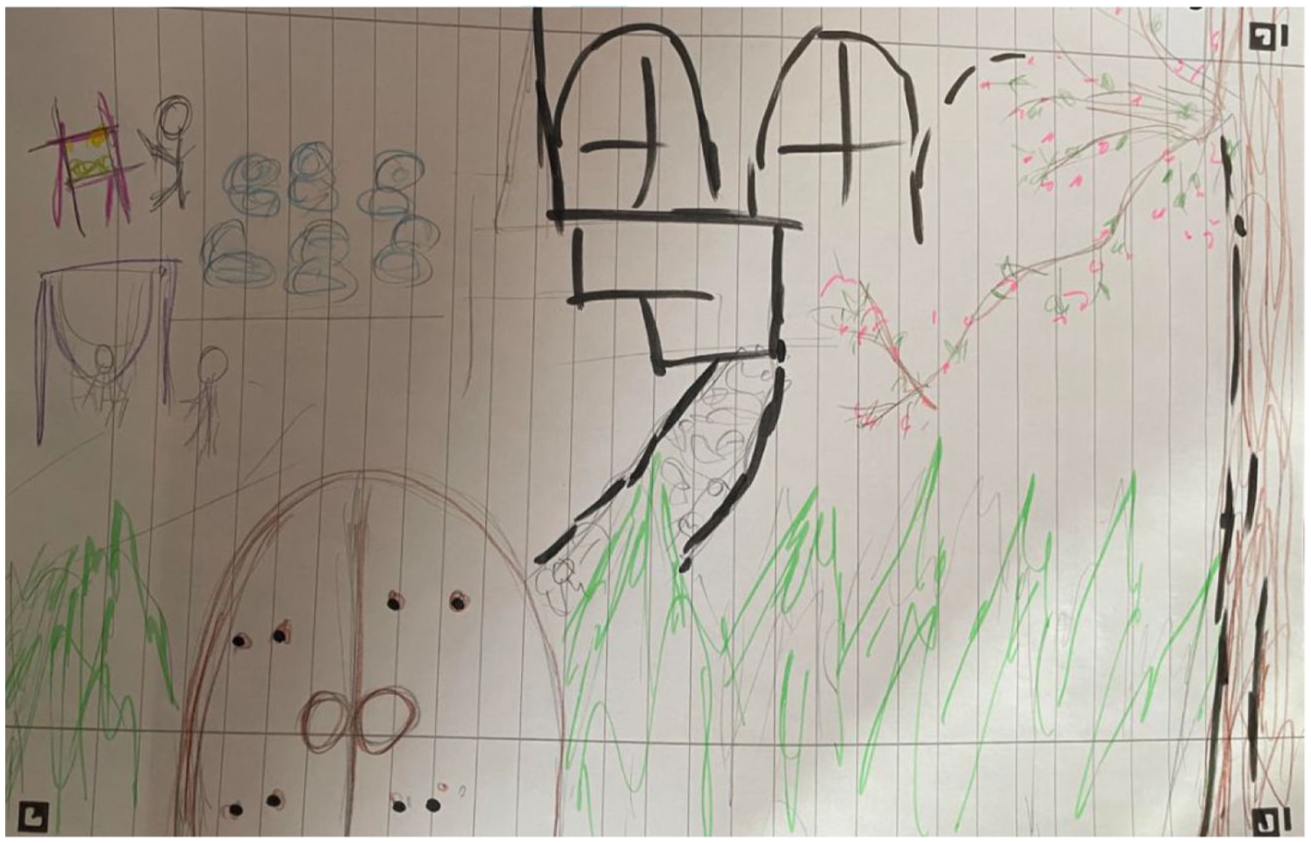
A place for creativity, inspiration, development and self-improvement.
People: In this category, it was notable that most of the pictures did not depict people. There were no teachers or students in the physical spaces, implying that school buildings and spaces were perceived as “silent teachers.” Spaces were supposed to be learning experiences. A teacher and students were present in only one part of the picture; the teacher (an ungendered stick figure) was distant from students and orchestrating their learning, giving them a lot of agency.
Learning resources: The pictures captured different resources in the learning environment. These were books, notebooks, pens, and boards, all of which were perceived as assets that could assist teaching and learning and be utilised by organisations, teachers and students to work effectively.
Learning locations: The drawing pictured the learning locations inside the buildings of educational establishments. The spaces inside were cosy and comfortable. There were no tables in the classrooms. The classrooms were designed to be student-centred and allowed dynamic interaction among students (collaboration, engagement, communication, learning). Some of the drawings depicted relaxation zones with carpets, blankets and armchairs where students could feel comfortable and both physically and emotionally protected.
Teaching and learning event: One drawing pictured people involved in the teaching and learning process. It was an event in the open air without any limits on students in terms of time and space, where the environment acted as a third teacher; the teacher’s role was to be a partner in the learning process.
The data obtained were distributed according to the categories and codes that emerged from the grounded theory analysis. Some elements in the pictures were common across categories, but these categories come from reading “the stories” told in each picture. Since some categories were poorly populated, I decided to create larger clusters rather than eliminating some categories from the analysis. The five categories were distilled into broader clusters that illustrated the students’ needs (see Table 1).
Distribution of drawings across clusters and categories.
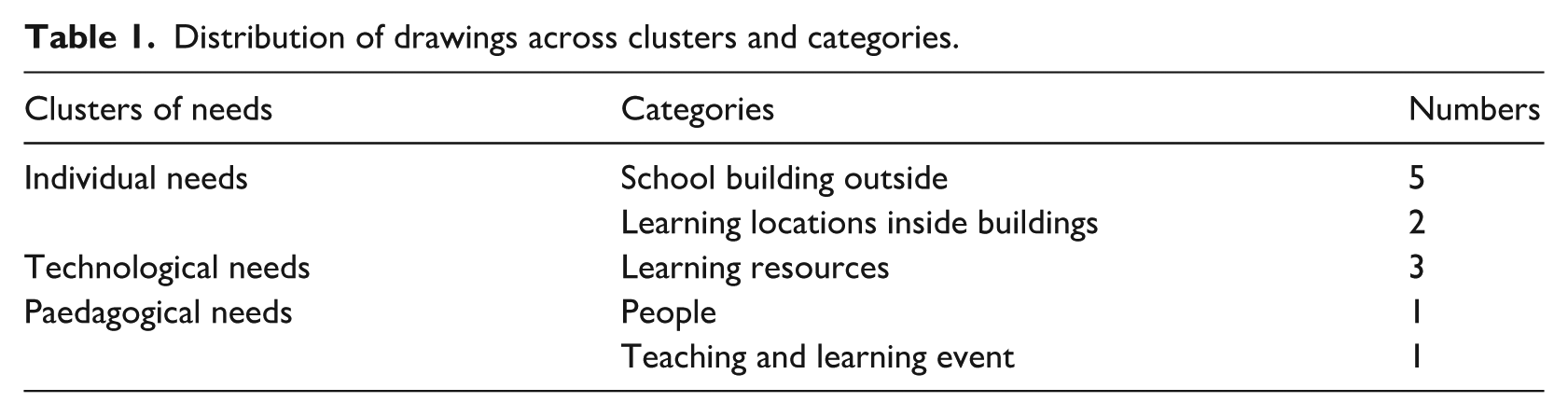
The five categories fall into three distinct need clusters:
Individual needs: The influence of the environment, in terms of both the inside and outside of school buildings, was foregrounded in many drawings. The focus of the environmental aspect of education was on students’ well-being. Learning environments were potential contexts for creating and strengthen students’ sense of well-being.
The presentation of education through nature (primarily flowers, plants and trees) was a notable feature of this need category. Depictions varied, from very traditional educational institutions, surrounded by greenery, to organised learning zones outdoors. For five participants, the environment was a key aspect of their vision of the future of education.
The drawings of indoor spaces within educational institutions featured unstructured designs without desks and chairs (n = 2), but that were divided into zones where students were free to move around and decided what space to occupy. One respondent described this space as being physically safe and emotionally relaxing. The centrality of students’ physical and psychological well-being was explicitly expressed in the drawing through labels given to objects: “safe surface and safe equipment,” “relaxation area for teachers and students.” Students’ ability to have their own space in the learning environment was stressed by two respondents as a prerequisite for creating a sense of social connection and communication in a learning group.
Technological needs: In this cluster, students’ needs were depicted in terms of learning resources and their influence on students’ performance. The drawings of students (n = 2) highlighted the importance and benefits of aids and tools for delivering the teaching. One drawing featured a classroom where students had free access to a range of different resources. Another drawing depicted state-of-the-art technologies in the learning space (glass ceiling and walls, whiteboards, etc). There was no reference to online learning, but a space with boards and screens that did not depict students or teachers could be perceived as distanced and as emphasising the role of learning resources and technology. Having been technologically equipped, students emphasised that they could not be bound to the physical location of an educational institution: that represented the present, not the future, and flexibility was the way forward for education.
Paedagogical needs: The categories of people and teaching events were assigned to this cluster. Presenting a teacher in the drawing, one participant showed that teachers were close to students but not necessarily collaborating directly with them. However, one teacher was making notes and observing the students who were actively engaged in interaction. When observing learning activities, a teacher could provide feedback to students and give them the opportunity to self-direct. It was important here that teachers and students were depicted in the same style and as being the same size. This implies that the students thought of teachers and students as equal participants in education. Students were engaged in collaborative activities, working in pairs and in groups of six. This revealed students’ pedagogical need of social learning and importance of working together with teachers. The need for effective communication was evident from the drawings: cooperative work was beneficial for students and presenting ideas and engaging in discussion were essential for their future careers as teachers.
Discussion
The decision to adopt a visual methodology in this research and ask pre-service teachers to imagine and draw the future of education was based on an understanding of drawings as semiotic systems of meaning-making and communication that can disclose information that may not be gained from text (Rose, 2001). This methodology enabled the identification of students’ needs that would have to be met for education to be sufficiently responsive and flexible. I was also aware of the potential challenges involved in using the visual methodology. One challenge when analysing the drawings was to consider different voices in a consistent and uniform manner. This method has been criticised for being open to a variety of interpretations, and subjective in terms of data analysis (Alerby and Bergmark, 2012). Taking these potential challenges into account, I conducted two stages of data analysis – firstly coding images and describing them in detail without interpretation, and secondly data interpretation. This allowed for different needs to be heard.
The advantage of using the visual methodology is that it allows students to reimagine educational future and feel safe and dream about education as relational and caring practice that adds stability to future (Otrel-Cass et al., 2024). As the participants in the research were students from a Ukrainian university, they are directly affected by the trauma of war. Their imagined educational futures are anchored in the uncertain and disruptive present. Their drawings illustrate the need for education to respond not only to immediate crises, but also to anticipate future needs by fostering adaptability, resilience, and inclusion. Education should serve as a dynamic space where different futures can emerge through dialogue, interaction, and shared meaning-making.
The research conducted with students, having a strong focus on studying their needs and engagement with them in the dialogue, reveals the pivotal role of staff-student partnership and the ways of how education should address crises in the future. While the research did not have a predefined model of partnership and was open to the engagement of students, the findings reveal that a partnership-based approach is central to educational futures. Traditionally within the context of higher education, students as partners are actively engaged in a variety of different ways, including quality assurance, research strategies, and institutional governance (Healey et al., 2016). However, staff-student partnership in crisis reality should be underpinned by a new mindset where collaboration, care, trust, and agency are foundational for education. These insights suggest that education systems responding to crisis should move from reactive approaches to radically flexible and relational models that centre students’ voices and lived realities.
Veletsianos and Houlden (2020) argue that crises such as war and pandemics demand a fundamental rethinking of education design. Their concept of radical flexibility frames education not as a system of delivery, but as an ethical, relational process that goes beyond traditional academic objectives and proactively foster students’ psychological resilience. The drawings in this study illustrate precisely this need through the communities, support systems, and secure and inclusive learning environments.
One dominant theme in students’ drawings is emphasis on well-being and emotional safety. Their imagined classrooms are places of security and belonging that are closely connected to relational trust. According to Veletsianos and Houlden, “trust is a precondition for learning in crisis” (2020, p. 856). This relational trust is especially crucial in enhancing collaborative and peaceful education. Helliwell and Wang (2011) argue that trust is directly linked to the individuals’ well-being and without it, people are reluctant to form social connections that are essential for meaningful engagement in learning. Emphasising trust, listening to students talk about challenges, having dialogue with them and responding appropriately goes beyond conventional teaching. It reflects an anticipatory model of education that opens up new ways of being and learning together. This model prepares students not only for academic success but also for the uncertainties of life, and ensures resilience and survival (Osberg, 2017).
There is no doubt that the sudden transfer to distance learning during the Covid-19 pandemic and armed conflicts made students’ technological needs more evident. The drawings reflect the anticipation that future education will be delivered flexibly (both in hybrid and digital formats). This aligns with the arguments by Hodges et al. (2020) that technology can serve as a quick and reliable replacement for face-to-face teaching and learning. The similar perspective is presented by Houlden and Veletsianos (2021) who assert that technology enables education to continue functioning in times of crisis, such as war or pandemics. However, technology alone is not the solution. Veletsianos and Houlden expressed the warning that while digital infrastructure is essential, it must be “designed for care, not control” (2020, p. 859). Future-oriented education should ensure that technology does not engender distrust or exert control over performance and behaviour. Sztompka (2017: 35) contends that “distrust produces suspicion and anxiety which are paralysing for actions and interactions.” The aim of technology is to foster connections, support student autonomy, and reduce barriers to learning (Veletsianos and Houlden, 2020).
The grater students’ agency and autonomy resonate with Osberg’s (2017) notion of symbiotic anticipation, where education becomes a space of mutual imagining – where students and educators co-navigate the uncertain landscapes of the future. In these futures, education is not static or predetermined, but constantly evolving through interaction.
The analysis of emergent needs, such as well-being, technological access, and pedagogical agency, underscores that education must become more dialogical, more inclusive, and more future-oriented. The findings support existing literature (Facer, 2016; Jenkins, 2020) which sees students as co-authors of educational futures, and align with calls for institutions to adopt long-term, care-based frameworks for responding to instability (Grenier et al., 2020; Veletsianos and Houlden, 2020).
Conclusions
This study of imagined futures for education through the use of visual methodology enabled analysis of students’ expressed needs in crisis situations. The need for flexibility and relationality in higher education practices was underscored in this context. In light of the research findings, the role of staff-student partnerships should be reimagined not as a discrete initiative but as the structural basis for crisis-ready education. Moving forward, partnerships should be embedded into institutional planning, policy development, and emergency response strategies rather than confined to curriculum design or teaching feedback. When students are invited to help shape how education adapts to crises, their lived knowledge becomes a vital asset.
This study demonstrates that radical flexibility and relationality, enacted through genuine student involvement, should guide how education evolves. Crisis reveals the fragility of traditional systems, but also opens space for innovation. Partnership is not just a desirable practice; it is a necessity for sustaining education in unstable contexts. Education of the future should not only teach about resilience, it must embody resilience, through structures that are collaborative, ethical, and deeply attentive to those it serves.
Footnotes
Declaration of conflicting interests
The author declared no potential conflicts of interest with respect to the research, authorship, and/or publication of this article.
Funding
The author disclosed receipt of the following financial support for the research, authorship, and/or publication of this article: The author acknowledges the financial support by the University of Graz.
