




Abstract
Extended periods of exclusion from education and the labour market can have a range of ‘scarring’ effects in later life. Consequently, there is international interest in early identification of young people most at risk of exclusion. Using a PRISMA format, this paper reviews an extensive literature on risk factors associated with three conceptualisations of exclusion: ‘not in education, employment or training’ (NEET); early school leaving (ESL) and high school dropout. It covers sources meeting three conditions: they present original findings on the factors associated with individual young persons becoming educationally excluded; provide evidence that the association is likely to be causal; and are based on data collected in English speaking countries or in European liberal democracies. The paper finds robust evidence for a range of risk factors at different levels. Micro (individual and family) and meso (school level) risk factors must be seen in the macroscopic context affecting young people, including economic circumstances, but also the nature of social institutions relating to the labour market, education and welfare. However, early-warning indicators based on selected risk factors must always be viewed with caution, since predictions of educational exclusion are probabilistic rather than categorical.
Keywords
Introduction
This review examines the knowledge base available to inform a key area of youth policy: identifying young people at risk of exclusion from education. 1 There is substantial international evidence that extended periods of exclusion from education and the labour market can have a range of ‘scarring’ effects with high individual, economic and social costs (Bäckman and Nilsson, 2016; Bell and Blanchflower, 2011; Cuervo and Wyn 2016; Ralston et al., 2016, 2021). However, concerns about early exclusion are framed differently according to national and cross-national contexts. In the UK, the dominant policy construct is the classification ‘not in education, employment or training’ (NEET), whilst early school leaving (ESL) exists in the European Union (EU) alongside the NEET classification. In North America, educational exclusion is usually thought of in terms of high school dropout. Whilst a number of literature reviews on identifying young people at risk of exclusion have appeared (Bowers et al., 2013; Esch et al., 2014; Gonzalez-Rodriguez et al., 2019; Gubbels et al., 2019; Rahmani et al., 2024), these have tended to focus on just one approach to conceptualising exclusion and often on a specific set of risk factors or demographic groups. There has been no comprehensive overview of the research base as it relates to NEET, dropout and ESL. Moreover, previous reviews have tended not to distinguish between studies where educational outcomes are observed relatively soon after the end of compulsory schooling and those in which outcomes are observed well into adulthood. Our review aims to fill these gaps by drawing together the literature on risk factors associated with each of these three classifications across a broad international context. It focuses particularly on factors which can be observed at the individual level and may therefore be of value in identifying those young people at greatest risk, particularly in the years following the end of lower secondary education.
The paper highlights the difficulties in comparing different conceptualisations of educational exclusion but also the similarities in the risk factors thus identified. All three conceptualisations illustrate how individual challenges such as ill-health, family difficulties and low educational attainment can increase the chances of leaving education, but also how the nature and practices of educational institutions as well as structural factors such as class, gender and race/ethnicity may operate alongside individual factors. Like Reay and Lucey (2004) we maintain that transitions in and out of education and training spaces act as an important influence in maintaining and contributing to wider societal processes of social exclusion and so need to be dissected and further explored.
The paper also highlights the need for caution in using risk factor research to develop early warning indicators for educational exclusion. Due to the probabilistic nature of risk factors, many of those identified as at risk of educational exclusion may not actually dropout, while at the other extreme others may be missed. There is therefore a trade-off between setting a threshold of risk high enough to identify most of those who will experience dropout, NEET or ESL, and the unintended consequence of intervening unnecessarily with large numbers of young people. This is particularly problematic when risk of exclusion is associated with a deficit understanding of young people, which may result in identification or intervention being counter-productive. In addition, the sheer volume and variety of risk factors that may operate, and variations between contexts and researchers in how these risk factors are defined means that an early warning system that is relatively accurate in one context may be unsuitable in another.
The paper begins by discussing the three conceptualisations used in this review to indicate exclusion from education, highlighting the main features of their definitions and how their differences affect the identification of risk factors. It then analyses the meaning of the term ‘risk factor’ in the context of educational exclusion and how groups of risk factors may be related, using a conceptualisation based on micro, meso and macro levels. We go on to explain the review methodology and some of its limitations. We then present the main findings, analysing the nature and depth of evidence relating to NEET, ESL and dropout and structuring the analysis according to the micro, meso and macro levels. The paper concludes by summarising these findings and reiterating our note of caution concerning early warning indicators.
Defining educational exclusion: NEET, ESL and school dropout
The literature on post-compulsory educational decisions has for many years emphasised the importance of ‘push’ and ‘pull’ factors (Gambetta, 1987; Maguire, 2021). Students may leave education because of the perceived attractions of early entry to the labour market, the lure of life ‘on the street’, or from over-riding pressures such as personal illness or caring responsibilities. They may be pushed out by failure to meet the requirements for continuing study, or for not conforming to the norms of school life – expressed through poor attendance, behavioural issues, or low attainment. However, these processes are rarely the outcome of free individual choice – rather, they result from the interplay of factors at various levels, structural, economic and institutional as well as individual. We therefore prefer to use the term ‘educational exclusion’, rather than more individualised expressions such as disengagement, to capture the processes in which we are interested. As noted earlier, educational exclusion does not refer to disciplinary exclusion from a particular setting, but the processes and outcomes leading to an individual being positioned outside or on the margins of the education system as a whole. How this broad notion of educational exclusion is captured in empirical studies tends to differ according to political and institutional context. As Maguire (2021) notes, there is no universal definition of exclusion, and researchers – particularly if aiming for policy impact – tend to use terms from the dominant political discourse within their national context. In this review, we consider studies using one of three such terms: NEET, ESL and high school dropout (Gillies and Mifsud, 2016; Piscitello et al., 2022; Simmons et al., 2014).
Not in employment, education or training
Definitions of NEET generally contain three factors: an age range; criteria for inclusion or exclusion from the NEET category; and the methods used to identify young people meeting these criteria. The EU definition adopted in 2010 included young people aged 15–24 (later extended to 15–29 and currently to age 34) who are unemployed or economically inactive according to the definitions of the International Labour Organisation (ILO) and are not in any education or training. It is a cross-sectional definition, capturing all young people meeting its criteria in the reference week of the quarterly EU Labour Force Survey (Eurofound, 2016). In the UK, a similar approach is used, based on the age range 16–24. Many of the studies in this review which use NEET as an outcome adopt a similar cross-sectional approach, observing NEET status at a particular point in time. This approach suffers from an inability to distinguish young people for whom becoming NEET is a transitory phase from those experiencing longer periods of exclusion. A longitudinal definition may therefore be preferable, for example one in which NEET must be sustained for at least 6 months. Although data collection is then more difficult and the population of interest smaller, a ‘six-month sustained NEET’ definition is more likely to capture young people at significant risk of social exclusion and subsequent ‘scarring’ effects (Bynner and Parsons, 2002; Furlong, 2006). Several studies in this review take this approach (Britton et al., 2011; Karyda, 2020; Karyda and Jenkins, 2018). Others use a continuous measure to capture such young people, such as number of months NEET (Gutman and Schoon, 2018; Schoon, 2014).
The NEET category is not exclusively concerned with educational participation; young people outside education or training but in employment are by definition not NEET. This relationship with employment status suggests a division of the NEET population into those actively seeking work (NEET unemployed) and those not seeking work (NEET inactive). The relative size of these sub-categories tends to be related to economic cycles, with periods of recession increasing the proportion of unemployed. The NEET inactive group is strongly related to ill-health, both mental and physical, to pregnancy and childcare – particularly amongst young women – as well as other caring responsibilities, and to a ‘discouraged worker’ effect in which churning between unemployment and insecure work reduces the motivation to pursue further opportunities (Eurofound, 2016). This is one reason age is particularly significant for defining the NEET category. Broadening the age range, from the 16–18 originally used in England and Wales in the 1990s to 16–24 or even older, changes the composition of the ‘at risk’ population. Older students and workers may be more susceptible to ill-health and discouragement, and the effect of gender may also be expected to change, as more women start families. In addition, because NEET is not applied only to those with lower educational attainment, a larger age range increases the diversity of qualification levels, again altering the way in which certain factors affect the at-risk population.
Early school leaving
Internationally, there is a range of different understandings of ESL, comprising young people who have experienced processes such as dropout before or immediately after the compulsory school-leaving age and those who have progressed to participation in the upper secondary stage but failed to complete a qualification at that level (Gonzalez-Rodriguez et al., 2019; Maguire, 2021). In the EU, where the term is particularly influential in policy discourse, ESL is defined in relation to attainment beyond the age of compulsory schooling: it refers to young people aged 18–24 who have completed at most the lower secondary phase of education and are not currently in education and training. This definition implies two significant differences between ESL and NEET: first, a young person may be ESL and in work; second, higher attainers (Level 3 or above) are not included in the ESL category, even if they are not in work or education. This has the advantage of providing a more homogeneous ESL population in terms of qualification levels and capturing all young people in the age group who are not in education, but begs the question of how similar are early leavers in work to those not in work. It also draws attention away from those who leave education before age 18; although such young people may eventually emerge in the ESL statistics, this could be several years after they have left education. Some of the studies in this review in which the outcome is ESL deal with this problem by focusing on educational status at age 18 (Kaye et al., 2017; Lamote et al., 2013), bringing them closer to US studies of high school dropout.
High school dropout
In North America, the dominant means of expressing concern about educational exclusion is the concept of dropout before graduating from high school. Dropout is also used in some European studies, particularly when the intention is to investigate young people who leave education before the age of 18 2 (Haelermans and De Witte, 2015). As with NEET and ESL, dropout is associated with scarring effects in later life and there has been considerable research effort on identifying factors enabling one to predict which students will be most at risk (see, e.g., Archambault et al., 2009, 2017; Giano et al., 2022; Piscitello et al., 2022).
The definition of high school dropout varies between studies, particularly in terms of age range. Including dropout from middle school grades, Piscitello et al. (2022, p. 4) define dropout as ‘any student being in seventh [age 12-13] through 12th [age 17-18] grade whose last entry in the administrative data set was marked with a “dropout flag” . . . [those who] successfully graduated from school or received an alternative graduate certification were . . . coded as not dropping out’. In this and many other studies, dropout status is observed during the school career, prior to or at 12th grade. However, where longer-term longitudinal data is available, it may be possible to determine whether a student has returned to high school to complete their diploma, or obtained an alternative credential, the General Educational Development test or GED. For example, Henry et al. (2012) used interviews conducted at age 21–23 to determine if former dropouts had taken either of these routes. However, some researchers consider that the labour market outcomes of GED graduates are sufficiently similar to those for high school dropouts who never complete an equivalent credential to justify including them in the dropout category (Gasper et al., 2012). This is an approach taken by several studies in this review. Elsewhere, GED graduates are regarded as a separate category alongside high school graduates and dropouts (Metzger et al., 2015; West et al., 2019). Some studies also investigate ‘persisters’, young people who do not achieve a high school diploma although they attended school until the normal leaving age (Uretsky and Henneberger, 2023). In other cases, the outcome is high school non-completion and does not distinguish between those who remained in school to 12th grade but did not achieve a diploma and those who dropped out earlier. This is therefore similar to the definition of ESL.
Defining risk factors
Broadly speaking, risk factors can be understood as personal, social, cultural or economic characteristics or circumstances that precede and are associated with an increased likelihood of dropping out of school, leaving school early or becoming NEET. The process of exclusion is complex, and dropout tends to arise from a confluence of risk factors rather than a single cause (Archambault et al., 2009). Indeed, some studies show that the more risk factors affecting a young person, the greater is their likelihood of educational exclusion (Duckworth and Schoon, 2012; Fortin et al., 2013). It is also important to remember that ‘risk’ factors are just that – factors that increase the likelihood of a young person dropping out rather than offering firm predictions: just because an individual has one or more risk factors, this does not determine their future education and career pathways. In the sources reviewed here, both Feng et al. (2015) and Dickerson et al. (2020) draw attention to the probabilistic and therefore inherently problematic nature of any predictive tool used to identify future exclusion. Other observed (or unobserved) characteristics may mediate and offer a degree of protection against negative education outcomes and experiences, whilst chance events or individual agency may result in different outcomes for otherwise similar individuals. Moreover, whilst young people with certain characteristics are more likely to experience negative outcomes than those without, the absolute risk remains relatively low, particularly in the younger age groups. We thus need to carefully consider the push and pull factors that shape the probability of risk when using early warning indicators, since both in situ shape the pathway to exclusion and participation in nuanced ways.
At first sight, the body of literature analysed provides evidence for a bewildering variety of potential risk factors, with many being highly specific and discussed in only a small number of studies. Examples include aspects of academic attainment or of health status (Machin et al., 2018; Wu et al., 2022). However, closer examination shows that they can be structured into reasonably well-defined categories, and to aid this process it is helpful to distinguish between groups of factors which operate at micro, meso or macro levels. In their conceptual model of ESL, Brown et al. (2021) identify five such groups: individual, family, social relationships (with teachers and peers), local institutions (an individual’s school and classroom context), and structural (the education system, welfare and labour-market institutions and the macro-economic context). Similar classifications have also been discussed elsewhere (Gonzalez-Rodriguez et al., 2019; Van Praag et al., 2018).
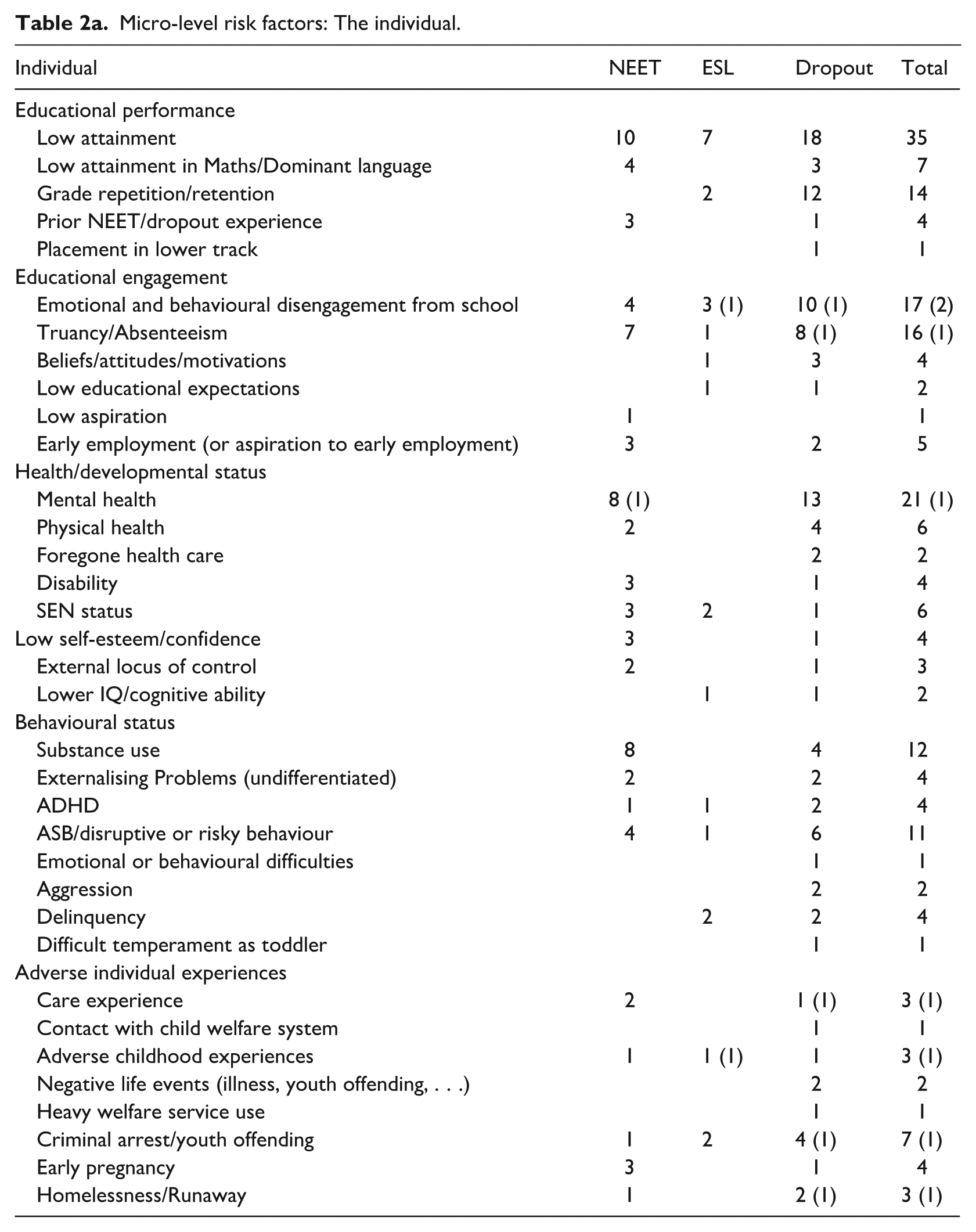
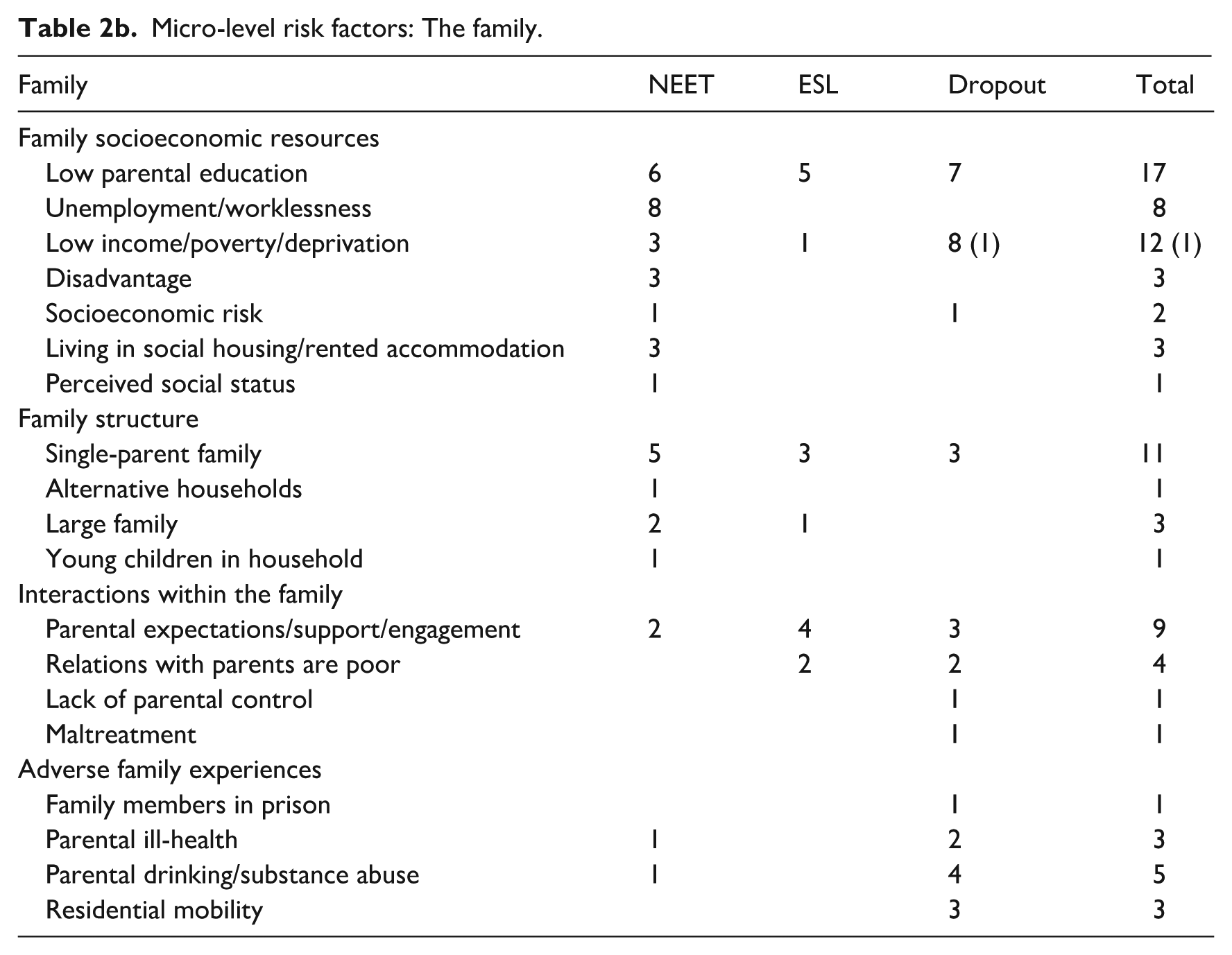
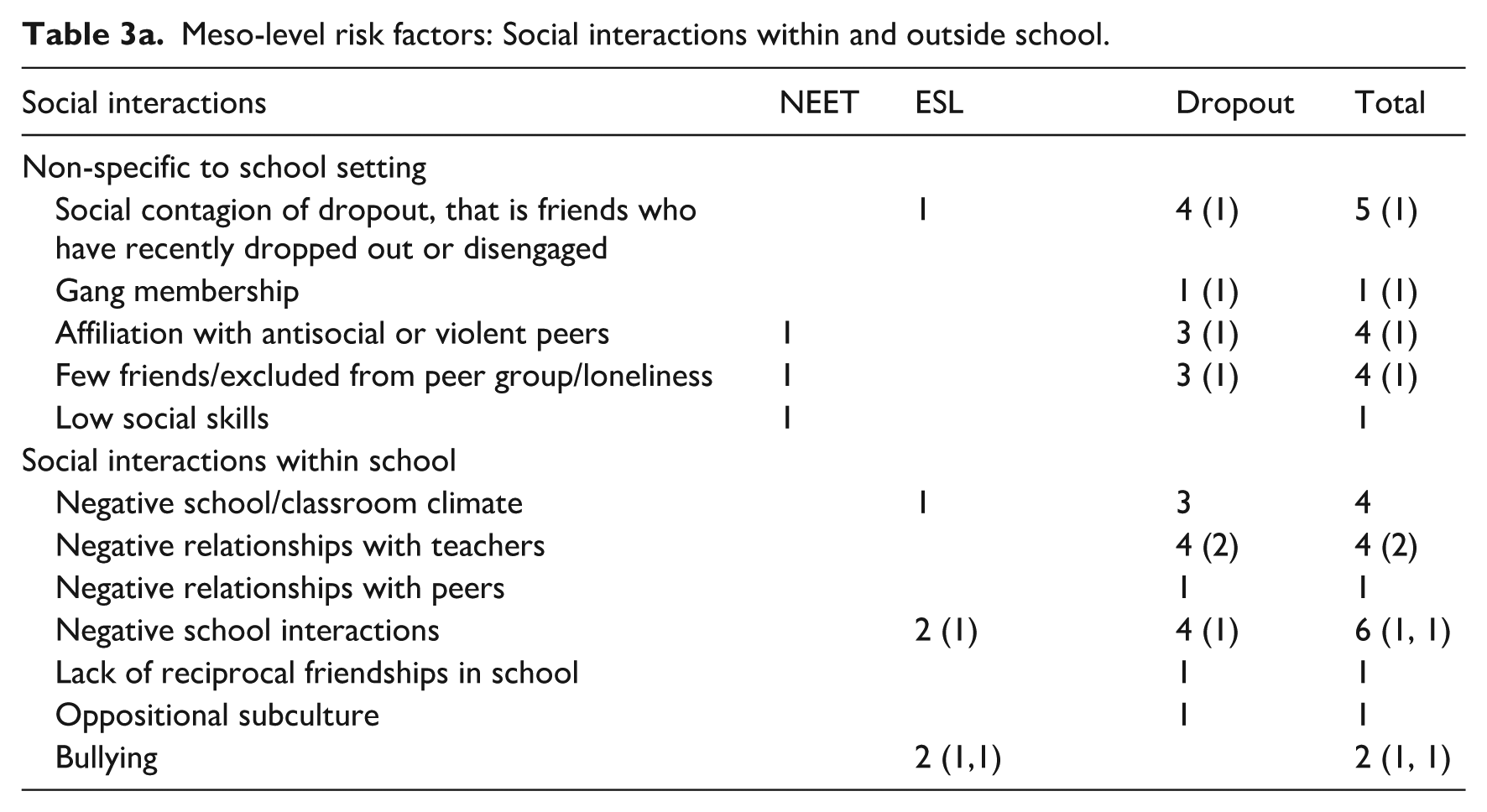
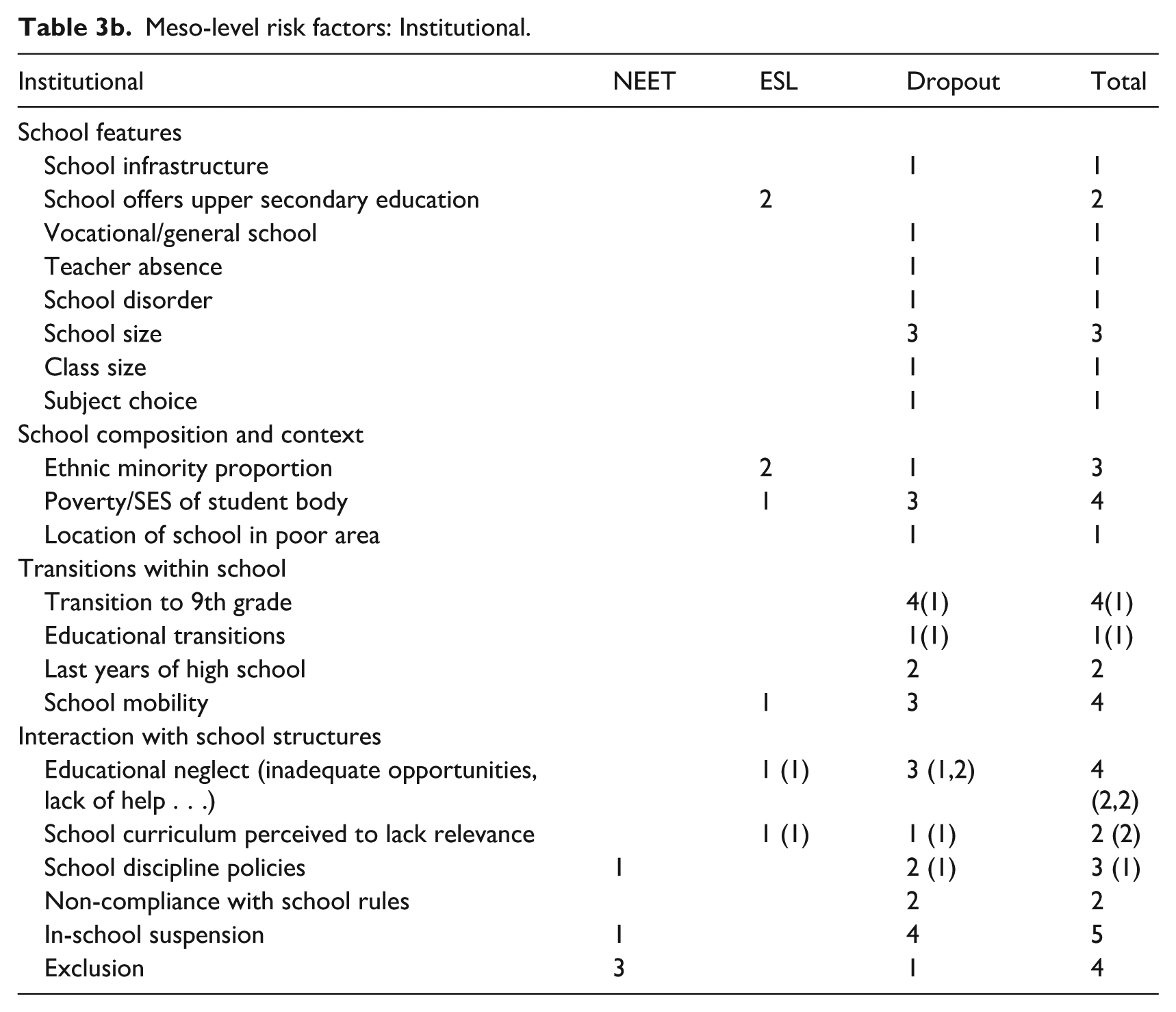
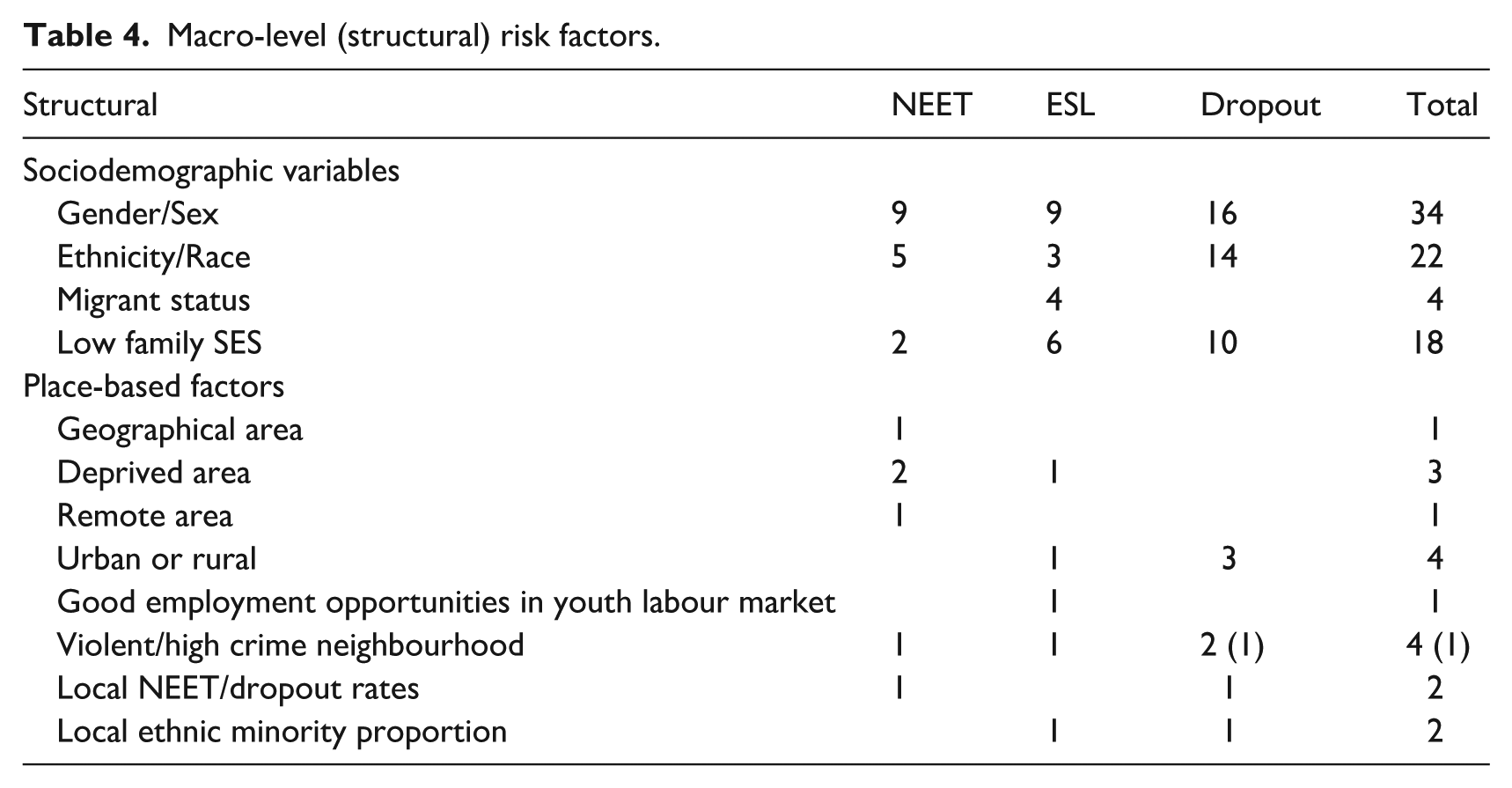
For the literature reviewed in this paper, we have found these five groupings to be reasonably appropriate, with the caveat that there is some overlap between categories and distinctions are sometimes blurred. This is particularly evident when classifying risk factors corresponding to sociodemographic variables such as gender, ethnicity and socioeconomic status: whilst these variables are observed at the level of the individual, their impact on educational exclusion operates largely through interacting structural processes arising from inequalities in power and social status. For this reason, we have included such overarching variables at the level of social structures, whilst placing more specific manifestations of structural processes – for example, parental education, deprivation or early pregnancy – within the micro-level groupings. The five groupings, and associated sub-groups, are shown in Tables 2–4 alongside the number of studies providing evidence on the relevant factors note that the frequencies cannot simply be aggregated to provide totals for each group, as most studies deal with more than one risk factor.
The reviewed literature involves a range of methodologies which offer different forms of understanding – most are quantitative studies which indicate what risk factors are important whilst the relatively small number of qualitative investigations focus on how specific factors operate and interact. The most robust knowledge about what risk factors operate and their effect in particular contexts comes mainly from large-scale longitudinal or cross-sectional studies of population samples, although studies focused on specific groups of vulnerable individuals and smaller-scale studies with samples constructed by the researchers remain important. Although 29 studies are based on samples of less than 1000 participants, the majority (93 studies) use samples of 5000 participants or more, whilst some cover complete cohorts of young people (see Borgen et al., 2023 for an example). These quantitative studies account for 149 of the sources in our review (117 of which are longitudinal 3 ), whilst 14 are qualitative and are indicated in Tables 2–4 by the figures in parentheses after the total number of studies corresponding to a risk factor. A few of these qualitative studies have very small numbers of participants (1–4), and are further identified in the tables by asterisks. The two remaining studies describe themselves as mixed methods. In the quantitative literature reviewed, the strength of a risk factor is expressed in a variety of ways, often by means of odds ratios showing the independent effect of each factor. However, the methodological and contextual variation between studies prevents us from making any estimates of average effect sizes for the factors presented here. Readers are referred to the individual studies (references available in the Supplemental Material) for details of the specific contexts, methodologies and measurement strategies adopted. A considerably smaller but more homogeneous sample of literature is analysed statistically by Rahmani et al. (2024), who provide pooled odds ratios for 22 separate risk factors for NEET status, although these are mainly individual or family-level factors and do not include literature dealing with institutional risk factors.
Methods and scope of the literature review
An extensive review of English-language publications on factors associated with educational exclusion was conducted. It included literature from 2008 to the end of 2023, covering periods of economic crisis and partial recovery, as well as the onset of the Covid-19 pandemic, and a burgeoning global mental health crisis. In particular, the beginning of this period was chosen to coincide with a significant increase of international policy interest in NEET young people (Eurofound, 2012) as NEET rates rose following the financial crisis, whilst in the EU policy and research on ESL were re-orientated as austerity measures took hold (Alexiadou et al., 2019). In-scope literature included academic journal articles, books, government-commissioned reports, and publications from independent organisations such as charities, ‘think-tanks’, and university research centres. The searches were initially conducted using the web-scale discovery service Summon, which provided an integrated search engine covering databases such as the Education Resources Information Center (ERIC). In these searches, the disciplines included: education; sociology and social history; social science; economics; social welfare and social work and public health. The primary search terms describing educational exclusion were NEET, ESL and (high school) dropout. These terms were combined in various ways with terms describing individual chances of exclusion such as risk factor, predictor and protective factor, for example (NEET) AND (risk factor).
The initial Summon search generated 4301 potential sources. These were exported to the reference management software Refworks to support a process of screening followed by examination of full texts. The two authors conducted the review: each source was independently reviewed by at least one author for eligibility, with any uncertainties being managed via the discussion and agreement of both authors. Using a PRISMA format, this paper provides a systematic review on risk factors associated with three conceptualisations, ‘not in education, employment or training’ (NEET); early school leaving (ESL) and high school dropout. PRISMA offers a preferred reporting framework to conduct literature reviews such as these, since it provides a thorough and transparent process as summarised in the left-hand branch of Figure 1, which uses the PRISMA format to record the selection process (Page et al., 2021). A total of 1025 exact duplicates were removed automatically by Refworks; a further six sources were removed as being earlier than 2008. The authors then screened the remaining sources using the following criteria:
Published between 1 January 2008 and 31 December 2023
Published in English
Title and/or abstract refer to the observation of at least one of (a) NEET, (b) early school leaving (ESL), (c) school dropout in late adolescence or early adulthood
Title and/or abstract refer to at least one of (a) risk factors, (b) predictors or (c) protective factors for these outcomes. Papers focusing on consequences of being NEET, policy context or interventions are excluded unless they also present new data on relevant factors
Title and/or abstract refer to a study of risk/predictive/protective factors conducted in Europe (excluding countries formerly in the USSR), UK and Ireland, Australasia, North America
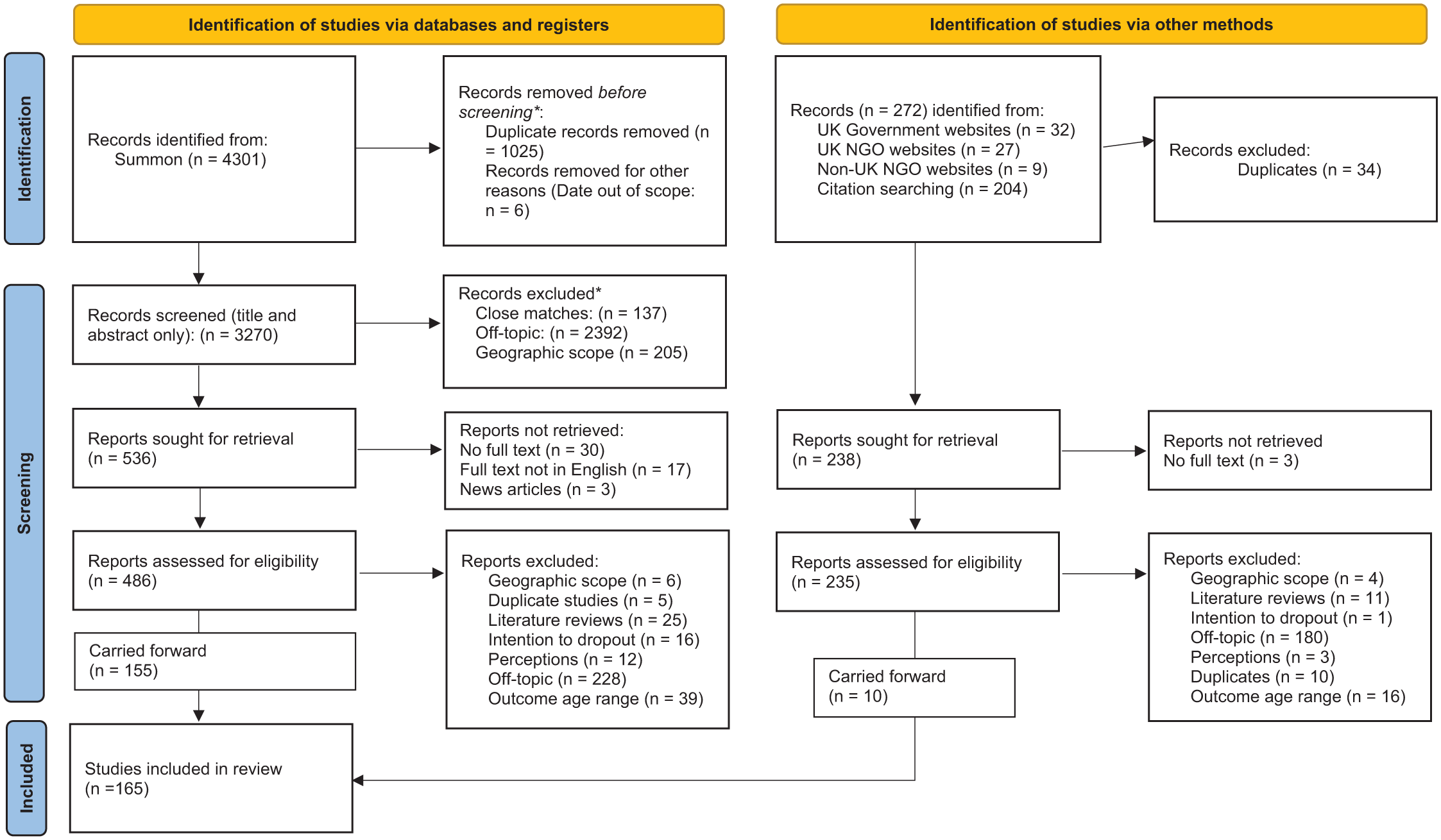
Systematic review process.
At this stage, a further 137 close matches were excluded and 205 sources were found to be outside the geographical scope of the review. However, by far the greatest number of exclusions were sources found to be ‘off topic’ – that is, not meeting criteria (3) and/or (4) above. The off-topic sources fell into three main groups. Firstly, we excluded those in which terms such as dropout or early leaving had meanings not related to educational exclusion, for example dropout from medical trials, health programmes or other non-educational contexts. Secondly, sources which concerned dropout from higher education were excluded. Thirdly, studies that used national or regional rates of exclusion, rather than individual-level data, were excluded. Finally, sources that were not concerned with risk or protective factors were also excluded. These comprised studies of interventions, policy responses, and critiques of the concepts related to exclusion.
Following this screening process, 536 sources remained. We then attempted to retrieve the full texts of these sources, leading to further exclusions: 30 had no full-text available (mainly unpublished conference papers), whilst in 17 cases the full-text was not in English. Three news items were also excluded. The authors then examined the full-text of the 486 remaining sources, classifying them according to date of publication, type of publication, country of origin, methodology, outcome used to describe exclusion (NEET, ESL or dropout), age(s) at which the outcome was measured, and risk factors identified. This process brought to light 16 studies which were about dropout intention, and 12 studies about individual perceptions (by students, teachers or parents) of factors involved in exclusion. These studies were excluded as having an insufficiently direct connection with actual exclusion. Five further duplicates were removed, along with 228 sources only revealed as off-topic by the full-text version, and 25 literature reviews that did not present original data.
A final category of excluded studies comprised those where the outcome was measured at an age too remote from our primary concern with early exclusion from education. For example, some studies observed NEET or dropout status at ages anywhere between 21 and 30 or even 35. As Caroleo et al. (2020) argue, risk factors for younger age groups tend to relate to the school-work transition, whilst those for older age groups are influenced more by labour market and welfare institutions. Moreover, at age 21 the number of graduates within the NEET cohort begins to acquire significance, further increasing the heterogeneity of those who might be regarded as at risk. 4 For these reasons, we excluded 39 studies in which outcomes related to educational exclusion were not measured until after the age of 21, leaving a total of 155 sources meeting all the inclusion criteria.
The reference lists of selected sources were checked as a means of validating and extending the initial search, together with forward searching based on citations of included sources. We found that Summon had a specific weakness regarding both government-commissioned and independent research reports, leading us to conduct further direct searches of national government and EU websites as well as using Google and Google Scholar to identify relevant publications not generated by the Summon searches (see the right-hand branch of Figure 1). A further 272 potential sources were identified, reducing to 10 after applying the process described above. We were now left with a final set of 165 sources. Table 1 shows the composition of this set, according to source type, observed outcome, year of publication and geographical focus; the full bibliography is provided in the Supplemental Material.
Structure of the literature review.
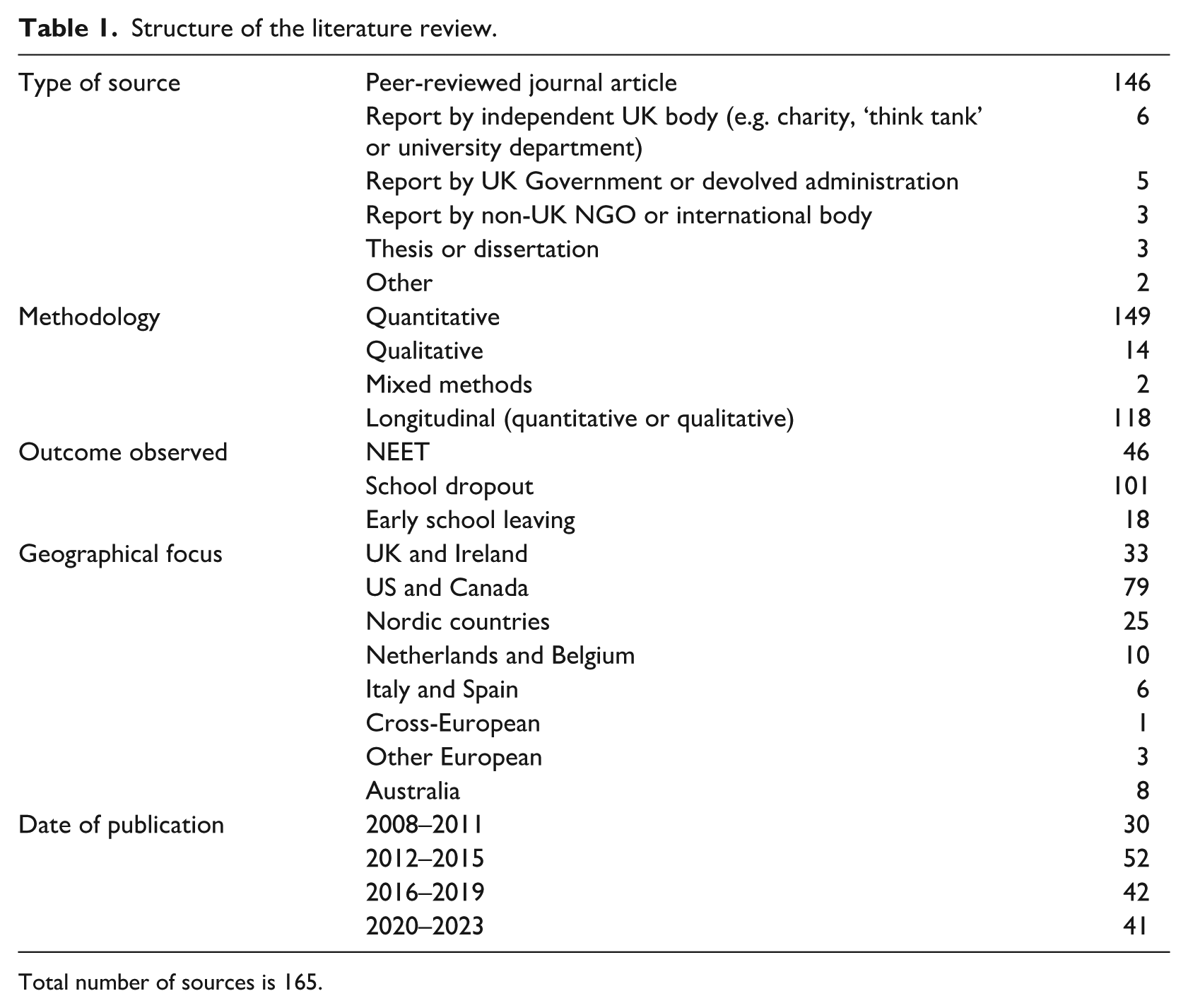
Total number of sources is 165.
Review limitations
The review does not engage with the growing NEET literature in China, Japan, South America and elsewhere. However, whilst the broader global literature adds important contextual information, it is not greatly at variance with the sources we have drawn upon here. Our geographical scope thus included Europe, UK, Australia and North America only. This was partly due to the availability of comprehensive data, but also since the economic impact educational exclusion has in these areas has been revealed as affecting broader labour markets, social welfare systems and economic growth. Moreover, these countries have had similar policy concerns and responses to managing such issues.
A further limitation arises from attempting to comprehend risk factors associated with ethnicity and race within a review covering United States, European and Australasian contexts. It is important to note that definitions and lived experience vary across these contexts, and categories such as ‘White Ethnicity’; ‘Black Students’ and ‘Asian Americans’ are deeply context-specific and tied in many instances to United States or Australasian histories of race and ethnicity which cannot be easily translated to a European context. Thus, where the study takes place dominates the categories used. This is clearly a limitation of this review, but nevertheless we consider it worthwhile to include findings on ethnicity as a potential risk factor as this draws attention both to the variation of how risk operates in contexts using NEET, ESL and high school dropout to capture exclusion but also highlights the shared role of marginality and structural inequalities related to ethnicity across these contexts.
The review has also intentionally removed sources that focused on dropout intention. Individual perceptions to dropout are clearly valid, but relating intention to actual dropout is problematic since thinking something and enacting it may be related but do not necessarily measure the same outcome. We have thus prioritised studies that have tended to suggest an epistemological prioritisation of ‘objective’ or measurable data, although we have too included subjective experiences as evidenced largely in the more qualitative based studies and mostly fall under the micro set of risk factors identified within this paper. It is inevitable too that if seeking causal links between risk factors and educational exclusion, quantitative studies are in a stronger position to be able to clarify macro-based links between key concepts of exclusion and educational outcome. However, our inclusion of qualitative studies reveals more nuanced regional variations within each country, as well as offering more analytical rigour regarding why some risk factors trump others in specific individual circumstances.
Findings 1: Individual risk factors
This and the following four sections highlight the main points arising from the literature review, organising the discussion around the five categories at micro, meso and macro levels introduced above. The literature cited is not meant to provide an exhaustive catalogue of the review, but to illustrate key themes from the included literature as well as areas where caution is required in interpreting findings. The reader is referred to the Supplemental Material for a complete listing of the individual sources relating to each risk factor.
Our analysis identified 35 individual-level risk factors, which can be divided between five subcategories: educational performance, educational engagement, health and developmental status, behavioural status (closely related to the previous subcategory, particularly in aspects of mental health), and adverse experiences. Of these, the first three have been the most extensively studied, whilst behavioural status and adverse experiences have received less attention, particularly in relation to ESL.
Educational performance
The influence of low attainment on educational exclusion is well documented in this review, with 34 sources across NEET, ESL and high-school dropout. Precisely what is meant by low attainment, and how attainment itself is measured, varies across national and research contexts, being partly dependent on factors such as data availability and requirements for entry to upper secondary education. Nevertheless, findings are reasonably consistent irrespective of approaches to measurement. For example, Falch and Strom (2013) use a continuous measure of attainment, the mean grade achieved at the end of lower secondary education. Using a data set covering all students in Norway transferring from compulsory education to upper secondary education in 2002, they find that this measure is the main predictor of the probability of dropout by the beginning of the third upper secondary year. Bradley and Crouchley (2020) use a six-point ordinal scale of attainment based on young people’s GCSE results in England; this scale distinguishes between young people above and below the threshold normally expected for progression to upper secondary education and beyond. Lower test scores are associated with a greater likelihood of being NEET, with progressively greater influence the lower the attainment level. In Canada, Anisef et al. (2010) use a three-point ordinal scale based on streaming level in grades 9/10, whilst in England Karyda and Jenkins (2018) use a dichotomous variable for low attainment based on the lowest quartile of attainment at age 11; both studies find that ‘low’ attainment is associated with a greater propensity to educational exclusion.
There are two important caveats to such results. Firstly, low attainment can be a consequence of educational exclusion as well as a precursor (Holmes et al., 2021). Particularly for attainment measured beyond the age of 16, those who have remained in education will have had the opportunity to acquire further qualifications or to improve their earlier grades. The studies included here almost all use attainment at or before age 16; however, it is possible that disengagement from learning at a younger age may affect attainment before the opportunity to leave education is available. Secondly, the subjects covered and measurement approaches vary. Whilst some use average ‘real world’ grades across a range of subjects, other studies focus on certain key subjects, usually mathematics and/or the target country’s dominant language (Archambault et al., 2009; Machin et al., 2018). Others use diagnostic or formative assessments administered at or soon after the transition to secondary education.
Educational performance involves more than test scores or grades achieved. In North America, and to some extent in Europe, students who have not reached the expected attainment for their age may not be allowed to progress with their year group. This practice of ‘grade retention’ has been quite extensively studied in the context of high school dropout, with a total of 12 sources represented here whilst a further two deal with grade retention in the context of ESL. Although grade retention is presented as an opportunity for students to ‘catch up’ with their same-age peers, its impact can be the opposite: noting that almost 91% of students in their sample who had been retained ended as dropouts, Bowers (2010) remarks that ‘retention at any level may not be serving students in a way that promotes increased achievement and eventual graduation’. As with low attainment, the association between grade retention and dropout or ESL may not be causal, and Lamote et al. (2013) suggest that a ‘cyclic’ model in which retention and disengagement progressively reinforce each other may be the most appropriate. The practice of tracking or streaming has also been associated with educational exclusion, with students in lower tracks being more likely to dropout, even after allowing for individual and school-level factors (Werblow et al., 2013).
Educational engagement
Rather than focusing on specific individual-level attributes, 17 studies use the more holistic construct of school engagement to provide a multidimensional perspective on the processes leading to educational exclusion. This construct involves behavioural, emotional and cognitive dimensions (Wang and Fredricks, 2014), represented by observables such as frequency of homework completion, school belonging and frequency of self-directed learning activities. In general, lower engagement is associated with an increased likelihood of educational exclusion, although as with educational performance a cyclical effect is often observed in which reduced engagement in a particular dimension both contributes to and is driven by reduced engagement in other dimensions. The complexity of these processes often leads researchers to identify multiple pathways to disengagement and later dropout (Symonds et al., 2016; Wang and Fredricks, 2014). Perhaps for this reason, some studies find that cognitive dimensions of engagement such as self-efficacy and subjective task value add little explanatory power (Parr and Bonitz, 2015). It is also important to recognise the contribution of sociodemographic factors to school engagement: female students are reported as having higher levels of behavioural, emotional and cognitive engagement, whilst low-SES students tend to have lower levels of emotional and cognitive engagement (Wang and Fredricks, 2014). However, there is some inconsistency across studies; with a narrower measure of emotional engagement Symonds et al. (2016) found that only White ethnicity, rather than gender or SES, had a significant impact on engagement.
In addition to studies based on the general concept of educational engagement, a number of sources focus on specific aspects of behavioural or emotional disengagement, in particular truancy or (more generally) absenteeism but also attitudes and aspirations related to education. Parr and Bonitz (2015), conclude that absenteeism, in conjunction with socioeconomic status, academic performance and parental involvement were the most predictive factors associated with high-school dropout. Low levels of attendance often arise from other individual risk factors such as low attainment and sometimes illness – especially if long-term and chronic. Thus, the reason a young person is absent from school can be significant for its impact on future exclusion. For example, Bradley and Crouchley (2020) find that truancy operates mainly through its effect on attainment; truancy in itself has little direct impact on the chances of becoming NEET. Regardless of reason, poor attendance has consistently been shown to be an important precursor to educational exclusion, although the magnitude of its effect varies across different studies.
Health/developmental status
Many studies focus on the relationships between physical or mental ill-health and high-school dropout or NEET, although no studies of health status as a factor in ESL met all the selection criteria for our review. Despite links between education and health, it is unclear to what extent educational exclusion is associated with specific health conditions and/or major chronic health conditions. Indeed, Gladwell et al. (2015) find no significant association between general health and becoming NEET at age 16–18, although for girls prior mental health difficulties are significantly associated with an increased risk of becoming NEET. Conversely, Mikkonen et al. (2018) find that any health condition at ages 10–16 increases the risk of dropout at age 17, irrespective of gender; a high proportion of this increased risk was due to mental ill-health. Like all of the risk factors discussed earlier, health is shaped by a multitude of factors, making it difficult to understand the causal pathways between physical and mental ill-health and later exclusion. For example, parents with higher educational levels tend to enjoy greater incomes which, for them and their children, facilitates access to safer neighbourhoods, healthier food choices, exercise and weight control, health information, stable medical insurance and reduced mortality.
Holmes et al. (2021) show that in the UK mental ill-health amongst young people has been increasing since 2007, and (across the 16–29 age range) has a greater effect on becoming NEET than low qualifications, and substantially greater than physical ill-health. Since Covid, mental health has acquired even greater prominence, with some authors suggesting that a mental health crisis is occurring. Although the impact of mental ill-health may be direct, with illness itself causing students to withdraw from their education, more indirect pathways are also possible. For example, Holen et al. (2018) investigate the association between mental ill-health, teacher-student relationships, grades and school noncompletion. They find an indirect association between mental ill-health and school dropout, mediated by less supportive interactions with teachers which impact negatively on academic performance. Although the direct impact of mental ill-health was small, this indirect association was significant.
Behavioural status
The distinction between mental ill-health and undesirable behaviour can be difficult to clarify, with some studies classifying externalising problems such as aggression, conduct problems, and hyperactivity-inattention alongside internalising problems (anxiety, depression etc.) as mental ill-health (Sagatun et al., 2016), whilst others discuss them alongside substance use, disruptive behaviour and delinquency as behavioural issues. Such issues are themselves difficult to define, with some studies relying on subjective views of what it means to behave in a disruptive way in an educational environment whilst others use more objective measures such as number of disciplinary incidents. How one defines and understands what is meant by a disciplinary incident is partially subjective, or dependant at least on the individual school settings own behaviour policy definition and then again on how the teacher understands and operationalises the incident and the repercussions of the incident in situ.
Using data collected over a 10-year period, Rodwell et al. (2018) examined adolescent predictors of being NEET in young adulthood, finding that young people with an early onset of mental ill-health and behavioural problems are particularly at risk. Associations between common mental disorders, disruptive behaviour, cannabis use and adolescent drinking behaviour suggested an increased risk of being NEET among frequent adolescent cannabis users and those who reported repeated disruptive behaviours or persistent common mental disorders in adolescence.
Substance use is a key indicator for the risk of later educational exclusion. This may be part of an array of ‘risky’ behaviours investigated as a group (Andrade and Jarvinen, 2017; Karyda, 2020), or as a more specific focus on drug use (Gasper, 2011). Andrade and Jarvinen (2017), for example, examined how early risk behaviours related to a person’s subsequent NEET status among men and women from different socioeconomic backgrounds in Denmark and note that 15-year olds’ drinking, smoking and cannabis use (in addition to early sexual experiences) were related to NEET status. They conclude that for young people from middle-class families, early risk behaviours are not associated with subsequent negative life events. However, for young people from less privileged backgrounds, early experimentation with alcohol, cigarettes, cannabis and sex is a clear predictor of negative events later in life. The association between early risk behaviours and subsequent negative life events is stronger for young men than for young women.
Findings 2: Family-related risk factors
These factors primarily include those associated with the socioeconomic resources available to the family, as well as those relating to family structure, interactions and social relationships. In some instances, particular emphasis is placed on specific family members, particularly in terms of the mother’s education (Archambault et al., 2009; Pagani et al., 2008), father’s occupational status (Fernandez-Macías et al., 2013) or having a teenage mother (Brownell et al., 2010; Duckworth and Schoon, 2012). Other studies address the concept of ‘parent’ and ‘family’ more broadly, although what is defined as ‘family’ and the characteristics within that domain differs. Several sources cite aspects of family structure as a factor in later educational exclusion. For example, living in a household with younger children (Dinku, 2021) or many siblings (Feng et al., 2015; Schoon, 2014), living with grandparents or in a single parent family (Barnes et al., 2011). Others point to the health status or disability of family members, particularly parents (Barnes et al., 2011; Cox and Marshall, 2020). Having an absent parent (Karyda, 2020; Karyda and Jenkins, 2018) or experiencing divorce or separation may also contribute to the likelihood of school dropout (Karhina et al., 2023).
Although interactions and relationships within the family may take many forms and have little directly to do with education, the most extensively studied in the context of educational outcomes are those concerned with parental expectations, support and guidance, and engagement with their child’s education (Gladwell et al., 2015). Having negative relationships within the family – including but not confined to poor relationships with parents – has also been identified as a risk factor (Fortin et al., 2013; Tilleczek et al., 2011). Having one or more siblings who have recently dropped out of school has also been found to increase the risk of dropout (Dupéré et al., 2021).
Family socioeconomic resources
Many of the studies reviewed here highlight the importance of material or cultural disadvantage during childhood for later educational exclusion. Although described in various ways by different researchers, for example in terms of poverty, low income or deprivation, the effect of material disadvantage has been extensively studied, particularly for NEET and high-school dropout. However, the ways in which material disadvantage is measured can be limited. For example, Franklin and Trouard (2016) and other studies in the United States refer to poverty or deprivation, but use a dichotomous variable based on a young person’s eligibility for free school meals. In Scotland, Cox and Marshall (2020) measure deprivation by means of neighbourhood-level indicators; both of these approaches are somewhat blunt instruments and may not differentiate sensitively between young people at different levels of disadvantage. Other ways of capturing disadvantage have occasionally been used, such as living in social housing or other rented accommodation. Schoon and Lyons-Amos (2017) construct a measure of cumulative socioeconomic risk from six indicators including parental education, household income and home ownership.
As an important measure of cultural as well as labour-market disadvantage, parental education has been extensively studied in its own right. Indeed, low parental education is cited as a risk factor in 17 of the studies reviewed here, across NEET, ESL and high-school dropout, with the mother’s education being particularly important in some research. Having a parent with a vocational qualification is cited as a risk factor by one study (Crawford et al., 2011).
Unsurprisingly in view of the impact of material disadvantage, parental unemployment or (more generally) workless households have also been identified as risk factors, although here all the relevant studies are concerned with becoming NEET (Feng et al., 2015; Pitkänen et al., 2021). In the UK particularly, public discourse has tended to attribute the association between workless households and NEET to a causal link generated by a ‘culture of worklessness’ handed down within families. However, there is little evidence for this and Schoon et al. (2012) and Schoon (2014) find that it is the material impact of unemployment, together with other linked risks such as parental education, that is mainly responsible for the association between workless families and becoming NEET.
Adverse family experiences
Several recent studies investigate the effect of parental or family substance use on a young person’s educational outcome. For example, Welford et al. (2022) find that, in Sweden, exposure to parental substance use before age 17 is associated with an increased risk of becoming NEET in young adulthood, the greatest risk being associated with NEET at age 17–19. Parental ill-health or disability has also been identified as a risk factor in some studies (Cox and Marshall, 2020; Morrow and Villodas, 2018). There is some uncertainty about whether residential mobility is an ‘adverse’ experience increasing the risk of exclusion: some authors find that upward mobility (relocation to a better neighbourhood) may reduce dropout, whilst others find that even this type of mobility can increase risk (Metzger et al., 2015).
Findings 3: Social interactions
At the meso level, several studies find associations between educational exclusion and various aspects of social interactions outside the immediate family unit. The literature considers both interactions and relationships within school, and those which are not specific to the school setting. Outside school, most studies are concerned with relationships with peers, whilst school-specific studies usually involve relationships with significant adults such as teachers as well as peer relationships (Moore et al., 2015). In both contexts, and particularly in low-income schools and neighbourhoods, membership of oppositional or gang-related cultures (Rendon, 2014) and/or having friends who have dropped out of school are frequently associated with educational exclusion, an effect sometimes referred to as ‘social contagion’ (Dupéré et al., 2021). Isolation from peers has also been found to be associated with an increased risk of NEET and dropout: having few friends, exclusion from peer groups and feelings of loneliness have all been identified as risk factors (Karyda and Jenkins, 2018; Tvedt and Bru, 2023). Within the school context, negative social interactions with friends and/or classmates have been associated with increased risk of ESL (Winding and Andersen, 2015), whilst some studies of dropout emphasise the importance of relationships with teachers (Kim et al., 2015). Few studies of bullying met all our selection criteria, but qualitative research in the context of ESL (Bunting and Moshuus, 2016; Santos et al., 2020) suggests that bullying is a significant part of the pathways leading to educational exclusion.
Findings 4: Institutional risk factors
Although there have been a number of studies investigating the relationship between a range of social institutions and the risk of educational exclusion (Assmann and Broshinski, 2021; Caroleo et al., 2020), these studies deal largely with rates of exclusion rather than individual-level data, or fail to meet our criteria in other ways. For this reason, the studies in this review concerned with institutional-level risk factors are predominantly concerned with schools or other educational institutions, such as further education colleges in England. Comparatively few of these studies deal with NEET or ESL, the majority of the relevant literature focusing on dropout, often in a North American context. Four main groups of risk factor are evident in this literature: school features such as overall size, average class size, the curriculum available and school status within the educational system; school composition, including ethnic diversity and composition by socio-economic status; transitions within or between schools, such as the transition to high school; and the interactions of a young person with the structures and policies of the school. A variety of factors evident within or related to the school environment seem key, with social relationships to include peer group characteristics as important. Perhaps surprisingly, however relatively few indicate ‘transitions’ specifically as a key school level risk factor. Specific school context factors, as well as how social relationships are defined and how ‘successful’ they are as well as with who differ from one study to the next, making direct comparisons difficult.
School features and composition
Although the number of studies is not large, findings are consistent across three sources that include a detailed investigation of the relationship between school size and dropout (no included studies of NEET or ESL discuss school size). Although the size of the effect varies, being in a larger school is significantly associated with a higher dropout risk, whilst Peguero and Hong (2019) note also that, size for size, being in an urban rather than suburban school carries a higher dropout risk. School physical and social environment also matters: although the evidence base is relatively small, poor school infrastructure, school disorder, teacher absence, and frequently enforced disciplinary sanctions have all been associated with increased risk of educational exclusion. In the case of teacher absences, Borgen et al. (2023) find that this increased risk is greater for low-SES students.
School composition, in terms of the proportion of low-SES students, location in deprived areas, and proportion of ethnic minority students, has been the subject of a number of studies of ESL and school dropout. Students from lower-SES families or experiencing poverty are in general more likely to leave school early (Peguero and Hong, 2019; Traag and van der Velden, 2011). Much of the literature points to poverty acting as a foundational risk indicator, meaning one’s socio-economic status at the micro, meso and macro level eminently enhances the chances of exclusion from school. For ethnic composition, the picture is more complex, with the specific ethnic minority in question being important. For example, Peguero and Hong (2019) find that, whilst dropout risk is greater for all students in schools with a greater proportion of Black/African American students, it is lower in schools with a greater proportion of Asian Americans.
Transitions and conflicts within school
Transitions are a key influence on a young person’s educational career, with some studies referring to a ‘shock’ occurring at the transition to high school (Pharris-Ciurej et al., 2012), whilst others also highlight the final years of high school as a time when students can legally drop out (Bowers, 2010). Characterised as a point in a time span rather than a significant event for a young person may explain why this has been relatively neglected in research, despite it being well known that transitions are often vulnerable periods. However, as Bowers (2010) notes, the effect of transitional periods is not large compared with other significant variables; for example, she finds that students with lower academic grades or who had experienced grade retention were at higher risk of dropping out.
In terms of the individual experience of school, the most extensively studied are student experiences related to conflict with the school system: non-compliance with rules, in-school suspensions and temporary or permanent exclusion. Exclusion in particular has been shown to increase the risk of NEET and high school dropout (Feng et al., 2015; Madia et al., 2022; Robison et al., 2017). In the United States, there have been several studies showing an association between suspension and dropout, with Leban and Masterson (2022) showing that this association is amplified for Black students.
Findings 5: Structural risk factors
Underlying many of the specific associations discussed above are factors which operate at the macro or structural level. Gender, ethnicity, family socio-economic status, neighbourhood deprivation and labour-market conditions are important determinants of education inequality and outcome. These rarely operate directly or in isolation from other factors; rather, they interact with and modify more immediate risks such as low educational performance and exclusion from school. Whilst structural influences are often observed through their effect on rates of educational exclusion in different countries or over time, they may also influence the probability or risk of a particular individual becoming excluded, for example in the impact of local NEET rates on the individual risk of becoming NEET (Feng et al., 2015). 5 Studies which focus only on rates have been excluded from this review: all the sources discussed here are ones in which individual-level data has been used to identify risk.
Gender
It is well documented that gender shapes educational outcomes (Peguero et al., 2019). Explanations for this largely lie in the idea that different genders may have qualitatively different experiences. Gender, ethnicity and socio-economic status are often viewed as intertwined within social institutions such as schools, and function as cultural lenses through which young people and teachers interact with each other. As such, gender is viewed as constructing unique social positions for boys and girls of specific ethnicities and class backgrounds. These positions change and develop with increasing age, affecting the propensity to educational exclusion for males and females. Thus, different risk factors operate according to gender: for example, Gladwell et al. (2015) find that the risk of NEET for girls, but not for boys, is affected by mental ill-health whilst in Schoon (2014), NEET risk for boys is increased by being in a single-parent family. Overall, particularly for younger age groups, the studies in this review tend to suggest that boys are more likely to experience educational exclusion (Archambault et al., 2009; Cox and Marshall, 2020; Lynch et al., 2014), although in some contexts this can be modified as age increases and motherhood or other caring responsibilities become more likely (Dorsett and Lucchino, 2014). As noted below, interactions with ethnicity are also important.
It may also be difficult to disaggregate gender from individual characteristics and other structural factors such as labour market conditions. Borgna and Struffolino (2017) make this very point in their examination of gender differences in ESL. Their results show that gender effects are partially mediated by scholastic performance, so the higher one performs academically the lower the effect of gender. Here performance acts as a crucial factor, and gender operates more eminently as a risk factor among low-achieving students. This indicates that girls have a higher resilience to academic failure. Parental education is also highly protective, especially for boys. Yet, boys’ higher propensity to dropout is also, at least partly, explained by better employment opportunities in the formal and informal labour market.
Ethnicity
As with gender, being from a minority ethnic group is not in itself a risk factor; what matters is the specific ethnic group in question and the political, economic and cultural context in which it is located. Thus, in the United Kingdom, the majority white ethnic group has been identified as at greater risk of becoming NEET than most others (Karyda, 2020; Karyda and Jenkins, 2018), but this is not borne out by much research or by official statistics which are in any case complicated by the aggregation of ethnic groups into single categories such as ‘black’. UK education exclusion figures are not even UK wide as the four jurisdictions (England, Scotland, Wales and Northern Ireland) have separate education systems and methods of reporting statistics. Whilst in the United States dropout risk tends to be significantly lower for Asian Americans than for other non-white ethnicities (Peguero and Hong, 2019). Nevertheless, the literature does point to the significance of ethnicity as in some ways correlated to educational exclusion. Expectations of educational failure and success, academic pursuits and attainments are all found to have distinct racial/ethnic patterns that work in unique ways with one’s gender identity. For example, Piscitello et al. (2022) find that, despite African-American girls’ high educational aspirations, their likelihood of dropout is higher than that of White girls. Peguero and Hong (2019) point to individual factors such as Black/African-American ethnicity, alongside being male and having low educational achievement as associated with dropping out. These individual effects are in addition to school level factors such as the school’s racial and ethnic minority population, scale of poverty, and school locality, which in turn are related to the racialised structuring of many societies. Individual experiences of racism and discrimination are also worthy of attention as individual risk factors in their own right (McWhirter et al., 2018).
In addition to ethnicity, a young person’s immigration status may also shape educational experiences. Fernandez-Macías et al. (2013) argue that around the mid-1990s there was a change in the previous trends of generalised educational upgrading which was partly explained by the phenomenon of mass immigration. They claim that this wave of immigration greatly affected the rates of ESL in Spain, magnifying a problem that was already quite formidable. However, this does not imply that immigrant status per se is causally linked with dropout; for example, Anisef et al. (2010) find that, after controlling for variables such as age at entry to high school, academic performance and living situation, differences between immigrant and native-born young people are significantly reduced. Thus, the poverty and other structural inequalities experienced by migrant families are likely to be largely responsible for greater dropout rates.
Socio-economic background
As noted above it is well-established that lower socio-economic status of a young person’s family is associated with an increased risk of educational exclusion. In some studies, low SES is found to operate largely indirectly, in shaping factors such as academic performance, family income, and expectations related to education and employment. When such variables are controlled for, SES differences are very often markedly reduced, leaving quite small or zero residual direct effects. However, this is not always the case; for example, Wood et al. (2017) find a significant independent effect of low SES, even after allowing for characteristics such as gender and educational performance.
One difficulty in interpreting the impact of SES is that how it is defined and subsequently measured (at the individual, family, community or wider structural sense) differs, making it difficult to analyse how other risk factors mediate the association (Winding and Anderson, 2015). As well as traditional definitions involving parental occupational status, this has often included (at the individual level) eligibility for free school meals (Robison et al., 2017), or directly refers to the characteristics in which the young person and their family is from and/or resides, or the school itself. Some studies make direct reference to the neighbourhood (Embrey, 2016), quoting neighbourhood disorder and violence as key triggers (Karyda, 2020; Karyda and Jenkins, 2018).
Conclusions
This paper has presented findings from a comprehensive review of English-language literature on factors associated with an increased risk of being excluded from education at or before the age of 21. Using a structured approach to the literature review, we identified a total of 165 relevant sources, refined from over 4000 references published between 2008 and 2023. Unlike previous reviews in this area, we excluded studies in which the outcome (NEET, ESL or dropout) was observed only after the age of 21, thereby providing greater confidence in the reported risk factors as ‘early warning indicators’ for exclusion.
Our definition of educational exclusion draws on the main international policy conceptualisations found in the literature: NEET, ESL and dropout from school. These outcomes have several important similarities. Most notably, they are all associated with scarring effects in later life which affect well-being, labour market participation, and involvement in illegal or risky activities. To varying degrees, they focus on educational participation, and may therefore all be considered to indicate educational exclusion. However, they are not coterminous and there are significant differences which must be kept in mind when interpreting the findings of studies in this review. Perhaps the most significant is that NEET differs from both ESL and high school dropout in lacking a ceiling on educational attainment. Whereas the latter outcomes exclude anyone with an upper secondary qualification or above, the NEET category can and does include young people with graduate and postgraduate credentials. A further difference is that whilst ESL and NEET have more or less precise official definitions, there is a wide variety of interpretations of high school dropout, so that both European and North American studies of dropout tend to rely on the researcher preferences. Within this review, high school dropout is by far the most extensively studied of the three outcomes, mainly through studies in North America, whilst ESL has a relatively low representation. Although this is partly due to our limitation on the age range of included studies (by definition, only 18–24 year olds can be ESL), it also reflects a relative neglect of this outcome by empirical researchers.
Bearing these differences in mind, we found that the final 165 sources revealed a considerable diversity in the factors investigated. As in previous research (Brown et al., 2021), we were able to distinguish risk factors operating in five main categories at three different levels: micro (individual and family), meso (the school or other educational institution and social interactions) and macro (wider societal structures). As shown in Tables 2–4, this included a total of 17 sub-categories comprising 99 distinct factors. However, there was a considerable imbalance between different factors or groups of factors, with some being more intensively studied than others. To some extent, this reflected the methodological approaches taken by the largely quantitative studies in our review: gender and socio-economic status in particular were used as control variables in many studies whose primary concern was with potential risk factors at the micro or meso level. Most of these studies found significant associations between educational exclusion on the one hand and socio-economic status and/or gender on the other. Alongside those studies in which they were a primary concern, this accounts for the large number of sources in which gender or SES are identified as risk factors. There were also significant differences in the focus of researchers dealing with different definitions of exclusion. For example, no studies of the association between ESL and health status met all of our inclusion criteria. Indeed, it was notable that certain factors appeared to be under-researched in the context of both NEET and ESL, particularly at the meso level. In particular, there has been little discussion of social interactions or of school-level institutional factors apart from a few studies on the impact of in-school suspension or exclusion on the probability of becoming NEET.
Micro-level risk factors: The individual.
Micro-level risk factors: The family.
Meso-level risk factors: Social interactions within and outside school.
Meso-level risk factors: Institutional.
Macro-level (structural) risk factors.
By contrast, attention at the micro level has been more evenly distributed, particularly where individual characteristics are concerned. The most intensively studied categories at this level were educational performance and engagement, health and developmental status, behaviour, and parental socioeconomic resources. With the exception of health status, there is consistent coverage of the factors in these categories across NEET, ESL and dropout, with multiple studies confirming their significance. A number of factors are well-documented in earlier reviews, including low attainment, disengagement from education, and mental ill-health; however, the inclusion in this review of all three conceptions of educational exclusion draws attention to factors that may have been missed by a focus on just one outcome. For example, transition points in the school career are not discussed in the literature on NEET and ESL reviewed here, yet the evidence from dropout studies is that difficulties in the transition to 9th grade (in North America, entry to high school) are important, as is an increased risk of dropout once the legal school-leaving age is reached. Whilst some adaptations to context would be necessary, research into the impact of school transition points on becoming NEET or ESL would surely be of value.
As noted above, the impact of sociodemographic variables such as gender and socioeconomic status was found to be extensively researched, yet not consistently defined and measured making direct comparisons across different demographic groups in different countries problematic. Although in some sources there was evidence of direct associations between gender, SES or ethnicity and educational exclusion after controlling for variables such as educational attainment (see Wood et al., 2017 discussed earlier), more often effects were indirect, multidirectional or served to modify the ways in which other risk factors operated. Interactions between these sociodemographic variables were also important, for example in the different effects of gender according to ethnicity observed by Zuccotti and O’Reilly (2018). It is also worth noting the cumulative impact of multiple risk factors across all levels found by Duckworth and Schoon (2012), in which the most severe negative educational outcomes appear to be produced by such combinations of risk factors.
One of the chief motivations for undertaking risk factor research is the early identification of young people who may go on to become excluded from education. This paper is the first to try and highlight the complexities and limitations that must be considered when trying to use early-warning indicators to predict who might experience educational exclusion when referring to the specific conceptualisations NEET, ESL and high school drop out, scoping international relevant research. Given the finding that risk factors are multiple, inter-related and often geographically specific, as well as defined and operationalised very differently at the micro, meso and macro levels, it would be fair to conclude that over-reliance on risk indicators alone should be avoided, and at best used with caution.
This review demonstrates that there is consistent evidence across a variety of contexts that certain factors – whether at micro, meso or macro levels – are associated with exclusion in late adolescence or very early adulthood. However, the large number of potentially important factors, the complex and interdependent ways in which they operate, and of course the agency of young people, shows that constructing valid and reliable early warning tools is likely to be problematic (Dickerson et al., 2020; Feng et al., 2015). Consequently, the ever-increasing reliance and widespread use of early-warning indicators may result in many young people either receiving unnecessary interventions or missing out on much-needed support. The term NEET is now fully embedded in European policy discussions (see e.g. the Europe 2020 flagship initiative ‘Youth on the move’). Reducing the chances of exclusion for young people is paramount to the European Commission, the European Parliament and the Council of the European Union, and reducing NEETs is one of the explicit objectives of the Youth Guarantee, a 2013 EU initiative (Eurofound, 2016). European policy makers, akin to those in the United Kingdom, Australia and North America do rely on early-warning indicators to better tailor their support and intervention practices aimed to ensure young people receive a good quality employment, continued education and training. Findings from this paper suggest that policy makers should look beyond identifying risk factors alone as a sound precursor to predicting young people’s exclusion from education and perhaps think more critically about the economic implications for the individual, as well as society if the risk indicators being used may be directing costs and resources in the wrong spaces. Keeping the policy lens more focused, and less fragmented may help better allocate finite resources in an era of economic volatility.
Supplemental Material
sj-docx-1-eer-10.1177_14749041251378585 – Supplemental material for Predicting educational exclusion: A literature review of risk factors associated with early leaving from education
Supplemental material, sj-docx-1-eer-10.1177_14749041251378585 for Predicting educational exclusion: A literature review of risk factors associated with early leaving from education by Lisa Russell and Ron Thompson in European Educational Research Journal
Supplemental Material
sj-docx-2-eer-10.1177_14749041251378585 – Supplemental material for Predicting educational exclusion: A literature review of risk factors associated with early leaving from education
Supplemental material, sj-docx-2-eer-10.1177_14749041251378585 for Predicting educational exclusion: A literature review of risk factors associated with early leaving from education by Lisa Russell and Ron Thompson in European Educational Research Journal
Footnotes
Declaration of conflicting interests
The authors declared no potential conflicts of interest with respect to the research, authorship, and/or publication of this article.
Funding
The authors disclosed receipt of the following financial support for the research, authorship, and/or publication of this article: This research was funded by the Leverhulme Trust under grant number RPG-2021-144, and we would like to express our thanks to the Trust for its support.

Supplemental material
Supplemental material for this article is available online.
Notes
Author biographies
References
Supplementary Material
Please find the following supplemental material available below.
For Open Access articles published under a Creative Commons License, all supplemental material carries the same license as the article it is associated with.
For non-Open Access articles published, all supplemental material carries a non-exclusive license, and permission requests for re-use of supplemental material or any part of supplemental material shall be sent directly to the copyright owner as specified in the copyright notice associated with the article.
