




Abstract
Educational institutions do not merely spread or construct knowledge, but also define what knowledges are worth knowing and what even counts as knowledge. We draw on prior scholarship to discuss knowledge differentiation as an epistemic line, which defines which and whose knowledges count. The hegemony of Eurocentric knowledge systems affects educational institutions in Europe and beyond. In this article, we analyze data from a series of four teacher workshops that we offered in a Finnish adult basic education (ABE) center that serves learners with forced migration background mostly from West Asian and African countries. Together with our teacher participants, we ask Can we cross epistemic lines? Our analysis of transcribed audio-recordings, fieldnotes, and open-ended, semi-structured interviews with the teacher participants shows that teachers reinscribed epistemic lines (e.g. via linguistic and cultural normativity), but also blurred and crossed them by drawing on their own individual and collective knowledges. The study points to the intertwinedness of students’ and teachers’ epistemic legitimacy.
Keywords
Introduction
Educational institutions do not merely spread or construct knowledge, but, implicitly and explicitly, also define what knowledges are worth knowing, and more fundamentally, what even counts as knowledge and what doesn’t. Ndlovu-Gatsheni (2020) has talked about this epistemic differentiation as an “epistemic line” (p. 17), which defines which and whose knowledges count. Dominant epistemologies are associated with former colonial powers and Eurocentric academic knowledges, while subaltern such as Indigenous knowledges have commonly been dismissed or erased from the official contexts of education and science. In this article, we ask, together with the teachers who participated in our study: Can we cross these epistemic lines? The objective of this study was thus to explore possibilities and practices of epistemic in/equity in teacher-researcher workshops.
Despite its reputation and possibilities for promoting equity through free and universal basic education, the Finnish school system is also a space where systemic exclusion and discrimination surface and have been documented. In their edited volume, Thrupp et al. (2023) highlight some of these issues, including the fact that pupils with migration background are about 2 years behind their peers in literacy and mathematics (Helakorpi et al., 2023), school segregation in urban areas reinforces social and economic inequities (e.g. Bernelius and Kosunen, 2023; Seppänen et al., 2023), and teacher education has become too detached from day-to-day school work (Säntti et al., 2023). In this article, our starting point is that some of the systemic inequities scholars have observed can be tied back to colonial ideologies, which linger in Finnish curricula, teaching materials, and educational discourses. These ideologies are particularly harmful for students in adult basic education (ABE), who are already commonly positioned as “other” in the Finnish society, for instance in terms of their racial identities, educational histories, socioeconomic status, and their religious, linguistic, and cultural backgrounds. Our article hopes to show that such ideologies are complex and multilayered issues, which nevertheless can be meaningfully addressed in teacher workshops.
In this article, we report on a series of 4 in-service teacher workshops that we, three researchers and teacher educators, held in an adult basic education (ABE) center in small-town Finland. The ABE center is a multicultural and multilingual space, populated by mostly migrant students from a variety of African, Asian, and South American countries. Some of their teachers also have migration backgrounds and most are multilingual. We analyzed the audio recordings from the workshops with the goal of understanding the potential for working toward pedagogies of epistemic justice with the teachers.
Theoretical framework: Epistemic justice and epistemic lines
The legacy of colonialism continues in today’s Europe in many implicit and explicit forms, embedded in our societal structures and conventions, including in how we understand “knowledge.” Quijano (2007) termed this continuing form of colonialism, specifically in regard to knowledge, “coloniality.” Across Europe, colonialism and coloniality have built and maintained epistemic Eurocentrism, for instance through exclusion of Indigenous, migrant, and Global South communities from academic institutions (e.g. Kuokkanen, 2011; Pastore et al., 2023) and the promotion of European epistemologies as universal and superior (e.g. Mignolo, 2009; Ndlovu-Gatsheni, 2020). Bringing Finland into the conversation on colonial power, Vuorela (2009) explains that participation in colonialism is not limited to claiming overseas territory. Many nation states, including Finland, directly and indirectly benefited from supporting landgrab, participating in trade of material and immaterial resources, and the exploitation of land and people, a position Vuorela (2009) has called “colonial complicity” (see also Keskinen et al., 2019: 5). Although colonial complicity is a useful concept for describing investments in colonial processes in more nuance, Finland continues to actively colonize Indigenous territories, for example, through “green colonialism” (e.g. Junka-Aikio, 2023), and control Indigenous Sámi people, for example by infringing on their right to self-determination (Kuokkanen, 2024). Related colonial processes are in place for extracting resources from the Global South, while at the same time maintaining a society that defines those who belong and excludes those who are constructed as “other,” for instance through racialization and social stratification (e.g. the forming of a “working underclass” of highly educated migrants from the Global South, see Ndomo, 2024). All these ongoing processes clarify questions about whether or not Finland is a colonial power.
As Alcoff (2007) explains, “the colonized were subjected not simply to a rapacious exploitation of all their resources but also to a hegemony of Eurocentric knowledge systems” (p. 83). In other words, colonial processes continue to work in many ways, including through Eurocentric ideologies (Posholi, 2020) within educational institutions, where epistemic discourses are constructed and evaluated. Quijano (2007) outlines the work of colonizers, who sought to erase Indigenous ideas and cultures and replace them with what were deemed to be “European” cultures and forms of knowing. Importantly, academic institutions played and continue to play a major role in this process of epistemic oppression (Mitova, 2020), extracting data and experiences from the Global South and molding them into theories to contribute to the epistemic and material wealth of the Global North (Ndlovu-Gatsheni, 2020).
As a consequence of epistemic oppression, systems of epistemic injustice establish hierarchies of knowledges and knowers and define epistemic legitimacy (Ennser-Kananen, 2019) in ways that uphold the current world order, for instance by excluding certain people and communities from public discussion or academic traditions and dismissing their knowledges as myths, legends, or witchcraft (e.g. Mignolo, 2009). In her foundational work, Fricker (2007) has coined some helpful tools for understanding epistemic injustice. She distinguishes between hermeneutical and testimonial injustice: The former denotes processes that exclude people from epistemic frameworks through which they could make sense of their experiences or communicate them to others. The latter describes a disregard or active discrediting of information or content because of the speaker’s identity, including for example their (perceived) race, gender, sexual orientation, disability, or social class. Often these two work hand in hand, for example in the case of the Roma people in Finland, who were declined the possibility to study the Roma language for generations and discriminated against publicly in the education system, and who regularly face racism and exclusion in the job market to the present day (Hagert, 2024). Language and culture are inextricably intertwined, so denying Roma people access to their language was a form of hermeneutical injustice, while excluding Roma people from societal processes due to their ethnicity is a form of testimonial injustice.
To further conceptualize the Eurocentric knowledge hegemony, Ndlovu-Gatsheni (2020) has described an epistemic line, a divide between the sphere of legitimate knowers (members of the European academy, e.g. who are seen as “knowledge producers”) and those who are seen as “knowledgeless.” Ndlovu-Gatsheni (2020) emphasizes the dehumanizing implication of the epistemic line: If the ‘colour line’ was indeed the major problem of the 20th century as articulated by William E B Du Bois (1903), then that of the 21st century is the ‘epistemic line’. The ‘epistemic line’ cascades from the ‘colour line’ because denial of humanity automatically disqualified one from epistemic virtue. Epistemic line is sustained by what Boaventura de Sousa Santos (2007) termed ‘abyssal thinking’ — an imperial reason that reduced some human beings to a sub-human category with no knowledge. This means that the epistemic line is simultaneously the ontological line (p. 17).
Following calls for epistemic decolonization (e.g. Quijano, 2007), and reminding ourselves that the decolonial exists within the colonial (la paperson, 2017), in this paper, we attempt to locate the epistemic lines in a Finnish ABE context. While locating epistemic lines helps identify obstacles to epistemic justice, it can also highlight the ways in which teachers are able and willing to think and act outside of traditional hierarchies and power structures (crossing the line). This is particularly important in contexts, like many European educational institutions and systems, where European/Eurocentric knowledges are normalized and universalized, often to the detriment of students from minoritized groups, such as forced migrants from the Global South.
Literature review: Epistemic injustice in Finnish education
As Finland has a history of being both colonized by Sweden and Russia respectively and of colonizing the Sámi people, it is situated in the “triangle of Nordic/European colonialism, racial thinking, and modern state building” (Keskinen, 2019: 164, 178; see also Hoegaerts et al., 2022: 3). Vuorela (2009) points out that from children’s books to anthropology and development aid, the idea of superiority of the needs and knowledge of the colonizer have been imprinted in Finnish culture. This can also be observed in Finnish language education, where the most taught “foreign” languages are English, German, French, and Russian, which is reflected also in our own and our teacher participants’ language backgrounds, as well as in the gap between those and the students’ linguistic resources. While every level of schooling is affected by epistemic hierarchies, prior research has documented especially clearly how epistemic injustice manifests in educational materials/documents and teacher attitudes.
A plethora of literature exists that analyzes textbooks, representing a great variety of contexts (e.g. Cho and Park, 2016 for South Korea; Olsson, 2010 for the UK), but also offering cross-national analysis, such as Terra and Bromley’s (2012) study of 548 secondary social science textbooks from Europe, North America, Australia, Asia and West Asia, Latin America, the Caribbean, and Africa. They note that while there seems to be growing awareness (i.e. mentions) of minoritized groups’ rights and discrimination, the inclusion of such groups into textbooks remains inconsistent and restricted. Also in Finland, this line of work has tradition and researchers have raised concerns about the quality of textbook content. For instance, they have pointed to the continuing history of racist tropes in ABC books (Laine, 2002) as well as othering and stereotyping even in materials that aim to promote intercultural sensitivity (Dervin et al., 2015; Paavola and Dervin, 2015). Mikander (2015) also studied how colonialism is described in Finnish textbooks and found that they tend to focus on techniques rather than violence and injustice and, in general, uphold the hegemony of the so-called “west,” including its epistemic supremacy. In yet another study (2012), Mikander examined textbook discourses around the events of 9/11 and the wars in Iraq and Afghanistan, finding that the “west” is depicted as righteous and livable, in contrast to the Muslim/Arab world, for instance. These examples show how textbooks can establish or reinforce epistemic hierarchies and lines and lead learners to understand which knowledges, belongings, and ways of being are desirable, and which ones are not. An important consideration is that learners may be exposed to such epistemic line-drawing across subject areas and for extended periods of time throughout their educational trajectories. In addition, some research has documented that the epistemic othering that surfaces in textbooks is mirrored by teacher education curricula. For example, in their article, Mattila et al. (2023) ask about potential openings in Finnish Teacher Education curricula to learn about and from Indigenous people, particularly Sámi. They found a “liberal and self-affirmingly ‘neutral’ approach to multiculturalism” (p. 8) and the persistent “myth of Finnish cultural unity and homogeneity” (p. 9), the two most dominant discourses, to stand in the way of learning from and about Sámi histories and lives. While the authors also identified instances of critical multiculturalism (e.g. “acknowledging injustices and promoting critical reflection” p. 11) and some explicit mentions of Sámi matters as potential openings for deeper learning, these instances remained limited. In other words, the insidiousness of epistemic lines and hierarchies that are promoted in education contexts lies in their overwhelming and normalized presence.
When it comes to teachers’ attitudes toward students who are commonly othered, most studies have focused on the issue in the context of migrant education. Results have shown a mixed picture. Acquah et al.’s (2016) study in a Finnish school surveyed 98 of the 130 teachers (94%) to determine teachers’ awareness of and preparedness for teaching in culturally diverse settings. Results showed that they had very limited exposure to members of non-dominant linguistic and cultural groups during their own years of formal education as well as limited opportunities to learn about multicultural education. Teachers showed low levels of cultural awareness but expressed a strong desire to learn about teaching in culturally sensitive ways. Given that the teachers’ backgrounds in Acquah et al.’s (2016) study were rather typical in the Finnish context, results may be similar in other schools. Other surveys have shown that, in general, teachers value diversity in their student community and are committed to social justice-oriented teaching (e.g. Vigren et al., 2022), a notion that has been complicated by some qualitative studies. For example, Sinkkonen and Kyttälä (2014) set out to document “best practices” in teaching migrant children, and found that, in reality, teachers were working toward cultural and linguistic assimilation. Similarly, Juva and Holm (2017) found some ethnocentric attitudes among teachers in two lower secondary schools toward students who did not comply with the cultural and linguistic mainstream and were thus not considered “Finnish.” Sahlström and Silliman’s (2024) study showed that Finnish teachers evaluated migrant students’ matriculation exams more critically than those of native students, and also teachers’ silences in the face of explicit aggression, such as racist attacks against racialized students, and their evasive stance toward segregation or bullying based on (assumed) racial or national identity has been noted (e.g. Hummelstedt et al., 2021). It is important to point out that we are referring to teacher attitudes not as a faulty character trait or moral evaluation, but rather as a societal phenomenon that is neither surprising nor unique in a society that has not provided systematic support for learning decolonial/antiracist stances to education. To us, these studies highlight the need for teacher-research collaborations to design effective anti-oppressive teaching practice. Although this work is ongoing (e.g. Alemanji and Mafi, 2018; Obondo et al., 2016), in the current reality, students who are not members of the linguistically and culturally dominant group are at high risk of being delegitimized as learners and knowers. As Wee et al. (2023) explain: Students are evaluated daily, based on the knowledge they show in class through assignments, classroom participation and discussions, and standardized tests. School assessment can be metaphorically described as an evaluation of a student’s ability to prove they are an independent producer and carrier of the knowledge that is promoted by the school’s system of values [. . .]. For instance, in the case of students from immigrant backgrounds, their previous knowledge (e.g., native language, culture, customs, and history) may be undervalued by the formal education values system. This can lead to an unfair assessment of the student as a legitimate knower. (p. 6/22)
With the goal of contributing to greater awareness of and attention to epistemic justice in schools, this study aims to understand epistemic lines, and their negotiations, in a Finnish ABE context. We also need to better understand teachers’ possibilities and impossibilities for crossing and blurring epistemic lines in order to create knowledge-fair pedagogies. The study is thus motivated by these questions:
What constitutes epistemic lines in an ABE in-service teacher education context?
How did teachers and researchers navigate (the possibility of) line crossings in the workshops?
Context and methodology
Who we are shapes the research we do. We offer some reflections on our positionalities, or loci of enunciation (Grosfoguel, 2007) in order to make our biases transparent and implicate ourselves in the call for learning epistemically equitable ways of being in the world. We gathered and analyzed the data for this article from our positions of white European women, who have been socialized and educated almost exclusively in the Global North and currently live and work in Finland, a settler colonial state. We have academic work histories, which have put us in positions of being so-called “knowledge workers” and include activities of evaluating, acquiring, and (re)assembling knowledges, often based on the norms of so-called “western” academia. In this sense, we have contributed to epistemic norms and hierarchies, which we are constantly looking to challenge. Our experiences as women, (junior) researchers, speakers of multiple languages, (temporary) migrants, mothers, second language users (Johanna), and members of a highly competitive and neoliberal academy/society, as well as our engagement with feminist, environmentalist, and antiracist scholarship and activism have given us a sense of what it means to be delegitimized as a knower. However, we acknowledge limits in our ability to recognize epistemic resources that are different from ours and are committed to continue our unlearning of coloniality.
This paper reports on a series of four workshops for in-service teachers at a community college for ABE in small-town Finland, which serves a linguistically and culturally diverse population of adults with migrant or refugee experience, including some students with emerging print literacy and many with interrupted formal education. ABE is a voluntary training program funded by the Ministry of Education and Culture, meant for adults who have interrupted formal education trajectories intended to strengthen their learning and Finnish language skills. At our research site, students’ languages included, according to the teachers, Spanish, Russian, different varieties of Arabic, Swahili, Thai, Turkish, Somali, Chinese, Dari, Kurdish, Sorani, Kurmanji, Ukrainian, Nepalese, Persian, English, varieties of French, Tigrinya, Estonian, Kinyarwanda, Tamil, Bambara, Herero, Dari, Urdu, Georgian, Dinka, Pashto, Belarusian and Russian sign language. The teacher listed the following as their own linguistic resources: various dialects of Finnish, Russian, English, Spanish, Swedish, French, Veps, Ingrian, Latin, Chinese, and Korean. Although the teachers’ repertoire is remarkable, the little overlap between the students’ and teachers’ language groups is indicative of the different geopolitical positions they inhabit.
ABE in Finland is organized by schools, municipalities, or third sector operators, and is financed by the Ministry of Education and Culture. ABE teachers serve one of the most heterogeneous groups of students in Finland, particularly in terms of their linguistic, cultural, and educational backgrounds. As our study shows, ABE teachers may have long-term experience in doing this work and are constantly building crucial educational knowledges. However, in Finland and beyond, there is little to no targeted education for ABE teachers, despite the fact that research has found continuous education for ABE teachers to be crucial (Hos, 2016). Following Vinogradov’s (2013) advice on developing teachers’ knowledge on early literacy instruction, teaching, refugee/migrant experiences, language acquisition, and adult learning, and following the wishes of our teacher participants, we designed workshops on translanguaging, which describes a pedagogy and practice of drawing on all resources in a linguistic repertoire, and a stance of challenging monolingual and exclusive linguistic ideologies (Wei, 2022). The workshops aimed to encourage the teachers to support their students’ multilinguality and challenge monolingual and raciolinguistic ideologies that limit their opportunities for participating in school and society.
During four afternoons (12 hours), three researchers (the authors) from the closest university worked with nine teachers (of Math, Literacy, Finnish, Culture Courses, History, Science, and Social Studies) on issues around translanguaging. The workshops were part of a larger critical ethnographic study that is currently ongoing at the school and examines the discursive construction of epistemic il/legitimacy (Who knows? Research Council of Finland, 2020–2025). We were thus able to draw on long-standing relationships and ongoing fieldwork to identify participants and familiarize ourselves with the school context. The workshops included activities such as discussions of research, reflection on personal and professional experiences, material design, and peer observations.
Data for this paper stems from transcripts of audio-recordings and fieldnotes from the workshops, as well as open-ended, semi-structured interviews with the teacher participants. After organizing and transcribing the data, we collaboratively identified instances of “line recognition” (i.e. participants’ acknowledgments of an epistemic line) through close reading and abductive coding (Tavory and Timmermans, 2019) of the data set. We then grouped and merged these instances into the themes of “describing the line,” “considerations for (not) crossing,” and “crossings,” which enabled us to uncover some of the complex pedagogical, social, and interpersonal negotiations that became evident in the participants’ discourse from the workshop sessions.
For this article, we selected three cases, each of them representing a different theme: describing the epistemic line, blurring the line, and crossing the line.
The teacher’s names were pseudonymised. The teachers who featured in our examples are: Piia, a Finnish teacher; Ilona, a Finnish teacher; Mila, a literacy teacher; Timo, a literacy teacher; and Emilio, a cultural studies teacher.
Findings: Drawing and crossing epistemic lines
In this section, we offer three examples that speak to our questions: (1) What constitutes epistemic lines? and (2) How did teachers and researchers navigate (the possibility of) line crossings in the workshops? The three examples were chosen to illustrate different kinds of epistemic lines and three levels of line crossing: In the first example, the epistemic line was discussed by Ilona (Finnish teacher), Mila (Literacy teacher), and Piia (Finnish teacher), but was not crossed; in the second example, the epistemic line was blurred; and in the third example, the epistemic line was crossed.
Mothering knowledge
The first example features Piia, Ilona, and Mila, two Finnish teachers and a literacy teacher, talking about a female Muslim student who had just announced her pregnancy.
(Example 1, Workshop 4, November 2022)
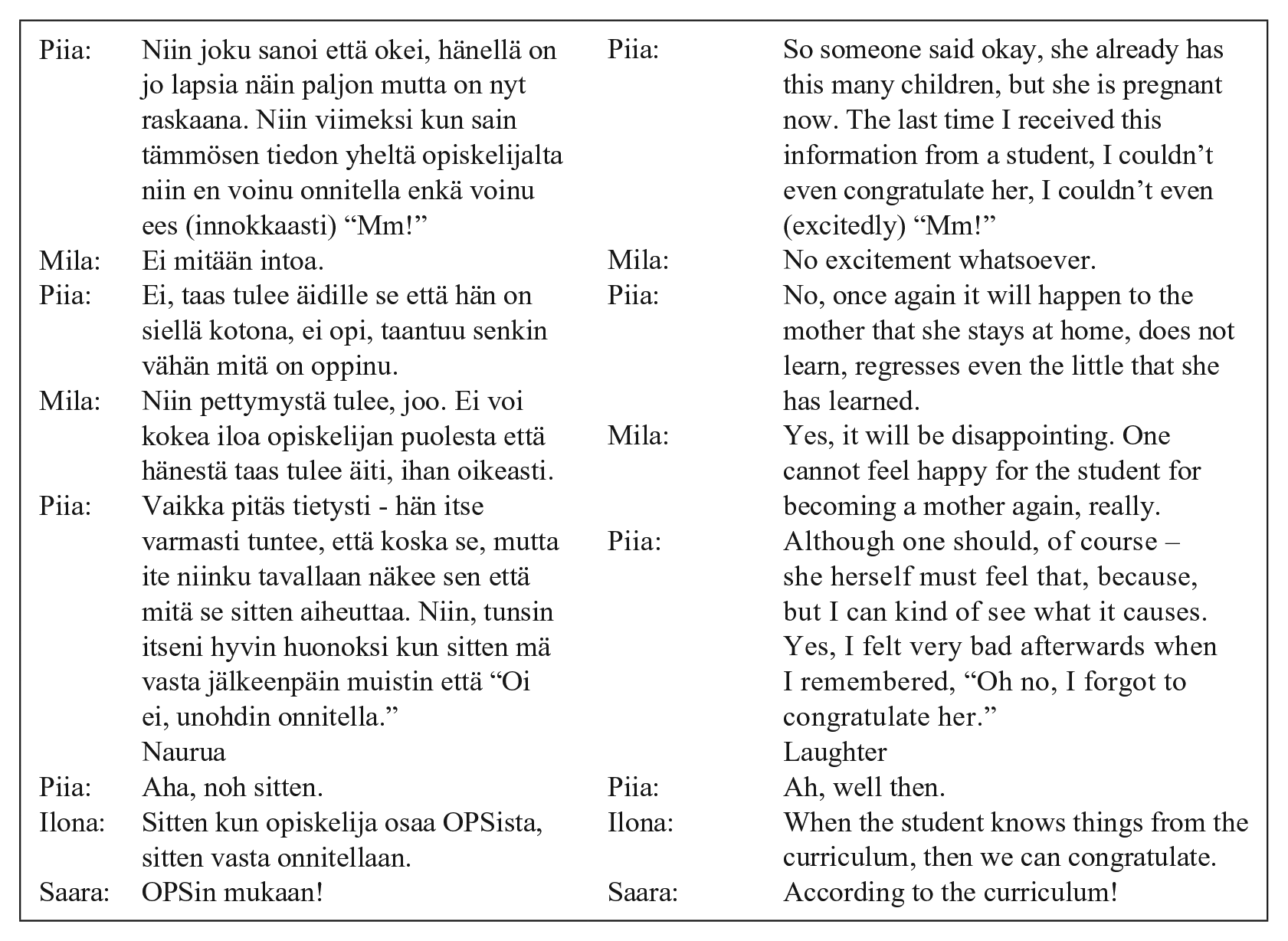
Piia shares her reaction to this announcement, which was one of disappointment and worry about the students’ interruption or potential end to her education and potentially even regressing in her learning. While the teacher’s view is based on her previous experiences as a language teacher, there are also several larger societal discourses that link to her statement and the conversation as a whole. The teacher continues by expressing her regret at not congratulating the student, which is followed by teachers self-ironically joking that only once the learning aligns with the curriculum, students are to be celebrated.
This instance illustrates the teachers’ conflictedness between promoting the goals of the curriculum and their empathy toward their students. Several larger societal dynamics are reflected in this exchange, which we outline here. First, the teachers’ worries may be related to the (explicit and implicit) goal of ABE to transition students into working life. Although adult basic education in Finland is conceptualized as “general education” rather than labor market training, there is an emphasis on the curriculum on preparing students for working life.
Basic education. . . promotes the social integration of students and the integration of adults with an immigrant background by providing them with adequate linguistic and social skills. In basic education for adults, special attention must be focused on employer connections, working-life skills and the development of skills that support employment. (Finnish National Agency for Education, 2017: 22.)
This quote from the curriculum highlights the central role of working life discourse that may also shape the teachers’ understanding of what knowledges are important. Pregnancy and child-rearing are seen as an interruption to the building of these knowledges, rather than as an epistemic resource. Within the teacher’s genuine concern for her student, other societal discourses may be reverberating, such as the fact in Finland even highly educated migrants are positioned as a subordinate class of workers who are not entitled to the same protection or welfare privileges as Finnish citizens and lack upwards mobility (Ndomo, 2024). The interruption of the studies due to the pregnancy may thus further jeopardize the student’s already precarious position in the labor market. In addition, the teacher’s discourse may also reflect her liberal feminist views, which emphasize the importance of employment and education as the foundation of gender equity. Although the centrality of work and financial security cannot be denied, such a convergence of liberal feminism with employment/market logics is a common phenomenon in the Nordics, a discourse which conflates women’s rights with a neoliberal agenda and thus factually undermines gender equity and women’s welfare (e.g. Ylöstalo, 2022).
White, liberal feminism also ties in with nationalist and racist ideologies. For instance, stay-at-home mothering of racialized women is likely to be viewed as oppressed and outdated practice, whereas for white women it is more likely regarded as a choice (see Bauer et al., 2023: 127). As Honkasalo and Hjelm (2020) have shown, in Finland and Finnish media, migrants and “racial others” tend to be constructed as a group that maintains conservative gender roles, while Finnish society as a whole is constructed as gender-equitable space. On an individual level, the stereotype of the independent “Nordic woman” emerges in juxtaposition with the “victimhood” of migrant women and a migrant “mass” from non-Western countries whose understanding of equity and family relations is depicted as limited and antiquated (Leinonen and Toivanen, 2014: 163). This type of “racial nordicisation” is based on the imaginary of Nordic countries as exemplary bearers of the egalitarian tradition and welfare state, and the conviction that gender equity is a defining feature of Nordic politics and social relations, which in turn creates a socio-moral superiority both in relation to non-western and other European countries (Keskinen, 2022: 17–18).
Racist tropes such as that of oppressed stay-at-home mothers concern particularly Muslim women or women of Arab descent. Brink Larsen (2009), who studied how Danish social workers view their clients, explains: Arabic women in particular are constructed as not only representing an inferior culture, but also as subordinate victims of culture who should be helped to assimilate. Rather than being recognised as agents, Arabic women are constructed as the objects of an integration politics marked by assimilation practices. (Mulinari et al., 2009: 13).
Although education, and language learning, play an important role in women’s independence, Edalati and Imani (2023) showed that the victim-stereotype tended to stick with Muslim women, even after having lived in Finland for years, learned the Finnish language, obtained a prestigious job, and stopped wearing the hijab. One of the women in their study shares: Although I am reluctant to explain and justify my religious views regarding women’s rights to white people, in many cases, I must do it. They perceive me as an oppressed woman, regardless of whether I am an engineer, I have a good job, or I am an active woman in society (p. 90).
Although it is important to show the larger societal discourses that permeate the teachers’ exchange, this does not diminish the teacher’s sincere concern for her student. In Finland, the women’s movement has managed to put policies in place that support women’s access to the labor market, for instance through accessible daycare and family benefits that (in theory) promote equal parenting (Jallinoja, 1988; Mickwitz et al., 2008). However, navigating this system of family planning and child rearing requires and builds knowledges that the example above does not take into account. An epistemic line (Ndlovu-Gatsheni, 2020) is drawn between the knowledges valued and promoted by the ABE curriculum (and the larger society), and the students’ unrecognized and undervalued knowledges that lie within the realm or parenting but remain unnamed. Although pregnancy and motherhood may be rich epistemic spaces, they are positioned as infringing on academic knowledges. However, as Piia identified and redrew the line between those knowledges, her and her colleagues’ self-irony about the unquestioned and powerful position of the curriculum indicates self-criticality and points to a potential opening for an alternative perspective on what counts as valuable knowledge. This may provide spaces to consider knowledges of motherhood and childrearing in their own right, as well as their potential to be leveraged to fulfill curricular expectations.
“There’s some kind of math there”
In the third workshop, we discussed translanguaging as a pedagogy and focused on how the content and the pedagogical practices could support translanguaging and epistemic justice in the classroom. We divided the participants into three small groups and provided prompts for reflecting on their teaching experiences and practices. The purpose of this exercise was to make the teachers aware of the practices they already engaged in and encourage them to employ translanguaging practices as a means to support students’ language learning and epistemic equity in more varied and conscious ways. Literacy teacher Timo commented: (Example 2, Workshop 3, November 2022)
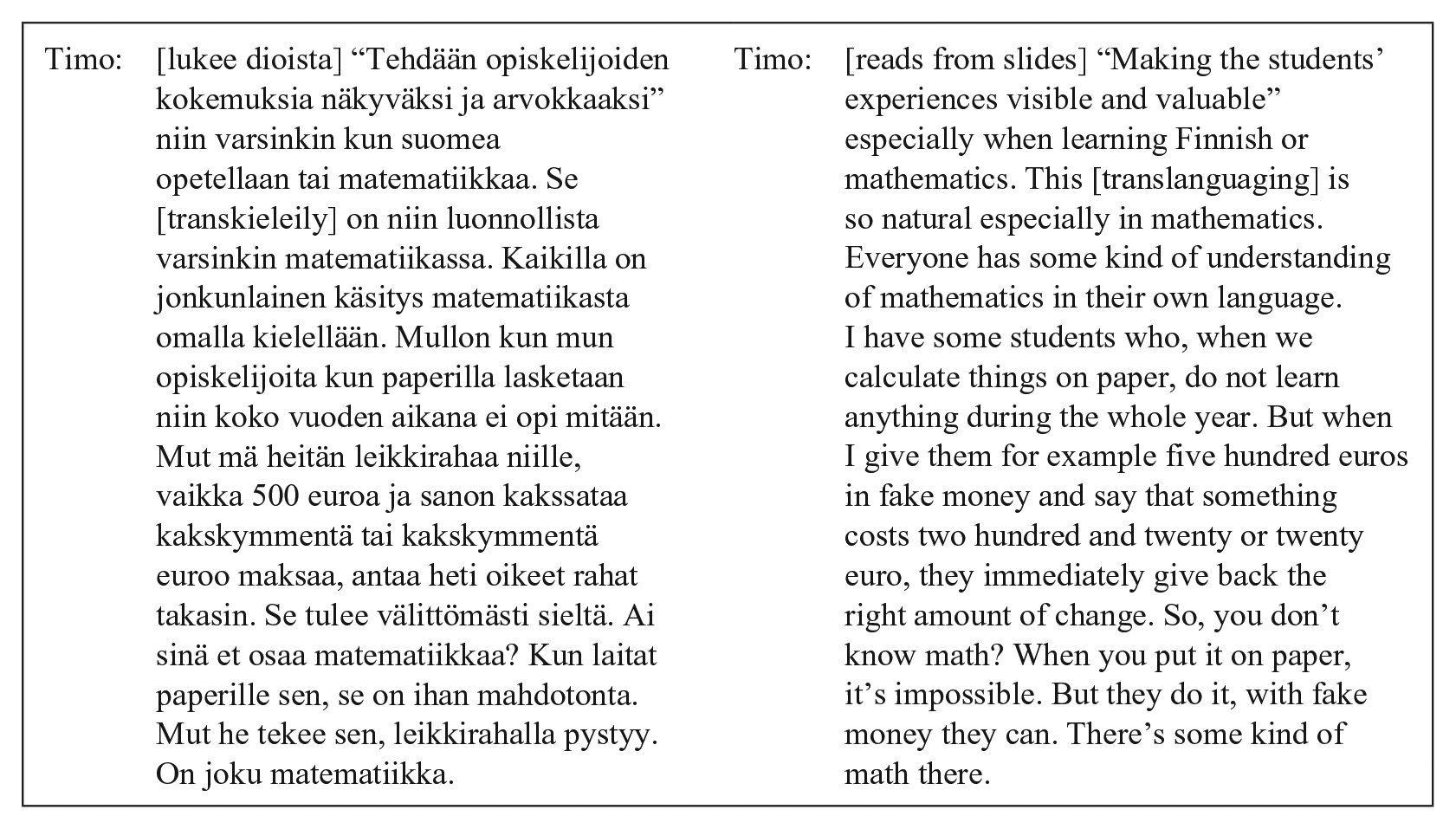
In this example, Timo intuitively links the language of mathematics, which is sometimes considered a “universal language,” to the topic of the workshop (translanguaging). It is noteworthy that the students that Timo is referring to had early-stage print literacy skills upon arriving in Finland, which might be why calculating things on paper was not their preferred way of doing maths. Traditional literacy-heavy assessment methods like tests or quizzes may not capture their mathematical knowledges accurately. However, through the use of fake money, the teacher was able to position them as knowers in the classroom.
During the workshop, many of the teachers came up with examples of how their students had managed mathematical everyday tasks (e.g. when working as salespersons) by using calculators or fingers. At the same time, the students’ math knowledges sometimes remained inaccessible to the teachers. In these cases, the teachers shared that they would ask the students to learn another, “Finnish” way of doing math, as the next excerpt shows.
(Example 3, Workshop 3, November 2022)
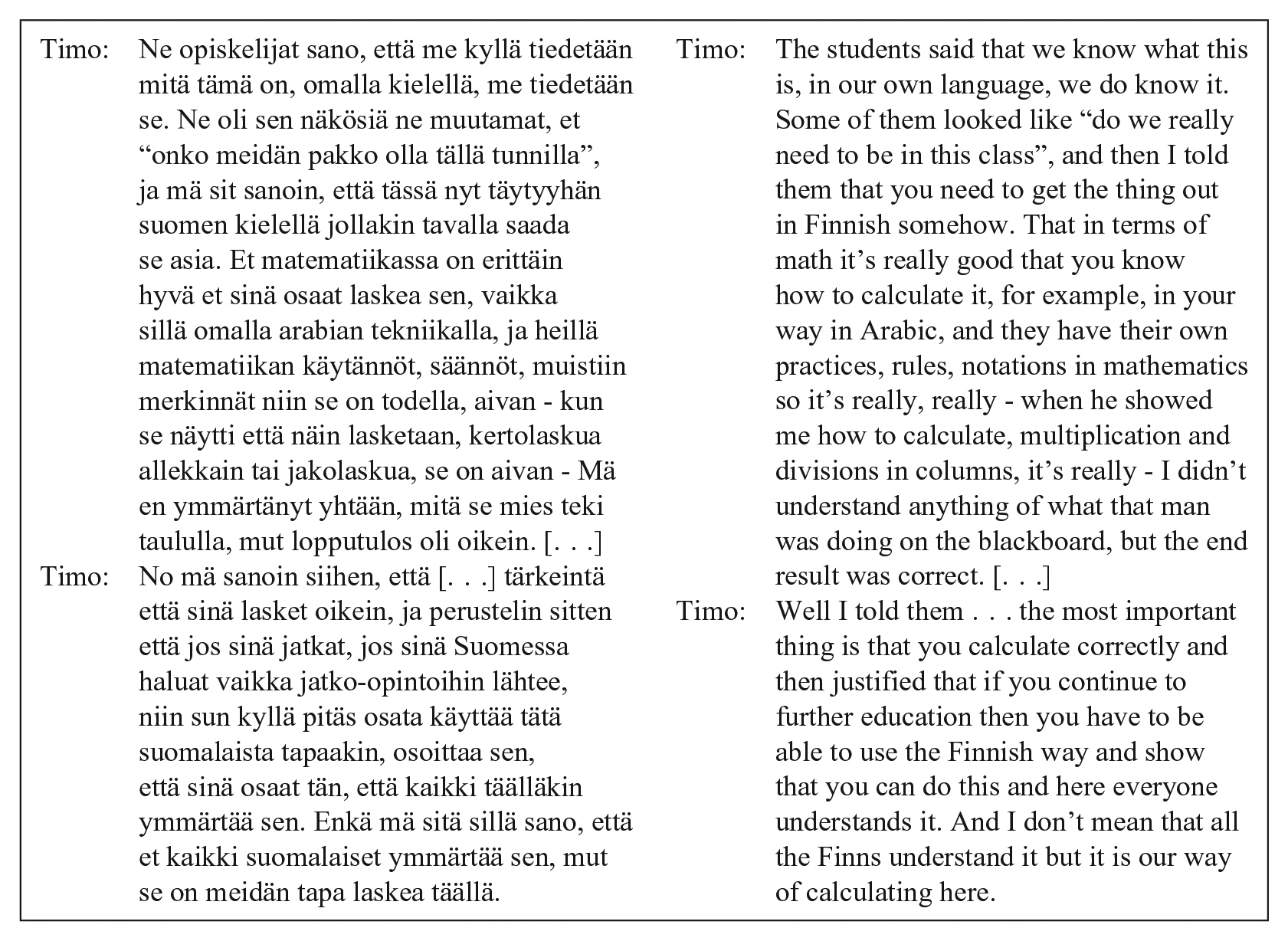
As prior studies have shown, especially learners with interrupted pathways in formal schooling are sometimes dismissed as legitimate knowers because the connection between their life experience and the educational goals is not always evident (e.g. DeCapua, 2016). However, the teacher in our scenario allowed space for the student to demonstrate their knowledge, thus blurring the epistemic line between the (curricularly) recognized way of doing math and the students’ way. Importantly, although Timo did not understand everything the student did, he legitimized the student’s knowledge in the classroom, thus positioning the student as a knower.
On the other hand, the teacher is operating within the Finnish education system, and therefore sees it as his responsibility to teach the students “the Finnish way” of doing maths. He justifies this by referring to the requirements of upper levels of education, where the students will, according to the teacher, have to be able to demonstrate their math knowledge in “the Finnish way.”
Importantly, the idea of a “Finnish way” of doing math was immediately challenged by the other teachers in the group. In response to Timo’s turn, teachers brought up experiences of struggling when helping their children with their math homework, due to some things having changed over time. For instance, Ilona, who attended school in Russia, shared that: When I am doing math homework with my kids. I needed to do a simple division, but how is it written down in Finland? Already there my brain gets tangled [. . .] Because for example if we have forty-nine divided by seven [. . .] this is how I did it at school [writes down a calculation], this is how we were taught (Workshop 3, November 2022, translated from Finnish).
Others chimed in, adding to Ilona’s experience, for instance by pointing to differences between Swedish, English and Russian ways of writing down calculations, multiplications, divisions, and decimal numbers and how they have changed through time. As a group, the teachers implied that given how math has changed through time and place, there could not be one way or even one “Finnish way” of doing math.
In sum, the epistemic line here consisted of images of “Finnishness” which define “correct” ways of doing math. It was later strengthened by notions of academic advancement: higher levels of schooling demand “Finnish math.” In this sense, the line was located “elsewhere” (in other educational institutions), and left ABE as a more knowledge-tolerant (but also less advanced/serious) space of education. The line, however, was blurred by other teachers’ recognition of different math knowledges. Here, the role of the group was essential as their collective knowledge exchange led to the recognition of the temporal and spatial variations in doing math through different languages. Importantly, in their interaction, teachers drew on their own parenting knowledges and knowledges of leading multilingual and multicultural lives, a process that, for example, Heugh et al. (2021) as well as Ennser-Kananen et al. (2024) have described as “transknowledging,” which allowed them to blur the epistemic lines of mathematics.
The line of comprehensibility
Throughout the workshops, teachers seemed torn between their empathy for the students and pressure to comply with curricular and workplace expectations. As they spoke about the challenge of eliciting (standard) written or spoken Finnish from students, they reflected on their willingness to accept or reward non-standard student output as a potential disservice to their students. While they identified “understanding of second language users” as a skill they had developed, they also argued that (over)using this skill would interfere with preparing their students for their workplace practicum or working life. The following excerpt shows an interaction between Finnish literacy teacher Mila, cultural studies teacher Emilio, and Finnish teacher Ilona.
(Example 4, Workshop 2, November 2022)
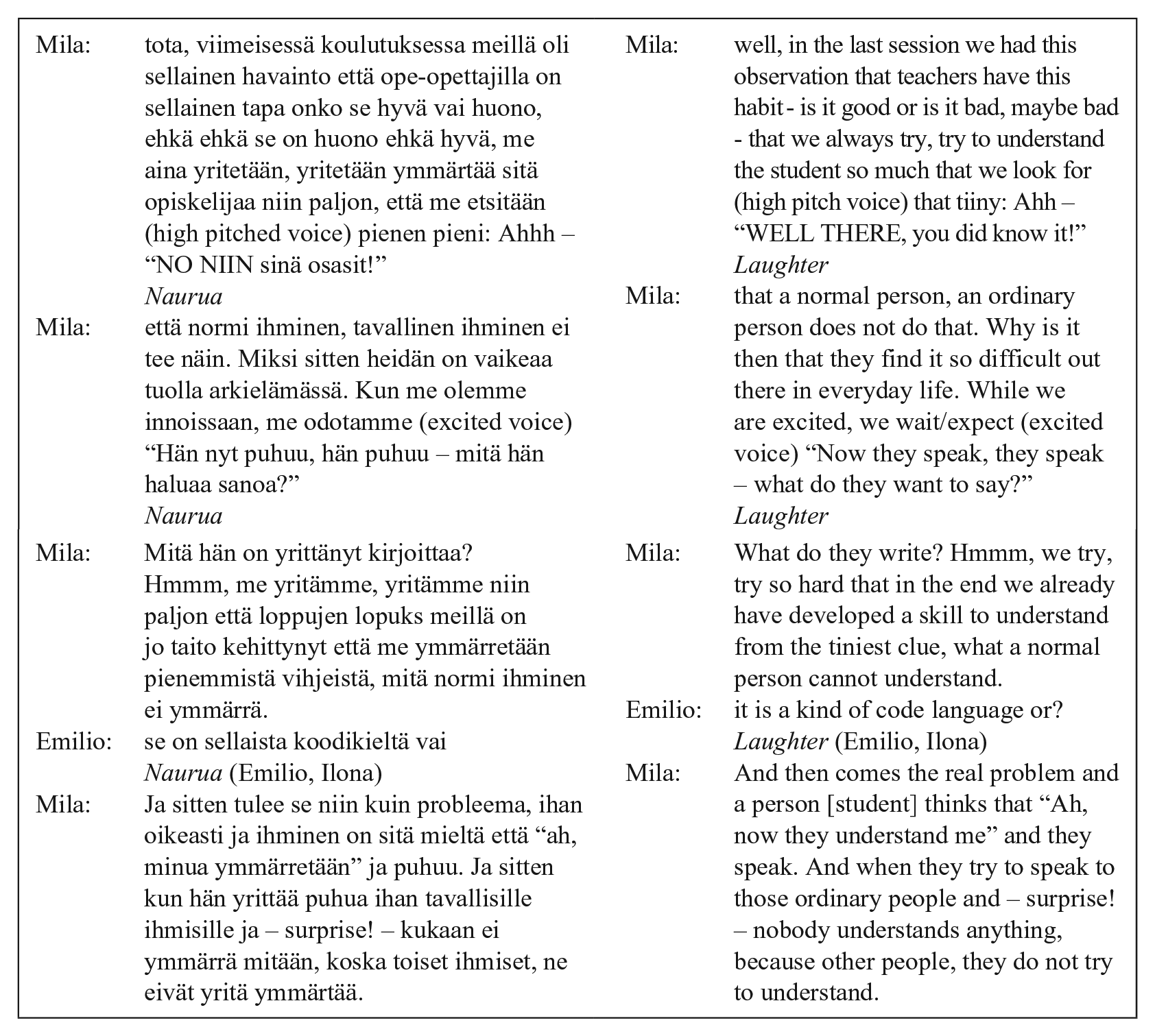
Several points are noteworthy in this data excerpt, in which the conversation revolves around Mila’s question “Yritämmekö me liikaa?” [“Do we try too much?”].
First, the teacher reports about herself and her colleagues having developed a special skill of understanding students, even if their language output is limited to “the tiniest clue.” The linguistic practices of the students are framed from a deficit perspective as truncated “code language,” which is implicitly juxtaposed with “real life” or legitimate language. Through these framings, an epistemic line is drawn between the students’ language practices and those of the teachers, with language on the one side and “code language” or “tiniest clues” on the other side. Among others, Mitova’s (2020) has pointed to the interaction between linguistic and epistemic oppression and explained that a dismissal or deprivation of colonized people’s language “leaves them at a permanent disadvantage as the eternal second-language speaker” (p. 202). Recalling Ndlovu-Gatsheni’s (2020) point about the epistemic line also constituting an ontological line, this permanent second-language user identity also perpetuates their identity as second-class humans. However, the conversation during the workshop did not end at drawing this line.
At the same time, teachers also reported having a “special skill” for understanding the “code language” on the other side of the line. In our fieldwork, we regularly witnessed some of the teachers mouthing words along with students, modeling how to produce different sounds in one’s mouth, creating situations that would encourage students to speak Finnish, and listening to them with great attentiveness (e.g. Fieldnotes January 2021). In the data excerpt above, Mila addresses the teachers’ ability and experience of crossing the line, which seems to be a common but somewhat contested process. As she shares, students have reported not being understood by people outside of the school context, whom she refers to as “normal people.” Noting a tension between what the students speak (“code language”) and what “normal people” understand, the teacher questions her and her colleagues’ teaching approach, suggesting that maybe they “try too much.” She points to an imbalance of the communicative work in the classroom, which might end up doing a disservice to the students, as it does not seem to prepare them for everyday life. Importantly, this dismissal of students’ language as “code language” goes hand in hand with the dismissal of teachers’ “special skill” of understanding them. While this skill could also be viewed as an extremely valuable one, particularly in linguistically and culturally diverse contexts, here it is identified as an obstacle to students’ success in the “real world.”
Additionally, while this data piece can be interpreted as teachers drawing an epistemic-linguistic line, it is worth pointing to the larger societal ideologies that are at play: First, the discourse of “preparing students for worklife” resurfaces here and seems to cause expectations for teachers that they worry about not being able to meet. This relates to the second point, which comes up at the end of the data excerpt, when Mila notes that “other people . . . don’t try to understand.” What she notices here is an unwillingness of “other people” to engage in communicative work with the students, or an unpreparedness of negotiating meaning with students whose linguistic, racial, and educational identities are marked as “other” in the Finnish local and societal context. Several instances the teachers shared during and outside of this workshop offer evidence of students being harassed or mistreated by locals (e.g. Ennser-Kananen, 2021). Dotson (2011) has described such refusal to understand and engage with others as an act of epistemic violence. Through the concept of “testimonial competence,” she emphasizes the responsibilities of audiences to contribute to successful interaction: “(P)art of the demand on an audience to communicatively reciprocate in linguistic exchanges . . . is demonstrating testimonial competence. Without such a demonstration, audiences execute epistemic violence on speakers.” (p. 251). Relatedly, the locals’ unwillingness to understand the students as described by the teacher can be understood as what Flores and Rosa (2015) describe as “white listening subject,” a raciolinguistic concept: The white listening subject rejects the legitimacy of racialized language practices in ways that are unrelated to empirical linguistic forms. Instead, it hears linguistic deficiency in racialized speaking subjects even when they engage in language practices that would be deemed normative were they produced by a white speaking subject (Flores and Rosa, 2015 para 4).
Even though the teachers seem to have the skills to cross the line of comprehensibility, the question of crossing remains contentious. It seems that teachers are (also) asking: How can we prepare students for situations when there is less willingness to understand them? In other words, can language education, or any education, prepare students for acts of racism and raciolinguistic ideologies?
Conclusions
We end this paper with five conclusions, hopeful that they will inspire more work that facilitates line-crossing and -blurring in educational settings permeated by the hegemony of Eurocentric knowledge systems.
First, as our analysis has shown, epistemic lines are complex intersections of (perceived) pedagogical and societal expectations (e.g. working life readiness), linguistic and raciolinguistic ideologies (e.g. comprehensibility), and social hegemonies and discourses that are informed by different systems of oppression and liberation (e.g. white liberal feminism, refusal to reciprocate). Crossing such lines can thus feel like a monumental task and requires multi-dimensional support. To move toward an epistemically just education, pedagogies and curricula are needed that refuse to draw restrictive epistemic lines in the first place and recognize students as knowers from the start, but also provide tools and spaces for dismantling epistemic boundaries.
Second, our analysis provided insights into the processes of epistemic line crossing and blurring, such as the central role peer support and exchange played for embrittling epistemic norms. For example, teachers engaged in a process of collective constructing and deconstructing of epistemic norms, or what Ennser-Kananen et al. (2024) have called transknowledging, when they complicated the notion of a “Finnish way” of doing math. To do so, teachers and researchers used their experiences as parents and migrants, with the effect that the line lost its absolute power in the collective transknowledging process. Our study thus identified collective engagement in transknowledging as a potential tool of epistemic justice, which may inspire epistemic justice work in other contexts. For instance, the drawing on time (“Math has changed.”) and place (“Elsewhere this is done differently.”) could encourage epistemic line-crossing in all subject areas. We further found humor (self-irony) and specific teaching strategies (e.g. use of fake money) to encourage line-blurring.
Third, our analysis highlighted teachers being affected by epistemic lines. In our first example, Piia expressed self-criticality about not congratulating a student on her pregnancy. Ridiculing the curriculum as the only and highest value, the teacher opened the door for other truths. Despite her sincere concern for her student, Piia understood that other values can (and must) overrule the goals of entering working life. However, her emotionally laden narrative also reveals an intense discomfort, which may relate to the tension she has observed between enjoying motherhood and obtaining an education. We suggest that this affect is a place where line-crossing can start. Rather than “overcoming” it, it can be redirected into social critique that considers what structural changes are needed so that pregnancy or motherhood do not pose an obstacle to education. We argue that the affect that comes with recognizing and negotiating lines can be an important door-opener and encourage scholars as well as educators to remain affected by epistemic negotiations.
Fourth, we showed that the epistemic legitimacy of different knowers is intertwined. In our third example, the teachers discussed their skill to understand their students “from the tiniest clue.” Rather than viewing this as a potential disservice to the students, this could be understood and even promoted as critical knowledge for schools and host societies. However, with the focus on aligning with curricular and societal expectations of Finnish teaching and learning, this important skill, a part of their teacher knowledge, became devalued: As the students’ language is denigrated to the level of a “code,” the teachers’ skill of understanding them becomes a potential risk or disservice for students. This scenario illustrates the intertwinedness and interdependence of students’ and teachers’ epistemic legitimacies and thus highlights the need for strategies that enable line-crossings (or line-refusals) for all. An epistemically aware curriculum could make space for negotiations of epistemic line-crossing that is inclusive of all members of an educational community.
Finally, our analysis pointed to the importance of naming the epistemic line. While line crossing is not always a possibility, also acknowledging and identifying the line is an important step. This involves explicitness and transparency about existing lines and the reasons why some knowledges are deemed legitimate or valuable, such as in the case of different ways of doing mathematics. This does not equal epistemic relativism, but rather motivates critical and self-critical recognition of epistemic diversities and questioning of epistemic hierarchies with the goal of flattening them.
Overall, the questioning and crossing of epistemic lines and the recognition of a variety of knowledges in educational settings in Europe and beyond challenge institutional or curricular epistemic universality and make the diversity and co-existence of different knowledges visible. Important theoretical contributions in this area have been made, for instance, by Posholi (2020), Ndlovu-Gatsheni (2020), and Grosfoguel (2011), who have outlined pathways toward epistemic decolonization. Additionally, scholars across disciplinary and geographical contexts have examined how epistemic justice can be approached in practice (e.g. Boni and Velasco, 2020; Kerfoot and Bello-Nonjengele, 2023; see also Ennser-Kananen et al., 2024 for more examples). These examples encourage us to move forward, knowing that spaces of epistemic justice are both possible and real.
Footnotes
Declaration of conflicting interests
The author(s) declared no potential conflicts of interest with respect to the research, authorship, and/or publication of this article.
Funding
The author(s) disclosed receipt of the following financial support for the research, authorship, and/or publication of this article: This study was part of a larger research project funded by the Research Council of Finland (2020-2025, grant number #332390, PI Johanna Ennser-Kananen).
Ethical approval and informed consent statements
All participants consented to participating in the study. Informed consent was built continuously and in multiple languages and modes. The ethical committee of JYU was informed about this study but did not require a full review.
