




Abstract
The benefits of cooperation between school and parents for students’ well-being, learning, and academic development are widely acknowledged. However, schools often face challenges in establishing cooperative relations with parents, and teachers sometimes perceive interactions with parents as burdensome. Despite its assumed relevance in shaping parent-teacher relationships, the legal framework has received little attention in the previous literature. This article addresses this gap by conducting a comparative analysis of the legislative framework in five countries: Germany, Israel, Italy, the Netherlands, and Switzerland. The analysis focuses on how parental role is defined in the legislation, the terminology used to describe the parent-school relationship, and the extent to which cooperation and shared responsibilities are legally emphasized. The findings reveal that all countries examined include references to the cooperative nature of parent-school relationships in their current legislation, though the scope and specificity of individual and collective rights vary. The article concludes with a discussion on why legal frameworks are necessary but not sufficient for establishing effective cooperation between schools and parents.
Keywords
Introduction
For some decades, the general discourse in literature across Europe and beyond has highlighted the benefits of a good relationship between school and family. This vision, largely driven by empirical studies (e.g. Hoover-Dempsey & Sandler, 2005) and considerations of Epstein and her research group (e.g. Epstein, 1987; Epstein et al., 2019), has received broad support from many actors in diverse countries (Kirmaci, 2019). Since then, terms such as “partnership” and “cooperation” have been widespread in definitions of the parent-school relationship. In this particular context, cooperation can be defined as “a process based on mutual communication, support, sharing of responsibilities and joint activities to achieve the optimal development of the child” (Višnjić Jevtić, 2023: 136). Empirical research confirms that a well-established relationship between parents and teachers is important in improving the academic outcomes of disadvantaged groups, such as children from a lower socioeconomic background or from ethnic minorities in particular (e.g. Anthony-Newman, 2024; Hoover-Dempsey & Sandler, 2005; OECD, 2022), but not only these groups (Jeynes, 2024).
A key factor in experiencing this relationship as cooperative is when teachers treat parents as competent and knowledgeable about their children’s needs, and as equal, capable partners in decision-making regarding their learning and development (Hoover-Dempsey & Sandler, 2005; Minjarez et al., 2013). In such cases, teachers provide parents with a sense of ownership and commitment to the school, moving beyond a one-way flow of information directed at parents (Goodall & Montgomery, 2014: 404). However, empirical research shows that, in practice, establishing this kind of positive and mutually beneficial relationship can be challenging (e.g. Gwernan-Jones et al., 2015; Jeynes, 2024; Santiago et al., 2016). This appears to be the case across Europe and beyond (for a previous review of European countries: Dusi, 2012).
School practice is shaped not least by legislation and governmental guidelines. Yet legislation has been underexplored to date in the scientific literature (Winton & Parekh, 2020). It remains unclear whether legislation and policy contribute to the challenges and problems encountered in practice. Therefore, this paper focuses on the legislation and policy documents shaping the parent-school relationship in five different countries. We investigate the ideas and forms of this relationship in these documents: Are there differences between the countries on this topic, and if so, can they be explained by specific aspects of the respective education system?
First, we briefly revisit the developments of this relationship in the past and then identify the constitutional aspects of education systems relevant to our comparative analysis. In the methodology section, we characterize the differences of the five countries and describe the analysis procedure. In the next step, we conduct the comparative analysis by highlighting common themes and divergencies that emerge, and finally discuss the relevance of legislation and policy in shaping and establishing relationships between school and parents.
Theoretical background
Parent-school relationship redefined
During the democratization of European society in the late 1960s, many areas of social life experienced a renewal and redefinition of individual rights. Although there had already been some effort to give parents more rights in schools between the two World Wars, a broader political discourse about parents accelerated in most nations during the 1968 movement (Ostner et al., 2017) as they asked for more democratic rights and opportunities to participate in schools. Consequently, from the 1970s onwards, parental rights were granted in many countries to varying degrees. Although the effects of socio-economic background on learning outcomes were well-known and have been analyzed critically (Bourdieu & Passeron, 1976; Coleman, 1988), the political discourse got a second huge boost when the first PISA results were published (OECD, 2001): There was now evidence that learning outcomes depend largely on parents, more precisely on their socio-economic background and education. Many studies and meta-studies (e.g., Barger et al., 2019; Gibbs et al. 2021; Hoover-Dempsey & Sandler, 2005; for a summary see Hillmayr et al., 2021) clearly showed that parental involvement happens in diverse ways: As academic socialization (when parents take part in their children’s education through cognitive stimulation and encouragement), as home-based involvement (when parents support their children’s learning activities at home), and as school-based involvement (when parents maintain formal and informal contact with teachers, support school activities and participate in school boards). Therefore, parents have now received attention not just as supporters at home, but also as participants and actors in schools. However, there have been critical studies pointing out that those tendencies ignore the heterogeneity of parents, and that the right to participate in school life is not claimed nor used by every parent (De Carvalho, 2000; Ostner et al., 2017; Van Zanten, 2005). Despite these considerations, the normative discourse, which includes an equality rhetoric, continues to demand an equal relationship based on shared responsibility between school and parents: Parents are considered as “educational and social partners” (cf. Rabusicová & Emmerová, 2002) who have valuable expertise in its own right. Against this background, the expectations of schools toward parents have considerably changed: Whereas in the 1950s contact with parents only took place when problems occurred, in the 1970s different forms of cooperation and exchange of information such as annual parent meetings were established (Epstein, 1987; Wolfendale, 1983). Currently, it seems that parents are facing new requirements and, in terms of “partnership,” parents are held more accountable for the learning processes and outcomes of their children (Ostner et al., 2017).
Even though there is a broad consensus that cooperation between parents and school is necessary for a positive school climate and good learning results, it seems difficult to put this cooperation into practice. Teachers especially are challenged by emerging expectations and the rights that parents claim or, on the other hand, by parents who keep their distance from school. In this context, it seems necessary to take a closer look at how the parent-school relationship is conceptualized in the legislation and whether this framework offers clear guidelines for teachers and school principals.
Constitutional aspects of education systems which are relevant to the present analysis
When comparing different countries in terms of their understanding of the parent-school relationship, the constitutional aspects of each education system must be considered. In our cross-country analysis, there is particular focus on whether law and decisions relating to education are made at the national, regional, or local level. According to Byrne and Paseka (2019) as well as Kirmaci (2019), the dimension of centralization vs. decentralization seems of considerable importance when comparing various countries. Decision-making is centralized if there is a high level of control at the national level (e.g. at the federal office or department of education). Decision-making is decentralized if the decision-making authority is regional (e.g. each province has the authority over education). This aspect affects how policies are implemented and the extent to which they are adapted to regional needs and culture. However, education systems sometimes undergo change, therefore terms like “centralized decentralization” or “decentralized centralization” are also frequent, highlighting a continuum between these two poles (e.g. Kaiser & Vogel, 2019; Kvalsund, 2009). Besides the aspect of centralization and decentralization, the extent to which (i.e. to what level of detail) an educational issue such as the parent-school relationship is regulated by law is relevant. A centralized authority that regulates such an issue at a very low level still allows local authorities (e.g. school boards) a lot of freedom. Thus, for our analysis, it is not only relevant whether legislation is decentralized or centralized, but also who is the decisionmaking authority in educational issues, and finally, the extent of regulation. Ultimately, the influence on school practices depends not only on governance structures such as centralization and decentralization, but the capacity of local institutions to manage responsibilities (e.g. Gibbs et al., 2021). However, local governance is not a subject of this study, our focus being on legislation.
Research questions and methodology
Although the legal framework is assumed to be a determining factor for practices concerning the school-parent relationship, research in this area remains limited (e.g. Kirmaci, 2019). This paper therefore aims to investigate how legislation and governmental guidelines in different countries conceptualize the parent-school relationship. In the debate about improving this relationship, it has been emphasized that it is crucial for schools to consider parents as equal partners and share responsibility for the learning, development and wellbeing of students with them (e.g. Epstein et al., 2019). This paper investigates whether this perspective is reflected in the current legislation of five different countries, and if so, how and to what extent.
The sample includes one country which has a more centralized education system (the Netherlands), two countries that have been strongly decentralized for a long time (Germany, Switzerland), and two countries that are shifting from centralization to decentralization (Israel, Italy). Table A1 gives an overview of further characteristics of the five education systems relevant to the parent-school relationship. However, the aspect of centralization vs. decentralization will be of particular interest when comparing the conceptualization of parent-school relationships in the five countries.
The guiding questions for the analyses and comparison are:
(1) How is the role of parents defined in legislation?
(2) What terminology is used in legislation and governmental guidelines to describe the relationship between school and parents?
(3) How is the relationship between school and parents defined in legislation and governmental guidelines?
The present study applies critical policy analysis (Young & Diem, 2017). This approach is appropriate for the purpose of the study because it focuses on policy narratives and relationships of the actors mentioned in policy documents. After identifying the critical sections addressing the parent-school relationship, document analysis according to Bowen (2009) was used. This method represents a systematic procedure for analyzing documents, by uncovering the meaning of text relevant to the research question. Its iterative process consists of skimming, reading, and interpreting text passages and combines elements of content and thematic analysis.
The analyses presented here are based on the legislation and governmental documents of each country. First, documents were selected based on their relevance at the national level, as well as at the federal state (Germany) or the cantonal level (Switzerland). In addition to the legal texts, which are unquestionably relevant due to their binding nature, some countries or federal states have supplementary policy documents that are also binding for actors in the education sector. These include documents issued by the education authorities, such as guidelines on the relationship between teachers and parents. The binding nature of the texts was therefore a key criterion in the selection process. As the authors are familiar with the topic, they had prior knowledge of the relevant documents. In countries with a decentralized education system, the relevant documents from each federal state or canton were either sourced directly or requested. In a second step, the relevant paragraphs were identified and analyzed by searching for keywords such as “parents,” “family,” and “relationship.” The authors analyzed the documents in their original languages, and the findings were subsequently translated into English for the purpose of comparison.
The answers to the first research question were found in fundamental laws existing in all countries: the Basic Law (Germany, the Netherlands), the Constitution (Italy), the Civil Code (Switzerland) and the Legal Competency and Guardianship Act (Israel). For the second and third question, the answers were partially found in national documents (e.g. decision of the Federal Constitutional Court for Germany, the Compulsory Education Act and the State Education Act for Israel, Agreements and Guidelines of the Ministry of Education for Italy, the Law on Primary Education for the Netherlands). However, in Germany and Switzerland, which have decentralized education systems, all relevant documents had to be analyzed.
Since the research group was composed of several members, each working on different documents, it was crucial to harmonize the analysis procedure. The researchers defined the procedure from the beginning (e.g. defining the three research questions) and met regularly online. After editing the first drafts of the country reports, a phase of reiterative adjustment followed: although the three research questions guided the editing process, mutual reading of the reports revealed a need to clarify the guiding questions in order to align the group’s understanding and lay the groundwork for meaningful comparison.
Despite the rigorous and well-considered methodological approach, two limitations must be acknowledged. First, although the countries selected for this study have distinct characteristics (e.g. centralized vs. decentralized education systems) that allow for meaningful comparison, the focus on only five countries is a limitation. To gain a more comprehensive picture of policies on the parent-school relationship in Europe and culturally related countries, it would have been beneficial to expand the sample. However, given the complexity of considering each national context and the challenges of managing a larger research team, we believe our approach was appropriate and feasible. The second limitation – or rather, challenge – arise from the fact that the documents analyzed and compared were originally written in different languages. This caused difficulties related to translation, as well as national and cultural sensitivities when comparing the content in English. Despite our meticulous attention to detail and critical awareness, some loss of accuracy in the translation was unavoidable. However, this seems inherent in international comparative work (see Hoveid & Paseka, 2019: 25–28).
Findings Germany (Jessica Kruska & Angelika Paseka)
In the Federal Republic of Germany, the “federal” aspect is of historical significance and affects various areas such as education, culture, and science. This “cultural sovereignty,” written into the German Constitution (the Basic Law from 1949), is considered of highest importance in all 16 federal states, consequently, there exist 16 different school acts and regulations. To coordinate the differing structures and interests and ensure a high-quality education system, the Standing Conference of the Ministers of Education and Cultural Affairs (KMK) was set up in 1948. The KMK has the authority to formulate recommendations, which the federal states can then pass into school acts. These acts usually leave room for interpretation, acknowledging regional differences as well as school autonomy.
The role of parents in German legislation
Although the German system can be categorized as decentralized, the Basic Law assigns nationwide governmental responsibility for education. Article 7 legislates that “[t]he entire school system shall be under the supervision of the state.” The state is obliged to take responsibility for ensuring the right to education and to maintain an inclusive, functioning education system. This includes guaranteeing that the prevailing compulsory schooling for children aged 6 to 15 is respected. Governmental responsibility is coupled with parental responsibility: Article 6 states that “care and upbringing of children is the natural right of parents and a duty primarily incumbent on them.” By law, parents are thus given a large part of the responsibility for raising their children. This explicitly includes respecting parents’ world views and individuality – provided, of course, that they comply with the German constitution (cf. BVerfg (Bundesverfassungsgericht), 1972, Bd. 34: 165). In addition, parents are obliged to ensure that the schooling of their children is enacted. If parents do not fulfil their legal duties, the state is allowed to intervene.
Terminology used in legislation, policy papers and educational guidelines in Germany
In 1972, the Federal Constitutional Court specified how the two articles of the Basic Law define the parent-school relationship: The goal is “to ensure the personal development of a child.” This aspect cannot be “broken down into individual competences and should be accomplished through meaningful cooperation between parents and school” (BVerfg (Bundesverfassungsgericht), 1972, Bd. 34: 165). The legal clarification of parental and governmental educational responsibility as “meaningful cooperation” has since been reinterpreted, using terms such as “parental participation”, “cooperation” and “collaboration” (“Elternarbeit,” Paseka & Killus, 2019, p. 12ff.). In more recent publications the term “upbringing and educational partnership” (“Erziehungs- und Bildungspartnerschaft”) 1 has entered the German parental discourse, which emphasizes the concept ‘partnership’ in the parent-school relationship. This partnership rhetoric can also be found in the policy papers of the federal states. An indicator for this is the fact that nationwide all legislations and regulations agree on the right of parents to participate in councils at school level as well as at different governmental levels. An interesting aspect is that the actors in the cooperation are named specifically as “parents,” “legal guardians,” or “persons with custody.”
Definition of the relationship between parents and school in legislation and governmental guidelines in Germany
In a KMK decree from 2018, the relationship is framed as a “shared task” between parents and school which is seen as a prerequisite for a functioning democracy and a functioning constitutional state (Kultusministerkonferenz Standing Conference of the Ministers of Education and Cultural Affairs (KMK), 2018). Furthermore, in referring to the Basic Law, which places educational responsibility in both parents’ and the government’s hands, it is proposed that “the mandate of the Basic Law can only be successfully implemented in a partnership-based cooperation” (Kultusministerkonferenz Standing Conference of the Ministers of Education and Cultural Affairs (KMK), 2018: 2) assumed to be based on mutual respect and acknowledgement. The overarching goal of this ‘cooperation’ is to ensure a child’s well-being, as well as to support the educational development of young people.
This type of cooperation is associated with rights and obligations of both parties, which are found in the governmental guidelines and differ slightly between federal states. An analysis of these guidelines showed that concerning the parents’ individual rights, the right for information and consultation with teachers is emphasized. The right to choose their child’s school is granted in most states, albeit with some restrictions and depending on availability. Only a few states allow parents the option to sit in on their child’s lesson in classroom. The collective rights of parents are justified by their democratic right for participation. However, even though there are councils at all levels (classroom, school, community, state, and nation), the higher the council, the lower the influence. At the highest level, for example, parents can only voice their needs without having the right to actively intervene. In order to encourage parents to realize their rights, support systems are in place which are usually financed by the municipalities. In terms of parental duties, the guidelines more or less reflect the legal responsibility for their own child (see Basic Law), as well as the willingness to cooperate with educational institutions. Schools on the other hand are prompted to guarantee a positive, welcoming climate that fosters this cooperation (Killus & Paseka, 2020). However, the practice differs greatly between individual schools.
To sum up, in Germany, legislation and educational guidelines emphasize the necessity for cooperation and partnership between schools and parents to ensure a good education for children and to support good learning outcomes. Therefore, parents are given collective and individual rights. However, the descriptions of options and ways to cooperate differ between federal states. Aside from general suggestions, schools are given great freedom to create and develop their own ideas of cooperation with parents.
Findings Israel (Audrey Addi-Raccah & Netta Sagie)
In Israel, national legislation has limited authority over education and the education system. A significant act is the State Education Act (1953) which defines the state’s responsibility for education and confirms the legitimization of the education system’s sectoral structure. There are two major sectors: the Jewish sector (79% of the student population) including secular, religious, and ultra-Orthodox schools, and the Israeli-Arab sector (21% of the student population) including Muslim, Christian, Bedouin, and Druze schools; together they represent the social fabric of Israel’s population (Gelbart et al., 2019). Both sectors are governed by national legislation and the supervision of the Ministry of Education (MOE) and follow a national core curriculum with a certain flexibility to set their particular agendas. To accommodate social diversity, the educational policy affords some decentralization. Since the 1970s, the MOE has not only handed over policy design to the educational sectors but also to local educational authorities and schools. However, the MOE still has main control of the education system, supervising central aspects like resources, core curriculum and teacher training.
The role of parents in Israeli legislation
Israeli legislation does include reference to parents’ responsibilities. Two laws govern the duties of parents towards their children’s education: Section 15 of the Legal Competency and Guardianship Act (1962) states that parental guardianship includes the duty and right to take care of a child's and young person’s needs, including their education. Section 4A of the Compulsory Education Act 1949(2007) requires parents to enroll their children in a recognized educational institution and ensure that they attend it regularly. Parents have the right to be involved in their children’s education in three spheres: (1) influence 25% of the school curriculum (State Education Act, section 6, 1953) which is mainly directed to provide supplementary enrichment programs (State Education Act, section 8, 1953); (2) be involved in protecting their children's rights, including receiving information about students’ rights, keeping their information confidential (the Student Rights Act, 2000), and maintaining their privacy (Privacy Protection Act, 1981); (3) having the right to choose the type of education for their children (e.g., educational sector) (State Education Act, section 10, 1949), change schools (Section 2, State Education Regulations 1959), and to choose between different special educational frameworks (Special Education Act, 1988). Although the legislation gives parents significant rights regarding their children’s education, this does not necessarily translate to the parent-school relationship, as presented here.
Terminology used in legislation, policy papers and educational guidelines in Israel
In previous policy papers, parents are viewed as passive with limited voice or initiative, except in domains that they pay for (e.g., the National Task Force for the Advancement of Education in Israel (Dovrat Committee), 2005). One exception is a policy paper focusing on parent-school relations (Ministry of Education Israel (MOE), 2018); our analysis of this document shows that parents are associated with terms such as “collaboration,” “communication,” “relations,” and especially “partnership,” which is mentioned around 350 times. Partnership is defined as a system of collaborations and interactions that take place between the teaching staff and parents, to promote the educational process and the child’s interests both inside and outside of school (Ministry of Education Israel (MOE), 2018; MOE, standard 6, May 2021).
Definition of the relationship between parents and school in legislation and governmental guidelines in Israel
Legislation recognizes the relevance of parents in their children’s education but does not determine the relations between parents and school. More information can be found in governmental guidelines and policy papers by the MOE that adopt a school-centric approach. This is expressed in two ways: First, school leaders are responsible for shaping the relationship between school staff and parents, and defining parents’ spheres of influence in school at the individual and collective level (Ministry of Education Israel (MOE), 2018). An example of this is the parents’ council at school whose responsibilities are determined by school principals (Addi-Raccah & Friedman, 2020). Second, in establishing a partnership, teachers’ autonomy and professional jurisdiction are preserved, while parents are perceived as a source of conflict that teachers need to manage and reach mutual consent with (Ministry of Education Israel (MOE), 2018). Overall, there are more details about the responsibilities of teachers/schools (e.g. communicating with parents) than of parents (e.g. safe internet use, informing the school about children’s needs).
In summary, parents are acknowledged as an integral component of their children’s schooling that contributes to the educational processes (Ministry of Education Israel (MOE), 2018). However, regulations and policies that focus on the parent-school relationship give schools the responsibility for determining these relations (Ministry of Education Israel (MOE), 2021; Shechtman & Bushrian, 2015). This can be understood in the context of the sectoral education system and decentralization that have seen an improvement in the status of parents in education and apparent weakening of central government. Therefore, by establishing a “partnership by school design,” there are risks of asymmetric power relations between school and parents that justify the Ministry of Education’s authority to continue to monitor and control education.
Findings Italy (Paola Dusi & Anna Lona)
Over the last few decades, the Italian school system has undergone a gradual transition from a centralized to a partly decentralized structure, now organized according to the principles of subsidiarity and autonomy of institutions. In fact, the state retains legislative competence over the general organization of the school system through the Ministry of Education and Merit, which has 20 decentralized regional offices (USRs) that guarantee compliance with educational law. Regions hold joint responsibility in certain sectors of education (e.g. early childhood education) and curricula, and have exclusive legislative competence over the vocational education and training system.
The role of parents in Italian legislation
According to the Italian Constitution, “it is the duty and right of parents to maintain, instruct and educate their children.” At the same time, the state supports families to fulfil their tasks and can only intervene “in cases of parental incapacity” (art. 30, 1948). At a constitutional level, the duty of parents to educate and instruct takes precedence over that of any other institution. However, parents must ensure their children’s schooling (ages 6–16) in one way or another, such as through home-schooling within a set of rules (e.g. home-schooled children must take an annual proficiency exam to progress to the next grade until their education is complete). The Constitutional Charter assigns both parents and school the responsibility of educating and training the new generation, giving them distinct but complementary roles. Therefore, schools and families must work together to ensure young people’s well-being. With this purpose, the National Forum of School Parents (FoNAGS) (composed of the most representative associations) was established in 2002 (Ministerial Decree 14) to promote a multi-level dialogue and consultation with parents (with regionallevel representation through FoRAGS).
Terminology used in legislation, policy papers and educational guidelines in Italy
As far as the parent-school relationship is concerned, the State has established general guidelines governing it. The place of parents in the school setting was formally recognized in 1974 (Presidential Decree (DPR) 416/74 (1974)) when they were invited to participate by joining bodies such as class, school, district, and provincial councils/boards. However, in practice, within the context of parent-school relationships, parents have played a subordinate role to the institution, as highlighted by a ministerial report (Ministry of Education University and Research Italy (MIUR), 2012b). It is precisely in an attempt to promote the parental role that the terminology used in the guidelines and national legislation regarding the involvement of parents in their children’s education was changed. Over time, there has been a gradual shift from the more formal term “participation” (class representatives), used in the decrees of 1974, to “collaboration,” to encourage a more active involvement of parents (Art. 1, Law 30/2000). In recent years, the parent-school relationship has been increasingly framed in terms of “shared responsibility” (National Institute for the Evaluation of the Education and Training System (INVALSI), 2020). In the legislative texts, education policy documents, and guidelines published by the Ministry of Education in more recent years (2007–2022), “participation,” “partnership,” “collaboration,” “cooperation,” and “co-responsibility” are often used synonymously in the same text. The parent-school relationship is defined in terms of sharing educational principles (Ministry of Education University and Research Italy (MIUR), 2012b), individual and collective participation (Ministry of Education University and Research Italy (MIUR), 2012a, Ministry of Education Italy, 2022), collaboration, and “cooperation in planning and educational processes” (Ministry of Education University and Research Italy (MIUR), 2012b, p. 2), as well as reciprocal education and exchange between teachers and parents (Ministry of Education University and Research Italy (MIUR), 2012a).
Definition of the relationship between parents and school in legislation and governmental guidelines in Italy
The current model of “shared responsibility” in the parent-school relationship is derived from an instrument called “Shared Responsibility for Education Agreement” (secondary schools, 2007), which was extended to primary schools in 2019. The objectives of this “educational contract” are outlined in the Quaderno (Notebook) (Ministry of Education University and Research Italy (MIUR), 2009: 17). These objectives include: developing new ways for schools and families to share educational models; offering teachers, parents and students opportunities for responsible interaction and participatory agreement; building a strong educational alliance based on shared intentions, methods and tools of education and instruction (Ministry of Education University and Research Italy (MIUR), 2009: 6–10). Parents and students are asked to sign this agreement when enrolling at school. Each institution drafts its own version, seeking to establish a common understanding among all parties concerning rights and duties (art.3, par. 1, Presidential Decree (DPR) n. 235/2007 (1998)) of families, students, and school (e.g. be informed and consulted about their children’s educational progress; cooperate with the school; request individual meetings with teachers; be represented in the school councils; communicate with the school to give all information necessary to achieve the educational objectives). Parents’ rights have been expanded to include the possibility of choosing a school from primary school onwards, whereas the teachers’ opinion only has an advisory value.
To sum up, there has been a recent shift in the culture and legislation surrounding the parent- school relationship in Italy. The legislative direction, supported by education policy, has sought to promote a form of parent-school relationship based on shared responsibility for young people’s education. However, the situation remains complex (Dusi, 2019). On one hand, the language reflects a re-evaluation of the relationship between teachers and parents, with the latter becoming fully recognized actors within an agreed framework. On the other hand, the difficulty of transferring this intention into practice becomes evident, challenging schools to “introduce new modes of organization that are capable of promoting increased parental involvement in the life of the school by holding parents jointly responsible for education” (Ministry of Education University and Research Italy (MIUR), 2012b, p. 2). The main issue appears to be respecting the roles, competences, tasks, and freedom of both parents and teachers (Ministry of Education University and Research Italy (MIUR), 2012a; b). The path suggested in the ministerial documents is grounded in the school’s sense of social responsibility and its central role in fostering the educational community through the creation of educational pacts (Mulè, 2022; National Institute for the Evaluation of the Education and Training System (INVALSI), 2021). The overall picture is one of change but also resistance and fragility on both sides.
Findings The Netherlands (Hélène Leenders & Johan de Jong)
The Dutch education system is centralized at the national level: All school acts and regulations are implemented and also evaluated nationally (e.g. Ledoux & Waslander, 2020). The Education Council, an independent advisory body, provides solicited and unsolicited advice to the Ministry of Education and Parliament. Its reports are based on scientific expertise, and informed by knowledge and experience from educational practice and education legislation and policy. The Dutch Inspectorate of Education also brings out annual reports about the state of education, based on key figures and statistical data from the Central Bureau of Statistics. Both institutions have significant influence on the national debate on educational (in)equality and (in)opportunities (e.g. Education Council, 2020; 2021; Inspectorate of Education, 2023), and on political decision-making.
Typical of the Dutch education system is the so-called ‘freedom of education’, enshrined in the Dutch Constitution since 1920 (Central Government, 2023), which allows anyone to establish a school and operate it according to their own beliefs. Public schools and schools founded on a religious or philosophical view are given equal consideration for financial support from the government. Schools are supervised by the government and regulated by law, but because of the freedom of education they have a lot of autonomy (Rietveld-van Wingerden et al., 2003). Schools have their own control over the educational content (curriculum) and decide for themselves how they will put guidelines into practice, while being accountable to the Inspectorate of Education.
The role of parents in Dutch legislation
According to the Law on Primary Education (Central Government, 1998/2024), parents have the right to be informed about the school (through the school brochure) and their child’s progress (through biannual reports). At the end of primary school, parents receive a copy of the school’s recommendations for secondary education (Central Government, 1998/2024). The Participation in Schools Act gives parents the right to discuss school policy in the Participation Council (Central Government, 2006/2023). Schools are obliged to formulate a clear vision of how to collaborate with parents. Each school may expect parents to (1) inform the school about important developments of the child; (2) provide a stimulating learning environment at home; and (3) cooperate constructively with the school in the child’s interest (Huisman et al., 2017).
Terminology used in legislation, policy papers and educational guidelines in the Netherlands
A critical report published by the Education Council (2010) concluded that “strengthening of parental involvement in school” is needed to fight inequalities of educational opportunities for children. Parents and schools should be considered as partners. The terminology “enhancing parental involvement in schools” is an appeal to schools and teachers to develop a more open and collaborative attitude towards parents.
More recently, the Dutch government has conceptualized the parent-school relationship explicitly as “shared responsibility.” Interestingly, this concept is embedded in national legislation on both education (in schools) and upbringing (at home or in youth care facilities), respectively in the Law on Inclusive Education (Ministry of Education the Netherlands, 2014) and the Law on Youth (Ministry of Health the Netherlands, 2015/2020). The focus is still on providing equal opportunities for all children, but there is greater urgency around the conceptualization of “shared” and “responsibility.” The Law on Inclusive Education indicates explicitly that all schools and all parents have a “shared responsibility to optimize development opportunities for children.” All schools, not only special education schools, have the duty to accept and care for children with (mild) special educational needs, the so-called “duty of care.” Teachers and parents are expected to “seek the best special support together” (Netherlands Youth Institute (NJI), 2014) and parents need to give their consent for extra support offered by the school.
Definition of the relationship between parents and school in legislation and governmental guidelines in the Netherlands
The Law on Primary Education (Central Government, 1998/2024) mainly defines the parent-school relationship in terms of mutual rights and obligations. Despite the use of the term “collaboration,” parents and teachers are supposed simply to give information to each other, in a one-way process (Leenders et al., 2019). Since 2013, the concept of “parents as partners” has become more widespread in schools and training institutes. Teachers need to talk with parents about effective strategies in the home environment and make sure that parents are able to support their children’s school career (Barger et al., 2013). This is consistent with the Minister of Education’s “parents as partners” definition in the Letter to Parliament in 2014 (Bussemaker, 2014). However, due to the schools’ autonomy in basic primary education law, it falls to principals and teachers to put educational partnership into practice.
From 2015, the concept of “shared responsibility” is embedded in the “Richtlijn samen met ouders en jeugdige beslissen over passende hulp” (guidelines deciding together with parents on appropriate care) by a broad collective of practitioners, including the national associations of educationalists, social workers and psychologists (Bartelink et al., 2015). The guidelines are used in all domains where professionals meet parents of children with problems, except for schools. In the Netherlands the wish for shared responsibility clearly exists, but the current asymmetrical power in the relationship between parents and teachers emerges as a barrier to shared responsibility (Leenders et al., 2021).
To sum up, in the Netherlands, parental involvement is gradually being strengthened both in legislation and policy. Parents are increasingly recognized as equal partners in education. However, whereas policy guidelines strongly encourage schools and parents to take joint responsibility, it is difficult to put shared responsibility in practice.
Findings Switzerland (Caroline Villiger)
Switzerland is a federal and multilingual country comprising 26 cantons and has a decentralized education system. It does not have a national Ministry of Education, therefore each canton is responsible for compulsory education and has its own legislation. However, the cantons are in close collaboration with each other through the Swiss Conference of Cantonal Ministers of Education, the committee responsible for national coordination of educational policy. In recent years, 15 cantons have agreed to harmonize important goals and structures of compulsory schooling, and they are continuing with this harmonization. The cantonal laws generally define how the education system is organized, and determine the rights and duties of the different actors.
The role of parents in Swiss legislation
The Swiss Civil Code (Schweizerisches Zivilgesetzbuch [Swiss Civil Code], 2024) defines the duty of parents to educate their children (“Parents shall bring up their children in accordance with their circumstances and promote and protect their physical, mental and moral development,” ZGB, Art. 302). It also mentions that they should “provide the child [. . .] with an appropriate [. . .] general and vocational education” and cooperate with the school in an appropriate manner (cf. Schweizerisches Zivilgesetzbuch [Swiss Civil Code], 2024). At a national level, this is the only legal regulation that defines parental duty with regard to upbringing and education; all other aspects are regulated by the cantonal school laws.
Terminology used in legislation, policy papers and educational guidelines in Switzerland
When it comes to specific issues like parent-school relationship, cantonal regulation is minimal. The cantonal laws offer a general framework for defining this relationship, but schools are autonomous in how they implement it in practice. Consequently, regulation occurs primarily at the community level by the school board or the school commission (Neuenschwander, 2020; Sui Chu Ho & Vasarik Staub, 2019).
The parent-school relationship has grown in importance in Switzerland over the last two decades (Vasarik Staub et al., 2018). The report of Cusin and Grossenbacher (2001) was one of the first publications to address changes in the school-family relationship since the 1970s, and systematically analyzed cantonal documents and survey data to determine how each canton shapes this relation. The report points out that the term “partnership” has been used increasingly during this period to describe the school-family relationship in Switzerland. When analyzing current law texts and regulations, this tendency is only partly reflected in the terminology. Similar investigations of a recent database by Villiger et al. (2020) showed that about 80% of cantons use the terms “collaboration” and/or “cooperation,” whereas the remainder do not explicitly use them. Seven cantons use the exact term “shared responsibility,” but only three cantons apply the term “partnership.” The German term “Elternarbeit” (meaning “work with parents”), which basically reflects a unilateral representation of the parent-school relation, is used less often in current documents 2 . A few examples are given here to illustrate how terms such as “cooperation” and “shared responsibility” are embedded in law, for example: “The school fulfils its educational mission in cooperation and in shared responsibility with the parents” (Canton of Aargau), or “Parents and schools cooperate in education together” (Canton of Basel-Stadt).
If the analysis of terminology is extended further to include cantonal documents and guidelines describing the parent-school relationship (e.g. websites of cantonal administrations), the same expressions are found (cooperation, partnership, work with parents). However, the term ‘partnership’ is used more often in non-legal documents (Villiger et al., 2020).
Definition of the relationship between parents and school in legislation and educational guidelines in Switzerland
The conceptualization of the parent-school relationship in Switzerland has shifted during the last few decades from a separate to a cooperative character (Vasarik Staub et al., 2018). Even though each Swiss canton has a unique way of describing the parent-school cooperation (for details see Villiger et al., 2020), the conceptualizations do not differ much between cantons. A document analysis showed that the legal texts of almost all cantons describe the activities of schools and families using adjectives like “together,” “common,” or “cooperative.” In most cases, cooperation applies at the individual level: Almost all cantons allow parents to participate in discussions about child-related educational issues. Thus, individual parent-teacher meetings usually take place at least once a year, and if required, teachers and parents meet additionally. Furthermore, parents are obliged to keep the school informed about any relevant changes concerning their child. Cooperation at the class and school level is mentioned less often: Some cantons allow parents to join the parents’ council or school board. A majority of cantons (exclusively German-speaking) allow parents to sit in on lessons. In general, parents are less involved at the class and school level and mainly receive information or instructions from school. Nevertheless, in some schools, other forms of cooperation exist, for example, parents initiate projects with teachers, are involved in lessons, or participate actively in school events. However, since school attendance is a matter of territorial allocation, parents are not generally allowed to choose their child’s school (at least not during the years of compulsory education).
To conclude: Cantonal legislation in Switzerland mainly conceptualizes the parent-school relationship as cooperative. In nearly all cantons, parents are allowed to participate in discussions about child-related issues and thus cooperate with the school most of the time at the individual level (Villiger et al., 2020). As with many other issues, Switzerland is a patchwork quilt in this area since each school defines the parent-school relationship individually and more or less explicitly, within loose parameters.
Discussion
There is broad agreement that a good parent-school relationship goes hand-in-hand with positive learning results and increased student well-being in school, because parents feel more welcome and evaluate the teachers’ work more positively, and teachers and schools benefit from a better image in the community (see summary in Killus & Paseka, 2020). Epstein and Sheldon (2016) point out that enacting policies is a first step to improving parental engagement and implementing school programs that initiate a good relationship of this kind. This paper therefore takes a critical look at the legislative framework for implementing this relationship, comparing the different education systems of five countries, ranging from centralized (the Netherlands), partially decentralized (Israel, Italy), to fully decentralized (Germany, Switzerland).
Despite the differences in these national education systems, some common trends can be uncovered, mainly regarding the first two questions on parent role and terminology, but also with respect to the third question, which focuses on framing the parent-school relationship. In this section, we summarize the findings of our analysis and discuss the role of legislation to establish cooperative parent-school relationships.
Looking at the constitutional laws across the countries in our comparison (research question 1), parents and the state are defined as two complementary subsystems of society with different functions (Parsons, 1959): Parents are responsible for the upbringing of children and offering them a good start in life, while the state provides school education and prepares them for society and the labor market. If necessary, and in line with subsidiary principles, the state supports parents to fulfil their tasks. In the five countries, parents have to ensure their children’s schooling, and the state expects parents to support their children’s learning.
The relationship between parents and school (research question 2 and 3) has changed over the last hundred years in all countries from a separate to a shared responsibility (Epstein, 1987). The 1968 movement clearly had an impact across all five countries, although the degree and nature of this impact varied. Despite these differences, the analysis shows that since the 1970s, there has been growing attention to democratization across various areas of social life, including education, resulting in greater parental influence on educational processes. The findings from international large-scale assessments highlighting the impact of family background on academic outcomes (Hillmayr et al., 2021; see also Introduction) can be seen as an additional reason for emphasizing the relationship with parents. As a result, change is evident by the increasing use of terms like “cooperation” or “collaboration,” and slight differences in the terminology used such as “shared responsibility” in Italy, the Netherlands, and in part of Switzerland, and “partnership” in Germany and Israel. In all countries, both the individual and collective rights of parents to participate in the school’s life are defined; however, the options and extent differ according to the current legislation and guidelines. Parents have collective rights when they are given the opportunity to participate in school councils and boards, although such opportunities are often determined at the school level. Using their collective rights, parents can become powerful actors and partners by expressing their shared interests and perspectives on what is best for their children. All countries also grant individual rights to parents, particularly in relation to receiving information and consulting with teachers to seek advice in supporting their child. These rights appear to be fundamental to building relationships between parents and schools. The right to choose a school – another individual right – also reflects the degree of power parents hold at the beginning of their child’s school career. This aspect is especially interesting for comparison, as it is handled differently in the countries analyzed. In Italy and the Netherlands, parents are given the right to choose school; in Germany this right is only partially given, depending on the regulations in the federal states; Israel restricts the parental choice to within enrolment zones, and in Switzerland, parents have almost no choice as students usually must attend the school nearest to their home. In the countries and federal states where parents are given the right to choose, they become customers of local schools, and schools must compete for their enrollment. In these schools, upper- and middle-class parents have been able to increase their rights and participation as most schools are very keen to recruit children from higher socio-economic backgrounds (Van Zanten, 2005, p. 160). In countries and federal states where parents have little or no school choice, there is far less need to compete for students and their parents, as they must simply be accepted by the schools. Thus, the right to choose a school gives parents agency and makes them powerful agents. This privilege may have an impact not only at the beginning of schooling but can also influence the balance of power throughout the school years, shaping the degree of reciprocity and cooperation between parents and teachers.
In summary, our analysis reveals that the respective responsibilities of parents and schools are clearly formulated by national legislation in the five countries. The same can be seen about choice of school (except in Germany and Switzerland where school choices are regulated on provincial level). The individual and collective rights of parents are defined at national and/or provincial level, depending on the country. In all five countries, there is a general tendency to assign schools the responsibility for the concrete implementation of cooperation with parents, regardless of how centralized the national education system is. Based on our data we conclude that centralized and decentralized education systems do not differ significantly in how they define the parent-school relationship; overall they describe it as cooperative. Furthermore, legislation in the analyzed education systems grants schools the freedom to design and organize their cooperation with parents. With greater autonomy, schools are more likely not only to initiate arrangements between individual agents (school representatives, teachers, parents), but also to cooperate with local groups within the community or region (see “partnership by school design,” Addi-Raccah & Sagie, in this paper). Schools that are delegated the responsibility to establish cooperative relationships with parents feel challenged, but it can also be considered as a chance to develop their own concepts to fit with the local context (Gibbs et al., 2021; Hoover-Dempsey & Sandler, 2005).
But why are schools still finding it a challenge to establish a cooperative relationship with parents even though the legislative framework clearly defines it as such? First, translating generally formulated regulations into practice is challenging. They need to be recontextualized and applied in the present conditions (school size, socio-economic landscape, heterogeneity of parents, financial and personal resources, teacher’s time quota, etc.). Second, although the aspect of heterogeneity among parents is not explicitly mentioned in any of the focused national legislative documents, it is one of the most challenging factors in the parent-school relationship and has to be considered when programs are implemented (see successful examples in Gibbs et al., 2021). Third, the duties, rights and responsibilities described in legislation are usually quite abstract and therefore vaguely formulated to give a normative frame for practice. The initial target audience is the administration, which then tries to ‘translate’ the meaning into practice. Even if the meaning is quite clear, the legal requirements do not always seem clearly applicable in practice. This gives rise to conflict and misunderstanding between the different actors.
To summarize, our analysis shows a rather similar picture of the way this relationship is conceptualized in the five countries studied, pointing to a cooperative understanding regardless of the education system (centralized vs. decentralized). This means that in these countries, legislation is a favorable component for establishing positive parent-school relationships. Thus, legislation does not appear to be a factor in the problems and challenges encountered in practice. However, the findings of this study lead us to assume that legislation and regulations alone do not guarantee successful cooperative practices. What matters is how these frameworks are implemented in specific contexts such as at the school level. This includes considering the socio-economic background and diversity of parents to meet their specific needs and expectations (Gibbs et al., 2021). Even though our analysis does not cover the whole of Europe, we suggest that the findings can be generalized for the European cultural area as the selected countries represent different ways of organizing a national education system (centralized vs. decentralized). Against the background of our largely shared history and values (e.g. democratization and democratic values), and given the empirical evidence that support cooperative relations between parents and school, our findings emphasize that policy grants rights and defines responsibilities but is limited in supporting and guiding teachers and school staff in their daily interactions with parents (cf., Winton & Parekh, 2020).
Conclusion
Legislation is undoubtedly relevant for enabling cooperative relationships between schools and parents, even though it does not directly determine how these relationships unfold in practice (Epstein & Sheldon, 2016). Legislative frameworks offer a foundational understanding of the rights and responsibilities of those involved and are thus essential.
Our comparative study revealed very similar conceptualizations of the parent-school relationship across five countries. Regardless of whether the education system is centralized or decentralized, the relationship is clearly defined in legislation as cooperative, emphasizing shared responsibility and active participation from both parties. However, differences emerged concerning parents’ rights of school choice, indicating that the extent of parental power within this relationship can vary significantly. This can have important implications throughout a child’s school career – for instance, when disagreements with the school arise, parents may be in a stronger or weaker position depending on the legal context. Yet, while legal rights may help ensure more equality in the relationship, they do not in themselves guarantee genuine cooperation.
Overall, our findings suggest a shift in legislation toward framing the parent-school relationship as one of partnership, shared responsibility, and cooperation. At the same time, the generally low level of legal regulation in all five countries grants significant autonomy to local authorities and schools. This creates a potential vacuum in which challenges and conflicts can arise, despite the presence of cooperative legal frameworks. Therefore, policymakers and education stakeholders should recognize that frontline actors – teachers, school leaders, school boards, and other staff – may require additional support to establish effective, cooperative practices with parents.
This study makes a significant contribution to the field for two reasons: (1) there is a notable lack of research examining the legal and policy dimensions of parent-school relationships, and (2) it offers a systematic comparison across five different national contexts. The results provide valuable insights for the European context and beyond, highlighting both the relevance of legal rights granted to parents and the persistent gap between legislative intent and actual practice.
Future research could explore comparisons between countries with different cultural backgrounds – for example, contrasting nations with and without histories of democratization – to better understand how cultural factors shape the conceptualization of parent-school relationships. Furthermore, it would be valuable to analyze how parents’ rights of school choice influence the parent-school relationship and whether it affects the cooperation quality. Finally, further studies should investigate how schools develop sustainable concepts of cooperation based on legal frameworks, where adaptations become necessary over time, and what drives these changes.
Taken together, these perspectives offer a deeper understanding of the interplay between legislation, culture, and practice – with the ultimate goal of fostering meaningful, equitable parent-school relationships.
Footnotes
Appendix
Relevant information about the education systems of the five countries (compulsory education).
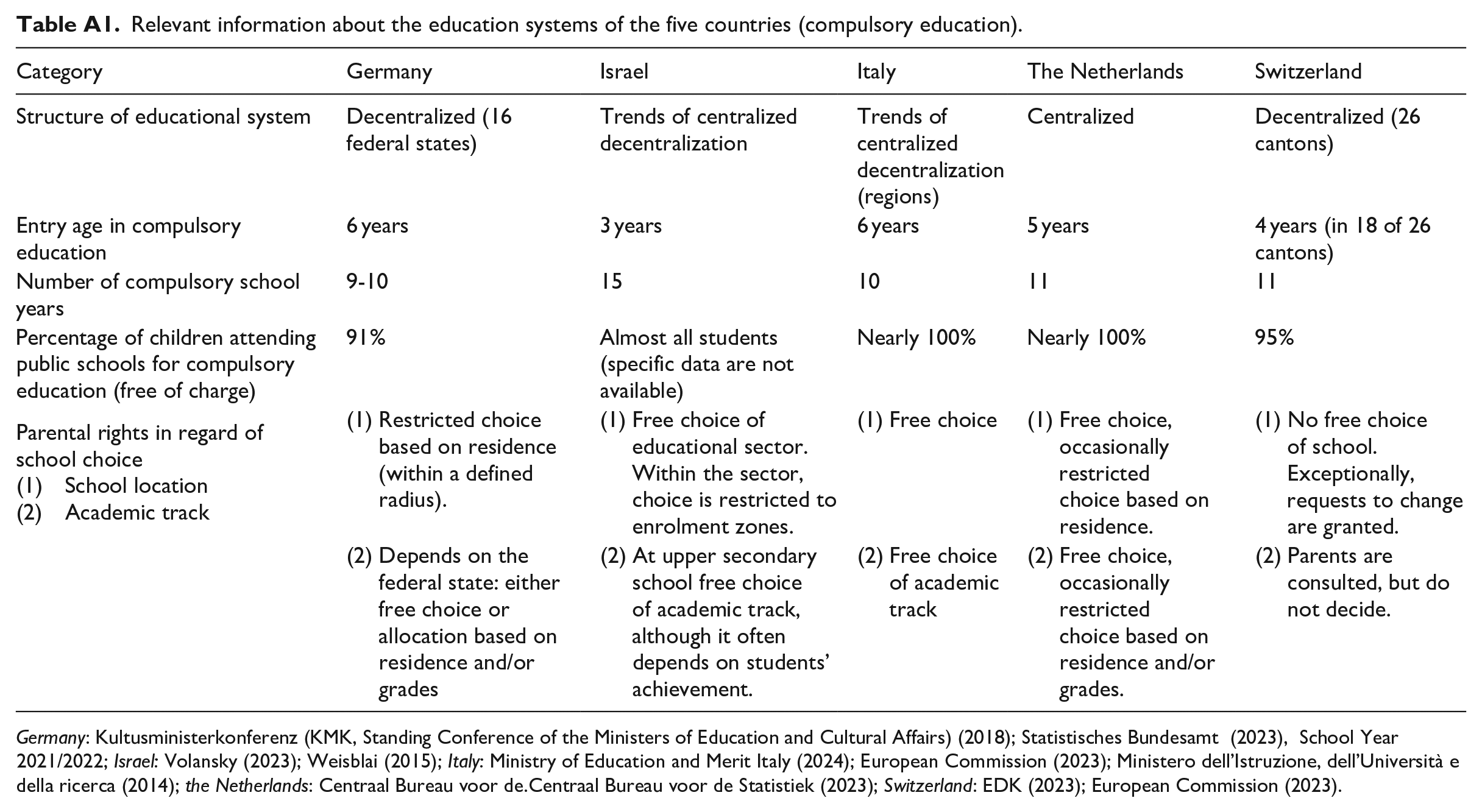
| Category | Germany | Israel | Italy | The Netherlands | Switzerland |
|---|---|---|---|---|---|
| Structure of educational system | Decentralized (16 federal states) | Trends of centralized decentralization | Trends of centralized decentralization (regions) | Centralized | Decentralized (26 cantons) |
| Entry age in compulsory education | 6 years | 3 years | 6 years | 5 years | 4 years (in 18 of 26 cantons) |
| Number of compulsory school years | 9-10 | 15 | 10 | 11 | 11 |
| Percentage of children attending public schools for compulsory education (free of charge) | 91% | Almost all students (specific data are not available) | Nearly 100% | Nearly 100% | 95% |
| Parental rights in regard of school choice (1) School location (2) Academic track |
(1) Restricted choice based on residence (within a defined radius). | (1) Free choice of educational sector. Within the sector, choice is restricted to enrolment zones. | (1) Free choice | (1) Free choice, occasionally restricted choice based on residence. | (1) No free choice of school. Exceptionally, requests to change are granted. |
| (2) Depends on the federal state: either free choice or allocation based on residence and/or grades | (2) At upper secondary school free choice of academic track, although it often depends on students’ achievement. | (2) Free choice of academic track | (2) Free choice, occasionally restricted choice based on residence and/or grades. | (2) Parents are consulted, but do not decide. |
Germany: Kultusministerkonferenz (KMK, Standing Conference of the Ministers of Education and Cultural Affairs) (2018); Statistisches Bundesamt (2023), School Year 2021/2022; Israel: Volansky (2023); Weisblai (2015); Italy: Ministry of Education and Merit Italy (2024); European Commission (2023); Ministero dell’Istruzione, dell’Università e della ricerca (2014); the Netherlands: Centraal Bureau voor de.Centraal Bureau voor de Statistiek (2023); Switzerland: EDK (2023); European Commission (2023).
Acknowledgements
We wish to thank Amanda Mannix and Sümeyra Sahbaz who were involved in editorial assistance of this article. Additionally, we would like to sincerely thank Dr. Netta Sagie and Dr. Annamaria Lona for supporting this research.
Declaration of conflicting interests
The author(s) declared no potential conflicts of interest with respect to the research, authorship, and/or publication of this article.
Funding
The author(s) disclosed receipt of the following financial support for the research, authorship, and/or publication of this article: This publication was financially supported by University of Hamburg and Pädagogische Hochschule Bern.
