




Abstract
This article addresses important aspects of the largely unexplored interplay between high educational aspirations and low academic achievement in migratory contexts. Using data from the German National Educational Panel Study (NEPS), I examine the determinants of learning investments of students who changed from vocational to academic tracking at the transition to upper secondary education. I also explore additional social challenges to upward track mobility that might affect immigrant students in a particular way. As educational disparities are often interpreted as a cumulative consequence of class- and migration-specific educational choices, I develop a learning investment model that explains differences in learning investments between immigrant and non-immigrant youth. I introduce the essential mechanisms of psychological motivation theory into a subjective expected utility (SEU) model, which allows for a specific examination of the relationship between educational aspirations, motivation, and learning investments. Results show that newcomers to academic tracking are more likely to invest in learning. Yet, learning investments in upward mobility processes may be influenced by the different learning environments of stratified education and by family dynamics. Here, I find differences between immigrant and non-immigrant youth. Thus, introducing motivational factors into an SEU model helps to understand when youth invest in learning.
Keywords
Across Europe, it is a well-documented finding of quantitative educational sociology that immigrant students from different countries of origin are more likely to choose academic over vocational education in upper secondary education – given comparable social status and prior educational attainment (France: Brinbaum and Cebolla-Boado, 2007; Ferrara, 2023; England: Jackson et al., 2012; Fernández-Reino, 2016; Sweden: Jonsson and Rudolphi, 2011; Finland: Kilpi-Jakonen, 2011; the Netherlands: van de Werfhorst and van Tubergen, 2007; Switzerland: Tjaden and Scharenberg, 2017; Germany: Busse and Scharenberg, 2022; Dollmann and Weißmann, 2019; Tjaden, 2017; Tjaden and Hunkler, 2017). However, there is only little research on the consequences of this so-called immigration optimism (Kao and Tienda, 1995, 1998) beyond the transition to upper secondary education. Recent research from Germany (Busse and Scharenberg, 2022; Dollmann and Weißmann, 2019), Denmark (Birkelund, 2020) and France (Ferrara, 2023) suggests that many immigrant students have difficulties in translating these more ambitious educational choices into subsequent success and thus show higher dropout rates from academic upper secondary education. In Germany, the same pattern can be found for tertiary education (Klein and Neugebauer, 2023). The reasons for this missing link between higher educational aspirations and corresponding educational attainment in migratory contexts still remain an open field of research (Rudolphi and Salikutluk, 2021).
Using a subsample of the German National Educational Panel Study (NEPS), this study addresses this research gap by examining mechanisms that influence educational investments – in learning, for example – in grade 12 of upper secondary education, 1 year before school graduation. Thus, the study sheds light on factors that may influence the amount of time and effort spent on learning and, consequently, dropout and graduation rates. This approach is consistent with rational choice approaches that interpret social and migration-related disparities in the education system as a cumulative consequence of class- and migration-specific educational investments (Maaz et al., 2006). Clearly, upward track mobility, such as changing from vocational to academic tracking when moving to upper secondary education, is ambitious due to the different curricula in the different education tracks and the corresponding different demands on educational performance. In the theoretical debate, common explanations refer to socioeconomic background (Maaz et al., 2010: 82). Accordingly, higher dropout rates of upwardly mobile immigrant students in academic upper secondary education are more likely because many of these students choose academic education despite comparatively lower levels of socioeconomic status and prior educational achievement (Dollmann et al., 2023). However, first, this argument does not address the specific mechanisms that link educational resources to educational attainment. Second, at least in Germany, students have to qualify for academic upper secondary education and should therefore be equipped with the necessary resources to achieve their educational goal – in this case: the university entrance qualification (Abitur). 1 In order to address a specific mechanism that links educational choices and educational attainment, I focus on factors and resources which influence learning investments. Further, I examine whether there are additional social challenges to upward track mobility that affect immigrant students in a particular way and may not apply to those who have already been in academic tracking during lower secondary education. Here, I draw on findings of qualitative research based on a Bourdieuian perspective that understands educational attainment as an effect of the habitual fit between the social milieu of origin and the school milieu (for an overview see Spiegler, 2015, 2018). Accordingly, qualitative research on social stratification and mobility shows that upward mobility often means overcoming habitual differences between the milieu of origin and the new social milieu, which can become a challenge; and that this challenge can vary by immigrant origin (El-Mafaalani, 2014). These challenges could tie up cognitive resources and thus lower learning investments. I test exploratively whether this perspective can be applied to upward track mobility into upper secondary education using quantitative data analysis. In doing so, I bring a new approach to a general debate that has been increasingly discussed in recent years, including in this journal (Behtoui, 2017; Bradley, 2017; Holmegaard et al., 2017; Lindgren and Lundahl, 2010; Nairz-Wirth et al., 2017; Nairz-Wirth and Gitschthaler, 2020; van Caudenberg et al., 2020; van den Broeck et al., 2023).
Theory
Learning investments
In both psychological motivation theory and sociological action theory, assumptions about expected utility play an important role in explaining decision-making processes. In these theories, decisions are modelled as assessments of the subjective expected value (SEU) of an action, considering both the probability of success and the cost of that action. Sociological SEU models of competence acquisition (Dollmann, 2010; Esser, 1999, 2006) are based on economic approaches that perceive competence acquisition as an investment in human capital (Becker, 1993). Thus, the level of competence is the result of cumulative choices to invest time and effort into learning (Boudon, 1980: 181). Accordingly, in this study, I do not investigate a particular learning behaviour, but students’ choices to invest in learning. This approach also appears in psychological motivation theory (Atkinson, 1974).
As sociological models often lack motivational components, Maaz et al. (2006) suggest combining the main components of both strands of theory when modelling educational choices. I take up this idea and will briefly introduce both theoretical approaches below and then integrate them to propose a rational choice model that I will use to study learning investments.
Psychological motivation theory
In psychology, researchers use the Expectancy-Value model to analyse educational choices, achievement behaviour and persistence on difficult tasks (Eccles, 2007; Eccles et al., 1983, 1999; Wigfield and Eccles, 2000). Eccles and Wigfield (2002: 119) differentiate four subjective task values. These are the interest-enjoyment value, which can be understood as intrinsic motivation, the attainment and utility value, which represent more extrinsic aspects of motivation, and the relative costs of a task. In my analysis, I focus on the extrinsic components of academic learning motivation and effort; they are measured in the NEPS data in sets of items with a general reference to school and work, consisting of performance-related, competition-related, and job-related facets of extrinsic motivation (Wohlkinger et al., 2019; see Supplemental Material). Intrinsic academic motivation in the NEPS data set relates to either mathematics or reading. Recent research shows that extrinsic reasons such as attainment values (e.g. I study for school because I want to show excellent achievement) or utility values (e.g. I study for school in order to have good career opportunities later) can support students to invest time and effort in learning particularly when they are not interested in a particular subject, e.g. mathematics or reading (Liu et al., 2020).
Further, Eccles and Wigfield (2002: 119) use the academic self-concept as subjective expectation of success. The academic self-concept describes students’ subjective and retrospective assessment of their own academic abilities. It results in an internal frame of reference from comparison with own previous abilities and in an external frame of reference from comparison with the abilities of the social environment (Festinger, 1954; Marsh, 1986; Shavelson et al., 1976). The more positive these assessments and comparisons are, the stronger the self-concept and the greater the subjective expectation of learning success (Marsh and Martin, 2011). In the NEPS data the academic self-concept is measured by a set of items with general reference to school (e.g. I learn fast in most school subjects).
Sociological action theory
Sociological literature often conceptualizes learning as an investment within the framework of rational choice modelling, in which the individual benefit of an action is first weighted by the subjective expectation of success and then set in relation to the costs (Dollmann, 2010; Esser, 1999, 2006). According to the approach of Dollmann (2010), there are two options: remaining in the status quo sq of the competence level – in other words, the option of not investing in further learning units – and investing in further competence acquisition ca. The subjective expected utility (SEU) for the first option sq results from the individual assessment of the utility Usq of the competences acquired so far (Dollmann, 2010: 45):

In contrast, the alternative ca to invest in further competence acquisition results in utility Uca, achieved with probability pca. However, this decision to invest is also associated with costs Cca. Since the benefit of this decision is not certain, but only achieved with probability pca, the benefit of the status quo Usq remains with the counter-probability (1 – pca) in case Uca is not achieved or the learning investment is not successful (Dollmann, 2010: 45).
This results in the following SEU weighting for option ca:

According to the assumptions of Rational Choice Theory, students decide to invest in additional learning units when the following applies:

After introducing (1) and (2) into equation .3) Dollmann (2010: 45) presents the following equation after a corresponding reformulation:

The left part of the equation contains the difference between the expected benefit of additional competence acquisition Uca and the expected benefit of the status quo Usq. This part of the equation describes the motivation to acquire further competences. On the right-hand side of the equation is the investment risk, which is the ratio between the costs Cca and the probability for a successful acquisition of further competences pca. Accordingly, if the costs remain the same, the investment risk increases as the probability of success decreases. Under these conditions, the motivation to acquire new competences must constantly increase for additional learning investments to be made. This means that even if motivation is high, learning will not happen if the probability of learning success is assessed as rather low (Dollmann, 2010: 46).
Model comparison and theoretical contribution
When comparing the psychological and sociological models, costs and benefit assessments as well as expectations of success are found as central influences in both approaches (Maaz et al., 2006: 312). The psychological approach stands out primarily by including motivational components at the benefit level and by deriving the expectation of success via the self-concept. Due to these subjective components, the psychological model is particularly well suited for the analysis of individual learning behaviour. Maaz et al. (2006) therefore suggested an integration of the two approaches, arguing that this approach will further enumerate and complement the current state of sociological research on differential educational investment (p. 322). So far, the classical sociological models on educational inequality explain lower educational achievement via lower educational motivation, but do not test this directly (Becker, 2003; Breen and Goldthorpe, 1997; Erikson and Jonsson, 1996; Esser, 1999). According to these classical models, socioeconomically less advantaged families tend to invest less in education because they do not need it to maintain their social status and therefore have lower academic motivation (Esser, 1999: 270). Integrating motivational aspects as benefits of an action directly into a sociological investment model and supplementing them with the self-concept as an expectation of success is therefore proposed here as a theoretical contribution to sociological educational research, since psychological motivation theory’s focus on individual factors allows for a more differentiated account of processes within sociological investment models at the micro level (Maaz et al., 2006: 300).
Linking the models
Two of the above-mentioned psychological mechanisms are particularly appropriate for analysing individual learning behaviour: academic self-concept and academic motivation (Eccles et al., 1983; Eccles and Wigfield, 2002). While academic self-concept can be introduced into the sociological investment model as a probability of success pca, academic motivation can be linked to the subjective utility value of further competence acquisition Uca.
After transforming equation (4), the following term results:

On the left-hand side of the equation, the academic self-concept is linked to the subjective expected probability of success pca and related to the subjective utility Uca of further competence acquisition in terms of academic motivation. This product is weighted with the costs of further competence acquisition Cca. In the NEPS data these costs are measured via the additional financial burden for parents due to further school attendance (e.g. How hard would it be for your parents to pay these costs if you went for the Abitur?).
The so-defined SEU weight forms the dependent variable of my analysis. In other words, to assess the subjective expected utility of learning investments, I multiply academic motivation by academic self-concept and relate this product to the cost of additional education:

I will further run my statistical analyses on the single components of the SEU weight: academic motivation (Uca), academic self-concept (pca), and cost of additional education (Cca). These additional analyses are provided in the Supplemental Material.
According to Boudon (1980: 181), differences in competence acquisition can only be consistently explained if they are understood as the result of individual action in a specific social context. For this reason, I will elaborate below mechanisms that might constrain on the decision to invest in learning.
Influences on learning investments SEU (ca)
The following sections are concerned with the development of hypotheses regarding the question whether there are differences in the tendency to invest in learning between students who moved up at the transition to upper secondary education from vocational to academic tracking and those students who have already been in academic tracking throughout lower secondary education – and whether this tendency differs according to immigrant origin. Thus, I will categorize students into ‘newcomers’ to academic tracking and ‘established students’ in academic tracking and further differentiate these groups according to immigrant origin (see section 3 for greater detail).
Learning investments in upward mobility contexts
There are reasons to expect that newcomers are more likely to invest in learning: Newcomers chose to move up from vocational to academic tracking at the transition to upper secondary education. Since they did not alternatively choose vocational education, they might have a strong academic motivation. Moreover, having qualified for academic tracking, these students are successful and should be equipped with a strong academic self-concept (Köller, 2004; Marsh et al., 2000). Since I use academic motivation as the value component (Uca) and academic self-concept as the probability of success (pca) in the SEU weighting, I thus assume that newcomers are more willing to invest in additional learning units at comparable educational costs, as defined in SEU (ca). Regarding the subjective cost of additional education (Cca), research on working-class educational choices in the transition to upper secondary education shows that educational choices are highly stratified by social class. Therefore, newcomers can be expected to be a positive selected group that expects the additional cost of further education to be affordable. This should also have a positive effect on their SEU weighting.
H1: Newcomers tend to invest more in acquiring further competences than established students.
These differences may be specifically pronounced for immigrants. First, international psychological studies found higher levels of extrinsic academic motivation (Uca) among immigrant students (Areepattamannil and Freeman, 2008; Kim et al., 2020; Xu and Wu, 2017). 2 Second, educational sociology shows that immigrant students in Germany are more likely to have a stronger academic self-concept (pca) than their non-immigrant peers at a given achievement level and in a given school track (Nauck and Genoni, 2019; Siegert and Roth, 2020). Both patterns are explained by positive self-selection into migration through so-called immigrant optimism (Kao and Tienda, 1995, 1998), according to which the decision to migrate is often based on a social upward orientation and thus associated with high educational aspirations (Rudolphi and Salikutluk, 2021), academic motivation (Xu and Wu, 2017) and a positive self-concept (Siegert and Roth, 2020). 3
H1a: Immigrant newcomers tend to invest more in acquiring further competences than other students.
Habitual class differences
Qualitative research on social stratification and mobility often focuses on the social hurdles faced by upwardly mobile individuals. These social hurdles refer to habitual differences between the milieu of origin and the new social milieu (Spiegler, 2018). Bourdieu (1987) defines the social habitus as class-specific logics of perception, thought, and action – which help to navigate through milieu-specific everyday-situations. Thus, in social mobility processes, newcomers have to learn and partly adapt the codes of the established habitus of the new social milieu in order to move confidently in the new social space. This transformation carries the risk of alienation from the milieu of origin and, moreover, leads to what Bourdieu calls a ‘habitus clivé’ (Friedman, 2016), meaning that upwardly mobile people often feel that they have become strangers in their old milieu, but at the same time will remain strangers in the new milieu (Lee and Kramer, 2013; Spiegler, 2018).
The basic idea of the following argumentation is that these feelings could lead to a retreat into the familiar milieu and thus lower the tendency to invest in further education and learning. I exploratively examine whether these patterns also apply to upward track mobility into academic upper-secondary education in Germanys’ stratified education system, and test for differences between immigrant and non-immigrant newcomers. More concretely, I ask whether these patterns influence the subjective expected utility of learning investments as defined above.
My theoretical argument is that, in stratified education systems, different learning environments emerge in the different ability tracks, reflecting the social habitus of the class that primarily attends a certain track. Thus, upward track mobility means overcoming habitual differences within the education system. Basically, I argue here with Boudon (1974) that due to the strong correlation of social background and academic achievement, the average socioeconomic status is higher in high-ability tracks, while the average socioeconomic status is lower in low-ability tracks. This correlation is reinforced by the empirical fact that educational choices are often class-specific (Relikowski, 2012; Seghers et al., 2019): as the curricula of the ability tracks are tied to the corresponding class-specific occupational profiles and lead to higher education or vocational training accordingly, students are channelled into vocational or academic tracks depending on their social background. Empirical results from Germany support this argument, showing that parents of students in academic tracks tend to have above-average socioeconomic status compared to parents of students in vocational tracks (Baumert et al., 2006: 98). Aries and Seider (2005) found that academic newcomers often feel intimidated by the economic and cultural capital of their new learning environment, getting the feeling of being inadequate at school. This could reduce the academic self-concept and thus the subjective probability of learning success (pca).
Further, these socioeconomic differences should be reflected in habitual differences. Accordingly, qualitative findings show that upwardly mobile students often complain of declining social ties to their milieu of origin as they habitually adapt to the new milieu (Lee and Kramer, 2013), but also report that they do not feel a sense of belonging to the new milieu (Lee, 2017) – they experience the aforementioned ‘cleft habitus’ (Lee and Kramer, 2013) that could reduce the value components (Uca) of the SEU weight for learning investments, as further steps in the process of upward mobility could reinforce these feelings of foreignness.
For this reason, a family’s socioeconomic status should have a positive influence on learning investments in high-ability tracks, as the social fit between the student’s social background and the academic learning environment increases as social status increases. Empirically I will test these effects with the measurements of parental occupational status, cultural capital and educational attitudes (see Supplemental Material). I assume the effects of these measurements to be more complex for upwardly mobile newcomers to academic tracking. The positive influence of socioeconomic status should be weaker for newcomers, as they climb up from lower- to higher-performing learning environments and change further to socioeconomically stronger schools as part of their upward mobility. Thus, upward track mobility provides opportunities for social upward comparisons. Schwarzer et al. (1982) found that these comparisons negatively influence students’ academic self-concept, and thus should lower investment in learning by decreasing subjective probability of success (pca). In addition, the newcomers’ learning environment has changed recently, so they should be particularly sensitive to habitual differences between the old and new school environments. This could influence their extrinsic motivation (Uca) in the way described above, as they could lose social ties to their old peers.
H2: The effects of socioeconomic status on the tendency to invest in acquiring further competences are weaker for newcomers.
Further, I will test exploratively whether I can find differences in these effects by immigrant origin, and accordingly discuss possible reasons for these differences.
Habitual sphere differences
In the process of upward mobility individuals not only perceive habitual class differences but also differences between the inner- and extra familial spheres (El-Mafaalani, 2012). As mentioned above, social upward mobility carries the risk of alienation from the social milieu – and thus from the family, as the family is often habitually attached to the milieu (Spiegler, 2018). This can become a challenge because in mobility processes parents often expect success in the extra-familial sphere, meaning social upward mobility, while at the same time they expect loyalty to the familiar habitus of the intra-familial sphere (El-Mafaalani, 2012). In the following, I assume that this ambivalence in parental expectations may become a specific challenge for upward track mobility into academic upper-secondary education. Focusing on the individual components of this ambivalence, I expect that perceptions of high parental educational aspirations (e.g.: My parents would like me to study.) and social upward orientations (e.g.: How important is it for your parents that you get ahead in your career someday?) have a positive impact on learning investments SEU (ca). First, if students feel that their parents trust them to succeed, this could have a positive impact on their academic self-concept and thus on the subjective probability of success (pca). Second, parental expectations of success could increase the value component of learning investments (Uca) and thus the external motivation to learn. Indeed, empirical findings show that social upward orientation and educational aspirations are important and supportive resources in upward mobility processes, as these expectations help students pursue their goal – even when they encounter difficulties (Bahena, 2020; Pott et al., 2022). Emphasizing this point, Gofen (2009) notes that upwardly mobile students often succeed not in spite of their families, but because of the support and resources of their families.
However, the organizational goal of the family is not the children’s educational success or upward mobility but to create lifelong, unconditional solidarity commitments and social bonds (Huinink, 1995). Accordingly, parents might oppose their children’s upward mobility if they expect their children to become too alienated in this process (Nauck and Lotter, 2016: 123). Particularly, solidarity obligations found in families of low socioeconomic status (Dykstra and Fokkema, 2011), such as always living nearby or helping with housework, may conflict with, for example, the expectation of attending university, which is often associated with a change of residence. In the NEPS data, these attitudes are measured in a series of items on family solidarity obligations (e.g.: Parents should expect their adult children to always live nearby) and family cohesion (e.g.: There is a strong sense of solidarity in our family). I expect these settings to lower the subjective expectation of success (pca) because they could tie up time resources that could be used for learning. I also expect them to lower the value component (Uca) of the SEU-weighting, as they lower the value of success in the extra-familial sphere.
To sum up, parental expectations on success in the external sphere and loyalty to the social habitus of the internal sphere might be contradictory in processes of social upward mobility. In this paper, I test whether an interaction of these ambivalent parental expectations has an impact on tendency to invest in further education and learning of newcomers to academic upper-secondary education.
H3: Under the condition of high parental educational aspirations and increasing parental loyalty expectations, the tendency of newcomers to invest in acquiring further competences decreases.
Again, I will test exploratively whether I can find differences in these effects by immigrant origin, and accordingly discuss possible reasons for these differences. 4
Methods
Data
The empirical analyses are based on Starting Cohort 4 of the National Educational Panel (Blossfeld et al., 2011), which observes students on their way through upper secondary education. This is a stratified sample drawn from regular and special need schools at the lower secondary level in the ninth grade in the autumn and winter 2010. After completing grade 10 in the fall of 2011, the transition to upper secondary education took place. The two-stage sampling, in which first schools and then classes within these schools were randomly selected, resulted in a subsample of 15,239 surveyed students at regular schools (Steinhauer and Zinn, 2016).
Sample
The research sample is based on all students in academic upper-secondary education in the school year 2013, 2 years after completing lower secondary education. Students enrolled in vocational training or vocational schooling (N = 7315) are excluded. In 2013 about 15% of students in academic upper secondary education showed temporary or permanent dropout. Dropout risk is generally higher for upwardly mobile students as they leave the sample school after lower secondary education and are subsequently monitored and interviewed individually (Zinn et al., 2018). Such systematic sample dropouts can lead to biased estimates because this type of missing data is not random. I use listwise deletion to manage this possible bias because recent data simulation studies show that modern techniques for managing missing data, such as multiple imputation, often lead to results that are more biased, less efficient, and have worse coverage than listwise deletion when the missing data are non-random (Pepinsky, 2018). I control for factors that correlate with systematic dropouts (Rothenbühler and Voorpostel, 2016), such as age, gender, immigrant origin, education track in grade 9 and socioeconomic background (Steinhauer and Zinn, 2016: 6). Considering item non-response, the sample consists of 3864 students in 176 schools, including 745 (19%) immigrant students.
Dependent variable
The dependent variable is the SEU weight (1.6) for learning investments. As explained in section 2, academic self-concept (e.g. I learn fast in most school subjects) is linked to the subjective probability of success (pca) and set in relation to the subjective utility of further competence acquisition (Uca) in terms of achievement values (e.g. I study for school because I want to show excellent achievement) and utility values (e.g. I study for school in order to have good career opportunities later). This product is then weighted by the student’s assessment that their parents can bear the cost of additional education (Cca) incurred by attending academic upper secondary education:

Uca and pca are based on corresponding item batteries for academic achievement and utility values and for academic self-concept. Thus, mean value scales were formed to operationalize the corresponding product terms. This was prefaced by a factor and reliability analysis. To better understand the interplay of the individual components of SEU (ca), I additionally ran all analyses for the individual components Uca, pca, and Cca. Achievement and utility values as well as academic self-concept were measured in upper secondary education, while the relative costs of further education were surveyed at the end of lower secondary education (for greater detail and additional analyses see Supplemental Material).
Independent variables
A categorical variable was formed that indicates the education track (vocational; academic) attended in lower secondary education. This variable thus indicates whether the students are newcomers to academic tracking or are established students in academic tracking. I further differentiate these groups according to immigrant origin and thus get four categorized groups (see Table 1):
Categorized student groups.

An immigrant origin was assigned to students based on their country of birth if they (N = 126; 3.26%), both parents (N = 303; 7.84%) or at least one parent (N = 316; 8.18%) was born abroad. Since the number of cases does not allow for a reliable differentiation according to countries of origin, a differentiation is only made according to immigrant origin. The countries with the largest immigrant groups in the data set are Turkey, the countries of the former Soviet Union, Poland and the countries of the former Yugoslavia (Olczyk et al., 2014). 5
To measure the influence of experiences with habitual class and sphere differences, I used the following operationalizations (details in Supplemental Material). Habitual class differences were measured by socio-economic background. This was operationalized via the highest occupational status of the parents (ISEI according to Ganzeboom et al., 1992) and via the number of books in the household. The number of books in the household also serves as a proxy variable for cultural capital. In addition, a mean scale was formed from the items on general educational attitudes, as educational attitudes are class-specific and thus reflect the class-specific social habitus (e.g.: A high level of education expands a person’s horizons; People who go to school for too long become snobs). These measurements were surveyed at the end of lower secondary education.
Also, habitual sphere differences were measured by different indicators. Parental social upward orientation was measured by the students’ assessment of whether their parents expect them to succeed in their careers. Parental educational aspirations were operationalized (in a binary form) by the students’ assessment of whether they think that their parents would like them to go to university 1 day (2622; 67.86%), or whether their parents would also be satisfied if they began vocational training (1242; 32.14%). In contrast to these rather supportive attitudes for upward mobility, I included family obligations, which can hinder upward mobility and are class-specific and thus reflect the class-specific social habitus (Zhang and Deguilhem, 2022). Accordingly, family loyalty expectations are included in the analyses via a mean scale based on the students' assessment that their parents expect them to support the family. Further, family cohesion is controlled for using a mean scale. Apart from family cohesion, which was measured during upper-secondary education, all effects measuring sphere differences were surveyed at the end of lower-secondary education.
Since, according to Boudon (1974), not only social origin but also academic ability is important for the analysis of educational investments; additionally, the results of the cognitive ability tests are included in the analyses (Brunner et al., 2014). 6 Control variables further include age and gender.
Analysis design
The multivariate analysis is prefaced by a descriptive analysis of key differences between the categorized student groups. First, differences in the SEU (ca) weighting and its single components academic motivation (Uca), academic self-concept (pca), the costs of further education (Cca) are considered. Next, I descriptively analyse group differences in indicators operationalized for possible habitual class and sphere experiences. Descriptions are based on z-standardized group averages.
The multivariate analyses are based on Ordinary Least Square (OLS) regressions. OLS regressions predict dependent variables measured at interval or ratio levels, such as the SEU (ca) weight, which has ratio level. The analysis strategy is to first examine a baseline model that measures the multivariate effects of all factors on the dependent variable SEU (ca). This gives insight into Hypotheses 1, according to which (immigrant) newcomers to academic upper secondary education are more likely to invest in further education. In the next step, using moderation analyses, I examine the influence of possible effects of habitual class and sphere differences between the categorized student groups on the SEU (ca) weighting. For this purpose, interaction terms are formed between the student groups and the variables related to habitual class and sphere differences, namely the family ISEI, the number of books in the household and general attitudes to education. This provides information on Hypothesis 2 which posits that the potential positive effects of social status on the SEU (ca) weighting are weaker for newcomers to academic tracking in upper-secondary education.
To measure possible effects of sphere differences, I examine the effect of ambivalent parental expectations from high expectations of success in the extra familial sphere and habitual loyalty to the intra-familial sphere. The three-way interaction term consists of student groups, parental educational aspirations, and parental loyalty expectations. Here, the effect of high loyalty expectations and simultaneously high educational aspirations can be calculated for each student group. This addresses Hypothesis 3, which states that the negative effect of ambivalent parental expectations prevails for newcomers to academic upper secondary education. I use loyalty expectations and educational aspirations for the three-way interaction for both theoretical and statistical reasons. Theoretically, loyalty expectations such as ‘my parents always want me to live nearby’ could be diametrically opposed to educational aspirations such as ‘my parents want me to go to university’, since attending a university often means moving to another city. Moreover, family cohesion may also be theoretically supportive, as empirical evidence shows that emotional closeness can improve success in upward mobility processes (Zhang and Deguilhem, 2022). Statistically, some of the distributions of perceived parental social upward orientations are highly left-skewed across student groups. Therefore, the perceived parental educational aspirations are used for the three-way interaction to ensure that the distributions have sufficient variance.
The metric indicators were mean-centred before the interaction terms were formed, so that the conditional main effects describe the mean values of the interactions. Since the observations are not independent of each other, but are in clusters at the class and school level, all models are calculated with adjusted standard errors at the school level (Abadie et al., 2017: 6). All models are examined with the statistical software for data science STATA.
Since I conduct a cross-sectional analysis, further causal questions arise analytically. Although the NEPS is a panel study, not all questions are repeated in each wave; some questions were asked only at the end of lower secondary education, others only in upper secondary education. The main components of the SEU (ca) score, academic self-concept (pca) and academic motivation (Uca), are collected in upper secondary education, while most of the independent influences on the SEU (ca) score are measured in lower secondary education. Although it cannot be said with certainty, I will interpret the analyses in the theoretically derived direction that the independent variables influence the dependent variable SEU (ca).
Results
Descriptive results
Figure 1 describes the SEU (ca) weight for learning investments and its single components, academic motivation (Uca), academic self-concept (pca) and perceived costs of further education (Cca) according to the respective student group. It is striking that newcomers to academic tracking are more motivated (Uca) and also have a stronger self-concept (pca) than established students who had already attended an academic education track in lower secondary education. Immigrant students rate the costs of further schooling (Cca) generally as higher. Immigrant newcomers show the highest academic motivation and exhibit the highest subjective utility for investing in skills, despite a weaker self-concept and the highest cost estimate of continuing education.
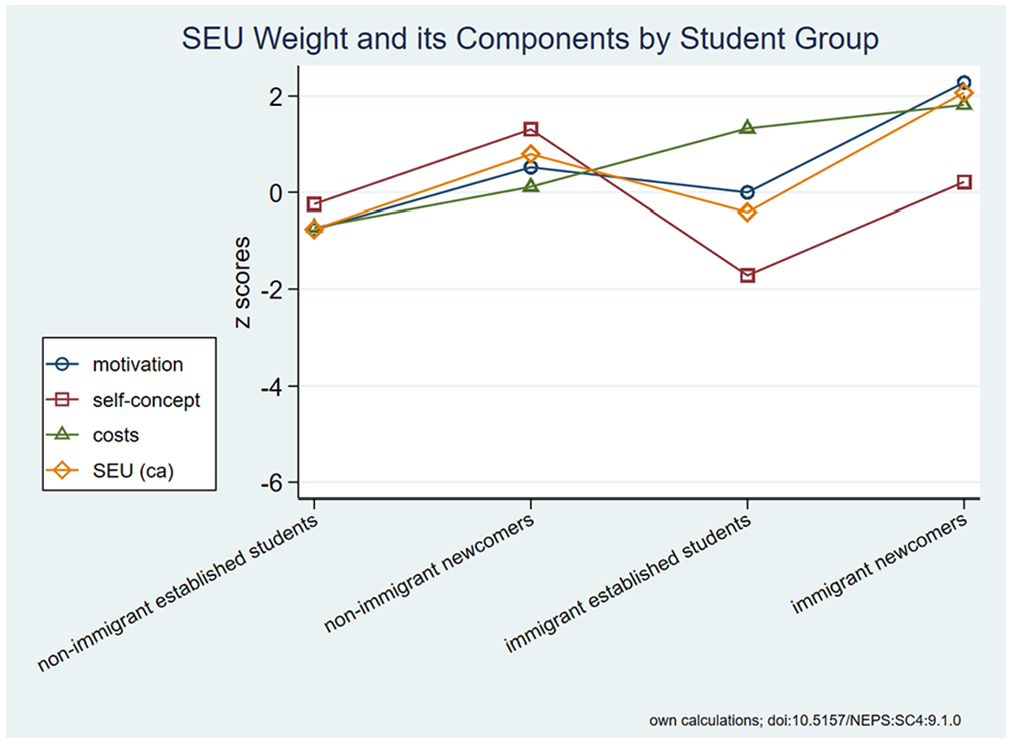
Dependent variable and its components by student groups.
Figure 2 describes the different parental attitudes and expectations within the student groups. It also shows average socio-economic status, cultural capital and general educational attitudes in the groups. Newcomers face higher social upward orientations and family loyalty expectations. It is striking that immigrant newcomers are not only confronted with particularly high expectations of success, but that parental loyalty expectations are also particularly strong in this group. At the same time, the average family social status within this group is comparatively low, and the cultural capital of this group is also lower. Interestingly, family cohesion seems to be lower in the lower status groups and especially among immigrant students. There seems to be a difference between loyalty expectations and family cohesion – the multivariate analyses will show that the influence of these factors is diametrically opposed. Thus, it is highly evocative of the double challenge faced by immigrant newcomers when dealing with these specific ambivalent expectations and furthermore, when they must bridge wider social gaps. Overall, the figures illustrate that upper secondary education is characterized by social differences: students who attended a vocational track in lower secondary school have lower educational attitudes, lower SES, perceive milder parental educational aspirations, but are confronted with higher family expectations regarding social mobility and habitual loyalty. The experience of habitual differences in processes of educational mobility is based on these social differences. The following multivariate analyses will show how these differences affect students’ tendency to invest in acquiring further competences SEU (ca).
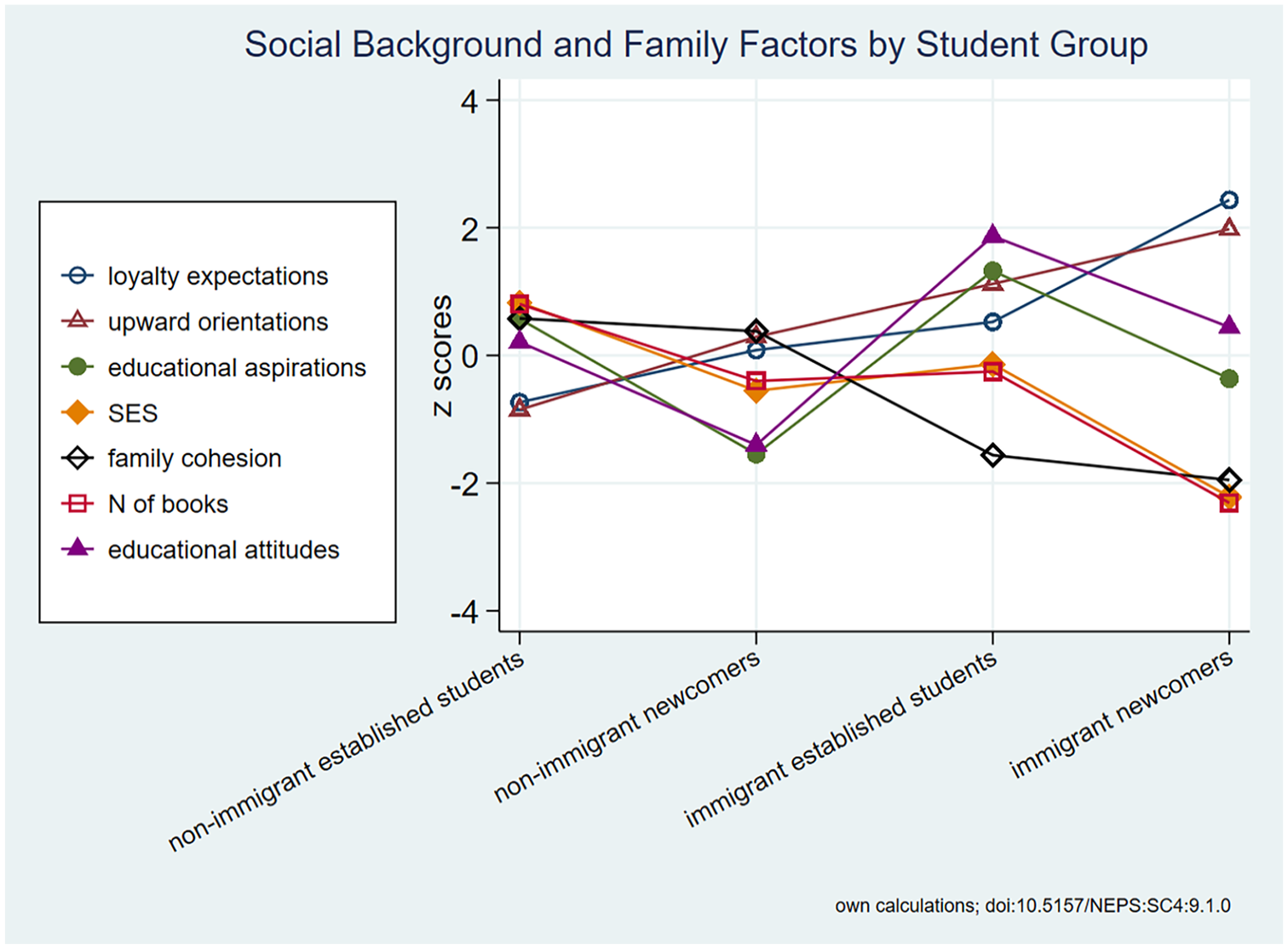
Social background and family expectations by school group.
Multivariate results
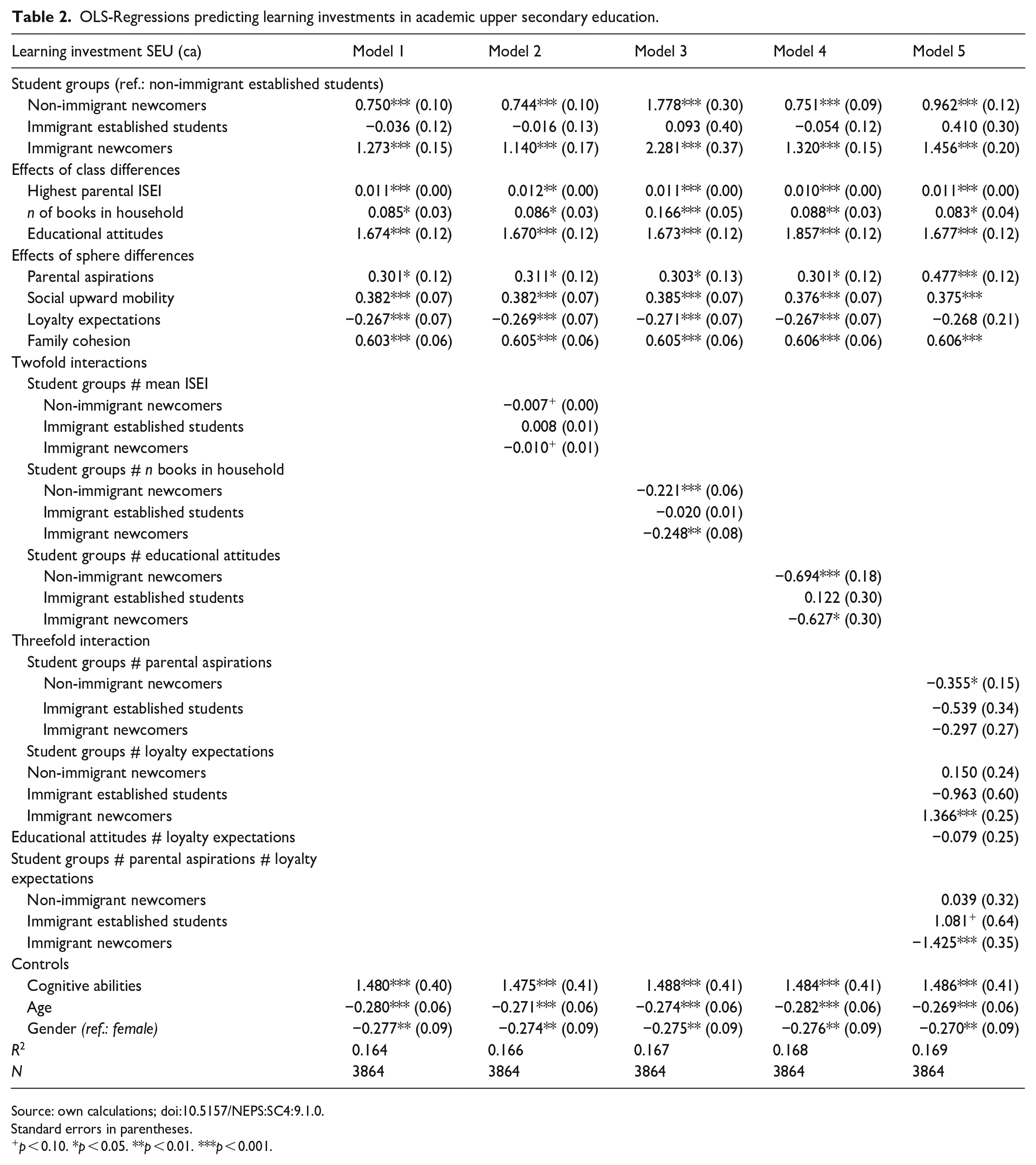
The multivariate results are presented in five models (Table 2). The baseline model (Model 1) shows that newcomers to academic tracking in upper secondary education are more inclined to learn than students who were already on an academic track in lower secondary school (H1). In line with existing literature, this is especially true for immigrant newcomers. Newcomers’ SEU (ca) weighting is specifically high under the controlled conditions. As argued in section 2.2, social status has a positive effect on learning investment. This may be due to the fact that with higher social status, students have to adapt less to a higher-status environment. This could reduce additional social costs and increase the utility value (Uca). At the same time, higher social family status also reduces the financial burden of further education (Cca), which can be reflected in a positive influence on the inclination to invest.
OLS-Regressions predicting learning investments in academic upper secondary education.
Source: own calculations; doi:10.5157/NEPS:SC4:9.1.0.
Standard errors in parentheses.
p < 0.10. *p < 0.05. **p < 0.01. ***p < 0.001.
Furthermore, educational attitudes have a strong positive effect on learning investments SEU (ca). Presumably, high educational attitudes increase academic motivation and thus the utility factor (Uca) of the investment term. I assume that with increasing social status and increasing educational attitudes, the social fit between individual habitual patterns and the academic learning environment also increases (see Figure 2). The stronger social fit could have a positive impact on academic self-concept (pca) and thus on the inclination to invest (Marsh et al., 2000).
Additionally, high parental aspirations, increasing upward orientation and increasing family cohesion have a positive effect on the tendency to invest in acquiring further competences. These factors are also theoretically related to academic self-concept (Marsh and Martin, 2011), which in the investment term, represents the probability of success (pca). Accordingly, family support is conducive to investment. The situation is different with loyalty expectations. These have a negative effect on learning investments in terms of additional family obligations and responsibilities (Model 1).
The remaining models in Table 1 analyse the effect of habitual difference experiences on the tendency to invest in learning. Models 2, 3 and 4 test the moderation of student group effects by the central indicators for possible habitual class differences (highest parental ISEI, cultural capital and general educational attitudes). As postulated in H2, these indicators interact negatively with the effects of newcomers to academic tracking in upper secondary education. The interactions with cultural capital and educational attitudes are highly significant. Thus, the investment-promoting effect of these indicators found in Model 1 is lower for newcomers. Findings hold while controlling for the highest parental ISEI. Thus, even with same social background, students experience habitual differences when ascending from low- to high-social-status learning environments. With reference to the theoretical argumentation in section 2.2, I assume that these habitual class differences reduce the tendency to invest in learning because they might favour social upward comparisons, which can weaken students’ self-concept and thus have a negative effect on the probability of success (pca) contained in the investment term. Further, habitual class differences could reduce the value components (Uca) of the SEU weight.
The effects of parental ISEI and cultural capital are particularly strong for immigrant newcomers. Yet, the effect of educational attitudes is stronger for non-immigrant students. This could be due to the unequal distribution of these resources between these groups (cf. Figure 2): While immigrant newcomers tend to have more positive educational attitudes, non-immigrant newcomers have higher SES and more cultural capital on average.
Model 5 tests for effects of a habitual sphere difference using a three-way interaction showing the effects of ambivalent parental expectations (increasing loyalty expectations combined with high parental educational aspirations) for the respective student group. Findings indicate that a significant negative effect applies only to immigrant newcomers. Thus, H3 is only partly confirmed: Controlling for educational aspirations, learning investments decrease with increasing loyalty expectations. However, this only applies to immigrant newcomers only, while effects are positive for established immigrant students. This exploratory finding could be due to differences in family expectations between these groups: Immigrant newcomers perceive higher family obligations and comparatively lower educational aspirations on average, while established immigrant students perceive less family obligations and comparatively higher educational aspirations (cf. Figure 2). This might shape their perspective on cost-benefit evaluation of additional learning investments and – given the distribution of SES and cultural capital also differs across these groups – is indicative of an effect of upward track mobility. These family impacts can be interpreted as migration-specific habitual sphere differences resulting (at least in part) from ambivalent parental expectations – with negative effects on learning investment.
Figure 3 shows this three-way interaction graphically. For non-immigrant newcomers, the effect of increasing loyalty expectations under the condition of high educational aspirations is less negative than for non-immigrant established students. Yet, this effect is marginal and not significant. For immigrants, however, it can be clearly seen that the negative effect of loyalty expectations is weakened if they believe that their parents might consent to their enrolling in vocational training. These somewhat milder educational aspirations thus make the parents' expectations less ambivalent, which eases dealing with these expectations. Presumably, lower ambivalence levels tie up fewer cognitive resources, which increases learning investments. The less ambivalent expectations also mean that students are less likely to be caught up in a conflict of objectives that puts more emphasis on the differences between the intra- and extra-familial spheres. This could have a positive effect on the expectation of success (pca) or on the value components (Uca) in the investment term, since a lower perception of difference mitigates comparative processes among the students, which could negatively influence self-concept or academic motivation (cf. section 3).
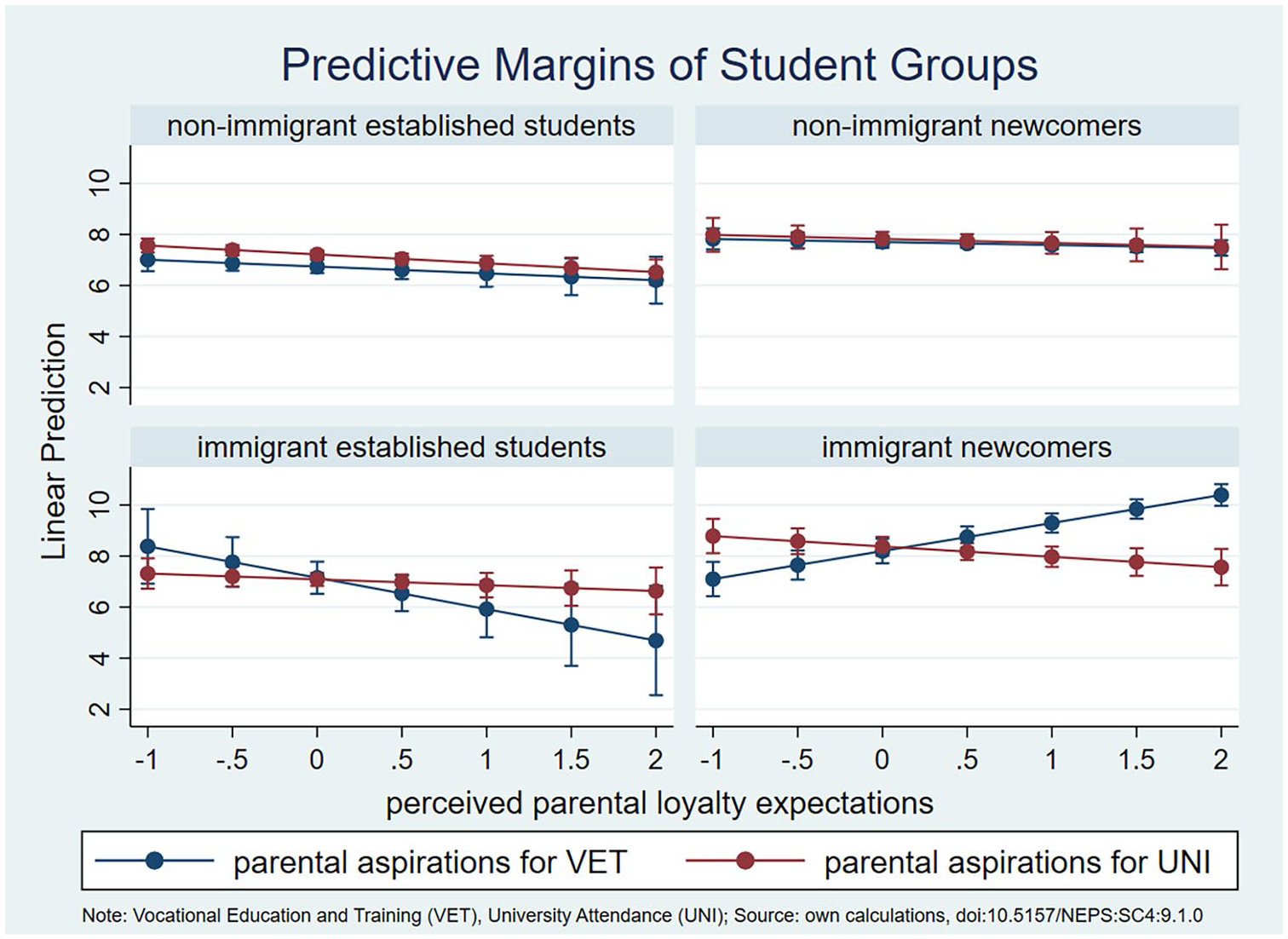
Threefold interaction of student group effects, parental aspirations and loyalty expectations.
Discussion
This paper aimed to address a prominent research gap in educational research, namely the paradox of high aspirations and low educational outcomes after upward transitions in secondary education which is specifically prevalent among immigrant students (Becker et al., 2023; Birkelund, 2020; Cebolla-Boado et al., 2021; Ferrara, 2023; Salikutluk, 2016; Tjaden and Hunkler, 2017). Since the perspective of quantitative educational sociology often focuses on family resources (Engzell, 2019), the potential deficits of immigrant youth are often addressed in this context. As discussed above, the basic theoretical assumption of this perspective is that rational actors weigh the costs, returns and realisation probabilities of different educational alternatives and then choose the alternative with the highest subjective expected utility (Boudon, 1974). Researchers assume that these subjective expectations are biased in migratory contexts, so that ambition and performance do not directly correlate with each other (Salikutluk, 2016). According to this argument, immigrant youth from non-academic parental homes are unable to fulfil their own expectations because, for example, they are unfamiliar with the requirements of academic education tracks or overcompensate for anticipated discrimination in their educational decisions. Since empirical findings on the effects of these motives on educational aspirations and educational choices are inconsistent and unclear, this theoretical concept has recently received increased criticism (Becker et al., 2023; Cebolla-Boado et al., 2021). In sum, quantitative educational research often does not address the context-specific challenges associated with educational upward mobility. It is overlooked that educational upward mobility is often accompanied by social upward mobility (Boudon, 1974: 30) and thus requires not only the acquisition of academic but also of social and cultural competences (Möller, 2017: 74), since milieu-specific habitual differences need to be bridged (El-Mafaalani, 2012).
In this paper, I suggested a focus on ‘learning investments’ of students in upper secondary education, combining psychological and sociological theoretical approaches. Learning investments are considered as one possible ‘missing link’ that contributes to a better understanding of the mechanisms of educational attainment following transition processes. Moreover, in this paper I aimed to broaden the perspective on the influencing factors, namely the changes in the social context that these ‘newcomers’ experience in the course of their upward mobility. Thus, the main research question in this paper was whether there are differences in the tendency to invest in learning between students who moved from vocational to academic tracking in secondary education and those students who were in academic tracking throughout lower secondary education, and how habitual class and sphere differences affect these patterns.
Learning investment was constructed as subjective expected utility, using external motivation (e.g. I study for school in order to have good career opportunities later) as utility component, academic self-competence (e.g. I learn quickly in most school subjects) as probability of success, and students’ assessment that their parents can afford the cost of additional education. Thus, even if motivation is high, investments will not be made if self-concept is low – because in this case only the investment costs would remain. This perspective perceives learning success as a cumulative outcome of learning investments, considering both motivational and socioeconomic factors.
The empirical findings based on the German NEPS confirmed Hypothesis 1 that newcomers to academic tracking are more likely to invest in learning than students who have already attended an academic track in lower secondary education. The findings further showed that this is especially true for immigrant students, who were significantly more likely to invest in learning than their peers (Hypothesis 1a).
Furthermore, the analyses showed that social status is positively related to learning investments. However, one of the main findings is that this relationship is weakened in newcomers to academic tracking (Hypothesis 2). This result can be interpreted in the framework of habitual differences between institutional school milieus: Moving from lower SES to higher SES school milieus, newcomers experience the habitual differences between their previous school milieu and the new milieu – this could mitigate the positive effect of SES, as even with high SES, they still experience a difference between them and their new social context.
Finally, there is evidence that high parental educational aspirations in combination with elevated loyalty expectations produce a vitiating effect on upwardly mobile students’ willingness to invest in acquiring further competences (Hypothesis 3). However, this effect was significant for immigrants only. Consistent with existing qualitative research, these findings suggest that ambivalent parental expectations – high educational aspirations in addition to high family obligations – represent a migration-specific barrier to their children's educational upward mobility (El-Mafaalani, 2017; Nauck et al., 2017; Nauck and Genoni, 2019; Schneider and Lang, 2014). This effect has been described as a ‘habitual sphere difference’ (El-Mafaalani, 2012). The quantitative analyses in this paper support the qualitative research finding that they have a negative impact on learning investments (El-Mafaalani, 2014).
The analytical innovation provided by the learning investment approach consists in the introduction of the essential mechanisms of the psychological motivation theory into a sociological SEU model. This way, academic self-concept and academic motivation could be considered as part of an investment concept that includes the costs of continuing education as a social-structural feature. By these means, it was possible to examine the factors influencing students' evaluation of educational investments on the basis of Expectancy Value Theory. Thus, it was possible to show which conditions are responsible for youths investing in acquiring further competences. Further, it became evident how learning investments in processes of educational upward mobility can be influenced by the different environments of the stratified education system, but also by family dynamics.
Accordingly, some measures I used to operationalize habitual class differences, namely parental ISEI and cultural capital, had a stronger effect on immigrant students’ learning investments, while others, namely educational attitudes, had a stronger effect on non-immigrant students’ learning investments. As above-mentioned, ambivalent parental expectations only had a negative effect on the educational investments of immigrant newcomers to academic tracking in upper secondary education. In future studies, it would be interesting to examine the effects of different family factors in greater detail, as family obligations had a negative effect on learning investment, but family cohesion had a positive effect. Descriptive analyses showed that the availability of these family resources varied by immigrant origin.
So far, it remains an open question to what extent the specific challenges for newcomers identified in this paper not only limit learning investments according to an SEU weight, but also the acquisition competences, and can thus explain part of the aspiration-achievement paradox in upper-secondary education or even in university (Busse and Scharenberg, 2022; Dollmann and Weißmann, 2019; Klein and Neugebauer, 2023). By broadening the perspective towards upward mobility in upper secondary education and focusing on the specific social-structural context of the education system that have not been examined in quantitative research so far, this paper lays the groundwork for further research regarding these questions.
The specific challenges of experiencing class and sphere differences can limit upwardly mobile students’ learning investments by constraining the interplay of academic motivation, academic self-concept and perceived costs of further education. Future studies should therefore examine the implications these concepts have for the development of competences and also on the all-too frequent dropout rate of immigrant students as mentioned above. The quantitative operationalization of complex and multi-faceted concepts such as habitual differences is difficult. For this reason, the empirical investigation of these concepts is often carried out using narrative interviews within qualitative research. Although this study demonstrated possibilities for quantitative operationalization, further groundwork is required to integrate these concepts appropriately into a quantitative research design.
Due to data limitations, it had to remain open as to what extent the effects of ambivalent expectations differ between the immigrant families' countries of origin. Internationally, qualitative research has documented the effect of habitual differences on various aspects, especially when cultural differences between country of origin and country of immigration are particularly pronounced (Anisef and Kilbride, 2003; Bohnsack and Nohl, 2001; El-Mafaalani and Toprak, 2011; Kobayashi and Preston, 2014; Nohl, 2001). The study findings thus provide a compelling argument for a more targeted measurement and more thorough investigation of these constructs in quantitative survey instruments.
Finally, students in vocational training were not included in this analysis. However, this group could be of interest for future research, as the German education system also offers the possibility of taking up a degree program after completing vocational training and thus being upwardly mobile in later phases of the educational trajectory (Schröter et al., 2022).
Supplemental Material
sj-docx-1-eer-10.1177_14749041241235988 – Supplemental material for Aiming high: Learning investments in German upper secondary education. Differences between immigrant and non-immigrant youth
Supplemental material, sj-docx-1-eer-10.1177_14749041241235988 for Aiming high: Learning investments in German upper secondary education. Differences between immigrant and non-immigrant youth by Markus Kohlmeier in European Educational Research Journal
Footnotes
Declaration of conflicting interests
The author(s) declared no potential conflicts of interest with respect to the research, authorship, and/or publication of this article.
Funding
The author disclosed receipt of the following financial support for the research, authorship, and/or publication of this article: I would like to thank the organizers of the RC28 Spring Meeting 2022 at the London School of Economics and Political Science for supporting the presentation of an earlier manuscript of this article with a travel award. I also acknowledge the support of the Open Access Publication Fund of the University of Duisburg-Essen.

Supplemental material
Supplemental material for this article is available online.
Notes
Author biography
References
Supplementary Material
Please find the following supplemental material available below.
For Open Access articles published under a Creative Commons License, all supplemental material carries the same license as the article it is associated with.
For non-Open Access articles published, all supplemental material carries a non-exclusive license, and permission requests for re-use of supplemental material or any part of supplemental material shall be sent directly to the copyright owner as specified in the copyright notice associated with the article.
