




Abstract
Digital instruments developed to support education practices add new dimensions to education governance. Among such developments is the digitisation of the national curriculum through instruments that govern teachers’ planning practices. In this article, a semiotics of configurations approach is applied to analyse a digital instrument, the Curriculum Planning Tool (CPT), developed with a renewal of the Norwegian curriculum to close the gap between the national curriculum and local enactment. The findings demonstrate how the CPT produces a structured vision of the teaching planning process through a template-like arrangement of planning components. Simultaneously, through enabled forms of action, the instrument controls the teaching planning process while leaving a place for pedagogic autonomy to determine teaching and assessment forms within the limits of the national curriculum. Finally, the CPT operationalises the intentions of curriculum renewal by creating expectations for teacher collaboration which can also contribute to increased process control where teachers control each others’ practice. This article contributes to the understanding of the potential of digital curriculum support instruments to shape relations between hard and soft modes of governance.
Keywords
Introduction
Education governance is increasingly being digitalised through instruments directed towards teachers’ practice. Such digital instruments are designed to materialise and operationalise particular policy intentions and govern the behaviours of actors within a network (Williamson, 2016b). Previously comprising formal written documents (Mølstad and Hansén, 2013), curricula are now subject to transformations to digital software and platforms. Across countries, transformations from analogue to digital formats range from the publication of digital documents on websites to interactive curriculum platforms (OECD, 2020). While research demonstrates that teachers have used various generic digital tools such as word processing, presentation and mind-mapping software for teaching planning for many years (Masterman and Vogel, 2007), curriculum digitisation introduces new digital curriculum support instruments designed specifically for curriculum work. Such specifically designed tools are also identified as tools for pedagogic planning and they focus on pedagogy rather than technology (Masterman and Manton, 2011). Earlier research has explored the curriculum as an instrument of governance (see, e.g. Hopmann, 2003; Mausethagen and Mølstad, 2015; Mølstad and Hansén, 2013). The contribution of this article is to examine how curriculum support instruments may generate new aspects of digital education governance.
Research on digital education governance emerged from attention to instruments that enable the collection and production of big data. This type of research often focuses on how data technologies emerge as actors that extend governing effects on educational administration, teachers’ work and students’ learning (see Hartong, 2016; Williamson, 2015, 2016c). Moreover, educational research has scrutinised digitised educational practices based on interactions between pupil performance data and digital instrument users, such as school inspectors (Ozga, 2016) or school leaders (Lunde, 2021). Other strands of research explore standardisation and increased accountability as effects of digital technologies enabling the utilisation of school data. For instance, Landri’s (2018b) analysis of two data infrastructures – one public and one private – demonstrates that platforms standardise school data and information to facilitate school searches, simultaneously reinforcing the regime of transparency and accountability. Similarly, an analysis conducted by Ottesen (2018) exemplifies how digital tools for school development might reproduce and reinforce national and international policies rather than address the needs of schools.
Along with big data-driven transformations of schools, digital technologies and analytics transform teachers’ professional practices and responsibilities (Fenwick and Edwards, 2015). As Lewis and Halloway (2019) claim, digital technologies have transformed teaching into a data profession that requires teachers to produce and consume data as well as improve the collected accountability data for professional growth. Such development leads to both new demands and threats to teachers’ professional identity. An example of digital tools for assessment documentation demonstrates how digital tools reshape teachers’ identities by playing an important part in assessment activities, thus resulting in possible de-professionalisation (Andreasson and Dovemark, 2013). Another important practical implication is that digital instruments developed to support and guide teachers might reshape teachers’ relations with other teachers. For example, Masterman et al. (2013) show how digital planning tools bring a considerably individual teaching planning practice online and enable collaboration and sharing teaching planning responsibilities among teachers. In this manner, digital curriculum support instruments transform teaching planning from an individual activity into practice for the professional community and make it visible to others.
This article focuses on one specific digital instrument, the Norwegian Curriculum Planning Tool (henceforth, the CPT), which is solely based on the national curriculum and does not enable big data collection or processing. The CPT was developed by the Norwegian Directorate for Education and Training (henceforth, the Directorate) to support teachers in using the national curriculum through functions that enable the planning of teaching, collaboration and information sharing (The Norwegian Directorate for Education and Training, 2021). In policy discourse, digital instruments offering support are classified as tools, and the focus is directed on the functionality intended for users (Edwards, 2015). Williamson (2014), on the other hand, argues that digital tools express social power and enable soft governance in education. Hence, in this paper, we do not merely investigate how this digital instrument supports teachers, but rather the potential to govern education by materialising a certain image of the teaching planning practice and the teaching profession. In times when international organisations promote digital technology and learning analytics as tools for lesson planning (OECD, 2021), a close study of a specific teaching planning instrument available in Norway might offer new insights into dimensions of digital education governance through teaching planning support.
In the article, we use the semiotics of configurations (SoC) (Cabitza and Mattozzi, 2017) as a methodological approach to scrutinise the visual design and the permitted and restricted actions within the instrument. Using SoC, we can describe and analyse the relations that are inherent to the instrument as well as the relations between instruments and human and nonhuman actors. Through these relations, the CPT emerges as an actor mediating teaching planning practice and shaping digital education governance (Latour, 2005). Our investigation was guided by the following research questions:
• How are teaching planning practices permitted and restricted by the configuration of the CPT?
• What are the possible implications of the identified permissions and restrictions for teachers’ professional autonomy in teaching planning?
The remainder of this article comprises five sections. The following section presents the Norwegian Knowledge Promotion Reform context and the premises for the CPT development. Thereafter, literature on curriculum and digital education governance is reviewed to demonstrate how digital curriculum instruments can mediate education governance. In the methodological section of the article, we briefly describe the rationale behind the SoC approach and explain how it was used to analyse the CPT configuration. The next section discusses how the CPT can govern the teaching planning process through the inscripted vision of teaching planning and enabled modes of action for teachers. Finally, the article presents a concluding discussion of the findings and their relevance for research on education governance.
Norwegian context: Digitisation of the national curriculum
Digitisation of the Norwegian national curriculum is an ongoing process traceable through curriculum reforms since the early 1990s. Digital formats were first introduced in the 1993 and 1997 curricula alongside printed curricula books (Sivesind, 2003) and were used for the succeeding curriculum of the Knowledge Promotion Reform (hereafter, LK06). In 2020, during the renewal of the Knowledge Promotion Reform (hereafter, LK20), a revised national curriculum was provided on an interactive platform with CPT as a supporting instrument. To understand the significance of such curriculum digitisation, we approach the CPT as an integral part of the LK20 curriculum renewal.
Conditions for the LK20 reform were set after the evaluations of the previous LK06. These evaluations (Dale et al., 2011; Hodgson et al., 2012; Ottesen and Møller, 2010; Rødnes and de Lange, 2012) identified gaps between policy intentions and their enactment. Among the concerns was the divergence between policy intentions and the operationalisation of competence aims and other parts of the curriculum, such as the core curriculum (Hodgson et al., 2012). Moreover, evaluations of policy implementation revealed struggles related to local work with the curriculum – for example, locally developed teaching plans lacked systematic progression (Dale et al., 2011; Hodgson et al., 2012). Finally, several evaluations found that teachers did not view the material developed to guide curriculum work as sufficient. One of the evaluations (Rødnes and de Lange, 2012) proposed that teacher guidelines should be more concise, standardised for all subjects and possibly based on interactive digital solutions that would enable the active use of subject curricula. To surmount these issues, the national curriculum of the LK20 reform was published on a digital online platform on the Directorate’s official website.
A vision for LK20 curriculum digitisation was laid out in ‘The Service Design for the Curriculum Renewal’ (Comte Bureau & The Norwegian Directorate for Education and Training, 2018), which was the result of a collaborative project between the Comte Bureau 1 and the Directorate. In the course of the project, various stakeholders – such as teachers, school principals, government officials and researchers – were invited to workshops, where they discussed and made suggestions for transforming the national curriculum into a digital instrument (Comte Bureau and The Norwegian Directorate for Education and Training, 2018). A report produced after the completion of the project claimed that an interactive curriculum that links different curriculum elements together would make it feasible to achieve coherence between the objectives clause in the Education Act and learning at school and would facilitate the use of different curriculum components, such as texts about subjects’ relevance (Comte Bureau and The Norwegian Directorate for Education and Training, 2018). Moreover, the report stated that a digital support instrument can enable the efficient use of curricula and teacher collaboration across subjects, with more emphasis on pupils.
At the onset of the school year 2020–2021, all Norwegian schools were expected to start using the renewed LK20 curriculum, which by then was presented as a fully interactive website with support resources. The CPT was integrated into this website to support the teachers in their planning activities. The CPT aimed to help teachers navigate between the different parts of the curriculum, collaborate with other teachers and share teaching plans with pupils and their parents (The Norwegian Directorate for Education and Training, 2021). To operationalise the curriculum in this way, texts from the curriculum are partitioned into components that, with the help of CPT, may be retrieved and formed into a plan.
Although the CPT is a fully functioning digital instrument, a collaboration between the Directorate and teachers aims to further develop the CPT in an iterative process driven by feedback and reporting about its functionality (The Norwegian Directorate for Education and Training, 2021). For instance, all users are invited to share their feedback and experiences using the CPT by sending emails to the Directorate and participate in its Facebook group for teachers. The Directorate reports all conducted and planned updates on an official website (The Norwegian Directorate for Education and Training, 2021). Among all recent changes concerning the functionality of this digital instrument, the instrument itself was renamed as the training planning tool. Although this kind of collaboration between the Directorate and teachers is not the focus of this article, it illustrates the dynamics of education governance related to the CPT.
Curriculum as an instrument of education governance
A curriculum can be defined as a text that presents ideas for possible future directions and transforms these ideas into programmes and practices for schools to follow (Williamson, 2013). A curriculum shapes relations within the education system by setting forth specific goals for schoolwork (Karseth and Sivesind, 2009). However, how a curriculum governs education, and specifically teachers’ practices, differs depending on national contexts. Research demonstrates that teachers’ pedagogic autonomy varies. In some countries, teachers develop local curricula through pedagogical work, while in others they ‘deliver’ a national curriculum (Mølstad, 2015; Mølstad and Hansén, 2013; Salokangas et al., 2020).
In contexts where the national curriculum is a legally binding, authoritative text, such as in Norway, school practice is governed towards implementation and institutionalisation of curriculum reform aims (Engelsen, 2009; Karseth and Sivesind, 2009). The national curriculum is recognised as an instrument of hard governance that directs teaching practices and outcomes towards convergence across local contexts (Williamson, 2013). Within this context, teachers are expected to adapt their teaching accordingly. Nevertheless, within the national curriculum’s boundaries, teachers might be given space to exercise professional autonomy.
The professional autonomy to enact the national curriculum in local contexts is based on licensing. This concept denotes a form of curriculum process control that provides teachers with professional autonomy within the national curriculum’s frame (Hopmann, 2003). Teachers are viewed as experts responsible for curriculum enactment, and they have the professional freedom to make autonomous decisions concerning teaching methods and materials as long as these decisions comply with the national curriculum (Mølstad, 2015). While research indicates that teachers are positive towards such freedom, it also points out possible challenges because curriculum work may become an individual activity lacking collaboration between teachers (Salokangas et al., 2020). Moreover, autonomy may give latitude allowing individual factors, such as teachers’ professional experience, to contribute to variations in curriculum enactment across local contexts (Hopmann, 2003). Engelsen (2009) refers to such variations or changes as gaps between policy formulation and realisation arenas. To address such gaps, instruments that guide teaching planning might be considered in an attempt to align local practices of curriculum work.
Digital curriculum instruments
Curriculum digitisation and transformation into digital instruments is an essential aspect of contemporary education governance, conducted through sociomaterial assemblages that combine social, technical and material entities (Landri, 2018a; Williamson, 2013). Such digital education governance is deemed as a form of soft governance practised through attraction, persuasion, support and shared interests (Williamson, 2014). However, it is important to recognise that digital curriculum instruments are designed to support teachers’ compliance with the (legal) requirements of the national curriculum and thus function as a form of hard governance. Mølstad (2015) argues that curriculum guidance materials represent an expectation of application of the national curriculum, and also work as process control by offering procedures for the enactment of the curriculum. For example, the attractive functionality of digital curriculum instruments might persuade teachers to use such instruments and comply with the expectation to use the national curriculum in teaching planning. At the same time, such instruments might contribute to the control of the curriculum enactment process by replacing, constraining or shaping teacher actions (Latour, 2005).
Curriculum instrumentation through digital technology is both a transformation of the curriculum into the digital format and an arrangement of relations among actors. Digital curriculum instruments comprise both technical and social representations of relations among actors, identify actors, frameworks and spaces for actions (Akrich, 1992; Lascoumes and Le Gales, 2007) that can guide teaching planning practices towards a narrowing of the gap between policy formulation and realisation arenas.
In education, the inscription of a particular version of the social world such as relations between actors can be explored as a hidden curriculum (Jackson, 1968). Edwards (2015) recognises that a hidden curriculum of digital education instruments is not limited to hidden knowledge that is often unattainable to students lacking the necessary knowledge or experience to uncover this knowledge. A hidden curriculum also denotes permitted teacher–student and student–student interactions. As the curriculum is an essential document in teaching planning, teacher–curriculum interactions may also be recognised as a part of such hidden curriculum, where digital technology determines how teachers should interact with the curriculum. Digital technology that operationalises curriculum produces specific effects such as permitting or opening some modes of action and closing others (Edwards, 2015; Williamson, 2016a) while directing teachers towards curriculum components that are inscripted as essential in teaching planning and by allowing teachers to interact with those curriculum components in specific ways.
Nevertheless, the produced effects are independent of the aims prescribed to digital instruments (Lascoumes and Le Gales, 2007). For instance, digital instruments can offer a structure which is intended to guide teaching planning through a curriculum in a manner that closes the gap between curriculum formulation and realisation arenas. However, inscribed flexibilities within the instrument open for modifications of the offered structure. For example, teachers’ practices with digital planning instruments may vary in terms of their choice of an individual trajectory for their approach to teaching planning rather than following a prescribed process structure (Masterman, 2020; Pozzi et al., 2020). Hence, digital curriculum instruments are, like any other entity that contributes to rearrangements or changes in the state of affairs, actors with agentic qualities to participate in the formation of social order (Landri and Gorur, 2021; Latour, 2005). They shape the social order of curriculum work through the arrangement of relations between different human and nonhuman actors, such as curriculum or other policies, teachers and pupils, teaching materials and digital technology.
Semiotics of configurations for the analysis of digital instruments
Analysis of digital instruments as mediators is based on descriptive approaches to sociomaterial entanglements that, according to Landri and Gorur (2021), do not intend to unveil such entanglements but instead demonstrate the entanglements’ complexity by ‘decomposing and recomposing’ them. Accordingly, separate elements of a digital instrument need to be analysed before combining these elements for the analysis of the sociomaterial entanglement of education governance. For the analysis of the CPT, we applied the SoC approach that provides a framework for the description of relations that constitute the CPT’s configuration and relations between the CPT and other configurations. This part of the article briefly describes the SoC approach and its application in this specific analysis of the digital instrument for teaching planning.
First, the SoC approach is applied for the identification and description of the inherent and external spheres of relations expressed in a configuration. The inherent sphere of relations is analysed through a description of relations that comprise the configuration of an entity – in this analysis, a digital instrument (Cabitza and Mattozzi, 2017). The external sphere in SoC refers to the relations formed during usage practises (Cabitza and Mattozzi, 2017). In this article, we limited our analysis to the examination of agentic qualities inherent in the CPT.
The inherent sphere is further divided into the internal and outward relations comprising the configuration. Internal relations are expressed through the organisation of separate elements within the design of a digital instrument and provide stability and autonomy for the configuration (Cabitza and Mattozzi, 2017). The configuration’s internal relations are analysed by exploring the visual characteristics of a digital instrument. Outward relations of a configuration denote relations to other configurations (Cabitza and Mattozzi, 2017) and are analysed through an exploration of how a configuration addresses other configurations through its design or how it leads its users to external configurations through inscripted modes of action.
To explore the complexity of sociomaterial entanglement that the instrument mediates Akrich (1992) suggests the need for the movement between the inside of an instrument and the outside world, or the use of the instrument. Although we limit our analysis to inherent relations, we approach the outward relations as a window to the enabled external relations. In this study we found that the exploration of both internal and outward relations is vital for our understanding of the complexity of the instrument. The analysis thus becomes a continuous exploration of internal and outward relations interchangeably as a way to explore the implications of digital instruments.
Identification of internal and outward relations through the exploration of visual design and inscripted modes of action formed the basis of our analytical strategy. The CPT is incorporated into the Directorate’s official website and is part of a larger digital configuration comprising the national curriculum, support materials and other relevant information for educators. Therefore, the first step was to define the CPT’s boundaries as an entity or an autonomous configuration. Access to the CPT is granted to school teachers, university and college students and employees through Feide identification 2 . Note that the CPT is under continuous development, and the version available in 2022 was used in this analysis.
During the analysis of the CPT configuration, we took the perspective of an intended user – namely, a teacher who would use the tool for teaching planning and walked through each step of the CPT from logging in until a complete lesson plan was made. During the first walkthrough, two distinguishable areas of this digital instrument were identified: an area that displays all plans and a teaching planning area. Upon logging in, a teacher is transferred to a calendar-like display of all teaching plans that he or she has developed. In this area, the teacher can revisit previously developed teaching plans to make changes. If the teacher chooses to revise any of the plans, then the instrument directly transfers them to the plan in the planning area. The process to create a new plan differs from revision because the teacher is transferred into a pre-planning area with a requirement to create a plan title and select the teaching period the plan is for, grade and subject curriculum or curricula for collaboration across subjects (Figure 1).
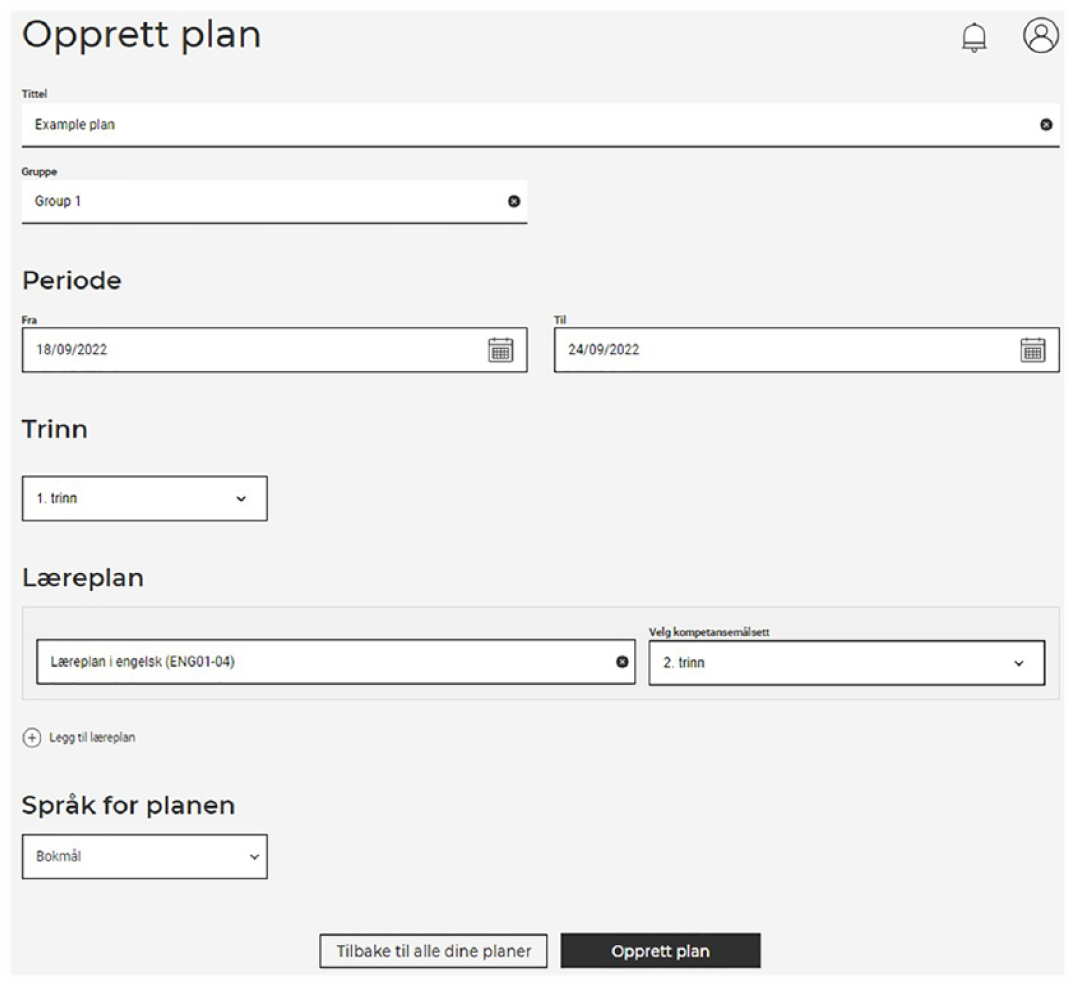
Pre-planning area with required fields: title, group, teaching period, class, subject curriculum and language of the plan (screenshot from our analysed example plan).
This area of the CPT functions as a type of boundary between all plans and the planning area. Selections made in this area set conditions for which elements of the subject curriculum will be available for the teacher in teaching planning. Only when the teacher fills out the required fields is he or she transferred to a teaching planning area. This area was purposely selected for our analysis because it shows how the curriculum and digital technology merge in the digital curriculum planning instrument.
Our analysis of the CPT configuration was based on several walkthroughs of the teaching planning area, where we developed our teaching plans and took notes. Then screenshots of a plan were uploaded and coded with the NVivo program. The first step of the analysis was the description and coding of internal relations that in SoC are grouped into three levels: (a) plastic qualities, such as contrasts and analogies among shapes and/or colours; (b) corporal relations expressed through relations of inclusion and exclusion and (c) figurative sphere, that is, the object’s recognisable aspects (Cabitza and Mattozzi, 2017; Landri, 2018a). In the analysis of the CPT, we focused on the description of visual aspects, such as the placement of different elements that comprise the configuration, recognisable frames within the design and colour coding. Through description, the patterns and linear placement of elements for the teaching planning process appeared, and the meaning of these visual aspects was revealed through the analysis of outward relations.
Therefore, the analysis was a continuous movement between describing the teaching planning area and testing functions to reveal outward relations created through inscripted modes of action. Cabitza and Mattozzi (2017) describe outward relations as potential external relations predisposed by the configuration’s inscripted modes of action. Accordingly, our analysis of outward relations was bound to the examination of what actions the CPT allows and limits teachers to perform rather than investigating the situations of practice where teachers use the CPT in their planning. Here, we coded the identified modes of action and the external configurations that the mode of action related to. Our analysis revealed different inscripted modes of action depending on whether teachers are required to do something, enabled to do something, have a possibility to do something despite prevention or lack of instructions, and are prevented from doing something during their teaching planning. In the discussion of the findings, these modes of action are systemised through the notions of prescription, affordance, allowance and proscription, respectively (Akrich and Latour, 1992), to demonstrate how the CPT governs teaching planning practice.
Governing teaching planning through the CPT
The analysis of internal and outward relations reveals an image of the CPT as an instrument which governs teachers towards compliance with the curriculum in their teaching planning practice. Below we demonstrate this when we discuss the internal relations of the CPT as a template that represents an inscription of a particular linear teaching planning process. Then, we examine separate elements of the CPT by focusing on the modes of action that define how teachers can interact with the curriculum in teaching planning. Finally, we approach the sociomaterial entanglement that includes actors other than digital technology, curriculum and teachers to discuss how the CPT transforms teaching planning as a collective responsibility.
Templatisation of the teaching planning process
After filling out a pre-planning form (see Figure 1), the teacher gets access to the planning area that is shaped in line with a digital template. Visually it is divided into two larger content areas. Cabitza and Mattozzi (2017) use the concept of enframe for bounded areas that enclose other elements and make them distinct from the rest. Plastic qualities, in this case grey and white backgrounds, serve as a distinctive feature for the two identified enframes of the CPT configuration (Figure 2).
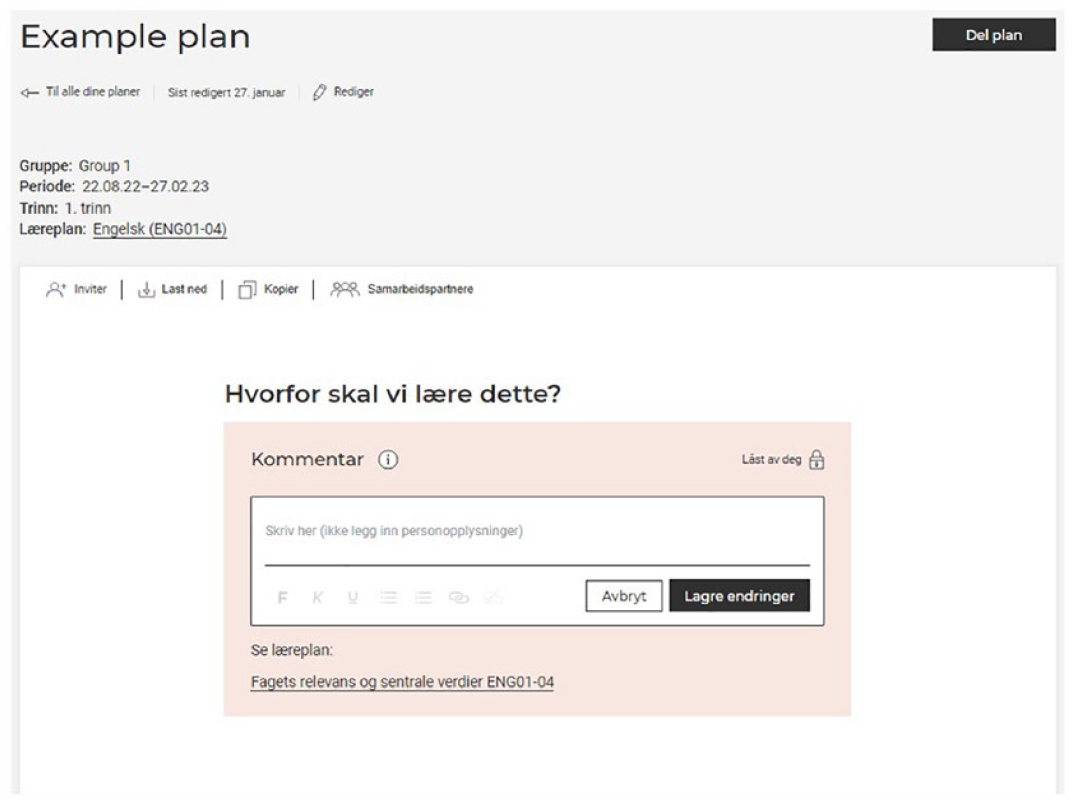
Grey enframe enclosing metadata of the teaching plan and white enframe which contains planning elements (screenshot from our analysed example plan).
The enframe visually coded with grey background encloses overall metadata about the teaching plan that the teacher is developing and a white enframe encloses the content of the plan. The grey enframe outlines information about the class that the lesson plan is intended for and identifies the selected subject curricula that the lesson plan follows. This metadata is based on the selections the teacher made in the pre-planning area (see Figure 1). Specific elements of the selected subject curriculum, such as competence aims, are available in the plan. In this manner, the grey enframe acts as a visual border for the lesson plan as well as sets conditions for teaching planning that teachers can conduct.
The grey area frames the second enframe, visually coded with white background (Figure 2). This enframe contains three elements of lesson planning that are vertically placed into a template-like configuration. These elements are placed in a hierarchical order from top to down. They are identified with the following textual elements: ‘Why should we learn this?’ ‘What should we learn?’ ‘How should we learn this?’. These elements constitute a template that governs local teaching planning practice (Hall, 2017). It translates teaching planning into a prescription of actions where the teacher is anticipated to follow the provided sequence of three questions by starting teaching planning with subject relevance and values (why); then moving to the content – core elements, interdisciplinary topics, basic skills and competence aims (what); and finishing with teaching and assessment forms and learning methods (how). By directly including components of the curriculum into the template the CPT operationalises teachers as deliverers of the national curriculum to local teaching contexts (Mølstad, 2015) and the template identifies which curriculum components (what) teachers are expected to deliver in local teaching contexts. Moreover, the template supports the teachers’ planning processes by breaking down the curriculum into the manageable steps.
Another important aspect demonstrated in the analysis of the CPT configuration is the arrangement of didactic reasoning in the template. Traditionally, didactic thinking is organised around ‘what’, ‘how’ and ‘why’ questions (see e.g. Engelsen, 2015). The ‘what’ question denotes competence aims and content, ‘how’ directs teaching forms and learning methods and ‘why’ is used to reflect on and justify the decisions made regarding the aims, content and methods. However, as our analysis reveals, the order of these elements within the template is rearranged, and the teaching planning starts with the ‘why’ question. Through such placement of didactic questions, the template shapes the teaching planning process and governs teachers towards the realisation of the curriculum reform intention to position subject relevance and values as the basis for academic content and teaching planning practice (Ministry of Education and Research, 2016).
By placing the subject relevance and values (why) element as a starting point of the teaching planning template, the CPT fabricates a temporality and spatiality (Decuypere and Simons, 2020) of teaching planning that corresponds with an intention to base teaching and learning on subject relevance and values (Ministry of Education and Research, 2016). Based on the inscripted vision of the teaching planning process, the CPT expects teachers to start this process by writing a future-oriented explanation or reasoning why students need to learn something concerning societal needs or future working life. Also, the space outside of classrooms such as the labour market and society are brought into teaching planning through the first element of the template (why). As the teacher moves to the next element of the template (what) the temporality also shifts to the subject curriculum and classroom activities necessary to reach the previously described future-oriented vision. The arrangement of temporalities within the template directs teachers to view curriculum delivery as a process of steps towards students’ individual, social and labour future rather than as completing competence aims and performing activities in a classroom.
The template of the CPT with its fixed structure prescribes teaching planning as a step-by-step process rather than a teacher-led fluid process where the structure of a lesson plan emerges through negotiations about teaching and learning (Masterman, 2020). However, the CPT provides an allowance to teachers to deviate from this specific ordering through what Cabitca and Mattozi (2017) call temporal proximity. Temporal proximity means that elements of the plan open only when the teacher performs some action such as selection. In this case, when the teacher opens the CPT’s planning area, a contracted form of the template is presented. If the teacher selects a specific element, then an expanded version of that element is displayed (Figure 3):
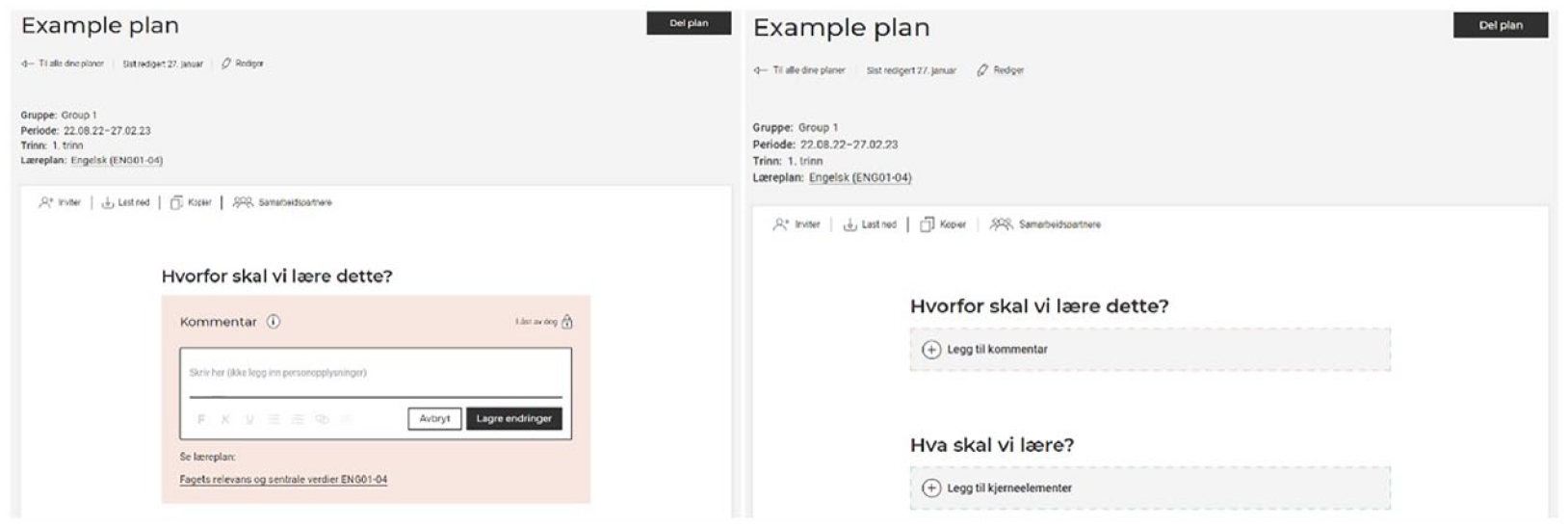
A comparison of the expanded (left) and contractet (right) versions of the ‘How should we learn this?’ element (a screenshot from our analysed example plan).
When the teacher is transferred to the planning area of the CPT, he or she is provided with a list of three questions enclosed within the white enframe. The meanings of these questions and the inscripted modes of action are initially hidden. On the one hand, such a configuration of elements acts as a prescription, where the teacher is required to click on each element to explore their content and meaning in teaching planning. On the other hand, it leaves an allowance for the teacher to open elements that they deem important to explore and fill out first. In this way, the teacher can shape an alternative sequence for their teaching planning practice without rearranging the template. The flexibility to start teaching planning with any other element of the template demonstrates the trust and autonomy provided to the teachers to follow the reform intention to place subject relevance and values as a starting point for teaching and learning. However, such inscribed flexibility might produce unexpected effects (Lascoumes and Le Gales, 2007) where, for instance, different teaching planning practices that do not necessarily start teaching planning with a consideration of subject relevance and values could emerge in local contexts.
Teacher autonomy within inscripted modes of action
As discussed above, the CPT forms an expectation to follow the curriculum reform (LK20) intentions and guides the process through a particular placement of didactic questions within the template. Further analysis of internal and outward relations of the CPT configuration reveals how inscripted constraints and possibilities affordances to use the instrument differently work as a form of curriculum work governance (Hopmann, 2003; Mølstad, 2015).
The inscripted modes of action within the CPT configuration can be divided into two main prescriptions: to write a text or select provided components of the subject curriculum. Colour coding distinguishes these prescriptions where the first one is enclosed in the pink enframe and the latter is enclosed in the light-green enframe (Figure 4).
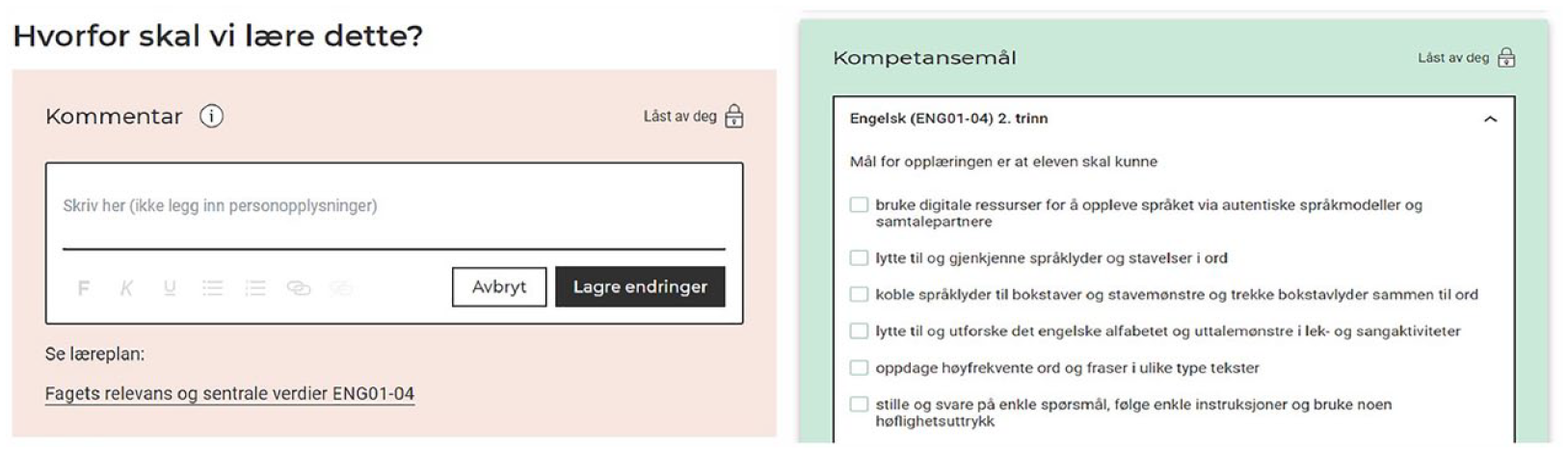
A comparison of prescriptions to write a comment about ‘Why should we learn this?’ (left) and to select competence aims from the subject curriculum (right) (screenshot from our analysed example plan).
A comparison of the inscribed modes of action within these enframes reveals a contrast in expectations for how teachers should work with different components of the curriculum. This hidden curriculum of the digital instrument concerning teacher-curriculum interactions (Edwards, 2015) defines teachers’ interaction with the curriculum text during teaching planning. Moreover, it sets a requirement for teachers’ professional knowledge and skills and outlines pedagogic freedom given within the template.
The light-green enframe identified with the question of ‘what’ encloses a list of tick-boxes with a prescription to select relevant core elements, interdisciplinary topics, basic skills and competence aims from the subject curriculum. The list of curriculum components – or the content that pupils should learn during the teaching period – is directly incorporated into the configuration depending on the selections that the teacher has made in the pre-planning area (see Figure 1). The analysis demonstrates that teachers are prevented from including other given curriculum components such as interdisciplinary topics or basic skills into their plan, shifting their order within the template or dividing them into smaller parts. Both the prescriptions to select content elements and constraints where teachers are proscribed from doing changes in the subject curricula text regulate teacher–subject interactions. They operationalise curriculum status as an authoritative document that is given a governing power to ensure that teachers across local contexts work towards the same goal (Karseth and Sivesind, 2009). The configuration of the CPT maintains the authority of the curriculum through the fixed text as well as predetermined relations between various curriculum components such as competence aims and interdisciplinary topics or basic skills. Hence, teachers’ pedagogic autonomy is constrained and structured by these boundaries.
The pink enframes of the CPT configuration enclose a free text space and prescribe for teachers to write about subject relevance and values (why), teaching and assessment forms and learning methods (how). Such prescription operationalises teaching planning within the licensing system where teachers’ professionalism is expressed through pedagogic freedom to determine ‘local day-to-day activities and outcomes using pedagogical arguments’ (Hopmann, 2003: 473). Teachers’ pedagogic autonomy is expressed through these prescriptions to include pedagogical arguments about teaching and learning activities or any other aspects of teaching that are deemed relevant. Thus, teachers may use experience and knowledge to decide on teaching methods within the boundaries of the subject curriculum which is a value that Norwegian teachers hold highly important for their profession (Dieudé and Prøitz, 2022; Mausethagen and Mølstad, 2015). The contrast between prescriptions found in light-green and pink enframes reflects an understanding that pedagogical autonomy emerges through tensions and struggles between expectations or dependence on curriculum as an organisational structure and teacher’s work in a classroom (Wermke and Höstfält, 2014).
Simultaneously, the intention behind the development of the CPT was to provide support to teachers to translate the curriculum into local work in schools (The Norwegian Directorate for Education and Training, 2021). While the pink enframes within the CPT configuration contain a pre-inscription or the expectation of competences (Akrich and Latour, 1992), such as teachers’ subject curriculum knowledge and the competence to translate it into a teaching plan, it is the relations within the CPT configuration that support teachers through inscripted modes of action.
In addition to the provided structure of a plan and integrated curriculum components, the CPT configuration contains an information icon (i) (see Figure 4, left image) or inbuilt links to particular components of the core curriculum. The information icon opens support texts with advice for teachers to discuss subject relevance and values with students. This can be viewed as both support through advice and governing teaching planning. Inbuilt links to the core curriculum, on the other hand, invite teachers to read other curriculum components as pedagogical resources that support teaching planning. Despite research demonstrating that teachers turn to other materials such as textbooks rather than curriculum text for support in local curriculum work (Gilje et al., 2016; Hodgson et al., 2012; Rødnes and de Lange, 2012), the CPT configuration holds an assumption that curriculum text is enough support for teachers and constraints from providing further pedagogic advice. While this might be seen as an attempt to secure licensed teachers’ pedagogic autonomy, it raises the important question of how the CPT performs a support function in cases when teachers experience curriculum text as complicated, vague or lacking support.
Instead, the CPT configuration suggests reflection after a completed teaching period as a way to support teachers’ local curriculum work and professional development. Once the period indicated in the pre-planning area (Figure 1) passes, a new enframe containing a prescription to reflect and evaluate the completed teaching plan appears. More specifically, the CPT prescribes to rate their lesson plan on a scale from bad to very good and discuss the lesson plan and its enactment with other teachers. With this, an expectation of self-governance, where the responsibility of governing is moved from central actors within the policymaking arena to teachers (Ozga, 2009) is created. The CPT has an inscribed vision of teachers as having the competence to evaluate their curriculum enactment and come back to the initial lesson plan to revise it for further professional growth. The CPT delegates the function of support to the professional teaching community. Simultaneously, the instrument of support is transformed into an instrument of assessment and accountability for teachers’ local curriculum work individually and collectively. This aspect is discussed in greater detail in the following part.
Teaching planning as a collective responsibility
By controlling which curriculum elements should be included in a teaching plan and defining teacher-curriculum relations the CPT can contribute to the convergence of teaching planning practice across local contexts. Research shows that despite a positive attitude towards independence in teaching planning, teachers point out challenges due to a lack of collaboration between colleagues (Salokangas et al., 2020). The CPT has the potential to open this rather private practice for more collaboration and transparency through inscribed teacher–teacher and teacher–pupil relations. However, these transformations might also contribute to new aspects of digital education governance.
The analysis of internal relations within the CPT configuration identified two icons: one visualising a single person and the other a group of persons (see Figures 2 and 3). Behind these icons, outward relations that enable interactions between teachers during teaching planning were identified. The icon that visualises a single person affords the teacher to invite other teachers to collaborate in teaching planning. The latter icon contains an affordance to see the relations between teachers within the plan: which teacher is an administrator and which teachers collaborate. Teachers invited to collaborate gain access to the plan with the same modes of action as the teacher who initially created the plan.
In one respect such collaboration mediated by the CPT configuration can be seen as teacher–teacher support where the digital instrument frames the relation within the template of a lesson plan. Teacher collaboration across grades and school levels is often confined to assessment discussions without crossing the boundary of the individual planning practice (Dieudé and Prøitz, 2022). Due to this, variations in curriculum enactment can appear not only between different local contexts but within the same schools between teachers (Hopmann, 2003). The affordance for collaboration provided through the CPT configuration attempts to open the individual practice of teaching planning for collaboration among teachers. This outward teacher–teacher relation inscribed in the CPT operationalises the curriculum reform intention to develop a professional teacher community and mobilise teachers’ collected competence through professional work and teacher collaboration (Ministry of Education and Research, 2016). The CPT enacts collaboration as a shared interest for teachers. It transforms teaching planning into a collective responsibility as a way to contribute to professional development.
Nevertheless, such opening of teaching planning through the inscribed expectation of collaboration can also contribute to the new control of the practice where teachers support but simultaneously control each other’s local curriculum work. During collaborative teaching planning teachers negotiate curriculum meaning and make decisions about teaching and assessment methods or learning activities. Paulsrud and Wermke (2020) interpret such collegial decision-making as a subtle form of control. Mediated by the CPT teaching planning practice transforms from an individualistic experience to a more transparent one due to increased control between teacher colleagues.
Moreover, the inscribed outward relation that affords pupils’ involvement in teaching planning and sharing teaching plans with pupils’ parents demonstrates that increasing transparency is an important aspect of the CPT configuration. The analysis of internal relations identified two internal elements related to outward relations with pupils. First, a textual reference to pupils is made under the ‘why’ question – a suggestion to discuss with students the relevance of the planned lesson(s). However, pupils are proscribed from commenting or writing directly in the plan. Second, within the grey enframe the template contains a contrasting black button that affords sharing the plan (visible in Figures 2 and 3). When the teacher clicks on this button, a new area of the instrument opens. Within this new area teachers are prescribed to select or limit which parts of the developed teaching plan will be shared with pupils (Figure 5).
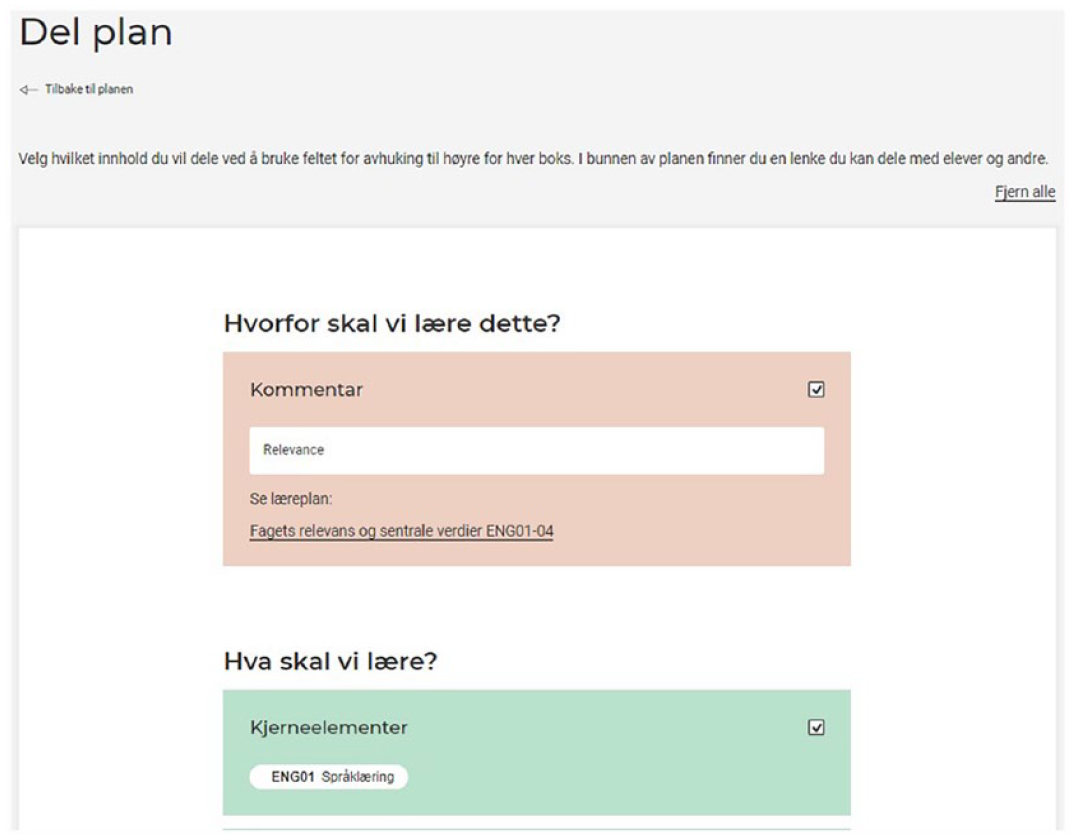
A plan sharing the screen with available teaching plan elements for selection (screenshot from our analysed example plan).
As shown in Figure 5, each teaching plan element has a box to tick if the teacher wants to share the particular element with pupils or their parents. Finally, a unique link appears at the bottom of the lesson plan. Because the CPT configuration proscribes sending the plan directly from the instrument, teachers are expected to use other means of digital communication.
This outward relation enables the operationalisation of the LK20 curriculum renewal intention to increase school–home collaboration and pupils’ engagement in learning by involving them in teaching processes (Ministry of Education and Research, 2016). It also reflects intentions to increase pupils’ agency in the learning process as promoted by transnational actors (OECD, 2020). However, the affordance to share plans with pupils or their parents differs greatly from intentions to increase students’ agency in terms of control. First, the CPT creates a vision of pupil involvement but does not provide any affordances for pupils to contribute to the plan. It is the teachers who control pupils’ participation. Second, teachers are prescribed to decide which parts of the plan to share with pupils or their parents. In the Norwegian context, discussions around the teaching profession and education quality led to new norms for accountability and professionalism with the involvement of pupils, parents and other interested parties in activities of internal accountability (Mausethagen, 2013). The outward relations of the CPT create an expectation for teachers’ professional accountability (to include pupils and parents in their planning processes), but the teachers are afforded to set the premises for the process.
Concluding discussion
This article examines how the CPT that was developed to support Norwegian teachers in local work with the renewed national curriculum governs their teaching planning practice. The analysis of CPT configuration with a focus on internal and outward relations demonstrates that this digital instrument materialises and operationalises the national curriculum and the LK20 curriculum renewal intentions in several ways. The structure of the CPT contributes to the templatisation of teaching planning and divides it into a manageable step-by-step process that prescribes relevant curriculum components for each of these steps. While it functions as a template of governance (Hall, 2017) delineating a specific process for teaching planning, the inscripted flexibility to move between the components of the template may be regarded as a soft form of governance based on an expectation to use the curriculum in a prescribed way. Further on, the teaching planning process within the CPT configuration is controlled through inscripted modes of action that prescribe and proscribe specific teacher–curriculum relations, also referred to as a hidden curriculum (Edwards, 2015). The instrument operationalises the national curriculum as an authoritative document governing the teaching planning process while maintaining pedagogic freedom to determine teaching and learning activities (Hopmann, 2003). Finally, the CPT can transform the traditionally individualised teaching planning into a collaborative endeavour between teachers to support curriculum enactment and professional development. However, such increased transparency among teachers can contribute to process control acted out by collaborating teachers.
Therefore, the CPT is not merely an instrument that supports teachers’ professional practice through intended functionality. The analysis show that it is also an instrument that may regulate teachers’ compliance with the national curriculum as a form of hard governance. Digital education governance is generally understood as a soft approach to governance that shapes practices through support and functionality (Williamson, 2013), which allows flexibility and autonomy for governed professionals. Regarding the CPT, the support and functionality are tied to process control through a template formed under the preconditions of the curriculum. Thus the CPT configuration contributes to the templatisation of practice which can lead to convergence of practices among teachers and serve as an instrument to close the gap between curriculum policy and its realisation in teaching (Engelsen, 2009). These findings align with the claim that the current LK20 reform acknowledges teachers’ professional capabilities, although it governs pedagogical practice more closely than the previous reform (Prøitz et al., 2019). Also, Karseth (2022) shows how support instruments provided with the curriculum renewal LK20 as cognitive maps or templates may govern how teachers work with the renewed curriculum. The CPT preserves teachers’ professional capabilities by licensing pedagogic freedom; however, the freedom is framed by constraints and possibilities of the structured template.
More importantly, it is important to raise questions about the curriculum as an instrument supporting teachers. According to Lascoumes and Le Gales (2007), new policy instruments are introduced due to the failure of stronger mechanisms of coordination to govern towards expected goals. Hence, an introduction of a digital curriculum support tool might be an attempt to respond to such failures. However, research on curriculum reforms demonstrates that changing curriculum guidelines in terms of format, size and level of detail have very little impact on teachers’ work with the curriculum (Hopmann, 2003). It is also important to note that digitisation of existing teaching planning practices might not necessarily contribute to the enactment of curriculum reform intentions because teachers tend to consult textbooks and use support guidelines only sporadically (Gilje et al., 2016; Hodgson et al., 2012; Hopmann, 2003; Rødnes and de Lange, 2012).
Hence, an essential question remains whether the CPT (and similar instruments) will support teachers’ local curriculum work or tighten the boundaries of teachers’ practice within the intentions of curriculum reform. As Masterman (2020) suggests digital support is provided through guidance that enables teachers to manage the teaching planning process without excessively constraining the process. In other words, it is important to ask why users, in this case, teachers, should enrol in using the instrument (Akrich, 1992). While our findings show that the CPT configuration constructs a prescriptive template that constrains teachers’ practice, prescribed teacher collaboration could potentially open up an individualistic practice for more transparency and input from other teachers contributing to professional development.
The findings in this article are relevant in a broader European context. According to the data from international questionnaires (OECD, 2020), in addition to Norway, other European countries including Ireland, Estonia and Poland are already using interactive digital curricula, and many other countries are in the process of developing such instruments. This article has demonstrated how such tools are mediators of teaching planning in ways that may affect teacher autonomy. However, research (see Salokangas et al., 2020; Wermke and Höstfält, 2014) shows that not only national curricula but also understandings of teacher autonomy differ across countries. Future research on digital education governance needs to explore how national contexts and teacher autonomy understandings are taken into account in digitised curriculum planning instruments. Moreover, research must consider whether digital instruments contribute to shifting teacher autonomy across countries towards convergence owing to the possibilities and limitations inherent to digital technologies.
The analysis of the digital teaching planning instrument in this article was based on the SoC (Cabitza and Mattozzi, 2017) approach that provides extensive terminology for such investigations in terms of both the instrument itself and practices when the instrument is in use. Although such a framework for the analysis of digital instruments might be considered rather rigid, having extensive common terminology to describe and explore digital instruments might open up possibilities for fruitful comparisons of such instruments within and across contexts. Moreover, the analysis of the digital instrument in this article is limited to the inherent sphere (Cabitza and Mattozzi, 2017), with a focus on the instrument’s visual description and enabled modes of action. Although such limitation allows an in-depth analysis of the instrument itself before exploring its use, it is important to consider that other modes of governance would emerge through the analysis of how the instrument is used across Norwegian schools.
Footnotes
Declaration of conflicting interests
The author(s) declared no potential conflicts of interest with respect to the research, authorship, and/or publication of this article.
Funding
The author(s) received no financial support for the research, authorship, and/or publication of this article.
