




Abstract
This article analyses discussions in the Russian media of the proposal to introduce the Unified State Exam (USE) in English as a mandatory test in the last year of (high) school education 2010s. The decision not to implement the mandatory USE in English was taken in August 2020. In the aftermath of the decision, we investigate the decade-long media debates. Building methodologically on frame analysis, we examine the frames used in the online media to present the pros and cons of English testing, and the qualitative modifications of these frames over time. We argue that media coverage of English as a compulsory test parallelled changes in the politics of nation-building and language policies. First it reflected the idea of Russia as a global economic actor, striving to reap the benefits of a global economy, and framed the acquisition of English as part of the global economic and political community. However, as the state’s prerogatives changed, English began to be discussed as a threat to national unity, national security and the mastery of Russian. Moreover, the ‘national’ became associated, with separation from the rest of the world and its perceived threat.
Introduction
In the theories of modern nationalism, language is the ‘chief criterion and main cultural substrate of nationhood’ (Brubaker, 2015: 98), Claims made in the name of language therefore speak volumes about claims made in the name of nations. In this article we analyse discussions in the Russian media in the 2010s about the idea of introducing the Unified State Exam (USE) in English as a mandatory test in the context of current Russian education policy and the politics of nation-building. The USE is a compulsory graduation examination in the last year of (high) school education. The exam constitutes one of the most important education policy reforms of the last twenty years that aim to standardise curriculum implementation and the evaluation of education quality through annual nationally designed testing of individual learning achievements. Since its inception the only mandatory USE subjects have been maths and Russian, while other examination subjects are selected by the students, depending on their professional and educational plans. The debates on English as a third compulsory subject are therefore significant in the context of the USE’s earlier focus on numeracy and literacy in the state language.
The decision not to implement the mandatory USE in English was taken in August 2020 after a decade-long debate on the reform proposal. In the aftermath of this decision, it is especially interesting to investigate how the debate has evolved in the context of Russia’s broader socio-political changes. Building on the methodology of frame analysis (Entman, 1993), our research task addresses the identification of the frames used in discussing the proposal in online media in the 2010s and their socio-political contextualisation and analysis.
We argue that the frames used in presenting the Unified State Exam in English in the Russian online media paralleled changes in the politics of nation-building and language policies. Debates on the benefits of introducing the mandatory testing of English first reflected the idea of Russia as a global actor and partner, requiring English acquisition to become part of the global economic and political community. However, as our analysis documents, with changes in the state prerogatives, English was increasingly discussed as a threat to national unification, national security and mastery of Russian. The frame therefore shifted to prioritising the national. It also isolated it from the influences of the outside world. Our purpose in this article is to study nationalism as a socio-political discourse, thus we do not interpret the intentions of the authors of the media texts. We see nationalism as reproduced across domains we might not immediately conceive of as central to nation-building. Moreover, our research was completed before the invasion of Ukraine by the Russian Federation (on 24 February 2022). As we write this article, Russia is continuing to wage a devastating war, and we detect the themes and arguments outlined in this study in the official justifications for the aggression.
The article proceeds as follows. First, we discuss the relationship between language policy, education and nation-building. We follow this with a nuanced contextualisation of language policies and education in Soviet and post-Soviet Russia, including developments in foreign language education. These sections build mostly on existing research, though we also introduce the evolution of foreign language education in Russian education policy through first-hand policy analysis. We follow these theoretical and contextualising sections with methodological insights into the role of the media and frame analysis, and a description of our empirical data. The empirical findings are presented in the next section, followed by a discussion.
Nationalism, language and education
The end of the Cold War prompted optimistic accounts that declared the end of the era of nationalism and national differences and juxtaposed nationalism with (the rise of) globalisation (Tröhler, 2022). The ‘spell of globalisation’ as an epistemological delusion has led to scant attention being paid to the question of national reproduction in and through education (Tröhler, 2022, but see Millei and Imre, 2021; Sautereau and Faas, 2022). Instead of being a passing historical anomaly, nationalism constitutes an underlying cognitive frame that shapes how people see and structure their worlds (Ozkirimli, 2005). In other words, it is a dominant form of modern subjectivity (Malešević, 2019). It ‘leads people throughout the world to think and frame their aspirations in terms of the idea of nation and national identity’ (Calhoun, 1997: 6). As a political principle it also equates the state as a bounded territory with the nation as an imagined cultural community (Anderson, 2006; Gellner, 2008). Nationalism should be viewed as a contingent and vulnerable accomplishment (Kymlicka and Straehle, 1999; also Kuzio, 2001) that depends on continuous strategic and habitual reproduction across the public and private domains (Brubaker, 1996; Malešević, 2019). Nation-states are products of ongoing nation-building policies and practices that diffuse and strengthen a sense of nationhood (Kymlicka and Straehle, 1999). State-funded and regulated education plays a major role in the daily preservation and reproduction of the bond between the people and authority and the nation itself. Historically, the spread of compulsory standardised elementary education ensured that all new cohorts underwent a process of political and national socialisation. The purpose of education was to advance the use of the national language, spread a standardised form of culture, and create a citizenry loyal to the emerging nation-state (e.g. Green, 1990). Mass schooling continues to explain the resulting fixity of national identities (Darden, 2022).
Language plays an essential yet varied role in the processes of nationalisation, but its firm linkage to the nation is far from natural or pre-existing. Instead, this link is crafted, emergent and ongoing, reiterated banally and strategically. Family and later formal schooling are central sites of linguistic reproduction, which are ‘powerfully shaped by political, economic and cultural processes, and they change as circumstances change’ (Brubaker, 2015: 87). Languages and nations are binarily constructed as bounded and exclusive categories rather than a continuous spectrum of variation. They differentiate practices and people, simultaneously dividing and uniting, thus constituting sameness and difference (Brubaker, 2015). The dynamics of the inclusion and exclusion of particular populations is thus based on language acquisition or linguistic identification. The existence of a shared language provides grounds for claiming an independent nationhood, leading to varied consequences such as viewing the presence of linguistic minorities as a threat to the state’s cohesive national identity or territorial integrity (Wright, 2016). Language skills are linked to citizenship both formally and morally, which can be seen in language tests (Khan and McNamara, 2017) or ‘as hegemonic understandings of what is an acceptable way of speaking’ (Ramjattan, 2019, cited in Saarinen, 2020: 14). Although linguistic tensions have largely decreased due to the expansion of employment, urbanisation, state education and the rise of other institutions and historical processes leading to linguistic unification and standardisation, this is not to say that the political relevance of language has been eliminated (Brubaker, 2015). Language continues to both reflect and co-constitute political and ideological structures (Saarinen, 2020).
Nationalistic interests and discourses permeate various policymaking sectors, and nationhood is usually reproduced in banal ways (Billig, 1995). In this paper, we therefore examine the reproduction of nationalism in less evident domains. Education policy researchers principally view the recent rise and spread of national large-scale assessments (NLSAs) as a manifestation of the globalisation of education policies and practices. In contrast, as we have shown elsewhere (Piattoeva and Vasileva, 2021), the USE as a variant of NLSAs in the Russian context enables the (re)construction of state-centric nationhood. NLSAs are not only incorporated into an environment in which nation-ness is an endemic condition; they reproduce the view of the world as one of existing or aspiring nations and the view of nations as real entities with defined borders and shared attributes (ibid.). The global and the national are thus ‘interdependent and have historically constituted each other’ (Häkli, 2013: 344). Instead of thinking of nationalisation and globalisation as opposite poles, we should approach the nation as (re)constituted by multiple nationalising discourses or narratives which may differ in content but retain their form. In other words, they may attribute different interests to the nation without questioning the ‘existence’ of the nation or nationhood as a ‘natural’ category (Soler and Gallego-Balsa, 2019).
For example, the discourse of economic interests and global competition of ‘our’ nation against others habitually frames economic arguments touting the benefits of learning and diverse linguistic skills. Saarinen (2020: 6) therefore states that as scholars ‘unpack the hegemonic discourses’ they ‘find not one but many nationalisms’, which is also a reminder that these discourses are not successive but layered and recycled across time and space. To understand how nationalism persists and its force, we need to trace the processes of its metamorphoses and manifestations across various domains. Saarinen (2020) gives an example of the English language transforming from ‘a guarantor of national interests and benefits’ to ‘today’s killer English’: a perception of English as a threat to mastering the national language and thus broadly to the continuity of national identity (p. 128). ‘Protecting’ national languages easily lends itself to nationalism that is, as essential for the reproduction of national identity and the link between nationhood and statehood (Kelly, 2018; Lee, 2017, as cited in Saarinen, 2020: 2).
Language policies and language education in Russia
To fully understand the politics underlying foreign language education in Russia, we should first consider the ‘context of general ideological stances and nation-building language policies’ (Davydova, 2019: 136). After the collapse of the Soviet Union in 1991 school education became ‘an arena of competing nationhood claims, where efforts to construct a state-centred identity confront[ed] attempts by regional actors to shape and transmit ethnic and regional belonging’ (Suleymanova, 2018: 53). The newly reshuffled post-Soviet republics and autonomous territories within the Russian Federation aimed to develop and implement their own language policies, as well as to manage the relationship between Russian and minority languages (Gulida, 2010, as cited in Davydova, 2019: 142). Language policies sought to exclude Russian from essential spheres of communication and promote the respective titular language as the national language of an independent state for use in government, education, administrative and media environments. Meanwhile, measures to enhance proficiency in English as an alternative lingua franca on the territories of many newly independent post-Soviet states were adopted. In some countries (e.g. Turkmenistan, Armenia and Lithuania) Russian competed with English as a foreign language in secondary education; in Uzbekistan and Azerbaijan it remained the language of instruction in the field of higher education (Davydova, 2019: 142).
With the establishment of the Russian Federation after the collapse of the USSR policymakers were torn between two seemingly opposing objectives: building a new nation that respected cultural and linguistic diversity; and uniting the nation through a new national identity based on the primacy of Russian (Piattoeva, 2010). The coexistence of the two objectives often resulted in vaguely formulated national policies pursuing both the integrationist goals of promoting a common civic identity and the ‘accommodationist goal of maintaining ethno-cultural diversity, inter alia, through the recognition of the status of ethnic republics’ (Laine and Zamyatin, 2021: 3).
The brief period of perestroika, glasnost’, and the liberalisation of the late 1980s and early 1990s was indeed evidence of a certain revival of national languages and titular language teaching, and the new legislation confirmed the principle of decentralisation in the field of language policy (Krouglov, 2022; Suleymanova, 2018). The first federal law ‘On the Languages of the People of the RSFSR’, whose main principle was the equality of languages, was adopted on 25 October 1991. It guaranteed basic language rights, including citizens’ right to use their mother tongue when interacting with the government and to freely choose the language of school instruction. However, while supporting language diversity, the federal government also sought to promote the special legal status of Russian as the ‘state’ (gosudarstvennyi) language, a symbol of national identity and a crucial element of state-building, aimed at unifying ‘the diverse nation into one nation state’ (Chevalier, 2018: 101). That was by no means the first attempt in the country’s history to establish the dominance of Russian at the cost of minority languages (see e.g. Davydova, 2019).
In pursuing the goal of ‘democratising’ education and better addressing individual learners’ needs, the Federal Law ‘On Education’ (adopted in June 1992) divided curricula into parts: federal; national-regional; and school-based. Twenty per cent of the national-regional component provided regions with the authority to ‘reintroduce titular and indigenous languages and cultures to regional schools’ (Chevalier, 2018: 103). Consequently, both rural and urban areas saw an expansion of national schools (Suleymanova, 2018). However, providing titular languages in constituent republics with the official status of the state language was largely symbolic, and the attempts to promote a wider use of titular languages lacked effectiveness due to poor funding and inconsistent legislative support. Some local languages maintained a stigmatised status and were associated with low social prestige. There was therefore a continuing shift towards Russian, which was attributed with enormous social power (Davydova, 2019). In December 2007 an amendment to the 1992 Federal Law on Education (Russian Federation, no. 309) abolished the ethno-regional educational component that had been widely used for teaching non-Russian languages (Suleymanova, 2018). The regional education authorities were concerned that the law might lead to the total disappearance of non-Russian titular and indigenous languages and cultures from school curricula (Zamyatin, 2012, cited in Chevalier, 2018: 108).
At the beginning of the 2000s the centralisation of power and political stability became the key issues in the Russian official agenda, and the federal authorities began to see decentralising regional initiatives as a threat to the integrity of Russia, including its education system (Piattoeva and Vasileva, in print; Suleymanova, 2018). Hence, a set of new education reforms with the main goal of recentralising power over the education system were introduced. In 2001 ethnic and religious parties were prohibited, and in 2004 direct gubernatorial elections were eliminated under the pretext of the threat of terrorism. The centralisation of power and references to external threats to national unity began to dictate the country’s nation-building policies (Laine and Zamyatin, 2021). Public education was aligned with the development of a highly centralised rule and was made responsible for shaping a state-centred citizen identity (Suleymanova, 2018).
Another blow to titular languages came from the introduction of the USE (2008), which could only be taken in Russian, regardless of the language of instruction. This resulted in the decline of popular support for non-Russian language education (Suleymanova, 2018). Minority languages were not only competing with Russian but with English, as well as other foreign languages taught at schools throughout the country (Krouglov, 2022). The launch of the USE therefore had a significant impact on the teaching of titular languages in national regions and marked a dramatic shift from ‘educational policies aimed at making education more accessible for the diverse population, to reforms aimed at instituting national standards’ (Chevalier, 2018: 108).
In 2005 the State Duma adopted a new federal law designed to reinforce the status of Russian as the official language of the entire state at the nationwide level alongside the federal programme for the Russian language. The law pinpointed the ‘superordinate status of the Russian language in comparison to the other mother tongues spoken on the territory of the Russian Federation’ (Davydova, 2019: 143) and focused on introducing moral and religious upbringing at schools. However, it is important to note that concomitantly, in individual republic constitutions, 35 ethnic languages were still recognised as official languages in addition to Russian, and some regional schools showed resistance to the russification trend (see e.g. Suleymanova, 2018).
In 2018 an amendment to the Law on Education removed the mandatory teaching of titular languages as the state languages of the republics, and Russian was recognised as a native language even for non-Russian students (Laine and Zamyatin, 2021). After the revision of the goals of the Strategy on Nationalities Policy, the goal of ‘strengthening of national accord’ emerged, while the emphasis on supporting ethnic and linguistic diversity lost its priority status (Laine and Zamyatin, 2021: 6). The result was that between 2007 and 2019 the number of children taught at school in their mother tongue decreased by 1.6 times (Krouglov, 2022: 14). The annexation of the Crimean Peninsula by the Russian Federation in 2014 was one of the most important developments that among other areas affected language policies and foreign language teaching (Laine and Zamyatin, 2021): the official discourse regarding the primacy of Russian ethnicity became much more outspoken, which marked an ‘ethnic turn in Russia’s identity policy as part of the conservative turn’ (Laine and Zamyatin, 2021: 6). One of the results was the removal of the compulsory teaching of titular languages of the Russian Federation republics from the law on education (Laine and Zamayatin, 2021: 6).
Foreign language education in Russia
Despite the Iron Curtain, the Soviet school curriculum offered four foreign languages, and in some specialist schools foreign language instruction began as early as in the second grade. However, foreign languages were stigmatised, and their study was often regarded as ‘a risky enterprise’ (Davydova, 2019: 145). Associated with the West, foreign languages commonly represented the ideological enemy (Davydova, 2019: 147). Most Soviet textbooks were used as a propaganda tool, ‘permeated by texts, vocabulary and exercise of ideological value’ (Pavlenko, 2003, as cited in Davydova, 2019: 146). Only after perestroika, with its clear shift in ideological doctrine, did the country become more open to foreign influences and thus to foreign languages (Dovydova, 2019: 147). However, the curriculum, which assigned many academic hours to foreign language studies, was later abandoned, as the school authorities concluded that the ‘learning of foreign languages should accompany rather than lead secondary school education’ (Davydova, 2019: 148).
The 2010 Federal Standard of general education (the ‘second-generation standard’, adopted 17.12.2010) formulated the first goal in foreign language education as follows: ‘shaping a friendly and tolerant attitude towards the values of other cultures, . . . developing national self-consciousness based on the awareness of peers’ life in other countries and examples of foreign literature of different genres’ (Ministry of education of Russian Federation, 2010). The very idea of foreign language learning was predicated on the concept of a mutually beneficial intercultural exchange. However, a decade later the situation changed. The latest (third-generation) Federal Standard (Ministry of Education of Russian Federation, 2021) of general education (adopted 31.05.2021) is much more detailed in its description of required linguistic competences (lexical, syntactic, morphological and cultural). However, the above goal (alongside the adjectives ‘friendly’ and ‘tolerant’) has completely disappeared.
Nor does the new standard mention the development of national self-consciousness based on other cultures’ achievements. Now, among the practical language skills it requires the ability to ‘expose representatives of other countries to the Russian national culture and the traditions of the Russian peoples’ (Ministry of Education of Russian Federation, 2021: 69). At the very end of the foreign language section, instead of formerly proclaimed friendliness and tolerance of other cultures, the standard requires the ability to reach an understanding with people of other nationalities, cultures and religions based on the ‘national values of the contemporary Russian society’ (Ministry of Education of Russian Federation, 2021: 69). The formerly proclaimed dialogical model of intercultural exchange thus becomes a somewhat monological affirmation of Russian values. The same shift in values is also noticeable in the description of the topics students need to master – native country and Russian culture now precede their foreign counterparts: ‘the native land and the target-language countries’; ‘great people of the native land and of the target-language countries’. The priority of national values shapes the idea of learning a foreign language, which shifts to the concept of acquiring technical linguistic skills to be able to translate the values and ideology of the native country to the rest of the world.
The media system and national politics
If one imagines society as a system composed of overlapping and intertwining sub systems – such as the health system, political system, education system and so on – the media system can be described as having a central position: it connects all the other systems (Luhmann, 1996). This is because the media is on the one hand the main tool allowing actors from other systems to disseminate their ideas to the general public and assess the other systems’ reception of this information. On the other hand the media is the main vehicle through which the public is informed about events in the world (Luhmann, 1996, 1997). Contrary to the expectation of neutrality, the media, functions as a mechanism for the double reduction of the social world’s complexity: first, the public is influenced to focus on some education themes; second it is led to interpret them from only a few perspectives’ (Santos, 2022: 64–65; Santos et al., 2022).
The dual dynamic that reduces the social world’s complexity can be observed in the Western countries, possibly with some nuances. In post-Soviet Russia the role of the media is characterised by a fragmented mixture of old traditions and new trends, combining influences from the outside and pressures from the local and national levels (Vartanova, 2013). Although freedom of the media has been granted by law with freedom of speech and the prohibition of censorship (de Smaele, 1999, 2007; Simon, 2004), in reality ‘. . . secrecy and a lack of access to information is a problem much quoted by journalists and citizens. . .’ (de Smaele, 2007: 1299). Today, more than sharing truthful information about national and world events, the official state-owned media is used to defend the interests of power holders (Hinck et al., 2018). Collective state-defined values enjoy precedence over individual ones, which makes it easier for the government to justify its control of information and the media (de Smaele, 2007: 1310). These strategies are used to construct a more or less common schemata of interpretation, which in turn works as a nation-building tool (Hinck et al., 2018).
In education policy research Baroutsis and Lingard (2017) have demonstrated that the media has begun to frame education policy by publishing the national PISA scores and demanding reform, for example. Our purpose is not to study the role of the media in policymaking but to highlight the relationship between the media and nationalism. Historically, the media has played a central role in the construction of “imagined communities” across the world (Anderson, 2006). Knowledge, values, and social rules are disseminated in society through media outputs such as national newspapers or radio and TV shows ( Baraldi et al. 2021; Luhmann, 1996). The media reproduces nationalism in both structure and content (cf. Skey, 2020). Structurally, the fact that one can understand and engage with the message is as important as its content (Szulc, 2017). The very language in which the message is transmitted matters, helping create and maintain distinct linguistic virtual communities. At the same time the media allows the transmission of standardised content and in some cases may strengthen support for nationalist parties, for example (DellaVigna et al., 2014). This recognised involvement of the media in most social dynamics including nationalism testifies that research is needed to understand how the different forms of nationalism are present in the media, and how they change in time (Mihelj and Jimenez-Martinez, 2021). This starting point, justifies our selection of media articles as sources of data for a period of more than a decade. We focus on online sources, because compared to the print media they represent more numerous and varied responses by diverse actors to urgent public issues such as the USE in English in Russia.
Frame analysis
As suggested above, the media frames topical issues according to schemata, and the frame analysis as a qualitative methodological approach to study textual data helps analyse this in detail. Framing consists of selecting and highlighting specific parts of an event while undermining or discarding others (Entman, 1993). The process of framing is both macro and micro (Scheufele and Tewksbury, 2007): macro, because how events are presented echoes previous common understandings constructed among the audience members; micro, because ‘framing describes how people use information and presentation features regarding issues as they form impressions’ (Scheufele and Tewksbury, 2007: 12). Framing should be understood as part of the context where the individual belongs and ‘. . .accounts for the larger flow of communication and influence among elites, media and public’ (Entman et al., 2009: 175). Frame analysis permits the identification of how problems are defined, interpreted, evaluated, and what solutions are presented (Entman, 1993: 54) and as such, when used across a longer time span as in this paper, it enables the identification of how diverse communications can contribute to the overall sensemaking of themes and world events, not only regarding individuals but also in larger societies in an extended period.
Our study builds on the data originally collected by Valeriia Smirnova (second author in this article), and focuses on the analysis of 50 news reports by journalists, op-ed pieces, and opinion articles from three online Russian media outlets: 16 articles from Uchitel’skaia gazeta (hereafter UG – Teachers’ Gazette, founded in 1924, a newspaper focussing on most education-related events), 11 articles from Moskovskiy Komsomolets (MK – a popular Russian tabloid with a circulation of about a million, founded in 1919), and 23 articles from Rossiiskaia gazeta (RG – founded in 1990, one of the largest and most influential government daily periodicals, which publishes and discusses official government documents). The three outlets represent three target audiences and three distinct focuses: MK mostly focused on the potential problems associated with the introduction of the USE and targets the ‘common reader’. RG translates the official perspective of the government and promotes government initiatives. It addresses the Russian people in the most general sense (as the recipients of legislative initiatives). UG focuses on the professional interpretation of education-related legislation and practices and targets education professionals. Additionally, we have used articles from other media outlets that occasionally and irregularly discussed the topic.
The criterion for selecting the articles was that the focus of the online piece should be to report on the introduction/withdrawal of the USE in English as a mandatory test. Keyword searches included ‘the unified state exam in a foreign language AND education reform’, ‘the USE in the English language’, ‘obligatory USE in English’, and ‘withdrawal of the USE in English’. The analysis identified and examined two periods, defined according to changes in the dominant frames presented in discussions of the USE in English as a mandatory exam: the early 2010s to mid 2010s; and the mid to late 2010s. The analysis of the articles then focused on the four devices outlined by Entman (1993): the identification of problems’ definitions, causal interpretations, moral evaluations (sometimes indirect and expressed, e.g. in irony or sarcasm as a rhetorical device), and treatment recommendations. The analysis was developed inductively, and the sub-themes emerged as the analysis progressed.
Framing the exam: From global integration to anti-Westernism
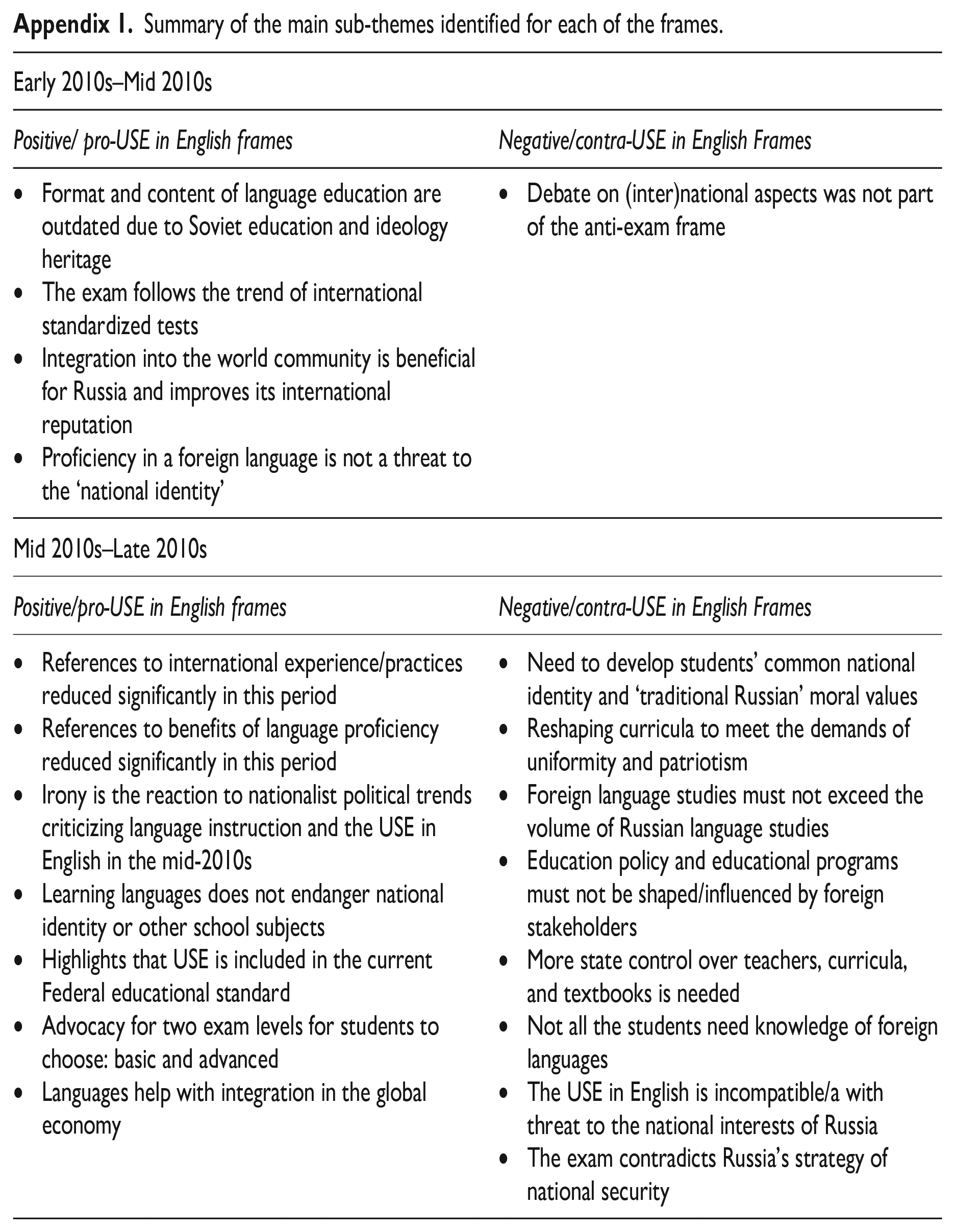
The analysis focuses on two main frames, one supporting and the other opposing the introduction of the Unified State Exam (USE) in English as a mandatory test. In the following we examine the pinpointed frames, their characteristics, and the devices on which they rely over the two identified periods. Both frames were constructed through three sub-themes: education (curriculum and paedagogical expertise); society (inequality and financial instability); and identity (Russia’s national and global interests and the characteristics of national identity). Throughout the analysed decade these sub-themes were discussed both positively and negatively and underwent change (see appendix 1). The subject of identity, which in the pro-exam framing of the early 2010s was manifested in aspirations for global education integration, acquired the opposite tone in the counter-exam frame in the mid 2010s, with a strong emphasis on the issues of national identity and interests. In the following we focus on the evolution of this sub-theme, using quotations translated by the authors for a nuanced illustration.
Overall, during the first period the newspapers Uchitel’skaia gazeta (UG) and Rossiiskaia gazeta (RG) consistently developed the exam-supporting frame and promoted the Ministry of Education’s plans, while Moskovsky Komsomolets (MK) represented the exam-opposing frame. However, when the anti-exam frame acquired nationalist connotations in the mid 2010s, the MK became the outlet for criticising this change, and publications defending the exam became more frequent. Meanwhile, the UG and RG remained more neutral in their stance and communicated the official anti-exam message without any harsh criticism. Finally, at the end of 2021 the UG and RG sided with the government’s decision to renounce the plans to introduce the mandatory exam in foreign languages, while the MK still published texts that cast the decision as a mistake. When the discussion of the USE in English became more controversial, irony emerged as a rhetorical device and was especially evident in the tabloid media.
Another interesting feature of the development of both pro and contra frames concerns references to various groups of experts. Initially, the exam-opposing frame mainly relied on the opinions of schoolteachers complaining about the school system’s lack of preparedness; the exam-supporting frame relied on the education and political authorities. However, after the mid 2010s, with the change in the political agenda and rhetoric, the ‘contra’ frame started referencing the authorities much more frequently, indicating the growing importance of exam opposition and the authorities as its source.
Early 2010s: Aspirations of integration
In the early 2010s the supportive frame dominated the media discussions, introducing the national and international relevance of English as a compulsory exam. The outdatedness of the format and content of language education was attributed largely to the heritage of Soviet education and ideology. In the quest for alternatives the exam was constructed as a promising solution to numerous challenges. In particular, the benefits of Russia’s integration into the global community appealed to the liberal values popular in the first post-Soviet decade. Studying a foreign language was often framed positively, promising to strengthen the country’s international reputation. For example, RG quoted an expert who placed the USE in English in the context of worldwide education developments and highlighted the importance of following the best examples of international standardised tests (RG, 20.08.2012). The newspaper framed the USE and English language studies in general as addressing the national interests of the country and as a vital development not only in Russian education, but in society as a whole, which could become an integral part of the world community. Furthermore, the Russian people were described as fully-fledged players on the global market, in which languages, especially English, were absolutely essential: Everything now – education, commerce, production – is connected with English. Unfortunately, not everyone in our country understands that yet (RG, 20.08.2012).
Although English is referred to as the ‘language of a superpower’ (RG, 20.08.2012), studies in foreign languages and the Russian languages were presented as complementary. The media did not present English and Russian as rivals, nor did they build hierarchies between more and less nationally relevant school subjects. Hence, the USE in English at this stage was not presented as a threat to Russian identity or culture. The exam’s opponents did not criticise it from the perspective of national interests but the challenges of its implementation and consequences in education and societal terms. While the debate’s (inter)national aspect was not part of the anti-exam frame in the early 2010s, in the mid 2010s it entered the discussion. The national interests’ aspect of the anti-exam frame emerged in 2014 and strengthened in the late 2010s, when it appeared to echo the authorities.
Mid to late 2010s: Establishing a Russian versus foreign binary
In 2014, coinciding with Russia’s annexation of Crimea, references to the national aspects of education started to outweigh those that referred to the international community, and new arguments against the implementation of the USE in English began to appear. Those arguments, unlike in the previous period, constructed a stark opposition between the studies of Russian language and culture and foreign language education in the curricula. The subjects of Russian language, literature and history were brought together under the umbrella of nationally relevant subjects as the ‘foundation of the nation’ and its strategic asset: ‘as regards national security, the humanitarian sphere is no less vital than the defence industry’ (UG, 14.07.2015). The proposed USE in English (as well as foreign language studies in general) appeared a threat to them.
Even UG, which had previously been a lone voice in supporting the exam, began to publish texts that critiqued the prospect of the new USE based on its negative effects on Russian language and culture, first calling for a careful balance between subject groups. It soon announced that the nationally relevant subjects should prevail over education in foreign languages and cultures. The MK referenced President Putin’s concerns about the ‘low level of the teaching of Russian’ and the then minister of culture Medinsky’s suggestion that the ‘proportion of hours spent on teaching the Russian language and foreign languages in favour of Russian’ should be changed (MK, 03.07.2014). At the same time the issue’s political relevance was already highlighted in the title of the article, ‘The USE results worried Putin’, referring to the low averages for Russian in that year’s USE.
The notion of threat extended to both the nationally relevant subjects and the Russian identity. For example, the 8.07.2014 UG article ‘The intelligent person is insured against the virus of nationalism and intolerance’, despite its headline, used the pronoun ‘our’ 15 times when insisting on a balance between the Russian and non-Russian cultures/languages in school curricula, quoting the minister of culture as saying: We are learning foreign languages more nowadays, and this is good, but these studies shouldn’t harm the learning of the Russian language, our literature and our history.
In juxtaposing the subjects of teaching ‘our’ language and history with those dealing with foreign cultures, the article unequivocally emphasised the leading role of the former.
The calls to rebalance nationally relevant subjects and subjects studying foreign languages and cultures eventually led to a direct questioning of foreign language teaching at school. Thus, the article ‘Double linguistic illiteracy’ (MK 02.09.2015) openly juxtaposed schoolchildren’s allegedly poor command of Russian grammar and the Ministry’s plans to introduce the new USE in English (as well as to start teaching a second foreign language at school). The article communicated a decidedly negative and openly sarcastic opinion regarding these plans with an underlying message that Russian children did not need foreign languages, and it would make more sense to improve their Russian skills than to develop foreign language programmes at school: Please don’t tell me how useful it is to know several foreign languages. . . Why don’t our school kids learn Russian at least? (MK, 02.09.2015).
The idea of decreasing the status of foreign languages at school in favour of the Russian language, literature, and culture appeared in a lot of media, not only in those analysed here. At the end of the period during which the introduction of the exam was debated, Gazeta.ru published an article summarising the reasons not to introduce the new mandatory USE. The lead paragraph mentions the demands of the state Duma ‘not to place foreign languages higher than Russian’ (Gazeta.ru, 30.07.2020). The opinions quoted in the article unanimously support the idea that ‘foreign languages are losing relevance’, and that ‘foreign languages should not be a priority subject at school’. In juxtaposing foreign languages and nationally relevant subjects, one of the cited deputies argues that ‘It’s more important . . . to stimulate children’s reading of Russian classical literature’ (Gazeta.ru, 30.07.2020). Even the pro-government RG eventually turned against the USE in English, a complete flip in its treatment of the exam issue. For example, it referred to the head of the Russian Academy of Sciences calling for the USE to be renounced and complaining about the brain drain from Russia (RG, 03.04.2018), highlighting the upper hand of ‘national interests’ in the anti-exam frame.
Equally, the MK quoted party leaders Vladimir Zhirinovsky (the late leader of the Liberal Democratic Party of Russia) demanding foreign languages be removed from curricula, and Gennady Zyuganov (leader of the Communist Party of Russia), who said ‘bad education makes bad soldiers’ (MK, 23.12.2015). The newspaper did not elaborate on the statements of the party leaders, but the title of the article, ‘Putin promised to think about Zhirinovsky’s idea to cancel teaching foreign languages at school’, as well as the last paragraph, which paraphrases the title, connotes consensus across major parties regarding this direction and thus the primacy of the framing.
Beyond the direct referencing of the state language and balance between the school subjects, some claimed that the new exam and foreign language education fostered the influence of foreign stakeholders – hence the accusation of treason (‘the fifth column’) against the Ministry of Education (see MK, 29.01.2015). Such debates discarded the complaints of language teachers about the limited hours allocated for language classes but accused the Ministry of Education of ‘unpatriotic policy’: [W]hose citizens are we raising at school? Maybe it isn’t the Russian state that orders our educational programmes? So which state does? (MK, 29.01.2015).
At the same time, a certain irony can be detected across articles that quote some of the most outspoken critics of foreign language education in the Russian parliament, who opposed school exchange programmes, the obligatory status of foreign language studies in the curriculum, and deemed foreign language education excessive and to outweigh Russian language studies. The very title of the UG article ‘Duma deputies are afraid of spies and call for foreign language learning to be abolished’ (18.11.2014) connotes such irony, but also signals careful avoidance of direct confrontation – a strategy characteristic of the pro-exam frame at the time. Overall, ongoing shifts and the binary categorisation of school subjects in the media weakened the exam defenders’ stance. While the inadequacy of language education in the light of the Soviet legacy and the promise of the exam as a remedy remained the same, their recommendation became more tentative: the exam could offer a solution to the familiar problems, but compromises were possible.
Finally, in this period the analysed media first referenced the emerging nationalist dimension of the exam-related debates as opinions of individual officials – and sometimes even with a degree of irony. However, towards the end of the period the nationalist agenda began to be reiterated as a collective stance. The MK article ‘Does the “United Russia” party want to return students to the pre-historic condition?’ (29.01.2015), even if it did not precisely defend the USE in English, used open sarcasm in the title; the sarcasm targetted the nationalist argumentation of the exam opponents, who sought ‘to eradicate all foreign influences in Russian schools, focus on Russian language, literature and history, and offer foreign languages only on a paying basis, if at all’. However, in the following years such irony became rarer, and arguments promoting national interests came to the fore in USE-related media discussions. For example, the UG article ‘The unity of the country depends on respect for its language’ (14.07.2015) referred to statements by President Vladimir Putin and Vladimir Tolstoy (chair of the Russian language council) without comment. The quoted authorities claimed that ‘concerning foreign policy, language and culture are the main tools of “soft power”, dissemination, influence and the creation of a favourable image of Russia – our great motherland’. They warned the reader that ‘we should never forget that it is the Russian language and culture that unify the multi-ethnic nations of Russia, because they combine all the languages in Russia, form our civil identity, and allow each one of us to feel we belong to Russia, to the Russian world’. Thus, the newspaper framed the approach to languages as a state policy, the importance of which was highlighted by the article’s title and its reference to the nation-building goal of language education.
In a similar manner, the RG offers the authoritative opinion of the head of the Russian Academy of Sciences with his warnings against the excessive emphasis on English in contemporary Russian school (RG, 03.04.2018), and the UG, in the lead paragraph of an article, references the National Parents’ committee’s concerns on the negative effect of the mandatory USE in English on the Russian language studies: ‘to prepare for the exam, children will have to spend a lot of time on foreign languages at the expense of studying Russian, mathematics and history’ (UG, 24.09.2019). The opinion is neither questioned nor even commented on – the threat to national interests now appears as a legitimate part of the agenda.
Discussion
Brubaker (2015) has suggested that language has been increasingly depoliticised in liberal democracies: language uniformity has either been achieved through historical processes of standardisation, or minority languages have been successfully accommodated within federal structures. As our research shows, language and language education remain a politicised issue in Russia as an authoritarian (Gel'man, 2015) country. The Russian president Vladimir Putin identified the Russian language as ‘the natural spiritual skeleton of our entire multinational country’ (RBK, 2017). Our analysis illustrates how this emphasis on the Russian language as a marker of Russia’s distinct identity – even destiny, and a special place in the world of other Russian speaking people – was played out in the debates on the introduction of the USE in English. The qualitative frame analysis highlights how the notions of the ‘national’ and ‘nationhood’ were referenced in the debates, and how their definitions shifted and narrowed down throughout the studied decade. The ‘nation’ was never absent from the media debates, and thus we cannot speak of a return or rise of nationalist discourse in the later years. Instead, the ‘nation’ was constructed differently throughout the period, and our analysis has mapped out its metamorphoses in time.
We show that the two languages– Russian and English – were increasingly positioned in opposing camps; moreover, compulsory testing in the English language came to symbolise excessive foreign influences and taking time and resources away from subjects’ core for the construction of national identity. While previous studies discussed the consequences of the USE for non-Russian titular languages (e.g. Suleymanova, 2018), in placing the growing standardisation and censorship of school education curriculum in Russia in the context of russification, our study has added to this debate by focussing on foreign language education.
In this article we considered media debates as both reflecting and constituting the relationship between language, education and nationhood. Our contribution lies in showing how policies of foreign language education and testing are not removed from broader language policies, especially those linked to both a native language and national identity. English often becomes a proxy for and a means to internationalisation and globalisation, but it also appears in opposite narratives – as a threat to national language, cohesion and national security at large (e.g. Saarinen, 2020). In the Finnish context Saarinen (2020: 119) shows that post-nationalist discourses of internationalisation were surprisingly fragile, and that nationalist discourses shifted from underlying the ‘inner cohesion of a nation’ to ‘construing a hegemonic majority and a national language under external threat’. Our observations interestingly parallel these findings, helping place Russia in a continuum of cases rather than perceiving it as an outlier.
Moreover, our analysis demonstrates the slow shift that happened in the decade between 2010 and 2020 in the political stance regarding the outside world and Russia’s place in it, manifesting the process of intensifying isolation led by Putin’s government, as has also been documented in the previous literature examining Russian society, media, and politics at large (e.g. Hinck et al., 2018; Vartanova, 2013). We show what these overarching tendencies have meant for education, language education and compulsory national testing. There is a clear political, nation-building angle to standardised testing and its preference for literacy and numeracy. Which subjects are tested on a mandatory basis, which remain voluntary, and which are excluded altogether (e.g. national non-Russian languages, in our case) is a decision underpinned by political preferences and power imbalances that have been especially evident since the mid-2010s in Russia.
The case of an education reform that was introduced, discussed, and finally refuted publicly across diverse media sources offered us an unexpected opportunity to follow the role of media in education policy. Our results clearly point to the media’s ability to reflect and present a diversity of opinions and actors, even in restricted contexts. Media frames reflect diverse discursive terrains (Blackmore and Thorpe, 2003) and provide insights into what is happening beyond the closed doors of administration, as well as how educational issues are discussed in public. The analysis thus helps us better contextualise and understand the trials of the exam project, as well as the challenges education reform faces in contemporary Russia. It is evident that some room for action was available for the media to frame the discussion of the USE in English in different and opposed ways, although opinions contradicting the official line were frequently presented discreetly through irony rather than direct opposition. Overall, however, the media outlets that we studied served the official political agenda and echoed the decisions of the authorities, no matter how dramatically these changed along the way.
We suggest that further research could benefit from a more nuanced qualitative approach to frames and the devices they deploy. As our analysis has shown, frames are manifested not only in what is said, but how. Thus visualisations, linguistic tools from words to styles (sarcasm, irony), and explicit attention to the actors whose voices are given a space in the public arena will all be interesting and productive ways to develop the frame analysis in the future. As some of us continue to examine Russian education, we are simultaneously acutely aware of the increasingly challenging conditions of fieldwork in Russia because of travel bans, sanctions and border-crossing restrictions for foreign nationals. The political situation raises important questions for data collection. We thus expect the role of open access media sources to increase in the future, while posing a question about how to account for the highly censored nature of media in an authoritarian society. All these concerns make it important to continue developing frame analysis further to understand the possibilities and limitations of media resources as research data across geopolitical contexts.
Footnotes
Appendix
Summary of the main sub-themes identified for each of the frames.
| Early 2010s–Mid 2010s | |
|---|---|
| Positive/ pro-USE in English frames | Negative/contra-USE in English Frames |
| • Format and content of language education are outdated due to Soviet education and ideology heritage • The exam follows the trend of international standardized tests • Integration into the world community is beneficial for Russia and improves its international reputation • Proficiency in a foreign language is not a threat to the ‘national identity’ |
• Debate on (inter)national aspects was not part of the anti-exam frame |
| Mid 2010s–Late 2010s | |
| Positive/pro-USE in English frames | Negative/contra-USE in English Frames |
| • References to international experience/practices reduced significantly in this period • References to benefits of language proficiency reduced significantly in this period • Irony is the reaction to nationalist political trends criticizing language instruction and the USE in English in the mid-2010s • Learning languages does not endanger national identity or other school subjects • Highlights that USE is included in the current Federal educational standard • Advocacy for two exam levels for students to choose: basic and advanced • Languages help with integration in the global economy |
• Need to develop students’ common national identity and ‘traditional Russian’ moral values • Reshaping curricula to meet the demands of uniformity and patriotism • Foreign language studies must not exceed the volume of Russian language studies • Education policy and educational programs must not be shaped/influenced by foreign stakeholders • More state control over teachers, curricula, and textbooks is needed • Not all the students need knowledge of foreign languages • The USE in English is incompatible/a with threat to the national interests of Russia • The exam contradicts Russia’s strategy of national security |
Declaration of conflicting interests
The author(s) declared no potential conflicts of interest with respect to the research, authorship, and/or publication of this article.
Funding
The author(s) received no financial support for the research, authorship, and/or publication of this article.
