




Abstract
The aim of this study is to examine how a particular object for consumption, professional development for teachers and principals, is marketed to schools, and what propositions and understandings are embedded in such offers. Adopting a conceptualization of marketing as a “perpetual questioning machine,” the study deploys and develops a theoretical approach from marketing studies to a new context: edu-marketing. The study is guided by the assumption that marketing functions as projection screen for the products and services offered to schools, but, also as a social and cultural space where dreams and desires are performed and governed. As such, marketing to school is not exclusively about selling things; but about what to be or who to become. Besides the theoretical contribution, the study contributes with empirical knowledge about (1) what concerns and desires this marketing “questioning machine” mobilizes and circulates and (2) how objects for consumption are de/stabilized in the education market. Thereby, it demonstrates some of the intricate relations between the growing education market and the values that those who work in schools are invited to strive for. It is argued that consumption at the education market-place is a question of identity, and therefore of branding and possible success.
Keywords
Introduction
This study is about marketing to schools. The study’s guiding assumption is that marketing functions as a projection screen for the products and services available at a particular market—in this case education—or, at least for a good portion of that. Moreover, I have taken as my point of departure the assumption that this projection screen is a social and cultural space where dreams and desires are performed and governed. Marketing is not exclusively about selling things; it is about what to be or who to become. As marketing studies scholars Zwick and Cayla (2011: 6) argued, “to understand the relationship between marketing and consumption is to acknowledge an ethics of the self that links the ongoing production of lifestyle, identity, and self to consumption and the market.” This is a claim that I want to examine in the context of education in which both market and consumption have become so important, but where at least the latter part, consumption, has been so little discussed. Therefore, in this paper I will argue that the disturbing emails with advertisements for workshops, seminars and literatures that school principals find in their inboxes every morning—which may seem innocent—actually enact and produce the dreams of education. Drawing on Zwick and Cayla (2011), I will use the theoretical approach of marketing as a “perpetual questioning machine” that promotes certain objects for consumption, to be consumed by subjects at the market who need to stay relevant. This machine works by putting the potential consumers in a state of “ongoing self-examination and querying” (Zwick and Cayla 2011: 8). My aim is to examine how a particular object for consumption, professional development for teachers and principals, is marketed to schools, and what propositions and understandings are embedded in such offers in terms of what potential consumers will find desirable and, potentially, even necessary to achieve.
This paper presents an analysis of offers to schools from what I have called edupreneurial actors (Ideland et al., 2021) proposing products and services to teachers and principals for their professional development, achieved by assembling and analyzing digital marketing material received by 13 Swedish school leaders during the 2018–2019 school year. The study thereby deploys and develops the theoretical approach of Zwick and Cayla (2011) to a new context: edu-marketing. It contributes with empirical knowledge about (1) what concerns and desires this marketing ‘questioning machine’ mobilizes and circulates and (2) how objects for consumption are de/stabilized in the education market (Slater 2011). The argument is that consumption at the education market-place is a question of identity, and therefore of branding and possible success (Ball, 2007, see also Gorur, 2013). Put simply: what we buy is what we want to be, or what we want others to think we are. In this regard, the present study demonstrates some of the intricate relations between the growing education market and the values that those who work in schools are invited to strive for. Thus, the study also contributes to the understanding of what this might mean for education at large.
The remainder of this article is structured as follows. First, I describe the case of Sweden as an education market-place and thus a milieu for researching marketing of professional development proposals. The second section develops this study’s theoretical approach to marketing and describes how the field of marketing research relates to it. The third section describes the research design and analytical procedures. The fourth och fifth sections present the results, structured by the two themes that were identified in the material as particularly important and predominant. (cf. Zwick and Cayla, 2011). The sixth and final section concludes the main results and discusses what becomes circulated and de/restabilized at the education market by edupreneurial actors offering professional development and what this might mean for education at large.
The Swedish education market as a place for professional development marketing
If schools are run like businesses, then it paves the way for external vendors (e.g. for-profit providers, philanthropic investors, etc.) to involve themselves in steering education matters and making a profit while doing so. As witnessed in the technology industry, eventually we reach a point where schools have to rely on the services provided by the ones setting the agenda. (Holloway and Keddie 2019: 897)
Several previous studies have shown the intimate connections between teachers’ professional development and the government of the teaching profession (e.g. Kirsten and Wermke, 2017, Kirsten, 2020). Education has also become an increasingly interesting arena for economic investment (Verger et al., 2018), resulting in schools becoming increasingly exposed to, and sometimes also dependent on, goods and services offered by external vendors as argued by Holloway and Keddie (2019) in the quote above. According to Hogan and Thompson (2017:12), the idea that there exists effective professional learning that is linked to improvements in teacher and student learning has opened up “a significant space to be populated by private providers offering workshops, seminars, and conferences to teachers in the name of continuing professional development, school improvement, and ‘performance enhancement’.” In other words, professional development is commodified at the education market, in the sense that professional “knowledge, as well as the educational process, becomes something that is produced, that can be sold, and hence something that can be consumed” (Simons et al., 2013: 419–420). Therefore, in the current figuration of education, described in a large body of literature as driven by ideas of productivity, efficiency, value production, and competition (cf. Simons et al., 2013; Verger et al., 2018), a natural idea is to turn to the market for solutions in order, to learn how to improve and become a higher-achieving school (Ball and Youdell, 2009), or a better-performing teacher (Englund and Frostenson, 2017). Thus, studying professional development as an object for consumption will suggest what teachers and principals are believed to need or lack, and what is desirable for becoming, or remaining, a successful school, teacher, or principal.
The literature has described Sweden as one of most marketized countries in the world (Dahlstedt and Fejes, 2019). This means that market forces play a major role in the government of school, and make Sweden particularly interesting for studying questions related to markets, such as education advertising and marketing. Along with a far-reaching marketization of the school system, Sweden has witnessed an increasing decentralization of education, which has resulted in a fragmentation of responsibility among the state, local government, schools, and individuals within education institutions, followed by an increased need for systematic monitoring and follow-up (Novak, 2019). Among the mechanisms at play in the Swedish school system is its voucher system, implemented in 1992, which has enabled the establishment of a large number (more than 1200) of tax-funded non-public school providers as principal authorities, in addition to the public, local school authorities that in Sweden correspond to the 290 municipalities (Svenskt Näringsliv, 2022). Inherent in this highly competitive market is a need to attract staff (the “best” teachers and principals) as well as (the “best”) students. In education systems based on vouchers, like the Swedish system, students equate to money, as all schools compete for existing students to choose them within the system of free school choice (for a closer description, see, e.g., Fredriksson, 2009). For the present study, the notion of competition, or rather the competitive environment that surrounds education, is important in the sense that the consumption of goods and services such as professional development can be seen as a way to become—or remain—relevant in the education market.
Although Sweden is a relatively small country, with a population of approximately 10 million people, 1 its education market is vast. According to Rönnberg et al. (2020), 25,000 companies operate within education in Sweden, with combined revenue of 45 billion SEK (approximately 4.3 billion EUR), including private delivery of formal education, as well as private providers of services and products offered to schools. Ideland et al. (2021: 3) argued that this edupreneurial apparatus builds on business possibilities “made up by discourses of ‘school in crisis’ and policy reform.” Ideland et al. (2021) showed how business ideas are translated from the crisis narrative creating a market where solutions are offered as products or services to schools, to “solve” various deficit-related problems. This is of particular interest in Sweden, since the performance of the education system, as measured by international assessments, has undergone spectacular declines during recent decades (followed by remarkable but much less noticed pickups). This has fueled a heated education debate regarding the condition of Swedish education and who is to blame for poor achievement (Lundahl and Serder, 2020). Overall, this means that the milieu in which the data were assembled for this study is expected to be colored by many of the elements described in the research literature as intrinsic to a market-oriented education system. Thus, in this article the term “education market” is used with two different, but related, meanings: it refers to the edupreneurial arena where products and services are offered to schools for consumption, and it refers to the competitive context in which schools are run in a market-oriented school system. Both are important for interpreting marketing of professional development, as in this specific case.
Marketing as a perpetual question machine
The empirical data for this study is an assemblage of marketing materials for education products and services in which proposals of professional and organizational development for teachers and school leaders make up the main content. As already noted, the decision to choose this kind of data was guided by an assumption of marketing as a projection screen for the market’s products, where the products available are rendered visible for potential consumers. As argued in the introduction, this projection screen is also a social and cultural space, where dreams and desires are performed, and governed (Zwick and Cayla, 2011). It is a space for circulating the discourses in and around education—and for the “agenda” that Holloway and Keddie (2019) pointed at in the above quotation. Ideland (2021) argued that within the ed-tech industry, for instance, the discourse around education produces “the desired teacher” as a coaching, ever-present, flexible and creative individual. This means that through its globally reaching social networks, the ed-tech industry (or any other edupreneurial actor) sells not only education products, but also ideas (Ideland, 2021, cf. Rönnberg, 2017).
However, in marketing, the products and services offered must also be depicted as objects that are desirable for consumption. Therefore, marketing is deeply interwoven with value creation (Zwick and Cayla, 2011); that is, who to become, both as a school and as an individual. With a Foucauldian understanding, this means that the market acts on its potential consumers by producing a certain culture of self-government. Following Callon (1998), Slater (2011) argued that a marketer’s job is “to destabilize and then restabilize definitions of objects and needs in order to reformulate markets” (Slater 2011: 38), thus suggesting a market in motion. However, marketing also has as its target “the stabilization and qualification of the contemporary consumer subject” (Zwick and Cayla, 2011: 6). Through such de/re/stabilization processes, marketing reconfigures what Slater (2011) called “use value” by connecting the properties of objects and subjects to desires. The results from this study illustrate both how objects and consumers can be de/stabilized in this regard. Simultaneously, markets and market relations are reconfigured (ibid). This means that the market, its products, and consumers are intertwined in mutual processes, where consumers imprint their desires onto the market and vice versa. For the present study, this means that schools’ “needs” and the products offered to meet those needs are constantly being negotiated and redefined at the market. Meanwhile, marketing is ensuring that practices of self-problematization never cease (Jambet, 1992).
Zwick and Cayla (2011: 8) suggested that marketing should be understood as a “perpetual questioning machine.” As such, it functions as a governing tool, which is “asking the consumer to make a project of oneself based on ongoing self-examination and querying” (ibid). Thus, the project is a continually problem-oriented amelioration journey, including “to look at oneself as a set of constantly multiplying problems (. . .) and as yet unrealized potentialities; to translate them into personal needs and desires; and to look to the market for solutions” (Zwick and Cayla, 2011: 8). Translated to education, the constant production of insufficiency and the subsequent needs for improvement (cf. Ideland et al., 2021) can be used in marketing to remind professionals to look for support and solutions at the education market. In addition, the marketing becomes “an enabler,” and “a resource center for the work of continuous self-realization and self-production” (Zwick and Cayla, 2011: 9), which in the market-oriented education system means a state of increasing achievement by the “right” means. The “questioning machine” (Zwick and Cayla, 2011) engages and directs the individual actor—whether it is the student, teacher, or principal—to contribute to this development. As Slater (2011) reminded us, consumption—and I argue that the selling and buying of professional development and school improvement definitely belongs to the area of consumption—is a question of identity, and thus of branding and possible success on the “educational market-place” (Ball, 2007: 41, see also Gorur, 2013). Thereby, it becomes urgent to study the education market in terms of its objects for consumption (Slater, 2011), as well as of the values they purport. This is a market in which some objects are to be consumed (for instance, professional development) in order for other objects (education) to be sellable, or valued.
According to Gurrieri (2012), the main interest in marketing research is whether a particular marketing approach is successful or not. That is not the interest of the present study. In a literature review on marketing research from an education approach, Martinez (2017) asserted that while consumer behavior and “marketing output” (p. 46) has been richly studied in marketing research (see also Slater, 2011), producer-oriented studies are rare. Also, Zwick and Cayla (2011: 5) stressed that few efforts seem to have been made to study the “growing army of economic actors whose work it is to define markets and give shape to the consumer culture as we know it.” Although the present study does not actively involve the edupreneurial actors studied, I do take their viewpoint, their formulation of the objects for consumption at the education market place, as my empirical point of departure.
Design, data, and analysis
This study builds on marketing material for education products and services collected from 13 Swedish school principals’ email inboxes during the 2018–2019 school year. The project’s request was for the participating principals to undertake the collection of marketing materials by forwarding all emails they received containing what the instruction formulated as “all of the offers from external actors (not including the local department/school district) with the principal as addressee.” For the purpose of this study, the empirical data includes the offers in this material that were categorized in the initial analysis as organizational or professional development for various categories of school personal, such as courses, workshops, conferences, literature, or teaching materials. A small amount of offers of technical products, furniture, gifts, and newsletters was omitted. The methodological consideration for not including offers from the local school districts was to reduce and delimit the data by looking explicitly at private edupreneurs, assuming the questions produced from their questioning machines—the marketing of various offers—would catch what counts as desirable knowledge at the education market, in its commodified way (Zwick and Cayla, 2011). Thus, the assumption was that the data cover what was considered sellable and desirable for consumption at the Swedish education market during the actual period, rather than what was offered as actual professional development in the school districts included in this study.
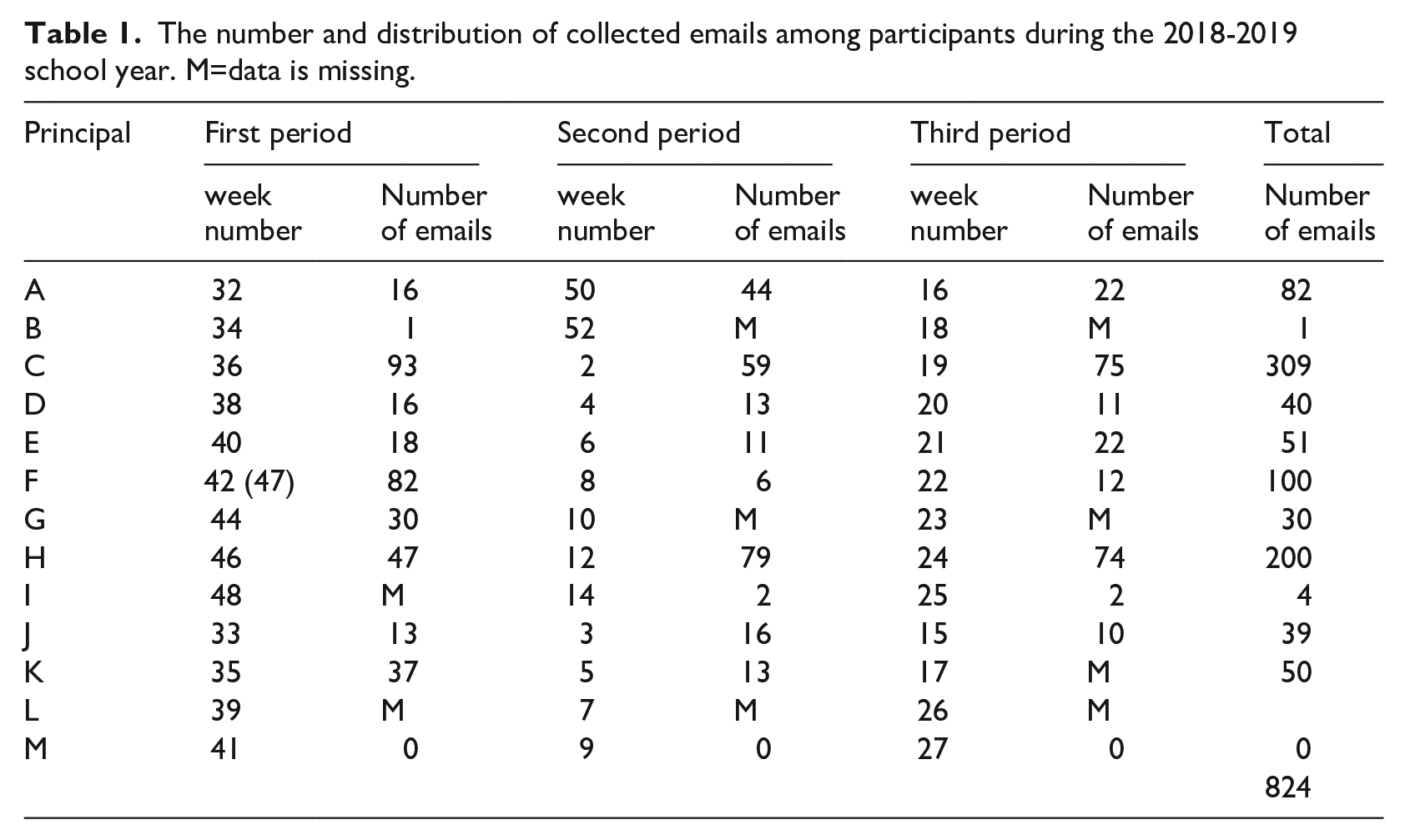
The principals were engaged in this study via professional networks of the author and a fellow colleague in the research project. Approximately two-thirds of the principals who were asked agreed to participate and provided signed consent. The participating principals were employed in six different Swedish school districts and at four independent private school providers. Their respective school units ranged from pre-primary to upper secondary. The research design was set up to be able to assemble a variety of material in terms of edupreneurial actors’ provision of goods and services and potential consumers in terms of principals as the “gate-keepers” of specific school units. The purpose of the design was to cover the marketing offers/objects for consumption at the market over a longer period and to allow the collection of data during a full school year, while minimizing the efforts from each participating principal. The participants agreed to collect and send further the offers from external actors received in their email for three separate week-long periods between August 1, 2018 and 30 June, 2019. A total of 824 emails with marketing material were collected over 30 separate weeks. The material covers marketing material from 123 unique edupreneurial actors, which turned out to be from both private and public, profit and non-profit companies. In the results section, offers from six of these actors, all of them private and for-profit, are used to illustrate the analysis.
The ethical considerations concerned the participation of the principals, which was voluntary, and the request to share emails addressed to them as individuals. However, the marketing materials were considered as public documents.
The analysis was undertaken as follows. In the initial step, the entire material for each of the collected weeks was listed according to the emails’ sender and subject in order to obtain a picture of the material as a whole. The material received for each participant was compared to the others to consider possible individual differences and variations in time. From that review, material from the four participants (Principals A, C, F, and H; see Table 1) who had received well over 50% of the marketing material was selected for the main in-depth analysis, and the rest of the data were to be used as complementary reference material. Secondly, the material was read through carefully and themed into two broad categories: products and services offering (a) new knowledge in terms of professional and organizational development, and (b) maintenance, such as technical products, furniture, signs, gifts, and newsletters that were not included in Category (a). The final step focused on the offers of professional development, making up approximately two-thirds of the material in total. This in-depth analysis served to answer the more detailed questions about the objects for consumption. More specifically, the analysis makes use of the theoretical approach to markets suggested by Zwick and Cayla (2011), asking how marketing in the field of education functions as a perpetual questioning machine. First, the offers were read to identify to what the advertisements were directing the consumers’ attention: what was the primary object for consumption? Second, these points of attention were formulated as assertions, and more often as questions asked by the advertisements, in line with Zwick and Cayla’s theoretical framework. This meant to ask: What desires and concerns are circulated, and what as-yet-unrealized potentialities do the offers suggest the consumers to discover? What can be said to be de-/stabilized? What values do these offers mobilize and what kind of self-realization or self-production do they address? During the analysis of marketing as a perpetual questioning machine, two themes, or points of attention, were identified in the material as particularly important and predominant. These themes have been analyzed as (1) questions on legal expertise and quality management, followed by (2) questions on science and evidence-based, systematic school improvement. This is also how they are presented in the next two sections. Although the advertisements had been sent to principals as their primary receivers, it is clear that the offers were not exclusive to principals. Therefore, the target group has been considered more generally as individuals in schools as potential consumers at the education market.
The number and distribution of collected emails among participants during the 2018-2019 school year. M=data is missing.
Parallel to the analysis, online searches were conducted to get complementary information about the providers and the persons and methods mentioned in the offers to contextualize the data.
Questions on legal expertise and quality management
Among the objects made available for consumption are myriad courses, software, and literature on law, administration, and legislation. Principals are addressed, but also teachers and student health personnel. Embedded within these offers of help and support from legal expertise is the opportunity to avoid fines or other penalties that the lack of relevant and timely knowledge in this area risks bringing (cf. Ideland et al., 2021). As a questioning machine (Zwick and Cayla, 2011) in this particular area, the marketing of an e-learning course from the company Bonnier Academy on violations and abuse will serve as my example. It refers to the high legislative demands on schools in Sweden, regarding discrimination and harassment (Figure 1): . . . the number of complaints [about discrimination and harassment] from parents and students [to the National School Inspectorate] is continuing to increase. Despite this, many schools are missing clear routines for how to act as a principal or a teacher, as well as for who is responsible and for what. (Bonnier Academy, September 6, 2018, author’s translation in all quotes)

Courses on legal updates from Bonnier Academy.
Approaching this advertisement as a perpetual questioning machine (Zwick and Cayla, 2011) means that we read it as a battery of questions asked to a potential consumer in school and to whom the questions participate in the ongoing self-querying and self-problematization: Does my school risk hearing from the National School Inspectorate about similar complaints? Are we lacking routines for how to act? What is my part in this matter? The first two bullet points in the advertisement (Figure 1) stress that teachers can take the short courses offered here (in 4–10-minute slots) whenever it suits them, asking: Could you spare a few minutes to make sure you are not the one who will contribute to failing? If not, your whole school might end up in trouble! The text in the bullet points suggests that the desired 21st-century teacher is fast and flexible and makes sure that s/he contributes to a school well-managed. Furthermore, the next bullet point stresses a possibility for the employer to check the status of each teacher’s learning progress in an additional follow-up tool. This suggests that principals should, or must, check what teachers do. It appears as a natural idea that teachers need to be monitored.
The advertisements are also inviting questions about policy implementation. The advertisement from the company Kompetensutvecklingsinstitutet is an offer of legal expertise and of updates about an upcoming revision of the national syllabus for pre-school regarding teaching in preschool and the new responsibilities of the pre-school teacher “for you and your colleagues to get as prepared as you can” (September 6, 2018); thereby asking: Are you prepared and ready for yet another change? The offer continues: . . . in order for the quality and the goal attainment to increase, what the preschool mission is, according to the national syllabus, should be clear. [Our company] offers a lecture that will provide you with insights about the upcoming changes and with methods to follow-up and secure the mission stated by the syllabus. (Kompetensutvecklingsinstitutet January 9, 2019)
What is circulated here are questions as about improvement, mission and assurance: Don’t you want the quality and goal attainment to increase? Do you know exactly what the pre-school mission is? If so, have you secured it? Zwick and Cayla (2011) suggested that marketing be viewed as a “resource center,” and updates like this also become an archive, a memory that ensures the consumer will not accidently miss out while the world is constantly running more quickly. It also reminds readers about the values to strive for as a desirable school—“quality” and “goal attainment”—stressed as a need both for these to increase and for schools to “follow-up” and “secure” (cf. Novak, 2019). The advertisement as a perpetual questioning machine asks consumers to contribute to a world of no mistakes and of increasing achievement. As objects for consumption for the market-exposed school, this is an offer that appeals to a self who wishes to appear well-monitored, secure, and safely adjusted to regulations. Also the offer by Zest, originally a staffing company, addressing the 2018 student health prevention policy, invites questions about quality management and policy implementation: Are you also striving to organize student health work to become more preventive and health-promoting, but find the challenge too big? Keep calm, we will help you! If you still haven’t used the government grant, there are chances for you to use it in cooperation with us. We will assist in writing your application as well as your reporting! Customized solution by experts! Zest’s Student Health Program is designed by experts and builds on scientific and evidence-based research about successful school development. For instance, we use Partanen, Timperley, and Katz, which means that we work systematically and with collaborative learning and supervised reflection. (Zest bemanning, August 8, 2018)
This piece of marketing offers support to consumers who desire order (organize, preventive, systematic) and the looks of ambition (striving, successful, development): Are you someone who is striving, who has ambitions and capacities even for the most challenging tasks? Can we count on you in the systematic building of the evidence-based school? What is being commodified is the possibility of receiving a government grant, through the act of buying support from the company, making it possible to understand and to implement a new national policy, by translating it into a doable program with the help of “experts.” The values set in motion by this advertisement are the systematic and evidence-based—but also collaborative and reflected—approaches to problems, on the way to success. However, there is also a promise of a solution that fits perfectly to the individual school (that is, it is customized), addressing desires for personalization and perfection.
Questions on science and evidence-based, systematic school improvement
In the advertisement quoted above, as in many of the offers in this material, references are made to “scientific and evidence-based research.” One obvious reason in the Swedish context is that this alludes to the Education Act from 2010, which as the first country worldwide to do so, inferred that “education should be based on science and proven experience” (Bergmark and Hansson, 2020). As an arena for the possible and desirable, the definition of objects (such as “science”) at the market is of specific interest (Zwick and Cayla, 2011).
In the above advertisement from Zest bemanning, the reference to science is linked to “successful school improvement” and names three academic scholars: a doctor of pedagogical psychology; a professor of education; and a professor of medicine, health management, and policy. Their names are mentioned almost in passing, as if a closer presentation is overruled, asking: Are you familiar with these famous researchers? Why not? Everyone else knows about them and their work! The names, as written out, mobilize a sense of familiarity and closeness. The advertisement has already positioned the consumer as someone who is striving, asking: With your ambitions, shouldn’t you belong to this school improvement family of academics whose research has proven to improve schools? Do you rely on their science when trying to improve your school?
In an advertisement from Lärarforbildning AB (Teacher Professional Development Inc.),
2
another triad of researchers are referred to in a similar way. The advertisement is an offer about a conference, asking questions related to the 2013 First Teacher reform, which aimed to improve Swedish school results by appointing a limited number of particularly skilled teachers to First Teacher positions (Skolverket, 2014). The reform proved to be problematic in several ways and questions were raised about how this new, well-paid, and skilled category of teachers could be rendered useful, not only for their students, but also for their schools. Lärarforbildning AB operationalized the policy by each year offering the national First Teacher Conference (Förstelärarnas rikskonferens). For 2019, the conference headline was “Double leadership—learning for students and for colleagues”: The First Teacher Conference 2019 focuses on how first teachers can develop their leadership in order to increase the learning for students as well as colleagues. The first teacher assignment usually includes planning, organizing, and leading school improvement processes. Researchers such as John Hattie, Helen Timperley, and Richard DuFour show that students’ learning should be centered for such processes. To succeed, sustainable and systematic work is needed and requires a shift from thinking about professional development more generally to professional learning. (Lärarfortbildning, January 10, 2019)
The marketing of this First Teacher Conference is not only an offer of continuing professional development, but must also be considered as part of a process in which this company is involved in what Slater (2011) suggested as a destabilization and restabilization of a specific object for consumption. In this case, this object has to do with who and what a Swedish First Teacher can be, and what the useful and desirable knowledge for such a profession should be. In the advertisement, the First Teacher is described as a leader of colleagues, but, viewed as a questioning machine, the advertisement also asks other questions: Is your assignment as a First Teacher in line with other First Teachers? First Teachers usually facilitate the processes that can lead to school improvement (planning, organizing and leading)—if not, is this not a project you should engage in? In the advertisement, the First Teachers are portrayed as key individuals for successful schools and legitimate school improvers in line with the intentions of the reform. But is their work sustainable and systematic enough, and does their work rely on the right thinking?
The thinking suggested in this advertisement is fetched from the triad of scholars—Helen Timperley, John Hattie, and Richard DuFour. The First Teacher is being asked: Are you acquainted with the work of these celebrities? Do you know that student learning must be centered (and what this means)? Have you convinced your colleagues to make this necessary shift in their thinking? What is being commodified here as professional development for First Teachers is research that can claim positive results for school improvement (cf. Hogan and Thompson, 2017): Timperley’s research on methods for “teacher professional learning and development that has been demonstrated to have a positive impact on valued student outcomes” (Timperley, 2008: 6), Hattie’s indicators on “what actually works in schools to improve learning” (Hattie, 2009: foreword), and Du Four’s leader strategies on how to develop PLCs (professional learning communities) (DuFour, 2004). 2
Further, what appear as desirable knowledge for teachers in the marketing material are primarily foremost “ready-made concepts” that stem from research. With this commodification of research concepts, the advertisements mobilize values of knowledge and excellence, but also the reliability and responsibility that science is a label of. One example is a course offered by Lärarfortbildning AB entitled “How you support and develop students’ inner motivation—for teachers in school years 4–9” which is presented as follows: A few years ago, an OECD report showed that Swedish students more readily give up when they encounter resistance and obstacles than other European students. Thanks to research on mindset and grit, we are now better prepared to support students learning and development in order to counteract. We use Carol Dweck’s, Angela Duckworth’s and Torkel Klingberg’s research on mindset, grit, and “jävlar anamma” [Klingberg’s Swedish term for grit] and learn how to translate this to our everyday teaching. (Lärarfortbildning AB January 29, 2019)
If we read this advertisement as the questioning machine suggested by Zwick and Cayla (2011), the questions to the potential consumer become something like: Have you made sure to follow what is being said in OECD reports? Did you know that your students are (more) likely (than students from other countries) to give up when things are getting tough? Do you prevent this through your teaching (do you counteract)? And are you using the research of the three researchers named here and the research concepts that they have in common, “mindset” and “grit”?
As objects for consumption, concepts like “mindset,” “PLC,” or “grit” have not only become contributions to scientific communities, in which they have obtained certain meanings; they have also been reconfigured at the education marketplace. As noted by Kirschgasler (2018: 710), grit has travelled into global education reform recent years, both as a “quantification that explains students’ drive” in the OECD PISA and as a “character quality.” The offer to translate these globally travelling ideas into our everyday teaching can be seen not only as the edupreneurial “solutionism” suggested by Ideland et al. (2021), but also links the offer to a school improvement community, well connected to global education reform. In the shape of sellable goods, the concepts attach a research quality label to the offers. Moreover, most of the research expertise that is being mobilized has been selected from a limited number of fields: school improvement research, applied psychological research, and what is occasionally sketched in the marketing material as “brain research,” such as in an advertisement of a one-day course entitled “Nudging—affect decision making with tools from behavioral science” (Figure 2). This course is marketed as follows: Nudging is about affecting people’s behavior by arranging a choice situation. The methodology is receiving increased attention from organizations that want to become more skilled at controlling decision processes without becoming overriding. Companies like Amazon, Google, and Spotify use nudging to improve the user experience of their customers, creating organizations that are more efficient. This one-day course provides you with the basic knowledge from behavioral science and the concrete tools that you need to work with nudging yourself. (Veckans akademi, September 5, 2018)

Course offered by Veckans akademi, email from September 5, 2018 (full translation in excerpt).
Do you know about the latest, groundbreaking research concepts? Have you caught up with how the biggest players organize their work? As a questioning machine, this advertisement suggests the possibility of mastering a pressing situation, becoming skilled at controlling decision processes. The potentiality lies in applying the prize-winning idea of nudging, emerging as a usable tool for making better decisions in variable contexts. There is little doubt about the scientific quality label added here. The questions and assertions circulated by the advertisement can be read as: Is your organization efficient, are you improving, and are you learning from the best? Do you see that this is of universal relevance? We are all using the services of these big actors! This knowledge leads to what we strive for—success! The names of the companies’ mentioned (Amazon, Google, Spotify, etc.) mobilize values of entrepreneurial creativity, success, and topicality, and activate a number of terms that are recognizable from the “market episteme” (Ball, 2007), such as choice situation, control, improving, and efficient. Thereby, the advertisement circulates discourses that are globally at play and that talk to, and stabilize, the constant need to calibrate schools’ activities to improvement in the almost global race to the top.
Concluding remarks
In this section, I summarize the concerns, desires, unrealized potentialities and values that this study finds are mobilized, circulated and de/restabilized in the education market by edupreneurial actors offering professional development and discuss what this might mean for education at large. Considering the empirical results, an initial remark is that, in using the term edupreneurs (Rönnberg 2017) for the external vendors whose offers are analyzed in this study, I point to the need to learn about these actors’ “agendas,” as Holloway and Keddie (2019) put it. In Rönnberg’s (2017) words, it is a way to recognize that these are actors involved in edu-business activities that, in one way or another, seek to shift the status quo in education.
According to Jambet (1992, in Zwick and Cayla, 2011: 6), marketing “seeks to ensure that practices of self- problematization never cease and that the resulting work of self-care is channeled through the freedom of market choice.” But who is that “self” at the edu-market? Not all of the advertisements in the present study have singular persons as their addressee, and in some cases the addressees are clearly groups of colleagues. Despite that, what is mobilized and circulated in the marketing material is still, in a certain way, a call for individuals to take responsibility, to look at themselves (individually or in groups) “as a set of constantly multiplying problems” (Zwick and Cayla, 2011: 8). What is at stake in the marketing material offering professional development is not about criticizing the system, or reflecting on what that system is doing to students, teachers, or principals, but about adjusting to the system and perhaps even reproducing it. What is desirable is improvement of quality and performance, along with avoiding failing or missing an opportunity. To stretch the argument, the perfect balance for exchange at this market seems to be achieved by feeding concerns of collective inadequacies and insufficiencies with desires of individual perfection and performance (cf. “the cult of excellence,” Ball, 2007).
A standard for the kind of perfection that permeates the marketing involves meeting the need for evidence and scientific trustworthiness in education. This need is mobilized through the use in the advertisements of catchy research concepts, such as “grit,” or “nudging” (cf. Kirschgasler, 2018), in addition to namedropping of what emerges as a kind of researcher celebrities. These findings also raise a concern in line with what Verger et al. (2018) claimed was problematic in global education policy in general; namely that a small group of international key players and policy makers are getting more influential actors when it comes to what ideas, preferences, and languages are useful for school improvement. With Zwick and Cayla’s (2011) theoretical approach to marketing used in this study, we can also see how the marketing helps to de/restabilize science as an object for consumption. To give it a certain use value (Slater 2011), expertise in school improvement is drawn to the offers from what I have called in the analysis “brain research”; and research from behavioral economics and applied psychology. Finding ourselves in what Whitehead et al. (2017) have argued to be a “neuroliberal” global reform era, embracing “behavioural economics, behavioural psychology and neuroeconomics” (Whitehead et al., 2017), we can perhaps conclude that the edupreneurs behind the edu-marketing studied are doing their share in this matter—partly, of course, because it sells. However, as conclude Zwick and Cayla (2011: 14), “marketing as a technique is just as deeply political, social, and cultural as it is economic.” Therefore, this might also be thought of as how marketing is governing the dreams of education.
Consuming what counts as the proper school improvement literature, workshops, or seminars add value to a “desired school identity.” Thus, the consumption of school improvement and “brain research” that claims to be successful becomes a question of identity, of branding and possible success on the educational marketplace. I would also add that claiming to be up-to-date with the latest research concepts in these areas might not be a choice for a school leader or a teacher, but a mandatory performance in order to remain relevant at the edu-market. To do so will signal values of excellence, novelty, and reliance, and in that sense also the belonging to a desired community.
Footnotes
Acknowledgements
A special thanks to Drakamöllan Nordic Forum for a generous writing retreat and to my fellow colleagues in the Education Inc. project; Malin Ideland, Anna Jobér, Magnus Erlandsson and Thom Axelsson. At last, I wish to thank the two anonymous reviewers for careful reading and for valuable comments.
Declaration of conflicting interests
The author declared no potential conflicts of interest with respect to the research, authorship, and/or publication of this article.
Funding
The author disclosed receipt of the following financial support for the research, authorship, and/or publication of this article: This work was funded by the Swedish Research Council, grant nr 2017-01657 and by Crafoord Foundation grant nr 20180742.
