




Abstract
Principal autonomy has been identified as an important ingredient in effective and healthy schools. However, little is known about the various dimensions of the phenomenon and how it takes form in different contexts. This article presents an analytical device contributing to further understand the complex nature of principal autonomy. The device follows the seminal work of Richard Ingersoll on autonomy in school organisations operationalised as decision-making and control. Moreover, we put forward a multidimensional device to organise decisions and control in several schooling domains: educational, social, developmental and administrative. By exemplifying the device on principals’ perceptions of autonomy in the very North of Sweden, Norway and Finland, we can reveal important differences between the three Nordic neighbouring cases. Related to these reforms, principals’ work can be compared in terms of different grades of complexity and risk, with corresponding consequences for their autonomy.
Introduction
Over the past two decades, autonomy in education has become an increasingly popular research topic in international education research. The topic has taken form in discussions on the degree of autonomy appropriate to the different units in the public education system. The discussion around school autonomy started during the decentralisation reforms which took place in Europe in the 1990s. Since autonomous schools do not imply that individuals working within them must necessarily be autonomous (Salokangas and Ainscow, 2017), it has become obvious that the autonomy of the various actors and actor groups must also be discussed. Here, principal autonomy has been seen as an important element in the understanding of school improvement. Some research indicates a positive correlation between leadership autonomy, strategic decision-making and student performance (e.g. Fuchs and Wössman, 2004), as well as between increased autonomy and curricular changes that improve student results (Cladwell and Spinks, 2013).
However, we argue that principals’ scope of action must be understood much more deeply, since principal autonomy is a complex phenomenon which complicates any simple correlation with a form of educational quality. Accordingly, the aim of this article is to develop and apply a comprehensive analytical device for the purpose of further understanding of educational leadership autonomy in different contexts. With this endeavour, we aim to contribute to the further investigation of the complex nature of autonomy in education. Our elaboration of the device draws on theoretical and empirical work on teacher autonomy and considers recent research on autonomy in education by the authors and Ingersoll (2003) and Ingersoll and Collins (2017). We suggest operationalising autonomy, following the seminal work of Richard Ingersoll, as decision-making and control. Furthermore, we suggest a multidimensional device to organise decisions and control in several schooling domains: educational, social, developmental and administrative developed by the authors of this article (detailed further below).
We also exemplify the potential use of the device for the deductive analysis of the empirical material of two minor comparative interview studies on Swedish, Norwegian and Finnish principals’ perception on their autonomy. We argue that these three national settings present interesting cases for exemplifying the complex nature of principal autonomy and how they can be compared. All three cases are based on a Nordic model, which, ideologically, emphasises modernising society in the name of science, rationality, equality and democratic participation (Aasen and Prøitz, 2017). Education was considered an important part of the modern Nordic societys’ development after WWII and since that the state was viewed as responsible for education as a common good (Aasen and Prøitz, 2017; Telhaug et al., 2006). Consequently, the Nordic countries developed extended comprehensive school systems with no streaming of students, and in which all social classes would meet. The Nordic model drew on a strong centralised school system with a strong state. In line with international developments in the western world since the 1990s, decentralisation and marketisation have been implemented in the respective school systems in the 20–25 years following. These reforms have resulted in various hybrid complex governance models, combining elements of centralised and decentralised governance regimes. This has had significant consequences for the working conditions and roles of principals (Moos et al., 2016).
The sample still has an empirical value in itself. The interviewed principals work alongside the respective national borders. Geographically, they work much closer to each other than to their superiors. Moreover, they present the rural parts of the countries, which often have been neglected by education research (see e.g. Nordholm et al., 2022b; Preston et al., 2013), but in case of the three countries still presents the majority of the geographical area. We assume also that due to the distance to reform epicentres in the capital and metropolitan areas of the countries, it would be easier to detect similarities and differences in the working practice of principals in three countries.
Research review: The promising but mystical nature of principal autonomy
In the last few decades and as described above, the concept of autonomy has gained increased attention in research on school development and school leadership. However, little is known about the structure of principal autonomy. While Cheng et al. (2016) have claimed that too little attention has been paid to the cultural particularities of autonomy and the internal structure of autonomy, there is nevertheless some significant conceptual work on autonomy in education which provides an interesting springboard for the further investigation of principal autonomy.
Cribb and Gewirtz (2007) unpack the concepts of autonomy and control in education. One argument put forward underlines the importance of moving beyond a normative presumption that autonomy should always be understood as something positive and control as negative, instead looking into the complexity that surrounds these concepts. Cribb and Gewirtz (2007) also assert that ‘underlying such [an] approach is a view of autonomy/control as both “always in process and ubiquitous”’ and that the concepts ‘are constantly being made and remade, and negotiated and renegotiated in all of our daily interactions’ (p. 205). Thus, negotiating and creating the meaning of this relationship and adapting leadership to the local setting becomes an important and ongoing task for school leaders (cf. Hallinger, 2011).
This element of school leadership is further emphasised in research on school leadership for sustainable school improvement and educational change (e.g. Townsend, 2007). To this end, school leaders need a sufficient degree of autonomy, enabling them to adapt their leadership to the local context (cf. Hallinger, 2011). Against this backdrop, our three Nordic cases, in which principal autonomy can be understood in terms of the relation between state and municipality governance, is increasingly relevant (Moos et al., 2016).
Drawing on the work of Cribb and Gewirtz (2007) among others, Wermke and Salokangas (2021) have developed a multi-dimensional perspective on autonomy and on the tension between autonomy and control, that highlights the complexity of leadership autonomy. They suggest that autonomy in education (1) has at least four domains (educational, social, developmental and administrative), (2) that autonomy and control are not opposites (both can be high and low at the same time) and (3) that autonomy in education is dynamic in nature. It can differ greatly between historical and spatial contexts. We will develop this line of thought later, in the elaboration of our analytical framework. In school systems that emphasise local and state governance structures at the same time, as the Nordic systems do, school leaders have to create meaningful dialogues with other educational professionals in the local municipality and the state administration (Nordholm et al., 2022b). With our comparative perspective on principal autonomy, building on its complex and multidimensional nature, this paper aims to address this need by investigating both cultural (comparative) and structural (in terms of multidimensionality) aspects of autonomy.
Autonomy and control in multiple domains
The theoretical point of departure is Ingersoll’s (2003) and Ingersoll and Collins’ (2017) theorising on power distribution and control. His work also considers the role of principals. Decision-making abilities are seen in relation to the degree of conflict in the school world, and autonomy is here seen as having a high degree of influence over issues around daily activities. Ingersoll’s approach is very useful for cross-cultural studies, due to the relations of his theoretical considerations to a very straight-forward and context independent operationalisation. Ingersoll formulates four empirical questions that guide our study design: (1) What are the most important decisions to be made in relation to principals’ work? (2) Who is allowed to make such decisions? (3) On which foundations are such decisions made? (4) Who ensures that the decisions made are appropriate? Questions 1 and 2 relate to the autonomy of principals, while questions 3 and 4 relate to the control dimension in our interest.
The empirical part of this study is structured in terms of an analytical device for the empirical investigation of autonomy in education from a comparative perspective. This device builds on the idea of autonomy in education as a multidimensional phenomenon (Ingersoll, 2003; Lortie, 2009; Rosenholtz, 1989). This means that actors in school systems can obtain and/or lack different forms of autonomy in different dimensions of their profession (Wermke and Salokangas, 2021).
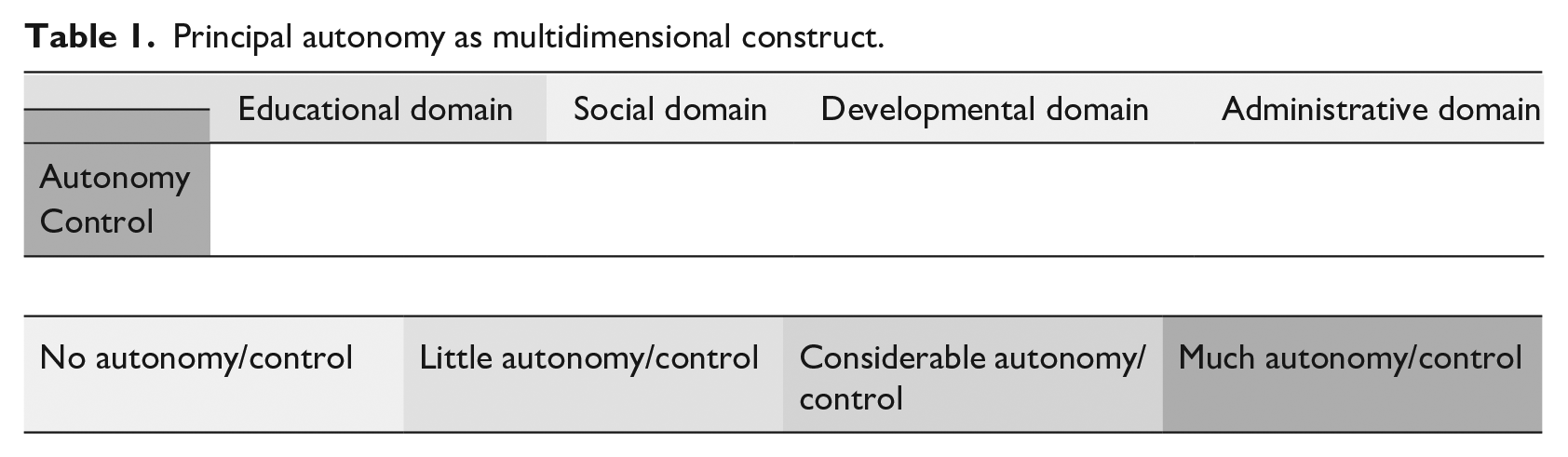
Drawing on the work of Wermke and Salokangas (2021), we propose four different domains in which principals take decisions and can be controlled. Our definition of the domains, as presented below, may be open to conjecture, but above all, our grid attempts to capture the multidimensionality of autonomy in public education. (a) Firstly, by educational domain we refer to matters related to activities and responsibilities connected to teaching and learning, including content, material and results. (b) Education and schools more specifically play a crucial role in the socialisation of students. We call this the social domain. Examples of such processes would include, for example, grouping students, either randomly, or based on their gender, ability or developmental stage. Another example of socialisation would be fostering of students following certain norms. (c) Developmental domain refers to decisions that relate to identifying and steering the school towards a ‘vision’ or a plan of action. This domain refers to what principals plan and do to develop the school, and in steering the direction of the school in matters such as professional development of staff. (d) Finally, by administrative domain, we refer to the administrative work of schools that facilitates learning, and other possible activities in schools, distinguishing educational and administrative duties, including decision-making concerning for example budget, resource allocation, recruitment, salaries, promotion of staff, and so forth. These considerations lead us to the following analytical device, as presented in Table 1. In our analytical device, it is also possible to show the perceived quality of control and autonomy. Much control can for example refer to expressions of much documentary work to do; little control to statements of the principals that nobody from the administration care, or that there is much trust in the work of principals. Much autonomy relates to statements on high decision making capacity in a certain domain (such as ‘That is me who decides’.). Little autonomy connotes to described situations of following to top-down-rule-book-expectations.
Principal autonomy as multidimensional construct.
Employing the device: The case of Principals of the very North of Sweden Finland and Norway
Sweden has variously been described as a striking example of decentralisation and marketisation (e.g. Lundahl, 2011). The school system was opened up to ‘independent’ school organisers in the 1990s, who henceforth shaped a school market together with public school organisers. Since the second half of the 2000s, we can observe a ‘return of the state’ (Rönnberg, 2011) marked by the foundation of the Swedish Schools Inspectorate in 2008, whose main assignment has been to regularly inspect all public and independent schools. A basis of the Swedish school system also holds that each school and municipality is obliged to report statistics annually to the National Agency for Education, including the results of national tests, so that these are made available to the public (Johansson, 2016).
In Norway, a quality assurance system was introduced in 2005, indicating a shift in the Norwegian education policy from an ‘input’ regulatory framework where laws, organisation and financing are included to an ‘output’ oriented policy that focuses on performance (Helgøy and Homme, 2007; Johansson, 2016). Nevertheless, Norwegian municipalities and counties continue to have a certain autonomy regarding what is to be reported, according to the local requirements and needs (Mausethagen et al., 2018. Principal practices in Norway have often been characterised by collaboration, team efforts and the building of professional communities of practice as a guiding norm of conduct (Møller et al., 2005).
In the Finnish context, the principal’s duties are not described in detail by legislation. Instead, the content and scope of principals’ work is formed in the local context (Saarukka, 2017). The duties generally span both administrative and managerial duties, as well as leading pedagogical work and development at school. In comparison with many other countries, the Finnish culture and tradition of school leadership is still characterised by trust in professional autonomy and has not, as yet, been deeply influenced by neoliberal accountability practices with extensive control (Uljens et al., 2016).
The empirical material of this paper was collected in the autumn of 2017, in a research project on autonomy in education (Wermke and Salokangas, 2021) which formed the foundation for two Master thesis studies. The authors of the respective theses are included as co-authors to this article. In the first study, five Swedish and six Finnish principals have been interviewed (Kotavuopio Olsson, 2018), in the second six Swedish and five Norwegian (Andersson, 2020) (N = 22). The principals work mostly in smaller towns on both sides of the Swedish-Norwegian and Swedish-Finnish borders, located in the upper North of the countries. In this region, the schools share similar local conditions, have rural characteristics, and are closely embedded in the civil society. As written earlier, we assume that such a sample would produce many local similarities, but also illustrate national differences. The sample is small, but empirically valuable. Our co-authors, both principals by themselves, have Swedish-Norwegian and Swedish-Finnish cultural and linguistic background. They are rooted in this Nordic region. That is why, they could approach principals in, due to geographical distances, by research often neglected areas. Moreover, there are not a plethora of principals working alongside the boarders of the respective countries in the very North.
The municipalities are little and with between 2000 and 23,000 inhabitants. The principals worked in K-6 and K-9 schools. In size of the schools there has been a considerable variance. The number of students at the schools varied between 15 and 400 in total. All schools had both principal and deputy principal positions, while at the larger schools, there were even school management teams. The interviewed principals worked in leadership positions for between 1.5 and 25 years. The variance is assumed to contribute to the validity to analyses. Moreover, our co-authors have presented our analyses to the principals in the North. The principals confirmed our interpretations of their work.
The interview guidelines were constructed following the theoretical work of Ingersoll (2003), and used the following questions.
(1) What do the principals consider to be the most important decisions to be made regarding school function?
(2) Who do the principals consider makes these decisions (the principal, teachers, private or municipality actors, parents, etc.)?
(3) How are decisions monitored and followed up on, and who ensures that decisions are implemented ‘correctly’?
The interviews were conducted by the authors of this paper in the principals’ native languages (Swedish, Norwegian, Finnish), then transcribed and translated into Swedish (the common language of the project group). Afterwards, the interview transcripts were analysed following a deductive qualitative content analysis (Mayring, 2007, as also exemplified in Wermke and Salokangas, 2021, with a focus on teacher autonomy). We drew on the analytical device presented earlier in Table 1. A group of codes were firstly related to expressions of decision-making capacity and practices in the educational, social, developmental and administrative domains of principals’ work. These codes represented teacher autonomy. Secondly, another group of codes were related to expressions of control of principals’ work in the given domains. In addition, we coded these two groups in terms of their experienced intensity. For increasing the reliability of our results, at least two members of our study group performed the coding work in varying combinations.
Although, such details are important for the trustworthiness of the study conducted, we want to emphasise, that the articles first and foremost aim is the illustration of how principal autonomy can be deconstructed in comparative studies. The study at hand is consequently of qualitative nature with the ambition to make analytical generalisations on the principal autonomy, that is, making conceptual contribution that could be validated in further empirical studies at scale.
Principal autonomy compared
We will present our results as follows. We will first discuss our observation on the principal’s autonomy, considering our theoretical framework, operationalised as decision-making responsibility. We will then present our control dimension as perceived by the interviewed principals. Both sections are introduced with an overall sketch of our three countries’ respondents, in terms of the experienced intensity of autonomy and control, the most important aspects to decide on and the most significant control. In the results, we will then focus on the most interesting findings, by comparing our cases in different combinations. Employing the described coding strategy, we have chosen extracts from the material that we believe are both representative and also illustrative of the national principals’ reasoning on autonomy in order to report them to the audience. We decided to present citations from the different schools evenly within a national context.
Principals’ perceived autonomy: The most important decisions
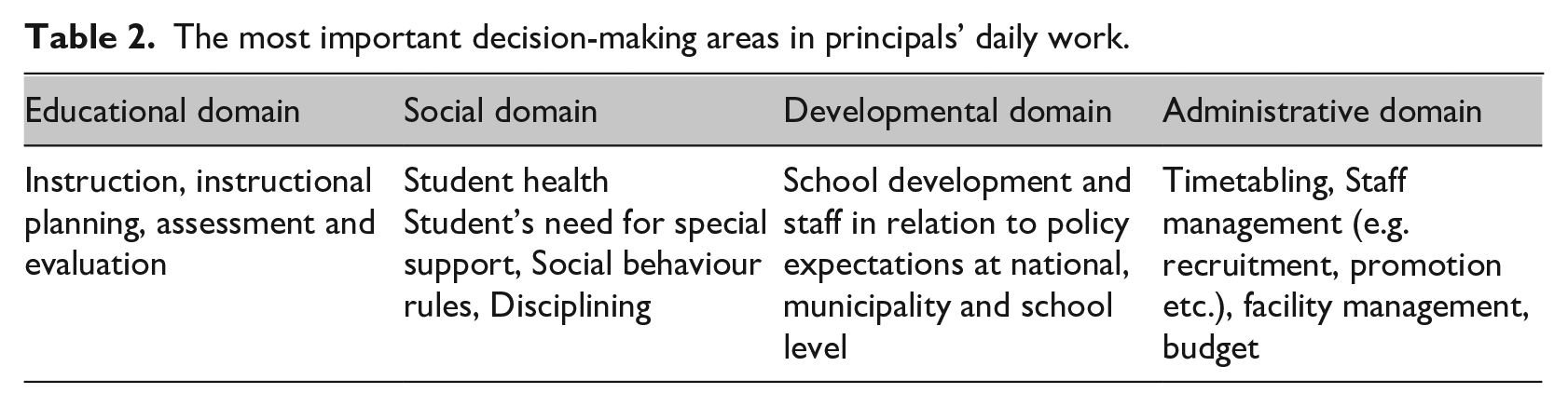
We start our results section with a presentation of the most important decisions to be made by principals, applicable to all three cases in Table 2. In Table 3, we present the decisions, in which their autonomy is mostly at stake in the three countries at hand. The decisions evolved from our interview analyses.
The most important decision-making areas in principals’ daily work.
Principals’ perceived autonomy.
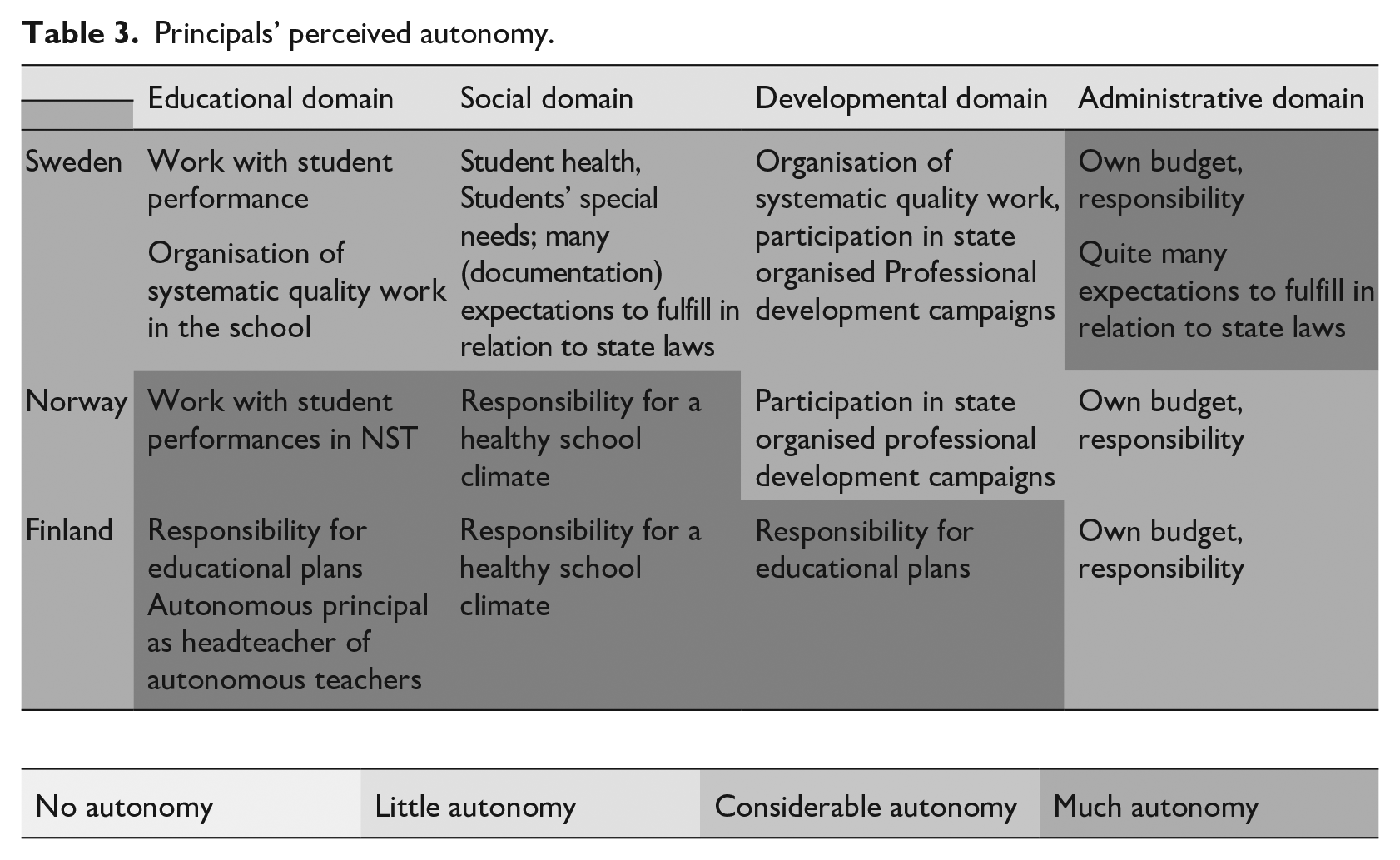
Our study shows that principals in all three countries experienced extended responsibility in important decisions in the educational domain. Swedish and Norwegian work with the result evaluation in National standard testing (NST), which have a great impact on their schools’ educational domains. Swedish principals are also expected to work with a systematic quality development in their schools (Ärlestig, 2014) having considerable influence on teachers’ work.
I am leading myself. Even if the board and superintended are the actual bosses, it is me who takes the lead. (Swedish principal)
Principal autonomy in the Swedish case consequently comes at the price of teacher autonomy (Wermke and Salokangas, 2021). Still, this responsibility comes with extended documentation requirements, which potentially decrease the experienced autonomy. Norwegian principals do not identify any impact on teachers’ work. Still, they have to report the results and this will be the main topic in one of the results meetings with the municipal superintendent. They must also make sure that the teachers use the results in feedback to students and parents in student development meetings. From the fact that Norwegian principals nevertheless do not identify these tasks, it can be seen that these are not seen as interventions in teachers’ practice. We see only that it is increasingly expected from them, and that they view this as exhausting.
The hardest part in the job is to get adults to work together. (Norwegian principal)
In Finland, the principals make an educational plan for an academic year, which structures both the educational and developmental domain of the school. This work plan is the responsibility of the principal but apparently also an expression of the complementary relation of Finnish teachers and their leaders.
I make a[n educational] plan, which comprises which themes must be worked with during the term, valid for all classes. [. . .] These are the educational things I have the lead on. All teachers make their own plans for their students. (Finnish principal) I cannot question my teachers’ authority by overruling them. (Finnish principal)
Moreover, Finnish principals, when speaking about educational decision-making, all used the pronoun ‘we’ in the interviews, meaning they viewed themselves and the teachers as a unit. Wermke and Höstfält (2014) have put forward the distinction of principals as administrational leaders and principals as head teachers. The first term emphasises the managerial role and practice of the work. The latter term indicates that principals are first and foremost teachers, and here the first own among equals (primus inter pares). Teachers and principals belong to the same profession. This is true in Finland. The first type is more prevalent in Sweden, where principals also can be seen as belonging to an individual professional group, having among other things, its own associations or unions (Jarl et al., 2012).
Moreover, the managerial alternative for the leadership position requires a hierarchical structure to be in place in schools. In Finland, which has a strong teaching profession, the organisations are rather organised in an autonomy-parity logic (Lortie, 2002 [1975]), meaning each teacher’s work is autonomous and equal to that of others. Consequently, principals have no means to intervene into teachers’ educational practice. At the same time, however, they still have the responsibility for the educational quality of their school (Risku and Pulkkinen, 2016). A way to solve this dilemma might actually be for principals to define themselves as part of, but nevertheless leaders within, the teaching staff, via various forms of distributed leadership (Wermke and Salokangas, 2021). Thus, we might argue that, just in the Finnish case, principal autonomy and teacher autonomy are highly related to each other.
In the social domain, as also shown by Wermke and Salokangas (2021), principals play a very significant role. In all three countries, the principals’ work is greatly framed by policy expectations. Moreover, in the school domain, decision-making is so important because social well-being and the functioning of both individuals and groups in educational settings are the prerequisite of academic performance (Ingersoll, 2003; Ingersoll and Collins, 2017). Wermke and Salokangas (2021) argue further that social decisions in schooling are often risky for teachers and that they therefore desire not only collegial, but also extensive support from their principal.
The handling of social issues in Swedish schools is highly regulated by both school law and the national curriculum. Principals must decide on many delicate questions, but, due to a system with considerable rules and regulations (Rosén et al., 2021), they can only make decisions in very particular ways. Many social issues are also specifically directed to the municipality or school owners (huvudmän), but these pass the responsibility directly to their principals (Montelius et al., 2022).
I have many professional rights. I can make official decisions through temporally dismissing students. I sign grades, individual support plans for students in need, starting official disciplinary cases. Every day, I feel I make principal decisions. (Swedish principal)
In Norway, principals’ scope of action appears to be more unregulated. However, it remains to be seen how Norwegian principals’ work will change in the near future. In 2017, at the same time our interviews were conducted, a new law was introduced, making the principals accountable for a sound learning environment for students in their schools through, for instance, systematic bullying prevention. In the social domain, we also see the relation of the principal to the civil society in the local community, here presented by the example of a Norwegian principal.
It is very important that one’s vantage point in students’ everyday life, in students’ culture, is the foundation for the best learning possible. (Norwegian principal)
However, whether there are many concrete legal regulations around the detailed social responsibility of the principal, as in Sweden, or more recently Norway, or without concretisation as in Finland, we see that the social domain is at the heart of leadership work, as Wermke and Salokangas (2021) or Ingersoll (2003), and also this Finnish principal, express it.
The most important thing is indeed to take care of the student. The student is the centre of everything, always. Everything that is related to student well-being and study is of the utmost importance. (Finnish principal)
Within the developmental autonomy domain, all the interviewed principals in Norway and Sweden perceive considerable autonomy. In Sweden, principals have been prescribed a more explicit role regarding the development of their schools by state governance. This domain is again related to the above-mentioned systematic quality development, which expects the principals in Sweden to organise systematically planned and evaluated professional development. Plans and evaluation are audited by the school inspectorate. Moreover, Swedish school governance is characterised by many state-driven professional development campaigns (Kirsten, 2020). In a shift from voluntary support to the decentralised school organisation, these campaigns have been become increasingly prescriptive and might therefore be understood as governance that aims to bypass the municipalities (Kirsten and Wermke, 2017). All these aspects condition the developmental work of Swedish principals. Norwegian educational governance, on the other hand, is characterised by state professional development campaigning as well. Professional development is an aspect of the Norwegian tradition of governance integration, according to which different stakeholders at various levels in public education (state, municipalities and principals) are supposed to work together (Wermke et al., 2021). In other words, in Norway, state governance today is less prescriptive and more negotiated.
We have started now a new campaign with the name ‘Including preschool and school environments’ [. . .] This is led by the state administration, the department of education [. . .] We were in Oslo, several times. The whole country participates. (Norwegian principal).
Apparently, in relation to a trustworthy autonomous teacher profession, in Finland, the developmental domain is not a significant issue. Principals experience themselves as quite alone in this respect, but the control is really only a matter of checklists.
You must do this after work. We get nothing for this. It is just doing it [. . .] and reporting it in the system. So, we have to prove that we have done our professional development. (Finnish principal)
All countries principals’ autonomy in the administrative domain relates to similar ways of budgetary routines. An education budget is set at the municipality level and provided to the principal. The frames of the budget were quite fixed, but within these frames, the principals were very autonomous. This budgetary work also binds the municipality administration and the schools together.
The budget and so forth. I am responsible for spending it by the end of the year. [. . .] I am responsible for the budget and my employees, but I also get help from the HR department in the municipality. I have lots of responsibility. (Norwegian principal) If I would consider my economic power [. . .] Own house [. . .] quite free within my budget plan, which is approved by the municipality. (Finnish principal)
However, Swedish principals also have various other tasks, which at the first sight betray a very extended autonomy. However, for the principles interviewed, these are extremely time-consuming, and this time must be taken from other important issues: the recruiting of teachers, individual salary negotiations with teachers and facility issues (e.g. renting and maintenance of school buildings).
Actually, I am allowed to decide quite a lot. I rule over the whole internal organisation. How we organise the school, how schedule our staff [. . .] Actually, I decide over most things [. . .] However, it is not that I want to rule the most things. I want to have my staff behind me, and the politicians and the administration [. . .] (Swedish principal)
Controlling principals
In our data on principals’ perceptions of control, various stakeholders appear: state administrations (such as national agencies or departments of education, school inspection in Sweden or the county governor in Norway), municipality administrations (such as the superintendent or elected municipality representatives), parents and the teaching staff in the principals’ school. The parents can also be understood as part and representative of the local community. To clarify, we observe here principals’ perceived control, and not which of the named actors objectively has the power to control the interviewed principals.
In Table 4, we summarise how the interviewed principals experience the control of their work. Again, the darker the colour, the more intensive is the perceived control. We see that Swedish principals perceive the most intensive control, followed by their Norwegian colleagues. The Finnish principals apparently experience little control. Consequently, the moment of control is universal for principals. The differences between the interviewed principals in the various domains of their work are rather in the amount of control.
Principals’ perceived control.
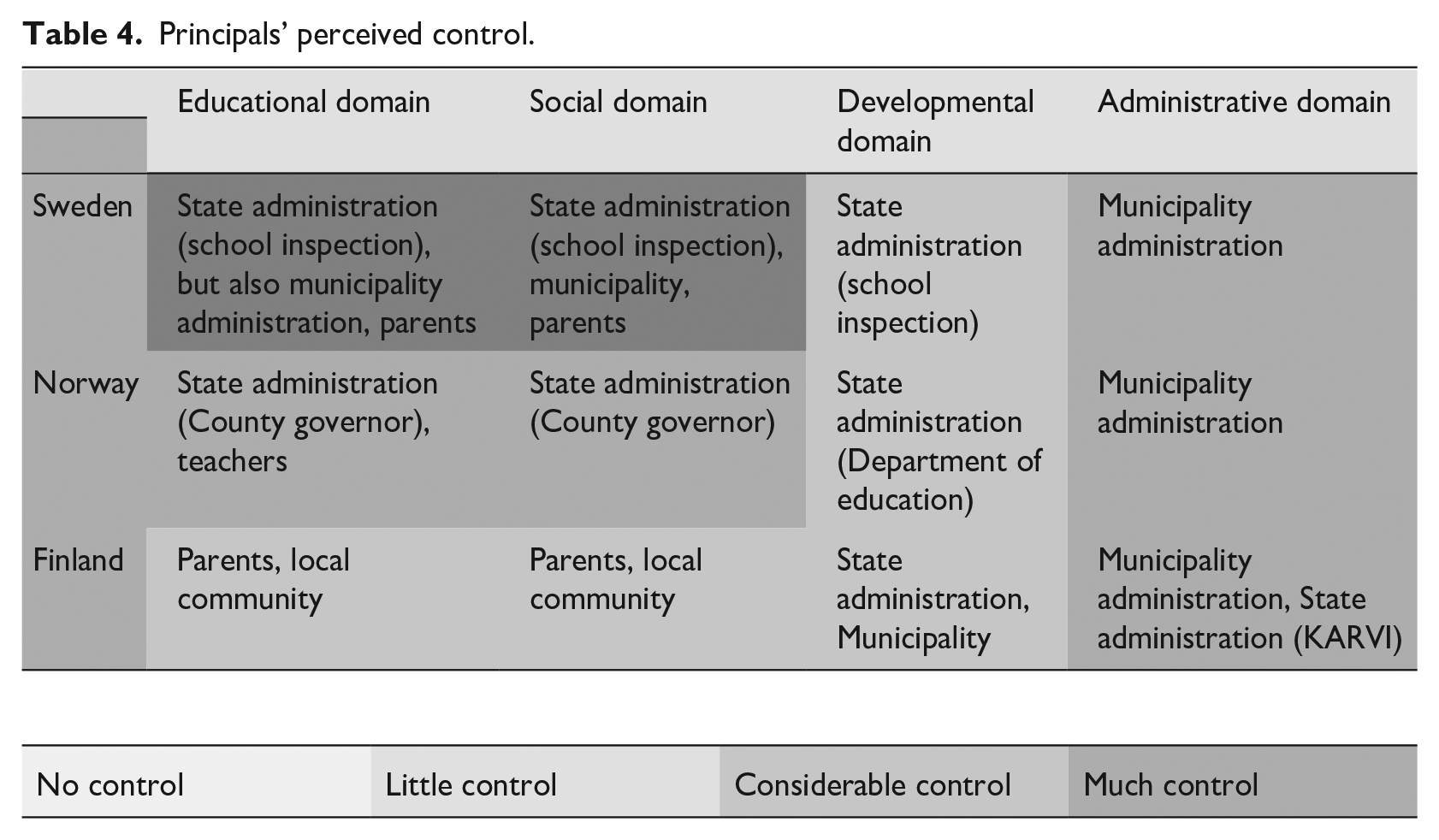
In Sweden and Norway, principals are controlled in the educational and social domain with a particular focus on student performance and well-being. This is done by National Standard Testing, and inspections. Such policy instruments do not exist in Finland, where there is only a central examination at the end of school (Matriculation). Via NST, the state can increase its control of both schools and municipalities. Extended testing of student performance delivers evidence concerning school quality from a comparative perspective. In other words, the state formulates standards and benchmarks for good schooling. In Sweden, such tests and inspections might provide an example of bypassing the municipalities in the governance of public education (Nihlfors and Johansson, 2017). In Norway, such testing might be seen rather as a strategy for the integration of municipalities and the central state further (Mausethagen et al., 2018). Telling examples of this integration are state employed public servants in the regions with the function of auditing and controlling the work of schools and ensuring it is in accordance with laws and regulations (County governor, Statsförvaltaren/Fylkesmannen), and also the institution of so called ‘result dialogues’. In the latter, principals, and municipality and state representatives discuss and interpret the NST results for cooperation and compliance (Prøitz et al., 2017).
Important differences between the Swedish and Norwegian control regimes, can apparently be found in the way things must be reported. The more time-consuming documentation workload is experienced to be, the more intensive the control is perceived, in turn, to be. This may be a universal for the interviewed principals.
The control of the council happens through a monthly accounting system [. . .] economy, organisation in terms of number of employees, sick leave, working environment, relations to the society, i.e. which communal services are employed, issues with school subjects, results of pupil surveys, national curriculum testing and health surveys [. . .] Such accounting does not constrain freedom. The questions are easily answered, not much work. (Norwegian principal) It is actually the administration and the politicians who control my work. This is through quality accounts we deliver. We have a system in which I produce five reports each year. There are various aspects which need to be covered in these reports. I have to report what the situation is, analyse why it is as it is [. . .] and discuss my planned activities regarding it. (Swedish principal)
Our Finnish principals experience little control in the educational domain at all.
Do they control student performance? No, since everything is about how the students reach their goals. However, it is a good question. Perhaps they should control more. (Finnish principal)
Moreover, they do not even name formal control in the social domain explicitly. They only relate to the role of parents and their own position at the heart of the local community.
How parents relate to us! [. . .] How the municipality’s inhabitants experience their school. Do they experience it as their very own school? This is the most important thing. (Finnish principal)
The developmental domain is the least controlled in all cases. It might therefore be seen as the least important one. Wermke and Salokangas (2021) have observed this phenomenon with teachers as well. The authors argue that, as control is or becomes more intense in the social and educational domains, professionals might prioritise and concentrate their efforts on exactly the controlled domains. In doing so, they cope with the higher complexity and greater risks associated with these questions, and consequently, the developmental domain is in danger of becoming a matter of rulebook slowdown.
In the administrational domain, all the interviewed principals emphasise their role as responsible for budgets within given frames of the municipality and the legal conditions provided by the state.
Getting municipality and state governance together is a very difficult equation. The state formulates the expectations to us and the municipality determines our working conditions [by resource disposition]. (Swedish principal)
In particular, the documentation of the budget is indeed experienced as restrictive, but is also accepted as part of the economic dimension of public school administration.
What is indeed restrictive is that I do not rule over my days as I want to. They want to have documentation [. . .] lots of documentation today, lots of administration [. . .] The time it takes restricts the autonomy. If the inspections go fine, I can do whatever I want. This is what I like best. (Norwegian principal)
For the Finnish principals, we observe in our interviews the phenomenon of apparently invisible control or control which is not experienced, in particular in relation to the administrative domain. Paulsrud and Wermke (2020) have argued that Finnish teachers might feel autonomous, because everybody says so. They are in other words empowered to do the ‘right’ thing. This might also be true for the principals in Finland.
The Finnish school system’s strength is that we trust each other regarding the fact that everybody does his/her job. We trust that everybody does the right thing. (Finnish principal)
Accordingly, most of the Finnish principals do not even use the term ‘control’. Instead, they speak about cooperation, dialogue or reminders. Such ‘invisible’ control, by norms and apparent best practices, can perhaps also be labelled ‘indoctrination’ (Mintzberg, 1979). However, it is quite an effective way of governance, especially in public education with its loosely coupled, multiple units (Ingersoll, 2003).
Control is in the system: the financial administration controls whether I do things wrong, and tells me I should stop this or that or do it differently. I do that then. I experience this as cooperation, not as control. (Finnish principal)
In the control dimension, the double pressure and the complex government, in particular of Swedish principals, becomes apparent. In many domains, the respondents feel accountable to the state and the municipality. They are also accountable for very extended areas, including student performance in the educational domain related to an appropriate support for students who are not reaching expected learning outcomes, students’ health and well-being and also their teachers’ and schools’ development as required by the systematic quality work. In other words, Swedish principals are not only responsible, related to a certain trust in their professional capabilities, they are made accountable for their work, related to an apparently vast documentation workload surrounding to their daily decision-making.
It has been argued that the Swedish situation correlates significantly with New Public Management principles in place in Sweden. Students and their parents are seen not only as clients but first of all as customers with extended rights (Moos et al., 2016). Their extended rights are built on the permission to control the school considering their expectation and act with respect to this, by way of exit, leaving the school and going to another, or by voice, complaining (Montelius et al., 2022). Such opportunities are provided to neither Norwegian parents and students, nor Finnish ones. However, the existence of multiple control systems is also part of the nature of NPM. This relates to the datafication of education, since data is needed to make rational choices, at least within NPM logic. In Sweden, we can see that the datafication pressure comes from several levels, the municipality and state level. In Sweden, we can see that that there are many different stakeholders to please. This is definitely a problem of bypass governance, where the state aims to govern schools by circumventing municipalities. Moreover, because of ambiguous responsibility and accountability distributions between municipality and state, bypass governance has become a form of cross pressure (Skott, 2014). This, again, is not true to the same extent for Finnish or Norwegian principals and probably makes the principals’ life easier.
I am not employed by the state, I am employed by the municipality. The state might become visible for us through questions or inspections [. . .] the audits check whether is in its right order. However, the system controls and helps. There are no inspections. (Finnish principal).
Discussion
In this article, we have presented an analytical device that aims to contribute to further theorising on the complex nature of principal autonomy. In order to illustrate its conceptual value, we have analysed and compared principals’ perceptions of autonomy and control in three Nordic countries. First, some words, on the limitations and contribution of such a device, and how the model could be used by scholars in the field.
Our matrix constituting the device contains eight different cells, which actually is quite complex and might also be confusing. We argue however that the distinct structure enables the analysis of data on principal autonomy very well. Moreover, the matrix is indeed of analytical by nature. The borders of the cells might not be straightforward in the actual practice of teachers, and the cells might split processes that span across different dimensions. For example, principals’ involvement (or lack thereof) in devising policies, may have administrative, educational, social or developmental functions. However, this is precisely why we argue that the matrix is applicable, as it helps to separate and analyse the conflated phenomenon of autonomy and control and show relationships between different dimensions. We argue that analysing principal autonomy with the matrix helps to make various patterns of autonomy visible. For example, principals might have or experience a particular quality or quantity of autonomy. Their autonomy can be categorised by applying the matrix to particular domains (educational, administrational, social, developmental) and in relation to issues of decision making and control. Regarding the nature or quantity of the decisions that are possible, categories such as strategic or routine or extended or restricted can be used.
Moreover, the device can also be used to compare different configurations of how principals in various contexts experience professional decision-making and control, in the sense of Ingersoll (2003) and Ingersoll and Collins (2017). Principals may be asked in which of the dimensions they have individual, collegial or professional discretion or which other actors in the school system have power to make significant decisions in different dimensions. As such, the matrix helps to reveal multiple context specific autonomy configurations. For example, autonomy in the administrative issue, might present a greater challenge for principals in one context than social or educational autonomy. The device helps such examples to become visible.
Besides the presentation of the device, our comparative approach revealed interesting findings on the nature of autonomy in education. This relates to the very significant issue of ‘so what’ for our research ambitions. How can a further understanding of principal autonomy as decision making and control contribute to a further understanding of principal work? Drawing on the work of Wermke and Salokangas (2021) and Wermke et al. (2022) on teacher and principal autonomy from a comparative perspective, we will now outline some conclusions on the nature of principal autonomy as presented in our material. Wermke and Salokangas (2021) argue that both possibilities and necessities for decision-making, and control (in particular, formal control), can be limited or extended. Increased decision-making capacity increases the complexity of teachers’ work and constrains the risks associated with the job. Drawing on this reasoning, they present a four-dimensional model, as presented in Figure 1:
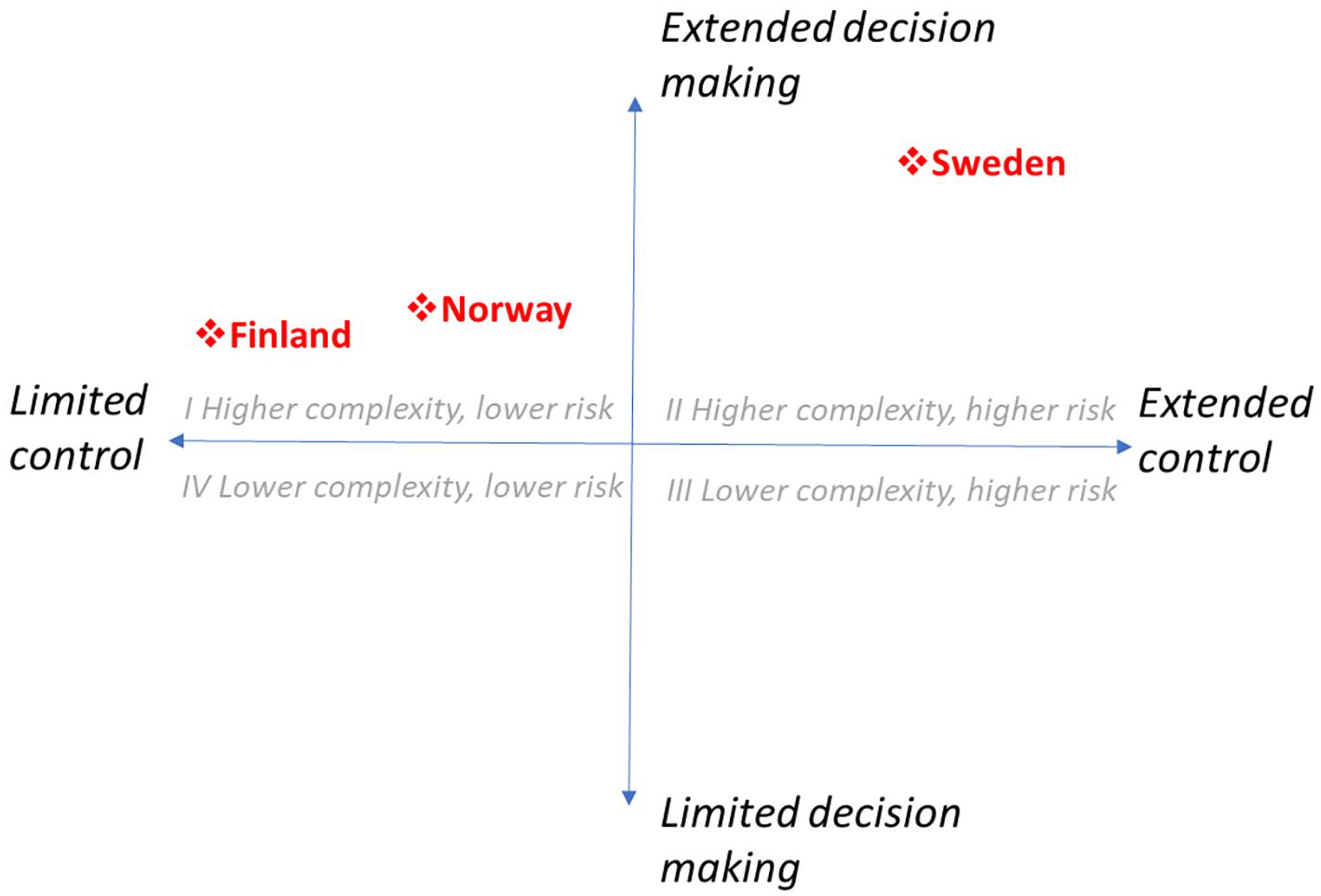
Decision-making and control (adapted from Wermke and Salokangas, 2021).
We have tried to understand our findings from the analyses in the following way. To clarify, our reasoning can indeed be discussed, that is, the positioning of the cases in the four sections. However, this is indeed the ambition of such theorising. It shall encourage further discussion facing the contingent sense making processes in social science in the tradition of Thomas Kuhn (1970).
The first section (I) applies to principals who have a very complex task, and who are assigned with considerable decision-making capacity. On the other hand, the control of principals’ work by different governance technologies is rather limited. The second section (II) refers to principals who have a very complex task, including a plethora of decision-making responsibilities. In this type, the profession’s work is also controlled in an extensive manner. The third section (III) describes lower complexity and intense control, meaning lower complexity in relation to types I and II. In section IV, principals are not subject to much control, but their decision-making capacity is also somewhat limited in relation to type I and II principals. It is important to emphasise the fact that the model, as presented in Figure 1, has a comparative character. By no means does it state that teachers’ or principals’ work is not complex or that it is not associated with any risks. It states that some principals must, due to varying governance regimes, bear lower or higher risk/complexity.
Regarding the Swedish principals, we argue that, compared with their colleagues, their work is highly complex and risky. This is because, of all our three groups, they have an extended responsibility with many important decisions to make. Due to high-stakes national testing in Sweden, where student grades and results can be used by parents as an argument for choosing schools and pedagogical specialisations are arguments in a schooling market, principals must be involved, together with teachers, in the educational domain of schooling. They also play a significant role in students’ access to special support if needed. In the social domain, Swedish principals are responsible for a healthy and positive school climate, one that actively prevents bullying and takes students’ psychological well-being into consideration.
In the developmental domain, they are responsible for a systematic school development and professional development for the staff, which must also be documented (systematic quality work). In the administrative domain, the interviewed principals are responsible for recruitment, salary negotiations, renting and maintenance of school buildings. This is in addition to other task such as decisions on promotion, scheduling, resource allocation and so forth. At the same time, principals in Sweden are also heavily controlled by various stakeholders: the state, by way of the school inspectorate, the municipal administration and also the parents with their above-mentioned extended ‘consumer rights’. The extended decision-making requirements, which are simultaneously controlled, correlate with risks of failures for which the principal will be made accountable, potentially by blaming or losing his/her position. That is why, we placed the case of Sweden in the second section of our model (high complexity/high risk).
This high complexity and risk scenario of Swedish principals, can be best understood by comparing it with their Finnish counterparts, who have fewer decisions to make in practice, a fact which we locate in the first section of our model (high complexity/low risk), quite close to the fourth section (low complexity/low risk). Although they also have a significant responsibility for the educational and developmental domain, they can still draw on an autonomous teaching profession, making the majority of decisions themselves. In the social domain, Finnish principals make many decisions regarding a healthy social-psychological climate in their schools. In the administrative domain, they perceive significant scope for decisions, since they indeed have an extended budget responsibility. But they, like their Swedish colleagues, are not required to make decisions about facilities or negotiate teachers’ salaries. Still, working with educational plans, scheduling, staff and school development constitutes considerable complexity.
When we look at the control dimension, there are considerable differences. Put simply, Finnish principals appear to be less controlled, and by fewer stakeholders. Finnish principals do not experience any cross pressure by the state and municipality administration. They perceive themselves as municipal employees, accountable to their local community. Moreover, there is little, not public, national standard testing and no school inspection. The prominent explanation of Finnish teachers as trusted professionals is obviously also valid for Finnish principals.
Finally, we see the interviewed Norwegian principals in the first section of our model (high complexity/low risk), but closer to section II (high complexity/high risk). In comparison, we find that the Norwegian principal position is more complex than it is for their Finnish colleagues, but less complex than their Swedish counterparts. They have an extended responsibility for educational and developmental planning, but there is a greater necessity to undertake this in a systematic way. Mandatory national standard testing must be processed, the results must be reported, evaluated and followed up. School and staff development must be planned in relation to municipality school strategies. Even in the social domain, Norwegian principals have an extended autonomy to handle, with the explicit requirement for bullying prevention. In the administrative domain, they are in a similar situation to their Finnish colleagues, with budget autonomy, but no need for salary bargaining or facility management. In Finland and Norway, such aspects are addressed at the municipality level.
Moreover, we see that Norwegian principals perceive a different form of control from their Nordic colleagues. They are apparently more extensively controlled than their Finnish colleagues but less so than Swedish principals. Like the Finnish principals, they perceive themselves clearly as municipal employees, embedded in their local civil societies. Even in Norway, there are control instruments such as national testing and inspection of schooling practice, such as in Sweden. The difference is that municipality and state are integrated, and principals participate more in the discussions of both testing and inspections (Wermke et al., 2021).
Finally, we argue that education policy is dynamic. In recent years, education reform has changed the working conditions of the interviewed principals considerably. Consequently, the configurations in our model might change, for example, Norway might move towards greater complexity, and Sweden towards less. This remains to be seen. Still, the reader might ask, so what? How can we use such a comparative model? We believe that comparisons in complexity can support us to make improvements in working conditions possible. The anthropologist Clyde Kluckhohn illustrated this point with an aphorism: ‘The fish would be the last creature to discover water’ (in Erickson, 1986). Comparative research, through its inherent reflection of the contingency of practice, helps us to make the familiar strange and interesting again. The commonplace becomes problematic. What is happening can become visible, and it can be documented systematically (Erickson, 1986).
We can also correlate our findings on different situation with work satisfaction. Wermke and Salokangas (2021), when investigating teacher autonomy in different countries, argue that teaching professionals with lower risks and complexity to handle can be characterised by being more satisfied with their job. This may also be true for principals. We do not have any material in our study on principal work satisfaction, but OECD TALIS data (2016) shows that both Sweden and partly also Norway are characterised by a higher turnover rate than their other colleagues in the North, in particular in Finland. We mentioned the Swedish issues of turnover and an overrepresentation of rather unexperienced principals earlier in this article, which may have many potential causes, but one might be unfavourable working conditions, with high complexity and high risk.
Even under this assumption, we still think that principal autonomy must be investigated further, in line with a perspective that analytically sees autonomy and control as two complementary, not opposing, phenomena. Moreover, there must be a more realistic perspective on autonomy in education and its potential consequences. Simply increasing principals’ professional autonomy might not lead to desired outcomes, since while increased decision-making capacity brings further complexity and risk to their work, it may instead lead to anxiety, self-restriction and the eventual rejection of autonomy. This is particularly true when extended autonomy is paired with extended control, as is often the case in NPM-inspired educational regimes. Finally, autonomy must be seen in its multidimensional nature, precisely as principals’ work is. In some domains, principals might need and handle autonomy and control, in other domains, they may not. The analytical device in this comparative article might be an invitation of further research in such questions as well.
Footnotes
Declaration of conflicting interests
The author(s) declared no potential conflicts of interest with respect to the research, authorship, and/or publication of this article.
Funding
The author(s) disclosed receipt of the following financial support for the research, authorship, and/or publication of this article: The authors received funding from CLASS-Comparisons of leadership autonomy in school districts and schools project #315147 funded by the Norwegian Research Council.
