




Abstract
The article synthesizes ideas from the capability approach, the embeddedness approach, and Nancy Fraser’s three-dimensional scale of justice and develops a theoretical framework for understanding subjective well-being (SWB) as a positive functioning. It also proposes an instrument for measuring SWB and its relationship with participation in non-formal adult education. Using data from the European Social Survey, carried out in 2012, for 24 European countries and applying multilevel linear models for the analysis, the study finds evidence for a positive association between participation in non-formal adult education and SWB. The results show that differences in the SWB among people who have participated in non-formal adult education and those who have not are higher for those who have no higher education and are unemployed than for those who have higher education and paid work. This study also reveals that when people live in countries with better economic and democratic development and a more individualistic culture, the differences in their SWB by participating in non-formal adult education are smaller than when they live in countries with worse economic and democratic development and a more collectivistic culture.
Keywords
Introduction
Subjective well-being has usually been defined as “the quality [of life] in the eye of the beholder” and is commonly referred to with terms such as “life-satisfaction” and “happiness” (Veenhoven, 2000: 7), that is, terms which grasp people’s emotional responses (good or bad feelings) and their evaluative responses (Diener and Lucas, 2000; Diener et al., 2010; Kahneman et al., 1999). We agree with Vittersø (2013), who argues against reductionism in well-being research. In his words: “reductio ad absurdum” leads us nowhere. . . . If the richness of human feelings is reduced to a hedonic balance (a “hedon” metric), or the subtle wonders of human lives to an evaluation of goodness (a “goodon” metric), we risk throwing out the baby with the bathwater (Vittersø, 2013: 14).
However, if we reject reductionism in research on subjective well-being, other important questions arise: What are the dimensions of subjective well-being, and what can be the theoretical basis for their identification? In this regard, it seems that Ryff’s (1989: 1069) conclusion that “[m]uch of the prior literature is founded on conceptions of well-being that have little theoretical rationale and, as a consequence, neglect important aspects of positive functioning” is still valid. The second question emerges as a counterpoint to the statement “Money buys happiness” (Blanchflower and Oswald, 2004: 1359). Although there are solid empirical findings that “higher income is associated with higher happiness” (Blanchflower and Oswald, 2004: 1381), it is worth studying in more depth the association of subjective well-being with other achieved individual characteristics, that is, with such that are obtained based on individual’s efforts and merits. For example, can participation in lifelong learning activities also “buy” subjective well-being?
Against this background, the present article aims to: (1) develop a theoretically grounded understanding of individual subjective well-being as a positive functioning with multiple dimensions; (2) construct a scale for measuring subjective well-being as a positive functioning; (3) explore the relationship between participation in non-formal adult education and individual subjective well-being; (4) reveal the embeddedness of the link between participation in non-formal adult education and individual subjective well-being in different socio-economic contexts.
The article will proceed as follows. First, we will make a brief overview of previous studies. Then, we will discuss our theoretical conceptualizations on individual subjective well-being and will argue for the understanding of individual subjective well-being as a positive functioning which has a multidimensional character and cannot—and should not—be associated only with happiness and satisfaction. After that, we will formulate our hypotheses. These will be followed by a description of the research methodology and presentation of the developed scale for individual subjective well-being. Next, we will present the findings from the analysis. The final sections of the article will offer a discussion of the results and some concluding remarks.
Previous research
There is a large body of research on subjective well-being in which two distinct approaches could be outlined. The first approach to subjective well-being, defined as the hedonic approach, emphasizes positive feelings (Kahneman et al., 1999; Lucas et al., 2003), whereas the second one focuses on positive functioning and is termed as the eudaimonic approach (Diener et al., 2009, 2010; Ryan and Deci, 2001; Ryff, 1989; Sen, 1996).
The understanding of subjective well-being as positive feelings is associated with research on happiness and life satisfaction. There is a long tradition (e.g. Bradburn, 1969; Inglehart and Klingemann, 2000) in studying happiness which goes back to Aristotle (1947), who views it as the highest of all goods achievable by human action. Life satisfaction is regarded as a no less important synthetic indicator of subjective well-being. Authors have developed several specific instruments for its measurement, such as the Life Satisfaction Index and Life Satisfaction scales (Diener et al., 2013; Högberg, 2019; Inglehart and Welzel, 2010). Different studies reveal that happiness increases with income and education and decreases with unemployment, urbanization, being single, and male gender (Deeming and Hayes, 2012; Gerdtham and Johannesson, 2001; Högberg, 2019). Research also shows how happiness as an indicator of individual subjective well-being is embedded and varies in different socio-economic and cultural contexts. Thus, Schyns (1998) provides evidence that there is a strong positive correlation between happiness and national economic and cultural living conditions. Deeming and Hayes (2012: 811) found statistically significant differences between the types of welfare regimes showing that “respondents living in liberal and conservative countries experience at least twice the odds of unhappiness of those living in social democracies, after controlling for individual- and country-level explanatory variables.”
The eudaimonic approach focuses on positive functioning. In terms of theory underpinning the different conceptualizations of well-being as a functioning, scholars have drawn on different theoretical traditions, such as the humanistic approach, developmental psychology, and psychodynamic theory. Different authors have identified different dimensions of well-being as positive functioning: meaning and purpose (Ryff, 1989); supportive and rewarding relationships (Ryan and Deci, 2000; Ryff, 1989); engaged and interested (Ryff, 1989); contribution to the well-being of others (Ryan and Deci, 2000; Ryff, 1989); competency (Ryan and Deci, 2000); and being respected (Ryff, 1989). Diener et al. (2009, 2010) developed two scales for measuring subjective well-being—the Psychological Well-being Scale (2009) and Flourishing Scale (2010); the latter consists of eight items: purposeful life, supportive social relationships, contributing to others’ well-being, competence, engagement, optimism, living a good life, and respect from others. In its module on well-being, the European Social Survey (2013) included the following aspects of subjective well-being: resilience, meaning and purpose, autonomy, engagement, competence, and vitality.
Studies on the relationship between education and subjective well-being mainly follow the approach which identifies subjective well-being with happiness and life satisfaction. There is ample evidence of a statistically significant positive association between attained educational level and happiness and life satisfaction (Blanchflower and Oswald, 2004; Chen, 2012; Gerdtham and Johannesson, 2001; Nikolaev, 2018). However, a recent study (Araki, 2022: 590) shows that the direct effect of education is varied as, on the one hand, “prior research has shown that education increases the level of happiness” but, on the other, “it has also been empirically revealed education loses (at least partially) its impact on SWB once accounting for the mediation by socio-economic statuses.” Araki (2022: 587) argues for examining the nuances in the relationship between education and happiness and demonstrates that the positive linkage between education and life satisfaction “is undermined due to the larger degree of skills diffusion at the societal level, and no longer confirmed once labor market outcomes are accounted for.”
However, there are very few studies which focus concretely on the benefits for subjective well-being stemming from adult education and lifelong learning. Field (2009: 11) states that “[w]e have very compelling evidence that adult learning has significant positive consequences for people’s health, earnings and employability, and there is some evidence of effects on our subjective well-being.” According to the third Global Report on Adult Learning and Education (GRALE 3), published by the UNESCO Institute for Lifelong Learning (2016), 89% of countries agree that adult education and learning contributes “a great deal” to personal health and well-being. Older adults see lifelong learning as a way to experience enjoyment, to improve their self-confidence, and to be engaged with other people (McNair, 2012). In their study, Granderath et al. (2021) reveal a significant relationship between participation in adult education and life satisfaction on the interpersonal level for both immigrants and natives, but they do not find significant effects on the intrapersonal level. Besides these studies, as Boeren (2021: 4) has recently outlined, the gap in research linking happiness with adult learning “remains visible in the literature as, based on an extensive literature search using EBSCOhost and the university library catalog, no specific studies on the link between happiness and adult learning can be found.” She further emphasizes that “this issue has not been studied through a European comparative lens, despite the EC’s desire to see participation in education throughout life as a vehicle for economic prosperity and well-being, both at the individual and the societal level” (Ibid.). Boeren’s paper (2021) makes a significant contribution in filling this gap. Using data from the ESS for 16 European countries, Boeren (2021: 1) shows that “while adult learners on average tend to be happier than non-learners, this correlation weakens when controlling for determinants of participation and happiness and for the countries in which these adults live.” Thus, adults who are learners in Bulgaria are happier than those who are not, but these learners are still significantly less happy than those who do not participate in adult education in Finland.
The above review reveals that there are still significant gaps in the available literature on the link between adult education and individual subjective well-being: (a) there is a reduction of individual subjective well-being to happiness and life satisfaction; (b) the studies of the relationship between adult education and subjective well-being does not fully take into account the heterogeneous character of adult education (e.g. formal, non-formal, and informal; job-related and non-job-related); (c) no due attention is paid to the embeddedness of the link between participation in adult education and individual subjective well-being in different economic, political, and cultural contexts, nor the moderating or mediating role of participation in adult education regarding the influence of other individual characteristics on subjective well-being.
Against this background, this article focuses on non-formal, job-related adult education and asks the following research questions (RQs):
RQ1: How is participation in non-formal adult education associated with individual subjective well-being as positive functioning?
RQ2: How do individuals’ level of education and their employment status moderate the association between participation in non-formal adult education and subjective well-being?
RQ3: How is the association between participation in non-formal adult education and individual subjective well-being embedded in different economic, political, and cultural contexts?
We focus on non-formal, job-related adult education because data 1 show that participation rate in this form of adult education is much higher than the participation rate in non-formal, non-job-related adult education in all European countries.
Theoretical considerations: The multidimensional character of individual subjective well-being as a positive functioning and its social embeddedness
Vittersø (2013: 10) identifies three main approaches toward understanding of functioning and functioning perspective toward well-being and relates them to humanistic psychology, health psychologists, and Amartya Sen’s theory. We acknowledge the heuristic potential of the first two approaches for studying human functioning as an important feature of a good life. However, our aim is to provide a sociological theorizing of the individual subjective well-being, which means that we are interested not only in understanding of the essence of individual subjective well-being, but also of how it is embedded in and influenced by the wider social context and structures. That is why we propose a broader theoretical framework of our study, that is based on a synthesis of insights from the capability approach, as developed by both Amartya Sen and Martha Nussbaum, the embeddedness approach (Granovetter), and Nancy Fraser’s scale of justice. The assembly of these theoretical approaches provides ideas for understanding individual well-being from a humanistic perspective and for grasping the fact that it is realized not in vacuum but in concrete social contexts, which can have both enabling and constraining influence on it.
Well-being is one of the main concepts in the capability approach (Nussbaum, 2011; Sen, 1999). 2 According to Sen (1999), the understanding of well-being should focus on what people can be and can do, rather than simply on what they have. He also puts emphasis on the quality aspect of life in all its dimensions—family, health, employment, education, leisure, etc.—and states that “[t]he well-being of a person can be seen in terms of quality (the ‘well-ness’, as it were) of the person’s being” (Sen, 1992: 39). It is important to note that in Sen’s (1992) view, well-being has two aspects: freedom and achievement. Whereas well-being freedom is “one’s freedom to achieve those things that are constitutive of one’s well-being” and “is best reflected by a person’s capability set” (Sen, 1992: 57), well-being achievements focus on the concept of functioning.
There are studies which have already examined the relationship between the subjective well-being perspective and the capability approach. Thus, Comim (2005) looks at the differences, similarities, and potential synergies between both approaches. One of the arguments for exploring the links between both approaches, in his view, is that a better understanding of “the problem of adaptive preferences and how one should combine objective with subjective information” (Comim, 2005: 163) might be reached. Binder (2014) goes further and develops a subjective well-being framework that incorporates insights from the capability approach. He also introduces the concept of subjective well-being capabilities which refer to “the substantive opportunity of individuals to achieve happiness” (Binder, 2014: 1198). This framework combines subjective and objective measures of well-being, but it has not been empirically tested to the best of our knowledge. Pugno (2015) argues that the integration of both approaches overcomes the weaknesses (aggregation and adaptation) of the happiness approach and the capability approach when they are applied separately. Hasan (2019: 15) also attempts to integrate the happiness approach with the capabilities approach and claims that “[a]n integrated approach can take a step further than taken by the Human Development (HD) approach.”
Among the research which empirically applies the capability approach in the analysis of well-being, we could add Chiappero-Martinetti’s (2000) study. It makes a multidimensional assessment of well-being with objective measures via the use of fuzzy set theory and micro-data from a single country—Italy. Anand et al. (2005) also use empirical data (from the British Household Panel Survey) to show that capabilities do matter, and they reveal statistically significant relations between the central capabilities as suggested by Nussbaum and well-being, defined as satisfaction.
Acknowledging the heuristic potential of the capability approach in studies on well-being, we will try to go further than the previous research by emphasizing three additional merits of the capability approach in the study of individual subjective well-being which allow us to regard it as a multidimensional functioning.
First, within the capability approach, subjective well-being is not reduced to happiness. Sen (1985: 189) argues “that although happiness is of obvious and direct relevance to well-being, it is inadequate as representation of well-being” and explains that: happiness has two basic problems in its claim to stand for well-being. First, as it is interpreted in the utilitarian tradition, happiness is basically a mental state, and it ignores other aspects of person’s well-being. . .. Second, as a mental-state concept, the perspective of happiness may give a very limited view of other mental activities. . . such as stimulation, excitement, etc., which are of direct relevance to a person’s well-being. (pp. 188–189).
From the capability approach perspective, we also cannot consider the level of satisfaction as a single indicator of subjective well-being. Both Sen and Nussbaum use the “adaptive preferences” concept to show that people’s desires may adjust to the circumstances in which they live and that such an internalization of external constraints has an influence upon the individual’s well-being and its assessment. It may lead to paradoxical situations in which a poor and a rich person report the same levels of satisfaction. 3 Within the capability approach, in order to evaluate subjective well-being, that is why there is a need for “an effort to take stock of and summarize the full range of elements that people value (e.g. their sense of purpose, the fulfilment of their goals and how they are perceived by others)” (Stiglitz et al., 2010: 65). As we show in the section on previous research, authors have furthermore referred to other aspects of individual subjective well-being as a positive functioning.
Second, we claim that individual subjective well-being is a multidimensional phenomenon which should be regarded not only as positive feelings and evaluations but as a positive functioning, as well. In order to define its dimensions as a positive functioning, we find it fruitful to rely on Nussbaum’s list of central capabilities. Nussbaum (2000) endorses a universal, cross-cultural list of 10 central human capabilities and outlines that these “capabilities can be the object of an overlapping consensus among people who otherwise have very different comprehensive conceptions of the good” (p. 5, emphasis in the original). This list comprises the capabilities of life, bodily health, bodily integrity, senses, imagination, and thought, emotions, practical reason, affiliation, other species, play, and control over one’s environment (Nussbaum, 2000, 2011). In her view, these capabilities are essential for a person to flourish and live a life that goes beyond economic participation, including a wider vision of flourishing and incorporating human development, the social context, the environment, and personal interactions (Walker, 2003).
Incorporating Nussbaum’s 10 capabilities as essential for the dignity of each person’s life, in the present study we define the following dimensions of subjective well-being: autonomy, sense of meaning, engagement, competence, recognition, affiliation, feeling of health, life enjoyment, and attachment to the environment. All these dimensions touch upon Nussbaum’s (2003: 41–42) central human capabilities. More specifically:
- autonomy is associated with “control over one’s environment”—“being able to participate effectively in political choices that govern one’s life”;
- sense of meaning is associated with “practical reasoning”—“being able to form a conception of the good and to engage in critical reflection about the planning of one’s life”;
- engagement is associated with “emotions”—“being able to have attachments to things” and to be interested in what you are doing;
- competence is associated with “the senses, imagination, and thought”—being able to “imagine, think and reason” . . . “in a ‘truly human’ way, a way informed and cultivated by an adequate education, including, but by no means limited to, literacy and basic mathematical and scientific training”;
- recognition is associated with “affiliation” and “control over one’s environment”—“being able to live with and toward others” and to enter “into meaningful relationships of mutual recognition with others”;
- affiliation is associated with “being able to live with and towards others, to recognize and show concern for other human beings, to engage in various forms of social interaction; to be able to imagine the situation of another” and thus refers to the capability Nussbaum also calls “affiliation”;
- feeling of health is associated with “bodily health”—“being able to have good health”;
- life enjoyment is associated with “play”—“being able to laugh, to play, to enjoy recreational activities”;
- attachment to the environment is associated with “other species”—“being able to live with concern for and in relation to animals, plants, and the world of nature.”
Third, we take advantage of the possibility for the capability approach to be combined with other theories. Thus, in order to conceptualize how individual subjective well-being relates to the wider social environment, the present study builds upon the embeddedness approach and Nancy Fraser’s three-dimensional theory of justice. According to the embeddedness approach, all human actions are socially situated, and human actors do not act as atomized entities. Granovetter (1985: 487) argues that: [a]ctors do not behave or decide as atoms outside a social context, nor do they adhere slavishly to a script written for them by the particular intersection of social categories that they happen to occupy. Their attempts at purposive action are instead embedded in concrete, ongoing systems of social relations.
It is important to be emphasized that the embeddedness approach goes beyond the “structure versus agency” opposition and provides a framework to account for both the constraining and enabling effects of social environments on different phenomena situated within them. From this perspective, the embeddedness of individual subjective well-being points to the social determination of both the way people assess their well-being and how their individual characteristics are associated with it.
To further enrich the understanding of the embeddedness of individual subjective well-being, we refer to Nancy Fraser’s three-dimensional scale of social justice. The scale is not limited to the widely acknowledged distributional dimensions of justice and includes redistribution, recognition, and representation (Fraser, 2009). Fraser’s theory draws attention to the obstacles that impede people from fully participating in social life and which are crucial for their social status. It is important to emphasize that she points not only to economic factors but political and cultural ones, as well (Fraser, 2005). Thus, such an understanding requires examination of the institutionalized patterns of cultural value and whether they constitute actors as peers—who participate on par with one another in social life—or as inferior, invisible, excluded others.
Figure 1 presents in a systematic and graphical way our theoretical understanding of subjective well-being as a positive functioning which is socially embedded. The figure includes the nine dimensions of individual subjective well-being as a functioning and highlights the complex determination of individual subjective well-being by individual characteristics, the wider economic, political, and cultural context, and the associations between individual characteristics and social contexts. More specifically, it shows that, on the one hand, individual subjective well-being is influenced by individual characteristics and the wider socio-economic and cultural context (short black arrows in the figure). On the other, it is affected by the interactions between: individual characteristics and the wider socio-economic and cultural context (short gray dotted arrow). The long black arrows in the figure show the interplay between individual characteristics and the wider socio-economic and cultural context.
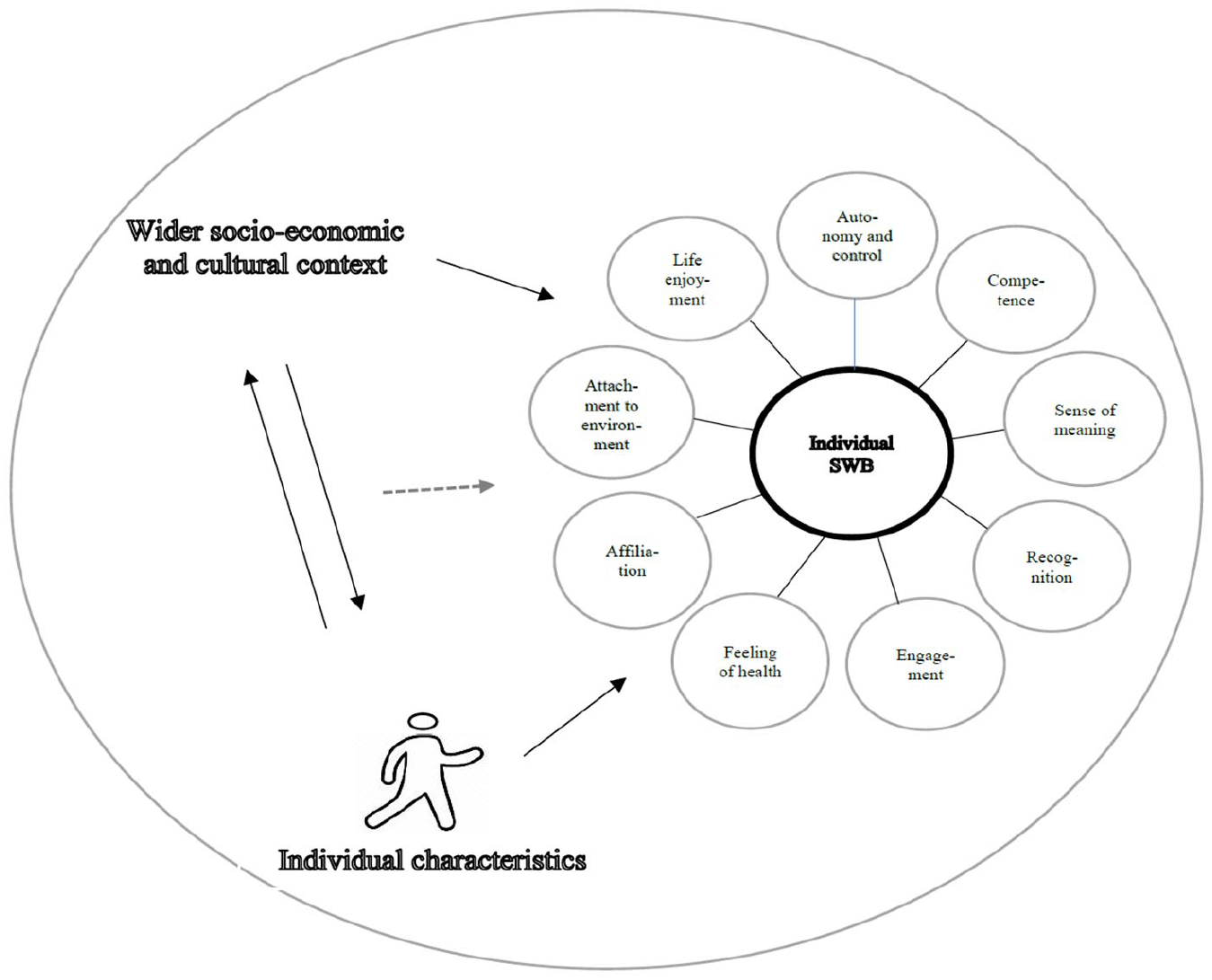
Theoretical model of subjective well-being as a socially embedded multidimensional functioning.
On the basis of the review of previous studies and the outlined theoretical assumptions, we have formulated the following three hypotheses:
Hypothesis 1: Participation in non-formal adult education is positively associated with individual subjective well-being as a positive functioning.
Hypothesis 2: There is an interaction effect between having higher education and paid employment and participation in non-formal adult education, such that having higher education and a paid work are negatively associated with individual subjective well-being among adults who have participated in non-formal education.
Hypothesis 3: There is an interaction effect between economic and democratic development and a given country’s cultural values and participation in non-formal adult education, such that better economic and democratic development of that country and a more individualist culture are negatively associated with individual subjective well-being among adults who have participated in non-formal education.
Research methodology
Data
The empirical basis of our study was data drawn from the European Social Survey (ESS). More specifically, we have used data from the ESS Round 6 (ESS Round 6: European Social Survey Round 6 Data, 2012) because it has a rotating module specially devoted to personal and social well-being. The ESS is a cross-national survey carried out every 2 years. It is representative for the population aged 15 and over. This survey involves strict random probability sampling and a minimum target response rate of 70%. It is carried out via face-to-face interviews in more than 30 countries. We have used individual-level data from the ESS and combined them with macro-level data from the official statistics to explore, on the one hand, whether or not there are differences in the levels of subjective well-being among those who participated in non-formal education and, on the other, if different aspects of contexts (economic, democratic, and cultural) moderate the associations between participation in non-formal education and individual subjective well-being. Our sample consists of 24 countries for which there are data available on all country-level variables of interest. We limited our analyses to the group of adults from 25 to 64 years of age. We focused on this group because the European Commission’ policy and benchmarks in the field of education have been developed by monitoring the educational attainment of this age group (e.g. European Commission/EACEA/Eurydice, 2021). After doing some list-wise deletion of the cases with missing values on one or more of the individual variables and deleting eight outliers in the dependent variable (<−2.5 cases), we ended up with an analytical sample consisting of 26,848 adults nested in 24 countries, respectively: Belgium (n = 1143), Bulgaria (n = 1339), Cyprus (n = 723); the Czech Republic (n = 1175); Denmark (n = 930); Estonia (n = 1351); Finland (n = 1367); France (n = 1201); Germany (n = 1734); Great Britain (n = 1105); Hungary (n = 1228); Iceland (n = 454); Ireland (n = 1629); Italy (n = 547); Lithuania (n = 1155); the Netherlands (n = 1149); Norway (n = 1073); Poland (n = 1115); Portugal (n = 1235); Slovakia (n = 1239); Slovenia (n = 772); Spain (n = 1231); Sweden (n = 1033); and Switzerland (n = 920).
The data at country level were extracted from the Eurostat website, a report from The Economist Intelligence Unit (2012), and Hofstede Insights’ website.
Measurement
Scale of individual subjective well-being (S-ISWB)
In accordance with the dimensions of the concept of individual subjective well-being defined in the theoretical section of the article, a psychometric scale was developed from the variables in the dataset. It was used as our dependent variable. The items of the scale were chosen from the variables in the dataset to match the main theoretical dimensions of the concept (see Table 1).
Items in the S-ISWB and their corresponding variables from the dataset.
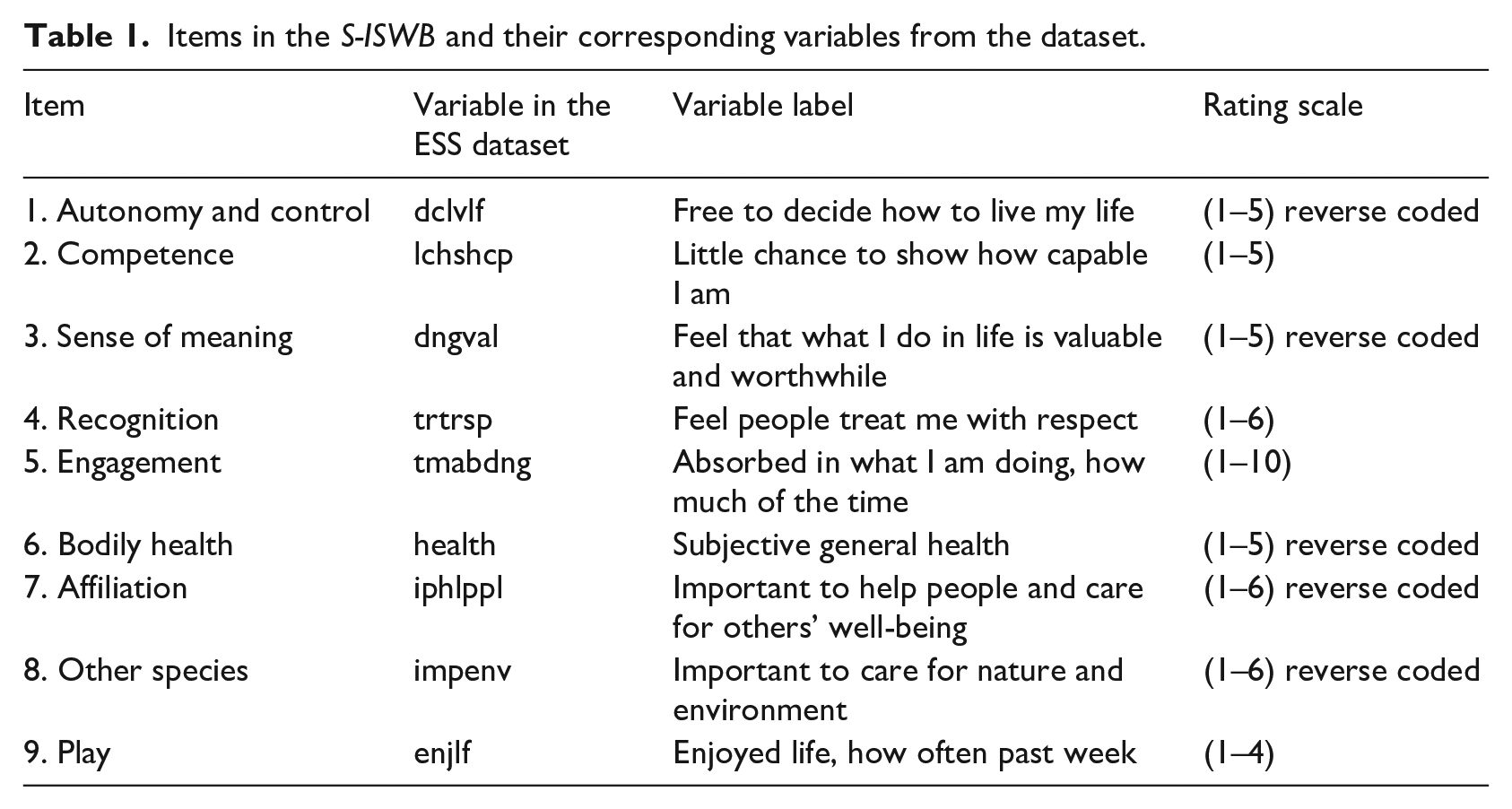
As can be seen from the table, the chosen variables use different rating scales. To be included in a common scale, they needed to be transformed in unified measures. In this case, the items of the scale were formed by recoding the initial variables in a way that greater values to mean greater intensity of the given aspect (dimension) and then all variables were standardized (converted into z-values). The S-ISWB was formed by averaging the comprising items. Its internal consistency, measured with Cronbach Alpha, was 0.66, Mean = −0.002, SD = 0.521. Our scale is positively associated with the measures of happiness and life satisfaction which are available in the ESS for the 24 studied countries, but still there is no overlap between our scale and these two measures (Pearson’s r = 0.520, p < 0.001 for happiness and Pearson’s r = 0.468, p < 0.001 for life satisfaction). This suggests that with our scale we grasp other important aspects of individual subjective well-being than happiness and satisfaction.
The main independent variable included at the individual level was: participation in non-formal, job-related adult education and training (reference period 12 months) (0 = no/1 = yes)—this came from an ESS question: “During the last 12 months, have you taken any course or attended any lecture or conference to improve your knowledge or skills for work?”
We also included as independent variables at the individual level having a higher education degree—1 for yes (ISCED 2011 5–8) and 0 for no (ISCED 2011 0–4) and having paid work (1 = Yes, 0 = No).
In order to study the social embeddedness of the individual subjective well-being and its relationship with participation in non-formal education, we selected some important indicators of political, economic, and cultural contexts.
As already outlined in the review of the previous literature, studies (Boeren, 2021; Deeming and Hayes, 2012; Flavin et al., 2011) have shown a link between country’s welfare regime and subjective well-being measured with level of happiness and life satisfaction. Despite this Boeren (2021: 13) also points to the “need to interpret data beyond the level of welfare regimes” indicating that “[t]he United Kingdom and Ireland are typically included in a similar welfare type category representing liberal regimes although results indicated more evidence of happiness bonus points for adult learners in the United Kingdom compared to Ireland.” Such findings suggest that it is worth studying the social embeddedness of the relationship between participation in non-formal education and individual subjective well-being by using separate indicators for countries’ economic, democratic, and cultural development instead of country typologies, such as welfare regimes or types of capitalism.
Studies reveal that the vast majority of people living in high-income countries appear to be reasonably happy and that life satisfaction rises with average income levels all along the national income scale (Deaton, 2008). That is why we included GDP per capita as an indicator for a country’s economic development. GDP per capita in PPS (volume indices of real expenditure per capita, in PPS_EU27_2020 = 100, Eurostat, Data code TEC00114, extracted on 8 April 2021). The highest GDP is in Norway at 188, and the lowest is in Bulgaria at 47.
Dewey (2001 [1916]: 91), one of the greatest theorists of education, argues that “[t]he devotion of democracy to education is a familiar fact.” Studies on the national patterns of lifelong education reveal that the transition to democracy in Eastern European countries after the “velvet” revolution in 1989 has had important consequences for the development of adult education (Saar et al., 2013). That is why we decided to use democracy index in order to capture the political context in a given country. More specifically, the report from The Economist Intelligence Unit (2012) developed a democracy index that ranges from 0 to 10 and is composed of 60 indicators grouped into five categories: electoral process and pluralism; civil liberties; functioning of government; political participation; and political culture. Among the 24 countries studied, the highest score on the democracy index is in Norway at 9.93 and the lowest is in Bulgaria at 6.72.
The cultural context in which adult education unfolds, is defined by the dominant values, norms, and beliefs in a given society. In order to capture the cultural values of a given society, we selected one of the most important ingredients of each national culture—its degree of individualism or collectivism. Degree of individualism or collectivism is one of the dimensions of Hofstede’s model of cultural values of society (Hofstede et al., 2010). Individualist societies are those “societies in which the ties between individuals are loose: everyone is expected to look after him- or herself and his or her immediate family,” whereas collectivist ones are defined as “societies in which people from birth onward are integrated into strong, cohesive in-groups, which throughout people’s lifetime continue to protect them in exchange for unquestioning loyalty” (Hofstede et al., 2010: 92).
The cultural value Degree of individualism or collectivism is measured with the individualism index (https://www.hofstede-insights.com/country-comparison/, extracted on 01 June 2021) and ranges from 0 to 100—with 0 standing for the country with the weakest individualistic culture and around 100 for the strongest.
We have further included three individual-level control variables, for age (continuous) and the following dummy variables: gender (1 = female; 0 = male) and parents’ education as an indicator of social background (1 = high (including persons with at least one parent with higher education), 0 = low (including persons without a parent with higher education)).
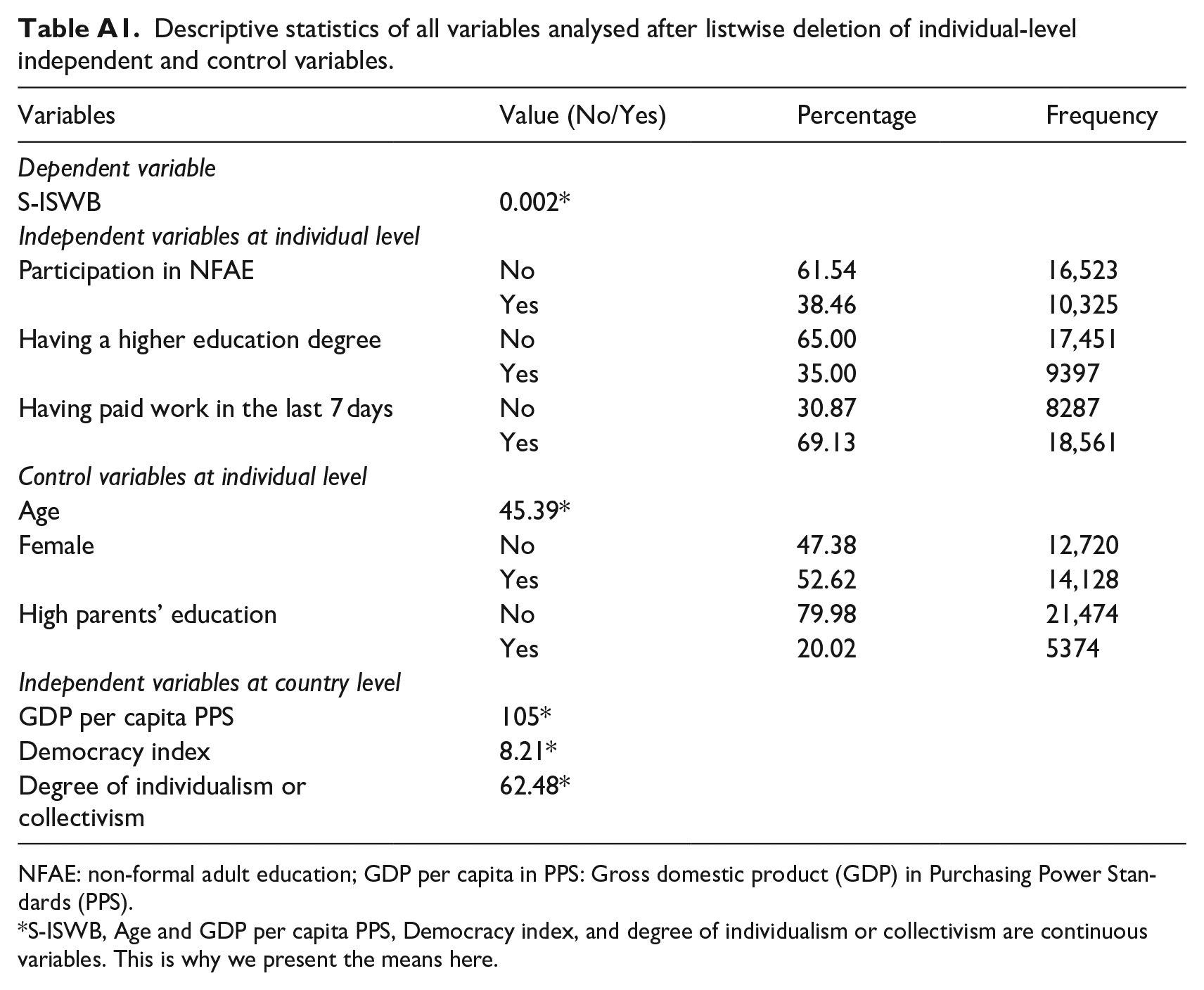
We have used the unweighted data from the ESS in all statistical analyses. Descriptive statistics of the dependent, independent, and control variables used in the empirical analysis are presented in Appendix Table A1.
Analytical strategy
This study used multilevel linear regression models to test our hypotheses. More specifically, we have used two-level random intercepts linear regression models. We chose them because they allow for the estimation of models with data at different levels and their individual-level and cross-level interactions. Based on Rabe-Hesketh and Skrondal (2012), we estimated 11 models in which adults (level 1) are nested in countries (level 2). These models were estimated using the xtreg command in Stata 16. Model 0 represents a baseline model with only the intercept. Model 1 includes participation in non-formal education. In Model 2, all the individual characteristics are added. Models 3 and 4 test the individual-level interaction effects between participation in non-formal education, and having a higher education degree and having paid work are respectively added. In Models 5, 7, and 9, country-level characteristics are added; whereas Models 6, 8, and 10 include cross-level interaction terms separately between each of the three aspects of the opportunity structures, respectively: GDP per capita, democracy index, and the degree of individualism or collectivism, and participation in non-formal adult education.
Results
Table 2 presents the results of the multilevel linear regression models for individual subjective well-being.
Results of multilevel linear models showing associations between participation in non-formal adult education (NFAE) and individual subjective well-being and interactions between participation in NFAE with different individual-level characteristics and different aspects of the country-level context, regression coefficients (standard errors in parentheses).
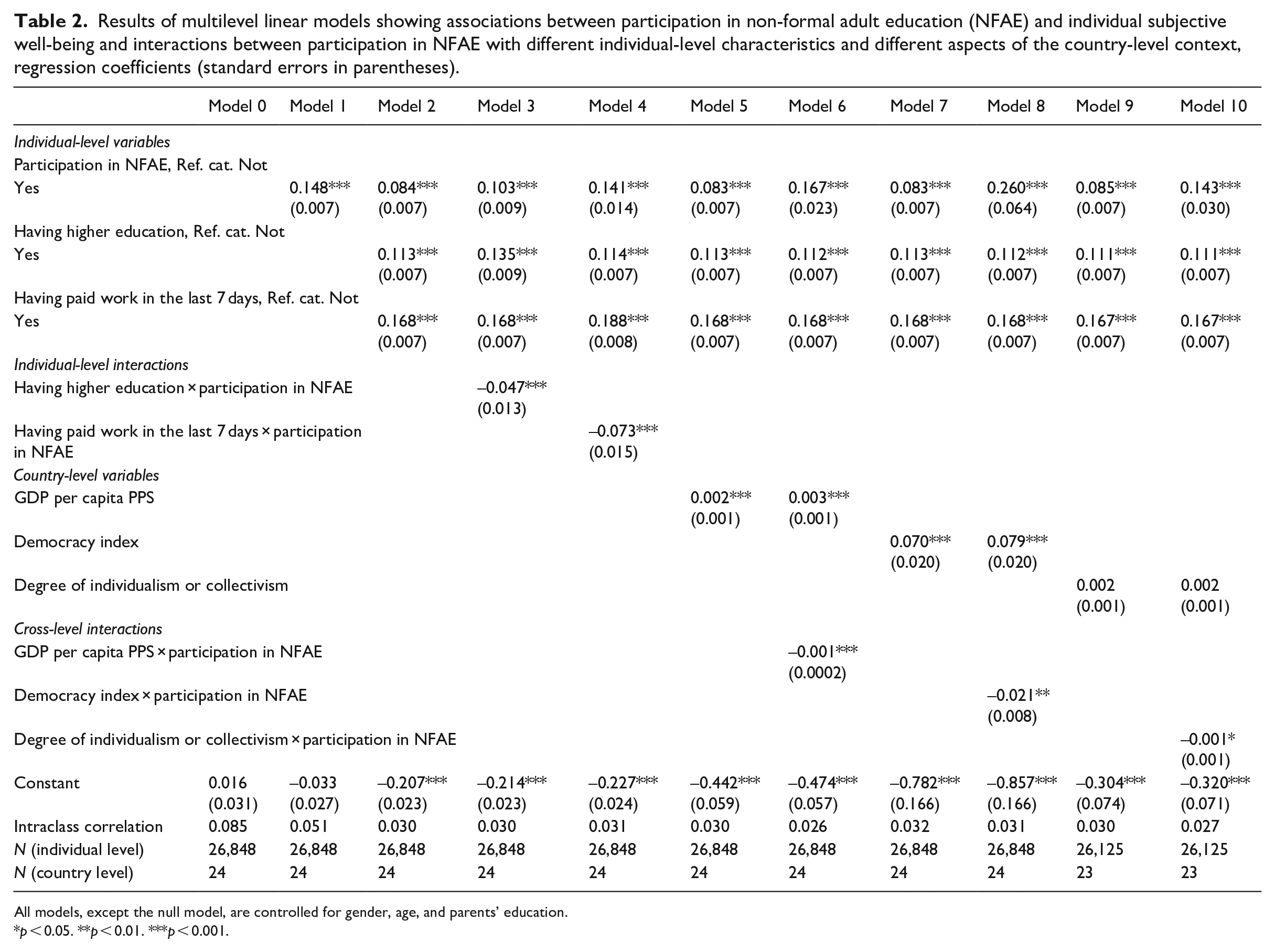
All models, except the null model, are controlled for gender, age, and parents’ education.
p < 0.05. **p < 0.01. ***p < 0.001.
The intraclass correlation (ICC) in the null regression model (Model 0) is 0.085. This shows that 8.5% of the variation in individual subjective well-being is due to differences between the countries where adults live. The ICC values in our study are consistent with other studies in the area of social research, which report an ICC that ranges from about 0.05 to 0.2 and justify these values as sufficient for the application of a multilevel modeling approach (e.g. Högberg et al., 2019; Hox, 2010; Peugh, 2010).
In line with Hypothesis 1, Model 1 demonstrates that participation in non-formal adult education is positively associated with individual subjective well-being. Regarding the other individual-level characteristics, having higher education and having paid work, Model 2 shows that they are also positively related to individual subjective well-being, and this partly explains the association between individual subjective well-being and participation in non-formal education—as its coefficient decreases from 0.148 to 0.084 when the variables of having a higher education degree and having paid work are added. At the same time, we find evidence to corroborate Hypothesis 2. More specifically, Models 3 and 4 show that having a higher education degree and having paid work have moderating effect on the positive association between participation in non-formal adult education and individual subjective well-being. Both interaction terms between participation in non-formal adult education and having higher education degree and having paid work are negative, respectively −0.047 and −0.073, indicating that the positive association between participation in non-formal education and individual subjective well-being is weaker among those who have higher education and are involved in paid work. Furthermore, to facilitate the interpretation of the interaction effects, we plotted them using average marginal effects (see Appendix Figure A1).
Models 5 and Model 7 show that the higher a country’s GDP or democracy index, the higher the individual subjective well-being of adults who live in this country. Model 9 shows that there is no statistically significant association between the level of individualism or collectivism and individual subjective well-being. At the same time, the estimates in Models 6, 8, and 10 suggest the presence of a moderating negative effect of the measures of economic, democratic, and cultural context on the positive association between participation in non-formal adult education and individual subjective well-being. These results support Hypothesis 3. More specifically, we found significant and negative interaction terms indicating higher GDP, democracy index, and level of individualism in a given country as significantly associated with relatively lower level of individual subjective well-being among adults who participated in non-formal education. Finally, to facilitate the interpretation of interaction effects, we plotted them using average marginal effects (see Appendix Figure A2).
Discussion
The present article synthesizes ideas from the capability approach, the embeddedness approach, and Nancy Fraser’s three-dimensional scale of justice in order to develop a theoretical framework for understanding individual subjective well-being as a positive functioning. Thus, this attempt is in line with the argument of a recent systematic review on studies on happiness and human well-being that there is a need to develop multidimensional models which focus more on eudaimonic rather than hedonic happiness (Delsignore et al., 2021). The article also empirically investigates the relationship between individual subjective well-being and participation of adults in non-formal, job-related education by relying on data from the ESS for 24 European countries. Our study contributes to the literature by: (1) developing a more differentiated multidimensional understanding of individual subjective well-being as a positive functioning which goes beyond its reduction to satisfaction and happiness; (2) constructing an instrument—a scale—for measuring individual subjective well-being as a multidimensional functioning; (3) demonstrating the relationship between individual subjective well-being and main individual characteristics; and (4) revealing the embeddedness of individual subjective well-being in different socio-economic and cultural contexts.
Based on Nussbaum’s list of central capabilities, we have defined nine dimensions of subjective well-being as a positive functioning: autonomy, sense of meaning, engagement, competence, recognition, affiliation, feeling of health, life enjoyment, and attachment to the environment. We acknowledge that we follow a normative perspective. We do so because of two main theoretical assumptions, both of which represent important ideas of the capability approach. According to the first one, the understanding of well-being should focus on what people can be and can do, rather than simply on what they have (Sen, 1999). The second one highlights that taking into account one’s central capabilities guarantees that “each person is treated as an end” (Nussbaum, 2003: 40).
The developed theoretical understanding of individual subjective well-being as a multidimensional positive functioning is operationalized on a scale and empirically tested in the analysis of the relationship between participation in non-formal education and subjective well-being.
We have found a positive association between participation in non-formal adult education and subjective well-being. There are two main mechanisms which have been identified in the literature in order to explain the association between individuals’ education and well-being, measured by happiness and life satisfaction. The first one is “education as a labour-market resource,” which is linked to “the assumption that education is a key resource that individuals can draw upon to strengthen their position in the labour market, and is therefore a determinant of income, working conditions, and unemployment risks” (Högberg, 2019: 666), whereas the second one reflects the fact that education is also related to some other resources that are important for individuals’ well-being, such as physical health, good family relations, communicative skills, or a sense of personal control (Blanchflower and Oswald, 2004; Högberg, 2019; Ross and Mirowsky, 1999). Our study reveals that involvement in adult education (and, more concretely, in non-formal, job-related education) is important for subjective well-being through its positive association with crucial aspects of individual subjectivity such as autonomy, sense of meaning, engagement, competence, recognition, affiliation, feeling of health, life enjoyment, and attachment to the environment. However, acknowledging the positive association of adult education with subjective well-being, we are aware that “something called ‘education’ delivered in schools, universities and elsewhere does not always expand people’s capabilities” (Walker, 2020: 506). Taking this into account points to the need to complement our analysis with studies of the influence on individual subjective well-being of concrete programs for non-formal education that should also use qualitative data.
Our results show that differences in the subjective well-being between adults who have participated in non-formal education and those who have not are higher among those who do not have higher education than among those who do. We find a similar association regarding individuals’ employment status—differences in the subjective well-being between adults who have participated in non-formal education and those who have not are greater among those who are unemployed than among those who have paid work. This suggests that participation in non-formal education has the potential to further increase the subjective well-being of adults who have higher education or paid work. However, it is important to be emphasized that the potential of participation in non-formal education to enhance individual subjective well-being is higher among those adults who lack a higher education degree or are unemployed.
The results show that when people live in countries with better economic and democratic development and a more individualistic culture, the differences in their subjective well-being by participating in non-formal adult education are lower than when they live in countries with worse economic and democratic development and a more collectivistic culture. We regard this as suggestive evidence that “the added value” of participation in non-formal adult education to individual subjective well-being is more pronounced in countries with worse economic and democratic development and a more collectivistic culture. Our interpretation is in line with Walker (2020: 510), who argues that “[e]ducation which is truly educational in this way, developing knowledge, the full range of skills and democratic values, can then serve as a catalyst for personal and social change, especially for people in poverty and disadvantaged circumstances.”
Conclusion
Our study has some limitations. The first one arises from the fact that we have used cross-sectional data. In this regard, we agree with Boeren (2021: 13), who outlines that “[t]he core limitation of studying happiness in relation to participation in adult education through a European comparative lens is the absence of longitudinal data. . . As such, findings in this article need to be interpreted as patterns appearing across the different countries and between learners and nonlearners.” The second limitation also refers to the availability of relevant data. Unfortunately, the rotating module specially devoted to personal and social well-being from Round 6 of the ESS has not been repeated since 2012, and thus there are no reliable comparative data for studying how individual subjective well-being as a functioning and its association with participation in non-formal education has changed in subsequent years.
We foresee several directions for future research. The first direction is related to further developing the conceptualization of the multidimensional character of subjective well-being as a positive functioning and its measurement. Thus, for example, it is worth trying to include in the S-ISWB dimensions which capture the other two capabilities from Nussbaum’s list—life and bodily integrity—and finding relevant indicators for their measurement. Secondly, the embeddedness of the association between participation in non-formal education and subjective well-being is worth studying while taking into account other macro characteristics, for example, the level of social inequality. Previous research (e.g. Lee and Desjardins, 2019; Stauvermann and Kumar, 2018) has shown that there is a relationship between inequality of participation in adult education and social inequality. Thirdly, special attention needs to be paid to the mechanisms through which social environments mediate the association between participation in adult education and individual subjective well-being. Fourthly, it is also important to investigate the relationship of other forms and concrete programs of adult education—for example, non-job related, non-formal, or informal education—with individual subjective well-being using qualitative data, as well. Finally, it is worth exploring the mediating role of non-formal education regarding the influence of individual characteristics on subjective well-being.
Although we strongly argue in favor of the understanding of subjective well-being as a positive functioning, we agree that “[t]he functional well-being approach is not an alternative to subjective well-being—it is a supplement” which calls “for future research not to abandon emotional or evaluative perspectives, but to broaden the theoretical scope so that it also reflects functional elements” (Vittersø, 2013: 14). That is why it is reasonable to conclude that only by combining different approaches and by carrying out differentiated analyses can we grasp the full complexity of individual subjectivity and well-being.
Footnotes
Appendix
Descriptive statistics of all variables analysed after listwise deletion of individual-level independent and control variables.
| Variables | Value (No/Yes) | Percentage | Frequency |
|---|---|---|---|
| Dependent variable | |||
| S-ISWB | 0.002* | ||
| Independent variables at individual level | |||
| Participation in NFAE | No | 61.54 | 16,523 |
| Yes | 38.46 | 10,325 | |
| Having a higher education degree | No | 65.00 | 17,451 |
| Yes | 35.00 | 9397 | |
| Having paid work in the last 7 days | No | 30.87 | 8287 |
| Yes | 69.13 | 18,561 | |
| Control variables at individual level | |||
| Age | 45.39* | ||
| Female | No | 47.38 | 12,720 |
| Yes | 52.62 | 14,128 | |
| High parents’ education | No | 79.98 | 21,474 |
| Yes | 20.02 | 5374 | |
| Independent variables at country level | |||
| GDP per capita PPS | 105* | ||
| Democracy index | 8.21* | ||
| Degree of individualism or collectivism | 62.48* | ||
NFAE: non-formal adult education; GDP per capita in PPS: Gross domestic product (GDP) in Purchasing Power Standards (PPS).
S-ISWB, Age and GDP per capita PPS, Democracy index, and degree of individualism or collectivism are continuous variables. This is why we present the means here.
Acknowledgements
We would like to thank Valery Todorov for his assistance in the construction of the scale of individual subjective well-being and the two anonymous reviewers for their valuable comments on an earlier version of this article.
Declaration of conflicting interests
The author(s) declared no potential conflicts of interest with respect to the research, authorship, and/or publication of this article.
Funding
The author(s) disclosed receipt of the following financial support for the research, authorship, and/or publication of this article: This research was funded by the Bulgarian National Science Fund, contract number KΠ-06-ДB-2/16.12.2019 within the project “Dynamics of inequalities in participation in higher and adult education: A comparative social justice perspective,” the National Science Program VIHREN.
