




Abstract
Growing global debates surrounding parental school choice underscore the relevance of school place allocation. While there is much research on school choice, the enactment of such allocation policy is rarely analysed. Responding to this research gap, this article investigates how local politicians in Berlin put public primary school place allocation into practice. Building on approaches of policy enactment and policy field analysis, this article examines the ‘doing’ of Berlin primary school place allocation with the concurrency of catchment areas and parental school choice. Methodologically, this article draws on semi-structured interviews with three inner-city district school department heads in Berlin. Using qualitative content analysis, their political objectives, scope and strategies are analysed. The findings demonstrate that local politicians can interpret the allocation process in line with their political objectives. Consequently, there is surprising variation between the districts’ enactment of primary school place allocation policy. Policymakers’ political preferences for either school choice or social diversity are influential, as is the local context (e.g. school place shortages). The study highlights the importance of local actors and identifies three political strategies used to influence school place allocation, which might inform local politicians’ strategies elsewhere.
Keywords
Introduction
The global trend in recent decades towards greater parental school choice has been accompanied by significant growth in the body of research focussing on education policy and, specifically, forms of allocating school places (Ball, 2003; Ball et al., 1996; Brighouse, 2002; Forsey et al., 2008; Lubienski et al., 2009). While past studies on education policy tended to focus on nation states, this study is part of a growing body of work that focuses on the local adoption of education policy (Lidström, 1999; Wiborg and Larsen, 2017). The article investigates the underexplored role of local politicians in the enactment of school place allocation policy, combining a policy enactment lens with policy field theory (Ball, 1994; Fligstein and McAdam, 2012; Hartong and Nikolai, 2017).
Academic debates relating to school place allocation often centre the concepts of freedom of choice and equality of opportunity (Bridges and Jonathan, 2007; Saltman, 2014; Tooley, 2000). There are studies suggesting that social class heavily influences parental school choice (Clausen, 2006; Gewirtz et al., 1995), which may consequently lead to socially more segregated schools (Groos, 2015; Söderström and Uusitalo, 2010). Equally, in socially segregated neighbourhoods, catchment areas may also lead to socially segregated schools (Radtke and Stošic, 2009).
While there is a substantial body of research on the global policy phenomenon of school choice in school systems across world (Benson et al., 2015; Forsey et al., 2008; Whitty et al., 1998), Central European school systems have not been examined as extensively (for exceptions see Clausen, 2006; Koinzer et al., 2017). In addition, existing research on school choice in Germany focuses on the perspectives of parents and schools (Breidenstein et al., 2020b; Clausen, 2006; Förste, 2013; Noreisch, 2007). By contrast, this study uses a policy enactment lens to examine how local politicians interpret public primary school place allocation and how they put the policy into practice in three inner-city districts of the German federal state of Berlin, focussing on their political objectives and influence. In doing so, it contributes to a growing body of research in a still understudied country and provides further insights into a part of the allocation process that has often remained a ‘black box’ in school choice research (Van Ackeren, 2006; but see Varjo and Kalalahti, 2015; Wiborg and Larsen, 2017). This article demonstrates the potential of further investigating the political objectives and linked strategies of local politicians and makes visible the influence they could exercise on school place allocation policy.
Traditionally, public primary school place allocation in Germany, much like in the rest of continental Europe, is determined by catchment areas (Butler and van Zanten, 2007; Van Ackeren, 2006). However, this is not universally the case. Since 1949, parents in Berlin have had the option of choosing a primary school outside their catchment area. In 2012, a third of all new Berlin primary school pupils did not attend their catchment area school (Vieth-Entus, 2012), suggesting that the possibility for parental school choice often undercuts allocation through catchment areas. This is further supported by studies investigating the perspective of parents on primary school choice (Förste, 2013; Mayer, 2017; Noreisch, 2007) and a study that highlights the segregating effects of primary school choice in Berlin (Fincke and Morris-Lange, 2012).
As Wiborg and Larsen (2017) identify within the Danish context, local politicians can bypass national school choice laws to form socially diverse catchment areas. Similarly, in Berlin, the 12 politically elected district school department heads are responsible for putting the public primary school place allocation policy of Berlin into practice, defining primary school catchment areas and handling change appeals from unhappy parents. Consequently, I investigate how these local politicians attempt to shape the primary school place allocation in their district, navigating the concurrency of two seemingly contrary principles – catchment areas and school choice. This article draws on three interviews with school department heads in inner-city districts in Berlin, addressing the following three research questions:
(I) What are the political objectives of district school department heads when allocating public primary school places?
(II) Which strategies do school department heads employ to meet these objectives?
(III) How do school department heads perceive their political influence on the allocation of primary school places?
In this article, I will first introduce freedom of choice and equality of opportunity as two theoretical concepts used to argue for specific methods of school place allocation. Then, I will discuss different approaches to studying education policy decision-making. After outlining the methods employed in this study, I provide an overview on the German context and primary school place allocation in Berlin. Next, I present my empirical findings, highlighting inter-district variation in the allocation objectives, allocation practices and the perceived personal influence of school department heads. In the last section, I summarise and discuss the results. Finally, the article identifies three political strategies used to influence school place allocation in Berlin, highlighting the importance of local political actors’ interpretation of central policy.
Theories and practices of school place allocation
Theoretical approaches to school place allocation
The two theoretical concepts at the heart of the question of school place allocation are freedom of choice and equality of opportunity. Freedom of choice in education usually focusses on the individual rights of parents to make decisions about their children’s education (Tooley, 2000). Mill (1859) bases this position on the ‘Harm Principle’, opposing compulsory education and advocating parental choice between education providers. The idea of market-orientated education systems gained momentum in the 20th century with Friedman (1955) proposing a voucher system of parental school choice, followed by Chubb and Moe (1990). In contrast, Feinberg (1980) argues for keeping as many options as possible open for children, contesting parents’ right to choose their child’s school if it limits the child’s future choices.
Equality of opportunity aims to provide all children with the same opportunity to come into societal positions of power, irrespective of their background (Brighouse, 1998). Although this concept criticises interpersonal inequality, equality of opportunity itself will not necessarily lead to equality of outcome, only to equal access to unequal positions (Heid, 1988). In present day societies, positions of power are distributed through education. Brighouse therefore argues for an equality of educational opportunities with ‘educational opportunities [. . .] insulated from family background’ (Brighouse, 1998: 140). A further step towards strengthening equality of opportunity is to limit social segregation between educational institutions (Van Ackeren, 2006).
However, the different methods of school place allocation are not clearly associated with either equality of opportunity or freedom of choice. Some scholars try to integrate equality of opportunity and choice (Tooley, 2000), while others are sceptical as to whether parental choice in education can be in line with equal opportunities (Fjellman et al., 2019; Radtke, 2000). While introducing school choice is said to further parents’ freedom of choice, studies suggest that catchment area policies lead to more equality of opportunity (Groos, 2015; Põder et al., 2017). However, if catchment areas are socially segregated, so are schools (Butler and van Zanten, 2007; Maguain, 2009; Radtke and Stošic, 2009). Meanwhile, if parents choose their child’s school poorly, this could limit the child’s future freedom of choice (Feinberg, 1980). In practice, school systems use multiple criteria to allocate school places (Butler and van Zanten, 2007); parental choice and residency are two of the many criteria used to allocate school places, rather than two opposing logics. This underlines, as other scholars have expressed, the importance of a thorough analysis of the enactment of school place allocation policies in their local contexts (Lubienski et al., 2009).
Education policy approaches to school place allocation
In recent years, an increasing amount of studies aims to understand how education reforms spread around the globe (Forsey et al., 2008), many of these focus on school place allocation. In the past, large parts of these studies ‘often viewed nation-states as uniform policy containers’ (Hartong and Nikolai, 2017: 520). However, we now see more and more studies that point to the importance of taking into account the local complexities within decentralised and federal education systems that might influence how policies are enacted (Verger, 2014). These studies investigate how local actors actively reinterpret global policy ideas, borrowing and lending education policy and relating it to existing policy structures (Steiner-Khamsi and Waldow, 2012; Verger, 2014).
In political science literature, two traditional models of policy-making are the rational model and the incremental model (Bochel and Bochel, 2017). The rational model emphasises the evaluation of goals or problems, and of alternative solutions and their consequences before making political decisions on their basis. This model has a normative component, as a (bounded) rationality is rarely realised in policy making, but seen as aspirational (Bochel and Bochel, 2017). Criticising rationalist approaches, proponents of an incremental model focus on how decision making is often characterised by ‘muddling through’ (Lindblom, 1959: 79) and repeated comparisons of the available options. This model again is criticised for being overly conservative and not accounting for radical policy changes. However, both models can be useful to analyse policy-making processes, if not used exclusively (Bochel and Bochel, 2017).
The theory of policy fields aims to make sense of social change and stability by viewing social life ‘as dominated by a complex web of strategic action fields’ (Fligstein and McAdam, 2012: 8). To understand policy phenomena, it can be helpful to investigate the transformation of existing fields and the emergence of new fields, their logics and actors. For instance, policy field theory is used to highlight how crises – exogenous ‘shocks’ or endogenous problems that culminate over time – might trigger a transformation of existing strategic action fields (Fligstein and McAdam, 2012). Such crises can also enable actors to change the focus from one education policy strategic action field to new policy fields, such as focussing on inclusion rather than school quality (Hartong and Nikolai, 2017).
The role of municipalities, districts and other local actors often remain underexplored, although they are often assigned the task of putting education policy into practice. With the current trend towards further decentralisation continuing, these local actors will likely increase in importance. Some studies already demonstrate how municipal politicians might use their influence to change the enactment of education policies (Wiborg and Larsen, 2017, see below; Varjo and Kalalahti, 2015). Similarly, policy implementation research highlights the importance of local actors in the implementation of central policy (see e.g. Bochel and Bochel, 2017; Hill and Hupe, 2009; Pressman and Wildavsky, 1973). For instance, Lipsky’s (1980) research on ‘street-level bureaucrats’ provided insight into how professionals working at the local level have significant influence on how central (social) policy is implemented on the ground.
The present study additionally builds upon policy enactment research that emphasises that ‘policies do not normally tell you what to do’ (Ball, 1994: 19), but rather influence the range of options or set specific goals, understanding the process of putting policy in practice as creative, complex and context-sensitive (Ball, 1994; Braun et al., 2011). Consequently, such studies tend to investigate how policies are enacted locally, with a special focus on policy enactment in schools. For this study, I use the enactment approach to investigate how local school department heads enact the Berlin primary school admission policy (inscribed in school law) on the district level. I intend to investigate whether school departments, much like schools, produce their own approach to the policy of school place allocation (and thus their own understanding of the strategic action field), informed by their ethos and political aims, and within the boundaries of the context of their district (Braun et al., 2011) instead of simply applying the rules set by school law.
One example of how local actors might influence national education policy is provided by Wiborg and Larsen (2017). The authors show how councils collaborating with teacher unions restrict parental school choice, bypassing national law that allows school choice within the limits of free school places. To do so, a social-democratic and a conservative council in agreement with teacher unions regularly redefine school catchment areas according to social criteria, aiming at creating socially integrated catchment areas (Wiborg and Larsen, 2017). In addition, local politicians limit the number of students per classroom, thereby limiting school choice. The only traditionally liberal council increased school choice by higher class sizes (Wiborg and Larsen, 2017). Much like the Danish case, many other authors also highlight unions’ influence on education policy, pointing towards the importance of vested interest (see also Busemeyer, 2014; Moe and Wiborg, 2017; Wiborg, 2010). For the Swedish case, Lidström (1999) challenges the view that political ideologies are the major driving force, rather emphasising that the extent of middle-class dominance in the community fosters school choice policy. However, there are also studies pointing towards party-political influence on education policy (Dobbins and Christ, 2019).
Although the influence of political parties and teacher unions might vary, it becomes clear that to understand the limits and possibilities of decision-making, the present study has to take into account political crises and policy fields. However, this study is not interested in how those factors shape the making of policy (i.e. how the allocation law came into place), but rather how they influence the enactment of school place allocation policy (i.e. how district actors put the law into practice).
Methodology
In this qualitative study, I explore how the locally responsible politicians shape the allocation of primary school places in inner-city Berlin, focussing on their political objectives, strategies and perceived influence. As described in greater detail in section School place allocation in Berlin, the politically elected heads of district school departments are responsible for putting the policy on school place allocation into practice, defining catchment areas and deciding on change applications by parents. As Noreisch (2007) points out, there are large differences in opportunities to choose primary schools between more rural and inner-city areas of Berlin. Therefore, for the present study, I contacted the six district school department heads from similarly populated districts inner-city districts to facilitate the comparison. In late summer 2018, I conducted three interviews with the three inner-city school department heads that agreed to an interview (the other department heads either declined or did not respond).
The aim was to investigate the ways in which the allocation policy as defined in the school law was interpreted by local school department heads through understanding both how the allocation process was laid out in the three districts and which political objectives and strategies the department heads pursued in the process. For this purpose, semi-structured in-depth expert interviews (lasting between 90 and 120 minutes) with the three district school department heads were used (in district B, the department head was accompanied by a staff member). Firstly, to understand how primary school places in Berlin are allocated, I explored the allocation policy with the help of both the interview data and public documents, such as legislation and rulings on school place allocation, newspaper articles on debates around catchment areas, as well as the districts’ and political parties’ websites and district parliament documents (as presented in section School place allocation in Berlin). Secondly and most importantly, I analysed the transcribed interview data to explore the enactment of said school place allocation policy by focussing on the political objectives, perceived influence and strategies of the three local school department heads. As the district school department heads have a considerable amount of power over the definition of catchment areas (see section School place allocation in Berlin), they are key actors to understand how the allocation policy is locally enacted. However, the chosen research design comes with notable restrictions: the scope of this article is not the actual implementation of school place allocation through school principals nor is it the policy effects on the ground (see also limitations in section Discussion).
The chosen methods are intended to reveal expert knowledge on allocation normally hidden when examining laws, public data and parent and school head interviews (Hildebrandt, 2015). However, the school department heads are not only interviewed as experts, but also as actors who subjectively affect the allocation process with their political objectives and strategies. Consequently, the expert interview method (Hildebrandt, 2015) was expanded to allow for questions focussing on the political objectives of interviewees (Meuser and Nagel, 2009).
Of the six Berlin inner-city school department heads, two-thirds are member of the Social Democratic Party (Sozialdemokratische Partei Deutschlands, SPD) and one-third are members of the Christian Democratic Union (Christlich Demokratische Union Deutschlands, CDU), adding a party-political factor to the analysis. For the interviews, the same party-political balance was met, as two out of three interviewees were SPD members and one interviewee was member of the CDU. To ensure the department heads’ anonymity, they are referred to as school department heads A, B and C in districts A, B and C. 1
The interviews were recorded, transcribed and subsequently analysed using qualitative content analysis (following Mayring, 2010; see also Meuser and Nagel, 2009). Taking an inductive approach, I examined how the interviewees described the process of primary school place allocation, their different objectives in the allocation process, which strategies they used to achieve these objectives, and how they perceived their political influence.
Literature on the allocation of school places often focusses on specific policies like ‘school choice’. However, as not all parents choose (even in environments that encourage parental choice) researching school choice has the problem of reifying the topic school choice (see a reflection of Krüger et al., 2020; Noreisch, 2007), possibly constructing school choice reality through researching school choice. To avoid this dilemma, in my interview requests, I explicitly chose to not to address school choice, but rather centre on school place allocation. In addressing the interviewees as experts on the topic of school place allocation, I tried to avoid framing one method of school place allocation as normal.
German and Berlin school policy context
Germany, with its 16 different state education systems, provides an interesting case to study the local meanings of reforms and federal actors as brokers or opponents of specific education policy (see Hartong and Nikolai, 2017). To differentiate further, the present study aims to investigate the variance within the German state of Berlin and the influence of district policy makers on primary school place allocation. Berlin is a suitable case study as it has multiple large and densely populated inner-city districts that make school choice both feasible and a consideration for parents. Additionally, there is party-political variance between the politically elected school department heads in charge of primary school place allocation.
Traditionally, the hierarchically structured secondary school system in Germany with Gymnasium on the top relied on the assumption of a meritocratic selection process in primary school with equal opportunities for all children (Breidenstein et al., 2020b). The catchment areas for primary schools that are thought to reflect the residential diversity are a remnant of this egalitarian ideal. Catchment areas also ensure that every pupil has access to a primary school in walking distance (following the idiom ‘Kurze Wege für kurze Beine’ 2 ), although attending this school is not obligatory. However, catchment areas also have a different history: Radtke and Stošic (2009) show that catchment areas in Germany might be ethnically and socially homogenous on purpose, which leads to ethnic segregation. Defining catchment areas has the potential to be very controversial if it threatens privileged parents’ expectations of the desired school’s intake (Breidenstein and Voigt, 2020). For Berlin, Fincke and Morris-Lange (2012) highlight the segregating effects of primary school choice in addition to residentially segregated catchment areas. Berlin also has a history of segregation within schools: until 1995, it was common practice for primary schools to create separate so-called ‘Ausländerklassen’ (‘foreigner classes’) if the number of children with migrant history exceeded a certain percentage (Karakayali and zur Nieden, 2013).
Berlin is a city-state with its own school system. The Berlin Ministry of Education (lead by the politically elected minister) is generally responsible for the schools and teachers, defining content, monitoring and supervising schools within the limits of school law. The twelve districts school departments are responsible for the school buildings and conducting primary school place allocation, the districts are not allowed to support schools in issues of paedagogy. This structure of local responsibility and the task of primary school admission, especially for school catchment areas, is not uncommon in Germany (for an overview see Breidenstein et al., 2020a).
Berlin is one of the few German states, in which the primary school lasts not 4 but 6 years, although there are some elite secondary schools that start after 4 years. Since the Berlin education reform in 2010, after primary school, students attend one of two forms of secondary school, which are formally equal although not all secondary schools lead to the Abitur. In addition to introducing this bipartite system, Berlin created so-called Gemeinschaftsschulen (‘common schools’) that combine primary and secondary school and provide only mixed-ability and sometimes mixed-year classes, which is a substantive break with the traditional hierarchically structured secondary school system in Germany. However, so far, the number of Gemeinschaftsschulen (26) is still quite limited.
School place allocation in Berlin
In Berlin, the task of primary school place allocation is the responsibility of the district school department and notably their department heads. District department heads (‘Bezirksstadträte’) are the politically elected heads of their respective administration areas (e.g. schools, youth, urban development), and as such are nominated by a party. Typically, they are one of the frontrunners of their party for district parliament. Together with their four colleagues they form the district government (the so-called ‘Bezirksamt’) one of them taking on the role of district mayor.
In Berlin, the large majority of primary schools are situated in a catchment area (for exceptions, see below). The school law tasks school department heads to define these catchment areas after listening to advice of principals and school representatives on the school and district level (who can either accept or comment on the decision). 3 The amount of influence of district parliaments seems to vary, while in most cases, district parliaments are only informed about changes, in one case, the parliament was apparently able to change the proposed catchment areas. 4 However, when looking into local newspapers, such power struggles over catchment areas between parliament and school department seem to be rare. Ultimately, the decision on catchment areas is made by the district government (‘Bezirksamt’, i.e. the five department heads) following a proposal by the school department head. While there are differences between the districts, school department heads have a large amount of influence on the catchment area definition.
Traditionally, catchment areas include only one primary school, but in 2010, Berlin parliament strengthened school choice by allowing districts to create catchment areas with multiple schools and allowing parents a restricted choice. However, school choice is not a new phenomenon: since at least 1949, parents have – within the limits of available space in the desired school – the right to file an application to change school for personal, paedagogical or professional reasons 5 to choose a primary school that is different from their catchment area school. Crucially, primary school choice is only possible, if the children for whom the school is the catchment area school do not already fill all school vacancies. Additionally, some public primary schools like European schools’, 6 special needs focus schools, 7 the Gemeinschaftsschulen 8 and private schools 9 (Habeck et al., 2017) have different, more choice-led, admission procedures, sometimes without catchment areas. The possibilities to evade the assigned catchment area primary school are widely used: Schwarz et al. (2017) found that a third of all first-year students are not schooled in their catchment area school. This figure varies between districts: in some areas up to half of the student population does not attend a catchment area school (Vieth-Entus, 2012). While the extent of choice seems to depend on the districts (between 23% and 48%), both parental choice and catchment areas influence the primary school place allocation in Berlin.
Within the last decades, the topic of primary choice in Berlin is becoming more relevant (Noreisch, 2007). While the idea of the neighbourhood primary school is still deemed attractive, other policy drivers might lead to more primary school choice. One such factor might be the extent to which Berlin is encouraging schools to develop school profiles (see Altrichter et al., 2011), either with regards to special subjects and extracurricular activities, or with regards to offering all-day schools (as opposed to the traditional German ‘Halbtagsschule’). Also, contrary to the assessment that in Germany, not a lot of information about schools is published (Breidenstein et al., 2020b: 418), the Berlin school administration actually uses a data platform to publish data on individual schools, including the share of students identified as having a ‘non-German language of origin’ (‘nichtdeutsche Herkunftssprache’), external inspection results and the percentage of cancelled classes. As we can see, to a certain degree, there are some mixed messages: on the one hand, Berlin has a catchment area system and restricted choice between primary schools, on the other hand, there is increasing differentiation between primary schools and parents can access (selected) data about primary schools.
Findings: Primary school place allocation in Berlin
Although legislation does not differ between districts, as it is passed on state level, its application varies. On the district level, three central sources of variation in putting school place allocation into practice can be identified: (1) definition of catchment areas; (2) planning with regards to the school capacity; and (3) introducing shared school catchment areas (big catchment areas with more than one school). Whether or not these possible mechanisms are utilised will be explored in the following sections based on the results of the interviews with inner-city district school department heads (SDH A, B and C) in Berlin. The findings are presented according to the three research questions.
Political objectives
All department heads agree that the current legislation in Berlin, with its combination of catchment areas and some parental influence, is a good system. Their prime objective is to ensure that all children can attend a primary school close to their home (Table 1). In districts A and B, this goal is considerably more difficult to achieve due to a recent increase in the number of children (endogenous crisis). The resulting shortage of school places is the most pressing issue for both department heads: ‘First of all, enough school places would have to be made available’ 10 (SDH A). In district C, the prior administration largely left the existing catchment areas in place while the demand changed over time. This misalignment between demand and catchment areas over the years lead to a problem of over- and undersubscribed primary schools with many children having to attend schools not in their neighbourhood (endogenous crisis). All school department heads agree that especially at a young age, a child’s journey to primary school must be short and safe (in line with the idiom ‘Short distances for short legs’). All describe this task to secure ample school places as their legal mandate, which they have to pursue first.
Political objectives of school department heads A, B and C; x = objective is pursued, (x) = objective is pursued to a lesser extent, - = objective is not pursued.
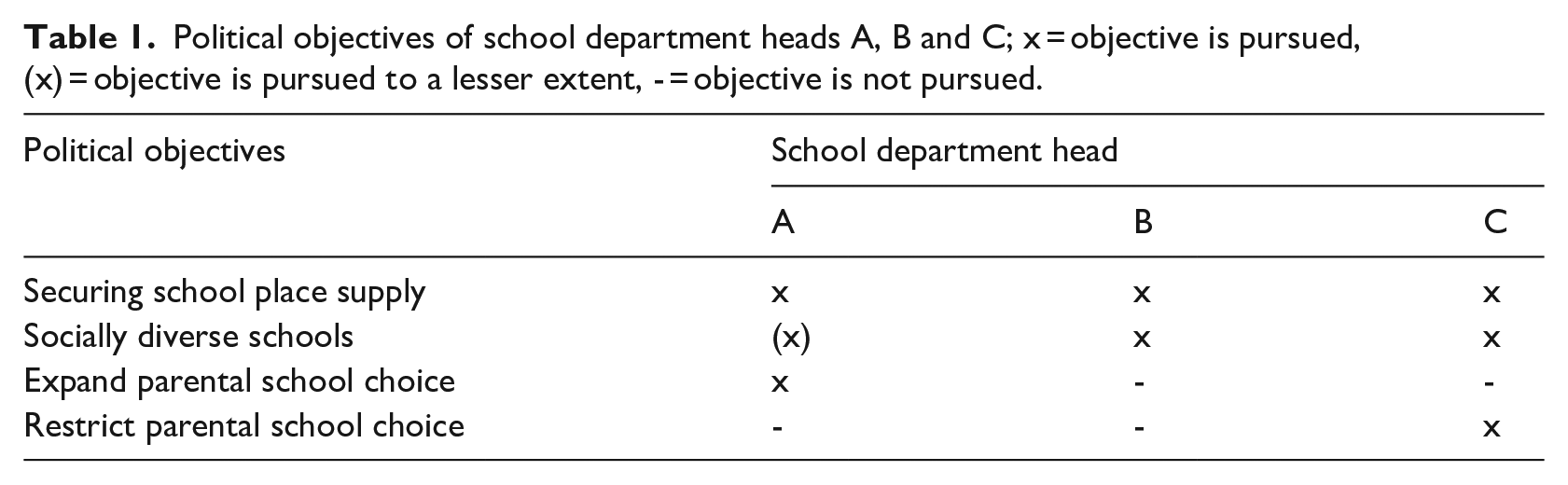
There are greater differences between the department heads regarding the objectives of social diversity and parental school choice. Generally, the goal of socially mixed primary schools is perceived positively. However, there are party-political differences. While conservative 11 SDH A wants social diversity only as long as it does not go against parents’ wishes, the social-democratic 12 department heads want to pursue social diversity regardless. SDH B aims for ‘as heterogeneous a student body as possible at each school’ with low social segregation between primary schools. SDH C wants a ‘reasonable mix’ in all primary schools, which should represent ‘all social classes as far as possible’, ‘because only a [. . .] reasonable mix ensures stability for schools and equal opportunities for all’.
It is with regards to school choice that the interviewees’ positions differ the most. The only consensus is that all want to allow children to attend their siblings’ school, even where this falls outside the catchment area, although SDH C wants to prevent this from being used strategically. While conservative SDH A wants to give parents more scope in determining their child’s primary school, SDH B disagrees. She sees enough possibilities for parental choice as it is and also opposes an increase in school choice for financial reasons. She strongly rejects propositions to move to a system of ‘complete freedom of choice’, which would in her opinion lead to more segregation and stress among parents. In district C, the catchment areas had not been changed for multiple years. Therefore, some primary schools had many empty school places, giving parents the opportunity to choose those schools, while other schools were already oversubscribed with the pupils living in their catchment area, which made a redefinition of all catchment areas necessary. In this context, SDH C aims to decrease opportunities for school choice. She wants to make it ‘as difficult as possible to change from the catchment area school to another school’, as this would threaten social diversity. However, it is worth noting that, in districts A and B, school choice is already limited due to a lack of school places. All department heads, irrespective of their objectives, state that, for the most part a certain privileged class of parents utilise the possibility of choosing primary schools where ‘one is amongst one’s equals’ (SDH A). However, according to department heads A and B, privileged parents also choose primary schools in disadvantaged areas if they like the school’s profile.
From the interviews, it is clear that the pursuit of equal opportunities is important for SPD department heads B and C. The conservative department head, on the other hand, prioritises parental school choice over social diversity. Securing enough school places close to children’s homes, however, is the top priority of all interviewed department heads.
Strategies employed
This section presents the strategies used by school department heads to achieve their objectives. It is divided into the three main goals expressed by the department heads: (1) securing school places close to home; (2) socially diverse schools; and (3) expanding or restricting parental school choice.
Strategies to secure school places close to home
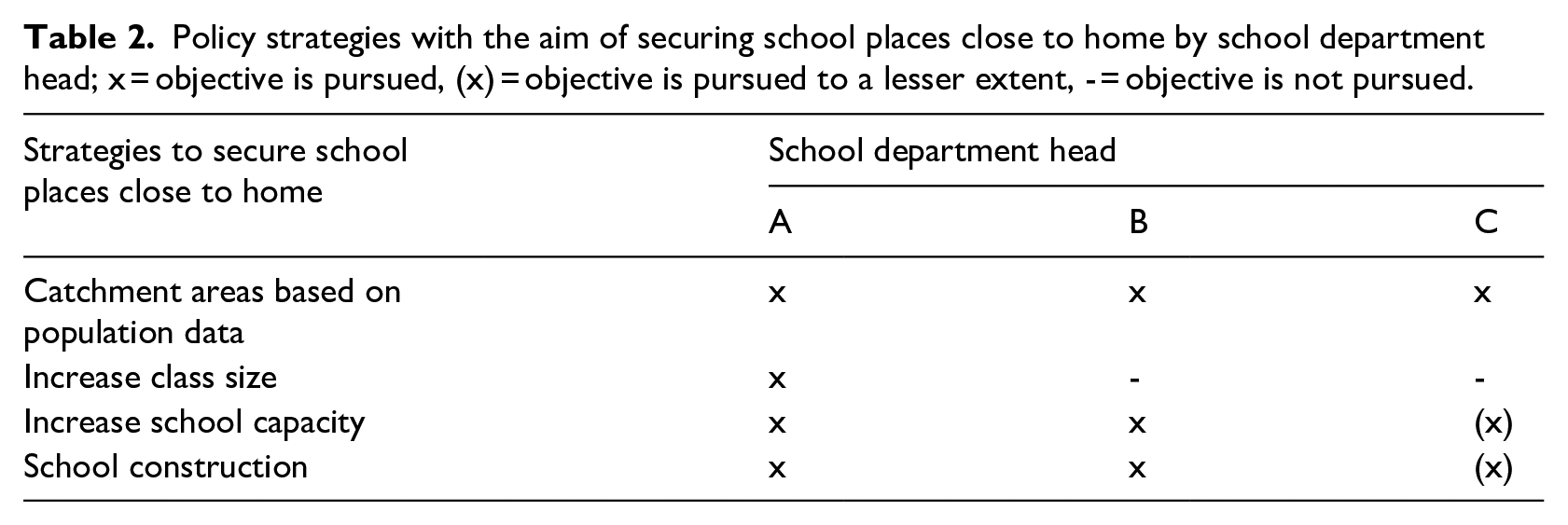
All school department heads use similar strategies to ensure there are primary school places close to children’s homes (Table 2). As districts A and B – and to some extent C – are faced with population growth, this objective is increasingly difficult to meet. In order to distribute children evenly among schools, the department heads determine catchment areas on the basis of population data. SDH A increases class sizes and all department heads expand school capacity through conversion and/or new construction. The differences between district strategies can primarily be explained by different demographics. However, in some cases, securing school places may be at odds with other objectives. For instance, SDH A initially denied a request to expand their capacity from a popular primary school in a socially disadvantaged catchment area. SDH A’s reasoning was that although the school is popular among middle-class parents and pupils changing to that school could have brought greater social diversity, it would also have left other schools with unfilled school places. Consequently, SDH A states that she prioritises ensuring sufficient school places over social diversity. A Berlin newspaper reported on parental resistance against her plans to modify the catchment areas. However, since parents have no institutionalised influence, she was able to pursue her plans regardless.
Policy strategies with the aim of securing school places close to home by school department head; x = objective is pursued, (x) = objective is pursued to a lesser extent, - = objective is not pursued.
Strategies for socially diverse primary schools
As described in section Political objectives, the social-democratic department heads B and C are more committed to social diversity than the conservative SDH A, and their political objectives clearly impact their strategies (Table 3).
Policy strategies with the aim of social diversity, by school department head; x = objective is pursued, (x) = objective is pursued to a lesser extent, - = objective is not pursued.
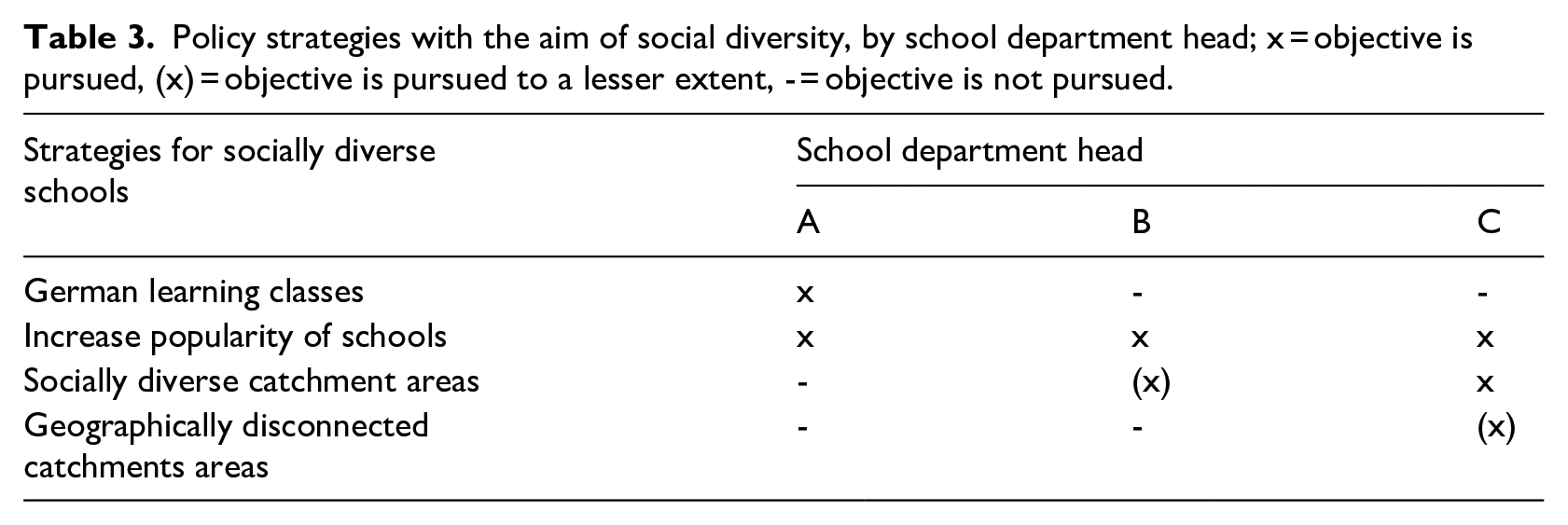
One strategy employed by all department heads is to try to influence parents’ choices. Social diversity is to be fostered by improving the reputation of schools unpopular among privileged parents. The hope is that this stops privileged parents from avoiding primary schools in socially disadvantaged neighbourhoods. SDH A describes that privileged parents even actively selected one primary school in a disadvantaged area. SDH B tries to reform unpopular schools into bilingual or Montessori schools to increase their attractiveness for middle-class parents. She also develops more schools into Gemeinschaftsschulen (‘Common schools’) to increase both social inclusivity and mixed-ability learning, sometimes despite resistance from schools themselves. The conservative SDH A supports primary schools in introducing so-called German learning classes, clustering children who do not speak German well into one class. 13 She sees this as a way of making those schools more diverse, arguing children would at least meet in the schoolyard, if not in class. The other department heads oppose this strategy on paedagogical grounds and due to its supposed segregating effect. Instead, SDH C wants unpopular primary schools to advertise their school profile more strongly and actively supports them in their efforts, even helping to develop profiles. 14 All interviewees, however, recognise that changing the reputation of a school and thus influencing parental choice is a very difficult task that requires time (‘very thick planks’/‘sehr dicke Bretter’, SDH A) and voice frustration about ‘playground propaganda’ (‘Spielplatzpropaganda’, SDH B). Even if a school improves, its reputation sticks, which the school department heads see as being unfair.
Regarding the strategy to form socially integrated catchment areas, there is strong party-political divergence, but also significant inner-party difference. SDH A, in alignment with her objectives, rejects any effort in this direction, deeming it unrealistic. Surprisingly, although both social-democratic department heads agree that social diversity is important, they differ in their strategies. In district B, socio-structural data informs catchment area changes only in some individual cases. SDH B states that her district is already diverse. SDH C, on the other hand, uses a software to systematically define all catchment areas on the basis of socio-structural and geodata, making them as socially diverse as possible. The catchment area software was commissioned by her predecessor in cooperation with a foundation and a geo-coding-experienced staffer is developing the software even further along with the district’s needs. SDH C’s position faced opposition from parents and was contested even within her party, with parents collecting signatures against the plans. However, she was able to convince her party of her approach. She reported in the interview that in the end nearly everybody was satisfied thanks to clear communication and especially with the help of the visualisation of catchment area, provided by the software. Anecdotally, she cites the example of a mother who was initially unhappy about her child’s allocated school, but then accepted it and eventually even convinced other parents to enrol their children as well. Thinking about an ideal primary school place allocation system, she questions whether catchment areas have to be geographically connected. Such a change would require amending the school law, but could facilitate the integration of privileged populations into less privileged catchment areas.
Strategies to expand or restrict parental school choice
As the interviewees’ political objectives differ, they pursue strategies for more or less parental school choice accordingly (Table 4).
Policy strategies with the aim to expand or restrict school choice by school department head; x = objective is pursued, - = objective is not pursued.
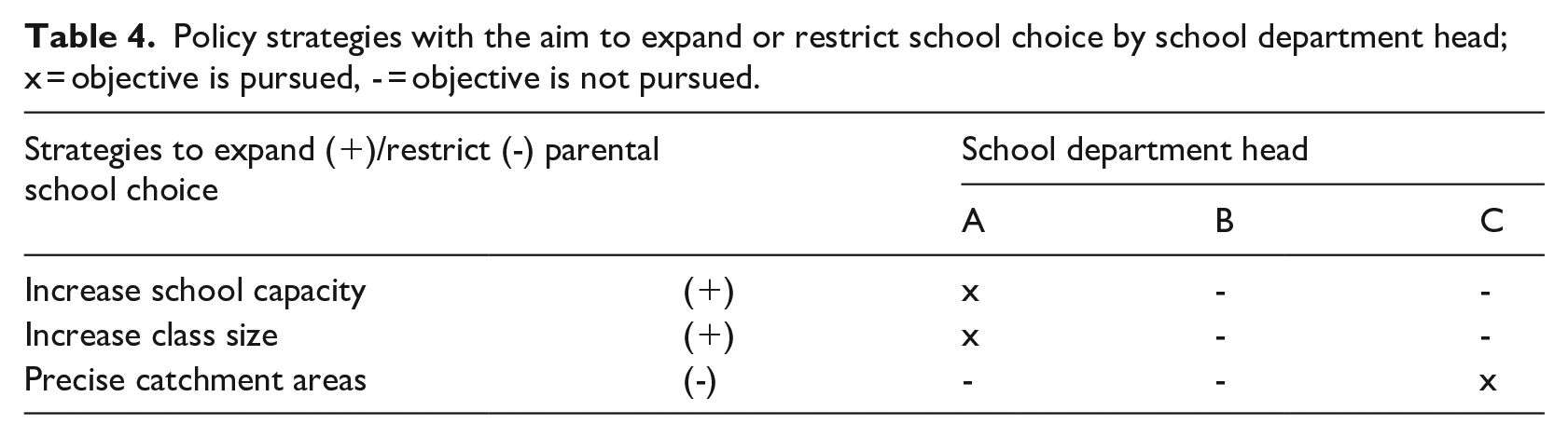
Conservative SDH A realises some school choice by allowing shared school catchment areas in her district, where parents can choose between two or three primary schools. She would like to make school choice possible for all parents through additional free capacity at every primary school. Such additional capacity used to be much more common; now, with the lack of school places in both public and private schools, school choice is more restricted. Nevertheless, in order to increase parental choice whilst still guaranteeing school places for all children (see section Strategies to secure school places close to home), she increases class sizes somewhat if there are children who would have liked to attend the school but are not able to. In the long term, she would ideally like to have between 3% and 7% of places unfilled at each primary school to enable more parental school choice.
By contrast, SDH B currently sees sufficient possibilities for school choice. Therefore, she does not employ any specific strategies. Fellow social-democratic SDH C wants to prevent social segregation through choice and aims to limit the number of parents, who successfully apply for a school change: ‘otherwise we can’t get a reasonable social mix in schools’. To achieve this, she consciously defines catchment areas that match the primary school’s capacity as precisely as possible. However, SDH C sets limits to the size of school catchment areas prioritising children’s short journeys to primary school over limiting school choice. As attending a non-catchment area school is only possible if the school has free places, precisely defined catchment areas could limit school choice.
Ironically, SDH C, who wants to limit school choice, has too many free school places to do so; and department head A, who wants to increase school choice, does not have enough school places to do so. In all districts, high rents and a lack of housing are further limiting school choice, as parents are prevented from easily moving into the catchment areas of popular schools.
Perceived influence of local policymakers
Although the same legislative regulations apply to all school department heads, they vary substantially in their perception of their political influence. SDH C describes herself as having significant influence over the allocation process, whereas department heads A and B feel that they have only limited scope. The latter two describe the definition of catchment areas as an administrative or even mathematical task on the basis of numbers. Here, SDH A ‘raise[s] mathematics to primacy’, seeing the problem as lying in the unequal social structure, not catchment areas. By contrast, SDH C is much more inclined to translate her political objectives into political action. Aside from supporting disadvantaged primary schools (as all interviewees do), she uses the definition of catchment areas to attempt to prevent school choice and make the areas more socially diverse. It is therefore not surprising that she describes herself as having political influence over the allocation of primary school places.
In district A especially, the shortage of school places overshadows any political objectives. SDH A does not think she will be able to construct enough primary schools in the time needed and sees no scope for ‘ideology’. While a shortage of places is also present in district B, the SDH is nonetheless trying to introduce more Gemeinschaftsschulen (‘Common schools’) to foster social cohesion.
While decisions regarding school change applications are also part of department heads’ responsibilities, they claim not to have any impact on decision-making. Free places must be allocated according to the legal lottery criteria. Were the department not to follow these rules, parents would threaten to sue. The interviewees unanimously say that nobody, neither schools nor department heads, can influence this process.
Discussion
The aim of this contribution has been to investigate how locally elected officials shape the allocation of primary school places in Berlin inner-city districts by interviewing three school department heads (SDH) of inner-city districts. The results of this qualitative study demonstrate that although the same legislative regulations apply for all of Berlin, there are surprising differences in the enactment of these regulations between districts. Primary school place allocation is influenced by department heads’ objectives, their strategies and their ability to enforce them. It can therefore depend on the individual school department head whether a district in Berlin follows parental preference, has socially diverse catchment areas or maintains catchment areas that have evolved historically. In spite of their differences in the enactment of the allocation policy, the interviewees generally support a combination of catchment areas and (restricted) school choice, which has been in place since 1949. This might be evidence of the general acceptance of the model or of the SDH’ possibility to enact the law in ways they see fit.
Concerning their political objectives (research question I), the priority for all politicians is to secure the supply of primary school places, especially in districts A and B. The SDH differ along party lines in the extent to which they want to foster social diversity in primary schools and will allow school choice. The two social-democratic department heads fully commit to the objective of improving social diversity within primary schools. The conservative SDH A only wants social diversity if parents do not oppose it. With regards to parental school choice the interviewees’ positions differed greatest: the social-democratic politicians perceive their aim of improving equality of opportunity threatened by (increased) school choice (following the arguments of Radtke, 2000, and in contrast to Swedish Social Democrats in Lidström, 1999). In contrast, conservative SDH A aims to expand parental school choice. SDH C was confronted with a catchment area system that allowed for a lot of choice, and she consequently wanted to restrict school choice. SDH B accepts the existing (limited) scope for school choice, but strongly opposes a system of complete parental choice (as proposed e.g. by Chubb and Moe, 1990). The differences in the objective follow clear partisan lines. Whether there are differences in how much school choice the social-democratic politicians want to allow has to remain unclear as they had differing rates of school choice in their districts.
In order to achieve their objectives, the SDH use their autonomy to define catchment areas and change the number of places in primary schools (research question II). To both increase social diversity and limit school choice, SDH C uses a new software to define socially integrated catchment areas that match the number of primary school places as precisely as possible; a strategy that she had to defend within her party and against parental objections. Notably, although they share political objectives, SDH B does not focus on the strategic action field of systematically defining integrated catchment areas. Instead, to foster social inclusion, she focusses on the policy field of introducing more Gemeinschaftsschulen (‘Common schools’, see section School place allocation in Berlin) – sometimes in the face of resistance. SDH A tries to strengthen parental choice by increasing primary school places in her district, although she struggles to put this strategy into practice due to an ongoing shortage of school places.
With regards to research question III, strikingly, only SDH C felt that she could effectively translate her objectives into strategies. One reason why SDH A and B instead perceive the allocation process only as an administrative or mathematical task could be the prevalent shortage of school places as the most pressing issue. The lack of school places focusses attention on building schools as a strategic action field. In addition, in the case of district A, the (mis)fit between local context and political objectives may influence the perception of political scope. Thus, because of the school place shortage, SDH A struggles to increase school choice, while at the same time providing enough school places for all pupils.
A second reason for SDH A and B’s perception of their influence as limited might be rooted in the kind of strategies the politicians adopt to foster social diversity. Department heads A and B primarily try to support disadvantaged primary schools by helping them become more popular, while also voicing that it is very difficult to change a school’s popularity. They act within the system of a supposed quasi-market where the state is just another (albeit powerful) player. This echoes an understanding of governance that moves away from hierarchical state control towards the ‘coordination of actors’ (Altrichter, 2010: 147). Their strategies can be characterised in terms of ‘muddling through’ and a rather incremental model of political decision making (Lindblom, 1959; see section Education policy approaches to school place allocation). In contrast, SDH C directly changes the rules. She too helps individual schools, but also uses the district’s regulatory power to try to decrease parental choice and integrate catchment areas. This can be understood as an expression of a rather rational model of decision making, identifying a goal and evaluating strategies to pursue said goal (Bochel and Bochel, 2017). While department heads A and B presuppose competition between primary schools and try to support disadvantaged schools, SDH C tries to limit competitive behaviour among parents because it hurts disadvantaged schools. As all interviewees deem school reputations unfairly persistent, we can assume that SDH A and B’s strategy of supporting disadvantaged primary schools in a competitive environment is unlikely to succeed quickly.
The notable difference in strategies to foster social inclusion between the social-democratic department heads can partly be traced back to different inciting crises and the resulting strategic action fields. In district C, the previous administrations had not substantially redefined the catchment areas, which over the years lead to a misfit between catchment areas and school place demand, resulting in over- and undersubscribed schools and excessive parental school choice (endogenous crisis). This may have focussed the SDH C’s attention on the strategic action field of changing catchment areas, combining her aims of social diversity and neighbourhood school supply. In district B, on the other hand, SDH B has to address a crisis of lack of school places. With her focus on establishing Gemeinschaftsschulen as a strategic action field, she too (much like the other department head) combines her objective of social diversity with a solution to the crisis in her district. This could also be a reason why SDH B characterises the definition of catchment areas as unpolitical. At the same time, due to the shortage of school places limiting school choice in district B, it remains unclear whether the rate of primary school choice is in fact lower in district B or in district C.
Policy field theory could explain why the teacher union in Berlin is not trying to influence despite the union being critical of school choice. When compared with their counterparts in the Danish study (Wiborg and Larsen, 2017), local Danish politicians seemed to restrict school choice even more effectively, which might be due to the Danish teacher union’s focus on this issue. One reason for this discrepancy may be that Berlin teacher unions have not identified socially inclusive catchment areas as a strategic action field to decrease school choice. Additionally, in Berlin, teacher unions have no institutionalised influence on primary school place allocation and were not mentioned by the school department heads as having informal influence.
Interestingly, when relating the findings of this study to the Danish case study of Wiborg and Larsen (2017), the strategies of the actors in both studies are very similar. The strategies of social-democratic SDH C align with those of the conservative and social-democratic local actors in Denmark. All try to integrate catchment areas socially and limit school choice by defining precise catchment areas and (in the Danish case) lowering class sizes. Similarly, the strategy of conservative SDH A is aligned with the Danish liberals, who both want to enable more choice by increasing capacity. The following three strategies can be found in both Berlin and Denmark:
(1) design socially diverse school catchment areas to increase social diversity in schools; (2) match schools’ capacity to the number of pupils to limit parental school choice; and (3) increase the number of free school places to expand parental school choice. (The strategy of SDH A to increase school parental choice through shared school catchment areas has no counterpart in the Danish study.)
The present study has limitations due to its focus on the perspective of three local actors influencing primary school place allocation in inner-city districts in Berlin. First, while the study could demonstrate a large bandwidth of how allocation policy is enacted in inner-city districts, the study is not equipped to talk about primary school place allocation in rural parts of Berlin. However, the central claim of the article that the decisions of local politicians can shape the school choice landscape still holds true as the three districts already present three substantially different approaches. Second, the expanding private school market (Mayer, 2017) was not analysed as the interviewed district politicians have no regulatory power over private schools. Third, a closer investigation of the software used by district C to define catchment areas was beyond the scope of this study. Future research should investigate such software and the underlying data infrastructure, especially since local politician C stated that data visualisations helped argue for socially diverse catchment areas.
Finally, this study is limited in its explanatory power as it relies on the perspective of school department heads, and especially because research challenges the interviewees’ claim that nobody can influence the lottery for oversubscribed places (Karakayali and zur Nieden, 2013). Noreisch (2007) found that (prior to the 2004 school law of Berlin) parents claim to have used unofficial routes to influence the allocation process, either through false addresses, appeals or by influencing school principals. Although principals claim not to have any influence, Noreisch’s interviews reveal that there might have been greater parental influence than the school department heads report in the present study. This would be in line with research on the power of so-called ‘street-level bureaucrats’ (Lipsky, 1980) and European research on parental choice (Butler and van Zanten, 2007). Therefore, in future studies, a multi-level and multi-method approach drawing on interviews with multiple actors and statistical data would help further explore the enactment of allocation policy.
In conclusion, despite its single case focus, this study demonstrates the importance of the local enactment of state policy and the subjective decision-making of those rarely explored local political actors who are seemingly ‘simply applying the rules’. How those local actors interpret central allocation policy might in turn influence whether global policy phenomena like school choice are implemented or not. The article highlights how district school department heads in Berlin influence school place allocation policy in ways that (they hope) will enhance social diversity in primary schools and increase or decrease primary school choice. It becomes apparent that the underexplored local actors are – at least in Berlin – integral to the ‘doing’ of primary school place allocation. The interviews demonstrate the relevance of political parties for the pursued political objectives. However, how (endogenous) political crises (such as the misalignment between school place demand and catchment areas or the lack of school places) may influence policy fields proved to be of greater importance to determine the adopted strategies, showing further potential for policy field approaches (see Hartong and Nikolai, 2017). Future studies could therefore profit from combining a policy enactment lens (Braun et al., 2011) with policy field theory when investigating how local politicians put state policies into practice.
This article identifies three main political strategies used by these actors to influence primary school place allocation. The Berlin primary school admission policy is similar to many German states, and also resembles other nation states’ policies, consisting of: a combination of residency criteria and parental choice, often with substantial local influence. Consequently, other local and state actors might use the political strategies identified in this study to either strengthen or restrict parental choice or social inclusivity. However, the study also points to the importance of the local context, for example, school place shortages, which might make an adoption of strategies more difficult.
Future studies might benefit from analysing school choice as a method of school place allocation to avoid reifying school choice and, thus, entangling their research in discourses about the desirability of school choice (Krüger et al., 2020). Additionally, focussing both on the local and state context and on the perspective of local politicians, alongside parents, schools, teacher unions and state legislators would help to further understanding of the effects of school place allocation policies (see Lubienski et al., 2009). 15
Footnotes
Declaration of conflicting interests
The author declared no potential conflicts of interest with respect to the research, authorship, and/or publication of this article.
Funding
The author received no financial support for the research, authorship, and/or publication of this article.
