




Abstract
National identities have been challenged by European integration, globalisation, migration and regionalisation. More recently, there has been a resurgence of nationhood and national identity which begs the question how education systems, and curricula in particular, are responding to this. This article explores how national identity is reflected in history, geography and civic education curricula in France and Ireland. More specifically, it examines how national, European and international aspects are intertwined in these state curricula. This question is explored through a case study of curriculum units and subunits as well as discourses of how identity is being promoted in the curriculum. Our analysis highlights that French curricula privilege national topics, especially in history and civic education, whereas Irish curricula veer between national, European and international (global) notions. Our analysis explores the extent to which macro-political discourses around national identity are reflected in the shaping of the subject curricula in two countries. While the article focuses on France and Ireland, the discussions are also of interest to other jurisdictions regarding the civic expectations and role of schools in promoting national (or other) identities.
Introduction
Curricula often reflect macro-level political trends and historical legacies around the promotion of national, European and global agendas in schools (see e.g. Faas, 2011). Teachers and students also play an important role in creating and interpreting school curricula thus promoting certain values and identities. This article aims to explore how history, geography and civic education 1 curricula in France and Ireland are dealing with the notion of national identity.
Current research literature, especially in an educational context, suggests that there are many different beliefs and understandings of citizenship, particularly in the context of increased migration and globalisation in Europe and elsewhere (see Nasser and Nasser, 2008; Osler, 2011). For example, according to Soysal and Wong (2007), the collapse of the polarised world system, the increased importance of human rights and democratic principles led to the emergence of a new model of citizenship. Girard and Harris’s (2013) notion of ‘citizens of the world’ is interesting in this context. However, it is difficult right now to see countries and people willingly accept to become ‘citizens of the world’ despite the promotion of global citizenship and a global educational agenda more broadly in education systems in countries like the UK. For instance, many European countries are willing to think of European citizenship including Germany and Greece (see Faas, 2016). Indeed, the 2019 European elections saw a rise in support for nationalist parties (European Parliament, 2019). According to a recent survey (European Commission, 2018a) among the 28 EU member states and five candidate countries (North Macedonia, Turkey, Montenegro, Serbia and Albania), 71% of the population felt they were European citizens whereas only 28% felt they were not. However, very few people said that they considered themselves firstly European and then a citizen of a nation, and even fewer said that they saw themselves as European-only. Caglar (1997) argues that the process of globalisation and migration led to a rapid multiplication of identities resulting in a conflict between these ‘new’ identities and the national one. In addition, national identity is based on emotional attachment whereas citizenship is a legal and political state (Guibernau, 2007).
There are few studies comparing the French and Irish school curricula (O’Connor and Faas, 2012; Philippou, 2012; Philippou et al., 2009). Existing studies focus on citizenship (Philippou et al., 2009), otherness (Fallace, 2012), nationalism, internationalism, formal education and integration. Moreover, some of these studies are dealing with the evolution of a curriculum in a specific country or a specific topic such as ‘race’ (Bryan, 2012), religion (Estivalèzes, 2011), violence (Edling, 2015) or technology and formal education (McEneaney, 2015).
For example, Philippou et al. (2009) focus on the changes and consequences in citizenship education policy and curricula in Europe. Firstly, they confirm the influence that supranational organisations have had on citizenship education. They argue that citizenship curricula in Europe incorporate multi-level conceptualisations of citizenship including local, national and supranational ones. They also highlight the tendency to use European citizenship as a way of excluding non-European. In Ireland, for instance, there has been a passive and/or oblique act which is that non-European and exclusionary practices European citizenship can create, are simply absent from the discussion about European citizenship (Keating, 2009). Indeed, Keating demonstrates that although the promotion of European identity increased, it is still a limited European citizenship that lessens the impact on national identity (Keating, 2009; Olson, 2012).
Furthermore, Benavot and Braslavsky (2007) helped to put the French and Irish curricula under a different light regarding the specific issues raised in this article. Indeed, their work helped by providing a context regarding the evolution of the curriculum, how history competence rose to become a key component for the promotion of democracy and also regarding the rise of human rights and its impact on curricula across the globe.
Globalisation, the evolution of our economic system, the progressive disappearance of the state as protector of social and economic equity and the perception of immigration led to various debates and changes in secondary school curricula (Quinn et al., 2017). At first sight, the educational system of these two countries seems quite different, especially regarding immigration issues. According to the French tradition, the state is doing everything it can to protect and promote laïcité. 2 According to Portier (2009: 322), laïcité can be defined as ‘an institutional order resulting from the citizens’ will and designed to keep religious influence away in order to allow the coexistence of a plurality of legitimate goals’. The French government prefers to focus its attention and the attention of students on the creation of France, on French history and particularly on the Republican tradition as the guiding principle for national cohesion. By contrast, Ireland evolved from a non-denominational to a mainly denominational primary education system with around 95% of primary schools currently being denominational (Faas et al., 2019). National schools, managed by a board under the patronage of the diocese, were followed in the 1960s by greater control from the state regarding matters of schooling, curriculum development and funding (Akenson, 1975; Coolahan, 1981). Today, there is an increase in multi-denominational schools (so-called Community National Schools and Educate Together Schools).
In all of its colonies, the French administration ensured that the national policies designed for them were implemented with strict regulation and control (Gifford and Weiskel, 1971). The goal was to make sure that French culture and civilisation were promoted. At the beginning of the 20th century, France also ensured that education was secular and without fees in the colonies (Feldmann, 2016). However, at the same time, the purpose of education moved from assimilation to adaptation (for a more detailed discussion, see Gifford and Weiskel, 1971). French curricula are veering more towards assimilation, ignoring the needs of minorities and lacking sensitivity to cultural diversity, as we will explain further throughout this article.
In contrast to a deeply secular France, the governance of Irish education has been fundamentally intertwined with religion. Throughout the various stages of Ireland’s decolonisation period, religious education has reflected societal changes – from dominating school life to one subject curriculum (see Kieran and Mc Donagh, 2021). The evolution of this curriculum reflects Bhabha’s post-colonial concept of hybridity that embodies ‘a means of evading the replication of the binary categories of the past and developing new anti-monolithic models of cultural exchange and growth’ (Ashcroft et al., 2007: 137). Today, the Irish primary school landscape remains one of the most heterogeneous in Europe, largely due to the question of how to accommodate religious matters in the classroom.
This article addresses the following question: How are national identity discourses promoted in history, geography and civic education curricula in secondary schools in France and Ireland? The next section discusses how national identity has been conceptualised differently in France and Ireland. After this, there is an overview of the research methodology. Key findings from this comparative curriculum analysis are then discussed.
Conceptual framework
According to Article 26 of the 1948 Universal Declaration of Human Rights (United Nations Educational Scientific and Cultural Organization [UNESCO], 2000), ‘education and more precisely an education of quality is a basic need for every human being’. For Sen (1999), it is impossible to distinguish education, capacities and freedom. However, children cannot secure formal education for themselves. Therefore, the state, region or government is morally obliged to establish the means for this right. 90% of the countries in the world made education mandatory (UNESCO, 2003). For France, it was in 1882 with the Ferry law (Cummings, 1997). With these laws, the state is shaping citizen’s loyalty through the inculcation of ideologies including nationhood. It is worth noting that the guiding principle of French formal education is to assimilate people (Koopmans et al., 2005). Therefore, the state is not actively debating a more inclusive notion of citizenship given its large migrant population. As O’Connor and Faas (2012) argued, migration movements test the flexibility of national identity. The response by the French society, when the narrative around citizenship was tested, resulted for instance in laws aiming to protect their conception of citizenship such as the Pasqua-Méhaignerie law in 1993 (O’Connor and Faas, 2012). French citizenship is based around French history and ethnocultural values which are at the centre of the French Republic and its perception nationally and internationally (see Osler and Starkey, 2001). This results in a ‘pensée unique’ (single thought/conformism) that is closely protected and seen as republican even if it jeopardises the acceptance of different identities and communities. The French model that developed at the turn of the 19th century during the time of Napoleon became a model for jurisdictions in other European countries. The legal state, the principle of universal suffrage and the Declaration of Human Rights of 1789 were the three main ideas that influenced thinking and the development of state administration in Europe.
By contrast, what is interesting in Ireland, is the relationship between schools and religion, especially Catholic influence in institutional and cultural life. The government designs the curricula except religious education. The Catholic Church influence over the Irish education sector dates back as far as the mid-19th century. Over time, pressure from the Catholic Church and its place within the State ensured that that Catholic ethos schools would become a dominant feature of education in Ireland. While the main purpose of schools in France is to turn children from different backgrounds and ethnicities into French citizens, Ireland attempted to treat Protestants, Catholics as well as other religious minorities equally. The Irish state believed that pluralism and self-gestion could be the key to that neutrality, hence the non-governmental aspect of schools in Ireland (Bader, 2007). This non-governmental aspect is also due to the fact that Irish schools are privately owned – often by the Church (Rougier and Honohan, 2015). It is also worth noting that parents can choose to send their children to schools where their faith is practiced or ask for their child to opt-out of religious education classes. However, in practice, it is difficult to opt-out of religious education because the school is designed according to the patron’s faith and the other school subjects can use faith as an educational tool (Rougier and Honohan, 2015). Religious education holds a unique position in Irish state primary schools as it is the only subject that receives a daily amount of instruction time.
With an increasingly diverse population in Ireland, more and more parents want multi-denominational schools for their children. Since 1978, a charity body has been patron of equality-based, de facto multi-denominational Educate Together schools and the Irish state, through Education and Training Boards (ETBs), established and became patron of the multi-denominational Community National School model in 2008 (Author 2 et al., 2019). Moreover, although Ireland continues to be mostly Catholic, religious diversity has increased. In the 2016 Census, Catholic religious affiliation fell to 78.3%, compared to 84.2% in April 2011 (Central Statistics Office, 2017). Once a homogeneous white, Irish and Catholic nation, Ireland has witnessed a rise in the number of people of different faiths since the 1990s. Following the 2008 global fiscal crisis and subsequent economic stagnation, Ireland has once again become an attractive migrant destination, experiencing net inward migration in 2016 for the first time since 2009. Prior to 2009, immigration came mainly from within the EU as a result of free movement. However, between 2011 and 2020, there has been a rapid increase in non-EU immigration, rising from 12,400 to 30,400; 35.6% of the total number of immigrants in 2020 (Central Statistics Office, 2020). This increasing cultural and religious diversity challenges national identity and curriculum planners. In recent years, parents, families and parishes have taken more responsibility for religious education leading to a divestment of patronage in some cases from Catholic Church to Educate Together or Community National Schools. Indeed, Community National Schools are the fastest growing type of primary schools in Ireland today. All 28 new primary schools that opened in the last 5 years have been equally-based and multi-denominational. Furthermore, there has been an average decrease of around seven CCatholic primary schools a year (Department of Education, 2021). Community National Schools have now moved sacramental preparation to extra-curricular time (just like the Educate Together Schools) and there is a continuing debate in Ireland if the same could or should happen for Catholic schools.
One of the functions of schools is to educate young people about their role as citizens (Homena et al., 2006). Schools are also important vehicles to promote social cohesion. Social sciences – such as geography, history and civic education – have a particularly important role in that process (Lambert, 2003). Schools have been used to teach a common background, knowledge, values and history (Benavot and Resnik, 2007). However, recent decades led to a change in the expectations of schools. With the focus moving from the national to the international level, a school’s purpose evolved as well. This internationalisation and standardisation of education is linked to the change of purposes for schools. Indeed, schools are now preparing students for their professional life (Rizvi, 2007; Wolk, 2007).
In order to contextualise our discussions, it is important to note that the subject curricula are developed and used under specific conditions of two different jurisdictions with different roles and functions of national curricula in France and Ireland. In France, the civic education curriculum mainly states what a citizen should and should not do (rights and duties). By contrast, in Ireland, with less formal regulations and more focus on global competencies, there is more room for global-local negotiations on how to create narratives of the citizens within the Irish policy space. There is a predominantly liberal conception of citizenship that is being promoted in Ireland (Faas and Ross, 2012). This liberal conception is partly resulting from the core values used in these curricula. Indeed, the use of European values from the human rights and the Convention on the Rights of the Child are two key documents allowing the Irish curriculum to be based on principles and values cementing it as more European and inclusive (Faas and Ross, 2012). In the history curriculum, while Ireland barely mentions national history and identity, France makes national identity and national history a core topic. It is also interesting to see that the ‘European values’ exemplified by the human rights and seen as European in Ireland are seen as French in France based on the country’s history (O’Connor and Faas, 2012).
The promotion of European values as universal can create barriers among students rather than bringing them together. As discussed in Faas and Ross (2012), children of migrant origin are separated from their comrades by making a distinction between them and the others who are European and therefore sharing the same values. As Beck (2000) argues, education is a socialisation tool used to make citizens thanks to tautological assumptions. Moreover, European values in the curriculum are associated with good outcomes (O’Connor and Faas, 2012). Values and topics like free market, human rights or democracy are used to facilitate integration and acceptance of one’s point of view by the government. They are used through the lens of binary oppositions (Maclure, 2003) which contrast sponsored values with negative portrayed attributes (Guibernau, 2007). In Ireland, the curricula favour European (and global) values, norms and identities because these are seen as a way of including people. In France, the curriculum is less inclusive with a stronger focus on the nation state (Faas and Ross, 2012).
It is difficult to adapt and change national identity (Eatwell and Goodwin, 2018; Goodliffe, 2016). Indeed, nation states are not as powerful as they are increasingly being challenged by supranational entities as well as regionalisation/devolution developments in countries like Spain or the UK (Trépier, 2013). According to Mandler (2006), national identity is the result of the progressive erosion of religion and dynasties as forms of community. It is based on common ethnic ancestors, values, responsibilities and duties. This notion relies on the idea of ‘us’ versus ‘others’ (Mandler, 2006). This opposition is essential because it creates at the same times boundaries as well as common elements necessary for the creation of the ‘us’ (Mandler, 2006). There is a deep attachment to this common aspect because the concepts of the nation and national identity rely on explicit and implicit understatement. It is impossible to know everyone that is living in a nation but in order to make it work, people need to believe that there are things that bind them together, that they are similar (whether this is ethnic characteristics and/or civic values that are shared collectively). This deep attachment is also present in our day-to-day lives, by choosing a product, service or political candidates based on its impact on the nation’s population or economy (Mandler, 2006). Advancement in technology also reinforced that feeling, making national identity more durable and pressing than others by its omnipresence. Moreover, in our world, we compare ourselves to others but also as nations, on the international scene. A powerful nation means more power regarding others, making the distinction clearer and reinforcing that pride that means to be a member of that faction (Yogeeswaran and Dasgupta, 2014).
Values, which are a core aspect of what national identity is, are also important regarding the adoption of new members in the nation/nation-state. In addition, many countries have implemented new rules in order to adopt these new people into the nation by adding ius solis (citizenship by territoriality) to the jus sanguinis principle (citizenship by blood/ancestry). However, many people do not feel as citizens and civic education is not helping them from identifying citizenship as described by the ethnic approach (Yogeeswaran and Dasgupta, 2014). According to Yogeeswaran and Dasgupta (2014), nations should emphasise the civic approach as well as promoting minorities’ strength and what they bring to the nation in order to fully immerse them. Moreover, it has benefits for the nation as the behaviour regarding them becomes positive.
Research methodology
The study focuses on the ways in which the nation state (including national identity) is reflected in French and Irish social sciences curricula, compared to other educational dimensions and identities (such as European or international/global). We found subjects such as geography, history and civic education curricula most important for the promotion of national identities and citizenship (see also the discussions in Faas, 2011; Karseth and Sivesind, 2010; Philippou, 2012).
Although France and Ireland both have centralised education systems, there are also important differences. France is a so-called old migration destination with a historically more monocultural outlook whereas Ireland is a more recent migrant-receiving country with an arguably more multicultural approach (see Faas, 2016). According to Eurobarometer 90, Ireland ranks in the Top three countries where citizens feel European whereas France ranks considerably lower (European Commission, 2018b). The Human Development Reports (United Nations Development Programme, 2019) put Ireland in fourth and France in 24th place. There is an increasing gap between the French and Irish educational system. Arguably, the good rankings of the Irish educational system are in part also the result of their more balanced and open approach towards different identities alongside a more multicultural (or intercultural) outlook. This makes for an interesting comparison for example with regard to the ways in which these different historical legacies have shaped current social science curricula and notions of national identity in terms of social inclusion.
There are several methodological issues to consider while conducting exploratory cross-national comparative case studies, including that of equivalence. Pepin (2005) defines conceptual equivalence as referring to the question of whether or not the concepts under study have equivalent, or any, meaning in the cultures which are being considered. These two countries have the same courses and expectations of the Junior Cycle. Regarding linguistic equivalence, we had to be careful while translating from French to English in order to avoid losing the meaning of words and ideas. In order to deal with these problems, we chose three similar subjects in both countries: history, geography and civic education. Both countries have a national educational system with official curricula. The curriculum documents were available online. However, they were uneven in length. This article focuses on the main units and subunits that were identified in relation to local/national, European, and international/global topics and units/subunits.
Curricula are organised similarly in France and Ireland. Both start by assessing the aims and knowledge that students should learn from these classes. Then the curricula go in depth on key elements, information or time periods that students must study throughout the year. For example, in the French History curriculum, one of the skills that students must learn is ‘to be aware and informed regarding the digital world’ (Ministry of National Education and Youth, 2018: 88). In Ireland, ‘the student uses technology and digital media tools to learn, communicate, work and think collaboratively and creatively in a responsible and ethical manner’ (NCCA, 2018a: 7). Then, the curricula go into elements studied during the course such as ‘Theme Number 2: The Europe and the world during the 19th century; Europe and the Industrial revolution; Conquest and Colonial Societies’ (Ministry of National Education and Youth, 2018: 93). In Ireland, we can see in ‘Strand 2 and 3: The History of Ireland and the History of Europe and the Wider World: Recognising key change; Key changes/developments in the domains of politics and international relations’ (NCCA, 2018a: 13).
What we considered as a unit are the main chapters such as ‘Theme 1: Christendom and Islam (6th–13th centuries), two worlds in touch’ (Ministry of National Education and Youth, 2018) or in Ireland ‘Strand 1: The Nature of History’ (NCCA, 2018a: 10). Sub-units are the elements used to further the description of the unit such as ‘The Third Republic’, when it comes to describing ‘Theme 3: Society, culture and politics in France during the 19th century’ (Ministry of National Education and Youth, 2018: 94) or ‘Local, personal or family history’ from ‘Strand 2 and 3: The History of Ireland and the History of Europe and the Wider World’ (NCCA, 2018a: 13).
Our study is based on curricula designed for the Junior Cycle in France and Ireland from 2017 in Ireland and 2018 from France. Our analysis focuses on the second–third year in Ireland (students aged from 12 to 14) – the equivalent in France is the 5éme and 4éme. It is during this period that students are fully introduced to notions of citizenship, nation and globalisation. More importantly, it is during this phase that students are creating their social identities. Identity here refers to the formation of personal goals, ideals, values, role models and the desired role to fit in society. Zhu (2018) highlighted the fact that school connectedness was one of the most important causes of depression among teens. This is a time period when young people are vulnerable and that will impact their future life and self.
The quantitative analysis referred to the presence of local/national, European and international/global topics/units in the curriculum. To this end, we counted which units and sub-units across the three curricula referred to Europe, global aspects and national/local issues. In this descriptive quantitative analysis, we looked for every unit having the word: ‘international/global; Europe/European; local/national/regional or rural’ and/or topics/units that were meant to give context or content about one of our selected topics. By doing so, we were able to see how much space was given to these topics in each curriculum. The descriptive quantitative data was supplemented and triangulated with qualitative data.
The qualitative analysis focussed on the discourses in the history, geography and civic education curricula. For example, we analysed the ways in which the nation state was conceptualised. We also examined how citizenship was promoted and how otherness was presented in these curricula. In particular, we looked at the distinction between those who are citizens, those who are not and those wanting to obtain citizenship. Moreover, we wanted to see if there is a distinction in the curricula between legal and illegal immigration and how these migrants are integrated into society. We carefully examined the content of each teaching unit including student learning objectives as well as the topics and ideas that were emphasised (or not). Based on this qualitative content analysis, which was conducted manually rather than with a software package, we were able to identify the general trends and discourses emerging from each subject curriculum in relation to the national, European and/or global level. This approach enabled us to discuss the kinds of discourses each country promoted through their curricula and therefore what kind of citizen and citizenship the state wanted to create through their curriculum/a.
Findings
Promoting national values in French curricula
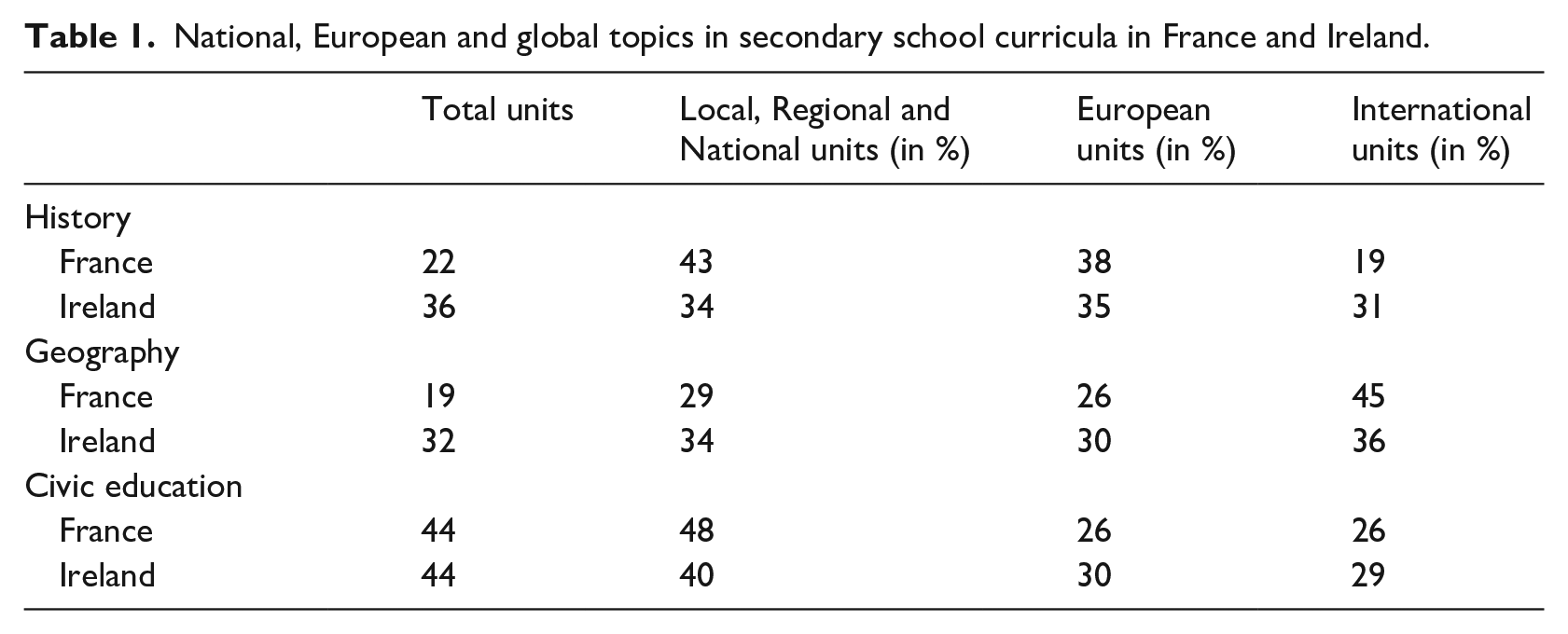
The first goal of the French history curriculum is to help students find space and time in order to have a more coherent understanding of the past and how French society became what it currently is. The second goal is to make students more critical, able to explain, justify and defend their choices and arguments. The history programme consists of national, European and international history, with a preference for local and national topics and to a lesser extent European and global topics, as can be seen in Table 1 below.
National, European and global topics in secondary school curricula in France and Ireland.
In history, students start with explanations regarding how the French state emerged, from royalty and feudality to an organised and constructed state: ‘Through the use of the French example, the classes analyse the evolution of the notion of the king from the 16th to the 17th centuries’ or ‘the teachers characterise the contribution of the French Revolution, regarding the political, social and economic orders not only in France but also in Europe in the context of the Republican and Imperial wars’ (translated from French) (Ministry of National Education and Youth, 2018: 92f.). History aims to make students realise how modern improvement such as laïcité is essential for French society. They are also seeing the evolution of the kings in France to an absolute king and Emperor, finally, to arrive at the role of the President (p. 93). A change in perception occurred in the 15th to the 18th century, leading people to contest the notion of absolutism which among other things led to the French Revolution in 1789 and then to Napoleon’s Empire (1804–1815). Finally, students are looking into the foundation of the Third Republic, the diffusion of the voting system leading to the universal suffrage (1848), the creation of national unity around the notion of republic, school and municipality: ‘From 1815 to 1870, French citizens voted: Who votes? To elect which candidate? How do we vote? The question on the vote - object of various political debates - allows us to see the political changes from the 19th century and to see how French people learned how to organise and apply a “universal poling” from 1848’ (translated from French) (Ministry of National Education and Youth, 2018: 94).
The international events that students are studying start with the evolution of Empires from ancient times to colonial empire. By studying these empires, students understand how important Europe was at that time. They see how the Industrial Revolution changed our conception of society, economy, work and human dignity. Finally, they consider how this Industrial Revolution impacted people’s migration throughout time.
This emphasis on local and national (and to some extent European) topics is hardly surprising. Indeed, as Faas (2011) pointed out, most history curricula in Europe are ethnocentric. With history, students learn how hard it was to make France as it is nowadays. The history curriculum is here to create a feeling of national pride. However, the government is here for a reason and therefore must be respected (Goodliffe, 2016). French society, as explained earlier, aims to assimilate people, meaning to make them give up their former self and embrace their new identity, the French one (Osler and Starkey, 2001). This is done to protect the cohesion of French society. Only what is regarded as common knowledge of what a young citizen can and should endorse within France is included in the curriculum, setting the standard of what the French state examines at particular schooling stages. Most European elements in these curricula are due to their proximity and interactions with France rather than a real desire to embrace a European dimension in history and the creation of a feeling of belonging, as is the case with the Irish history curriculum.
Geography: Illustrating global phenomena
Unlike history, the French geography curriculum is unusual in its focus on more global topics (see Table 1). The aim of geography is to help students understand their surroundings, less in terms of the historical past, but in terms of construction, resources and evolution. Moreover, there is a real emphasis nowadays on environmental geography: ‘It is important to raise awareness among the students regarding the notion of development, which stays essential, but changed due to the rise in intensity of the issues linked to global change and to the over-exploitation of various natural resources’ (translated from French) (Ministry of National Education and Youth, 2018: 97).
Students discuss the impact of human lives on the environment and how the human way of life is not sustainable. They learn how unequal life is depending on where you are from and its impact on society and people (Baten and Hippe, 2018), how our society rapidly evolved since the Second World War and the impact of globalisation on our way of life with an emphasis on the role of cities (Potlogea, 2018). Then students look at the new responsibilities that citizens have especially when it comes to environmental protection. Students then deal with current issues such as legal and illegal migration. By studying this, students may become more open and welcoming, leading to a different type of society (Bruch et al., 2007; Higbee et al., 2014; Mičić, 2018).
Similar to Ireland, there is emphasis on the ecological duty of citizens. However, unlike in Ireland where it is organised around local examples where students see what actions they can do, the French geography curriculum prioritises the ‘bigger picture’.
In history and civic education, students focus mainly on national and local events. By contrast, geography is trying to open the student’s perception of the world (see Table 1). It aims to make students realise that the nation is not the only preoccupation that citizens must have. It is the only part of the French curriculum that is mainly turned towards other countries. In geography, the focus is on the world and its interactions, whereas in Ireland local and international agendas are being promoted as discussed further below (Girard and Harris, 2013).
Civic education: Understanding the importance of hierarchy and social rules
Like history, most units in the civic education curriculum in France have a local and national focus (see Table 1). According to the curriculum document, a good citizen is someone that puts the common good as a priority and someone that protects the environment. Interestingly, the European identity was present even though the civic education curriculum is mainly focussed on national identity and social cohesion. Indeed, the emphasis on human dignity is the result of European laws (see Duper, 2013; Soysal and Wong, 2007).
The aim of civic education in France is to create citizens that respect each other and more importantly, that respect humanity: ‘The “moral” adjective of the civic and moral classes refers to the project of the appropriation by the students of the principles which grant someone else’s respect. This moral relies on the conscience of each and everyone’s dignity and integrity demanded by another human being, whether it is regarding itself or someone else’s, and demands an organisation that defines everyone’s rights and duties’ (translated from French) (Ministry of National Education and Youth, 2018: 78). The curriculum explains that all the knowledges’ students learn in school is to promote national cohesion. Finally, it explains that the goal of this course is to create and make students debate and engage with each other, forcing them to cooperate among themselves.
The French civic education curriculum is important in its coverage of concepts that students glimpsed at such as laïcité. This is the most important curriculum concept (Berzonsky, 2011). Without it, the omnipresence of the national category would be less meaningful. Indeed, the assimilationist goal of France is powerful only if associated with the concept of laïcité. By saying that no differences are accepted in the public sphere, the aim is to reinforce the cohesion of society. However, it is also an issue for the development and integration of different parts of the population into society. It is an obstacle to the economic and social development of these populations and at the end of France as well.
The French case is interesting due to its connections with French national history. Indeed, this creates an emotional link between citizens, the state and the values promoted by Europe. It makes citizens feel special as well as proud of feeling European and de facto French due to shared values. Having commonly shared values as an entry point to French culture, rules and duties also indirectly facilitates assimilation. However, the lack of flexibility surrounding citizenship in France results in communities, migrants and/or migrant children to feel left out of the system of French citizenship, and it creates tensions between them and the state.
Ireland’s place in Europe and the world in Irish curricula
Unlike in France, the focus in Irish secondary school curricula is more on explaining Ireland’s connections with Europe and the world. This is in part due to Ireland’s less formal regulation and stronger focus on global competencies resulting in European-global-local negotiations on how to create narratives of the citizens and ultimately identities. History makes students understand how the past shaped the world students are living in (NCCA, 2005: 4). It aims to make them realise how to be critical regarding information and therefore be a productive member of the society. Moreover, and more importantly, the emphasis is on understanding why these events happened.
History: Ireland’s creation and it’s connections with the world
The Irish history curriculum ‘explore[s] the concepts, practice[s] the skills and consider[s]s the values and attitudes that inform the discipline of history’ (NCCA, 2018a: 16). It aims to make young people ready to understand the ‘big picture’. To do so, students are trained to develop a sense of empathy by learning what happened in the past. They also see and discuss the notion of commemoration in our modern culture and why some people are elevated to the rank of national heroes or symbols. This is similar to the French history curriculum.
Then, students discuss the history of Ireland and its evolution. They study key changes: Irish settlement, the parliamentary tradition, the pre-20th century, the rise of nationalism and unionism. Students then explore in-depth the topics that are prevailing in Irish society: Christianity, Irish diaspora and their histories, and how the First World War and the Second World War impacted the lives of Irish people. Then, they discuss the struggle for equality between men and women as well as the power of sporting, cultural and social movements on Irish history and life.
Finally, students examine the evolution of the world and of Europe. They start by studying an ancient or mediaeval civilisation and how it impacted our modern world. The students look at various historical events from a range of perspectives. They study the colonisation period, the revolutions that occurred in Europe around the pre-twentieth century, the evolution of art and science from the mediaeval time and especially around the Renaissance, and the changes occurring in Europe with the Reformation. Students explore a different point of view by studying the life in a communist country, the Cold War and the Holocaust. The focus is on the European and the UN constructions as well as their promotion of international peace and cooperation by promoting common values and rules such as human rights and dignity.
The history curriculum reveals connections between the national and international scale. Indeed, even if the history curriculum is ethnocentric, most of the knowledge that students learn is focussed on Ireland but also on European issues (Duper, 2013). The desire to emphasise these European values is a common goal of the Junior Cycle (see Table 1). Indeed, this goal is shared in the civic education curriculum.
Geography: Using local examples to illustrate global phenomena
The geography programme suggests that an important goal is to make students aware of the fragility of our environment. Moreover, it is to make them realise the goals and objectives of our world on economic, social and cultural issues. By studying geography, students are able to become active citizens, aware of changes occurring in the world. With geography, they get a deeper understanding of these differences and to respect them. Geography provides students with the information needed to deal with globalisation and its consequences (NCCA, 2018b: 5). Indeed, the aim of this programme is to raise student ‘awareness, knowledge, skills, values and motivation to live sustainably’ (NCCA, 2018b: 6). There is, as said earlier, a desire to use geography to show the diversity of our world: ‘the student appreciates and respects how diverse values, beliefs and traditions have contributed to the communities and culture in which she/he lives’ (NCCA, 2018b: 6). By studying the global context, students ‘value what it means to be an active citizen, with rights and responsibilities in local and wider contexts’ (NCCA, 2018b: 6).
In geography, students see multiple events that are linked to these themes: ‘exploring the physical world’; ‘exploring how we interact with the physical world’ and ‘exploring people, place and change’. The first one aims to help students understand earth, natural phenomena and their challenges. The second unit explores how humans adapt to these natural phenomena. Students learn how humans interact with the economy and how they adapt to the world. The third unit focuses on migration, tourism, exploitation of resources and the increasing urbanisation. As seen in Table 1, and unlike in the French geography programme, the Irish curriculum relies on local examples to explain global phenomena. Students start with a national example and then they see a global example.
Geography provides the means to get a deeper understanding of the challenges that they will have to face in order to create a better life for themselves. Students see economic issues and try to find alternatives for a better life. Ireland dealt a lot with issues regarding capitalism (Allen, 2017). The environmental issue is definitely important in Ireland (Deckard, 2016). They are making students realise their role in this current issue throughout their schooling – an emphasis that can be found in the geography and civic education curricula.
Civic education: Developing European and global citizens
Unlike in the French curriculum, the notion of civic education in Ireland is less on duties and rules but more on the development of Irish society and how to create a space where people can live together. Citizens have a duty towards other human beings and the world, not towards the government. The goal of civic education is to prepare students to be active citizens. This subject is trying to make students think about issues such as gender equity, racism and xenophobia, interculturalism, the environment, development, work and unemployment, poverty and homelessness, and minorities. Students must be able to follow and uphold the human rights values that are the most important rights in the world.
Topics studied in civic education are divided in different categories: ‘the individual and citizenship’; ‘the community’; ‘the State-Ireland’ and ‘Ireland and the World’. Students learn the different spheres where citizens have duties (family, school, local, national and international). The emphasis is on the involvement of citizens whereas in France it is to make students respect the existing organisation and order. The last unit focuses on the international aspect of citizenship. Indeed, by looking at the international relationship, students understand the effects of their actions in Ireland and beyond. At the same time, they see how global decisions are influencing Ireland and how it affects Irish citizens (NCCA, 2018c: 14), what goals these institutions have or how much power do the citizens have on these global institutions.
There is a clear emphasis on the global duty of Irish citizens (see Table 1). However, students learn to be aware that we are living in an interconnected world with various issues needing to be dealt with. Civic education aims to make citizens feel confident and proud of themselves. By feeling proud and confident, they will not hesitate to fight for the causes they believe are right. As they saw, economy is now global, resources and the earth are global, and history of countries are interlinked. There is a sense of optimism across geography, history and civic education in Ireland that if people are working together things can change, and that nationalism should be avoided.
Compared to France, Irish citizenship is more inclusive, less restrictive and less frustrating for newcomers. However, this shift is relatively new and is a response to the need arising from recent social change in Irish society. Some of the challenges include how to successfully include non-Catholic, non-European migrants into the fabric of Irish society.
Discussion
The findings in our study are in line with Banting and Kymlicka’s (2019) Multiculturalism Policy Index which examines policy indicators such as formal education, labour market mobility, anti-discrimination and dual citizenship. Overall, France (two out of eight points in 2010) scored lower than Ireland (three out of eight points in 2010). Since 2010, Ireland has seen the publication of an Intercultural Education Strategy 2010–15, and most recently, the Migrant Integration Strategy 2017–2020 which outlined several areas within formal education that will be monitored and improved with the aim that ‘migrants and particularly their children benefit from the education system’ (Department of Justice and Equality, 2016: 10). Moreover, according to the European Commission (2018a), the average number of early leavers from formal education and training (18–24) in 2017 was 9.6% among native-born students and 19.4% among foreign-born students across Europe. In France, the number of native-born leavers is 8.3% and 15.5% for the foreign-born students. For Ireland, the native-born ratio is 5.3% whereas the foreign-born is 4.0% which is much lower than in France (European Commission, 2018a). Both countries are below the European average.
Our analysis is interesting in light of current political debates in France and Ireland on the status of history and geography in secondary schools. The Irish Minister for Education is currently planning to give history ‘special core status’ in the junior cycle – in other words proposing to make the subject mandatory. History has never been a mandatory subject in Irish secondary schools although more than 90% of pupils at junior cycle study history. In 2019, a subject called Wellbeing which includes CSPE (Civic, Social and Political Education), PE (Physical Education) and SPHE (Social, Personal and Health Education) already became mandatory in addition to English, Irish and Mathematics. A similar debate occurred in France in 2011 when history was removed from the examination of the scientific path from the senior junior cycle examination. It was re-introduced in 2014. It is worth noting that in both countries history and/or geography have been the subject of debate.
By downgrading geography, curriculum designers indirectly promote national identities because geography can play an important role in European and international identity formation. On the other hand, history is an important subject for reflecting on national identity issues, and making it optional may result in a proliferation of European and international identities and agendas elsewhere in the curriculum. A decision to make a curriculum subject mandatory or optional therefore not only reflects macro-political priorities at a certain point in time but also has implications on the norms, values and principles that young people are taught about.
Conclusions
Our study has two central findings. First, it has shown that while both the French and Irish systems are highly centralised in terms of state examinations, there is a much stronger focus on global competencies in Ireland than in France. The Irish state uses their social science subject curricula to a much larger extent than France to allow for global-local discussions including the promotion of a European and global dimension in the curriculum. This reflects macro-level Irish policy debates on transnationalism and globalisation. The Irish state, including all levels of the education system, deem it essential to develop in young people not just national pride but global skills and citizenship. This approach contrasts with the French nationalist approach to citizenship and curriculum development where the French Republic and the respect for French values are important. This is deeply rooted in the principle of laïcité and state control over conforming to a set of national norms, values and principles legitimated by the fact that the state considers itself as the guardian of the Constitution, thus representing the ‘common will’.
Second, our analysis shows how national identity debates are reflected in French and Irish curricula – what we call a duty-oriented approach in France focussing on what citizens should do and how citizens should act compared to a more inclusive approach in Ireland focussing on how citizens should be living together, well-being and how to help others. The duty-oriented approach in France and the more inclusive approach in Ireland are presented as the result of their respective national histories and legacies. However, the two countries have different perceptions of citizenship and how citizens should interact with society and government. In France there is a strong emphasis on respect for the government, institutions and symbols of the Republic. By contrast, in Ireland, there is a stronger emphasis on European and global issues in the curriculum. The aim is to create Irish citizens that are aware of their role in Europe and the world. This then results in different identities and values being promoted through the various social science subject curricula in France and Ireland.
While the article focuses on France and Ireland, our findings are also of interest to other jurisdictions regarding the civic expectations and role of schools in promoting national (or other) identities. Social sciences curricula in particular reflect macro-political developments resulting in different structures and contents being promoted through these curricula. This in turn impacts on the knowledge of students and the conception of their surroundings.
Footnotes
Declaration of conflicting interests
The author(s) declared no potential conflicts of interest with respect to the research, authorship, and/or publication of this article.
Funding
The author(s) received no financial support for the research, authorship, and/or publication of this article.
