




Abstract
This paper explores perceptions of work intensification around the world. Underpinning this analysis is C. Wright Mills’ (1959) argument that many personal troubles are public issues, and the notion that a significant dimension of the privatisation of public education, a concern of public education advocates worldwide, is the ways in which school work has become a private issue. One hundred and thirty interviews were conducted with education stakeholders across Australia, England, New Zealand and Canada exploring the issues of work intensification, school autonomy and accountability policies. The paper argues that the work done in public schools is increasingly becoming a private problem as a result of policy interventions. It suggests that we need to widen the scope of defining publicness in education beyond that of governance and funding to include consideration of how work is organised and experienced.
Introduction
This paper explores perceptions of work intensification around the world. Underpinning this analysis is C. Wright Mills’ (1959) argument that many personal troubles are public issues, and the notion that a significant dimension of the privatisation of public education, a concern of public education advocates worldwide, is the ways in which school work has become a private issue. This is one of the key contours of responsibilisation, whereby the creation of competitive, quasi-markets within education ‘shifts responsibility from the state (the so-called welfare state) to the citizen . . . and to professionals who are “responsible” for providing the service’ (Peters, 2017: 139–140). This paper reports on an international project exploring the emergence of models of autonomous public schools in different systems. The systems chosen were England, New Zealand (NZ), Australia (two states) and Canada (two provinces) because they have, to varying degrees, implemented a range of policies regarding school autonomy and accountability that have reshaped their public systems. Specifically, the data presented here focus on the perspectives of work intensification in schools.
The intensification of work is a micropolitical manifestation of privatisation, yet the contours of this phenomenon have rarely been explored. There is a view that increasing school autonomy increases workload and pressures for school leaders; however, based on our analysis of interview data from experienced school and system leaders we suggest a far more complex relationship. This paper proceeds first with a brief overview of work intensification, school autonomy and policy accountability literatures as they relate to schools and school systems. Second, we briefly contextualise the four national contexts in which the research was conducted. Third, we present interview data looking at work intensification, autonomy and accountability in each of these jurisdictions. Finally, we discuss the extent to which the interview data support the relationship between competitive education markets, experiences of work intensification, and the mediating role of audit cultures set up to manage the unaccountable school. We conclude by arguing that the publicness (or not) of a school system is constituted by more than issues of funding and governance and includes the systematic organisation and understanding of teachers’ and school leaders’ work.
Background
In line with much public sector reform, public education systems have experienced a reformist agenda in many countries over the last few decades (Adamson et al., 2016; Rizvi and Lingard, 2010; Verger et al., 2016). This has variously been characterised as the global education reform movement (GERM) (Sahlberg, 2011), the privatisation of public education (Ball and Junemann, 2012) or the neoliberalisation of education (Peck, 2010; Wilkins, 2019). Of course, the ease with which national education systems, policy regimes and the enactment of this reforming zeal can be simply categorised is problematic. As Wilkins (2019: 1180) suggests, there is always a ‘mixed economy’ in reform that traverses ‘state regulation and deregulation; tight, centralised accountability and devolved management; government-managed bureaucracies and private monopolies; and public ownership and privatisation’ and so on. Rizvi and Lingard (2010: x) suggest that this mixed economy is the vernacular response to ‘global policy pressures and globalized policy discourses’ emerging from the ‘varying cultures, histories and politics within different nations’. In the results that follow we examine the specific, or vernacular, experiences of systems that have used policy reform to grant schools more autonomy at the same time as ‘steering at a distance’ through the promotion of auditing technologies to regulate behaviour.
This idea of a mixed economy relates to the concept of the ‘publicness’, or indeed privateness, of an institution or a system. While simple definitions abound, such as the Organisation for Economic Co-operation and Development (OECD, 2012: 18) definition of a public school as one ‘managed directly or indirectly by a public education authority, government agency, or governing board appointed by government or elected by public franchise’, recent research has suggested that there are multiple characteristics that inform any claim to publicness beyond that of funding and governance. In early work, Marginson (1997) argued that the school systems had been so challenged by market and corporate logics, the public/private dichotomy was no longer useful as a tool for analysing a school type. Boyask (2015, 2020) has suggested that while the concept of publicness has merit, it is not useful to see it trapped in a public/private binary. Rather, the publicness of a school or an education extends to ‘disentangling the public from the state’ in order to extract the public good of a public education (2020: 3). Mockler et al. (2021) have suggested that publicness is not a property that is owned by an institution or school, but rather expressed as a continuum of important characteristics that range from more or less public in how they work in specific systems. For example, one key characteristic of publicness identified concerns the organisation, employment and support for teaching itself, understood as the redefinition ‘of teaching and teachers’ work’ within marketised systems where the lines between public and private have become blurred (Mockler et al., 2021: 206). Understanding teachers’ work as a characteristic of the publicness of education systems requires seeing the dynamic work of teachers, the conditions under which they conduct their work and the various mechanisms to support their work as characteristics of a system rather than matters for individuals. Work intensification must be understood within global policy pressures and discourses that are the preconditions for the creation of education quasi-markets through the twin vectors of privatisation and commercialisation (Hogan and Thompson, 2017). Within the four jurisdictions that comprise the focus of this study, corporatising policy agendas that create quasi-markets were evident, often through a dual approach (a) creating auditable accounts of schooling and (b) reorganising schools to grant more autonomy. Despite these similarities, it is evident that these policy vectors interact in different ways within systems around work intensification.
Work intensification
Concerns regarding the intensification of work in many ‘service’ industries has been evident in research literature since the 1970s (see Burawoy, 1979). There has been a concern that ‘work’ has changed in its nature, to become ‘boundaryless’, ‘limitless’ and ‘extreme’ (Pérez-Zapata et al., 2016), comprising an increased ‘blurring’ of traditional boundaries and regulations of work. As Pérez-Zapata et al. (2016: 31) suggest, ‘Boundaries between control/resources and demands blur, and it is no longer clear where control lies, whether resources help to cope and/or generate demands, what is personal and what is organisational and even what is labour and what is capital’. They argue that workers internalise responsibilities, despite the fact that these are set by organisational goals, systemic forces, policy, accountability mechanisms and punishment. They suggest that rather than focusing on individual choices more attention should be paid to the social forces that drive subjectification.
Sociologically, work intensification is also understood through the theory of social acceleration, captured in the notion of the ‘high-speed society’ (Rosa and Scheuermann, 2010). Across many Western countries, the ‘acceleration of just about everything’ (Gleick, 1999) can be seen to include time demands on professionals working in institutions. For example, doctors (Walter et al., 2017), lawyers (Tremblay and Mascova, 2015), and even parliamentarians (Byrne and Theakston, 2015) express concern that there is no longer enough time to do their jobs well, and that professional responsibilities leak into private lives, negatively impacting work–life balance.
This international concern around the intensification of professional work is particularly evident in relation to the teaching profession (Braun, 2017; Lawrence et al., 2019; Pyhältö et al., 2011). Work intensification impacts individuals’ wellbeing, work–life balance, health outcomes and job satisfaction, and has flow-on effects for wider social cohesion and flourishing (Glaser et al., 2015). Research from a variety of national contexts including Canada (Wang et al., 2018), Australia (Niesche, 2018) and the US (Reid, 2020) has focused on the increased intensification of principals’ work as a consequence of marketised education policy manoeuvres, variously related to accountability, performativity and the creation of competitive systems. Recent work from Australia has suggested that work intensification manifests as both an increase in workload causing a ‘constant conflict’ in how to allocate time, with a kind of ‘triage effect’ coming into play (McGrath-Champ et al., 2019), and as a shift in the kind of work required, away from core educational work to administrative ‘paperwork’ tasks (Fitzgerald et al., 2019).
School autonomy
Autonomy is the sine qua non of marketised systems even if the contours of the autonomy offered to systems, and enacted by individuals, are significantly different. Autonomy for school decision-makers is often a key platform for reforming public schools to function within a marketised system. Examples include Local Schools, Local Decisions in the state of New South Wales (NSW) in Australia, Independent Public Schools in Queensland and Western Australia, academisation policy in England and the Tomorrow’s Schools policy platform in NZ. While the literature suggests that there are many forms of school autonomy, such as coercive and indentured autonomy (Thompson et al., 2020), an emerging concern is that as schools receive more autonomy, workload increases for key school personnel required to manage the more autonomous school. Keddie (2016: 714–715) argues that while school autonomy ‘is a complex and contested range of processes that can be taken up in “intelligent” and less intelligent ways’, in many instances, it is explicitly linked to ‘the current predominance of market ideologies governing western education systems’.
A common definition of school autonomy is that it is ‘a form of school management in which schools are given decision making authority over their operations, including the hiring and firing of personnel, and the assessment of teachers and pedagogical practices’ (Demas and Arcia, 2015: 3). An extension of this standard definition is that autonomy is as much against centralised authority as it is for more localised decision-making: [autonomy] purports to grant schools greater freedom in governance and decision making. Freedom from centralised authority is associated here with improving public education by creating the conditions for school leaders to better respond to the local needs of their schools and by promoting innovation and resource efficiencies at the school and system level. (Keddie, 2017: 374)
School autonomy more usually pertains to decision-making structures in schools and their capacity to be self-governing and/or self-administering.
Audit and accountability
Often allied with school autonomy has been the development and implementation of auditing technologies designed to ‘steer at a distance’ (Kickert, 1995). In the context of schooling, Ball (1993) argues that as the school, principal, teachers and students are all measured and compared by their performance, these indicators of performance enable steering by the state. Ball observes that in this way, devolving responsibility for schools from central authorities to individual decision-makers is an important strategy in reforming education as it becomes possible to ‘blame’ schools, principals, teachers and/or students for failure, citing their misuse of autonomy. Lingard (2010) suggests that high-stakes standardised testing and consequential accountability have become the most influential steering mechanisms across Anglophone school systems.
First identified in the early 1990s, the ‘audit explosion’ (Power, 1994) and ‘audit cultures’ (Strathern, 2000) emerged at roughly the same time as ‘New Public Management’, which sought to apply marketisation and managerialism in administration of public institutions. While definitions of the concept of ‘audit’ are contested, in later work, Power defines ‘audit’ in terms of ‘formal institutions for monitoring’ (2003: 188), arguing that ‘the audit explosion’ consists of ‘a convergent institutional mutation of financial and nonfinancial inspection practices, importing the control of control philosophy of quality assurance’ (2003: 190). In education, Apple (2005) argues that audit cultures in schools rationalise the richness and complexity of multiple possibilities so ‘only that which is measurable is important’ (2005: 11), threatening more critical and creative practice. Taubman (2011) suggests that technologies of audit in schools play to the social and cultural vulnerabilities of educators, arguing ‘if, as so many educators now seem to believe, it is nothing if it can’t be measured, then much of the auditee’s life in education fades into a silent nothingness outside the reality of numbers’ (2011: 166).
The rise of audit cultures in education is an international phenomenon, inextricably linked to the reshaping of the notion of accountability in education, from one ‘with real democratic potential to a set of procedures that have stifled educational practice and that have reduced normative questions to questions of mere procedure’ (Biesta, 2010: 50). Indeed, the growth of performative accountability, with its emphasis on efficiency and effectiveness, as ‘the dominant mode of accountability in schooling’ (Lingard et al., 2017: 10), points to the complex relationship between audit, accountability and trust in contemporary education systems. On this relationship, Power (1994: 9–10) has noted that ‘audits are needed when accountability can no longer be sustained by informal relations of trust alone but must be formalised, made visible and subject to independent validation’; while Taubman has argued elsewhere (2017: 18–19) that ‘because the demand for accountability presumes all human connections are untrustworthy, human relationships – already fragile – grow more suspect and tenuous’. Regimes of audit and accountability in education have both collective and individual consequences for educators and their school communities.
Education policy encapsulating technologies of audit and accountability can be observed worldwide, often linked to policy agendas espousing quality and equity. In the UK, the Office for Standards in Education (Ofsted) reforms aimed to improve education to achieve quality and equitable outcomes (Ball, 2008). The ‘No Child Left Behind’ and ‘Race to the Top’ programmes in the USA similarly aimed at increasing education quality in low-performing schools (Lee and Wu, 2017). Australia’s ‘Education Revolution’ aimed to improve educational equity, quality and social justice outcomes (Clarke, 2012). Common to these policies is the use of, and belief in, assessments and metrics that are quantifiable and assume commensurability across systems and contexts.
Snapshots of the four contexts
Trying to understand policy and its effects in multiple contexts is challenging work. School systems, their structures, histories, cultures and how these interact are extremely complex and nuanced. Here we provide a very brief introduction to autonomy and audit in each of the four contexts of our research. In doing so we seek not to give a definitive account of each, but rather to highlight some similarities and differences between articulations of autonomy and audit across the four contexts, as a backdrop to our research.
Autonomy and audit in Australia
Australian schooling has a long history of policy reform encouraging enhanced autonomy, dating back to the Schools in Australia report of the early 1970s (Karmel, 1973). The provision and governance of schooling by virtue of the Australian constitution is a responsibility held by the eight states and territories rather than at the federal level. However, the expansion of federal government control of education over the past 50 years (Lingard, 2000; Savage and Lewis, 2018) has seen the introduction of national curriculum, assessment, teaching standards, and, on occasion, the provision of education funding for states and territories contingent upon their adoption of national policy positions (Lingard, 1991). Victoria was the first Australian jurisdiction to embrace systemic school autonomy reforms during the 1990s through the introduction of Self-Managing Schools (Caldwell, 1992). The ‘Schools of the Future’ policy saw Victoria devolve 93% of the state government’s education budget to individual schools (Fitzgerald and Rainnie, 2012), positioning state schools as ‘small businesses’ (Gobby et al., 2018) and leading to an intensification of teachers’ work; greater casualisation; less employment security; conflict between principals and staff; and a problematic reliance on student enrolments (Blackmore, 2004). Over the past 15 years other states have embraced similar decentralised policies, including the Independent Public Schools initiative introduced in Western Australia in 2009, and then in Queensland in 2013, and the ‘Local Schools, Local Decisions’ reform in NSW in 2011. These policies promise greater control and responsibility for schools through devolving decision-making, particularly in relation to staffing and budgeting, to principals (McGrath-Champ et al., 2019). In Australia, school autonomy policies commonly espouse ideals of ‘community participation and choice’ (Fitzgerald and Rainnie, 2012: 174), but in reality, shift risk onto local school communities and the people within them (Stacey, 2017).
The principal technology of audit in Australia, the National Assessment Program – Literacy and Numeracy (NAPLAN), was established in 2009 as a mechanism to promote accountability through pressure (Thompson and Cook, 2012). Intended to evaluate systemic performance of Australian schools, and touted as a diagnostic tool by bureaucrats, NAPLAN quickly became high-stakes, tied to federal funding, public media reporting, school choice logics and increased competition (Lingard and Sellar, 2013). The MySchool website, which since 2010 has made NAPLAN results at the school level publicly available, has amplified these consequences. Thompson and Mockler (2016) write of the ‘double bind’ faced by principals through the NAPLAN/MySchool ensemble, in which they understand their roles within practices of audit and are regulated through audit practices.
Autonomy and audit in England
The 1988 Education Reform Act gave rise to the local management of schools in England (Whitty, 2002), devolving resource allocation and priorities from local authorities to governors and head teachers, whose schools consequently became considerably more autonomous. The Reform Act of 1988 also introduced the English National Curriculum and associated assessments, which resulted in the publication of league tables showing school performance statistics in national newspapers – and later, in 1992, the establishment of Ofsted and its comprehensive programme for the inspection of all schools in England. Despite increased autonomy, school leaders were held accountable for school performance through a highly developed national accountability framework (Higham et al., 2007). Research over the ensuing years has documented the pressures of local governance for head teachers, including increased workload, particularly regarding the complexity of managing budgets, human resources, administration and professional development, which has led to much longer working hours (Dunning and Elliott, 2019; Higton et al., 2017; Thomson, 2009; Walker et al., 2019).
Academies were then introduced in 2002 by the Labour party as a potential solution for ‘struggling’ schools in disadvantaged areas. Initially, sponsored academies were set up as charitable trusts, funded by the government, but operating outside the control of local authorities (Keddie, 2019). By the time of the 2010 Academies Act, there were 203 academies throughout England, all secondary schools serving disadvantaged communities (Eyles and Machin, 2019). The Act expanded the academies programme to include primary schools as well as ‘successful’ schools, and the 2016 white paper, ‘Educational Excellence Everywhere’, called for all 20,000 English schools to become academies by 2022. Key within this policy was the acknowledgement that autonomous schools could not, in and of themselves, bring about the desired goal for systemic school improvement, and an associated call for ‘supported autonomy’ (Ladd and Fiske, 2016, which encourages – and in some cases requires – schools to join Multi-Academy Trusts (MATs), charitable trusts supporting member academies through central services such as HR and accounting (Ehren and Godfrey, 2017).
Since 1988, accountability and audit have intensified in the English school system alongside drives toward autonomy. Perryman (2006) argues that there has been a shift in teacher accountability from accountability to their communities to accountability to external agencies, including the Qualifications and Curriculum Authority, Ofsted and the Teacher Training Agency, and that this shift has come with increased audit and surveillance. More recently, Keddie (2015) has suggested that these audit mechanisms have increased competition between schools and led to increasing levels of segregation and stratification within the English education system, while at the same time the rigidity of audit and accountability demands has led to scepticism as to whether school autonomy is actually possible.
Autonomy and audit in NZ
NZ adopted decentralisation for schools in the 1980s, with the 1988 Picot report recommendations leading to the adoption of the Tomorrow’s Schools policy. Codd (1993) explains that the restructuring featured a reduction in the central bureaucracy and the conversion of schools to self-managing units with elected boards of trustees. This did not, however, mean complete autonomy for schools, with control maintained through tightly circumscribed forms of accountability (Codd, 1993). This reform has often been referred to as ‘tight-loose-tight’ (Fiske and Ladd, 2001), with the ‘managerial’ principal steered from the centre through national legislation (Court and O’Neill, 2011), including curriculum statements and performance measures. Wylie et al. (2016) argue the role of the public school principal in NZ is particularly diverse, including the administration and staffing of schools, and oversight of school property, finances, employment and student learning and achievement. Data from the Trends in International Mathematics and Science Study (TIMSS) suggest that NZ principals spend more time on administration and less time on supervising and evaluating teachers compared to principals in other countries (Wylie et al., 2016).
Charter schools (often referred to as partnership schools or Kura Hourua) were introduced in 2013 and by 2017, 11 such schools had been authorised (Courtney, 2017). The intent of partnership schools was to provide more freedom to manage and govern, and to develop innovative ‘solutions’ to match local needs while still meeting quality standards. Historically, there has been ongoing tension around issues of autonomy, particularly for Māori and Pasifika communities, and partnership schools were adopted by some Māori communities as an opportunity for more autonomy over curriculum, pedagogy, enrolment and staffing. The election of the Ardern Labour government in 2017 saw the roll back of partnership schools, with most being reintegrated into the state system as ‘special character’ schools in 2018.
With respect to technologies of audit, Thrupp (2010) has pointed out the striking resemblance between the NZ Education Review Office (ERO) and England’s Ofsted, in that both attempt to construct ‘school failure’ as the clear responsibility of schools themselves. The creation of ‘school improvement clusters’ by the mid 2000s, with schools either self-nominated or nominated by the ERO; the implementation of a new curriculum in 2007; and the introduction of ‘National Standards’ for literacy and numeracy in 2010, was designed to deliver ‘a high accountability, low trust model’ that ‘intended to provide some level of standardization in outcome across New Zealand schools in relation to curriculum, assessment and learning progression’ (Hood, 2019) in lieu of standardised testing. These have been the primary technologies of audit in operation over the past two decades, although National Standards were rolled back in 2018 with schools given greater freedom around assessment processes and asked to report on children’s progress against the wider curriculum.
Autonomy and audit in Canada
Canada, like Australia, is a federation, with each of the 13 jurisdictions responsible for school provision. While decision-making is largely entrusted to school boards or school districts, the level of autonomy delegated to schools is at the discretion of provincial governments (Newton and Da Costa, 2016). This means that different jurisdictions experience different levels of autonomy. Newton and Da Costa (2016) argue school autonomy policies have never been ‘aggressively’ pursued in Saskatchewan, whereas, in contrast, Alberta has continued to expand autonomy (referred to as site-based management (SBM)) policies since the 1980s. SBM was adopted by the Edmonton district in Alberta in 1978 (Brown, 1987), and was expanded greatly in the 1990s to open school attendance boundaries, establish ‘schools of choice’ with special/alternative programmes and encourage further decision-making on the local level through the adoption of school councils (Newton and Da Costa, 2016). In 1994, Alberta passed legislation for the establishment of charter schools ‘as an addition to the public education system’ and ‘as sites of innovation’ (Bosetti, 2001: 103). Currently, there are 13 charter schools in Alberta.
Like Alberta, British Columbia (BC) has encouraged autonomy policies since the adoption of decentralisation by the Langley district in 1984 (Brown, 1987). Autonomy was expanded with the School Amendment Act (2002), which encouraged the development of a quasi-market in public schooling that gave school-planning councils enhanced freedom and flexibility in making decisions according to their local needs (Fallon and Paquette, 2009). Fallon and Poole (2014) argue that this increased autonomy in BC schools has led to more competition, and that principals have had to become far more ‘entrepreneurial’ in their practice, often chasing private income to supplement public funding or offering more ‘specialised’ programmes. Other researchers have argued that these programmes have led to increased inequities through the segregation of students (Parekh and Gaztambide-Fernández, 2017) and that French immersion programmes, for example, often have ‘elitist, inequitable and exclusionary’ practices (Delcourt, 2018).
Technologies of audit in relation to public schools in Canada are driven not by government agencies but rather by a Vancouver-based think tank, the Fraser Institute. The Fraser Institute describes itself as ‘an independent non-partisan research and educational organization’ (Fraserinstitute.org). In 1998, the Institute first began publishing school ‘report cards’ using school data acquired from the Education Ministry in BC. By 2009 report cards were published for schools in BC (expanding into Washington State), Alberta, Ontario and secondary schools in Quebec. In 2011, secondary schools in Yukon were also added (Raptis, 2012). Report cards are produced by weighing multiple indicators (e.g. provincial scores of reading, writing and maths, and the gender difference between scores), and have helped to focus the public’s attention on school achievement scores that identify low-, mid-, and high-performing schools (Simmonds and Webb, 2013). Simmonds and Webb argue that a key consequence of this has been the creation of a perception ‘in the public’s mind over time that private/independent schools were better than their public school counterparts’ (2014: 38).
Methodology
This paper emerges from a project investigating alternative modes of schooling provision within Anglophone public systems. The case sites Canada, Northern England, Australia and NZ were chosen because they had implemented varying degrees of school autonomy in recent decades. Within these systems there were also visible public conversations regarding privatisation and commercialisation in public schooling and other discussions regarding publicness.
In total, 130 interviews that took approximately one hour were conducted with education stakeholders, including principals, teachers, parents, policymakers, bureaucrats, public school advocates, education union officials and researchers. Table 1 shows participants broken down by role and jurisdiction. These interviews explored perceptions of school privatisation, autonomy and what it means to be a public institution, particularly within increasingly marketised public school systems. Questions were directed at forms of privatisation, school types, the experience of choice and competition, levels of autonomy, enrolment (and exclusion) practices, and how far schooling is a matter for public good.
Participants by jurisdiction and role.
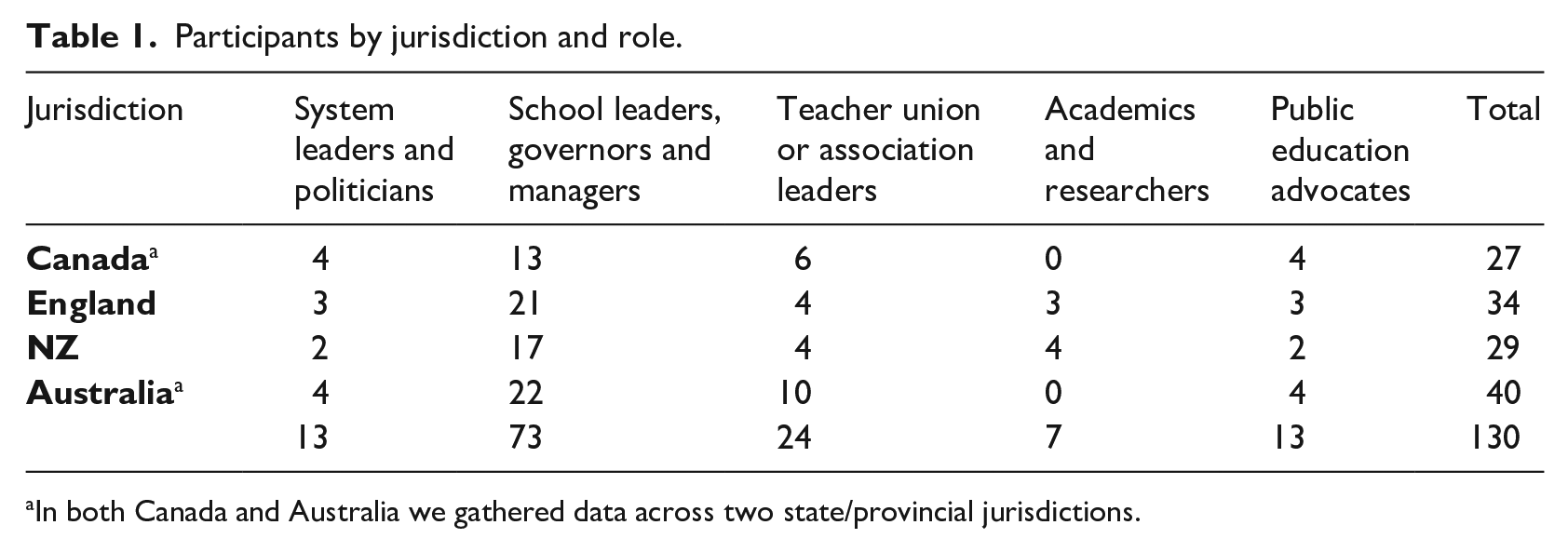
In both Canada and Australia we gathered data across two state/provincial jurisdictions.
Two researchers conducted independent thematic analyses of the transcribed interview data using NVivo software as a management tool. Thematic codes were established via both an inductive and deductive approach with initial codes created from a typology developed by the research team in the first phase of the research (Mockler et al., 2021). Researchers then identified and coded emergent themes from the data that sat outside of those originally identified.
This paper principally reports on three related themes that emerged from the interviews. While these themes were evident across many interviewees, a decision was made to prioritise the voices of school leaders because of their tacit understanding of these issues. The emergent themes were:
There was widespread concern around work intensification, including workload, work–life balance and the ability of principals and teachers to cope with work expectations.
There was a view that school autonomy was having an impact on workload, particularly for principals, as they found themselves responsible for things that systems used to do.
There was a strong belief that the creation of audit and accountability cultures in schools was a prime reason for work intensification.
In the reporting of quotes we use generic titles to ensure the anonymity of participants. While we define role and context we do not include gender or other potentially identifying characteristics.
Work intensification
Across the interviews there was widespread concern regarding teacher and principal workload, work–life balance and their ability to cope with policy expectations, manifest within two main aspects of work intensification. The first relates to the scale of the work required, and the second concerns perceptions that work roles have changed significantly, and taken them into areas other than those that participants felt they had skills/capacity in. This particularly refers to the need to run the school as a more entrepreneurial entity, with oversight of marketing and promotional activities, managing school boards and hiring out school facilities.
The first aspect of work intensification was expressed as a concern at the lack of time to undertake the tasks required for both teaching and school leadership. In a MAT in Northern England, a head teacher (HT) argued that concerns regarding work intensification were evident across the whole country.
There’s a concern about workload, full stop, in schools in England, because the goal posts keep changing, the pressures are enormous, and the threat of Ofsted and league tables – you know, there’s the constant fear of shame, public shaming. So yeah, it is difficult. (England, primary HT 2)
For this HT, accountability and the tendency for politicians to continually revise the aims of school reform meant that the system was based on work intensification. He went on to suggest that being part of a MAT had ‘been a real source of strength: you’ve got colleagues you can speak frankly to about the pressures, and you can support each other and share resources’. In another MAT in Northern England, a HT estimated that ‘I do seventy-plus hour weeks, but teachers who are main scale will comfortably do fifty-five, sixty hours a week’. A concern that this HT had was that the system had reached a ‘tipping point’ where the intensity of the work meant that ‘it’s reached that point where the pressures and the accountability, particularly with Ofsted, it’s not worth it, increasingly, for an increasing majority of people’ (England, secondary HT 2). For this HT, the intensification of his work inevitably leaked into his private life, both in the difficulty he experienced in finding ‘quality’ time to spend with his children, and ultimately, significant health concerns due to stress and long working hours.
Workload or work hours were commented on by many school leaders, with a deputy principal in England reflecting on the changes to work that she had seen across her career. As a beginning teacher she felt it was possible to work from ‘quarter to nine to half past four, and enjoy the holidays’ but that no teacher works those hours now. Instead, the ‘pressures on you are huge’ with continuous expectations to ‘solve the ills of society on top of the job you’re already doing with no extra funding’ (England, primary, deputy HT). Some school leaders felt that the promise of school autonomy itself was part of the problem.
The increase in workload for myself and the business manager is phenomenal. We spent two years without really having a personal life, because we were constantly working, and it didn’t impact on the staff and it didn’t impact on the children. When we academised, nothing changed. We worked incredibly hard so that nothing changed. We’re struggling at the moment not to feel quite bitter about that. (England, primary HT 2)
In Province 2 of Canada, it was the erosion of central support that meant that school leaders found themselves subject to more administrative tasks: as one principal notes, in a small primary school like his, he was expected to teach his class and do all the administration of the school, essentially meaning he had ‘two full time jobs’ (Canada P2, elementary principal 2).
In Australia, despite policies implemented to shore up autonomy for public school principals and their schools, principals felt that the increased administrative load meant that they were less likely to be able to act with autonomy.
I feel more constrained now but for different things. It’s just like people ask you for stuff you think that’s just, it’s all administrative stuff most of it and I think, why am I dealing with that when I’ve got very serious issues to deal with at school. (Australia S1 secondary principal 9)
In NZ, many principals similarly felt that they were constrained by imposed administration. One principal commented: You always look at your day and you go, you know ‘What have I done today, what percentage have I spent talking about teaching and learning versus policy and procedure or dealing with behaviour management of some description?’ Probably, in reality, a lot of policy for my job, would be around 50% of a day. (NZ primary principal 1)
An Australian ex-politician interviewed who had previously been responsible for oversight of a public education system was very aware of the workload pressure that teachers and principals were reporting.
The data out there shows the number of principals who are feeling stressed, overworked, the hours that they’re doing are unsustainable, that they’re actually doing less of the education leadership and more management. (Australia S1 politician 2)
This quote segues into the second aspect of work intensification, which concerns the ways that the roles had changed to encompass more domains beyond that of teaching and learning. In particular, in competitive systems, this often necessitated school leaders investing significant time and energy in aspects of running a school as a business that they were not trained for. A principal in Canada argued that despite the system privileging training that focused on ‘how we work with teachers to support learning and do all of these things’, his experience was rather different: I’m finding more and more that actually I’m trying to find money for, you know, how to deal with the playground, or these other things that are important and related to the kids’ experience at school, but not specifically their classroom experience. (Canada P1, elementary principal 2)
An Australian principal expressed concern that his school leadership had become a reactive, triage process to deal with what seemed a constant stream of crises. This meant that the school leader was ‘continually doing the reactive stuff’ during school hours, but the demands for a more corporate style of leadership meant that ‘to get the space to be creative and strategic we need to do that out of hours’. This constant stress has an effect on personal wellbeing, and the constant work pressure can get really hard then because there are days where you’re just exhausted and you don’t have anything left in the tank. Apart from the drive by Dan Murphy or BWS there’s not a lot going on in the cognitive processes. . . If I’m numb, I don’t feel anything. (Australia S2, primary principal 2)
Another Australian principal remarked that principals got told the other week to start acting like we’re CEOs and I said, no, when you pay me $500,000 I’ll act like a CEO, until then I’m not. I already work 24 hours a day, open my eyes and check emails; I can’t work any harder. (Australia S1, secondary principal 7)
Many principals felt that the system expected of them skills that they did not have, having received their university training as a specialist subject teacher, and then finding themselves in charge of running ‘a $12 million budget’ (Australia S1, secondary principal 7). This Australian principal comments that they have ‘absolutely no finance training’, ‘no property skills’ and ‘no project management skills’, and yet are expected to manage all of these in running their school. This was a familiar experience in many contexts. In Northern England, a HT of a secondary MAT stated: ‘Would you believe, I am a principal of a largish academy, but I am technically in charge of teaching and learning. You’d be surprised how little time I spend on monitoring the quality of teaching and learning’. (England, secondary HT 1). In NZ a secondary school principal commented: You know, to do the things that principals are supposed to do, like ATAR
1
, and finance. I mean, these are teachers. They haven’t been taught that stuff. And buildings, and maintenance, and all that stuff. Those are specialist areas. And expecting a person who’s been trained to teach, I don’t know, physics, and who’s become a principal, to know all of those areas, that’s just silly. Principals are failing. And they’re failing because the breadth of their job is very, very wide. (NZ, charter principal 2)
In Canada, a principal commented that what was expected of schools, and what principals were expected to be accountable for, has just changed. I mean, it’s become harder. Talking to principals around the province. I’ve got a colleague who’s a district principal here and he’s been talking to people and he says that for us, it’s become way more intense. The pluralistic nature of the families that we’re working with create some opportunity, but it also creates challenge. (Canada P1, elementary principal 1)
School autonomy
In interviewing principals, bureaucrats and union officials about systemic approaches to the alternative provision of public schooling, we expected to find a straightforward relationship between autonomous public schools and work intensification. What we found was more complex. In some contexts, work intensification was perceived as an effect of the withdrawal of central support as a result of granting schools more autonomy. In other contexts, particularly those where accountability measures are particularly onerous, school autonomy was hoped to be a mechanism to change the hostile working conditions that school leaders perceived themselves working in. In some contexts, autonomy can exacerbate work pressure; in others, if it does not alleviate it, it seems that it can provide an outlet for support. For example, in England it may be the type of trust a school joins or is forced to join that is a significant factor because the most important impact on work intensification is the Ofsted-inspired audit culture that preceded mass academisation by some decades.
What autonomy seems to do, however, is to create or intensify competition within the system that is driven and/or organised around accountability and audit. Audit cultures essentially privatise public problems through making principals accountable (through Ofsted and test-based accountability) for poverty, for generational unemployment and so on. As one HT of a primary academy in England commented: Autonomous! [laughs] It doesn’t exist! We still, behind closed doors, we still believe that if we can find a way to give them what they want, and jump through the hoops, we will be able to do what we really believe in underneath, but there are so many hoops to jump through, and keeping the standards high, and keeping everybody happy with diminishing resources. (England, primary HT 2)
For this HT, the promise of autonomy was always mediated by the associated accountability requirements. Further, as a relatively small trust of four schools, it was the corporate realities that dominated institutional strategy and thinking. For example, in 2018 when the interview was conducted, the school found ‘ourselves in a position where the money that we are getting in, based on our pupil numbers, doesn’t meet the staff salary every month. . .yeah. It’s shocking. I could weep. . .’. The explanation was due to enrolment anomalies: Our numbers dropped last year. We had a large cohort leave Year 6. We’ve got fewer children coming into reception, so we’re already £40,000 down, and it is just incredibly worrying. Those are the kinds of things that add to the stress, yet there’s always a massive workload in schools. There’s nowhere we can go. (England, primary HT 2)
The impact of losing central support for key initiatives, and the responsibilisation of the school leadership to fill that void, was a common theme of the increased workload. As a primary principal in Australia stated: What I’ve found is that we’ve been left to our own devices and we’ve had to try to. . . a lot of effort now and time has been taken up by schools and the leadership of the schools to try to develop programmes to support the implementation of initiatives that used to be done for us by the department itself. (Australia S1, primary principal 2)
This perspective was echoed by another Australian principal, who argued: Look I think Local Schools, Local Decisions [a state-based policy mandating greater school and principal autonomy] has a lot of positives in terms of I get to make decisions based on the context of my school. But the responsibility [is given] without the mechanisms of support in place. If you’re going to make me that responsible for the things that happen, then give me the mechanisms to be able to do it appropriately and with the right support. (Australia, S1, secondary principal 7)
In NZ, the ‘Tomorrow’s Schools’ policy shift towards greater school autonomy was seen to have caused similar problems.
I think the big downside to Tomorrow’s Schools is that we lost system leadership. The Ministry became just a policy implementer. The ministry became almost totally focussed on serving the minister of the day rather than serving the sector. So you have this real acrimony and lack of trust between the ministry and the sector, which is a very unhealthy state. A school sinks or swims depending on the quality of leadership, and the board. And there have been too many starting to sink, and of course, the cracks show more so in poor areas. We went too far with devolution. (NZ, primary principal 4)
This principal went on to link autonomy, accountability and impact on the work of schools particularly within a context where many students entering school have complex needs.
Much more complex, much more demanding in terms of the complexity of needs coming into schools. Strangely enough, although we’ve got more autonomy, we’ve actually got less autonomy. The accountability framework has become burdensome to the point where it’s quite crazy. That’s come out of the low trust model. (NZ, primary principal 4)
This was partly caused by a policy discourse contained within Tomorrow’s Schools that there was nothing special about education as a profession. ‘I actually think Tomorrow’s Schools caused that. It was significant the day that we said schools could be run by Joe Bloggs off the street, it was not particularly conducive to the profession’ (NZ, primary principal 4).
The point made that policy discourses claimed to deliver autonomy often met head-on realities that undermined that autonomy was a fairly common thread. When asked whether Local Schools, Local Decisions had delivered more autonomy, a principal in Australia answered: No. Very little. Let’s call it autonomy with strings, okay. I believe there is still very much a top-down focus. Yes, stated Local Schools, Local Decisions but I don’t think it’s the Local Schools, Local Decisions that the Principals’ Council wanted. So wherever there is a possible freedom there are a lot of strings or administration or bureaucracy attached to that and in a time-poor work environment the need to be flexible balanced with how much actual time it will take you to be that way, sometimes you weigh it up and there’s no win so it doesn’t occur. (Australia, S1, secondary principal 6)
The jurisdictions in which this research was undertaken all had undergone significant policy reforms to grant schools more autonomy. The style of this autonomy was different in different contexts. However, these responses all indicate that granting autonomy to a school is not easy; these opportunities are frequently blocked and there is an effect on the work that principals and schools can do. Partly, this can be explained by the cultures of audit and accountability that exist in specific systems.
Audit/accountability
Mechanisms of audit and accountability at work in each of the four contexts were reported by interviewees to have a range of different effects, often linked to work intensification as a result of the time and energy spent by principals and teachers on attending to audit and its consequences. Across the different jurisdictions, principals in particular pointed to a politics of commensuration which emanated from the audit technologies employed. Often this saw data generated through audit becoming embodied by the principal, such that the performance of the school or its pupils as measured by audit technologies was understood as a reflection of their personal professional efficacy.
I think the pressure’s always going to be on the head teacher. You’ve got to perform, you’ve got to get the kids to pass the exams, but the high-stakes, high-achievement agenda that this government has got, and has had for the last 10 years, I think makes this job untenable, if I’m honest. (England, secondary HT 3)
This pressure to perform, to be responsible for ‘getting the kids to pass the exams’, as expressed by one head teacher in England, resulted for others in a fear of professional failure, or as another head teacher put it, shame: the goal posts keep changing, the pressures are enormous, and the threat of Ofsted and league tables – you know, there’s the constant fear of shame, public shaming. (England, primary HT 2)
This high-stakes nature of audit, both professionally and personally for principals, positioned many of them such that they saw no option but to comply with the audit process regardless of how counterproductive they might understand it to be in actually improving education in their schools.
The kids here are the most tested nation of kids in the world, but the fear factor that Ofsted brings is just so counterintuitive and counterproductive for quality schooling. . .The government’s really saying, ‘We don’t want to be prescriptive in what you must do there’, but actually, if you don’t do it and they come in here and don’t see books marked, and you get judged to be a 3, it’s fatuous what they say in there, really. (England, secondary HT 2)
The internalisation of audit results on the part of principals was, of course, linked to their very publicness. Not only did they report the threat of public failure and shaming but also the knowledge that parents and community members formed impressions of their schools – which through the mechanism of competition and choice became in some ways self-fulfilling prophecies – based on inadequate or meaningless data generated through audit. In NZ this was often linked to the inadequacies of the National Standards, which, when used as proxies for school performance, fail to take into account important contextual factors.
And so in a school like this, you know, where 80–90% of kids meet a national standard, which is, it’s irrelevant to us, you’ve got all these other kids in education systems around New Zealand who don’t get breakfast, who don’t get food, who don’t have all these things that kind of connect, and then they get told they’re no good. (NZ, primary principal 1)
The league tables generated around the NZ National Certificate of Educational Achievement were also seen by principals to be counterproductive to schools focusing on authentic student learning, and this was reported as a key frustration related to current regimes of audit and accountability in NZ. There remained a concern that ‘for 95% of your kids to get Level 1, that means you have sacrificed deep learning’ (NZ, secondary principal 4). This sense that target setting was distorting educational goals was similarly endorsed by a principal of a charter school.
We had a ridiculous goal set by the most recent Minister of Education. . .that we’ve got to get 85% pass rate for Level 2 NCEA. It’s a meaningless qualification. And so schools are under pressure to do that, and so kids can, you know, it’s going like into a lolly shop, and all you had to do was fill your Level 2 lolly bag with 20 credits from Level 1 and 50 credits from Level 2, and it didn’t matter whether it was from pumping up the bike tyre, whatever it was, and so kids then go onto Year 13 and they go ‘Oh, I can’t do any of the accredited courses that the universities require me to do’. (NZ, charter principal 1)
In Canada, a level of frustration at the consequences of the activities of the Fraser Institute was expressed by principals, particularly in relation to this issue of shaping public perceptions of schools in inadequate or unproductive ways: [E]ven people I would argue are intelligent, educated, thoughtful and caring people, don’t – they don’t recognise the fallacies of the Fraser Institute and the ranking system, and they will make choices about where to send their child based on that. You begin to unpack it: people want to argue, but it is numbers. The school’s doing well because the teachers are good, or this school’s not really good enough because the building’s old, or some other perception. (Canada P1, elementary principal 2)
Finally, the reconfiguration or reshaping of teachers’ and principals’ roles was reflected in interview data from participants in a range of different roles. The notion that ‘data is underpinning a complete change in the way educators do their job’ (Australian S2 union representative 3) was reflected in different ways across the four contexts. Often this was seen as a shift of attention for teachers and school leaders from matters of substance around teaching and learning and student welfare to matters related to performative accountability: [W]hen I first started teaching, you know, our focus was just core business of teaching and learning, teaching and learning was the focus, but since then, they’ve wanted teachers to be able to prove that they were quality teachers by providing evidence, and so we have this huge appraisal system to make sure that everybody is operating at a quality level, and you have to provide a huge amount of documentation for that. . .so yeah, the nature of teaching is different to what it was. (NZ, subject area coordinator)
Our interview data revealed that these technologies of audit and accountability, regardless of being configured differently across the different contexts, contributed to a reshaping of educators’ relationships to their work. The responsibilisation of principals through the publicness of audit data clearly had meant for many of them an internalisation of not only the data itself but the very success or failure of their schools. Furthermore, these technologies were observed to also be reconfiguring public perceptions of what ‘good’ education is, and reshaping the focus and nature of teachers’ and school leaders’ work within schools.
Discussion
This paper began with the observation that many teachers and principals have experienced an intensification of their work over preceding decades. This, we argue, represents a problem for the publicness of institutions in that there has been a shifting of the burden of work for teachers and schools from the public to the private sphere. The old liberal notion of public and private time as a way to divide the day up no longer adequately describes the contours experienced working in schools. Excessive work out of hours has both become the norm and is recognised as a significant problem for public education sectors. In all jurisdictions there are concerns around mental and physical health, the retention of experienced teachers and the recruitment of new teachers as a result of this work intensification. To paraphrase C. Wright Mills, work has become perceived as a private trouble more so than a public issue. Importantly, the ways that school leaders felt responsibilised for the private troubles of their staff trying to cope with the intensification of the work also represented another vector of this pressure for school leadership. School leaders continued to feel responsible for the future generation of teachers, and remained concerned at the system that younger teachers and school leaders would inherit.
A relatively common perspective was a concern about the support central authorities were offering. In NZ, the school autonomy offered by the Tomorrow’s Schools policy reforms was seen as being undercut by the loss of system leadership as it was assumed that schools as autonomous institutions could be left more to their own devices. In England a common concern was the support offered by local authorities, particularly with regard to preparation for high-stakes Ofsted judgements. In Australia, principals argued that the policy reforms meant that they had to learn skills most closely associated with corporate leadership rather than those learnt from years of professional experience in classrooms and schools.
The secondary aim of this paper was to consider the relationship between school autonomy, work intensification and audit and accountability cultures currently in favour in education contexts. Across multiple jurisdictions we found strong evidence of a relationship between these three vectors of school reform. Based on the literature (for example, Wylie et al., 2016), we expected to find a relatively simple, linear relationship between school autonomy and workload, based on the premise that autonomy usually meant the withdrawal of centralised supports and services pushing greater workload onto school staff and leaders. However, what we found was a more complex phenomenon where autonomy and work intensification were always mediated by audit and accountability cultures operating with education systems. For example, in England these audit cultures emerged around accountability initiatives such as Ofsted inspections since the 1990s. The Ofsted school inspection, which has high stakes for schools and principals (Perryman et al., 2018), changed work practices as teachers and school leaders tried to respond to the expectations, and shifting goalposts, of the inspection regime (Bradbury and Roberts-Holmes, 2017; Thompson et al., 2020). In England, school autonomy (the decision to academise) was often seen as a calculated gamble to manage the demands of other aspects of the school reform agenda such as work intensification. In Australia, by way of contrast, the recent emergence of an accountability regime using school comparisons based on standardised test scores (NAPLAN and MySchool) meant that school autonomy is seen less as an answer to work intensification but a cause of it. We note, of course, that this analysis is tentative, but it seems that in countries with less punitive accountability systems, or with less experience of punitive accountability, greater concern was expressed at the impact of school autonomy on work intensification. This is most likely because excessive accountability itself can cause the intensification of work and, if it has gripped a system long enough, autonomy probably does not seem to make workload worse. This is evident in the quotes where school leaders talk about the rise of ‘administrivia’ that detracted from their ability to devote themselves to being instructional leaders. Furthermore, this is one of the key contributions of this work, highlighting the value of a nuanced comparison of education reform across four similar but different national contexts: while popular discussion of the GERM often emphasises a commonality of experiences of reform in diverse contexts, it elides subtle but important differences.
What this paper suggests is that there is more to the discussion of publicness than issues of funding and governance. A key characteristic is the working conditions and expectations of frontline teachers, school leaders and other staff. In a public institution, care has to be undertaken with regard to work, as a means through which to understand the vexing issue of publicness and its antithesis, privatisation. In previous work (Mockler et al., 2021) we tried to avoid the realist/idealist divide invariably at play in definitions of publicness to argue for a set of dimensions that encapsulate both ideas and practices arranged along a continuum.
Conclusion
A challenge for understanding publicness is the multiple uses of the word ‘public’ particularly as it relates to education in general and schooling in particular. This often plays out through parochial battles between realist and idealist commitments. On the one hand, a realist position assumes that the schools that call themselves public, are considered to be public by their communities, are public in essence. An idealist position, on the other hand, suggests that publicness is a commitment to a set of ideals or values that sit behind but inform all facets of the public school, that publicness is the realisation of those ideals in the world. To an extent this is an irreconcilable conversation. What we take from it, however, is that both the practices and sense of publicness are constantly at work and constantly in flux. While there has been much work published on the privatisation of public spaces and institutions, our interest is primarily in how these reorganisations of public spaces and institutions are experienced by individuals, particularly those working for public institutions and in the service of some sort of public. This is why work intensification is an important vector to understand the relationship, and rearticulation, of publicness (and privateness), because it underscores that a commitment to publicness must be more than how a school is funded. And this remains a significant concern in ‘mixed economies’ (Wilkins, 2019) like the four jurisdictions we studied. Attempts to influence public institutions by corporate practices through policies advocating accountability, autonomy and competition inevitably change the work that is, and can be, done. And this appears to be making the work in schools more complex, and more difficult to complete.
At the system level, the relationship between the intensification of work, autonomy and audit and accountability technologies is complex. The most important factor inflecting work intensification is not school autonomy; rather it is the form and extent of accountability expectations that a system imposes on schools and school staff. The desire for autonomy amongst the profession emerges as a belief that, if schools and school leaders were better able to respond to their local communities, they could better counter the effects of pernicious accountability measures and seemingly malevolent policy directives aimed at teaching and learning. The counterexample, of course, is that systems often see autonomy as a means to remove centralised support for schools and school staff. When this happened, many school leaders either found themselves without the resources needed to pursue autonomy in teaching and learning or in some instances found that the autonomy they had was limited to only some aspects of schooling. In both instances, this tended to increase workload as school leaders found themselves responsible for what might be termed ‘corporate’ leadership. These included responsibilities for budgeting, marketing and recruiting students to enrol. Understanding this, perhaps, suggests that systems and those in charge of them need to think through what publicness actually means and how this manifests in practice within schools and their communities. To argue the point more strongly, if a system is going to name itself ‘public’ it must attend to the policy agendas at work in reshaping the provision of schooling. In this paper, we argue that evaluating the publicness of an institution or a system extends to how work and the workforce are organised, and that consideration must be given to issues such as workload, work intensification, work/life balance and how it is that private time flourishes or leaches away.
Footnotes
Declaration of conflicting interests
The author(s) declared no potential conflicts of interest with respect to the research, authorship, and/or publication of this article.
Funding
The author(s) disclosed receipt of the following financial support for the research, authorship, and/or publication of this article: This research was supported by the Australian Government through the Australian Research Council’s Discovery Projects funding scheme (project DP170103647). The views expressed herein are those of the authors and are not necessarily those of the Australian Government or Australian Research Council.
