




Abstract
This study investigates the work of second language teachers in two institutional settings responsible for integration training. By exploring teachers’ accounts in Finland and Germany, we seek to deepen the understanding of the daily practice of second language education. Bridging conceptual and practical approaches, the aim is to contribute to the current discourse on the development of adult second language education in Europe. A phenomenographic analysis of semi-structured interviews reveals challenges that influence instruction from inside and outside institutional practice. Accounts in the Finnish setting depict issues in how language education, teachers’ work, and adult education are perceived. Administration and language teachers disagree on what needs to be improved in a changing societal environment. Professional pride and appreciation are strongly demanded in a profession that is still being established, and challenges specific to adult education translate into priorities in delivering instruction. In the German setting, expressions culminate in prerequisites, and challenges lie in the way external factors influence course design and instruction. They also touch upon learning: methods, materials, and abilities. Feelings of inadequacy describe teachers’ psychological working environment. A comparison concludes a need to defend contact teaching in Finland and to improve tracking of slower learners’ progress in Germany.
Keywords
Introduction
The present study examines experience in two European settings of adult second language education. In a phenomenographic analysis of teachers’ accounts of experience, we investigate challenges in integration training aimed at labor market integration (e.g. Kosyakova and Sirries, 2017) and social integration (e.g. Laurentsyeva and Venturini, 2017). The analysis of daily practice in one Finnish and one German educational establishment in the aftermath of 2015 global mobilities responds to a call for research-based development of second language education in Finland (Ronkainen and Suni, 2019: 89). It is also relevant globally, as demographic changes and subsequent challenges will be critical during the next several decades (Alba and Foner, 2014). In Europe, Germany is among the top five countries hosting refugees worldwide (UNHCR, 2020) and has a long history of receiving migration, such as the mobilities of the Turkish temporary workforce after World War II. Finland may be considered a relatively marginal destination with a brief history of migration (Dunlavy et al., 2020: 12), but the increasingly research-based teacher education and teachers’ autonomy (see Salokangas et al., 2019; Simola and Rinne, 2015: 361–364) could open relevant viewpoints for developing education as part of integration services. The aim of bringing together two European cases, one major and one marginal destination of migration, is to gain understanding about the variety and range of issues that involve second language education in today’s Europe. A comparison of differing settings will broaden the insight into the “what and why” of future developments for integration education (see Saukkonen, 2020: 28–29).
European Policy Discourse on Integration Training and the Need for Research
Second language teachers in both Finland and Germany work within goals communicated in documents such as The Action Plan on Integration and Inclusion for the Years 2021–2027 (European Commission (EC), 2020b), which outlines strategies for European integration services, including education. Within the specific scope of language education, The Common European Framework for Reference for Languages set out by the Council of Europe (2001) defines the target skill levels for second language learning (B1, independent language user) and has significantly shaped language education in the past decade (Latomaa et al., 2013; Tarnanen and Huhta, 2008). The topical European rhetoric of skills development (e.g. EC, 2020c, 2020d; see also OECD, 2019, 2020) implies broader societal goals for Finnish and German integration education. This includes successful transitions into working life and a skills match (e.g. Calmfors and Sánchez Gassen, 2019: 12; Sarvimäki and Hämäläinen, 2016) as a response to a need for a qualified workforce in an aging population (Bach and Wittenberg, 2017: 44). On a national level, implementation of integration training is steered by curricular documents by the Finnish National Agency of Education (FNAE) and the German Federal Ministry of the Interior (BMI). The pedagogical culture guided by The National Core Curriculum for Integration Training for Adult Migrants (Finnish National Agency of Education (FNAE), 2012) has been regarded as one of the strengths of Finnish integration training (e.g. The Ministry of Economic Affairs and Employment in Finland (MEAE), 2013: 13–14). Currently, the curriculum holds a legal status (Pöyhönen and Tarnanen, 2015: 112), and its renewed version will orient the development of Finnish integration training (Ronkainen and Suni, 2019: 79). The German Core Curriculum (Ger. Rahmencurriculum) primarily targets the development of language tests, course books, and language courses, and only secondarily the work of second language teachers (BMI/Kaufmann, 2016: 5). In addition to skills development, however, integration is a multi-level and multi-actor process (Könönen and Himanen, 2019: 61–62) that should also be approached ethically, as an opportunity to foster a sense of belonging and participation in public and social spaces (Brücker, 2020; Foroutan, 2019: 79).
Overall, research is needed on the effects of different types of language training on language skills and labor market outcomes, especially in the Nordic countries (Calmfors and Sánchez Gassen, 2019: 32; see also Saukkonen, 2020: 28). Despite this gap, studies on integration education specifically are still few in Finland, and knowledge of different aspects of integration is far from complete, even in Germany (Berliner Institut fur empirische Integrations- und Migrationsforschung (BIM), 2020). The present contribution seeks to deepen the understanding of these local, European, and global problematics, contextualizing in practical settings but influencing integration outcomes. In conceptual terms, by revealing challenges in social practice that represent historical and geographical variation (Schatzki, 2010: 51), the study seeks to understand how people, based on their ways of experiencing, handle problems, situations, and the world—and do so in more or less efficient ways (Marton and Booth, 1997: 111–117). The efficiency discourse is both coinciding and problematic. For teachers supervising the quality and implementation of effective practices (Penalva, 2019), instructional success enhances well-being at work and in the classroom. However, teaching fast for fast integration in a responsible role for national productivity implies stress (e.g. Kurki et al., 2018; Lindberg and Sandwall, 2007). The adult educator’s role as an economic subject (Heinemann, 2017) challenges the teacher’s sense of autonomy (see Fejes et al., 2016). Research and debate need to tackle the working life of not only migrants but also their teachers.
Teachers’ Work in European Integration Language Education
Research on second language education as part of integration training that concentrates specifically on the language teacher’s work in Europe is still modest. To our knowledge, the present study is the first to approach the matter from a broad comparative perspective. Existing Finnish studies scrutinize second language teachers in increasingly business-oriented integration training (Kurki et al., 2018; Montonen and Lappalainen, 2017; see also Ruuska, 2020). The work of second language teachers in this setting is considered crucial, challenging the idea of independent language learning in workplaces (Pöyhönen et al., 2009; Ronkainen and Suni, 2019; see also Rasilainen, 2016). Second language teaching should acknowledge adult learners’ varying life situations rather than focus on their cultural and linguistic differences (Kärkkäinen, 2017). Teachers’ support is also central to extra-curricular matters, such as in helping students to build social networks (Kokkonen et al., 2019). In a German setting of integration training, research on second language teachers discusses a similar change of focus from humanistic to more mechanical direction in adult second language education, due to pressure from state-assigned goals (Heinemann, 2017, 2018; see also Gargova, 2017). Teachers face conflicting professional roles and create coping strategies (Becker, 2014). Closely related research in the Swedish context describes a transformative effect of second language instruction for both students and teachers and calls for more opportunities for teachers to influence at the local and national levels (Colliander, 2018, 2019; see also Öbrink Hobzová, 2021).
In the present work, the insight into teachers’ working life is built in an analysis of institutional language (Säljö, 1997). We approach discourse as a “productive and regulative practice with material effects” (Brunila, 2011: 424). In comparing two case settings, we depart from the idea of perceiving similar processes, but also consider differences revealed by comparison (see Lahelma and Gordon, 2010: 126). Conceptually, our aim is to open new zones of looking beyond physical boundaries, within a space delimited by frontiers of meaning (Nóvoa and Yariv-Mashal, 2003: 436–437). We ask: What are the qualitatively different ways in which second language teachers experience challenges in their daily work in Finland and Germany? Consequently: How do the accounts differ between the two national contexts? What are the implications for a European integration education framework?
Adult Second Language Education in Finland and Germany
Recent dynamics in the two European settings of integration training, Finland and Germany, are similar, but their volumes are different. After the peak of ca. 32,500 asylum applications to Finland in 2015, the number of applications dropped to ca. 4550 in 2019 (Finnish Immigration Service, 2020). The share of residents with migrant backgrounds, ca. 8% in 2019 (Statistics Finland, 2020), is the lowest in the Nordic countries (Calmfors and Sánchez Gassen, 2019: 10), a rough third of Germany’s 26% (Statistisches Bundesamt, 2020). Russian stands out as the most common foreign language, followed by Estonian, Arabic, English, and Somali in Finland (Statistics Finland, 2020). In financial terms, integration training has been funded by the state yearly with ca. 82 million euros (National Audit Office of Finland (NAOF), 2018: 11), declining to an estimated 60 million euros in 2020 (Saukkonen, 2020: 114). Completion rates in integration training have increased steadily since 2013 (NAOF, 2018: 13), yet the target language level is often not achieved (e.g. Huhta et al., 2017), remaining at 35% (Audit Committee, 2019). In 2014–2016, the waiting time for Finnish integration training decreased by half. Among key Finnish priorities is to make integration services more mandatory, especially language training (Audit Committee, 2019). In Finland, local integration programs link more tightly with cities’ own strategies than national alignments. The model may not be considered clearly centralist or centrally steered, as evidence lacks in proving that municipalities would actually follow or even seek to follow state-defined choices and implement such policies locally, or that state authorities would strongly steer local integration in a certain direction. (Saukkonen, 2020: 101–102.)
In a decentralized steering model in Germany, the Federal Ministry steers the implementation of policies, but federal states may choose on differing or rather new policies. Also in Germany, some cities have had more active practice of migration policy than federal states (Saukkonen, 2020: 103). A central goal for Germany is to deliver integration courses during the asylum process (e.g. Bach et al., 2017: 58). Since 2015, over 1 million individuals have completed German integration training (Foroutan, 2020), based on immigration policy focusing on fast and sustainable integration of the newly arrived into the labor market (Kosyakova and Sirries, 2017). Research reveals that target language skills influence this transition positively (Bach et al., 2017: 8). Also in Germany, Russian is the most common foreign language spoken, together with Turkish, Polish, and Kurdish (Statistisches Bundesamt, 2019). For 2019, a total reserve of ca. 720 million euros was allocated for integration training (Federal Ministry of Interior of Germany (BMI), 2019). In contrast to the Finnish tendency, German completion rates have decreased in the past 5 years (Deutscher Bundestag, 2019), corresponding to a ca. 50% achievement of the target language in the past years (Federal Office of Migration and Refugees, 2020a: 16). Also, waiting times have almost doubled since 2016 (Deutscher Bundestag, 2019; NAOF, 2018).
The sharp increase of participants to second language education in Germany led to an increased need for a teaching workforce and modifications to their qualification requirements, such as literacy courses (see BAMF, 2019). Societal conditions challenging participants’ settling, such as housing or children’s daycare, intervened in second language instruction. Increased demand for education tightened competition among education providers in both settings, also at the expense of developing collaboration (see Karinen, 2013) and discussing the quality of second language teaching. In both non-anglophone settings, the target languages are formerly less or completely unknown for the participants, with implications for learning progress. Due to little migration to Finland, the professional field of second language teaching is still rather new (e.g. Ruuska, 2020: 24). Development of integration efforts is largely project-based and lacks a longer-term perspective (see Saukkonen, 2020: 104–111; Rasilainen, 2016: 44–45). Research and information on different aspects of Finnish integration services are still dispersed and require nationwide structure and support (Karinen, 2020: 222), especially to inform teacher education in collaboration between national universities (see Pöyhönen et al., 2009: 40).
The Present Study
Data and Participants
Representative education providers were identified and contacted through existing specialist networks in Finland and newly established ones in Germany. Once written consent was received from organization leads, potential teacher-participants were contacted either via email or in person to ask about their willingness to participate. The selection was primarily based on participants’ interest, acknowledging variation in their educational and professional backgrounds. All participants were teaching Finnish or German as a second language in an integration course at the time of the interviews. In Finland, courses ranged from slow to mid- and fast-paced and were at the starting, middle, or ending phases at the time of the interviews. In Germany, teachers worked at different stages (Modules 1, 2, 6, 9, and 10) of either an integration course, a literacy course (Ger. Alphabetisierungskurs), or an occupational language course (Ger. Berufsprachkurs). The educational backgrounds of both male and female participants varied from a university degree to profession-specific training. All participants in Finland were teaching (in) their mother tongue, while teachers’ native language varied in Germany. Teachers’ relevant work experience, teaching Finnish or German as a second language for adults, ranged from recent graduates or relatively new professionals to very experienced ones. Table 1 offers an overview of the variation among and between data sets. The degree of detail is based on sufficient protection of anonymity (Polio, 1996: 73–74) and the collective rather than individual approach to participants’ accounts of experiences (Marton, 1981; Orgill, 2012).
Participants of the study, Finnish/German as a second language teachers in Finland and Germany.
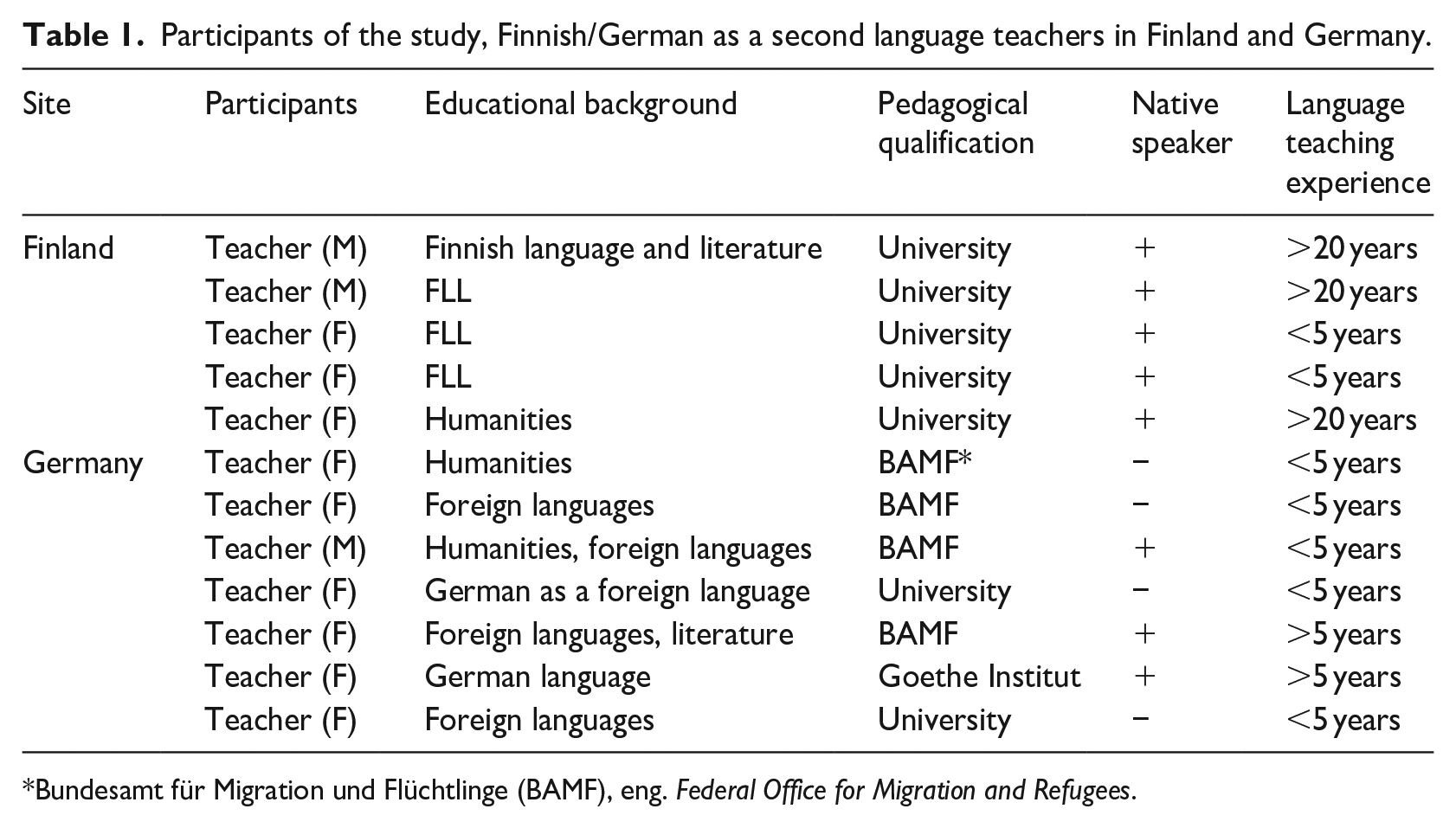
Bundesamt für Migration und Flüchtlinge (BAMF), eng. Federal Office for Migration and Refugees.
Methods, Analysis, and Methodological Considerations
Semi-structured interviews
The participants were interviewed at language training providers, both private establishments in a large urban center (a city of over 100,000 inhabitants). The number of interviews (N = 13) presents both reiteration and variation within an economical employment of available resources (see Robson, 1996: 24). It was determined when introduced aspects and the argumentation started to repeat themselves and reached a saturation point (Eskola and Suoranta, 1998: 62–63). The interviews were arranged at the organization’s premises in Finland (05-06/2016) and Germany (11/2017). A difference in the timing of the interviews reflects a different stage for the case organization in addressing the 2015 peak of mobilities and creates a continuum for a European comparison. Personal face-to-face interviews ensured adequate privacy protection for acquiring ethically aligned and qualitatively high-caliber material. All communication with participants, including the interviews, was conducted in their working language, Finnish or German. Before the interviews, the researcher-interviewer participated in the informants’ working day and observed classroom interactions to familiarize themselves with the research setting. The analysis focuses on interviews, but the discussions were informed by classroom observation, as both interviewer and participants would refer to the reactions and atmosphere they had witnessed together in class. The interviews, ranging from ca. 60 to 90 minutes, followed a semi-structured schedule to obtain an optimum description of the informant’s personal experience (e.g. Marton, 1997: 99).
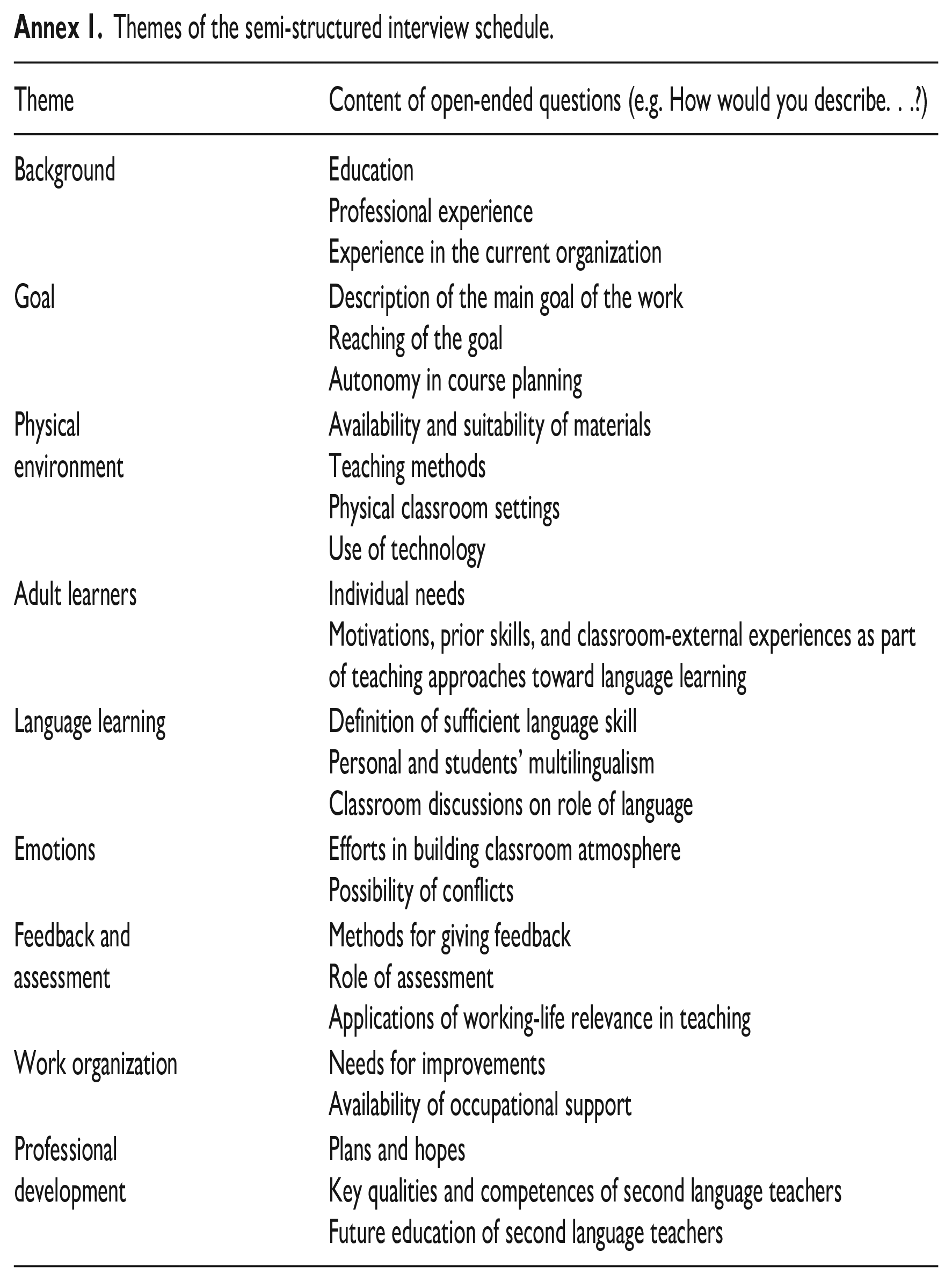
To carry out the interview as a dialog (Marton, 1997: 99; Säljö, 1994), the interviewer shared relevant, mainly professional knowledge and experiences with participants. The aim was to contextualize the discussion and optimize a mutual understanding of the interview questions (Lankshear and Knobel, 2004: 362; Säljö, 1997). Ultimately, the goal was to facilitate a discussion where the subject’s experience was jointly explored and thematized (Marton, 1997: 99). An identical set of questions, based on themes of the Finnish Core Curriculum for Adult Migrants (FNAE, 2012), guided discussions in both case settings. Themes of the open-ended interview questions are presented in Annex 1. The interviews were concluded with questions on hopes for professional future and development, using the future dialog method to encourage the participants to imagine and describe positive futures (Arnkil, 2006). Upon completion, the interviews were transcribed, and selected excerpts were translated into English by the first author.
Phenomenographic analysis
Gaining insight into how informants describe their experience of practice required an approach to analyzing the data that would acknowledge the nature of the discourse in which the interviews were conducted. A notion of institutional language (e.g. Säljö, 1997) corresponds to how we perceive the teacher-participants taking a more collective and professional role in the interviews than, for example, student participants, who might speak from a perspective closer to the private sphere and identity. In that sense, a choice of phenomenography analyzing experience as “collective but individually and culturally distributed” (Marton, 1996: 172) seemed a better match than a more clearly phenomenological approach. Furthermore, within phenomenography, we lean on the side of a discursive approach, underscoring the role of utterances in expressing the experience (Säljö, 1994, 1997). Instead of “conceptions,” therefore, we employ the term “accounts” to highlight the role of linguistic expression in mediating the experience. The analysis consisted of two main stages for both data sets: grouping of accounts into “categories of description” and a compilation of a summarizing “outcome space” (Marton, 1986: 33–34). The value of the categories is to explore qualitative variation in ways of experiencing or conceptualizing a phenomenon. Fundamentally, the ways of experiencing are assumed to be finite and rather limited in number (e.g. Richardson, 1999), the conceptions not only subjectively constructed and—relevantly to our specific approach—most accessible through language (Svensson, 1997). The abstract outcome space offers a structured manner of validating the relationship between the two sets of interview analysis. It helps to ensure that the analyzed phenomenon in two different societal contexts, challenges in language teaching in Finland and Germany, are in fact qualitatively similar enough to provide a scientifically meaningful comparison (see, Melin, 2005: 55–56).
After several readings of the transcripts, the analysis proceeded inductively, also involving a deductive approach due to the thematic organization of the interview schedule (Annex 1). The first stage for both data sets, the Finnish and the German, was an initial organization of excerpts according to immediately relevant aspects (Marton, 1997: 99). The analysis was based on a preliminary thematic division into teachers’ descriptions of the goal of their work and their insights into developing second language education. There, expressions such as “what I would like to add” or “what to me is crucial here. . .” helped direct attention to the main issues that the participants wanted to raise. This organization of data further developed into descriptions focusing on the teacher’s role, students’ profiles, students’ activities, and needs for teachers’ professional development. In phenomenographic terms, the aspects were identified by contrasting similarities and differences among the utterances, both in relation to the context of other extracts and the individual interview (Marton, 1986: 42–43). At this stage, the notion of challenge started to emerge increasingly among the excerpts, in participants’ implicit or explicit descriptions of lack of resources or abilities or a difficulty in achieving a goal. As the categorization of challenges was progressing, attention was shifted from relations between the quotes to relations between groups to detect differences among groups (Marton, 1997: 100). For example, challenges in interaction could be identified either between administration and teacher, teacher and students, or among students, affecting the forming of categories. In this phase, three criteria were considered: the content per category should be distinctive, relations between the categories should be logical, and categories should be as few as possible (Åkerlind, 2005: 323). The consistency of the categories was tested and modified (Orgill, 2012), leading to a further division into subcategories. The subcategories present a more detailed aspect within the scope of the fundamental challenge of the main category, as introduced by the participants in the way they referred to other similar issues (see Säljö, 1988: 41). Finally, outcome space was created for both data sets as the result and the second stage of the phenomenographic analysis. The goal of the outcome space was to present the created categories in the relationship between the categories (Marton and Booth, 1997: 125).
Methodological remarks on contrasting the data sets
The “collective” approach granted by phenomenography coincides with a cross-cultural methodology involving two research settings (Willis, 2018). A qualitative variation of experiential perspective (Marton, 1981) describes problems to tackle, rather than “facts” and “realities” (Nóvoa and Yariv-Mashal, 2003: 436–437). The ideographical cases cannot be generalized (Kallo, 2018), but to compare the data sets and to arrive at broader implications, we apply ontological concepts to smooth the methodological jump to practical suggestions from our descriptive analysis (see Penalva, 2019). The aim of introducing an ontological “metadiscourse” is to ease a cross-national discussion between two complex and multidimensional settings of integration services. A context-driven framework of social sites by Schatzki (2010: 124) assists in interpreting the conceptual implications of the identified challenges and suggesting connections for future empirical studies. By making implicit ontologies explicit (Schatzki, 2003), we hope to enhance the pragmatic validity of the findings beyond the country cases for a broader international readership (see Åkerlind, 2005), and introduce a voice of practice into a conceptual discussion of adult second language education.
The position of the researcher-interviewer is related to the outcome of the phenomenographic scrutiny (Åkerlind, 2007: 323). Here, interviews were conducted by a Finn with fluent German skills and prior cultural knowledge. Professional experience in language teaching and tender-driven education in Finland and Germany contributed to building a compatible conceptual system with participants (Säljö, 1997) with the goal of optimizing mutual understanding with participants (Orgill, 2012). Modest prior experience of European-steered integration training, on the other hand, helped in approaching informants’ utterances without prior assessment of their correctness (see Ashworth and Lucas, 1998: 418; see also Marton, 1997: 99; Orgill, 2012; Sandbergh, 1997). For the phenomenographic approach, a combination of adaptation and a researcher’s particular perspective may be considered an asset (Åkerlind, 2007: 332). Similarly, incorporating a researcher’s inside knowledge with an outside perspective favors conducting comparative educational studies (Judge, 2000: 155). The present study arguably benefits from both assets, yet the uniqueness of the interview situation and the varying motives of participants poses a challenge for the researcher to understand and fight against potential prior assumptions (see Säljö, 1982: 31; Säljö, 1994, 1997, 2020).
Analysis and Results
The findings in “categories of description” and an “outcome space” characterize in logical relations different ways of experiencing, conceptualizing, understanding, perceiving, and apprehending a phenomenon, and represent an ordered set of the created categories (Marton, 1997: 95). The goal is “to find out the differences in the structure of awareness and in the corresponding meaning of the phenomenon or situation” (Marton, 1997: 98). We present the identified categories by introducing the category and by elaborating on them. Excerpts of the interview data represent aspects of the subcategory that constitute the core of the main category.
Categories of Description: Challenges of Teachers’ Work in Finland
A shared key concept to describe all three main categories of the Finnish data is “perceptions” of the practice: language education, teachers’ work, and adult learning. At the time of Finnish data collection in 2016, record volumes of new integration training participants were anticipated, resulting in plans for changes in the organization of integration language education.
Category 1: Perceptions of language education
The first category evolves from friction between two groups of actors: the teaching administration and the practitioner. Common to this line of accounts are differing perceptions of language education in integration. The presence of a change at hand intensifies the perceived challenge, as reforms are being planned and adjustments for the practice anticipated.
Conflicting perspectives
A top-down approach affecting the teachers’ work is described by Finnish participants from a few key angles. First, a felt lack of knowledge and realism regarding the experienced expectations is expressed.
The administration sets new challenges. As if the officer was better aware of the needs and practices than we over here. We constantly receive requirements we consider simply impossible to implement.
The contradiction anchors in a setting where education delivery is tender-driven, based on competition among education providers.
What has happened here again is that regulations have been directed from the top down about how to do the work in the future [. . .] To be implemented by the organization to get the offers through. [. . .] Formulated in a document that nobody really believes in, not very seriously anyway. Operating at a level of some mysterious jargon.
Teacher practitioners express frustration about the ways in which education objectives are being communicated. A discursive mismatch emerges where practitioners balance between a highly conceptual objective setting and the practical work. The given goals are perceived as “simply impossible to implement,” even if ways of working capable of producing “good results” have been identified.
A very good system, indeed [we have created]. We’ve got good results. I’d like to emphasize that we have got lots of good results with the existing system.
Frustration toward goal setting seems to derive from contradicting ways of approaching—and communicating about—the teaching practice by different actors. Teachers’ tacit rather than theoretical take on practice collides with an increasingly market-oriented angle to discussing educational reforms that lack a perspective of conditions restricting daily teaching activity. This clash separates the actors involved into “us and them” and results in practitioners’ frustration with unrealistic requirements.
Addressing a change
Within the scope of differing perceptions of language education and a clash between requirements and established practices, a set of accounts clearly calls for a better understanding of practical work in times of change and reform.
The new teaching system required from us, this extremely fast language learning; well I don’t know where it’s based on, as it has not happened before either. We should increasingly be taking language learning towards working life, and I see many insuperable problems in how it cannot work the way it has been thought in some labor administration body. Maybe we’ll have to bang our heads against the wall again.
The required “new” aim toward fast working-life-oriented language learning leads to frustration.
But maybe it’s the kind of Bernstein socialism that here’s the direction to be taken but the goal is one that will never really be reached, yet one should progress towards it.
Reluctantly, teachers reorientate themselves into accepting the “top-down” requirements as guidelines. A similar dialog on differing perceptions of language education under reform can be perceived in terms of time.
I get the point, but the cut in Finnish classes is substantive. Language learning takes time.
Differing perceptions of what it means to learn a language further arise in teachers highlighting the value of formal language learning.
Well, it will be a change that leaves students hanging in terms of language skills. It’s absolutely positive if they get to see how some professional course is taught or get into a workplace training, but their linguistic abilities will be even weaker than before, to cope in or understand communication there.
From a teacher’s perspective, cuts in contact learning will not serve the students’ learning or participation.
Category 2: Perceptions of teachers’ work
The second category of accounts raises a question about differing perceptions of teachers’ work from a profession-internal angle and the historical perspective of the establishment of the profession.
Professional pride and appreciation
The attitude among teachers toward their work in a highly specialized professional field describes the core of the challenges involved in the category.
What has been bothering me now for a long time is how little pride teachers take over their work. Why wipe under the carpet the own expertise? Especially at the beginning, when this field was so new in Finland that nobody had an idea of how to do this work.
Along the lines of the previous category, points of sensed professional capability and pride are also raised. This time, the issues are raised clearly from within the profession and reflected over a broader time perspective.
The respect towards the teaching profession has declined, quite frankly. In this migrant work, for as long as I recall, there has always been the kind of thinking: anyone can do the job.
A lack of appreciation toward language teachers’ work echoes in an account describing a somewhat passive role given to teacher actors in efficiency-driven education.
The past years I’ve got this feeling that here the students, now you take care of the matter. And then we try to cope somehow, under a fear of reclamation.
A stronger collective professional identity for second language teachers is called for.
Establishing the profession
Reflection on the development of the professional field of second language teaching spans a few decades. Political and economic climates have been decisive in speeding up the transition of adult language learners into working life.
At the end of the ‘80s, we were living a huge economic upturn, and students were taken from the course even before it ended. At the closing ceremony, teachers were having coffee among themselves. There was nobody left there to give the certificate to, as they had all been taken to working life, with weak language skills.
The political and economic climates have also influenced how the bases have been set for the emerging professional field, affecting its later unity.
But back then, while we were learning this work by doing, no one wanted to really raise the issue either and explain that this is how this needs to be done and this here is a good system. Maybe we now get to suffer from that. We are constantly in the position of a listening student, we are being told what to do, instead of us telling them how to do this.
According to accounts, the work has been learned by doing, yet identified practices have not been sufficiently promoted.
The results have been good. But this has not been communicated in any way.
Overall, the accounts paint a picture of specialists whose experiences of performance and collective professional identity are significantly influenced by socio-economic circumstances. While the challenges described in the first category derived from the outside, perceived as top-down directions and business-driven efficiency aspirations, the second category essentially involves practitioners themselves: how they assess the past and evaluate the present.
Category 3: Perceptions of adult education
Moving from societal and profession-specific perspectives to classroom practices, the third category evolves from challenges pertinent to teaching interaction and preferences. Specifically, problematics of adult education are raised: how is second language education organized as part of integration training, and how does the adult learner profile affect the instruction?
Priorities in language education
Coinciding with the 2016 interviews, a substantial cut in classroom language instruction was about to take effect in Finnish integration training. Aspects related to priorities in implementing second language education emerge in the accounts.
Contact teaching is extremely important. To weaker learners, simply teacher-led instruction is very important, as they do not possess such independent learning abilities. [. . .] Every student needs interaction with the teacher, at every level of the Finnish language.
First, the role of contact teaching is discussed. Its value is underscored from an interaction perspective for students of all skill levels. Language teachers’ support for learning is important from both a skills and a social perspective.
For many, the teacher is the only Finnish person with whom they have daily or closer contact.
Related to the significance of formal teacher-led language instruction for adults—and challenges due to cuts in it—teachers are also at the core of identifying priorities for language instruction contentwise.
Written language skills are needed. We live in a society where one must demonstrate a skill, and the skill must be demonstrated in the local language.
Another relevant angle to challenges in the category is linked with choices in conducting the instruction.
My method is that we operate at a phrase level, right from the beginning. We pay less attention to morphological details; those come along with the phrase context then. This has caused problems. [. . .] Students come from very conservative teaching cultures.
Teachers’ priorities may not correspond to learners’ expectations. This requires acknowledging the potentially differing perspectives on language skills and teaching—in our terms, of differing perceptions of adult learning. Differing priorities may alternatively present challenges perceived from the teachers’ perspective toward the learners, manifesting in attitudes or aptitudes toward language learning.
The problem often is that the students are not themselves aware of the learning process. They don’t realize why they are here in the course, or they think that it’s enough to sit here in class and the teacher teaches. [. . .] This applies quite the same to both very weak and academic students.
Challenges characterized as priorities in the implementation underscore the expertise of the teacher in charge of the courses. The category, however, also exposes the subjectivity of the learner in assessing the meaningfulness of methods. Also significant is the learner’s personal effort, or “priority,” in the endeavor. Both teachers’ preferences and priorities and students’ responsibility in learning lead to further aspects of challenges related to perceptions of adult education.
Dynamics in classroom relations
In continuation of the discussion on prioritizing methods in instruction, problematics due to differing skill levels of adult learners emerge in the accounts:
As we don’t have skill-level groups, we have people here who are highly qualified and with little to none educational background.
Another angle to differentiation reveals the role of group-internal relations:
If the atmosphere in the course is good, quite many activities are possible. Often, however, there are groupings. That makes different group and pair work more difficult. And then there is simply racism among migrants. That too complicates matters. That is something that is less talked about.
Problematics in the differentiation of teaching may not only depend on teachers’ didactic choices but might also be associated with interpersonal relations among students. Finally, within the scope of perceived challenges in adult education, the task of assessment is raised:
Assessment is, I feel, terribly difficult. I do give feedback: great, great, excellent! But to give feedback to a student who doesn’t much come to classes and leaves early, or doesn’t do homework [. . .] really difficult, as we are all adults and there are many everyday scenarios.
In the context of adult education in an integration setting, the pressure for teachers lies in the role of assessment, especially as it affects students’ transitions to further studies and employment.
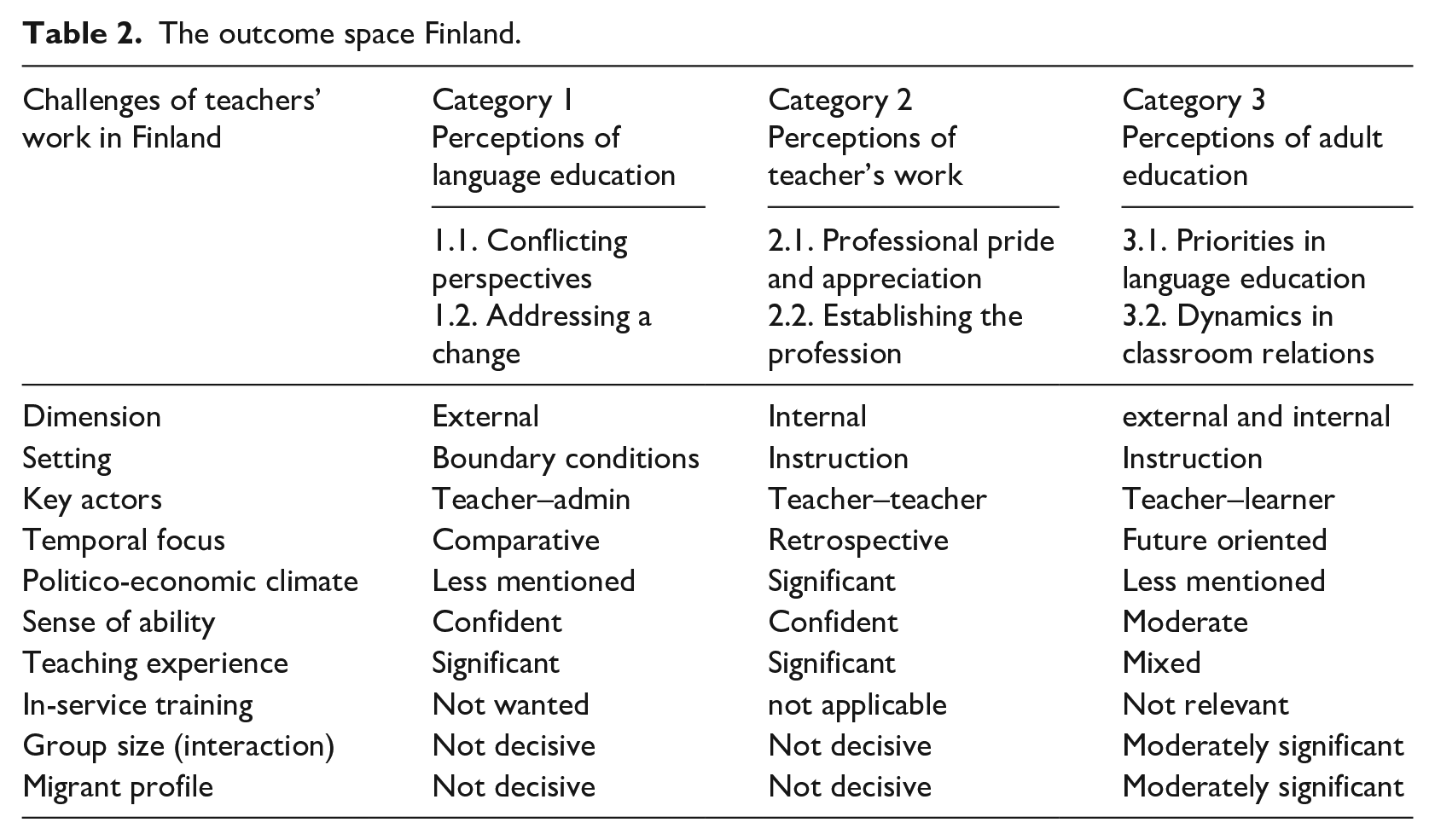
The final excerpt summarizes the core problematic across all the above accounts. In the institutional setting of second language education, the challenge circles around external and internal frictions: what is expected from teaching (and teachers) and what is expected from learning (and learners). Both actors—teachers and students—enter the “common space of education” from their particular perspective with unique skill sets, attitudes, and motivations. Within learning interaction, each aspires to a goal. For some, the goal is less clear with altering motivations; for others, it is more clearly in sight. All involved work under conditions and perspectives that affect their reaching their goal. Characteristics of the identified challenges (categories) are described in a summarizing outcome space in Table 2.
The outcome space Finland.
The Outcome Space: Finland
In Table 2, aspects of the identified categories are presented in relation to other categories. The numbering in the horizontal axis reflects the chronological order in which the categories of challenges merged as the analysis progressed. The vertical axis presents a hierarchical flow from abstract to more concrete: from aspects of the organization of the education to questions of its delivery, mainly related to the teacher practitioner.
Category 1 builds upon a direct relationship between a teacher and an employing educational organization, and further indirectly with external administrative actors. Teachers’ accounts in the category strongly reflect the boundary conditions shaping their daily work. The current state of work is compared temporally, as before and now. The accounts are characterized by confidence in one’s own competence, resonating with extensive professional experience.
Category 2 raises a teacher-internal view on teaching a second language for adults. The birth and development of the professional field are critically examined from a retrospective angle within the profession. The corresponding political and economic climate plays a pivotal role in the accounts of informants, who also, in this case, may be characterized as rather professionally confident and experienced.
Category 3 of accounts is characterized by choices to be made in the daily teaching practice. Challenges derive from both inside and outside classroom activity. The focus is on teacher and learner interaction, including questions on group size and learner profile. The reflection departs from the current moment with reference to the future, with the voice of both experienced and novice teachers.
Categories of Description: Challenges of Teachers’ Work in Germany
At the time of the interviews, toward the end of 2017, a record increase in the participant volumes of 2015 had materialized. The change had resulted in pressure to quickly employ teachers, implicating “fast” teacher training, to produce needed competence according to the Federal Ministry’s standards. Competition among existing and completely new education providers set the framework for the activity. The accounts of teachers describe challenges that, for us, present as prerequisites and psychological factors relevant to practice.
Category 1: Prerequisites for teaching
Against the described background, an opening perspective to experienced challenges points to requirements that are set from outside toward organizing second language education and steering daily teaching work through course planning.
External factors
External challenges are manifested in terms of time, learning materials, and ultimately the learners’ lives outside classroom activity. An essential challenge is pressure on the pace at which progress is measured.
Time isn’t sufficient. That is always the problem. There’s always a clash between not being able to learn, to receive what is being offered, and on the other hand: you have got to do this, accomplish this, get 6 books done within a certain time, take an exam.
The role of external requirements is central, significantly directing the choice of the teacher.
In the end, I will have to fulfill my duty. But if it wasn’t for this requirement from BAMF, I would progress at a pace that is realistic for the participants. They should learn—not to run through a course book fast—but to learn a language.
Another external factor relevantly describing the accounts of the category lies in students’ life situations influencing their learning motivation:
The real problems come from the outside, from daily life. As long as that doesn’t improve, also the instruction here is difficult. They come in so frustrated. They have been declined here and then it’s difficult to say, the language will help you.
Teachers balance between empathy and their professional role in the service system they represent.
Course design
Another dimension to challenges categorized under prerequisites for teaching involves factors in designing the language course.
This is instruction and I teach a language. That requires practical work instead of presentation only. Now I feel it’s mostly about giving a presentation [. . .] Language instruction, however, is that way only mediocre.
Frustration due to pressure to compromise one’s own standards of work can be heard.
There should be from 6 to 8 people in a group and then intensive work with those. They should be the ones talking, right?
Insecurities in the category manifest additionally in the search for teaching techniques in challenging classroom settings.
With 25 it’s no longer possible [to speak with everyone during class]. One is simply over-challenged.
Another factor affecting course planning is testing.
When we have difficult words, sometimes they would say: Oh, I won’t need this word. But the thing is, for the test they will have to learn it.
Following the voicings in Finnish accounts on challenges in adult students’ assessment, the role of obligatory testing at the end of the course is also visible here.
This is not mass education, but an industry that pulls through many things fast. [. . .] I need real teaching. And this here now, I think, is no real language instruction.
As can be seen in the account above, and from the perspective of our analysis, a rather mechanical approach to language learning has implications for methods, materials, and views on learners’ performance.
Category 2: Prerequisites for learning
The second category identifies challenges in conditions for enabling and supporting learning, involving methods and materials in use, and problematics specific to the learning of adults.
Methods and materials
In aspiring to foster the participants’ language learning in an optimal way, the challenge of addressing different learning needs is raised.
How do I give each participant what she needs? X would like to read and write, and Y is struggling with speaking inhibitions. And all this implemented in instruction, which unfortunately, yet and again, is very teacher-led, even if I would like to change that.
Methods or physical learning environments currently available are hindering a preferred way of teaching.
I’m not really happy with this frontal teaching, I must admit. We always say that it is not what we do, but it’s difficult to change that. The physical surroundings, the materials available, the preparation time should be much more in line to change that.
As noted in measuring progress in the previous category, the prominence of printed material may also challenge learning from a more instrumental point of view, in the form of exercise design.
If they don’t understand what the exercise is about, what they are supposed to do, it affects the atmosphere here in class. Worries arise, why haven’t I understood it, and they no longer have the 100% capacity to concentrate, no bandwidth left for learning.
In conclusion, teachers express an awareness of prerequisites for learning, which they—to the described extent—cannot, however, address. This is due to difficulties in changing the physical learning environment and materials. The problematics of shifting from teacher-led to more personalized teaching identified in Finnish accounts also characterize the present German category.
Adult learners
Similarly, challenges related to learners’ age, as raised by teachers in Finland, emerge as an aspect of prerequisites of learning for teachers in Germany. The life situation and varying skills and experiences reflect second language learning within an integration setting.
These people, their minds are not empty here. They’ve always got some worries, related to their stay here, their families in the countries of departure. On top of that, the employment agency is pushing them. So, it’s actually not easy, their lives here. And it is quite frankly not realistic what Germany expects from them.
The pressure for fast learning conflicts with learners’ cognitive and psychological capacity. Teachers empathize with students’ demanding positions.
They are at a certain age. They only have their mother tongue skills, always bring their mother tongue with them. We say “a,” for them it’s “i.” Even if they had 500 lessons accomplished. [. . .] And we cannot keep up this pace.
Also, a clash between requirements for learning and the learners’ profile as adults is raised.
That is also our task here, to simply introduce and present a thing and off we move on. All the rest is up for them to do. That is also very difficult for some, as they have not yet realized what it means to learn a language.
Discussing strategies for language learning seems, however, rather challenging within the given timeframe.
There are people who have lived for 20 to 30 years in Germany already and still don’t “speak German.” They have learned a street language, they cannot learn grammatically anymore, as they are so pressed by the spoken language.
The account indeed implicates a need for creativity in teaching methods for adults with strong prior expectations and experiences toward language learning and teaching. With this, we return to the perspective and performance of teachers in the third and last category.
Category 3: Psychological working environment
The third category expresses teachers’ ways of experiencing worry about their ability to support learners and cope with their duties. Challenges are reflected in reference to the professional future by discussing current and anticipated motivation and well-being at work.
Sense of incapability
Sensations of frustration and insecurity in the professional role echo a described lack of feedback and interaction regarding performance.
This job offers very little resonance, hardly any feedback. [. . .] You never know whether you’ve done something right or lost time in something. Recognition you’ll have to grant yourself. I see myself in this job in a year still, but after that not. I’m not going to be a lifelong integration training teacher.
Own motivation and future career plans are expressed in the form of a rather fundamental question.
One tries to understand the people and to understand where the problem lies. Why don’t they learn this? But also: how much work we’ll have to invest in it?
A wish to support individual students’ learning also mixes a broader psychological perspective with a feeling of helplessness.
I feel very much on my own [. . .] With some students I had a feeling that I don’t know how I could help them. [. . .] He shuts down. And he’s frustrated. And that is exactly what I should prevent.
Teachers express an awareness of the significance of language skill development to learners’ individual well-being. The introduced dimension of the category expresses a wish for more interaction and feedback to perceive progress at work, both from the perspective of learning and for the purposes of one’s own professional capability.
Burdening interaction
Whereas above, the challenge of too little interaction, also with students, seemed to form the core of the psychological challenge at work, a further challenge may lie in student interaction perceived as (qualitatively) “too much.”
The better you know the students, the more intensive it is. You have to give more out of yourself. It is difficult to maintain a certain distance and anonymity. You’ll be facing students’ personal problems, so a shorter time together would decrease this intensity, which requires a lot of energy.
Even conflicts emerge. When conflicts escalate, a sense of loneliness arises.
There have been real clashes, massive conflicts: political, personal. Up to a point where students have left the course. What I would hope for is more exchange with colleagues, as we are all rather on our own here.
In our analysis, controlling student attendance seems to be one of the conflicts deriving from administrative tasks assigned to teachers, which further raises a question about complementary training.
The student left without my allowing it. In such situations I don’t know how to behave. [. . .] So I need in-service training. I need to learn what to say.
A need for adapting one’s own behavior to address the challenge is expressed, to remain in charge of the situation.
If you don’t show dominance, you’ll lose. I’ve led quite a few courses until now, have tried quite a few things. You know, I’m a rather different kind of person.
Teachers empathize with students’ personal situations but feel that they lack the means to support them.
Sometimes they start to tell things. Why they left, what they experienced on their way here. I can’t help in any way, and that is really hard.
In the present analysis, the intensity between teacher and students emerges as a sense of helplessness.
Mood swings, not at all easy. Sickness, depression, deaths in the family [. . .] That is for me the difficult part. To pass on positive energy.
In conclusion, alongside future-oriented reflections on professional perspectives, the accounts in the German setting focus on the present moment. Time is relevant in describing the pace required for proceeding in teaching, which, according to the accounts, is too fast and leads to unrealistic expectations toward second language learning, further influencing the use of methods and materials. Smaller group sizes might allow for more personalized teaching and less compromising of preferred methods, but with some groups, the challenge lies in the intensity of interaction and insinuates a wish for shorter courses.
The Outcome Space: Germany
Table 3 presents characteristics of the above-described categories in the classification of characteristics, followed by a summary.
The outcome space Germany.
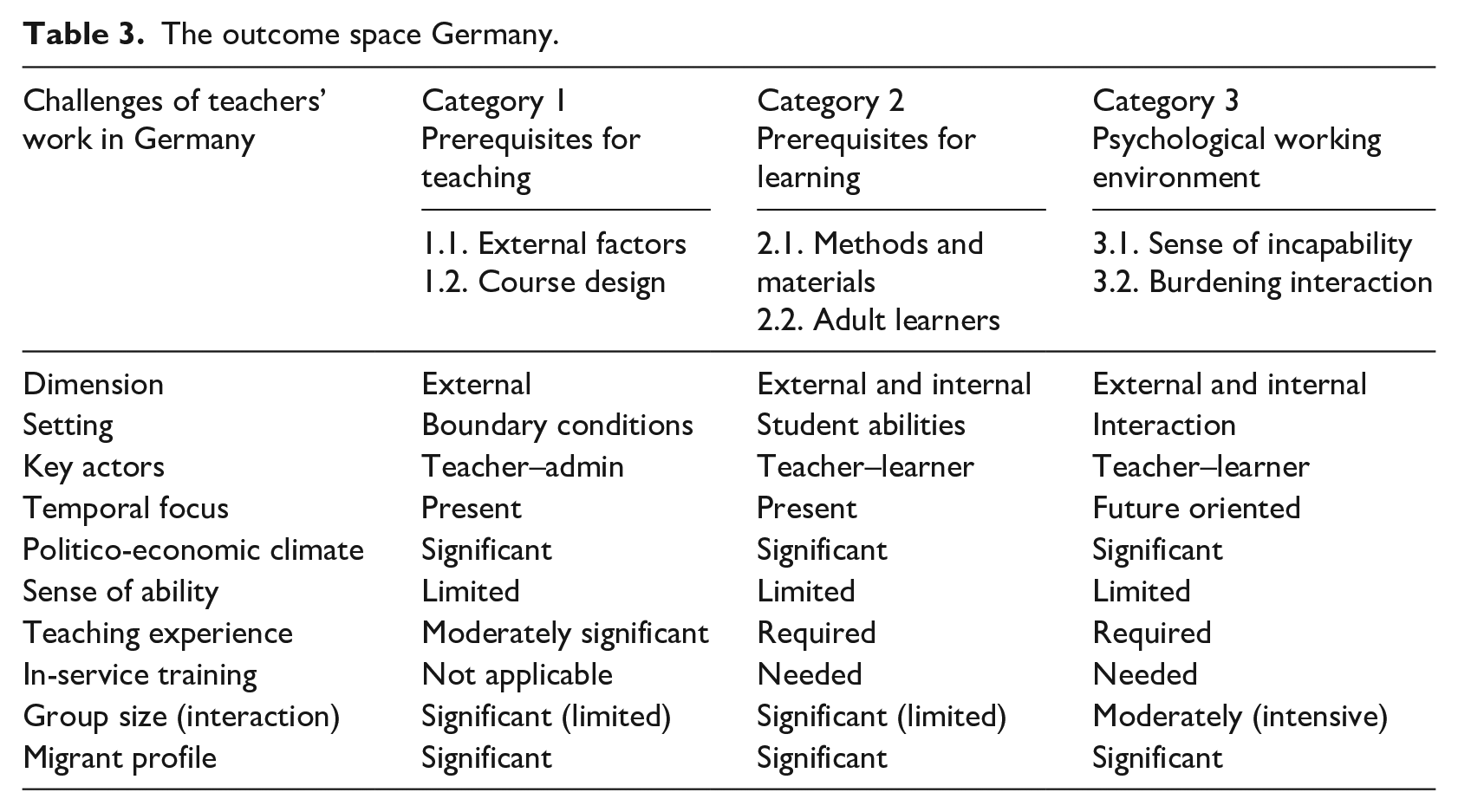
Category 1 culminates in challenges from the outside, deriving from boundary conditions affecting teaching. At the core of the problem is the relationship between teachers and the higher administration setting the goals for education. The temporal focus lies in the present; both the politico-economic climate and the volume and profile of learners are significantly relevant. The practitioners’ sense of ability is limited.
Category 2 reflects both external and internal challenges in instruction. Problematics involve the relationship between teacher and learner and focus on cognitive processes of learning. The political and economic climate is significant in the form of directions received by teachers and affecting learning. Teachers perceive limited professional capability and wish for supplementary professional training. The group size and migration profile of learners clearly affect the delivery of education.
Category 3 is characterized as both external and internal. The current political and economic climate is relevant, indirectly influencing practitioners’ sense of ability. Challenges in teacher-learner interaction also highlight the role of group size in a qualitative sense, underscoring the profile of learners. Relevant work experience and a need for in-service training are significant in responding to felt or anticipated sense of incapability.
Discussion
The present study focuses on experiential accounts in two European contexts. A phenomenographical analysis of institutional language (Säljö, 1997) explores the qualitative variation among ways that second language teachers in Finland and Germany experience challenges in their work.
Explicating core challenges from the conceptual categories of description reveals issues that anchor in teacherhood, formal language education, and learning and well-being. Further, our findings, epistemologically at the junction of “lexis” and “praxis” (see Penalva, 2014: 408), represent for us semantic, material, and relational dimensions of social practice, as described in the model of site ontologies by Schatzki (2002, 2010) in its application to educational practice (Kemmis et al., 2014; see Heikkinen et al., 2018). This conceptual framework offers a valuable “metadiscourse” for synthetizing our results, as it prioritizes context in social phenomena, but without limiting itself to spatial connotations only, and acknowledges both human practices and material arrangements (Schatzki, 2003), as well as the specific temporal-spatial conditions that shape the practices (Schatzki, 2005). To illustrate how our findings per national context meet and differ, we relate them in Figure 1 with sayings in semantic space, in the medium of language; doings in physical space-time, in the medium of activity or work; and relatings in social space, in the medium of solidarity and power (Kemmis et al., 2014: 31–34).
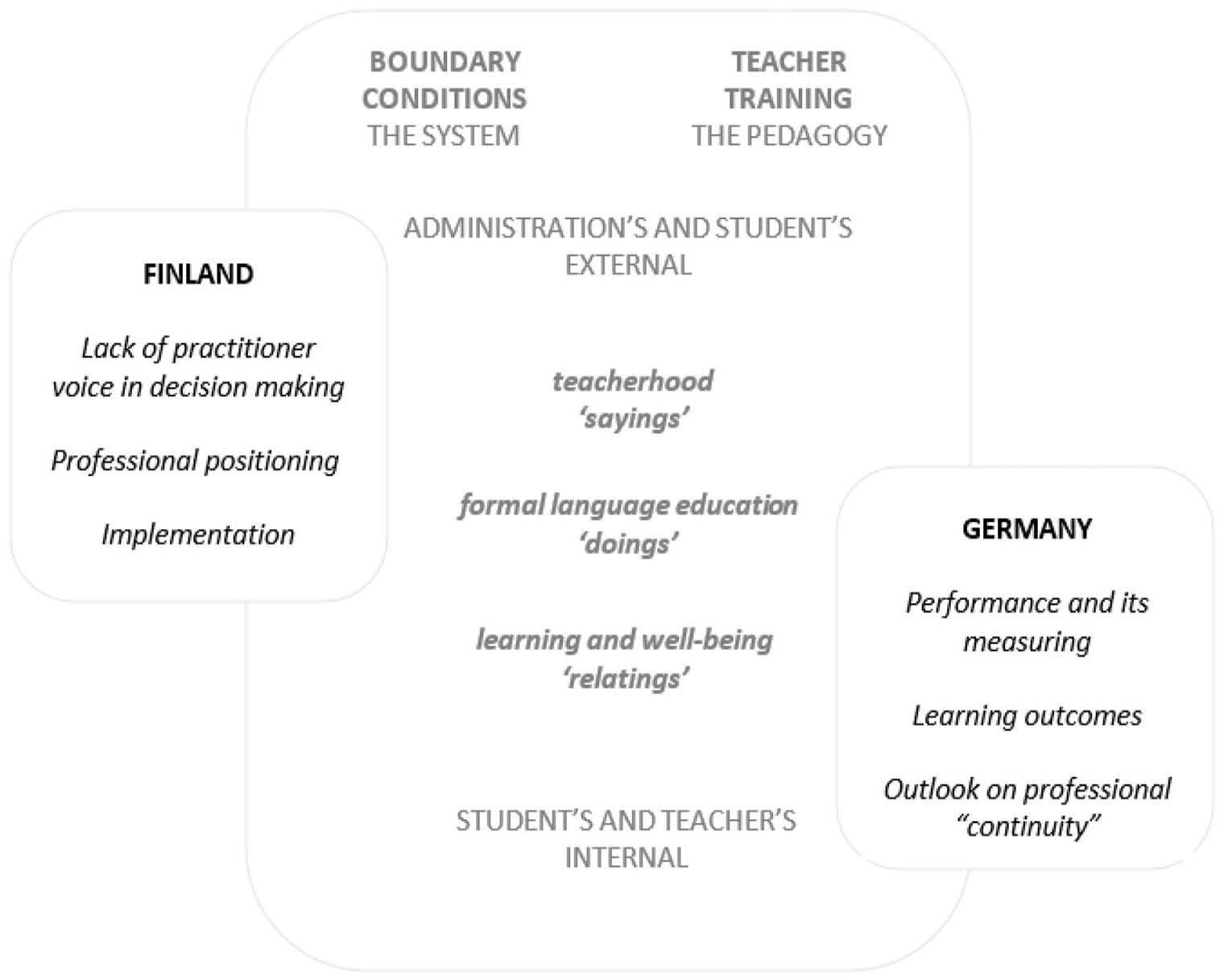
Foci in comparing the challenges among the national contexts.
Comparison Between the Two National Contexts
To begin with broader terms, challenges in Finland express a worry about maintaining existing good practices in the future, whereas colleagues in Germany struggle with more immediate problem solving in their present environment. In both contexts, challenges derive largely from classroom external factors: in Finland predominantly from administration, in Germany, from students’ personal issues. The unrealistic if not impossible requirements for language teaching identified in both settings emerge in Finland as issues of professional pride and appreciation at the level of the system, and in Germany as immediate practical pressure in enabling learning.
A sense of compromised teacherhood in Finland materializes in a semantic space and coincides with prior research on Finnish integration training (Montonen and Lappalainen, 2017). Teachers in Finland ask not to cut but to develop contact teaching. In Germany, instead of anticipating changes, teachers reflect on a current sense of loneliness under too demanding goals, especially with slower language learners. In Finland, classroom interaction as a social space is described primarily through its benefits for learning, and in Germany as a space for helping the participants, also with extra-curricular matters. Competition among education providers affects both countries. It is criticized strongly in Finland, but its implications for pedagogical priorities are discussed more in Germany, also in the literature (Heinemann, 2018; see also Kurki et al., 2018). The role of learning materials identified in our analysis and prior research in Germany (Becker, 2014: 146; Gargova, 2017: 258) is not present in Finland, though recognized in the literature (Pöyhönen and Tarnanen, 2015: 114). Assessment taxes teachers’ pedagogical preferences, especially in Germany, although test preparations also guide the practice in Finland. Official language tests are recognized as a stress factor in research, as the results determine crucial matters for participants, such as state financial aid, citizenship applications, and decisions for the length of stay (Heinemann, 2018).
The intensity of the student-teacher relationship is identified in Finland, yet the counseling role of the language teacher—even if accepted—emerges more in Germany (see Becker, 2014: 141–161). In discussing the relationship, teachers in Finland raise adult students’ own conscious effort toward learning, while colleagues in Germany describe conflicts. Conflicts derive from teachers’ bureaucratic responsibilities, such as strict recording of attendance, leading to disciplinary actions (Heinemann, 2018), as expressed in Germany. Also, mistaken or over-scaled expectations toward the role and work assignments of the professionals (Castañeda et al., 2018: 144) or the impact of language learning in an integration setting (see Saukkonen, 2020: 18–19) create friction in the second language classroom and challenge the learning effort requested in Finland. For the empathizing professional, the influence of societal phenomena and political decision-making in work increases compassion stress and has consequences for occupational well-being (Castañeda et al., 2018: 144). Teachers try to support students’ learning and foster their well-being but have difficulties in tracking their progress or predicting futures (Becker, 2014; Colliander, 2019: 152–155). This balancing act is accentuated in our findings in Germany, to the extent of affecting teachers’ future career plans.
Implications for a European Integration Education Framework
The present study concludes with European implications. Our recommendations tackle the specific perspective of language education as part of integration training from the experiential perspective of second language teachers. In our interviews, Finnish teachers described a missed momentum in making tacit knowledge explicit for higher administration at the expense of their role in developing the field. Today, to respond to the increasingly common European problematics (see EC, 2020b), we cannot afford to miss hearing what it means to “to take care of the matter” with suddenly peaked volumes and subsequent societal issues, as in Germany. The experience is valuable for fellow teaching professionals but crucially also for the administration. Understanding the multidimensional role of second language teachers within the broader information system of integration services is required for better calibration of expectations and objectives for the work. Stronger multi-stakeholder collaboration among European actors (see European Integration Network, 2021) and exchange of knowledge appreciating the teacher perspective would positively also influence teachers’ professional identity (see EC, 2020a: 11; EC, 2020b: 24).
In discussing implementation priorities, Finnish teachers stress the importance of written language skills, while German colleagues describe generation-wide consequences of guest workers’ limited language education. For future development, we perceive a critical need to defend formal second language education as a forum for developing grammatically correct language skills. Instead of course books, the use of available time should be optimized by differentiating teaching (see Pöyhönen et al., 2009: 44). To accommodate environments, methods, and materials for this purpose, the possibilities of modern technological infrastructures should be considered. Within teacher-led contact learning, interactive language-lab functionalities and increased visuality offer opportunities for more focused group work and individual oral practice to address different learning styles and needs, as well as phonological training. Digital content further offers increased flexibility and multimodality for differentiation, especially when developed by applying expertise to adult language learning and learning difficulties (see EC, 2020b: 22). Such expertise should also inform the development of assessment in collaboration with labor administration (see also Rasilainen, 2016: 47–57).
From a psychological and skills-development angle, in-service training offers a setting for peer support (see Obrink Hobzova, 2021) and tackles, for example, the raised classroom management issues in adult education (see also EC, 2020a: 18–19). Teachers’ sense of loneliness could be addressed in mentoring programs. These would benefit new teachers (Heikkinen et al., 2018), but also the growing freelance workforce (Montonen and Lappalainen, 2017). Personalized efforts may not resonate with all, but rather seeing change in conditions delimiting possibilities of action (see Simola, 2020). Organizations should share external pressure with individual teachers working under “fear of reclamation” (see Becker, 2014). Evaluation of teachers’ performance should acknowledge the impact of labor market conditions on the “outcome” (Table 2). Learners’ slow transitions from integration training to the labor market do not equal second language teachers’ weak performance (see also Saukkonen, 2020: 12–18). Consulting rather than inspecting interventions to educational organizations would inform reform work about conditions that restrict daily teaching activity (see Simola, 2020), in addition to recruiting language teaching experience in the administration. Improvements, such as freelance teachers’ remuneration (BAMF, 2020b), would further demonstrate appreciation of the profession (see, EC, 2020a: 9). Investing in this educational profession implies supporting participation and a sense of belonging, even transformation of individuals and communities beyond generations (see Colliander, 2019).
Reporting an “experienced reality” always implies limitations for a study, as it is based on the participants’ choice of expression and the degree of sharing (Säljö, 1994, 1997). Our position in conceptualizing an educational problem thus differs from participants’ role in fulfilling a professional task (see Kraft and Conroy, 2011: 386) within complex integration services in two different societies in flux. Explicating efficient practices in such a dynamic framework is not easy (Penalva, 2019), but the discourse is needed, as it has material effects (Brunila, 2011). A simulation model on the labor-market integration of refugees promises substantial returns for investments in language education (Bach et al., 2017: 54–58). High-caliber second language education will also benefit work-based migration. Both Finland and Germany need systematic large-scale empirical studies and longitudinal designs to measure the effectiveness of integration services (BIM, 2020; NAOF, 2018: 7). In any setting of the European practice, consequent improvements will be designed, documented, implemented, and ultimately experienced by people. To better understand people—complex as systems and societies—accounts of teacher experience are fundamental.
Footnotes
Appendix
Themes of the semi-structured interview schedule.
| Theme | Content of open-ended questions (e.g. How would you describe. . .?) |
|---|---|
| Background | Education Professional experience Experience in the current organization |
| Goal | Description of the main goal of the work Reaching of the goal Autonomy in course planning |
| Physical environment | Availability and suitability of materials Teaching methods Physical classroom settings Use of technology |
| Adult learners | Individual needs Motivations, prior skills, and classroom-external experiences as part of teaching approaches toward language learning |
| Language learning | Definition of sufficient language skill Personal and students’ multilingualism Classroom discussions on role of language |
| Emotions | Efforts in building classroom atmosphere Possibility of conflicts |
| Feedback and assessment | Methods for giving feedback Role of assessment Applications of working-life relevance in teaching |
| Work organization | Needs for improvements Availability of occupational support |
| Professional development | Plans and hopes Key qualities and competences of second language teachers Future education of second language teachers |
Acknowledgements
The authors would like to express their gratitude to the participants of the study and the reviewers of the manuscript for their valuable contribution.
Declaration of conflicting interests
The author(s) declared no potential conflicts of interest with respect to the research, authorship, and/or publication of this article.
Funding
The author(s) disclosed receipt of the following financial support for the research, authorship, and/or publication of this article: Data collection in Germany was funded by Emil Öhmann Foundation of the Finnish Academy of Science and Letters (personal travel grant). Data analysis was funded by the Central Fund Finnish Cultural Foundation (personal grant 1/2). Finalizing the manuscript based on peer review was funded by Finnish Cultural Foundation (personal grant 2/2). Preliminary results were presented as an oral presentation at the Congress of the Nordic Educational Research Association 2020, University of Turku, Finland.
