




Abstract
Teachers with so-called migration backgrounds are often assumed to possess higher intercultural competencies or skills for more adequately dealing with migration-related diversity than other teachers. However, these assumptions of higher intercultural competencies, specific pedagogical orientations and attitudes have rarely been systematically empirically examined. On the other hand, such a utilitarian ethnicization is increasingly criticized by migration researchers in educational science in Germany as furthering stigmatization and deprofessionalization. Against this background, our paper aims to contribute to the lively discourse about teacher with so-called migration backgrounds. We start with analysing teacher data from the German National Education Panel Study (NEPS). Our analyses indicate that teachers with and without so-called migration backgrounds do not differ significantly in most respects. These findings led us to methodological considerations with regard to the (non-)usefulness of the statistical category of ‘migration background’ in educational migration research.
Keywords
Introduction
Based on international research and key findings on ethnic minority teachers in the US, European educational policy recommendations suggest that teachers with migration backgrounds can help reduce the educational disadvantages faced by ethnic minority students due to the teachers’ ability to act as positive role models or due to them engendering fewer stereotype threat effects (Donlevy et al., 2016; Heckmann, 2008). In addition, educational policy in Germany assumes that teachers with so-called migration backgrounds, as the term is used in Germany and other German-speaking areas in Europe, have higher intercultural competencies or skills for more adequately dealing with migration-related diversity than other teachers (Akbaba et al., 2013). In education policy discourse, these competencies are commonly seen as quasi-natural (Akbaba et al., 2013), arising from everyday experiences in the lives of individuals homogenized under the label of ‘migration background’. In this sense, several studies have explored the (hidden) potential of these teachers (e.g. Edelmann, 2013; Karakaş, 2013) or stressed the importance of their representation: ‘Increasing the number of teachers with [a] migration background is indeed an essential part of intercultural school development’ (Georgi, 2016: 70; cf. Stiller and Zeoli, 2013: 369). However, these assumptions of higher intercultural competencies, specific pedagogical orientations and attitudes have rarely been systematically empirically examined. In addition, such a utilitarian ethnicization is increasingly criticized by migration researchers in educational science in Germany as furthering stigmatization and deprofessionalization (e.g. Akbaba, 2017; Karakaşoğlu et al., 2013; Rotter, 2014a).
Nevertheless, to date, the category of ‘teachers with migration background’ has been widely used in official statistics in Germany and other European German-speaking countries. 1 Additionally, some ‘pioneering’ studies (Rosen, 2015b) in education research in Germany have been concerned with ‘teachers with migration background’ (see the book titles of, e.g. Bräu et al., 2013; Georgi et al., 2011). 2 Against this background, our paper aims to contribute to the lively discourse about the appropriateness of the statistical category of ‘migration background’ by first shedding light on the presumed characteristics and attitudes of teachers with and without so-called migration backgrounds. Therefore, our research question seeks answers to two questions. (1) Do teachers with and without so-called migration backgrounds differ in their pedagogical orientations regarding migration-related diversity? To answer this question, we use data from the German National Education Panel Study (NEPS). In this data analysis, we work with the term ‘migration background’ but add ‘so-called’ to express the nature of our open-ended empirical analysis, and therefore, we speak of ‘teachers with so-called migration backgrounds’ (this phrasing is also chosen by Karakaşoğlu and Doğmuş, 2016). In summary, our analyses indicate mostly neutral (‘null’) findings, that is, teachers with and without so-called migration backgrounds do not differ significantly in many respects. The findings led us to perform a second step involving methodological considerations with regard to the statistical category of ‘migration background’ as such, giving rise to the following question: (2) Is the category of migration background actually useful for educational and social science migration research with a focus on teachers’ pedagogical orientations? We close with several considerations regarding further research in light of recognition theory in order to embed our considerations in the theoretical framework of the special issue.
Background and literature review
In the following, we first provide a brief overview of studies focusing on (pre-service) teachers with so-called migration backgrounds from Germany and two other German-speaking countries in Europe (Austria and Switzerland), as the term ‘teacher with a so-called migration background’ seems to be predominant in these countries. In contrast, research in the United States, the United Kingdom and Canada, for example, examines minority teachers and/or ethnicity, terms that have different definitions and connotations that tend to focus on individuals’ race or ethnicity rather than indicating the timing of their immigration history, their place of birth or the immigration history or birthplaces of their parents. Nevertheless, we start our literature review with studies on minority teachers to contextualize our research in that strand of research. We then discuss studies from German-speaking areas in more detail with regard to presumed differences in the pedagogical orientations comparing teachers with and without so-called migration backgrounds.
Research on teachers with so-called migration backgrounds
International research from the United States, the United Kingdom and Canada shows some positive effects of ethnic minority teachers on the academic performance of ethnic minority students: Such teachers provide multicultural education, serve as role models and change agents, are less negatively biased against ethnic minority students and have higher academic expectations of these students (e.g. Dee, 2004; Gershenson et al., 2016; Goldhaber et al., 2015; Marx et al., 2009; Smith, 2000). Relevant findings emphasize the entry barriers, unequal treatment, discrimination and racism experienced by ethnic minority teachers in university teacher training and in the labour market (e.g. Carrington and Tomlin, 2000; Cunningham and Hargreaves, 2007; Kohli, 2009; Lynn and Lewis, 2006; Neal et al., 2015; Quiocho and Rios, 2000).
Six years ago, Lengyel and Rosen (2015: 162) stated that compared to these studies conducted in the United States, the United Kingdom and Canada since the 1980s, this research in Germany has only just begun (see also Georgi, 2013, 2016; Mantel and Leutwyler, 2013 for Austria, Germany and Switzerland). Since then, research attention on pre-service and in-service teachers with so-called migration backgrounds has increased considerably. In this research area, qualitative studies predominate over studies with mixed-methods designs, and there are very few studies using large-scale quantitative data (Rosen and Lengyel, in press). With regard to the latter, in an international literature review focusing on the Netherlands, Belgium, Germany, the United Kingdom and the United States, Driessen (2015: 181) found no studies conducted in Germany that met the criteria of being quantitative empirical research, providing sufficiently large sample sizes and using the ethnicity of the teacher as the central explanatory variable. In contrast, three other aspects have received particular attention in the academic discourse on German-speaking areas, which mainly focuses on subjective teacher evaluations rather than actual student outcomes (exceptions are e.g. Klein et al., 2019; Neugebauer and Klein, 2016). Most research has been concerned with (1) experiences of ethnicization, racism and othering, (2) teachers’ professional identity and (3) teachers’ characteristics and specific pedagogical competencies regarding the migration-related diversity of their students. Only research with the last focus actually compares (pre-service) teachers with and without so-called migration backgrounds; this research will be reviewed separately in research comparing teachers with and without so-called migration backgrounds.
Ad (1), many studies on (pre-service) teachers with so-called migration backgrounds in Germany, as well as in Austria and Switzerland, focus on the experiences of ethnicization, racism and othering processes, for example, by means of biographical-narrative interviews (Karakaş, 2011), in-depth interviews (Kul, 2013), problem-centred interviews (El and Fereidooni, 2016) and ethnographic observations (Akbaba, 2017). Exploratively, these studies show that ethnic differences are constructed in everyday school life, that (pre-service) teachers are racialized and that they develop different strategies for dealing with (often subtle) derogatory forms of address. This research area also captures the views of teacher education instructors and shows that they approach pre-service teachers with so-called migration backgrounds with deficit-oriented attitudes (Döll and Knappik, 2015 for Austria; Wojciechowicz, 2013). These views encompass, in particular, anti-Muslim attitudes and stereotypes (Karakaşoğlu and Doğmuş, 2016; Karakaşoğlu and Wojciechowicz, 2017). Interestingly, an exploratory study of students’ perceptions shows that they attach little or no importance to the so-called migration background of their teachers. Strasser and Warburg (2015) use focus groups and show that teachers’ minority statuses become relevant only in certain situations and that this minority dimension seems to be tightly interwoven with other dimensions (e.g. age, gender and class) that are more salient for students.
Ad (2), another strand of research, which is well developed in the German-speaking literature, examines the professional identity of pre-service/in-service teachers through biographical-narrative interviews (Georgi et al., 2011; Mantel, 2017, 2021 for Switzerland), in-depth expert interviews (Rotter, 2014b), semi-structured interviews (Bressler and Rotter, 2017), focus groups (Lengyel and Rosen, 2012, 2015) and the document analysis of teacher portfolios (Lengyel and Rosen, 2015; Rosen, 2015a). These studies scrutinize the ways in which teachers with so-called migration backgrounds handle diversity and multilingualism in schools and classrooms (or the ways in which pre-service teachers intend to do so), how they deal with educational policy that suggests that they have certain intercultural competences and how they understand their professional identity in this context. Overall, (pre-service) teachers with so-called migration backgrounds approach such educational policy attributions with ambivalence: On the one hand, they want to reduce educational inequalities; on the other hand, they do not see themselves as responsible for ethnic inequalities, and they want to be perceived primarily in their professional roles as teachers, rather than as people with so-called migration background. In addition, they do not consider their own multilingualism to be part of their professional identity (Karakaş, 2013; Lengyel and Rosen, 2015; Panagiotopoulou and Rosen, 2016; Schlickum, 2013). At the same time, based on focus groups with pre-service teachers with so-called migration backgrounds in university teacher training, Lengyel and Rosen (2012) use the in vivo coding ‘giving us somewhat of an advantage’ (p. 78) to show that the majority of them assume themselves to have a higher level of intercultural competence than pre-service teachers without so-called migration backgrounds. These pre-service teachers with so-called migration backgrounds also emphasize that their fellow teacher education students can and should acquire specific pedagogical orientations such as openness, tolerance, appreciation and individualization, that are considered to be crucial, migration-independent elements of pedagogical professionalism for multicultural schools (Lengyel and Rosen, 2012: 81 ff.).
Research comparing teachers with and without so-called migration backgrounds
Ad (3), there are a number of exploratory studies that provide a comparative perspective between (pre-service) teachers with and without so-called migration backgrounds focusing on teachers’ characteristics and pedagogical orientations (Bandorski and Karakaşoğlu, 2013; Edelmann, 2007 for Switzerland; Edelmann et al., 2015 for Switzerland; Glock and Schuchart, 2019; Göbel, 2013; Kleen et al., 2019; Ova et al., 2020). Regarding teachers’ characteristics, Klein et al. (2019: Table 2) reveal some socio-demographic differences of teachers without and with so-called migration backgrounds. Using teacher data from the IQB National Assessment Study on Languages 2008/2009, the authors show that in their sample, teachers with so-called migration backgrounds are more often female and younger and possess less job experience than teachers without so-called migration backgrounds. Furthermore, they are more often employed in middle or intermediate secondary schools than in upper secondary schools than teacher without so-called migration backgrounds. As a possible consequence of school segregation within the stratified German school system, teachers with so-called migration backgrounds more often teach in classrooms with a slightly higher share of students with so-called migration backgrounds and students with less educated parents. Furthermore, there are no differences between teachers with and without so-called migration backgrounds regarding parent’s social background.
Of particular interest for our research questions are findings that indicate differences and reveal the educational potential of (pre-service) teachers with so-called migration backgrounds in dealing with migration-related diversity. Accordingly, Bandorski and Karakaşoğlu (2013) report that pre-service teachers with so-called migration backgrounds are more sensitive to inequality than other teachers and, thus, are more motivated to oppose inequality in the education system. In a vignette study, Glock and Schuchart (2019) show that pre-service teachers with the same ethnic backgrounds as the target students assess students’ family language proficiency more positively and perceive students to be more competent in mathematics, science and general competence than two other pre-service teacher groups (ethnic-majority pre-service teachers and pre-service teachers with ethnic minority backgrounds different from those of the target students). Taking a similar approach, Kleen et al. (2019) conducted an interview study to investigate the attitudes of pre-service teachers towards Turkish students, who compose the largest minority group in Germany, and argue that teachers’ attitudes towards Turkish students might contribute to the educational disadvantages of this social group (see Lorenz et al., 2016 for an explanation of stereotypes and biased teacher expectations). Their findings showed no differences in explicit attitudes but significant differences in implicit attitudes depending on pre-service teachers’ ethnic backgrounds: Those with Turkish backgrounds showed positive implicit attitudes towards Turkish students, those from other ethnic minority backgrounds had more neutral attitudes, and German preservice teachers had negative implicit attitudes towards Turkish students. The authors discuss these findings regarding the benefits of having a diverse teachers’ lounge. Göbel (2013) investigates the emotional reactions of teachers towards critical incidents and shows that teachers with so-called migration backgrounds indicate greater emotional stress, provide more complex interpretations of situations and favour the resolution of conflicts through communicative engagement with those involved; the author interprets this finding as an indication of high intercultural competence. Edelmann (2007) examines the attitudes and pedagogical orientations of teachers in the German-speaking part of Switzerland. In her qualitative study of 40 teachers, including 15 with so-called migration backgrounds, she found that all teachers with so-called migration backgrounds acknowledged that diversity has synergistic benefits, while none advocated a detached or distanced teaching style. In particular, young teachers with so-called migration backgrounds prefer a ‘silent recognition’ (Edelmann, 2007: 173) of diversity in classrooms, thus avoiding stereotyping students. For these reasons, Edelmann concludes that teachers with so-called migrant backgrounds have ‘potential pedagogical professionalism in dealing with migration-related diversity’ (this is the title of one of her publications from 2013; see Edelmann, 2013).
In a recent study from Germany, a total of 51 teachers, 10 of whom had so-called migration backgrounds, were interviewed qualitatively about their values and educational maxims (Ova et al., 2020). In contrast to all other studies we referred to, this study shows that the value orientations of teachers with and without so-called migration backgrounds hardly differ. The authors attribute this to the shared socialization conditions of the teachers as well as to their common socioeconomic characteristics and conclude that their findings ‘suggest a universality of value types, especially when ethnically differentiated but socially equal individuals are compared’ (Ova et al., 2020: 120). We will return to this in the discussion of our own empirical results, which also predominantly reveal no differences between teachers with and without so-called migration backgrounds Discussion; however, our focus is more on teachers’ professional educational orientations than on the general educational maxims explored by Ova et al. (2020).
Empirical analyses using German NEPS data
In the following, we present analyses of a large-scale dataset to address the question of systematic differences between teachers with and without so-called migration backgrounds. We first describe the data in more detail and then present our results.
Data and variables
In our empirical analysis, we use data from the German National Educational Panel Study (NEPS). The NEPS is one of the few large-scale education datasets in Germany that has a multi-actor design, that is, that provides information on both students and teachers (Blossfeld et al., 2011) 3 . The school samples primarily comprised students, and additional information was gathered from their teachers. In our analyses of teacher characteristics, we use the teacher surveys of students in grades 5 and 9 (so-called starting cohorts, SC3 and SC4, respectively). 4 We include all teachers observed in the first wave of the study in 2010, as well as (additional) teachers surveyed in the subsequent waves in 2011 and 2012. We analyse the data cross-sectionally, ensuring that each teacher is included only once in the pooled dataset. Our sample of teachers consists of n = 3548 cases.
In the NEPS, teachers were asked to indicate their migration status as follows: ‘I was born abroad’, ‘I was born in Germany, but at least one parent was born abroad’, or ‘no migration background’. We use both options 1 and 2 to identify teachers with so-called migration backgrounds. Unfortunately, the data do not allow more differentiated analyses. By no means do we want to perpetuate the distinction between teachers with and without so-called migration backgrounds as a basis for othering; instead, we aim to test the usefulness of the distinction given its widespread use in policy recommendations and previous research in Germany, Austria and the German-speaking part of Switzerland. We will discuss the shortcomings of this categorization in the following section.
Due to space considerations, we abbreviate the terms ‘teachers with so-called migration backgrounds’ and ‘teachers without so-called migrant background’ as so-called mt and non-mt, respectively, in the tables.
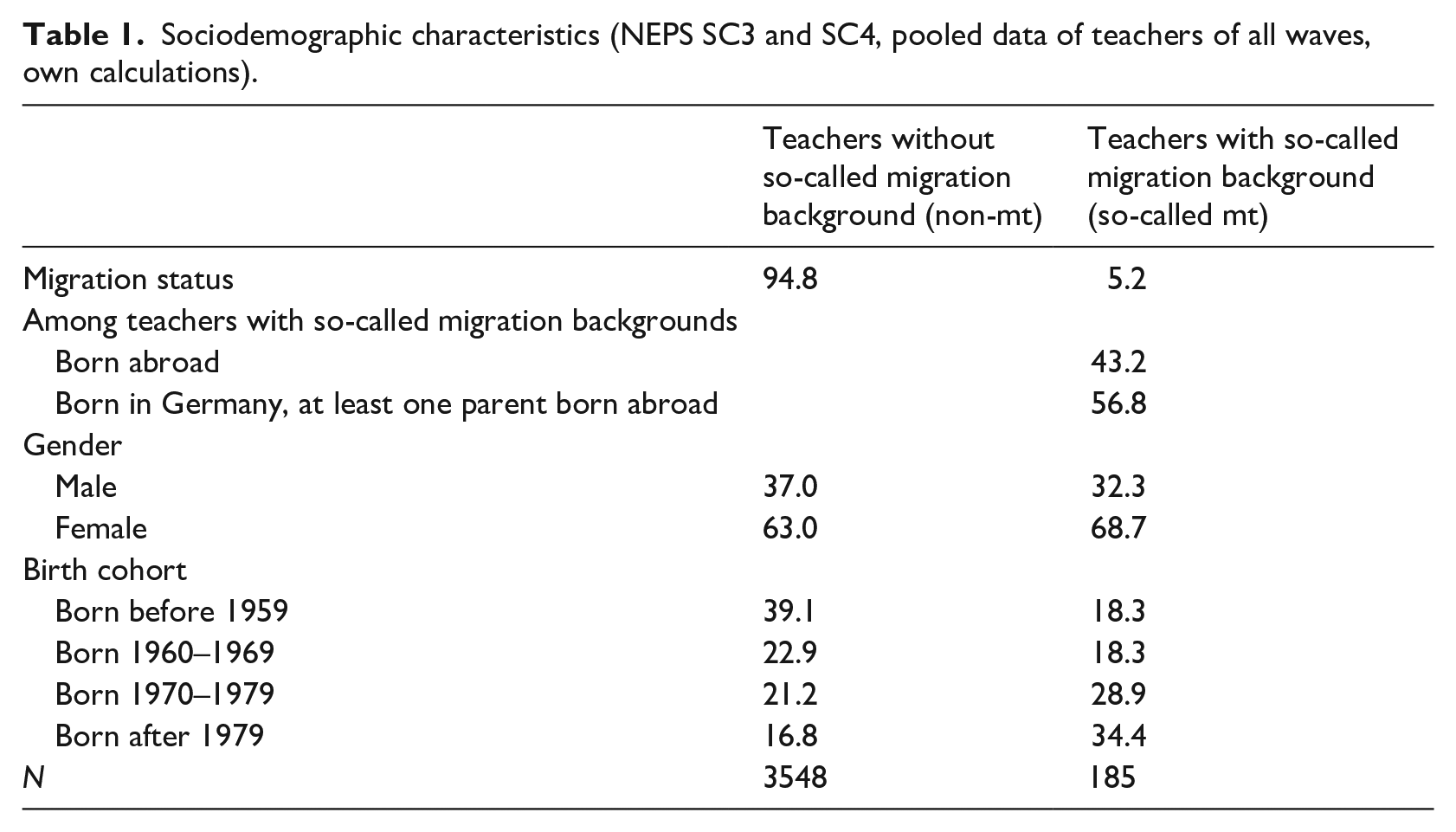
In our dataset, 5% of all teachers could be categorized as teachers with so-called migration backgrounds (n = 185). Of those, 43% were born abroad, and 57% were born in Germany and had at least one parent who was born abroad. Among the teachers with so-called migration backgrounds, women are slightly overrepresented and their age distribution is younger than that of teachers without so-called migration background (see Table 1).
Sociodemographic characteristics (NEPS SC3 and SC4, pooled data of teachers of all waves, own calculations).
In the following, we compare teachers with and without so-called migration backgrounds in terms of their attitudes towards migration-related diversity as well as several aspects of their pedagogical orientations, such as professional aspects of teaching and factors of student success in school. Several items in each of the domains were presented to the respondents; but not all items were included in all survey waves: interculturality and cultural diversity were assessed only in wave 3 and some of the factors of student success were assessed only in waves 1 and 3. Tables A1 to A3 in the Appendix show the full wording of the items, frequency distributions of all categories and Cronbach’s alpha for each scale, which is a measurement of the items’ interrelatedness. As a rule of thumb, scales with an alpha >0.7 are considered acceptable, whereas scales with an alpha <0.6 are considered to not consistently measure one underlying concept. According to their Cronbach’s alphas, the items on the evaluation of cultural diversity and professional aspects contribute to an internally consistent scale, whereas the items about influential factors of student success do not. Hence, in the following empirical analyses we examine all items separately. In the following tables, we dichotomize the respondents’ answers using the middle of the response scale but note: several distributions are highly skewed (see Tables A1–A3 in the appendix).
Results: Teachers’ evaluations of cultural diversity, professional aspects of teaching and factors for student success
Table 2 shows the teachers’ agreement on items concerning migration-related diversity. Interestingly, we found no significant difference between the two groups, except for 1 out of 10 items, which is also reflected in the t-test of the full scale (p < 0.30). This result contradicts the assumption that teachers with so-called migration backgrounds have better migration-related or minority-related understanding due to habitus sensitivity (Fabel-Lamla and Klomfaß, 2014).
Evaluation of cultural diversity by teachers with so-called migration backgrounds (NEPS SC3 and SC4, pooled data from teachers in all waves, authors’ own calculations).
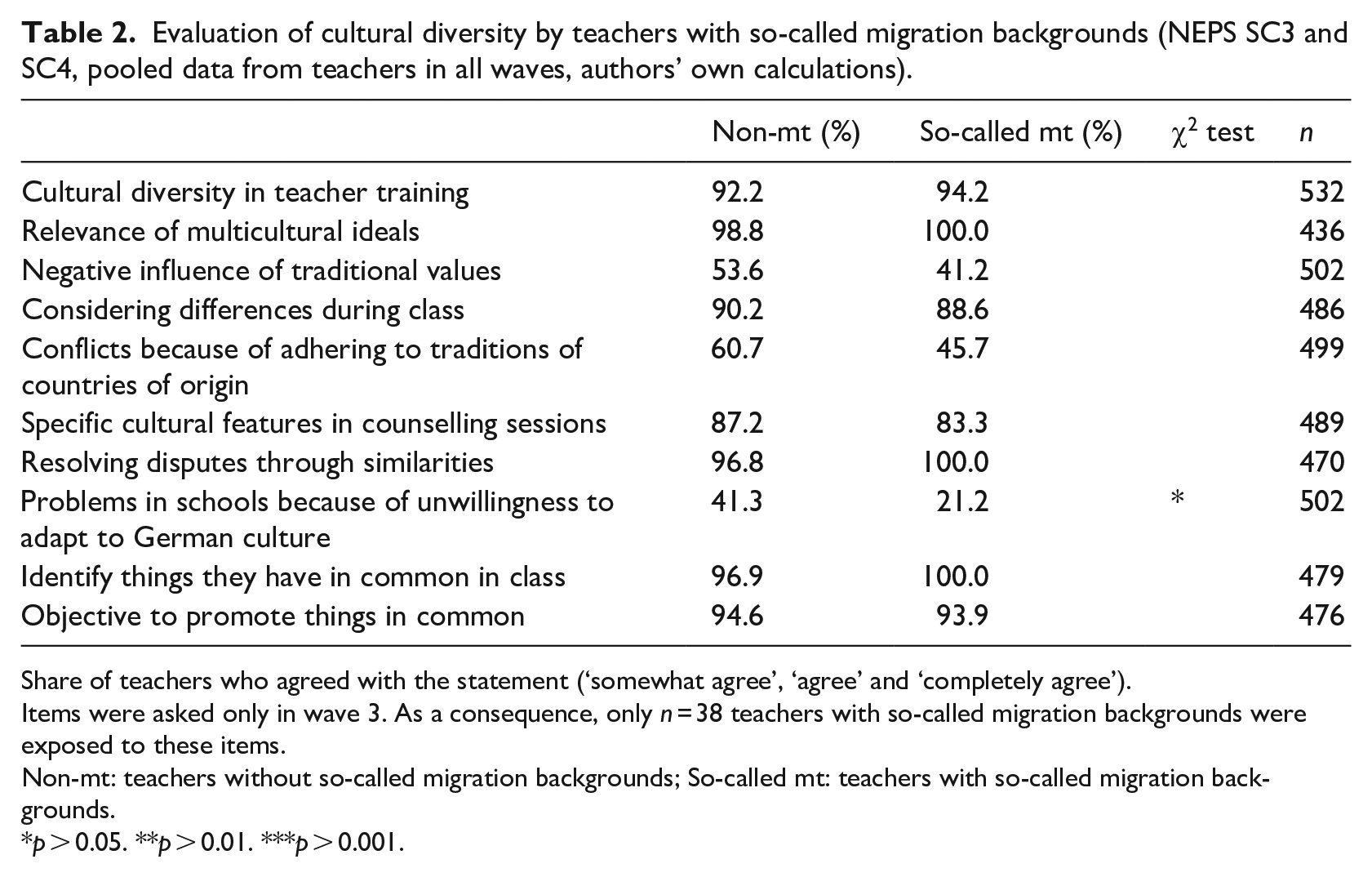
Share of teachers who agreed with the statement (‘somewhat agree’, ‘agree’ and ‘completely agree’).
Items were asked only in wave 3. As a consequence, only n = 38 teachers with so-called migration backgrounds were exposed to these items.
Non-mt: teachers without so-called migration backgrounds; So-called mt: teachers with so-called migration backgrounds.
p > 0.05. **p > 0.01. ***p > 0.001.
The teachers were also asked to evaluate different professional aspects of teaching. The results are shown in Table 3. The results for all three items indicate significant differences between the teachers with and without so-called migration backgrounds, but not in the ways one might expect, given the literature. Teachers with so-called migration backgrounds place less emphasis on considering students’ personal situations in the assessment of student performance, and they less often state that it is important to be informed about students’ problems and family backgrounds. Regarding the full scale consisting of the three items about professional aspects of teaching, we also observe a significant difference in the means of the two groups, with teachers with so-called migration backgrounds paying less attention to students’ context than teachers without such backgrounds do (p < 0.01).
Professional aspects of teaching by teachers with so-called migration backgrounds (NEPS SC3 and SC4, pooled data of teachers of all waves, authors’ own calculations).
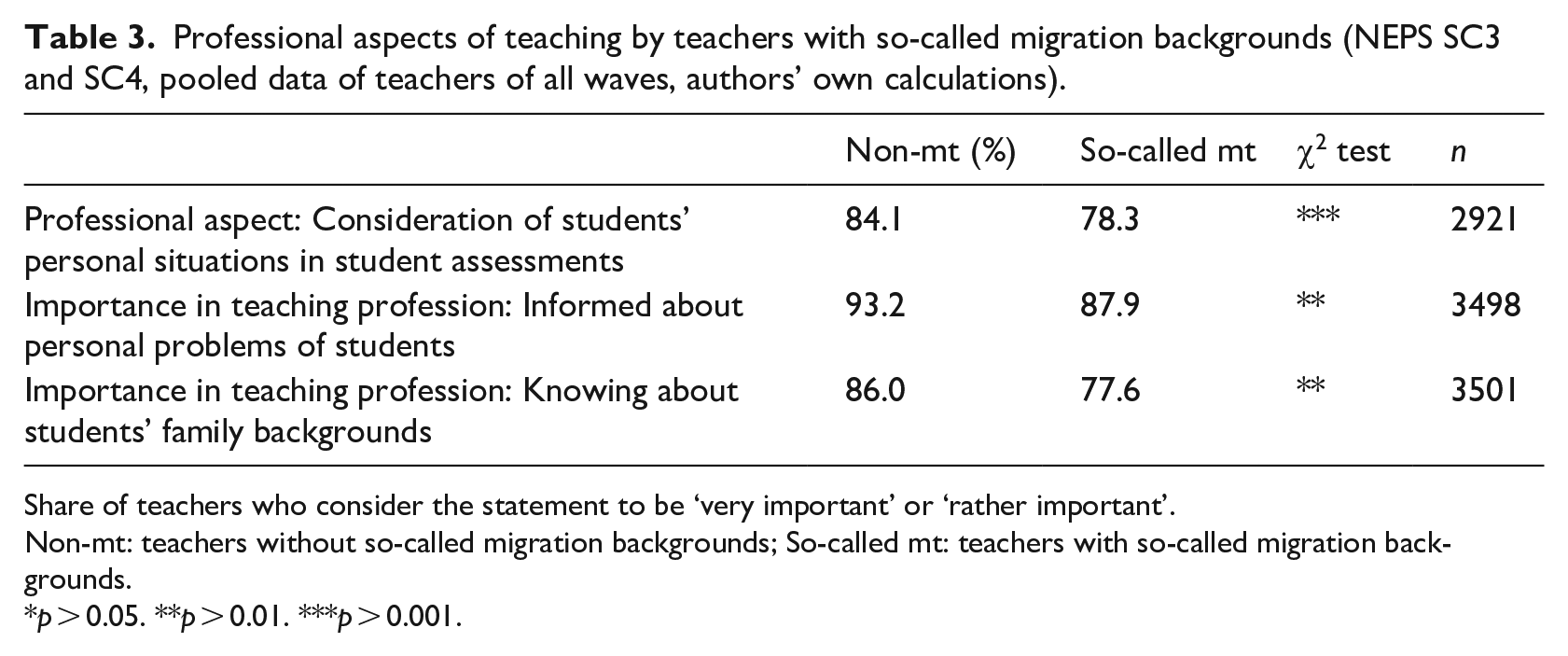
Share of teachers who consider the statement to be ‘very important’ or ‘rather important’.
Non-mt: teachers without so-called migration backgrounds; So-called mt: teachers with so-called migration backgrounds.
p > 0.05. **p > 0.01. ***p > 0.001.
Finally, in most cases, teachers with and without so-called migration backgrounds do not significantly differ in almost all aspects related to factors that may influence students’ success in school (see Table 4). The exceptions are mothers’ employment, students’ language proficiency and method of teaching, which are rated as less important by teachers with so-called migration backgrounds. In addition, teachers with so-called migration backgrounds place significantly less emphasis on teaching methods in ensuring student success.
Influential factors for student success by teachers with so-called migration backgrounds (NEPS SC3 and SC4, pooled data of teachers of all waves, authors’ own calculations).
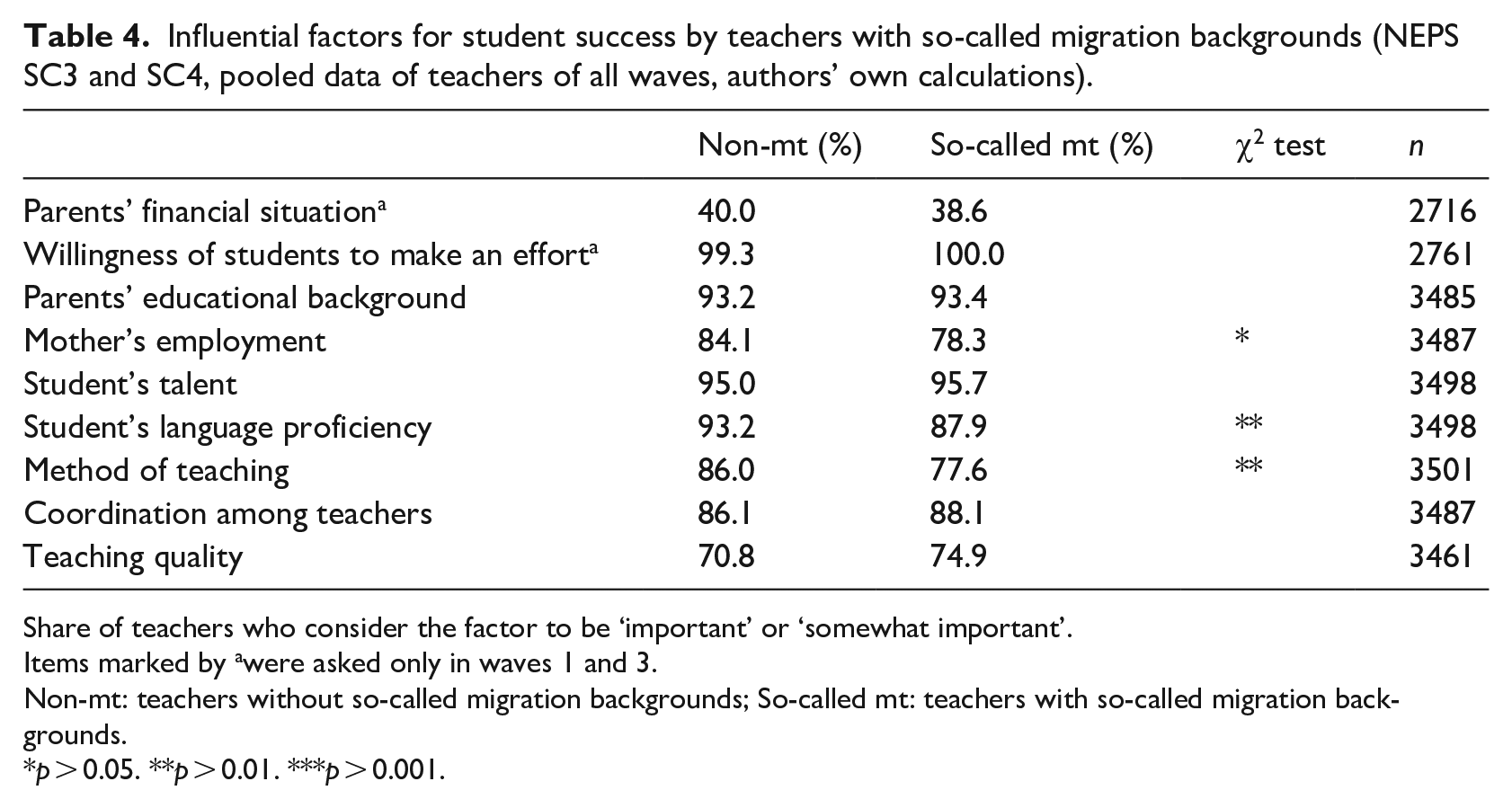
Share of teachers who consider the factor to be ‘important’ or ‘somewhat important’.
Items marked by awere asked only in waves 1 and 3.
Non-mt: teachers without so-called migration backgrounds; So-called mt: teachers with so-called migration backgrounds.
p > 0.05. **p > 0.01. ***p > 0.001.
Discussion: Questioning the use of so-called migration backgrounds
Our descriptive findings show that teachers with and without so-called migration backgrounds hardly differ in most of the examined aspects, and thus, teachers with so-called backgrounds place less emphasis on information about students’ personal situations and family backgrounds, contradicting the assumption that teachers with so-called migration backgrounds might possess extraordinary closeness to students. Therefore, what can we conclude from these results? First and foremost, teachers with so-called migration backgrounds do not quasi-naturally hold certain attitudes or skills that help them better deal with migration-related diversity. These findings bring into question the educational policy in Germany that has advocated an increase in the number of teachers with so-called migration backgrounds due to ‘functional or utility arguments: such teachers are ideal bridge-builders, cultural brokers, language translators and integration ambassadors’; in particular, they are ‘assumed to possess intercultural competencies deemed useful for dealing with highly diverse students’ (Georgi, 2016: 60). In other words, the recognition of their so-called migration background is based on the culturally coded practice of identification (see Balzer, 2019) and on the implicitly ethnicizing attribution to them of pedagogical competences and diversity-sensitive attitudes. Hence, in a more general discussion, we now turn to our second question: Is the category of migration background useful for educational and social science migration research with a focus on teachers’ pedagogical orientations?
First, the term itself is ambiguous and operationalized in a wide variety of ways (see, e.g. Schneider and Schmidt, 2016 for different definitions and usage with regard to teachers; for an example of different operationalizations with students, see Kemper, 2017). In any case, its usage may contribute to othering processes. Several researchers have already problematized categories such as ‘migration background’ and ‘first, second and third generation’, as they are socially constructed and reinforce exclusion processes in the media, politics and everyday life (Chimienti et al., 2019; Dahinden, 2016; Elrick and Schwartzman, 2015; Korteweg, 2017; Rotter and Schlickum, 2013; Will, 2019). For example, the label ‘Germans with migration backgrounds’ is misleading, as 52% of persons with so-called migration background are German citizens (Will, 2020) . Rather, the term suggests that there are ‘real’ and ‘less real’ Germans, potentially leading to their unequal treatment and constructing and perpetuating otherness (Bednaschewsky and Supik, 2018: 191). In this respect, the complex combination of citizenship and place of birth, for example, in the Microcensus with 19 (!) questions on respondent’s citizenship, place of birth (in Germany or abroad) and the same variables for each parent may still not provide an adequate operationalization of so-called migration backgrounds (Bednaschewsky and Supik, 2018: 183). Moreover, the so-called migration background is more generally questioned by Gillborn et al. (2018: 117), who draw on the principles of Critical Race Theory as statistical ‘categories/groups are neither ‘natural’ nor given’. 5
Second, other factors may actually have a much stronger influence than teachers’ migration background on migration-related attitudes and pedagogical orientation, and these attitudes and orientations may change over time, that is, based on their own school experiences but also, in particular, on their teacher training and teaching experiences. Epp (2019), for example, refers to the scope of these orientations when he references the statement of Altmann quoted in many publications on teacher education research: ‘Teachers teach as they were taught, not as they were taught to teach’ (1983: 19, cited in Epp, 2019: 6). However, defining one’s migration background by one’s place of birth does not grasp this aspect, as some teachers categorized ‘with so-called migration backgrounds’ grew up in Germany and/or completed their school career there, whereas others may have acquired their educational qualifications abroad and migrated to Germany after graduation as internationally trained teachers (cf. Terhart, 2021; in this Special Issue). In the same vein, using nationality rather than birthplace also does not shed any light on this issue. Instead, information on the school career and the educational qualifications acquired, including professionalization as a teacher, might be relevant for the development of the diversity-related attitudes and pedagogical orientation of teachers if, for example, university teacher training has an impact on attitudes towards migration-related diversity and provides pedagogical knowledge about ‘unschooling racism’ (Orelus, 2020). In this case, the school attendance history of those who have gone through the monolingual and monocultural school system in Germany (Gogolin, 1994) are less of an explanatory factor than pedagogical professionalism in dealing with migration-related diversity acquired in university teacher education.
Third, unlike the term ‘ethnicity’ used in English-speaking areas, one’s so-called migration background cannot be ‘chosen’ by the individual; rather, it is defined as a statistical category (Horvath, 2017: 206). According to Stošić (2017: 95), the problematic potential of the term ‘migration background’ lies in its timelessness. Furthermore, on an epistemological level, Stošić (2017) emphasizes that scientific disciplines dealing with migration issues need an idea of the ‘other’ to be able to continue their analyses and operations. As coherent and convincing as this critique is, research on social and educational inequality is paradoxically forced to use terms that can expose and combat these very inequalities through, for example, initiatives such as diversifying the teaching force. What is required, then, is a terminological repertoire that allows distinction for revealing inequalities but is at the same time non-discriminatory. Therefore, we also plead – following Horvath, 2017, among others – for a (self-)critical examination of the use of specific terms in the context of scientific research. Hence, instead of the widespread recording of migration background in German official statistics as well as in educational research, ethnic belonging could be also surveyed according to the recommendations of the United Nations Statistics Authority by a single, relatively simple question about subjective self-identification (Bednaschewsky and Supik, 2018: 191f), namely, ‘To which ethnic group do you belong’? As Bednaschewsky and Supik (2018) further explain, there is no right or wrong answer to this question; each respondent replies to it with what suits her or him subjectively. There can then be a whole range of predefined categories to choose from, some of which are self-identifications and some of which are external identifications, alongside additional fields for an open response (Bednaschewsky and Supik, 2018: 192). The implementation of such a question could contribute to a dismantling of binary coding along with the schemas of ‘with’ and ‘without’ or ‘us’ and ‘other’ according to post-migrant theory (Römhild, 2017) by questioning hegemonic understandings of ethnic belonging and exclusion in a migration society. Such new categorization may stimulate further research on the question of whether and to what extent teachers with different senses of ethnic belonging actually differ from one another in terms of their attitudes towards diversity and pedagogical orientations or whether professional qualifications and identity as a teacher are the deciding factors; in the words of one teacher, ‘First and foremost, we are teachers’ (see Proyer et al., 2021 in this special issue).
Footnotes
Appendix
Influential factors for student success.
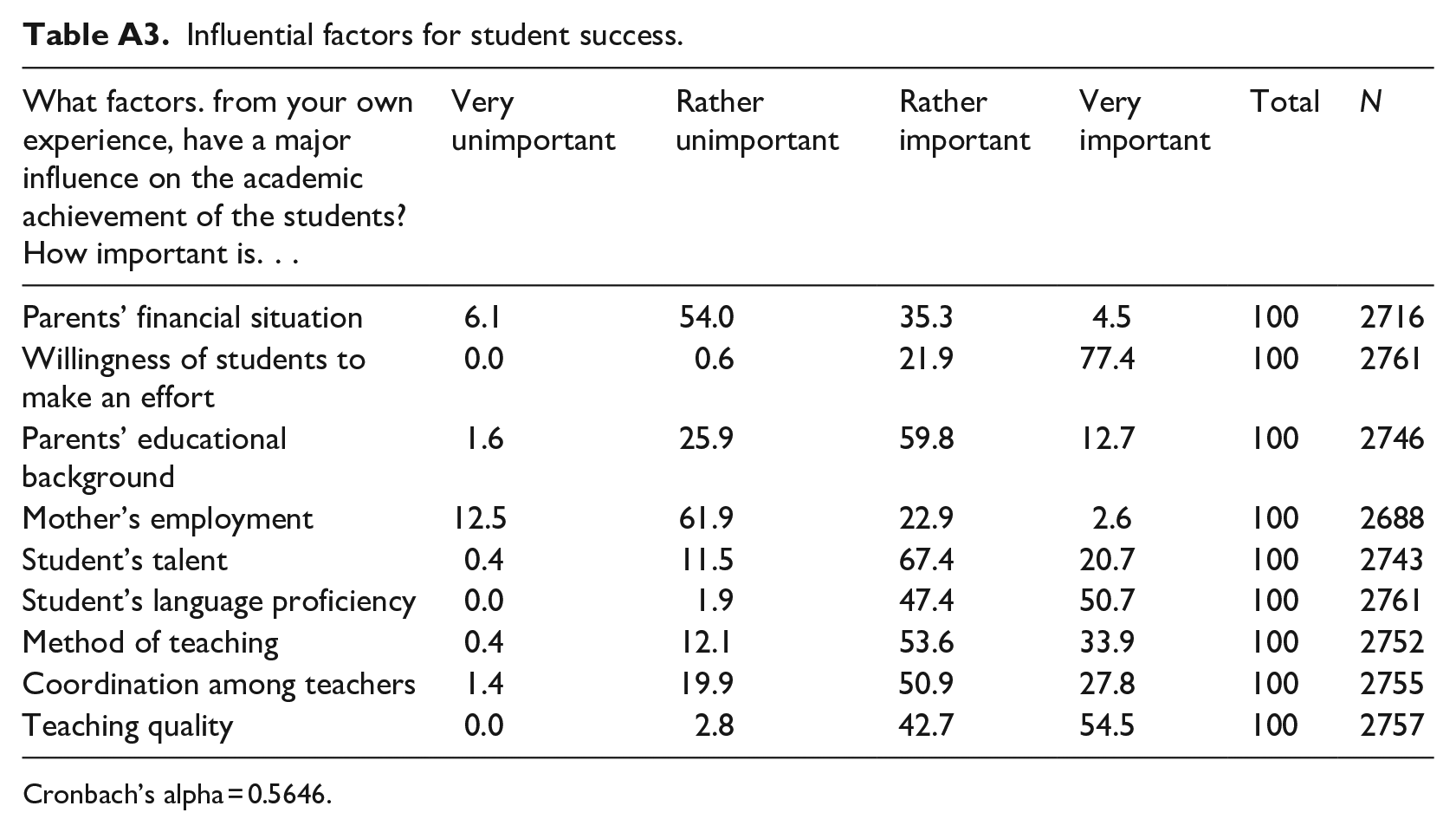
| What factors. from your own experience, have a major influence on the academic achievement of the students? How important is. . . | Very unimportant | Rather unimportant | Rather important | Very important | Total | N |
|---|---|---|---|---|---|---|
| Parents’ financial situation | 6.1 | 54.0 | 35.3 | 4.5 | 100 | 2716 |
| Willingness of students to make an effort | 0.0 | 0.6 | 21.9 | 77.4 | 100 | 2761 |
| Parents’ educational background | 1.6 | 25.9 | 59.8 | 12.7 | 100 | 2746 |
| Mother’s employment | 12.5 | 61.9 | 22.9 | 2.6 | 100 | 2688 |
| Student’s talent | 0.4 | 11.5 | 67.4 | 20.7 | 100 | 2743 |
| Student’s language proficiency | 0.0 | 1.9 | 47.4 | 50.7 | 100 | 2761 |
| Method of teaching | 0.4 | 12.1 | 53.6 | 33.9 | 100 | 2752 |
| Coordination among teachers | 1.4 | 19.9 | 50.9 | 27.8 | 100 | 2755 |
| Teaching quality | 0.0 | 2.8 | 42.7 | 54.5 | 100 | 2757 |
Cronbach’s alpha = 0.5646.
Declaration of conflicting interests
The author(s) declared no potential conflicts of interest with respect to the research, authorship, and/or publication of this article.
Funding
The author disclosed receipt of the following financial support for the research, authorship, and/or publication of this article: The authors gratefully acknowledge financial support from the Competence Area “Social Inequalities and Intercultural Education” (SINTER) of the University of Cologne and say special thanks to the spokesperson Prof. Julie A. Panagiotopoulou and to the research assistants Ibrahim Demirer, Maik Mielenz and Julia Däumling.
