




Abstract
Starting from the assumption that ‘education’ in higher education (HE) is a floating signifier and can take on different meanings, we problematise the problem representations regarding the notion of ‘education’ in HE. We hereby focus on the analysis of problem representations in a set of Communications on the Modernisation Agenda for Higher Education by the European Commission. Drawing on Bacchi’s method What’s the Problem Represented to be, we look at two policy solutions and their related problem representations. Using Pollack’s term ‘creeping competence’, and drawing on previous research, we identify within these problem representations and policy solutions, a double creeping competence. Secondly, we problematise these problem representations and creeping competences from an educational perspective. The first problem representation is problematised as being instrumental and monofunctional. By contrast, we look at what it means to look at HE as worthy in and of itself, and as having multiple purposes at once. The second problem representation of a language of learning is problematised by suggesting the onset of language(s) of education. We conclude that further research is needed to pursue this articulation of these languages of education and hence to explore other possible articulations of education in HE.
Keywords
Introduction
In contrast to rationalist (Bacchi, 2009: 251; Simons et al., 2009: 1) understandings of education policy analysis, where problems generally are followed by solutions, in this article we look at the problem representations and how the proposed solutions are to accommodate and frame the problem in a specific way. The aim is thus not to formulate answers to these problematisations nor to fix or solve the problem identified (Webb, 2014: 365). Rather, the ways in which these problems are constituted and what they themselves bring about are brought to the centre stage. In other words, we want to highlight the particular way of framing policy problems and understand the circumstances that produce these problems, and how they have come to be (Webb, 2014: 372). This implies that we conceive of the notion ‘education’ as a floating signifier (Laclau, 2007; Laclau and Mouffe, 2014). This concept of Laclau and Mouffe is based on the assumption that different meanings are ascribed to the notion ‘education’ and the meaning of ‘education’ is, therefore, temporarily ‘suspended’ (Laclau, 2007: 131). In other words, different actors ascribe different meanings to the floating signifier ‘education’ and, in doing so, they define ‘education’ in a specific way. The floating aspect points towards the fact that different discourses are at play in the struggle to temporarily fix its meaning. Discourses are linked and interrelated, constituting at the same time the order of discourse (Glynos et al., 2009; Jørgensen and Phillips, 2002; Laclau and Mouffe, 2014). In this sense, we understand these conceptualisations of ‘education’ as contingent, rather than fixed. Consequently, the possibility of different meanings for ‘education’ opens up the battlefield for a constant struggle for hegemony about different notions of ‘education’, with social effects resulting from it (Jørgensen and Phillips, 2002: 24; Laclau, 2007: 70–71). We conceive of ‘education’ as shaped as an object of thought in a particular way. Hence, the purpose of this article is to show the different ways of articulating higher education (HE). On the one hand, there is the way of articulating HE as construed in the discussed policy documents. A broad literature critiquing this way of articulating HE already exists (e.g. Gourlay, 2017; Lorenz, 2012; Smith and Swift, 2014). We argue that by problematising the problem representations, the onset of an alternative, education-oriented notion is articulated. This is by no means a fixed or natural language but rather aims to open up our currently closed-off notion of education. Related to this, we follow Biesta (2005) when he stresses that ‘language matters to education’ (Biesta, 2005: 54). A particular articulation of ‘education’ makes a way of saying or doing possible or impossible – in other words, ‘the language or languages we have available to speak about education determine to a large extent what can be said and done, and thus what cannot be said and done’ (Biesta, 2005: 54). The problematising activity is meant to open up the temporary fixation of the language found in the policy documents and discuss what education could be about (Masschelein and Simons, 2014: 177). Both languages – the one in the policy documents and the one we aim for by problematising the articulations in the policy texts – are each construing ‘higher education’ in a different way. The tensions between these languages also highlight the contingent nature of each of the languages.
In this article, the focus is on how ‘education’ comes to be articulated, thought and practiced in problem representations: the way ‘education’ is problematised and what solutions are proposed to solve these problems. In a second step, these problem representations are themselves problematised in order to formulate the beginnings of an alternative language. Grek (2010) makes a similar exercise in the context of international organisations like OECD and the European Union (EU). In her study, she focuses on the shared construction of problems in Education Governance in Europe and the constitution of meaning and norms that comes along with them. The aim is to disrupt and stand back from taken-for-granted notions (Bacchi, 2012) of ‘education’, looking for silences (Bacchi, 2009: 12) and the norms and values that come along with them in Communications on the Modernisation Agenda for Higher Education (MAHE) by the European Commission (EC). In that sense, the aim of this study can be seen in line with the aim of post-critical research as ‘articulat[ing] those aspects of our current conditions that are left out of view by both dominant discourses and practices, and by the negative critiques that show us how we are oppressed by these’ (Hodgson et al., 2017: 81). The postcritical perspective goes beyond a mere position of negative critique and instead creates ‘a space of thought that enables practice to happen anew’ (Hodgson et al., 2017: 17). Here, we first focus on the problem representations of education in HE, and in a second step we problematise these problem representations from an educational perspective.
The chosen texts, the MAHE, are particularly interesting, because they constitute the EC’s answer to HE challenges that emerged in the last decade of the 20th century and the first decades of the 21st century. The Communications on the MAHE frame the changes in HE within the wider move towards a so-called global and knowledge-based economy and society (European Commission (EC), 2006). In this context, physical resources are replaced by knowledge as the main driver of economic growth and jobs (EC, 2006; Olssen and Peters, 2005). Situated at a supranational level of governance, these Communications are to be considered as strategy documents, with a particular focus on HE. Corbett (2011) sees these communications as an ‘important policy tool’ (p.40), in that they give an expression of the policy direction of the EC. At the same time, they facilitate the Commission’s role as a prominent agenda setter (Sin et al., 2016). In this sense, the EC contributes with these communications to the opinion forming (Magalhães et al., 2013). The 2012 Director-general for Education and Culture at the EC called it a ‘strategic agenda’ (Truszczynski, 2012: 17) for HE in order to advance and maximise the contribution of HE to the economy. Although they are not binding, the Communications are assumed by the EC as an instrument to outline its vision for HE. In the EC’s perspective, HE is positioned as a driving power for economic goals of growth and competitiveness. As such, they contributed to and were positioned within the broader frame of the Lisbon strategy 1 for supporting growth and jobs (Sin, 2015). The EC is but one actor in the broader European HE policy process, which is characterised by the building of the European Higher Education Area (EHEA), and contributing to the EU’s ambition to become ‘the most competitive and dynamic knowledge-based economy in the world’ (European Council, 2000: para 6). In short, the Communications articulate the Commission’s vision on HE and for now leave out the broader policy process in which the member states are actively involved in policy development. In this paper, the Communications are used to understand how HE is framed or, in other terms, what the Commission considers as core principles in order to change European universities.
We thus pursue the questions of what problem representations and policy solutions regarding education are constituted in the MAHE documents from the turn of the century to 2017, and how these problem representations can be problematised from an educational point of view. In tracking down these problem representations, we follow Bacchi’s (Bacchi and Goodwin, 2016: 17) method of ‘working backwards’ from a proposed solution to a problem representation. This method is explained further on in the article.
We assume that the Commission was able to put forward particular policy solutions by first defining HE problems in a specific way. Accordingly, we focus on two main policy solutions and their related problem representations. The first problem representation is HE’s deficit as regards its potential to serve as an engine for economic growth and development, as HE is seen as inefficient and ineffective. We argue that the solution to the problem is to address HE as a distinct economic sector. This is a significant shift since HE is a policy domain by and large that falls outside the EC’s competencies. However, by considering HE as a separate economic sector it is subsumed under the economic rationale of the EU. On this account, the EC is opening up policy space to play a role as agenda setter in this domain of HE. The second problem representation is that HE and Higher Education Institutions (HEIs) as actors are represented as deficient in their core competence of teaching and learning. As HEIs fail to achieve excellence in skills development, the proposed policy solutions are prescriptive recommendations in terms of learning and the learning environments. In a second move we problematise both problem representations from an educational point of view.
First, we position the MAHE within the European HE context. Then, we briefly look into the methodology used by Bacchi (2009) and Bacchi and Goodwin (2016) – What is the Problem Represented to be?. In the third section, we give an outline of what we understand by an educational perspective – that is, ‘education’ is hereby considered as an autonomous discipline next to other disciplines like sociology or political sciences and not as an object of study by disciplines such as sociology, psychology, philosophy or history (Biesta, 2015a; Vlieghe, 2020). Fourth, we present the two problem representations within the different Communications on the MAHE, and the related ‘creeping competences’ 2 (Maassen, 2012: 86; Pollack, 2000: 521). In the fifth part, we problematise each of the problem representations from an educational point of view and form the beginnings of one or multiple language(s) of education. In the discussion and conclusion, we argue that our understanding of ‘education’ in the research university becomes closed off, reducing ‘education’ to economic oriented notions as skills development and learning outcomes. At the same time, we argue that alternative articulations of ‘education’ are at our disposal, which stress not only the economic significations but broader social, political, cultural and educational significations of ‘education’. We conclude that further research is needed in order to pursue the articulation of these alternative language(s) of education (Biesta, 2005) and, hence, to explore other possible articulations of education in HE. First, let us briefly consider the context of the MAHE.
Contextualising the MAHE
Within the recent history of the EU, for four decades HE was left under the competence of the member states. Cooperation between member states and HEIs was initiated in the 1980s with actions like Erasmus 3 and other initiatives within the Framework Programmes of the EU. 4 A 1991 endeavour from the EC to formalise a HE policy area was the Memorandum of Higher Education. After negative feedback from the member states, this initiative quietly died the death (Maassen, 2012: 80).
About eight years later, outside the scope of the EU and on a voluntary basis, 29 participating countries initiated reforms in HE at the European level, triggered by the Bologna Process. The Bologna Process was an intergovernmental, rather than a EU initiative. In spite of its independent start from the Commission, in the beginning of the 21st century, the Bologna Process included the EC in the formal structures as a partner of the Bologna Follow-up Group with the same role and privileges as the member states (Amaral and Neave, 2009; Keeling, 2006; Sin, 2015; Veiga, 2012; Veiga and Amaral, 2009). As seen by Corbett (2011), the year 2004 represented a turning point in a lingering process of reallocation of power, with increased action at the supranational level, next to the traditional national, sometimes regional levels of policy initiatives (Gornitzka, 2007). From then on, different initiatives concerning HE became increasingly entangled and integrated. The 2000 Lisbon Agenda, for example, became strongly coupled to and even appropriated the Bologna Process (Gornitzka, 2010). The former was set up under a broader aim of making the EU compete and participate in the global knowledge-based economy in order to create jobs and social cohesion (European Council, 2000). Hence, universities as ‘knowledge institutions’ were put in function of the Lisbon strategy. The goals of the Bologna Process were soon considered as a deliverable by the Lisbon Follow-up programme and later they were also integrated in the Education and Training sector’s work programme (E&T 2010 5 ) and the Europe 2020 strategy 6 (Gornitzka, 2010; Kwiek, 2012). This means that, from 2004 on, the EC assumed HE as a critical factor in the contribution to the European economic future (Kurkiewicz and Kwiek, 2012: 19). At the same time, education remained a competence of the member states. The EC subsumed HE under the economic rationale of the EU and opened up policy space to play a role as agenda setter in this HE domain, by framing HE as a separate economic sector (Brøgger, 2019b), a domain where the Commission does have far-reaching competences and which is considered in need of intervention at the EU level (Kurkiewicz and Kwiek, 2012). A European competence for education, however, was (and still is) absent since the principle of subsidiarity 7 regulates this policy field. With the close links between the Lisbon Agenda and the Bologna Process, HE started to be subsumed under the economic competence of the EU. Simultaneously, this opened up the route towards the creation of a (new) political space in HE (Gornitzka, 2007: 177). HE, on the one hand, was made an indispensable aspect of economic competition in the Lisbon strategy. On the other hand, this very action strengthened the position of the EC in HE (Sin et al., 2016: 2). In the domain of education, the Education Council of the EU followed the Commission’s suggestion to incorporate the targets of the EHEA belonging to the Bologna Process into the E&T 2010 (Gornitzka, 2007).
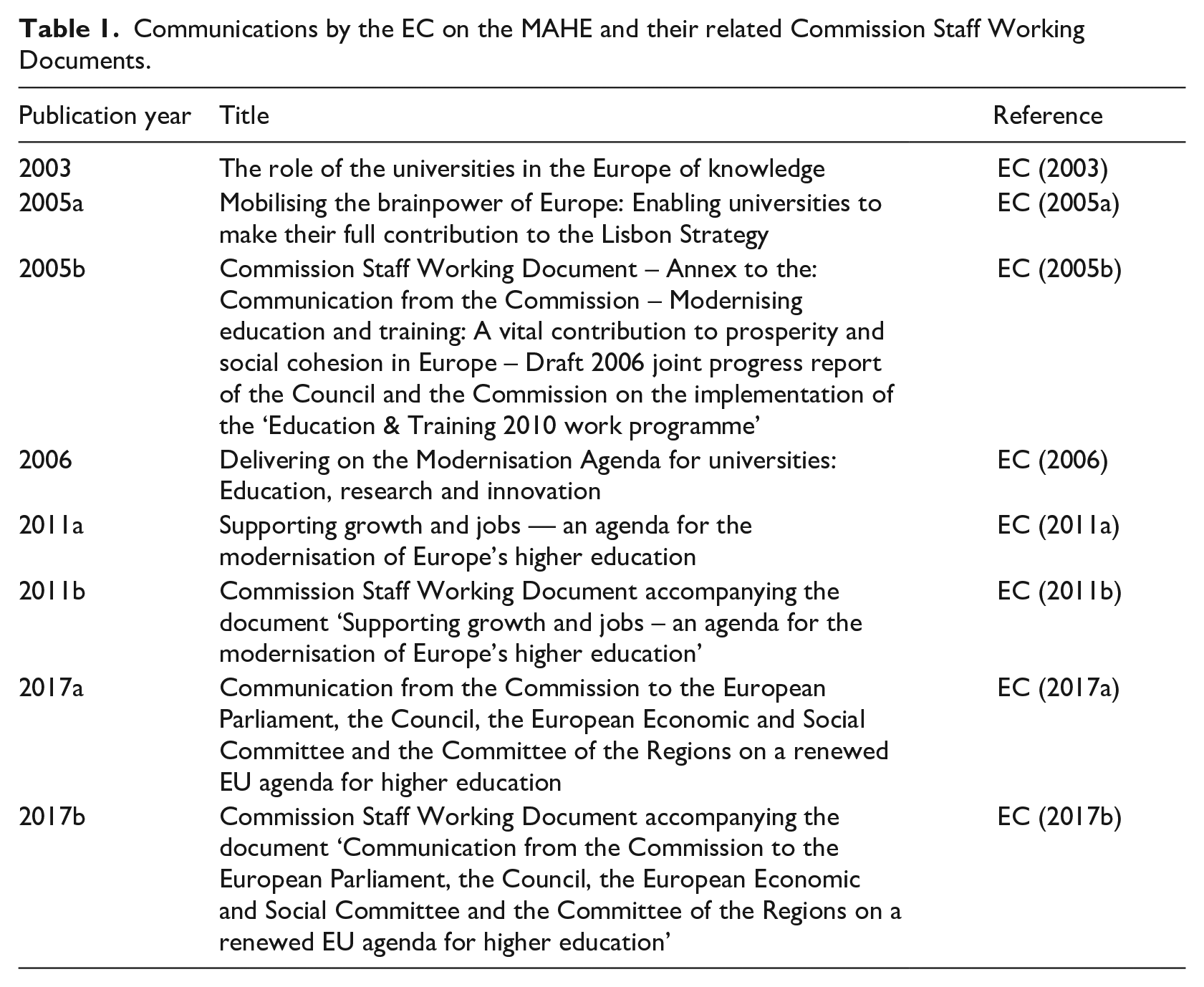
While in the Bologna Process and in the EHEA, the Commission is just only one of the partners, the Commission articulated its own mandate to HE in the Commissions Communications. The first Communication on the MAHE appeared in 2003. Subsequent Communications were to follow in 2005, 2006, 2011 and 2017. These Communications took up policy issues from the Bologna Process like the Diploma Supplement, the European Qualifications Framework, the use of ECTS, mobility, and so on (Sin et al., 2016). Thus, the Bologna Process was not only incorporated in the Lisbon Agenda, but it also developed into an instrument serving (the Communications on) the MAHE (Sin et al., 2016). From this perspective, it proves interesting to look at the way this process took shape from the perspective of problem representations and subsequent policy solutions related to education in HE. The MAHE communications cannot be seen by themselves. They function as part of the broader Open Method of Coordination, adopted in 2000 in the Lisbon European Council. Together with the communications, technologies like comparison, benchmarking, standardisation and ‘best practices’, translate these policies into practice (Brøgger, 2016: 80). Rather than direct steering, these communications in combination with the practices of ‘peer pressure and naming–shaming mechanisms’ provide the means to implement the ideas and suggested practices (Brøgger, 2016: 79).
The WPR-approach: What is the Problem Represented to be?
From a Foucauldian-informed policy analytical perspective, Carol Bacchi (2009; Bacchi and Goodwin, 2016) proposes the What is the Problem Represented to Be-Approach (WPR-approach). In this article, this means that we look at what exactly is problematised within the different Communications on the MAHE and link these problematisations to the proposed policy solutions. This links to Foucault’s view on ‘problematizations through which being offers itself to be, necessarily, thought – and the practices on the basis of which these problematizations are formed’ (Foucault, 1990: 11). The WPR-approach takes on as a starting point the proposition that the recommendations to change something are embedded in what the problem is conceived of (Bacchi and Goodwin, 2016). In other words, the proposed solutions can never be seen as separate from what is perceived and represented as the problem. Here, this means that when HE systems are depicted as having the potential, but not fully using it, this perceived deficit will ask for a solution in which HE systems will be able to use their full potential. The idea, here, is to challenge taken-for-granted and naturalised notions within HE. As outlined in the introduction, these different problem representations are involved in a discursive struggle for hegemony. What is seen as a problem and what is subsequently suggested as a solution consequently articulates what is seen at stake. In line with this approach, we look at three elements: we scrutinise (1) the problem representations, (2) the proposed policy solutions and, lastly, (3) the underlying assumptions on the notion of ‘education’ in the EC’s Communications on the MAHE. We look at the HE policy context and, more specifically, at the EC policy discourse, which can be found in the 2003, 2005 and 2006, 2011 Communications and especially in the last Communication in this series, the Communication of 2017.
As mentioned above, the focus of the WPR-approach is the calling into life of an issue as a particular problem: in this case, what exactly is problematised within the different Communications on the MAHE? What is seen as a problem within European HE policy by the EC as a policy actor? There are different possible ways to frame what exactly is the problem. It is the discursive struggle (Jørgensen and Phillips, 2002: 34) over what is seen as a problem and what is subsequently suggested as a solution, that articulates what is seen at stake in HE in Europe. Bacchi’s main claim is that problems are not just a given, but are themselves constituted (Bacchi, 2009), and a problem is never a mere problem, as the problem representation already frames the issue in a particular way. It has consequences for our thinking about the topic, for the people involved and for the ways these persons understand themselves (Bacchi, 2009). Hence, the way problem representations are construed and what underlying assumptions are brought forward has implications for the way we think about them, and, consequently, for how we see and construe our social and political world. By formulating problems in a certain way, other ways of representing the problem become occluded: The argument here is not simply that there is another way to think about the issue but that specific policies are constrained by the ways in which they represent the ‘problem’. The objective therefore is to bring into discussion issues and perspectives that are silenced in identified problem representations. (Bacchi, 2009: 13)
This approach, therefore, distances itself from what Bacchi (2009: 251) calls the ‘rationalist tradition’ to policy analysis and offers an alternative perspective to policy analysis. It seeks to recognise the contingencies and the nature of how we look at and perceive HE. In the Communications on the MAHE, the EC frames particular problems and mandates specific solutions. The WPR-approach, as proposed by the author, consists of six questions in total. Hence, the research question is the following: What problem representations and policy solutions regarding education are constituted in the MAHE documents of the EC between 2003 and 2017, and how can we problematise these problem representations from an educational point of view?
The sources for the analysis concern the five main documents by the EC on the MAHE and their related Commission Staff Working Documents, covering almost 15 years (see Table 1).
Communications by the EC on the MAHE and their related Commission Staff Working Documents.
Taking on an educational perspective
We position this research within the broader scope of educational research, considering ‘education’ as an autonomous academic discipline. We hereby follow the distinction made by Biesta (2011a) between the ‘continental’ tradition as one can find it, for instance, in France, Belgium, the Netherlands and Germany, and the Anglo-American perspective, on the other hand. Within the former, education is positioned as an autonomous discipline with its own faculties, educational programmes and journals (Biesta, 2011a; Vlieghe, 2020): [A]n autonomous sphere of human action, i.e. as a dimension of our lives that has its own logic, and that therefore needs to be expressed in a language that is built-up from the inside out. The proper way to address education is on its own terms, and not in terms that stem from other spheres of life. (Vlieghe and Zamojski, 2019: 5)
By contrast, the Anglo-American perspective considers educational studies as an interdisciplinary field (Biesta, 2011a), built on knowledge of other disciplines. Education, then, becomes a ‘phenomenon’ that is studied by ‘fundamental’ disciplines like psychology, history, sociology and philosophy (Biesta, 2011a). This results in ‘education studies’ such as sociology of education, history of education, philosophy of education, etc. (Vlieghe, 2020). The continental orientation is important in the sense that it allows to ask different – in this case, educational – questions about education, instead of psychological, historical, sociological or philosophical questions. In other words, the continental tradition starts with the question of the conception or – in more post-structural and discourse theoretical terms – the articulation of education, and frames these educational questions as questions with an educational concern (Biesta, 2015a; Vlieghe, 2020). Articulation is seen – in line with Laclau and Mouffe (2001) – as ‘any practice establishing a relation among elements such that their identity is modified as a result of the articulatory practice’ (p.105). Hence, articulation is the connection between different elements, resulting in a recontextualisation of meaning of these elements, just by their joint expression.
We look at pedagogy in the broader sense, hereby referring to the term Pädagogik in the German language and its related discipline (Biesta, 2011a; Vlieghe, 2020) and focus on specific educational questions (Biesta, 2011a: 188; Biesta, 2015a). This starts from value judgements and questions on what is seen as ‘educationally desirable’ (Biesta, 2011b: 209) or ‘what we hold as worthy of passing on’, as ‘worthy of affirmation’ (Hodgson et al., 2017: 80, 85). In that sense, it concerns our practices ‘that students and academics perform’ (Hodgson et al., 2020: 3), or what is done, rather than the institutional aspect of it. Framing the research question from this educational outlook makes it possible ‘that we can see things differently but also in that we may be able to see problems where we did not see them before’ (Biesta, 2007: 297). Asking the question, ‘what constitutes good education?’ (Biesta, 2009: 36), or the more fundamental questions about the content and purpose of education (Biesta, 2005: 60; Magalhães and Veiga, 2013), however, becomes increasingly difficult within our current societal context because education is more and more exclusively addressed from the external disciplines.
In order to discriminate between different articulations of HE, Biesta (2005) differentiates a language of education from the current language of learning. The latter ‘allows for a redescription of the process of education in terms of an economic transaction’ of the learner-consumer and the teacher-provider meeting the needs of the learner-consumer (Biesta, 2005: 58). He refers to ‘the transformation of an educational vocabulary into a language of learning’ as the broader process of learnification (Biesta, 2009: 36). While the language of learning and the process of learnification is quite well documented (e.g. Gourlay, 2017; Lorenz, 2012; Smith and Swift, 2014), this is not the case for what a language of (university) education could look like. In the second part of this paper, we problematise the EC’s problem representations. In doing so, we are trying to articulate the onset of a language or languages of education. Moreover, this educational perspective is directed towards (future) possibilities. Masschelein and Simons (2014) characterise it as follows: where functionalist approaches are directed towards the (description of) the actual situation (what is), and idealistic approaches are focused on the normative (what should be), an educational outlook asks the question of what would be possible (what could be) (Marin, 2018; Masschelein and Simons, 2014: 173, 177). As such, the question of what could be possible in education, or as alternative articulations of HE, becomes centre stage.
Two related problem representations within the different Communications on the MAHE
Having outlined the background on the Communications on the MAHE, the WPR-approach and what we see as an educational perspective, we now turn to two different problem representations within the different Communications on the MAHE. The first problem representation concerns the fact that HE is presented as inherently in deficit, as neither effective nor efficient in what it does. The second problem representation addresses HEIs as being incompetent in one of their core competencies – that is, education. Both problem representations are already well consolidated in the literature. That is why – in a second move and in line with the post-critical perspective (Hodgson et al., 2017) – we move beyond critiquing these problem representations and turn to problematising these problem representations from an educational perspective. This problematising exercise results in the onset of an alternative articulation of education in HE.
HE is inherently in deficit and is neither effective nor efficient in what it does
The first problem representation concerns the fact that HE systems and HEIs are presented as essential for Europe (EC, 2017a: 2) while simultaneously they are depicted as neither effective nor efficient in what they do. The idea of not living up to the expectations, of not ‘contributing as much as they should’ (EC, 2017a: 4) is prevalent. Moreover, HEIs are represented as failing in ‘deliver[ing] what Europe needs’ (EC, 2017a: 9). HE systems are considered as possessing the potential, but at the same time are not fully harnessing it (EC, 2006: 3). They ‘can do more’ (EC, 2017a: 8), and need to ‘respond better to people’s needs’ (EC, 2017a: 5). In this context, forms of underachieving or failing to attain the desired goals concern the governance of HE systems and institutions, the use of technology, the innovation potential, the allocation of resources, and so on. HE and HEIs are, hence, positioned as inherently in deficit. HEIs have, in other words – for about a decade and a half – been depicted as the stumbling blocks on the road to European success, at least for as long as HE does not carry out the suggested policy changes.
Positioning HE as it were in a performance crisis (Olsen and Maassen, 2007: 3) opens the door for the formulation of a number of policy solutions. These measures bear the promise of making HE institutions more ‘effective and efficient’ (EC, 2017b: 36). The more foundational policy solution, however, prompted by the EC, is to address HE as a distinct economic sector: Higher education is not just the sum of its education, training and research activities. It is also a fundamental economic and social sector in its own right, in need of resources for redeployment. The EU has supported the conversion process of sectors like the steel industry or agriculture; it now faces the imperative to modernise its ‘knowledge industry’ and in particular its universities. (EC, 2005a: 10)
The EC (2005a) regards this ‘knowledge industry’ implicitly as much as an economic sector, similar to the steel industry or agriculture, implying that all what is applicable – in economic terms – to these latter sectors also is applicable to the former.
By framing HE as an economic sector the Commission has been paving its way to the domain of education where it did not have a competence, or as Brøgger phrases it, it was ‘a potential solution to an inconvenience within the EU’ (Brøgger, 2019a: 51). Hence, following from Maassen (2008), we refer to this process of entering the field of HE via an economic detour as the first ‘creeping competence’ (Pollack, 2000: 521). Despite the subsidiarity principle, where the competence for education lies with countries, the regulation competence is transferred to the supranational level of the EC and to the Council. The Commission is expanding its competences to a new HE policy area and the move is similar to the Bologna Process. The latter was appropriated by the Lisbon Agenda, and the Bologna goals became deliverables of this Agenda, subsuming education under an economic rationale. HE is addressed from an economic perspective and ‘as a marketable service’, positioned within a ‘European-wide market’ (Antunes, 2016: 420–421). Thus, a shift in competence from the nation-state to the Commission can be traced, creating a policy space for HE at the supranational level. This allowed for a second problem representation to be identified.
HEIs as being incompetent in one of their core competencies: education
Besides this main problem representation of inefficiency and ineffectiveness of HEIs in general, another, more targeted, problem representation is identified: HEIs are portrayed as deficient in achieving excellence in skills development (needed for the labour force). The problem is represented as HEIs failing their core competence of teaching and learning. The proposed policy solutions consist of addressing HEIs with prescriptive recommendations in terms of learning and the learning environments. The recommendations in the 2017 Communication (EC, 2017a) shift from recommendations on governance towards recommendations on teaching and learning, including the curricular reform. The way teaching and learning are organised, teaching excellence and the potential of technology are also very present. Moreover, these recommendations assume a rather coercive form. From the very beginning, in 2003, the Communications advance instructions on funding mechanisms and incentives as well as recommendations regarding external and internal governance systems. Whereas the prescriptions in terms of funding are a constant element until 2017, the recommendations on system and institutional governance became less prevalent. It seems that the Commission changed its strategy in the 2017 Communication. This Communication is rather reticent in its governance proposals, and limits its contribution to ‘good institutional leadership’ (EC, 2017a: 10). At the same time, the topics related to designing programmes and curricula – a topic that has been briefly mentioned from the first communications – the way teaching and learning are organised, the characteristics of good teaching and the potential of technology seem now to occupy a more dominant position. Whereas the earlier Communications addressed ‘[t]eaching and learning [. . .] in its curricular dimension, in one brief instance only’ (Sin, 2015: 334), the 2017 Communication makes the way to influence the teaching and learning processes, or what Sin (2015, 334) calls ‘[t]he revision of pedagogy’ part of the Commission’s agenda. Sin (2015) calls this step rather bold, referencing to the principle of subsidiarity (p.334), particularly in the domain of pedagogical approaches on what is considered as quality teaching, and the potential of technology, making the prescriptions more and more precise. The case can be exemplified by the prescriptions on open and online learning which would encourage various ways of teaching and learning (EC, 2017b: 20). Other recommendations focus on the need to change the approach to learning and teaching (EC, 2017b: 21). The Staff Working Document of 2017 further mentions among others ‘student-centred learning’, ‘pedagogical approaches’, ‘pedagogical techniques’, ‘pre-defined learning outcomes’, ‘problem and inquiry-based learning’, ‘work-based learning’ and ‘flipped classroom approaches’ (EC, 2017b: 18–19, 30). In addition, the use of technology is addressed in the 2011 Communication as ‘eLearning and blended learning’ and ‘virtual learning platforms’ (EC, 2011a: 6). Likewise, the 2017 Communication promotes ‘open, online and blended learning’, the use of ‘learning analytics’ and ‘digitally enabled open science’ (EC, 2017a: 5–6). Over time, the Commission changed its scope: from more governing and funding oriented recommendations to recommendations concerning the organisation of teaching and learning. As a result, the Commission is venturing – seemingly uneventful – into a field that was traditionally assigned to the autonomy of HEIs and the freedom of academic teaching.
At the same time, attention must be paid to the way these recommendations are formulated. The proposals became very prescriptive, authoritative and compelling in nature, again especially in the 2017 Communication. In this Communication, HE systems and institutions and also all those involved in HE, ‘staff and students’ (EC, 2017a: 2) alike, are addressed in a very prescriptive and, at times, instrumental language: HE ‘has a duty’, ‘should’, ‘must’, ‘needs’ to do something (EC, 2017a, 2017b). Whereas Sin et al. (2016: 51) already characterises the tone of the 2005 Communication as ‘bold, authoritative and prescriptive’ because of the use of verbs like ‘urge’ or ‘should’, the later Communications take it one step further. The tone is to be found in recommendations not only on curricular reforms, but also in the organisation of teaching and learning, the characteristics of quality teaching and the use of technology.
The recommendations in the last Communication thus change the focus towards curricular reform, the way teaching and learning are organised, the potential of technology and quality teaching. Being very confident both in its role and its competence in the domain, the Commission intervenes further and deeper in the HE policy area. With the Commission moving into the domain of teaching and learning, we hereby identify a second ‘creeping competence’ (Pollack, 2000: 521). The prescriptive recommendations on instructional strategies, delivery methods and the use of technology seem to imply that the EC’s ‘creeping competence’ (Pollack, 2000) moves further within this created policy space towards a domain that traditionally belonged to the competency (and academic freedom) of academics and HEIs. Here again, teaching and learning move from the sideline to the centre in European Higher Education Policy (Sin, 2015: 325). The shifts in focus and tone illustrate the underlying assumption that HEIs need support and clear guidance in their task of ‘knowledge transmission’.
In the next part, we problematise both problem representations from an educational perspective.
Problematising problem representations (and related policy solutions) from an educational perspective
In this second section, we look at possible, alternative ways to articulate HE. We start from the way HE is problematised in the MAHE Communications and question the way the EC articulates HE. In line with the post-critical perspective (Hodgson et al., 2017), we try to articulate the onset of an alternative articulation of education in HE.
The problematisation of these problem representations is positioned in the broader shift in modes of government from the welfare state towards advanced liberalism (Rose, 1999), or towards what Hodgson (2018: 1204) calls ‘entrepreneurial governance’. Rose (1999) and Olssen et al. (2004) describe the transition from welfare liberalism to advanced liberalism, and how they see this form of advanced liberalism characterising our current society. This shift did not occur at once but was a gradual replacement of the ideal of the ‘social state’ by the ideal of the ‘enabling state’ (Rose, 1999: 141–142): the role of the state is not anymore laissez-faire nor is it focused on social welfare, but now, it is seen in a positive and proactive way. This ‘enabling state’ is the state that facilitates the conditions of the market to exist and to function (Rose, 1999: 141–142). In advanced liberalism the role of the state is reduced to the facilitation of market forces and supporting individuals in their competitive contribution to human capital, while also remaining a controlling state (Dale, 1997: 274). Within these lines, all aspects of the social are now understood from an economic logic: ‘as calculative actions undertaken through the universal human faculty of choice’ (Rose, 1999: 141). Health, education and welfare are re-assessed in terms of ‘their contribution to the development of human capital’ (Rose, 1999: 142). In advanced liberalism, governing happens through innovation, inclusion, competition and responsibilisation (Hodgson, 2018).
In this second step, we look at how these problem representations – and what we referred to as the double ‘creeping competence’ (Maassen, 2012: 86; Pollack, 2000: 521) – can be problematised from an educational perspective.
Problematising the instrumental and monofunctional way of articulating HE
By framing HE as a distinct economic sector (which is the proposed policy solution), the Commission answers to the problem representation of HE systems being in deficit in performing their missions and mandates. The first ‘creeping competence’ serves as a gateway in the process of getting a firm foothold within the domain of HE at the supranational level in Europe (Gornitzka, 2007; Maassen, 2012). While the role of the Commission and its ‘democratic legitimacy’ (Featherstone, 1994: 162) has been criticised from a political perspective, the implications go beyond mere policy influence. Moreover, the (re)framing of HE as an economic field is not a new element in the debate and has already been extensively discussed in the literature. For instance, Polanyi (2001: 60) has described the inversion of the relative positions of society and economy in our societies. Where the economy used to be part of a broader social realm, nowadays, the social has become a part of the economic realm. More specific aspects of this reframing within HE have been discussed by, for example, Brøgger (2019b), Lorenz (2012), Marginson (1997) and Slaughter and Leslie (1997). At the same time, the (re)framing of HE as an economic field needs to be seen as more than just a shift in economic outlook. The problematising of HE as inherently in deficit and as neither effective nor efficient in what it does, is seen – from the perspective of governmentality – as belonging to, and as the expression of the shift in modes of governance (Hodgson, 2013: 193; Olssen et al., 2004; Rose, 1999). In articulating HE as a distinct economic sector, HE is positioned as instrumental to the economy, seen as contributing to a goal outside itself. From an educational perspective, this economic external framing of HE is questioned and the more fundamental educational issue about the purpose of education is addressed (Biesta, 2005: 60). There are two dimensions to this question. First, there is the question of instrumentalising HE for the economy, versus a more autonomous position of HE. Second, there is the hegemonic position attributed to the purpose of innovation versus the possibility of multipurpose HE.
Let us start with the question of instrumentalising HE for the economy: should HE always contribute to a goal outside itself? Or can it also be seen as worthy by and of itself as Vlieghe and Zamojski (2019) state? By representing the problem as such and proposing these policy solutions, the assumption is that HE needs to function as an economic sector in a competitive and global world. The instrumentalisation of HE as an economic strategy has been discussed and critically approached by a number of authors (e.g. Featherstone, 1994; Robertson, 2009). By framing ‘education’ in HE as serving economic goals, other notions of HE and its purposes are rendered ‘invisible’ (Bacchi and Goodwin, 2016: 22). In the 2003 Communication, for instance, outlining the importance of ‘universities’ 8 for the economy, the ‘unique’ position of universities is highlighted by their involvement in the knowledge production under the form of research, knowledge transmission, under the form of education and knowledge dissemination, under the form of the exploitation of research results or innovation (EC, 2003: 2). Moreover, in the aftermath of the global economic crisis of 2007, intensified attention was given towards innovation, with a major influence on the direction the policy change would take. Hodgson (2013: 196), in this context, refers to the ‘recasting of the European Union as an Innovation Union’ (Hodgson, 2013: 196). For Europe to survive, innovation is required by all actors, at every level, involving ‘all aspects of economic and social life’ (Hodgson, 2013: 197). In line with this, Magalhães and Veiga (2018) discuss the reconfiguration of articulations between education, research and innovation. They stress the hegemonic position given to innovation – under the form of knowledge dissemination. Biesta (2011c) is even more outspoken, specifically about the university. He states that a university that is only adjusting to outside demands, bears the assumption that the university has nothing to offer by itself (Biesta, 2011c: 44).
What would it then entail to address HE as having a purpose in and of itself? To think about HE from an internal, educational perspective? The least we can say is that this would imply that HE has to think about its own purpose(s). And this is an endeavour we are not used to. The emphasis on skills acquisition and employability (Sin and Neave, 2016; Sin et al., 2019) would become less important, allowing to follow the interest of both academics and students. Hence, when not primarily addressed from an external disciplinary perspective, ‘education’ might be seen as worthy in and of itself, as autotelic: ‘education’ for education’s sake (Hodgson et al., 2017: 18). This thinking exercise about alternative articulations of HE immediately calls tensions and objections into life that relate to the hegemonic language of learning in terms of cost-effectiveness, and the need of alignment with the labour market.
Secondly, the hegemonic position attributed to the economic purpose might be referred to what Sennett (2013: 4) calls a monofunction, as it does not allow other purposes to come close. The hegemonic economic-innovation purpose reconfigures different notions around it and funnels our thinking towards the economic and innovation purpose, as a certain way of saying and doing is drawn upon, and other ways of saying and doing are made invisible (Biesta, 2005: 54). Hodgson (2018) illustrates this process of recasting with the notion of citizenship, or the figure of the citizen, and with research, or the figure of the researcher. Under the hegemony of the economic purpose, innovation – that is, the impact of education and research on economic development, on the enhancement of competitive advantages of regional systems and on the generation of skills for that purpose – reconfigures the university, research, the researcher and their governing and governance, as well as the role innovation plays in the governance of society (Hodgson, 2013: 206). Moreover, other possible purposes are reframed to fit within the hegemonic framework. Hence, the question we ask becomes, what would it entail to address HE as having multiple purposes?
This would mean that there are different and simultaneous ‘drivers’ or purposes, ranging from the importance of HE in personal development, and building a more equal society, to the role of HE in the consolidation of the nation states, and to the idea of education for education’s sake. This multipurpose feature is what opens up ways of thinking, meaning that HE could be attributed multiple purposes, beyond its economic monofunction. We tend to forget about features of ‘education’, including notions of citizenry, the public role of the university or the responsibility of universities for societal and academic knowledge, socialisation and reproduction of society, as well as the potential of transformation and critical thinking (Fanghanel, 2012; Zgaga, 2009).
The representation of the problem and the framing of the proposed policy solution, also entail a reframing of the notion of ‘education’ and its purposes in HE. Magalhães and Veiga (2018) argue that this hegemonic position of innovation – that is, the assumed centrality of the impact of education and research on economic development – also reconfigures the meaning of education. It is this reconfiguration of education to learning and the process of learnification (Biesta, 2015b) that we now turn to. Here, the second problem representation is seen as constituting HEIs as being incompetent in one of their core competencies: education.
Problematising the language of learning and looking for language(s) of education
The second problem is represented as HEIs failing to achieve excellence in skills development and as deficient in their core competence of teaching and learning. The proposed solutions consist of recommendations on curricular reform, pedagogical techniques, ‘good teaching’ and the use of technology. Moreover, these recommendations also seem to involve a shift in tone. The latter hints towards an underlying assumption on the need for clear and explicit guidance for HEIs, even more than in matters of governance and funding. We, therefore, conclude that Pollack’s (2000) ‘creeping competence’ is present both at the level of recommendations on the (supra)national level, as well as on recommendations on the day-to-day practices in the classroom. The vocabulary the EC is using equals a language of learning and this shift in language towards a language of learning is what Biesta terms ‘learnification’ (Biesta, 2009: 36). This process of learnification is well studied (e.g. Gourlay, 2017; Lorenz, 2012; Smith and Swift, 2014), but by further and deeper intervening in this domain, we argue that the EC – as an influential policy actor – contributes to the reconfiguration of different notions, this time related to education itself though. Magalhães (2010: 38), for instance, emphasises that ‘modern educational categories’ like ‘education’ and related figures (students, professor, . . .), entities (universities, . . .) and processes (research, teaching and learning) are reconceptualised in this process (Magalhães, 2010). In other words, with a changing mode of governing, the object and strategies of governance also shift along (Hodgson, 2018: 1209). What we look at in these problematisations is what this reconfiguration entails.
In this language of learning, ‘education’ and quality teaching are articulated in terms of efficiency, effectiveness, ‘student-centred learning’ and ‘pre-defined learning outcomes’. This brings forward an understanding of education as a predictable, controllable, skills-focused and straightforward economic exchange process. In addition, the potential of technology and ‘open, online and blended learning’, the use of ‘learning analytics’ and ‘digitally enabled open science’ underline the (potential) increase in efficiency of the process. Didactic approaches as ‘problem and inquiry-based learning’, ‘work-based learning’ and ‘flipped classroom approaches’ are presented as a toolbox from which to pick the right device to apply. With this recent turn of the EC to learning and pedagogy in HE, HE is assumed to be a rather technical affair and seen as an economic transaction between the learner-consumer and the teacher-provider (Biesta, 2005: 58). We argue that this language of learning in the MAHE Communications addresses the pedagogy from a narrow sense, as a didactical toolbox, as a technical tool to achieve a certain outcome. In contrast, in our educational outlook we address pedagogy in the broader sense, as based on the term Pädagogik in the German language and its related discipline (Vlieghe, 2020). From this perspective on pedagogy, we ask the question, what would it mean for education in HE to develop and articulate a language of education (Biesta, 2005)? Other questions include, ‘what constitutes good education?’ (Biesta, 2009: 36), or the more fundamental questions about the content and purpose of education (Biesta, 2005: 60) in HE. What is left out when talking about education in terms of knowledge transmission, skills development, learning outcomes or work-based learning? What educational practices are silenced?
In answering these questions, a number of non-measurable aspects and the imponderabilia of the educational experience emerge. These comprise, for instance, contact with, and care for students, and the idea of inspiring students. The ‘sense of the human that can never be fully accounted for’ (Hodgson, 2018: 1218) can also be seen as part of these aspects that are not immediately measurable, quantifiable, controllable or predictable. These elements would bring into life an articulation of HE as a relational experience between students and academics, with room for connection and engagement as an alternative to a standardised output-oriented process. This relates to an experience which is unique, depending on the students which are in class, and what input they give and what makes them think. Non-expected elements which could be labelled as failures, as things turning out different than planned are also part of the uniqueness of the educational experience and escape the predictability of learning outcomes. These different elements together could form the onset of one or several language(s) of education.
Towards the onset of alternative articulations of education in HE
In this article, we looked for the Problems Represented to be in the Communications on the MAHE, including the presuppositions or assumptions underpinning these problem representations. We identified two problem representations and related ‘creeping competences (Maassen, 2012: 86; Pollack, 2000: 521). The problem representations of an economic framing of HE and the use of a language of learning in the MAHE documents show the constructed character of these problem representations. In a second step, we problematised these problem representations from an educational perspective. Our argument casts away from the classic observation in political science that bureaucratic organisations inevitably expand their domains of power, and, thus, inevitably display creeping competences. The outset of the article is a search for an alternative articulation of HE, for the onset of language(s) of education (Biesta, 2005). We did so by looking at HE as a ‘floating signifier’, taking on ‘different ascriptions of meaning’ (Jørgensen and Phillips, 2002: 28; Laclau, 2007; Laclau and Mouffe, 2014). We also adopted an educational outlook in which the question, ‘what constitutes good education?’ (Biesta, 2009: 33), and the broader issues of ‘content, purpose and relationships’ (Biesta, 2011b: 207) form our base.
We tried to offer a counterbalance for the economic and functionalist way HE is articulated in the two problem representations and related policy solutions. The articulation of the onset of language(s) of education is an exercise in looking what could be possible when changing language register (Hodgson, 2013: 207). By drawing attention to non-measurable aspects and what we referred to as the imponderabilia of the educational experience, we intended to delineate some of the outlines of one or multiple language(s) of education. This language comprises elements like contact with, and care for students, the actual process of education, the relational experience between students and academics, with room for exploration, failure and experimentation.
The importance of drawing attention to possible alternative ways of articulating HE, is to open up new and challenging avenues of thinking about HE. Returning to the concept of ‘education’ as a floating signifier, we argue that with the beginnings of these language(s) of education we can start opening up this economic notion of ‘education’ in HE and its mainly economic purpose. In this process, the recontextualisation of related notions like education, citizenship, etc. becomes clearer. ‘Education’ might not be primarily addressed from a sociological, political, economic or anthropological perspective but as worthy in and of itself, as autotelic: ‘education’ for education’s sake (Hodgson et al., 2017: 18). Addressing these aspects by means of language(s) of education and focusing on the imponderabilia of the educational experience allows different aspects to be articulated, bringing forward a diverse view on HE.
These language(s) of education are still insufficiently developed and need further elaboration. Moreover, from a governmentality perspective, the role advanced liberalism plays in this process needs to be clarified further. Hence, further research might look into the ways these language(s) of education are often rendered insignificant, and how the economic articulation renders invisible alternative purposes. What other dimensions, different from the ‘knowledge-based economic’ and a ‘commodity-dominant discourse’ (Wihlborg, 2019: 149), have been silenced? Further research exploring new and other possible articulations of language(s) of education in HE (Biesta, 2005, 2009) will allow to open up our thinking on, and the practices of what could be possible in future HE.
Footnotes
Acknowledgements
We are very grateful for the careful reading of Amelia Veiga, Cosmin I Nada and three anonymous reviewers for constructive critiques and helpful comments on earlier drafts.
Declaration of conflicting interests
The author(s) declared no potential conflicts of interest with respect to the research, authorship, and/or publication of this article.
Funding
The author(s) disclosed receipt of the following financial support for the research, authorship, and/or publication of this article: This work was supported by the EC FP7 People programme: Marie Curie Initial Training Network UNIKE (Universities in the Knowledge Economy) (grant number 317452).
