




Abstract
This paper reports the results of a study aimed at understanding the processes governing the construction of educational inequalities in French classrooms, the French school system being particularly unequal. Traditional explanations have focused on the factors governing the production of inequalities but have not always shown how these factors translate into learning inequalities in class. Consistent with relational approaches, the study draws on ethnographic research conducted over an 18-month period in 6 socially contrasting Parisian schools. Both students from wealthy families considered to be ‘high-achieving’ and students from poor families viewed as being ‘low-achieving’ were observed over the course of full school days to understand the factors that lead them to develop different activities. The evidence suggests that children interpret teacher expectations very differently, although the same expectations were observed in all the classes observed during the study. These expectations point to an invisible curriculum operating alongside the formal curriculum and generally perceived only by high-achieving students, who are able to grasp and understand it through their prior socialization. A further characteristic of the invisible curriculum is that it is rarely made explicit by teachers. This finding highlights the need to further examine explicitation strategies in schools.
Keywords
Introduction: a relational hypothesis
Since the large-scale surveys of the 1950s and 1960s, the sociology of education has clearly demonstrated the link between the educational status of children and their parents’ social status. Successive Program for International Student Assessment (PISA) surveys have also shown that France ranks as one of the most unequal countries in the Organisation for Economic Co-operation and Development (OECD, 2014, 2019a). Explanations of these significant inequalities have until now focused on the fact that students enter school carrying a different ‘educational baggage’ (Alexander and Morgan, 2016; Bernstein, 1975b; Bourdieu, 1966; Duncan and Murnane, 2011; Duru-Bellat, 2015; Heath, 1982; Lahire, 1993; Van Zanten, 2010), on inequalities between schools (Ben Ayed, 2009; Merle, 2012; Phillips and Chin, 2004; Van Zanten, 2001), on the ‘teacher effect’ (Bressoux, 1995; Hattie, 2009) and, in the more specific context of France, on the influence of qualifications (Dubet et al., 2010), which impact the educational strategies of some parents (Ben Ayed, 2011; Van Zanten, 2005, 2009, 2016). This paper aims to contribute to the explanation of the processes involved in the production of school inequalities. On the assumption that such production is governed by inequalities in the acquisition of academic knowledge (Broccolichi and Sinthon, 2011; Felouzis, 2014), the paper offers a detailed examination of the processes governing the construction of these inequalities in class. Therefore, the focus is not on why inequalities exist so much as on how they develop in class, along the lines of the program defended by Mehan (1992) and, in particular, on how differences in ‘cultural capital’ (Bourdieu, 1979) become learning inequalities.
Any study of the processes involved in the production of inequalities in class calls for research based on an ethnographic approach. The pioneering work of Waller (1932) is central to this line of thinking in that it outlines a ‘relational’ hypothesis by focusing on the concept of the ‘definition of the situation’ drawn from the work of Thomas and Znaniecki (1918). According to Thomas (1923), this is a key concept since it operates prior to any action and ‘gradually a whole life-policy and the personality of the individual himself follow from a series of such definitions’ (42). According to Waller, in any classroom situation, every individual develops an interpretation of what is happening, about the goal or purpose of the situation, and about the attitude toward the activity that it presupposes. What this finding immediately implies is the idea of comparing different interpretations: ‘from the fact that situations may be defined in different ways and by different groups arises a conflict of definitions of situations’ (297). Waller thus provides a theoretical framework for differentiation processes in class by emphasizing the differences between teachers’ and students’ definitions of situations. In other words, what matters here is not each individual’s definition of the situation so much as the relationship between these definitions, which is precisely why the matter can be approached in terms of a relational hypothesis, a line of argument developed in French research (Bourdieu and Passeron, 1964), to the point of becoming a principle for avoiding any form of naturalization of actors, with Bourdieu and Passeron (1970) proposing to ‘systematically apply the relational mode of thinking’ (257; translation ours).
However, Waller’s focus – perhaps inspired by Thomas’ own interests – is above all on student behavior. In that respect, his views are in keeping with the work of several interactionist sociologists whose work is consistent with his own ethnographic research (Jackson, 1968; Mehan, 1979; Philips, 1983; Pollard, 1987). The focus here is on understanding students’ culture and how it causes them to build social bonds within the school community (Mehan, 1980) rather than examining the detail of inequalities in the appropriation of knowledge. In this approach, inequalities are thus viewed through the prism of directly perceptible power relations. To put it differently, the focus is on interactions as indications of roles and positions within the classroom rather than as vectors of learning inequalities.
Since the 1990s, a specifically French line of research in education largely inspired by the New Sociology of Education as developed, in particular, by Bernstein (1975a, 1975b, 2000), consistent in some respects with research in the sociology of cultural studies (Hall, 1980) and the knowledge turn taken in the sociology of the curriculum (Moore and Young, 2001; Young, 2003) but that also shares common ground with interactionist research with a focus on learning (Cicourel et al., 1974), has developed in the wake of this ‘relational’ hypothesis by focusing on the appropriation of knowledge by students and the resulting inequalities (Bautier and Rochex, 2004; Goigoux and Bautier, 2004; Rochex, 2013). Based on an ethnographic perspective, the aim of this approach is to identify recurring socially differentiating phenomena in which the classroom operates not simply as a setting like any other but as a site intrinsically linked to these phenomena. The resulting framework does not seek to attribute the cause of academic failure to actors (whether students or their parents, teachers or the public authorities) but rather to a socially constructed relationship within the educational institution at work within the classroom and in which actors operate on the basis of sometimes differing objectives and relationships to knowledge. In short, the aim is to investigate in-class activity with a view to exploring the claim made in different ways by Bourdieu and Passeron (1964, 1970) and by Bernstein (1975a) according to which school transforms differences of culture into differences in school positions among students.
Inequalities are thus viewed as the product of the relationship between different ‘definitions of the situation’. One definition, produced by a student or group of students, will thus be connected to their prior socialization and to the relationships to knowledge that they have developed over time (Rochex, 2004), while the other, which is produced by teachers and, beyond them, by the institution, represents the expression of school expectations in which knowledge plays a central role. If these definitions differ significantly but the differences between them remain implicit, the resulting situation can lead to long-lasting misunderstandings.
Studies in this area have so far mainly focused on two aspects of this relationship: on the one hand, students’ culture and relation to knowledge and, on the other, the way in which misunderstandings develop in pedagogical systems between students and teachers with different definitions of the situation (Bautier and Rayou, 2009; Bonnéry, 2007; Rochex and Crinon, 2011). The purpose of this paper is to report the results of a study relating to a third aspect: school expectations. Many studies have shown that teachers’ expectations vary in different teaching contexts and depending on the students to whom such expectations are addressed (Anyon, 1980; Rist, 1970, 1997), including in France, where a single school curriculum applies in theory to all students (Rochex and Crinon, 2011). School expectations will not be examined from this perspective. The point will not be to ask what expectations a teacher may have of a student in a given context but rather where there are, beyond the diversity of expectations, unspoken shared expectations that may account for how children are expected to approach schoolwork in order to succeed and that some children do not understand or perceive. In other words, the focus is not on teachers’ expectations so much as on what is expected of students. This nuance, which may seem to be a mere matter of language, implies a significant shift in perspective. What it does is to place this research in a line of descent from the project outlined by Bourdieu and Passeron (1970), according to whom the education system ‘does not explicitly set out what it requires [. . .], i.e., the relationship to language and culture that produces a particular mode of inculcation’ (163). If we accept, following Waller (1932), that ‘the school may be viewed as an agency for imposing preformed definitions of situations’ (296), the process that interests us is not what the teacher imposes but what is imposed by the criteria of academic success to which students must defer and which impose a definition of each situation within the classroom. Therefore, this paper may be seen as an attempt to contribute to the construction of models capable of generating descriptions intended to shed light on the processes involved in the transmission of knowledge (Bernstein, 2000), or ‘to tackle problems not only of knowledge as a structure, but its relation to curriculum [. . .] and, critically, its realisation in pedagogy’ (Morgan et al., 2018).
Materials and methods
We know that educational inequalities appear from the outset at primary level before then widening, increasing further at secondary level (Caille and Rosenwald, 2006; Duru-Bellat, 2015). In order to understand the reasons for this increase, an ethnographic study was conducted in 6 Parisian primary schools (among children aged 6–11) located in socially contrasting neighborhoods, including 2 schools with an intake consisting mainly of children from poor, low-educated families, one school with an intake consisting of children from relatively poor backgrounds, one school with a diverse intake, and 2 schools with intakes consisting almost exclusively of children from wealthy and highly educated families. Other criteria were used in the process of selecting the schools, including the greater or lesser degree of collaboration within teams, which proved to be roughly similar in the participating schools, and dispersion across Paris to avoid local oversight specificities. Field research was also conducted in a preschool among children aged three to six years from diverse backgrounds to test the validity of the results among younger students. Presentation meetings were held with the local education authorities, the City of Paris authorities, headteachers and all the teachers and activity leaders from each school team. One team declined to participate and was therefore replaced by a team from a neighboring school deemed to be equivalent based on the selected criteria. All the other teams approached as part of the study agreed to participate and, in each school, two or three teachers agreed to be observed in class. In each school, the study lasted approximately two months, the aim being to allow time for the researcher’s presence in school to become the norm. In total, 14 classes were observed in the various participating schools over a period of 18 months. The involvement of a single researcher over an extended period of time helped to limit the intrusiveness of the study in the participating schools and allowed for comparisons between situations observed in different classes and schools that may have seemed incomparable to multiple observers.
The approach taken involved observing as closely as possible the activities of the children included in the sample as soon as they arrived at school at 8:20 a.m. until they left school, sometimes as late at 6:15 p.m. All periods of the school day were observed, including recess time, lunchtime, and extracurricular activities. The aim was to establish whether there were common expectations beyond class time. Though not a central focus of the study, teachers’ activity was also observed. All the observations were recorded using an audio recorder hung around the researcher’s neck. Classroom sessions were also filmed to allow for the analysis of non-verbal signs. However, filming was not allowed outside the classroom (with some rare exceptions) because of image rights. Alongside the observations, quiet informal discussions were also held with the students during the activities or at other times – such as during recess or at lunchtime – with a view to encouraging the children to explain the rationale behind the activity.
The group of children targeted as part of this study mainly consisted of students assessed as weak and attending schools located in lower-income neighborhoods or students assessed as strong and attending schools located in affluent neighborhoods. To identify them, all the students were characterized using academic indices provided by the participating teachers, together with social indices based on the different fees charged to families for school meals and extracurricular activities and, where available, the parent’s occupations, but not their level of education, which was not easily available. Teachers’ measurement of levels of academic attainment may appear to constitute a bias. However, it appears that it was reflective of the reality of the positions assigned to students in the field and that, where it could be controlled, the educational level indicated by the teachers was found to be similar to the levels measured by national assessments. The social index is not ideal when the aim is to understand the relationship between the appropriation of specific symbolic and cultural systems and academic performance. However, in the specific settings chosen for this research, the levels of academic attainment of children were found to correlate broadly with parents’ income, thus lending credence to the validity of the latter indicator, despite it being somewhat crude. This may be a result of the particularly strong association in France between the level of education, the level of qualification and social status (Dubet et al., 2010). Of course, the correlation does not apply at the individual or classroom level, meaning that there is no such thing as socio-educational determinism. However, while some of the observed students from low-income backgrounds were deemed to be ‘very high achieving’, no students from affluent families performed poorly at school.
In the course of the investigation, the aim was to produce a contrast in the levels of academic success with a view to better understanding the processes involved in disadvantaging students from poorer backgrounds assessed as being weak. The situations presented are therefore generally contrasting situations. This does not mean that there are not more nuanced cases where some students, regardless of their social background, partially learn and begin to understand certain notions without fully mastering them. However, contrasting situations better highlight the differentiation processes studied. During the observations, other criteria were sometimes applied, including the attendance of some children only in an extracurricular workshop, the observation of a particularly interesting activity, or simply the degree of ease with which a suitable location for observation could be accessed in class. In the remainder of this paper, the terms ‘strong’ and ‘weak’ will be used to reflect the academic index thus established but do not reflect the author’s opinion or indeed any intrinsic qualities that might be attributed to the children observed.
In total, 468 hours of observation were conducted, including 206 filmed hours, corresponding to activities led by 128 different activity leaders. Twenty-two very weak students, almost all of whom were from poor or extremely poor backgrounds, were observed more closely, together with 67 very strong students, approximately half of whom were from affluent or very affluent backgrounds: throughout the school day, their attitudes, their work and their responses were examined and conversations were conducted with them to collect evidence about how they conceive of situations.
Results
In that school seeks to impose a definition of situations, it also assesses and evaluates children on the basis of their ability to conform to this definition. Put differently, the definition imposed by schools implies specific expectations and, for students, understanding these expectations means defining the situation in terms that are valued in class – in other words, in terms of what it means to be a ‘good student’. The aim of the investigation was to determine the nature of school expectations, whether or not these were explicitly articulated and made clear to children during the situation, and whether or not teachers were aware of them. While it is quite possible to identify explicit expectations, a more difficult task is to uncover those which are not explicit, particularly if the teachers themselves are not actually aware of them. The activity of high-achieving students proved invaluable in this regard since students in this category generally seek to conform as closely as possible to such expectations to ensure they perform well in assessments, sometimes even beyond what the teachers might have expected or predicted. Given this, underlying school expectations appear to operate as the mold within which the activity of very high-performing students comes to be shaped, with their practices mirroring these very same expectations, in the same way that in analog photography the image produced originates from a negative that is never seen. These expectations can also at times appear to be critical in situations where teachers, faced with evident difficulties encountered by students, are led to make them visible.
Before providing a detailed picture of these expectations, it is important to note that expectations are not expressed in exactly the same way in all contexts. Expectations are to a certain extent lowered by teachers working in schools located in lower-income neighborhoods, meaning that student assessments use content and material deemed to be more simple or that a degree of imprecision or vagueness in students’ answers is tolerated. Nevertheless, ‘good students’ tend to share the same relationship to knowledge and language in all schools, faced with a formal curriculum delivered by teachers having undergone the same or equivalent training. Thus, while levels of expectation may vary, the structure and content of the expectations were found to be surprisingly stable across the entirety of the field observed. A range of expectations is repeatedly found to be at work, some of which, though they may seem obvious, are nonetheless not familiar to all students and are not clearly articulated in class.
A first aspect of these expectations relates to the recognition and interpretation of specific signs. Much of the work carried out in schools revolves around the learning of writing, a system of signs that is central to the educational institution. However, many other systems can also be seen at work, including maps and graphs (which may also be regarded as forms of writing), figures drawn on whiteboards, pictures and artworks, or simply what the teacher says. Ultimately, all the human productions involved in classwork presuppose having the necessary keys for interpreting and understanding them in the way that teachers expect them to be understood. The meanings produced by each student in the process of interpreting these productions serve to reinforce and even sometimes enrich the structures governing the interpretation of the pre-existing world, the precise definition of these structures being a guarantee of the speed with which they are mobilized. A brief example will serve to illustrate this point. In a class of eight-year-olds, while correcting an exercise about identifying the subject of a sentence, the teacher emphasized the question to be asked in order to locate the subject; that is: ‘Who is…?’ in the case of a person and ‘What is…?’ in the case of a thing. One very strong student then asked the teacher about the case of animals, thus putting the teacher in a difficult position. What we see with this question (which, incidentally, is not as simple as it may seem, with different languages implying different answers) is that it is not only a rule that is incorporated, but an abstract set-theoretic structure that may be written as {people}∩{things}=Ø and {person}U{thing}={world}. The highest-performing students observed in affluent neighborhoods were found to devote much of their energy to mobilizing and perfecting such structures on abstract frameworks, even where they were not required, ranging from simple coloring-in giving rise to complex algorithms to putting their things away based on geometric principles or the construction of sentences with cleverly articulated propositions. These structures enable them to interpret the signs arising from the situation in the expected way; in return, and as part of a virtuous cycle, the work carried out on these signs enables them to adjust the structures. These observations are consistent with how Young (1971) described academic curricula as being socially constructed and focused on abstractness and literacy. However, the point is not to describe the content of educational programs so much as dispositions, with some students having integrated these characteristics and applied them as keys for interpreting situations encountered at school, whatever these may be.
A second feature of these expectations lies in the fact that they always cover several aspects of the situation, which we may distinguish by considering each of them in turn.
First, some signs involve a material perception that must be correctly interpreted in order to understand the resources used in the activity. For example, in a class of eight-year-olds, the teacher led an activity on major French cities. She handed out a blank map (reproduced in Figure 1) that the students were expected to fill in using maps from their textbooks (see Figure 2).
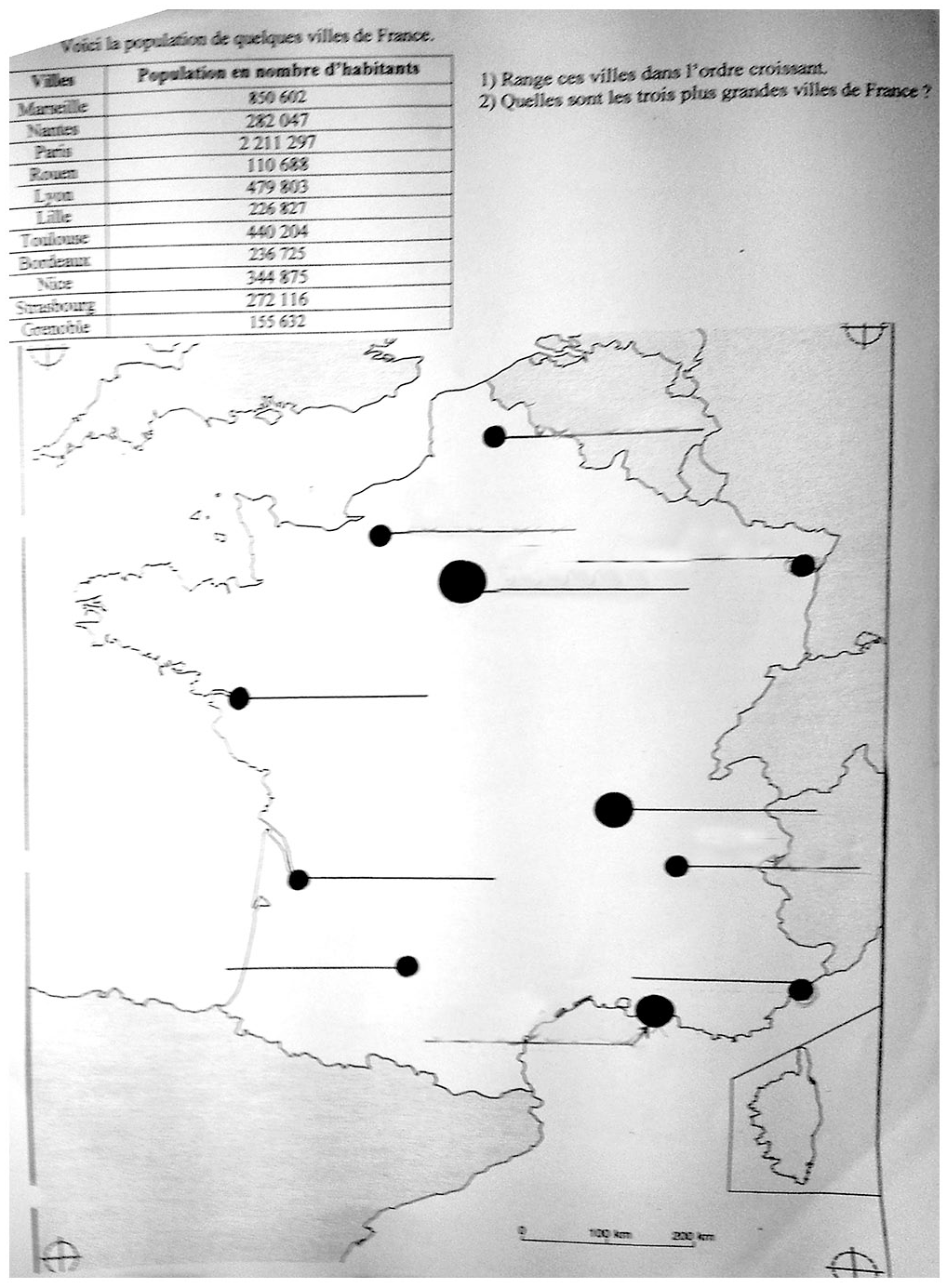
The sheet given to the students.
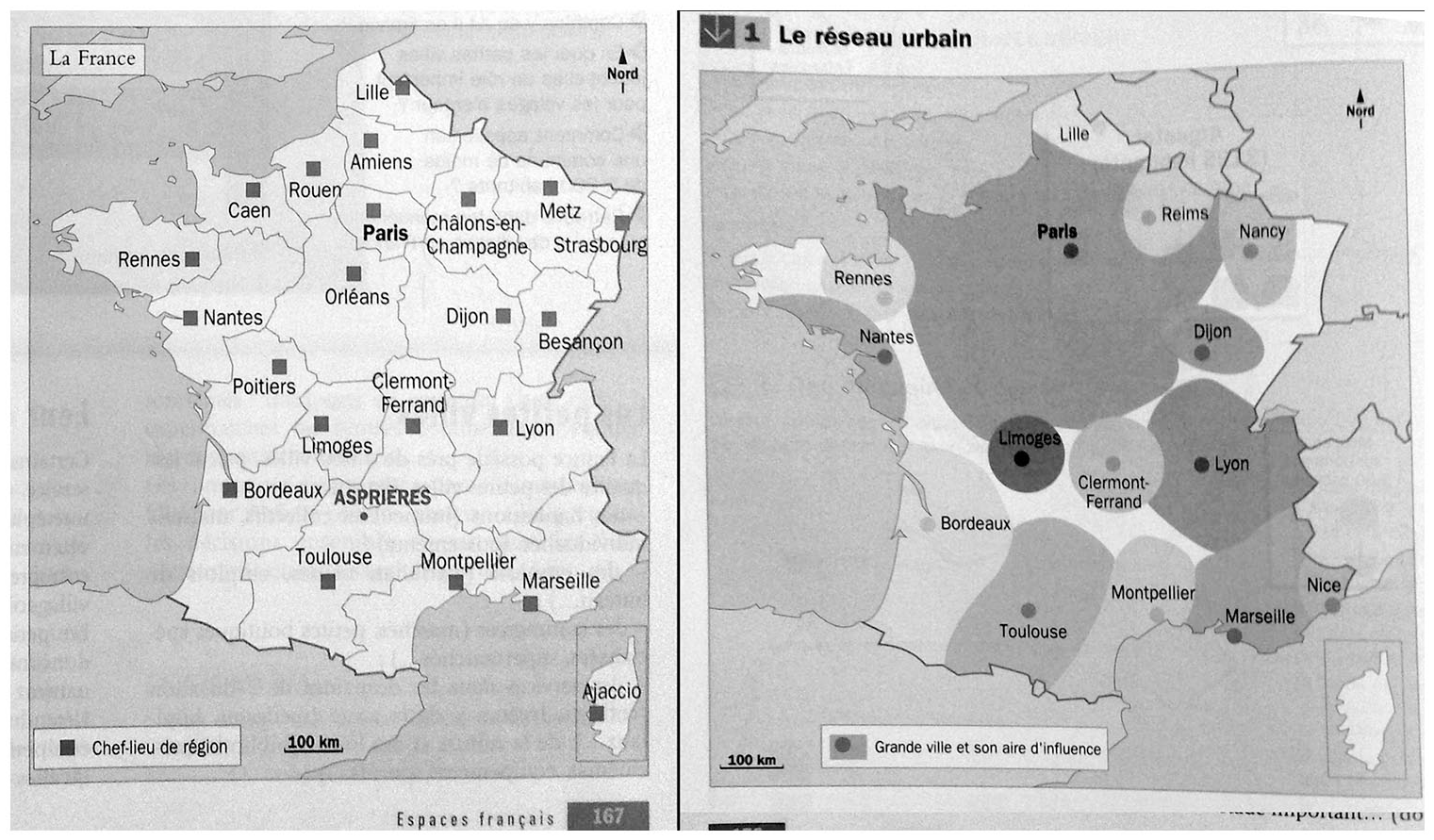
Maps included in the students’ textbook.
On the students’ sheets and in their books, coastlines are represented by black lines. The teacher used a satellite photograph displayed on the board to correct the exercise. Here, coastlines are not represented by lines but by different colors, with different shades of blue used to represent seas, and colors ranging from green to brown for land. Leila, a student deemed to be weak, walked up to the board to show the location of Nantes, a coastal city that she had located on her sheet. However, thrown off by the different method of representation, she appeared confused and was no longer able to locate either the city or the tip of Brittany ‘sinking into the sea’. Astounded, the teacher exclaimed: ‘Hold on a minute, let’s get things straight. Take a step back and look at the map from a very long way away. Can’t you see places that look like land and places that look like sea?’ Faced with the student’s continued lack of understanding, the teacher was forced to point out the coasts on the map and to clarify the meaning of the different colors. The teachers observed in this study were often found to neglect this technical aspect unless they were forced to address it, simply because most signs and symbols are, to them, perfectly obvious and require no explanation. However, these are skills that students need in order to access further knowledge, and there is substantial evidence showing that some children are not familiar with them.
Second, other signs relate to the activity itself. There is generally a requirement to think about what the proposed activity points to beyond the task itself and how it fits into the conceptual architecture developed year after year. In the situation described, the students were required to draw connections between the points symbolizing cities and other indications (coastlines, borders, the north, etc.) or alignments where no proximate indication was available, as well as comparing distances in cases where several proximate cities were located far from specific landmarks and comparing the list of cities to be located with the list indicated on their sheet. The requirements of the activity – a complex activity for eight-year-old students – may be inferred from the documents provided and from cues from the teacher but are not clearly set out. Students were simply instructed to ‘write the names of cities on the lines’. Soke, a low-achieving student from a low-income family, appeared to partly understand the activity. Figure 3 shows that he began by locating a constellation of geographically proximate cities – that is, Paris, Rouen and Amiens – which form a triangle.
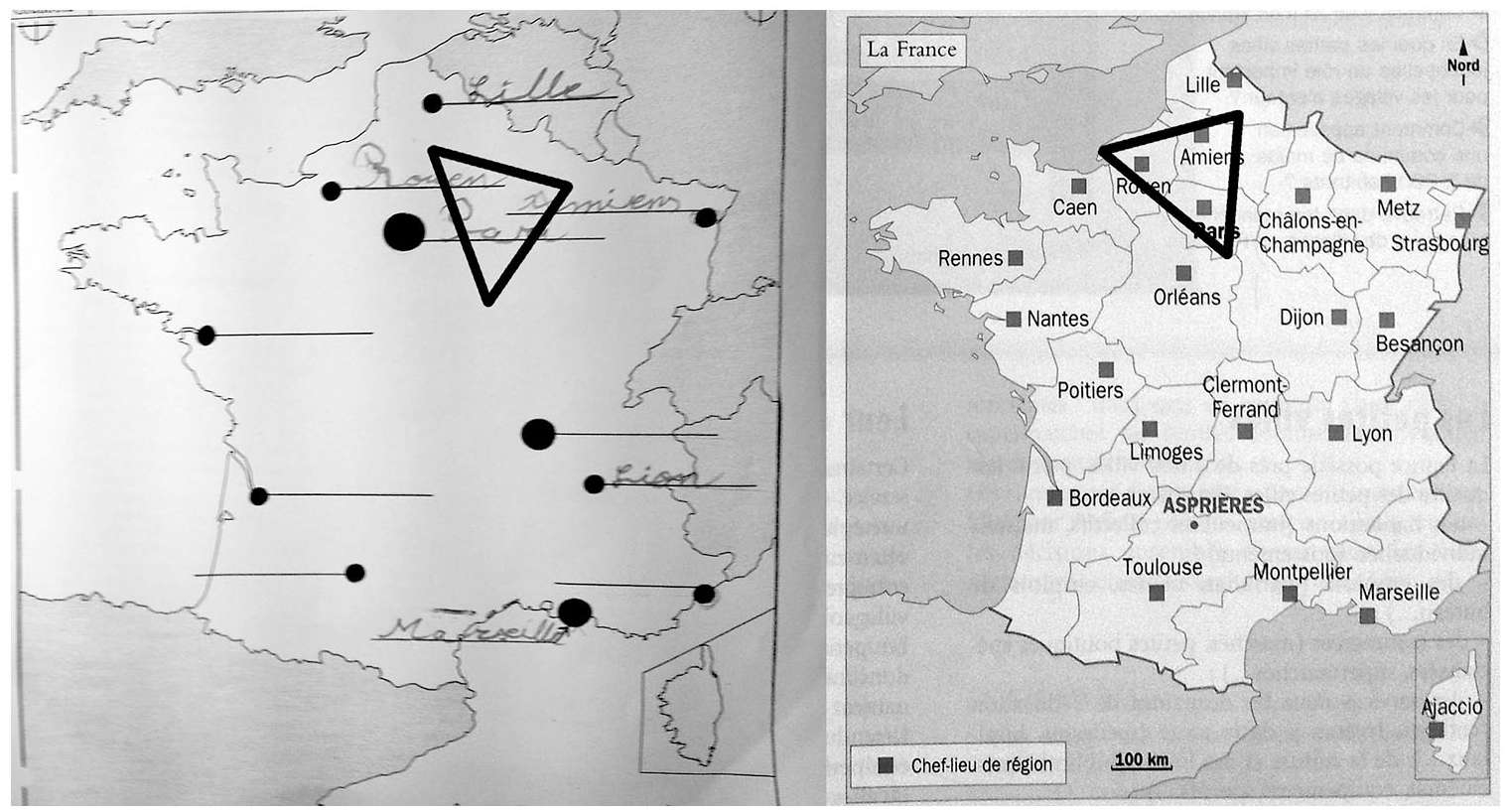
Soke’s initial work.
However, he appeared to focus on the position of the lines on which he was required to write rather than the points and was misled by the inclusion of additional cities in his book, causing him to indicate ‘Amiens’ in error. The teacher looked at his work and pulled a face, without, however, explaining the exercise more clearly. Soke understood that he had made a mistake but was unable to see what he should have done differently, leading him to resort to another strategy. To ensure he would be assessed positively, his focus now was on copying the answers of the student seated next to him without the teacher noticing. The other student was a high achiever in an otherwise average class who appeared to have no difficulty in correctly interpreting the relevant expectations. The teacher in question, who felt that the exercise ‘entailed no particular difficulties’, was, like many of the other teachers observed in this study, not focused on the necessary intellectual operations so much as on the general behavior of the class. Likewise, many of the students observed in the study were found to carry out the set tasks by shirking the actual intellectual activity, such as when Soke simply copied his classmate’s answers, or when students got the teacher to offer a simplification that enabled them to avoid engaging with the substance of the activity.
Third, other signs refer to the discipline in question and to how it reflects and embodies a particular way of thinking about the object of study. The simple fact of filling in a map in geography should be enough to indicate to the students that geographical features and landmarks and relative distances are of critical importance. We can draw on another situation to understand the importance of discipline. In the observed classes, grammar was mostly seen as a subject that requires learning rules and applying them in exercises. Three seven-year-old students from low-income backgrounds were observed studying a lesson about negative sentences in an after-school workshop. While their grasp of the subject was clearly limited, a teacher was observed helping them and re-explaining the lesson, with the result that they were soon able to write three negative sentences. They left the workshop with a sense of satisfaction, but, in response to the question ‘What about you, when you talk, do you use negative sentences?’, they seemed to take offense, as if feeling insulted, and responded sharply with: ‘What? Negative sentences? No, we never use them!’ Thus, although they had clearly progressed in their understanding of the subject, the notion that grammar might be connected to the language they use and is not simply a set of recipes for exercises seems foreign to them, so that the very idea of grammar loses much of its meaning. This episode, though somewhat commonplace for children of this age, illustrates the way in which disciplines are perceived more as naturalized objects to which students must adapt than as social constructs to be questioned, the characteristics of which need to be made accessible to them so that they are able to find their way within the labyrinth of academic requirements.
Fourth, some signs also refer to the appropriate behavior to be adopted and to how students are generally expected to think as a collective in class about an object and what its properties might be. For example, one high-achieving seven-year-old student from a high-income background was observed attending an extracurricular workshop in which little actual learning took place. She was clearly bored and became increasingly insolent and disruptive during the session, singing at the top of her voice right in front of the workshop leader and inciting several of her classmates to do the same. She then left the workshop and, at around 5 p.m., went to the homework club run by non-teaching staff. There, she was seen entering the room, sitting down quietly on her own in the front row and getting out her things. Without saying a word, she started to revise her lessons and to complete her exercises. The signs emanating from each of these situations imply vastly different interpretations produced by the same student, leading to widely differing behaviors and activities. It is worth drawing attention to a number of differences here: the presence or absence of writing (which is often interpreted by students as being synonymous with schoolwork), of an object or focus of thought and reflection (which tends to immediately guide and direct the activity of strong students) or of a school subject or similar type of activity (which strong students look for in order to understand what they are required to do), the greater or lesser emphasis on behavioral rules (indicating the degree of proximity to standard classroom activities); the fact of displaying or not displaying a learning objective on the board (which is something that strong students are trained to look for); and the articulation of standards to be adhered to (which provide information about the ultimate goal of the activity). Though operating simultaneously, these signs all reflect different aspects, forming configurations characterizing each of the two situations and directing the activity of the strong student. The teachers observed guide students not towards attitudes so much as towards positions that reveal nothing about school activity. For example, they would ask the class to be quiet (rather than to focus on a learning object with a view to examining its properties), to write (and not to note the outcome of the reflections carried out), etc. These expectations, which seem so self-evident that it does not seem necessary to articulate them given their degree of embeddedness in schools, appear to be difficult to interpret for some students.
Finally, other signs refer to the objective of the situation, with the objective ‘learning’ and ‘working’ being generally identified but endowed with vastly different meanings by different children. Does learning mean learning by heart and being able to reproduce learned content, learning to pass the next test or assessment, learning to understand notions and knowing how to transfer and use them in new contexts, or changing and growing by developing one’s categories of thought? Does working mean filling a page with words or arithmetic or thinking about a problem? While the observed teachers all sought to encourage intrinsic motivation demonstrating the importance that they attach to the acquisition of new notions and categories, they struggle to convince students whose interpretations tend toward a more material conception of school objectives. One teacher responsible for a class of 10-year-olds in one of the low-income neighborhood schools was surprised about the fact that a student kept persevering with work that he did not understand. However, she also referred discouragingly to her classmates’ resistance: When it comes to work, they’re very resistant. You’ll often hear them say: ‘oh no, oh . . .’. I’ve managed to introduce little ‘carrots’, in inverted commas, with trips, bonuses, etc. [. . .] They’re always asking me: ‘Have you corrected this or that, miss?’ or ‘How many bonuses will there be for the dictation?’. That’s what drives them.
Like her, most of the teachers observed mostly materialized objectives using rewards or sanctions. Objectives are not defined so much as indicated in terms of discrepancy or consistency. This poses a challenge for students, some of whom are unable to clearly understand what those objectives are, leading them to turn toward extrinsic motivation and focus on rewards or a good grade at the expense of longer-term goals, to a which a greater value is attached in school.
The five types of signs that I have just described operate simultaneously. In each of the situations set out above, the interpretations involved relate to physical signs, the activity, the discipline, behavior and the objective. Given this, it is easy to see why it is so difficult for teachers to engage in explicitation. An explicitation of a situation limited to one of these dimensions is not sufficient, as illustrated by the case of three students who ‘never use’ negative sentences.
A third characteristic of school expectations then concerns the links between the different aspects of the situation referred to above (material signs, the activity, the discipline, the behavior and the objective). In students’ interpretations, these aspects are interconnected by a process of calibration, as defined by Bateson (1979: 196), whose concept was itself based on research by Mittelstaedt (1962). For instance, in the above example, the ‘learning’ objective identified by the presence of learning content served to calibrate the expected behavior: in the case of a strong student, if the goal is to learn, it is important to be quiet and to behave well. Likewise, the way in which the discipline is conceived serves to calibrate the activity, giving it form (to use Bateson’s terms). A specific situation will serve to illustrate the point. A very weak student aged nine from a low-income background was asked to do a geometry exercise. She was required to reproduce a frieze formed of three circles with the same radius and with centers located on the same line, at the intersection with an adjacent circle, as in Figure 4.
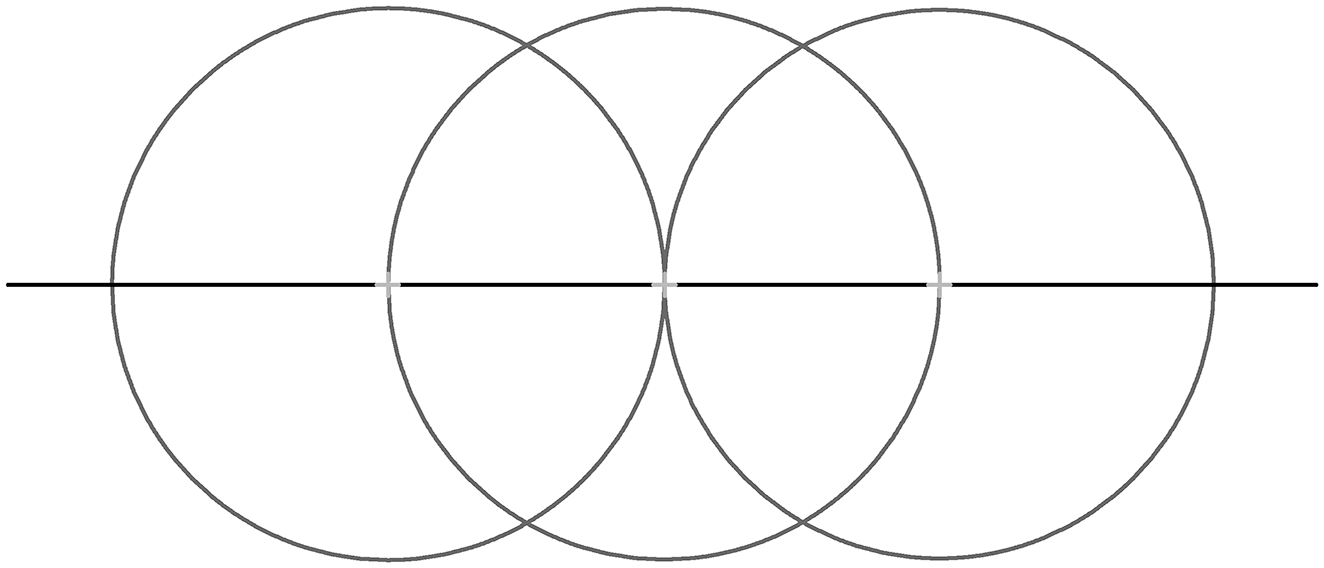
The template to be copied.
However, the student’s conception of geometry meant that her understanding of, and approach to, the exercise was inherently problematic – or, to put it differently, not consistent with the relevant school expectations, which, in this case, were highly implicit. The immediately present signs (figures drawn using a pencil and a white sheet of paper instead of a pen and graph paper) and the student’s prior experience evidently resulted in her viewing geometry as a form of drawing rather than as an analysis of the properties of figures.
Given this, as can be seen in Figure 5, the student’s primary focus was on reproducing a drawing, and the properties as she viewed them were not geometric so much as visual, resulting in her producing three roughly equivalent circles and centers represented by crosses, but with no axis structuring the figure, three circles with different radiuses, and centers that were not the actual centers of the circles and were not aligned, as shown in Figure 6.
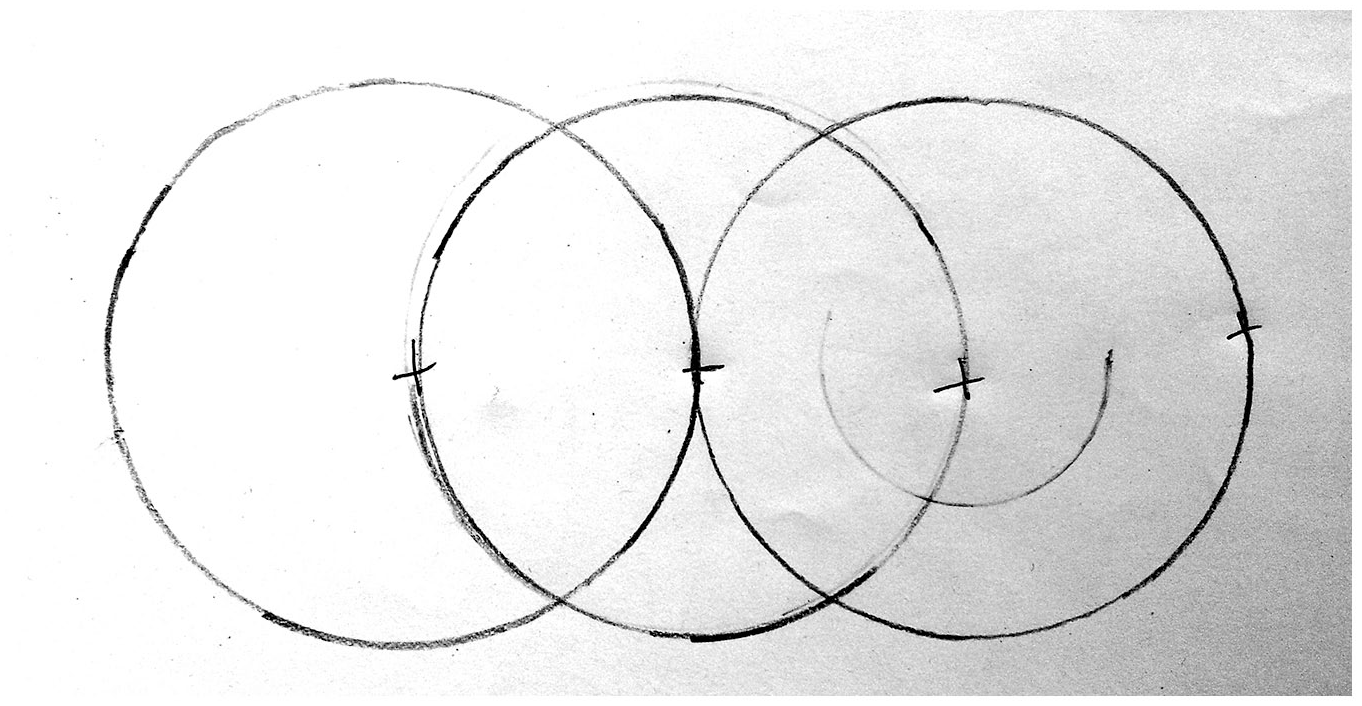
The student’s work.
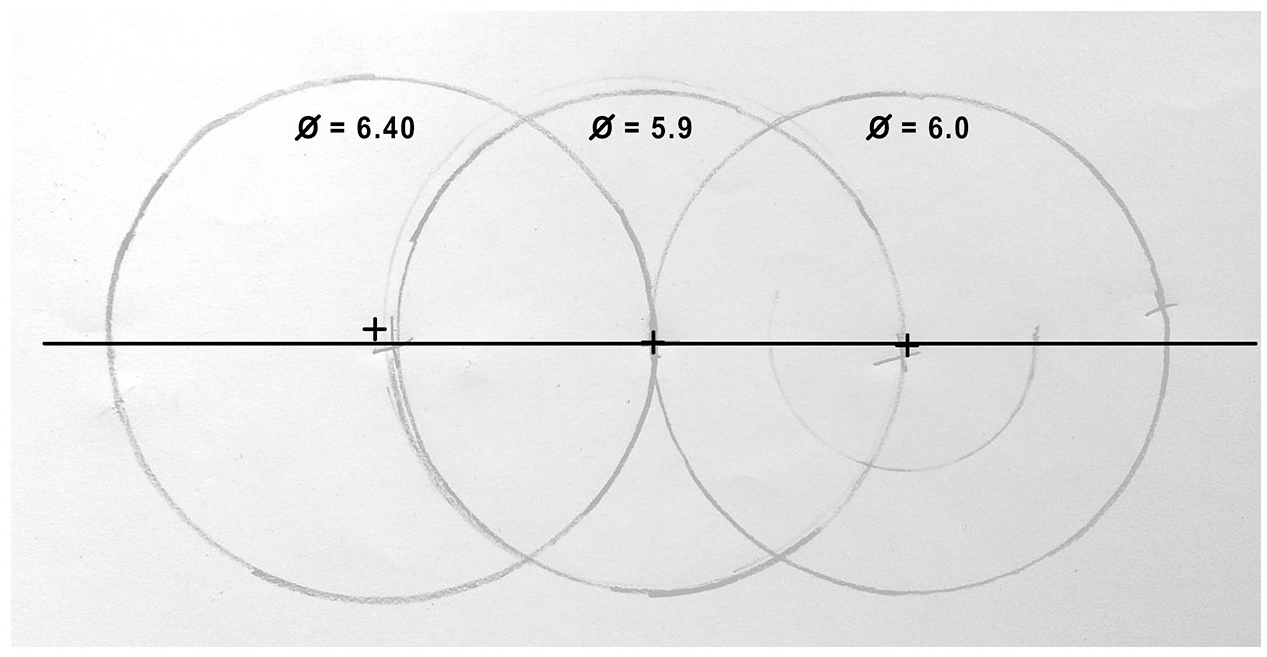
Some properties of the student’s work.
While such a perception of geometry is not uncommon among 10-year-old children, the resulting limitations are clear to see, as is the explicitation of expectations required to overcome them. Another conception of geometry was found to enable strong students (observed in other schools during other exercises) to calibrate their activity differently. However, the different aspects of the situation are also connected, conversely, by a process of adjustment (Bateson, 1979) causing students to consolidate or tailor them in part to each new experience. For example, the fact of specifying the size of the circles can result in a shift in the perception of the activity that causes students to focus on looking for properties behind the drawing, which may lead to a change in the perception of ‘geometry’ as a discipline and, therefore, the perception of the expected behavior in class.
A final aspect of French school expectations is their tendency to extend beyond the confines of the classroom. In the many activities developed for children outside class time, if they carry a potential for learning, strong students are able to apply a definition of the situation in academic terms themselves, enabling them to continue learning outside the classroom and to consolidate the structures that they develop with their teachers. However, insofar as ‘extracurricular’ situations do not share exactly the same characteristics as ‘classroom’ situations, a problem arises since they relate not to an academic subject in the strict sense but rather to a topic (tales, fairytale characters, material recovery, etc.) and generally give a prominent place to play and peer interactions. These findings are consistent with research by Bernstein (1967, 2000) on what he termed the aggregated and integrated codes, and with Young and Lambert (2014) on knowledge and other competing priorities in contemporary education, although the approach taken here focuses on the perspective of the activity expected of students. When confronted with a thematic activity, students are led to perform a translation of the activity, enabling them to perceive the disciplinary activity behind the thematic activity (Netter, 2018) or the serious activity behind the play (Netter, 2019). Once the activity has been translated, a synthesis still needs to be performed to enable interaction with other activities. A specific situation will help to illustrate this last point. In a class of seven-year-olds observed in a school located in an affluent neighborhood, the teacher had put in place a ‘reading rally’. The children were often required to read short novels and to complete a questionnaire, a task that ended up boring them. Their music lesson was for them an opportunity to let off steam and indeed proved highly disruptive. On the occasion in question, the teacher was attempting to get the children to sing a tune from The Sound of Music, which the children deliberately butchered. One high-achieving student who was particularly disruptive during the session was punished and sent to the back of the classroom. However, while chatting during recess with a classmate who was also a very strong student, he explained his interest in music to the researcher and showed him that he was able to sing in tune by tapping the palm of his hand to the beat of the song. When the researcher asked him if there was a link between music and class, he laughed and replied: ‘Well, yes – the reading rally!’ His classmate further emphasized the point by tapping his palm and sighing, thereby underlining the repetitiveness of the obligation to read in class: ‘reading rally, reading rally, reading rally, etc.’. In other words, high-achieving students from affluent neighborhoods are experts in synthesizing seemingly very different contributions, which they compare and collate by formalizing their inscription in abstract categories – such as, in this case, the representation of time. Because it is structured into different activities (subject-specific activities in class, projects, cultural and artistic workshops, excursions, etc.) (Netter, 2019), contemporary education requires children to develop the ability to synthesize, without which attainment gaps tend to widen between children who only learn in class and children – such as the very strong students referred to above – who are able to derive educational benefits from all activities.
Discussion
The different characteristics of school expectations set out above (interpretations of signs organized into precise, stable structures relating to different aspects of the situation and linked by calibration; the need to synthesize activities by translating a part of them into disciplinary, or subject-specific, terms) were seen in all the classes observed as part of this research. The point here is not to deny the differences that may exist between different schools but to underline that, beyond these differences, there exists a set of shared expectations, which can be described in curriculum terms.
The sociology of education typically makes a distinction between the formal curriculum, which refers to what schools are officially expected to transmit (formalized in France as the ‘programme scolaire’), and the curriculum-in-use, which refers to the way in which the formal curriculum is transformed in everyday practice (Mangez, 2015) to form what is actually taught in schools. However, alongside this, another curriculum can be seen at work – a curriculum that refers to how students are expected to define situations. In other words, the education system expects students to be able to identify and interpret the elements of the formal curriculum presented to them on a day-to-day basis. This is not the curriculum-in-use since it is not generally implemented in class, although mastering it is a condition for doing well at school. Though it may be familiar to some students, I refer to it as the ‘invisible curriculum’ since it remains invisible to other students, as in the case of the weaker students from lower-income backgrounds observed as part of this study. Although very high-achieving students apply it without even having to think about it, it is not the same as the ‘mindless curriculum’ (Silberman, 1970), a concept used above all to lament the importance of routines and to defend the value of creativity at school. It also differs from the ‘null curriculum’ (Quinn, 2010), an idea used to highlight gaps or absences in the formal curriculum, while the invisible curriculum emphasizes a lack or an absence in the curriculum-in-use. It also differs from the idea of the ‘curriculum shadow’ (Uhrmacher, 1997), which, as an extended version of the ‘null curriculum’, indicates the difficulty of taking emotions into account at school, and from the ‘shadow curriculum’ (Brown, 2005), a term used to denote the important role that business and the private sector now play in the field of education.
The invisible curriculum is not the same thing as the hidden curriculum. The hidden curriculum is taught, albeit tacitly. The many authors who have studied the concept have tended to focus not on inequalities so much as on how students are socialized in schools and led to develop certain attitudes such as obedience, self-denial, conformism, punctuality, etc., without these being made explicit. The opposite happens with the invisible curriculum, which is not generally taught in school despite the fact that students are expected to grasp and understand it, not unlike the dispositions required to succeed in the education system described by a number of French sociologists of reproduction. For some students who are not led to understand, through socialization in other settings, what is expected from them in the classroom, the invisible curriculum as it is defined here represents the missing link that keeps them at a remove from knowledge as taught in school. It thus differs from the notion of the ‘invisible curriculum’, which has sometimes been used in the past to denote the idea of the ‘hidden curriculum’ (Hicks, 1969). However, in some studies that refer to the hidden curriculum, such as Snyder (1970), influenced possibly by the work of Bourdieu and Passeron (1964), and in some of Bernstein’s (1975a) writings, we find an interpretation of the notion that shares much in common with how the invisible curriculum is defined in this paper. But the idea has struggled to gain traction, being subsumed under the dominant concept of the hidden curriculum and remaining largely undeveloped as a result. In other words, the failure to recognize the invisible curriculum as denoting a different reality to the hidden curriculum has prevented the emergence of the idea as a full-fledged notion, despite it being a valuable analytical tool. Indeed, the research reported in this paper, which provides a description of the structure and main features of the invisible curriculum, demonstrates the extent to which the notion can help in understanding how inequalities crystallize in class.
The notion of the invisible curriculum highlights how differences in the way that situations are interpreted are transformed in the course of everyday activities undertaken in class into educational inequalities. In each situation, students interpret each of the five dimensions described above, with their interpretations being more or less consistent with the invisible curriculum; that is, not far removed from the interpretations that are valued and promoted in school. These different interpretations, which arise from, and feed into, students’ categories of thought, serve as points of reference for the implementation of a practice (Bourdieu, 1972), thereby leading to productions of different value, some of which provide access to better academic results. Access to interpretations that are valued within the terms of the invisible curriculum is therefore critical.
However, wherever the invisible curriculum remains unspoken at school, students’ understanding of it depends heavily on their prior family socialization, as shown by an observation in a class of nine-year-olds from a high-income neighborhood during a visit to a museum. The children learned about different symbols of monarchy from a speaker. They had been provided with paper and pencils by their teacher, the idea being for them to draw one of the works on display. In front of the first work, a discussion began before being cut short when all the students began taking notes in silence, as might university students. When questioned about the matter, the teacher expressed surprise and suggested that her students may have learned how to take notes the previous year with another teacher, an assumption contradicted by her colleague. The capacity to use writing to organize one’s thoughts may then seem ‘natural’ to those involved, with the children’s comments appearing at first sight to reinforce this impression. For example, Charles, a participant from an affluent background and regarded as a ‘good student’, simply remarked: ‘when they handed out a sheet of paper, that’s when I said to myself “it must be for taking notes”, so…’. It was only after reflecting on the matter that he explained that he had developed the habit after previously visiting the museum with his parents. This research, while it demonstrates the importance of the invisible curriculum in class, therefore adds to the findings of ethnographic studies conducted among families and that have shown how different modes of family socialization lead to the development of configurations of specific dispositions valued differently at school; that is, cohering to a greater or lesser extent with the invisible curriculum (Bernstein, 1975b; Bonnéry and Joigneaux, 2015; Heath, 1982; Kakpo, 2019; Lareau, 2002). However, the variations in the degree of command of the invisible curriculum, including among students from the wealthiest families, is a reminder that this development process is anything but mechanical or automatic and that it depends on children’s entire range of experiences.
The invisible curriculum is so well understood and applied by the highest-achieving students that some are able, despite their young age, to formalize it in relatively clear terms. For example, two high-achieving students aged nine explained how they approached their various activities in school and outside school, emphasizing that they are always diligent and aware of time and always think hard regardless of the activity, concluding thus: You always have to get what’s inside here [pointing to her forehead] working hard (laughter). Even when we’re having fun, we’re working!
However, the study found that in schools located in lower-income neighborhoods, students tended to be diverted from the expected activity because they struggled to perceive the invisible curriculum. For example, one of the participating schools located in an underprivileged area organized a visit to a museum for a class of six-year-olds. The purpose of the visit was to provide an opportunity to observe casts of hybrid animals – copies of medieval bas-reliefs. An invited speaker helped to run the event, presenting an analysis of each animal in turn while taking care to repeat her explanation of what a hybrid animal is several times and telling a story drawn from the relevant mythology. The speaker was also careful to reiterate several times that the students would have to draw a hybrid animal at the end of the visit. Yet, despite her skilled delivery, many of the children appeared to gradually lose interest and, when the time came to draw an animal, three-quarters of them were visibly disconcerted, showing little understanding of what was required of them. An analysis of the session and the students’ responses shows that they were unable to synthesize the relevant information. In particular, the children appear not to have grasped the core focus of the visit (i.e. hybrid animals), which they failed to connect with a school subject. In other words, the thematic nature of the activity was not ‘translated’ into a subject-specific activity. Moreover, the situation, which seemingly required a different behavior to that required in class, tended to distinguish the visit from a school activity, thereby de-legitimizing the learning activity. A very weak student aged nine from a low-income neighborhood summed up how such visits tend to be perceived by explaining that, on excursions, unlike classwork, ‘you have fun!’. There was a striking contrast with the two students who explained, conversely, that the fun associated with their activities helped them to learn. In short, the study showed that, in the schools observed as part of this research, teachers, often without explicitly saying so, expect children to ‘academicize’ the world and to adopt a ‘definition of the situation’ – the invisible curriculum – that is consistent with what they themselves have in mind, but that not all children are prepared for it.
The ethnographic methodology adopted in this study provides no grounds for assuming that the invisible curriculum is found in other schools. However, three points suggest that the invisible curriculum is a descriptive model that might extend beyond the confines of the study. The first is that the invisible curriculum is, logically, relatively stable since it depends primarily on three interconnected elements: (a) the formal curriculum, which is identical in all French schools, subject to (b) a ‘school’ interpretation of the world specific to a given period and that school teachers, who are recruited and trained under similar criteria and conditions throughout France, embody in their everyday practice; and (c) the structuring of school into different activities governed by national policies. The second is the persistence in French classrooms of the ‘theory of socio-cultural handicap’, well beyond the schools visited and observed as part of this research (Roiné, 2014). According to this theory, the difficulties encountered by students stem from parental, cultural, linguistic and psychological deficiencies. Without going into the detail of the argument – refuted on a number of occasions by research in sociology (Bernstein, 1975b; Charlot, 1997) – the mere fact that it continues to exist on a large scale shows that, for teachers, weak students seem to be missing something, even if that something is not clearly identified and is assumed to be related to external factors. In other words, there appears to be a discrepancy between teachers’ expectations, which tend to be viewed as homogeneous, and the extent to which weak students are able to respond to them. A third factor reinforces the idea of a more general curriculum – a factor related to success rather than academic failure: the high attainment of teachers’ children, a fact highlighted by several studies conducted in France (Caille and Rosenwald, 2006; Devineau and Léger, 2001; Lasne, 2012) and explained by their better understanding of the workings of the system, a factor seen at middle-school (collège) and, above all, at primary-school level, in the form of close parental supervision in line with school expectations (Kakpo and Rayou, 2018), as argued in this paper. Thus, the academic success of teachers’ children suggests the existence of common expectations shared by teachers throughout the national territory.
The invisible curriculum was found to be a problem in the classes observed as part of this study in cases where it became apparent that teachers did little to draw attention to it or make it explicit, not because of any unwillingness or because they wanted to favor certain students over others but simply because the expectations associated with the invisible curriculum seem obvious to them or are for the most part not formalized. However, it is important to note that in the preschool class observed in this study, the teacher put much emphasis on making the invisible curriculum explicit. In other words, while it is identical across all the observed classes, the extent to which it is made visible and explicit varies significantly. Several factors may account for its absence in class. First, the expectations associated with the invisible curriculum tend to be eclipsed by the ‘official’ expectations of the formal curriculum, which play a very significant role in France, where the education system is highly centralized. The content of required knowledge, which forms the core of school curricula, exists in written form and is taught in teacher training courses, and a sound knowledge and understanding of it is required in competitive recruitment exams, while teachers’ theoretical and practical grasp of such content is verified during ‘inspections’ that have a decisive influence on their careers. Nothing of the sort applies to how students are assumed to understand such content – in other words, the invisible curriculum. The invisible curriculum is not consigned to writing and there is no requirement to teach it formally within the education system. The proportion of students with a good understanding of the invisible curriculum varies significantly in different classes and can also lead to its existence being altogether forgotten. For example, in the schools located in high-income neighborhoods observed in this study (in other words, schools where many students already have a good grasp of the invisible curriculum), very little attention is given to it by teachers, meaning that those students who are less familiar with it (who, in our study, were invariably from low-income backgrounds) come across at best as ‘exotic’ and are often stigmatized because their behavior, which arises from their interpretations, departs from the norm. Students in this category face repeated injunctions to understand and operate in a particular way without having the necessary tools to do so. For example, on one occasion, a teacher leading a class of seven-year-olds from high-income backgrounds announced that she was going to correct an exercise. Almost all the students grabbed their green pens, which they know are to be used for corrections. However, two of their classmates, Vincente and Delia, continued to write because they failed to identify the word ‘correct’ as a signal meaning a change in activity and an instruction to use a green pen. Noticing them, the teacher remarked sarcastically that ‘as usual, two of you haven’t got your things out’. In short, the invisible curriculum, though critically important, is likely to seem of little importance to any educated person who knows how to interpret teaching and learning situations.
Let us consider another simple example. Preschool curricula dictate that children should read picture books, and teachers implement the curricula and require children to listen to stories. But who explains to children what ‘listening to a story’ actually means? Should children, as some of the observed students appeared to believe, remain quiet, avoid distracting the children sitting next to them and wait for the teacher to stop talking and close the book? Or, as some see it in a family context (Bonnéry and Joigneaux, 2015), should we expect them to be able to identify characters and what happens to them, to identify important details in the text or the pictures, and to draw connections between different situations on different pages or in different books? All these operations are implied in the verb ‘to listen’ without, however, being explicit. What they imply is a specific definition of the listening situation that is assumed to be conducive to schoolwork and that some children fail to develop. They are missing from the formal curriculum but are nonetheless necessary for academic success. This is just the kind of thing that is central to the invisible curriculum.
Thus, Waller’s idea according to which the aim of schooling is to impose a culture – or a specific definition of the situation – on all students fails to account for the differentiating phenomena observed in this study. Rather, in the case of France, the education system simply expects students to define the situation based on the main features of the invisible curriculum, relegating those who fail to do so and thereby contributing to social differentiation in learning. On the other hand, the evidence suggests that students who find themselves relegated in this way seek to overcome their bitterness by claiming to be opposed to the idea of an education system imposing a culture on them that they do not recognize, rather like the lads referred to by Willis (1977) who sought to assert their own definition of the situation.
Limitations and prospects
The light thrown on the invisible curriculum requires education professionals to engage in a systematic effort to explicate and elucidate educational situations and provides an insight into what a ‘rational methodical’ pedagogy might look like (Bourdieu and Passeron, 1964). In other words, explicitation should not be understood as a recipe to be systematically applied but rather as the fact of clearly exposing the workings – the whys and wherefores – of each school situation to make knowledge accessible to all (Young and Lambert, 2014).
Such an approach requires teachers to constantly question and challenge situations, to interrogate their goals and the associated intellectual and material framework and tools, and to engage in an effort to gather detailed information about how students perceive these situations. In France, teachers appear to be largely untrained and unprepared for any of this, as indicated by the Conseil National d’Évaluation du Système Scolaire (CNESCO, 2016: 94). French teachers report feeling uncomfortable about pedagogical methods and about how to manage heterogeneous classes at both primary (Charpentier et al., 2019) and secondary levels (OECD, 2019b). Drawing on the concept of the invisible curriculum as a theoretical tool, the implications of such a finding are clear to see. This particular weakness of French teacher training may account for the significant importance of the invisible curriculum in France and, therefore, the extent to which educational inequalities have developed there. However, we may also ask whether it is the expression of a specifically French preference for inequality (Dubet, 2014). A policy aimed at reducing its effects may then find little support among those who benefit from the current situation. In that case, is there not a risk of society breaking up the social contract founded on solidarity (Durkheim, 2007) that is denied to some from the youngest age?
Footnotes
Declaration of conflicting interests
The author declared no potential conflicts of interest with respect to the research, authorship and/or publication of this article.
Funding
The author disclosed receipt of the following financial support for the research, authorship and/or publication of this article: This study was funded by a grant of 115,000 euros from the French government (50%) and the city of Paris (50%).
