




Abstract
With schools and universities closing across Europe, the Covid-19 lockdown left actors in the field of education battling with the unprecedented challenge of finding a meaningful way to keep the wheels of education turning online. The sudden need for digital solutions across the field of education resulted in the emergence of a variety of digital networks and collaborative online platforms. In this joint article from scholars around Europe, we explore the Covid-19 lockdowns of physical education across the European region, and the different processes of emergency digitalization that followed in their wake. Spanning perspectives from Italy, Germany, Belgium, and the Nordic countries, the article’s five cases provide a glimpse of how these processes have at the same time accelerated and consolidated the involvement of various commercial and non-commercial actors in public education infrastructures. By gathering documentation, registering dynamics, and making intimations of the crisis as it unfolded, the aim of the joint paper is to provide an opportunity for considering the implications of these accelerations and consolidations for the heterogeneous futures of European education.
Introduction: Europe in a state of emergency
On December 31, the World Health Organization’s (WHO) Country Office in China picked up information on cases of viral pneumonia in Wuhan (WHO, 2020a). It did not take long before the EU Health Security Committee held its first meeting on the Wuhan Covid-19 outbreak on January 17, 2020 (European Commission, 2020), only five days before the WHO mission to Wuhan issued a statement saying that evidence suggested human-to-human transmission (WHO, 2020b). In a matter of months, the spread of the Covid-19 virus had effectively closed the borders normally open for travel between the countries in the European region. Europe was in a state of emergency.
As in many other areas of life, the closure of educational institutions in Europe in response to the Covid-19 pandemic was followed by simultaneous, and often conflicting, developments. As nation states began issuing national lockdowns, and students were sent home to engage in remote learning to prevent further spread of the pandemic, new and accelerated efforts toward digitalization began to appear throughout the European region (Williamson and Hogan, 2020). Enabled in many spaces by platforms and services developed by global tech-corporations, this acceleration was accompanied by a consolidation of the role of private providers in European education systems, enacted through multifaceted and hybrid forms of collaboration between teachers, technologies, non-profit organizations, and commercial enterprises. As the veil of the pandemic lifts the implications of this accelerated integration of commercial solutions and quasi-public networks into the center of many national emergency strategies for digitalizing education remain largely unknown.
Spanning Italy, Germany, Belgium, and the Nordic countries, this article sets out to investigate and map these accelerations and consolidations as they unfold in ways that may both reinforce and potentially challenge the realization of educational digitalization as a process predominately controlled by private companies and technologies. Taking inspiration from earlier experiments with collective writing during the crisis (Plotnikof et al., 2020), the paper presents five independent case studies of digitalization in Europe during the pandemic. By bringing together different types of analysis, voices, and perspectives on the digitalization and privatization of education, each case in the paper presents an empirical invitation to begin considering the differences and similarities in how digitalization was advanced and consolidated in Europe during the pandemic. Looking ahead toward a future of education beyond the pandemic, these considerations can play an important role in questioning the long-term democratic implications and pitfalls of urgently integrating digital solutions from non-governmental actors in public education infrastructures (Cone and Brøgger, 2020; DiMartino and Scott, 2013).
Digitalizing European education
As illustrated across the cases presented in this paper, the relatively swift transition to digital platforms during the Covid-19 lockdown was, in a certain respect, unsurprising. Over the course of the last two decades, local and transnational actors in many parts of the European region have adamantly promoted digital education infrastructures, pushing the use of learning management systems, databased performance assessments, and various platforms for digital teaching materials, parent-teacher communication, and administration (Bergviken Rensfeldt et al., 2018; Cone, 2020; Landri and Vatrella, 2019). Prompting what educational researchers have described as an emerging field of digital education governance, a range of studies from across the region have documented how ‘digital technologies, software packages and their underlying standards, code and algorithmic procedures are increasingly being inserted into the administrative infrastructure of education systems’ (Williamson, 2016, p. 123). Supporting and enabling this infrastructural insertion are at least three interrelated processes which have gained traction across the European region during the past decades with varying degrees of intensiveness:
The advancement of processes of soft privatization through which private technologies and commercially driven platforms are embedded in public education governance. In the European region, soft privatization is, on one hand, connected intimately to the development of network governance in the European Union, in which associations, think-tanks, and tech-providers are informally integrated in policy-making processes, and on the other hand to the increased delegation of public operations to non-state (private) agents. (Ball and Youdell, 2008; Cone and Brøgger, 2020; Grimaldi and Serpieri, 2013; Hartong and Förschler, 2019).
The datafication of educational activities and knowledge through which commensurable and quantified abstractions constitute and re-represent who, what, and where counts as valuable in educational settings and governance processes (Lycett, 2013; Perrotta et al., 2021; Sellar and Thompson, 2016).
The corresponding encroachment of digitalization in an intensifying platformization of education, denoting a process through which single enterprises and/or commercial networks engage in the ‘systematic collection, algorithmic processing, circulation and monetization of user data’ (Dijck et al., 2018: 4; see also Komljenovic, 2019).
Taken together, the interrelated processes of soft privatization, datafication, and platformization have played a key role in configuring the evolvement of (commercial) digitalization efforts in the European region. As several researchers have noted, however, the realization of an innovative, data-rich, and network-based field of digital education governance in Europe has been neither smooth nor uncontroversial (Grimaldi and Ball, 2021a; Ratner, 2019). Due in part to local structural restrictions, in part to political opposition, assemblages of digitalization in education have been largely constricted to the efforts of a selected number of institutions, school districts, associations, companies, and programs. Despite heavy national investments and transnational advocacy, the promises of the innovative potentials of a digital transition in education have, with a few notable exceptions, remained exactly that: promises.
As the cases discussed in this joint paper illustrate, the urgent transitions following the Covid-19 lockdowns parenthesized many of the structural limitations and contestations against digital solutions. In effect, the lockdowns of physical education institutions did not so much create as accelerate and consolidate the commercially driven networks, processes, and technologies to which students, teachers, researchers, and policymakers are increasingly bound. By gathering evidence of these accelerations and consolidations, it is the ambition of this paper to both map and problematize their possible implications for the future of European education systems.
A gathering of cases
In the following sections, we present five case analyses of digitalization in the European region during the Covid-19 pandemic. Taking seriously the empirical nature of this collective endeavor, we have not edited the cases into one coherent narrative. Rather, we found it important to allow readers to access the case descriptions as empirical material that bears witness to the effects of the Covid-19 crisis on the enactment of digitalization – and the interrelated processes of privatization, datafication, and platformization – in and across European education systems.
The majority of contributors to the article are members of the PRIVATOPIA European research network. 1 The cases presented in the article were submitted following an invitation from the network coordinators sent out in May 2020 to network members and authors conducting research on the topic, asking whether one or more groups of authors would be willing to contribute with a short case description of how digitalization in their country or region of focus unfolded during the pandemic. Following Berlant’s discussion of the case as method (Berlant, 2007), the purpose of configuring the present gathering of cases is not to exemplify or illustrate a pre-established evaluation of digitalization during the pandemic. Nor is it to construe the pandemic as an opportunity to imagine alternative education realities (Peters et al., 2020). Operating in the middle ground between precedence and futurity, the cases are first and foremost an opportunity to gather documentation, register dynamics, and make intimations – not in order to conclude on the event, but to fold the singular into the common in a manner that opens it up to debate. By placing each case in relation to one another, it is our hope that the collective format of this joint paper will provide the reader with an opportunity to consider the stakes and implications of these singularities for the heterogeneous futures of European education.
The rise of EdTech in Germany
Germany is a relative latecomer in terms of digitalization, so it provides a particularly interesting case to trace manifestations of Covid-19-related EdTech empowerment. Unlike many other European countries that moved quickly to initiate large-scale reforms to implement digital education, data infrastructures, and systems of e-governance (such as the UK or most Scandinavian countries), investments in digital education emerged much more cautiously in Germany. Various context-specific reasons for this reluctance can be identified:
(1) Germany’s specific federal architecture, which not only includes 16 subnational state (Länder) education systems but also involves complex divisions of authority. This results in divisions between (digital) curriculum development, teacher education, and school supervision (authority of the states) on the one hand, and (e.g. digital) infrastructure or major parts of local administration (authority of the communities) on the other hand.
(2) Germany’s traditional skepticism about the influence of for-profit actors in the education system, with public institutions traditionally being given responsibility for (and potentially then subcontracting elements of) (digital) testing, reporting, and data management tools. Hence, instead of a few global EdTech players acting nationally, the fragmented market structure mainly supports the activities of small and medium-sized vendors.
(3) Germany’s system of relatively high teacher professionalism and autonomy, governed through a combination of extensive professional training and the state provision of input resources. As a consequence, skepticism about any kind of high-stakes data, external testing, school rankings, and non-anonymized data flows has remained high.
Taken together, these factors have had a major influence on Germany’s turn towards digitalization and, consequently, opportunities for the EdTech industry to establish lucrative markets (Förschler, 2018; Hartong and Förschler, 2019; Hartong et al., 2021). It was not until 2016 that digital education became a prioritized national policy agenda (KMK, 2016; BMBF, 2016), leading to tremendous discursive transformations as well as massive investments in infrastructural hardware and software. Still, despite this policy turn and the introduction of the so-called DigitalPakt in 2019 – an agreement to provide 5 billion Euros to foster digitalization in schools – until 2020 the actual reform outcomes remained disappointing for most EdTech providers. In turn, many of these actors began to criticize the German education system for dramatically lagging behind internationally and sticking with an outdated, dysfunctional model of education.
In spring 2020, Covid-19 appeared to prove the critics right: as mass closures of schools and universities generated demands for alternative (digital) forms of remote teaching and learning, most institutions lacked the hard- and software, skills, and expertise required to provide solutions. Within a short period of time, the situation turned into a large-scale public media scandal (e.g. Wiarda, 2020), driven in part by EdTech providers offering both political support and emergency solutions (Williamson, 2020) in the form of free hardware and software for schools and short-term tutorial initiatives. As the providers framed it, Covid-19 had presented a chance to finally overcome former obstacles and reform the education system: ‘The virus proved [. . .] to be a very effective tutor with regard to the digitalization of our schools. You could even say that Corona was the most effective, comprehensive advanced education training that our school system has ever experienced.’ (Pausder, 2020, Min. 3:34–3:56, own translation).
One example of the rapid transformation of German education during the Covid-19 pandemic can be seen in the expanding provision and implementation of learning management systems (LMSs) – which were in many cases offered free of charge on a temporary basis (Didacta Verband e.V., 2020) – as well as the development of emergency support structures such as tutorials, help desks etc. (e.g. Microsoft, 2020a). To support the digital transformation, some German states deliberately relaxed their data security laws, such as Baden-Wuerttemberg, which switched from prohibiting Microsoft products before the crisis to actively encouraging schools to use Office 365 (Ministerium für Kultus, Jugend und Sport Baden-Württemberg, 2020, p. 2). However, it was not only (global) EdTechs that ramped up their products and marketing, but also traditional schoolbook publishers, many of which came to play an important role in providing media for German schools (e.g. Cornelsen, 2020).
At the same time, the extraordinary situation of nationwide school closures further empowered the Federal Ministry of Education and Research (BMBF), which already for some years (yet often quite unnoticed from the public) had expanded its authority regarding datafication and digitalization of education through several law amendments and the DigitalPakt (Förschler, 2018). Using the pandemic as a window of opportunity, the BMBF was now able to further strengthen its large-scale governmental investment programs to promote digital learning (BMBF, 2021) – albeit still in (forced) cooperation with the federal states as the traditional units of legal authority.
As an example, in mid-2020 the federal ministry broke with the complex application processes which schools initially had to follow in order to receive funds from the DigitalPakt. Instead, the ministry now made a significant part of that funding (100 million Euros) available for instant support for remote education, followed by an ‘immediate equipment program’ (500 million Euros) to finance hardware and infrastructure for schools and ‘students in need’ (BMBF, 2021).
Interestingly, while the BMBF activities thus contributed to a gradual establishment of nationwide markets for learning management systems and other EdTech services, the BMBF also declared an intention to promote non-profit, state-led, and open-source alternatives. The most striking example of such non-profit alternatives is the BMBF-funded School Cloud (Schul-Cloud), an LMS initiated in 2016, which was strongly promoted and offered to schools nationwide during the shutdown. Of course, such public initiatives do not mean that none of the actors involved are non-profit companies or organizations, because these actors may be hidden behind partnerships and contracts, as in the case of the School Cloud developer Hasso-Plattner-Institute (HPI), which is a research institute funded by the owner of the global for-profit provider SAP (www.sap.com).
It is precisely this amalgam of private-sector empowerment, public alternative initiatives, and complex, hidden interrelations between the two, which characterized Germany’s emergency digitalization measures. Such interrelations include not only practices of subcontracting (as in the case of HPI) and relaxing data security regulations, but also the rise of new activity fields for EdTech players and intermediary players who indirectly promote EdTech products, as well as pushing the shared values of digital education. In garnering legitimacy around their shared vision of future schooling as digital schooling, the role of consultancy continues to play a major role in the ambitions of EdTech and intermediary players, including:
supporting schools in applying for DigitalPakt funding;
initiating network events (e.g. #wirfürschule Hackathon June 2020);
providing homepages with information sources, best practices, links to products etc.;
offering training/webinar tutorials;
conducting surveys to measure the achievements (including the benefits of remote learning) and outstanding needs of digital education (e.g. Bündnis für Bildung, 2020).
In sum, while there is clear evidence of EdTech sector growth during the Covid-19 pandemic in Germany, the general context of skepticism toward digitalization has in many ways restricted or buffered the transformations at play. It remains to be seen whether public alternatives to private EdTech products will ultimately take hold and counterbalance privatization dynamics, or whether privately owned and global infrastructures will have become a more permanent part of the German education system. Furthermore, even though the BMBF has widened its scope of responsibility and critique of the supposedly dysfunctional decentral federal education system in Germany rises, the federal states have so far remained the central authority for schooling throughout the pandemic. However, the states as well as the federal government have claimed their intentions to broaden their cooperation to enforce the digitalization of schooling. One of the most prominent examples is the ‘School Summit’ (Schulgipfel), which was recently established to bring together members of the federal government with the state ministers of education to discuss further steps addressing the pandemic challenges for schools (tagesschau, 2020). Altogether, it thus remains unclear how strong the ‘disruptive potential’ of the pandemic ‘summer of digital education’ (Bär, 2020, para 4) will turn out to be.
Boundary spanning in disaster capitalism: The Swedish Edtech Industry Association
Policy initiatives impacting the digitalization of schools and the curriculum has been an on-going process in Sweden. In the 1990s, decentralization and deregulation reforms placed the 290 municipalities as principal organizers of education with considerable autonomy. As a result, digitalization is an undertaking for each school and principal organizer, with very few central rules and guidelines. In addition, Swedish education has experienced far-reaching privatization and marketization with, among other things, the emergence of tax-funded, privately operated schools that are competing over the students in a ‘market’. The consequences from these transformations are several. One is the growing inequity across schools depending on, for instance, who owns and runs them and who attends them. Other inequalities become visible in access to digital technology and infrastructure. Although most Swedish schools have access to a digital infrastructure, there are major differences in the types of technologies offered and what possibilities these provide in relation to teaching, learning and administration (Skolverket, 2018). There is, however, a national strategy on digitalization in education, involving representatives from the EdTech sector, among others (Williamson et al. 2018). Taken together, during the past few years we have seen the development of a large potential market for the EdTech industry that was further expanded and consolidated during the pandemic.
In a European context, Sweden diverged from the path taken by most countries in the Covid-19 crisis, leaving most of its preschools and schools for students under the age of 16 open. However, for students older than 16 attending upper-secondary and higher education, schools and universities went online from one day to the next. The general climate of uncertainty also pushed primary schools to prepare to move online any day, galvanizing an arms race to ensure that digital infrastructures were in place should the schools shut down. This case report explores how private EdTech actors, through the association for the Swedish Edtech Industry (SEI), made use of the Covid-19 pandemic in order to advance their positions and accelerate digitalization of the Swedish school sector.
SEI is a non-profit industry association whose overall aim is to increase and improve the digitalization of the formal education sector. The SEI is funded by EdTech company member fees and represents the interests of commercial EdTech companies that offer services and products to different levels of schooling. A majority of Swedish EdTech actors are members of the association. SEI is governed by a board consisting of member representatives, with the daily work performed by a small office with a small permanent staff (Swedish Edtech Industry 2020a). The work primarily involves acting as what we label as a ‘boundary spanner’ (Jacobs et al. 2019) for the EdTech sector, as it is facilitating and enabling the private sector to reach potential public customers as well as engaging lobbying activities in different stages of the public policy process and acting as a connector between different sectors and actors. The SEI also spans boundaries internationally, by sharing information and connecting partners with similar interests via similar associations in the Nordic countries and Europe. One of the services offered by SEI is the ‘EdTech map’, providing an overview of the sector and a list of private businesses offering EdTech to schools.
As Covid-19 spread, the SEI accelerated and consolidated itself and its EdTech affiliates as important players in education through a process where the SEI actively positioned itself as a legitimate and trustworthy actor in the field of educational crisis management. This positioning was done mainly through the SEI website, which during the crisis was turned into an information service for schools to function as a mediator of solutions to the variety of problems connected with digitalization that teachers and schools may experience. The main tool used – one that also helped to consolidate the SEI as a boundary spanner – is a long list of what the member companies have provided during the Covid-19 crisis beyond what they usually offer (philanthropic or discounted), which created conditions for accelerating and consolidating digitalization by both attracting new customers and strengthening ties between existing ones and the technologies and services offered by member companies. This list includes, for instance, free digital textbooks, increased functionalities, discounted hardware (for leasing), online in-service teacher training, and weblinks to companies offering temporary staff during sick leave (Swedish Edtech Industry 2020b). The services are targeted at school organizers and school staff, and advice is posted in the form of clear guidelines for the school sector, including parents and students. The list accentuates the feeling of crisis as well as the ambition and ability of the SEI to manage and help in the situation. This feeling is further reinforced by the SEI tool called the EdTech Thermometer, a weekly report in which SEI both defined the problems for schools that had emerged in light of the Covid-19 crisis, and highlighted the solutions that the member companies of the SEI had identified. The EdTech Thermometer is designed as a crisis report on the EdTech industry’s capacity. By presenting the digital capacities of the Swedish education system in the form of a thermometer scale that goes from red (0) to green (100), it draws clear associations to the daily crisis situation reports from the Swedish Public Health Authority, where the capacity of the healthcare system is evaluated on the basis of available places of care for the seriously ill in Covid-19. By mobilizing the discourse on infection rates and healthcare (temperature, staff position, and capacity, weekly spread), the EdTech thermometer ties explicitly into the feeling of a state of emergency.
The examples above illustrate how the SEI has performed the role of a responsible actor during the Covid-19 crisis. The message is that it takes command, leads the way, is optimistic rather than dwelling on problems. As a corollary, the association has played a role in setting the agenda for the digitalization of the school sector, as well as preparing for a beneficial (and profitable) post-Covid situation by positioning the digital at the heart of schooling in Sweden, a movement that is in purported need of long-term planning beyond the temporary, ‘free’, and philanthropic solutions offered by companies during the crisis. At the same time, the actions of the SEI mean that it runs the risk of being perceived as an organization which is capitalizing on the global pandemic, which might threaten its credibility and position as a boundary spanner. In the end, however, any such risk depends on the association’s ability to balance between these narratives, upholding a dual position of being stable and flexible, capitalistic, and altruistic in a time of crisis (c.f. Jacobs et al. 2019).
One such balancing act concerns the topic of digital teaching as such. Due to the swift transition from classroom-based to online teaching, the quality of teaching and learning was naturally expected to decline. To accommodate this critique, the SEI was quick to distinguish between the kind of digital education occurring during the crisis and ordinary digitally supported education, by distinguishing between ‘emergency education’ and ‘well-planned and conscious remote and distance education’ (Swedish Edtech Industry 2020c: 7). The balancing act at play here is semantic: the association suggests an alternative term – emergency education – which associates with the healthcare sector. This semantic innovation also makes it possible to not ‘smudge’ the idea of digital teaching once Covid-19 releases its grip.
Another example of the SEI’s attempt to be altruistic and capitalistic at the same time can be found in the association’s portrayals of the EdTech industry as a sector on a mission to work for the public good. On the one hand, the SEI portrays itself as stable, ready to provide solutions for schools. But on the other hand, it argues that: ‘Many of the small or start-up companies signal that they will have difficulties surviving until the summer because they have been pushed so hard [during the Covid-19 lockdown]’ (Swedish Edtech industry 2020c: 6). Like many other core sectors of Swedish society that have been protected by state loans during the Covid-19 crisis, the SEI applies this rhetoric to suggest a need for targeted support from the state.
Undoubtedly, the rapid transformation to online teaching created an excessive demand for EdTech knowledge, and since such knowledge is provided by and ‘locked into’ private companies, the crisis further reinforced the ways in which the public and private intertwine in education and schooling. This case demonstrates how EdTech knowledge emerged as a solution to a particular way of representing the problem of schooling and education during the Covid-19 health crisis in Sweden (Bacchi, 2009). By balancing altruism and capitalism, the case illustrates how the SEI has furthered the apparent need for a digital future for education through positioning itself as a vital institution working for the good of society and simultaneously continued to represent the commercial interests of the industry. Drawing on the notion of ‘disaster capitalism’ (Klein, 2008; cf. Saltman, 2016), the case also illustrates how the SEI as a key boundary spanner came to enable and expand relations between the public and the private sector by ‘working’ the crisis in certain ways. The reassuring, society-oriented form of crisis management, with semantic references to the crisis management of the healthcare sector, thus paved the way for arguing for future state subsidies and for making temporary (often free) EdTech offers permanent at a normal cost. By enacting and bringing to light an imagery of a ‘healthy’ (i.e. well-functioning) EdTech market post-Covid-19, the SEI has brokered a portal to a common digital education future of the Swedish education system, extending beyond the state of emergency.
The Covid-19 pandemic as an accelerator of soft privatization in Italian public education: The Distance Education network
Italy can be regarded as an exemplary case in the emergency digital transformation of public services, especially when it comes to the field of education and its relation to processes of privatization and platformization (Williamson and Hogan, 2020). In fact, in the course of two decades of endless reforms, NPM ideas and tools have significantly influenced a restructuring and reculturing of the Italian education system, with specific reference to issues of governance, evaluation and workforce regulation (Grimaldi et al. 2016). At the same time, a process of policy privatization can be recognized in the Italian education policyscape, with the increasing involvement of private sector organizations in policy design, development, and enactment (De Feo and Pitzalis, 2018; Forciniti et al., 2019). In a country which, since the 2013 OECD Review of the Italian Strategy for Digital Schools, has been considered to be lagging behind most OECD countries when it comes to ICT equipment and usage in school (Avvisati et al., 2013, p. 11), the incipient platformization of education and education governance can be regarded as both the effect of those two processes of privatization and a window of opportunity for their further acceleration.
As the pandemic spread, various lockdown policies forced the education system to manage an unprecedented interruption in the provision of public and private education in the country, affecting more than 8.4 million students. Unsurprisingly, the massive use of digital educational technologies was identified as the chief strategy to deal with the crisis. Multiple voices from the government, media, private sector, and educational opinion leaders invited Italian schools and teachers to move their teaching activities quickly from physical to virtual classrooms.
The invitation to move classroom activities online emerged in and was framed by two distinct but interrelated discursive frameworks. On the one hand, the epistemic and technological aspects of the educational shift to online provision were defined and articulated under the conceptual umbrella of ‘distance education’ (Keegan, 2005). On the other hand, its ethical dimension was informed by a dual discourse linking responsibility for young people with a sense of social solidarity (Burns, 2019). During the pandemic, these two discourses were articulated perhaps most prominently in the Ministry of Education’s (MIUR) Distance Education Initiative (DEI) (Ministero dell’Istruzione, 2020), defined as an in-progress workspace to support schools in enacting different models of distance education during the school closure. Dovetailing with the broader Digital Solidarity Initiative (DSI) launched during the pandemic by the Ministry for Technological Innovation and Digitalization (MID), the DEI website presented best practices for online education, offered webinars on distance learning presented by educators from the national educational avant-garde network, and, more importantly for the present argument, hosted a section dedicated to educational online platforms centering around three learning management systems (LMSs) supplied to Italian schools and teachers free of charge: the Google G Suite for Education, Microsoft Office 365 A1, and WeSchool, a platform powered by TIM, the biggest Italian corporation in the field of information and communication technology.
Through DEI, Google, Microsoft, and TIM have acquired significant visibility for what they regard as a responsible contribution to the solution of the Covid-19 crisis. Microsoft offered schools and teachers the free use of its Office 365 Education A1 (until September 30, 2020), with the option of registering for and downloading the software directly from its education website. At the same time, Microsoft provided direct support and assistance for schools that intended to move existing systems and data to its cloud architecture. TIM also engaged with a narrative of digital solidarity, offering free registration for WeSchool, a digital classroom platform running on TIM technology that allows teachers, using either a PC or an app, to move their classrooms online, share materials, create discussions, set assignments, carry out tests, and evaluate lessons. Moreover, TIM provided every interested Italian student with a free one-year card to navigate on all MIUR-sponsored learning platforms. In the same vein and confirming its long-standing corporate strategy, Google did the same with its G Suite for Education platform, mobilizing two Italian firms as intermediaries, C2Group and CampuStore, to provide a fast track for Italian schools to register and adopt the suite.
As the philanthropic offerings above demonstrate, Italian schools and teachers registering for these platforms free of charge were presented with a discourse of radical innovation that was reliant, interestingly, on the simultaneous de-legitimization of their current teaching practices. ‘You are about to transform the way in which students and teachers interact with each other’, says Google, while gifting a teacher the G-Suite platform (Google, 2020). In a similar vein, WeSchool promises a ‘learning tornado’ that makes education more effective and inclusive, providing teachers ‘in trouble with their teaching activities’ with ‘superpowers’ (WeSchool, 2020). Microsoft invites teachers to ‘improve collaboration in the classroom/school’ and students’ learning results using its ‘free productivity (sic) tools’ (Microsoft, 2020). All these claims were paralleled and reinforced in the Italian public debate by a discourse of radical and disruptive innovation and, similarly, a significant shift in the way in which distance education and digital technologies were framed. In the context of a harsh discursive struggle between digital evangelists and apocalyptics (Grimaldi et al., 2020), Italian schools and teachers contributed to a growing sense that traditional schooling was bordered and limited by the physical constraints of the classroom, in contrast to the enabling and free educational opportunities offered by digital educational technologies and virtual learning environments (Grimaldi and Ball, 2021b). Soon after the beginning of the crisis, this discourse paved the way for a ‘soft’ shift in the use of distance education and the related digital and pedagogical technologies from being a temporary solution to school closures into a central pillar for a long-term strategy to innovate a resistant and outdated education system (Cone and Brøgger, 2020).
Notably, as the DSI demonstrates, this phenomenon was not limited to the adoption of various distance education platforms but was part of a diffused project of re-acculturation of the Italian education system and redesign of its curricular, pedagogical, and evaluative pillars, following the blended learning approach and, in particular, the flipped classroom model (Bergmann and Sams, 2012). Google, for instance, also realized and made available for free its Learn@home YouTube channel, offering learning resources for students and parents. Similarly, Insegna da casa, the Italian version of Google’s Teach from Home initiative, was launched in partnership with UNESCO-IITE as a temporary hub with information and tools to help teachers during the Covid-19 crisis with blended and online methodologies. In addition, TIM operated as the main funder of a philanthropic educational program called Digital Renaissance, created in partnership with, among others, Accenture, Manpower, Hewlett-Packard, NTT Data, and the European Commission, the aim being to expand the use of digital networks and services in Italy for all Italian citizens (including students and teachers). The two central Italian Google Partners, C2 Group and CampuStore, were also active in this respect, with the former providing training for professionals through the Stati Generali per la Scuola Digitale, an annual conference at which EdTech associations and experts discuss the perspectives for the digital transformation of Italian schools, in partnership with EPSON, Acer, and Samsung. Finally, during the crisis, Google, TIM, and WeSchool, along with partners like IBM and Cisco, created the online community lascuolacontinua.it to support schools and teachers in adopting free open-source platforms to create digital classrooms, share content, assess learning, and produce distance video lectures, regardless of the technology the school intended to use or was already using. Naturally, this complex project of cultural reconfiguration of the curricular, pedagogical, and evaluative grammars of Italian education through digital technologies began well before the pandemic crisis. The point here is that the process has been significantly re-invigorated and boosted by the suspension of disbelief that is typical of the state of emergency characterizing the field of education since March.
As history has shown, the philanthropic offerings of Google, Microsoft, and TIM can be interpreted as a wise commercial strategy to secure their role in education after the pandemic as infrastructural providers, business partners for education delivery, and key nodes in the policy-influencing network (Williamson and Hogan, 2020: 43). In the functioning of the relations that constitute the network, along with the intense activity of cultural suasion we have described above, it is possible to observe an intensification of the attempt to shape and govern a national techno-pedagogical market through processes of re-infrastructuring the Italian education system, with schools, teachers, and students emerging as clients and consumers. Money and the prospects of turning a profit are not irrelevant here. During the pandemic alone, the MIUR provided Italian schools with a budget transfer of 85 million Euros to buy e-learning platforms, software, hardware, and teacher-training courses, further increasing the nearly 1 billion Euros that had already been set aside for the period 2014–2020 in support of the digitalization of the Italian school system.
Thanks to the philanthropic donation of G-Suite, Office 365, and WeSchool, Google, Microsoft, and TIM have created a de facto oligopolistic cartel in a market which was potentially wider prior to Covid-19. The creation of longstanding relations of (inter)dependence, brand allegiance, and familiarization with their LMSs and related products and services is now smoothed only by the persistence of the bureaucratic legacy of the Italian education system. In other words, the above mentioned Ed-Tech companies are positioning themselves as the owners and providers of the technical infrastructure of a significant part of the Italian public education system. This has several educational and political implications, of which we will highlight only two: a) the capacity that the three corporations have acquired to influence the curricular, pedagogical, and evaluative design of public education and its provision to a significant number of schools, teachers, and students in the country through the future remaking of the tools, functions, and apps of their LMSs; and b) the opportunities they have gained by extracting data and monitoring/analyzing the functioning of the school system through learning analytics. This dynamic can be regarded as a peculiar kind of folding and molding the previously mentioned endogenous and policy privatizations in the form of a ‘soft privatization’ (Cone and Brøgger, 2020), with private corporations and their platforms being delegated a key set of public education operations: the current (and possibly the future) design of curricular, pedagogical, and evaluative pillars of public schooling in a configuration of power relations in which the state will not necessarily retain the option of acting as a regulator in the near future.
Tracing GAFAM within the emerging data infrastructures of Learning Management Systems in Nordic higher education
The impact of global data infrastructures has reached new levels for Nordic higher education during the Covid-19 pandemic. Similar to other countries in Europe, higher education institutions in the five Nordic countries of Norway, Finland, Denmark, Sweden, and Iceland transitioned to online education early in the Covid-19 pandemic, engaging a variety of blended or hybrid synchronous online and campus education modes in the months that followed (Crawford et al., 2021; European University Association, 2021; Laterza et al., 2020). As part of this transition, infrastructural capacity demand to manage the increased data traffic accelerated. Taking one of the most widely used learning management systems (LMS) in higher education, Canvas, as an example, this case illustrates how such data infrastructures rely on socio-technical powers of datafication as a logic and asset for global platform industries like GAFAM (Google, Amazon, Facebook, Apple, Microsoft), and the implications of their integration into a predominantly public-funded Nordic higher education sector and its existing data infrastructural policy frameworks. By tracing ‘data assemblages’ (Kitchin and Laurialt, 2014) of the global GAFAM industries in higher education which provided fuel for a fast infrastructure policy mobilization (Peck and Theodore, 2015) of the pandemic, we aim to discuss the role of the platform technology industry in the Nordic move to online education.
Even before the pandemic, a network of higher education institutions, learning and technology support providers, and local and global technology providers had been mobilized to form a coalition for the joint procurement of a new LMS initially intended for all Nordic higher education institutions. The Nordunet consortium was appointed to be the representative. Similar to Géant and GREN on a European and global level, Nordunet provides the digital infrastructures for university education and research to the five national university computer networks (such as the Swedish University Computer Network, Sunet). The procurement led to the purchase of Canvas from the company Instructure in 2017. While the choice of the commercial platform was met with some resistance – leading several countries to leave the procurement process – Canvas was procured as LMS, becoming the dominant higher education LMS in Sweden and Norway and replacing earlier systems such as itslearning, Fronter, and Ping Pong. Typical of the kind of platform economy surrounding new generations of open LMSs that support plugins, extensions, and interoperability, digital data and platform labor dependence form a central part of Canvas’s functionality (Perrotta et al., 2021). The economic logic of such ‘platform capitalism’ relies on the productive socio-technical powers connecting people and data that result in network effects, suggesting that ‘the more numerous the users who use a platform, the more valuable the platform becomes for everyone else’ (Srnicek, 2017: 45). As an extensible LMS, Canvas provides an application programming interface (API) and follows the learning tools interoperability (LTI) standard for the delivery of content and data extraction. This allows third-party software to be integrated into the platform, forming increasingly complex assemblages of software as a service (SaaS) functionality. This also means that many actors can profit from the network effects of openly integrated data-networking services, and allows for global data transfer in pursuit of a cost-effective use of public resources. Hence, public-sector infrastructural actors can secure public accountability and showcase an efficient use of public resources while also creating interfaces for public data such as the national student data registers common in the Nordic countries.
An exemplification of Canvas’s functioning can be found at the University of Gothenburg, Sweden, where Canvas is the institutionally provided LMS – and at which the authors of this case are employed. The following figure presents the results of a data traffic analysis comparing network traffic on Canvas before and at the height of the first Covid-19 wave (August 2019 and May 2020) during teaching sessions in a distance education program. It was conducted using the network protocol analysis tool Wireshark (Wireshark Foundation, 2019), which collected the source and destination internet protocol (IP) address of each data packet exchanged. The registered owner of each IP address was then revealed by querying databases of internet resources through the WHOIS protocol. The number of data packets exchanged was subsequently calculated for each major internet infrastructure provider involved.
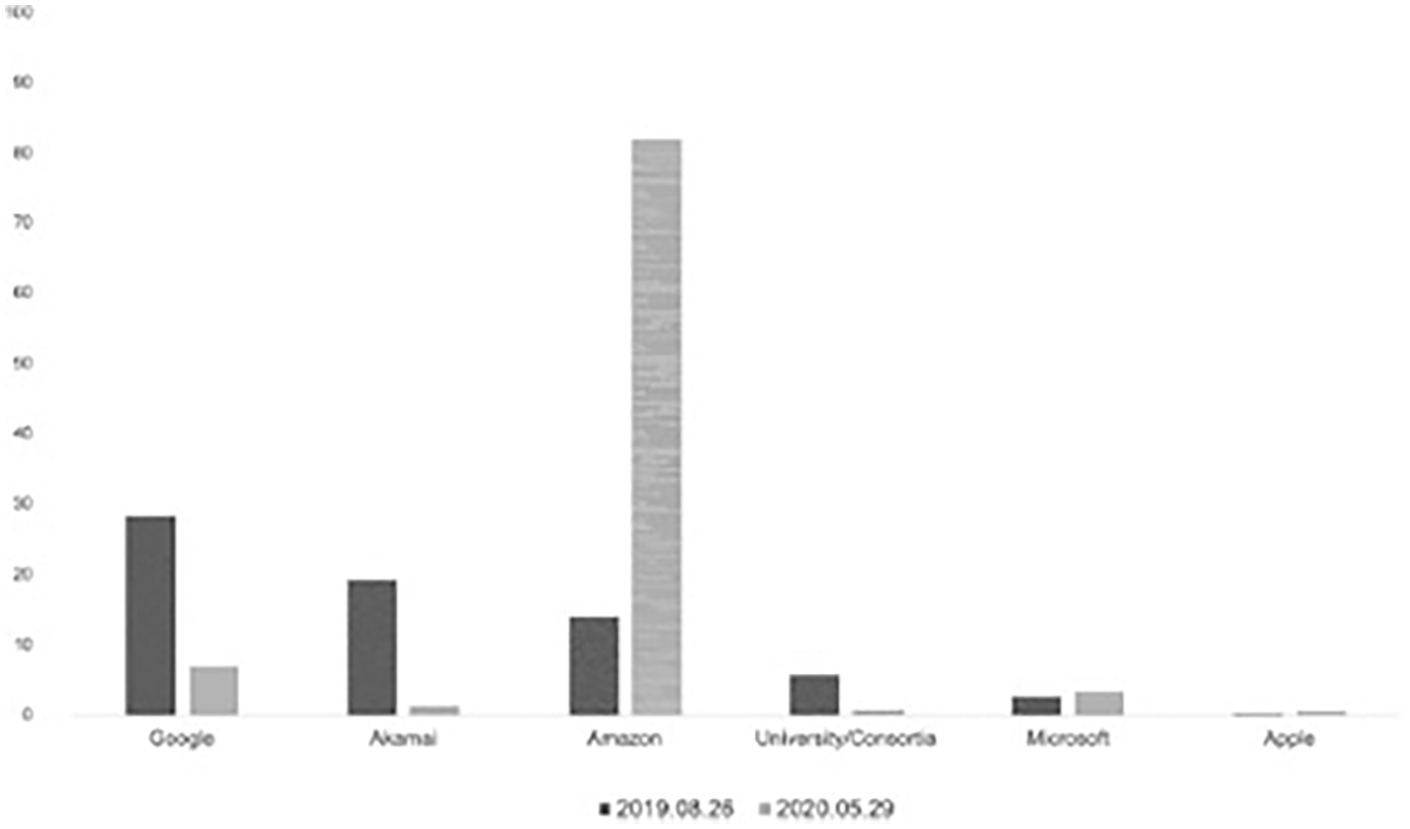
Proportion of data packet traffic during distance teaching sessions (Wireshark Foundation, 2019).
The figure below shows the six actors with whom most data packets were exchanged during distance teaching sessions using Canvas. Four of these six are GAFAM companies, but Akamai is also well represented, particularly before the Covid-19 pandemic. This is not surprising given that, despite being a largely hidden actor for end-users, Akamai’s content delivery network (CDN) handles data accounting for 15–30% of the world’s total web traffic (Akamai, n.d.). In the case of the teaching sessions, the data handled by Akamai most likely took the form of images and other media content included in Canvas pages, including teacher and student contributions. In contrast, a relatively small amount of traffic can be traced to the university, or to Nordunet’s infrastructure consortia. In fact, the balance between Nordic and global data traffic is rather uneven, leaving little operating power for a Nordic voice. In particular, the comparison of the sessions shows a radical increase of data traffic on the globally operating Amazon Web Services (AWS) server infrastructure used by many SaaS providers, including the Canvas provider Instructure. One possible explanation is a shift in the server infrastructure to the Zoom video-conferencing system integrated with the University of Gothenburg’s installation of Canvas. Zoom is administered on behalf of the university by Nordunet, who announced a shift to an increased use of AWS to alleviate server capacity problems experienced early in the Covid-19 pandemic.
The traces of the GAFAM giants seen in the analysis here are not unexpected. Several reports have highlighted massive growth in the use of LMSs and video meeting tools during Covid-19, including Zoom and Canvas (Hill, 2020). It is also well reported that the three companies holding the most student data globally in 2019 were Google, Microsoft, and Instructure, all of whom provide basic infrastructures for most education forms (Menard, 2019). That only a few education technology giants hold so much data raises concerns about how to best organize and protect data from exploitation (Williamson et al., 2020). Clearly, commercial LMSs are part of the dynamics of social, economic, and infrastructural networks, and are therefore key actors in public higher education policy-making. However, the operational powers of the LMSs and their integrated software are largely run without public transparency. According to Marachi and Quill’s case study of Canvas (2020), the platform began to use AWS in 2015, hence becoming an integrated part of what Instructure calls the ‘seamless’ data-sharing of products and services across platforms (2020: 422). Guided by ideals of interoperability materialized in an app store called ‘Open Apps’, Instructure has made it possible for all users to install third-party apps and ‘conveniently, such a structure also funnels a massive amount of data to Instructure datasets’ (Marachi and Quill, 2020: 423).
The legislative boundaries undergirding the massive flows of data in connection with the Canvas LMS are often unclear and regulatory bodies struggle with the dynamic data policies formed by these types of companies. As exemplified during the Covid-19 crisis, globalized forms of infrastructural policy formation have implications for public higher education, not least with regard to data ownership and regulations relating to data collection and extraction. During a crisis such as the Covid-19 pandemic, the situation risks transforming the common ideals of public higher education through what Stensaker calls ‘crash digitalization’ (Stensaker, 2020), potentially increasing pressure for enhanced efficiency and performance measures (Laterza et al., 2020).
With necessary data infrastructures established and cross-platform interoperability enabled through APIs (Perrotta et al., 2020), calls for enhanced efficiency may drive contracts for the next LMS procurement period toward the kind of intensified datafication marketed by Instructure for the past few years – a kind of datafication that provides for more data analytics, monitoring, and prediction through the datafied work of higher education institutions, and further risks of insecurities around data ownership (Hillman et al., 2020).
In sum, three aspects appear to characterize the openings provided for accelerated higher education data infrastructural policy formations in the Nordic countries during the Covid-19 move to distance education. First, new global technology network connections have been established, with some relatively new actors strengthening their positions while other traditionally strong actors retreating. Second, issues of securing public higher education student data protection have been bracketed while concerns have shifted to solutionism and protecting financial gain. Lastly, the social powers of emotional platform-based labor and support networks have been reformed and harnessed to find solutions as adaptably as possible. These changes, pivoting on the LMS as a socio-technical actor and infrastructural solution, have quietly gone under the radar of a necessary public debate.
KlasCement: A platform for collaboratively constructing Flemish digital education in Belgium
It was March 13, 2020, when the Belgian federal government announced the suspension of all classroom-based and on-campus activities in order to hamper the spread of Covid-19. This suspension galvanized a host of emergency measures to organize a relocation of, or substitution for, educational practices to people’s homes and bedrooms. Consequently, and given the sense of urgency accompanying this relocation, various existing online tools and platforms gained major traction during Belgium’s first lockdown. In this case, we focus on a platform supported by the Flemish Community government and that, alongside privately run platforms, grew in popularity during the emerging crisis: KlasCement. On KlasCement, all kinds of educational actors (including teachers, not for profit organizations, and commercial enterprises) can publish, share, and access (self-developed) educational materials without monetary returns (Vlaanderen, 2020). Owing to its approach, structure, and positioning, the platform is quite different from other, usually privately owned and commercially oriented educational platforms in the Belgian context. In what follows, we position KlasCement within this context, explain its development during the Covid-19 pandemic, and discuss the platform’s central operations in terms of what they could exemplify for current and future conditions of education.
As a federal state, Belgium has partitioned responsibility for organizing education to its three communities: Brussels, Wallonia, and Flanders. Within these three communities, education policy is organized along the lines of a ‘central state’ which supports a ‘diversity of initiatives’ (Simons et al., 2009: 71). This organization implies that, on the one hand, the government exerts a significant amount of control over schools, as it sets conditions for their recognition and subsidization (Eurydice, 2020). On the other hand, schools’ governing boards have substantial autonomy; they can decide on teaching methods, the philosophy of life taught at school, staff recruitment, timetables, and so on. Moreover, the government (financially and organizationally) supports new initiatives. Within this policy context, in which the subsidiarity principle is central, KlasCement was created by a single ICT teacher in 1998 and has, from 2013 onwards, been sustained by the Flemish Community government and its Department of Education (KlasCement, 2020a). The teacher behind the platform had initially developed a website for his school in partnership with his pupils, and later on deployed it in a larger collaboration with other schools, teachers, and students. This first ‘version’ of KlasCement grew even more after becoming part of the governmental policy structure, in terms of its amounts of users, the number of uploads and downloads, the scope of materials (including training activities, research), and audience (including (non-)commercial organizations and researchers).
When Flemish schools were closed between March 13 and April 19, 2020, KlasCement’s audience appeared to expand even more due to the spreading coronavirus. On Twitter, the platform claimed to have gained 22,000 extra members in this period (6.6 times more than in the same period in 2019). Moreover, 1,000,000 searches were performed (1.5 times more than in 2019), 1768 materials were added (2 times more), and 887,000 downloads were initiated on the platform (1.3 times more). 2 Furthermore, queries on the platform show that during this period, 1695 new materials were uploaded (KlasCement, 2020a). Comparing this with the same period of March 13 to April 19 in the previous year (2019) and the following year (2021), queries respectively amount to 801 and 990 newly added materials. This suggests a rather modest aftereffect of the sudden growth of KlasCement witnessed at the lockdown’s beginning, at least in terms of contributions.
Two possible explanations for the growth of KlasCement in the wake of the crisis can be considered. First, KlasCement aligned itself with the measures taken by the Flemish Ministry of Education. For instance, after two weeks of lockdown, the minister launched a didactic crisis management method called ‘pre-teaching’, which meant that schoolchildren had to study their materials at home to repeat the same content faster once schools would reopen. In accordance with the minister’s announcement, KlasCement put this theme of pre-teaching explicitly on its front page and offered 31 learning materials related to this theme. Second, the platform explicitly extended its target audience in response to the important role of parents in co-facilitating emergency distance education. That is, while KlasCement previously positioned itself as a platform for educational professionals and organizations, KlasCement started to explicitly welcome parents after the lockdown hit (KlasCement, 2020b).
As Belgian schools have continued to operate under hybrid solutions such as ‘split’ and part-time schedules, or temporary closings in the 2020–2021 school year, it remains speculative as to what will happen both to KlasCement and digital education at large once schools fully reopen. Nevertheless, a recent policy note on Flanders’ future plan for digital education has declared strengthened governmental support to the KlasCement platform in the upcoming years (Vlaamse Regering, 2020). This policy note underlines the importance of accessible, open-source teaching materials and states that KlasCement will be expanded further as ’a ’unique platform’ for open teaching materials’ (ibid, p. 8, translation). To address what makes KlasCement ‘unique’, we zoom in on two of the main operations of the platform and reflect on their implications for the future of education, with or without school closings.
KlasCement’s first operation is communalization: bringing together various educational partners to collaborate on its ongoing (co-)construction. First of all, it does so by addressing its users, mainly teachers, governmental, non-profit, and for-profit (educational) organizations, as ‘produsers’. This means that they are expected, urged, and enticed to play an active role in producing various educational resources (Bruns, 2008). During the pandemic, the presence of these produsers on the platform was visible through the ongoing contributions under the ‘corona’ and ‘COVID-19’ metadata or tags. Teachers, in this regard, were mainly involved in producing educational resources and school tasks, while organizations generally contributed resources to facilitate the transition to distance education for teachers (for example, with pre-teaching). What is remarkable, though, is that pupils in compulsory education are explicitly excluded from (produsing) the platform and redirected towards platforms that suit ‘their age group’ (KlasCement, 2020b). Produsing operations thus initially appear to install an ‘exclusive’ authority for educational professionals in making educational materials. However, zooming in on the typical platform features of KlasCement, it becomes visible how it is a ‘heterogeneous assemblage’ that distributes agency through relations among people and technologies (cf. Decuypere and Landri, 2021). This way, ‘produsing’ implies a collaborative, human-digital effort that, particularly in platforms, tend towards network effects: the more KlasCement (prod)users build digital content, the more the platform attracts new (prod)users which, in turn, leads to more content. This partly explains the growth of KlasCement during the pandemic, as this attraction could be accelerated. Yet different from private platforms, it does not imply the increasing authority of one organization (cf. Srnicek, 2017). Rather, it leads to expanding possibilities for educational actors to gather, share and learn from each other while being at a distance. This is also visible in other kinds of ‘communalizing’ operations, particularly those on its discussion board called ‘the digital teacher staffroom’. This discussion board normally includes two channels for announcements and questions, through which teachers share their experiences and support each other in their professional challenges. During the lockdown, this discussion board gained an extra channel for ‘education in corona times’. Again, this exemplifies collaboration between technologies and people that manifest growth in the KlasCement platform. That is, while technologies establish possibilities for these discussion boards, they would not exist nor expand without people making and using these discussion boards. All in all, this shows that KlasCement, both as resource collector and discussion board, enables the emergence of a network of communalizing practices that gain traction during times of crisis.
A second operation of KlasCement is that of standardization: aggregating materials of various educational professionals and organizations and bringing them together into a coherent, standardized frame. It does so, first of all, through processes of content moderation. The platform has thereby appointed several staff members who are or have been (part-time) teachers. These staff members evaluate, manually, whether the educational materials adhere to the platform’s standard (quality) criteria. Next to these manual evaluations, materials are also ordered, and curated, by algorithms. For example, KlasCement relies on a sorting algorithm (‘Famerank’, a reference to Google’s ‘Pagerank’ algorithm) to organize search results and thereby considers parameters such as keywords, ratings, and date of publication. A search through the platform based on the keyword ‘corona’ in May 2020 generated a mixture of 321 relevant materials that can be ordered either by date of publication or popularity, yet they remain predominantly provided and rated by teachers. Furthermore, the KlasCement staff members also actively intervene in this ordering by offering prizes (such as books and film tickets) or distinctive ‘badges’ that are attached to the ‘produsers’ personal profile. Such badges and prizes are active tools: in the abundance of potential resources, some teachers’ resources are granted more authority than others. In this respect, it is important to note here that curation processes do not perform an innocuous and/or neutral process of presenting content (about COVID-19, for instance). Instead, they offer a ‘mode of ordering’ that privileges some content above others (Law, 2004). While thus leading to certain hierarchies, what is still particular to the standardizing operations of KlasCement is that all contributions are fitted into a similar structure: they start with a title, short description, accompanying picture, categorizing tags, average attention score, and the produser’s name (and profession). In this sense, it does not matter whether a contribution is made by a local teacher of a rural elementary school or by (local branches of) EdTech giants: they all gain a similar ‘form’ in the presentation. This demonstrates how, through standardized processes, KlasCement also gives individual educational professionals and large organizations a ‘platform’ in a figurative sense: it becomes a shared, levelled ground to act on next to each other (see also Gillespie, 2010). These operations show KlasCement’s potential to continue connections between public, private, and individual actors that all have an interest in education and want to share their practice.
In conclusion, KlasCement exemplifies how digital platforms before and during the Covid-19 pandemic are not bound to reinforce private enterprises at the disadvantage of public resources. What is specific to this platform is that it allows individual teachers, organizations, and technologies to organize in collaborative communities. Especially during the period of ‘social distance’ invoked by the pandemic, such a way of collaborating has allowed these actors to remain involved in the making of education through this government-supported platform. This tendency of collaboration brings us to another pivotal point regarding this platform: it demonstrates that digital platforms do not necessarily undermine the agency of educational professionals in the context of the pandemic. While this platform is not free of curating algorithms, personalized filters, or EdTech products, content is still made and moderated by teachers and educational staff members with a stake in the educational nature of the platform. Rather than being dominated by private companies and technologies, this shows that these actors engage and meddle with all kinds of contributions by different sectors, making a hotchpotch of materials that each platform (prod)user can value on his/her own terms (Decuypere and Landri, 2021). This way, KlasCement shows how the simultaneous (de)centralization of education through digital platforms due to the pandemic generates new ways of taking responsibility for education, especially for teachers (cf. Williamson et al., 2020). That is, to be ‘prod-users’ of a platform’s public and educational value rather than merely consuming the content or using the functionalities of a privately owned counterpart. While the actual effect of KlasCement on school practices in the era after COVID will be clearer when pandemic-related measures have been lifted and schools reopen, there is at least something to learn from the operations of KlasCement. It shows how digital tools may generate more positive freedoms for teachers to contribute to education as a public good.
Concluding remarks
It’s a great moment. All the red tape that keeps things away is gone and people are looking for solutions that in the past they did not want to see. Real change takes place in deep crisis. You will not stop the momentum that will build. Andreas Schleicher, Head of education, OECD (Anderson, 2020)
The cases presented in this paper offer a glimpse of how the Covid-19 crisis affected and contributed to reorder the boundaries and legitimization of digitalization processes across the European region. By configuring the virus as a common enemy to be overcome by innovative digital solutions offered by private corporations, networks, and quasi-public associations, the cases help show how an apparent acceleration and consolidation of European digitalization agendas took shape during the crisis:
In the case of the German education system, it was asked whether the temporarily free provision of learning management systems, relaxation of data security laws, and large government investments would accelerate a more general opening toward lucrative markets for the EdTech industry in a historically skeptical setting.
Looking specifically at the moral positioning of the Swedish Edtech Industry during the early months of the pandemic, the second case identified a similar tendency as the association ‘worked’ the crisis, establishing market solutions as an inherent part of the public education system post-crisis.
Through an analysis of the discursive frameworks of the Italian Distance Education network, the third case examined the philanthropic donations of Google, Microsoft, and TIM as effectuating a de facto consolidation of the Italian market for digitalization during the pandemic.
The concern with consolidation was reiterated in the analysis of the Canvas learning management system, where the swift bracketing of privacy concerns, paralleled by the emergence of new global technology network connections, led to similar concerns pertaining to the consolidation of unaccountable influence in Nordic higher education.
Focusing on the KlasCement platform operated by the Flemish government, the fifth case asked whether the heterogeneous assemblage of human and non-human actors on the platform may accelerate the sense of responsibility and positive freedom among teachers and other platform users – an acceleration which may challenge perceptions of digital platforms in education as instruments for branding and corporate control.
Building on the shifts and coalitions drawn forth across the cases in this paper, there seems little doubt that the Covid-19 crisis has removed much of the red tape keeping digitalization – and the interrelated processes of privatization, datafication, and platformization – at bay. As the cases demonstrate, however, the extension of this momentum beyond the pandemic appears less inevitable than Andreas Schleicher suggests in the quote above. While the calls for remote teaching and learning have certainly accelerated and consolidated many aspects of private sector involvement in public education infrastructures, the cases demonstrate the apparent complexity in legitimizing and foreseeing the long-term democratic effects of this emergency involvement in a highly contested field of actors. A reminder, we might say, that the unfolding and governance of digitalization in education can never be reduced to a matter of simply improving teaching and learning processes, but is deeply imbricated in broader movements of commercialization and responsibilization.
Footnotes
Acknowledgements
We would like to thank our two anonymous reviewers for providing succinct comments and suggestions for improving the paper. We would also like to thank the editors of the European Educational Research Journal, Paolo Landri and Sotira Grek, for supporting the challenging work of bringing together the cases and reflections of research colleagues across different geographies, times, and spaces.
Availability of data and materials
The datasets generated and analyzed during the current study are available from the authors on reasonable request.
Declaration of Conflicting Interests
The author(s) declared no potential conflicts of interest with respect to the research, authorship, and/or publication of this article.
Funding
The author(s) received no financial support for the research, authorship, and/or publication of this article.
ORCID iDs
Notes
Author biographies
 ).
).