




Abstract
The purpose of this article is to analyse how education and schooling took part in handling the early phase of the COVID-19 pandemic in eight European countries (Denmark, Finland, Germany, Greece, Italy, Norway, Poland and Sweden). The focus is on primary education and on decisions to close schools, or not. Our research was informed by assemblage theory in order to analyse how different components interacted in developing societal responses to mitigate the pandemic. The research was designed as a comparative case study of practical reasoning in diverse contexts. Data sources were the mass media and statements from governments and authorities. Our analyses showed that decisions to close schools, or not, were based on two alternative discourses on schooling. Closing primary schools was a preventive measure underlined by discourses of schools as places for infection. Keeping primary schools open was underlined by a discourse in which schools were conceived of as a place for social supportive measures and caring. Furthermore, the closing alternative was often combined with attempts to replace school practices by distance learning or computerized instruction. Legal constitutions and lawmaking were of significant importance in selecting discourses and the relative impact of different components, mostly political or medical, in responding to the pandemic.
Keywords
Introduction
In early 2020, COVID-19 was spreading across the world, leading to disease and deaths. There was no vaccine available, and there was great uncertainty as to how to mitigate the growing pandemic and how to behave. However, it had to be counteracted, and different agents – global organizations, governments and a number of national authorities and organizations – were interacting in order to slow the spread of the pandemic. School lockdowns and distance education were part of such responses in most but not all places. As educational researchers, we posed questions regarding why and how these different responses were made. Furthermore, we asked: what do these responses, such as closing the school premises, tell us about the school as a societal institution?
In the formulation of these questions, we make a distinction between school as an institution and education as an administrative system. Referring to Hamilton (2013), a school is a social institution – like the family or the Church – constructed in order to manage and preserve the population. 1 For instance, to Hunter (1994), the school is an invention of the 17th century, constituted by a schoolhouse, teachers and students communicating about selected texts by means of eye contact and hand-raising in conversations based on questions and answers. Education has a longer history (see e.g. Durkheim, 2006) in organizing the making and differentiation of culturally competent people (Luhmann and Schorr, 2000), mostly as a state apparatus or as part of the Church. As a kind of world movement, schooling was integrated into the organization of education (Meyer et al., 1992). Here we are interested in the school as a social institution and the opening and closing of the actual premises of this institution. Why keep schools open – for what reason – and what happens when they close down? This is the overarching question in this article.
It is a difficult question, since we are trying to analyse a societal disorder created by the COVID-19 pandemic, and it is this disorder – or rather chaos – that we are eager to analyse. Thus, we have to develop a conceptual framework and a research design that make it possible to capture what is going on during the pandemic.
Previous research on pandemics and education and schooling
Throughout the history of humankind, some contagious diseases have turned into pandemics (McNeill, 2010). Not surprisingly, there are a number of studies on pandemics and how they are mitigated. This research is dominated by medical inquiries (e.g. Anderson et al., 2020 on COVID-19; Ferguson et al., 2006 on influenza), but there are also some studies on school closures and their effects on pandemics (e.g. Cauchemez et al., 2008) or on people’s willingness to adhere to societal restrictions, including school closure (e.g. Seale et al., 2020). However, as is pointed out by Holmberg (2017), changing societal structures over the centuries entails that it is difficult to learn from the past in these matters. There are a few studies on implications of school lockdowns in terms of mental health problems (e.g. Raballo et al., 2020), and on possibilities of schooling in terms of distance education or the uses of mass media as substitutes for teaching and instruction (e.g. Moscardino et al., 2021). In addition, there is little research that captures why lockdown decisions were made – or not – or what lockdowns tell us about the school as a social institution.
From irritation to research problem based on a conceptual framework
Since the pandemic was dealt with by a number of different agents with quite different functions and networks, we realized that predominant analyses of society and education as sealed systems would not work. Given this interest in complexity, we turn to assemblage theory (DeLanda, 2016; Deleuze and Guattari, 1988) as a way to understand and analyse dynamic systems based on complexity and change. 2
An assemblage is a collage of autonomous parts (such as two or more systems) that are interacting to form emerging objects (such as responses mitigating a pandemic). Or as stated by Deleuze and Parnet (2007): What is an assemblage? It is a multiplicity which is made up of heterogeneous terms and which establishes liaisons, relations between them, across ages, sexes and reigns – different natures. Thus the assemblage’s only unity is that of a co-functioning: it is a symbiosis, a ‘sympathy’. It is never filiations which are important, but alliances, alloys; these are not successions, lines of descent, but contagions, epidemics, the wind. (69)
An assemblage is a complex whole emerging from the interacting of autonomous contingent and heterogeneous components that also function in other contexts. This is what is at work in the combatting of a pandemic, where, for example, different authorities, organizations or networks are joining forces and adapting to the context and tasks that are put forward in the emerging assemblage. We will here present a highly condensed version of assemblage theory in relation to COVID-19.
In an assemblage a constellation of components are interacting and also acting upon each other. With reference to DeLanda (2016), we are dealing with assemblage theory as a social ontology – understanding how objects are formed and stabilized by social action. DeLanda (2016) put forwards two parameters acting on the components in the development and change of an assemblage – territorialization and coding – and their counterparts in de-territorialization and de-coding.
Territorialization is a matter of homogenization of an assemblage: [Territorialization] refers not only to the determination of the spatial boundaries of a whole . . . but also to the degree to which an assemblage’s component parts are drawn from a homogeneous repertoire, or to the degree to which assemblage homogenises its own components. (DeLanda, 2016: 22)
Thus, in our studies, territorialization is turning heterogeneous components (policymaking, health care, schooling, etc.) into an assemblage with the function to combat the COVID-19 pandemic. De-territorialization is working the other way – loosening boundaries and making the components less homogeneous. For instance, the making of a COVID-assemblage might weaken the territories of components in the assemblage such as diminishing other kinds of health care or closing down schools.
Coding in turn is a parameter dealing with language and symbols in governing and directing the assemblage in order to make it work: ‘Coding refers to the role played by special expressive components in an assemblage in fixing the identity of the whole’ (DeLanda, 2016: 22). In the case of the COVID-19 pandemic, coding is defining what the components have to do and what to do in order to mitigate the pandemic, given their special qualities. Examples of this are ordering lockdowns and asking for solidarity among the citizens to maintain physical distance. De-coding might imply that such expressions are cancelled.
It follows from such processes in assemblages consisting of different heterogeneous components that an COVID-19 assemblage might vary over time and place. Thus, we have to make a distinction between actual assemblages and their virtual counterparts in conceptual or structural terms. In other words, the ways the pandemic is dealt with in different countries are actual cases of a virtual COVID-19 assemblage as a basis for a comparative study sensitive for contextual and component-specific variations. 3
Given this concept of parameters as externalities impacting components, we have tools to analyse dynamics of the assemblage and to understand how components change in the making of responses. From this it follows that the making of these responses will have impacts on the heterogeneous components and their contexts – as ‘side-effects’ of the assemblage causing dilemmas in decision-making on responses.
There are some studies in educational research based on assemblage theory in different ways, such as Youdell (2015), dealing with policy sociology and assemblage theory, where the latter points out that policy is just one component in current transformations of education. Based on a review of different studies, she lists a set of components at work in educational assemblages and points to uncertainties in these processes. Savage (2020) presents a similar view when conceiving assemblage theories as a corrective to mainstream theorizing in education policy studies: Assemblage has been positioned as a generative tool for addressing the limits of established debates and concepts, especially those relating to policy transfer, borrowing and diffusion; but it has also been framed as a corrective to rational–technical, institutionalist and state-centric accounts of policy and governance processes. (320)
Such positions in educational research correspond well with the point of departure taken here. However, we have not identified any study on pandemics and schooling based on assemblage theory.
It is important to capture contextual dependencies and contingencies in collages of actions and interactions that are at work in emerging responses to the pandemic. This leads us to analyse reconstitution of the parts in the assemblage and how these interact in developing responses to the pandemic. This way of understanding complexity and contingency in order to deal with chaos and change during a pandemic crisis is regarded as more productive, compared to approaches where the parts are regarded as given, stabilized totalities that function in a linear order.
Based on initial inquiries, we constructed a virtual model of the pandemic which we translated into the actual cases in February–March 2020 that we were researching. 4 We put forward this model in formulating the following research questions:
Why were primary schools closed or kept open in different European contexts?
What components were at work, with what interaction and impact in the assemblage?
What tasks and roles has schooling had in relation to the different components and what are these components doing to schooling?
What do answers to these questions tell us about schooling and education in different contexts?
Methods
A case study approach was used to support and guide our analysis, a retrodictive construction of logics of events wherein the decision to close (or not) the school premises is in focus. Data collections were based on an inductive approach in identifying different components in the COVID-19 assemblages.
Given the purpose and research questions presented above, we designed a comparative case study (Nóvoa and Yariv-Mashal, 2003). More specifically, this study has a comparative case study (CCS) approach (Dahlberg et al., 2021; Bartlett and Vavrus, 2017) in the analysis of emerging COVID-19 assemblages in eight countries: four Nordic (Denmark, Finland, Norway and Sweden), two from continental Europe (Germany and Poland) and two from southern Europe (Italy and Greece). Given the similarities between Nordic welfare states, on the one hand, and continental and south welfare states, on the other (Esping-Andersen, 1990), these particular countries are important to the research design.
We identified a timeline of events leading to school closure and potentially relevant components in the different cases. After that we analysed relevant and expressive feature of the components in the assemblage(s) and the ways in which these heterogeneous components became assembled; that is, how they were acting on and reacting to each other and thereby became an emerging social whole responding to the pandemic.
The process of data creation in the case studies covered the time when the primary schools were closed, with a main focus on mid-March 2020.
The data includes scraping of internet websites of governments and national authorities including policy and law texts, as well as a selection of relevant mass media extracts; for instance, newspaper articles and online/television broadcasts of national press conferences of governments and public health agencies/civil protection with information about the current status of the spread of the virus and the different measures taken to contain it.
Findings from inquiries
The Organisation for Economic Co-operation and Development (OECD, 2020) describes the closure of schools in different countries. Based on their reporting, Table 1 shows how many days the primary schools were closed during the spring of 2020. We have also included closures of secondary schools and confirmed COVID-19 cases per million inhabitants.
School closures and presentations of confirmed cases of COVID-19 per million inhabitants across countries.
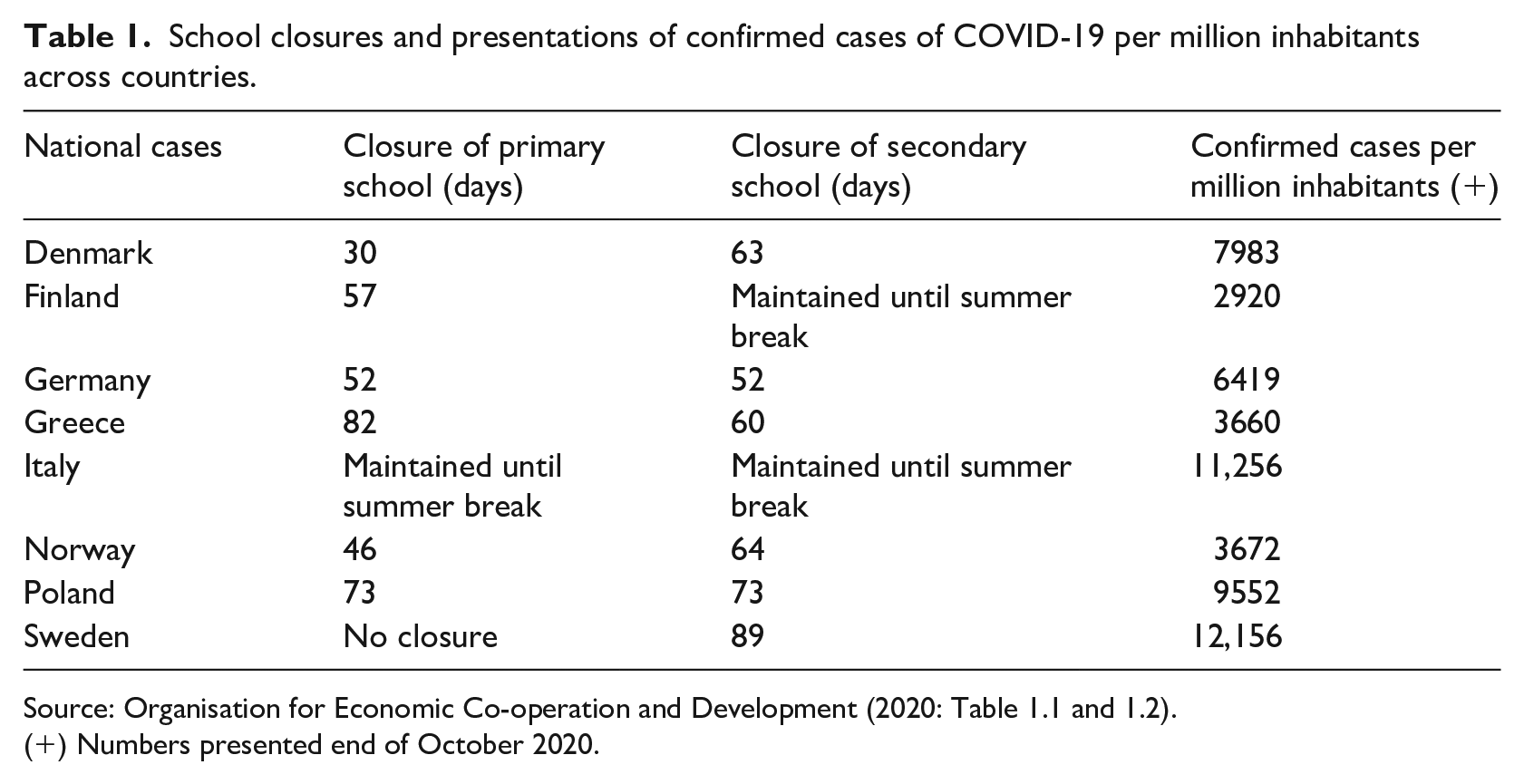
Source: Organisation for Economic Co-operation and Development (2020: Table 1.1 and 1.2).
(+) Numbers presented end of October 2020.
In Table 1 we present our first finding – that in seven European countries there were primary school lockdowns, while one country – Sweden – kept primary schools open.
Components in assemblages
In all eight countries, we identified five kinds of heterogeneous components activated in a COVID-19 assemblage: medical, political, juridical, educational and media agents. Importantly, each component can comprise individuals and organizations as well as material and discursive entities:
Medical agents are experts and professions in medical science, including national agencies of public health offices, and prevention and curative activities.
Political agents are actors on national, regional and/or local levels – for example, parliaments and governments – with legitimate political power to lay down regulations and who stand politically responsible for the decisions made.
Juridical agents are present in terms of laws and regulations governing policymaking and relations between agents.
Educational agents are teachers, school leaders, national agencies, researchers, trade unions, etc. They are actors with educational expertise or organizing or carrying out educational activities.
Media agents are organizing platforms for exchange of information from assemblage agents – such as medical and political authorities – presenting and commenting on what is regarded as newsworthy and opening up platforms for other actors to perform.
What came to be territorialized as an assemblage was not an everyday social formation; for instance, the school sector and the medical sector are highly separated and have little to do with each other in their everyday institutional lives. It was the responses to mitigate the COVID-19 that kept them together.
However, as we will show, coding patterns between components varied across countries since relations of exteriority (Savage, 2020) between components are nationally embedded; perhaps the most obvious examples here are available laws and regulations.
Importantly, daily press briefings delivered statistics on the pandemic and advice on how to act to prevent the spread of the disease in all the countries. As argued by Zinn (2020), the virus embraced elements necessary to become major news events. Through the media, experts in medical science, politicians, education actors and others reached the citizens in general, but also started to respond to each other. Yet, as we will discuss here, activation of the agency of a collage of agents and the making of a COVID-19 assemblage demanded national decision-making as to how to deal with the school question.
National cases
In the following, we present actions and reactions of heterogeneous components as processes of a territorialization (DeLanda, 2016) of evolving COVID-19 assemblages. The national cases are presented in alphabetical order.
Denmark
In a press conference on 11 March, the Danish prime minister announced the decision to close the school premises as part of a package of measures, including to send all civil servants home who could work remotely, from 16 March. These steps were justified as necessary to slow down the spread of the infection, in order not to allow the health-care system collapse (Regeringen, 2020). Live press conferences, where the government informed about the number of infected and measures to confine the spread of the virus, were frequent in the weeks to come and reached historically high numbers of viewers.
In the emergent assemblage, the prime minister and the government appeared as the dominating component. The two medical authorities were assigned subordinated roles: the Danish Health Authority (DHA), responsible for public health issues and uniform health-care services, and the State Serum Institute (SSI), principally a research institute responsible for preventing and combatting infectious diseases. As the medical authorities, in the initial phase of the pandemic, represented different positions regarding school closure (Altinget, 2020; Information, 2020) it was possible for the government to achieve legitimacy for their proposal to close schools without the support of the medical components of the assemblage.
The government decision presupposed a change in the Communicable Diseases Act, that in a few days was approved by the legislative assembly, the Danish Parliament (Retsinformation, 2020). The revised law equipped the minister in charge, the minister for health and the elderly, with far-reaching authority, including decisions on whether schools and educational institutions should be closed or open.
During the closure, the daily care of school children was handed over to parents. For those who had essential functions in society, the municipalities arranged emergency education and care. Other parents were encouraged to find solutions for the care of their children. It was emphasized that children were supposed to follow the school day from home. In the 10 years of compulsory schooling in Denmark, there is a duty to learn what corresponds to the requirements, in public school or alternative schooling, but attendance is not compulsory (Børne- og undervisningsministeriet, 2020). Although provided with digital material and instructions, most of the schoolwork during the closure took place as individual work, while those in the higher classes had access to virtual classrooms (Danmarks Evalueringsinstitut, 2021).
To conclude, the government, as the political component of the Danish assemblage, took a leading role from the start. The decision to close school premises was based on the assumption that it was necessary to deal with the pandemic challenge. This was made possible by the fact that the medical component was divided about the measures. Furthermore, this political dominance was rendered possible by the juridical component, thereby territorializing both the authorities of the medical and the educational components.
Finland
The first known case of COVID-19 in Finland was announced on 29 January. At the beginning of March, the Finnish government announced martial law/a state of emergency and decided to activate the existing Emergency Powers Act (Valmiuslaki. 1552/2011), which gave the government extended power to stop the spread of the virus. The government used this activated legislation and, among other things, decided to close the school premises. Homeschooling was not new in Finland, since Finnish basic education law (Perusopetuslaki. 628/1998) already enabled it due to its ‘obligation to learn’ legislation (läroplikt). However, traditionally only a minority of Finnish families used it, but suddenly it became mandatory for almost everybody. When school premises were closed, most students, apart from, for instance, children with special needs or whose parents were needed as part of the work force in the medical sector, turned to homeschooling and distance education. The tools for home education were already established, and the authorities’ educational material for homeschooling and distance education was provided by the media.
The decisions to close school premises were political and got their legitimacy from the juridical component. However, the medical component was probably also present in the decisions through the National Institute for Health and Welfare (THL), whose task was to support the Ministry of Social Affairs and Health. The Finnish public was informed about the political decisions through daily press conferences. Here, the THL supported the decision to the school premises. 5 Through press conferences, the public was also educated in terms of how to behave during the pandemic in order to stop the spread of the virus. During this period, the political decisions were unquestioned, with few critical public voices.
Despite the fact that the pandemic in many ways changed the ordinary way of living, it can be argued that formally nothing happened to education, since teaching continued through the existing legislation and educational prerequisites, which followed a logic of events based on political decisions. Yet there was a huge change, as school premises in Finland were closed.
To conclude, in Finland the closure of school premises was considered necessary in order to stop the spread of the virus and was made possible thanks to political decisions based on already existing juridical prerequisites. Thus, the political component coded how education should contribute to the mitigation of the pandemic. Following this, education could be regarded as re-coded and thereby a component of the COVID-19 assemblage.
Germany
In Germany, the states (Länder) had by the beginning of March in some cases closed schools where there had been a spread of infection or a risk thereof, based on the German Infection Protection Act (IfSG). However, on 13 March the Standing Conference of the Ministers of Education and Cultural Affairs of the Länder (KMK) – the cooperative body in education, science and culture – announced decision 369, which dealt with the coordination of measures and procedures to prevent the spread of infection. It included closing schools temporarily (KMK, 2020) and rested on the recommendations by the federal government’s central public health authority, the Robert Koch Institute (RKI). Within a few days, all the Länder had closed school premises with the exception of some that were open to children whose parents worked in occupations vital to society. The school-closure response of the emergent COVID-19 assemblage was uniform and consistent, in accordance with the constitution and the pre-existing pandemic plans. That is, the measures were in line with the National Pandemic Plan and the individual Pandemic Plans for the Länder (RKI, n.d.). Initially, the development of the assemblage can be seen as linked to the constitution, hence, based on a legal coding stressing the political component.
Germany is a pluralistic and corporative federal republic (cf. Rudzio, 2019). The 16 Länder have a far-reaching autonomy, and education is the responsibility of each Land. At the start, the emergent assemblage was centred on the decision-making authority of the Länder. However, the federal part in the assemblage became ever-more visual when the Ministry for Public Health (BMG) and the Ministry for the Interior summoned the crisis team, as prescribed in the IfSG. This trend was reinforced when BMG came to design the health policy – preparing legislative proposals, administrative recommendations and ordinances. Furthermore, the current state of the spread was communicated by BMG and RKI in briefings and press conferences where the media acted as the mediators of official announcements. This development can be described in terms of a re-territorialization of the assemblage by an increasingly federal-weighted hierarchy.
The school closure meant temporarily pausing the duty to attend school but not the duty to attend education. However, the agency for schooling – teaching, learning, structuring – was largely handed over to teachers, parents and students, to deal with as best as they could. This de-territorialization but also re-territorialization and re-coding of school became evident when the problems of homeschooling were gradually addressed and measures taken to promote avenues of learning, such as distance teaching and digital technology (DigitalPakt Schule, n.d.). The development in Germany was based on the contingency plans for emergencies, which explains how the state, and thereby the political component, came to dominate the assemblage by a legal coding.
Greece
Primary schools in Greece closed down after a Joint Ministerial Decision issued on 10 March 2020 (N. 16838/2020), as part of the governmental coding process in the emerging COVID-19 assemblage. As early as February, a Legislative Decree enabled a set of urgent measures to prevent the spread of the coronavirus. This included, among others, the potential closing of schools, and therefore their de-territorialization, provided that such an initiative would help towards the protection of the population against the new threat. Such a precondition was to be based on and legitimized by the verdicts of the National Committee for the Protection of Public Health against COVID-19, a scientific group of experts established in February 2020. In this way, two major components of the emerging assemblage, the political and the medical, were engaged in a process of (re-)territorialization in the handling of the pandemic.
More specifically, the government, as the political component, used the coding features of the medical component, represented by the national scientific committee against COVID-19, to legitimize the necessity of closing down schools. The measure was initiated by a reformulation of the juridical framework by the government, which at the time held an absolute majority in the Greek Parliament (legislative branch). The resulting territorialization processes enabled the potential closing of the schools provided that the measure was scientifically warranted.
In conclusion, the political and medical components developed reciprocal relations and a mutual dependence in the handling of the pandemic and may, thus, be seen as the dominant ones in the COVID-19 assemblage. It is important to highlight, though, that the coding features of the scientific committee were established upon issuing recommendations, but the decision remained a responsibility of the government. At the same time, a re-coding of the mass media component took place via daily press conferences by opening up spaces for the political and medical agents to communicate what they deemed as important and necessary in the handling of the pandemic. Education as a component was de-territorialized since no other alternatives were seen as possible. The centralized educational system of the nation was eventually subjected to a universal closure, a measure which would potentially contribute to the protection of the population against COVID-19.
Italy
Italy was the first country in Europe with a major spread of the virus. On 31 January, the Italian government declared a state of emergency. On 23 February, a law decree was issued that emphasized the evolution of the epidemiological situation and the extraordinary need and urgency to issue provisions to counter the epidemic. Law decrees are a legitimate coding process with a strong political power that is generally used in the country as provisional measures to be able to quickly issue new laws and regulations in a situation of crisis or emergency. In the February decree guidelines, paragraph 1 states the responsibility of the authorities and requirements to take all containment measures needed and the importance of adequate and proportionate management as the situation evolves epidemiologically (Gazzetta Ufficiale, 2020a). Thus, for instance, one of the first outcomes of the decree and of central interest for this study was that on 5 March all schools and universities were closed as a consequence of the law decree, with the aim to contain the spread of the virus. The following law decree, on 8 March, confirmed that distance instruction was the education mode to be implemented during the school closing (Gazzetta Ufficiale, 2020b). The Ministry of Education website offers access to a range of tools, platforms and pedagogical counselling for the school. Here, relations of exteriority and (de-)territorialization are concepts that illuminate the ways in which the assemblage holds together, in spite of being continuously dismantled and then reconstituted with new political decisions, regulations and boundaries.
One central component in this assemblage is the national scientific committee that played a crucial role in the creation of the Italian strategy to contain the spread of the virus, including the school closure from the start of the crisis, in February 2020. A technical task force was created in the first week of April. It comprised experts on different areas (besides the medical) led by Vittorio Colao, an Italian business executive, former chief executive officer (CEO) of Vodafone. This team had the task, delegated by Italian Prime Minister Giuseppe Conte, to ‘dialogue’ with the national scientific committee that has previously worked with the government in handling the crisis.
To conclude, effective coding processes that legitimize the coherence and robustness of the assemblage are exemplified by the political decisions, in consultation with the task force, that are then made into law decrees and shared through the media, at press conferences always in the evening at 6 p.m., when data about the epidemic situation are officially released. Such coding processes imply that laws and regulations are formally published through the online state national bulletin. Protezione civile (civil protection) has the leading role in handling the situation at the operative/grassroots level. Thus, in Italy, the school close-down was framed as an inevitable decision in the Italian strategy primarily at the level of the government, and this was made possible in the assemblage with the issues of law decrees as the primary coding process.
Norway
The emerging COVID-19 assemblage in Norway started to take form during March 2020 when the three components – the Norwegian Institute of Public Health, the Directorate for Health and the government, headed by the prime minister – started to hold regular press conferences broadcasted from the office of the prime minister. Later on, the minister of education became a fourth and equally important component in the coding of the Norwegian COVID-19 assemblage. The emerging COVID-19 assemblage was ameliorated through coding by almost daily communication in various media.
In the coding of the COVID-19 assemblage, the prime minister called for action and solidarity among the citizens by evoking the Norwegian concept of dugnad, a concept integral to the Norwegian national identity meaning civic duty due to a sense of community, thus re-coding the concept into a focal point for the citizens as actors within the COVID-19 assemblage. The concept was further re-coded by being contextualized and motivated by the prime minister as essential for the largest civic effort in the history of the nation during a time of peace.
In Norway, primary school premises were closed from 12 March, as decided by the Institute of Public Health, the Directorate for Health and the government, communicated by the prime minister. The main argument for the lockdown was medical, to stop the spread of the virus, with some exceptions: solutions should be provided for children of health-care personnel and other critical societal functions, and for children with special educational needs. Juridically, school lockdown was initially made possible with support by the Infection Control Act (LOV-1994-08-05-55). Closure of school premises was a means, in this scenario, to slow the spread of the virus.
One of the tools used to curb the spread of the virus was to enact new laws that enabled restrictions on citizens’ lives. Shortly after the schools closed, a temporary Corona law (Norwegian Government, 2021) was passed, granting the government the power to make decisions without involving the parliament, hence de-territorializing the parliament by temporarily shifting the juridical power to the government.
To be able to homeschool children, the government enabled the option of applying for an allowance during the lockdown, an allowance that earlier was earmarked for taking care of sick children. Juridically it was, according to our understanding, already possible for private primary and lower-secondary education at home (LOV-1998-07-17-61, §2). Thus, de-territorializing Norwegian schools was furthered by the possibility of economic aid and a stronger coding of homes as part of schooling in Norway. An additional motivation in the re-coding of schooling was that many could work from home and others could use flexible work hours to accommodate children’s needs at home. The schools’ approach to homeschooling was primarily through digital means, which was possible, to a large degree, in Norway, due to a well-developed digital infrastructure.
Consequently, a continuous coding and re-coding of the parts of the emerging COVID-19 assemblage by the Norwegian Institute of Public Health, the Directorate for Health, the Minister of education, and the government as the dominant part, enabled de-territorialization of the different parts of the assemblage. Thus, the lockdown of schools in order to curb the spread of the virus was made possible through de-territorialization and re-coding of schooling. The process of the school lockdown was aided by juridical means, the digital infrastructure and communication through various media.
Poland
The decision to close down schools was juridically as well as politically coded through a conflation of executive and advisory powers at the government’s disposal. As a parliamentary republic, Poland’s government structure is centred on the council of ministers with the prime minister as a head of government. Specifically, a close co-operation between the Chancellery of the Prime Minister and the Government Centre for Security (as executive bodies) along with the Government Crisis Management Team (as advisory body) homogenized the responses within the COVID-19 assemblage, bringing forth the school lockdown. This politically coded measure to protect the country from the virus as ‘an outer enemy’ thus strengthened the degree of territorialization on the part of the government. The Chief Sanitary Inspectorate as a medicine agent and part of the assemblage tentatively endorsed the decision of a national school lockdown. The Chief Sanitary Inspectorate foregrounded the decision as a logistically difficult operation but necessary and well-advised when done at the right moment in time and paired with additional measures such as sanitary controls at the borders. Such framing weakened the degree of territorialization of the Chief Sanitary Inspectorate. Subsequently, this de-territorialization on its part seemed politically coded as the government’s powers of deciding the right moment for a school lockdown reduced the decision to a matter of time and discretion.
The decision by the government was juridically coded as it was preceded by a special law on ‘Particular solutions regarding the prevention, counteracting and combatting COVID-19 as well as other infectious diseases that cause crises situation’ (Dziennik Ustaw 2020, pozycja 374), passed in the two chambers of the Polish Parliament. This act also provided grounds for care allowance for parents as individual agents to provide care for their children. Through ordinances by the Minister of National Education, distance education was enforced, except for the cases where this was not practically possible or advisable; for example, in special education. These politically and juridically coded measures reinforced the totality of the government’s territorialization process. The substitution of instruction by distance education (Dziennik Ustaw 2020, pozycja 493) markedly interfered with the current state of affairs both juridically and practically as distance education had previously only been allowed in continuing education; for example, in adult education. Extensive and nationwide initiatives for distance education by the Ministry of National Education followed the school lockdown (state-owned e-platforms, public service TV and radio). Subsequently, through the de-territorialization processes of the two components of the COVID-19 assemblage – that is, educational and medicine actors – the government, as another assemblage part, strengthened its degree of territorialization. Remarkably, the agency of educational actors – for example, schools as both care and instruction providers – could therefore be conveniently circumscribed and motivated by practical reason in a logic of event.
To conclude, the vagueness of medical coding as its distinct feature, and in concert with the mobilization of juridical coding, enabled the government (as the political component) to claim the necessity of the ensuing school lockdown.
Sweden
As mentioned, Swedish primary schools did not close in mid-March as a general measure but remained open. The coding impact of the Public Health Agency (PHA) was visible in the Swedish context as the producer of recommendations on how to behave and statistics. Recommendations from PHA are not legally binding, but target groups are expected to follow them. PHA (like all Swedish public agencies) is regulated by the government through laws, state budgets and specific commissions but has its own autonomy in relation to the government. Thus, medical and political actors are always interconnected in territorialization processes that have been ongoing since the 19th century (cf. Rothstein, 1996). The legitimacy of PHA is related to the division of labour between the government and its public agencies and is a fundamental part of the Swedish constitution and reflects the relations between the state and the citizens, including far-reaching human rights and freedoms. Thereby, PHA also became the dominating component of the COVID-19 assemblage – through its coding and ongoing territorialization processes between PHA and political agents (cf. Ludvigsson, 2020).
The fact that the recommendations regarding the pandemic came from a public agency implied that everyone was expected to follow them, including schools. The recommendations – and their societal consequences – were picked up by media actors and turned into newsworthy events that even strengthened the assemblage. Schools had to respond and take precautionary measures and ensure that teachers and students could adhere to them. This demanded a re-coding of the school actors as preventers of COVID-19 infections; however, they still retained their own autonomy as an educational component.
This COVID-19 assemblage was based on the legitimacy of PHA, and interacting responses of medical, political, media and school actors. However, nobody had the legitimacy to command the schools to close. Swedish children have a duty to go to school (premises). In addition, a Swedish government needs support from the parliament to be able to act in these matters, combined with a strong local self-government.
The territorialization processes of the COVID-19 assemblage were further strengthened in mid-March when new legislation (SFS 2020:148; SFS 2020:430) came into force, meaning that local authorities or the government now had the possibility to command a school lockdown (e.g. Ericson and Wilske, 2020). It also sometimes happened that a local primary school was closed when deemed necessary by medical actors. This implied a potential de-territorialization of the school since the closing of upper-secondary schools showed that distance education could not replace all aspects of schooling. Many students became socially vulnerable when they lost their everyday life in school, including food, friends and caring (Henning Loeb and Windsor, 2020). Thus, keeping the schools open was conceived of as a necessary response to the pandemic, following a logic of events based on what was constitutionally possible to decide and every child’s right to education, and to keep parents in jobs for the protection of vital societal functions and critical infrastructure.
Comparative analyses
The assemblages that we identified in our cases emerged as responses to national contextual matters. However, all could also respond to information from actors situated outside their national boundaries, such as information from the World Health Organization (WHO) and the European Union. Most European countries closed their schools, except Iceland and Sweden. The decisions concerning schools were taken at about the same time – in February–March 2020. This was a time when the virus had started to spread rapidly in society, and COVID-19 was declared a pandemic by the WHO. We found several similarities among our national cases regarding timelines and types of assembling components. However, this does not mean that the countries acted and responded in similar ways, even though they could monitor each other and that they were expected to harmonize their work. The individual components might in one sense look similar but, as interacting components of a national assemblage, they had different properties in comparison across the countries.
A similarity among the cases was that decisions to close the schools, or to keep them open, were taken by the governments, though in all cases except one they had to turn to lawmakers in order to revise the legislation to make a closure of schools possible. National contexts and procedures were important for the potential expressive features of the political component. Clearly, juridical components were vital, since they ranged from constitutional matters to school laws and regulations that all have different kinds of status. Ministers had different spaces of action in relation to the parliament. As autonomous components, there were big differences across our cases regarding political and juridical components, even though conclusions were the same: to close primary schools.
Medical advice was picked up by political components and was used for gaining legitimacy and to further stress the need for the juridical component to respond. No doubt medical components strengthened the assemblage, but it played out differently. In some cases, it happened that political components/governments made decisions against medical advice given regarding the schools; in other cases, medical components were dominant in the decision-making. We also note a variety of specialists, ranging from public health and epidemiology to infection control and virus research, representing different institutions and having different constitutional relations to the government. Taken together, there were differences across the cases regarding which was the dominant component, the political or the medical.
In all cases, the mass media were important for the coding of COVID-19 assemblages in two ways. Firstly, by presentations of the pandemic and analyses of mitigation actions, the mass media provided the assemblage with a public face. Secondly, the mass media seemed to have ambitions to be instructive in relation to competent pandemic behaviour among the population, presenting the spread of the pandemic and how this was related to individual behaviour. This also comprehended the school question. In sum, the mass media were important not only in keeping the assemblage together, but also in trying to educate the population to behave in a competent way, and thereby mitigating the pandemic. However, these mitigation efforts seemed to be of different kinds – over time as well as place – in attempts to govern the population, either in terms of threats of constraints and lockdowns or by appealing to rational behaviour and reason. Thus, the mass media, too, differed across the cases in their specific national mitigating contexts.
The closing of schools, finally, was ordered for political and/or medical reasons and implied a de-territorialization of schooling. Our findings indicate that closure of school premises has an impact on kinds of coding – what we here will label re-coding – by means of instructions about alternative ways to do education. Thus, we will argue, distance education means a re-coding of schools that accordingly embraces a de-territorialization of the school as an autonomous component. Examples of such re-coding are prescribing distance education or computer-based instruction given at home instead of classroom teaching. Here we also note involvement of the media (TV) in some countries. Political and juridical components interacted closely, since in some countries children have the duty to go to the school premises and in other countries they have a duty to learn, signifying that the responsibility for learning in a higher degree is a responsibility for the parents and caretakers. We also identified worries about the social consequences of closing schools; for instance, in terms of demands for the social care of children, increasing risks for social (e.g. digital) exclusion. In some countries there were also concerns regarding problems of maintaining vital societal functions if the parents had to stay at home. This also points to vital aspects of schools that are perhaps sometimes taken for granted but become visible in times of a pandemic.
Final observations and conclusions
Our research resulted in answers to the questions we put forward on schooling and education as parts in mitigating the COVID-19 pandemic during the first months of the pandemic, where uncertainties were high (Czarniawska et al., 2021) and there was little knowledge about the virus. It was important in these answers not only that we could understand why the mitigating responses differed across the countries included in our research, but also that similar responses emerged in different ways in our actual cases. In this final section we will present a set of observations and conclusions based on this research.
We put forward three observations. First, school lockdowns made it possible to engage with counterfactual analyses of schooling – what happens in a society without school premises and with limited interaction between teachers and students (see e.g. Hunter, 1994). The importance of school as a social institution was emphasized in several of the national assemblages – and later on by the students (Henning Loeb and Windsor, 2020). Such an emphasis is an argument in relation to predominant discourses stressing education in performative terms (for a critical discussion, see e.g. Biesta (2015) – for example, comparisons of school results as a governing principle – or simply relegating schooling to a realm of digital technologies which have been presented as educational innovations or a panacea of some sort (see e.g. Cuban, 2009; Selwyn, 2011; Selwyn et al., 2017; Williamson et al., 2020) rather than a destruction of the societal institution of schooling. The quick transition to online distance education further strengthens this argument since that digital technology, in most countries, has been implemented following the same technology as panacea ethos, in which technology is considered the solution to all problems, from, for instance, accessibility to the practices of schooling when its premises are no longer available, to connectivity between students and teachers to be able to participate in such practices.
Second, the importance and tasks of schooling varied across national contexts, with differences in schooling as taking care of and nurturing the growing generation, for instance, concerning allowing persons who work in health care to go to their jobs, which was vital in the Nordic countries, but less so in, for example, Southern European contexts. We also noted disparities in school laws across Nordic countries, presenting them as more heterogeneous than expected from the distinct features of the Nordic social-democratic welfare state regime and its universalism as categorized by Esping Andersen (1990). We can also note a difference between the Nordic countries as to the relation between the minister and the public agency which gives larger autonomy to a public agency in the Swedish context than in the other countries (Lægreid, 2017).
Third, in our studies we identified repeated statements about the vital importance of doing social distancing in order to mitigate the pandemic. One alternative is in the form of ordering lockdowns and bans on leaving home combined with threats of punishment. Another alternative is in the form of obtaining a pandemic governmentality – by persuading people to behave in a rational and community-oriented way. To us it was striking that there were few reflections in the form of educational philosophy – for instance, in terms of governing and individual freedom (Foucault, 2003). The balance between coercive state interventions in people’s lives and ‘voluntary obedience’ that springs from citizens’ trust in the state might be subtle and difficult to handle in times of a societal crisis regarded as a threat to people’s lives.
Furthermore, given the results of our studies of the emerging responses on keeping schools open or closed in order to deal with the pandemic, we put forward three broad conclusions based on our inquiries.
A first conclusion is that each of these components cannot alone explain how primary schooling was handled. Instead, you have to analyse interactions between the components and their territorialization and coding (DeLanda, 2016) of each other and of the assemblage as a whole. Based on our national cases, we concluded that the political component was the dominating territorializing component in five of the cases (Denmark, Finland, Italy, Norway and Poland), while the medical component had a stronger impact in Germany, Sweden and, to some extent, Greece. However, in all cases the juridical component played an important role in the coding of the assemblage. This was due to two characteristics: one was in regulating relations between the medical and the political component. The other characteristic was that a school lockdown required a change of the school law or comprehensive legislation that schools will be under the jurisdiction of in six of the cases. Taken together, it was the configurations of the components turning into different logics of events (Von Wright, 1983) that made the different responses about education and schooling not only reasonable, but also necessary. This conclusion supports notions about the complexity of education and teaching (Youdell, 2015) and the criticisms of government-centric and reductionist ways of analysing educational policymaking as stated by Savage (2018).
A second conclusion is that the heterogeneous components were contingent on their respective contexts. For instance, political components were under the influence of events and interaction in struggles for political power. The impact of this political context depended on the political territorialization of the assemblage. The context of the mass media outside the assemblage was highly visible by means of selection and presentation of news considering the pandemic as in the mass media coverage. The medical component contained discussions of different positioning by medical and health-care experts. A recurrent focus for discussions was the side-effects of responses to the pandemic – for example, in terms of social isolation due to lockdowns and physical distancing. Thus, in order to understand what is going on in the assemblage and why certain responses developed, we have to put the components into their respective contexts. This conclusion supports ideas of contextual impact in, for example, curriculum theorizing (e.g. Popkewitz, 2001), and it is a counterargument against de-contextualized understandings of teaching and schooling. A contextual sensitivity is often lacking (sic!) in comparative studies of educational performances (see e.g. Lindblad et al., 2018), where the contingency and actual heterogeneity of educational components are neglected and instead treated as sealed systems, de-coupled from contextual influences.
These conclusions are further supporting the potential of assemblage theory to understand complex systems such as education and their dynamic qualities by means of empirical research. In addition, our studies also pointed to the importance of understanding stabilizing forces in assemblages, where their boundaries might be preserved by a number of components and actions.
A final conclusion referring to our chosen research approach: assemblage theory is often referred to as a way to capture fluent and changing actualities. But our study might be used as an example of how processes and matters in schooling and education homogenize the assemblage and work in stabilizing ways through actions of their different components, their impacts and contextual influences in the ordering of chaos.
Footnotes
Declaration of conflicting interests
The authors declared no potential conflicts of interest with respect to the research, authorship and/or publication of this article.
Funding
The authors received no financial support for the research, authorship and/or publication of this article.
