




Abstract
This paper develops informed assumptions on the potential loss of trust as an unintended side-effect of the measures in education to contain the spread of the COVID-19 pandemic. Well-founded concerns according to which the pandemic-induced closure of educational facilities and the shift to digitalized distance education are contributing to increased social inequality in education serve as a starting point for the argumentation. The paper contends that together with the temporary changes in the style of educational governance, in the medium term an exacerbated social inequality in education can cause a potential trust problem for the central actors imposing the measures. To support this line of reasoning, the exploratory study describes the context conditions which are relevant for the implementation and participation in digitalized distance education (measures, access and competent use of digital devices in education, level of trust) and combines them with the findings of a qualitative analysis of relevant documents from three European countries (Czech Republic, Denmark, Germany). A neo-institutional view is applied to exploring the implications of the changes in education governance and their potential side-effects on trust.
Introduction: the measures to deal with the COVID-19 pandemic in education and their potential implications for trust
Crises such as the current COVID-19 pandemic are characterized by the fact that they evoke uncertainty regarding the extent of the threat, the development of the crisis, the implementation of new measures and their (unintended) side-effects. As a reaction to the initial exogenous shock caused, governments returned as central actors in education and prompted various measures to combat the pandemic. It came to an unprecedented closure of educational facilities, and particularly schools and higher education institutions were pushed to roll out digitalized distance learning. However, in spite of the European Digital Action Plan (European Commission, 2018), neither teachers nor students were consistently sufficiently equipped or skilled for digitalized distance education (Stanistreet et al., 2020: 628). Correspondingly, concerns were raised early on that the pandemic measures in education may further increase already existing social inequality (Economic Policy Institute, 2020; Hübener and Schmitz, 2020). 1 Based on aspects such as technical equipment, competencies or the quality of digital distance education (Helbig, 2021), inequalities are likely to occur both within and across European countries. In this respect, the inclusiveness and quality of education as targeted by the European Commission (n.d.a) may be challenged in the realm of public education.
Although effective emergency measures are called for to overcome the crisis, in order to work effectively the governments and their measures require the public’s trust (Cerna, 2014: 9). Following Neal et al. (2016: 181), trust is more common when there is a high dependence on institutions with the structural power to deal with a crisis. The particular importance and challenge of trust in abstract capacities has already been discussed in terms of increasingly complex risk societies in general (Beck, 1986; Giddens, 1990: 26). In addition, as a variety of highly topical publications discuss (for a brief overview, see e.g. Aksoy et al., 2020: 2), trust is especially relevant in times of crisis when compliance with policies matters.
Surveys show, however, that trust in national governments increased at the beginning of the COVID-19 pandemic but then declined (Eurofound, 2020; Krastev and Leonard, 2020: 4). This might be due to institutional trust being associated with the perceived quality of the performance of these institutions (Bouckaert and Van de Walle, 2003: 203; Robbins, 2012). That is to say that if the implemented measures are not considered helpful or if they cause (unintended and/or undesired) side-effects, institutions may lose some of their perceived effectiveness and functional legitimacy. Accordingly, trust in institutions is presumed to reach its limit when the guiding principles they represent are no longer accepted (Lepsius, 2017: 81). It is also at stake when the values underlying decisions are not considered to be fair or benevolent, if relevant interests are not safeguarded, if decisions are not executed competently or if needs and demands are not responded to in efficient and effective ways (Lepsius, 2017; Mayer et al., 1995: 124; Organisation for Economic Co-operation and Development (OECD), 2017: 21–27).
Education is pivotal when it comes to fostering trust (Rothstein and Uslaner, 2005: 47) because it facilitates the development of insights, knowledge, values and various skills that help people to successfully interact with others (Borgonovi and Burns, 2015). In addition, individuals can, for example, experience fair treatment and justice, from which they develop trust that they transfer from educational organizations towards institutions in general (Abdelzadeh et al., 2015). However, while crisis-related uncertainties (initially) promote trust in governments, the (unintended) side-effects of their interventions can, in turn, lead to a weakening of trust (Burns et al., 2016: 153). Especially when measures increase social inequality, both the institutions that decide to implement them and their actions can be perceived as not being fully effective or not complying with the core guiding principles of institutions: for example, to provide equal opportunities in education. Inequality in education is not only considered a side-effect of the pandemic measures; what is more, it is particularly known to have a negative impact on trust (Green and Preston, 2001: 270). In accordance with seminal works that regard trust as a comprehensive social mechanism which holds societies together (e.g. Coleman, 1988; Putnam, 1995), trust is therefore not just a topic that is important in a hypothetical way.
Against these backgrounds, this exploratory paper seeks to develop informed assumptions according to which the short-term management of the pandemic in education (school closures, digitalized distance education) may unintendedly evoke context-specific medium-term side-effects (increased social inequality) that can in the longer term result in a loss of trust in institutions. After the introduction, a neo-institutional view on the meaning of trust in institutions is employed to frame the issues which social inequality in education can cause for institutions. The third section outlines the research questions and the methodological orientation, while selected context conditions relevant to trust in three European countries (Czech Republic, Denmark, Germany) are described in the fourth section, together with the relevant measures, access to and competent use of digital devices in education, social inequality in education and levels of trust. The results of qualitative document analysis are shown in the fifth section. Based on this, informed assumptions on trust in institutions are developed in the sixth section by considering the relevant theoretical considerations, contextual information and analysis.
Exceptional measures in exceptional circumstances: a theoretical framework
The briefly introduced thoughts underlying this paper require additional notes. This section argues from a neo-institutionalist perspective that both the crisis-induced changed governance and its side-effects can affect institutional trust and that country-specific context-conditions need to be taken into consideration to assess how much it could be affected.
Following neo-institutional approaches, governments can be considered as representing institutions. Institutions are seen to set the ‘rules of the game’ (North, 1990). Many neo-institutional researchers consider organizations the ‘preeminent institutional form’ (Zucker, 1983: 1). In this view, organizations maintain social order because of their rules, which are primarily followed for normative reasons; that is, either because of moral obligations or for lack of alternatives (Powell, 2007). This is where, inter alia, depersonalized trust in institutions comes into play. According to Kramer (1999: 579), trust can develop on the basis of stable adherence to shared rules and norms. Conversely, the change of rules can affect trust.
Institutions and actors vary across societal fields. Neo-institutionalist theorists hold that the education system is a highly institutionalized environment where ‘institutionalized myths’ apply (Meyer and Rowan, 1977, 2006). Myths are seen to contribute to the legitimacy of institutionalized organizations that can rely on the logic of confidence in their effects and efficiency, especially when there are only limited possibilities of control (Meyer and Rowan, 1977: 357; 2006: 5). The myth at issue in this study relates to the stability of trust in institutions or the extent to which it is taken for granted (Figure 1).
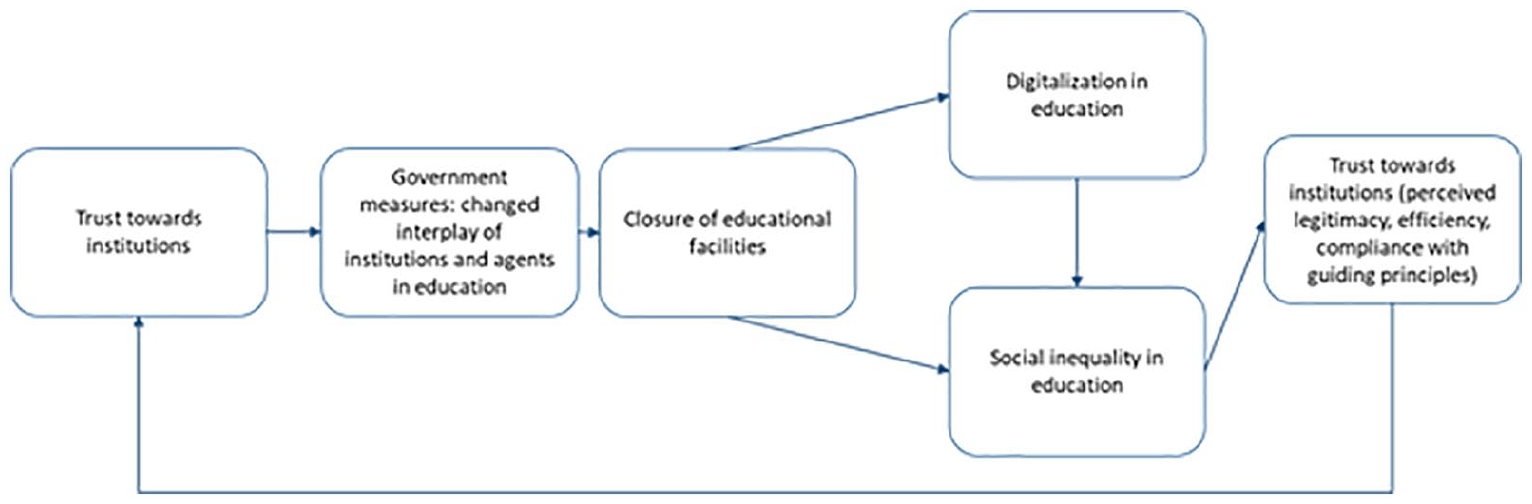
Visualization of theoretically explored interconnections.
Changed governance in education and the meaning of trust for institutions
Especially in times of crisis, cooperation and trust are significant resources for governments (as representing institutional order) when it comes to effectively and efficiently handling collective action problems. However, at the same time it is also a challenge to maintain trust (Bormann and John, 2014; Cerna, 2014: 9; Tyler, 1998: 289). Because policies rather than structures are said to be capable of producing trust (Uslaner, 2003: 171), far-reaching decisions and measures that are, in addition, put forward on the basis of the changed ‘rules of the game’ (Rhodes, 2007: 1246) may call trust into question.
Trust is considered a complex relational phenomenon between those doing the trusting and the party they trust. It is based on the risk-taking acceptance of those placing their trust of being vulnerable to the actions of those they trust, in that they positively expect that the fact that they cannot monitor or control the trusted party will not tempt this party to violate their expectations but instead to ‘encapsulate’ their interests (Hardin, 2002; Oomsels and Bouckaert, 2014: 579). This broad working definition basically applies to interpersonal and institutional trust. Institutional trust in connection with education is at the center of this paper. Institutional trust is more or less clearly addressed in educational research that discusses the wide range of new public management issues (Ehren et al., 2020; Niedlich et al., 2021: 134; O’Neill, 2013). In this paper we refer to institutional trust as trust in institutions because of the relationship of guiding principles and the competent, efficient and legitimate actions that sustain them (Lepsius, 2017: 81).
It is not a surprise given the scale of the pandemic that, to contain the crisis, actors are needed who are legitimized and powerful enough to implement far-reaching and efficient measures for the benefit of all and across all societal realms – including education. But instead of allowing complicated and lengthy negotiation processes in parliament and with various stakeholders at different levels of the education system to take place, in the hope of effectively containing the pandemic, central authoritative bodies imposed strict regulations. These were often implemented by decree; that is, abandoning the participation procedures otherwise customary in democracies in general and in the education system in particular. That is to say, during the current COVID-19 crisis the ways and means of how governments acted and coordinated social action (Rowan, 2006: 30) brought back power to central governments – while through the Bologna Process, education became increasingly governed by means of decentralized forms of network-based soft governance (Brandsen et al., 2006; Brøgger, 2019; Klijn, 2008; Rhodes, 2007). With their order to close education facilities and switch to distance education, governments acted as institutions appearing to deal with the crisis effectively and efficiently.
Through the lens of neo-institutional approaches this change in the ‘rules of the game’ can be considered as taking account of the ‘myth of legitimacy’ (Meyer and Rowan, 1977) insofar as actors must have good reasons for their measures to be legitimate, especially when they break from their usual pattern of action. Efficiency can be such a source of legitimacy. To achieve legitimacy, myths of efficiency which are based on trust need to be in place (Meyer and Rowan, 1977: 344, 357). This appears to be particularly true when – as in the case of the pandemic measures – the control of short-term success is not possible. This is in line with Rothstein and Stolle (2008: 456), who posit that an actor will gain (or lose) trust through the perceived quality of its actions.
Ultimately, the perceived performance of government measures plays a vital role for trust (Bouckaert and Van de Walle, 2003; Neal et al., 2016: 179). But changes in established forms of governance in education can lead to increased attention or even suspicion of the ‘actors playing the game’ and thus have an impact on the trust in the established myths. Concerning the lockdown measures and the digitalization push, scholars assume that the current pandemic situation could force a ‘crash digitalization’ (Cone et al., forthcoming; Koch and Koch, 2020), in which institutions rely on their staff to be ready to adapt to change and to student needs.
As a result, institutional trust cannot be taken for granted. If governments are not considered responsive – that is, not sufficiently taking into account the interests of those they represent (Hardin, 1998: 12, 16) – it may come to a decline of public trust in their legitimacy or efficiency and thus in the support for governmental actions. In addition, when the applied measures in education are seen to increase social inequality, debunked myths may have an erosive effect: (plausible) short-term interests (e.g. to contain the pandemic, secure national health, protect the economy) can be considered to outweigh established long-term interests and guiding principles in education (e.g. equal opportunities in education, fair treatment).
Context conditions and trust in institutions
Because ‘existing levels of trust may influence evaluations of performance’ (Bouckaert and Van de Walle, 2003: 301), the societal level of trust matters in terms of the trust which people show in different situations. Trust in governments is unequally distributed across countries (World Value Survey, n.d.). This is because of the spillover effects of interpersonal and institutional trust (Høyer and Monness, 2016), the relationship between the overall educational performance of a country and the societal level of trust (Pizmony-Levy and Bjorklund, 2018) and the role inequality in education plays in a society’s trust (Green and Preston, 2001).
What derives from the previous thoughts is that when trust in established norms, for example, of decision-making and participation as previously known in education, is (temporarily) suspended, the outcomes of the actions in terms of their quality and compliance with established principles can be even more critical for the trust in institutions. However, little is yet known about the perception of government measures taken in education across European countries to contain the pandemic. Acknowledging the importance of context conditions for trust, the paper seeks to shed light on this research gap by discussing what implications the measures in education in a selection of three European countries can have on trust in institutions.
Research question and methodological orientation
Against the background of the theoretically underpinned problem definition, the exploratory study presented in this paper aims at empirically developing assumptions on what the COVID-19 measures can mean for trust in institutions.
The impact of the COVID-19 measures on education has not been sufficiently documented yet. Research has primarily been organized as ‘prompt blanket surveys’. To explore current measures in education across countries to some extent, the study aims to provide a preliminary in-depth insight into the issue (Creswell et al., 2007: 239). It does so in the style of a descriptive case study approach and uses multiple sources of information (Yin, 2018). Within the framework of a ‘contextual comparison’ (Steiner-Khamsi, 2010: 327), the study explores the potential impact the measures taken in education during the pandemic can have on institutional trust. The empirical basis of this exploratory study builds on data from three European countries (the Czech Republic, Denmark, Germany). These countries were selected because they have all been challenged by the COVID-19 pandemic as much as any other European countries. Although the measures of their respective governments in the realm of public education are more or less similar, the potential meaning they have on trust might vary according to social inequality in education and the status of digitalization in education.
To explore this, the data include different types of text such as press releases, media reports on surveys, examples of good practice, interviews and existing studies on the consequences of the pandemic measures in education published between March and September 2020. While the Czech case addresses the relationship between parents, students and schools, the Danish case refers to actors in higher education institutions. The German case considers relevant actors in the realm of schools and higher education institutions.
The documents were evaluated according to principles of qualitative content analysis (Schreier, 2014). The coding frame includes concept-driven categories (Schreier, 2014: 171); that is, categories referr to the theoretical considerations outlined in the previous sections of this paper, and includes government, governance, digitalization and social inequality.
In order to be able to formulate informed and context-sensitive assumptions about the potential implications of the measures, information from the three countries regarded in this study is first presented. For this purpose the categories of the conceptual framework are taken up (measures, digitalization in education, social inequality in education, trust). The explanations are based on official data and empirical studies. Since trust in institutions is to be explored, the results of the subsequent data-driven cross-case synthesis will be discussed in terms of the potential meaning the measures have on the explanandum.
Setting the context: COVID-19 pandemic measures, social inequality, digitalization in education and trust in three European countries
The countries involved in this exploratory study differ in terms of when and what measures were implemented in education to contain the pandemic, the extent of their social inequality in education, the distribution and use of digital media in education and the societal level of trust, which varies considerably across the three countries.
The measures in education to contain the COVID-19 pandemic
As Table 1 shows, the three countries involved in this paper were hit by the pandemic between March and September 2020 to a somewhat similar extent. However, the measures in education and the time at which they were introduced vary, particularly in terms of who first benefited from the re-opening of educational institutions. In the Czech Republic and Germany, older students were given preference in the later opening of educational institutions over the younger ones, who had less ability to organize their studies solely because of their age.
COVID-19 pandemic: infection rates and education measures in the Czech Republic, Denmark and Germany until summer 2020.
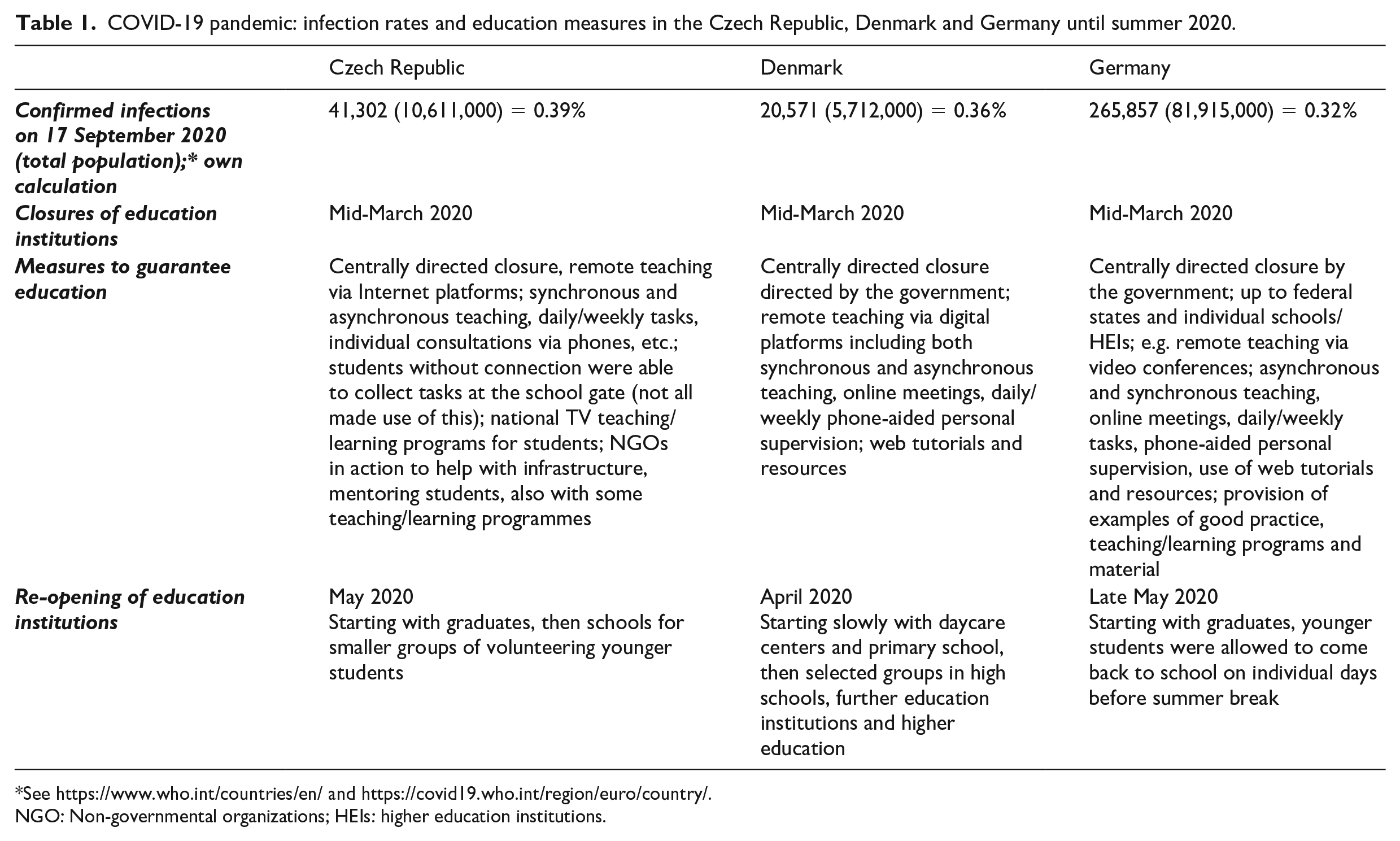
NGO: Non-governmental organizations; HEIs: higher education institutions.
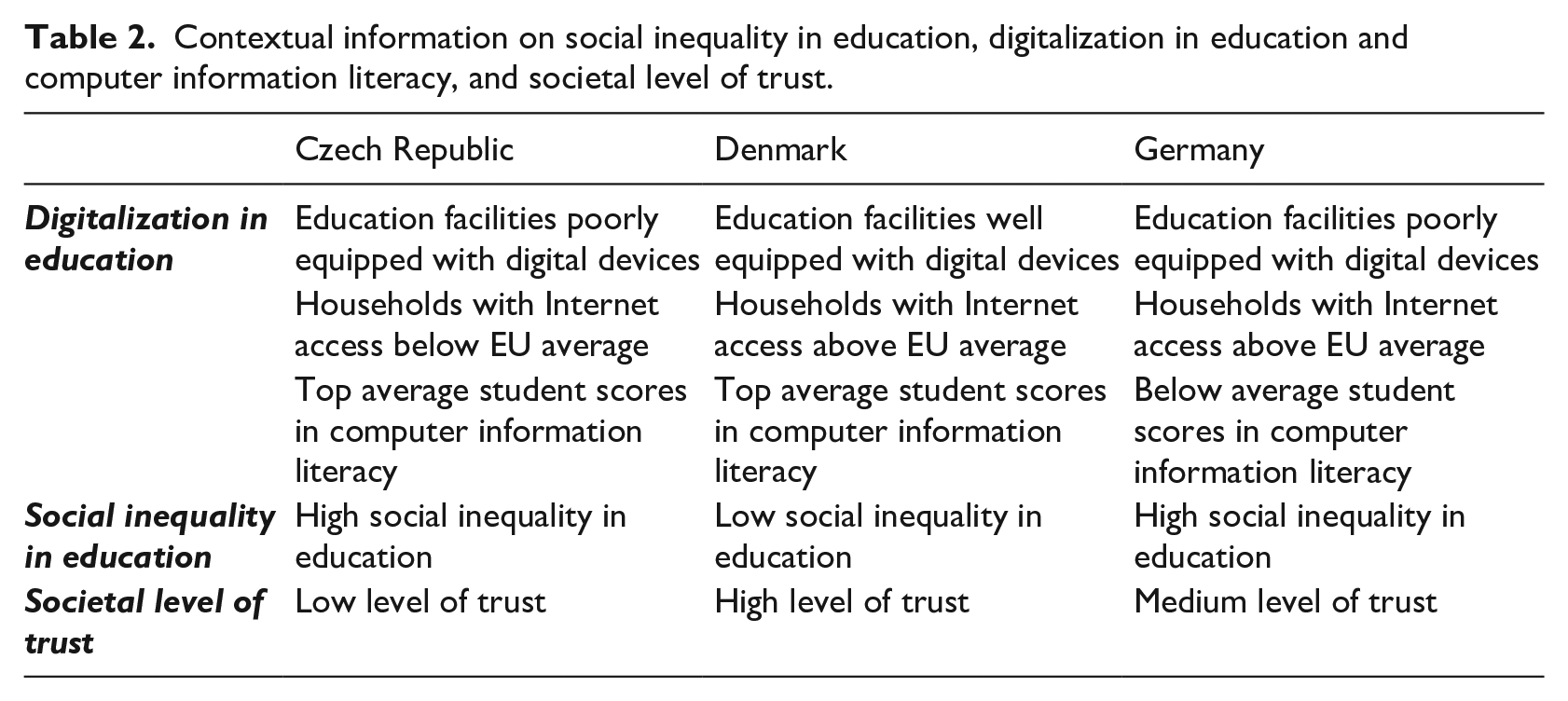
To formulate informed assumptions about how the interventions in education may affect trust in institutions, we outline below the contextual conditions which the measures encounter in the three countries involved. A summary will be provided in Table 2.
Contextual information on social inequality in education, digitalization in education and computer information literacy, and societal level of trust.
Digitalization in education: access and competent use of digital media
If a key measure to combat the pandemic in education is to close schools and offer digital distance learning, how well prepared are learners and teachers in terms of access to the Internet and digital skills? These factors can provide conclusions about how well this measure can succeed in engaging all learners in education, even during the lockdown, or, vice versa, how it can deepen educational inequalities.
Over the past few decades most European countries have promoted and invested in digital educational infrastructures – as part of both national and European Union (EU)-based strategies (Brøgger, 2019; European Commission, 2018, 2019a, n.d.b, n.d.c). However, even though digitalization has been on the agenda for some time, there is a still widespread lack of access to and familiarity with the competent use of digital media in education as well as a wide range of information and communications technology (ICT) literacy across Europe and within European countries (Fraillon et al., 2020; Pulham and Graham, 2018). Whereas education facilities in some countries were already well equipped and have intensified the use of existing digital technologies, in other countries the pandemic-induced swift transition from physical to digitalized distance education was partially hampered.
In general, scholars emphasize that it is unnecessary to ask whether there is a digital divide and to acknowledge instead that it already exists in terms of socio-economic background (Harris et al., 2017). Data show that the number of households with access to the internet is unevenly distributed across Europe. On average, 90% of households in the EU have Internet access. In 2019, Germany and Denmark were above average (both 95%). In the Czech Republic, where private Internet access is comparatively high, 87% are below the EU average (Eurostat, 2020). When it comes to the three countries considered in the present paper, significant differences can be identified in the extent of socio-economic groups with access to the Internet and who are used to ICT (Rodrigues and Biagi, 2017). Denmark is the country with the smallest digital divide, whereas in the Czech Republic and Germany this gap is greater (Cruz Jesus et al., 2016: 80). Concerning the use of digital media in schools, the 2018 International Computer and Information Literacy Study (ICILS) 2 studies showed that 90% of 15-year-old Danish students attend schools where ‘bring your own device’ is standard, whereas in Germany only 15% of students do so (Eickelmann et al., 2019: 14). 3
Accordingly, the 2018 ICILS study showed that Denmark is the country with top average student scores in computer and information literacy, whereas Germany’s students rank in third place (European Commission, 2019b: 9). In 2013, Czech students ranked higher than Danish ones (European Commission, 2019b: 10). The proportion of young people who report that they have digital skills differs across the three countries: in the Czech Republic, 52% of 16- to 19-year-olds report they have above-basic digital skills, whereas in Denmark 75% of them do. The ratio improved significantly in the Czech Republic from 2015 to 2017, while in Germany it remained unchanged above the EU average (European Commission, 2019c: 64, 75, 115).
Social inequality in education
The pandemic caused a surge in digitalization, which is said to make up for digital inequalities (Beaunoyer et al., 2020). If digitalized distance education is a way to ensure education during the pandemic, such inequalities can increase existing divides in social inequalities in education. How this plays out is also likely to be related to the extent to which social inequality in education was salient before the crisis.
Education is supposed to provide equal opportunities. However, family educational background is well known to play a pivotal role in student performance in general. Concerning the three countries considered here, the influence of the educational background of parents on educational performance is lowest in Denmark, medium in Germany and highest in the Czech Republic (Schlicht et al., 2010). In terms of the shift to digital education, students from well-off backgrounds have more options for effectively dealing with the new situation (Bayrakdar and Guveli, 2020; Pensiero et al., 2020).
Drawing from his analysis of Programme for International Student Assessment (PISA) data, Burger (2019: 19) particularly underlines the fact that in addition to the social and the family background, contextual conditions contribute to social inequality in educational achievements in such a way that in more segregated countries the effect of socio-economic background is more intense than in less segregated ones. As for the three European countries considered in this paper, compared to Denmark both Germany and the Czech Republic display stronger social segregation in education. Among these three countries, the index of social inequality in educational achievement is highest in the Czech Republic (Burger, 2019: 19). Other than in Denmark, in Germany and the Czech Republic, students with a lower-income background obtain significantly lower learning outcomes than wealthier students. In contrast, the divide between rich and poor is lower in the Czech Republic (Council of Europe Development Bank, 2017: 9).
General trust among societies
According to the above-mentioned spillover effect which (generalized) interpersonal trust has on institutional trust, it is pivotal to consider a society’s level of generalized trust. Following the World Value Survey, generalized trust is highest in Nordic countries. In Denmark, 73.9% of citizens assume that most people can be trusted. In Germany, only 42.6% of citizens share this opinion, whilst in the Czech Republic, with 21.1%, even fewer people do so (World Value Survey, n.d.). With institutional trust the picture is similar. Before the pandemic outbreak in November 2019, 63% of Danish citizens tended to trust their government, whereas in Germany the figure was 50% and in the Czech Republic only 40% (European Commission, 2021).
The different levels of trust experienced by societies are, among others, attributed to features such as their style of governance, the state welfare system or its democratic history (Freitag and Bühlmann, 2005; Rothstein and Stolle, 2008). Moreover, general trust is interconnected with overall educational performance (Pizmony-Levy and Bjorklund, 2018) and the extent of inequality in education (Green and Preston, 2001).
The contextual information presented so far is summarized in Table 2.
Taken together, students in the three countries began the COVID-19 crisis with significantly varying digital skills (and access to the Internet). This means that students will be challenged to a very different degree by shifting to digitalized distance education. It also implies that inequality in access to digital learning opportunities and inequality concerning digital competencies might intensify through the pandemic and may become a threat to trust, based on the differences in the countries’ previous social inequality in education. The segregation in Denmark’s education system seems to be limited, while in the Czech Republic and Germany, on the other hand, the measures involved may more likely be perceived as resulting in increased social inequality because the ‘users’ of education are already more vulnerable. The effects the measures can potentially have on trust are associated with societal levels of trust. Denmark’s citizens seem to be exceptionally trusting, whereas the Czech Republic is a low-trust country and German citizens are in the middle between these countries. The level of generalized trust on the part of society could ameliorate the loss of trust in institutions in such countries whose measures are perceived to increase social inequality. Thus, during the pandemic, trust might be more at risk in the Czech Republic and Germany than in Denmark.
Insights into pandemic measures in education in three European countries
Given the real-time character of the still-raging pandemic, the analysis from three European countries aims to provide insights into different manifestations of how the pandemic is being dealt with and how it affects digitalization and social inequality in different realms of education.
The Czech Republic
This case deals with the way the COVID-19 crisis in Czech education developed and was coped with between March and September 2020. The document analysis database consists of four press releases and documents from the Ministry of Education, Youth and Sports (MEYS), two texts from non-governmental organizations (NGOs), one study conducted by Czech education researchers and two surveys conducted by the Czech School Inspectorate (CSI).
Overview of the government’s pandemic measures in the Czech Republic
Primary schools, general lower/upper secondary schools and higher education institutions closed on 11 March 2020. Kindergartens and pre-schools, in general, remained open, but the providers were able to decide to close later if it was deemed necessary. Schools switched to distance education mode, which was carried out to a variable extent and quality. A gradual re-opening of schools began on 11 May 2020, first for students in the last year of their school attendance. Nevertheless, attendance remained voluntary until the end of the school year.
After the summer break, only two weeks before the start of the school year at the beginning of September, MEYS published a manual consisting of three types of measures: obligatory, recommended and informative. Schools were invited to apply procedures appropriate to their specific situations, albeit in the framework indicated.
Implications for governance
The management of the crisis underlined the responsibility of school principals for dealing with the crisis and highlighted their partially limited resources for doing so. The situation was also addressed by the establishing entities, NGOs and other local bodies, many of which tried to help schools and families with the acquisition of equipment and other aid.
The crisis inflicted new demands on parents as well. A survey of 10,000 parents (Švaříček et al., 2020) showed that most parents of students at primary and lower secondary schools (91% of those addressed) were able to support home learning. The usefulness of the current schoolwork was described as positive by 75% of parents. However, parents perceived a low level of technological preparedness and a lack of knowledge and skills on the part of teachers as significant problems. In another CSI (2020b) survey, many head teachers say that some parents only now discovered what their children really know and what the school actually does. As a result, they have developed a more favorable opinion of the school.
Digitalization in education
Despite strenuous efforts on the part of many actors, access to technologies could not be provided to all children and students, or rather their families. In the initial stage, schools lacked methodological and informational support, but institutions including MEYS (by creating a national platform 4 ), Czech television, NGOs, various other organizations and volunteers (university students in particular) progressively joined the effort. The situation in most schools was more or less stabilized within three weeks.
Another CSI (2020a) survey (5000 respondents; lower and upper secondary schools; data collected in the first half of April 2020) shows that distance education included the majority of students, regardless of differences in the extent and form of involvement. Although schools managed to involve most students, even those without access to online communication, there were approximately 9500 students at primary, lower and upper secondary schools with whom communication was not established at all, meaning that they received no formal education during the period of school closure in spring 2020. As significant reasons for this, the CSI (2020a) survey mentions an absence of information technology (IT) equipment, Internet connection failure, low motivation on the part of some students and insufficient support from parents.
Before the outbreak of the pandemic, Czech teachers taught using digital technologies at less than a fifth of all primary, lower and upper secondary schools. The crisis forced numerous teachers to make a radical change (CSI, 2020a). During the summer of 2020, an amendment to the law was passed, declaring remote teaching obligatory if required by the situation. Nevertheless, the amendment does not specify how such remote teaching will be provided. This will depend on the school. It does not necessarily follow that it will be online, conducted with computers and via the Internet. MEYS has invested almost €500,000 in summer learning camps for students (180 schools involved and a total of 1300 educational days). An important subsidy for IT purchases in basic schools amounting to approximately €50m was approved (approx. €750 per school). After the vacation and the first wave of the pandemic, teachers were invited to start working again step by step in September to avoid playing catch-up later.
Social inequality in education
It seems that there are two risk factors here: firstly, the high dependence of children’s results on their social background, and secondly, the high degree of school autonomy. Despite sufficient equipment, such as what was borrowed from the school, some parents could not help their children cope with online teaching. Many were even unable to help them with the basic school curriculum. Recent research shows that pupil failure is closely related to constraints such as inadequate housing and low standards of parental education. Consequently, online teaching deepens these differences (Korbel et al., 2020).
The Czech Republic typically displays relatively significant differences among schools and regions. Extremes became evident during the crisis: better schools (and better classes within schools) were able to manage the situation better. Many schools were quickly able to manage online teaching, arrange for individual approaches and often equip families with computers. On the other hand, many schools could not communicate adequately with families, inform them, respond to their needs and approach students individually. Consequently, the high level of autonomy means that some schools performed extremely well while others did poorly because there were insufficient tools to ascertain quality standards. In addition, access to high-quality education for all remained a problem (People in Need (PIN), 2020). The difference between the rich and the poor continues to increase. Nevertheless, this divergence is not only a problem at the level of individuals; that is, students and their families. To account for the different conditions of schools, the Czech School Inspectorate has accentuated the requirement to differentiate clearly between schools in the support provided, in terms both of methodology and funding and based on given conditions.
Denmark
The empirical material builds on a selection of 11 press releases from the Ministry of the State of Denmark and 13 press releases from the Ministry of Higher Education and Science between March 2020 and June 2020. The material also includes selected university strategies concerning the implementation of COVID-19-related restrictions, including initiatives on the digitalization of teaching and exams, as well as the home offices of faculty members. Finally, the material also encompasses two preliminary studies on the effects of the COVID-19 lockdowns on Danish university students. Furthermore, seven qualitative, semi-structured pilot interviews with Danish university students at both bachelor’s and master’s degree level divided between four universities and the following degree programs are included (global studies, mechanical engineering, educational sociology, educational science, pedagogy, political science, and information science and cultural communication). 5
Overview of the government’s pandemic measures in Denmark
The authorities worked to limit the spread of COVID-19 in Denmark, and on 12 March 2020 the Ministry of Higher Education and Science sent all higher education students home for an initial two-week period from 13 March 2020. Employees at higher education institutions were also sent home for an initial two-week period. Only employees essential for critical functions were to be physically present at the institutions (Ministry of Higher Education and Science, 2020a; Ministry of the State of Denmark, 2020). With few exceptions, the lockdown had an impact on the approximately 250,000 students and 40,000 employees in higher education. The Ministry of Higher Education and Science required students to continue their studies by actively studying at home as far as possible. SU payments (Danish students receive a publicly funded study grant called State Education Support, more commonly known as SU) to students continued uninterrupted.
On 23 March 2020 the government announced that the initiatives already in place to limit the spread of COVID-19 were to be extended up to and including 13 April 2020. From the end of April a controlled re-opening of higher education institutions began. The re-opening mainly targeted students with particular needs for physical facilities such as laboratories, clinical facilities or workshops to complete or avoid delaying their studies. The same applied to several PhD students and researchers at educational institutions. The majority of students at higher education institutions continued studying from home, using online teaching and digital exams (Ministry of Higher Education and Science, 2020b). After the summer vacation the government’s COVID-19 measures mainly consisted of social distancing, bans on assemblies of people and the requirement that all students and teachers at higher education institutions must wear a mask when moving around within the educational institution.
Implications for governance
The pandemic has led to at least two implications for education governance: the (momentary) reassertion of the sovereign rule of government and drastic growth in the use of private sector services within public education institutions and administrations. Even though the pandemic did not lead to a ‘state of exception’ in the legal sense of the word in Denmark, it gave rise to the initiation of emergency powers. In practice, these emergency powers, based on majority votes in parliament, served as the (legal) exception through which the government was able to exercise sovereign power over people and institutions, albeit for a short period. Such emergency laws came with expiry dates and merely allowed ministers to sidestep parliamentary procedures for a limited period. The sovereign rule became more visible in the lockdown in March, however. In addition to these procedures, to which higher education institutions were unaccustomed, the integration and embedding of private services in public higher education and administration was accelerated during the lockdown (Cone and Brøgger, 2020; Williamson and Hogan, 2020), blurring the traditional conception of public education as a state-operated service.
Digitalization in education
The lockdown in March 2020 prompted emergency measures in order to ensure teaching. In most cases, the primary consideration was to substitute physical teaching with digital teaching. Overnight, universities implemented various digital platforms and boosted the capacity of their digital infrastructures. Among the most favored platforms introduced by one of the Danish universities, Aarhus University, were Zoom, BlackBoard (including Collaborate), YouTube and Google Drive. Zoom is an online platform for video, voice, chat and content sharing. BlackBoard is a virtual learning environment and learning management system that features course management and includes the distance-learning system Collaborate, which provides virtual classroom solutions quite similar to the Zoom online platform. They were both used for online meetings, webinars and teaching – both synchronous through live sessions and asynchronous through pre-recordings of sessions. For teaching purposes, Zoom and Blackboard Collaborate became the most favored platforms used by university teachers and are also recommended by the university strategies on blended learning (Aarhus University AU Educate, 2020). In addition, some teachers integrated the online video-sharing platform YouTube to upload and share recorded sessions, and Google Drive – a file storage and synchronization service where users can back up, access, view and edit files. However, instructors mainly used Google Drive for training purposes. Furthermore, students themselves also used Skype and Messenger to meet virtually (pilot interviews).
Interviewing university students, however, shows that the complexity exceeds the immediate number of digital technologies used. Teachers applied the technologies in different ways, and, thus, the complexity increased significantly in terms of the learning arena available to the students (pilot interviews). The technologies were combined in various ways, and sometimes their use was also characterized by a lack of digital competence among teachers, which corresponds with the results of the survey mentioned in the paragraph below (pilot interviews).
The swift transformation from physical to digital teaching drastically changed the conditions for learning. One of the few quantitative studies available is a survey from the University of Copenhagen, Denmark, evaluating the weeks from March until June of the COVID-19 lockdown and its impact on university students (Misfeldt et al., 2020). The survey includes students from health, theology, humanities and science and indicates that the transformation to online teaching initially caused a lack of motivation to study among the students (Misfeldt et al., 2020). Almost two-thirds of the students were having trouble motivating themselves during the lockdown. This is also reported in the pilot interviews, and in addition the students here also mention a lack of ability to concentrate when working from home. Most respondents never or almost never experienced difficulties applying the software (Misfeldt et al., 2020: 11), which indicates a certain familiarity with the applied technologies. At the same time, one out of six respondents reported teachers having problems with handling the technical solutions. Most respondents reported that they experienced increased stress, nervousness and loneliness during the lockdown, which is corroborated by a report from the Danish Association of Masters and PhDs (2020) indicating increased stress and loneliness for students during the COVID-19 lockdown. Furthermore, in the survey, many respondents mention that they missed informal conversations with teachers and fellow students during the lockdown (9 out of 10 respondents missed informal conversations with fellow students and 6 out of 10 respondents missed informal conversations with teachers) (Misfeldt et al., 2020: 11).
Social inequality in education
Even though most respondents in the survey never or almost never experienced difficulties applying new digital software during the COVID-19 pandemic (Misfeldt et al. 2020: 11), the students in the pilot interviews point towards several factors which they consider decisive for how students have been able to handle the COVID-19 lockdown. They consider student membership of study groups one of the main factors contributing to students’ ability to continue studying during the lockdown. According to the students, the groups serve both professional and social purposes, and the social dimension of the groups has been particularly important during the lockdown. The students also mention living conditions at home, including physical space and the possibility of having sufficient peace and quiet to work and whether or not students had to nurse or homeschool children (during the first weeks of the lockdown, daycare and schools in Denmark were also closed down). These reflections were connected to socio-economic background considerations, fellow students’ resources and the differences in physical living conditions when the students were prevented from using office and library spaces at the universities. Finally, the students also point towards a particular risk for exchange students, who do not have strong networks in their host country and thus run a significant risk of experiencing loneliness during the lockdown.
Germany
The sudden and forced shift to digitalized distance learning during the COVID-19 pandemic in Germany took place at a time when the shortcomings in digital equipment and education were already clearly known, but improvement measures could not yet be implemented across the board or show substantial effects.
The data include articles and press releases that were systematically gathered on the websites of relevant actors in school and higher education (German School Portal, Federal Parents’ Council, Conference of Ministers of Education and Cultural Affairs, German Rectors’ Conference and German University Association: 108 texts in total (for a detailed analysis, see Bormann, submitted). The analysis shows a clear evolution of the discourse from a ‘coming to terms with the present’ via ‘encouraging pragmatic solutions and giving critical voices a hearing’ towards the start of an engagement with the ‘feasibility of continuing the measures against the background of a differentiated impact assessment’.
Overview of the government’s pandemic measures in Germany
To contain the spread of the coronavirus, all educational facilities were closed in mid-March 2020 as a result of the federal government’s decision. Students were allowed to take their final exams, but the facilities remained closed for younger students and daycare-center children and most university students. Education was expected to take place as distance education, while many educators experimented with digitalized distance education. To enhance the equipment of schools with computers, the federal government decided on a faster cash outflow. After the summer break, schools returned to a condition similar to regular operation with extended hygiene protocols, while higher education institutions were then still almost wholly in their semester breaks.
Implications for governance
After the centrally imposed closures of education facilities in March 2020, in May 2020 the federal states (Länder) partially reasserted their sovereignty in this field and laid down the conditions for on-site education within the framework of the national behavioral guidelines and hygiene protocols. As a result of the measures, school and home interplay massively changed insofar as parents were pushed into supporting their child’s home education. Due to the lack of digital equipment at schools and unequally distributed access to student digital devices, in July further measures for the ‘Digitalpakt’, a federal government measure to accelerate digitalization in education in the Länder, were decided. However, in September the Länder still had to push the federal government to roll out the long-announced money allocated in this program.
Digitalization in education
Shortly after the closure of the educational facilities there were voices that stressed that there was no alternative to the closure. However, the topics discussed revolved around fundamental worries and concerns, mainly focusing on schools where a lack of digital competence on the part of teachers and the equipping of schools with digital media prevailed. After a few weeks the texts show a significant turn towards feasibility aspects. Many statements point to positive examples, tips and tricks, and accessible resources for digitalized education that make it possible to maintain operations under new conditions. In another study (Huber and Helm, 2020), 56% of teachers disagreed or strongly disagreed that their school was sufficiently technically equipped for web-based teaching formats. Parents reported that they think that staff are digitally active but not interactive (Vodafone Foundation, 2020). Accordingly, press releases show that homeschooling is to be continued on the basis of pragmatic approaches, while at the same time social inequality remains a topic of concern. After the Länder returned to their own regulations under the framework of the federal government’s ordinance, press releases in early summer address jurisdictional questions such as data protection, the legitimacy of performance assessment despite a lack of on-site teaching, and the decision to return to normal operations on-site. However, the feasibility of digitalized education is the dominant topic; for example, through presentations of success stories, but also concerning the lack of digital competence on the part of pupils, the lack of digital expertise on the part of teachers, or the lack of concrete measures by the federal government to speed up the digitalization process.
Press releases from the German School Portal mainly refer to digitalized distance learning benefits to enhance self-regulated learning as a crucial future skill and cover skeptical voices on furthering digitalization. The Conference of Ministers of Education and Cultural Affairs represents itself as a prudent advocate for maintaining education, and as attentive and caring concerning students and staff. The press releases also underline that the return to regular operations will be accompanied by further digitalization to take advantage of the increase in COVID-19 measures.
Social inequality in education
Shortly after the closure of educational facilities, the data show that increased social inequality resulting from digitalized distance learning gained awareness, mainly within the realm of public schooling. As early as mid-April the results of a teacher survey (Forsa Politik- und Sozialforschung GmbH, 2020) stated that 86% of 1031 respondents were sure that school closures would increase the effects of social inequality. More than a quarter of staff assumed that students lack digital equipment, and about one in five believed that creating and delivering appropriate digital educational content is a major challenge for teachers resulting from the school closures. Moreover, Hurrelmann and Dohmen (2020) warned that the school closures highlight and further increase the fact that educational achievement depends on students’ social background. To break this cycle, they call for both schools and students to be technically equipped. What is more, they stress that parents need to facilitate their child’s distance education at home. Resulting from this, the parents consider themselves to have been put in a far-reaching role in terms of teaching or supporting their children in their learning, a role about which many of them tend to be skeptical. In particular, parents with disadvantaged social backgrounds are concerned about their child’s education (Vodafone Foundation, 2020). Students from low-income families are reported to have to continue to wait for the support intended for them in order to avoid social inequality in computer equipment. The issue of social inequality is also underlined in terms of a historically informed critique of digitalization as undermining the possibility of disadvantage compensation and the chance to offer equal opportunities as important functions of education (Tenorth, 2020).
While the Federal Parents’ Council takes on the role of admonisher and appeals to political decision-makers not to overburden parents with homeschooling they are unable to provide, the Conference of Ministers of Education and Cultural Affairs does not explicitly refer to the issue of social inequality.
Trust in institutions at stake as a result of the pandemic measures in education? Summary and discussion
Findings from the data analysis covering three European countries and information about the context will be brought together to explore the crisis-induced measures implemented in education and the potential side-effects they might have on trust in institutions.
Summary of findings
The concept-driven presentation of data shows similarities and differences between the three countries. First of all, the analysis shows that the cases have in common the fact that the governments implemented massive interventions in education to contain the pandemic. In all three countries, education facilities were shut down and digitalized distance education proved the foremost suitable means of choice to guarantee the provision of education. Table 3 summarizes the main results.
Summary of results concerning governmental decisions and governance, digitalization in education, social inequality in education.
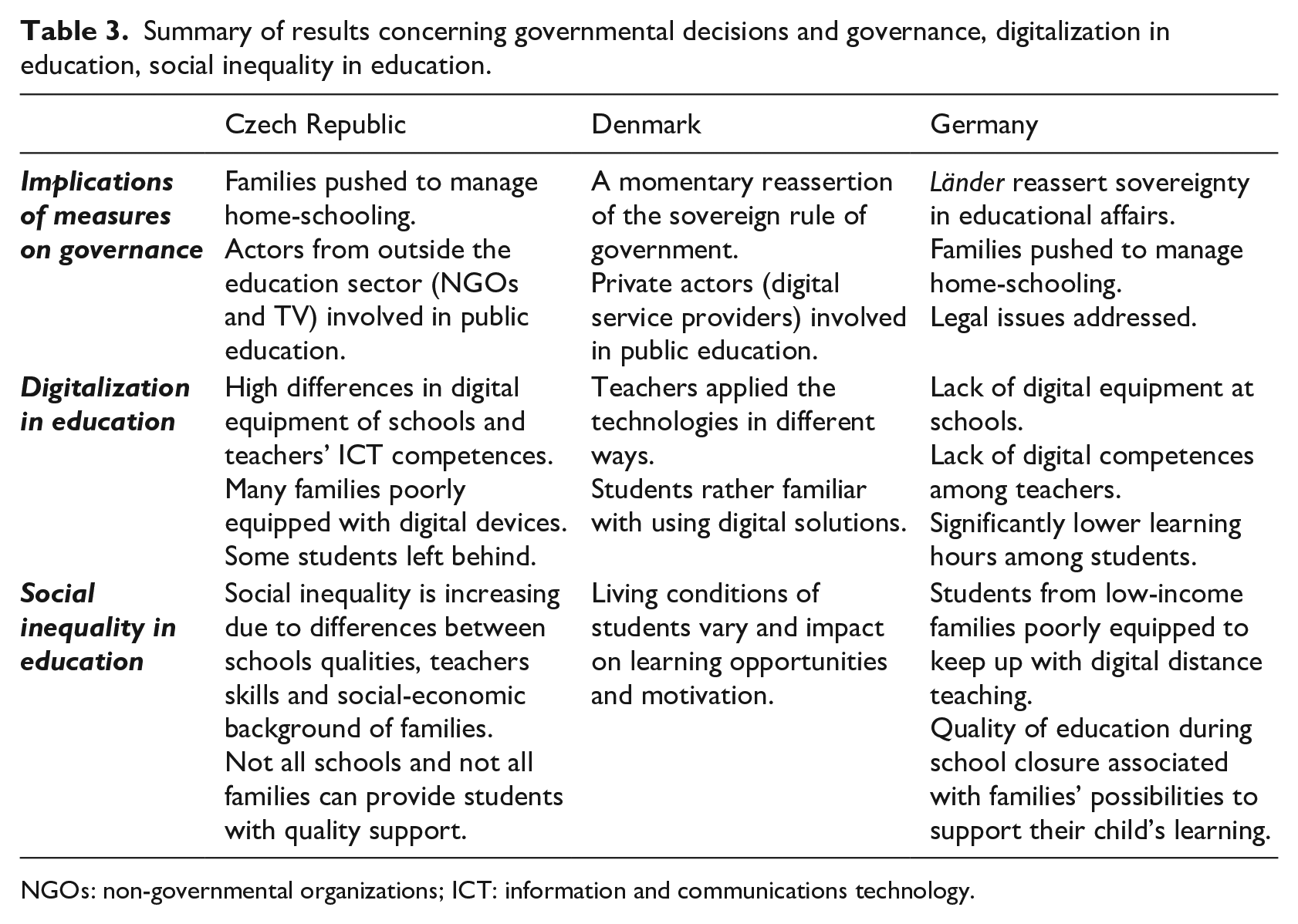
NGOs: non-governmental organizations; ICT: information and communications technology.
Other than the Danish case, which looked at the higher education institution sector, the Czech case exclusively referred to schools. In contrast, the German case covers both sectors (although the references involved mainly address the school system). Focusing on schools (as in the Czech and partly also in the German case) means that younger students are considered to be more at risk and more dependent (e.g. on their parents and what the school offers) than older students enrolled in higher education institutions.
Governance
The mode of governance changed in all three countries during the pandemic. In the Danish case, the influence of private actors in education is explicitly emphasized, and a reassertion of the sovereign rule of government appeared to occur. In Germany a shift in government action towards the federal government and then back to the sovereignty of the Länder could be observed. In addition, the data show that legal issues of data protection and scoring are addressed. In the Czech Republic the involvement of various actors from outside the education system was observed, including an increased transfer of responsibility for education to local actors such as principals and parents, but without supporting them with appropriate means. Tensions between stakeholder views are apparent across the three countries, and in Denmark and Germany the authoritative bodies appear to use the crisis as an opportunity to pave the way for further digitalization in education. Together with an increase in the influence on education on the part of various actors, this might cause suspicion of an ongoing change to privatization in education tolerated by the government.
Digitalization
All actors are confronted with the same challenge, but in terms of access and competence they can meet the current challenges to a very different extent. While teachers had to rely on the prompt delivery of digital access, material and methodological support, political actors often relied on teachers (and students) to adapt to the situation. Many hastily created methodologies were challenging to apply in specific contexts, and their use was sometimes in contradiction with current legislation. In terms of higher education institutions, the data from Denmark showcase the fact that the technical preparedness of teachers and students to deal with digitalized education is addressed but not a major issue. Analysis of the data from the Czech and the German case differs from the ones in Denmark in a similar manner. The results of the analysis of these two countries indicate differences in the capabilities on the part of students and teachers (and parents) to deal with digitalized education technically. With regard to access to and competent use of digital devices, the (unintended) side-effects of increased social inequality in education can significantly differ among the three countries.
Social inequality
Whereas the governments act as strong protagonists taking responsibility for societal health, students in particular seem to be expected to take responsibility for adapting, obeying and sharing the measures – although at the risk of being left behind and of increased social inequality. In the three selected countries, social inequality was already very different before the crisis. Insights into the Danish case in higher education show that social inequality is mentioned as a matter of student resources because unequal conditions prevent them from keeping up with their peers. In the Czech Republic and Germany, however, the increase of social inequality in education due to digital distance education is emphasized more clearly. Pupils may be more impacted than students enrolled in higher education institutions because the latter depend to a lesser degree on their teachers’ digital skills, simply because of their already accumulated digital experience.
All in all, it seems that in Denmark the conditions of learning under pandemic conditions are addressed effectively. In contrast, in the Czech Republic and Germany problems with the conditions and access to digitalized distance education are a matter of concern as a risk of increased inequality in education. That is, while the data in one country show that performance is a matter of concern, in the other two the concern relates to the preconditions for performance.
All three countries have problems in common in the sudden switch to digital educational scenarios. However, if the context conditions are taken into account, the potential (unintended) side-effects the measures may have for trust in institutions can differ in type and scale. As outlined in the fourth section, the context conditions which have been considered vary across the three countries, with Denmark being a low social segregating, high trust country that is well prepared for digitalized education. Social inequality in education is much higher in the Czech Republic than in Germany, and the same applies to students’ digital skills.
Preliminary assumptions concerning trust in institutions drawn from theory, context information and analysis
Education is widely considered an essential instance of socialization that is therefore institutionalized – but what if governments decide to close schools and higher education institutions temporarily? Schools act as safeguards for providing equal opportunities. If they are closed, students are more self-reliant despite distance education. Their digital skills, conditions at home and the type of support they receive from teachers and/or parents might be at risk of having a more significant impact on their educational achievements. This was the point of departure of this paper, which explores the impact which digitalization and increased social inequality may have on trust in institutions. Neo-institutional approaches frame the reflections on the interconnection of government, governance and trust in education in the face of the assumed massively changed interplay caused by the COVID-19 pandemic. The following informed assumptions range from data-based via more theory-focused to more abstract conclusions.
Context conditions accelerate or buffer the role the measures might have on trust in institutions
Due to the context conditions, we can assume that only a lower extent of (unintended) side-effects caused by the COVID-19 measures in education is likely to leave the trust in institutions relatively unchanged. Considering the previously existing level of trust, it can be assumed that the side-effects of the pandemic measures affect trust in institutions to varying degrees, because the measures are to varying degrees responsive to the divides in social inequality or the digital divides. Trust in institutions may change to the least extent in Denmark because social inequality is low and seems to be little affected by the pandemic measures. Furthermore, access to the Internet is widespread and digital skills are highly developed. What is more, the previously existing high level of trust can be assumed to ameliorate the extent of any potential loss of trust due to the (possibly limited) impact the measures have on social inequality in education. In the Czech Republic, trust may decline from its already low level because inequality in education is likely to be accelerated by distance education, particularly because Internet access, especially for disadvantaged students, needs improvement. Even the previously high level of student digital skills might not reduce the negative effects of suspended learning on-site, because of the need to increase the digital proficiency of teachers in some cases and to support schools in their flexibility to react quickly. School leaders therefore need to be prepared to support the staff. At the same time, local actors are more closely aligned in coping with the crisis, and parents are mostly positive about working with teachers in times of homeschooling, which can prevent greater damage to trust. In Germany, on the other hand, the crisis meets shortcomings in the digitalization strategy of the federal and the Länder governments and, at the same time, a still considerable social inequality in education. Against this background, it can be assumed that an increase in social inequality due to digital distance education is likely because students and teachers are poorly prepared for distance education and have limited digital competencies. Therefore, social inequality in education may increase and may lead to diminished trust in the performance and legitimacy of the measures taken to overcome the crisis, and thus negatively touch upon the trust in institutions.
The assumed mid-term effects of the short-term measures in education are likely to result in institutional changes
Trust in institutional myths is a pillar of institutional legitimacy and stability. The myth of trust might become damaged insofar as the (unintended) mid-term side-effects of the measures are likely to increase social inequality in education. Given these changes in trust in institutions and taking into account the aforementioned accelerating or ameliorating context conditions, this may result in institutional changes in education in some countries, whereas in others the institutional issues remain unresolved. Institutional changes can relate to the interplay of democratically legitimized and private or non-governmental actors in (digitalized distance) education.
If the assumptions regarding (unintended) side-effects in education and their importance for trust in institutions are correct, the different ways and effectiveness of dealing with the pandemic may increase the European divide
Educationally and socially disadvantaged individuals in countries that are poorer in terms of digitalization, social equality and trust may fall even further behind than before. This can fuel centrifugal forces that can be observed at the moment – not only within the countries themselves but also across Europe. Such a divide may increase further due to the resources, capability and willingness of governments to effectively deal with the situation and of citizens to comply with governmental regulations.
The project of a cohesive European society could be challenged if harmonizing the effects of context conditions in education fails
In this paper a limited number of three countries was taken into consideration. However, what results from this study can be thought of as being scalable (with all due care) to a larger number of European countries and may then become even more evident. In terms of the common values for the European Educational Area, the European Commission (n.d.a) underlines that ‘inclusive and high quality education and training, at all levels, as well as the European dimension of teaching, are paramount for creating and maintaining a cohesive European society’. From a theoretical point of view, education impacts on public behavior and supports democratic governance. Trust in the institutions regulating education is needed to maintain support for them (Honneth, 2012).
Limitations and future directions
Because of the COVID-19 pandemic, societies worldwide witnessed an unprecedented situation and were forced to put the elasticity and acceptance of their institutions to the test. At the same time, a lack of knowledge on how best to deal with the pandemic was a challenge. As a result, crisis management inevitably results in a challenging real-world experiment without any ‘control group’ – which also means that it is not likely to implement measures whose success can be taken for granted. This also applies to the measures in education considered in this paper.
Our study has strengths and limitations. Its strength lies in bringing together insights from three European countries that showcase different manifestations of the phenomenon concerned and make it possible to develop differentiated but provisional assumptions on how the context conditions which have been considered may buffer or promote trust in institutions during the pandemic. It also addresses the issue of trust as a potential driver of institutional change in the field of education. We assume that the mere change in the ‘rules of the game’ (North, 1990; Rhodes, 2007) as an expression of the lack of alternatives (Powell, 2007) in the crisis is only the trigger of institutional change. Its sustainability is presumably determined by the extent to which trust in institutions is affected in relation to the contexts. Future studies, ideally longitudinal or process tracing, contextual comparative ones, need to substantiate this assumption.
With regard to the framework of the study, neo-institutional approaches have not been without critics. Criticisms point to the failure of linking situated forms of organization with beliefs (Hasselbladh and Kallinikos, 2000), taking for granted the quality of institutions (Zucker, 1983: 5), and employing a one-sided focus on macro-level phenomena (Wiseman and Chase-Mayoral, 2014). This study seeks to reflect these critiques by examining the potential impacts that crisis-related measures imposed by the macro-level can unfold at the meso- and micro-level. By focusing on the potential risks which the current measures may pose to trust in institutions, the paper thus takes the stance that trust can act as a potential driver of institutional change at a time of crisis – and beyond. Putting trust in institutions at the center, a relatively new approach in neo-institutional research is adopted here. Another point that is sometimes criticized in relation to neo-institutionalist framings is addressed by explaining the concepts and their scope (Alvesson and Spicer, 2019: 210), relating them to each other and considering them in their (country-specific) context. In so doing, the study also dismisses the neo-institutional strand of research on a convergent ‘world culture’, as was criticized by Silova and Rappleye (2015).
The limitations of the current study refer to the methodological approach adopted. Following Flyvbjerg (2006) there are, among others, two main misunderstandings relating to (multiple) case studies, one of which refers to a bias towards verification and the other to generalization. With regard to the verification bias, such studies are, in general, capable of getting close to real-life contexts and force researchers to contest preconceived views. According to this view, the sample of three case studies is seen as a common source for drawing preliminary informed assumptions on the potential effects of the measures concerned. Regarding generalization, in order to gain ‘most’ or ‘least’ likely cases, selecting information-rich cases that differ in some aspects is crucial. Concerning the three countries employed here, the countries share the challenge of the pandemic and the massive measures taken to contain it. However, they differ in many other ways, of which only some are outlined in the fourth section.
This exploratory study is a snapshot of a crisis in full swing, which means that not much data is available and the available data can be criticized in terms of their completeness and meaningfulness. Therefore the preliminary assumptions presented here need to be scrutinized and contested in further studies. Studies should, for example, explore how different actors in the education system make sense of the legitimacy and feasibility of the measures concerning the trust they (already) had in institutions in education, and how much they feel their autonomy to be threatened. Furthermore, studies are needed that scrutinize the role of context conditions that enable education systems to perform over time, and the trust education institutions gain.
The paper introduces the so far under-represented concept of trust into the discussion on the nexus of education, governance and government (Niedlich et al., 2021). In addition, it provides preliminary insights into a little-noticed area of the short-term side-effects of the COVID-19 pandemic (événement) in education that may, however, play a prominent role in the long term (longue durée) in terms of societal cohesion. Because education is key to self-determined societal participation and to fostering trust in social institutions, the risk of an erosion of trust in educational institutions may turn into a problem for social cohesion within and across countries, which is why considering the question of trust is essential.
Footnotes
Acknowledgements
We thank Paolo Landri and three anonymous reviewers for their valuable comments on earlier versions of the paper.
Declaration of conflicting interests
The authors declared no potential conflicts of interest with respect to the research, authorship and/or publication of this article.
Funding
The authors received no financial support for the research, authorship and/or publication of this article.
Notes
Author biographies
 ) and works as editor-in-chief of Studia Paedagogica, a Scopus-databased journal, and a board member (formerly chairperson) of the European Network for Improving Research and Development in Educational Leadership and Management (ENIRDELM).
).