




Abstract
Across many international contexts, the design and construction of architecturally different school buildings has become a key strategy in providing innovative learning environments designed to prepare students for work and life in the 21st century. Despite the global popularity of this strategy, research has highlighted persistent challenges associated with the transition to, and occupation of innovative learning environments. We explore the nexus between risk and innovation, reporting on data arising from a primary school in Australia, built as part of one state government’s Private Public Partnership initiatives. We apply a conceptual framework for risk and public service innovation and a responsible innovation framework to investigate how the school leaders and the architect understood the educational intentions, values and risks that shaped their school design and to assess users’ perceptions of their new school. Our findings draw attention to how responses to externally driven design innovation in the complex and dynamic environment of a school can create risk and uncertainty for users on multiple levels. We argue that the application of a responsible innovation framework provides a mechanism to highlight limitations in school design processes and opportunities to improve alignment and on-going adaptation of schools for future conditions.
Introduction
Organisation for Economic Co-operation and Development (OECD) policy intends that schooling should prepare students to be lifelong learners who have developed the capacities and agency to succeed in work and life in the 21st century (OECD, 2017, 2018; Schleicher, 2018). Equitable opportunity through quality education has been articulated by many educational policy bodies, from international organizations to state governments. For example, the European Union has adopted the recommendation that ‘member states should support the right to quality and inclusive education, training and lifelong learning and ensure opportunities for all to develop key competences’ (Council of the European Union, 2018: 4). The European Commission notes that meeting these objectives requires flexibility in meeting the needs of diverse learners not only in teaching and learning approaches, but also in the learning environments in which schooling takes place (Council of the European Union, 2018).
Across many international contexts, governments have invested in the innovative design and construction of schools as one way of working towards these policy goals (e.g. Building schools for the future programme (United Kingdom) (Department for Education and Schools (DfES), 2003) and the subsequent ‘Priority school building programme’ (Education and Skills Funding Agency, 2011); Building the education revolution (BER) infrastructure programme (Australia) (Australian National Audit Office (ANAO), 2010); innovative learning environments in Canada and New Zealand (OECD, 2017). Under these schemes, schools were purposefully designed and built to create environments that would foster the development of 21st-century competencies – communication, collaboration, critical thinking and creativity – and environments that could be adapted for the needs of future learners (OECD, 2017).
Research regarding school learning environments has emerged in a number of European contexts: Austria (Schabmann et al., 2016), Finland (Mäkelä et al., 2018; Niemi, 2020), Iceland (Sigurðardóttir, 2018; Sigurðardóttir and Hjartarson, 2016), Germany (Reh et al., 2011) and the Netherlands (Könings et al., 2017); as well as in Australia (Byers et al., 2018; Deed and Lesko, 2015; Mulcahy et al., 2015; Saltmarsh et al., 2015), New Zealand (Benade, 2019; Carvalho et al., 2020; French et al., 2019; Wells et al., 2018) and the UK (Cardellino and Woolner, 2019; Daniels et al., 2017, 2019; Tse et al., 2015; Woolner et al., 2018). These researchers have reported on various expected and unexpected educational consequences of redesigned school learning environments. An evolving body of research evidence is being built, to improve the alignment of government policy with school design for use in different organizational, social and cultural contexts (Blackmore et al., 2011; Cardellino and Woolner, 2020; Carvalho et al., 2020; Daniels et al., 2019; Kokko and Hirsto, 2021; Mäkelä et al., 2018; Mulcahy, 2016; Niemi, 2020).
In the context of school design, innovation inevitably involves change and therefore also risk (European Union FP7 project; 1 Flemig et al., 2016). The contribution of this study to international research is its focus on responsible innovation (RI) and the more challenging task of understanding how the investment in school infrastructure has materialized, and whether it has been appropriate to different contexts and conditions of risk and uncertainty.
Innovative school learning environments
Various terms are used to describe innovative school learning environments (e.g. ‘open and flexible learning environments’, ‘21st-century learning environments’, ‘modern learning environments’) that are characterized by future-focused architectural design features (Byers et al., 2018; Gislason, 2015). In this paper, we use the term innovative learning environments (ILEs), which has been applied by the OECD in their ILE framework (OECD, 2013, 2017) and subsequently adopted extensively in many international contexts (Mulcahy and Morrison, 2017). A key learning principle in the ILE framework is based on the social nature of learning and assumes collaborative arrangements with a range of partners. Aligned with this principle, architectural design thinking has emphasized open, aesthetically pleasing and comfortable learning spaces, that can be flexibly organized for different purposes, pedagogical approaches and student learning opportunities (Benade and Jackson, 2017). Unlike traditional enclosed classrooms with rows of desks, minimal time is expected to be spent in ILEs in teacher-led whole-class arrangements with more time allocated for student engagement in active learning with opportunities for students to design their own learning, individually and through peer collaboration. International reports have emphasized infrastructural innovation alongside cultural shifts in practices in order to enable active learning in innovative learning spaces: ‘There will need to be flexibility in educational cultures, practices and learning spaces, and the capacity to accommodate different pedagogies and mixes of group and individual learning’ (OECD, 2015: 29). There is evidence that ILEs can support ‘active’ learning which in turn, can benefit knowledge retention and academic performance and well-being (Byers et al., 2018; Kariippanon et al., 2018, 2019a, 2019b). Despite the general consensus that ILEs can increase well-being and improve learning for staff and students, these outcomes are not always achieved, nor are they consistently achieved for all students (Benade, 2019; Chapman et al., 2014). Further, how successful change was achieved has remained unclear (Leiringer and Cardellino, 2011; Woolner et al., 2018).
Studies have reported on how culture and organizational structures can influence how learning spaces are used in different contexts (Blackmore et al., 2011; Cardellino and Woolner, 2020; Daniels et al., 2017; Mulcahy, 2016) and impact the effectiveness of the ILE (Cleveland, 2018; Deed and Lesko, 2015; French et al., 2019; Saltmarsh et al., 2015). If the intended change processes initiated through ILEs are misaligned with a school community’s practices, there is a risk that the innovations will become irrelevant and unsuitable for stakeholder needs (Niemi, 2020). When this occurs, necessary modifications can mean extensive financial and social resources, which may or may not achieve the intended aims of the innovation (Daniels et al., 2019; Veloso and Marques, 2017; Wheeler and Malekzadeh, 2015). ILEs that fail to properly adjust for the acoustic considerations of open environments result in noisy spaces that negatively impact all students (Wheeler and Malekzadeh, 2015). Students with hearing difficulties or challenges with self-regulation may find these spaces particularly unsuitable for learning (Benade, 2019; Chapman et al., 2014; Page and Davis, 2016). There is evidence that infrastructural and pedagogical mitigation measures, including design for noise absorption and retreat space, can reduce these challenges (Cardellino and Woolner, 2020; Page and Davis, 2016).
A recent review of empirical research of ILEs (Deppeler and Aitkens, 2020) reported that when ILE designs were well aligned with their context, multiple benefits arose for the users. Reviewed studies identified a number of student benefits including increased autonomy and self-regulation, and flexible and collaborative learning opportunities (Cardellino and Woolner, 2020; Daniels et al., 2019; French et al., 2019). Identified benefits for teachers included increased agency and teaching environments characterized by having high levels of trust and being creative and collaborative (French et al., 2019; Wright and Adam, 2015). A sense of belonging across all the school community members was associated with alignment (Cardellino and Woolner, 2020; Daniels et al., 2019; French et al., 2019; Mulcahy et al., 2015; van Merriënboer et al., 2017; Wright and Adam, 2015). Several of the elements identified as key to supporting the alignment of the stakeholder perspectives and practices with the design and occupancy of ILEs are consistent with a well-established education literature that emphasizes the importance of local knowledge for informing change processes. Examples include: participatory processes, professional learning, effective school leadership and institutional change theory (Fullan, 2016; Hitt and Tucker, 2016; Manzini and Rizzo, 2011; Wenger-Trayner, 2014).
This literature review also highlighted persistent challenges associated with the transition to, and occupation of, ILEs. Several case studies have documented failures in new-build ILEs. In some schools, this culminated in costly retrofitting to create more traditional classroom environments (Daniels et al., 2017, 2019). In others, inadequate consideration of design implications and/or budgetary restraints created problems of acoustics, poor ventilation and temperature control, and inadequate social space (Wheeler and Malekzadeh, 2015). Research findings have reinforced that successful transition to ILEs requires changes to schools’ organizational cultures (Carvalho et al., 2020; Gislason, 2010; Kokko and Hirsto, 2021; Woolner et al., 2018).
Clearly, the relationship between the alignment of ‘innovations’ in ILE design and the way these environments are used is complex and is likely to be influenced by a number of contextual aspects of schooling. In this paper, we aim to contribute to the understanding of the varied and complex ways in which architects, school leaders, teachers and students interpret, make sense of and use an ILE built within a particular top-down, risk-adverse scheme, and how this process was mediated by contextual factors.
The following questions guided the larger research study:
How do the principal and the architect understand the educational aims and ideas, expected values and risks that shaped their school design and how did they respond to these challenges and to unexpected events?
How do the stated intentions of the educational vision which informed the school design compare with the ways the built learning spaces influenced the perceptions, actions and interactions of students and teachers?
How do students and staff perceive and experience the newly designed spaces, and what do these spaces mean to them (including the value of the spaces and benefit to whom)?
Context
Selected data reported on in this paper arises from one primary school in a larger group of schools built in Australia in 2017 and 2018 as part of one state government’s Private Public Partnership (PPP) initiative. The PPP involved the financing, design, construction and 25-year maintenance of 15 new schools in the state’s fastest-growing communities. The high level of enrolment pressure in growth areas and the importance of schools as centers of communities strengthened the need for a large number of new schools to open across 2017 and 2018.
The PPP project aimed to build on the declared success of the previous partnerships that had built 12 schools in 2010 and 2011. The designed schools were intended to represent advancements in 21st-century learning design. Consistent with international policy (Council of the European Union, 2018; OECD, 2015, 2017), the education principles that were expected to drive the designs were developed specifically for the PPP schools. It was anticipated that school designs should support:
• inclusion (access and choice) by adhering to the principles of universal design;
• a learning centered approach;
• collaborative learning and teaching;
• community engagement and belonging;
• and would be aesthetically pleasing to support the physical, emotional, and social wellbeing of students and staff.
In addition, these principles were expected to support the development of ‘responsive designs’ which included the potential adaptability for varied current uses and to be future-focused and able to be reconfigured for changing needs that might occur over the long term.
It is important to note that the PPP arrangements in this context extended only to the school building facilities and their maintenance. Schools resulting from this initiative continue to operate under state curricula and policy, with administrative and teaching staff appointed through public government processes. Nevertheless, the final design and construction work completed by the contracted architectural firm have lasting administrative and pedagogical implications for the school occupants.
Conceptual and analytical frames
The starting point for our conceptualization concerns the inextricable links between risk-taking and innovation (Flemig et al., 2016). Risks are the expected or unexpected effects of uncertainty (Wang et al., 2018) and risk management is the application of processes considered necessary to mitigate the risks inherent in any project (Rybnicek et al., 2020). In order to examine the relationship between risk management and innovation in the context of a new-build innovative school learning environment, we apply two conceptual frames in relation to risk and innovation that are relevant for analysing and understanding our data.
In the sections below, we first describe Flemig et al.’s (2016) framework for risk and public service innovation, which incorporates concepts of hard and soft risk management. Following this, we outline the contributions of an RI framework to our analysis. RI provides a structure for the ethical management of innovation, with the consideration of impacts across implicated stakeholder groups.
Risk management and public service innovation
Innovation and partnership among private and public institutions has become a popular strategy for managing risk and enabling increased cost-effectiveness and efficiency in realizing solutions to government challenges with limited resources (Brogaard, 2017; Hong and Kim, 2018; Rybnicek et al., 2020; Warsen et al., 2018). Research has reported mixed findings on whether the supposed benefits of PPP arrangements are realized in practice (Warsen et al., 2018). There are potential risks for cross-sector partners that arise from their differing perspectives and drivers in PPPs (Pinz et al., 2018) and no clear evidence that the risk factors that are relevant in one project or sector apply in another or that the importance of risks will not vary over time (Rybnicek et al., 2020).
Across disciplines and sectors there are two very distinctive research perspectives on what constitutes the success of the PPP that are relevant to this study. One perspective emphasizes success as the delivery of the project and the importance of ‘hard’ factors such as ‘the inherent structural features of the arrangement (that is, long tight contracts, bundled together through an overarching consortium, and the strong use of private finance’ (Hodge et al., 2018: 1113). The alternative perspective focuses on relational characteristics of the PPP and views ‘soft’ management approaches (e.g. building strong trust and collaboration) as critical for the successful development of on-going relationships among the partners, that go beyond the delivery of the project (Hodge et al., 2018; Warsen et al., 2018).
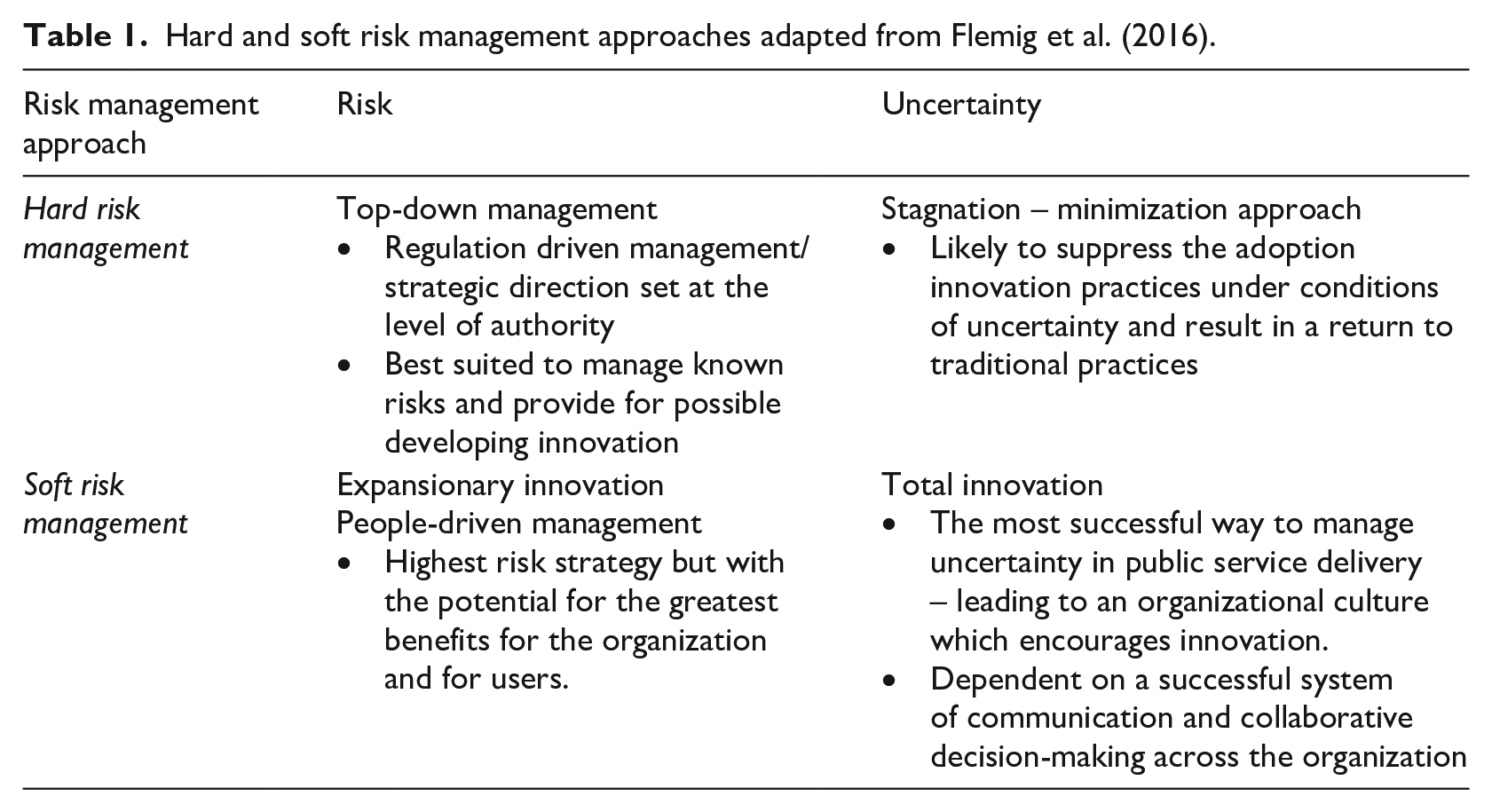
The redeveloped conceptual framework for risk and public service innovation (Flemig et al., 2016) incorporates both the hard and soft risk management approaches (described above) to the contexts of risk and uncertainty (Table 1). Flemig et al. (2016) make clear that hard risk management approaches are best adopted to manage known risks and with the potential for evolutionary innovation. When applied to uncertainty, however, hard risk management approaches ‘stifle innovation’ (Flemig et al., 2016: 430). Alternatively, it is the soft risk approaches that are likely to be the most successful in dealing with uncertainty. However, soft risk approaches are highly dependent on effective communication and collaborative decision-making across the organization. For government-led PPP arrangements it is, therefore, highly risky to adopt soft approaches but also the ‘one with the potential for the greatest benefits for the organization and for service users’ (Flemig et al., 2016: 430). While differentiating between risk and uncertainty, and characterizing the two approaches separately, the authors note that in reality, risk and uncertainty are addressed simultaneously at different levels (Flemig et al., 2016).
Hard and soft risk management approaches adapted from Flemig et al. (2016).
Dimensions of RI
Secondly, this analysis employs the recent but increasingly useful concept of RI. RI aims to balance a range of economic, social and cultural drivers to achieve ‘more responsible solutions for meeting the challenges’ of the future (Lubberink et al., 2019: 179).
The governance of RI is typically discussed in terms of an adaptive framework, developed to shape innovation processes. The aim of employing an RI framework is to achieve ethical alignment between the values and needs of diverse stakeholders and the intentions of the innovation (Deppeler and Aitkens, 2020; Ribeiro et al., 2018).
In this analysis, we apply the RI framework developed by Stilgoe et al. (2013).
This RI framework has been applied in a wide range of international cultural and political contexts and across various sectors and used as an analytic tool in a systematic review of research school ILEs (Deppeler and Aitkens, 2020). The framework developed by Stilgoe et al. (2013) includes four interconnected dimensions: anticipation, inclusion, reflexivity and responsiveness. A brief description of these RI dimensions (RID) follows with examples relevant to the specific context of school ILEs.
Anticipation involves systematic thinking about the expected and unexpected impacts of innovation for diverse contexts and users, along with the sustainability of the innovation, prior to its introduction. In the context of ILEs, anticipation would explicitly recognize the complex and uncertain nature of the social environment of a school and the need to consider the intended and unintended consequences of the school design on different school community user groups in different cultural and geographic contexts and under different conditions (e.g. extreme weather events, population growth or a pandemic).
Inclusion and participatory processes are expected to involve stakeholders at various levels of institutional hierarchy to inform the development and introduction of the innovation and associated practices. In relation to ILE schools, this dimension would mean active participation of educators, students and a range of school community members working together with architects at various stages of the innovation (policy intent, school design, occupation and implementation of practices).
Reflexivity means ‘holding a mirror up to one’s own activities, commitments and assumptions . . . and being mindful that a particular framing of an issue may not be universally held’ (Stilgoe et al., 2013: 1571). In relation to ILEs, the dimension of reflexivity would include the critical examination of the policies, values and assumptions that underpin the innovation, that are held by stakeholders across all levels and that guide design and educational practices.
Responsiveness entails the capacity to make adjustments or change direction in response to stakeholder values and needs, as well as shifts in socio-environmental conditions (Stilgoe et al., 2013: 1572). In the face of the challenges and uncertainty of our rapidly changing world, modification is expected and an on-going part of innovation. In the dynamic context of schooling, responsiveness demands that ILE designs must be flexible to be adapted for multiple purposes and users, but also sustainable and easily reconfigured over time for changing practices, contexts and conditions.
Aligned with the RI conceptual framework we have also placed importance on examining the perceptions of stakeholders in the PPP case study and in particular for gaining a better understanding of the social relations in the ILE through the perspectives and voices of teachers and students. In bringing student voices to the forefront, we employed an adapted version of the voice-centred relational methodology (VCRM) approach (Brown and Gilligan, 1991; Gilligan et al., 2003). VCRM was developed to amplify the voices of vulnerable and disadvantaged groups and those whose voices are not readily heard. Previous research has demonstrated this approach to be a useful for examining how individuals situate themselves in relation to others and within the perceived realities of their communities (Macaulay, 2020; Macaulay and Deppeler, 2020). Thus, the VCRM approach was deemed appropriate to draw attention to how the students perceived their social/relational experiences within their new school.
Method
Following ethics approval for the research from relevant authorities and ethics committees, 2 schools were nominated by the architecture firm selected by the state education authority and responsible for the design and construction of schools located in high-growth communities. Several schools were invited to participate in the research project. The first school that agreed to participate was a primary school with student enrolment that reflected a range of demographics from those with complex family and social needs to those from middle-class backgrounds. Index of Community Socio-Educational Advantage (ICSEA) 3 values ranged from 971 to 1035 (the average ICSEA value is 1000). The school had high proportions of enrolled students with a Language Background Other than English. Scores from the Australian National Assessment Program – Literacy and Numeracy (NAPLAN) indicated that the selected school was performing close to or above comparator schools with similar student demographics.
Participants
Participants in the study included the architect who designed the school, the school principal, deputy principal, 4 Year 6 teachers, a Year 6 teaching assistant, 3 subject-specialist teachers (music, art, STEM (science, technology, engineering, mathematics)) and 98 Year 6 students (out of a total of 104 students) whose parents had consented to their participation.
Procedures
Researchers used multiple methods to collect data, including interviews, a recorded school tour, observations of teaching and learning activities, student photography activities, researcher field notes and photographs of learning spaces, and review of relevant documents and policies. We undertook individual interviews with the architect, principal, deputy principal and classroom teachers, as well as a focus-group discussion with three subject-specialist teachers.
A video recording of a school tour was conducted by a school leader on the same day as the interviews. In doing so, the principal and another school leader were able to offer clarity around environmental and structural features of the building in discussing the organizational features in their school.
Supplementing the audio-recorded data were researcher notes from the interviews; school-based documents offered by the principal and staff to the vision, philosophy and organization of the school (such as de-identified class lists and literacy and numeracy groupings, behavioural approaches); and observations of teaching in whole-class, small-group and one-on-one sessions. An architectural photographer and one of the researchers took photographs of the various learning spaces on two occasions in the school and these were annotated with descriptions of the observed activities and time of day.
Student data collection
Student data collection consisted of student-led photography, followed by paired interviews with one of the research team members. Year 6 students whose parents had consented for them to participate were given cameras and asked to photograph areas in the school that they felt were most important to their learning and well-being. As part of preparation for the photographic activities, students were invited to participate in a group workshop led by the research team. The focus of the workshop was to brainstorm and clarify student understandings of learning and well-being and to make explicit their responsibilities as ethical co-researchers and photographers. Each student was provided with a summary of the session and the rules for ethical photographic research.
The photo-discussion activity took place in groups of two students. Students were given physical copies of their photos and worked first individually, then collaboratively to develop a ranking system of photos from most to least important. Student photo rankings were then used to prompt discussion about why the students considered these images important. The session was audio-recorded and digital photos were taken of the individual and shared rankings. To ensure consistency of the processes all researchers were given written protocols for the photographic activities, and the lead investigator modelled the procedure with a student pair for the co-investigator and research assistant.
Analysis
The audio recordings of each interview, focus group and student photography activity discussion were transcribed. These transcripts and researcher notes were then stored using NVivo 11 so that coding and analysis of the data could be collaborative among the researchers. Using a priori themes identified from the conceptual framework for risk and public service innovation (Flemig et al., 2016), transcribed data from the architect, school leaders and teacher interviews and focus groups were first coded to understand how risk and uncertainty were addressed simultaneously at different levels of design and occupation of the school. The Stilgoe et al. (2013) framework was then used to code the transcribed data according to the four dimensions of RI. We used a hybrid deductive-inductive approach (Fereday and Muir-Cochrane, 2006) to compare and contrast what educational intentions and challenges the framework’s four dimensions (anticipation, reflexivity, inclusion and responsiveness) helped to articulate. We identified the elements that were considered important in aligning the design of the school with the experiences of its users in context.
Researchers came together to discuss additional themes to emerge inductively from the coding process in light of differing perspectives of the participants. We also checked and verified affirming and disconfirming evidence within and across the school as well as by going back to the notes written by each researcher. Discrepancies or differing interpretations were resolved through discussions among researchers, until agreement was reached according to standard recommendations for rigor and validity in qualitative research (Bazeley, 2013).
Student transcripts were analysed from the four key VCRM perspectives as described by Brown and Gilligan (1991): (a) The story of who is speaking (analysing transcripts for key concepts and searching for an overarching narrative); (b) In what body? (exploring how students spoke of themselves); (c) Telling what story about relationships? (exploring how students spoke of others); and (d) In which societal and cultural framework? (identifying a societal and/or cultural framework in which students framed their narratives). Multiple layers of the students’ voices were amplified through highlighting their use of different pronouns in their narratives and the creation of pronoun poems. (See Supplemental materials, Appendix A for detailed examples of how pronoun poems were constructed.) Further, we shared our de-identified findings regarding students’ experiences with school leaders, teachers and with the students themselves to confirm that our analyses resonated with what they knew about the school and to further expand our interpretations where their discussion contributed additional or discrepant perspectives.
Findings
Our findings presented in the following section include two tables relevant to the two conceptual frames that were applied in analysing and understanding the selected data. Table 2 summarizes the risk management approaches and outcomes across stakeholders and Table 3 provides examples of the RIDs evident in the actions of various stakeholders. Selected pronoun poems are included to represent student perceptions in relation to these elements.
Risk management approaches and outcomes across stakeholders.
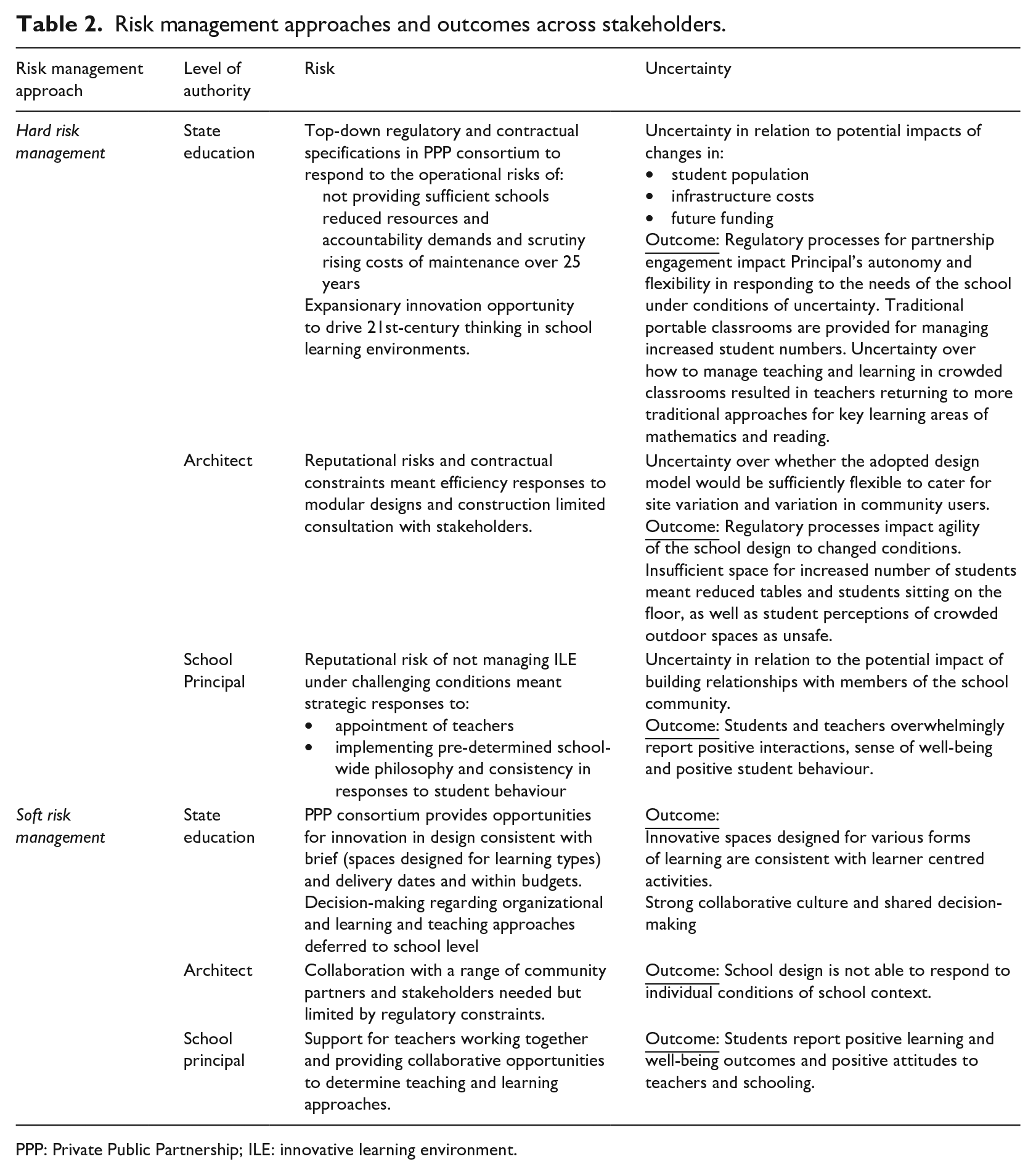
PPP: Private Public Partnership; ILE: innovative learning environment.
Responsible innovation dimensions (RIDs) examples across stakeholders.
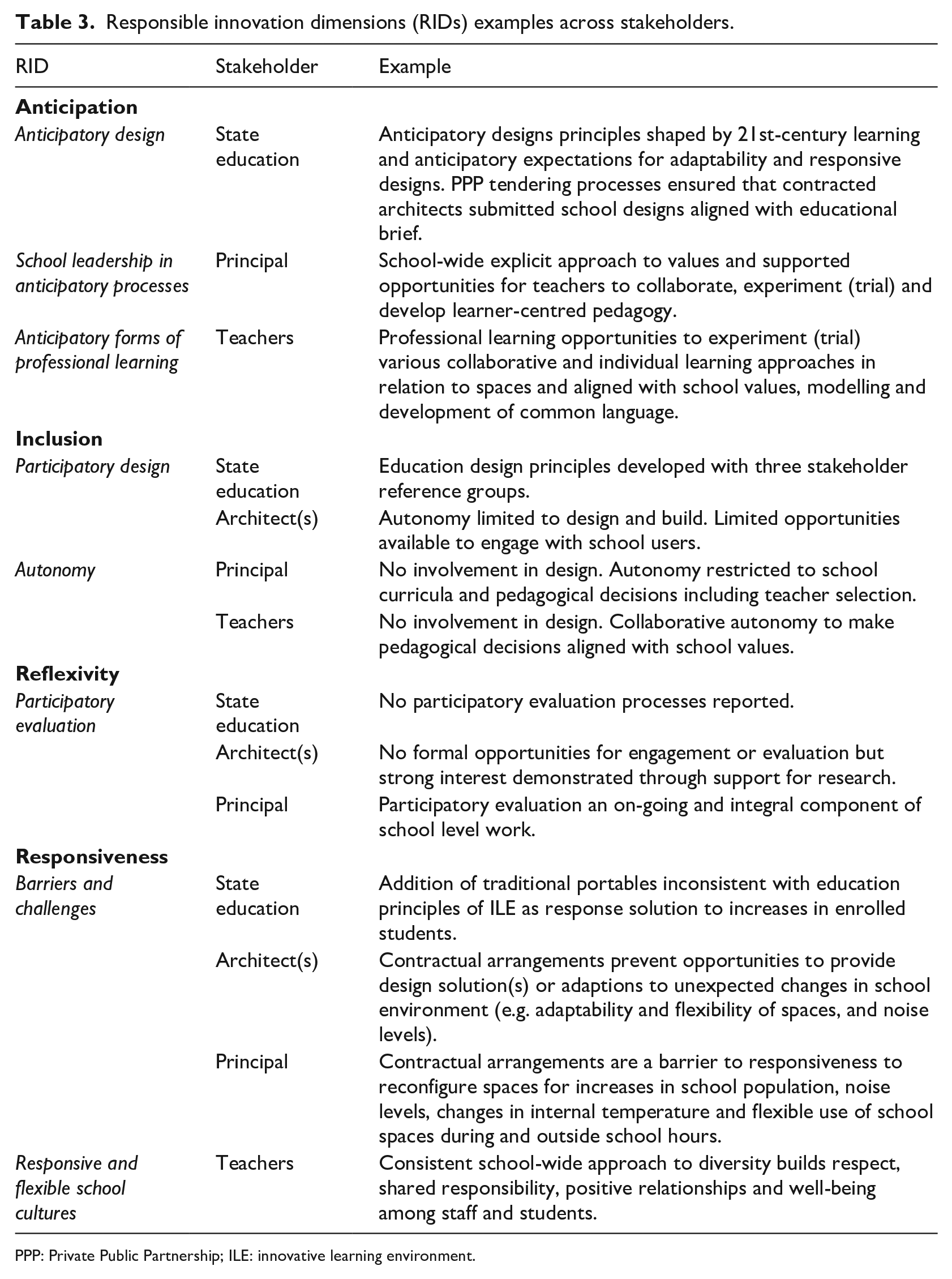
PPP: Private Public Partnership; ILE: innovative learning environment.
Accountability and risk
Government response to increased demand for infrastructure and services almost always implies challenges of resources utilization. Under these conditions along with existing accountability mechanisms and media scrutiny, any failure to deliver quality schools in a timely fashion and within budget would have resulted in significant repercussions for the state government. Applying a hard risk management approach with regulatory and contractual specifications with private partners allowed the government to provide explicit strategic direction and to reduce risk. The PPP contract was awarded to a consortium of partners with significant expertise and previous experience in the design, delivery and maintenance of schools and thus reportedly represented strong value for money for the state.
The 15 schools were designed and delivered within the specified period of 2 years. Whether this approach will similarly deliver the value for money specified in the agreed 25-year maintenance contract remains uncertain. In addition, the government’s approach of engaging a range of stakeholders to establish education principles to drive the design is aligned with the RI dimensions of anticipation and inclusion. The designs were explicitly directed to consider the diversity of school environments in different cultural and geographic contexts and be able to be responsive to different conditions and future changes. Thus, the contract both anticipated and addressed the potential risk that the intended and unintended consequences of the school design would not be fit for purpose once occupied.
The design risks
There was a strong reputational risk for the architectural firm if they failed to design and deliver the schools within the designated time frame. Thus, due diligence process at the beginning of the project determined a regulatory approach across all schools. The architect explained: ‘We had 16 weeks from master planning right through to the end design development . . . documented . . . to a level that it can be constructed to deliver the 15 new schools within two years.’ This approach, in turn limited the opportunities for the architect(s) to engage with stakeholders at the school level to inform design development (RID inclusion), with the exception of consultation with the principal of the first school to be constructed. In relation to the RID reflexivity, these constraints also prevented future opportunities for any critical examination of the design by the stakeholders to guide modifications in the school design and/or adopted educational practices. Thus, the design of individual schools varied minimally in relation to their pre-selected features. Various modules within the schools were designed by the architects for the different forms of learning activities that were perceived to align with the vision outlined by the state education authority (e.g. collaborative and individual learning spaces along with presentation spaces): [W]e do know for a fact that children learn in different ways. So, we had to provide a lot of different types of learning settings that can cater for those kids to put them in an environment where they want to learn and can find their own true passion for learning . . . spaces for small quiet group work . . . large freeform collaboration spaces . . . spaces where you still have direct and explicit instruction . . . a real big shift from a very teacher centric model, to a very learner centered model. (Architect)
The expected uses of the various spaces are indicated in the architect’s floor plan of the Year 6 learning community (Figure 1). Figure 2 illustrates the anticipated activity in these spaces in an artist’s impression.
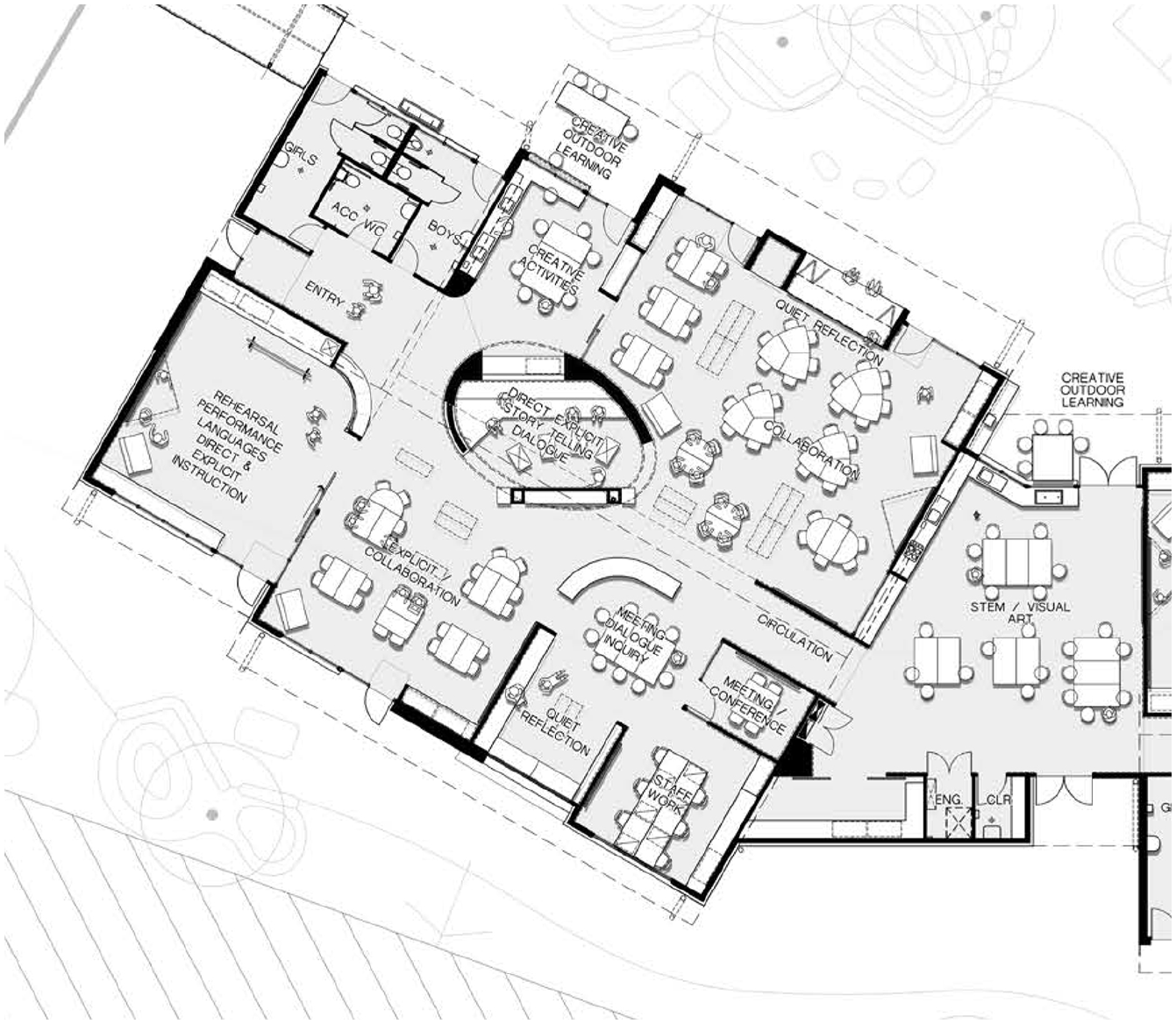
Architect’s floor plan of the Year 6 learning community.
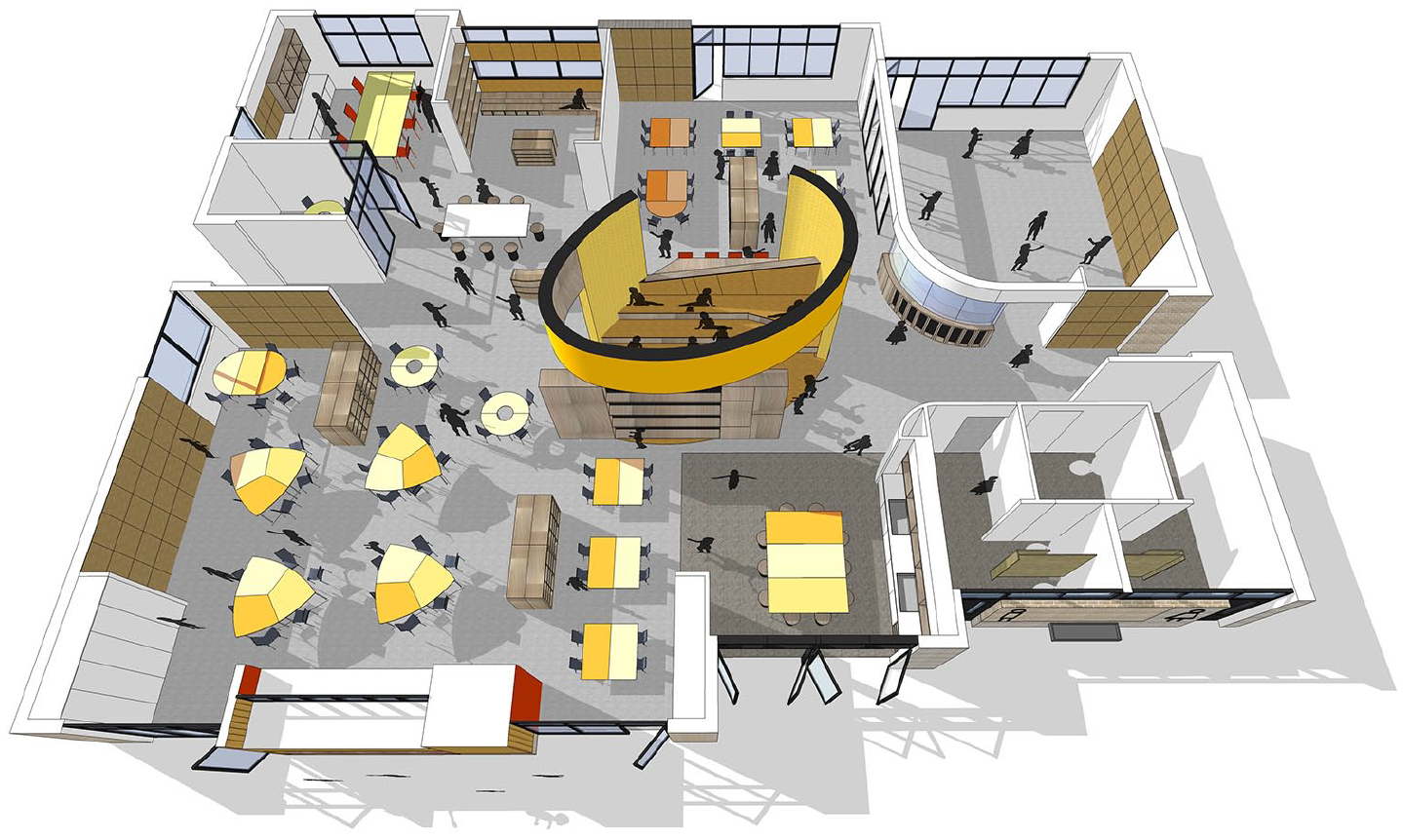
Artist’s impression of anticipated activity in the spaces.
The occupation risks
The school principal commented on the positive impacts of the regulatory elements of the PPP in the on-time delivery and design of the school: A Public Private Partnership – the good things about that are we have a totally finished school . . . I’ve got a beautiful school . . . it was opened day one with everything completed. Furniture was already here, things like that. Even though that was a good thing, I didn’t get a hand in what furniture I wanted . . .. I did not choose the colours in the school.
However, the pre-determined organizational processes for PPP partners to manage the school environment and for engagement with the wider community was perceived as a loss of the principal’s autonomy with respect to management of the school environment: The [Name of building management system] . . . the temperature is designed to range between 21 and 26 degrees and this is managed by the [name of system] through heating and cooling. Opening a window then is not possible. If I’m here on a Saturday, I can’t even turn on heating in my own office, because I’d have to schedule that [action] prior to the event . . . you can’t effect change or introduce new things to the facility or building itself, and to engage parents – I can’t really have a working bee. We tried – the first year we wanted a small kitchen garden, so we had a little working bee during school hours. But if I bring people in on the weekend or at other times, then even if it’s planting plants for Tree Day, I have to try and match the plants which are already there, according to the design brief, and I have to sort of talk to [Name of school maintenance partner]. We were engaging our community through education, parents’ sessions, and what the kids do with open nights and things like that, and the events we hold, but I think long gone are those days as well.
As a consequence, the contractual arrangements for the management partners acted as barriers for the principal to engage with the wider school community (RID inclusion) and respond to changing conditions relevant to needs of the school (RID responsiveness). In addition, while the PPP arrangement was intended to free up the principal to focus solely on educational matters, the principal noted the additional time spent in contacting the partners for school maintenance tasks, including
sending emails or have wasted meeting time talking about the same things that never actually get progressed . . . calling them to account on their procurement. Things like the cleaning – I don’t have to manage the cleaning contract, that’s a great thing. But again, if I’m not happy with the cleanliness of the school, I then have to go through [Name of school maintenance partner] to meet with them. There’s layers of bureaucracy. They make it sound very easy, but it hasn’t been, I don’t think.
Alternatively, the soft management approach adopted by the state education authority allowed decisions and responsibility regarding the organizational and curricular approaches to be made by the principal of the school: Whatever happens during the school day, if it’s something that’s going to enhance your curriculum or help support student wellbeing, that’s the school decision, and my decision, and the principal’s decision, along with school council. (Principal)
The principal used this level of authority to manage several conditions, known prior to occupation, that were perceived to be potential challenges and risk. First, it was apparent that the school enrolment was likely to exceed the capacity that the school was designed to allow. Second, the enrolled families were highly diverse in terms of their country of origin and cultural, ethnic, religious and social backgrounds. In anticipation of these conditions the principal strategically appointed teachers (RID anticipation) who had experience in teacher collaboration and were confident and competent to support the needs of students with any potential learning, social and behavioural challenges posed by the overcrowding and the diversity of students: I had input into the selection of teachers. In the Year 6 we have two very experienced teachers who were interested in working collaboratively and two first-year teachers willing to collaborate and learn. (Principal) We’ve been chosen for this school, when I applied for the job here there were over 300 applicants. And I think that the people have been chosen by the Principal and panels they’ve been looking for certain types of people and I think that, it’s important . . . this is working because we’ve got good staff that pull their weight. We’ve got competent staff and not only are we all on the same page with curriculum delivery and everything else but also in the way we manage the students. (Teacher 2)
There is evidence that anticipatory professional development for teachers (RID anticipation) is associated with more successful adaptations to ILEs (Deppeler and Aitkens, 2020). While no formal teacher professional development was available in preparation for teaching in the ILE environment, the principal discussed several anticipatory processes she employed in order to support teachers’ and students’ transition to their new environment. This included an explicit school-wide approach that supported positive behaviour and promoted inclusion through the valuing of respect, responsibility, resilience, relationships (4Rs) and belongingness was adopted (RID inclusion): We have our four school values, which are really crucial, and our vision, which is growing great kids to be great people essentially. We needed to be clear from the outset what our expectations of the students were, and to reinforce those [expectations] consistently through-out the school. Respect, responsibility, relationships and resilience . . . Each term we emphasize one of four Rs. I mention it in every assembly and we include it as part of everything we do across the school. (Principal) So, it [emphasis on four school values] is very consistent – it starts right at the top, it’s in every assembly we talk about it every week. (Teacher 2)
Teachers were provided with the autonomy and supported professional learning opportunities to make decisions and determine and trial the collaborative and learner centered approaches to teaching and learning (RID reflexivity): I guess, with the leadership, and we talked through what our expectations were, and we had a lot of learning in the beginning about how spaces can be used. We didn't tell them how to use them . . . They needed to come together. How would they use the spaces – so they had lots of discussion. Trialed things. What did work, what didn’t work. (Principal) At the beginning . . . we set up our expectations and we actually do a lot of role modelling about how we’re going to do and we actually set up what we want, how we want the room to run, what the expectations are when they [students] move into a space. How are they meant to work? So, if we address kids that are not doing the right thing, it’s that common language so the kids are on board on what we’re saying. (Teacher 3)
These combined hard and soft risk approaches appeared to be successful in producing overwhelmingly positive responses from students. The students described actively participating and sharing responsibility for the shaping and enactment of school values (RI inclusion). Students photographed representations of the values held by the school (e.g. the 4Rs, Tree of Kindness and Hands holding up the world (Figure 3). They enthusiastically described the culture of their school as ‘a safe place’ that was respectful of diversity particularly compared with their experiences of previous schools. When asked, 98 students indicated there was no bullying in the school, with some students contrasting their (negative) social experiences at previous schools. The following student (ST) pronoun poems are illustrative of their views.
I have to be the four R’s: respect, responsibility, resilience, and relationships You have to not only have really good relationships with your peers But with the teachers, student helpers You have to have a good relationship with many people You have to show those four traits. (ST97) I think it’s referring to a metaphor or idiom We're holding the past We're holding the earth in our hands We work together The hands are our culture and community come together We're a multicultural community. (ST12) I witnessed so many other people from different countries I didn't come from a school like that A lot of people would judge others for the religion they are Coming to this school, I’ve learned I've seen so many people So many diverse students working together And, to be honest, it makes me feel happy. (ST04) You need to have tolerance when you’re working with others Maybe they have a different skin tone Maybe they’re from the LGBTQ team You need to respect that You don't know their story You don't know their past You just need to show some tolerance. (ST04) There were a lot of bullies in my old school People would always bully me I came to this school I feel much better I feel more safe I don’t like getting bullied There’s no bullies here There’s a lot of nice people here. (ST 80)
These students articulated values consistent with taking collective responsibility for creating and maintaining safe, respectful and inclusive school environments.
Innovation and uncertainty
The school was designed to accommodate 475 students, which was the approximate number of students expected on opening. Enrolment levels at the school continued to increase from the time of opening and by the time this study was conducted 2 years later, the student enrolment was 921 and predicted to be more than 1090 students in 2020. The ILE school designs were expected to be responsive to context, enabling potential adaptability and flexibility for varied use and future change (RID responsiveness). However, the school was not sufficiently agile to allow the building to be reconfigured to accommodate the continued increases in population. In this section, we present evidence that the enrolments resulted in overcrowded school conditions, which, in turn, limited the opportunities to successfully adapt to the new school environment.
In order to accommodate student numbers, the principal requests for additional space resulted in a number of relocatable or ‘portable’ units being placed on the school grounds. The principal commented: ‘we actually have more students in our portables than we would have in our main buildings’. Unable to change shape or direction, elements of the RID responsiveness, the school portables no longer provided the innovative learning-centred spaces that were intended in the school design. The principal was concerned about the reactions of parents who anticipated a modern school environment and whose children were now placed in portables which supplied only traditional single-classroom spaces.
Insufficient classroom space for the increased number of students in newly designed spaces meant reduced tables and students sitting on the floor: [T]hey say that it’s flexible learning spaces and they only allow for I think 70% of the students to have chair and table . . . But if you’re going over what that limit is then . . . we should have more chairs and tables for the number of kids we’ve got in here but there’s not enough space. (Teacher 4)
During photography discussions with researchers, nearly two-thirds of students ranked images of tables and chairs and/or the floor in their top nine selected photos. The following student (ST) pronoun poems are illustrative of their views on why: We all don’t have a chair I don’t like working on the floor I enjoy working up at a table I find it a little more comfortable and a little easier If I got to pick I'd pick on a chair Obviously, we all don’t have a chair I don't really like sitting on the floor. (ST 65) I don’t tend to learn I don’t like sitting on the floor, it’s uncomfortable I’m not concentrating when I’m on the floor I fiddle and do not pay attention I don’t tend to learn as much when I’m on the floor. (ST63)
Several teachers and students discussed the problem of noisy conditions due to the large number of students in the open spaces.
There’s always 2 classes that have to work together, they have to be in complete sync all the time and that’s challenging in terms of the space it means that you’ve got these 2 massive groups together . . . which makes it more difficult for teaching and learning. (Teacher 3) Some modification even minor . . . even like with having some form of sliding door to stop the noise coming in and out, where you can open it, but you can keep it shut at the same time if it’s getting too noisy. (Teacher 1) Sometimes you just like to be quiet You don’t really want to be out there It helps kids if they’re quiet They just want to sit down and read They have that space to read They don’t have to sit back in the environment where everybody’s shouting. (ST97)
Noisy conditions may have more detrimental impacts on students who already struggle with hearing loss or self-regulation challenges.
Outdoor spaces in general were ranked highly by students, and the oval in particular was ranked the highest (n = 65). Students described the oval as ‘a freedom place’ where ‘you get fresh air and you get to unwind’, ‘play our favourite sports’ and as a place ‘to socialize . . . learn about each other and make new friends’. Despite this highly favourable ranking, student comments also highlighted the negative impacts of overcrowding on the oval: There’s heaps of space. Yeah, but there are so many other kids playing and sometimes they get hit. We’ve injured a lot of people. It’s annoying . . . well it’s annoying for them. They keep getting hurt. They can’t really go out to the oval if they want to play. It’s kind of restricted for young kids. We have to be extra careful. If they get hit we get the responsibility. (ST70)
Increased student numbers resulted in a riskier recreational space; the above student comments indicated that schoolmates experienced more injuries on the oval because of overcrowding.
Hard risk management in student academic performance
Consistent with the Flemig et al.’s (2016) stagnation – minimization approach to uncertainty (Table 1), the teachers of the Year 6 learning community responded to increased student numbers by abandoning the collaborative practices associated with the designed spaces and returned to a more traditional teaching approach. In particular, it was within ‘high risk’ learning areas – nationally assessed curriculum areas and learning challenges – that teaching responses were consistent with less innovative and more traditional approaches. We describe these findings in more detail below.
Students were allocated to ability groups for mathematics and reading based on their academic performance and each of the four teachers took individual responsibility for a group. Many more students were placed in the top groups
4
(e.g. mathematics n = 36; reading n = 33) compared with the numbers of students in the lowest-performing group (mathematics n =16; reading n = 13). These subjects are assessed through the National Assessment Program.
5
The rationale for this strategy was that the higher-performing students were more independent and were able to work in the overcrowded spaces with less supervision. The lowest-performing group was moved to one end of the staff room where there was less noise and visual distraction. Mathematics and literacy groups were fluid, with students moving between groups, based on on-going evidence of changes in learning (RID reflexivity): The weaker, the low, lower groups go in there [rehearsal room with closed door] because they are more likely to get distracted, they find it harder to focus. So, it’s hard to argue with that. So, I never get to go in there, because I’ve either got the top or the 2nd top for everything. So, I’m always in these open spaces and I’m very conscious of keeping the noise down with my group. So, there’s not, there’s not a lot of dynamic discussions in groups and things like that because [of] the noise. (Teacher 2)
This grouping of students also effectively removed student choice and agency in selecting the location and the range of peers they could choose to work with in smaller groups. The groupings made the academic differences among students highly visible to all. All other teaching remained collaborative and included student choices for location and form of learning (e.g. working in collaborative small group arrangements and independent learning activities). Despite the negative impacts of overcrowding on teacher practices and student and teacher perceptions, teacher and student comments and student photos reflected many positive experiences of learning and well-being in relation to specific collaborative spaces that were highly popular. Further detail regarding student perceptions of space is beyond the frame and scope of this paper and is reported elsewhere.
Discussion
Responding to externally driven innovation in the complex environments of school design creates risk and uncertainty for stakeholders on multiple levels. In this analysis, we have employed a four-dimensional framework of RI in order to evaluate how the risks of innovation were managed in a newly built school ILE. In the case of the RIDs anticipation and inclusion, we wish to highlight the following findings. Firstly, the contracted architectural and design consortium worked with stakeholder reference groups of educators and administrators to design school buildings that would serve teaching and learning needs and respond flexibly to changing conditions. However, in part due to tight timelines and budgetary constraints, these designs were not individually adapted to local school communities. There was no provision for inclusion of families and community members in the design phases of the project, an element that is increasingly recognized as critical for creating successful school learning communities that are responsive to student needs (Cleveland, 2016; Heers et al., 2016). As documented in our analysis, the school principal also felt that the contractual mandates as a result of the PPP arrangement also limited her ability to practise community-inclusive leadership.
We also documented a significant misalignment between the RIDs anticipation and responsiveness. The final school design was completed with student enrolment targets that were, by any measure, a gross underestimate of the actual school population. While the architectural consortium had designed some flexibility to accommodate growth in student numbers, the rapid increase in enrolments resulted in accommodation through portable units installed on the school grounds. In other words, although the school buildings were designed to accommodate change (RID responsiveness), there was an overall failure to anticipate actual student numbers. This resulted in negative impacts for students and teachers, including a loss of outdoor recreational space, and indoor retreat and social space, as well as adequate provisioning of tables and chairs. Student data were clear in expressing the unsuitability of these conditions. Though this is beyond the scope of the data presented here, we expect that the lack of adequate student workspace may have posed additional cognitive and/or emotional burdens on students who already face challenges of self-regulation and executive function.
Despite identified areas of misalignment in this study, a high sense of belonging was evident across all the school community members. This was evidenced by interviews, observations and student comments during discussion of their photography activities. However, previous research raises concerns about whether this will be maintained for students and teachers under the changed conditions where learning occurs in traditional groupings and portable classrooms (e.g. Cardellino and Woolner, 2020; Daniels et al., 2019; French et al., 2019). For example, due to the unexpected conditions arising from the COVID-19 virus, there will not be sufficient space for the enrolled students in many ILEs to socially distance from one another.
The challenges for PPPs within current regulatory regimes point to the potential benefits of the RI framework to articulate these processes. School leader and teacher responses primarily involved changing teaching practices. In high-risk areas (e.g. nationally assessed curriculum areas and learning challenges), teaching responses were consistent with less innovative, more traditional approaches (e.g. one teacher per streamed grouping). Our findings converge with previous research conducted in the UK in a similar Private Financing Initiative where opportunities were constrained by the conflicting motives of the various partners, which in turn resulted in schools that were deemed unfit ‘for the needs of the end-users’ (Daniels et al., 2019: 76).
Limitations
This study was conducted in one primary school in one educational jurisdiction and in one state in Australia. While the data collected from this school is extensive, it is not considered representative of views and practices in all schools in the group of schools built in this project or sector. In addition, only a subset of the data collected is presented in this paper. Conducting similar research in more schools in the sector and more broadly across Australia would provide deeper contextualization of the findings presented here. It would also be beneficial to consider other factors influencing the work of school leaders and staff in primary schools compared to secondary schools. Finally, capturing the perspectives of parents and of community organizations that work in partnership with schools was not feasible given time restrictions; however, future research could certainly incorporate these perspectives to add depth to the findings.
Conclusion
In this paper, we have explored the nexus between risk and innovation in the context of an innovative school learning environment. Our findings support the Flemig et al. (2016) contention that risk and uncertainty need to be addressed simultaneously. In partnership arrangements to drive innovation in school design, the management of risk and uncertainty needs to be restructured as an on-going process that will support the partners to address known risks and also encourage organizational resilience to respond to uncertainty in their environments.
RI provides a framework for supporting and shaping collaborative decision-making, by enabling individual stakeholder decision-making alongside experts and partners. This approach not only enables individual autonomy to control conditions of uncertainty in their environment, but also provides opportunities for stakeholders to explore the risks and benefits associated with major decisions. An RI design process is more likely to build organizational cultures that can accommodate mistakes as an integral learning process in the innovation project itself. Our analysis indicates that contracted design and construction timelines can prevent alignment with RI principles.
Consistent with the findings from other international contexts, our findings highlight the importance and the challenges of addressing divergent stakeholder needs as a part of these processes. Managing uncertainty will necessarily need to be flexible and ensure partners have sufficient authority and autonomy to make timely decisions and implement innovative solutions to unexpected situations. Our findings have relevance to researchers and educators in other contexts in terms of the interconnected goals of fostering inclusive participatory engagement and designing quality innovative school learning environments for future conditions of risk and uncertainty.
Supplemental Material
sj-docx-1-eer-10.1177_14749041211030400 – Supplemental material for Innovation and risk in an innovative learning environment: A Private Public Partnership in Australia
Supplemental material, sj-docx-1-eer-10.1177_14749041211030400 for Innovation and risk in an innovative learning environment: A Private Public Partnership in Australia by Joanne Deppeler, Deborah Corrigan, Luke Macaulay and Kathleen Aikens in European Educational Research Journal
Footnotes
Acknowledgements
The authors gratefully acknowledge the support of the primary school principal, teachers and students who so willingly gave their time to work with us in this project. We would also like to thank the architect who designed the school and gave his time and provided relevant documentation and drawings in support of this study. Finally, we would like to thank and acknowledge the contributions of the architectural photographer from Reduct Architecture ( ).
).
Declaration of conflicting interests
The authors declared no potential conflicts of interest with respect to the research, authorship and/or publication of this article.
Funding
The authors received no financial support for the research, authorship and/or publication of this article.
Supplemental material
Supplemental material for this article is available online.
Notes
Author biographies
References
Supplementary Material
Please find the following supplemental material available below.
For Open Access articles published under a Creative Commons License, all supplemental material carries the same license as the article it is associated with.
For non-Open Access articles published, all supplemental material carries a non-exclusive license, and permission requests for re-use of supplemental material or any part of supplemental material shall be sent directly to the copyright owner as specified in the copyright notice associated with the article.
