



Abstract
Modern cities produce areas of poverty, despite their overall wealth. These pockets of living can exacerbate societal problems, especially because the opposite end of the societal spectrum is often close by. This paper examines an educational initiative in one such district, called Claymore, in the suburbs of outer Sydney. The project deployed a mobile youth van equipped with high-tech educational hardware and software, and encouraged local youth to take advantage of the van, to further high-tech skills acquisition. This paper offers a Deleuze/Guattari (1988) cartographic approach to mapping the effects of the van extracted from their opus maxima, 1000 Plateaus. This approach is a mode of social topology that deepens the type of discourse analysis that one may take from Foucault and its uses in educational research (e.g., Ball, 2012). The social cartography that one might derive from Deleuze/Guattari involves producing a ‘plane of immanence’ and assemblages about the phenomena under scrutiny, in the case of this article, the mobile van initiative in Claymore. This does not mean that hierarchies are diminished, but that they are reset for the purposes of analysis, so that their complex relationships are realized and understood. This paper looks to describe and analyse what is immanent to the situation in Claymore, and what effects the mobile van might have given this state of affairs.
Introduction
As one approaches Sydney from the south on the Hume highway, the first suburb that one encounters, rises on one side of the motorway. There is a McDonald’s, visible at a roundabout, wooden and metal garden fences line the thoroughfare, one glimpses rows of rectangular houses and yards beyond. Then the suburb is gone, and you begin the slow crescendo to the heart of Sydney, and the destination that you’re looking for. You have just passed through Claymore. Claymore is at the outer limits of greater Sydney. It could be conceived as a ‘non-place’ (Augé, 1995), or as ‘any-space-whatever’ (Deleuze, 1986; 1989), a place that has been simultaneously left behind, yet produced by globalization, and here it will be dealt with as an ‘assemblage’ and a ‘plane of immanence’, thus denying any transcendence in its conception. This article takes Buchanan’s (2015) definition of assemblage to anchor the analysis presented: ‘the assemblage is the productive intersection of a form of content (actions, bodies and things) and a form of expression (affects, words and ideas). The form of content and the form of expression are independent of each other – their relationship is one of reciprocal presupposition’ (390).
Capital is distributed across the city, but concentrates in pockets of the rich and powerful, and has not accumulated in Claymore. This situation may change, as investors decide that this district is ripe for (re)development; Claymore is, after all, next to a major highway. However, at the time of writing this article, Claymore continues to be a rundown and neglected suburb in outer Sydney. It contains integrated estates of public housing, and curvaceous, winding streets, that topologically fit and merge together like so many Mobius strips, laid over the ground to produce the greatest number of dwelling places with small gardens possible in the space. The Mobius strip is an important and recurring topological figure for this paper, as it folds back on itself and contains an ‘undisclosed middle’ (Tuck, 2010). This is a feature of Claymore and the youth van project that can be specifically approached using the method of social cartography as deployed here through immanence and assemblage. This paper tells the story of a mobile van, laden with computer technology, that was sent into the labyrinthine streets of Claymore, to try and make a difference with the local youth, and the many folds that this endeavour encounters.
We do not present a ‘one-to-one’ relation between educational failure and growing up in a suburb like Claymore. This paper does not measure or judge the educational achievements of the youth in Claymore. Rather, it takes a social cartographic approach from the work of Deleuze and Guattari (1988) that prioritizes the ways in which social forces merge and diverge, understood through assemblages and planes of immanence, and with respect to specific questions, such as the effects produced by the introduction of a mobile youth van into this zone. In contrast (but not opposition) to schools, where learning is usually controlled and assessed using a mandated curriculum, and the fixed power coordinates that this action assumes, the mobile van presents an opportunity to envisage a new, informal, mobile, and uniquely personalized learning environment, outside of the regulatory and disciplinary effects of the school enclosure (Cole, 2013b). Further, this learning environment has the possibility to be highly informed by the specific experience of living in Claymore, as matter transference, and in space and time (which is why the conceptual architecture of ‘non-place’ and ‘any-space-whatever’ are required in this analysis). As a result, this paper focuses on the crossover effects of what it means to come from a place such as Claymore, and to encounter the learning effects of the mobile van, if only briefly. The methodology of social cartography (Liebman and Paulston, 1994) via assemblages and planes of immanence of this article is transitory and relational, in that the fleeting and partly imaginary educational effects of the van are conjectured in an ephemeral social map of the van project, fully open to the dynamics of change in a multi-levelled, but interconnected time/space.
This paper is of interest to European researchers: (1) Because there are many ‘Claymores’ all over the world (e.g., McCormick et al., 2012), and not just on the outskirts of Sydney. Even though Claymore presents unique characteristics that shall be presented in this paper, it also tells a common story of urban decay since its conception. Much more could be made of this point of convergence and divergence, and it is hoped that these fields of inquiry can be drawn out in subsequent work. Public housing schemes since the Second World War have proliferated globally to deal with and cater for populations not able to economically fit in with privatized, mortgaged, permanently employed life (cf., Fenton et al., 2013). Whilst the motives and objectives of such schemes are frequently earnest and hence worthwhile, in that they have sought to improve the lives of struggling communities, the results, 50 years on, can be ghettos of unemployment, underachievement, social, psychic and educational problems, and a social life that this article will endeavour to map; (2) The method for research here, taken from 1000 Plateaus, can be seen to be a development from the social cartography and topology, coming from the 1990s (Paulston and Liebman, 1994; Paulston, 2000). Social cartography from 1000 Plateaus is not a post-modern method for understanding social relativity through language, but purposefully creates topology through assemblages and planes of immanence of the moving and flux-like component parts that make up a place such as Claymore and the educational prospect of having a high-tech mobile van visit it.
What is social cartography?
Social cartography as a research method has a history of providing useful data sets and analysis for problems that cannot be addressed through positivist or closed approaches (e.g., Casebeer, 2016; Robinson, 2002). Rather, social cartography is applied when questions are posited with respect to open, shifting, variant conditions, where change is recognized as being immanent to the situation, and, as such, becomes the focus of the study. Hence, social cartography does not simply apply a method to answer research questions and gain results, or narrow the data through reductive schemata, such as coding and thematic analysis, but looks to initiate a thinking practice, whereby complex social relations can be mapped (e.g., Lundy, 2013; Cole, 2018) in space and time. This thinking practice borrows from Deleuze and Guattari’s (1988) 1000 Plateaus, in which assemblages and planes of immanence are construed as moving and flexible methods for isolating and understanding how social relations, for example, respond to the pressures of capital and schizophrenia through time. Deleuze/Guattari’s (1984; 1988) two major collaborations demonstrate how capital becomes embroiled with and takes over the psyche to augment schizophrenia through societal formation and deformation. The researcher(s) do not take a privileged or insider view on the mapping of social relations, which can use a combination of methods such as personal reflections, observation, document analysis, relevant insights, surveys, and objective remarks with respect to the subjects under investigation, and which in this case relate to the mobile learning van in the outer Sydney suburb of Claymore. Furthermore, social cartography does not require position statements on behalf of the researchers, as the research is not based on particular stances of power, language interactions, signifying value systems, or the malleability of subjectivity (cf., Perkins, 2004). Social cartography is political, and enters into political debates about, for example, educational provision in a place like Claymore, but this politics is not static, or implying of a fixed position from which the research has been executed (excluding all others). The specific politics that is opened up by this social cartography of a mobile youth educational van in Claymore, influenced by the work of Deleuze/Guattari (1984; 1988), is called: ‘immanent materialism’ (Cole, 2013a, 2014a).
Immanent materialism constructs a plane of space and time and assemblage, through which the movements occurring in the space and time may be mapped. In terms of the social theory and social cartography that one may extract from Deleuze/Guattari (1988), there are two major influences to be considered with respect to this approach. Firstly, the philosophy of science that is being applied to sociological investigation may be named as vitalist (cf., Bergson, 1998). The French academy was heavily influenced in the 20th century by thinkers such as Bergson (1998) and Canguilhem (1994), who looked to teach and write about science as a thinking practice that actively investigated the concept of life. As such, the relations that are under inquiry here are a complex mixture of the human and non-human, natural and constructed. Hence, the social that is being produced is not entirely human, but non-human relations enter into them, and can in some cases take them over, for example, with respect to machinic relations/information and communications technology (ICT learning), and relations considered natural, such as ‘evolutionary/biological relations’ (see, Deleuze and Guattari, 1984: 141). Secondly, the materialism that is produced by the social theory of Deleuze/Guattari is not fixed on emancipatory or critical work, such as maybe the case, for example, with historical materialism (e.g., McLaren, 1998). Rather, Deleuze/Guattari rework the phenomenology of Husserl in 1000 Plateaus to produce an immanent philosophy and assemblages from specifically dated plateaus, which conjoins intensities to go beyond language and subjectivity, in an expanded thinking material practice, here called ‘cartography’.
The point of the social cartography from Deleuze/Guattari is to better understand the interconnections between capitalism and schizophrenia through time. However, unlike, for example, the application of phenomenology to research (e.g., Finlay, 1999), the resulting expanded thinking practice is not human-only, or from a subjective perspective, investigating the world through language and being. Nor is the social cartography productive of a map of relations that excludes human society, as might be the case, for example, with actor network theory (ANT), which expands agency into things and relations via networks, but tends to ignore the specific ways in which capital has agentic impacts on these relations (e.g., Latour, 2017). In contrast, Félix Guattari, who was a practising anti-psychiatrist at La Borde clinic, expressed social cartography as assemblages and planes of immanence, and as the specific relations between four divisions of a diagram, which deal with: (1) existence/territory; (2) social experience (flux); (3) ideas (universe); and (4) the machine of nature/imagination(ΦPhylum). Each zone of Guattari’s quadratic map (2013) is a ‘meta-model’, to discern the imbricated factors at play in cartography. Janell Watson (2008) has defined meta-modelling as ‘schizoanalysis’, an inversion of psychoanalysis, stating: ‘Guattari himself declared schizoanalysis a “meta-modelling”, but at the same time insisted that his models were constructed aesthetically, not scientifically, despite his liberal borrowing of scientific terminology. The practice of schizoanalytic meta-modelling is complicated by his and Deleuze’s concept of the diagram, which they define as a way of thinking that bypasses language, as, for example, in musical notation or mathematics,’ (online). ‘What I am precisely concerned with,’ Guattari suggests, ‘is a displacement of the analytic problematic, a drift from systems of statement [énoncé] and preformed subjective structures toward assemblages of enunciation that can forge new coordinates of interpretation and “bring to existence” unheard-of ideas and proposals’ (Guattari, 2013: 17). In sum, the social cartography that is being deployed here is the original articulation of non-normative thought or diagram, in the case of this article, that concerns the effects of a mobile youth van in Claymore.
With respect to methodological considerations, social topology may be figured in a number of manners. Perhaps most straightforwardly, topology may be measured from a positivist viewpoint (e.g., Agreste et al., 2015). Such research might consider socio-economic indicators for a district such as Claymore, as well as employment and education statistics, and social digital nodes, to enable a numerical understanding of the social landscape, in terms of the assignment of values to aspects of society, as its shape. In contrast, social researchers deploying a methodological framework derived from Bourdieu (Fogle, 2011) or Bhaskar’s (Cole and Mirzaei Rafe, 2018) critical realism, might look to understand social topology in terms of the construction of habitus, dialogue, and how constrained social relations might affect the local social landscape through their shapes. Researchers working with Foucault’s (e.g., Ratliff, 2019) discourse analysis will present social topology in terms of its historical genesis, and conflicting means of expression, and this resulting discourse shape might have an important impact in places such as Claymore. Deleuze/Guattari’s (1988) cartographic method looks to set up relations as fluid, interchangeable, and hybrids of forces in time that cross over and become immanent to one another, as Guattari (2013) expresses it in his four zones of the unconscious diagram and as assemblage (shape diagrams). Topology as a concept for inquiring into social life has intrigued both Deleuze and Guattari separately, and when they have written together. Guattari termed his first conceptual analysis as ‘transversality’, which attempted to free up psychiatric treatment (Guattari, 2015) from subjectivity. Deleuze has consistently included mathematical figures, concepts, and terminology into his philosophical work (Deleuze, 1990) that has worked against the closed subject (with a private unconscious). Hence, the chosen approach of social cartography of this article is a method to set up and explore topology (and micro-topology in terms of the digital) as a wholly affective, open, mathematical and natural feature in the world, or as planes of immanence and as assemblages. Firstly, we need to reimagine Claymore as a ‘non-place’ to understand its reciprocating potential and ‘affect’ on the social cartography, and as the major influence of space as a (non)place on and in the project.
Claymore as a non-place 1
This article explores Claymore and the interventions of a mobile youth van, as being founded on the ‘affects’ of Claymore, as ‘any-space-whatever’ (Deleuze, 1986; 1989), and as a ‘non-place’ (Augé, 1995); and makes the case that these concepts can be understood through the practice of social cartography as moving, transitory maps of the unconscious. This research is about desire and capital, about the desire to escape Claymore, and the ways in which the mobile van may facilitate such an escape. It is important to set up Claymore as a non-place, as this action locates it on the plane of immanence and as assemblage, through which analysis is possible, beyond a descriptive evaluation of the place and the van. The notion of a plane of immanence is important here, as it signifies the act of analysis, as placing the objects for analysis into a constructed field. Further, this article contends that the topological connections between the non-place and the any-space-whatever are a form of human and non-human pedagogy that demonstrates the transformational and affective dimensions of doing a social cartography as ‘matter’ (Barad, 2007). The primary intention of this social cartography of the non-place can be expressed as a mode of immanent pedagogy in the search for escape routes from zones like Claymore (Figures 1–4). 2 Claymore is a product of the planning and layout of the contemporary city and the ways in which globalization designates flows of capital that reinvigorate some places and leaves others behind (the forks in capital). As a result, non-places emerge, for example, airports, fast food outlets, chain stores and shopping malls, where identity bleeds away, and this action creates spaces of non-designation that could be called ‘nowheres’ (Cole, 2019); or, contrastingly, the other side of the flows of capital, where collapse and entropy are augmented, as investment leaves a place behind, and it is neglected, as ‘development’ happens elsewhere. Non-places are being read here not in terms of their phenomenological effects, but through their immanent material displacements (e.g., Delalex, 2002). Non-places are sites without cultural context and that exist outside of location or history. As spaces of temporariness and transience, they are devoid of social relation, shared history, or signs of collective identification. For Augé, the opposite of somewhere like Claymore is a place that is historical and relational, and that carries personal significance for the people who live there (they don’t want to escape). ‘A place has a history and its inhabitants know the past. Places focus on the static, whereas non-places focus on the temporary’ (Augé, 1995: 101). In other words, a non-place is devoid of significance. People are disconnected and empathy is absent (Augé, 1995: 77–78). Through these non-places, people pass. Communication is absent in the non-place. People are frequently self-absorbed and empty in the non-place.

Metal walkway across the motorway.

Abandoned child’s toy.
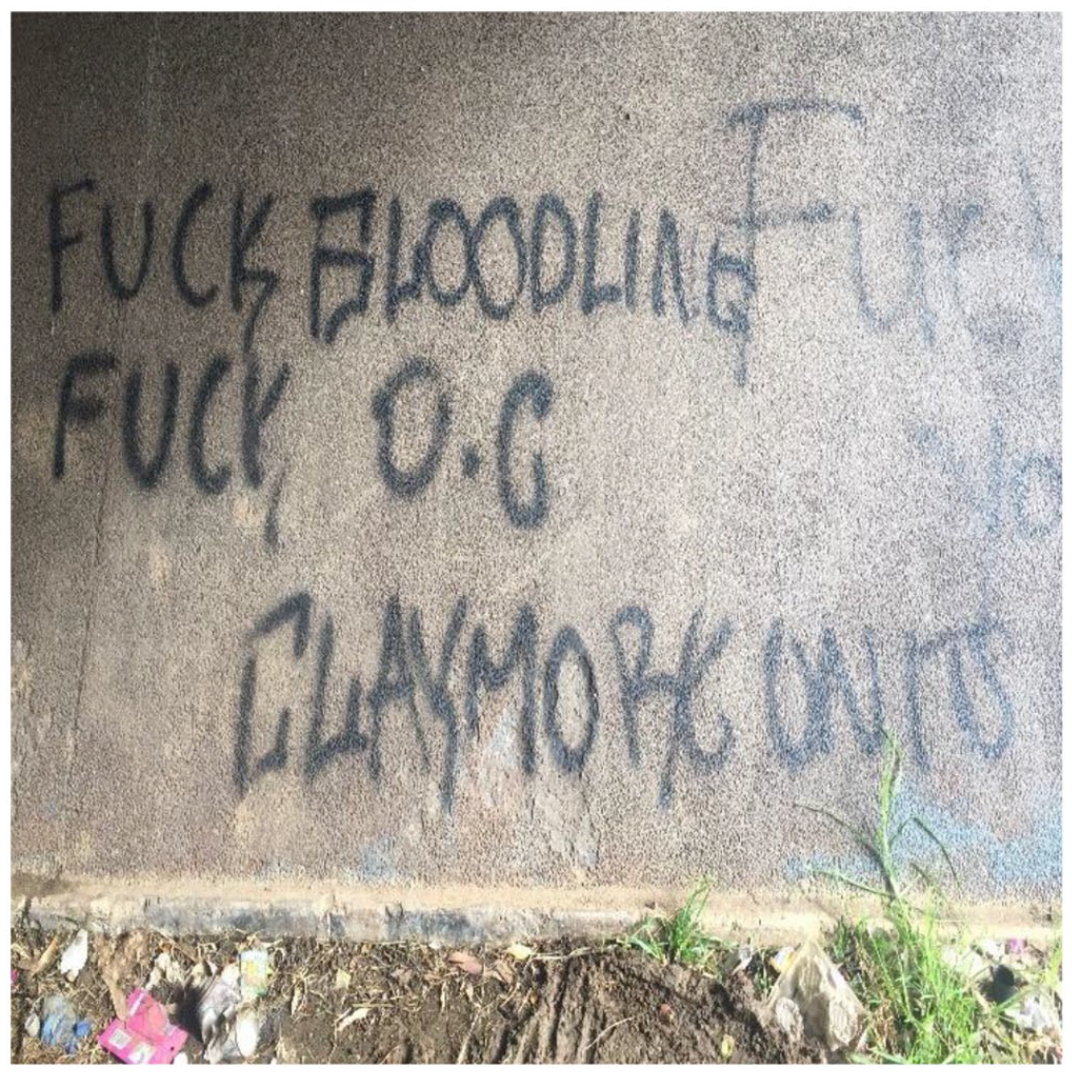
Graffiti in an underpass.
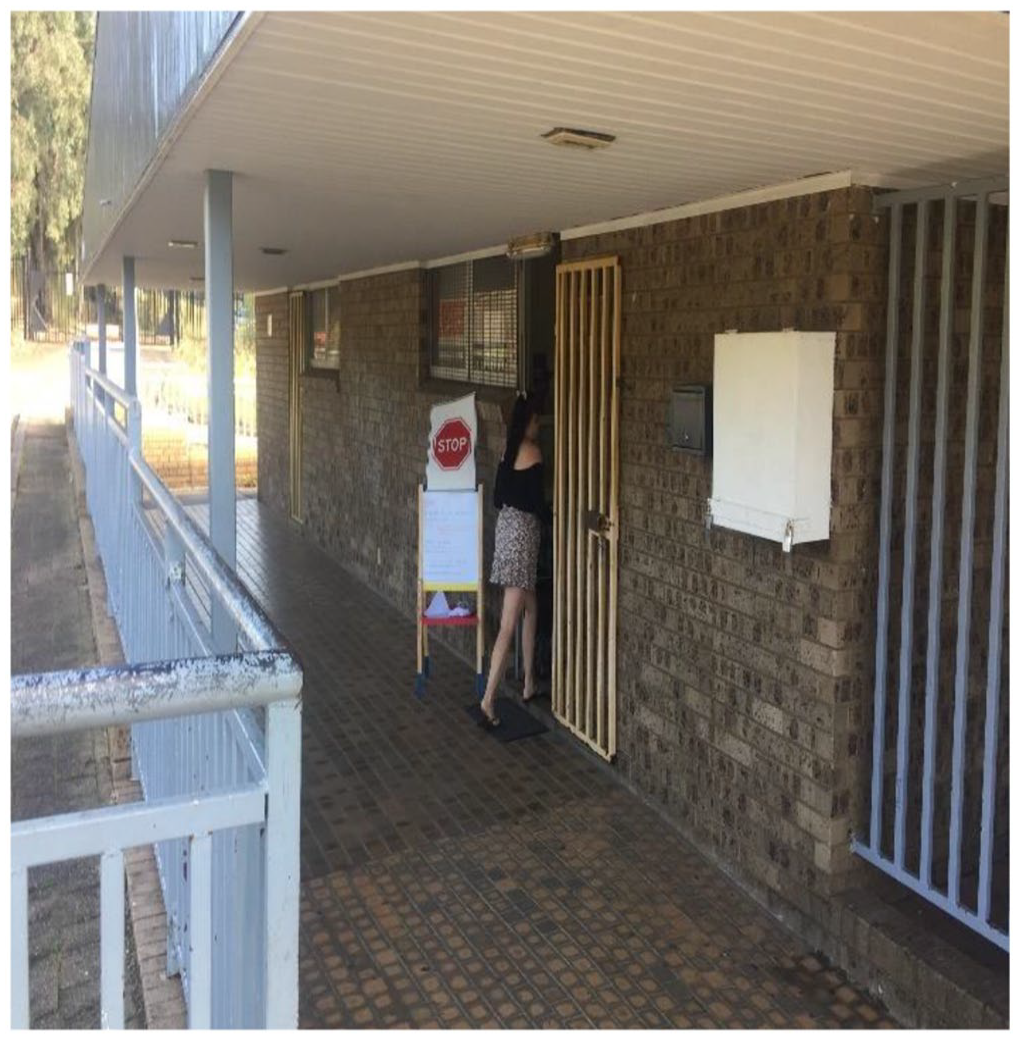
Entering a doctor’s clinic.
Non-places are sites of anonymity for the traveller, and as such, the epitome of a non-place is the ‘voyager’s space’ (Augé, 1995: 86). This sense of the non-place shares parallel qualities with what Arjun Appadurai (2001) has designated as the ethnoscape, that is to say, the anonymous spaces of globalization or planetary capitalism that we find in Claymore (Figures 1–4). As such, this article adds to the notion of ‘global–local’ dynamics and relations as a site of anonymity that adds to the whole. Claymore is a place that we pass through, yet barely register its existence, as its characteristics have been erased from the global circulation of capital and scattered as entropy. Moreover, in the work of Levinas, we encounter an analysis of the non-place that may be carried forward to understand the ‘affects’ of Claymore, and how they are related to the mobile youth van project. In thinking about the otherness of the other, Levinas finds in the café a site of horror and inhumanity. Levinas (1990: 111) writes: ‘The café holds open house, at street level. It is a place of casual social intercourse, without mutual responsibility. One goes in without needing to. One sits down without being tired. One drinks without being thirsty. All because one does not want to stay in one’s room. You know that all the evils in the world occur as a result of our incapacity to stay alone in our room. The café is not a place. It is a non-place for a non-society, for a society without solidarity, without tomorrow, without commitment, without common interests, a game society.’
Augé (1998) suggests in A Sense for the Other that a person in fleeting, soon-to-obsolescent non-places such as Claymore is a ‘witness’. Hence, the ‘I’ in the non-place is in constant movement and dislocation, at once here and absent, in anonymous and inter-related spaces of communication/consumption. Pointedly, through this analysis, the individual can be reread as the ‘imperson’ or ‘dividual’ (Deleuze, 1989; Cole and Bradley, 2016) in the non-place. The ‘imperson/dividual’ is a degraded version of the individual in photographic terms, but not in value, as the ‘dividual’ may have powers of mutation and integration not accessible to the individual (Deleuze and Guattari, 1984). One might reframe the ‘imperson’ as a figure of history under investigation through the mobile van in Claymore; but, in this case not as a maker of history, in that the non-place remakes individuals as empty products of globalization via capital and desire, prophetic, but lacking in self-reference and insight. In these spaces, the ‘imperson’ is abstracted from a direct relation to the ground, and, as such, ‘the natural’ is destroyed, which is precisely what we are addressing in this social cartography of Claymore, and the mobile youth van through Deleuze/Guattari’s (1988) immanent approach of assemblages and the tensions between capitalism and schizophrenia. The analysis that the ‘I’ is a witness to in the ubiquity of non-places is congruent with the notion that at present history is not being made; time and history are at a standstill in places like Claymore, due to the forks in globalization made by capital. In these places, impersons exist ‘atemporally’, life is in effect elsewhere, living unlived lives as ‘inexistents’, or as a type of ‘living-dead’ (Norman, 2012) that is perpetuated in the non-place, and against a backdrop of any-space-whatever. Through such ‘ranges of affect’, subjects often resist exposure to alterity. Those who pass through non-places do so by denying the face of the other, by showing instead a sheer exterior and indifference to others. In the pictures of Claymore (Figures 1–8), the viewer can encounter a conspiracy of silence, with eyes as watchful, vigilant, yet fearful (Grinberg and Dafunchio, 2016). The pictures are presented as data that is not static, but as part of a shifting flux of maps that move, as cinematic and as thinking (Cole and Bradley, 2018). According to Augé, such pictures allow the observer to reimagine the suggestion of alterity, and hence produce an infinite demand, whose plea one cannot evade. As Augé (1998) writes: ‘It is almost as if their silence drew us into an impossible conversation on the order of the world and the meaning of life; almost as if, without saying anything, they were questioning us’ (287), which can be applied to our analysis of Claymore and the mobile van.
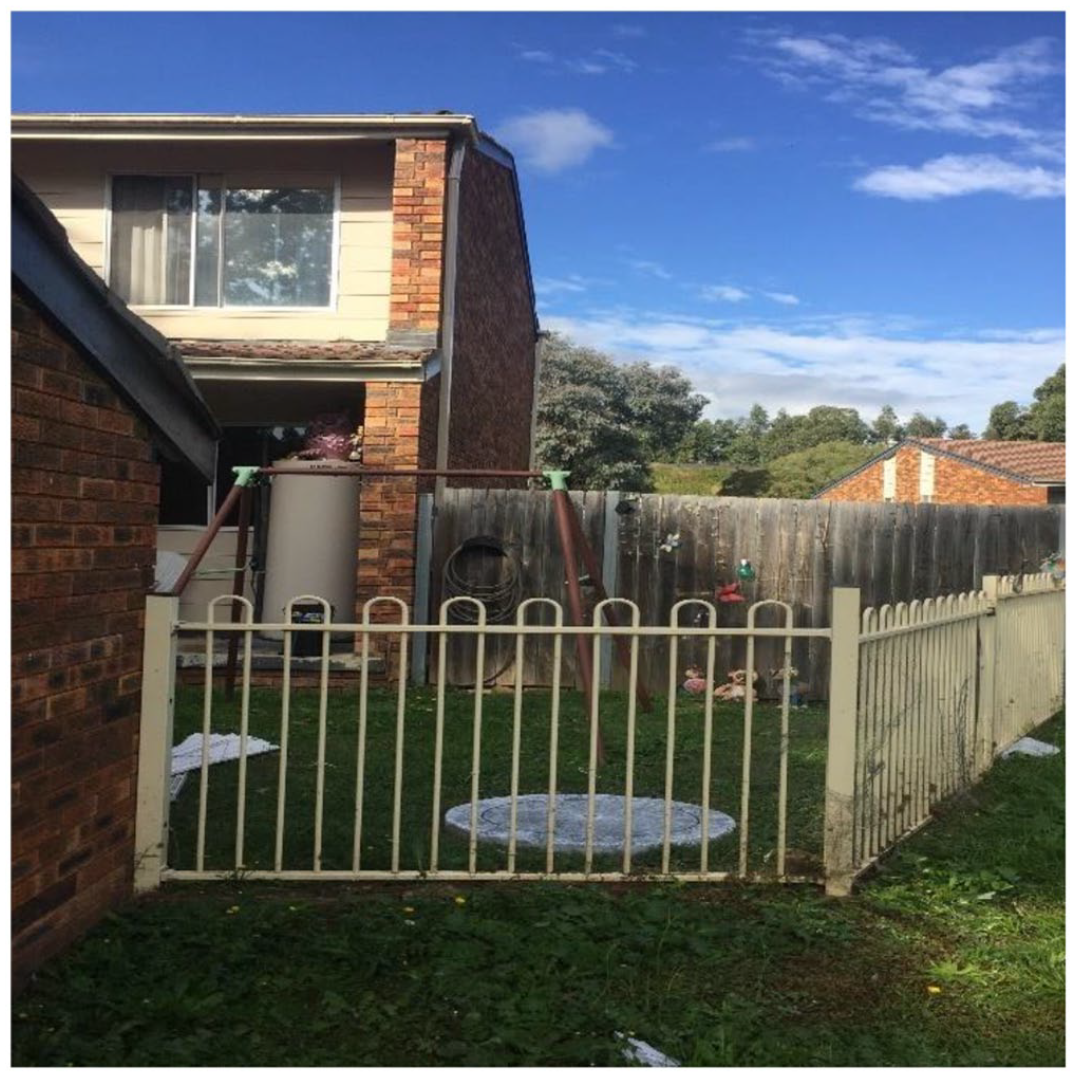
House with garden in Claymore.
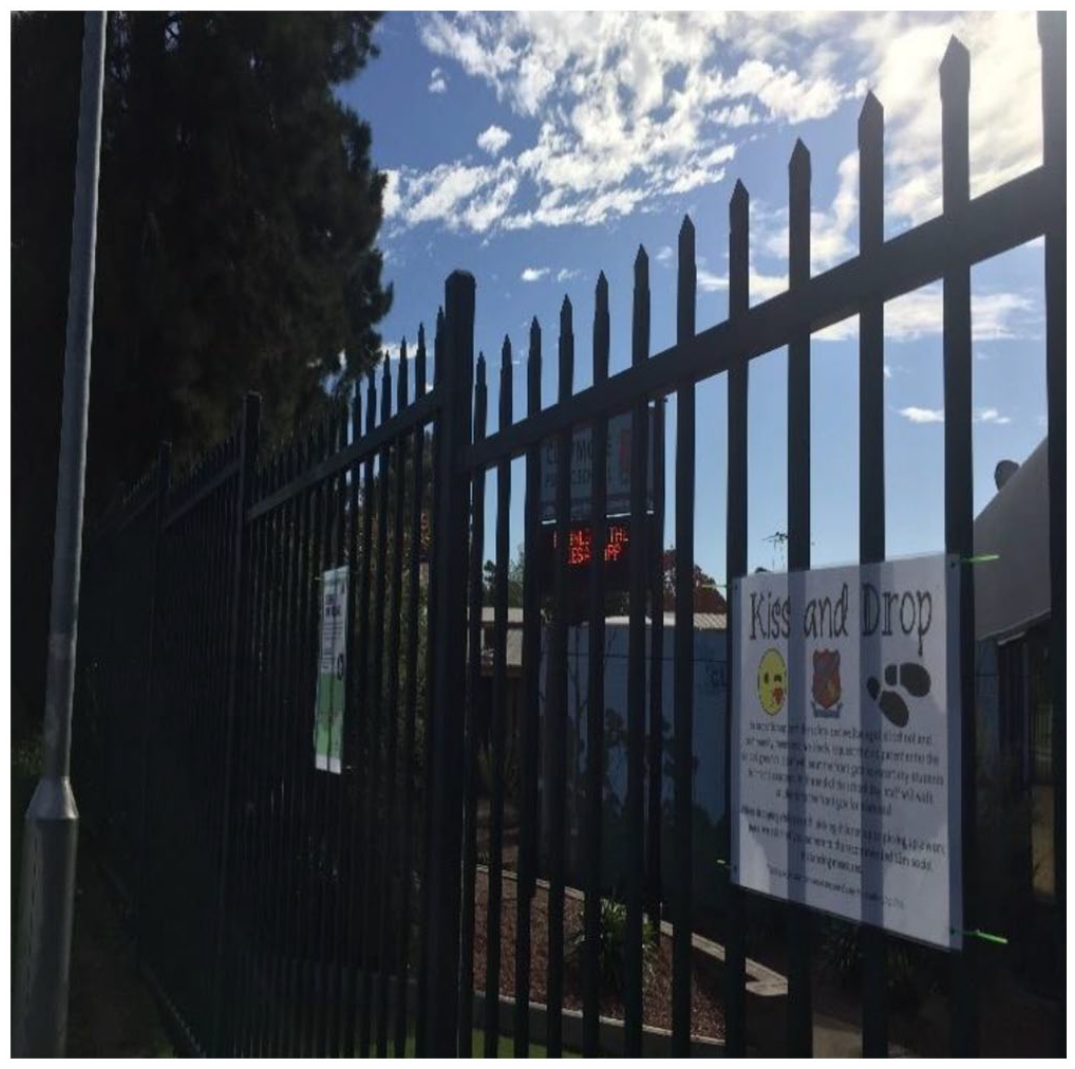
Front gates of the local school.

Underpass skate park.
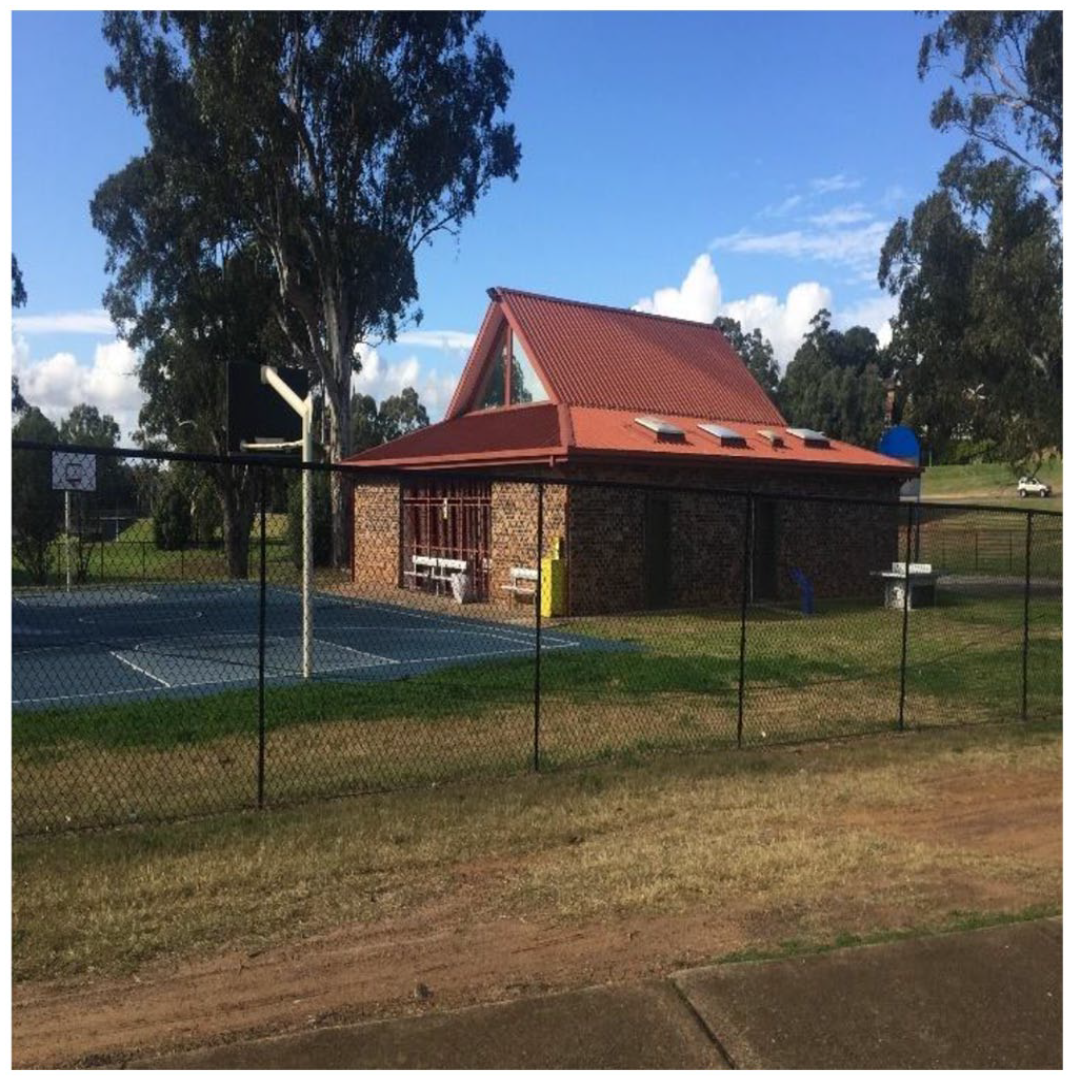
The youth centre.
Thus, in the present global world, places like Claymore present a quandary for those wanting to question the unequal status quo produced by globalization yet understand how to do a social cartography that accounts for the ‘topology of change’ in a project such as the Claymore youth van expedition (Nancy, 2007). In the arterial link roads, train stations, bus terminals, rental complexes of public housing, schools, squalid children’s parks, fast food restaurants, bland supermarkets, shops and motels, there is little sense of place and/or identity (Figures 1–4). Travellers predominantly pass through such non-places, obliviously, as they chose not to dwell here. And there is no going back with respect to this process of detachment. Augé argues that the world has been shrunk by global transport systems and technological developments such as the internet. As Augé says, the planet is in a state of ‘constant feverishness’ (Augé, 1995: 55). Further, both Virilio (2010) and Augé (1998) share the view that speed has affected the sense of ‘dwelling-in-the-world’, and that we may encounter places such as Claymore through social cartography as assemblages. For Virilio (2010), history is accelerating immanently and driven through a ‘techno-military’ spirit. Journeys in the non-place are essentially ‘featureless’, ‘empty’ and ‘without destination’ in the present state of globalization, and due to capital, they might as well be in outer space. As such, there can be read in this social cartography a confusion of time distances and the quashing of a depth of field (Virilio, 2010: 40), as speed is squeezing the world, and we are left with the sense of shrinking temporal distances through globalization, the kind of non-places we find in Claymore (Figures 1–8), and the mobile van project as an exploratory part of this assemblage. To further this discussion, we need to attend to the understanding of Claymore and the mobile youth initiative as a ‘Time-image’ (Deleuze, 1986), as a frozen temporal element, which is crucial to position within the context of social cartography and our chosen methodological approach.
Social cartography and the Time-image
In the preface to the English edition of Cinema 2: The Time-image, Deleuze (1989) notes that in post-war societies, contexts have proliferated where ‘we’ no longer know how to react. In these places, desire, capital, and their images are mixed up and frozen in what Deleuze termed from cinematic analysis as the ‘Time-image’. Hence, the notion of the Time-image adds to the non-place as a concept that locates the social effects of the plane of immanence of Claymore as assemblage. The plane of immanence gives rise to and makes clear the assemblages that we are analysing through reciprocation. In sum, we are able to discern topological patterns and forms from the images (Figures 1–8) by seeing them as planes of immanence and assemblages, and not as static photographs. This topological analysis of images is the cartography of unconscious desire from Deleuze/Guattari (1988) and is augmented by the data sets below, which in totum present a non-representational/immanent perspective on data and analysis. Claymore is a place where time has stood still, and a ‘Time-image’ is produced through social cartography that captures the movement of matter, and hence presents a means to understand its ‘immanent pedagogy’ (Nadler, 2015) – here, as a result of the mobile youth van project and its consequent assemblage. Indescribable spaces have emerged immanently since 1945, such as the estates in Claymore (Figures 5–8): where there are dilapidated neighbourhoods, rundown schools, unused libraries, and playing fields left unattended. These are designated as any-space-whatever, with spatio-temporal coordinates detached from an action-oriented, sensory-motor continuum (they are out-of-time), and described as ‘deserted but inhabited, disused warehouses, waste ground, cities in the course of demolition or reconstruction’ (Deleuze, 1989: 120). However, in this any-space-whatever, Deleuze also finds that a new brand of mutants has been ‘stirring’. 3 They are no longer acting, they are seers of an accelerated life, the crossroads between desire and capital, and are to be found in places such as Claymore; these mutants inhabit non-places, but which they may struggle to describe due to the forces of globalization and capital (Deleuze, 1989: 32). One can say that theirs is a boredom told by blocks of movement and duration, as the ‘Time-image’, and as assemblages of immanent, topological parts. The stasis, paralysis, fear, and trauma that people in Claymore experience is conveyed to the observer as a sensory event (Figures 1–8). For example, the endless waiting to be evicted, unemployment, no money, underlying violence and dissatisfaction with education (which will be addressed below through the van project) is passed on to the viewer, as one who affectively bears witness to the ‘Time-image’ as its immanent assemblage. Immanent assemblage in this context means that the arrangement of Claymore passes through the mind of the viewer as a wholly material map of its time-based qualities.
Claymore and the youth van expose the ‘Time-image’ lingering in the proliferation of dehumanized landscapes and emptied space, as a result of globalization and the effects of no capital (Cole and Bradley, 2018). The practice of social cartography has the potential to transform time into a diagram, and, as such, we are enabled to ‘see’ the dynamics of the situation as assemblage/topology. More specifically, the observer of the Time-image is able to gain access to the peculiarities of time itself. This is time detached from functional clock time, and it is not the measurement of time (Hallward, 2006). In particular, the Time-image of Claymore defamiliarizes the world as a ‘transposable anonymous place’ and, in so doing, resists the formation of the bourgeois, suburban subject in the research field as a non-place, immanent assemblage (Deleuze, 1986; 1989), and as a mapping based on time. Hence, the Time-image produced by the social cartography of Claymore works by forming a relation with an observer to respond to the boredom, endless waiting and disjunction of the place (schizophrenia), by putting research into contact with the thought experiment of the eternal return. Deleuze (1989: 169–170) writes: The sensory-motor break makes man a seer who finds himself struck by something intolerable in the world, and confronted by something unthinkable in thought. Between the two, thought undergoes a strange fossilization, which is as it were its powerlessness to function, to be, its dispossession of itself and the world. For it is not in the name of a better or truer world that thought captures the intolerable in the world, but, on the contrary, it is because this world is intolerable that it can no longer think a world or think itself.
In many ways, Claymore and the mobile youth van initiative is a reflection on the collapse of the ‘nuclear family’ and reimagines the horrors that await youth under incipient forms of neoliberal capitalism – i.e., a toxic job, toxic debt, a toxic life. Escape from a generic non-place such as Claymore is an act of rebellion against the dissolution of family unity, the transience of friendship, the disappointment of life in such a faceless zone (Arefi, 1999), and as forming a whole raft of assemblages of the other. As non-agents, the youth of Claymore are ‘seers’ of the destruction of false images of bourgeois satisfaction, and observers of what is not attainable to them. As such, they are frozen, unable to act, as the ‘Time-image’ of globalization works immanently through them as part of the eternal return of being condemned by capital (Featherstone, 2017). Against the backdrop of ‘affects’ of pure boredom in the everyday suburban waste-ground of Claymore (Figures 5–8), the object of inquiry becomes the banality of family life and the possibility of critique as social cartography/assemblage. Any-space-whatever permits the observer to contemplate the background of things, and in the case of this paper, it is the escape route through the mobile youth van and learning ICT skills. Any-space-whatever thus affords the creation of pure optical and sound images through digital means (cf., Berardi, 2017) – i.e., a new topology. The traumatized youth can become seers of the nihilism and meaningless of their outer suburban life by learning how to upload and do something with their lives digitally (micro assemblage). The digital-consciousness in Claymore records the emptiness of the non-place, whilst simultaneously generating mental connections amongst the junk and the non-resistance, the inhumanity, and the violence of the place. The any-space-whatever is thus a space of immanent conjunction (assemblage); it is a pure locus of the possible (Deleuze, 1989: 109); in topological terms, it is a plateau of zero. One can say that in the ‘soon-to-be-condemned’ milieu of the forgotten, and in the anonymity of the infinite permeability of creation, a new world beckons for the inhabitants of Claymore, as ‘impersons/dividuals’ that engage with the digitally new to turn around their situation as a vector of its desolation. In other words, the any-space-whatever translates the negative ‘affects’ of the background into matter as pedagogy, that is to say, into the world as something ‘digitally new’, and as a break from the Time-image, as this article insinuates.
In Claymore, there are graffiti-ridden, boarded-up houses with no one at home – it is an outer suburban undifferentiated desert (assemblage). The non-place of Claymore as a Time-image is a ‘strange assemblage’ (Cole, 2014b) where codes – ethical, social, sexual, narcotic – are mixed in an ad hoc, experimental fashion. In this grey zone life is suffering a breakdown not only of everyday reality, boredom, domestic violence, drugs, alcoholism, simmering rage, acts of irrational violence, but of the temporal order itself (Guattari and Lotringer, 2009). Yet against the backdrop of violence, unemployment, domestic abuse, poverty, suicide, drug use – nothing happens. The youth wait for the van to turn up as an escape, as a ‘flash’ that might lead them elsewhere and out (in time/space). The abandoned, rundown space of the any-space-whatever Time-image suggests exhaustion, tedium, the presence of the ahistorical and atemporal; it is a collapse of the real in a blurring with the immanent: and the manifestation of ‘powers of the false’ (Deleuze, 1989). The dystopic any-space-whatever of Claymore is rendered fragmentary, indeterminate (Figures 1–8), as a social cartography/assemblage in time. Here, the youth await the arrival of the van, and the all-important ‘flash’ of digital escape. . .
Claymore and the van (the data) 4
The influence of Claymore (the non-place) on the youth
Claymore is a compact, fixed district with borders in the outer suburbs of south-west Sydney. In contrast to the influences of airports, shopping malls, or car parks as identity-busting ‘non-places’ on the youth growing up in Claymore, Claymore itself has the ‘affects’ of being rundown, discarded, and, in a sense, may be considered through assemblage/plane of immanence as a space trap (though this influence also works with respect to the Time-image (Deleuze, 1989) as entrapment in/through time) and this trap functions on every level. If one looks down at Claymore from space, its map from above comprises spiralling roads with further smaller branches curving off into dead ends, similar to a twisting, fractal design. On these smaller fragmenting roads heading to so many ‘nowheres’ (Cole, 2019), the state government built lines of two-storey housing commission accommodation, which were possibly acceptable as adequate accommodation when they were constructed as an experiment in low-cost dwellings in 1978. Now, the houses are rundown, unkempt, and frequently abandoned; they are an assemblage of entropic building materials. As one youth worker volunteer noted with respect to the district of Claymore: It is about as close as you can get to a slum ghetto in Sydney. The houses are very close together, so everyone knows everyone else’s business. Not only that, but there are often too many people living in these tiny houses in cramped conditions. Then, of course, there is the rubbish.
One of the most noticeable aspects of entering Claymore is the rubbish (a classic assemblage). There are piles of rubbish on street corners, and assorted plastics have been somehow riven into the ground, and appear like white ribbons of unnatural growths. Claymore is undulating, and its vale-like topology helps to solidify the effects of it being a place apart, a non-place, or any-space-whatever, as it is hidden from the outside (Frichot, 2009), so it comes as a surprise to the visitor, who, inevitably, will find no reason to stay and will soon look to move on, adding to the dislocating and alienating mode of psychic dispersal of Claymore (schizophrenia). What is perhaps even more jolting for the researcher is that in Sydney, where investment and redevelopment of slums and ghettos has been prevalent for the last 30 years (Anderson, 1990), a place such as Claymore could be left behind, frozen in a catatonic, entropic state since its construction. As another worker involved in the youth van project has stated: Claymore is in many ways a special place. Even though it is rundown and neglected, it has a very particular atmosphere and is like nowhere else in Sydney. Even though most of the youth want to leave at the first opportunity, there is a sense that if you come from Claymore, you always come from Claymore, and that this somehow sets you apart from the rest of the community in Sydney.
Claymore is well known beyond its hidden, ‘non-place’ characteristics, as being portrayed in this article through social cartography/assemblage. Some ‘wear’ the fact that they come from Claymore as a ‘badge of honour’, and as proving that they are tough enough to come from a place like Claymore, and have survived it, and this is a proto-schizophrenic position. In the contemporary situation, with shifting and unpredictable conditions produced by globalization and flows of capital, and its concomitant effects such as economic precarity, global warming, and mass migration (Crownshaw et al., 2019), coming from Claymore can give the youth a certain ‘street-credibility’, a potential instinct to sustain beyond the negative effects of the non-place (Augé, 1995) and anonymity of any-space-whatever, a sort of manifestation of will beyond the schizophrenic effects of capital and desire. As one respondent to the research elicited on questioning about his motives to join the youth project: It’s just like, you know, there’s good things in Claymore as well. We all know what it’s like around here, and no matter what, we will look out for each other. You’ll always go somewhere and come back to Claymore. There is a lot going on here that everyone else in Sydney doesn’t know about. . .
As such, there is a twisted reality and contradictory truth to the influence of Claymore as a non-place on the youth (cf., Gregory, 2011), the focus of this social cartography as assemblage, and the potential of a youth van educational project. Even though Claymore has been palpably left behind, and the clusters of public housing commission dwellings bunch together and feed into each other through the accumulation of mutual feelings of despondency and despair, there is also a sense of defiance and strange resilience present, nestled in the planes of concrete, metal fences, and shards of bare road sidings (topology, Figures 1–8). One could say that in the overall sense of the global non-place, perpetuated by the ubiquity, domination and power of one world capitalism, places such as Claymore retain something of a forgotten vision of communality, or anti-capitalist ‘thrown-togetherness’ (Lingis, 1994: 178–183) created by the very construction of Claymore (this is one of the many points that Deleuze/Guattari (1988) were trying to get to with their formulation of the assemblage).
As an employee attached to the project suggests: We go all around Sydney with this van and helping vulnerable youth in different situations and from different backgrounds. However, something always brings me back to Claymore. I have a heightened sense of mission here. Even though every client that we serve is equally worthy, and gains our full attention and help, the youth of Claymore present a unique sense of struggle and anger, that can be entirely negative, but also profoundly liberating if moved in the right direction. . .
However, before we move onto the direct effects of the mobile van youth project, it is worth considering the specific Time-image that Claymore produces as part of the assemblage, and as distinct from yet related to its reality as a non-place through the unconscious desires produced by capital and schizophrenia. This data helps to form the map and social cartography of Claymore and the youth that took part in the mobile youth initiative.
The effects of time on the youth (the Time-image)
The most prevalent Time-image that we may discern from the youth of Claymore is that of boredom. It was frequently noted during the research for this project that the youth had nothing to do, and form assemblages that this writing privileges by wandering the streets, or sitting in small groups (gangs) in meeting places, such as on the walls outside of the dilapidated shopping centre, often smoking and drinking, close to the most dominant feature of the centre, which is a drive-through bottle-shop.
5
As was said by one of the youth aids that were present with the mobile van in Claymore: What strikes you most about the youth here is their lack of activity, how they can sit and stare into space for hours. There are gangs who take to the streets at night and try and intimidate and bully those around them when they can. It is very hard to engage the youth here with traditional activities, they tend just to slouch off, and do their own thing. . .
Hence, along with the Time-image of boredom and listlessness is the affect of fear. Fear is apparent in the eyes of the people in Claymore. It is an atmosphere between people, and one senses it in the emptiness and bareness of the situation (the plane of immanence). Fear stalks the streets of Claymore, especially at night, when the gangs come out, and the fear and violence of the situation is apparent. However, the most pertinent question for the Time-image is whether or not the aspect of fear is an internally produced survival mechanism produced by the youth as a ‘means of protection’ (Salem and Lewis, 2016: 34–45) over time, or whether it has been superimposed upon them through the communal struggle and poverty that has become ingrained in Claymore. Either way in terms of analysis of the assemblage, the Time-image of fear is real, as suggested by a social facilitator on the project: Yes, fear, that’s what strikes you around here, especially at night. We make sure that we pack up and leave before the youth start wandering the streets again. There are frequent fights and violence is common both on the outside and inside. Some say that there is nothing else to do, others that it is inevitable in Claymore. Whatever the reason for it, it doesn’t bode well if you come from Claymore.
In fact, the Time-image of Claymore is so well known that film crews and documentary-makers have frequently descended on Claymore to capture the images of poverty, inadequacy and bleakness, and relay them to audiences ever hungry for new sensations.
6
Images of children are especially powerful, as they had been born into Claymore, and are hence innocent to the concentration and enclosure of social problems that the suburb presents (they truly grow into the assemblage and schizophrenia). In terms of the Time-image, children ‘evolve’ and ‘learn’ in a place like Claymore, and the connected images of crime, delinquency, vandalism, drugs and gang life that beset them. The image of children growing up in Claymore is one of becoming the all-too-frequently-referred-to notion of ‘young people without a purpose’ (Damon, 2009:11), and looking as if they are going nowhere. As one attendee of the mobile youth van sessions states with respect to how he passes his time in Claymore: Most of us meet up in the underpass and try and find something to do. There’s really not much going on. Some do drugs, ice and that, you know, it makes it easier, for time to pass, and that, what do you expect, it is Claymore. There’s lots of drugs around here, they come and go. People shoot up, that kind of thing. Lots of adults, they are pretty much wasted as well. . .
Time has been stood still in Claymore, and this paralysis in and of time is reflected in the locality, bodies and attitudes of the youth (a topology). Claymore was planned and executed from 1976–1978, when the first of 3000 residents moved into this public housing estate, which quickly became a black hole for unemployment and welfare-dependency (Cairns, 2002). In contrast to suburbs where a living wage is necessary to pay the mortgage or rent, Claymore has sunk into a ‘Time-image of decrepitude’ (Dowd, 2015: 155), due to residents not having the money or will to furnish repairs to their properties. Usually, in owner-occupied areas, houses are continually worked upon and updated. In Claymore, this doesn’t happen, thus presenting original fittings from the 1970s and structures that are rotting away, and clearly in need of drastic attention. This aspect of the social cartography/assemblage works in unison with the non-place of Claymore, to demonstrate a connection between the halted time state of Claymore and society, as intimated by a youth leader of the mobile van: You get what you expect in Claymore. Some of the youth they look right through you. They hang around for a while, then they pass right on. You never know what they are really looking for or need in terms of our youth work. Whatever goals and priorities that we set are dismissed and overcome here. You just know, in the end, that the kids here are going to trash the place.
Clearly, Claymore is an example of any-space-whatever that Deleuze (1986; 1989) analysed in terms of the new wave of cinema, and the production of the Time-image. However, are the youth representative of the seers that he speaks of, the mutants that have arisen from the dregs of these post-war spaces and perturbations in time? Such a direct question is probably not the correct one to ask in this social cartography/assemblage. Rather, one may discern the Time-image in the behaviours and habits of the youth, and how being left out and bypassed by the flows and eddies of time created by the capital of globalization and its resultant schizophrenia suggests a sense of being lost or stranded in time, unable to hold onto time, as it works its way through the global capitalist present and all that this entails (Reith, 2004). There are bare facilities for playing basketball and an underpass skate park in Claymore (Figures 7 and 8), which are both suggestive of repeated, time-filling activities, pointedly to waste time, so that time passes without incident/conflict/violence (this is an important aspect of the immanence of Claymore). In the middle of this situation, the mobile youth van with its retinue of workers and technology has been parked to try and make a difference in the heart of Claymore.
The flash of the van
The mobile van, replete with youth workers and technology, pulls into the non-place of Claymore and starts to change the Time-image, perhaps imperceptibly.
7
The ‘flash’ of the van works with the social cartography/assemblage of this article in two ways: (1) The encounter with the van was fleeting, ephemeral, as it only came to Claymore once a week for several hours, then it disappeared (suggesting a boomerang topology or circulating line of flight); (2) The van contained suites of high-tech software uploaded on the latest Apple laptops and iPads (bringing a micro assemblage or digital topology to bear on this research). The suites of software were designed to engage the young people of Claymore with: (i) Music making facilities, with thousands of sample tracks and music production units, including 8-track recorders, DJ effect and play boxes, voice recording and synthesized pitch manipulation devices, beat boxes, and musical instruments, pre-programmed, and ready to drop into song lines, as one attendee to the project observes: The music, that was wicked. We did rap songs, and the tech was brilliant, it made great tracks, I’ve heard nothing like it, at school we get nothing like it, I couldn’t wait to have a go at this every week. . .
In effect, this was a sonic, vibrational approach to youth work, wherein the rhythmic manipulation of sound quickly creates an atmosphere of cooperation, creativity, and interest (Herzogenrath, 2017: 1–15), here understood as micro assemblage. As a result, the young people of Claymore, who carry with them a specific non-place and Time-image, could express themselves through music in a non-examined, open, and free manner that releases the non-place and Time-image through micro assemblage (Scannell, 2009), encouraged and helped by the youth workers attached to the van; (ii) Image and video production. The suite of high-tech equipment facilitated the young people to depict themselves, their lives, their dreams, and their district by utilizing the latest in visual software, to upload and manipulate pictures from mobile phones, add graphics, symbols and signs that could resemble digital graffiti, make music videos in sync with their music tracks, create digitally manipulated and enhanced pictures (further micro assemblages), including 3D effects. As a youth worker stated with respect to the visual work undertaken in Claymore: What the kids did with the software was amazing. They had loads of creative ideas. We had the sense that the digital image-creation was a type of catharsis, where they could just get out all the ugliness in their heads and make something beautiful for themselves. They made loads of weird ideas, that they probably weren’t allowed to do at school. . .
The visual creation of images by the youth of Claymore added to and complemented the sonic creativity, to help change the atmosphere around the locus of the van (affect) by making new visual signs for themselves and transforming the non-place and Time-image through micro assemblages; (iii) A platform for youth advocacy. The team of youth workers, which could number between four and six at any one time, focused on using the high tech of the van to reach out, enable, and organize a committee of young people, who decided what issues they wished to address, e.g., rubbish, crime, drugs, bullying, violence, prostitution, and together they figured out strategies to address these problems (see, Moore and Garzón, 2010). As a result, the youth advocacy achieved a project to clean up Claymore, organized an online local anti-bullying campaign, and by using social media, circulated anti-drug information sheets, made available throughout the community page, and showing the harmful effects of drugs (micro assemblages influenced by the plane of immanence of Claymore in terms of the non-place and Time-image, and hence the mapping that is possible). According to social cartography, the ‘affects’ of this initiative were discussed by the leader of the mobile van project: Yes, the youth advocacy committee was vital to us. It showed everyone that it was possible to do something and to make a difference in Claymore. Social media is very powerful, most everyone looks at it nowadays. The kids got their messages out there, and I think that this was very important to everyone.
Informal education
The youth workers also acted as ‘drop in’ tutors for anyone who needed extra tuition for their school learning. This free service helped to make sure that the community saw the worth of the programme, and encouraged the youth to come back to use it, along with the other reasons (i–iii) as demonstrated above, and determining a topology of attendance and interest around the van. This informal, affective education (Cole, 2013b), which was run on a non-judgemental and entirely voluntary basis, helped to power the local circuit created by the ‘flash of the van’, as represented by Figure 9 and as the assemblage of the project analysed here. The educational aspect of this paper relates to the circuit and dynamics of the van (topology), and the ways it penetrates the non-place and any-space-whatever of Claymore (Figure 9) through assemblage. It is in the educational (learning) aspect of the van’s actions that the social cartography of this article may be seen to be at its most effective, as it maps the different levels of social change at the same time; for example, personal change, collective change, digital change and unconscious change (e.g., attitudes) as assemblages. Social cartography from Deleuze/Guattari (1988) gives the analyst the ability to interlink different influences, relations, and impacts from multiple levels and perspectives and in time.

The non-place, Time-image, and mobile youth van diagram.
Conclusion
The mobile van initiative came and went. Funding has dried up, and it has ceased (cf., Orlando and Moustakim, 2016), adding to the schizophrenizing nature of this story, as the project was in the main successful. In sum, this story and social cartography as assemblage shows the precarious nature of youth work in a neoliberal era, wherein positive and noteworthy projects, such as this mobile van innovation, are wholly dependent on funding and its benefactors (i.e., flows of capital). For a brief time span (two years), a difference was made to transforming the non-place and Time-image of Claymore by the mobile van, as has been shown by the social cartography/assemblage of this article. The method for social cartography from Deleuze/Guattari (1988) allows for and encourages the mode of analysis that puts the ‘non-place’ and ‘any-space-whatever’ as concepts to work to build a plane of immanence and assemblage on which complex social relations can be mapped through their reciprocation and functionality. The paper has functioned via the problems and difficulties of youth work in a place such as Claymore, an enclave that has been left behind and ignored by capital investment around it. The social cartography and assemblage of the mobile van shows the characteristics of a positive scheme for social youth work that functions in such a situation as Claymore, as it passed via stealth tactics in and out of the markers of the ‘non-place’ and ‘any-space-whatever’ as analysed through social cartography and the topology above. Ironically, if the van had stayed in Claymore, it could have become part of the problem and just another sign of the non-place/any-space-whatever (Sharma, 2009) for the youth. In reality, Claymore will change, but only when the capital developers move in, the public housing is demolished, the long-term residents are moved out (to who knows where), and a new estate is built on top of this unique social experiment that has, up until now, largely endured since 1978.
Footnotes
Declaration of conflicting interests
The author(s) declared no potential conflicts of interest with respect to the research, authorship, and/or publication of this article.
Funding
The author(s) received no financial support for the research, authorship, and/or publication of this article.
