



Abstract
Taking a point of departure in the paradoxical fact that the increase in educational knowledge leads to an increase in uncertainty for educational organisations, this article explores how uncertainty and contingency have increasingly become an integral part of school governance. The article draws on Niklas Luhmann’s theory of ‘World Society’ as a functional differentiated society providing a range of different symbolic media for educational organisations. To trace the increase in the complexity of governing, we provide a historical account of the shifting couplings between schools and function systems. We show how the school becomes linked to an increasing number of symbolic media so that education becomes only one out of many other concerns. The article studies the consequences these shifting couplings have for how schools are governed and how they are expected to self-manage their relationship to different function systems.
The article adds to existing studies of how education has become more and more differentiated with the argument that this has also led to new forms of couplings between schools and the education system with a number of important implications for the teaching profession.
Introduction
In April 2013, two education experts wrote a commentary in a Danish newspaper. The article is entitled ‘The core task of the state school is no longer teaching’, an assertion that might sound rather strange. The argument, underpinning their claims, falls into three parts. First, they write: If the core task of the state school is teaching, then we create a school where teachers are more important than pupils. The point of reference becomes what teachers do rather than how children benefit. Success becomes a matter of how teachers do the teaching and not whether pupils learn anything. (Seneca and Christensen, 2013)
The question they pose is whether a school engaged in teaching can also be a school engaged in pupils’ learning. As such, they turn the relationship between teaching and pupils into a contradiction. In the second part of their argument, they describe teaching as a conservative value and state that a focus on teaching necessarily centres the attention on teaching conditions like preparation time (Seneca and Christensen, 2013) to the detriment of other perhaps equally important conditions. The third and last part of the argument concerns multi-disciplinarity: When assuming that teaching is the core task, teachers continue to have higher priority than those in other professions and with other competencies in and around the school. Preschool teachers, kindergarten teachers, administrative staff, cleaning staff and others employed by the school all take secondary roles in relation to the teaching, just as it seems irrelevant to focus on the possible benefit of involving other actors in the future school. However, pupils do not learn only from the teachers, and they do not learn only from teaching in a classical sense. (Seneca and Christensen, 2013)
Thus, the two experts argue, if we are to reap the benefits of collaborating across professions and external partnerships, teaching should not be described as the core task of a school, but rather seen as one of several, equally important contributions to the school. If this is so, then something once taken for granted – that the core professional activity of schools is teaching – seems to have lost its status as being self-evident.
This article asks: how did the statement that teaching is not core to schooling become plausible, and what may this tell us about how the school is governed today?
To develop this question and, later, to answer it, we draw on the work of Niklas Luhmann. According to Luhmann, schools and the educational system are different systems. Schools are not simply an element in the educational system. The educational system is a global function system communicating through teaching and instructions. Schools, on the other hand, are (becoming) local organisations communicating through decisions. Schools and the educational system are each other’s environments. They can be linked, of course, and at first sight this link seems obvious and self-evident. However, in this article, we will argue that this is no longer the case. It is no longer self-evident that schools use the medium that the education system makes available. Taking a point of departure in the history of school governing in Denmark, we will argue that it can no longer be taken for granted that schools as institutions are structurally coupled to the educational system. A new type of uncertainty is produced: not only is the stabilisation of expectations to teachers significantly more difficult but also, in the policies we shall be studying, uncertainty is celebrated and observed as important for reproducing a state of constant openness regarding which function systems to refer to.
Education, uncertainty and government
This article explores the growing complexity and uncertainty in schools. Many studies of education policy and contemporary education governance have shown how the emergence and growing importance of global policy actors and of a global policy landscape have increased uncertainty and complexity in national school systems (Henry et al., 2001; Martens et al., 2007; Ozga and Lingard, 2007; Sellar and Lingard, 2014). Scholars have described how new uncertainties and risks in educational practice have arisen from the global proliferation of discourses regarding evaluation, assessment, standardisation and accountability (Kurunmäki et al., 2016; Miller, 2014; Pors, 2009; Power, 1997), as well as from the many new and powerful devices put in place to produce and channel global communication about education (Rizvi and Lingard, 2009). In the face of this increased globalisation, educational knowledge and knowledge forms have also proliferated (Mangez and Vanden Broeck, 2014). As Mangez et al. (2017) argue, the quantity, quality and diversity of knowledge about education are much greater now than in the past. Moreover, education, like other societal systems, increasingly describes the environment in which it exists as being characterised by radical uncertainty and risks (for the case of education see Mangez et al., 2017; Pors, 2011; for the case of the economy see Esposito, 2011). For the school, this means that the normative certainties that generally shaped schools until half a century ago have lost their self-evident character (Mangez and Vanden Broeck, 2020). Mangez et al. (2017: 3) state: The answers are no longer given. What can be expected of a pupil or a teacher? What values should be championed? What objectives should be pursued – equity or efficiency of the system, development of the pupils, their future employability, critical faculties, technical knowledge, creativity, rigour, adaptability? There are many possible answers, but none of them is any longer self-evident.
An array of contingencies has replaced the once given normative references in which educational processes and decision-making were previously anchored (Mangez and Vanden Broeck, 2020: 683). Many scholars have argued that globalisation and uncertainty have compelled national education systems to narrow their focus to performance (e.g. Ball, 2000, 2012). Grek (2009) has shown how an emerging global policy landscape has led national school systems to redirect themselves towards global performance and test cultures. Papanastasiou (2012) calls it governing by comparison, while Grek (2009) and Shore and Wright (2015) call it governing by numbers (see also Lingard et al., 2012). Obviously, this heavily impacts schools, as it forces local knowledge cultures and professional values to co-exist with global policy measures. Blackmore and Thorpe (2003) have eloquently depicted how teachers experience having their local efforts to educate recast into new forms of national, regional and global assessments and comparisons. Ball (2003) and others (e.g. Glatter, 2002; McGhee and Nelson, 2005; Webb et al., 2006; Wilson et al., 2006) have examined how teachers thus risk losing some or even all of their professional autonomy and methodological freedom. Thus, many studies relate the new uncertainties stemming from globalisation to a more or less unequivocal focus on performance in education policy, as well as to an impoverishment of professional values and judgements. While we do not disagree with this observation, we want to draw attention to other, albeit related, dynamics within the government of education and to the equally powerful consequences these have for schools.
Rather than focusing on performance in pursuit of establishing how education governance reacts to uncertainty, we aim to illuminate how, in the specific case of Denmark, education governance channels and perhaps even accelerates uncertainty as it dismantles the self-evident character of values, roles and relations in the school. As such, we will argue that the observation made by Mangez and Vanden Broeck (2020: 681) that ‘even the fundamental notion of the “school form”, which had been thought very stable, now has less solid normative grounding’ is not only a condition produced by contemporary society but also a key dynamic within the workings of contemporary education governance. We offer an empirical study to support the claim that ‘the fundamental distinctions it [the school form] made between different roles (teacher/pupil), specific times (learning/work time) and distinct places (in school/outside of school; in classroom/outside of classroom) are no longer as obvious as they once were’ (Mangez et al., 2017: 3). We will demonstrate how contingency has become a key feature of contemporary governance as well as how this repositions the relationship between the school and the educational function system.
Conceptual framework: Functional differentiation and relations of form and media
In earlier works, we suggested that public welfare institutions have developed from formal institutions towards polyphonic or heterophonic 1 organisations (Andersen, 2003, 2020; Andersen and Pors, 2016; Thygesen and Andersen, 2007). In this article, we will sketch a recent history of education policy in order to add an extra layer to this account of rising levels of contingency in the public sector. To do this, we will draw on Luhmann’s work on the distinction ‘form/medium’. This helps us to theoretically describe the relationship between organisations and function systems. Maturana argued that the internal dynamics of systems depend upon their structural couplings to different media (Maturana, 1978: 52). For Maturana, the medium is that which from within the system delimits its capacity of observation. In his words, systems ‘can only make [the] distinctions that their structural couplings to their medium permit’ (Maturana, 1978: 53).
Luhmann’s definition of a medium rests on a distinction between form and medium. Media are defined as loosely coupled elements. Forms are tightly coupled elements that select and use the potentiality of the relevant medium (Luhmann, 1987; Schiltz, 2003). The unity of form and medium is itself a form. As an example, the alphabet is a medium of loosely coupled letters that can be combined in numerous ways. When one writes, one forms the alphabet linking its elements in a fixed manner without ever using up its potentials for other forms. For Luhmann, meaning is the basic communication medium. Meaning is loosely coupled elements that create the potential for communication. All communication mediates meaning actualising certain themes and, at the same time, reproducing meaning as potentiality. The communication of social systems can only make the distinctions that their medium permits. This means that systems’ observations of their environment as well as of themselves are limited by the possibilities of the communication medium they couple themselves to. Every construct in a system is shaped by the medium it uses.
Luhmann argues that organisations are structurally coupled to function systems by their internal selections of media. Function systems communicate by means of their own particular media called ‘symbolically generalised media’: the economic communication system uses money as its medium, the education system uses the life course, the political system uses power and the mass media system uses information (Luhmann, 2012: 113–250). Accordingly, society can be understood as being differentiated into a range of function systems each with their own symbolically generalised medium and binary code. This makes communication between function systems impossible. The systems produce differing parallel streams of communication, which function as each other’s external environment. Through the creation of symbolically generalised media, function systems make different potentialities available to the organisations (Luhmann, 2018: 316–346). Rudolf Stichweh (2015) argues that organisations are not tied to one symbolically generalised medium. Decisions can be mediated and coded differently. Using the various media made available by the function systems, organisations can observe and communicate about their decisions in different ways, which in turn produce different types of considerations. As such, organisations can be multi-referential or multi-functional (Apelt et al., 2017: 12–13; Stichweh, 2015: 29).
This means that organisational decision-making can be understood as a form that is imprinted into symbolically generalised media like money or valid law. If, for example, a decision is made through the medium of money and therefore becomes an economic decision about paying or not paying, the whole world is observed from that perspective. How organisations internally couple themselves to function systems is illustrated in Figure 1.

Organisation linked to a function system via its medium.
Coming back to the school, a new question emerges: are schools form or medium? In order to begin answering this question, our point of departure is that this depends on the observer, and that the possible observers have changed during the last 100 years. First, in the Danish context, public schools are not constituted as organisations! Public schools are constituted by law as institutions in a hierarchy. They were and are still not autonomous legal subjects. Seen from the legal system and from the political system, schools are a medium for reaching educational goals (Andersen and Pors, 2016). As a medium, schools are loosely coupled institutions formed by law and political decisions. Seen from the law and from politics, schools are institutions in a hierarchical public administration. They are a medium for implementation of politics and policy. When Stichweh argues that organisations generally are not tied to one symbolic generalised medium, his argument is not valid for public schools at the beginning of the 20th century, simply because they were not organisations. But as public governance developed and the semantics of New Public Management emerged in the 1980s, law and politics tried to form schools as institutions to become like organisations (see also Luhmann, 1992 for a discussion of the distinction between institution and organisation). Nils Brunson and Kerstin Sahlin-Andersson have argued that to be an institution becomes a matter of being able to behave as an organisation (Andersen, 2020; Andersen and Pors, 2017; Brunsson and Sahlin-Andersson, 2000). However, public schools have never become organisations in Stichweh’s understanding. They only become institutions that are governed to function as if they were organisations. As they move in the direction of becoming organisations, they also become open for different media. This makes the internally constructed relationship between form and media in schools very special. Very peculiar decision-making programmes are demanded that loosen up the self-evident structural coupling between schools and education. In a legal sense, schools are never recognised as organisations, but the idea of schools behaving as if they were organisations has been institutionalised. In our analysis below, we will describe the evolution of public schools in Denmark from medium (institution) to form (organisation).
Our analysis focuses on educational policy and the governance of schooling. Thus, we do not provide a historical account of schooling as such, nor of educational ideas or the school’s everyday life. Instead, we study educational policy and efforts to govern schools in Denmark from around 1900 until today. To this end, we draw on a number of previous studies focusing either directly on school governance (Gjerløff and Jacobsen, 2014; Pors, 2011) or more broadly on welfare governing (Andersen, 1995; Andersen and Pors, 2016, 2017).
The empirical material for the contemporary analysis stems from an archive we have constructed by searching for the concept of core task in today’s education policy. The archive contains discussion papers and reform material from the Ministry of Education, The National Association of Local Governments in Denmark, the Danish Assessment Institute, the respective unions of teachers and preschool teachers, as well as material from domestic and foreign consultancies introducing and describing the concept of core tasks and interprofessional work organised around core tasks. The documents all promote the concept of core tasks as a particularly effective, quality-generating and up-to-date way of organising welfare.
Two comments are needed here to avoid misunderstandings: (a) the school and not the education system is our system reference. We will not be analysing the history of the educational system. It is an important topic, but not the topic of this paper; (b) we are following the development of the form of form/medium, but our article is not historical in a classic understanding of history. We are not interested in cause and effect. We are using history as a tool for second-order observation of a form that could easily vanish for the observer were we not asking how it is made and remade over time. Our analysis draws on this framework to describe in detail how, over time, the different semantics used in school governing bring about different relationships between the school and function systems.
The developments we depict are part of a broader story of how public sectors respond to the increasing differentiation and complexity of the global society by creating new inner structures. The movement from the school as a formal institution to the school as a potential organisation can be seen as an answer to a question regarding how to create coherence and unity, on the condition that all processes in the school are part of a hypercomplex network of dependencies that can neither be formalised nor organised in any classical sense. In this way, this article is about how a global drive towards increased differentiation plays out at local levels in specific settings as new and surprising strategies to deal with complexity and uncertainty.
The school as a formal institution (1860–)
The formation of a formal bureaucracy in Denmark is a good place to start tracking the development towards increased uncertainty and its ramifications. Here, we find the school conceptualised as a formal institution based on the idea of the constitutional state. The first Danish school law is from 1814. The law stated that all children had a duty to take part in schooling from the age of 7 until their confirmation. The law regulated not only the subjects to be taught, it also instructed teachers in how to enforce norms, hygiene and conduct the teaching of the children. The earliest signs of formal bureaucracy can be observed in 1860, but little substantial development within administrative law happens before the 1920s (Andersen and Pors, 2017), at which time schools became defined in the medium of law as formal institutions operating through administrative decisions. As such, the school became governed through a body of legal acts, parliamentary recommendations and commission reports. Legal acts connect to earlier legal acts thus ensuring continuity and controllability. As a result, the school became governed as a formal institution with carefully defined areas of responsibility and teaching guidelines as well as clearly defined areas of competency.
Using our Luhmannian framework, we can describe this as a situation where form/media relations are established via the medium of existing law. In school governance, law has a kind of primacy. For example, all employees in the Ministry of Culture, where education was placed at the time, were lawyers. For many of them, their work consisted of overseeing and controlling schools and local school governance followed school enactments and policies (Gjerløff and Jacobsen, 2014: 87).
Naturally, this does not mean that only law guided teachers and teaching in local schools. Strong societal norms at the time constituted self-evident norms that guided behaviour in the classroom without the need for legal regulation. What is more, in this period, the school was still tightly coupled to the church and local vicars, and the teacher played a major role in many local issues or developments, particularly in smaller, rural towns and villages. In this context, the juridification of schools also functioned in order to loosen up what became increasingly observed as a problematic link to religion. Law functioned to differentiate religion and education and to protect the teacher’s pedagogical observation of the children as potentiality rather than as religious subjects.
N.F.S Grundtvig’s role in the early Danish school discourse might serve as a good example regarding the challenge to differentiate religion and education, allowing for new manners of observing children as potentiality. Grundtvig struggled against the conventional school’s close relationship to the church and argued that schooling should not be a matter of faith (Korsgaard et al., 2017: 232). He envisaged the Danish people as a community of cultivated individuals with a free mind enlightened by Danish history including Nordic mythology. In 1832, Grundtvig wrote: Man is not a monkey, destined to imitate the other beasts first, and then himself to the end of the world, but he is an incomparable, wonderful creature in whom Divine powers must proclaim, develop, and prosper through a thousand generations. (Grundtvig, 1832, 1907: 408)
With our Luhmannian framework, we might describe this era as a transformative time between stratifying differentiation and functional differentiation. This is a period Reinhardt Koselleck calls ‘neuzeit’ (Koselleck, 2004: 222–254).
When one observes school governance, we would say that law serves as a non-contingent framework for understanding the school, which can be defined in legal terms and regulated specifically. Law in this period is first and foremost conditional law; it consists of conditional statements saying, ‘if this and this/then that and that’ (Teubner, 1983, 1986; Willke, 1986). As early as in 1814, a law introduced at state schools read that if a child is 7 years old, then the parents are obliged to send the child to school. If a child does not attend classes, then such and such sanctions will be imposed. By providing clear directions, this form of law efficiently reduces complexity and contingency in local decision-making at the school. School governance around 1900 included regulations pertaining to factual conditions such as the number of children in a class, weeks of teaching a year and hours of teaching a week, as well as which subjects should be taught, etc. An important circular letter was also instituted in that same year, for the first time laying out detailed instructions for teaching goals in the subjects of Danish, history, geography and mathematics (Det Sthyrske Cikulære, 1900). The medium of law offers an assurance of a certain level of external control of teaching as well as the development of somewhat predictable schooling (Gjerløff and Jacobsen, 2014). Thus, at the turn of the 20th century, the school was governed in the medium of law and law served as a non-contingent framework that reduced complexity. Law regulated teaching and specified the few instances in which teachers were allowed to use their professional judgement to make decisions in the classroom.
The homophonic school (1960–)
The next development, worthwhile examining when tracking the relationship between the school and function systems, occurs in the 1960s. At that time, Danish welfare governance became increasingly organised into specific sectors, such as e.g. education, which meant that the specificity of each welfare sector and its particular form of operating were taken much more seriously (see also Parsons, 1956, 1971; in the specific case of schooling see Hills, 1976). This period also saw the teaching profession become more consolidated and gain importance. In 1955, the first chair of pedagogy was appointed at Copenhagen University and, in 1963, the national teaching college was given the status of a university.
In the late 1960s, Danish school legislation also began to be more firmly built on means/end differences than on if/then ones. With this approach, the law was organised around an effort to manage the purpose and results of educational processes in the school and to withdraw from regulating behaviour through if/then programmes (Andersen and Pors, 2016, 2017). Sociology talks about instrumental law and about a re-substantialisation of law (Teubner, 1983, 1986; Willke, 1986), where the law operates according to the means/end difference, but only establishes what legally counts as an end, while the means remaining open-ended and unmarked. In this way, law constituted the school as being goal-orientated and specified its primary symbolically generalised medium (Luhmann, 2013: 150). Specific educational goals then governed public schools, which were nonetheless self-organised when it came to teaching and reaching these goals. Schools became expected to couple themselves to the education system, a function system which like the political, legal and economic systems is closed around a particular function, form of operation and code.
In the case of education, the function is to educate people, the operation is teaching and the code is better/worse learning (Luhmann, 1989: 100–106). 2 Schools became expected to form an educational medium of human life course (Luhmann and Schorr, 2000). Human life course is a medium which entails a set of loosely coupled elements consisting of all events forming an individual’s life course (Luhmann, 2002, 2004). Observed in this medium, pupils are seen as yet unrealised potentials. As Claudio Baraldi and Giancarlo Corsi explain it: ‘Paradoxical as it may sound, while the child is what it is, for the education system it is what it is not (yet). Teachers consider pupils as a potential that has to be developed’ (Baraldi and Corsi, 2017: 55).
This new legal attention to a specific function system relevant to schooling can be seen in an important educational reform from 1958, which contained significantly more references to pedagogics, to educational knowledge and to the teaching profession than previous educational acts (Danish Ministry of Education, 1960). Like other welfare institutions at the time, schools were then given a specific, legally stipulated goal linking them to one particular function system and the corresponding communication medium. We refer to these welfare institutions as homophonic to mark the fact that they were guided by one specific medium. Along the different function systems, a range of specialised institutions emerged, all based on specific programmes with specific objectives. 3
As a homophonic institution, the school was governed as a specific relationship between legal acts and educational knowledge and expertise. Concepts such as professional judgement or methodological freedom expressed this way of relating the institution to the educational function system, thus indicating a legally specified need for the school to be tightly coupled to the education function system. Accordingly, when it came to school governance, the relationship between the school and the teaching profession was consolidated. Teaching was confirmed as the primary and self-evident profession of the school. Moreover, school governing at the time clearly extended teachers the power to use their educational expertise to operate within the school. This reduced the contingency of educational decisions at local schools by enabling a specific coupling between law and professional judgements. The law defined the overall framework, but similarly defined the forms of decision-making that should be left to teachers.
The heterophonic school (1990–)
The third development on which we focus as we track the increasing uncertainty and relationships between the school and the education system occurs in the late 1980s. In 1990, the initial attempts to decentralise decision-making from local governments to schools culminated in a new school governing act whereby the individual school was constituted as a self-governing unit (Local Government, Denmark, 1988a, 1988b; see also Pors, 2011). Central to this new legislation was the expectation that schools would handle a wide variety of concerns and act on issues stemming from many welfare areas other than education (Andersen and Pors, 2016). The individual school was expected not only to act as an independent unit (in the shadow of the hierarchy (Héritier and Rhodes, 2010)) but also to be responsive to an array of welfare goals. In addition to having the capacity to work with educational goals, the school was expected to foster the integration of immigrants, to prevent social problems or criminality, and to train students in democracy, healthy lifestyles, responsible sexual habits, traffic safety, ecological awareness and so on. Moreover, as an independent unit, the school became responsible for its own budget. Schools were still expected to organise around educational competencies and language, but the growing number of concerns challenged the status of the education function system as the most prevalent coupling. This means that local school management ceased to be simply educational leadership, but became an orchestration of a number of concerns in relation to which education may not always have taken precedence.
In this form of school governance, a new procedural orientation emerged, where if/then and means/ends statements were supplemented by reflexive procedure/goal statements (Teubner, 1993). Reflexive procedures were marked by law, but the goal was now unmarked and open-ended. This meant that schools were expected to define goals and aims in a way that reflected reflexive procedures, including the different media and codes that the law found were relevant in different cases. In other words, schools were now constructed as independent organisations that should produce their own objectives in which different considerations should be reflected. This gave rise to the expectation that schools should formulate goals that balanced considerations in different media without producing any clear norm for how to balance them. Schools were expected to prioritise and balance heterogeneous media and codes without their having any super medium to define what value was most appropriate and at what time, e.g. economy vs. care, care vs. education, or education vs. health (for analyses of similar developments in health care, see Knudsen and Vogd, 2015).
Thus, from the 1980s, Danish schools were expected to observe a particular problem with the help of heterogeneous media that were not easily balanced. Schools were expected to simultaneously fulfil a wide range of potentially conflicting goals and in doing so refer to a great many symbolically generalised media (Andersen, 2003; Rennison, 2007). This resulted in a heterophonic school (Andersen, 2003; Andersen and Born, 2007; Andersen and Pors, 2016) that had no given goals, but instead an ambition to accommodate and balance a number of different media and codes, as illustrated in Figure 2.
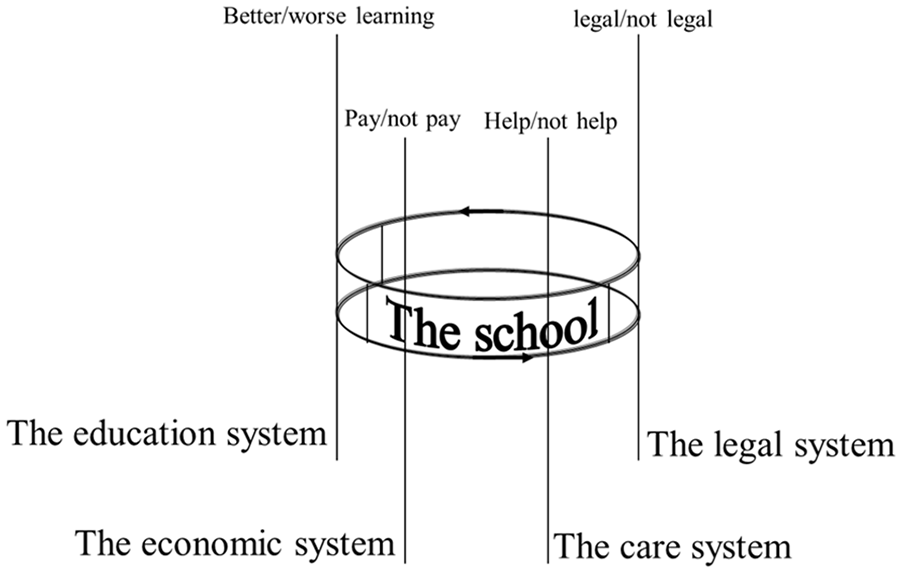
The heterophonic school.
The heterophonic school was accelerated with the policy of inclusion from 2003 (Danish Ministry of Education, 2003). The imperative of inclusion hindered the schools in exporting social problems to welfare institutions outside the schools. Children with special needs and different kinds of diagnoses were to be included within the school. This produced cross-pressures between the medium of care and health, on the one side, and the medium of education, on the other. Economic resources invested in children with special needs moved from resources spent on teaching. Sometimes, this ended up in uneven decisions where children with very different special needs were put together in the same group and exposed to the same treatment in order not to move too many resources from general teaching (Ratner 2013, 2016).
This development resembled what Mangez et al. (2017) called ‘fragmentation’. Their emphasis was on how educational institutions were fragmented ‘into different organisations each taking specific normative orientations’ (Mangez et al., 2017: 7). Similar insights have been offered within institutional theory where scholars have pointed to how schooling became an organisational field in a cross-pressure between competing institutional logics such as market, state and community (Glazer et al., 2019; Marsh et al., 2020; Runesdotter, 2011).
However, with our concept of heterophony, we are aiming to stress more strongly that organisational divisions cannot manage the condition of fragmentation. Heterophony means the availability of a growing number of symbolic-medium relations linked to the same situations. Not only are these media available to communicate specific, functionally delimited themes, but they also contribute to the overall organisational self-description. Each time a different form/medium relationship is chosen, the perspective on the decision, the organisation, the environment or the pupil also changes. This means that clashes between incompatible values characterise the school as a heterophonic organisation, as does the fact that no single value can capture and represent the unity of the others.
Thus, when the school was increasingly governed through reflexive law, the uncertainty and contingency attached to the relationship between the school and educational function system increased dramatically. The medium of the education system was no longer the only and self-evident coupling for the school. When the school was transformed from a homophonic institution to a heterophonic organisation, the education system was no longer the obvious primary medium for the school’s self-description. The education medium became one medium among many whose priority and dominance could not be taken for granted. Although this led to a steep rise in complexity, reflexive law did condition how the school was to handle this complexity as the reflection and balance of certain decision-making concerns. However, with contemporary education policy this conditioning was weakened.
Today: The concept of core tasks (2010–)
To investigate what is currently happening to the relationship between organisation and the teaching profession, we will return to the example with which we began, namely the recent focus on Danish education policy on core tasks.
In recent years, the concept of core tasks has proliferated in Danish welfare policy, education policy in particular. An increasing number of local governments have reorganised their policy efforts and organisation around the core task concept. The concept was introduced in response to a problem often called ‘silo-divided organisation’. In the education sector this has meant that each organisation, such as the school, day-care centre, preschool, healthcare clinic, dental clinic, etc., has been closed around itself and does not collaborate with other organisations. Intended to counter this silo mentality, core task policies are built on ideas of ‘inter-professionalism’ and ‘relational coordination’ (Albertsen et al., 2012). Professor Jody Hoffer Gittell from Brandies University is invoked as a central reference for these policies, as she describes relational coordination as the opposite of a sector- or silo-divided organisation with a predefined division of labour. Gittell argues for the importance of putting the citizen at the centre of service delivery. She writes: Relational coordination improves performance of a work process by improving the work relationships between people (shared goals, shared knowledge, mutual respect) who perform different functions in that work process, leading to higher-quality communication. Task interdependencies are therefore managed more directly, in a more seamless way, with fewer redundancies, lapses, errors, and delays. (Gittell, 2011: 402)
For Gittell, organising around core tasks is a way to put the individual citizen at the centre, fostering professional collaboration and thus improving the quality and lowering the costs of welfare service. In the school, professionals are expected to put the individual child at the centre. The idea is that coordination and collaboration should emerge from the bottom up, dynamically and flexibly. Professor at Auckland University, Viviane Robinson, who is often used in Danish school development projects, argues in a similar way for a transformation from teacher-centred to a student-centred school leadership, where all activities should focus on learning (Robinson, 2011). Everything should be organised so as to support the single student’s learning processes.
Central to the concept of the core task is the idea that each child may call for different constellations of relationships between professions. This means that a particular profession and the work it does in the school is not understood as a value in and of itself. Instead, professionals are described as having to (re)define their work in relation to the core task and in relation to the collaboration they do with other professions. As stated in an influential policy review: The core task requires different professional approaches and different functions . . . Collaboration between different professional groups and functions at the place of work is necessary. Therefore, it is important that all professional groups and functions find out how they contribute to the core task and, not least, how they interact. (Team Work Life and Centre for Industrial Production, 2014: 3)
Thus, the core task is described as something that requires many additional professional approaches. As also described in the introduction, today school governance supports the idea that teaching is not the core task of schooling: The core task of the school is not to teach. Teaching is only one – albeit a central – component of a wide range of services and tasks that the school must carry out to foster learning and help children grow into competent citizens. Since learning also occurs outside teaching (independent learning, social learning, etc.) teaching is an inadequate picture of what it takes to accomplish the purpose of schooling. (Hasle et al., 2015: 7)
The introduction of the core task concept leads to a reappraisal of the value of teaching. Teaching cannot be the core task but only one among many components. The above quotations present how a predefined purpose (teaching) is replaced by the concept of core task with the stated aim of attuning the school to how children learn in different settings. The argument goes that learning is much more than teaching and happens in many more settings than teaching ones, so the teaching profession alone cannot be considered core to schooling (see also Sørensen et al., 2017).
A main idea built into this concept is that a multiplicity of professional perspectives on different issues represent a potential that can be harvested. Core task policies are designed to produce a surplus of possibilities for, say, observing a pupil. The new collaboration between professions is about ‘benefitting positively from the different professional views of the pupils’ (BUPL, 2012: 15). One professional perspective no longer suffices: ‘To have a dialogue partner with another perspective both during teaching and before and after . . . widens the understanding of the pupils’ actions’ (BUPL, 2012: 15). Interdisciplinary collaboration is meant to provide the school with a surplus of different possibilities for observing the individual child so that the school can investigate which perspectives and professionals create the most opportunities for that child. Thus, the core task concept challenges the relationship between public schools and the education system, as teaching no longer appears to be the school’s dominant system coupling. Some argue: ‘It is not crucial what professional method one uses. The crucial thing is whether one actually contributes to the solution of the core task’ (Team Work Life and Centre for Industrial Production, 2014: 4). Thus, the desire is to create a school that does not define itself via a tight coupling to the education system, but instead continually searches for other possibilities inherent in different professions. A multiplicity of differing professional views is considered a value in itself. Thus, when considered through a systems theoretical lens, the core task can be observed as a contingency increasing communicative device designed to loosen up links between the school and the medium of the education system.
This is also a school that, by being purely processes, negates itself as structure. A good example of such an articulation is the self-description as an amoeba in The H.C. Andersen School in the municipality of Odense. On its website, the school writes: ‘The flexible school is an amoeba organisation, capable of orienting itself according to registered needs’ (The HC Andersen School, 2012). The amoeba metaphor suggests an organisation which continually changes and does so in order to provide pupils with different forms of learning and learning environments. The school’s intention is to create flexible and emergent forms of organisation that are open to different symbolic generalised media. As Figure 3 shows, the school has decided that each day is to begin with a morning assembly. The rest of the school day, however, can be constructed and organised around different organisational possibilities. These might include cross-disciplinary projects or joint teaching in large groups, but it can also include smaller groups created according to different principles such as learning style, interests or level of achievement. Thus, organisational structure such as, e.g. timetable planning, cannot simply be decided on once or a few times a year. Rather than being established in advance, the organisational setting is dynamic. Still using the amoeba metaphor, the school writes: Thus, the school tries to see itself as an amoeba, flexibly and self-reflectively meeting the challenges it encounters, both from within its own environment and from the surrounding world. It would be very difficult to produce specific proposals for how a weekly schedule might look before establishing specific goals. And there also can be no pre-existing structure.

The H.C. Andersen School drawing itself as an amoeba.
We have chosen to call this contemporary semantic construction of the school ‘the potentiality-seeking organisation’ (see also Andersen 2020; Andersen and Pors, 2016; Juelskjær et al., 2011). This is an organisation that constantly looks for potentials by opening up new and alternative ways of viewing particular problems or issues (Andersen, 2008). The term is meant to describe the expectation that schools should constantly explore the possibilities that the different media of different function systems represent, when it comes to understanding a case, organising a teaching project or formulating a strategy. We have graphically illustrated the school as a potentiality-seeking organisation in Figure 4.

The potentiality-seeking school.
When the school is expected to become a potentiality-seeking organisation, the level of complexity and uncertainty rises again. Core tasks may sound concrete and definable, but this is far from the case. Policy papers define the idea of a core task as the exact opposite of concrete actions and efforts, and as something that ‘must be abstract and disconnected from the concrete work assignments and efforts’ (Team Work Life and Centre for Industrial Production, 2014: 3). Core task is ‘the overall task of a given organisational unit to create long term effects’ (Team Work Life and Centre for Industrial Production, 2014: 3). Thus, teaching is not a core task in schooling, but the well-being and future educational possibilities of children might be.
Inherent to the concept of the core task is the argument that understanding a core task in a specific manner or defining it in advance of a collaboration process will close down possibilities for new perspectives, collaborations and solutions. Core task policies are instead meant to enable the emergence of something new or something more: ‘The collaboration has a different form, structure and background, but the common factor is that preschool teachers and teachers together create new learning spaces for the children’ (BUPL, 2012: 14; see also Csonka and Majgaard, 2013). What seems strange here is that the value of the core task appears to lie in its ability to be open and uncertain rather than concretely defined. Curiously, in order to function as core, the core must be coreless.
Thus, when the school is governed through notions of a core task, the school is expected to do more than handle complexity by balancing different media from different function systems. It is also expected to continually produce and maintain a high level of complexity and uncertainty by never settling on a specific definition of core task. Radical uncertainty has also come to characterise the relationship between the school and the education system. Teachers are expected to acknowledge that their professional language and expertise are not necessarily more relevant than those of other professions. They are expected to offer their expertise but also without insisting that their professional knowledge can function as a stable decision-making premise. Not only does the level of uncertainty increase, it is praised as a value in itself. To keep options open, to not reduce complexity becomes a goal in itself (Andersen and Pors, 2014; Müller and Groddeck, 2013).
Conclusion
By exploring Danish school governing, this article has shown how the relationship between schools and function systems has been articulated in different ways over time. We have suggested that, in Danish school governance, schools and function systems have been articulated in four distinct relationships, and that over time these articulations have developed as a series of overlapping layers. In the first articulation, the formal school handles a multiplicity of symbolic media provided by function systems through legal procedures. Here, law functions to protect the school from religion and makes possible a differentiation in the education system. In the second form, the homophonic school, the relationship between legal acts and professional educational knowledge and expertise is further formalised. Concepts like professional judgement or freedom of methods express this way of relating the institution to the educational function system and indicate a legal specification of the need for the school to be tightly linked to the educational function system. Third, the heterophonic school is expected to balance a multiplicity of symbolic media. In this articulation, the school is meant to observe the same decision from different standpoints and to balance different considerations, all simultaneously, by which token the given decision should be a gestalt of heterogeneous media. The school should not only teach but also take care of children with special needs, promote health, take responsibility for the integration of minorities and manage its own budgets. Fourth, the potentiality-seeking school is expected to handle the multiplicity of symbolic media by exploring and experimenting, constantly searching for new possibilities. New core task policies testify to this. With the concept of core task, schools are expected to disrupt the idea that teaching is the core purpose of schooling and instead keep all processes open to new perspectives. These shifting articulations are hardly trivial, for administrative law continues to constitute schools as formal institutions and ideas about a close link between the school and the education system are still present. As a result, today’s school governance oscillates between the different manners of constituting the school.
These oscillations can for instance be seen in a newly developed concept, the so-called ‘effort staircase’ used in psychological pedagogical counselling (Deloitte, Absalon and UCN, 2020; Møller et al., 2015). The further up the stairs you are, the more intrusive the efforts and intervention are. The further down the stairs you are, the closer you are to ordinary everyday life. When a child is on the lowest step it is not a given that an unfortunate incidence would be considered as a particular problem (see also Knudsen, this issue). Neither is it a given that the incident would be attributed to social relations between the children, or to the single teacher or single child. As we move up the stairs the incidents become diagnosed as a problem and are attributed to an individual child. At the top of the stairs the child might be removed from the school and placed in a special institution. Schools are using the ‘effort staircase’ to structure which media to form and how. On the first step the form is potential and the media are mostly the ‘welfare’-related ones like pedagogy, care and health. Here, the case is sought to be handled in the classroom. In the middle of the staircase, more intrusive effort is to be decided upon and money as a medium becomes relevant. Cross-pressures emerge. And finally, at the top of the stairs, a formal decision has to be taken to exclude the child and relocate them to another institution, maybe a school for children with special needs. Here the medium is primarily law and secondarily money. The welfare-related media like pedagogy or care are silenced.
Our analysis forms part of a larger attempt underway today to understand how mounting societal uncertainty affects education and schooling (e.g. Mangez et al., 2017). However, our argument differs from that of scholars occupied with how increased globalisation has narrowed the focus of school governance to performance, and how this in turn has limited teachers’ room to manoeuvre (e.g. Ball, 2000, 2003, 2012). Although we recognise that an emphasis on numbers and comparisons in education governance do sometimes limit the teaching profession’s possibilities, our article has been interested in how an increase in complexity and contingency also affects the profession. We argue that greater levels of conntingency (as opposed to the lower levels of contingency inherent in a limited focus on performance) is an equally powerful, yet under-explored dynamic in contemporary education policy.
We have shown how contemporary school governance deconstructs structural support of particular stabilised forms of relationships between the school and the education system. Instead, it installs constant shifts and experiments as a mode of existence for schools. Schools are expected to make symbolic media oscillate, and every shift alters how pupils are observed, how decisions are made, what becomes visible and invisible, and how the organisational identity of the school emerges. The ambition to potentialise (Andersen and Pors, 2016) tight and loose couplings thus creates a kind of oscillocracy where different media are constantly tried out. Consequently, the new way in which educational governance posits the relationship between schools and function systems seems to come at the price of legal and professional coherence.
As we have also shown, this means that the idea of the teacher as the natural primary profession in schools – a notion consolidated with the homophonic school and the legally ensured value of freedom of method – has been challenged, first with the heterophonic school and, later, with the potentiality-seeking school. In the heterophonic school, educational concerns become but one of many considerations to be balanced in the school and can no longer constitute fixed premises for decision-making. Moreover, in the potentiality-seeking organisation, contingency is not simply a challenge to be handled by local leaders and teachers but installed as a value in itself. This means that the contribution of teachers to schooling is questioned, and teachers are met with the suspicion that they may be too dominant in schooling and should thus constantly be prepared to withdraw so that other professions, too, can make their contributions.
Footnotes
Declaration of conflicting interests
The authors declared no potential conflicts of interest with respect to the research, authorship and/or publication of this article.
Funding
The authors received no financial support for the research, authorship and/or publication of this article.
