




Abstract
Klaus Mollenhauer (1928–1998) is one of the most important German theorists of education in the postwar era. Mollenhauer is often remembered in Germany today for his first book titled Education and Emancipation: Polemical Sketches, but he received international renown for his final monograph, Forgotten Connections: On Culture and Upbringing. Although Mollenhauer characterized Forgotten Connections as actually working to move towards a more “substantial conception of emancipation,” many of his followers and colleagues such as Kaufmann et al. saw it as nothing less than an act of “infidelity to those who had taken on his emancipatory pedagogy” (Kaufmann et al., 1991: 86). In the light of these differences in emphasis and interpretation, this paper provides an overview of Forgotten Connections that (following Wivestad and Saevi) sees it as presenting six main questions and themes—ranging from “Why do we have children” to “How can we respect and draw out a child’s inherent character?” However, in doing so, this paper simultaneously traces Mollenhauer’s own efforts to develop a more substantial concept of personal and political emancipation in this text.
Introduction
Klaus Mollenhauer (1928–1998) is one of the most important German theorists of education in the postwar era. Mollenhauer is often remembered in Germany today for his first book titled Education and Emancipation: Polemical Sketches, but he received international renown for his final monograph (1983), Forgotten Connections: On Culture and Upbringing (Mollenhauer, 2014; translated by the author of this article). The first of these texts established the term “emancipation” as a rallying cry in the 1960s and early 1970s, and solidified Mollenhauer’s reputation as a guiding light in West German “emancipatory” or “critical pedagogy.” Forgotten Connections, meanwhile, represents a significant departure from critique and emancipation, and goes back to the (in many ways “pre-democratic”) basic human and cultural constituents of education as both a private and public endeavor. It deals with these in a highly original and accessible way, based largely on literary, historical and pictorial examples. Although Mollenhauer characterized Forgotten Connections as actually working to move towards a more “substantial conception of emancipation” (quoted in Kaufmann et al., 1991: 81) many of his followers and colleagues saw it as nothing less than an act of “infidelity to those who had taken on his emancipatory pedagogy” (Kaufmann et al., 1991: 86). In the light of these differences in emphasis and interpretation, this paper provides an overview of Forgotten Connections that (following Wivestad and Saevi, 1997) sees it as presenting six main questions and themes—ranging from “Why do we have children” to “How can we respect and draw out a child’s inherent character?” However, in doing so, this paper simultaneously traces Mollenhauer’s own efforts to develop a more substantial concept of personal and political emancipation in this text. It shows this concept as ultimately applying not only to students and young people, but as giving special attention to the teachers and adults who care for them, demanding their resistance to coercive and in this sense, undemocratic, limitations on their actions and sense of self. This paper begins, however, by introducing the biography and earlier work of Klaus Mollenhauer, who led a life of political and professional engagement that is deeply intertwined with the themes, tensions and questions central to both Education and Emancipation and Forgotten Connections.
Mollenhauer: biography and early work
Mollenhauer was born the son of a prison teacher and a social worker in Berlin. Like others born at the end of the 1920s (e.g., sociologist Niklas Luhmann or Frankfurt School theorist Jürgen Habermas), Mollenhauer was forced to join the German army in his early teens at the end of the Second World War. After being captured and imprisoned for almost four weeks by the British Army, Mollenhauer returned to school in 1946, and then went on to attend the College of Education in Göttingen. 1
There, Mollenhauer studied under Herman Nohl and Erich Weniger, key representatives of human science pedagogy (geisteswissenschaftliche Pädagogik). In the tumult of the late 1960s, Mollenhauer, now working at the Goethe University in Frankfurt, stood out as a rare, older ally or “big brother” of dissatisfied youth, providing assistance for the likes of Gudrun Ensslin and Andreas Baader, later key members in the Red Army Faction terrorist group. His 1968 book Education and Emancipation: Pedagogical Sketches was influenced by the then-dominant critical social theory of the Frankfurt Institute for Social Research, or the Frankfurt School. In this text, Mollenhauer repudiates the human science pedagogy of his student days in Göttingen, saying that “the years since the Second World War have shown that [this] pedagogy is limited in its ability to shed light on those circumstances which constitute the reality of education” (1968: 9). In the place of this human science pedagogy, Mollenhauer argued for an “emancipatory pedagogy,” one which would take as its “purpose [the achievement] of the maturity (Mündigkeit) of the subject” (10). And referencing Habermas’ division of the technical, practical and emancipatory interests of knowledge, 2 Mollenhauer declared that the epistemological interest of educational studies would clearly fall on the side of the emancipatory.
Mollenhauer made this case at a time when Germany was still shedding many of its deeply conservative and undemocratic laws and social norms. (Some of these had been in effect even before Hitler’s rise to power.) In the context of education, these included things like authoritarian pedagogies in the classroom, different educational streams with vastly different educational and social outcomes, and a failure to make curriculum consistent with Germany’s fledgling postwar democratic system. In Education and Emancipation Mollenhauer (1968) identified six “deficits of our educational system from the perspective of democratization (Demokratizierung)” as follows:
The deficit in opportunities and freedoms for active participation and decision-making among the young;
The deficit in equity in the distribution of opportunities for learning;
The deficit in free time that is emancipated from either “work” or the “leisure” of capitalist consumption;
The deficit in the autonomy of young people in relation to dominant economic interests;
The deficit in the facilitation and formation of a political consciousness in education;
The deficit in the impartial rationality (i.e. the inequity) of forms of communication used in the educational system.
In concluding this list, Mollenhauer says that given these deficits, one need not wonder why a significant “part of the youth today is both protesting and provoking. Such a reaction is simply to be expected” (1968: 115).
Ultimately, the reaction of university students and other young people at this time led to some radical educational experiments in the 1970s and later—when this generation took time to raise their children. In the name of “emancipation” and “Auschwitz never again,” they undertook a variety of programs of radical de-schooling, raising their children in grass-roots, experimental, collective child care centers—often renting empty storefronts for this purpose. However, in the interests of eliminating any kind of authority or repression in the lives of their children, they let the children set rules and norms in these centers on the basis of their unrestrained desires and impulses. And they did this with little or no regard for how uncomfortable or counterproductive these might seem from the perspective and ethos of traditional childcare approaches. German public schools, on the other hand, embraced Mollenhauer’s terms—above all, emancipation and democratization—and introduced their own general reforms as well. For example, they eliminated separate schooling for girls and boys (Geißler, 2013: 853), and introduced American models of teaching and curriculum (Geißler, 2013: 847; Horlacher, 2018: 3–4). They also undertook to expand their understanding of and services for students that went beyond merely their academic performance. This change, which also bears clear traces of Mollenhauer’s influence, resulted in what one author refers to as a “turn towards social work” in teacher training and other aspects of the teaching profession (Hauenschild, 1997). However, these and other public school reforms occurred only haltingly, and paled in comparison to the radical educational experimentation that parents were undertaking on their own.
A few years after the publication of Education and Emancipation, and influenced by Habermas and other critical, social and psychological theorists, Mollenhauer (1972) published his second monograph: Theories of Educational Processes: Towards an Introduction to Educational Problems. This book has been described as a “theoretical explication along the lines only coarsely sketched in Education and Emancipation” (Aßmann 2015: 174), and as an investigation—using a new sociological “terminology” and complex “social models” (Hopmann, 2014: 58). Mollenhauer combined the conceptual vocabularies of sociology, psychology and also of the human sciences in this text to form models of social reproduction through intergenerational educative processes.
At this time, Mollenhauer returned to Göttingen to accept a positional at his alma mater. His subsequent three decades in Göttingen were marked by great academic productivity, and by a concern for questions of aesthetics and culture. They can also be said to be marked by a return to the human science pedagogy of his student days—albeit in indirect or covert form. Originally published in 1983, Mollenhauer’s Forgotten Connections appeared roughly in the middle of his time in Göttingen and represented a clear break not only from “de-schooled” forms of upbringing, but also from the ideas of childhood emancipation that underpinned them. It is focused much less on contemporary political and social conditions than on children’s individual inner experiences, and on the subjective and aesthetic dimensions of education. As Michael Winkler explains, by the time he wrote Forgotten Connections, Mollenhauer came to “insist on the real life situations of children, including their powerlessness as part of the characteristic structure of upbringing and on critical understandings of upbringing.” Winkler continues: “Although they are certainly located within social conditions,” Mollenhauer came to see that children “cannot simply be explained away as a social function” (2002: 58). Mollenhauer himself put this specifically in terms of the new kinds of language and sources he began to use in Forgotten Connections: So I thought, in order to find another language [other than a critical-theoretical one], I would have to realign my object of study. I found I was able to arrive at a better language for studying education and upbringing when I read more, say, of Franz Kafka’s educational text [‘Letter to his Father’]. Or the extraordinary care that Augustine takes in his writings. These are exercises in the Bildung of the self (Selbstbildung). (Quoted in Kaufmann et al., 1991: 81)
Mollenhauer, in other words, became deeply dissatisfied with the language of abstract processes (e.g., social reproduction, “capitalistic consumption”), and with general institutions and structures (e.g., class or political “consciousness”). These specialized sociological labels seemed to him inadequate; for example, for talking about the meaning of upbringing in one’s own life, or about what one’s hopes might be for a child in one’s life. Regardless, Mollenhauer nevertheless insisted that his Forgotten Connections did not represent “a turning away from the concept of emancipation; rather that for me, it [provided] a path, to actually gain a [more] substantial concept of emancipation” (1991: 81). In now exploring the six questions and themes in Forgotten Connections, I also consider how a concern for emancipation might be threaded—however elusively—within the structure of Mollenhauer’s argument in this famous text.
Forgotten Connections: six key words and questions
Bildung and upbringing
In introducing Mollenhauer’s Forgotten Connections as a textbook in my classes, I begin by asking my students to speak of someone who changed or shaped their lives, who contributed meaningfully to “making you who you are today.” The answers I generally receive recall a parent, a teacher, a counselor or a grandparent as playing such a role. Such examples—extending from home to school and beyond—together with students’ accounts of their significance readily illustrate one of most important and challenging concepts in Forgotten Connections. This is “Bildung,” which refers to the mutual engagement of self and world, and self and others, and, particularly, of the self with itself and its growth. Mollenhauer himself once powerfully characterized Bildung as simply “the way of the self” (quoted in Winkler, 2002: 7), saying that his own calling was to “help young people find the path of their Bildung” (Mollenhauer, 1999: 158).
Any one person’s experience of their own upbringing and Bildung is not simply the product of overarching political and social conditions; instead, it is deeply personal, embedded in biography and culture (both in the sense of our unique involvement in the circumstances of our time), and often decisively shaped through a relationship; for example, with an especially engaged teacher, parent, counselor or relative. This understanding of Bildung as a social-biographical “way of the self” means that Mollenhauer’s attention in Forgotten Connections is focused not only on cultural content in general, but on particular instances of “ways of the self,” and on particular descriptions and accounts of these different “ways” and their interpretation. Speaking of such interpretation specifically in terms of “hermeneutics,” Mollenhauer again references Augustine in his explanation: To take a text from Augustine, when you interpret it, you cannot speak as if you were talking of sociological theory; the text would simply disappear. That is related to my thoughts on hermeneutics . . . For me, hermeneutics means first of all the understanding of, in some way, documented connections or contexts (Zusammenhänge), to be able to understand a source, or an autobiography . . . or also pictorial sources. Images are for me just as important as sources for hermeneutic study as linguistic resources. (Mollenhauer, 1991: 81)
Autobiographical, literary, pictorial and other sources are provided throughout Forgotten Connections with the intention of suggesting and documenting connections that have otherwise been forgotten. And because a number of the most economic and powerful of these sources and examples are indeed images, reproductions of some of these are included in this paper.
In opening Forgotten Connections by asking “Why we want (to be) with children,” Mollenhauer not only cuts through myriad academic and theoretical assumptions about social reproduction and socialization; he also poses for his readers a question that is deeply personal, even existential. One answer that many students have given in response to Mollenhauer’s question is that children give us hope for a different and better tomorrow. However, Mollenhauer emphasizes a rather different possibility—namely that I have or am with children and the young because “I want to perpetuate the (perhaps very little) goodness in my life” (2014: 8). This is an answer, Mollenhauer continues, that ultimately implies not only an affirmation of the continuance of human history and human endeavors, but that also confirms the belief that my culture or “the way of life I offer to children has some common value” (2014: 8).
The first theme corresponding to this question is Bildung—an ultimately untranslatable notion whose personal, biographical and cultural dimensions have been mentioned above. The second theme is “upbringing.” Although the German Erziehung is generally translated as “education”, in translating Mollenhauer’s book I used the word upbringing. Erziehung, like the word “upbringing,” literally suggests a “drawing up” or “drawing out” of something from the child. German bookstores, for example, will use the label Erziehung for their titles on the birth and care of children (as well as, for example, on special types of school education), subjects rather distant from the policy debate, test preparation and teacher guides typically found in English stores under “Education.” 3
This first chapter of Mollenhauer’s book is, I believe, one of its most rewarding. As I have shown in presentations (e.g., Friesen, 2015), a careful reading of its casually styled but dense 10 pages reveals a detailed argument about upbringing and education that sees it not so much as a preparation for the future, but an exercise in the recovery of the past. It frames Mollenhauer’s conception of education and upbringing—and his project for his book—as above all one of the recuperation or “revival of forgotten connections” (Friesen and Sævi, 2010): in the current situation, Mollenhauer explains, it is important “to remember the old questions; to find out whether something along the lines of fundamental principles exist for modern educational practice” (2014: 6). Each of the subsequent chapters, questions and themes around which Forgotten Connections is organized can be understood as an attempt to frame and reframe these old questions, to understand the fundaments of educational meanings, values and practices. Indeed, as I show, many of the key themes and examples that Mollenhauer develops in his book are taken from earlier centuries of educational scholarship and teaching practice.
Chapters 2 and 3: presentation and representation
The second chapter of Forgotten Connections focuses on the theme of presentation, or “the presentation of a way of life” and its structures—which Mollenhauer characterizes as “the first elementary step in upbringing” (2014: 18). Presentation refers to the ways in which we as adults exemplify a way of life, its implicit judgments, priorities and values for children: we work, shop, watch TV, and engage in other everyday activities, generally without deliberately reflecting or acting on what these “ways of life” might mean for the upbringing of children in our lives. Mollenhauer emphasizes that as parents and teachers, one of the most powerful ways that we present a way of life is through language: [L]anguage learning has special significance in a child’s Bildung . . . In this process, the child of course is not presented with a random and chaotic series of things and words; instead, things are presented in a distinct order or structure through words. Inuit children learn twenty different words for snow, whereas in our culture skiers learn the names for only five or six. . . . For some children, a piece of metal is a body ornament; other children learn to call it an arrowhead or a coin. (2014: 14)
Things are given meaning and value by being recognized and labeled—for example, as a coin or an arrow-head—and by how they fit into broader practices and social relations—for example, as an archaeological find or as something used at the corner store to buy candy. Language and everyday ways of life are presented to children unavoidably, simply by virtue of adults leading their lives with children. Although this process is unintentional and perhaps in some senses chaotic, it ultimately inculcates a relatively organized and, in some cases, positively rigid structure, in the minds of children. This structure is vividly illustrated in the opposition of right and wrong, white and black, safe and dangerous, big and small. Through such oppositions—and other, more subtle shadings—language also determines the way that the world is perceived and “classified” by the child. Of course, the importance of the political dimension of such classification (obvious in the examples of right and wrong, black and white) is of undeniable importance for those growing up. Mollenhauer, however, does not draw particular attention to the politics of labeling—or any emancipation of it—in his discussion.
Mollenhauer indeed goes on to explain that the process of presentation, however powerful and necessary it may be, has become increasingly problematic as time has passed. He sees this as a result of “cultural compartmentalization.” “The world of upbringing and education,” Mollenhauer explains, “is part of the culture, but” this realm of the child is increasingly “separate[d] from the overall culture” (2014: 24). Mollenhauer forcefully illustrates this point by examining a number of engravings, spanning the 1400s to the 1600s, each depicting children with adults or parents who are at work. The sequence begins with parents engaged in farm and domestic labor in a very young child’s presence (Figure 1). The purpose, meaning and interrelationship of these activities, Mollenhauer observes, would be relatively self evident as the child grows up. As Mollenhauer says, the parents’ way of life is on offer to the child “as a seamless whole” (31). Mollenhauer then moves to examples of children’s more marginal involvement in adult work (e.g., Figure 2), and concludes his analysis with an image of children being readied for a day at school, leaving them with almost no exposure to the adult workday, and its corresponding “ways of life.” In the last two images, it is relatively easy to see that the child is increasingly involved in his or her activities or reality, ones which are increasingly separate from the accounting and book-keeping activities that preoccupy male adults or fathers. However, in the images of children being sent away to school (Figure 3), this break of the worlds of adult and child is complete. The child does not learn about the father’s way of life by sitting at his knee and copying what he does. Instead, very different arrangements come into play.
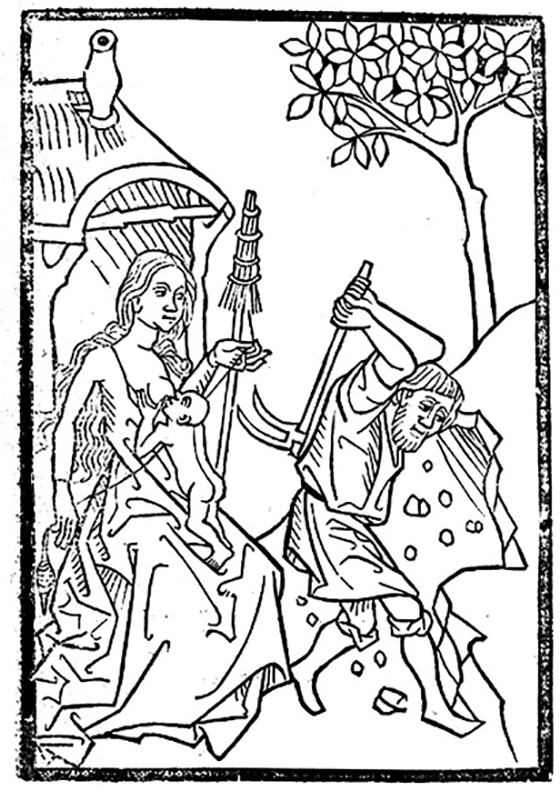
Farm family working, woodcut, ca 1476 (From: Da Udine G (n.d.) Compilatio historiarum. Basel.) Reproduced with the permission of the Morgan-Pierpont Library and Museum.
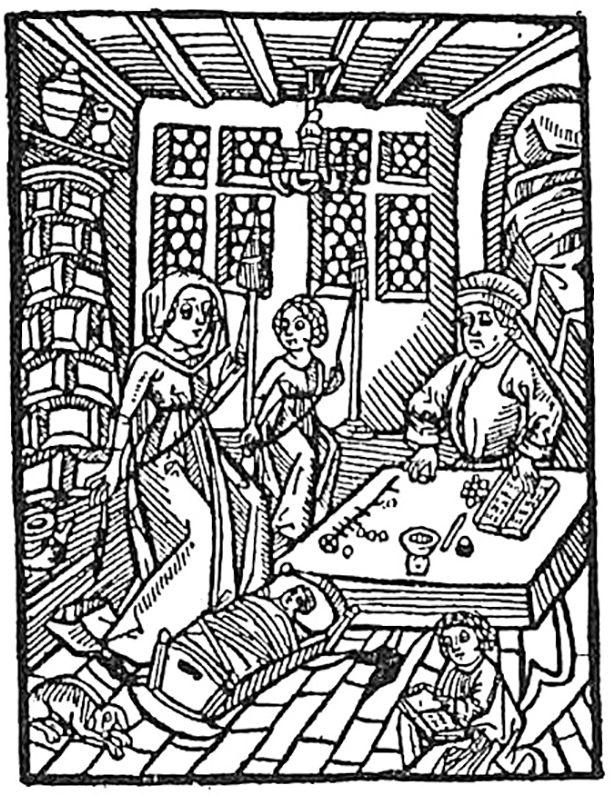
Merchant with his family, woodcut, 1477. As reproduced in Boesch H (1900) Kinderleben in der deutschen Vergangenheit. Mit einhundertneunund-vierzig Abbildungen und Beilagen nach dem Originalen aus dem 15.–18. Jahrhundert. Leipzig: Eugen Diederichs, p.108.

Mother giving children their breakfast before sending them off to school, copperplate engraving, 16th or 17th century. From Jan Saenredam. Reproduced with the permission of the Berlin Kupferstichkabinett, Preussische Kulturstiftung.
As the individual child grows, and as society and culture develop and become more complex, school emerges as an important way that children are paradoxically separated from adult ways of life in order to learn about them. Mollenhauer sees this as a radical change in the upbringing of children, explaining that the ground rules according to which reality is constructed for children are not simply changed [through this shift]; instead, a whole new system of rules emerges. Culture is no longer presented to the child as a seamless whole, but only in part. The part that is presented is offered through a kind of pedagogical rehearsal or practice, as it would be for someone from a foreign land. (2014: 31)
This pedagogical practice, exercise or rehearsal becomes necessary both as the child becomes older and as society becomes more complex. It exemplifies the central theme and question for the third chapter of Forgotten Connections, which (respectively) are “representation,” and “What way of life should we systematically represent to children?” Unlike presentation, re-presentation generally does not occur accidentally in the world at large; it is undertaken purposefully and systematically in the separate pedagogical sphere that is filled with “visual materials,” formal or informal curricular contents and other kinds of representations in both the school and the nursery. This is the world of ABCs, of learning about people in your neighborhood, of fairy tales that contain old or new messages about family relations, gender roles, etc. And these are just a few examples. (Again, questions of politics, equality and democracy are obviously raised by such examples, but are not mentioned explicitly by Mollenhauer.)
In our complex modern or postmodern world, to put things slightly differently, children can no longer experience the adult world as if it were “a seamless whole”; instead, they access it through different “compartments” (e.g., age-appropriate games and movies, classroom spaces, curricular structures) and through different sorts of rehearsal or practice. To simplify grossly: first, children learn the numbers and letters, later their combination into words and equations (and what these represent), and, still later, the times-tables and more elaborate rules, forms and codes of representation. And these are not learned naturally, as one might learn to speak; they require much rehearsal and practice, and must be taught explicitly, as if the child came from a foreign land to learn the customs and organization of an alien culture.
Again, Mollenhauer uses historical, visual examples to illustrate his point. In the case of representation, Mollenhauer turns to the Orbis Pictus, the Visible World of Johann Comenius from 1658. This is one of the first picture books published for children, and its author is widely regarded as the “father” of modern education. This picture book “represents” the world to children in the form of 150 topics, ranging from “the sky,” “animals,” and “musical instruments” to “gardening” and “justice.” Each topic is represented through a picture with numbered parts and examples on one page, and via textual labels and via explanations on the facing page (see Figure 4).
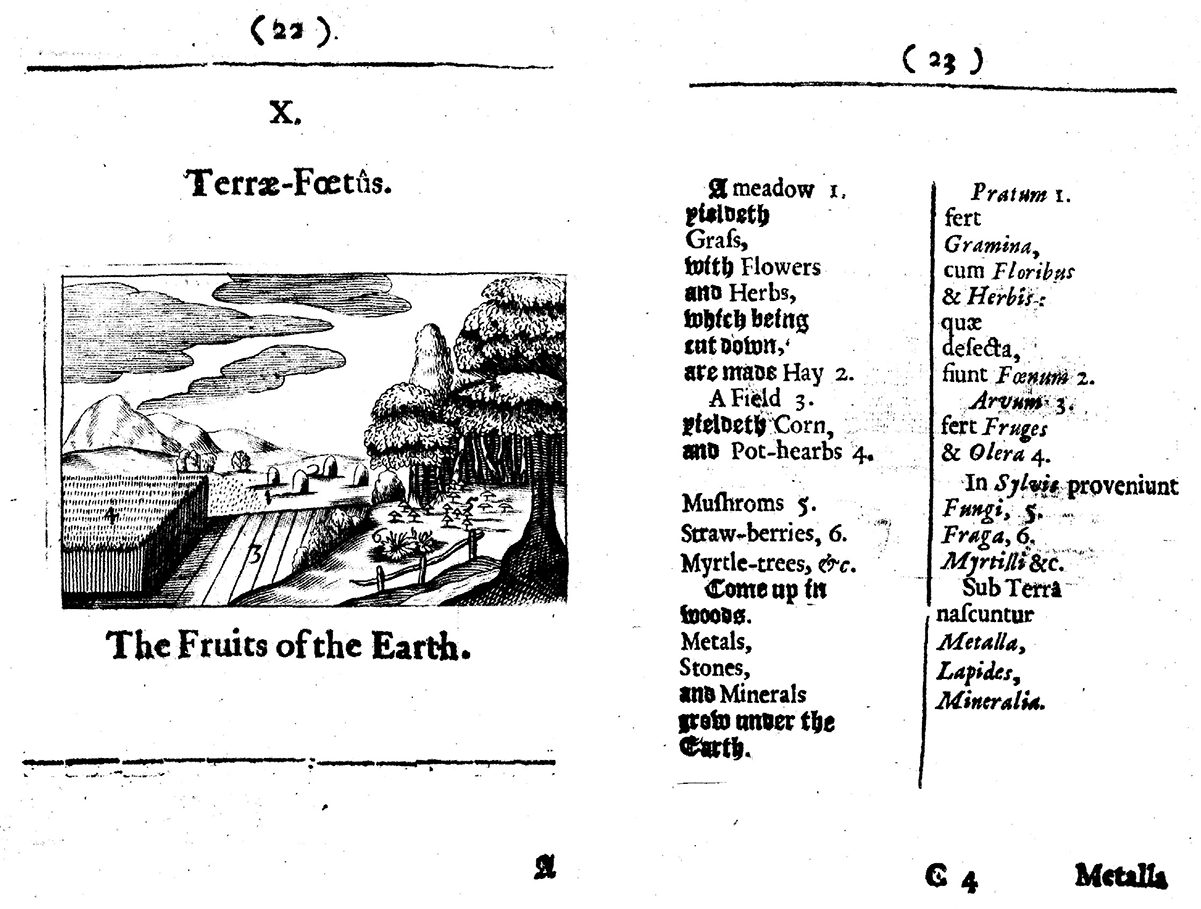
Page from the Orbis Pictus showing the “fruits of the earth,” growing both in the wild through and cultivation.
The Orbis Pictus was published in many different countries (including Britain, America and China), and its labels and explanations would generally be provided in both Latin and the child’s native tongue. Comenius also includes “the gallows” and “bodily deformations” as individual topics in his book. Would these same subjects be included (and labeled in the same way) in today’s curricula? Because a separate pedagogical realm still exists today as it did in Comenius’ time, very similar questions remain current—and now take the form of disputes over textbook contents and regarding the values and lifestyles to be covered through contemporary curricular representations.
It is noteworthy that the third chapter is the first in Forgotten Connections to speak in a sustained way about education in the sense that it almost always has in English: something that takes place in the separate pedagogical sphere of the school, generally conceived as a public institution. Just as the meaning of “education” and Bildung in German exceeds the bounds of formal schooling and is relevant (for example) to birth, childcare and biography, so does “pedagogy.” Also, the term “pedagogy” continues to be seen in German-language discourses as identifying its own sphere of action, knowledge and investigation. Questions of why we have children, or of how the self is formed and also forms itself, for example, cannot be adequately addressed by the psychological and social sciences (the two “purer” sciences which education is often seen as “applying” to students and the classroom 4 ).
Seen pedagogically, however, questions of our responsibility to children or of the way of the self are not answered in terms of the causality of neurological development or the dynamics of social reproduction: pedagogy is not interested simply in “what” these things are or “how” they occur. Instead, from Mollenhauer’s (and others’) pedagogical perspective, questions of intergenerational responsibility about are norms; they bring with them the normative qualifier “should,” and, like Mollenhauer’s own statement, they apply to the young not in abstraction, but to specific persons in particular situations: what should my part be in this young person’s path to the future? Or what should my relation (as a teacher, parent or adult) with this particular child be like—should it be like a relation with a friend, peer, therapist or mentor? Pedagogical theory and practice in this sense are directed toward both the child’s present and his or her future, and they are concerned with the adult’s intention and responsibility toward the well-being of the child both today and as the child matures in the future.
Chapters 4 and 5: Bildsamkeit and self-activity
Representation, together with presentation, can be seen as a pairing of key terms or themes for Mollenhauer. Both have to do with ways through which upbringing occurs – at different points in the growth of the child and at different points in the medieval and modern history of the West. At the same time, one does not necessarily exclude the other; they are instead complimentary, and at times, may even be challenging to distinguish. We may deliberately point out and categorize things to teach a child in a context where much else is taken for granted and simply “present” to the child. Also, both presentation and representation are still very relevant to school and other educational settings, for providing children with curricular substance and for its integration with what is presented to students. The pairing of themes and questions for chapters four and five in Forgotten Connections work in a similar way. The theme or keyword for chapter 4 is Bildsamkeit, which addresses the question: “How can we respect and draw out a child’s inherent character?” The key term for chapter 5, on the other hand, is “self-activity,” and it frames the following question for its readers: “How can we give children space to be active and solve their own problems?”
Bildsamkeit and self-activity are as closely interrelated as presentation and representation. Bildsamkeit and self-activity can be seen as opposite sides of the same coin—with one being incomplete or even inconceivable without the other. Both are a part of the active engagement of child and world, and between child and adult. On the most basic level, Bildsamkeit and self-activity have to do with how children are addressed by the world and by adults in it, and also how they respond to this address. Bildsamkeit, literally translatable as “form-able-ness,” focuses on what is inside the child and how the child is drawn into the world through adult engagement and, especially, through language. Self-activity, as the word itself suggests, emphasizes what the child does in the outside world, through action. And although this self-activity may be initially prompted by adults, it has to do with the child’s own desire, projects and goals, rather than with those of others.
Both Bildsamkeit and self-activity, however, have a paradoxical or aporetic character. Both involve a delicate balance between too much and too little involvement on the part of adults. The induction of the child into the structures and conventions of the world through Bildsamkeit is both valuable and unavoidable, but it can take place too quickly—threatening to reduce the child to complete conformity – or it can occur much too slowly—as highlighted in the case of the famous foundling Kaspar Hauser (see below). Similarly, the freedom needed for a child’s self-activity—for example, in learning to walk—is often won precisely by establishing borders and limits: the child realizes a new freedom of mobility but does so safely and successfully when certain doorways and stairways are made “off limits,” and when an adult provides help and guidance as needed.
The story of Kaspar Hauser is indispensable to Mollenhauer’s account of Bildsamkeit. Kaspar was apparently kept in a stable his entire childhood. He was about 16 and barely able to speak when he was discovered. Despite these challenges, Kaspar quickly learned the local language and customs, and was eventually able to give remarkable accounts of his past and “upbringing” that had earlier been shrouded in mute silence. This famous case provides Mollenhauer with an account of Bildsamkeit, particularly as a kind of progression from what he refers to as an unarticulated “pure subjectivity” into the shared “intersubjectivity” of language. As Mollenhauer sees it, Bildsamkeit is a drawing out of the child from mute isolation to a kind of “common subjectivity” constituted by shared meanings and experiences. As we gradually learn to give names to things (generally through the dynamics of presentation as outlined in chapter 2), particularly as we are able to “label” our own feelings and experiences, we progress from the private, idiosyncratic and unshared, to the social, relational and common. This is fundamental to the story of Kaspar, who during his short life in society constantly “had problems with [the] boundary” between private experience and its public articulation (Mollenhauer, 2014: 61).
A powerful example of this is provided by Kaspar himself, when he writes of his recollections of his childhood trapped in the stable, and how he remembers using language at this time: I wanted to see how my horses were doing and play with them, but no horse was there; and then I said: “I woulde lik be a ridar like father” [sic] by which I meant where have the horses and the bread and water gone? . . . I also saw a whole lot of other things that were so amazing as to defy description. I said: “I woulde lik be a ridar like father,” by which I meant what is this thing and where have the horses gone? I heard the clock chime again and heard this sound for a very long time. When I didn’t hear anything anymore, I saw the tile oven, which was green in color and shiny. (Translated from Hörisch, 1979: 108–109)
Without the ability to recognize or use language in its most basic, everyday meanings and functions, Kaspar’s world appears almost as one of a “blooming, buzzing confusion,” of objects, sounds and sights, their presence and absence. Although these might have some vague meaning or association (for which Kaspar repeatedly uses the phrase “I woulde lik be a ridar like father”), they clearly do not “come together,” to form a meaningful and coherent whole. Before he enters society, Kaspar can thus be said to be “trapped” in a world of his own, private meanings and sensations. And although these may be “so amazing as to defy description,” as Mollenhauer puts it, Kaspar can neither understand them in a conventional way nor learn their meaning from others. Mollenhauer explains: [Society presents] an order of things, which marks the boundary between Kaspar as subject and the intersubjectivity of those who participate in language. Insofar as Kaspar is open to Bildsamkeit, he abandons the “state of being a subject;” insofar as he does not take this step, he does not become part of the “world.” (2014: 61)
Kaspar Hauser’s integration into the world allows us to know his experience through the shared meanings of his remarkable written accounts. However, the example of Kaspar also shows that the substance that Bildsamkeit declares to be “formable” cannot be entirely reshaped according to strictures of conventional meaning and expression—despite the power of patterns of everyday life and language to reinforce these strictures. The mute subject that Kaspar once was does not completely disappear, for the privacy and individuality of the unsayable remains part of him—and also part of our own subjectivity. Indeed, according to Mollenhauer, this “unsayable” dimension of ourselves is one of the most important things that characterizes us as persons. He goes so far as to suggest that it makes us who we are: that which is not rendered into language, as Mollenhauer explains, “still resides in the unconscious and is a source of our desires, hopes, fantasies, and utopias . . . In art as in [our own and other’s] childhood[s], we seek to interpret such manifestations” (2014: 64–65).
It is, in other words, the source not only of personal hopes and dreams, but also of ones “utopian” or political in nature. But as before, Mollenhauer stops short of any further discussion of the political and utopian.
Mollenhauer’s discussion of self-activity in chapter 5 of Forgotten Connections is similar in organization to his treatment of Bildsamkeit: As he says, it is organized “not with a view to developing a systematic theory—but rather to interpret examples that can provide access to the problem at hand” (2014: 85).
Self-activity, as a way of reflectively appropriating different ways of acting and interacting, does not always take place in children on its own. Instead, it is often initiated or supported by another (an adult) who is similarly capable of rational, reflective action. This can again be illustrated through the activity of learning to walk. The child will need to be consciously and attentively supported or prompted in particular ways by a parent or other adult to readily acquire this activity or ability. It is at the same time a project or a conscious attempt on the part of the child to solve a kind of a “problem” (i.e., that of participating in the world of mobility engaged in by older children and adults). The role of the parent or adult in this context is not defined by any specific activity or process; it likely has more to do with attentiveness and awareness. Mollenhauer’s general characterization of what adults are to do to continue supporting a child’s self-activity could be imagined as applying to some of the next stages in a toddler’s gradual appropriation of walking as an activity: A parent or educator who encourages a child to self-activity need not come across as a highly active person themselves, or as explicitly engaged in pursuits that aim at a particular effect. All the parent or educator need do is to be reasonably attentive to the difference between what is possible and what is real for the child. Hence the primary virtues of pedagogues are attentiveness, being a good listener and a patient observer. (2014: 89)
As the child learns to walk, what is important for the adult is not to hover over every single step, but to attend to the child, being mindful of what the child currently can do and what he or she is becoming capable of. In the case of walking, the difference between what the child currently can do and what he or she is capable of is expressed in a literal way in terms of the obstacles and possible dangers (e.g., stairways) that the child may encounter as he or she roams at ever greater distance from his or her parent(s).
Here again, Mollenhauer’s discussion in Forgotten Connections touches on political subject matter—specifically the question of the freedom or emancipation of the child, broadly understood. And it is indeed in this fifth chapter that the only occurrence of the word “emancipation” is to be found in his book. This happens in a discussion of an extended passage from an autobiographical memoir by Austrian author Thomas Bernhard. It describes one of Bernhard’s experiences as a teenager: Every morning for years I had woken up thinking that I must break away from the route onto which I had been forced by those who brought me up and managed my affairs, but I had always lacked the strength to do anything. For so many years I had been forced to take this route against my will, all the time enduring extreme mental and nervous tension, until quite suddenly I found the strength to break away from it and do a complete about-turn, something of which I was the last to believe myself capable. (Bernhard, 2010: 153)
The key phrases for Mollenhauer in this passage are clearly “break away” and “do a complete about-turn”—phrases which Mollenhauer connects explicitly with his earlier discussion of mobility and walking. But in Bernhard’s case, what is important is not walking per se, but a “walking away from,” an emphatic rejection of, “the route onto which I had been forced by those who brought me up and managed my affairs.” “Such a moment” of breaking away, Bernhard goes on to observe more generally, “is crucial for our survival; we simply have to pit ourselves against everything or quite simply cease to exist” (153). Mollenhauer quotes this last observation of Bernhard’s not once, but twice, and then simply notes: “[T]his attitude on the part of a teenager sounds ‘emancipatory’ in a certain sense. But is it really?” (2014: 99) Mollenhauer then attempts to answer his own question. He does so by briefly citing a number of other memoirs that offer rather more sentimental accounts of victimization and rejection. What separates Bernhard’s account from these, and by implication, what can be seen to make it an expression of emancipation, Mollenhauer suggests, is that “each and every one of [its sentences] gives direct expression to the enormous effort it takes to look within oneself.” And “what is evident in these depths” of self-examination, Mollenhauer continues, is not any single guilty person, or any one set of clearly decisive circumstances or causes. Plumbing these depths . . . simply gives rise to a surge of willpower [in which] the “victim of the system” declares independence and does an about-face that leads him as far away as possible from home and his middle-class background. . . This is an act of “self-Bildung”. (2014: 101)
Emancipation, in other words, takes place at the point where one finds the strength, the willpower, to “pit [oneself] against everything.” It is a moment of rejection confirmed by one’s sincerest self-knowledge; it is a point at which one finds one’s independence and even affirms one’s very “existence.” Mollenhauer’s one reference to “emancipation,” in other words, takes the form of a warning that such emancipation is worthy of the name only if it not simply a negation of what is, but also an affirmation of something that allows the young person to “decide for himself which call or challenge he needs to address” (101). But again, Mollenhauer’s text leaves the question of the political and “emancipatory” implications of its subject matter hanging in mid-air. This is because Mollenhauer immediately moves on to discuss how, through the continuation of self-activity in both teenage and adult life, we find ourselves in a constant state of becoming. By repeatedly testing what is real for us, and pushing the boundaries of what is possible, we are always changing, surpassing who we once were; we are, in a sense, continuously “retouching” our image or our projection of ourselves.
Mollenhauer’s discussion of self-activity as opening up the possibility of a kind of “self-surpassing” marks a decisive shift in his book. We are taken from the questions of prompting self-activity as a part of raising children to issues of adolescent and also adult identity. The challenge of surpassing—or at least revising or “retouching”—who we are, our identity, is something that we encounter most intensively during adolescence, but that faces us throughout our adult lives. This process is, Mollenhauer says, “a person’s relationship to their self-image,” “a projection of oneself into the future” that is not so much a stable reflection of one’s “inner feeling” or “outer reality,” but a continuously adjusted expression of one’s ambitions, aspirations and desires (2014: 117).
Chapter 6: identity
In the sixth and final chapter on identity, Mollenhauer takes his readers on what I believe is a tour-de-force cultural and historical analysis of identity. Here, his guiding questions are: “Who am I? Who do I want to be, and how do I help others with their identity problems?” His keyword is simply “identity” itself. Working now with theories of human becoming and self-transcendence, Mollenhauer defines identity as our often challenging relationship with ourselves, and illustrates the characteristics of this relationship through a final sequence of images—this time of self-portraits, creations through which artists have recorded and interpreted themselves, and thus given expression to their varying self-relations, self-projections and self-conceptions over historical and personal time. Like his sequence of engravings illustrating the modern domain of representation and compartmentalization, this sequence of self-portraits does not progress along an upward narrative arc, from confusion to clarity; instead, it shows how the risk involved in engaging with our identity, of working towards something other than who we are, has increased, rather than decreased, with time.
In the self-portraits of Albrecht Dürer, Rembrandt von Rijn and others, Mollenhauer interprets “the self” as portrayed either in direct relation to a social role, or in the conspicuous absence of such a role. Wearing a luxurious robe, Dürer (Figure 5) shows himself in the role of the upper classes of his wealthy home of Renaissance Nuremburg. At this time, there were relatively clearly defined social roles and positions which were indicated unambiguously by one’s dress and outward appearance. For example, Dürer’s fur-collared coat and his long, shiny hair both communicate an upper-class identity. Although these kinds of markers expressed and enforced existing social inequalities and injustices, they also made questions of identity less problematic than they are today. Over 100 years later, a young Rembrandt, by contrast, portrays himself as confronting the world directly, and not from the perspective of a specific social position (Figure 6). In painting this portrait, the young Rembrandt is not telling the world about himself and where he stands as much as he is showing his response to the world. As Mollenhauer explains, “Rembrandt portrays himself as a self who is confronted with conventions, roles, myths and painting techniques – as he is confronted by the world and by himself” (2014: 121). His wide-open eyes and gaping mouth almost seem to ask “What or who is out there?” The specifics of his identity, like the details of his own youthful face, are unclear, with the only indicator of social status being the lace collar he is wearing—a sign of fashionable affluence. Otherwise, though, there is much evidence here to reinforce Mollenhauer’s own understanding of youthful identity—the principle focus of this chapter—as being particularly unstable and risky: for the young, “that which is possible,” Mollenhauers explains, “outweighs that which is real” (117).
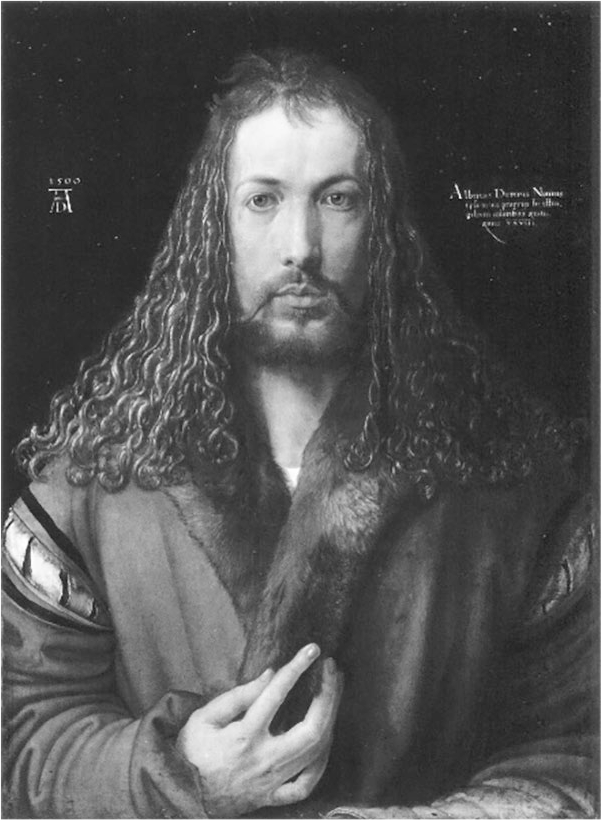
Albrecht Dürer, Self-Portrait in a Fur Collared Robe, 1500 (courtesy of Wikimedia Commons).
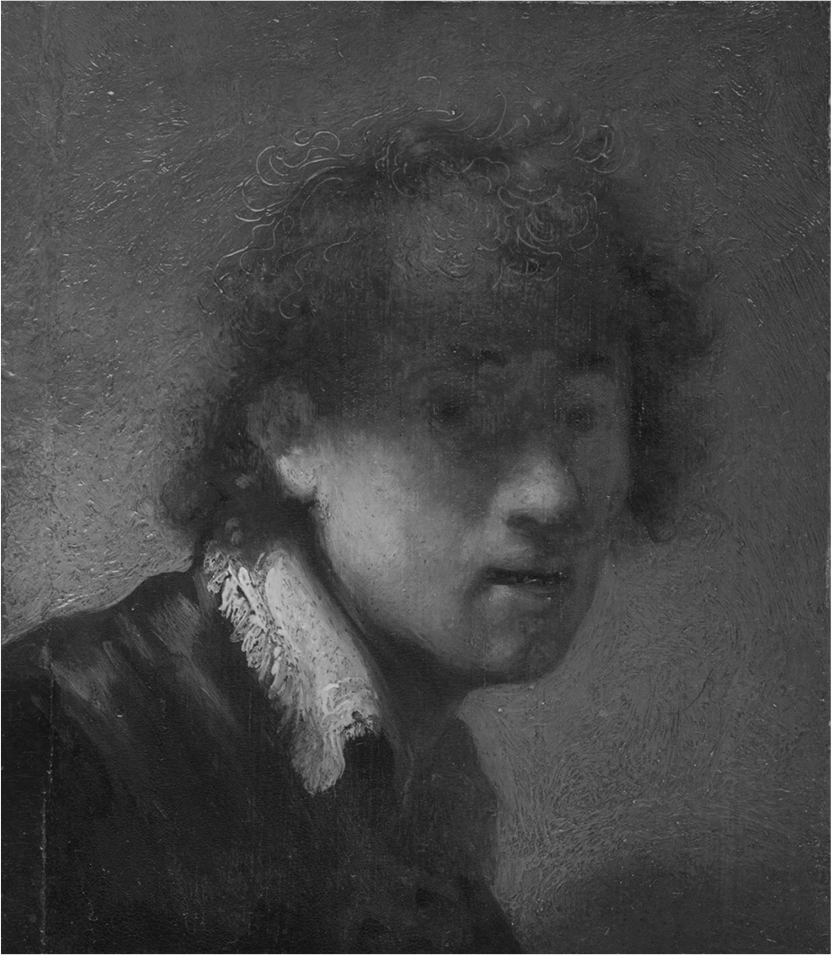
Rembrandt, Self-Portrait as a Young Man, 1629 (courtesy of Wikimedia Commons).
The identities of the young—like their lives as a whole—are largely unwritten, lying open before them, rather than having already been realized in any one particular form or another. Unlike older adults, whose lives are defined by a given past rather than by an unknown future, a child’s or adolescent’s “self-image is characterized by an intrinsic instability” (Mollenhauer, 2014: 117). In order to be able to incorporate at least some of the possibilities they face, the young person’s image of themselves (as in the young Rembrandt’s painting) is incomplete, or more partial and selective than an adult’s. The instability in the face of an open, unwritten future contrasts sharply with the stability, or even near immobility, of the identity of a much older Rembrandt, as expressed in his final self-portraits (e.g., Figure 7). The look in Rembrandt’s own eyes in these final expressions of identity and self-relation no longer confronts the viewer with the question “What is out there?”; it communicates instead a mixture of exhaustion and sadness—but still with a penetrating self-awareness and self-assurance. Art commentator Simon Schama has noted that the old Rembrandt seems to be saying something more like: “I’ve seen people like you before, sonny boy, you come and go, but I stick around” (2006, n.p.).
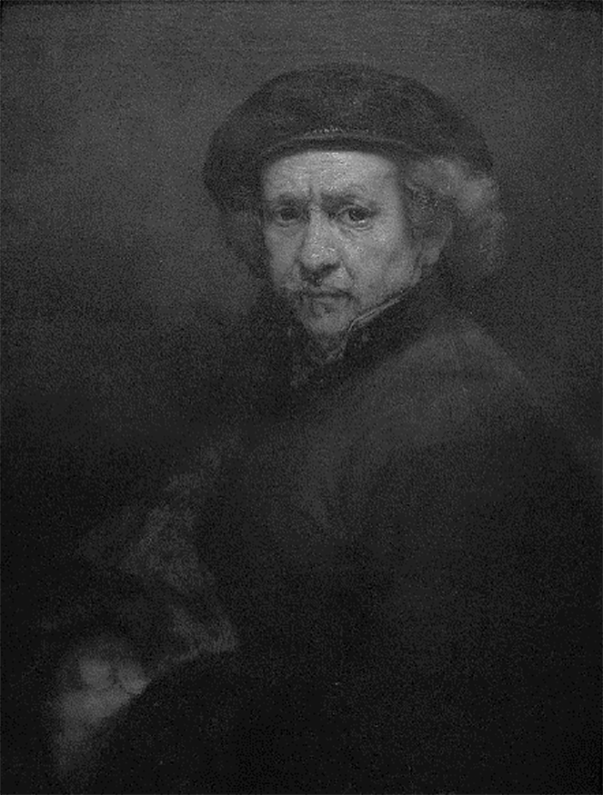
Rembrandt, Self-Portrait, 1659 5 (courtesy of Wikimedia Commons).
It is also in this chapter, significantly, that Mollenhauer returns to the question of emancipation, of individual autonomy, and, by implication, of democracy and politics, broadly speaking. This occurs in its final paragraphs, which also represent the conclusion to his Forgotten Connections as a whole. Here, Mollenhauer makes the case that identity as a question emerged in Europe around the time of Dürer, in the epoch of the Renaissance—as Europe moved from the “God-given” structures of Medieval feudalism to the relative uncertainties of the modern era: “[a]dolescence was interposed” at this time, Mollenhauer explains, “between the phase during which a child is socialized (and in so doing accepts the basic norms and values of society) and enters adulthood (and thus becomes an autonomous and full-fledged participant in the processes and history of social production)” (2014: 128). The question of who one is and who one will become—particularly as an adolescent—likely for the first time became an unsettled one.
The fact that today’s criteria for identity—whether they are sexual, ethnic, racial or other—have themselves become uncertain only makes an adolescent’s “projection” of their identity even more difficult. Mollenhauer puts this as follows: “The fact that a society’s cultural heritage is no longer an unquestioned article of faith gives rise to a problem of justification” (2014: 128).
Both adolescents and adults no longer find their place in the world based on norms and processes that are accepted just because “it’s always been that way.” In finding out who they are in this contemporary context, adolescents must also evaluate and test the general social conditions first in order to then establish their place within them. They must “discover and formulate a valid and robust basis for the self-projections that will shape their future,” as Mollenhauer puts it. “And to do this,” he continues, young people “need to distance themselves from and transcend, in their own way and based on their own self-projections, society’s norms and values. Only in so doing can they step beyond the confines of the present” (128).
Now writing the closing sentences of his book, Mollenhauer goes on to advise how adults can help when “the key pedagogic tasks associated with adolescence come into play” (2014: 129).
Namely, he asks that adults represent the problem of identity by setting an example – but an example of a particular kind: To refuse to sacrifice their own possibilities in the face of so-called “reality” while under pressure from the “coercion” exerted by the circumstances and limitations of life; and to do so without falling prey to delusions. Indeed, this is the only justification that we as adults can give for the audacity that lies at the heart of any efforts in the upbringing and Bildung of a child. (129)
Mollenhauer, in other words, is concluding by saying that parents, teachers and others need to show how they, too, stand at some distance from their own society’s norms and values. 6 He then implies that such distancing provides the only justification that adults have for engaging in education in any full sense of the word. And thinking also of the very beginning of Forgotten Connections, we can see that this means it is the only justification we have in some senses for bringing children into the world in the first place—and trying to give them the little good that we might have in our own culture and ways of life.
Conclusion: emancipation as a “forgotten connection”
In the end, Mollenhauer’s Forgotten Connections certainly leaves us with more questions than answers. Of course, Mollenhauer has provided us with six questions, ranging from why we want to have children to how we can help with their adolescent identity. But in ending his book, he adds to these by suggesting we have only one justification, only one way of grounding our engagement with children. This, he makes clear, is to be found in our refusal of “coercion” and “sacrifice” when it comes to our own possibilities.
It is obvious that unlike Education and Emancipation, Forgotten Connections no longer takes emancipation as the keyword for education. Instead, it is clear from both his concluding discussion and from his only reference to emancipation in chapter 5 that Mollenhauer chooses to locate this notion in questions of adolescence, identity and self-awareness. And for Mollenhauer, this includes both the experience of the adolescent him or herself and of the adult (still) engaged in upbringing. For it is only when adults remain mindful that all norms, conventions and ways of doing things are not necessarily justified, that they, according to Mollenhauer, themselves can be justified in undertaking the audacious act of education. And here, one could add that a type of emancipation is necessary to free not just adults, but also education itself, from pressures and conformity, to ensure both they and it remain open to “their own possibilities.” For our educative acts of inculcating “basic norms and values of society” in the lives of young adults are no longer justified on the basis of any certainties of the past. Instead, they can be based only on those possibilities for the future that we will share with the young, and for the future that belongs only to them. And such possibilities, finally, can only be kept open through both individual and collective effort—an effort, one could say, in the radical democratization of both identity and of the painstaking processes of its discovery and cultivation that is known as Bildung.
Perhaps unlike his colleagues and early followers, we can thus take Mollenhauer at his word when he says that Forgotten Connections represents “a path that I had to follow one more time, in order to arrive at a substantial conception of emancipation” (quoted in Kaufmann et al., 1991: 81). We can see that this more substantial conception takes the form not of demands for the formation of a political consciousness in education, or for the complete release of children from authority and repression. Instead, Mollenhauer now demands something very different from adolescents and especially from adults. In its audacity, education is indeed still informed by an emancipatory epistemological interest, not as the rejection of the existing order by those who would see themselves as its victims, but by one of a very different kind. This is a refusal of coercion, of unnecessary sacrifice, for the sake of keeping possibilities open—both for oneself and for the young in one’s care.
Footnotes
Declaration of conflicting interests
The author declared no potential conflicts of interest with respect to the research, authorship and/or publication of this article.
Funding
The author received no financial support for the research, authorship and/or publication of this article.
