




Abstract
Global learning may be understood as an educational response to the development towards a world society. The development of world society is accompanied by a wide range of adaptation challenges, such as the development of global social justice, the overcoming of paternalism or the facilitation of social solidarity and dealing with migration in an era of climate change. This paper reflects the learning of the understanding of world society by empirical studies. The paper shows some challenges for the research agenda, especially concerning the Organisation for Economic Co-operation and Development’s framework of global competences and suggests a framework for further research.
In this paper, I will reflect upon the implications of today’s survival risks for humanity and the planet Earth and the challenges for education related to them. I call the contribution to these learning challenges ‘global learning’ and consider it as a central area of educational research for the future, related to comparative and international education as well as education for sustainability. My research contributes to international comparative policy research on global competences.
Firstly, I will present and give reasons for this idea by exploring the concept of world society. The assumption behind is that the way we reflect these challenges is deeply connected with the way how we understand coexistence and problem-solving on this planet. Secondly, I will show how the related learning challenges have been so far described in educational research. Against this background, I will then present empirical research in this field in order to enrich the international theoretical and conceptual debate as well as to contribute the discussion on change in education policies and practice. Finally, I would like to evaluate this research and outline some of the implications for further research.
Global developments and the concepts of world society
Key topics such as climate change, population growth and global migration, consumption of natural resources, plastic waste in the oceans and the diminishing ice of the Arctic describe some of the more dramatic dimensions of global developments.
An important feature of this development is the close interconnectedness of geographical spaces: developments in one part of the world have consequences for others. The CO2 emissions from industrial countries have consequences for tropical forests (Fearnside, 2013; Grainger, 2017). The plastic fibres from the washing of fleece pullovers in Europe are found in fish caught in the Mediterranean (Nadal et al., 2016). According to a study by the Ifo Institute for Economic Research in Munich (Felbermayr et al., 2019),
To understand learning about the world society, it is particularly important to understand the social processes related to these developments. The reflection of these challenges has a long tradition in – not only educational – philosophy, as one of the oldest may be the pansophy of Comenius. I mention some of those thinkers with resonance in education and educational research, who are dealing with the new quality of interconnected spaces and its consequences for understanding and reflection.
In 1784 the philosopher Immanuel Kant (1764) pointed out this dimension of sociality in his ‘Idea for a general history with a cosmopolitan intention’. He reflected how people could deal with the challenges associated with cosmopolitanism. He considered this a learning challenge because, in his opinion, people tend to be egoistic and socially cold towards those with whom they are not personally acquainted. At the same time, it is inevitable that people deal and work together with one another. He therefore speaks of an ‘unsociable sociability’ of man. In modern society, coexistence can no longer be organized based on the idea of a small group with emotional closeness, or on the model of belonging together as family, but requires an abstract social order for coexistence and the development of freedom. In his work, he is pointing out the necessity to reflect on structures of living together in order to guarantee freedom.
The social philosopher Niklas Luhmann described in the 1970s that today’s society is to be understood as a world society in terms of its character, since social communication today is no longer possible independently of world social contexts. His central thesis suggests that every society today exists as world society because it is always part of a global context (see Luhmann, 1975; 1997: 806–812). World society does not have the form of a state or a world organization, but consists of the sum of social, political and cultural diversity and its interdependence. By this, the worldwide coexistence and the need for a global world understanding becomes inevitable. Every human being is a part of it and included in very specific dimensions and segments. However, the awareness of being globally interwoven is not easy to reach. Moreover, participation and inclusion in it is very unequal. Since global social interdependencies have very noticeable effects almost everywhere, this new social quality must be dealt with. Luhmann’s important message is to understand the mechanism of communication and to understand world society as a specific form of communication.
Jacques Derrida (1994) calls this kind of order ‘beyond the principle of brotherhood’ (10). His thinking reminds us of the challenges of emotions and the danger of othering and setting hierarchal differences and he addresses the challenges of belonging in a global world.
The British sociologist Roland Robertson (1998) saw in this a new form of spatial experience, which he denoted by the term ‘glocality’. He worked out the challenges of working for the ‘global common good’ in this setting and related his thinking to an understanding of the complexity of risk management in a glocal society, pointed out by Ulrich Beck (1992).
In the tradition of these thinkers, the understanding of a world society becomes clearer. It is not a bigger family, it is not a real state, it is not a situation of direct elections and problem-solving just related to one actor. The world society has very weak decision-making structures, high complexity and multilateral actors in problem-solving. The world society has only very few guiding principles as the Declaration of Universal Human Rights. Against this background, the learning challenge is to learn of abstract social relations in an abstract social space (for details, see Asbrand and Scheunpflug, 2014).
This means to learn to deal in a social context with an unknown complexity and a structural uncertainty. Things are losing the anchor in space and belonging is loosing the function to be related to distinct entities. This results in learning tasks in regard to identity, in overcoming paternalism, the perception of challenges of global social justice and the ability to reflect on how social solidarity can be shaped in a global spatial context (Scheunpflug, 2004).
All these developments are a great challenge for human beings, who are local beings due to their Stone Age past and imprints (Scheunpflug, 2001, 2007). Man is evolved into life in families and sensual communities. That is why people learn everything that can be experienced by the senses much more easily; that is, what takes place within the close range that can be experienced by the senses.
At the same time, however, people are gifted – and this distinguishes them from all other living beings – by being able to use their reason, to learn and to solve problems. People have a high capacity for abstract reflection, which also enables them to learn abstract contexts. One such example is the innate ability to count and to think mathematically, which in human history has been cultivated, taught and learned with considerable effort to high abilities. If people can learn to think in mathematical categories, they can also learn to cultivate their coexistence in a global context. However, this also requires a clear intellectual effort (Scheunpflug, 2007; Schmidt, 2009).
I call such learning ‘global learning’, using the definition of the Maastricht Declaration of the GENE/European Council from 2002: ‘Education, that opens people’s eyes and minds to the realities of the world, and awakens them to bring about a world of greater justice, equity and human rights for all’ (Maastricht Global Education Declaration, 2002; Nygard and Wegimont, 2018; see also other scholars such as Bourn, 2014, 2018; Lehtomäki, 2019; Lehtomäki et al., 2016; 2017; Räsänen, 2009; Tarozzi and Mallon, 2019). This concept is seen as an umbrella concept of ‘global citizenship education’ (cf. Grobbauer, 2014; Shulz, 2010; UNESCO, 2015) and related concepts, pointing out the necessity to reflect human relations in a globalized world as the foundation of solving problems. My hypothesis is that the understanding of the character of this world society as an abstract social space on a real planet is of high importance for the way people act.
Global learning in the framework of the United Nations Educational, Scientific and Cultural Organisation (UNESCO) and the Organisation for Economic Co-operation and Development (OECD)
Even if global learning has not, until now, been a huge field of research, the first meta-study was carried out by Wiek et al. (2011), reflecting 43 concepts of competencies in education for sustainability and global learning. With their study, the authors showed that systems-thinking competence, anticipatory competence, normative competence, strategic competence and interpersonal and intercultural competence are seen as the core competencies reflecting global interconnectedness. The international Delphi study by Marco Rieckmann (2010, 2012) supported these findings by integrating scholars from the global south. This research had a tremendous impact, as it was the foundation for UNESCO (2015) to develop a ‘Framework on global citizenship education’ which is now used in curricula around the world.
The mentioned meta-study (Wiek et al. 2011) also had an impact on the OECD in the ongoing research on ‘Global competencies’. The framework of the OECD combines the meta-study and the findings of intercultural learning especially in the Unites States. Under the title ‘Preparing our youth for an inclusive and sustainable world’ the OECD (2018) describes four dimensions of global competencies:
The capacity ‘to examine issues and situations of local, global and cultural significance’ (OECD, 2018: 9) (‘e.g. poverty, economic interdependence, migration, inequality, environmental risks, conflicts, cultural differences and stereotypes’ (OECD, 2018: 8)).
The capacity ‘to understand and appreciate different the perspectives and world views of others’ (OECD, 2018: 9).
The capacity ‘to engage in open appropriate and effective interactions across cultures’ (OECD, 2018: 10).
To ‘take action for collective well-being and sustainable development’ (OECD, 2018: 11).
This framework, which leads the assessment of the OECD, focuses knowledge on the problems of a global world, but does not emphasize the special character of the world society as ‘unsociable sociability’ and its consequences for learning and teaching. However, I suggest, that the underlying understanding of the character of world society, drives actions in this field. Therefore, reflecting the understanding of a world society is a necessity to consider for research.
An empirical approach to global competences
To reflect these challenges, I want to present the results of three empirical studies from my research group. All three deal with the challenges of global learning. In order to allow the reflection of the learning process, the research is situated in different global contexts. The studies focus on the central orientations, which are leading action in the field, as the action guiding orientation is at the heart of the learning process (for the method, see Scheunpflug et al., 2016):
Study 1 (Wagener 2018a, 2018b) deals with the learning processes of German students who are committed in their school to sponsoring children in the global south by raising money monthly for one of these children, either using their own pocket money, or through fundraising campaigns or by selling cakes and other items.
Study 2 (Krogull, 2018; Krogull and Scheunpflug, 2013) surveys the orientations of young people who have taken part in encounter trips to a country of the global north or the global south. The trips took place half a year to two years before the data collection. The study includes students from three countries, Ruanda, Bolivia and Germany.
Study 3 (Richter, 2018) focuses on the quality of learning processes for German young people taking part in voluntary work in the global south. The experiences of the returned volunteers were collected by interviews.
Table 1 summarizes the study, samples and funding organizations.
Overview on the underlying studies.
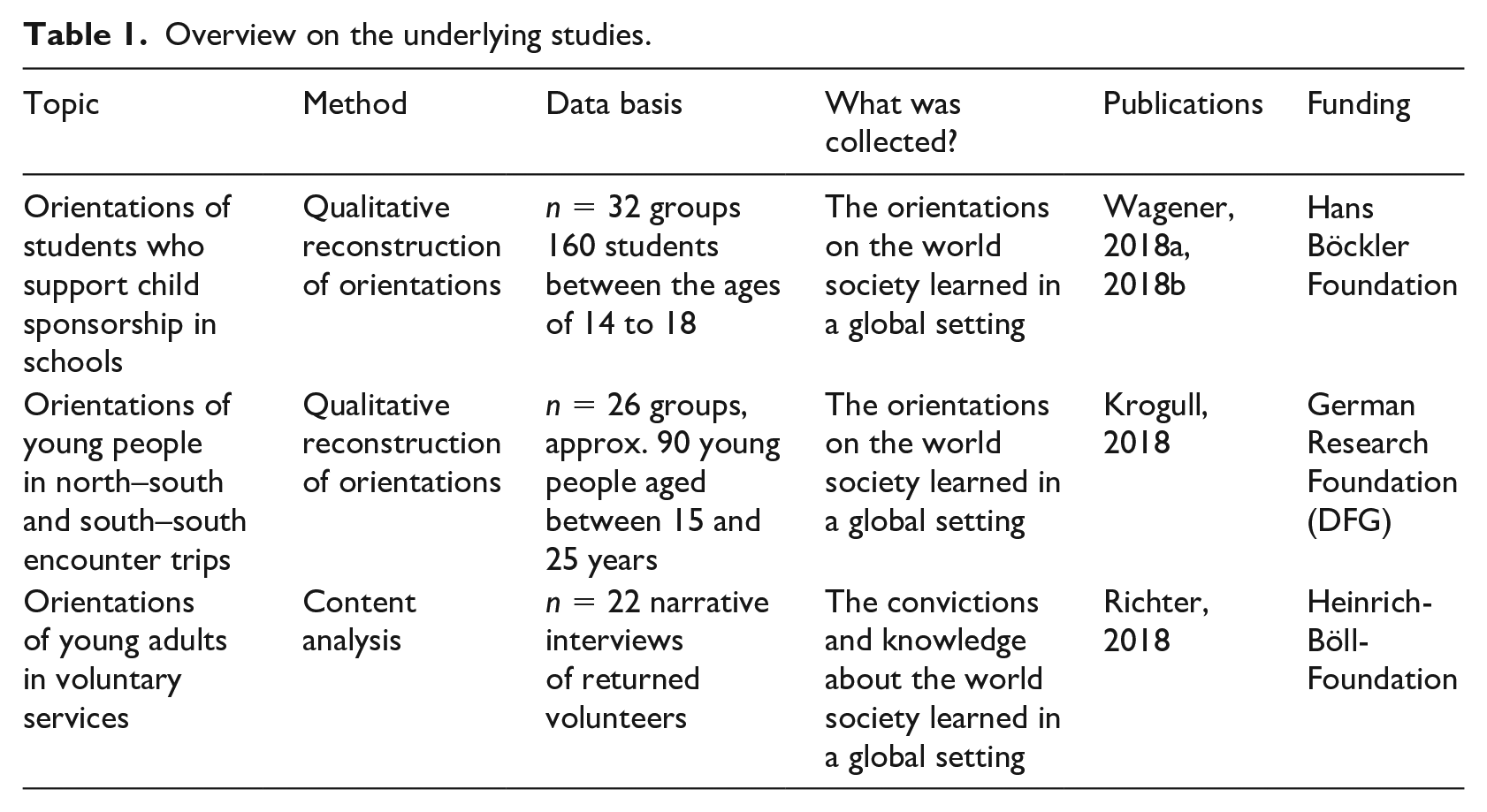
For this paper, the different findings of the single studies had been abducted together once again (see, in a first approach, Wagener and Krogull, 2018). We found that even with a high level of cognitive global knowledge and many global experiences, there were very different forms of understanding ‘glocal’ connectedness and the specifics of ‘unsociable sociability’. In the following, the findings are presented in brief and the complexity of the results is considerably reduced (in comparison to the original studies); in addition, all transcripts quoted are edited for reasons of comprehensibility.
Through the abduction process, perception of the other, localization of differences, dealing with knowledge and motivation for action evolved as important aspects to structure the field. This structure formed three types that I will describe in the following.
Understanding the world society as vicinity in adding neighbourhoods
In child sponsorship, student exchange and voluntary service, orientations emerge which transform new experiences of strangeness into a new local area. Students integrate the new experiences into a new vicinity and, by this, the world constitutes by added neighbourhoods.
In all three studies, groups and individuals, whose understanding of world society is shaped by this type, show an orientation towards asymmetries in the perception of others. Thus, young people from Germany perceive themselves in a giving role, whereas the partners in the global south are in a receiving role. The situation of economic inequality superimpose all other experiences. For example, German pupils in upper secondary schools clearly feel superior to experienced teachers in the southern countries: ‘They are not only dependent on the money, but also on the help, on the knowledge that comes from Europe . . . they have teachers, but they are in no way as far as our secondary students are now’ (Krogull, 2018: 141). Conversely, the young people we examined from the participating countries of the south felt that they were inferior. The learning arrangement thus led – in all three studies – to an increase in self-esteem of the young people from the global north. In the following interview, a participant shows his pride at being asked to contribute to the teaching in a school (being himself still a student): ‘in school and so on, they all said whether we did not want to do something there’ (Krogull, 2018: 142). The increase in self-esteem is also expressed explicitly in part: ‘so for example . . . as a white man you are simply THE person and are adored like such a little god, and I mean in the beginning it’s all so nice and good and your ego also rises (laughs)’ (Richter, 2018: 20). In this type, the localizations of differences is seen in one’s own everyday culture: eating here and there, living as a student here and there, the cityscape here and there, the climate here and there, and so on:
‘And another thing . . . the markets of the Germans, that is different from here in Rwanda; when you go to the market here, you ask for the price of items and you answer the money you have; but in Germany, for example, the clothes; there were the prices and you pay directly; but here it is not like this; you demand discussing. (Krogull, 2018: 95)
The new world becomes the new neighbourhood and the sponsored child becomes like one’s own child: ‘So this is like our little child somehow, our own baby’ (Wagener, 2018: 6) The newly experienced everyday culture is identified and related to one’s own experiences. In this way, one makes the living environment of other people one’s own in parts. In this way, globality develops as the addition of vicinities.
In all three samples, the understanding of world society is oriented towards the expectation of being able to encounter the world in all dimensions authentically. Encounter trips and voluntary services are of course situations of direct contact; the situation of supporting a child through regular donations reflects the desire to help another person directly. Authenticity becomes very important.
In the following example, the group discusses whether the child they sponsor has written a card by itself/by him or herself:
A: Somebody helped her. B: Yes, as she cannot yet write very well! A: Yes. C: She does not know it very well, but she knows it. D: I think the letter was from her but not the writing as this was not her scripture, she did not write this was somebody else. B: Yes, but she made the card by herself. (Wagener, 2018: 103)
In this reflection, we observe a struggle for authenticity. The students are orienting their solidarity to the fact that there is an authentic counterpart and a real existing relation. For the students it is central that they experience authenticity. The related action is motivated by charity.
Understanding the world society as community
We found groups which did not focus on this kind of vicinity, but identified communities of global belonging. Here is the example of one group from Rwanda:
Before leaving, I asked myself how would life look like, how would people approach us? We do not speak the same language; we come from very different cultures, so I asked myself many questions. But I met the contrary: these families where we lived had really been Christian – Christian families. (Krogull, 2018: S.112)
Others built on the communities of football clubs, music or youth organizations. Common to all is a kind of global belonging related to an understanding of community. Those groups reflected the new experiences and the new knowledge gained by identification with the community. Action in the global world was motivated by solidarity.
Understanding the world society as abstract social space
We also found young people who showed that, beyond their immediate experiences, they are interested in the structures of the world society, showing orientations that do not devalue the identity of others and discussing aspects of global justice. These young people can describe their experiences and reflect them by talking about forms of organization of societies, tax systems, legal regulations; they reflect what their effects look like, and they think about what constitutes a society: ‘I really believe that I have had a very important experience in what a new concept of order is (.) An order in society, order in behaviour, (.) order of (.) a whole society’ (Krogull, 2018: 129). Young people of this type show an orientation towards perceptions of others which do not depreciate other people. They are able to classify individual situations and translate them into reflexive actions with regard to underlying principles. Their forms of action are motivated by global participation.
Table 2 summarizes the findings. People of the type ‘addition of vicinities’ understand the world society as an addition of things they know by their own experience. They create asymmetries with people they meet – either in paternalism or in subordination. The complexity of the world society is reduced by an authentic approach and the resultant action is charity. People of the type ‘community’ understand the world society as a community of people with the same background. They learn in organizations of the same character, like churches, music bands or football clubs. The complexity of the world society and of the related knowledge is reduced by the identification with others (football player as me, workers as me, etc.) and the resulting action is solidarity. People who understand the world society as an abstract social space understand the underlying structures and principles. They reflect the complexity by using self-reflection and act by global participation. Only those who understand the world society by abstract social spaces would correspond to what I described at the beginning, against the background of the theoretical considerations indicated, as a global competence, being able to deal with the challenges of the planet in equality with people from other parts of the world.
Findings summarized.
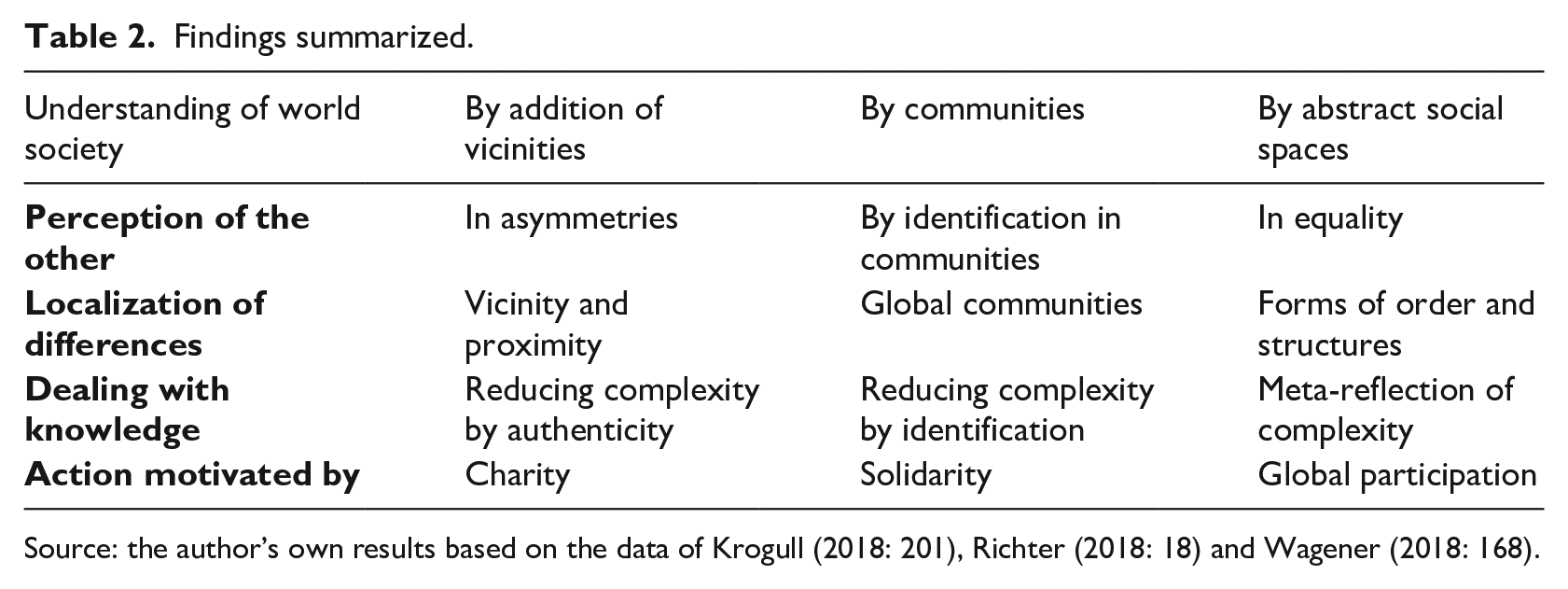
Source: the author’s own results based on the data of Krogull (2018: 201), Richter (2018: 18) and Wagener (2018: 168).
These findings show that a world social learning setting does not naturally lead to a perspective of joint work on the outstanding problems of this world, but that there is a danger that structures or ascriptions of supposed superiority or inferiority are determined, and possibly cultivated and not worked on. To summarize the observations from the three studies, one can state that knowledge about globality and personal experience of globalization do not automatically lead to global competence in the sense of an understanding of symmetrical ‘unsociable sociability’ – or the understanding of ‘abstract sociality’. Learning which evolved in this context was independent of the age of the participants, the north–south context and their educational background.
In educational terms, this raises the question of what a concretion of abstraction can look like; that is, how such complex contexts can be conveyed and experienced in simpler learning constellations. The question arises of how the desire for personal encounter and authenticity can be brought together with ‘abstract sociality’ so that the social background of emergencies as well as human rights aspects can be taken into account.
People with a world social orientation towards ‘unsociable socializing’ all had the experience of active social participation with an international component. The experiences of these young people were connected with guided self-reflection. These young people did not learn by experience alone, they did not learn by knowledge and knowledge alone, but in all the reports of the young people surveyed, the connection of knowledge and experience with their own biography and their own self plays a central role. The combination of these three aspects – experience, knowledge, biography – resulted in learning constellations in the direction of world social understanding. However, the format of donations for children in the global south was linked to orientations that lead to a considerable distance from the topic. From the three studies, we do not know whether the three types build on each other hierarchically and in sequence in the sense of a progressive level of competence, or whether they develop in a different form.
The findings of my study confirm other studies in this field that highlight the risks for the consolidation of paternalism and emphasize opportunities for participation (Asbrand, 2009) even in teaching situations (Kater-Wettstädt, 2015).
World society and ‘abstract sociality’: summary and outlook
My central thesis, which I outline in this contribution, is that world society has some structural logic and can only be grasped inadequately with the categories of social groups from the local area or national societies available to us so far. World social structures in their complexity and interdependence demand an even higher abstraction in order to understand and influence them.
This has led to my position that global competencies must be founded on an understanding of ‘abstract sociality’ if they are to help master today’s challenges facing the world society.
The OECD will present the results of the survey on ‘Global competences’ at the end of the year. The research concept has already been criticized, among other things for its narrowly economic objective, the lack of clear operationalization of the associated competencies and the lack of a social framework for data collection (Auld and Morris, 2019; Conolly et al., 2019; Grotlüschen, 2018; Sälzer and Roczen, 2018; see also, in general regarding the challenges of measuring global learning, Scheunpflug, 2020). The operationalization of ‘global competences’ by the OECD is likely to miss the ‘abstract sociality’ as I described it, because it draws the focus into the realms of proximity. The study uses as indicators personal contacts with people from other countries and an interest in getting to know people from other countries. Items such as ‘in our school we celebrate festivities from other cultures’ (OECD, 2018) I would not see as an indicator for global understanding, but as a form of othering or a low level of global consciousness.
The results of our research provide an impetus to explore whether the OECD survey questionnaire is sufficiently focussed on the interplay of informal learning opportunities, self-reflection opportunities and participation opportunities. Understanding the acquisition of global competences, recording them empirically and then looking at pedagogical practice on an evidence-based basis against this background is likely to prove to be more complex than expected.
Drawing on these results, I see the following aspects for further studies and surveys:
Research on how these global competencies develop is of importance. What steps are necessary to build a competent global understanding? In what way should local experiences and an abstract understanding of global social structures intertwine? How exactly do experiences and the dimension of experience relate to knowledge, understanding and reflection?
The informality of framing the learning of global competencies should be included accordingly. The interplay between formal learning and informal learning seems to be very important.
It would indeed make sense to substantiate the findings described previously in quantitative studies. It is important to take the collection of value attitudes into account, in order to enhance the understanding of promoting symmetrical understanding. However, value attitudes such as paternalism, for example, are difficult to examine in quantitative studies, as people might easy understand the social desirability of the data.
‘Abstract sociality’ must focus more than before on what forms of new social spaces and networks are created by the Internet and social media. Social media offer completely new forms of space experiences and proximity, but also pose the danger of unreal and virtual experiences that are detached from real living conditions.
Footnotes
Acknowledgements
I thank the anonymous reviewer for his/her very helpful comments to improve the text. I thank Dr Susanne Krogull, Sonja Richter, Dr Susanne Timm and Dr Marina Wagener for the intensive discussions on the topic.
Declaration of conflicting interest
The author(s) declared no potential conflicts of interest with respect to the research, authorship, and/or publication of this article.
Funding
The author(s) disclosed receipt of the following financial support for the research, authorship, and/or publication of this article: The article is inspired by research funded by the German Research Association DFG SCHE 646/3-1.
