




Abstract
North Macedonia’s two main ethnic groups, the Albanians and Macedonians, have experienced increasing segregation in education, though recent political shifts have made social cohesion a priority, which could replace decades of segregationist policies and break down a damaging cycle of segregation. Using a qualitative approach, I examine the complex relationship between policies, schools, and individuals through analysing 18 years of education policies, interviews/focus groups with 30 participants, and four years living and working in segregated communities. To explore how educational policies, institutions, and practices perpetuate ethnic segregation in North Macedonia, and how growing up in a divided society shapes individuals’ conceptions of themselves and other predominant ethnic groups, I employ contact theory and critical policy analysis. I find that as students grow up in divided schools and communities, their conceptions of the self and of people from other ethnic groups are constituted by these experiences of segregation. While the nation’s education policies currently include more initiatives for integrated education, these have yet to be implemented satisfactorily, meaning that public schools could teach inclusion and serve as a mechanism for dispelling negative stereotypes, but to do so requires a reconceptualization of ethnic difference and a cohesive vision of national identity.
Keywords
Introduction
North Macedonia, a small, mountainous country in the Balkans, has experienced recent political shifts that create space for rethinking education policies to better align with the goals of Europeanization and internationalization. Increased movement of people, both to Europe in the recent waves of refugees and other immigrants and also within Europe’s borders between European states, has intensified nationalist visions across the continent. This shift has also strengthened national education systems, which, despite being viewed as important for European policy, are still administered nationally and locally (Grek, 2014). North Macedonia appears to be moving counter to this trend. Following a change of government in May 2017, the country has made social cohesion a priority.
Zoran Zaev, the country’s Prime Minister from 2017 to 2020, promulgated legislation known as the Law on Languages to give the Albanian language higher status and negotiated a compromise with Greece to move toward European Union (EU) and North Atlantic Treaty Organization (NATO) accession. Likely a result of this political shift, the Comprehensive Strategy for Education 2018–2025 (CSE), which was released in May 2018, includes the goal of integrating students through education initiatives. If successfully implemented, the CSE could be an important step in moving North Macedonia from a country with parallel societies where Albanians manage and work in Albanian-language schools attended by Albanian children and Macedonians manage and work in those where Macedonian is spoken, which are attended mainly by Macedonian children, to one where both groups unite to improve outcomes for all students.
This shift could have important repercussions for international education and Europe more broadly, where ethnic segregation and increasingly diverse populations have been of growing relevance (Geddes and Scholten, 2016). Indeed, Loader et al. (2018) highlight lessons from North Macedonia’s approach to interethnic education, including extensive teacher training and efforts to balance gender and ethnicity in mixed activities, which they state could be beneficial to Northern Ireland. They call for further research on building social cohesion in societies experiencing ethnic and religious division, emphasizing the importance of collaboration among researchers, non-profit organizations, policy makers, and educators. Such research may also have applications in other divided societies like Bosnia and Herzegovina and Israel, and in addressing changing educational needs in the midst of Europe’s current influx of immigrants. However, in order to do so, it is essential to understand the complex way that policies, schools, and individuals have traditionally intersected to create a cycle of segregation.
Prior research on ethnic segregation in North Macedonia has looked at the historical and political elements of conflict, only superficially considering education (see Poulton, 2000; Zanker, 2010). Political conflict (Ceka, 2018) and the economic repercussions of segregation (Fontana, 2019) have been extensively theorized. However, limited international scholarship examines the relationships between Macedonians and Albanians in primary and secondary education. This article investigates the complex division between these groups and the cyclical segregation in North Macedonia. In particular, it considers the role schools play in perpetuating this divide. As a part of Europe and with aspirations to join the EU, North Macedonia may be considered in future discussions of European educational spaces and international education policy. This research is unique in that it analyses education policy, incorporating the individual voices of actors at multiple levels to address the role of educational policies, institutions, and practices in perpetuating ethnic segregation in North Macedonia and to examine how growing up in a divided society shapes individuals’ ethnic identity. It establishes a multilevel framework for analysing these questions in a way that considers the intersections between macro, meso, and micro actors.
The following section provides a brief historical introduction to the role of education and segregation in the country, looking at the effect this segregation has had on the people of North Macedonia. I then outline a multi-layered approach for analysing this segregation that considers the interrelationships of policies, schools, and individuals. The next sections examine the study participants and methods of data collection and analysis. Subsequently, I discuss the study’s findings in detail, including possibilities for what the country can do to improve interethnic contact in schools and break the cycle of segregation between ethnic groups. It concludes with a discussion of North Macedonia as a case study for broader issues of diversity and multilingualism in European education and the wider implications of social cohesion in the context of the European educational space.
Education as a tool for contesting identity
Education has historically been a source of ethnic tension in North Macedonia. In the later part of the 1980s, the Macedonian Assembly began educational reforms requiring secondary students from non-Macedonian ethnicities, some of whom did not speak Macedonian proficiently, to attend ethnically mixed classes in the Macedonian language (Poulton, 2000) and required classes taught in Albanian to have at minimum 30 students, greatly limiting the classes for Albanians in rural areas (Pichler, 2009). School records were kept in Macedonian and all teachers had to be fluent in Macedonian, even if the language of instruction was Albanian (SRM, 1989). These policies provoked Albanian discontent, leading to protests and arrests throughout the 90s, including a boycott of the country’s referendum for independence in 1991 (Poulton, 2000). In 1994, Albanians opened the State University of Tetova with classes illegally taught in Albanian, which acted as a further catalyst for protests and police shutdowns of the university (Koneska, 2016). Armed conflict near the Kosovo border in 2001, a Macedonian-led protest that culminated in the beating and hospitalization of an Albanian teacher, and a bomb explosion in a trashcan outside Goce Delcev Secondary School triggered Albanian parents in Kumanovo to pull their children from mixed-ethnicity Goce Delcev and send them to a nearby Albanian primary school in a third shift.
The 2001 Ohrid Framework Agreement (OFA) ended the conflict and gave linguistic groups comprising 20% of a municipality official language status within that area. It laid out provisions for language usage in schools and provided groups with official status the right to attend school in their mother tongue, effectively establishing segregated education (OFA, 2001). It also decentralized schools to local control, thus creating “de facto functional autonomy” in education for Albanians (Koneska, 2016: 148). However, despite a push across Europe for more integrated education, up until the recently released CSE, there has been little effort to integrate the various populations of North Macedonia. Rather, divisive moves in education, such as an Albanian-boycotted policy in 2009 that stated that all students would learn Macedonian from first grade but did not require Macedonians to learn Albanian have led to resistance to learn the language of the other ethnic group and resulted in communication difficulties and further segregation between groups, particularly since Macedonians rarely learn Albanian, and though Albanians study Macedonian in school, many do not reach a level of proficiency that allows them to interact fluidly or professionally in the Macedonian language (Vollebæk, 2009).
The effects of ethnic segregation and the solutions to improve integration outcomes must come from considering multiple aspects, both within and outside schools. Moreover, segregation based on custom and practice, as in North Macedonia, can be difficult to identify and to reverse, as it provides a nebulous target (Gallagher, 2007). This fluidity may be one reason why North Macedonia’s interethnic segregation is so difficult to break. For this reason, Council of Europe Commissioner for Human Rights, Nils Muižnieks, affirmed:
Inclusive and integrated education is not a utopian goal. The central and local authorities should support such an education system, including through proper outreach to parents and communities, so that children of all ethnic groups. . . have the opportunity to meet, and learn about and from each other. (COE, 2018)
To focus on social cohesion and integration, breaking the cycle of segregation will be crucial.
By examining the role of schools and classrooms on multiple levels—the individual experiences of students and teachers; the way that stereotypes and curriculum play out in the classroom; and the way policies are set and interpreted, and by and for whom—it is possible to consider the often-complicated relationships between these various dimensions. Recent policies speak of integrating education, though to do so effectively requires cutting through decades of division and polarizing political rhetoric to understand the complex way policies, schools, and individuals intersect to create a cycle of segregation. The following section lays out a framework for analysing these divisions within and among ethnic groups.
Conceptual framework
Research applying a multilevel approach that goes beyond the school to examine the relationship of education to the wider society and its institutions is well documented (Ogbu, 1981; Vavrus and Bartlett, 2006). As early as 1981, Ogbu advocated for a multilevel approach to studying the education of minority students that goes beyond the school to examine the relationship of education to the wider society and its institutions. In his framework, he relies on four assumptions:
That formal education is linked in important ways that affect people’s behaviors in school with other features of society. . . that the nature of this linkage has a history that to some extent influences present processes of schooling. . . that the behaviors of participants are influenced by their models of social reality. . . [and] that an adequate ethnography of schooling cannot be confined to studying events in school, classrooms, the home, or playground. One must also study relevant societal and historical forces. (Ogbu, 1981: 14–15)
Sutton and Levinson (2001) support this sentiment in their analysis of policy as a practice that spans disciplines, social contexts, and institutional settings. The authors look across cultural, contextual, and political dimensions of education policy and urge a historical, comparative, and localized view of policies and the way they are appropriated and implemented in order to more fully understand the complexity of policy processes.
Similarly, Vavrus and Bartlett’s (2006) vertical case study approach “situate[s] local action and interpretation within a broader cultural, historical, and political investigation” to examine how the intersections of politics, schools, and individuals are vertically bound yet also inextricably linked (96), sharing the assumptions of Ogbu (1981) that research must consider the situational context and multiple levels of analysis. They emphasize that single-level analysis often lacks a contextualized knowledge of structural, historical, and social interactions and understandings (Vavrus and Bartlett, 2006). For this reason, I examine ethnic segregation on multiple levels, looking at how policies are formed and enacted, what schools do to influence ethnic attitude, and how separation becomes part of one’s identity. The following sections outline these levels, highlighting how they at times play a part in perpetuating segregation.
Policy
A number of cultural and structural barriers exist in accessing education that result from (or in some cases in) a domination of one group’s language and values over another’s in schools and classrooms. Levinson et al. (2009) support analysis of policy as a practice that spans disciplines, social contexts, and institutional settings to urge a historical, comparative, and localized view of how policies are appropriated and implemented to more fully understand the complexity of policy processes. They state:
Power is engaged by research that continually asks fundamentally value-rational questions, such as “where are we going?” “is it desirable?” and “what should be done?” In designing and conducting research according to such questions, the social researcher seeks a hermeneutic fusion of horizons with local, contextual knowledge, and aligns him/herself with the democratic aspirations of those often least able to represent themselves in the public sphere. (775)
In doing so, researchers also ask who is and is not included in the policy-making process and who does and does not benefit from these policies. Employing critical social theory in this way can illuminate educational processes on multiple levels, allowing researchers to better understand relationships between teachers and students and the structure of educational policies and systems more broadly (Levinson et al., 2015).
Currently, North Macedonia has a centralized education system with a singular national curriculum where non-Macedonian students have the right to study in their native language, but there is no bilingual curriculum and Macedonian students are discouraged from learning Albanian (Trajanoska and Jenne, 2008). While more broadly “government programmes and the legal and policy framework do serve to advance inter-ethnic communication, their focus so far has been on the prohibition of discrimination rather than the positive promotion of multicultural principles” (Petroska-Beska et al., 2009: 6). Critically examining these and other similar policies and their implementation can inform the power dynamics at play between who makes policies and who is affected by them.
Romaine (2009) cautions, “Language occupies a contested position when nations cannot ground their basis for a common identity on language, religion, or culture” (374). If this process of linguistic segregation continues, it could have long-term detrimental effects on the stability of North Macedonian society:
Education needs to be part of a wider national strategy to promote integration and to build a multi-ethnic society. This national strategy should include measures to encourage minority participation in the political and economic life of the state, in political representation and in the broadcasting media. It has to tackle poverty and exclusion. Progress on the broader aspects of integration will make it easier to promote integrated education. (Vollebæk, 2009: 6)
These effects are visible in the limited number of Macedonian historians who can read sources in Albanian (Pichler, 2009), despite recommendations from the European Council that all its member countries learn the languages of their neighbours as often as they can (Xhaferri, 2014).
School
Intolerance arises from perceptions by Macedonian and Albanian students, teachers, and parents that the other group is more privileged. Before 2001, students from both ethnicities studied in the same school shifts and sometimes even the same classroom (Trajanoska and Jenne, 2008). Now, students are increasingly separated, often in distinct buildings where students have little to no contact with other groups. Macedonians claim that assessment criteria are unequal and that “Albanian students get higher grades for less knowledge” (Petroska-Beska et al., 2009: 9). Conversely, Albanians claim to have poorer school conditions than their Macedonian counterparts, including crowded classes, a dearth of quality Albanian-language textbooks, and poorer infrastructure in the schools (Petroska-Beska et al., 2009). Beyond conditions in schools, curricular differences in history teaching perpetuate segregation and disseminate negative stereotypes and nationalism.
Examinations of bias in North Macedonia’s history curriculum highlight partiality that persists when teachers select which lessons to teach and how to teach them (Petroska-Beshka and Kenig, 2018). These practices result in narrowly focused content that only tells one side of history, adding significantly to the understanding of how schools perpetuate segregation. However, schools can serve as a tool for reconciling differences and building tolerance (Becker, 2017).
To do so effectively, curriculum and instruction should address the cultural and linguistic differences of each group and acknowledge how these differences are perceived (Nieto and Bode, 2012). It should present events, both past and present, through a lens both groups agree upon (Bekerman and McGlynn, 2007) and strive to build consensus, debate, and discussion into the curriculum (Freedman et al., 2008). As Nieto and Bode (2012) caution, “If the content of school knowledge excludes the history, science, art, culture, and ways of knowing entire groups of people, these groups themselves are dismissed as having little significance in creating history, science, art, culture” (20). Achieving unity among ethnic groups requires appropriate curricula that does more than examine whether an event occurred; it must also consider how the history was constructed. To do so, history must be “disarmed” to allow children to understand that histories are created (Vollebæk, 2009).
Absent these efforts, history curricula can legitimize ethnic conflicts by providing students with one-sided narratives that relate moral worth and identity (Metro, 2012). A 2017 analysis of sixth- to ninth-grade history textbooks in North Macedonia showed that while they include information about other groups, they overwhelmingly favour the group of the textbook’s language, which
[r]esults in the development of fixed psychological boundaries in the minds of students, as they separate entirely their own ethnicity from that of others. The notion that Macedonia is a land belonging to ethnic Macedonians gains traction, and all significant historical events are linked first and foremost to a conception of Macedonian identity. Equally, the idea that ethnic Albanians should treat Albania as their country and turn to it for their heroes and stories in the search for collective identity is also fostered. (Petroska-Beshka and Kenig, 2018: 241–242)
Making curricular improvements requires a critical examination of each group’s contribution to the historical event in question, and in the case of conflict between groups, an acknowledgement of the suffering each side has inflicted on the other and an empathy for the experiences and suffering on the other side (Bekerman and McGlynn, 2007; Bekerman et al., 2009).
Additionally, contact between youth at local schools may manifest as incidents of violence (Koneska, 2012). Though research indicates intergroup contact generally promotes intergroup acceptance, quality of contact also matters (Bekerman and McGlynn, 2007; Pettigrew and Tropp, 2006). Intergroup contact theory has posited conditions necessary to reduce prejudice against those seen as outsiders to the group or individual of focus. The original Intergroup Contact Hypothesis stated four conditions needed for contact to reduce prejudice: equal status within the contact situation, intergroup cooperation, shared goals, and support from local norms (Allport, 1954). However, a meta-analysis of 515 studies on intergroup contact found while Allport’s conditions helped facilitate positive intergroup contact, they were not essential for positive outcomes (Pettigrew and Tropp, 2006). Though non-superficial contact had a higher likelihood of reducing prejudice, familiarity with the other (repeated contact) and quality of contact (developing friendships) also affected outcomes (Pettigrew and Tropp, 2006).
As a principal form of socialization, schools affect formation of student identity, and schools in divided societies can serve as particularly strong socialization agents (Becker, 2017). Using this socialization to promote social cohesion should come as a result of winning over the hearts and minds of students, families, and educators to the idea that learning together and about other groups can be advantageous (Bekerman and McGlynn, 2007). Awareness of other ethnic groups sets in at age six, while positive or negative feelings begin to develop at 10 (OSCE, 2010). A 2009 survey of 4032 high school students from throughout North Macedonia found 40% of students were influenced by their teachers’ opinions and almost half indicated their teachers made negative ethnic comments (OSCE, 2010). One-third of students indicated their school did not create positive interethnic relations. When these negative acts occur in a school setting, schools and teachers become complicit in propagating the biases that perpetuate segregation. To counter these effects, educators can explore the biases and unofficial histories they bring to the classroom (Freedman et al., 2008).
Individual
Individuals’ multiple identities change prominence depending on surroundings and circumstance and can vary and conflict (Grant, 1997). To understand identity for students in North Macedonia, one must examine the way language, culture, ethnicity, and prior experiences interact to shape a person’s sense of belonging and self within and around society and schooling.
Youths see and compare themselves in relation to those around them, based on their social similarity. . . [with] groups that most directly affect their experiences. . . Ethnic self-awareness is heightened or blurred, respectively, depending on the degree of dissonance or consonance of the social contexts which are basic to identity formation. (Rumbaut, 1994: 754)
This is particularly true for students who belong to multiple, potentially conflicting groups, including citizenship, nationality, gender, race/ethnicity, religion, language, and social class (Banks and McGee, 2010; Grant, 1997). To counter this dynamic, thinking critically about identity can be an important tool in neutralizing ethnic conflict (Metro, 2012).
Particularly for students, it can be difficult to separate individual and social norms and values, such as nationality, ethnicity, and religion. North Macedonia has not formed a singular national myth from which to build a common national identity. Rather, political and religious leaders use ethnicity and religion to divide people, widening the gap between ethnic groups and cementing categories of “us” against “them” (Krasniqi, 2011). An example is religion, which became synonymous with ethnic identity as the Macedonian political elite attempted to make North Macedonia a country for Orthodox Macedonians, unifying Muslim Albanians’ ethnic and religious concerns into a singular cause (see Babuna, 2000; Krasniqi, 2011). While religion is now viewed as an important identity marker, this divide was politically constructed—historically, language and ethnicity divided Macedonians and Albanians (Krasniqi, 2011). However, religious symbols can be powerful markers of outward identity that classify an individual as a part of their ethnic group (Grant, 1997).
Due in part to segregation, nationalism, which Dekker et al. (2003) define as “feeling a sense of belonging to a particular ‘nation’ with a common origin, wanting to keep that ‘nation’ as pure as possible, and desiring to establish and/or maintain a separate and independent state for that particular ‘nation,’” pervades Albanian and Macedonian ideologies and is an example of constructed difference (347). Current conditions of distrust and fear toward other groups have led to increased nationalism. Early national emotions are important because everything that occurs later in life is attached to and filtered through these conceptions (Dekker et al., 2003). For this reason, what students learn in school, especially in the early grades, becomes the lens through which they process future interactions.
Left unaddressed, negative perceptions can manifest as damaging stereotypes and anxiety, as well as feelings of threat and uncertainty toward the other. Stephan et al. (2000) surveyed college students in the US and Mexico on realistic threats (violence, economic, environmental), symbolic threats (perceived differences in morals, values, norms, standards, beliefs, attitudes), intergroup anxiety, and negative stereotypes. The results indicate both quality and quantity of contact affect prejudice: more favourable contact led to more positive feelings toward the other group and lower levels of anxiety for both groups. Interestingly, symbolic threats were a factor in negative attitudes for Mexican students, but not for US students, leading the researchers to conclude that for members of more powerful groups, symbolic threats may not be as salient as for less powerful groups. Assuming these findings hold across cultures and national borders, they indicate Albanians are more likely to perceive symbolic threats, like the belief that Macedonians want to assimilate them to Macedonian cultures and language, while Macedonians would cite realistic threats of safety or economic concerns as their main reasons for wanting to stay separated.
Indeed, Zanker (2010) asserts that forced assimilation is a fear of Albanians who perceive “integration” to mean acculturation to Macedonian language, culture, and values, and Ljujic et al. (2013) support the assertion that power differentials between groups mediate the type of threat the group experiences. They surveyed 380 Dutch and Serbian high school students about perception of threat and nationalistic feelings and found that perceived economic and symbolic threats mediated the relationship between nationalist and integrationist preferences, particularly in Serbia where the dominant group is less economically secure.
Methods
This qualitative study incorporates interview and focus group data for 30 participants; education policy documents spanning 18 years; and reflections from living and working in segregated, mixed-ethnicity schools and communities to better understand the underlying factors affecting ethnic relationships in North Macedonia and answer the following questions: “What roles do educational policies, institutions, and practices play in perpetuating ethnic segregation in North Macedonia?” and “How does growing up in a divided society shape individuals’ ethnic identity?”
Study participants
Participants come from two ethnically mixed cities with a split population of Macedonians and Albanians: Skopje, the country’s ethnically mixed, but largely segregated capital; and Kumanovo, a mid-sized city in the north of the country that is known for its ethnic conflict and segregation, particularly after 2001. They were a mix of government employees from the Ministry of Education and Science (MoES) and United States Agency for International Development Interethnic Integration in Education Project (USAID’s IIEP), researchers and non-profit workers, teachers, and students. All participant names are pseudonyms.
Focus group/interviews
In 2012, I conducted semi-structured interviews with 14 participants and a focus group of 16 students from an Albanian high school. Conversations focused on interviewees’ experiences attending ethnically mixed and segregated schools, their views on learning the language of the other, and their perceptions of people from other ethnicities. Interviews ranged from 25 to 75 minutes. They were conducted in English, Macedonian, and Albanian, using the language the interviewee selected. Most interviews were audio-recorded and notes were transcribed and translated into English.
Policy documents
Document analysis included policies from 2001–2018—namely, the OFA (2001), National Strategy for the Development of Education 2005–2015 (NSDE, 2004), Strategy for Integrated Education (SIE, 2009), and CSE (2018). This allowed an in-depth look at how education policies have been interpreted, implemented, and how their view on integration shifted over time.
Observations/reflections
I supported interview and policy analysis with four years (2006–2009 and 2012) of journal reflections on conversations with teachers and other community members, observations of K-8 students in multiethnic English clubs and classes, and content from adult English-language conversation groups with Albanian and Macedonian adults. This content provides anecdotes and first-hand perspectives to issues that arose in the data and helped situate participants’ responses in the broader sociocultural context of multiethnic North Macedonian communities.
Analysis
Concurrent with data collection, I combined coding, analytic and reflective memos, and validity checks to describe, analyse, and triangulate the data. From this analysis emerged a schema of factors that influence ethnic perceptions in North Macedonia. Figure 1 diagrams the study’s research questions and how they align with the various factors. While neither question is specific to any singular factor, Question 1 addresses broader concerns of policy and implementation while Question 2 examines how individuals’ ethnic identities form in and around divided schools and communities.
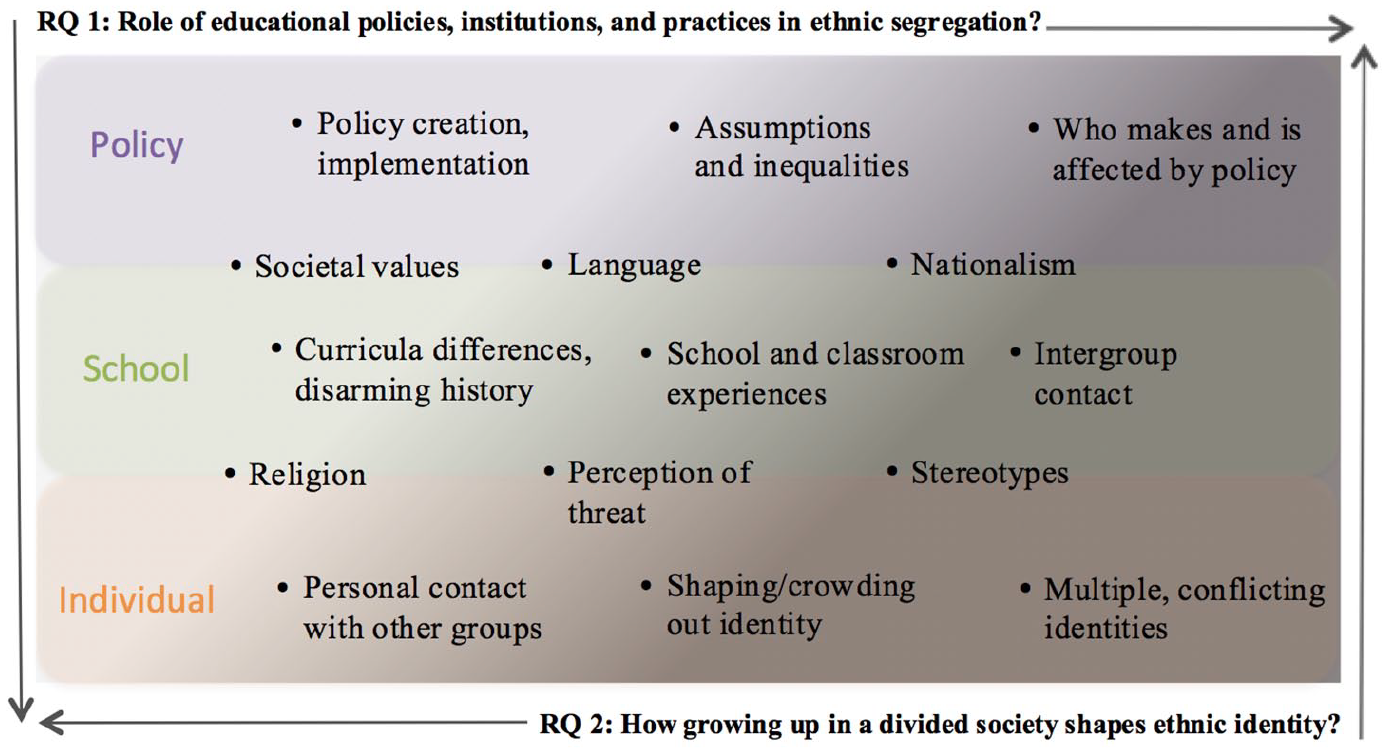
Framework for analysing the research questions.
Question 1: what roles do educational policies, institutions, and practices play in perpetuating ethnic segregation?
Recent shifts in education policy demonstrate that North Macedonia may be ready to promote interethnic education. To reduce damaging nationalism and negative stereotypes, contact theory suggests bringing students of different ethnicities together, ideally in repeated ways that allow for developing deeper relationships (Pettigrew and Tropp, 2006). Exposing students to multiple historical narratives, if done by building consensus and fostering discussion about the contested nature of history, is one step toward achieving this aim (Freedman et al., 2008; Metro, 2012).
Previous policies like the 2004 NSDE and 2009 SIE referenced integration, but did not germinate policy changes. The NSDE suggested students should participate in voluntary multiethnic activities using “multicultural forms and [promoting] social cohesion and association,” though without a plan to specify, implement, or fund such activities (47). Similarly, the SIE was never fully implemented, rather,
[d]omestic politicians cherry picked the recommendations they felt would increase their popular support [including increased Macedonian nationalism and a push for an ethnically “clean” Macedonia free of other groups, Albanians in particular], neglecting others and indicating the limited role that external actors could play in resolving ethnic issues in the post-conflict context. (Koneska, 2012: 45)
The assessment by Loader et al. (2018) of the SIE found funding constraints left schools struggling to transport students to the sites of multiethnic activities. As a result, when staff from one partnership attempted to walk students to the other school, the group encountered ethnically motivated violence. While programs such as USAID’s IIEP helped roll out mixed-ethnicity initiatives, they also met political resistance (Koneska, 2012; Loader et al., 2018), some of which stems from a nationalistic fear that ethnic Macedonians are continually losing ground.
Marija, a Macedonian non-profit worker in Skopje, commented: “[Macedonians] will be the minority in 50 years and we need to be secure in our place in our homeland. . . [Macedonians] fear that they will end up. . . people without a country.” This dread of losing their country was echoed by other Macedonians, including Goran, a Macedonian non-profit worker from a different organization. However, Goran indicated that nationalistic perceptions might be shifting toward acceptance of non-dominant groups: “I don’t think anything significant has changed since 2001, except our mindset. Our neighbours [Serbia, Bulgaria, Greece] are bullies and we thought that was the right way, but now we know it’s not. We can recognize and accept Albanians now.” That Macedonians must be “bullies” to protect their national identity illustrates how Macedonians defined themselves in opposition to those around them. This antagonistic mindset limited national reform and increased the divide between ethnic groups.
Political motivations surfaced repeatedly as a challenge to implementing interethnic initiatives. Several participants referenced intentional government actions to keep ethnic groups separated. According to Luljeta, an Albanian youth worker and former student at Goce Delcev during the 2001 conflict, promoting intercultural dialogue sometimes conflicted with the goals of government, preventing widespread support for her organization’s projects: “When I’m working on the process and have the local municipality doing the contra process and you don’t have the support of the local or the national government, the effects [cancel each other out].” Joan, a US-based researcher on a multiethnic teacher training project, echoed these sentiments: “While the educators may have changed individually and in their treatment of students, little public policy shifted in the schools and town.” Joan projected a bleak future for the country’s interethnic initiatives, explaining that in a best-case scenario reconciliation programs could be self-sustaining in five to 10 years, “but that is with real support and real solidarity and I don’t think that exists [currently in North Macedonia].” Recent political shifts, however, indicate openness to increased cohesion.
Protests against government corruption in 2016 united Macedonians and Albanians. In addition, the CSE aims to improve “the acceptance of multiculturalism, interethnic integration, respect for diversity and democratic values” (2018: 19). It acknowledges some textbooks are “obsolete and contain stereotypes, prejudices, stigmatization and lack elements of coexistence, respect for diversity, integration, multiculturalism,” adding that revisions are not currently supported by legislation (CSE, 2018: 40).
Though the NSDE began to address the problem of textbooks and history curriculum, it did not lead to the removal of ethnocentric content or spark training to equip teachers with tools to discuss historical events with more nuance. Twelve years after the plan’s initiation, the same conversations take place in education spheres. In contrast, Luljeta emphasized, “History teaching is a big issue because the Albanian teachers skip the part of the Macedonians and they start teaching about the Albanians from other sources and Macedonians do the same.” A recent examination of whether Macedonian history textbooks facilitate multiethnic acceptance or foster division, Petroska-Beshka and Kenig (2018) found that while steps have been made to improve teaching polarizing histories, divisive and biased content is still taught across the country.
To improve this situation, CSE’s Action Plan seeks to increase funding for language teaching and place interethnic activities in 80% of ethnically mixed schools by 2020. However, it does not specifically address obtaining funding, training, or school and teacher support for such initiatives. Moreover, it lacks clarity around who benefits from which parts of the plan, lumping special needs, interethnic, and other non-traditional education into one category. A critical examination of the unspoken policy assumptions behind the CSE suggests that while the policy pays lip service to advocates for interethnic initiatives, success will be difficult given the absence of clarity. Considering that previous interethnic policies have not been fully realized, complete implementation may be challenging. Hatixhe, an Albanian employee at the MoES, expressed concern about the disconnect between government plans and implementation. She referenced the SIE somewhat optimistically: “These [questions of ethnicity and integration] are very serious issues. I will be happy if things start moving because on paper we have a strategy and now it would be good if we start doing something in practice.” Ultimately, the SIE was only partially realized, in a way that primarily served politicians and did not move the country’s education system to increased integration (Koneska, 2012).
A further impediment to widespread interethnic education relates to language use and rights. North Macedonia grants language rights to non-dominant groups to learn in their native language, but has historically limited focus on integrating ethnic groups. The CSE proposes to achieve contact through joint teaching of extracurricular activities and languages, improved spaces for integration, and building multiethnic interpersonal and social competencies. Nevertheless, there is still strong resistance to learn the language of the other. Beti, a Macedonian in an organization for multiethnic issues, reacted to the question of whether Macedonians should have to learn Albanian with a strong but common response: “I don’t think it’s a problem for Macedonians to be able to learn Albanian, but they shouldn’t have to. We live in Macedonia, and [Macedonian is] the main language, so people should learn it in order to be able to interact.” From her perspective, Albanians had the right to learn in Albanian, but that did not diminish the need for them to acculturate to the dominant language.
For many Albanians, however, the fact that Macedonians overwhelmingly choose not to learn Albanian delegitimizes Albanians’ citizenship in North Macedonia. Luljeta explained, “[f]or Albanians, if you know the Macedonian language and the other side does not respond to your language, I would say this is making tensions for the Albanians.” A new law elevates Albanian to official status and presents an opportunity to rethink this view and formulate policy accordingly, though it alone cannot change the will of each group to learn the language of the other. As Hatixhe explained, “[p]eople need to feel the need. It helps with respect and understanding.”
Question 2: how does growing up in a divided society shape individuals’ ethnic identity?
The identities that developed in participants were complex manifestations of the way individuals perceived themselves and people from other ethnic groups. Ana, a Macedonian English teacher in a Macedonian school, exemplifies this dynamic through her explanation of Albanian–Macedonian relations in Kumanovo:
Things were integrated before the war, and there are problems on both sides, but if an Albanian went into a Macedonian area [now], probably nothing would happen, but if, for example, I went into an Albanian area, they would hiss and probably grab at me.
As a result of living in a city with segregated schools and communities, Ana viewed the world through a lens that reflected this separation. Her assessment of the safety difference between Albanian and Macedonian areas did not hinge upon examples where she or someone she knew felt unsafe, but in a broad and largely unsubstantiated perception of Albanian spaces as unsafe for Macedonians.
Luljeta, the Albanian non-profit worker, countered this narrative, explaining why Albanians felt unsafe in, and consequently did not frequent, Macedonian areas of town: “[Albanian] kids were going out [to the theatre] and a bunch of the other [Macedonian] kids attacked them. And then they stopped coming to the theatre.” Taken together, these stories illustrate a tendency to oversimplify conflict in a way that blames the other group. The reality, however, is rarely that simple, and includes instances of prejudice and violence across groups.
Biljana and her brother, Ace—Macedonians and former students at Goce Delcev concurrent with Luljeta during the split—told of a Macedonian friend with a secret Albanian boyfriend who was stigmatized by her family and community when they found out:
Biljana: [Her] brother. . . saw her kissing him at the disco. And. . . he calls her parents—he has a fit right there. He hits her in front of her friends, drags her out by the hair, screaming and crying, puts her in a cab. . . he started screaming, “an Albanian, what are people going to think?” and she was banned from going out for two to three months. This was five years ago, when she was 25. . . And the really sad thing is, after that episode, after people saw her kissing that guy and her brother yelling, she hasn’t been able to have a boyfriend. . . The point is she’s been with an Albanian. . . Ace: From the Macedonian mindset, if a girl has been with an Albanian, she’s been spoiled.
This story illustrates how prejudice and stereotyping, taken to an extreme, can damage those who try to break down divisions. While a radical example, the ideas of “spoiling” and “purity” came up more than once in reference to interethnic relationships. As Biljana explained, “[In] the few instances that I know of. . . of a Macedonian and an Albanian getting married, they can’t make it in Kumanovo. They have to move out to a third place [and] start all over again.”
Interestingly, stereotyping and ethnocentric thinking spanned community and professional affiliations. Participants across these identity groups expressed similar sentiments towards the other. For example, while Ana, the Macedonian English teacher, emphasized that more educated people integrate more, citing her choice to send her children to an Albanian doctor, the overarching sentiment was that her children’s doctor and some other educated Albanian individuals were exceptions. Despite professing to have Albanian friends, the stereotypes she embodied about a Macedonian female entering a predominantly Albanian space revealed a level of discomfort with Albanians that may not have been conscious, but was no less important in the context of contentious identity development. Though Ana’s personal experiences with Albanian “friends” and her children’s doctor seem to have nurtured positive feelings toward certain Albanians, these feelings coexisted with negative stereotypes and fear about the other that became intertwined with how she identified as a Macedonian. Due, in part, to the historical struggles between groups, Ana internalized negative feelings in a way that limited how she could view Albanians. Rather than using positive experiences with individuals to shift her perception of Albanians as a group, she seemed to mark individuals as exceptions to the undesirable and unsafe majority.
Ace and Biljana echoed similar sentiments, notwithstanding their desire for a more open and accepting society. Like Ana, they highlighted exceptions to an otherwise generalized negative feeling toward Albanians. In the excerpt below, she explains that despite exceptions, many Albanians are unqualified workers with jobs gained through political appointments:
Biljana: Mind you, I’ve met some really good Albanians. . . but with one [competent worker] come five people who can’t even spell the alphabet. You get all kinds of people. … I’m not saying all of them are bad, I’m just saying the system is wrong. They do have good people, but they can’t come out on top because maybe they are not involved with a party. It’s the same with the Macedonians. Either way. . . the system is not helping anyone. . . Even with the Macedonians, the system doesn’t know how to extract the best, and that’s why people leave.
As they spoke, their focus on Albanians’ corruption shifted into an affirmation of political corruption more broadly. Moreover, in the way her discourse progressed from the description of an ethnic issue into a generalized concern across ethnic groups, it seems Biljana unconsciously adopted particular aspects of culture and structure, such as a stereotyped belief that Albanian ministers make unqualified political appointments, while initially ignoring that this happens with Macedonian ministers as well. By supressing the knowledge that nepotism spans ethnic groups, Biljana momentarily suspended her position that political corruption was a problem holding North Macedonia back as a country in favour of one deriding Albanians and labelling them collectively as a problem. This example illustrates how ethnic identity at times overrides political and social affiliations.
Conflating ethnicity and corruption became part of how these siblings conceptualized Albanians and, in turn, how they saw themselves as Macedonians. Political corruption and government effectiveness have been cited as one of the largest remaining challenges for North Macedonia’s EU ascension (Grieveson et al., 2018), yet these issues are muted in the face of ethnic difference. Widespread political corruption manifested in the minds of Ace and Biljana as an “Albanian problem,” limiting opportunities to see beyond ethnicity to the broader issue of nepotism. This manipulation of ethnic difference was, in the eyes of some participants, a means to keep the country divided and allow the political elite to benefit from a separated population that, divided, was less likely to demand collective rights, a finding supported by the contention by Stephan et al. (2000) that the dominant group (the Macedonians) would cite realistic threats as reasons for maintaining separation.
Another topic that surfaced frequently, particularly in interviews with Macedonians, was religion—specifically, the increasingly visible markers of Islam, like mosques and women in hijab, after 2001. Biljana and Ace summarized this sentiment in a discussion of changes they observed:
Biljana: The first thing that hits you [coming into Kumanovo] is the large number of mosques being built. They’re being erected overnight. . . At the time we were high school kids, we didn’t know the word Madrasa and now all the girls go to Madrasa to learn the Islamic way of living. . . Ace: We started seeing women dressed in hijab. We had never seen women dressed in a hijab before. . . Biljana: Now there’s this stream of people [everyday] going to the mosque for their prayers. They never did that before. . . Ace: The people we would see going to the mosque were really, really old. But now, [they] are young. . . our age or even teenagers.
While no participants spoke of adverse impacts from increased religious practice, religion came up repeatedly as a marker of difference between groups.
Goran likened the visibility of hijab and other visible religious markers to an influx of Kosovar Albanians:
Albanians from Kosovo moved to northern Macedonia and they cause the problems. . . Many Albanians lived in Macedonia for generations, but in the north, they’ve moved [here] within the last 50 years. . . People who got along now don’t get along for religious reasons.
While religion now plays a role in segregation, increased visibility of religious markers is a result of unifying ethnic and religious identity, which was originally propagated in an effort to consolidate Macedonian power by differentiating Albanians and marginalizing them (Krasniqi, 2011). Once Albanian religious identity became synonymous with ethnic identity, these religious symbols—headscarves, beards, mosques—became, for many, outward symbols of Albanian identity. As such, they serve as visible affirmations of Albanians’ existence within Macedonian society.
Interestingly, though religion surfaced in interviews across ethnic groups, cities, and professions, Christianity was not discussed in the same way as Islam. Whereas Macedonians overwhelmingly spoke about Islam as a factor negatively differentiating Albanians, neither group spoke about the Orthodoxy of Macedonians as a distinguishing trait. This difference could be due to the fact that during Yugoslavia religion was minimized in favour of a more secular state. However, another influential factor could be that the dominance of Macedonian culture, language, and religion made it somewhat invisible, an uninterrogated assumption of what constitutes the norm in North Macedonia.
Luljeta shared similar stories of division, illuminating another dimension of this segregation—stereotypes groups hold about the other:
Realistically, there are no risks, but there are fears and I would say it’s more stereotypes. . . In Kumanovo, you have a separate city. It’s almost divided where you have an Albanian part and everything they need, they have it in that area, and the Macedonian part.
This division was observed particularly among participants with more limited or superficial contact with people from the other ethnic group and was particularly noticeable in the teacher’s lounge at the mixed-ethnicity school where I taught English. At the long table separated by ethnicity and gender, my choice of seat simultaneously brought approving smirks and averted eyes. I had to be careful to greet everyone and change my location at the table daily or, better yet, within the same 20-minute coffee break. Too much time with one group would result in someone from the other asking if I was learning that language better or if I associated with more people from that ethnicity outside work. In this context, even drinking coffee was a political statement and the questions and comments about my ethnic affiliations suggested the tension associated with segregation.
This emphasis on ethnic difference also played out in the classroom: in an interethnic afterschool English program, several fifth graders refused to sit with students from the other ethnicity. Two walked out in protest. This experience served as a barometer for what kids were learning at home, in the community, and from teachers and peers at school. It suggested the complicated way students conceptualize themselves and others, even at a young age. Despite challenges to integration, Filip, a Macedonian non-profit worker, extolled the benefits of bringing kids from different ethnic groups together:
A kid that never met the other ethnicity, that moment when that kid will get the chance to hang out with the other, the Albanian or Macedonian, and they will see that it’s nothing so complex and not acceptable, that kid will never be the same.
In essence, contact, specifically structured contact in schools, can expose students to the other, countering stereotypes and humanizing people from other groups—what Metro (2012) likens to “stepping into the other’s shoes [which] seemed to make one’s own shoes fit differently afterward” (np).
Conclusion
Since 2001, education policies have operated on an assumption that providing mother-tongue education creates equality between groups. The elevated status of Albanian to an official national language and the emphasis on integration in the CSE present opportunities to move beyond conceiving of language as a right to promulgating social cohesion and integration. If implemented fully, the CSE has the potential to combat some of the deep-seated stereotypes and nationalistic attitudes that influence individuals and perpetuate segregation between groups, bringing the country closer to the EU goal of social cohesion. But the nation must first get to the point where unity and dialogue are possible.
As a policy, the CSE elucidates efforts toward European integration and shows how North Macedonia, though not yet a part of the EU, is relevant to the European educational space. This space, which was conceived as a way to embody a collective vision for Europe, combines citizenship, knowledge, and competence toward a goal of establishing a unified set of European values (Lawn, 2003, 2011). Europe is continuously evolving and redefining “Europeanness,” and political actors in Eastern Europe have been part of formulating this active definition of the meaning of Europe (Paasi, 2001). The European education policy space has been and continues to be constructed amid tensions between a desire for a cohesive vision of European values and the various national education systems and their embedded traditions and histories (Grek, 2014). Moreover, policy transfer and borrowing have gained popularity in Europe and elsewhere, making it essential to understand countries on an individual level in order to know what happens at each point in the transference of a particular policy idea from one context to another (Burdett and O’Donnell, 2016).
As Ana’s comments demonstrate, when teachers have contrasting views of other ethnic groups, those attitudes may carry over into the classroom. This can happen in the language teachers allow (and use) and in how views of the other are reinforced in history teaching. As a result, when teachers focus on the particular version of history supported by their ethnic group, they perpetuate their national myth, which can send messages to their students that their group is superior, furthering division. Macedonians and Albanians, including young students, embodied segregation in their daily lives by selectively embracing stereotypes and making generalizations about the other that became intertwined with the way they viewed the world and how they perceived themselves within it. They constructed their ethnic identities in and around struggles for legitimacy, often in opposition to the other, even when simultaneously professing to understand that ethnic divisions benefited politicians, not citizens. In essence, stereotypes and ethnocentric thinking at times trumped community and professional affiliations. In these moments, participants seemed to speak primarily as part of the Macedonian or Albanian ethnic group, placing other identities and affiliations on hold. Interestingly, in the case of Biljana and her brother Ace, despite obtaining high levels of education abroad and professing a desire for cohesion in the country, they still held negative stereotypes about Albanians and succumbed to ethnocentric ways of thinking. Unfortunately, these patterns can have lasting impacts on the relations between groups.
Fear, whether tangible or perceived, can act as a powerful marker for the way social forces impact ethnic identity. For citizens of North Macedonia, the self develops amidst struggles for legitimacy, and as assumptions are made about the nature of these struggles, they manifest as policies that further segregation. Schools foster the development of ethnic identities in and around viewpoints sanctioned by students’ teachers and peers (Bekerman et al., 2009). As such, Macedonian and Albanian youth become more susceptible to negative ethnic stereotypes and polarizing nationalism as schools become more segregated and students have less contact with people from other ethnic groups. This division leaves students without counterexamples to ethnocentrist perspectives, increasing the possibility for future conflict (Trajanoska and Jenne, 2008).
Historically, the disparately implemented policies brought forth by North Macedonia’s MoES and the way they play out to create segregated schools, unequal language divisions, and contentious identities, jeopardize the country’s stability. Recent moves to obtain membership in the EU and NATO, and to prioritize integrated education initiatives, give North Macedonia a chance to rethink ethnic rights. Public schools can serve as a mechanism for teaching inclusion and dispelling negative stereotypes, but to do so requires a reconceptualization of ethnic difference and a broader European vision of identity that favours cohesion. As Petroska-Beska and Najcevska (2004) emphasize, “[t]he school system is, potentially, the single most effective mechanism for introducing the kind of social change necessary if the rhetoric of reconciliation employed by political leaders is to be translated into practice” (4).
As North Macedonia prioritizes social cohesion, it is in a position to serve as a case study for integrated education that could positively impact other segregated societies. Particularly unique in this context is the multilingual nature of its ethnic groups. A closer look at North Macedonia has relevance in the increasing linguistic diversity of countries like Germany, Belgium, and Sweden as they wrestle with questions of language and culture in educating rising numbers of immigrants. To effectively promote the European value of social cohesion and contribute meaningfully to the European educational space, the country must commit to setting standards that require teaching histories of, learning languages of, and interacting with the other. “[When] people fight with and over versions of history. . . they are also fighting for particular versions of the future” (Holland and Lave, 2001: 27). A cohesive European identity would give citizens of North Macedonia the best chance to fight for a prosperous future.
Footnotes
Declaration of conflicting interests
The author(s) declared no potential conflicts of interest with respect to the research, authorship, and/or publication of this article.
Funding
The author(s) disclosed receipt of the following financial support for the research, authorship, and/or publication of this article: Research for this article was partially funded by a Boren Fellowship provided by The Institute for International Education’s National Security Education Program. The views expressed in this article are the author’s own and not necessarily those of the funding agency or the U.S. Government.
