




Abstract
Although there is an extensive body of literature on the causes and consequences of early school leaving (ESL), little is known of how early school leavers cope with their situation after having left the education system. This paper’s main objective is to fill this research gap. At first we look at developments in the social positioning of early school leavers in Austria that show that their situation has deteriorated not only because of changes in the labour market (e.g. due to globalization) but also because of displacement processes that are influenced by habitus formation and capital endowment. Drawing on Bourdieu’s concepts of habitus and capital, we explored the situation of young people who had left school early. We used a multi-perspective approach and conducted 123 narrative interviews which we analysed by grouping cases that demonstrated similar social practice and perception patterns generated by a set of socially learned dispositions. Thus we were able to reconstruct a habitus typology consisting of seven different types: the ‘ambitious’, the ‘status-oriented’, the ‘non-conformist’, the ‘disoriented’, the ‘resigned’, the ‘escapist’ and the ‘caring’. How young people experience stigmatization is the common thread that runs through all seven habitus types.
Introduction
According to Eurostat, an early school leaver (ESL) is a person aged 18 to 24 ‘whose highest level of education or training attained is at most lower secondary education and who received no education or training (neither formal nor non-formal) in the four weeks preceding the survey’ (Eurostat, 2019). 1 In other words, early school leavers lack education beyond compulsory schooling and are as such considered to be low-qualified. The risk of long-term unemployment and social exclusion is for them greater than for most other societal groups. In many cases this leads to economic marginalization as well as to physical and mental distress (MacDonald, 2011; OECD, 2016; Simmons et al., 2014) which, in turn, may jeopardize social cohesion, decrease political participation and democratic awareness, reduce economic growth and tax revenues and thus cause considerable costs for society (Belfield and Levin, 2007; Brunello and Paola, 2014).
In the beginning studies on early school leaving focused mostly on personal characteristics and thus did not take sufficient account of social and institutional risk factors (e.g. Voss et al., 1966), a situation that has been rectified by more recent research (e.g. Downes et al., 2017; Lessard et al., 2008). Most studies and typologies on early school leaving concentrate on its causes (e.g. Bowers and Sprott, 2012; Doll et al., 2013; Fortin et al., 2006; Lessard et al., 2008; Menzer and Hampel, 2009; Rumberger and Lim, 2008; Witte et al., 2013). Studies, and especially typologies, that focus on what happens to early school leavers after they have dropped out hardly exist (e.g. MacDonald, 2008; Tomaszewska-Pękała et al., 2017). This study aims to fill this research gap and explores the diverse ways in which this group of young people cope by reconstructing their habitus and capital endowment. Thus, we can present the core element of our comprehensive study of early school leavers in Austria, namely a habitus typology consisting of seven different types. The main result of our research emphasizes Bourdieu’s relational research paradigm: habitus is a relational concept intrinsically linked to the early school leaver’s capital endowment.
Theoretical concepts
Before enlarging on Bourdieu’s concepts of habitus and capital, we contrast the situation of people with low qualifications with that of 40 years ago in terms of their education and inclusion in the labour market. In 1980, 46% of the Austrian working-age population had completed only compulsory schooling (ISCED 1-2) (see Figure 1), while in 2015 it was 19% only (Statistik Austria, 2018).
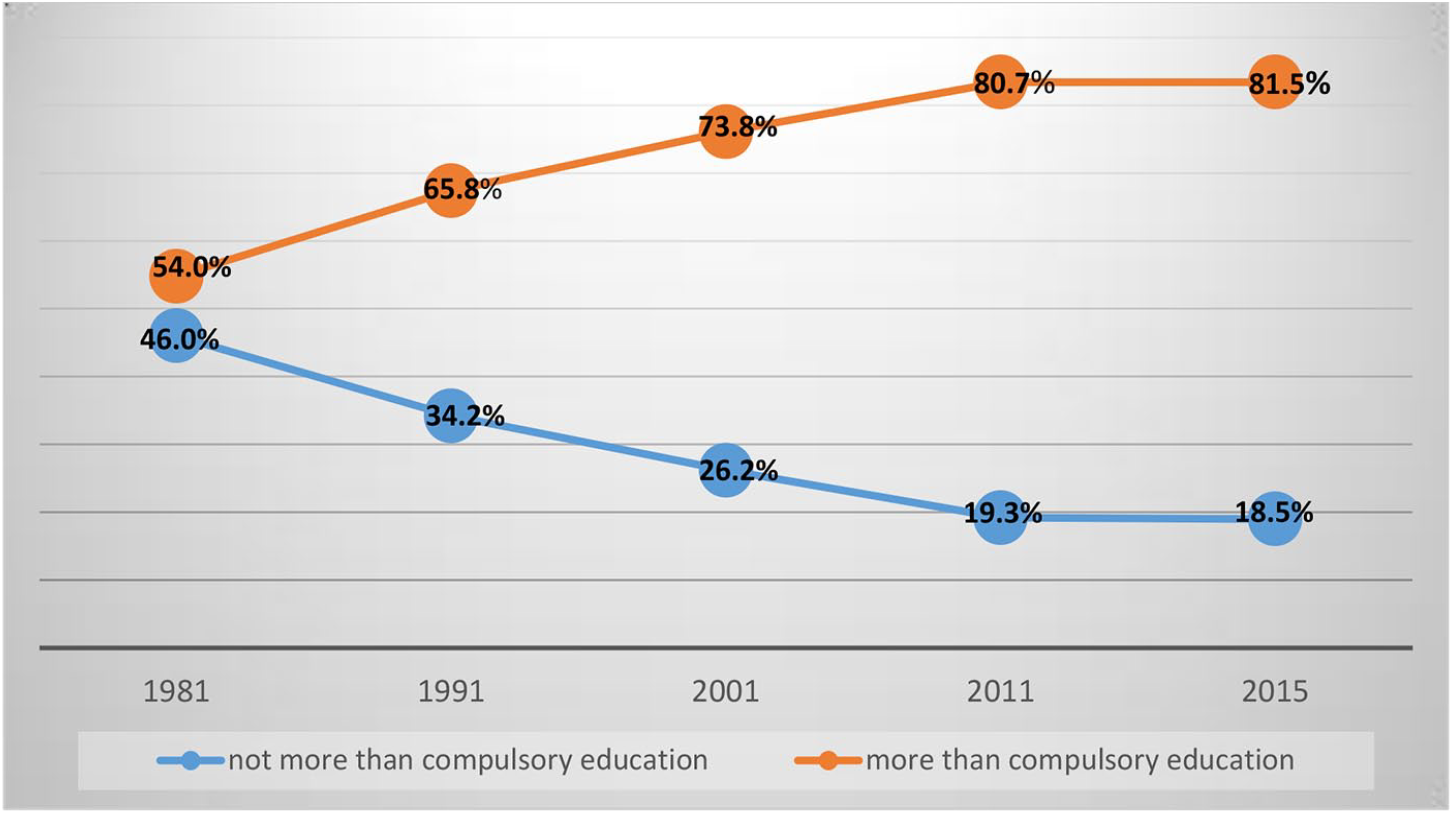
Educational status of the Austrian population over time (25–64 year-olds).
As far as inclusion in the labour market is concerned, the early school leavers’ high level of employment in 1980 is, when compared to present figures, remarkable (men: 80.1%; women: 43.4%; Statistik Austria, 2015). In contrast, low-qualified people currently constitute the largest share (45%) of the unemployed in Austria (Arbeitsmarktservice Österreich, 2018), despite only constituting a small proportion of the entire population. This precarious situation for early school leavers is not only an Austrian phenomenon but occurs across the European Union where almost 60% of this group are unemployed – a rate that is four times higher than that for young adults of the same age cohort who have attained an upper-secondary education certificate (15% versus 60%; Eurostat, 2018).
The causes of early school leavers’ exclusion from the labour market point first and foremost to the education expansion (see Figure 1) that has led to displacement processes both in the education system and in the labour market. At the same time, as a result of technological progress (e.g. digitization) and the ongoing transition to a knowledge and service economy, the demand for unskilled workers is on the decrease. Continuing globalization and outsourcing of unskilled tasks to low-wage countries likewise aggravate the situation of early school leavers. Such displacement processes are always induced when ‘the volume of corresponding jobs (. . .) varied over the same period [and] the number of diploma-holders has grown more rapidly than the number of suitable positions’ (Bourdieu, 1984: 128), that is when education and employment have expanded at different rates. This unintended consequence of education expansion (Hadjar and Becker, 2009) leads to a devaluation of qualifications and confirms Bourdieu’s theory that medium and lower academic qualifications are ‘most affected by such devaluation’ (Bourdieu, 1984: 128). However, explanations that focus on the devaluation of academic qualifications and the dynamics of the labour market fall short when it comes to explaining the weak social position of early school leavers. Successful transition from school to work strongly depends on one’s capital endowment and the structure of the education system (Ecorys, 2013; Gesthuizen et al., 2011; Van Alphen, 2012).
An education and training system that is highly stratified according to socio-demographic characteristics – as is the case in Austria – results in a more homogeneous group of early school leavers comprised mostly of young people with less (acknowledged) cultural and social capital. These early school leavers often feel stigmatized or shamed for not having achieved what is socially expected, namely upper-secondary level qualifications. Some studies draw attention to stigmatizing labels like ‘early school leaver’ or ‘low-qualified’ that are used in public policy discourses (MacDonald, 2008; Rumberger and Lim, 2008; Witte et al., 2013). A similar effect occurs when educational researchers define young people by ‘something they are not, something that they do not have or, generally, their presumed social and economic distance and dislocation from “the rest”’ (MacDonald, 2008: 236). Bourdieu too refers to stigmatization when he recalls the origin of the term ‘category’ which stems from the Greek word kategoresthai, meaning ‘publicly accusing of’ (Bourdieu, 1985: 729). He then points out that the fear of being categorized negatively by others can initiate a process of self-stigmatization. Stigma is thus a phenomenon that arises through a relationship to other people or groups, i.e. through the negative assessment of characteristics (usually of a minority) by those who have the power to decide which characteristics are of value and which are of no value (Bourdieu, 1992). When early school leavers apply for a job they often experience stigmatization by being excluded from certain occupational fields because they do not have the required certificates. However, the exclusion has started much earlier when others noticed their poor capital equipment, different habitus or ‘strange’ language patterns.
The concept of habitus, the core element of Bourdieu’s theoretical work (Nash, 1999; Reay, 2004), refers to a ‘system of lasting, transposable dispositions which, integrating past experiences, functions at every moment as a matrix of perceptions, appreciations, and actions’ (Bourdieu, 1977: 82–83). The primary habitus is acquired through socialization, usually within the family. Further experiences outside the family, above all in education and later in work, successively overlay the original habitus and lead to the emergence of secondary habitus, e.g. a school habitus (Ingram, 2009; Meo, 2011). Habitus as a person’s incorporated learning and life history is a relational concept (Bourdieu, 1992) and as such is closely intertwined with capital in its different forms: social (beneficial relationships), economic (money, real estate, securities, jewellery, etc.) and cultural (diction, lifestyle, academic qualifications, books, etc.). The symbolic capital or prestige ascribed to each of these capital forms (e.g. a language spoken) serves to indicate its owner’s social positioning in the respective field 2 (e.g. the school) (Bourdieu, 1997). In particular, one’s social capital endowment and the resources it provides (e.g. financial support, information) – is crucial for successful re-integration in education and training (Grenfell, 2009) and as such most crucial for early school leavers.
Empirical study
The search for the causes and consequences of early school leaving has been dominated for decades by a statistical, quantitative approach, with such studies far outnumbering their qualitative counterparts. Yet a qualitative approach allows an in-depth understanding of what happens when young people leave school early. Accordingly, when looking at the entire issue from a relational perspective, we opted for a qualitative approach and, in 2009, began with a series of 25 autobiographical-narrative interviews (Schütze, 1983). The interviewees (9 female, 16 male) were between 16 and 25 years old, had all dropped out of school at least once and had been early school leavers for a period of at least four months.
Eight of the 25 young people interviewed came from migration backgrounds: Serbia (2), Kosovo (1), Turkey (3), Cyprus (1) and Afghanistan (1). The interviewees had dropped out of different types of schools such as new middle schools (5), special educational needs schools (3), pre-vocational schools (5), vocational schools (3), academic schools (5) and middle and higher vocational schools (4); some had left school at grade 7, some at grade 11, that is in the year prior to the school-leaving certificate, that entitles to admission to higher education (Matura). Because of these differences, the interviewees’ cultural capital regarding school qualifications was very heterogeneous. We contacted the interviewees through social workers, youth coaches, schoolteachers and university staff. All the interviews took place at Vienna University of Economics and Business. We deliberately chose a room with a young-style décor to ensure that the interviewees felt at ease. To guarantee the heterogeneity of the sample and the variance of the field of study, we selected the interviewees according to the principle of ‘theoretical sampling’ (Glaser and Strauss, 1967). One of the sampling criteria used was socio-economic background.
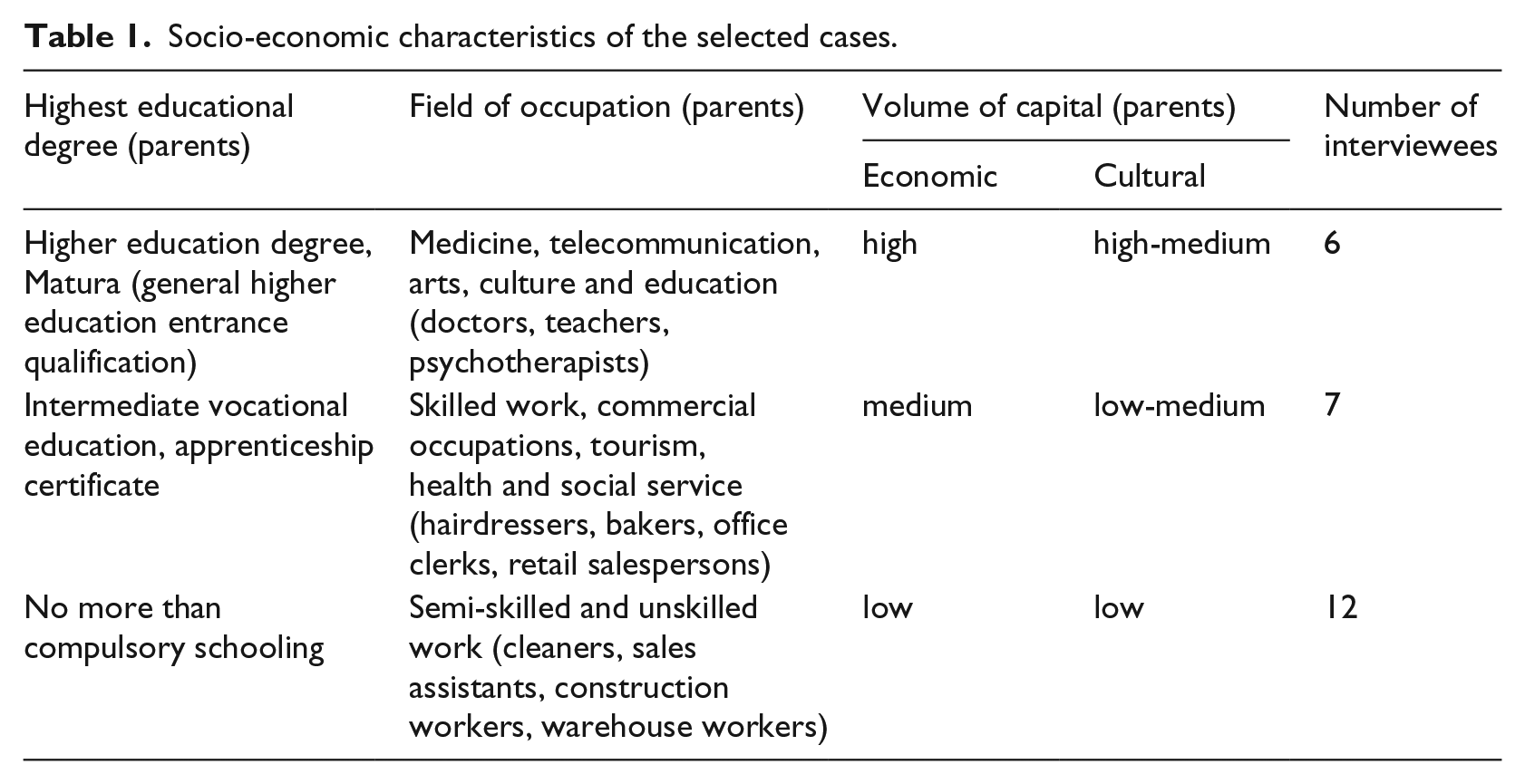
The majority of ESL studies focus on young people from socially disadvantaged milieus and do not sufficiently include the heterogeneity in their social backgrounds (e.g. Finlay et al., 2010; Thompson et al., 2014; Webster et al., 2004). In our study, we sought to select early school leavers from all social backgrounds (see Table 1). The choice of a wider range of social backgrounds proved especially useful for the relational analysis and interpretation of the cases since it clearly revealed the differences in habitus, capital endowments and field experiences. It also revealed the close link between the economic and social capitals available to early school leavers and how this, in turn, set the terms for further socialization in fields outside the family.
Socio-economic characteristics of the selected cases.
The interviews lasted between 60 and 90 minutes and were transcribed in full. All but two of the interviewees arrived punctually at the agreed time. We analysed and interpreted the interviews according to the habitus type generation method proposed by Bremer and Teiwes-Kügler (2010) (see also Kuckartz, 2006). First, we identified and analysed the subjective perspectives and, in a second step, interpreted these in socio-genetic terms. In this second step, we focused above all on the economic, cultural and social resources that were available to the interviewees. Those with similar patterns of social practice were assigned to a specific type. The aim of this type generation was to achieve maximum homogeneity within a type and maximum heterogeneity among the types.
We also aimed to shed light on the specific distinction practices imparted through the habitus that the interviewees themselves expressed to describe or classify their development and education histories.
Main research result: A habitus typology
The typology consists of seven different types and demonstrates the habitus diversity of early school leavers. Thus, we could refute their frequently assumed homogeneity as well as stereotypes that describe them as “culturally deprived”, unintelligent, unskilled, unadjusted’ youngsters who finally become ‘unemployed and delinquent’ (Witte et al. 2013: 15). The seven types: the ambitious, the status-oriented, the non-conformist, the disoriented, the resigned, the escapist and the caring were developed on the basis of single cases, compared with one another and related to each other. They are therefore empirically reconstructed types that emerged through the inclusion of the relational concepts of habitus, capital and field. In methodological terms, they thus constitute real types. Some of the cases fitted a specific type particularly well and can therefore be seen as prototypes. Others represent the types to a greater or lesser degree (Bremer and Teiwes-Kügler, 2010). Each type has been reconstructed on the basis of at least two cases. The disoriented is the most represented type, followed by the non-conformist, the status-oriented and the ambitious. The other types (resigned, escapist, and caring) are, however, less represented. Their retreat from social life made it difficult for the research team to access them. The process of validation of findings took more than three years, during which we consistently conducted further interviews with early school leavers until theoretical saturation has been achieved. The reconstruction of the typology did not differentiate between gender or ethnic groups.
The ambitious
The ambitious type has a very positive attitude towards education. Driven by the desire to flee from a disadvantaged social background (both parents are unskilled workers or work in subordinate positions or are unemployed), early school leavers of this type try their best to obtain an upper-secondary level qualification. They compensate their lack of social capital by establishing social relations or finding friends who can support them, such as teachers, mentors and peers with high academic aspirations: The best thing that has ever happened to me is finding friends, I have met very many, very real, yes I would call them very real, natural people; some of them university graduates. (Christian, 22)
High objectives and performance-orientation are also characteristic for early school leavers of this type who finally manage to re-enter the education system and ultimately conform to the prevailing rules in the school field: I had a ‘D’ in the first term, but then I told myself to change my attitude, I must make an effort and really study, I told myself, and I made an effort and got a ‘B’ in the second term. (Ahmed, 18)
Due to insufficient financial support from the family, this type frequently works while studying for an upper-secondary level qualification. For them, a higher education degree is the key to realizing their aspirations in the future: Yes, I for instance want to finish my apprenticeship positively and I will try to get a vocational Matura and then go to university, well, I cannot say that I really want to study but I want to do so when I get the vocational Matura, for why not, everybody can do what they want with their life, can’t they. (Ahmed, 18)
The status-oriented
Status-oriented early school leavers come from an academic milieu. When compared to the other types, they have much better resources and are much more privileged. Being socialized within an academic milieu, they have developed status affinity which expresses itself in the desire to reach a responsible leading position – although that does not correspond with their realistic situation. To them the parents are role models who emotionally and financially support their children over a long period. The status-oriented type’s ideas of the future focus on getting and maintaining the status of their family of origin: I would like to see myself as, maybe, the manager of the bank for which I worked, that was a super job. Hm, or perhaps as the main bartender in a disco or something like that. I would also like that [. . .] I would enjoy it enormously [. . .] or as a tennis player with full employment in a super tennis club where I would continuously organize tennis camps – yes, that would be my dream goal, to work towards that to achieve that. (Peter, 19)
Their lifestyle – holidays, designer outfits, fitness centres, own apartment, etc. – is still being paid for by their parents, and reflects their visions of the future: If possible, a flat on the top floor with terraces, that would be wonderful and yes, a diving licence. What else do I want? Driving licence, too. And yes, I want to get myself a car, in about five years I want to have my own car, yes, a BMW Z4. (Cornelia, 20)
The dispositions formed within their primary habitus, their expectations and their self-image are based on the past and are no longer appropriate for their current social position. Although status-oriented early school leavers receive financial support from their parents and other family members who also provide them with valuable information capital for their education and careers, they are hesitant to re-enter education and training. With their style of dressing, speech and behaviour as well as their social capital, they easily find a job, but do not keep it, because their status-oriented habitus does not fit the demands of the position within the field.
The non-conformist
Much like the status-oriented type, non-conformists fulfil the prerequisites of a positive educational path with respect to their social background. However, they are sceptical about re-entering the education system. What is conspicuous about them is their use of language. They are oriented towards general, sustainable welfare and their basic attitude is marked by social criticism. During the phase of adolescence non-conformists have developed an aversion towards prevailing social norms and values which has resulted in resistance and a rebellion against school and consequent expulsion.
Great rebellion on my part, that is to say that I [. . .] really picked arguments with my teachers and I did so certainly not in a very diplomatic way rather like a 15-, 16-year-old. (Simon, 25)
Non-conformists feel themselves to be outside the education system and consider schools to be primarily institutions of social segregation and discipline: Of course friendships also develop in school classes, and simply because I kind of failed my exams, I am, hm, this education machine has the nerve to cut these personal bonds. (Roland, 24)
Contrary to the ambitious type, non-conformists are not keen on re-entering the education system because that would mean a betrayal of their ideals: I don’t know, I have often thought of it and it was suggested to me several times. But in the end I could not see what it would bring, ‘OK, what good would the deal be? What for should I do that now?’ (pause) [. . .] As long as I have a chance of doing it differently, hm, I want to try it because I simply think that the status quo is wrong. (Simon, 25)
Since their main worry is becoming ‘bourgeois’, non-conformists opt for an alternative plan of life and accept only (casual) jobs with no bourgeois or conservative connotations in pedagogic, social, arts-based and media-oriented fields. Although they have heterogeneous social networks which also include higher-educated people, the latter still cannot encourage them to re-enter education or training. Only a few non-conformists ultimately enrol in alternative training programmes. Although this form of life is less secure than a so-called normal biography, a rebellious disposition can also open up doors to jobs in creative, arts- and media-oriented fields.
The disoriented
While the three previous types stem from homogeneous social milieus, disoriented types can be found in all milieus with different levels of capital endowment and are financially and emotionally supported by their parents. However, they are unable to decide which career they would like to follow or which educational path to take. They quickly give up on courses or jobs because they do not really identify with the expectations or the role they have to play. Some cases of this type have high social capital but – like their status-oriented counterparts – are unable to use it to successfully re-enter education. They rather ‘drift through life’, with no clear perspective or plan, I would really like to have a plan, a little plan, because without any plan, well, I would love to have at least a little plan or something like a plan (deep sigh). But as it is now, I have no vision of the future, cannot see myself in any vocation or so. (Konrad, 19)
When the disoriented enrol in a training programme, they usually quit quickly because they cannot identify with the tasks they are given or they find some other excuse for leaving: Well, [. . .] carpentry wasn’t my thing either, no, well, I don’t know [. . .] I just cannot make up my mind. (Ismail, 18)
Afraid of opting for the wrong path, they feel inhibited to commit themselves to anything: I thought it would be better to not do anything at all and maybe then something comes along [that is right], better than trying out things. (Konrad, 19)
Even when they are, like Konrad, equipped with high social capital, they are not fully motivated to re-enter education or training.
The resigned
The situation for people of this type is extremely precarious. They come from particularly disadvantaged backgrounds and in some cases even have to break off contact with their families to achieve mental stability.
Yeah, I know where they [parents] live in Vienna and yes, I said (stalled) I’m just not interested in them. They have been torturing me for years with court hearings and stuff like that because they just wanted me to come up for their maintenance costs. (Daniel, 25)
Resigned type persons have very few social relationships, mostly restricted to people who are in a similar situation and as such cannot provide social capital. They usually live in facilities where they are supported by social workers or by care providers who assist them with everyday tasks. The education programmes they are offered are generally restricted to simple, manual tasks and do not provide them with a qualification that would help them to get on in life. Their career aspirations are associated with simple low-skilled jobs or a social or caring profession like taking care of animals. They tend not to expect much of life in general and come to terms with the fact of not finding a job outside sheltered occupational areas: I just resigned myself to not really getting a job. (Markus, 24)
The escapist
Like the disoriented type, escapists come from all social backgrounds. Characteristic of this type is a tendency to want to escape from reality and its challenges. They sleep all day and spend the nights playing computer games or watching TV: At night I play computer [. . .] any ego-shooter games all night long. (Frank, 18) When I turn it on [television], I just notice that I will sit longer. Especially at the weekends, I hardly go to bed, just watching movies and so on. (Ogan, 19)
Addiction and day-night reversal lead to increasing social isolation. They live in worlds of their own, which even their closest family members find difficult to enter: Well, I just want them [family] to leave me alone. (Frank, 18)
All attempts by family members or social workers to encourage them to re-enter education or training or to find a job either fail or have only a short-term effect: On the twelfth of February, school would have started. I bought everything, had everything ready for him but he did not go there. I would have taken him to school, but no chance. He put off his clothes, sat next to me in the living room and hid under a blanket. (Frank’s mother)
The caring
Cases of this type do not exactly fit into our typology since it is mostly the family habitus and capital that inhibit them from re-entering education or training. They have to take care of sick family members and young siblings or other relatives. The parents often need language support when communicating with official authorities. Such commitments forced our cases to leave school early and now they hinder re-entry into education or training: Two weeks before the end of pre-vocational school he [uncle] got ill, he was in hospital and he could not stay there longer, because he did not want to. Then they sent him home and we made a plan then, and then, well, [. . .] I took care of him for two years. (Mirko, 18)
In other studies, early school leavers of the caring type are described as ‘burdened by family’ (Stamm et al., 2011: 73), ‘swamped in family turmoil’ (Lessard et al., 2008: 30) or ‘involuntary dropouts’ (Voss et al., 1966: 363).
Adolescence or the time of transition from school to work or to a vocational training is a critical phase. Young people who do not successfully go through this phase often have the feeling of ‘not being able to fit into a socially accepted place, something that is connected with the idea of falling short of something, with not being accepted, with having failed’ (Kronauer, 2010: 159). Stigmatization is what early school leavers generally experience when trying to find a job. The typology shows that some of them can cope better with these feelings while others aggravate them by self-stigmatization until they finally retreat from social life and become increasingly isolated.
The future visions of the interviewees of our empirical study do not differ from those of young people with so-called normal biographies. They too want to find a job to attain economic independence and to start a family, an observation that is also made by other researchers (Finlay et al. 2010; Rose et al. 2012; Thompson et al. 2014). Our interviewees primarily want to improve their situation in life and almost all of them show a clear labour market orientation that is to say that social transfers make them feel uncomfortable and are generally refused.
Our relational investigation into early school leavers’ vocational aspirations yielded results that show that such aspirations differ according to capital endowment. Early school leavers from parents with higher educational attainment orientate themselves towards jobs that require higher education or that have high social status. Those from parents with lower educational attainment rather speak of jobs in skilled labour. In the majority, their ideas are realistic and realizable. Only two interviewees spoke of so-called ‘over-aspirational dreams’ (Finlay et al., 2010: 865) that is, aspirations clearly unrealistic or strongly influenced by the media such as the career of a professional footballer or of a musician.
Upper-secondary qualification has become the minimum standard and prerequisite of a successful transition into the labour market in OECD countries (OECD, 2016). Our young people have felt what it means to not comply with these norms or social expectations, especially when applying for a job. All our interviewees, independent of social background and habitus, faced high obstacles to finding decent work. Only low-qualified work is available for them. What they experienced when trying to find work using the official ways was mostly exclusion. Their written applications were frequently rejected. Some reported that their applications were not even answered: I didn’t even get a ‘no thanks’ letter back for most of my applications [. . .], even though people working at the companies tell you that they urgently need people in all areas. (Simon; non-conformist, 25)
To most of them the discrepancy between incorporated orientations and the chances to realize them was quite a burden: And then you start to ask yourself ‘Well why didn’t they choose me?’ or ‘Why don’t they want me?’ And it’s bad for your motivation when you get rejection letters. After a while, you start to feel useless pretty much all the time, I would say. (Peter; status-oriented, 19)
The interviewees themselves attributed their lack of success in finding work to their lack of qualifications: It sounds stupid now, but I’m a nobody on paper, I dropped out of school, did nothing instead, lots of temporary jobs; that this doesn’t make a good impression is what I assumed would happen. (Lorenz; non-conformist, 24)
To speak of oneself as a ‘nobody’ is a good example of stigmatization through others internalized into self-stigmatization. The feeling of having no chance to realize one’s vocational aspirations together with the fear of being humiliated again when applying for a job may in some cases lead to giving up actively seeking work through official application processes. These young people are then left with the alternatives of finding work through their own social networks or through recruitment agencies. The latter ‘don’t ask too many questions’ (Oman; ambitious, 22) and it is experienced as positive to not to have to justify one’s lack of qualifications or to legitimize one’s disadvantaged social status. However, a job found through these channels often does not bring full integration into the labour market but is just ‘a dead-end job’ that offers neither social security nor long-term prospects.
Summary and outlook
The typology reconstructed by drawing on Bourdieu’s relational concepts shows that education ‘inheritance’ remains high in Austria (Oberwimmer et al., 2016; OECD, 2017): early school leavers from privileged families with respect to cultural and economic capital are in a less precarious position. However, our findings also show that coming from more privileged social backgrounds does not necessarily lead to successful re-integration into education and training – some habitus forms are clearly better suited for re-entry than others.
Young people whose family background provides them with few resources are particularly disadvantaged regarding education and career. This applies to the resigned, and to some of the disoriented, caring and ambitious. The latter, however, manage to build up social capital, in the form of a support network of coaches, mentors, education and career advisors (see also Raffo and Reeves, 2000: 161, ‘changing individualized systems of social capital’). In the case of the resigned and the caring, family members may even turn into an additional disadvantage. The status-oriented and some of the disoriented and non-conformist serve as evidence that moderate or high capital endowment is no guarantee for re-entry into education. Intervention measures by caring family members or professionals all fail for the escapist who, in this respect, is most at risk of exclusion and poverty.
The status-oriented try to maintain the lifestyle they were brought up in, thus making visible the discrepancy between habitus and possible fields for re-entering education or training (Nairz-Wirth et al., 2017). Early school leavers of the disoriented type might express a desire to return to school or vocational training but have no realistic ideas about their future. They quickly drop out again from any educational and vocational fields.
The young people we interviewed reported school-exclusion practices and also referred to push-out factors such as lack of professional intervention in cases of bullying or lack of adequate support with partial or general learning difficulties. These stigmatizing experiences continued after they had dropped out of school and were a hindrance to re-entry into education. This becomes particularly apparent in our interviewees’ descriptions of the job application process. They sensed that they did not meet the expectations of society, which lowered their self-esteem. Accordingly, their decision to ignore ‘official’ application paths and seek work through social networks and recruitment agencies can be seen as a form of stigmatization management (Goffman, 1963, 1986; see also Gesthuizen et al., 2011; Làmont and Lareau, 2015; Solga, 2002). Early school leavers need access to high-quality education and career guidance, psychological and emotional support (see Downes et al., 2017).
Our typology is based on snapshots of the lives of early school leavers. Furthermore, we should consider that transitions into education and work are frequently characterized as non-linear and reversible (Du Bois-Reymond and Blasco, 2003; Furlong et al., 2011). In other words, wrong choices or failed transitions can be reversed or compensated with the appropriate support. Because of this we followed our interviewees in a longitudinal study to observe how their habitus developed over time. The results will soon be published.
Finally, our typology illustrates that early school leavers are not a homogeneous group of low-achievers (see also Witte et al., 2013). Hence, the study is a contribution to overcoming prejudices which are still common against early school leavers with regard to their social background, behaviour and intellectual capabilities.
Footnotes
Declaration of conflicting interest
The author(s) declared no potential conflicts of interest with respect to the research, authorship, and/or publication of this article.
Funding
The author(s) disclosed receipt of the following financial support for the research, authorship, and/or publication of this article: This study was funded by the Chamber of Workers and Employees, Vienna & MA 23 - EU-Strategy and Economic Development, Labour and Economics Department, Vienna.
