




Abstract
In this article, we study the academisation of the teaching profession in Sweden, which follows contemporary trends in other Nordic and European countries. The specific aim was to analyse 14 reports written by researching teachers enrolled in a master’s programme to investigate how they perceive, interpret and value academic and professional knowledge. The conceptual framework comprises theories concerning academic literacies and knowledge structures. The report analysis focussed on scope, aims and research questions, and how the researching teachers related to teacher knowledge and academic knowledge, normativity and a critical approach. After a preliminary analysis, the researching teachers were invited to participate in the analysis, giving their contextual understanding. The study indicates that the reports were based on empirical data and situated in a professional context, with the aim of exploring and understanding professional issues in relation to research, national policies and professional teacher experience. Report orientation was deeply nourished by teacher knowledge. The researching teachers’ contextual knowledge both benefitted and challenged academic knowledge and vice versa, with the ambition to improve practice. Accordingly, the teachers’ contextual knowledge can deepen the understanding of a research phenomenon. There was an empowering oscillation between teacher knowledge and academic knowledge in the teachers’ research.
Introduction
Academisation is a common and global trend that is transforming education programmes at the post-compulsory stage and at multiple levels, such as Teacher Education (TE) (Kyvik, 2009). In Sweden, where this study is situated, TE has varied according to the subject, school sector and historical period. ‘Seminaries’ or institutions for primary school teachers were established in the mid-19th century, while secondary subject teachers gained their academic subject knowledge at university. At different times in the 19th and 20th centuries, specific TE programmes were established in various teaching areas (such as childcare, fine arts, home economics, music, physical education, textiles, woodwork, metalwork and preschool) (Erixon Arreman, 2008). TE was not formally included in higher education structures until 1977. However, practically, the previous separation of different TE programmes continued in a so-called ‘binary’ form or system, with some courses conducted in the old TE seminaries or colleges and others within the university (Erixon Arreman, 2005a, 2005b; Scott, 1996).
This situation continued until a major national reform created new programmes for comprehensive TE, which were put into place in the late 1980s and affected the previous boundaries between the different programmes and disciplines involved in TE. In order to implement the reform, ‘Didaktik’ was introduced and institutionalised as an overarching philosophical approach, and collaboration was required between actors in different TE programmes and university disciplines. This led simultaneously to demands for the development of research and an extended knowledge base with a closer connection to experience and practice (Erixon Arreman, 2005a, 2005b).
A restructuring of Swedish undergraduate and postgraduate TE took place in 2001 (Swedish Government, 2000; cf. Erixon Arreman, 2008), which resulted in the combining of the various strands of undergraduate TE into one programme. The revised programme covered the education of pupils aged 1–19 years in various education settings including preschool, primary, secondary and upper secondary schools and ‘leisure centres’ (part of compulsory schooling since 1994). A new TE reform was enacted in 2008, to meet the demands of building education on scientific grounds and proven experience. Means for this improvement were to increase the number of university teachers with a doctoral degree. It was stated that TE should be an ‘academic vocational education’ (Swedish Government, 2008: 65). In Sweden today, the field of TE is still struggling to meet the twin demands of the graduate labour market and academisation, with a particular focus on academic writing (Erixon Arreman and Erixon, 2015; cf. Ivanič, 2004).
For several years, academisation has also been taking place in Swedish schools. In 2010, increased academic requirements were introduced in the Swedish Education Act (Swedish Government, 2010). The academisation of the teaching profession follows the contemporary trends seen in other Scandinavian and European countries (Caena, 2014; Cain, 2015; GTC Scotland, 2012; Lunenberg et al., 2007; Skagen, 2006). The current Swedish policy claims that all education should ‘rest on a scientific ground and proven experience’ (Swedish Government, 2010: 5§), which has resulted in significantly greater academic demands being put on teachers in Swedish schools. The new requirements involve increased policy activities at the state level and have enhanced the emerging cooperation of municipality and higher education, as well as between teachers and researchers and, as an extension, obliges teachers to study their own practice as researching teachers. These new policies about academisation imply that teachers should possess profound academic knowledge. This is especially problematic for teachers who have a teaching degree from the time when TE still was not fully academicised, where practical teacher knowledge was prioritised at the expense of academic knowledge. Therefore, it is of special interest to study how experienced teachers tackle the new demands, deepening their academic knowledge and adding to their existing professional teacher knowledge.
Against this backdrop, this study was conducted in a Swedish municipality in which a local strategy was adopted, with the objective to meet the scientific requirements for teaching. As part of this work, together with a university, the municipality has designed a postgraduate programme corresponding to a one-year master’s level (according to the Bologna agreement), divided into four years of part-time studies, with a focus on practical research and school development. Sin (2012) claims that studies conducted within higher education programmes that involve a research component often consider doctoral studies. Therefore, she identifies the need to study master’s programmes, which are seen as the first step in students performing autonomous research, facilitating students’ academic knowledge and competence. We use Sweden as an example, but see it as applicable to other Nordic and European countries that share the same focus on promoting the use of research in schools and teachers’ own research processes.
This article addresses how the experienced teachers that participate in this programme, and of which all have undergone a TE that included different theories in Didaktik with a main focus on conditions for classroom teaching and learning processes (Englund, 2006), deal with teacher knowledge and academic knowledge when writing an academic report in their master’s programme. According to Shulman (1987), teacher knowledge can include: content knowledge, general pedagogical knowledge, curricular knowledge, pedagogical content knowledge, knowledge of learners, knowledge of educational contexts and knowledge of educational ends, purposes and values. These knowledge categories for teaching are both generic and specific, but all relating to a teaching context, a profession. In general, professional knowledge is often associated with practice and practitioners – in our case, teachers.
On the other hand, academic knowledge is associated with theory and researchers, and such knowledge is generated through systematic inquiry and aspires to build theory. Academic knowledge is understood as decontextualised and abstract. These contrasting kinds of knowledge have resulted in the forming of a gap between them (McIntyre, 2005). However, Hamza et al. (2018) argue that this gap in theory/practice and teacher/researcher can be bridged and reduced if research and teaching are regarded as two equal practices that meet each other, which might result in both changing based on the interaction. However, we conceive the boundaries between these two knowledge domains as not so clear-cut, but more as a continuum along which researching teachers, in our case, can move.
The specific aim of our study was to analyse 14 reports written by researching teachers enrolled in a master’s programme to investigate how they perceive, interpret and value teacher knowledge and academic knowledge. The study is based on a qualitatively oriented analysis of successfully finalised reports. Our research questions are as follows:
How do the researching teachers relate to policy, previous research and the teaching context in their research?
How do the researching teachers handle the relationship between normativity in a professional discourse and a critical academic approach in their research?
How do the researching teachers use teacher knowledge and academic knowledge in their research?
Firstly, we will give an overview of the conceptual framework relating to academic literacies and forms of knowledge. Secondly, we move on to the method – context, data and analysis – and thirdly, we present the findings and the discussion, where we relate the findings to the conceptual framework.
Conceptual framework
The conceptual framework of the paper combines the research fields of academic literacies (Ivanič, 1998, 2004; Lea and Stierer, 2000; Lillis and Scott, 2007) and forms of knowledge: discourses and structures (Bernstein, 2000) (see Figure 1).
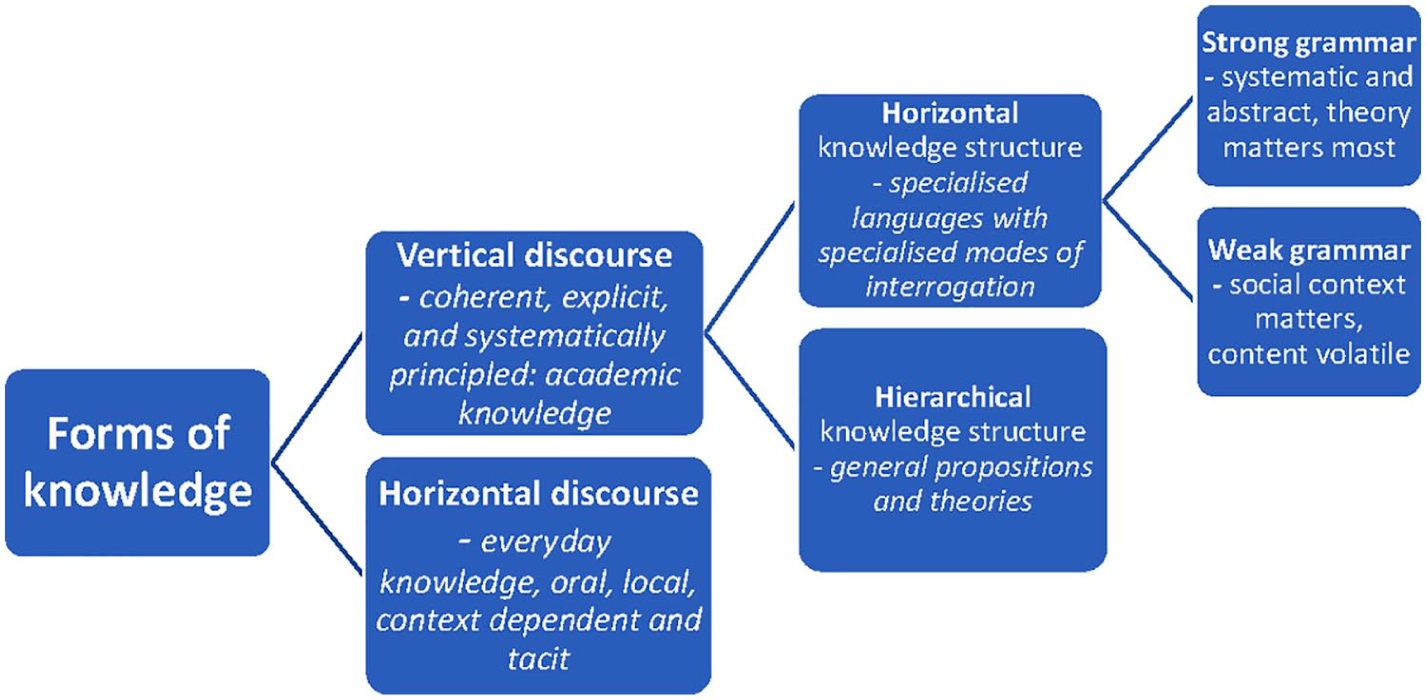
Description of different forms of discourses and structures of knowledge, following Bernstein (2000).
Academic literacies
Written assignments are included in all academic programmes and writing has long constituted the primary artefact of academic education and scientific research (Kruse, 2006), and been materialised in multiple kinds of texts in various disciplinary fields (Becher, 1994; Ivanič, 1998, 2004; Lea and Street, 1998; Sullivan, 1996). Writing involves more than solely producing a text that is emphasised in the research field of academic literacies, which constitutes a specific epistemology (i.e. of literacy as a social practice and ideology). Such a perspective involves a shift of emphasis away from students’ texts towards practices, identity and identification in academic writing, and academic writing as ideologically inscribed knowledge construction (Lillis and Scott, 2007). Academic institutions are regarded as sites of power and discourses (Ivanič, 1998, 2004; Lea and Street, 1998). Discourses are seen as particular wordings and practices, incorporating choices and decisions on what should and what should not be taken into account (Barton et al., 2000; Burke, 2008; Ivanič, 2004). There is also a recognition that academic writing practices are not sealed off from professional practices and programmes in TE.
In the process of learning to write in university education, students meet ‘conceptual gateways’ or ‘portals’ (Meyer and Land, 2005: 373) that might hinder students in mastering sets of literacy practices, including drawing on academic genres and discourses that students might be unfamiliar with. Likewise, Swedish students in Early Childhood Education and Care expressed worries about applying or translating the theoretical subject-based knowledge acquired during their university-based studies in their everyday work in the preschool settings (Karlsson Lohmander, 2015). They stressed a ‘reality gap’ between theory and practice. The same pattern emerges in nursing education (Baynham, 2000).
With a focus on experienced teachers’ writing in academic settings, Stierer (2000a, 2000b) also identified a clash between the professional culture of school teaching and the (higher status) professional culture of the academy. However, this pattern is not unambiguous, like social work students in Rai and Lillis (2013) and Hughes et al. (2011). They found that students’ experiences of thinking critically in another higher education programme – namely, for social work students – were relevant and valuable to their professional writing and relevant to social workers’ future careers.
While all university students seem to rapidly assimilate the ‘dialect’ or ‘voice’ of a particular discipline or field (North, 2005) they encounter early on in their education (Arneback et al., 2017), it seems that writing in higher education programmes directed to a profession tend to be more circumscribed given their explicit connection to professional values and ethics in public service jobs (Borglin and Fagerström, 2012; Drudy, 2008; Moss and Dahlberg, 2008). In such programmes, students might identify themselves as potential members of a vocation and might, therefore, not identify with such academic literacies (Barton and Hamilton, 2005; Burke, 2008; French, 2013).
Forms of knowledge: discourses and structures
To explain the nature of different forms of knowledge, Bernstein (2000) makes a distinction between ‘horizontal’ and ‘vertical’ discourses and ‘horizontal’ and ‘hierarchical’ knowledge structures (see Figure 1).
In the horizontal discourse, knowledge is perceived to be everyday knowledge – oral, local, context-dependent and tacit. Due to its oral nature, this discourse will not be considered in our paper, as it deals with written text. Within the vertical discourse, which relates to the researching teachers’ written texts, knowledge is considered as ‘specialised symbolic structures of explicit knowledge’ (Bernstein, 2000: 160) (i.e. academic knowledge). In this discourse, Bernstein distinguishes between two modalities of knowledge – hierarchical and horizontal structures of knowledge. The hierarchical structures of knowledge operate at a more abstract level and are signified by a ‘coherent, explicit and systematically principled structure’ (p. 157), integrating propositions and theories by refuting former positions into more general propositions. Knowledge develops through the integration and subsuming of previous knowledge at lower levels.
In horizontal structures, knowledge develops by adding on segments of various topic areas; being dependent on a specific social context, it does not necessarily have relevance in other contexts. Horizontal structure involves languages within an area of knowledge that is not transmutable (or transferable); each one of them starts from distinct and sometimes opposed assumptions. In horizontal structures of knowledge, there is a difference between those bits of knowledge that have a specialised language of description with ‘strong grammar’ (e.g. mathematics and linguistics), and those with many languages of description with ‘weak grammar’ (e.g. sociology and cultural studies) 1 (p. 163). In strong grammars of horizontal structures of knowledge, the learner does not have the problem to define whether speaking or writing, for example, mathematics, as the strong grammar explicitly shows that through its ‘explicit conceptual syntax’ (p. 164). This is not the case in weak grammar since in, for example, sociology, the learner is concerned whether the issues relate to sociology, as there are many languages to describe a phenomenon in that field. Therefore, Bernstein (2000) emphasises that, in weak grammar, a particular mode of recognising and realising what counts as an ‘authentic’ sociological reality has to be acquired through a ‘gaze’, a selection and privilege of perspective (p. 165). In weak grammar, contents are volatile, which implies the expectation of change and negotiation of the understanding of knowledge, primarily through linguistic expressions.
Methods
The context of the study
We conducted our study in a Swedish municipality that has adopted a local strategy aiming to meet the scientific requirements for teaching in schools (i.e. that it should be based on scientific grounds and proven experience). The municipality has taken multiple initiatives as part of the strategic work to integrate practice-based research in education – for example, by establishing a scientific leader position in the municipality’s education department and by founding a scientific board for the purpose of promoting scientific activities and structures for school development and teachers’ professional development on a scientific basis. Moreover, the municipality has employed an in-house researcher (the first author) who studies and supports the integration of practice-based research in preschools and schools (for instance, action research projects exploring teachers’ own questions). The municipality has also started a research and development project together with a university that concentrates on the academisation of the teaching profession (the second author is a researcher in that project). Also, together with a university, the municipality has designed a master’s programme in education with a focus on educational research and school development.
The work in the municipality has so far been explored in two papers (Hansson and Erixon, 2019; Bergmark, 2019) on topics related to (a) dilemmas that arise when teachers, higher education and the local municipality come into contact in the pursuit of integrating research in school and in the teachers’ practice; (b) changing roles and relationships between researchers and teachers in action research through a philosophical analysis based on the writings of Nel Noddings, especially the ethics of care concept.
Participants and data
In this study, we explored 14 reports in the master’s programme, which form one part of the municipal strategy of integrating practice-based research into schools. The purpose of the master’s programme is to promote teachers’ academic knowledge, as applied in practice-based research and school development, as well as supporting the principal and colleagues in the work of integrating the practice-based research. The master’s programme might also be seen as a bridge to postgraduate studies aiming at a doctoral degree.
In the spring of the first academic year, 2017, and as a preparation for the final exam, the students completed a minor empirical study – a report – which is the subject of our analysis in this study. According to the study guide, the report is a qualitative research report on scientific grounds (five European Credit Transfer and Accumulation System credits) and should follow the IMRaD form (i.e. include Introduction, Method, Results and Discussion sections) (Sollaci and Pereira, 2004). The writing of the reports was preceded by courses including educational research and school development, introduction to empirical methods and ethical issues in empirical research, with a focus on dilemmas arising while researching one’s own teaching practice. Moreover, the courses included literature searching and academic writing.
In total, 16 teachers handed in their reports. We informed the teachers in the master’s programme about the study both orally and in writing. They were also informed that they have the right to terminate their participation in the study without giving reasons and that the empirical data were to be handled confidentially. Next, the teachers were invited to participate. In accordance with the law on ethics (Swedish Government, 2003), informed consent must be obtained before a study starts. In this case, informed consent was given by 14 teachers. Two teachers chose not to participate. Of the teachers, 13 were female, and one was male. Their work experience ranges from nine to 32 years, with an average of 20.4 years’ experience. Two teachers work in preschool, two in compulsory school (lower grades: preschool class – Grade 6), five in compulsory school (upper grades; Grades 7–9), three in upper secondary school and two are special education teachers.
Data analysis
For analysing the researching teachers’ reports we used critical linguistics analysis (Fairclough and Wodak, 1997; Fowler, 1991; Fowler and Kress, 1979). Critical linguistics is based on the assumption that there are frequent links between linguistic and social structures. Language is seen as a social practice, and the context is considered relevant to include in the analyses (Fairclough and Wodak, 1997; Fowler, 1991; Fowler and Kress,1979). Critical linguists do not just ask the descriptive research question ‘What?’, but also the questions ‘How?’ and ‘Why?’. At each point in the text, choices are available to the writer (Kress, 1983). The data have, for that reason, been analysed through so-called content condensation, divided into two phases (Alvesson and Sköldberg, 2008). In the first phase, we as researchers analysed the content of the reports, which is further described below. In the second phase, the researching teachers were given the opportunity to give their reflections on our analysis. As previously mentioned, this study forms part of a larger research and development project involving six researchers in total. One prerequisite for the project is that preliminary results are brought back to the teachers as both a part of their academic education and as a way to deepening the analysis. Therefore, and in line with Harding (1991), we methodologically distinguish between research reflected on by the researchers themselves (light reflectivity) and the researcher and the participants (strong reflexivity). With strong reflexivity, participants who are experienced in the field reflect (‘gaze back’) on the researcher’s project, led by a researcher who tries to look at the conducted research from the participants’ positions and backgrounds.
Phase I
In our analysis of the reports in Phase I, we created an analysis matrix including area of research (pedagogical content knowledge, pedagogical knowledge or organisational knowledge), point of departure (theoretical, policy or teaching practice), purpose of the study (investigative or modest verbs), literature (policy, research, philosophy or a combination), focus (teacher, student or both) and methods (interview, observation, text analysis, visual methods, questionnaire, miscellaneous). 2 Both authors analysed all reports according to the matrix. We then compared our analyses and compiled the results.
We deepened the analysis by focusing on exploring the text voice 3 (teacher, researcher or both), how contextual knowledge is used and teacher knowledge versus academic knowledge. Again, both authors analysed all reports according to the matrix. After that, we compared our analyses and compiled the results.
Phase II
While Phase I was mainly based on an analysis of the written text in the form of researching teachers’ reports, Phase II focussed the teachers’ oral comments and notes on our analyses. In Phase II, we held a workshop for 10 of the 14 researching teachers (four were unable to participate) to present our tentative analysis and asked for their reflections on it. After presenting our tentative analysis, the teachers worked in pairs or trios, in which they reflected on our analysis. The teachers were asked to take notes, and to send these to us after the session. Questions for consideration were: Do you recognise yourself? Have we misunderstood something? Do you wish to add something? What would you say are the conclusions of this study? In which ways can teachers in preschool and school as well as school leaders use the findings in their own practice? What are the personal benefits for you, for giving a response to an analysis in a study in which you yourself participated? Also, the pairs/trios presented their reflections for the whole group and one of us researchers took notes of the discussion. In the findings section, the teachers’ responses will be presented as part of the data analysis. However, the teachers did not read and analyse all 14 reports, and only responded to our tentative analysis. They could thus reflect on the analysis on a general and not a detailed level. In foregoing seminars within the master’s programme, the teachers obtained a general knowledge of all reports when they were presented and discussed. However, specific knowledge on one report was acquired when the researching teachers were serving as an opponent in the same seminars.
Ethical and methodological considerations
As we decided to undertake a study in the context of a master’s programme where the reports formed part of the examination of the course, it was important that the course was finished and graded before the teachers were asked to participate. When analysing the reports, we as researchers were unaware of the grades given to each report since that was not the focus of the study.
The number of participants might be considered a limitation of the study. However, while connecting the national case to literature based on international perspectives, the findings are elaborated on in relation to the international context. Moreover, there could be some potential weaknesses in the use of the chosen method, namely text analysis, since the analysis concentrates on what is written and how that can be interpreted. We could not claim to know what the intentions behind the words were unless they were shown explicitly in the text. Therefore, to address this possible weakness we decided to discuss our analysis with the teachers, thereby inviting them to give their contextual understanding. Although these challenges related to methodology, we regard our choice of text analysis as sufficient, based on the described procedures.
The teachers’ reports were conducted near their academic supervisors, which means that they could easily embrace their supervisors’ ideas regarding both the content and the form of the report. In line with a recent study on PhD students’ socialisation into an academic culture (Anderson, 2017), we understand researching teachers’ self-monitoring and positioning themselves as key strategies in relation to idealised notions of a successful student – in our case, a master’s programme.
Findings
Our overall analysis included the title, abstract, table of contents and content of each report. The tables of contents indicated that all reports were based, with minor variations, on the so-called IMRaD form, but also expanded to include a section for research overview and theory. In Phase I, the researchers analysed the data. The findings are presented below.
Situating the research in an area
Situating the research includes a manifestation of the area of research in the report. Our analysis showed an even division between reports exploring areas of pedagogical content knowledge and pedagogical knowledge. Researching the area of organisational knowledge was less frequent (Table 1).
Research areas in the 14 reports.
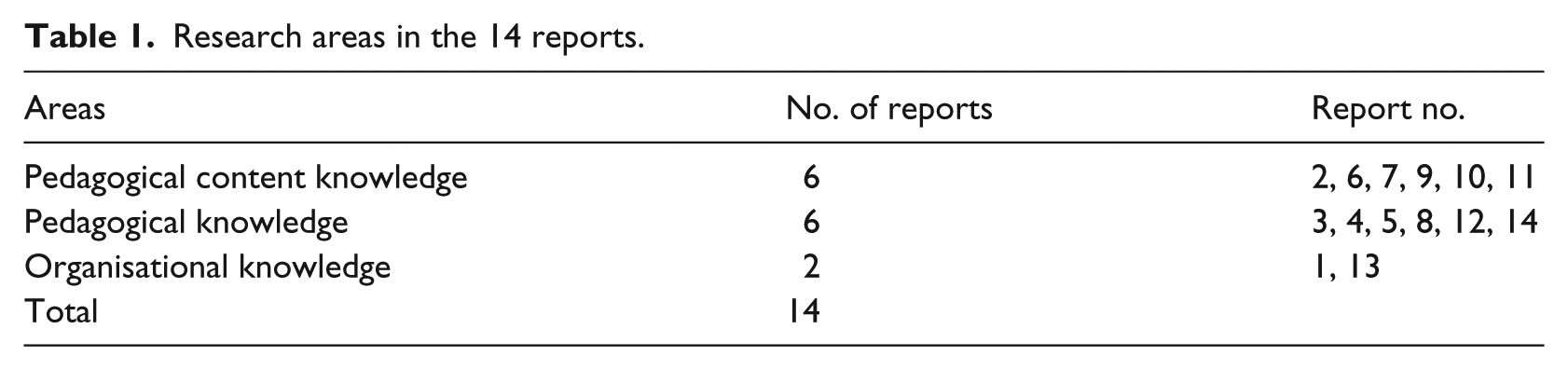
Pedagogical content knowledge related to pedagogical issues in the following school subjects: Music – the learning of note values, students’ experiences of success and failure in music education and playing in ensembles (2, 6, 10); Mathematics – homework and learning of mathematical concepts (2, 7); and Swedish – speech anxiety and reading comprehension (9, 11). Shulman (1987) explains that pedagogical content knowledge relates to ‘that special amalgam of content and pedagogy that is uniquely the province of teachers, their own special form of professional understanding’ (p.8). The pedagogical knowledge related to more general pedagogical issues concerned parents’ knowledge of the preschool curriculum (3), systematic quality work (4), students’ experiences of the school environment (5), assessment (8), development dialogues between teachers, students and parents (12) and newly arrived students’ experiences of transitions between preparation class and regular class (14). Here, Shulman (1987) deepens the understanding of pedagogical knowledge by stressing that pedagogical knowledge represents ‘principles and strategies of classroom management and organisation that appear to transcend subject matter’ (p. 8). Organisational knowledge related to transitions between preschool and school (1) and middle leadership (teachers who lead colleagues) (13). Organisational knowledge relates to what Shulman (1987) terms as ‘knowledge of educational contexts’ (p.8), which is situated on a higher organisational level than the classroom: schools, school districts and nationally on a policy level.
Altogether, we found that these identified issues emerge from the teachers’ knowledge base as acquired from proven experiences in teaching, relating to teacher knowledge in different areas, with an emphasis on pedagogical content knowledge and pedagogical knowledge (cf. Shulman, 1987). The issues were also derived from academic knowledge achieved in theoretical courses in the master’s programme (cf. Hamza et al., 2018; McIntyre, 2005). While dependent on its specific social context, where knowledge is negotiated in the interaction between teacher knowledge and academic knowledge, the knowledge structure is to be regarded as horizontal with weak grammar (Bernstein, 2000).
Text voice
Regarding who speaks in the reports, what voice (Bakhtin, 1981) the reports have, we found that both teacher and academic voices were present in all reports. They were woven together, but in different parts of the reports, representing a continuum between using a teacher voice (based on proven teacher experience) and a researcher voice (in the forms of theories appropriated in their education). When the teachers were situating and formulating the research problem at the start of their reports, a teacher’s voice was present in some cases while in other reports there was a researcher’s voice (Table 2).
Summary of who speaks when formulating the research problem.
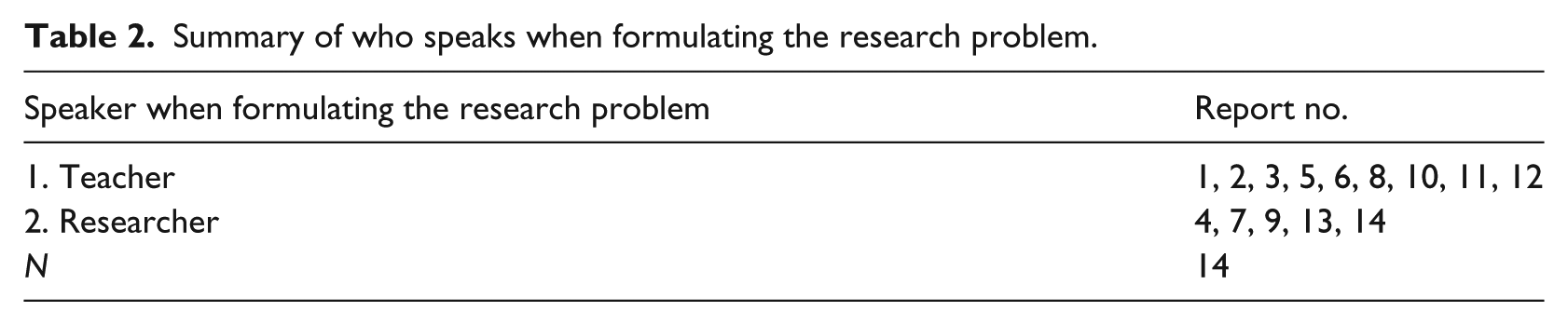
In nine of the reports, the authors started in their teacher perspective and experience when they contextualised the research problem based on their teaching experience.
I started to work as a teacher in the early 1980s. In my first school, the new beginners were given a lot of extra attention. . . . [Nowadays] the introduction takes place on three occasions and consists of a couple of hours of visits to the pre-school class (Report 1).
Here, the teacher compared teaching experiences from the past with the present situation. The teacher believes the introduction has changed dramatically in terms of both content and period, which intrigued her/him to study this phenomenon.
In five of the reports, the teachers indeed situated the research in their teaching context, but the researcher’s voice was strong at the beginning of the report, using their academic knowledge by referring to research and generalised knowledge. The following extract from report 7 provides an example of how the research issue was situated, where the researcher’s voice was present: ‘Homework in Mathematics has been a hot topic in the school debate. Where people have positioned themselves for or against. You also find it in research . . . At our school, different positions have also been chosen about homework’ (Report 7). The teacher started with academic knowledge in a more overarching perspective, addressing the school debate and also research, and then was engaged in connecting the research to own teaching experience. In another example, one teacher situated the research based on previous research and also on educational policy relevant to the study’s context: The students in today’s school communicate orally in many subjects, but a particular responsibility for training students’ oral practice is in the Swedish subject, which is particularly suitable for integrating the school’s democracy and knowledge assignments (Olsson Jers, 2010). The oral communication skills are emphasised in both the primary and lower grades as well as the secondary school’s steering documents [curriculum]. (Report 9)
In this case, the teacher found arguments from both research and policy for the study. Later on, in the report, the teacher connected research and policy to own teaching experience, finding further support for the study.
In one way or another, all teachers (teacher voice or researcher voice) situated their study in a teaching or school context and were thereby practice-based. The origins of the studies were based on teacher experiences, educational policy and research. However, the reports had different starting points (voices), like teacher experiences, educational policy and research when situating the research. We thus found the teachers moving back and forth on a continuum of teacher–researcher voice, using both teacher knowledge and academic knowledge.
Altogether, these identified issues emerged from the teachers’ knowledge base as acquired from both experience in teaching practice and theoretical courses. The focus of the research was based on their understanding of the profession as situated in a social context with different pedagogical and social conditions, including their embracing of prescribed social and ethical values in policy in a professional context, part of horizontal knowledge structures with weak grammar (Bernstein, 2000).
Presenting the research
The aim and the research questions were clearly situated in a school context. They often had the aim to explore and originated from a real teaching context: as suggested above, sometimes from real pedagogical questions, based on the teachers’ proven experiences, and sometimes from the research literature and policy. On a general level, the overall purpose of a respective study involved either understanding practice or understanding and improving practice (Table 3). In 11 reports, the purpose was to understand practice based on the verbs used while formulating the aim – for example, describe, illuminate, analyse, investigate, explore, compare and study. In three reports, the teachers explicitly added an improvement dimension to the purpose of understanding practice by emphasising that the teachers, together with colleagues, could use the results from the study to improve their own teaching practice. The researching teachers included themselves in a ‘teaching-we’ when they formulated the purpose of the study. In doing so, they expressed confidence in both their own experiences as teachers and research in the field. The inclusion of themselves in a practice in their academic writing relates to Lillis and Scott (2007), who argue that literacy is a social practice and relates to issues of identity. The ambition seems to have been to extend the teacher knowledge, making the knowledge more general and valid through the use of academic knowledge.
Overall purpose of the study.
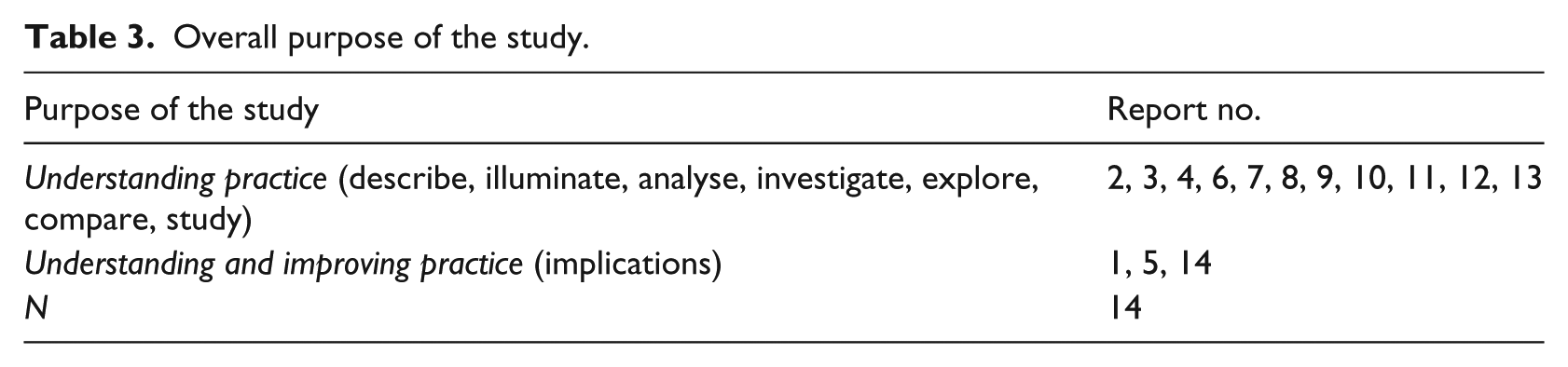
Within the two categories of ‘understanding practice’ and ‘understanding and improving practice’, the teachers used different verbs while formulating their purpose. The 14 reports fall into two groups, including what we have identified and interpreted in our words as: (a) modest verbs, neutral in character; and (b) investigative verbs, involving agency and action (presented in Table 4).
Verbs used while formulating the study.

The teachers used verbs from either one of the types of verbs, modest and investigative, or a combination of the two types. Examples of formulations that used modest verbs were: ‘The study is about’ (Report 6), ‘The aim of this study is to study two different learning situations’ (Report 10) and ‘The aim of this study is to describe and study the use of the scientific approach in preschool teachers’ quality texts’ (Report 4). Other examples of teachers using a combination of modest and investigative verbs were: ‘This study aims at describing and comparing the teaching strategies used by teachers’ (Report 2), and ‘The purpose of this study is to investigate which factors are important for students to overcome strong concerns in the speech situation’ (Report 9).
The use of verbs, we claim, says something about the researching teachers’ ambition with their assignment. Words like ‘analysing’, ‘investigating’ and ‘comparing’ point to an ambition to uncover something that has been hidden, while verbs like ‘describe’ and ‘study’ express greater vagueness and a cautious approach while formulating the research questions.
Moreover, one study could be described as an ‘intervention study’, where the teacher aimed to explore how a model worked in students’ reading processes using pre- and post-tests with the class that participated in the intervention and also a control group. The teacher did not formulate a purpose of the study using certain verbs but instead posed research questions: ‘How much is the reading flow affected after four weeks of reading in pairs according to the “Wendick model”, and how will it work in practice to complete this in a whole class situation?’ (Report 11). The construction of this study indicated teacher agency and action according to the understanding of the teachers’ use of the modest and investigative verbs described above. Teachers’ use of certain verbs indicates that teachers position themselves within different discourses of understanding practice or understanding and improving practice. A discourse can be seen as a context with particular wordings and practices that govern actions (cf. Barton et al., 2000; Burke, 2008; Ivanič, 2004).
Describing the methodology
One part of the report was the method section, in which the author(s) described how the research was carried out and showed the design of the study in terms of the subjects, procedures and methods, as in the following quotation: I have chosen a qualitative method that ranges over the spring term. The study aims to study and analyse some students’ experiences and feelings of staying in the same corridors as secondary students . . . I used the semi-structured interview as an interpersonal situation that Kvale (1997) writes about. (Report 5)
Similarly, the other 13 reports were based on small qualitative methods. Table 5 provides an overview of the methods employed.
Methods and perspectives used in the reports.
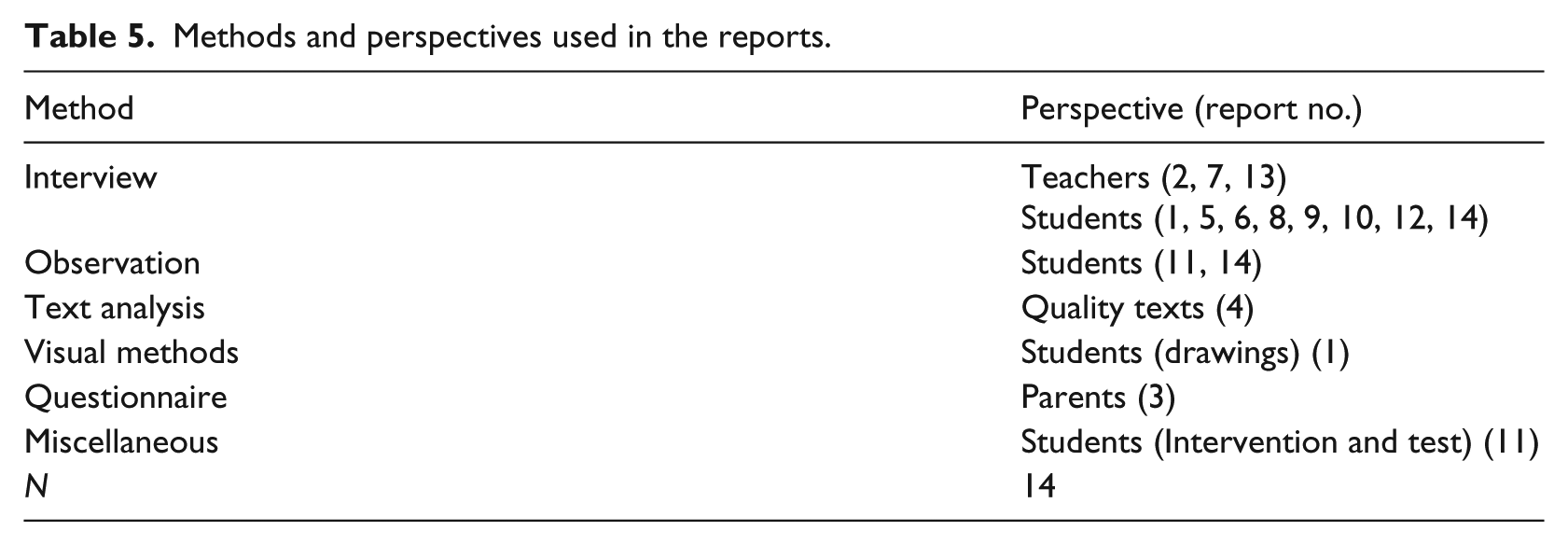
As shown in Table 5, the qualitative interview was the dominant method, used in a total of 11 reports; in one, it was complemented with observations, and in another one with visual methods (drawings). In one report, text analysis was employed, and in another a questionnaire. Furthermore, one report used an intervention with pre- and post-tests. The table also shows that the students’ perspective was the main perspective, adopted in 11 reports. Other perspectives were: teachers (three reports), parents (11 reports) and the school as an institution (one report).
Part of the method section also included methodological considerations. The teachers reflected on their own role as researching teachers through the use of scientific methods that helped them distance themselves from their own teaching practice and take on the role of a researching teacher. The contextual teacher knowledge seemed to be important when doing research: It is also important that I have the knowledge to understand what my colleagues mean, so my knowledge as a maths teacher is important when analysing qualitative data because I am in the same context, facing the same dilemma, experiencing the same problem. (Report 8)
The contextual knowledge, or their preconceptions, could be seen as a benefit for doing justice to the interpretation of the findings. Their academic writing practices are not sealed off from their professional practice (Lillis and Scott, 2007). Even if all teachers regarded the teaching context as important, they chose different ways to do the research, close to their own teaching practice or with a more distanced approach.
I will only include my own students, that is, the class I’m mentoring. The reasons for this are numerous. First, they have had the same type of development dialogues throughout the [grades 7–9] compulsory school period. Second, there is no time to investigate any larger group. Third, I regularly meet these students, and it will, therefore, be easier to conduct the research. (Report 12)
Some teachers chose not to study their immediate practice; for example, one teacher wrote: ‘With the previously described findings/problems as a researching teacher staying as objective as possible, to learn new knowledge while using my own experience as a tool, I chose to refrain from seeking participants in my own school unit’ (Report 13). Accordingly, the teachers referred to different arguments for both conducting the study in close proximity to their teaching practice (pragmatic reasons such as simplicity, time and knowledge about the topic) and the decision to carry out the study beyond the immediate practice, inviting other participants, but still teachers or students, from another class or school. This procedure was chosen to facilitate the process of distancing from the teaching practice.
The teachers were not only problematising whom they had invited into their study, but also how the participants were treated. One teacher described the dilemma of determining how much information to give to the participants beforehand.
An ethical research dilemma I faced was whether I should describe the goal orientation theory and different approaches to learning for the students, and then talk with them about how they had experienced successes and failures. I wanted spontaneous and honest answers in my interview but, if the students knew the meaning of the respective definition, they might not dare to be honest about how they thought in different learning situations. I chose to prioritise the information required in consideration of research effects because I wanted the informants to feel fully involved in the study. (Report 6)
In this case, giving sufficient information to the students was, according to the teacher, more important than the possible negative effects of knowing the theoretical intentions behind the study that might lead to giving the ‘desirable answers’.
Even if the teaching context was evident in the method section, the researching teachers mainly used their academic knowledge in this part of the research process.
Summarising the findings of the reports and discussing the research
In presenting the findings of this part of the study, we put together the two sections summarising the findings and discussing the research present in the reports. All 14 reports contained a section summarising the main findings of the study. Summarising implicitly includes a valuation of the findings. It highlights the authors’ selection and emphasis of certain meanings and is, therefore, not just a neutral presentation of empirical data. In the discussion of the research, the researcher is in a position to advance the study’s significance by making claims relative to the value or implications of the findings and intended to answer the questions, including giving recommendations. This thus represents a further step from an implicit to an explicit interpretation of the findings (Wolcott, 1994).
In our analysis of the reports, we investigated to what extent the teachers problematised their findings relative to teaching practice, policy and research. We found that all reports problematised the findings in relation to their previous teaching experiences and research. In some cases (three reports), the findings were also related to policy (Table 6).
Problematising findings.
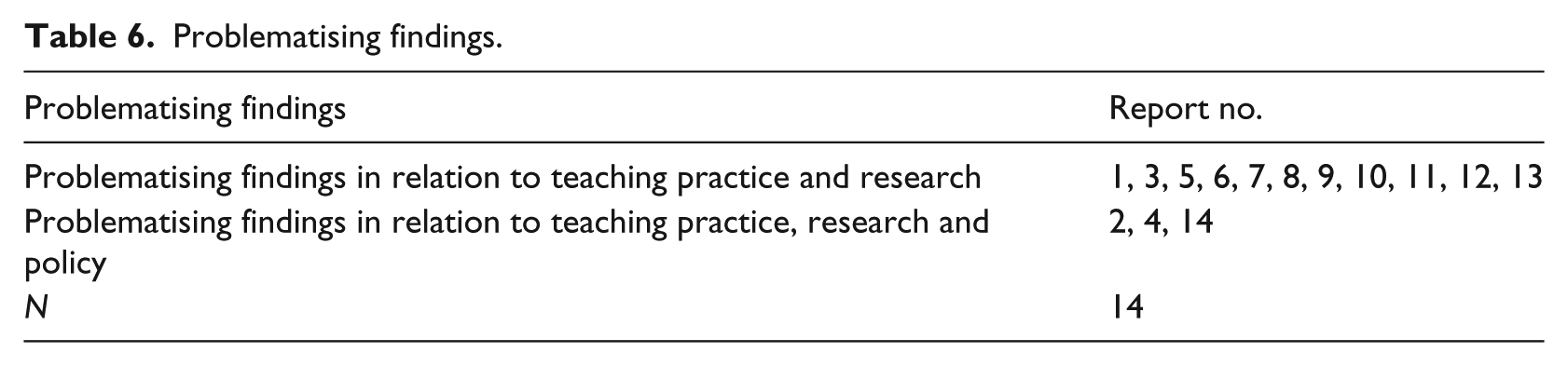
In the discussion section, the teachers also related their findings to previous literature, either as confirmation of the results or by adding a new aspect to existing research (Table 7).
Confirming results or adding new dimensions.
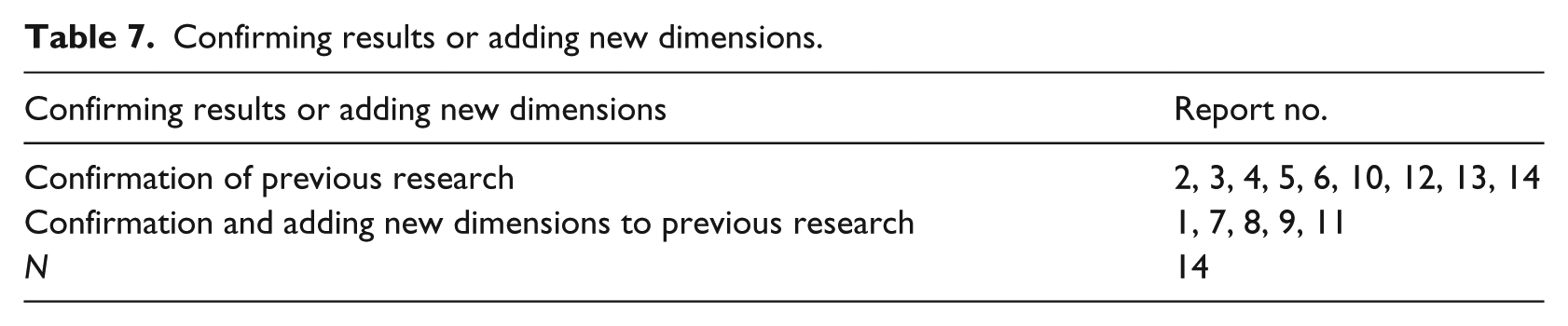
One example of the confirmation of previous research was: ‘My study shows that, like many other studies (Axelsson 2013, Nilsson and Axelsson 2013, Bunar 2015; Nilsson Folke 2015; Nilsson Folke 2017), the transition between preparation class and regular class is problematic for newly arrived students’ (Report 14). In another example, a teacher found differences compared to previous research, which could be seen as a way of adding new dimensions to the literature in a specific area. Highlighting differences concerning existing literature could also relate to elucidating a group’s perspective that was understood as being under-researched.
Problematising their findings could also relate to a comparison to previous teacher knowledge and expertise (proven experience), thereby valuing the contextual knowledge in educational research. In their own studies, the teachers could confirm previous research, but the research in itself led to ‘aha-moments’ and surprises based on their own teaching experience, which resulted in a moment of learning for the researching teacher.
Some things surprised me. As a teacher, I know how much time and energy is spent on giving students feedback and development advice. . .[but] the students did not bring up the feedback and advice for development given by the teachers [as something important]. (Report 9)
Based on the previous extensive experience, the teachers implicitly hypothesised how feedback works. But when scrutinising their own practice through research, the understanding was deepened. By using their teacher knowledge as well as their academic knowledge, they created new understandings.
It is not only the teachers who can learn from these research studies, but the students also learn from participating in their teachers’ research. One student said in an interview: Actually, you should talk a lot about this already from the first day – successes and failures. So, bring up these questions you have asked now. Kind of, almost the first then, you know when you get to know each other . . . because these are great, great, really important questions. And this gives you a lot of thoughts . . . If I had got this in the first year of upper secondary school, I only had . . . wow. (Report 6)
In the conclusions, the reports presented understandings of the researched phenomena and in some cases also suggestions for improvement (corresponding to the purpose of the report, as described above). The suggestions could be formulated as questions for readers to consider or as advice directed to teaching practice: ‘How is the result of this study useful for those teachers working with worrying students?’ (Report 9); ‘I hope that we in preschool, through the conversations with the parents, emphasise the importance of the national curriculum’ (Report 3); and ‘In order to bridge the gap between the preparation class and regular class, I believe that we, in schools, must be better at taking advantage of the students’ previous knowledge’ (Report 14).
Accordingly, the teacher’s voice was present when the researching teacher included her/himself in the conclusion of the study – belonging to the ‘teacher-we’ – stepping away from the researcher role. However, it is interesting to note that suggestions for improvement were given in 12 reports, yet based on the purpose of the report only three reports aimed at understanding and improving practice. Overall, the improvement aspect was, therefore, strong in the teachers’ research. The starting point for the teachers’ research was questions of importance in their teaching practice, and the research also ended in their teaching practice when reflecting on implications and showed the will to contribute to an improvement of teaching by using their academic knowledge, which entails knowledge construction (Lillis and Scott, 2007).
The teachers’ response to our findings
In Phase II of the data analysis, the participating teachers were given the opportunity to respond to our tentative analysis. On a general level, the teachers confirmed our analysis: ‘We recognise ourselves’ (written teacher notes). However, they problematised methodological questions in the study, and raised and directed to us researchers the question of what they named ‘bias’: ‘Are you not questioned as biased when being researchers in this kind of research [practice-based]? It is rewarding for you as researchers if this [the municipal strategy to support teacher research] gives results’ (written teacher notes).
Furthermore, the teachers deepened our tentative analysis in different areas – for example, concerning the importance of the academic context of the master’s programme and the focus on school improvement in their research. Regarding the academic context, the teachers reflected on factors shaping their studies and reports: ‘The report we have written is a result of the education so far. We can only think based on the tools we have been given’ (written teacher notes). The supervisors ‘affect the choice of method and focus’ and ‘how the aim was formulated, mine or the supervisor’s words, which verbs we used’ (notes from the oral presentation). Therefore, the role of the supervisors cannot be underestimated when teachers, at the start of their academic career, formulate and carry out their research projects. The teachers trusted their supervisors and the reports were influenced by their knowledge and view. The teachers are building up their interdependence and academic knowledge throughout the master’s programme. In doing so, they also positioned themselves in relation to idealised notions of successful academic writing (Anderson, 2017). ‘We can see a development from the teacher to the researcher’ (written teacher notes) and ‘much has happened in 1 year’ (notes from the oral presentation). Their reflections also highlighted one problem that could appear: ‘It will be exciting if this perspective will change over time. Will we maintain the teacher’s perspective, or will it change?’ (written teacher notes).
The teachers emphasised that their studies were based on their teaching practice and with a focus on school improvement. Their research aimed for understanding and improving practice. ‘There is an interest in all reports to improve practice, even if it is not formulated in that way’ (notes from the oral presentation). The teachers wanted to study aspects that would be useful for their own teaching. Organisational issues were less frequent, compared to the other two kinds areas of research, because such issues can be difficult to handle and it takes a long time to change an entire organisation. This is in line with Shulman (1987), who argues that pedagogical content knowledge is of certain importance as it lies at the heart of teaching, entailing interconnected processes between a content and a pedagogy, which forms the basis for understanding how teaching and learning work in specific contexts.
Discussion
In this study, we analysed 14 reports written by researching teachers enrolled in a master’s programme. We aimed to investigate how they perceive, interpret and value teacher knowledge and academic knowledge in their own research by analysing the academic writing in their reports.
Our analysis showed that the researching teachers, in contrast to the preschool students in Karlsson Lohmander (2015), were seemingly not worried about applying or translating the theoretical subject-based knowledge acquired during their university-based studies to their school settings. No conflicts could be identified between a practice-oriented account on the one hand and a disciplinary account on the other (Baynham, 2000), or a ‘clash’ between a professional culture of school teaching and a (higher status) professional culture of the academy (Stierer, 2000a, 2000b). The researching teachers seemed like social work students in further education (Rai and Lillis, 2013), able to manage and mix both abstract and distanced theory (i.e. academic knowledge), and concrete and real workplace-based knowledge (i.e. teacher knowledge).
Concerning the first research question, (a) How do the researching teachers relate to policy, previous research and the teaching context in their research?, we found that the identified issues emerged from the teachers’ knowledge base as acquired from both experience in practice and theoretical courses. The aim and the research questions were clearly situated in the context of school and could relate to pedagogical content knowledge, pedagogical knowledge and organisational knowledge. In Phase II, the teachers stressed that organisational issues were difficult and took a long time to change. All teachers related to previous research and the teaching context in all stages of the research process. Only a few referred to educational policy during their research. Accordingly, the level of abstraction was mainly enhanced by using one source beyond the teaching context, namely previous research. Thus, the profession, and not a specific academic discipline, was the core around which multiple academic perspectives were situated. We conclude that the meaning was closely related to the acquisition and use in the professional context, but also that the aim was to extend the academic knowledge. In line with Rai and Lillis (2013), we determined how the researching teachers positioned themselves in the text and used evidence to build an argument that was relevant and valuable to their professional writing. Critical thinking and reflective practice seemed to be highly useful and relevant to their future career (cf. Hughes et al., 2011).
Concerning the second research question, (b) How do the researching teachers handle the relationship between normativity in a professional discourse and a critical academic approach in their research?, we found that the teachers embraced both normativity and a critical approach in their research. The overall purpose of their studies involved understanding practice and, in some cases, also improving practice. However, in Phase II, all teachers stressed that they aimed to improve practice, even if this was not explicitly stated in their report. The contextual knowledge could be seen as a benefit for supporting a proper interpretation of the findings. Even if all teachers regarded the teaching context as important, they chose different ways for doing the research, close to their own teaching practice or with a more distanced approach. Moreover, the teachers problematised their findings in relation to teaching practice and research, and, in some cases, policy. They compared their findings to previous research and highlighted differences with regard to existing literature. Problematising their findings could also entail a comparison with previous teacher knowledge and expertise (proven experience). The purpose and problematisation show normative and critical aspects. When formulating implications, the normative perspective was more evident, resulting in practice-based interpretations of the findings. Thus, we see the researching teachers as having a critical perspective on their own practice, and they were able to separate their arguments from their teacher position, and judge ideas and results also in an academic discourse.
We interpret the overall alignment of the reports with a professional perspective. It is thereby assumed that teachers possess knowledge based on proven experience that should be recognised and added to the knowledge base of the field. Moreover, there is the recognition that academic writing practices do not occur isolated from professional practices and TE programmes (Lillis and Scott, 2007).
Concerning the third research question, c) How do the researching teachers use teacher knowledge and academic knowledge in their research?, we found that the reports had different starting points (voice) and the authors showed variations in how much they focused on teacher experiences, educational policy and research while situating the research. In doing so, we found that they oscillated between using teacher knowledge and academic knowledge in different parts of the process. Both forms of knowledge were constantly present, but one of them was more evident in different stages of the process. Frequently, they began in practice, where contextual knowledge was central (teacher knowledge). Then they used their academic knowledge by using different research tools to describe, understand and analyse the practice. The results were then returned to teaching practice where they could contribute to further development. But the use of academic knowledge could also appear in the middle of the academic reporting of results. A researching approach can both deepen the understanding of practice but also challenge and critically evaluate taken-for-granted truths. Thus, we found that the teachers were moving back and forth on a continuum of the teacher–researcher voice when using their teacher knowledge and academic knowledge. The teachers became involved in the issue of how to translate theoretical subject-based knowledge of the university-based studies into teaching practice, parallel to the development of abstract and academic knowledge, including writing skills (cf. Rai and Lillis, 2013; Stierer, 2000a, 2000b). To a certain extent, and in different parts of the research process, the teachers identified themselves as potential members of a vocation, including particular wordings, practices, values and beliefs (Barton and Hamilton, 2005; Burke, 2008; French, 2013; Ivanič, 2004), but also, to some extent, they identified themselves with academic discourse conventions by, for example, in the response seminar, problematising the relationship between research and bias while researching their own practice.
As previously mentioned, the researching teachers’ suggestions for improvement were given in 12 reports, yet, based on the purpose of the report, only three reports aimed at understanding and improving practice. This might indicate that the teachers let their professional perspective break through even if their academic supervisors’ demands for a more neutral academic approach were strong.
An empowering oscillation between teacher knowledge and academic knowledge
The researching teachers’ research, materialised in the academic writing in their reports, represents an empowering oscillation between using teacher knowledge and academic knowledge, thereby reducing the gap between practice and theory. This is in line with Hamza et al. (2018), who emphasise that this gap can be reduced when the teacher knowledge and the academic knowledge are seen as equal practices enriching each other. In that regard, we claim that the researching teachers have taken a step to reduce an existing gap between theory and practice. The process of the teachers’ research is illustrated in Figure 2. The teacher’s voice was particularly present while situating the research, as the topic of the study emanated from practice and aimed to create a deeper understanding of practice and, in some cases, to improve practice. When the research process moved on, the researcher’s voice became more present, using academic knowledge when performing the empirical investigation. Here, the researching teachers assumed a more distanced role from their school practice while questioning the contextual knowledge. At the end of the research process, the teacher’s voice was again more visible when presenting the findings and relating them to previous research and assessing them against teacher experience. Moreover, they presented implications for practice for both teachers and students based on their professional but also academic knowledge of the topic at hand. The implications can be viewed as results of the oscillation between teacher knowledge and academic knowledge, and can be compared to a process that Bernstein (2000) terms as ‘generating formal modelling of empirical relations’ (p. 164), which is significant for horizontal knowledge structures with weak grammar. This is in opposition with a strong grammar, where it is expected that the research will be able to describe the empirical reality using fairly precise descriptions.
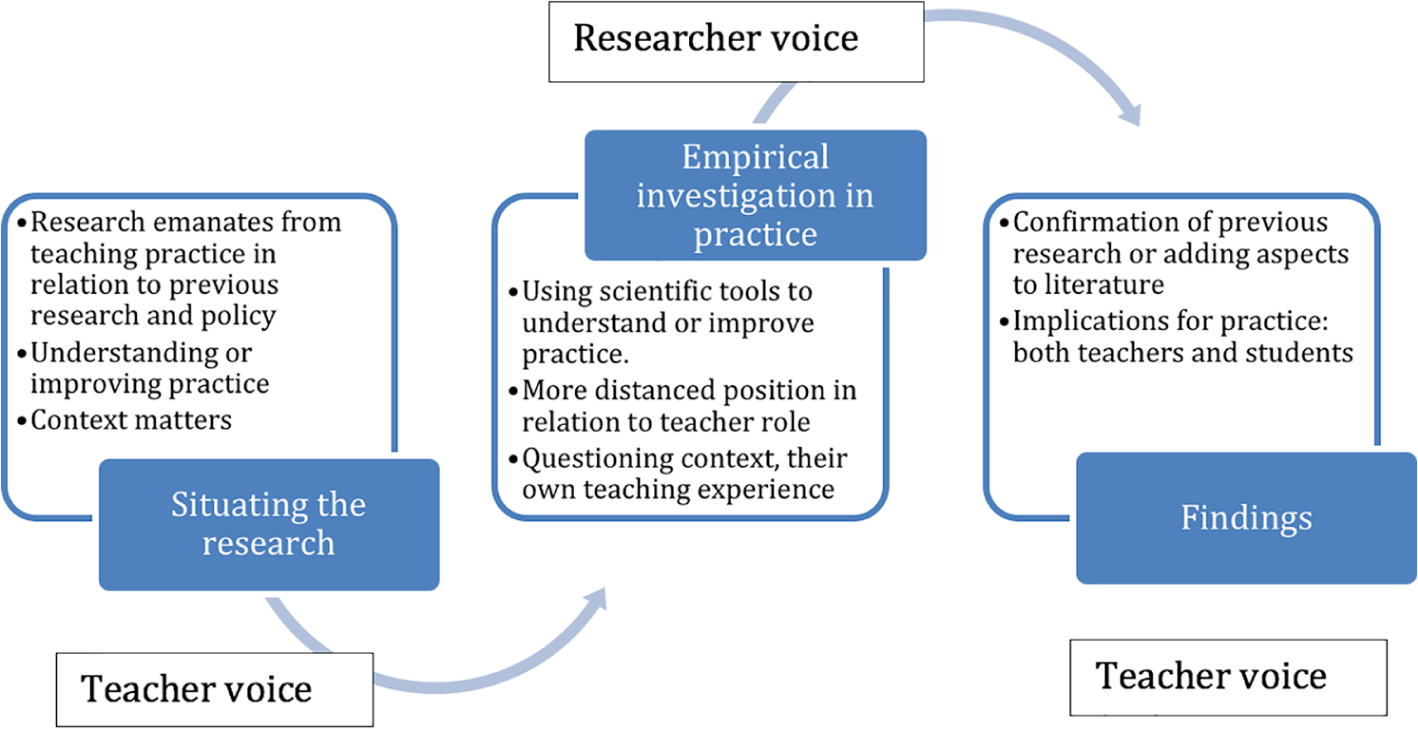
An empowering oscillation between using teacher knowledge and academic knowledge in the teachers’ research.
Conclusion
We conclude that the researching teachers’ contextual knowledge both benefitted and challenged academic knowledge, and vice versa. The teacher knowledge enriched the understanding of practice, but it could also be difficult for teachers to step out of the teaching experience and critically consider their own practice. Through research (both theory and method), they understand teaching practice with the ambition to improve practice. Accordingly, the contextual knowledge of the teachers’ research cannot be underestimated since it deepens the understanding of a research phenomenon. The study underlines Bernstein’s (2000) claim that horizontal knowledge structures with weak grammar are volatile in nature, as it is found that teachers’ research impacted on and contributed to change in teaching practice, through its negotiation of the understandings of knowledge, expressed through writing. Based on the results of this study, we concur with Hamza et al. (2018), who stressed that educational research could learn from teaching practice, which might sometimes entail a change in different stages of an educational research process. It is important that reciprocity exists between academic and teacher knowledge, and that there is an openness to learn from both knowledge domains, which is especially vital in teachers’ research into their own practice, potentially reducing the gap between these two practices. We believe that the municipality in this study, by establishing a scientific leader position, founding a scientific board and employing an in-house researcher, has taken steps to help close the gap between research and teaching and brought the two practices closer to each other (Hamza et al., 2018).
By building an education based on scientific grounds and proven experience, schools of today and tomorrow will arguably be involved in both teaching and research. Therefore, it is necessary for municipalities to build structures that create opportunities for teachers to research their own practice, thereby facilitating an empowering oscillation of both teacher knowledge and academic knowledge.
Footnotes
Declaration of conflicting interests
The author(s) declared no potential conflicts of interest with respect to the research, authorship, and/or publication of this article.
Funding
The author(s) disclosed receipt of the following financial support for the research, authorship, and/or publication of this article: This work was supported by The Swedish Foundation for Humanities and Social Science [RMP17-0054:1,RMP17-0054:2].
